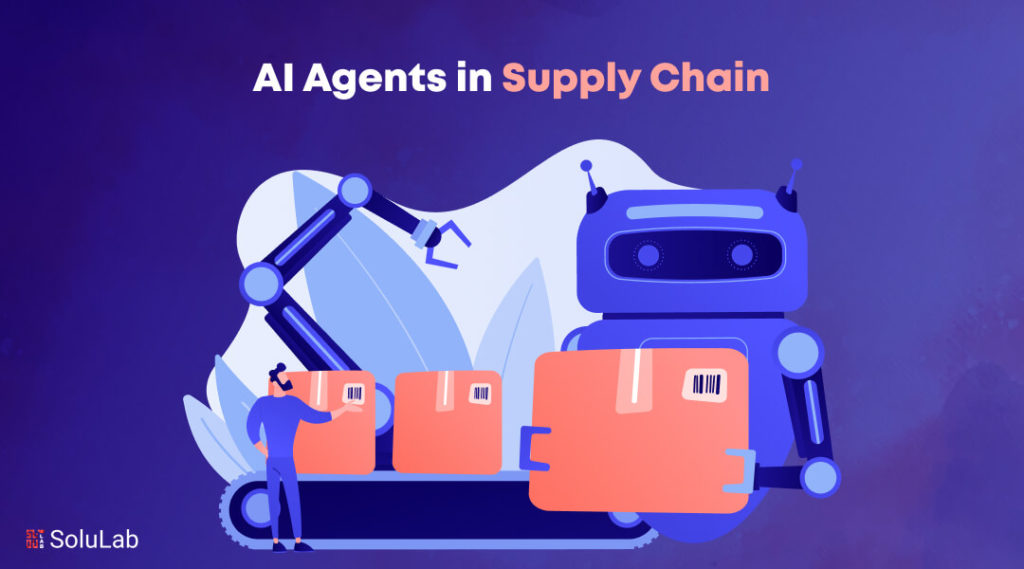
By 2030, AI in the supply chain is projected to be a $41.23 billion market, growing at a CAGR of 38.8% from 2023 to 2030. Run an online retail business and you already know why. You need to see where a box is at any moment, from the pallet rack to somebody’s porch, and that means keeping suppliers, warehouses, and carriers all talking to each other. Do that by hand and things go dark fast. Disruptions pile up, the data you have is thin, and operations start to buckle. It is not a rare failure either: as many as 60% of organizations lose real revenue to exactly this kind of mess.
AI agents are what changed the picture. These systems give you a long list of levers to pull on more or less every stage of your chain. Automating warehouse work, predicting demand, watching inventory, picking routes: across all of it, AI agents cut mistakes, shorten reaction times, and make the whole operation run tighter.
This blog walks through the role of AI agents in supply chainand logistics, the various types of agents in AI, and the pieces that make these systems tick. We will cover where they get used and what companies actually get out of them. Then we get practical: recommended practices, plus what building an AI agent for logistics involves. And to round out the picture of how artificial intelligence is reshaping supply chain management and logistics, we close on the trends pointing at where this sector goes next.
What are AI Agents?
An AI agent is autonomous software that senses what is happening around it, decides on a response, and then acts to hit a goal you set. That combination, machine capability plus something close to human judgment and interaction, is the real breakthrough. The category is wide. A simple rule-based system counts. So does a sophisticated machine learning model. What they share is independence: they run without somebody standing over them issuing instructions.
The job list is long. Creative work, process optimization, customer service, strategic calls. By taking the repetitive work off people’s plates and turning data into something you can act on, AI agents lift productivity, make the customer experience better, and give a business room to grow and compete.
Functions of an AI Agent
The numbers are worth pausing on. According to the recent studies, AI-enabled supply chain management can pull logistics costs down 15%, inventory levels down 20%, and push service levels up 40%. That shift comes from how these agents engage with both digital systems and the physical world. Five functions do most of the work:
- Perception: The agent notices what changed. Inventory swings, a truck running late, demand spiking in one region and going flat in another.
- Responsive Actions: Having seen something, the agent does something. It replans delivery routes when traffic updates come in, or moves inventory levels around as real-time demand signals arrive.
- Reasoning and Interpretation: Messy information goes in, usable supply chain insight comes out. Feed an agent past sales data plus market trends and it will give you a solid demand estimate.
- Problem-Solving: This is where agents shine in a logistics setting. They flag equipment about to fail so you avoid the downtime, redesign a warehouse layout for better throughput, or work out the cheapest shipping route available.
- Inference and Learning: Past data and present data together become a forecast. Every encounter teaches the agent something it keeps. That is what makes it good at predicting inventory requirements, catching seasonal demand swings, and sharpening procurement tactics.
Read Also: AI Agents for Procurement
- Action and Result Analysis: Agents line up possible situations, weigh the consequences, and hand you something to plan against. Model three distribution approaches and see which one keeps costs down without stretching delivery times.

Types of AI Agents
Not all agents are built the same way, and the differences matter when you pick one. Here are the main types of agent in AI:
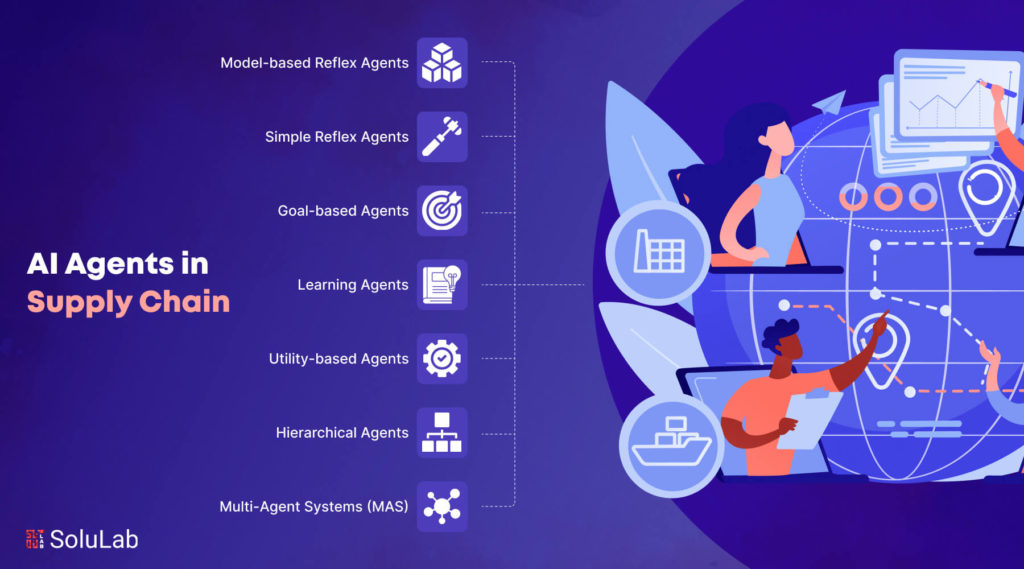
1. Simple Reflex Agents: They react to whatever their sensors report right now. No internal picture of the world, just condition-action rules. That is fine when the present moment tells you everything you need. Put one somewhere complicated or unstructured and it falls apart, because it cannot anticipate an outcome or draw on what happened last time.
2. Model-based Reflex Agents: These carry a mental image of their surroundings. That internal model is what lets them cope when the view is partial: they fill the gaps by combining what they already know with what they can currently see. Decisions draw on both. The result is an agent that holds up better when conditions shift or turn unpredictable.
3. Goal-based Agents: Here the question is always the same: which choice gets me closer to the goal? The agent weighs likely outcomes and picks accordingly. That planning ability is why these suit hard decision-making work.
4. Utility-based Agents: A step up in nuance. A utility function scores each possible outcome, assigning numerical values that capture how desirable one state is against another. The agent then chases the highest score it can reach. When several courses of action are all defensible, and several results all look plausible, having a defined value to optimize is what breaks the tie.
5. Learning Agents: They get better as they go. In a setting that keeps changing, that matters more than raw starting accuracy, because the agent keeps revising its tactics and sharpening its read on the situation to squeeze out better results.
6. Multi-Agent Systems (MAS): Several agents working together, sometimes toward one shared objective, sometimes toward separate ones. MAS fits operations that need real coordination. Supply chain management is the obvious case, with a different agent standing in for each part of the chain.
7. Hierarchical Agents: Think of a chain of command. Higher-level agents oversee and direct the ones below them, and each tier has its own functions and duties. Large systems need this, because actions have to be managed at several levels at once while still pointing at the same final objective.
Read More: AI in Fuel and LPG Crisis Management
What are AI Agents in Supply Chain and Logistics?
Drop the same idea into logistics and you get advanced software built to tighten up the processes these businesses already run. The agents lean on machine learning, data analytics, and natural language processing to handle work that used to need a person. Give them enough data and they will estimate demand, keep inventory in line, pick better delivery routes, and sharpen the decisions around all of it. Productivity climbs, costs come down, accuracy improves, and a firm can turn on a dime when the market or a client moves.
These are the capabilities that carry the weight.
- Demand Forecasting: Past data plus strong algorithms equals a read on what sells next. You plan inventory against that number, so stockouts stop happening and you are not sitting on overstock either. Get the forecast right and the rest of the operation follows, including getting orders to customers on time.
- Inventory Management: Agents read live data to watch stock levels, follow product movement, and call replenishment before you need it. Artificial intelligence in logistics holds stock at the right level, trims carrying costs, and makes both stockouts and surplus less likely. Warehouse space and staff get used better as a side effect.
- Route Optimization: Traffic patterns, weather, delivery windows: the agent weighs all of it to find the route that actually works. Less fuel burned, lower transport spend, deliveries that land when promised. There is a climate angle too, since tighter planning shrinks the carbon footprint of the whole operation.
- Supply Chain Visibility: Wire an agent into the supply chain management systems you already run and visibility improves in real time. It reads the data, spots the abnormalities, and suggests moves to cut risk before it bites. You get to fix problems early rather than explain them later.
- Predictive Maintenance: Sensor feeds and monitoring devices tell the agent when a machine is heading for failure. You repair it on your schedule instead of theirs. Downtime shrinks, machines and vehicles last longer, and logistics operations stay consistent.
- Customer Service Automation: Order tracking, routine questions, returns. All of it can run without a person in the loop. Agents AI answers quickly and gets it right, which keeps customers happy and frees your human operators for the tangled cases that genuinely need them. Better service, more loyalty, less churn.
Applications of AI Agents in Logistics and Supply Chain Management
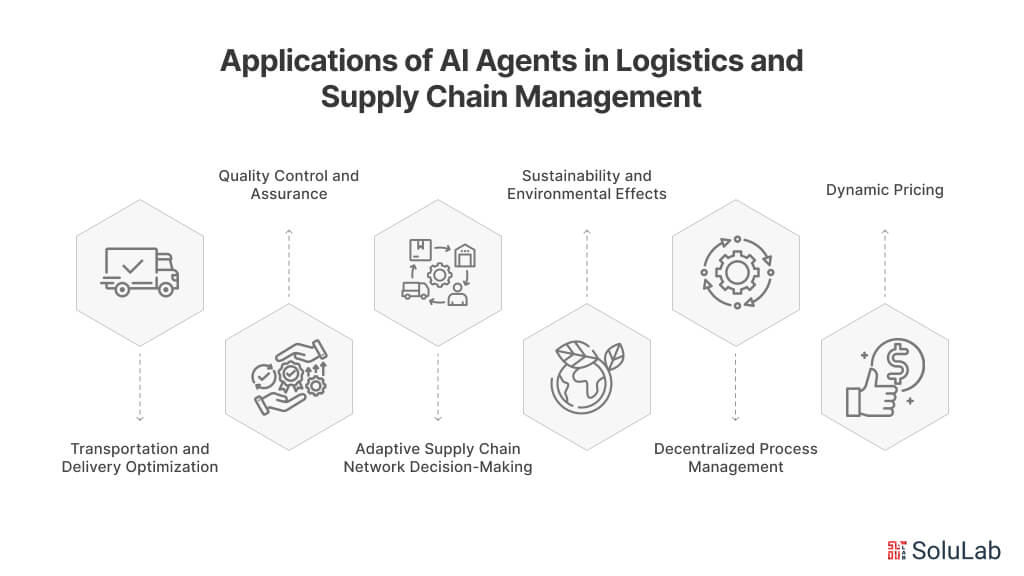
So where does supply chain AI actually show up on the ground? These are the areas where it has made the biggest dent:
1. Transportation and Delivery Optimization
Large Language Model (LLM) agents read live traffic, weather, and delivery schedules, then recommend the route that holds up. Fleet management gets the same treatment: the agent studies vehicle performance data, calls maintenance before something breaks, and models what happens when self-driving trucks join the delivery operation you already run. LLM agents put those skills toward less downtime, lower labor cost, and transportation that simply works better end to end. Plenty of businesses go a step further and bring in a fleet management software development company to build something tailored, wiring AI into the vehicle tracking and dispatch workflows already in place.
2. Quality Control and Assurance
A defect shows up. Why? AI agents trace the likely root cause, read the pattern across defects, and tell you what to change upstream so it stops recurring. They learn from automated inspections run on computer vision. They will also write the report: what the inspection found, what to fix, how to adjust manufacturing. Pull in real-time data from several stages of the chain and the analysis surfaces trends and anomalies pointing at production, shipping, or warehousing quality problems you had not connected. Process improvement stops being an annual exercise and becomes continuous, which is how quality standards hold across the whole chain.
3. Sustainability and Environmental Effects
Pull apart the data from logistics operations and AI agents can show you where resources are being wasted and where energy is going. They will track the carbon impact of your supply chain activity and point at the spots worth working on. Sourcing benefits too: feed an LLM data on supplier practices and it can identify ethical and sustainable material suppliers, then propose substitutes where the current one does not measure up.
4. Adaptive Supply Chain Network Decision-Making
Conditions change. That is the whole job. Autonomous AI agents adapt the chain on the fly, finding new suppliers, proposing alternate routes, or reallocating inventory when a supplier goes down or a shipment stalls in transit. Agility of that kind is what makes a network less fragile when something breaks. The agent is watching consignments, stock levels, and outside variables constantly, so the adjustment happens before the disruption reaches you.
5. Decentralized Process Management
Supply chains are not run from one desk, and AI agents suit that reality. They collect and analyze data, push real-time alerts when something happens, and give suppliers, manufacturers, distributors, and retailers a shared basis for deciding together. By passing live numbers back and forth on stock, demand trends, production capacity, and transport schedules, AI agents for supply chain make the teamwork real rather than nominal. Decisions get better, information moves faster, and resources land where they are needed.
6. Dynamic Pricing
Pricing is where agents earn their keep fastest. They watch stock levels, competitor prices, and market demand continuously, chewing through volumes of data no pricing team could read, and pulling out the patterns that tell you what a thing should cost right now. The market moves, your price moves with it. Demand spikes and the agent raises the number, because buyers in that moment will pay it. Demand sags and it cuts the number to move units before they turn into surplus. Margin improves, obviously. The quieter benefit is that supply and demand stay closer to balance, which makes the market itself work better.
Read Our Blog Post: Build AI Agents For Logistics
Benefits of AI Agents in Supply Chain and Logistics
Reading data, tuning processes, making smart calls: those three abilities pay off in a lot of directions at once. Here is where the benefits of agents in AI land in day-to-day logistics and supply chain work:
Improved Route Planning and Optimization
Live traffic, weather, delivery schedules. AI agents in logistics weigh all three and settle on the most efficient route available. Fuel bills drop, deliveries land sooner, operating costs fall, and customers notice.
Automated Warehouse Operations
Picking, packing, sorting: AI-driven robots and agents take it on. Throughput goes up, errors go down, labor costs fall, and the floor runs tighter than it did.
Enhanced Supplier Relationship Management
Which suppliers actually deliver on time, at the quality promised, for the price agreed? AI agents score that. You pick better, you negotiate from a stronger position, and the relationships that survive are the ones worth keeping.
Risk Management and Mitigation
Geopolitical events, natural disasters, a supplier going under. AI agents read the risk factors and flag the disruption while you still have options. Contingency plans written in advance beat scrambling after the fact, every time.
Fraud Detection and Security
Agents watch transactions and chain activity for patterns that look wrong. Anomalies get caught and flagged fast, which keeps fraud from taking root and keeps your operations honest.
Enhanced Collaboration and Communication
Data sitting in six systems helps nobody. AI agents pull it together into one view, so partners and stakeholders are working off the same picture and activities line up instead of colliding.
Scalability
AI solutions grow with you. Expand the operation and the agents absorb the bigger data volumes and the added complexity without performance falling off.
Labor Efficiency and Workforce Management
Demand forecasts and operational requirements tell you how many people you need and where. AI agents turn that into a staffing plan, so labor sits where the work is and productivity rises.
Market Expansion and Penetration
AI-driven insight points at openings you would otherwise miss. Regional demand, how consumers behave there, who else is already selling: that is the groundwork for deciding whether a new market is worth entering.
Humanitarian and Disaster Relief Logistics
Aid delivery is logistics under the worst possible conditions, and speed is the whole game. AI agents optimize the routing and predict what will be needed based on how disasters have unfolded before, so the response arrives while it still counts.
Use Cases of AI Agents in Supply Chain and Logistics
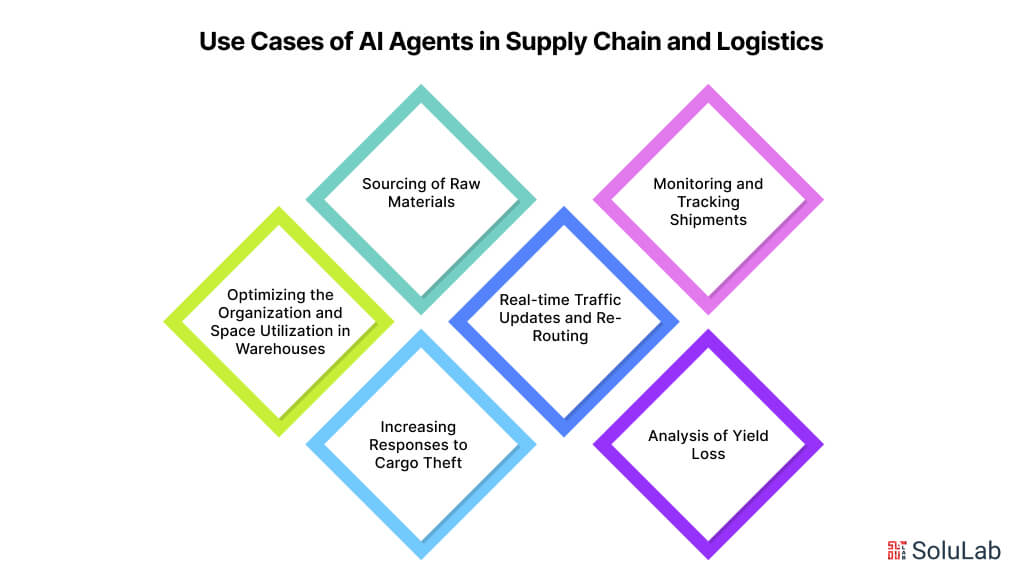
1. Sourcing of Raw Materials
Picking a raw material supplier means weighing dependability against price swings, quality requirements, and how far away they sit. Algorithms do that weighing well. Artificial Intelligence in the supply chain keeps watching market conditions and supplier performance without a break, so producers catch interruptions early, walk into price negotiations with evidence, and keep materials flowing steadily without overpaying. Less waste, less production downtime, and a sourcing process that stops being guesswork.
2. Increasing Responses to Cargo Theft
Cargo theft is a security problem and a response time problem, and artificial intelligence helps with both. Shippers get to manage the risk before it materializes, and when a theft is suspected, they can move immediately instead of filing a report days later. Overhaul’s RiskGPT is the example worth knowing. Tools like it keep learning from fresh data, so they get steadily better at spotting an attempt in progress. When a threat surfaces, RiskGPT can pull together past theft trends, current location data, and live feeds from GPS trackers and similar devices, read all of it at once, and tell the shipper what to do about this particular incident, right now.
3. Real-time Traffic Updates and Re-Routing
Ask any logistics operator what hurts most and traffic congestion comes up fast. AI lets you watch conditions as they are, not as they were an hour ago. Artificial intelligence systems step in when a delay appears and reroute the delivery so it still arrives on time. What makes this genuinely useful is the breadth: weather, accidents, road closures all feed in. With those dynamic elements accounted for, logistics companies get accurate and current information, which means faster calls, better routes, fewer delays.
4. Optimizing the Organization and Space Utilization in Warehouses
Layout is destiny in a warehouse. AI-driven optimization looks at product demand, inventory levels, and whatever else is relevant, then tells logistics firms how to rearrange the floor to get more out of the square footage they have. Often that means moving shelves, racks, or bins around to accommodate items of awkward sizes or particular storage needs. Plan it carefully and picking and packing get faster, usable storage grows, and the whole operation runs leaner.
5. Monitoring and Tracking Shipments
A shipment that arrives late or damaged costs you twice. AI in logistics and supply chain gives businesses live tracking plus fast warnings the moment a delay or problem shows up. It goes further than alerting, though. The system reads shipping data, travel durations and the variables around them, spots trouble forming, and acts before it lands. Feed it delivery locations, traffic patterns, and the rest, and it tunes routes and schedules so delivery times shrink and efficiency climbs. This logistic agent approach is how you get shipments arriving on time and in good shape, which is ultimately what your customers are judging you on.
6. Analysis of Yield Loss
AI and logistics is not only about making good processes better. The more interesting work is in the operations that underperform, because that is where the insight hides. Analyze production data, isolate the variables dragging on yield rates and product quality, and AI-driven tools will show a business where its output is leaking away. Sometimes the problem is how a product is made. Sometimes it is how the operation is run. Either way you now know, and both the process and the cost line improve.
Future of AI in Supply Chain and Logistics
Where does this go? Industry expectations point at substantial change, and a few developments come up again and again:
- Increased Acceptance: Adoption should climb sharply over the next few years, simply because more businesses are seeing what AI does for customer satisfaction, cost, and efficiency.
- Autonomous Vehicles: More of them, moving more goods, more safely. Drones and self-driving trucks cut the need for human drivers while making deliveries faster and more precise.
- Smooth Integration: Plugging AI into systems a company already runs keeps getting easier, which lowers the bar for adopting it and shortens the wait before the benefits show up.
- Improved Safety and Security: Face recognition, biometric identification, and machine learning algorithms will tighten the safety and security protocols running across supply chains and logistics. Theft, fraud, and terrorism all get harder to pull off.
- Sustainability: AI pushes the sector greener. Better energy use, fewer emissions, tighter routes: together those shrink the environmental cost of moving things around.
Final Words
Efficiency, accuracy, scale. Those are the three things AI agents change about supply chain and logistics work, and the change is not subtle. Supply chain AI has rewritten how traditional processes run, letting businesses forecast demand, pick routes, and manage inventory at a precision level that was not available before. Artificial intelligence in logistics is why data-driven decisions now translate into real cost savings and customers who stay. More companies adopt it every quarter, and the direction of travel is clear.
None of which makes the rollout easy. Data quality bites first. Then integration with the systems you already depend on. Then finding people who know how to run any of it. In practice, this is where most projects stall. That is the gap SoluLab, as a leading AI agent development company, exists to close. We build AI solutions around the operation you actually have, so those obstacles get handled rather than worked around, and you get the full value of supply chain AI. Cleaning up data accuracy, connecting systems that were never meant to talk: SoluLab supports the whole path from start to finish. Want your supply chain running on artificial intelligence? Contact us today and let us talk through what that would look like for you.
FAQs
Shipra Garg is a tech-focused content strategist and copywriter specializing in Web3, blockchain, and artificial intelligence. She has worked with startups and enterprise teams to craft high-conversion content that bridges deep tech with business impact. Her work translates complex innovations into clear, credible, and engaging narratives that drive growth and build trust in emerging tech markets.