Want to stay competitive? Look at how you talk to customers. Nearly every successful business gets customer engagement right, and attention is hard to win and harder to keep. That’s where AI chatbots for customer engagement come in. They give you a lot of practical ways to grab that attention and hold onto it.
Gartner expects AI chatbots to become the main customer engagement channel for most businesses. One forecast puts revenue from AI chatbots in global business at up to $454.8 million by 2027.
These conversational agents do three jobs at once. They lift engagement, take friction out of operations, and change what a customer conversation looks like. They’re also turning into the next generation of virtual assistants, and client relationships are shifting because of it. This guide walks through how AI chatbot customer service is changing the way companies do business.
Understanding AI Chatbots
An AI chatbot is a computer program built to copy the way people talk, so using it feels like a conversation instead of a form. It’s on 24/7. It answers questions, suggests fixes, and hands over whatever information the customer needs. Under the hood, artificial intelligence algorithms read what the user typed or said, work out what they mean, and reply in natural language. Text or voice, the goal doesn’t change: give people a smooth, human-feeling way to talk to a machine, whatever they need it for.
Here are 10 common chatbot applications and examples showing their capabilities:
- Automated Response Bots: Answer the questions customers ask over and over, about orders, shipping, accounts, and so on, right away. Your human agents stop spending their day on the basics.
- AI-Powered Virtual Assistants: Use advanced NLP so the conversation flows naturally. They pick up on context and suggest things based on what each user likes and has done before.
- Escalation Chatbots: Spot the moment a problem is too tangled for automation and pass the customer to a live agent without a clumsy handoff, so a person can sort it out quickly.
- Lead Generation Chatbots: Qualify prospects and gather their details through tailored questions, walking them step by step down the sales funnel.
- Interactive Product Guides: Act like a shop assistant on your site. They help customers move through the catalog, compare options, and buy with confidence.
- Feedback and Survey Chatbots: Run surveys, collect opinions, and make sense of the answers so you know what to fix and customers end up happier.
- Multilingual Support Chatbots: Talk to a global audience in several languages. Language stops being a barrier, and satisfaction goes up.
- Social Media Chatbots: Meet customers on social channels, answer questions, deal with complaints, and support them in real time.
- Appointment Scheduling Chatbots: Replace manual booking. Customers pick a slot and they’re done.
- E-Commerce Recommendation Chatbots: Study how people buy and suggest products that fit, which drives upsells and cross-sells and makes shopping feel more personal.
Read Also: How to Build a Multilingual Chatbot in 2025?
How AI Chatbots Helps Businesses ?
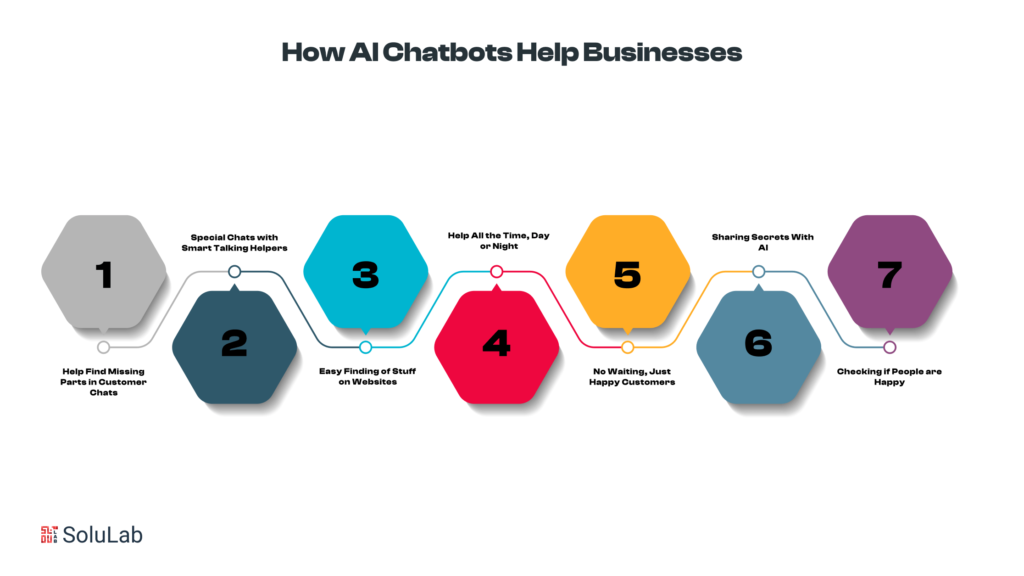
So what does an AI chatbot for customer service actually do for a business? Quite a lot:
- Help Find Missing Parts in Customer Chats: The bot notices where a conversation has holes in it. Problems get solved sooner, and customers stay happy.
- Special Chats with Smart Talking Helpers: Think of the chatbot as a fast helper that fields basic questions, using a few clever tricks so it sounds like a person.
- Easy Finding of Stuff on Websites: Lost on a big website? The chatbot points users straight to the item they’re after.
- Help All the Time, Day or Night: It never clocks off. Help is there 24/7, wherever the customer is, and questions get answered fast.
- No Waiting, Just Happy Customers: Shorter queues. Customers get what they came for quickly and leave in a better mood.
- Sharing Secrets With AI: The bot remembers what people tell it during a chat, and that gives the business a clearer view of what each customer prefers.
- Checking if People are Happy: Quick in-chat surveys collect feedback and measure satisfaction, which shows the business where to improve.
The Advantages of Text or Voice-Enabled Chatbots
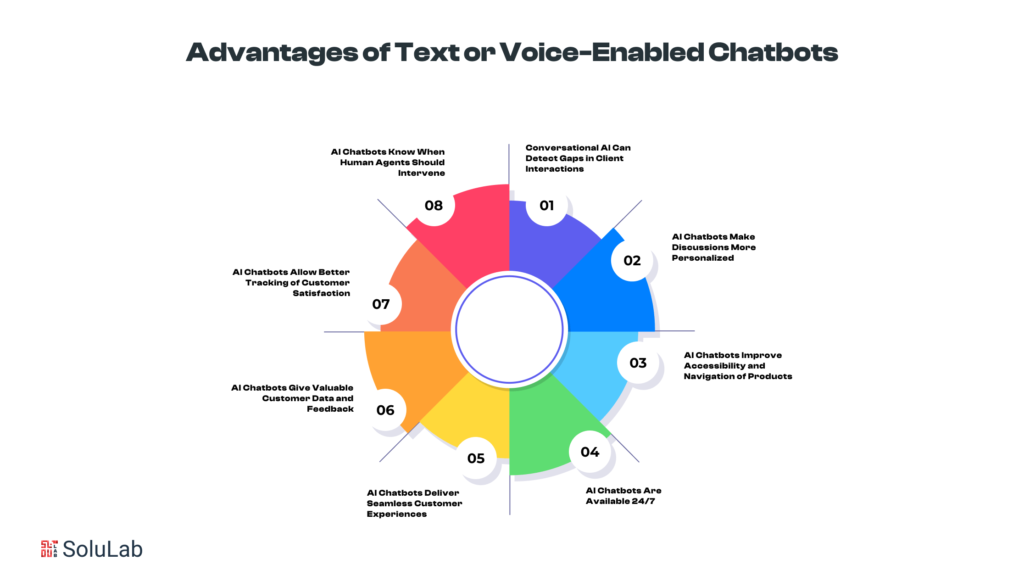
More and more of the customer relationship happens online. If you want conversions and better experiences, you have to get those conversations right. AI chatbots remove a lot of the friction between a company and its users and pull the two closer together. Customer service chatbots built on Artificial Intelligence bring plenty of benefits of AI chatbots that change the customer experience and cut wasted effort out of operations.
Conversational AI Can Detect Gaps in Client Interactions
Conversations with customers often have gaps nobody notices. Ignore them and you can miss the questions that really matter. An AI chatbot finds those gaps by studying how users interact with it, and then helps close them quickly. Better still, it can change the direction of a conversation while it’s happening. The result is customers who leave satisfied, not just served.
AI Chatbots Make Discussions More Personalized
Speed is the obvious win. AI chatbots automate engagement by answering all sorts of questions in seconds. But AI powered chatbots also make the chat feel personal. They can handle basic questions because their programming mixes AI logic with simple rules that mimic how people talk. Add AI, and the bot starts to understand the context of each conversation. Quick, accurate fixes mean happier customers and a better experience overall.
AI Chatbots Improve Accessibility and Navigation ofProducts
We’ve all been lost on a website, hunting for one product. It’s like walking into a huge store and wandering aisle after aisle to find a single thing. With an AI chatbot, the customer just types the product name and the bot takes them there. Simple. And it keeps people engaged and happy.
AI Chatbots Are Available 24/7
Brands work hard to keep customers happy, yet some gaps never close. Round-the-clock availability is the big one. Users expect it now, and no human team can offer it. Chatbots fill that hole. AI and people working together are changing what customer experience means. Attention spans are short, and patience is shorter. With an AI customer service chatbot a brand can answer questions and offer support at any hour, in any language, by text or voice. Customers get help wherever they are and sort things out with very little human input.
AI Chatbots Deliver Seamless Customer Experiences
Being always on is only the start. AI chatbots also raise the bar for the whole experience. Users reach the right resource immediately, with no wait for an agent and no explaining the problem twice. They get answers that actually solve things. That matters, because this is how you build loyalty and keep people coming back. Chatbots learn from past conversations, so their suggestions get more tailored over time. They can even stand in for signup forms, contact forms, and similar tools.
AI Chatbots Give Valuable Customer Data and Feedback
Think about how much information changes hands in one conversation. Human or bot, both sides share something. Pull all of that into a single customer view and you can see the full journey, including where people drop off and where they convert. Those moments are what you design customer-centric experiences around. You can also use the same data to sharpen marketing and recommend the right products and services to each user.
AI Chatbots Allow Better Tracking of Customer Satisfaction
Measuring customer satisfaction is hard for online businesses. Chatbots make it practical. They ask customers to rate the company through short surveys or questionnaires, in a way that feels helpful rather than pushy. These usually go out over messaging apps such as WhatsApp and Facebook Messenger. Response rates tend to be decent. Once you know your satisfaction score, you can go back and improve the whole workflow, adjusting processes until the number moves. Meanwhile the chatbot keeps storing useful customer data and tracking satisfaction for you.
AI Chatbots Know When Human Agents Should Intervene
Chatbots can hold a human-like conversation. They still can’t replace human support. Honestly, the ability to hand over to a person may be the most important feature a chatbot has. Your company or support team can step in and take over any chat that’s already running. Plenty of tricky situations, closing a deal or a real-time payment for instance, are beyond what a bot can settle. A good AI chatbot recognizes those moments and brings in an agent right away, so the issue gets fixed fast.
AI Chatbots Enhancing the Customer Experience Across Industries
Companies all over the world already use AI chatbots to improve how customers experience them. Here are the leading AI Chatbot use cases by industry, showing how different sectors are using the technology to grow:
- Retail: Chatbots help shoppers with personal recommendations and answer questions about products. Customers decide with better information, and they’re more satisfied with what they buy.
- Hospitality: Hotel guests can book, ask about amenities, and get local tips from a chatbot. Some even take room service orders. Convenient.
- Insurance: Customers use AI chatbots to file claims, look up policy details, and get answers. Services become easier to reach, and staff have less on their plates.
- Healthcare: A lot of hospitals now rely on AI Chatbots for customer engagement to book appointments, answer health questions, and send medication reminders. Patients get easier access, and care teams carry a lighter load.
- Banking: Banks and other financial institutions use AI chatbots to handle account questions, give financial guidance, move money, and make services easier to reach. Customers wait less and get faster, better service.
The pattern is the same everywhere: quick, personal, convenient conversations make the customer experience better, whatever the industry.
Future Of AI Chatbots: What To Expect From This Emerging Trend?
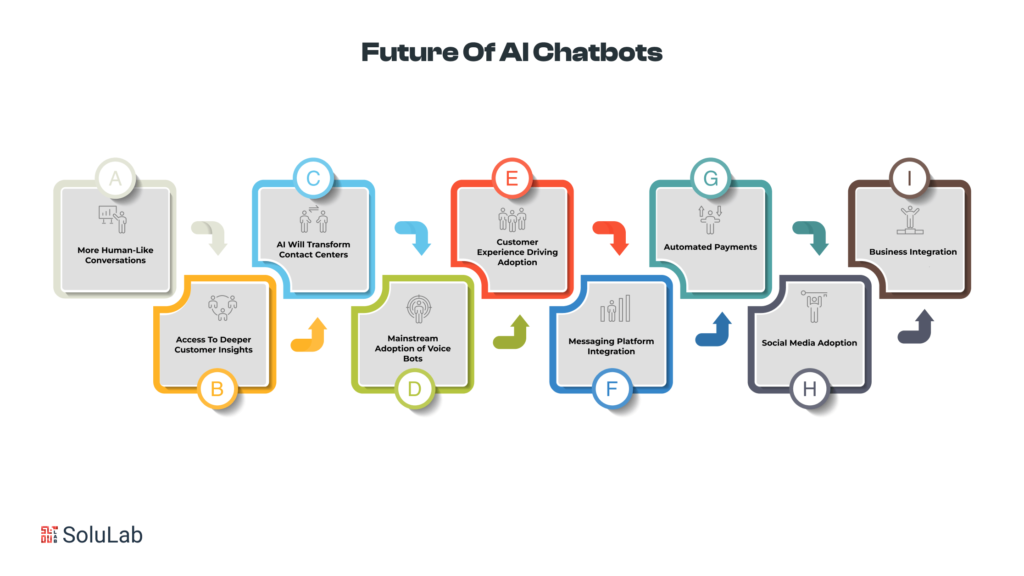
The chatbot market is set to grow fast over the next few years. Current projections have it passing $994 million soon, a jump of roughly $200 million year over year. That works out to a compound annual growth rate (CAGR) of about 22%.
Small shops and big enterprises alike are adding AI chatbots for customer service. Why? Because chatbots let them connect with customers efficiently without blowing the budget. These are the trends we expect to shape where AI chatbots go next:
- More Human-Like Conversations: Progress in natural language processing (NLP) and machine learning will make talking to a chatbot feel more natural, closer to talking to a person, and users will come away more satisfied.
- Access To Deeper Customer Insights: Smarter AI will let chatbots dig through large amounts of user data and draw conclusions about each individual. With that level of detail, their replies will be personal and fit the context.
- AI Will Transform Contact Centers: As the tech matures, chatbots will sit at the center of how contact centers are rebuilt. They already handle routine questions quickly and consistently. People will still be needed for sensitive matters. Even so, combining chatbots and humans should eventually make fully autonomous contact centers possible, with efficiency and consistency that are hard to match today.
- Mainstream Adoption of Voice Bots: Voice assistants keep getting more popular, and voice-enabled chatbots will follow them into everyday use. People will just speak to the bot in plain language. Easier for everyone.
- Customer Experience Driving Adoption: The main reason companies deploy chatbots will be customer experience. Personal, 24/7 support raises satisfaction and builds loyalty.
- Messaging Platform Integration: Tight links with popular messaging apps such as WhatsApp and Facebook Messenger will put chatbots right where users already are.
- Automated Payments: In banking and other transaction-heavy settings, chatbots will handle secure payments, balance checks, and money transfers, which makes dealing with money quicker and less of a chore.
- Social Media Adoption: Platforms like Facebook will lean on chatbots more and more to engage users. Businesses can use social media bots to answer questions, recommend products, and support customers in real time.
- Business Integration: Companies will also point chatbots inward, at HR, IT support, and other internal work. Automating those processes makes the workplace more efficient and more productive.
Key Considerations for Successfully Implementing Customer Service Chatbots
Chatbots can change customer service a great deal. You only get that payoff, though, if you plan the rollout with care. Keep these factors in front of you:
Choose the Right Chatbot Solution: Start with an honest look at what your business needs and how it works, then pick the chatbot technology that fits. Weigh the kinds of questions you expect, the integrations you’ll need, how far you need to scale, and what you can spend.
Define the Balance Between Automation and Human Assistance: A chatbot should strengthen your agents, not replace them. Draw a clear line between what the bot handles and what goes to a live agent, so both the digital and the human side of support work at their best.
Continuously Monitor Performance and Refine: Check usage metrics often. Read customer feedback. Keep tuning responses through ongoing machine learning. That’s how a chatbot stays useful as customer needs change.
Maintain a Human Touch: Know which situations call for a real person and some empathy, like complicated troubleshooting or an emotional conversation. For those, make the handover to an agent smooth, so the customer gets the best experience you can offer.
Consider Long-Term Evolution: Don’t treat the launch as a one-off project. Take an iterative approach centered on users and keep improving. As chatbot capabilities grow, revisit where they can do more for your customer service.

Keep these points at the center of the rollout and you’ll get far more value out of AI chatbots for customer service as one part of a joined-up, omnichannel support strategy.
Key Takeaway
As 2023 wraps up, one thing is clear: AI chatbots for customer engagement are only getting started, and they have an exciting road ahead that will change how we deal with technology. There’s a lot these bots can still do. As more customer data lives in the cloud, where it’s easy to reach, chatbots will take on more of the work of managing customer relationships, data, and communications, with less friction than before. Businesses get more agile and more productive as a result.
If you want to build AI-powered conversational interfaces, SoluLab is a strong chatbot development partner. We have more than a decade of experience building intelligent chatbots, and we know how to understand what you need and design bots that deliver real value. Our full-stack developers work with current natural language processing, machine learning, and AI capabilities to build chatbots that feel natural, give relevant recommendations, and improve the customer experience.
Talk to SoluLab today. You’ll get reliable, scalable, secure solutions that fit cleanly into your tech stack, with support that continues after launch.
FAQs
Shipra Garg is a tech-focused content strategist and copywriter specializing in Web3, blockchain, and artificial intelligence. She has worked with startups and enterprise teams to craft high-conversion content that bridges deep tech with business impact. Her work translates complex innovations into clear, credible, and engaging narratives that drive growth and build trust in emerging tech markets.