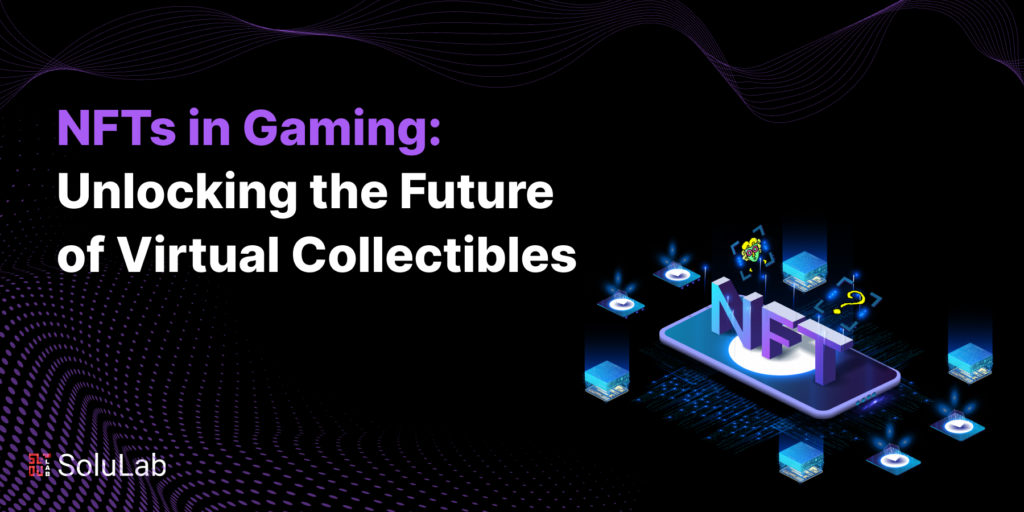
Blockchain met gaming, and something odd happened. Players started asking who actually owns the sword they spent forty hours grinding for. That question is what Non-Fungible Tokens (NFTs) in gaming is really about. This piece walks through what non-fungible tokens are, why gaming collectibles built on them matter, and where the whole idea still creaks.
A quick definition first. NFTs are cryptographic tokens that live on a blockchain, usually built with Ethereum’s ERC-721 or ERC-1155 standards. Each one carries a distinct set of properties, things like metadata, an ownership trail, and rarity attributes, and no two are interchangeable. Gaming is not the only place they showed up. Art, entertainment, and a long list of digital platforms picked them up for the same reason: an NFT can prove a specific digital thing belongs to a specific person.
So why do gaming collectibles built this way matter? Because ownership stops being a polite fiction. A player who holds an NFT item or character can sell it, trade it, or carry it to another platform. Compare that to the old arrangement, where the publisher holds everything and your account is a rental agreement with extra steps. The money you sink into a game can, at least in principle, come back out.
Read Our Blog Post: Top NFT Development Companies
What are NFTs in Gaming?
Non-fungible tokens changed how people talk about digital property. To see why that matters inside a game, you need two things: what an NFT actually is, and how developers have wired them into video games.
NFTs, or Non-Fungible Tokens, are digital assets that cannot be split, swapped, or quietly duplicated. Bitcoin and Ethereum are fungible. One coin equals any other coin. NFTs go the other way. Each token points to one specific thing, whether that is a piece of digital art, a collectible, or an in-game item, and each carries its own token ID recorded on a blockchain along with its authenticity and ownership history.
Gaming was always going to be a natural fit. Virtual items had value to players long before anyone tokenized anything. What developers added was a way to make that value portable: unique in-game assets and collectibles that players buy, sell, and trade, with the record sitting on-chain rather than in a publisher’s private database. Players get possession they can actually exercise. Developers get a new set of design and business options.
What Role Do NFT Gaming Collectibles Play in Shaping the Economies?
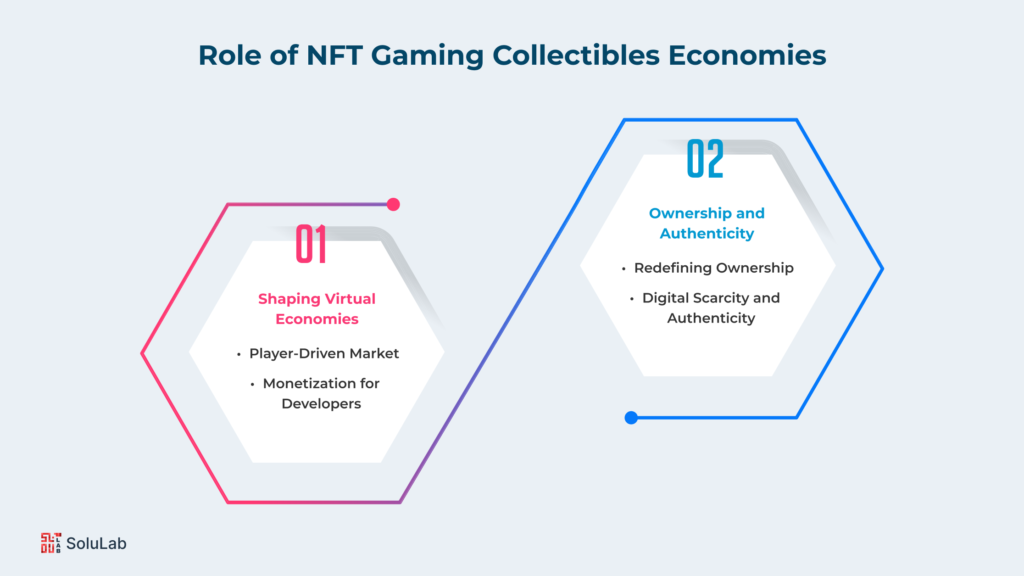
An NFT gaming collectible is a distinct digital item inside a video game, each one represented as its own NFT on a blockchain. The difference from a normal in-game asset is boring to state and large in practice. Normal assets are trapped inside the game that issued them. These are not. Players trade them inside the game, outside the game, on marketplaces the studio never built, and the ownership record follows along on the blockchain. Possession that survives outside the title it came from. That is the part collectors care about.
1. Shaping Virtual Economies:
Player-Driven Market
Markets inside these games run on players, not patch notes. The assets are not decoration; they carry real-world value, which pulls people into trading, buying, and selling. Scarcity and price then move because of what the playerbase does, not because a designer set a number in a config file.
Check Our Blog Post: ERC-3643 vs ERC-1400 vs ERC-20
Monetization for Developers
There is a developer side to this too. Secondary sales of in-game NFTs usually route a cut back to the studio, so revenue keeps arriving after the initial sale. That recurring slice is what funds continued development and upkeep instead of a single launch-day spike.
2. Ownership and Authenticity:
Redefining Ownership
Ownership works differently here, and the shift is not cosmetic. The player holds the asset. That means controlling it, trading it, and moving it between games and platforms without asking permission. An item stops being worth something only inside the session that produced it.
Digital Scarcity and Authenticity
Scarcity and authenticity come baked in. Every NFT is unique, provably limited, and impossible to replace, and the blockchain is what makes that checkable rather than promised. Players and collectors can confirm for themselves that the thing they hold is rare. Verification is most of the appeal.
Read Blog Post: Top NFT Trends That Will Build Revenue Streams to the Business
How are NFTs Revolutionizing the Future of the Gaming Industry?
Gaming has shifted, and Non-Fungible Tokens are a big reason why. NFT gaming collectibles went from niche curiosity to a term everyone in the industry has an opinion about, and they have changed how players relate to the virtual worlds they spend time in. Below, both halves of that story: what the technology makes possible, and what it still gets wrong.
1. Potential of NFTs in Gaming
Expansion Beyond Collectibles
Collectibles used to mean skins, weapons, and cosmetic upgrades. That was the whole menu. NFTs widened it considerably: rare in-game characters, custom skins, virtual real estate, all of it verifiable and owned outright. The value is not sentimental anymore, it rests on scarcity and provable ownership, and that changes what it means for a player to invest in a game.
A marketplace grew up around that. Players buy, sell, and trade their gaming assets, and the sense of owning something starts to resemble owning a physical object rather than renting a database row. As more of these assets circulate, games turn into player-driven economies where the value creation happens outside the studio’s control.
2. Evolution of In-Game Assets
In-game assets themselves have changed shape. Think about what players used to get for their money and their hours: digital items with no real-world value and no way out of the game they lived in. NFTs put value and transferability into those same items. Same object, entirely different economics.
Read Also: How to Make an NFT Game?
They also travel. An NFT can move between games and platforms, which gives players a kind of continuity and personal history that does not reset every time they install something new. Cross-platform play stops being about matchmaking and starts being about inventory: your assets follow you into the next virtual world, and engagement follows the assets.
What are the Challenges and Concerns Associated with the Integration of NFTs in Gaming?
None of this arrived clean. Putting Non-Fungible Tokens into games opened real opportunities for players and studios, and it also dragged in a set of problems that nobody has fully solved. Ignore them and NFT gaming collectibles do not grow; they spike and collapse. Here is what actually needs handling.
Scalability Issues
- NFTs sit on a blockchain, and blockchains slow down when everyone shows up at once. More players means more transactions, and past a point that means sluggish confirmations and fees that make small trades pointless.
- Scaling NFT games efficiently is the job here, usually through layer-2 solutions or upgrades to the underlying chain. Get it wrong and the only people left playing are the ones who can absorb the gas costs.
Environmental Impact
- Energy use is the criticism that sticks, particularly for Proof-of-Work chains. Mining is power-hungry, and some NFTs carry a carbon footprint because of it.
- The fix is usually a move: a greener chain, or a different consensus mechanism such as Proof-of-Stake. Worth deciding before launch rather than after the first angry thread.
Regulatory and Legal Considerations
- Regulators noticed. How an NFT gets classified and taxed is an open question in a lot of places, and the answer changes depending on which jurisdiction your players are sitting in.
- Studios have to track those rules as they shift. Compliance is not optional decoration here, and the penalties for guessing wrong land on the company, not the players.
Ownership and Security
- Owning an asset and keeping it are different problems. Hacks, scams, and outright fraud have cost players their collectibles, and a stolen NFT does not come back because you filed a support ticket.
- Security work comes first, not last: hardened wallets, real authentication, sane key handling. Trust in a game’s economy is built there or it is not built at all.
Read Also: Best Play To Earn NFT Games In 2025
Market Saturation and Speculation
- Too many projects, not enough attention. Launches pile up until nothing stands out, and speculation pushes prices to levels the underlying game cannot justify. Bubbles form that way.
- The defensible move is to build a game people want to play, then let the NFT layer serve it, rather than betting the whole thing on speculative demand. A community that sticks around holds value better than a chart does.
How do Top NFT Developers Influence the Future of NFT Gaming Amidst Evolving Roles and Technology?
Non-Fungible Tokens reshaped a chunk of the gaming industry in a short span, and gaming collectibles are where that shows up most clearly. Whether any of it works, though, depends on the people building it. SoluLab works in NFT game development and sits close to this. So it is worth looking at what these developers actually do, what separates the good ones, what they offer, and how that shapes where NFT gaming goes next.
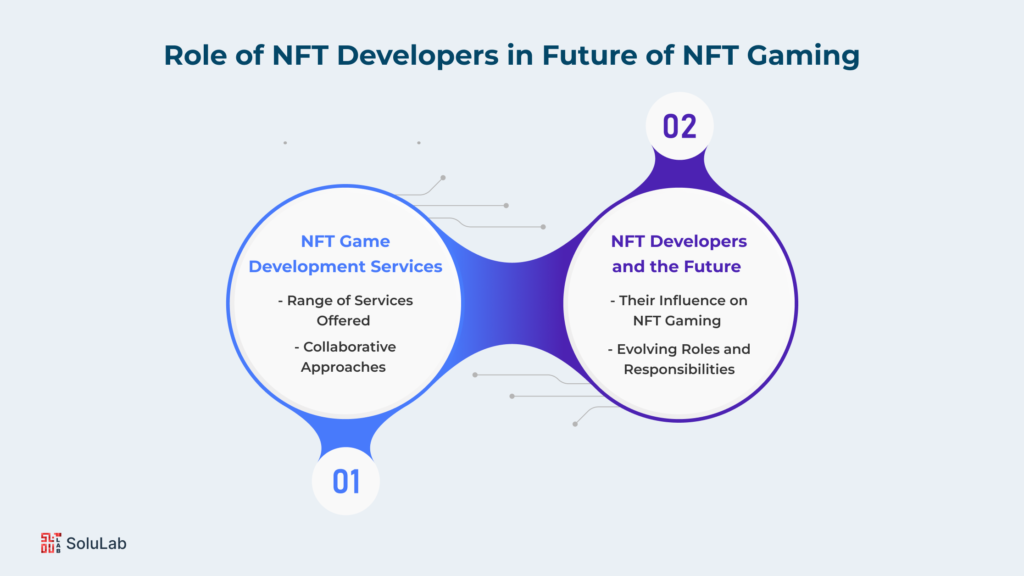
1. NFT Game Development Services
Range of Services Offered
SoluLab covers the range most serious NFT firms do: smart contract development, NFT marketplace creation, and wiring NFTs into games that already exist or ones being built from scratch. Advisory work sits alongside that, covering NFT strategy, tokenomics, and how a given game should actually make money.
Collaborative Approaches
Nobody ships one of these alone. Developers work shoulder to shoulder with game designers, artists, and publishers, because a collectible that ignores the game around it feels bolted on and players notice immediately. SoluLab’s process keeps the NFTs tied to the game concept, which is what keeps players engaged past week one.
2. NFT Developers and the Future
Their Influence on NFT Gaming
Developers set the ceiling on what NFT gaming can be. Their work is what pushed NFTs past simple collectibles into in-game assets, skins, characters, and whatever comes next. Change what can be tokenized and you change how players think about owning and trading anything in a game.
Evolving Roles and Responsibilities
The job keeps getting wider. Scalability, sustainability, and regulatory change all land on the development team now, and none of those were in the original brief. How well a studio answers them decides whether NFT gaming keeps growing or ends up dismissed as a phase.
Conclusion
NFTs are still rewriting what a virtual collectible is, and SoluLab has been building in that space rather than commenting on it from the sidelines. The work in NFT game development services and solutions shows up in games that treat ownership as a design feature instead of a marketing line, which is a harder thing to get right than it sounds.
Strip away the noise and the point holds. NFTs in gaming are not only digital assets. They change the relationship between a player and the items they collect, and that relationship was lopsided for a very long time.
The option to hire top NFT developers is what makes this reachable for businesses and individuals who do not want to assemble a blockchain team from nothing. Virtual collectibles end up being three things at once: entertainment, tradable property, and a way for people to show what they care about.
This field moves fast and it does not wait for anyone to catch up. A partner who has shipped NFT games before is worth more than one who has read about them. That is the work SoluLab does, one non-fungible token at a time. For expert support, contact SoluLab today.
FAQs
Shipra Garg is a tech-focused content strategist and copywriter specializing in Web3, blockchain, and artificial intelligence. She has worked with startups and enterprise teams to craft high-conversion content that bridges deep tech with business impact. Her work translates complex innovations into clear, credible, and engaging narratives that drive growth and build trust in emerging tech markets.