
Key Takeaways
- Most blockchain startups fail from skipping validation, not from bad code; the tech usually works fine, but the market interest doesn’t exist yet.
- Blockchain isn’t automatically the right technology. If your idea doesn’t need trustless transactions, multiple untrusted parties, or immutable records, a normal database is cheaper and faster to ship.
- Customer interviews and competitor research should happen before a single smart contract gets written, not after.
- A lean proof of concept, not a full product, is enough to test real demand and technical feasibility.
- Regulatory and compliance review belongs early in validation, not as an afterthought once development is already underway.
Validate a blockchain startup idea by confirming the problem is real, checking whether blockchain is actually the right tool for it, talking to potential customers before writing a line of code, and testing a lean proof of concept with a small group before committing to full blockchain development.
Skip that sequence, and you’re not building a startup; you’re gambling with a much longer runway than most founders realize. 70% of failed startups ultimately ran out of capital, but the root cause for 43% was poor product-market fit.
We’ve watched founders burn six figures on smart contracts nobody asked for. This is the process we walk clients through before that happens to them, too.
Why Blockchain Startup Validation Matters?
Blockchain app development doesn’t play by the same rules as a typical SaaS build. Costs run higher, timelines run longer, and the regulatory ground keeps shifting under you while you build. Skipping validation here doesn’t just risk a wasted sprint. It risks a wasted year.
1. Development Costs Are High From Day One
Smart contract audits alone can run into five figures before you’ve written a line of frontend code, and that’s before node infrastructure, wallet integrations, or security testing enter the picture.
2. Regulatory Uncertainty Changes the Math
Token classification, KYC/AML obligations, and data residency rules vary by jurisdiction and keep evolving. A business model that’s compliant today can need a rebuild after a single policy shift, so it’s worth stress-testing your idea against that risk early.
3. Product Cycles Run Longer Than Typical Software
Between smart contract development, external audits, and testnet cycles, a blockchain MVP routinely takes longer to ship than an equivalent Web2 product. Every extra month is runway you don’t get back.
4. Investors Expect Proof, Not Just a Pitch Deck
Blockchain investors have sat through enough failed token launches to want evidence: real user interviews, a working proof of concept, a defensible reason the chain is necessary at all. Vague promises about “revolutionizing” an industry don’t clear that bar anymore.
5. Product-Market Fit Still Comes First
None of the above matters if nobody wants what you’re building. Blockchain startup idea validation exists to answer one question before the expensive part starts: Does this problem, for these people, actually need solving badly enough that they’ll pay for it?

Is Blockchain the Right Technology for Your Idea?
Before validating the business idea, validate the technical premise underneath it. A surprising number of blockchain startups don’t actually need a blockchain; they need a database with better marketing. Ask yourself the following, honestly, before you go further.
1. Do You Need Trustless Transactions?
If parties in your system don’t trust each other and there’s no third party willing to arbitrate, blockchain earns its place. If everyone already trusts a central authority, a traditional backend does the job for less money.
2. Are Multiple Independent Parties Involved?
Blockchain technology shines when several organizations need to share and verify data without any one of them controlling the record. A single-company internal tool rarely needs it.
3. Do You Need Immutable, Tamper-Proof Records?
If your use case depends on proving a record hasn’t been altered after the fact (supply chain provenance, audit trails, credential verification) that’s a real signal in blockchain’s favor.
4. Is Decentralization Actually Required?
Ask whether removing a central point of control changes the product’s value. If a centralized database with strong access controls would work just as well, decentralization adds cost without adding benefit.
5. Do Smart Contracts Solve a Real Coordination Problem?
Smart contracts are worth it when they automate an agreement between parties who otherwise can’t trust each other to follow through. If you’re just using them to store data that could sit in a normal table, you’re overengineering.
If you answered “no” to most of these, that’s not a bad thing. It just means you might be building a Web2 startup with a blockchain buzzword attached, and that’s worth knowing before you spend money finding out the hard way.
Common Blockchain Startup Ideas Worth Validating
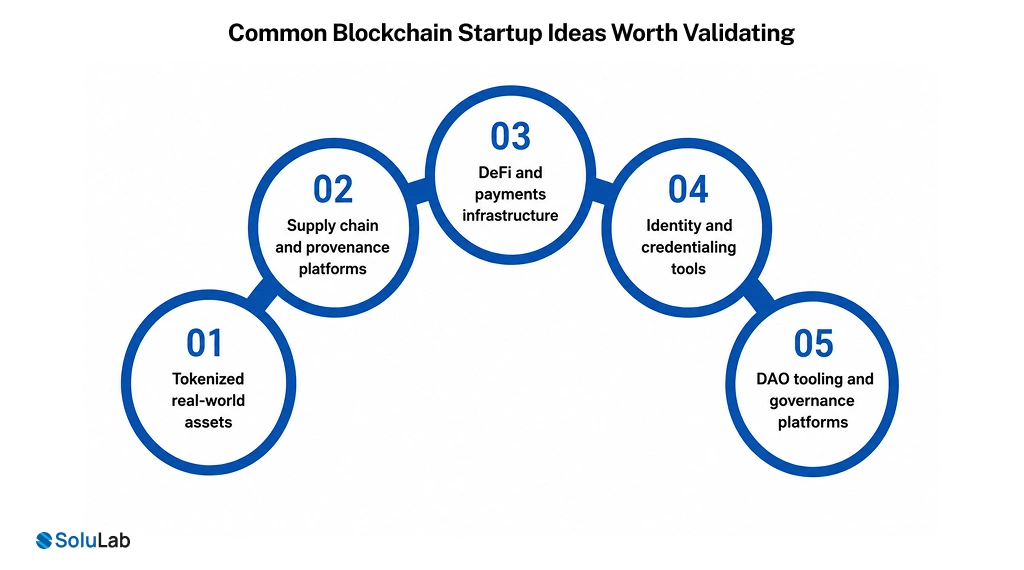
Founders come to us with a fairly consistent set of blockchain startup ideas, and some hold up to validation far better than others. A few categories worth knowing before you pick a lane:
- Tokenized real-world assets, such as real estate, invoices, or commodities, are converted into tradeable digital tokens.
- Supply chain and provenance platforms tracking goods from origin to shelf with tamper-proof records.
- DeFi and payments infrastructure lending, exchanges, or cross-border settlement rails.
- Identity and credentialing tools provide verifiable credentials that don’t depend on a central database.
- DAO tooling and governance platforms infrastructure for decentralized organizations to coordinate and vote.
None of these is automatically a good idea. They’re just categories where blockchain has proven it solves a real coordination problem often enough to be worth testing, which is exactly why the validation steps below matter regardless of which one you’re chasing.
How to Validate a Blockchain Startup Idea: Step-by-Step Guide
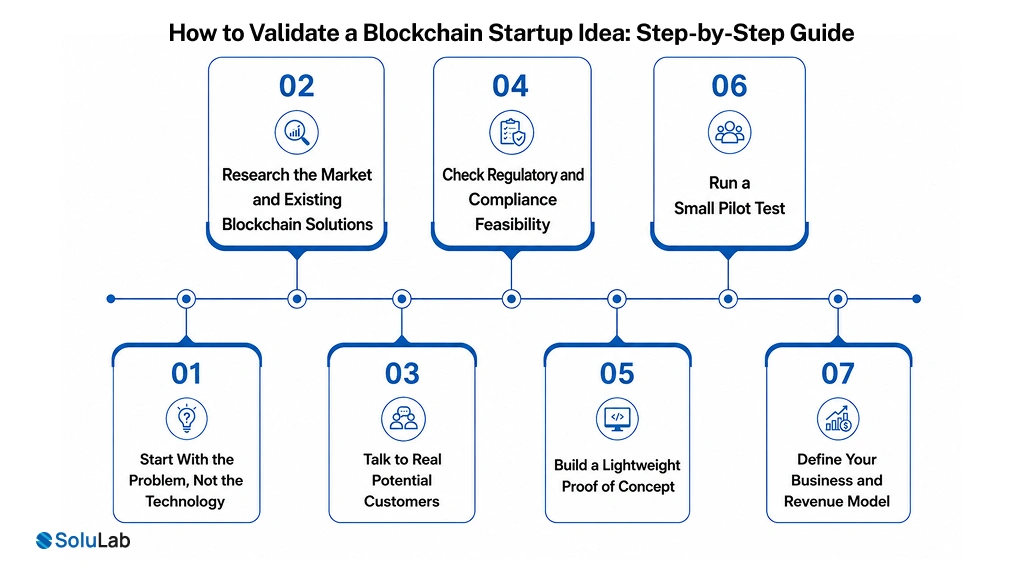
Validating a startup idea before building means proving the problem, the market, and the technology all hold up under scrutiny, in that order, before you spend real development cost on any of it.
1. Start With the Problem, Not the Technology
Write down the problem in one sentence without mentioning blockchain at all. If you can’t, you’re probably starting from the technology instead of the need, which is how most failed blockchain startups begin.
- State the problem in plain language
- Name exactly who has it
- Confirm they currently pay to solve it
2. Research the Market and Existing Blockchain Solutions
Look at who else is already trying to solve this, on-chain or off, and figure out why they haven’t fully cracked it yet. Market research for blockchain startups should tell you where the gap actually is.
- List direct and indirect competitors
- Check funding and traction signals
- Identify the specific unmet gap
3. Talk to Real Potential Customers
Interviews beat surveys every time here, because people will nod along to a survey question about “revolutionary technology” and never actually pay for it. Get on calls before you write code.
- Interview 15-20 target users directly
- Ask about current workarounds used
- Probe willingness to pay now
4. Check Regulatory and Compliance Feasibility
Get a straight answer on token classification, KYC/AML exposure, and data-residency rules in your target markets before development starts, not after a lawyer flags it at your Series A.
- Identify applicable regulatory frameworks early
- Consult counsel on token classification
- Flag data residency requirements upfront
5. Build a Lightweight Proof of Concept
A blockchain proof of concept doesn’t need every feature; it needs to prove the riskiest technical assumption works. Scope it down until it answers one question, not ten.
- Scope one core technical assumption
- Build on testnet, not mainnet
- Time-box the build to weeks
6. Run a Small Pilot Test
Put the proof of concept in front of 10-20 real users and watch what they actually do with it, not what they say they’d do in a hallway conversation.
- Recruit a small pilot cohort
- Track real usage, not opinions
- Collect friction points and drop-off
7. Define Your Business and Revenue Model
Blockchain business model validation means confirming, with real numbers, how the startup actually makes money, token economics included, before scaling development further.
- Confirm the primary revenue stream
- Model token economics if applicable
- Stress-test unit economics at scale
Blockchain Startup Validation Checklist
Before green-lighting full development, run through this list. If you can’t check most of these boxes honestly, that’s not a failure; it’s information you needed before spending the budget.
- Problem validated — confirmed with direct evidence, not assumption
- Customer interviews completed — at least 15-20 target users
- Competitor analysis done — direct and indirect alternatives mapped
- MVP planned — scope limited to the riskiest assumption
- Compliance reviewed — token and data regulations checked
- Technical feasibility confirmed — proof of concept tested on testnet
- Revenue model defined — with real unit economics, not projections alone
- Security requirements identified — audit and access-control needs scoped
Conclusion
Validating a blockchain startup idea isn’t a formality before the “real work” starts, it is the real work, at least at this stage. Confirm the problem is genuine, confirm blockchain is actually the right tool for solving it, talk to the people who’d need to pay for it, and test a lean proof of concept before committing serious development budget.
If you’ve worked through the steps above and want a second opinion before you build, that’s exactly where an outside perspective earns its keep.
SoluLab works as the best blockchain development partner for startups, helping founders pressure-test ideas, scope a proof of concept, and figure out honestly whether blockchain is the right call before a single dollar goes into full development.
FAQs
Neha is a curious content writer with a knack for breaking down complex technologies into meaningful, reader-friendly insights. With experience in blockchain, digital assets, and enterprise tech, she focuses on creating content that informs, connects, and supports strategic decision-making.