
If you’re still debating whether crypto cards matter, the market has already answered, and it didn’t wait for consensus. $18B a year in crypto card transactions is proof that behavior has already shifted, and it’s only accelerating into 2026.
And this is where platforms quietly win or lose. Users don’t just want to hold crypto anymore – they want to spend it, seamlessly, which is why wallets without cards feel incomplete and easier to abandon. So while some teams keep optimizing dashboards, others are locking in daily usage and real revenue.
But the part most founders miss is that you don’t need to become a bank to compete. We have built White-label crypto cards that let you move fast, own the brand, and plug into demand that’s already here before waiting turns into regret, and we tell you that it’s still not too late.
Key Takeaways
- The problem: Crypto businesses struggle to bridge the gap between digital assets and real‑world spending. As they need a way to let users spend crypto like cash while still controlling branding, compliance, and revenue.
- The solution: White-Label Crypto Card Solutions that allow you to launch your own branded crypto card program in weeks, not years. Our solutions combine card‑issuing infrastructure, KYC/AML, and API‑first integration so you can focus on users, not spending useless time on rails.
- How SoluLab helps: As a Crypto Development Company with deep experience in white-label solutions, SoluLab can help you design, custom-build, or integrate a White Label Crypto Card into your platform, while keeping your brand front and center and your compliance stack tight.
What Is a White Label Crypto Card?
At its core, a White-Label Crypto Card is a debit or prepaid card that lets users spend their crypto balances at normal merchants like Visa, Mastercard, Apple Pay, and Google Pay without having to manually convert everything to fiat first.
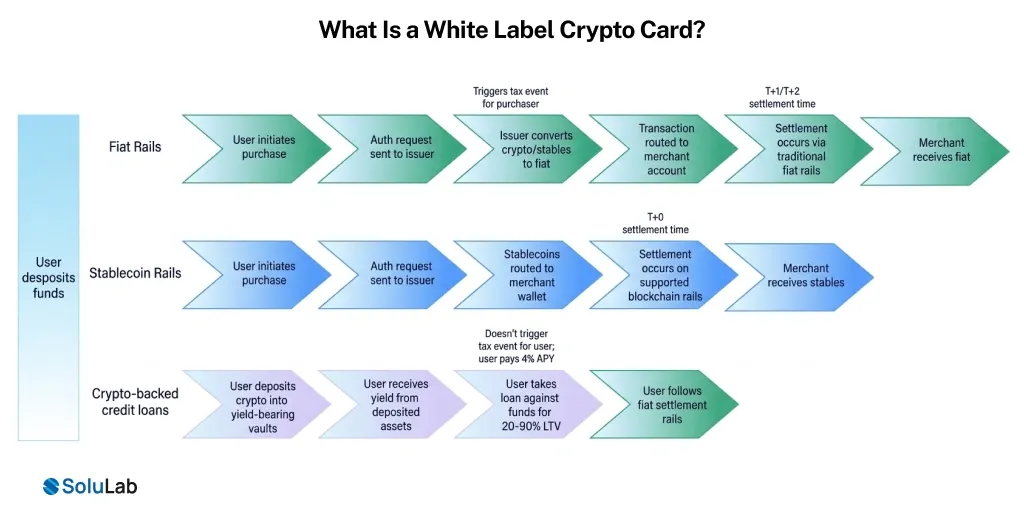
Usually, the workflow is:
- Your users hold crypto in their wallet or exchange account.
- When they make a purchase, the card provider converts crypto to fiat in real time, charges the merchant, and settles back to your platform.
- All of this happens under your brand name, your design, and your UX, which is why it’s called a white-label solution.
In 2026, these white-label crypto card platforms will be widely used by crypto exchanges, wallets, neobanks, and even payroll platforms that want to let employees or contractors spend crypto directly without touching traditional banking steps.
Why Launching a Branded Crypto Card Is Becoming Essential for Crypto Businesses?
If you run a crypto exchange, wallet, DeFi frontend, or neobank and you’re not yet offering a branded crypto card, you’re missing a very obvious lever – user behavior.
- Users who can spend their holdings every day are simply more engaged.
- Users who see your logo on their card every time they pay at a merchant build long‑term brand recall.
- Businesses that let teams or vendors get paid or spend via crypto‑backed cards reduce friction in cross‑border payments and FX overhead.
That’s why Crypto Card Use Cases for Businesses now include corporate expense cards, payroll‑via‑crypto tools, travel budgets for remote teams, and marketing‑ad cards that link directly to crypto wallets.
If you’re serious about competing with the big centralized exchanges and fintechs, you need to move from We hold your crypto toWe let you spend it anywhere, under your brand.
That’s where White Label Crypto Card Development comes in.

Choosing Between White-Label Crypto Card Platforms and a Custom Card Issuer
There are two ways to get into the crypto card game:
- Build your own card‑issuing stack (banking license, sponsor bank, BIN, card‑network certification, compliance, KYC, fraud engine, etc.).
- Use a pre-built white-label solution and plug your brand on top of an existing issuer’s infrastructure.
Unless you’re a bank or you’re ready to burn millions and years, the second path is the only realistic route for most startups and growth‑stage businesses.
With a white-label solution, you can launch your own branded crypto card with:
- Your logo and design.
- Your own fees and rewards.
- Your own UX and onboarding.
At the same time, the provider takes care of the heavy lifting like KYC/AML, compliance, BIN sponsorship, card‑network certification (Visa, Mastercard), and real‑time crypto‑to‑fiat conversion.
This is why white-label crypto card providers are becoming a go‑to choice for crypto development companies and truly ambitious founders who want to ship fast and still act like a full‑stack fintech.
How to Launch Your Branded Crypto Card Using a White-Label Solution in 8 Steps
Let’s walk through these steps one by one so you can understand how we implement it for other enterprises-
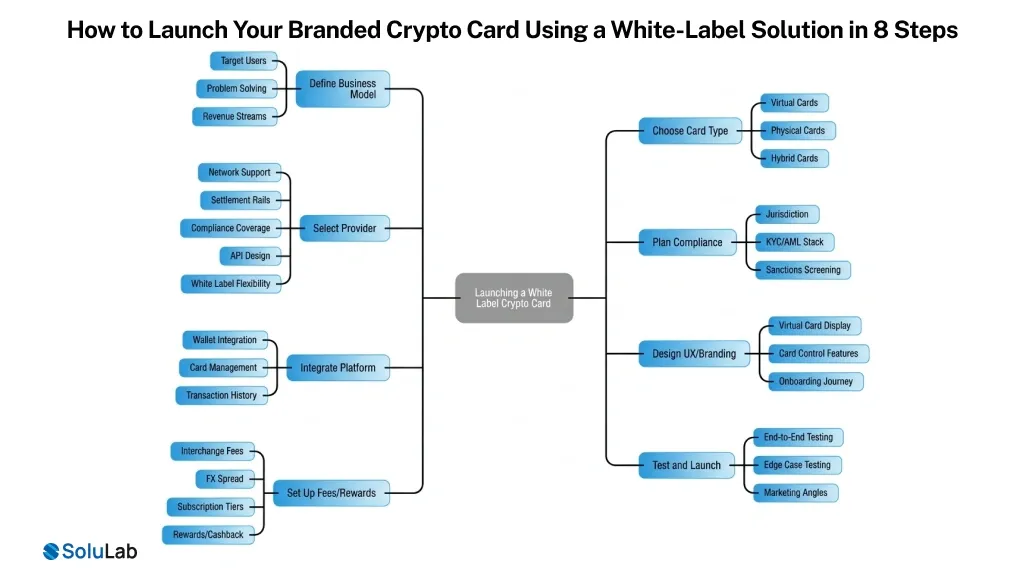
1. Define Your Business Model and Target Users
Before you touch a single line of code or even choose a provider, you need to answer:
- Who is this card for? Retail users, HNW investors, SMEs, DAOs, or corporate teams?
- What problem are you solving? Daily spending, expense management, payroll, or travel‑budget control?
- How will it make money? Interchange fees, balance spread, FX, premium tiers, or subscription?
Your answers will shape everything:
- regulatory choices (jurisdiction, licensing constraints),
- card‑type choices (virtual vs physical, single‑currency vs multi‑currency), and
- Which white-label crypto card platforms should you shortlist?
Most serious crypto exchange development companies recommend starting with a lean card program targeted at a specific vertical, then expanding later.
2. Choose Between Virtual, Physical, or Hybrid Cards
Not every user needs a plastic card. For many fintechs, virtual‑only cards are enough to start.
Virtual cards work perfectly for:
- Online subscriptions, SaaS, marketplace payments, and digital services.
- Quick testing of your white-label crypto card solution without card‑production overhead.
Physical cards are strong for:
- OTT (online‑to‑offline) spending,
- Branding and user trust, and
- Travel, dining, and retail use cases.
Many white-label crypto card platforms now offer hybrid models: virtual cards for onboarding, then an option to order a physical card inside the app.
As a founder, ask yourself:
- Do your users care more about convenience (virtual) or tangible branding (physical)?
- Can you start with virtual cards and only ramp up physical ones when volume justifies the cost?
3. Select a White Label Card Provider or Dev Agency
This is where most founders get stuck. There are plenty of white label crypto card providers and crypto development companies offering white-label crypto development solutions, but not all are built the same.
When you compare, look for:
- Network support: Visa, Mastercard, or schemes you want to support.
- Settlement rails: How they handle fiat‑settlement and FX spread.
- Compliance coverage: Jurisdiction, KYC/AML, and AML reporting.
- API design: Are their docs clean, are they really developer‑friendly, and can you build a custom UX on top?
- White label flexibility: Will they let you fully launch your own branded crypto card, or is it a half‑branded product?
Some of the big names you’ll see in 2026 include UPay, Striga, Zypto, Verestro, and various white-label crypto card platforms that bundle issuer, BIN, and card production into one stack.
If you’re not a fintech with an in‑house securities legal team, partnering with a blockchain development company like SoluLab that has already integrated with multiple providers can save you months and a lot of stress.
4. Plan KYC/AML, Compliance, and Jurisdiction
No one launches a white label crypto card program without thinking about compliance. This is a Your Money or Your Life type of product, and regulators are watching.
At a high level, you need to decide:
- Which jurisdiction do you want to launch in (e.g., EU, UK, US, Singapore, Hong Kong)?
- Who will hold the KYC/AML stack: your own system, the white label provider, or a hybrid model?
- How you’ll handle sanctions screening, transaction monitoring, and suspicious activity reporting.
Reputable white label crypto card platforms usually come with built‑in KYC/AML tooling and documentation you can reuse, which massively reduces the burden on your team.

5. Integrate Crypto Card into Your Platform
Once you pick a provider, the next challenge is: how to integrate the crypto card into your platform so it feels native, not bolted on.
Typical integration points include:
- Wallet integration (so users see their card balance tied to their crypto holdings).
- Card‑creation and management flows (instant virtual cards, physical card ordering, PIN reset).
- Transaction history and spend analytics inside your app or dashboard.
- Reward or cashback logic if you want to run a branded card program (e.g., reward points for on‑chain actions, staking, or trading).
This is where SoluLab really shines. Most off‑the‑shelf white label crypto card solutions give you APIs, but they don’t design a UX that matches your brand tone.
If you’re serious about user‑retention, you want:
- Fast, one‑click card creation.
- Simple balance management between crypto and fiat.
- Clear labels so users know exactly which card is being charged.
A skilled Crypto wallet Development Company can help you integrate the crypto card into your platform so it feels like a core feature, not a third‑party widget.
6. Design the Card UX and Branding
If everything behind the scenes is solid, your card UX and branding can be the real differentiator.
Today, users expect:
- Virtual cards that show instantly in Apple Pay / Google Pay.
- Card‑control features (freeze, spend limits, merchant‑type restrictions).
- Clear visuals for categories like online, travel, or crypto‑only merchants.
Because you’re using a white label solution, you control the design on top of the provider’s rails.
That means you own:
- The card‑branding (colors, logo placement, program name).
- The app screens that show cards, transaction history, and rewards.
- The onboarding journey from signup → KYC → first spend.
For enterprise‑level Crypto Card Issuing Solutions, this is where brand trust really starts to build.
7. Set Up Fees, Rewards, and Monetization
A white label crypto card program is a revenue stream if you design it right.
Typical monetization levers include:
- Interchange‑style fees on card‑swipe volume.
- FX spread (if you’re marking up the conversion rate).
- Subscription tiers (premium cards with higher limits, better rewards, or lower fees).
- Rewards/cashback funded by your own treasury or partner programs.
When you launch your own branded crypto card, you can decide:
- Who captures the economics (you, your provider, or a shared split).
- How transparent you are with users about fees.
- Whether rewards are tied to crypto‑native actions (staking, governance, trading) or real‑world spend.
This is a very operator‑level decision. If you want, SoluLab can help you model a fee and rewards structure that balances growth, profitability, and UX.
8. Test, Launch, and Market the Card
Before you announce to the world that you are launching your white label crypto card program, you need to test properly.
Good testing includes:
- End‑to‑end user flows (KYC → card creation → funding → first spend → dispute resolution).
- Edge cases (limits, blocked merchants, failed transactions, cooldowns).
- Localization and currency trials if you plan to go global.
Then, when you launch, market it as a core product, not an add‑on.
Strong angles include:
- Spend your crypto anywhere.
- Turn your wallet into a real‑world spending account.
- Employee‑expense cards powered by crypto.
For Crypto Card Use Cases for Businesses, this is where real‑world adoption starts to kick in.
How SoluLab Helps You Launch a White-Label Crypto Card Program Faster?
If you’re a founder, the idea of buying a white label solution and plugging it in can sound easy, but in practice you’ll still face:
- Integration complexity.
- UX that feels generic, not brand‑aligned.
- Compliance and security patterns that are hard to get right without experience.
That’s where SoluLab, comes in. Our team can help you:
- Select the right white label solution that matches your jurisdiction and growth plan.
- Design and implement a card‑native UX that feels seamless inside your wallet or exchange.
- Integrate crypto card into your platform, from wallet linkage to KYC, card creation, transaction history, and rewards.
- Build additional value like card‑linked staking, governance incentives, or loyalty programs.
In short, you get the speed of a white label solution with the depth of a custom Crypto Development Company working behind the scenes.

Conclusion
If you’re serious about building a next‑gen crypto product in 2026, launching your own crypto card is a core part of bridging the gap between digital assets and everyday spending.
By using a white label solution, you can launch your own branded crypto card without needing a bank license, a multi‑year card‑issuing stack, or a massive compliance team. At the same time, you still need a web3 Development Company that understands both crypto infrastructure and fintech‑grade UX, so your card feels like a native feature.
If you’re a founder, product lead, or CTO running a serious crypto project, the next step is to either:
- Map out a detailed Launch White Label Crypto Card Program strategy, or
- Get a concrete technical roadmap from a team that’s already done this for multiple platforms.
The market isn’t waiting. The data shows that crypto card usage is growing fast, and the first movers who build Crypto Card Solutions into their core UX will capture the most engagement and loyalty.
FAQs
With over 3 years of experience, I specialize in breaking down complex Web3 and crypto concepts into clear, actionable content. From deep-dive technical explainers to project documentation, I help brands educate and engage their audience through well-researched, developer-friendly writing.

![How to Build a Japan-Ready Crypto Wallet: Must-Have Features [2026]](https://www.solulab.com/wp-content/uploads/2026/02/Build-Japan-Ready-Crypto-Wallet.webp)