Language kills deals quietly. Maybe you run a support desk and half your queue is written in a language your team only half-speaks. Maybe you sell online and watch carts get abandoned because the checkout copy reads like a stranger. Either way, it stings, and most of us have hit it at some point. So what do you do? Hire fluent staff for every market? Good luck with that budget. Keep the service consistent across a dozen languages? Harder than it sounds. This is where a multilingual chatbot earns its keep, quietly handling the people you’d otherwise lose.
The numbers back it up. Around 76% of online shoppers say they’d rather buy from a site in their own language, even when the translation is rough, and roughly 40% will simply walk away from a site that isn’t in their language at all.
The global chatbot market is expected to climb from $7.01 billion in 2024 to $20.81 billion by 2029. That kind of jump tells you how fast businesses are picking up AI-powered chatbots.
And people clearly want it. 82% of customers now say they’d rather talk to a chatbot than sit in a queue waiting for a human, up 20% since 2022. Instant help, in their language, beats waiting.
In this piece, I’ll walk through how these bots actually work, how to stand one up, and a couple of real deployments that show what they can do.
What is a Multilingual Chatbot?
A multilingual chatbot talks to people in more than one language. It figures out which language someone is using and answers back in that same language. Underneath, it leans on NLP and translation to serve a global audience, meeting each person where they are instead of forcing everyone into English.
The switch happens on the fly. Someone starts typing in French, the bot follows in French. Customers get to stay in their native language, which takes a lot of the friction out of a support chat. The bot can pick up the language on its own from the browser, or you can just let people choose the one they’re most comfortable with.
If you sell across borders, this stops being a nice-to-have. A good multilingual bot does more than swap words for their equivalents. It bends to the customer’s culture and location. That’s real localization, not just translation with extra steps.
There’s a scale angle too. A multilingual crypto trading bots can juggle many conversations at the same time, which frees your human agents to spend their attention on the people who genuinely need a person.
Why Does Your Business Need a Multilingual Chatbot?
If language is the wall between you and your customers, a gen AI in customer service like a multilingual chatbot is a practical way through it. It may well be the fix for the localization headaches you keep running into. AI-powered bots pull ahead of the alternatives, and here’s the case for adding one.
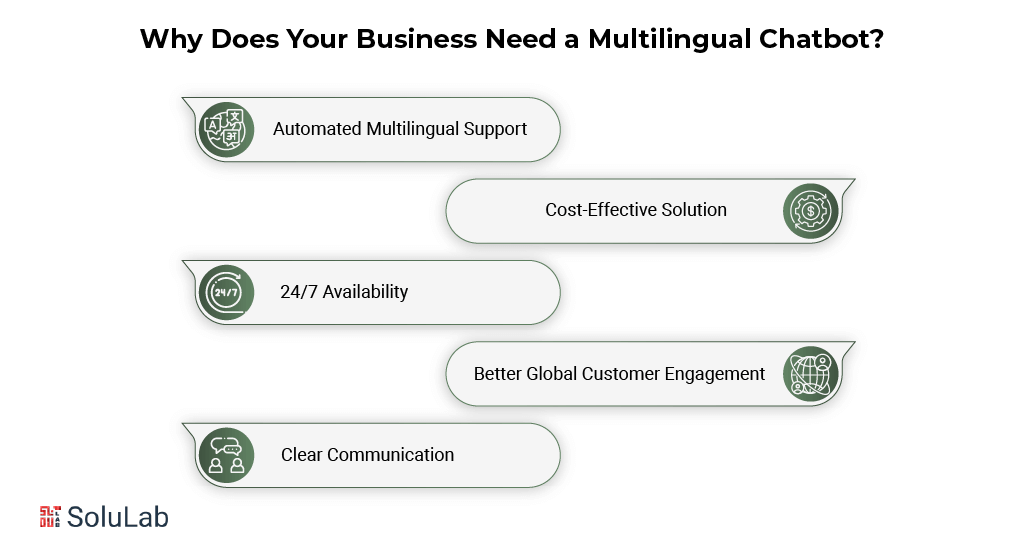
1. Automated Multilingual Support
Do questions land in your inbox in half a dozen languages every day? A multilingual chatbot answers each person in their own language, and you don’t have to staff up a small army of agents to do it.
English, Spanish, French, the regional ones people actually speak at home, it keeps the conversation clear and the replies quick and correct. Customers get faster answers. Your team gets to work on the harder, more interesting problems.
2. Cost-Effective Solution
Hiring and training staff for every language you serve is expensive, and it rarely holds up as you grow. A multilingual chatbot takes that support load off people and spreads it across languages, so you save money without letting service quality slide. And service quality is exactly what builds trust.
3. 24/7 Availability
Customers don’t only need help between nine and five. A multilingual chatbot never clocks out. It answers someone in Tokyo at 3 a.m. and someone in New York at 5 p.m. without missing a beat. That always-on presence lifts satisfaction and quietly signals that you respect people’s time.
4. Better Global Customer Engagement
A language gap caps how many people you can reach. Close it, and suddenly you’re talking to customers all over the world, in the language they actually think in. People feel seen when that happens. Engagement rises, conversions rise, and the whole experience feels warmer.
5. Clear Communication
Even fluent human agents drift. Ask three of them the same thing across three languages and you can get three slightly different answers, and sometimes a misread.
Multilingual chatbots take the guesswork out. Same accurate answer, same consistent tone, whatever language it comes in. That consistency is the point.
Can Chatbots be multilingual?
Short answer: yes. There’s more than one way to build one, but let’s pin down what a multilingual chatbot actually is first.
Think of it as a virtual assistant that reads and answers customer questions in several languages. It spots the customer’s language, pulls the right response from its database, and replies in that same language. It’ll also handle a crowd, many people at once, each in their own tongue.
So how do people build these? Three common routes:
- Teach one bot several languages at once by feeding it training data in each of them.
- Spin up a separate bot per language.
- Build a crypto arbitrage chatbot in one language that can then talk in many.
Of the three, the AI route wins. With Natural Language Processing (NLP) doing the work, the bot detects the language, reads the text, and produces translations and replies that actually fit the context. You train it once, say in English, and machine translation carries it into the rest, smoothly enough that most users won’t think twice.
How to Build a Multilingual Chatbot?
A multilingual bot makes the whole experience better simply by speaking the user’s language. Here’s a plain, step-by-step run-through to get you moving:
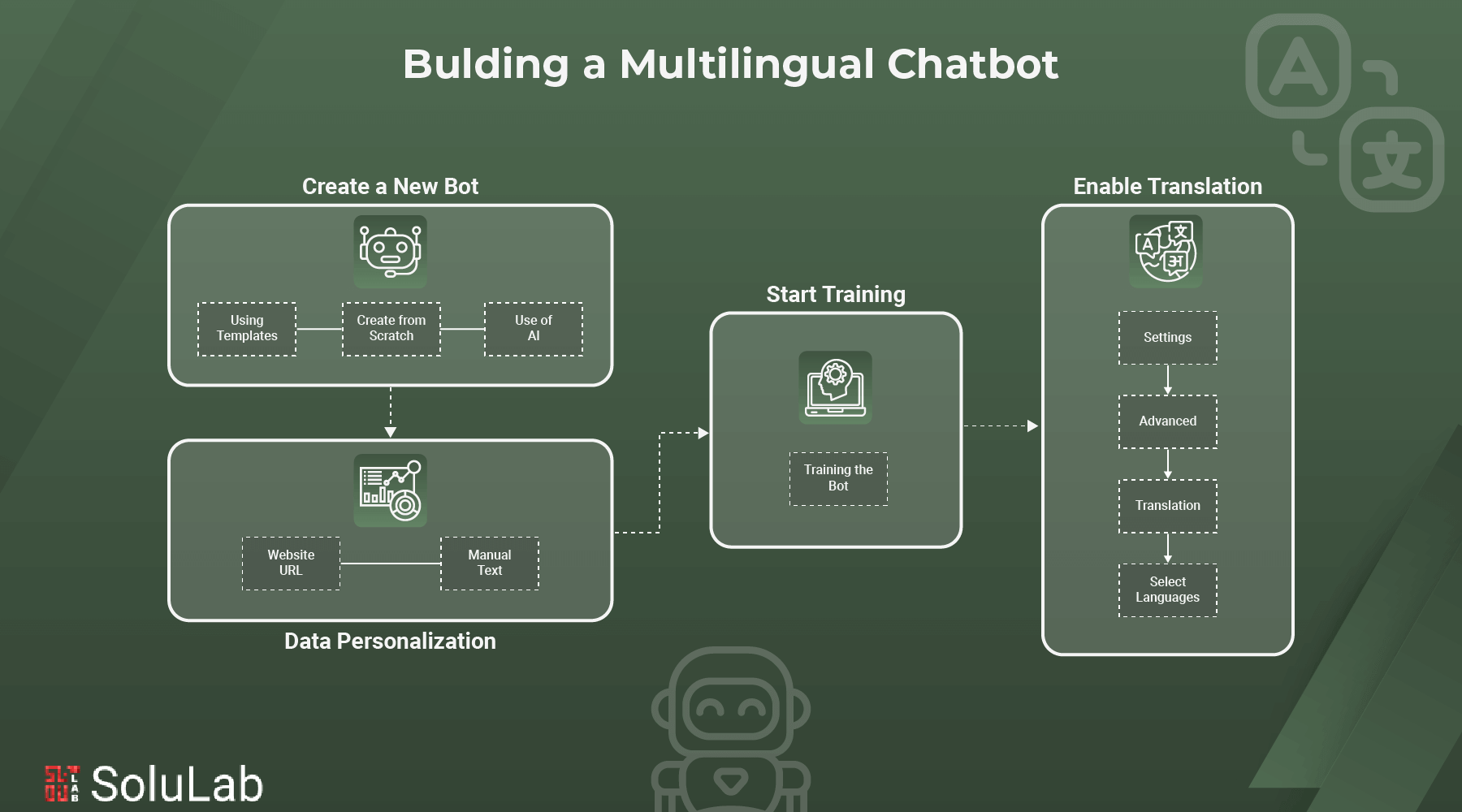
Step 1: Head into the Bots section of your dashboard. You’ll see three ways to build one.
- Make Using Templates
- Create from Scratch
- Use of AI
Hit the “+Create New Bot” button, then pick “Using AI” from the dropdown. Feed it the details it needs to learn from and to hold a conversation with your users.
Step 2: Use your own data to shape the bot
You’ve got two ways to set it up:
URL: Drop your website address into the “Website URL” field. The system crawls the site and pulls your own content into the bot’s knowledge base, things like product descriptions and FAQs, so it answers in your words.
Text: Prefer to type it in yourself, or want to add something the site doesn’t cover? Enter text by hand. This is the spot for precise rules, guidelines, or any detail you really want the bot to know and pass along to customers.
Once you’ve chosen your source and entered the data, click “Process Data” to move on. Need to fix something? The edit icon lets you change the processed data.
Step 3: When the website data has processed cleanly, click “Start Training.”
Step 4: To turn on real-time translation, open “Settings,” go to “Advanced,” pick “Translating,” and switch on the current translation box. From there you choose the language you want.
Then click the “globe icon” at the bottom of the chat screen and pick your preferred language from the list.
That’s it. Your multilingual bot is built and ready to go.
Benefits of Multilingual Chatbot
Roughly 74% of customers reach for a chatbot when the question is simple. If your customers are spread around the world, a multilingual chatbot stops being optional. Still, it’s worth being honest about both the upsides and the trade-offs.
1. Better Customer Reach:
Answer people in the language they prefer and more of them buy. It’s that direct. The bot nudges purchase decisions along and lifts conversions. Businesses come across as more approachable and more trustworthy, which is an edge competitors without one don’t have. Over time, that shows up as loyalty and a preference for your brand.
2. Cost-Efficiency:
By automating the support grind, a multilingual chatbot cuts the manual workload and the bill that comes with it.
3. Scalability:
As you add customers and regions, scaling support gets easier rather than harder. And speaking to people in their local language quietly improves the whole experience along the way.
Localized content pulls its weight here too: 75% of customers say it makes them more likely to engage with a brand. Personal support builds a bit of goodwill and trust, and satisfaction follows.
4. Improved Customer Support:
88% of customers say good service makes them more likely to buy again. A multilingual chatbot delivers round-the-clock, personal help, and that’s what keeps people coming back.
Put simply, multilingual chatbots let a business grow past its home market, reach more people, and get past the language wall.
How Does a Multilingual Chatbot Work?
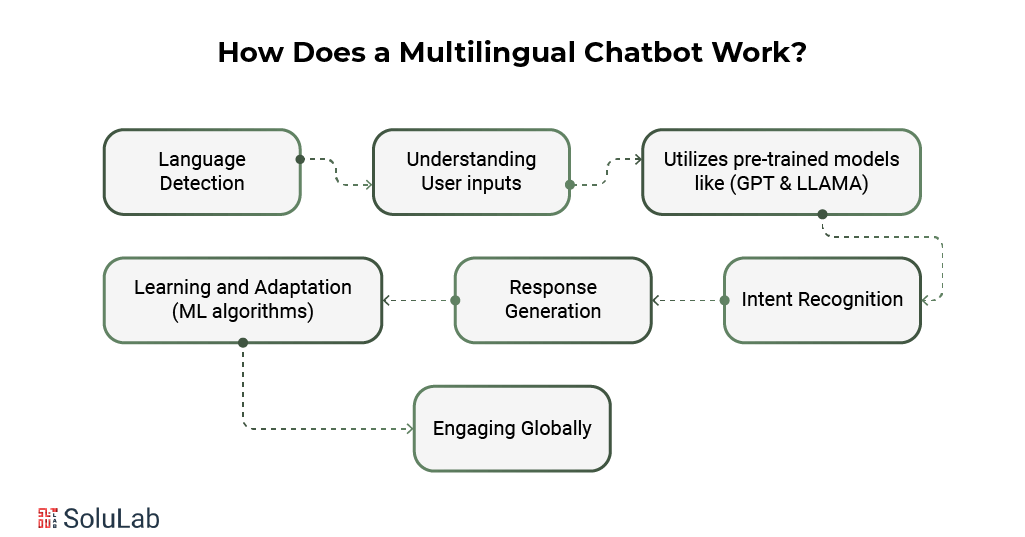
Under the hood, a multilingual chatbot runs on AI, mainly Natural Language Processing (NLP) and Machine Learning (ML), to move between languages without stumbling.
- Language Detection: First it works out what language you’re using. NLP algorithms read the linguistic patterns, through probabilistic models, n-grams, or neural embeddings, to make the call. That’s how it tells apart close cousins like Spanish and Italian, catching the small differences in context and word structure.
- Understanding User Inputs: With the language pinned down, it shapes its replies to fit, so the exchange feels personal.
- Utilizes Pre-trained Models: Big pre-trained models like GPT (Generative Pre-trained Transformer) keep the conversation flowing because they grasp context, not just words.
- Learning and Adaption(ML Algorithm): open-source models like LLAMA let businesses fine-tune the bot on their own data while staying inside their data privacy and security rules.
- Response Generation: For the actual translation, tools such as Google Translate or Microsoft Translator use neural machine translation (NMT) to produce real-time output that reads correctly in context.
- Intent Recognition: There’s also a central intent recognition layer that lines up inputs across languages, mapping them to specific intents with vector embeddings. That’s what keeps responses consistent and localized, and lets workflows run without hiccups.
- Engaging Globally: ML gets sharper the longer it runs, pulling in feedback loops as it goes. It adapts to slang, cultural quirks, and personal habits, so the bot keeps pace with what people actually say. In the end that makes it a genuinely useful tool for AI development companies trying to reach a global, mixed audience.
Challenges of Building a Multilingual Chatbot
Language differences and cultural nuance make this hard. No way around that. But with the right approach, none of it is a dead end. Here are a few practices that make rolling out a multilingual chatbot go a lot smoother.
1. Handling Linguistic Variations and Idioms
Every language carries idioms and cultural references that don’t survive a word-for-word swap. Catching that meaning is where things get tricky.
Best Practices:
- Contextual Understanding: Put your money into NLP models built for context, the ones that can read an idiom for what it means rather than what it says.
- Localization Teams: Bring in linguists or localization specialists so the translations land right and keep their cultural footing.
2. Ensuring Accuracy and Quality
Keeping translations accurate while holding on to the original meaning, across every language, is a real challenge.
Best Practices:
- Human Review: Build in a review step where bilingual experts check translations for accuracy, tone, and cultural sensitivity.
- Continuous Improvement: Set up feedback loops and update regularly, refining the translations as you learn from real user interactions.
3. Scalability and Maintenance
Add more languages and the job of keeping everything consistent gets messier, fast.
Best Practices:
- Automated Workflows: Automate how you create language versions inside the chatbot. Pick a language, publish, done.
- Modular Design: Build a modular architecture so scaling and updating across every language variant stays easy.
4. User Experience
Giving everyone the same smooth experience, no matter the language, is tough precisely because languages don’t behave the same way.
Best Practices:
- Multilingual User Testing: Test heavily with native speakers of each language you support, so you catch what’s clunky or culturally off before customers do.
- Adaptive Design: Design the interface to flex around linguistic differences without the experience falling apart.
5. Continuous Monitoring and Improvement
A chatbot isn’t a set-and-forget thing. It needs watching and tuning to stay useful across every language it speaks.
Best Practices:
- Analytics and Insights: Lean on tools that break down how users interact language by language. REVE Chatbot, for one, gives language-based insights and analytics that point you to what needs fixing and let you update on evidence, not hunches.
- Agile Approach: Work in short iterations, rolling in changes as user feedback and shifting language trends tell you what matters.
Best Practices for Multilingual Chatbot
Now that you know how to put one together, here are a few habits worth keeping once it’s live:
1. Continuous Training: Keep the training content of your multilingual chatbot fresh. Refresh what’s already there and add new material as the need comes up.
2. Monitor Performance: Watch how the bot does through customer feedback and analytics, and make sure it’s actually hitting the mark.
3. Refine Responses: Let human agents read over and sharpen the bot’s replies. Native speakers are best for this, since they’ll catch what an algorithm won’t.
4. Compliance: Check that the chatbot plays by the rules in every region where it runs.
Building the bot is only half of it. Making sure it delivers accurate responsible AI matters just as much. Give it the time and resources to get the performance right.
How Do Companies Benefit from Using Multilingual Chatbots?
Multilingual chatbots move the needle. They let a business talk to a far wider audience and give each person a smooth, personal experience in their own language.
Here’s where the payoff actually shows up:
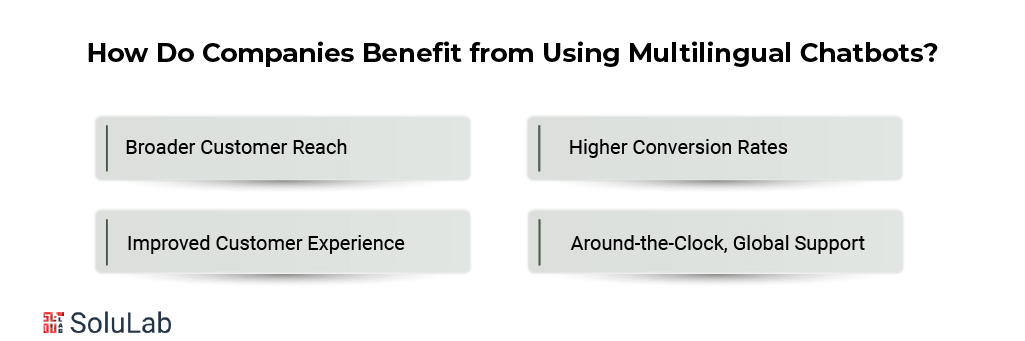
- Broader Customer Reach – Support more languages and you can talk to customers who don’t speak English, which widens the market a lot. Roughly 60% of shoppers steer clear of English-only sites.
- Improved Customer Experience – Help someone in their own language and it just feels more human. Happier customers, stronger loyalty. Deepl’s report puts it at 75% of people saying localized content lifts engagement.
- Higher Conversion Rates – People buy more readily when they can shop in their preferred language. After translating their site into German, REVIEWS.io saw traffic climb 120% and conversions rise 20%.
- Around-the-Clock, Global Support – About 51% of customers expect a business to be there 24/7. A multilingual chatbot keeps the door open in several languages, so people in any time zone can get help long after the office lights go off.
Put all that together and multilingual chatbots help a business build real relationships with customers everywhere, which is what drives growth on a global scale.
Real-World Examples of Multilingual Chatbot
A multilingual chatbot can genuinely separate a company from the ones that skip it. Here are a couple of businesses putting them to work.
Veritas Finance Limited works to get financial support to micro, small, and medium enterprises (MSMEs) in India, a group that’s been overlooked for a long time. Their main aim is making credit reachable, especially out in rural areas.
Their big obstacle was language. A lot of rural customers weren’t comfortable in English, so reaching them meant reaching them in their own tongue. The answer was the REVE multilingual chatbot development, rolled out in seven languages: Hindi, Bengali, English, Kannada, Tamil, Telugu, and more. Since bringing it in, Veritas has seen a 40% jump in customer interactions and reached people it simply couldn’t touch before.
Then there’s the Mexican Government institution INAI, short for Instituto Nacional de Transparencia, Acceso a la Información y Protección de Datos Personales (National Institute for Transparency, Access to Information, and Protection of Personal Data). INAI’s job is transparency, public access to government information, and protecting personal data across Mexico. It handles information requests, enforces privacy rules, and pushes for accountability so that open governance and citizens’ rights hold up.
To serve its citizens, INAI runs REVE’s multilingual chatbot in English and Spanish, which covers essentially everyone in the country. That let INAI reach both Spanish and English speakers in a way it couldn’t have otherwise, and customer satisfaction climbed 45%.
Conclusion
People want fast answers in their own language, and that demand points to something businesses can’t really ignore: multilingual chatbots carry a lot of weight when it comes to personal, inclusive, global customer experiences.
Backed by AI and language models like GPT and LLAMA, multilingual chatbots pair natural language understanding with real-time translation. That combination knocks down language and cultural barriers with little friction. These tools don’t just prop up support with round-the-clock, multilingual help, they let a business connect with very different audiences at scale, build stronger relationships, and keep engagement up.
SoluLab helped Sight Machine, a leading AI-based company in digital manufacturing, by bringing expertise in generative AI and machine learning to work around their resource constraints. Sight Machine wanted to strengthen its digital twin offerings, build scalable architecture, and fold in advanced AI models. With SoluLab’s help, they shipped those solutions and pulled real insight from them, which sped up their product development. SoluLab is an AI development company with a team ready to talk through your business problems and actually solve them. Contact us today.
FAQs
Shipra Garg is a tech-focused content strategist and copywriter specializing in Web3, blockchain, and artificial intelligence. She has worked with startups and enterprise teams to craft high-conversion content that bridges deep tech with business impact. Her work translates complex innovations into clear, credible, and engaging narratives that drive growth and build trust in emerging tech markets.