Key Takeaways
- Traditional sales processes often struggle with slow follow-ups, inconsistent lead qualification, and limited visibility into buyer intent, leading to missed opportunities and lower conversion rates.
- Unlike rule-based automation tools, AI helps sales teams make smarter decisions by analyzing customer behavior, prioritizing leads, and recommending the right actions at the right time.
- AI can improve every stage of the sales funnel, from lead scoring and personalized outreach to sales forecasting, pipeline visibility, and post-sale retention.
- Practical AI use cases such as smart follow-ups, CRM enrichment, sales call analysis, and churn prediction help businesses reduce friction and improve team productivity.
- AI supports them by removing repetitive work, improving response times, and helping reps focus on building stronger customer relationships.
- Successful AI adoption depends on identifying the right sales bottlenecks, integrating AI with existing workflows, and measuring performance through clear business outcomes.
You’re generating leads, but somewhere between interest and close, they go cold. Not because they weren’t ready to buy. Because your follow-up was a few hours too late, and your competitor wasn’t.
That delay is costing you deals you already earned. AI development solutions fix exactly this. It tracks every lead in real time, triggers follow-ups at the right moment, and keeps prospects engaged — without your team manually chasing each one.
The result? Leads that actually move through your pipeline, conversations that stay warm, and conversions that reflect the effort you already put into getting them.
Continue reading this blog to know why businesses automate sales processes and more.
What is AI for sales?
AI for sales refers to the use of artificial intelligence to help sales teams automate repetitive tasks, qualify leads more accurately, personalize outreach, and improve decision-making.
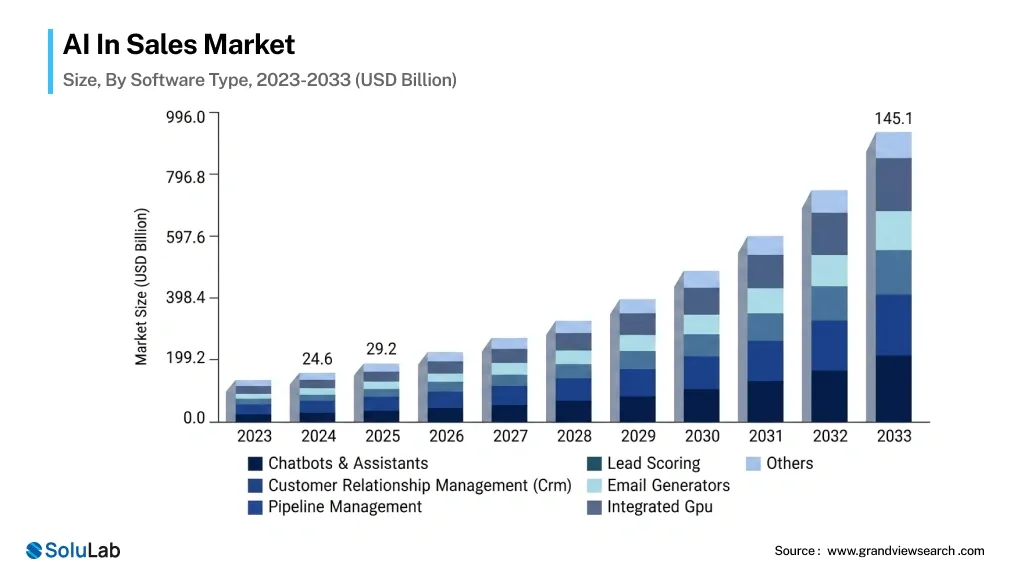
It helps businesses respond faster, reduce lead drop-off, shorten sales cycles, and increase conversion rates by using data-driven insights. The global AI in sales market size is projected to reach USD 145.12 billion by 2033.
Why Businesses Should Start Using AI in Sales?
AI is helping businesses move from reactive selling to proactive revenue growth by improving speed, accuracy, and customer engagement across every stage of the sales process.
- Faster lead qualification: AI quickly analyzes customer behavior, engagement history, and buying signals to identify high-potential leads, helping sales teams focus on prospects most likely to convert.
- Better personalization at scale: AI enables tailored outreach based on customer preferences, past interactions, and intent signals, making sales communication more relevant without increasing manual effort.
- Improved response time: AI-powered chatbots, alerts, and follow-up recommendations help businesses respond faster to inquiries, reducing lead drop-offs and improving customer experience.
- Higher sales productivity: AI automates repetitive tasks like CRM updates, meeting notes, scheduling, and reporting, allowing sales teams to spend more time selling and less on admin work. AI-driven sales automation can help teams save 2 to 3 hours per day.
- Smarter sales forecasting: AI analyzes pipeline trends, deal movement, and historical performance to provide more accurate forecasts, helping leaders make better revenue decisions.
- Reduced customer churn: AI detects early signs of disengagement or churn risk, enabling teams to take timely action and improve retention before customers are lost.
- Stronger sales coaching: AI reviews calls, emails, and deal patterns to identify skill gaps, helping managers coach teams more effectively and improve close rates.
- Better decision-making: AI turns large volumes of sales data into clear insights, helping businesses identify bottlenecks, optimize strategies, and make faster, informed decisions.

Benefits of AI-driven Sales and Marketing
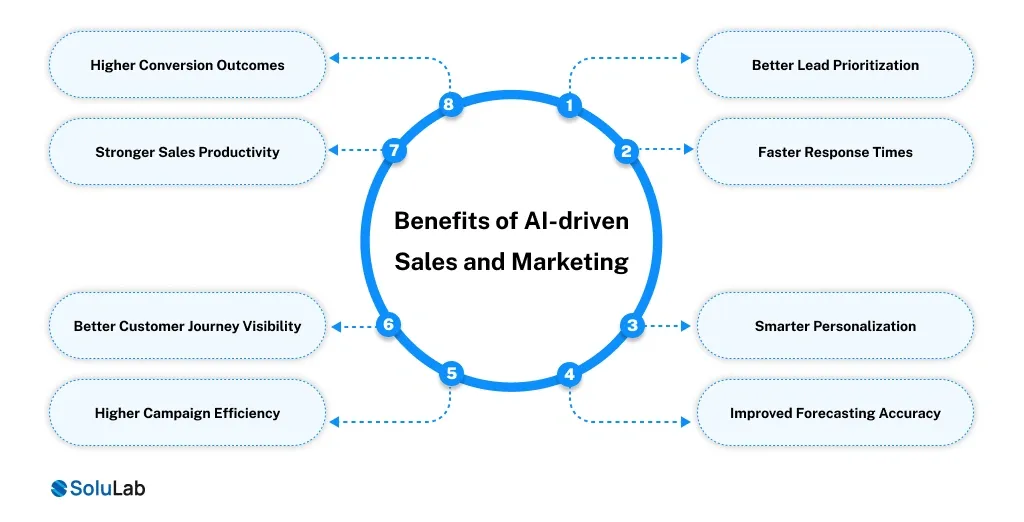
AI is helping sales and marketing teams move faster, respond smarter, and improve conversions by turning scattered customer data into timely actions that support better decisions across every stage.
- Better lead prioritization: AI Sales Solutions help teams identify high-intent prospects by analyzing behavior, engagement history, and buying signals, so sales efforts focus on leads most likely to convert.
- Faster response times: AI automates follow-ups, lead routing, and first-level responses, reducing delays that often cause drop-offs and helping teams engage prospects while interest is still high.
- Smarter personalization: AI studies customer preferences, browsing patterns, and past interactions to tailor messages, offers, and campaigns, making outreach more relevant and improving engagement quality.
- Improved forecasting accuracy: AI detects pipeline risks, deal delays, and revenue trends early, helping teams make more informed decisions instead of relying on assumptions or outdated reports.
- Higher campaign efficiency: AI helps marketers optimize audience targeting, budget allocation, and content performance in real time, reducing wasted spend and improving return on marketing investments.
- Better customer journey visibility: AI connects insights across channels, giving teams a clearer view of customer behavior and helping improve touchpoints from awareness to conversion.
- Stronger sales productivity: AI reduces manual work like CRM updates, reporting, and data entry, allowing teams to spend more time on conversations, strategy, and closing deals.
- Higher conversion outcomes: AI-powered sales conversion improves through predictive recommendations, timely nudges, and intelligent engagement that help move prospects through the funnel faster.
Why Do Traditional Sales Processes Not Work Anymore?
Traditional sales have had their moment. But the buyer has changed, and the process hasn’t kept up. Here’s why that gap is costing you deals.
- Your pipeline moves slower than your buyer’s patience: Buyers research, decide, and move on fast. But most sales teams are still waiting on weekly reports and manual follow-ups to figure out who’s ready. By the time your rep acts, the window has closed. AI Sales Solutions give your team signals in real time, not in retrospect.
- Everyone gets the same pitch even when they shouldn’t: A CFO and a Head of Marketing don’t buy the same way. But traditional sales scripts treat them like they do. AI-led development solutions tailor outreach, messaging, and timing to each buyer’s actual behavior, not a persona someone wrote in 2019.
- Forecasting is still basically gut feeling with a spreadsheet: Most sales forecasts are built on rep opinions and CRM notes that are three days old. That’s not a forecast, that’s a guess. When deals slip, nobody saw it coming. AI Sales Solutions replace the guesswork with patterns your team can actually trust.
- Reps spend more time on admin than actual selling: Data entry, follow-up emails, logging calls, updating stages, it adds up to hours every week. That’s time not spent in front of buyers. Custom AI Solutions automate the busywork so your reps show up to conversations prepared, not burned out.
- Hot leads and cold ones look the same in the CRM: Without smart scoring, every lead gets roughly the same attention, or the squeaky wheel does. Real buying signals get missed while reps chase accounts that were never going to close. AI Sales Solutions surface the right accounts at the right moment, automatically.
How can AI automate lead generation in sales processes?
AI native strategy is changing how sales teams find, qualify, and nurture leads, cutting hours of manual work down to minutes. Here’s how AI automates lead generation in sales:
- Scrapes and enriches prospect data automatically: AI tools scan LinkedIn, company websites, and databases to pull contact details, job titles, and firmographic data without anyone lifting a finger.
- Scores leads based on real buying signals: Instead of guessing, AI ranks prospects by analyzing behavior like email opens, page visits, and content downloads to predict who’s most likely to convert.
- Writes and sends personalized outreach at scale: AI drafts tailored emails or messages for hundreds of leads simultaneously, adjusting tone and content based on each prospect’s industry and role.
- Qualifies inbound leads instantly: AI chatbots on your website ask the right questions 24/7, filter out poor fits, and pass only sales-ready leads to your team.
- Identifies lookalike audiences: AI analyzes your best existing customers and finds new prospects across the web who share the same profile, expanding your pipeline automatically.
- Predicts the best time to reach out: By studying engagement patterns, AI recommends the exact day and time a specific lead is most likely to respond to your message.
How to Successfully Implement AI in Your Sales Process?
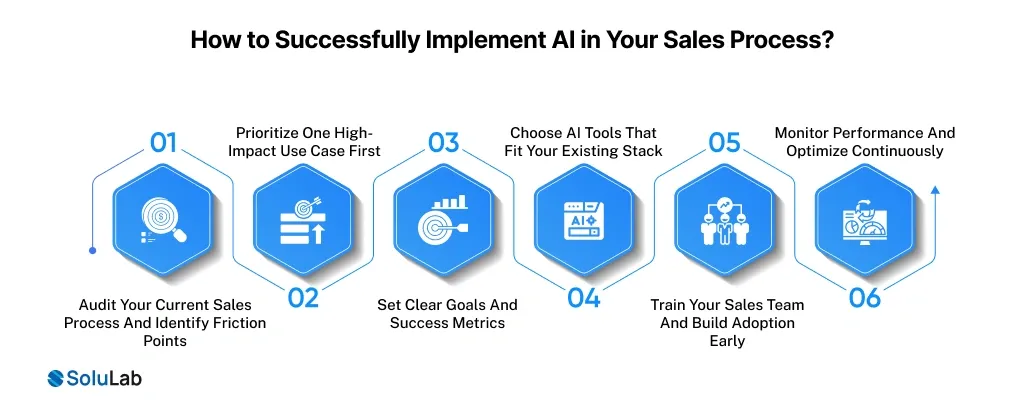
A successful AI sales rollout starts by fixing real workflow gaps, not by adding more tools. The best results come from solving clear bottlenecks, improving team adoption, and measuring impact from the start.
1. Audit Your Current Sales Process and Identify Friction Points
Start by reviewing your full sales funnel to understand where time is being lost. Look at lead response delays, follow-up gaps, poor CRM hygiene, and forecasting issues before deciding where AI consulting can create the most value.
2. Prioritize One High-Impact Use Case First
Avoid trying to automate everything at once. Begin with one practical AI use case, such as lead scoring, follow-up reminders, or call summaries, so your team can test the impact without disrupting daily sales activities.
3. Set Clear Goals and Success Metrics
Define what success looks like before implementation begins. Set measurable KPIs such as response time, lead conversion rate, sales cycle length, or forecast accuracy to track whether AI is delivering business value.
4. Choose AI Tools That Fit Your Existing Stack
Select solutions that integrate smoothly with your current CRM, outreach tools, and reporting systems. A connected setup reduces manual work, avoids duplicate data, and helps teams adopt the new workflow faster.
5. Train Your Sales Team and Build Adoption Early
AI works best when your team understands how to use it confidently. Provide hands-on training, explain how it supports daily tasks, and address concerns early to encourage trust and consistent usage.
6. Monitor Performance and Optimize Continuously
AI implementation is not a one-time setup. Review performance regularly, gather feedback from sales reps, and refine workflows based on results to improve efficiency and long-term revenue outcomes.
AI for Sales vs. Traditional Sales Automation
Traditional sales automation helps teams complete repetitive tasks, but it often lacks context and adaptability. AI adds intelligence, helping sales teams make faster decisions, personalize outreach, and improve conversion outcomes.
| Aspect | AI for Sales | Traditional Sales Automation |
| Decision-Making | Uses data patterns and buyer signals to recommend next actions and improve sales outcomes. | Follows fixed rules and workflows without understanding changing buyer behavior. |
| Lead Prioritization | Scores lead based on intent, engagement, and historical conversion trends. | Relies on manual sorting or basic filters with limited accuracy. |
| Personalization | Tailors emails, follow-ups, and messaging based on customer context. | Sends predefined templates and scheduled messages with little flexibility. |
| Forecasting | Predicts deal risks, close timelines, and revenue trends proactively. | Reports past pipeline activity without strong predictive insight. |
| Efficiency | Reduces manual work while improving rep productivity and response speed. | Automates repetitive tasks but still depends heavily on human input. |
| Learning Ability | Continuously improves using new sales data and customer interactions. | Does not learn or adapt unless workflows are manually updated. |
Top 7 AI in Sales Use Cases
A modern sales team cannot rely on speed alone anymore. AI app development helps teams improve timing, personalize every interaction, reduce manual effort, and make smarter decisions across the sales cycle.
1. AI Emails and Call Scripts for Relevancy at Scale
AI helps sales teams create context-aware emails, follow-up messages, and call scripts tailored to buyer intent, past interactions, and funnel stage. This improves response rates while reducing the time reps spend drafting outreach manually.
2. AI Account Research for Strategic Outreach
An AI tool can instantly analyze company websites, recent news, funding updates, and buyer signals to prepare sales reps before outreach. This helps teams approach prospects with stronger context and more relevant conversations from the start.
3. AI-Powered Spam Detection and Lead Filtering
AI helps identify fake, duplicate, or low-quality leads before they enter the pipeline. By filtering spam submissions and irrelevant inquiries early, sales teams can focus only on opportunities with genuine revenue potential.
4. AI Scorecards to Automate Call Reviews
AI models can automatically review sales calls for talk-to-listen ratio, objection handling, compliance, and tone. This saves managers hours of manual QA work while helping teams coach reps using clear performance insights.
5. AI Research and Account Summaries
Before meetings or demos, AI can generate quick account summaries by pulling together CRM history, prior conversations, open tickets, and business updates. This helps reps enter discussions prepared and more confident.
6. AI Lead Scoring for Better Prioritization
AI analyzes behavioral signals, engagement history, and past conversion patterns to rank leads by likelihood to close. This helps sales teams prioritize high-intent prospects instead of wasting time on low-value opportunities.
7. AI Follow-Up Recommendations and Deal Risk Alerts
AI tracks email opens, reply patterns, inactivity, and deal movement to suggest the best next action. It can also flag stalled opportunities early, helping teams re-engage prospects before deals are lost.
How SoluLab Helps Businesses Build AI Sales Solutions?
As an AI-native company, SoluLab helps businesses build practical sales solutions that improve lead quality, workflows, and create more predictable revenue across modern sales teams.
- AI-powered sales assistants and chatbots
- CRM intelligence and workflow automation
- AI email personalization engines
- Sales call transcription and coaching tools
- Pipeline forecasting and deal risk analytics
- Custom sales dashboards and reporting tools
- CRM and third-party sales stack integrations
- AI sales process consulting and implementation
For example, SoluLab built CyberHulk, an AI-powered marketing SaaS platform that unified campaign management, lead generation, analytics, and workflow automation.
By integrating multiple marketing tools into one system, CyberHulk helped businesses reduce manual effort, improve lead quality, and make faster, data-driven growth decisions across channels.
Want one for your business? Get in touch now!
The Future of AI in Sales
The future of AI in sales lies in making every customer interaction faster, smarter, and more contextual. As global AI trends evolve, AI will help teams reduce friction, improve timing, and close deals more efficiently.
- Hyper-personalized buyer engagement: AI will analyze customer behavior, preferences, and past interactions to create tailored outreach strategies, helping sales teams deliver more relevant conversations that improve trust and conversion rates.
- Real-time lead prioritization: Future AI systems will continuously score leads based on live intent signals, enabling sales teams to focus on high-conversion opportunities instead of wasting time on low-value prospects.
- Predictive deal forecasting: AI will move beyond historical reporting by identifying deal risks, revenue gaps, and buying patterns early, helping businesses make faster and more accurate sales decisions.
- Autonomous sales assistance: AI-powered assistants will handle repetitive tasks like scheduling, follow-ups, CRM updates, and meeting summaries, allowing sales reps to spend more time building relationships.

Conclusion
AI for sales is no longer just a productivity tool. It has become a practical way for businesses to reduce lead drop-off, improve response times, and create more consistent customer experiences.
From smarter lead qualification to personalized follow-ups and better forecasting, AI helps sales teams work more efficiently while improving conversion outcomes.
The key is choosing solutions that fit your sales process and customer journey. Businesses that adopt AI thoughtfully today will be better positioned to scale faster and compete more effectively tomorrow. SoluLab, an AI integration company, can help your business build tailored AI sales solutions that deliver measurable results.
FAQs
Neha is a curious content writer with a knack for breaking down complex technologies into meaningful, reader-friendly insights. With experience in blockchain, digital assets, and enterprise tech, she focuses on creating content that informs, connects, and supports strategic decision-making.