
Key Takeaways
- Compliance is an engineering skill, not a checkbox. Evaluate it like you’d evaluate API design.
- Three constraints separate fintech from general development: audit exposure, money-movement correctness, and security-by-default architecture.
- Idempotency is the interview tell. Ask how a retried request avoids double-charging. A duplicate row is an inconvenience in CRUD, a compliance incident in payments.
- Pick your hiring model by who owns audit liability, not by rate. Freelancers carry none; a dedicated team shares posture; a full partner designs it in.
- Security retrofits cost more than security by design. Tokenization, encryption and audit trails are week-one decisions.
- The hourly rate understates the real number. Security tooling, penetration tests and audits make regulated projects overrun after launch, not during the build.
- Raise AI and blockchain in the first call. Fraud scoring and stablecoin settlement are now common, and few staffing vendors have shipped either.
A fintech developer builds software that moves, stores, or reports on other people’s money, which means the job carries three constraints a general app developer rarely faces: regulatory and audit exposure (PCI-DSS, KYC/AML, GDPR), money-movement correctness (ledgers, reconciliation, idempotent transactions), and security-by-default engineering (tokenization, encryption, audit trails). This guide covers how to hire fintech developers: engagement models, skills, cost, compliance, and how to evaluate SoluLab as a partner.
Most readers here already know they need engineers and are weighing which engagement model fits their compliance exposure and what this actually costs. This article answers both directly, with a decision-oriented comparison table most agency guides skip. If you’re also evaluating AI talent for fraud or risk-scoring work, see SoluLab’s broader hire AI developers page for that adjacent hiring path.

What makes hiring a fintech developer different from a regular developer?
A general web or mobile developer optimizes for feature velocity. A fintech developer has to optimize for velocity, and three things a typical job description skips:
- Regulated, audited environments. Fintech code is routinely reviewed against frameworks like PCI-DSS (card data), SOC 2 (operational controls), KYC/AML (identity and transaction monitoring), and GDPR (data privacy). A developer who’s never had code reviewed by an external auditor tends to underestimate how much documentation an audit requires.
- Money-movement correctness. Ledgers have to balance, reconciliation has to be exact, and every transaction-affecting operation needs to be idempotent so a retried request never double-charges a customer. That’s a different discipline from CRUD development, where a duplicate row is an inconvenience, not a compliance incident.
- Security-by-default engineering. Tokenization, encryption at rest and in transit, and immutable audit trails aren’t add-ons bolted on before launch; they’re architecture decisions made in week one, since retrofitting them onto a live data model is expensive and risky.
The practical takeaway: compliance isn’t a checkbox ticked after the code ships. It’s an engineering skill, on par with API design, and you should evaluate it the same way when you hire fintech developers.
What skills and tech stack should a fintech developer have?
A capable fintech engineer brings four layers of skill, and most candidates are strong in one or two but weak in the others.
- Backend and languages. Python, Java, Node.js, and Go are the most common backend languages in production fintech systems, valued for handling concurrent transactions and mature financial libraries. Strong typing matters more here, since a silent failure in a payment path is a financial incident, not a bug ticket.
- Payment and financial data APIs. Practical experience integrating gateways, Stripe, Plaid, or comparable providers for card processing and bank verification, plus webhook reliability and reconciliation against provider-side records.
- Security and compliance implementation. Hands-on experience actually building tokenization, field-level encryption, access control, and audit logging, not just familiarity with PCI-DSS as a term.
- AI/ML and blockchain in fintech. This is where SoluLab’s background as an AI and blockchain engineering firm is a genuine differentiator: fraud and risk-scoring models, and blockchain-based settlement or tokenized-asset infrastructure, are increasingly part of modern fintech roadmaps, and few staff-augmentation vendors have engineers who’ve shipped either.
What are the fintech developer hiring and engagement models?
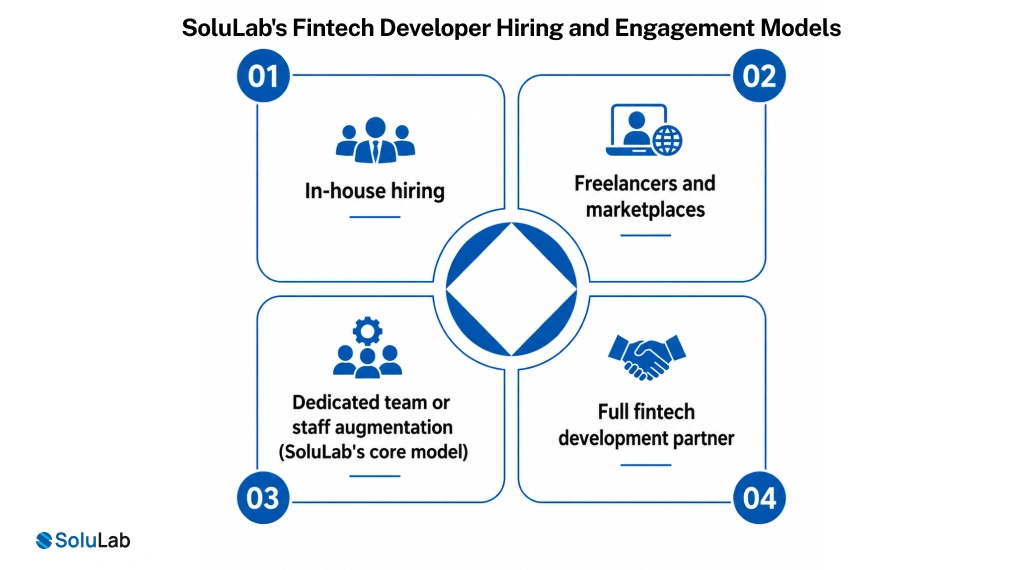
There are four broad ways to get fintech engineering capacity, and each shifts risk, cost, and control differently.
- In-house hiring. Recruit, employ, and manage developers directly. Maximum control and institutional knowledge, but slow to scale and expensive to staff for intermittent compliance skills.
- Freelancers and marketplaces. Fast to start, flexible for narrow tasks. Weakest fit for regulated work, since compliance liability and continuity are hard to enforce with an individual contractor outside a formal process.
- Dedicated team or staff augmentation (SoluLab’s core model). A vetted team embeds with your roadmap on an ongoing basis, giving near-in-house control without the overhead of direct employment. Most fintech founders land here once they’ve priced out the alternatives.
- Full fintech development partner. An end-to-end engagement covering architecture, compliance, and build, where the vendor owns broader technical outcomes, not just headcount.
In-house vs freelance vs dedicated team vs agency: which is right for you?
The right model depends less on budget alone and more on who owns compliance liability and audit readiness, the risk most guides gloss over.
| Model | Hiring speed | Cost profile | Control | Scalability | Compliance/audit ownership | Best-fit stage |
| In-house | Slowest | Highest fixed cost | Highest | Slow | Fully on you; no partner for audit prep | Later-stage teams, permanent core |
| Freelancer/marketplace | Fastest | Lowest rate, highest hidden risk | Low, inconsistent | Poor | Effectively none; rarely addressed | Small, non-regulated tasks only |
| Dedicated team (SoluLab) | Fast | Mid-range, predictable | High | Strong | Shared: vendor supports posture, client retains liability | Startups through mid-market |
| Full fintech partner | Moderate | Higher upfront, often lower TCO | Shared | Strong | Strongest; designed in from architecture | Greenfield or compliance-driven rebuild |
How much does it cost to hire fintech developers?
Published rate cards vary widely because “fintech developer” spans a junior integration engineer and a senior architect who’s led a PCI audit. As a market-level orientation, not a SoluLab quote: hourly rates commonly cited across staffing sources run roughly $40 to $80/hr in Eastern Europe or India, and $90 to $150/hr in the US or Western Europe for mid-to-senior fintech talent
What actually drives the cost
- Seniority and specialization. A developer who’s shipped a PCI-DSS-scoped payment flow costs more than one who’s only worked on non-regulated apps, a premium justified by reduced rework risk.
- Compliance scope. The more frameworks a build touches (PCI-DSS plus KYC/AML plus GDPR, say), the more architecture review and audit prep gets built into the estimate.
- Integration count. Every payment gateway or identity-verification provider adds design, testing, and edge-case time beyond the base build.

The total cost of ownership regulated software actually carries
Most cost guides stop at the hourly rate, which understates the real number for regulated software. Total cost of ownership adds recurring security tooling (static analysis, dependency scanning, penetration testing), periodic audits and remediation, and ongoing time maintaining audit trails as the product evolves. Budgeting for the build alone is a common reason fintech projects run over budget after launch, not during it.
How do you ensure your fintech developers build securely and stay compliant?
Compliance has to be implemented in the code, not documented after the fact.
- PCI-DSS in practice. Tokenization replaces raw card numbers with non-sensitive tokens wherever possible, shrinking PCI audit scope. Combined with field-level encryption and network segmentation, this is how a fintech team reduces audit burden and breach blast radius.
- KYC/AML and identity flows. These requirements translate into engineering work: identity-verification integrations, transaction-monitoring rules that flag suspicious patterns, and case-management workflows, built with the same rigor as the core product.
- Audit trails and secure SDLC. Every transaction-affecting change needs an immutable log of who did what, when, backed by code review gates and a documented lifecycle a third-party auditor can walk through.
How long does it take to hire and onboard fintech developers?
Market-wide, sources commonly cite roughly 5 to 7 business days from kickoff to a matched, onboarded fintech developer or team through an established staffing or dedicated-team partner, versus weeks to months for a direct in-house hire. The variables that move this number are how tightly scoped the skill set is, and how much compliance documentation needs review before code access is granted.

Why hire fintech developers from SoluLab?
SoluLab’s fintech engineering practice sits inside a broader AI and blockchain consulting firm, the differentiator that matters most for a modern fintech roadmap. Two capabilities most staff-augmentation vendors don’t have in-house:
- AI/ML for fraud and risk scoring. Transaction-level fraud detection and credit-risk models built on the same data your product already generates, rather than a bolt-on black box.
- Blockchain for settlement and tokenized assets. Engineers who’ve shipped blockchain-based settlement rails or tokenized-asset infrastructure, relevant for roadmaps touching stablecoins or cross-border settlement.
For AI talent alongside your fintech hire, such as a risk-scoring model, see SoluLab’s hire AI developers page. Comparing a full-service partner rather than individual hires? See SoluLab’s fintech app development company and fintech software development company pages.
FAQs
Neha is a curious content writer with a knack for breaking down complex technologies into meaningful, reader-friendly insights. With experience in blockchain, digital assets, and enterprise tech, she focuses on creating content that informs, connects, and supports strategic decision-making.