
Key Takeaways
- Most health systems are no longer asking whether to adopt AI. They are being asked to show measurable returns on what they already deployed.
- Ambient clinical documentation is the first genuinely proven generative AI use case in healthcare, with published burnout reductions behind it.
- Regulatory deadlines, not vendor roadmaps, are setting the interoperability timeline for 2026.
- Cybersecurity has stopped being an IT line item and become a board-level budget on par with AI spending.
- Smaller domain-specific models are displacing general-purpose ones for clinical and revenue cycle work.
- The gap between a working pilot and a production system is governance, integration and validation, not model quality.
Healthcare technology budgets in 2026 are being scrutinised harder than at any point since the EHR rollouts. Leaders bought AI, telehealth and analytics at pace. Now finance wants the numbers.
The pressure is real, but the market keeps expanding around it. Grand View Research values the global digital health market at $347.4 billion in 2025, reaching $420.2 billion in 2026 and a projected $1.83 trillion by 2033. Deloitte’s 2026 Global Health Care Outlook, built on a survey of 180 C-suite executives across six developed markets, found more than 80% of non-US executives holding a positive or cautiously positive view of their organisation, while 20% of US respondents reported a negative industry outlook and 33% felt uncertain.
That split matters. The trends below are the ones executives are actually funding, not the ones generating conference talks.

What Are the Top Healthcare Industry Trends in 2026?
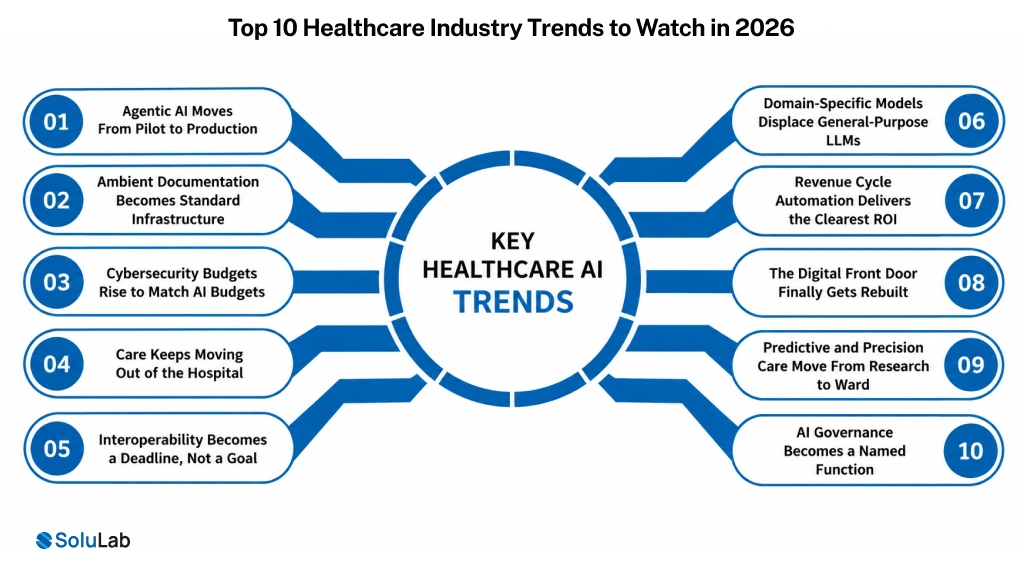
The dominant healthcare industry trends in 2026 cluster around four pressures: margin, workforce, regulation and trust. Each trend below maps to at least one of them, which is a useful filter when a vendor pitch arrives with no clear business case attached.
| Trend | Pressure it answers | Maturity in 2026 |
| Agentic AI in operations | Margin, workforce | Early production |
| Ambient clinical documentation | Workforce | Proven, scaling |
| Cybersecurity and resilience | Trust, regulation | Mandatory |
| Care outside the hospital | Margin, access | Scaling |
| Enforced interoperability | Regulation | Deadline-driven |
| Domain-specific models | Margin, accuracy | Emerging fast |
| Revenue cycle automation | Margin | Proven |
| Digital front door | Access, retention | Mature but uneven |
| Precision and predictive care | Outcomes | Early |
| AI governance and assurance | Trust, regulation | Forming |
Top 10 Healthcare Industry Trends to Watch in 2026
These are ordered by how much attention they are getting in 2026 budget cycles, not by long-term significance.
1. Agentic AI Moves From Pilot to Production
Agentic systems that complete multi-step work rather than answer single questions are the defining shift of 2026. Deloitte found more than 80% of healthcare leaders believe generative and agentic AI can deliver moderate to significant value across clinical, business and back-office functions, yet roughly 30% of health systems are running generative AI at scale. The distance between those two numbers is the whole opportunity. Prior authorisation, eligibility checks, referral management and denials work are where the early production deployments sit, because they are high-volume, rule-heavy, and measurable. Teams building this usually start with a narrow workflow rather than a platform, which is the pattern we see work in AI agents in healthcare deployments that survive past the pilot phase.
2. Ambient Documentation Becomes Standard Infrastructure
Ambient scribes are the first generative AI use case in healthcare with a real evidence base. A 2025 JAMA Network Open study across six US health systems found clinician burnout fell from 51.9% to 38.8% after 30 days of ambient scribe use. A UChicago Medicine analysis found users spent 8.5% less total time in the EHR and over 15% less time composing notes than matched non-users. The time savings are more modest than vendors claim, and a 2026 study of roughly 1,800 clinicians across five academic centres found around 16 minutes saved per eight hours of care. Burnout reduction, not throughput, is the honest business case.
3. Cybersecurity Budgets Rise to Match AI Budgets
Healthcare has been the most expensive industry for data breaches for 14 consecutive years, averaging $7.42 million per incident and 279 days to identify and contain, according to IBM’s Cost of a Data Breach Report 2025. US organisations reported 772 large breaches to the Office for Civil Rights in 2025, exposing roughly 138.5 million records. Deloitte’s outlook notes boards are now allocating cyber budgets on par with AI and digital health investment. Any 2026 technology plan that treats security as a later phase will not survive procurement.
4. Care Keeps Moving Out of the Hospital
Outpatient, virtual and home-based care continue to absorb volume that used to require a bed. Deloitte found non-US leaders prioritising care model transformation toward outpatient, virtual and preventive care, while US systems remain partly constrained by fee-for-service incentives that still reward treatment over prevention. The technical implications are unglamorous and expensive: device integration, remote monitoring data pipelines, and clinical escalation logic that works when the patient is 40 miles away.
5. Interoperability Becomes a Deadline, Not a Goal
Data sharing in 2026 is driven by regulation rather than goodwill. The CMS interoperability and prior authorisation rule (CMS-0057-F) has put hard implementation dates on FHIR-based APIs for payers, and Gartner has assigned intelligent prior authorisation a “Transformational” benefit rating in its 2026 Hype Cycle for US healthcare health plans. Payers and providers that treated FHIR as a compliance checkbox are now discovering their data quality was the actual problem.
6. Domain-Specific Models Displace General-Purpose LLMs
General-purpose models are losing ground to smaller models tuned for narrow clinical and administrative domains. Gartner projects worldwide end-user spending on AI models and platforms will reach $64 billion in 2026, up 63.4% from $39 billion in 2025, with domain-specific language models forecast to grow 210% in the same year. For healthcare the appeal is practical: lower inference cost, smaller attack surface, easier validation, and output that can be traced to a defined corpus. Most generative AI in healthcare projects that fail cost review fail on token spend rather than accuracy.
7. Revenue Cycle Automation Delivers the Clearest ROI
Claims, coding, denials and patient billing remain the most reliable place to find a payback period under 12 months. Deloitte reported 64% of executives saying AI could reduce costs by standardising and automating workflows and 55% pointing to workforce optimisation through predictive analytics. Revenue cycle work is attractive precisely because the baseline is measurable: denial rates, days in accounts receivable, and cost to collect are all tracked before the project starts.
8. The Digital Front Door Finally Gets Rebuilt
Scheduling, intake, triage and follow-up are being consolidated into single patient-facing experiences after a decade of app sprawl. Most systems now have six or seven patient touchpoints that do not share state, which is why booking an appointment still means re-entering insurance details. Consolidation projects here usually involve less new development than expected and more integration work, and they overlap heavily with healthcare app development roadmaps already in flight.
9. Predictive and Precision Care Move From Research to Ward
Risk stratification, sepsis prediction, readmission modelling and precision treatment selection are graduating from research settings into operational use. The hard part is rarely the model. It is the alert design, the clinical workflow it interrupts, and whether anyone acts on the output. Deployments that skip the change management step produce accurate predictions nobody reads.
10. AI Governance Becomes a Named Function
Validation, monitoring, bias testing, and model inventory are becoming a defined role rather than a side task for the CISO. Gartner’s strategic predictions note that through 2026, the erosion of critical thinking from generative AI use will push 50% of global organisations to require AI-free skills assessments, with high-stakes sectors including healthcare facing the sharpest talent scarcity.
Regulators are moving the same way. Organisations that cannot say which models are in production, what they were trained on, and who validated them will struggle in their next audit.
How Big Is the Digital Health Market in 2026?
The digital health market is worth roughly $181 billion to $420 billion in 2026, depending on how narrowly it is defined, and every credible forecast points in the same direction.
1. The Two Numbers Worth Quoting
Statista projects digital health revenue of US$181.25 billion in 2026, growing at 8.44% annually to US$271.82 billion by 2031, with the United States generating US$55.25 billion of the 2026 total. Grand View Research, using a broader definition that includes health systems software and analytics, puts 2026 at $420.2 billion with a 23.4% growth rate through 2033. The gap between them is definitional, not contradictory.
2. What the Spread Actually Tells You
Narrow definitions cover consumer-facing digital health. Broader ones include the enterprise software and infrastructure layer where most provider spending sits. If you are building a business case, cite the definition that matches your segment rather than the largest number available.
3. Where the Growth Concentrates
North America held the largest regional share in 2025 at roughly 43%, while Asia Pacific is forecast to grow fastest. For US-based health systems, that means the vendor landscape will get more crowded and more international over the next three years.
What Does Healthcare Technology Cost to Build in 2026?
Healthcare technology development costs in 2026 depend on the solution’s features, integrations, complexity, and compliance needs.
| Healthcare Technology | Estimated Cost |
| Telemedicine App | $30,000 to $50,000 |
| Patient Portal | $30,000 to $50,000 |
| Healthcare Management System | $60,00+ |
| AI Healthcare Chatbot | $80,000+ |
| Remote Patient Monitoring | $60,000 to $120,000+ |
| AI Diagnostic Solution | $60,000 to $120,000+ |
| Healthcare Analytics Platform | $60,000 to $120,000+ |
| EHR System | $60,000 to $120,000+ |
Why Do Most Healthcare AI Pilots Stall Before Production?
Healthcare AI pilots usually stall for reasons that have nothing to do with model performance. In our experience reviewing stalled projects, the blocker is almost always integration, governance or clinical workflow fit.
1. Integration Debt
The pilot ran on exported data. Production needs live EHR integration, which means HL7 or FHIR interfaces, an interface engine, and someone who owns the mapping. This is typically where a six-week pilot becomes a nine-month project.
2. No Owner for Validation
Somebody has to sign off that the model performs acceptably on this population, and re-check it quarterly. When that role is undefined, legal and compliance stop the rollout, correctly.
3. Workflow Fit
A model that adds two clicks to a clinician’s day will not be used, regardless of accuracy. The successful deployments remove steps rather than add them. Teams with experience in machine learning development for regulated environments generally design the workflow before the model.
What Should Healthcare Leaders Prioritise First in 2026?
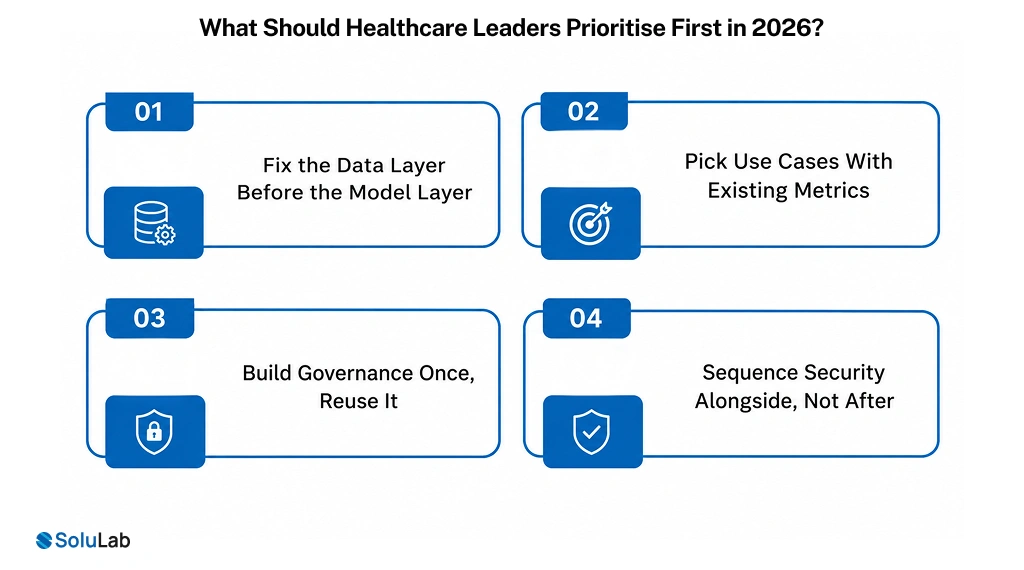
Start where the baseline is already measured, the regulation is already dated, and the workflow already has an owner. That combination is rarer than it sounds and it is what separates funded projects from stalled ones.
1. Fix the Data Layer Before the Model Layer
Interoperability work is unexciting, and it gates everything else. Clean, mapped, accessible clinical and claims data makes every subsequent AI project cheaper.
2. Pick Use Cases With Existing Metrics
Denial rate, documentation time, no-show rate, time to prior authorisation. If you cannot state the current number, you cannot prove improvement.
3. Build Governance Once, Reuse It
A model inventory, a validation protocol and a monitoring dashboard should be built once and applied to every subsequent deployment. Doing this per project is how organisations end up with 14 models and no oversight.
4. Sequence Security Alongside, Not After
Threat modelling and access design belong in the architecture phase. Retrofitting HIPAA-grade controls costs considerably more than designing for them, which is standard practice for any competent AI development company working in regulated healthcare.
How Do You Evaluate a Healthcare Technology Partner?
Evaluate on regulated-environment experience and integration depth rather than general AI credentials. Most vendors can demo a model. Far fewer have shipped one into a live clinical workflow and kept it validated.
1. Questions Worth Asking
Ask questions such as:
- Which EHRs have you integrated with directly?
- Who on your team owns clinical validation?
- Show me a model you monitor in production and the drift report.
- What happened on the project that went badly?
2. Signals That Matter
Named architects rather than account managers, a security posture you can audit, and references from organisations of similar size and regulatory exposure. Teams that can also speak credibly to adjacent infrastructure, whether that is IoT development for connected devices or AI in healthcare for consent and provenance, usually have deeper systems experience than single-product vendors.
3. When to Hire Rather Than Outsource
Ongoing clinical model ownership belongs in-house eventually. Build phases, specialist integration work, and initial architecture are where external teams earn their fee. Many organisations hire AI developers for the build and transition ownership after go-live, which is usually the right sequencing.
What Are the Risks and Trade-Offs?
Every trend on this list carries a failure mode, and the honest version of this article names them.
1. AI Is an Efficiency Lever, Not a Strategy
Deloitte’s finding is blunt on this point: leaders see generative and agentic AI as an operational lever rather than a 2026 strategic game changer, with adoption limited, regulation evolving, and returns only beginning to materialise. Treating AI as a strategy rather than a tool produces expensive disappointment.
2. Automation Can Move Work Rather Than Remove It
Ambient scribes reduce documentation time without necessarily increasing throughput. That is a genuine win for clinician wellbeing and a weak one for capacity planning. Budget accordingly.
3. Consolidation Risk
The vendor landscape is consolidating. Architecture that assumes a specific vendor’s API will exist in three years is a risk that deserves an explicit mitigation, usually an abstraction layer.

Conclusion
The healthcare industry trends worth acting on in 2026 share a common shape. They answer a measured pressure, they have a regulatory or financial deadline attached, and they can be proven with numbers the organisation already tracks. The rest can wait a year without cost.
If your 2026 plan includes AI in clinical or revenue cycle workflows, the useful next step is an honest assessment of your data layer and integration surface before any model selection.
SoluLab, an AI development company, can help your business scope that work, build the integrations and governance that make deployment possible, and ship systems that pass clinical and security review.
FAQs
Shipra Garg is a tech-focused content strategist and copywriter specializing in Web3, blockchain, and artificial intelligence. She has worked with startups and enterprise teams to craft high-conversion content that bridges deep tech with business impact. Her work translates complex innovations into clear, credible, and engaging narratives that drive growth and build trust in emerging tech markets.