Generative AI architecture is the blueprint that decides whether your AI works for one team or for the whole company. It is the arrangement of data, models, orchestration, and controls that turns a promising demo into a system finance will sign off on and security will let through.
Most enterprises do not fail at generative AI because they picked the wrong model. They fail because nothing was designed to hold the data, the models, and the actual business workflows together. The pilot works. Then a second team asks for access, outputs drift, costs climb, and nobody can say which version answered which question.
Companies that get the foundation right report 15-30% productivity improvements. The difference is almost always architectural.
This guide covers what generative AI architecture is, the layers it contains, a reference architecture you can reuse, how it differs from AI platform and AI system architecture, and the build sequence that gets it into production.
Key Takeaways
- The Problem: AI efforts scatter. No agreed architecture, infrastructure bills that climb, and models that will not plug into the systems teams already use. Adoption slows and business impact stays thin.
- The Solution: Seven defined layers, data pipelines that hold under load, a deliberate model selection policy, and integration mapped before the first sprint. That is what turns a demo into something you can scale on purpose.
- The Shortcut: Start from a reference architecture instead of a blank page. The blueprint in this guide covers the request path, the deployment topology, and the guardrails most teams discover far too late.
- How SoluLab Helps: We are an AI-native company. We run AI inside our own delivery workflows, so the architecture we design for you is one we have already operated ourselves, not a diagram from a slide deck.
What Is Generative AI Architecture?
Generative AI architecture is the end-to-end design of how an organisation stores data, selects and calls models, controls outputs, and delivers results into the systems people already use. It is not the model. The model is one layer of seven.
A traditional application architecture moves records between a database and an interface. A generative AI architecture has to do something harder: assemble the right context for a question it has never seen, call a probabilistic model, check that the answer is grounded in real sources, and leave a trail that an auditor can follow.
That last requirement is what separates an enterprise architecture from a prototype. A prototype answers. An architecture answers, cites, logs, and stays within policy when the question is adversarial.
What Are the Layers in Generative AI Architecture?
Seven layers appear in almost every production generative AI system. Teams that skip one usually rediscover it during a security review or a cost escalation.
| Layer | What it does | Who typically owns it | What breaks without it |
|---|---|---|---|
| 1. Data | Ingests, cleans, chunks, and embeds source content into a vector store | Data engineering | The model invents answers because nothing grounds it |
| 2. Model | Hosts or calls foundation models, fine-tuned variants, and embedding models | ML engineering | Vendor lock-in and no way to compare cost or quality |
| 3. Orchestration | Routes requests, chains steps, calls tools, runs agent logic | Platform engineering | Every use case becomes bespoke code nobody can maintain |
| 4. Retrieval | Semantic search, reranking, and context assembly | ML engineering | Answers ignore your private knowledge entirely |
| 5. Guardrails | Input filtering, output validation, PII redaction, grounding checks | Security and risk | A public incident, and usually a policy freeze after it |
| 6. Integration | APIs, events, and connectors into CRM, ERP, and support tooling | Application teams | A working system nobody uses because it lives in a separate tab |
| 7. Observability | Tracing, evaluation, cost attribution, drift detection | Platform engineering | No way to prove value or diagnose a regression |
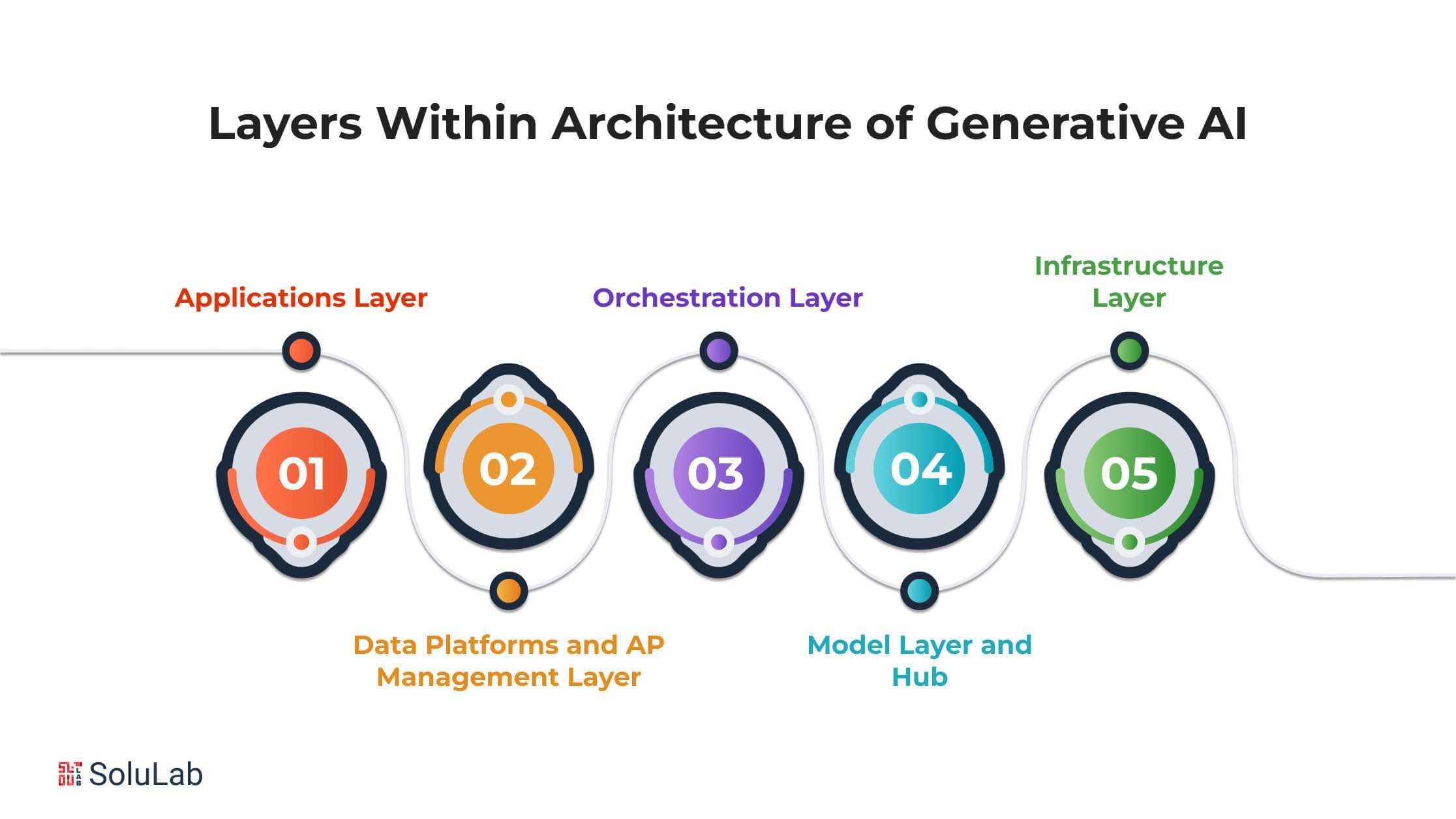
The layers are a checklist, not a build order. You will touch data and model first, but guardrails and observability have to be designed in from the start. Retrofitting them is where most timelines slip. Our guide to LLMOps covers the operational side of layers 5 through 7 in more depth.
Generative AI Reference Architecture: A Blueprint You Can Reuse
A reference architecture is a known-good starting arrangement. Instead of designing from a blank page, you adopt a proven request path and change only what your constraints demand. It shortens the design phase from weeks to days and makes security review far easier, because reviewers recognise the shape.
Three details in that path do most of the work and are the most commonly skipped:
- Entitlement checks at the orchestrator, not the retriever. Filter what a user is allowed to see before you search, not after. Post-filtering leaks through token counts and latency.
- A token budget at context assembly. Without one, retrieval quality silently degrades as your corpus grows and the most relevant chunk gets truncated away.
- Citations returned with the answer. This is the cheapest trust mechanism available, and it doubles as your grounding check.
If you are choosing between building this in-house and adapting an existing stack, our breakdown of how to create your own generative AI solution walks through the trade-off.
Where the Architecture Runs: Deployment Topology
The seven layers do not change with hosting. What changes is who operates them, where your data sits, and what the bill looks like in year two.
- Weeks to first release
- No GPU operations
- Data leaves your boundary
- Per-token cost scales with use
- Data stays in your tenancy
- Choice of open-weight models
- You own scaling and uptime
- Higher fixed cost
- Full data residency control
- Predictable long-run cost
- Months to stand up
- Real MLOps headcount needed
Most enterprises land on a split: a vendor API for low-sensitivity, high-volume work, and a private deployment for anything touching regulated data. Designing for that split early is far cheaper than migrating into it later.
Generative AI Architecture vs AI Platform Architecture vs AI System Architecture
These three terms get used interchangeably and they should not be. They describe different scopes, and confusing them is why architecture reviews stall.
| Generative AI architecture | AI platform architecture | AI system architecture | |
|---|---|---|---|
| Scope | One class of workload: generative and retrieval-augmented | Shared infrastructure serving many AI workloads | The full technical design of one AI-powered product |
| Primary concern | Grounding, context, and output control | Reuse, multi-tenancy, and governance at scale | Meeting one product requirement end to end |
| Typical owner | AI or ML engineering lead | Platform or enterprise architecture | Product engineering |
| Lifespan | Evolves with model releases | Multi-year | Tied to the product |
| You need it when | Your first GenAI use case goes to production | Your third or fourth team asks for the same capability | You are designing a specific application |
The practical rule: build a generative AI architecture for your first use case, and only extract an AI platform architecture once a third team needs the same capability. Building the platform first is how organisations spend a year on infrastructure nobody uses yet.
Application Architecture vs Model Architecture
Two more terms worth separating, because the skills and the decisions behind them are completely different.
Gen AI model architecture
This is the internal design of the model itself: transformer blocks, attention heads, parameter counts, context windows, and training objectives. Unless you are training a foundation model from scratch, you consume these decisions rather than make them. What you do decide is selection: which model, at what context length, at what cost per token, with what licence. Our overview of generative AI models and the LLM comparison cover that choice in detail.
Gen AI application architecture
This is everything around the model: how requests arrive, how context is built, how outputs are validated, how results reach users. This is where your engineering effort actually goes, and where nearly all the differentiation lives. Two companies using the identical model will get very different results based on this layer alone.
If you remember one thing: model architecture is a procurement decision, application architecture is an engineering discipline.
Integrating Generative AI with Enterprise Applications
An architecture that cannot reach your systems of record is a research project. Integration is layer 6, and it decides adoption more than model quality does.
- Embed, do not relocate. Put generated output inside the CRM record, the ticket, or the document the person already has open. A separate chat window competes for attention and usually loses.
- Write back through the same validation your apps already use. An AI-generated field should pass the identical rules a human-entered one does.
- Design for the failure case. Decide what happens when the model is slow, unavailable, or unsure. Degrading to the previous manual flow is a feature, not an admission.
- Attribute cost per use case from day one. Token spend that cannot be traced to a business owner becomes an unexplainable line item and then a cancelled budget.
Common integration points include customer support, where generated drafts reach agents inside the existing console (see customer service automation), sales workflows through conversational AI, and internal knowledge search across document repositories.
How to Build a Generative AI Architecture, Step by Step
A sequence that works, in the order that keeps you out of trouble.
| Step | What you do | Done when |
|---|---|---|
| 1. Pick one use case with a measurable owner | Choose a workflow where someone can state the current cost in hours or dollars | A named business owner agrees on the baseline number |
| 2. Map the data | Identify sources, sensitivity, refresh rate, and who is allowed to see what | You have an entitlement model, not just a data list |
| 3. Set the guardrail policy | Define what the system must never output and what must always be cited | Security and legal have signed the policy, before any build |
| 4. Stand up retrieval | Ingestion, chunking, embeddings, and a vector store with the entitlement model applied | Retrieval returns correct chunks for 20 real questions |
| 5. Select the model | Evaluate two or three against your actual prompts, not benchmarks | You have cost and quality numbers for your own workload |
| 6. Build the orchestration | Routing, context assembly, tool calls, and the guardrail chain | The full request path runs end to end with citations |
| 7. Instrument before launch | Tracing, evaluation set, cost attribution, and drift alerts | You can answer “why did it say that” for any past request |
| 8. Integrate and pilot | Put it inside the real tool, with a real team, with a fallback path | The owner from step 1 confirms movement against the baseline |
The order matters most at step 3. Teams that set the guardrail policy after building spend roughly twice as long, because the policy usually changes the retrieval design.
Generative AI Architecture Best Practices
| Do | Instead of |
|---|---|
| Keep model selection swappable behind an interface | Hard-coding one vendor SDK through your codebase |
| Version prompts and retrieval configs like code | Editing prompts in a console with no history |
| Build an evaluation set from real failed answers | Relying on public benchmarks that do not match your domain |
| Apply entitlements before retrieval | Filtering results after the search returns them |
| Cache aggressively at the embedding and response layer | Paying per token for the same question fifty times |
| Set a per-use-case cost ceiling with alerts | Discovering the bill at the end of the quarter |
| Return citations with every substantive answer | Asking users to trust an uncited paragraph |
| Plan for model deprecation on a six-month cycle | Assuming the model you launched on will still exist |
Applications of Generative AI Architecture Across Industries
The seven layers stay constant. What changes is which layer carries the most weight.
| Industry | Where the architecture is stressed | Typical application |
|---|---|---|
| Healthcare | Guardrails and audit. Every output needs provenance | Clinical documentation and prior-authorisation drafting |
| Banking and finance | Data residency and explainability | Risk narrative generation, KYC summarisation, advisor copilots |
| E-commerce | Retrieval freshness at catalogue scale | Product description generation and conversational merchandising |
| Retail | Integration breadth across store and online systems | Demand narrative, planogram assistance, associate support |
| Manufacturing | Edge deployment and offline tolerance | Maintenance instruction generation and quality report drafting |
For a deeper look at sector-specific patterns, see generative AI in manufacturing and our wider list of generative AI use cases. A worked example is in our generative AI mobile banking platform case study.
Where Generative AI Architecture Is Heading
- Small models at the edge of the architecture. Routing simple requests to a small local model and reserving the frontier model for hard ones is becoming the default cost strategy.
- Agentic orchestration as a first-class layer. Layer 3 is absorbing planning and multi-step tool use, which raises the importance of tracing in layer 7.
- Retrieval moving beyond vectors. Hybrid search combining keyword, vector, and graph traversal is outperforming pure semantic retrieval on enterprise corpora.
- Evaluation becoming continuous. Fixed test sets are giving way to sampled production traffic scored automatically against grounding and policy.
- Governance arriving as regulation. The audit trail in layer 7 is shifting from good practice to a compliance requirement.
Keep an eye on the generative AI tooling landscape, which is consolidating quickly around the orchestration and evaluation layers.
Final Words
Generative AI architecture is the difference between a demo that impresses a room and a system a business depends on. The seven layers, the reference request path, and the deployment topology in this guide are the parts that recur in every production system we have built.
The teams that succeed do not start with a platform. They start with one use case that has a measurable owner, design all seven layers for it, and only generalise once a third team asks for the same thing.
SoluLab is an AI-native company. We design, build, and operate scalable generative AI systems shaped around how your business actually runs. If you are deciding what to build or how to get an existing pilot into production, our generative AI development team can help.

FAQs

Shipra Garg is a tech-focused content strategist and copywriter specializing in Web3, blockchain, and artificial intelligence. She has worked with startups and enterprise teams to craft high-conversion content that bridges deep tech with business impact. Her work translates complex innovations into clear, credible, and engaging narratives that drive growth and build trust in emerging tech markets.