If you’re building for Japan, wallets can’t be treated like generic plumbing anymore. The market has moved on as there are now 12.4 million crypto users in Japan, and over ¥4.26 trillion ($27–30B) sitting on licensed exchanges and custodians. That’s real money, held in a system that actually works.
And in 2025, while many regions slowed down, Japan saw a 120% year-on-year jump in on-chain activity, leading APAC. At the same time, 27+ FSA-registered exchanges are live, listing 100+ assets, operating under strict rules, yes, but no longer hostile to innovation.
Crypto wallet development solutions themselves are also changing. What used to be a side feature is turning into the control layer. The wallet market is expected to grow from roughly $5–15B today to $50–100B+ in the next decade, and with forecasts pointing to 10% of global GDP being tokenized by 2027, wallets are where value, identity, and regulation collide.
So going into 2026, the question isn’t whether you need a wallet. You already do. The real question is whether what you’re building actually makes sense for Japan.
Key Takeaways
- The Problem – Japan’s 12.4M+ users, ¥4T+ in assets, and 120% YoY growth sit inside a dense, regulation-first market where generic wallets fail fast.
- The Solution – Japan needs wallets built for compliance, trust, and local flows, JPY rails, clear UX, and regulation-aware design, not global shortcuts.
- How SoluLab Helps – SoluLab can build Japan-ready crypto wallets aligned with FSA standards and future Web3 rails, designed to win users and enterprises long-term.
What Makes the Japanese Market Unique for Crypto Wallet Development?
If you’ve shipped in other regions, Japan will feel familiar on the surface, but behave very differently once you get into wallets, risk, and UX.
1. Regulation sets the tone.
Japan was one of the earliest countries to put crypto under a formal legal framework, largely as a response to Mt. Gox and Coincheck. The Financial Services Agency (FSA) and JVCEA have since built a system where custody, segregation of assets, cold‑hot ratios, and listing processes are tightly defined. That’s why Reuters can report investors holding over 5 trillion yen in crypto on domestic platforms without the market collapsing under security FUD.
2. Users here skew older and more conservative.
Analyses of the Trends of Japan in Web3 & Wallet show that most on‑ramp users are in their 30s and 40s, middle‑income, and motivated by wealth building rather than pure degenerate trading. That shapes what they ask a Web3 Wallet in Japan to do: stability, clear legal status, understandable tax records, and minimal surprises. Gamified chaos doesn’t convert well in this segment.
3. Institutions are finally leaning in.
APAC allocates billions in institutional crypto exposure, and Japan’s sandbox and tax reforms have attracted over 2 billion USD in FDI into blockchain infrastructure alone. For a crypto wallet platform in Japan for enterprises, this means you’re designing not just for retail flows but for treasury, tokenized assets, and future DCJPY/JPYC‑style rails under a highly supervised regime.
So, Japan is a trust‑first, regulation‑heavy, upside‑hungry market, and your wallet has to respect all three.
Core Criteria for Japan-Focused White-Label Crypto Wallet Development
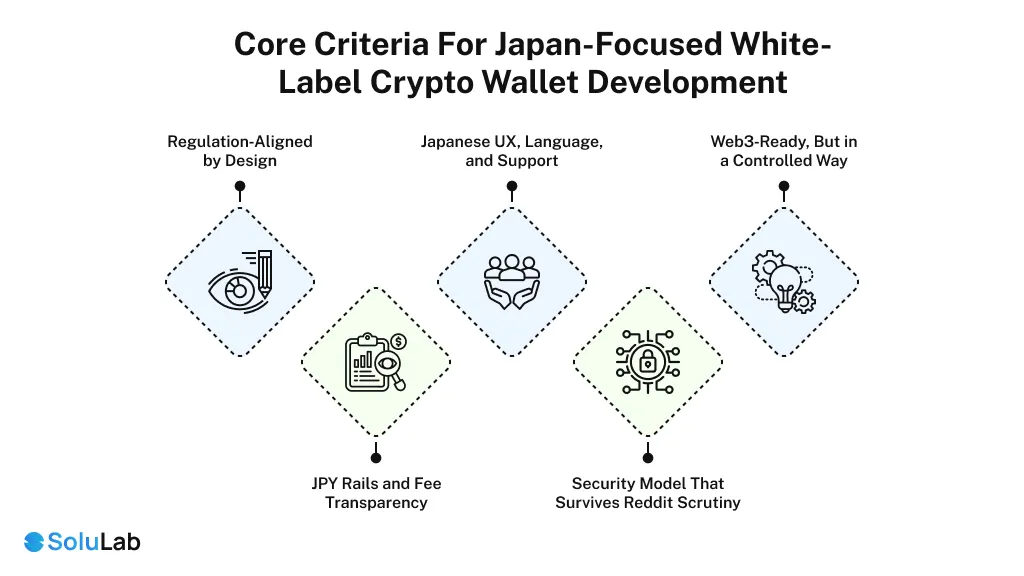
When you scope crypto wallet development with a Japan brief, these are the non‑negotiables you end up building around.
1. Regulation‑Aligned by Design
You cannot bolt compliance on later. The World Economic Forum’s digital asset regulation work makes it clear: Japan is treated as one of the reference jurisdictions for serious digital asset policy.
For a Japan-Focused White-Label Crypto Wallet, this usually means:
- Clear separation of custodial vs non‑custodial flows.
- Travel Rule‑ready data fields and audit trails.
- Support for FSA and tax office reporting expectations (lots of timestamped, exportable history).
- Governance hooks that your legal team can actually map onto internal controls.
A generic wallet SDK won’t cut it for serious corporates here. That’s where targeted White Label Crypto Wallet Development tends to show its value, and you get to embed your own policy, not just swap logos.
2. JPY Rails and Fee Transparency
Japanese users care deeply about fees and predictability. Statista’s data on exchanges, coins, and user activity matches what you see on the ground – heavy concentration on BTC, XRP, and a few majors, repeated interaction with local banks, and sensitivity to FX and spreads.
If you’re building Japan Crypto Wallet Applications and Platform, you want:
- Native JPY funding and withdrawal paths (via licensed partners).
- Clear display of spreads, gas, and FX in yen terms.
- Guardrails around withdrawal limits and risk flows that map to your compliance policies.
This is where thoughtful Crypto Wallet Development Services pay off, when your product, legal, and engineering leads sit together and design an experience that a Japanese regulator and a Japanese CFO are both comfortable with.
3. Japanese UX, Language, and Support
On paper, just translating the app sounds easy. In practice, Japanese users are remarkably good at spotting half‑done localization. That’s one of the fastest ways to lose trust.
A customized mobile crypto wallet for Japan tends to include:
- Full Japanese copy written by locals, not machine‑translated UI strings.
- Flows that respect Japanese documentation formats, addresses, and names.
- Support hours and channels that match local expectations (e.g., email with chat, not just Discord).
When you work with serious cryptocurrency wallet development teams, ask to see how they’ve handled Japanese UX before – error states, KYC flows, even how they present legal risk language. These are not aesthetic details; they influence conversion and complaint ratios.
4. Security Model That Survives Reddit Scrutiny
Between major hacks and exchange failures, Japanese retail and institutions are hyper‑sensitive to real security, not just badges. Community threads often call out reused seed phrases, poor backup UX, or hardware wallet scams.
A production‑grade crypto wallet app development cycle for Japan usually pushes for:
- Clear self‑custody education and safer default options.
- Support for hardware devices, MPC, or secure enclave signing for higher‑value users.
- Easy‑to‑understand risk segregation (e.g., daily‑use hot wallet vs long‑term cold).
If you plan to offer customized cryptocurrency wallet solutions to institutional clients, expect their CISOs to dig deep into key management, recovery flows, and monitoring. Show them the architecture, not just marketing copy.
5. Web3‑Ready, But in a Controlled Way
Global data from Statista shows that 80%+ of active wallet users now also interact with DeFi, NFTs, or other Web3 applications. In Japan, that’s growing from a smaller base but gaining speed thanks to government support for Web3, content NFTs, and tokenized finance.
For a Web3 Wallet in Japan, this doesn’t mean throwing users into the deep end of on‑chain risk. It means:
- Safe lists and curated dApp discovery.
- Clear contract interaction summaries.
- Built‑in guardrails against obvious scam patterns.
Done right, this is where a Japan-Focused White-Label Crypto Wallet becomes a strategic asset: you can give users Web3 access, but through your own risk lens and design system.
Mapping Crypto Wallet Development Choices to Real-World Use Cases in Japan
When you map the types of Wallets available in Japan to actual user journeys, patterns appear quickly.
1. Beginner retail investors via local exchanges
- Likely to start and stay on exchange‑hosted wallets.
- Need clear education to graduate to safer combinations (exchange + hardware).
- A good Japan Crypto Wallet Applications and Platform story is, we don’t force you off the exchange, we give you progressive options.
2. Active Web3 participants (DeFi, NFTs, gaming)
- Want non‑custodial control, multi‑chain support, and seamless dApp access.
- For them, a Web3 Wallet in Japan with strong UX and gas abstraction is your wedge into higher‑margin flows.
3. Long‑term HODLers
- Tend to favor hardware or high‑security setups; some may accept MPC for simplicity.
- Here, the right MPC Crypto Wallet Development decisions center on reducing operational mistakes (seed loss, wrong address) rather than chasing yield.
4. Enterprises and institutions
- Need governance, roles/permissions, policy‑driven approvals, and audit trails.
- A credible Crypto Wallet Platform in Japan for Enterprises lets them plug into tokenization, stablecoins, and on‑chain rails without breaking their internal control environment.
5. Global projects targeting Japanese users
- Shouldn’t launch a region‑agnostic wallet and localize later.
- This is where partnering on white label crypto wallet development or using a mature white-label solution in Japan gives you a faster, safer route into the market.
The thing is you don’t need one wallet, you need a wallet strategy that maps these segments to specific flows and interfaces. That’s what strong crypto wallet development services should deliver.
Common Mistakes Japanese Users Make When Choosing Web3 Wallets in Japan
If you spend time in Japanese forums, Reddit, and X, the same failure patterns show up again and again. These patterns should directly influence how you design and message your solution.
1. Leaving everything on a single exchange
- Even after the big hacks, plenty of users still park entire portfolios on one custodial wallet.
- A smart customized mobile crypto wallet experience teaches risk segmentation in‑app, not in a separate blog post.
2. Misunderstanding the difference between self‑custody and apps
- Users think that if it’s an app, the company can help me recover everything.
- Good cryptocurrency wallets in Japan are brutally clear about what is and isn’t recoverable, and guide users into safer setups.
3. Buying unverified hardware or using sketchy browser extensions
- A lot of horror stories in community threads are about phishing, fake apps, or compromised second‑hand devices.
- A responsible Japan Crypto Wallet Applications and Platform stack includes built‑in warnings and clear links to official hardware vendors and verified extensions.
4. Ignoring tax and reporting until it’s too late
- With Japan’s historically high tax rates on crypto, people discover the reporting pain only at filing time. Reforms that move toward flat 20% rates help, but don’t remove complexity.
- High‑quality customized cryptocurrency wallet solutions push transaction histories, CSV exports, and even basic categorization to the surface. They reduce accountant pain and user churn.
For CXOs buying or building, listening to these failure stories is free product research.
How to Future-Proof Your Crypto Wallet Strategy in Japan?
If you’re making a 3–5 year bet, don’t design for static conditions. WEF expects 10% of global GDP to be tokenized by 2027, and Japan is one of the early movers on regulated digital assets and stablecoins.
A future‑proof approach to crypto wallet development in Japan usually has a few common threads:
1. Tokenization‑ready architecture
Assume you’ll be supporting tokenized securities, RWAs, and regulated stablecoins (JPYC, DCJPY‑style projects) within your Crypto Wallet Platform in Japan for Enterprises.
2. Modular compliance layers
Regulations will keep shifting. Design your Japan-Focused White-Label Crypto Wallet so that KYC, KYB, Travel Rule, and sanctions modules can be upgraded without rewriting core logic.
3. Interoperable identity and data
Following global wallet trends highlighted by Forbes and others, identity and data portability are becoming as important as asset custody.
4. AI + wallet convergence
Japan is pushing AI and Web3 together; expect AI‑driven risk scoring, anomaly detection, and UX personalization to become table stakes.
5. Ops‑friendly design
For real teams, the bottleneck is often operations, not code. Good cryptocurrency wallet development teams design admin consoles, monitoring, and playbooks that your ops people can actually live with.
This is also where enterprise‑grade AI-powered crypto wallet platforms in Japan shine, they give you an upgrade path aligned with Japan’s policy direction, instead of leaving you to chase every new rule alone.
A Practical Checklist for Building a Japan-Ready Crypto Wallet Platform
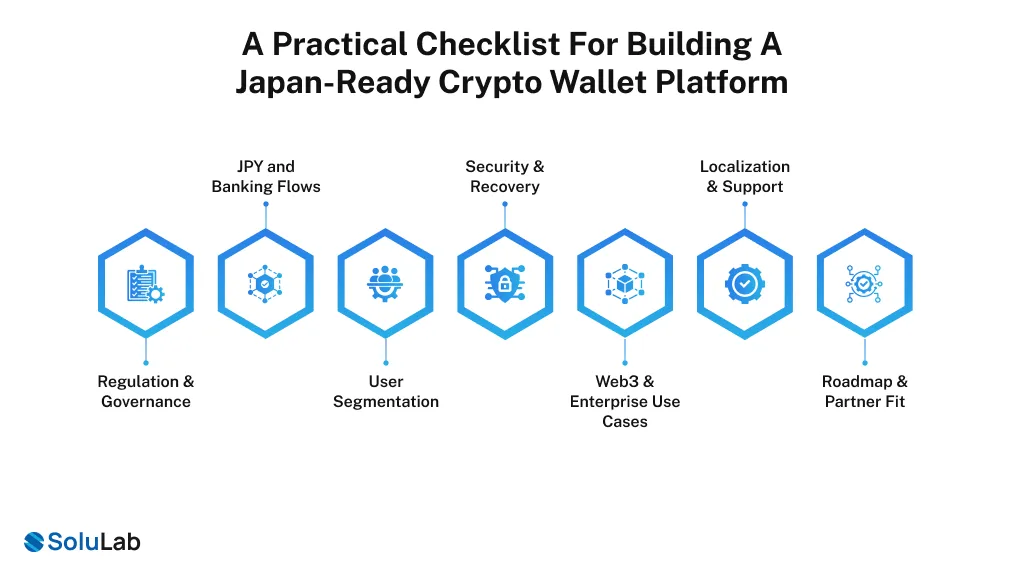
You can use this checklist whether you’re evaluating a vendor, a Japan-Focused White-Label Crypto Wallet like SoluLab, or your own in‑house build:
1. Regulation & Governance
- Does it align with Japan’s current digital asset rules and leave room for updates?
- Can compliance, legal, and risk see the same data in a useful way?
2. JPY and Banking Flows
- Are JPY on/off ramps clearly mapped, with transparent fees?
- Does the experience match what Japanese users expect from financial services apps?
3. User Segmentation
- Have you mapped the types of wallets Available in Japan to your actual user personas (retail, power users, institutions)?
- Do your flows change meaningfully by segment, or is it a one‑size‑fits‑all front end?
4. Security & Recovery
- Is the security model documented well enough to survive an external review?
- Are seed/recovery flows designed to prevent common human mistakes seen in cryptocurrency wallets in Japanese user stories?
5. Web3 & Enterprise Use Cases
- For enterprises, does the Crypto Wallet Platform in Japan for Enterprises support governance, policy rules, and multi‑sig / MPC levels that match your treasury requirements?
- For consumers, is Web3 exposure curated rather than chaotic?
6. Localization & Support
- Is Japanese UX written by professionals and validated with local users?
- Are there clear plans for ongoing content, docs, and support in Japanese?
7. Roadmap & Partner Fit
- If you’re using Crypto Wallet Development Services or White Label Crypto Wallet Development, do they have credible references in Japan or similarly regulated markets?
- Are they willing to co‑own outcomes (conversion, retention, risk), not just ship code?
If you can’t tick most of these boxes, you’re not looking at a Japan‑fit wallet yet; you’re looking at a global wallet hoping Japan will bend to it. It won’t.
Conclusion
Japan in 2026 is not just another crypto market. It’s a test bed for what regulated, large‑scale, tokenized finance will look like when it meets real users, real institutions, and real policy.
For CXOs and founders, the wallet is where all of that becomes concrete. It’s the interface where policy, product, security, and user trust meet. Whether you adopt a White-Label Crypto Wallet Platform In Japan, or stand up your own stack from scratch, the bar is higher here than in many other markets.
Treat wallets as strategic infrastructure, not a checkbox. Work with a Web3 wallet development company like SoluLab that understands both the trends of Japan in Web3 & Wallet and the realities of your business. If you do that, you’re not just supporting Japan – you’re building the infrastructure that will still make sense when 10% of global GDP actually lives on‑chain.
FAQs
With over 3 years of experience, I specialize in breaking down complex Web3 and crypto concepts into clear, actionable content. From deep-dive technical explainers to project documentation, I help brands educate and engage their audience through well-researched, developer-friendly writing.