DeFi staking has quietly rewritten what earning from crypto looks like. You no longer have to sit on tokens and pray the price climbs. Lock them into a smart contract instead, and they start paying you. Think interest on a savings account, minus the bank, minus the branch, minus anyone deciding what you can do with your own money.
These platforms run on decentralized networks. No middleman sits between you and your assets, you keep control, and the reward math is out in the open for anyone to check. For someone using crypto day to day, that answers a nagging question: how do you grow a portfolio without babysitting charts or betting the whole thing on a volatile swing?
Pick the right platform and the rewards trickle in steadily while you get on with your life. Below, we walk through the 9 best DeFi staking platforms to consider in 2026.
What is a DeFi Staking Platform?
A DeFi staking platform is a decentralized application where you lock crypto into a smart contract to help run a blockchain, validating transactions, for instance, and get paid for the help. You see this most on chains built around a Proof-of-Stake (PoS) consensus mechanism.
There’s a catch, though. Staking through a DeFi platform carries real risk. Prices can drop and wipe out your gains, and a bug in a smart contract can do worse. As with any DeFi development, do the homework first. Understand exactly what you’re exposed to before you stake a single token.
How DeFi Staking Works?
At its core, DeFi staking means locking your crypto into smart contracts on a decentralized platform, helping the blockchain run, and collecting rewards for it. Here’s how the flow actually plays out, step by step:
1. Choose a DeFi Staking Platform
Start by picking a decentralized application (dApp) that supports staking for the coin you hold. Coinbase, Binance, and OKX are the usual names people reach for.
2. Deposit Your Tokens
Move your crypto into the platform’s staking pool or smart contract. That deposit locks the tokens and puts them to work on network jobs like validating transactions.
3. Select a Validator
Next, pick a validator node to delegate your staked tokens to. Validators keep the network honest. They process transactions and forge new blocks, and your tokens back their work.
4. Earn Staking Rewards
As your tokens pull their weight on the network, rewards start arriving, usually as more tokens. Most platforms pay these out automatically. How much you earn shifts with things like how long you stake and how the network performs.
5. Unstake When Ready
Once any lock-up period is done, you pull your tokens back out along with what they earned. One thing to watch: some platforms hold you to a waiting period or skim a fee when you unstake.
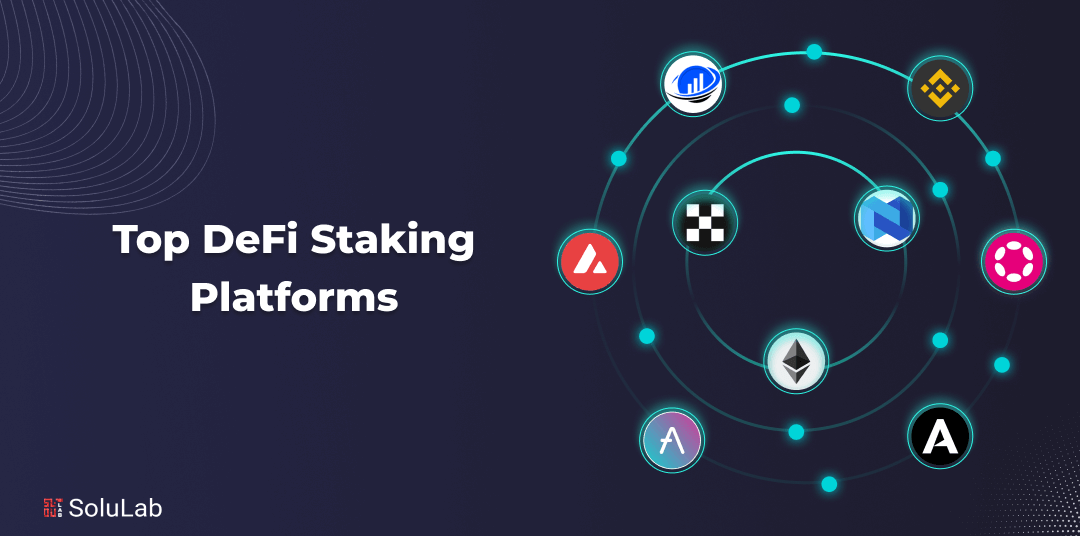
Top 9 DeFi Staking Platforms in 2026
1. AQRU
AQRU is a London-based DeFi platform that launched back in 2021. The interface is easy to get around, and it covers staking for more than 200 cryptocurrencies, DAI, USDC, and Bitcoin among them. Yields run competitive too. Stablecoins can earn up to 12% APY here.
Security gets real attention. AQRU works with Fireblocks for multi-signature protection and layers on two-factor authentication. On top of that, you get margin trading, advanced order types, and the AQRU Trend product, which runs algorithmic strategies to manage a spread-out crypto portfolio for you.
2. Polkadot
Polkadot dates to 2016 and stands out as a multi-chain platform built to let different blockchains talk to each other. On its staking side, you lock up DOT tokens to help secure the network and collect rewards, all through a nominated Proof-of-Stake (NPoS) system.
What draws people in: it scales well, plays nicely across chains, and holds up on security. That combination of fresh ideas and dependability keeps it near the top of many DeFi shortlists.
3. Avalanche
Avalanche is a Layer-1 blockchain from Ava Labs that went live in September 2020. The goal was straightforward: give decentralized applications (dApps) and custom blockchain networks a place to run that stays fast and secure.
Under the hood, Avalanche splits the work across three chains. The X-Chain (Exchange Chain) handles assets, the C-Chain (Contract Chain) runs smart contracts, and the P-Chain (Platform Chain) coordinates the network. Together they keep the whole thing moving.
4. Ethereum
Ethereum arrived in 2015 and still leads the pack for DeFi staking, especially after moving to Ethereum 2.0’s Proof-of-Stake (PoS) consensus. It gave us smart contracts in the first place. Stake your ETH and you help secure the network while earning rewards for it.
It’s hard to beat on a few fronts: heavy decentralization, strong security, and a busy DeFi scene. You can stake through wallets directly, or lean on platforms like Lido and Rocket Pool.
5. Binance
Binance opened in 2017 and grew into one of the biggest DeFi staking platforms anywhere, with staking options across a long list of coins. You get both flexible and locked plans, competitive rewards, and an interface that doesn’t scare off beginners while still serving power users.
Staking sits right inside the wider Binance setup, so moving tokens around and reaching its other DeFi products feels like one continuous flow rather than a hop between apps.
6. OKX
Trades here cost a flat 0.05%, which makes OKX one of the cheaper DeFi staking exchanges you’ll find. It’s a full-service platform. Traders at any level can buy, sell, stake, and trade over 200 different coins and tokens without a steep learning curve.
Through the OKX Wallet, the platform ties in a range of decentralized applications (dApps), so you can stake assets, collect rewards, and vote in governance, all from one place.
7. DeFi Swap
DeFi Swap is a decentralized exchange (DEX) and staking platform running on Ethereum. It lets you trade Ether and ERC-20 tokens securely and anonymously, with no intermediary standing in the way.
Two things stand out. An arbitrage function lets you play price gaps between markets, and incentivized liquidity pools pay you for staking tokens into them.
8. Nexo
Nexo is a regulated DeFi platform that launched in 2018, covering crypto staking, lending, and high-yield savings. Certain assets can earn up to 16% APY, with interest paid out daily. It handles Ethereum smart staking and throws in a loyalty rewards program. People tend to trust it for its security, how simple it is to use, and the broad range of assets it supports.
9. AAve
Aave started life in 2017 as ETHLend, built by Stani Kulechov, then rebranded in 2018 into one of DeFi’s leading protocols. It lets you lend and borrow crypto through decentralized liquidity pools, no middleman required. The standout features: flash loans, overcollateralized borrowing, and aTokens that rack up interest in real time.
AAVE token holders govern the protocol, and the whole thing leans hard into transparency and user control. It runs across several networks, Ethereum and Polygon included, and has locked up billions in total value, a fair sign of how much weight it carries in DeFi.

Conclusion
DeFi staking is changing how crypto holders earn on the side: securely, out in the open, and with nobody skimming in the middle. The 9 platforms above cover a spread of high yields, flexible terms, and solid track records, which is what makes them worth a look in 2026.
Seasoned investor or complete newcomer, there’s a fit here for you. Just keep this in mind: reward and risk travel together. Research first, and spread your bets.
As DeFi keeps expanding, staking stays one of the smartest ways to put idle crypto to work. Take NovaPay Nexus, a self-hosted cryptocurrency payment processor. It teamed up with SoluLab to work through hurdles in blockchain integration, security, and getting users on board. SoluLab strengthened multi-crypto compatibility, tightened protection around private keys, and built an interface people actually enjoy using. The result? A secure, fee-free, decentralized payment setup that lets businesses accept digital currencies directly, with no intermediary in between.
SoluLab, a DeFi staking platform development company can point you toward the right solution and walk you through it. Reach out and let’s talk it over.
FAQs
Shipra Garg is a tech-focused content strategist and copywriter specializing in Web3, blockchain, and artificial intelligence. She has worked with startups and enterprise teams to craft high-conversion content that bridges deep tech with business impact. Her work translates complex innovations into clear, credible, and engaging narratives that drive growth and build trust in emerging tech markets.