Key Takeaways
- An app development company is a team, not a single service — product strategist, UI/UX designer, engineers, QA, and a delivery manager working from one roadmap. Dev shops, product consultancies, and staffing agencies solve different problems, and conflating them is a common cause of hiring mistakes.
- Process predicts outcome more than price does. The strongest signal before hiring is whether a vendor runs discovery before quoting — vendors that quote first are guessing, and the client inherits that risk.
- Evaluate on six criteria: portfolio depth in a comparable category, a defined discovery/design process, ability to justify tech-stack choice, clear communication structure, a real security practice (e.g., OWASP Mobile awareness), and a defined post-launch support offering.
- The build process has four phases: discovery and strategy, design and prototyping, development and integration, and QA/launch/maintenance. Skipping discovery is the most common reason projects go over budget or miss user needs.
- Native vs. cross-platform vs. PWA is a trade-off, not a default. Native (Swift/Kotlin) suits hardware-intensive or graphics-heavy apps; cross-platform (Flutter, React Native) is the pragmatic choice for most business apps; PWAs suit content-driven products that need to skip app-store review.
- AI-native app development changes the architecture itself, not just the feature set — via retrieval-augmented generation, agentic multi-step workflows, or on-device ML, each requiring new infrastructure like vector databases and orchestration layers.
- Cost has no honest flat number. It’s driven by scope/complexity, platform choice, integrations, compliance needs (HIPAA, PCI DSS, SOC 2), and team location/engagement model (fixed-price, T&M, or dedicated team).
- In-house vs. agency depends on what’s being optimized: in-house suits a core long-term product with embedded control; an agency suits speed, specialized skills (AI, blockchain, AR/VR), or bounded projects. Many teams land on a hybrid model.
- Protect IP and reduce risk early: get an NDA before detailed discussions and a contract that explicitly assigns code ownership to the client, and clarify what post-launch support does and doesn’t cover before signing.
An app development company is a firm that plans, designs, builds, tests, and maintains mobile, web, or desktop applications on a client’s behalf, combining product strategy, UI/UX design, and engineering under one roof. The one thing to check before hiring an app development company is whether it leads with strategy and discovery, or jumps straight to a quote, since that single habit predicts most of what happens after the contract is signed.
On this page: what an app development company does, how to choose one, the full service scope, the build process step by step, native versus cross-platform versus PWA, AI-native app development, realistic cost drivers, in-house versus agency, and why teams work with SoluLab.
Most people searching this term already have an idea, a budget range in mind, and a nagging sense that most vendor sites and review directories tell them who ranks well, not who actually fits their project. This guide is built to answer the harder question directly: how do you evaluate an app development company on process, not marketing copy, and what should the engagement actually look like once you sign?

What is an app development company and what does it actually do?
An app development company isn’t one job, it’s a small team of distinct roles working from a shared roadmap. A properly staffed engagement includes a product strategist or business analyst who translates a business goal into requirements, a UI/UX designer who turns those requirements into a usable interface, engineers who build the frontend, backend, and any integrations, a QA function that tests before and after each release, and a project or delivery manager who keeps the whole thing on schedule and on budget.
It’s worth separating three vendor types that get lumped together in search results:
- A dev shop takes a fixed spec and codes it. Fast and often cheap, but weak on strategy, you bring the “what,” they build the “how.”
- A product consultancy helps define the “what” as well as build it, including market validation, architecture decisions, and roadmap planning before code starts.
- A staffing or outsourcing agency places individual developers on your team under your direction, rather than owning delivery of a finished product.
None of these is universally “better,” but they solve different problems, and confusing them is the most common reason a hiring decision goes wrong before a single sprint starts.
How do you choose the right app development company?
This is the decision most buyers actually need help with, and it’s the question review directories are structurally unable to answer, since they rank vendors on reviews and profile completeness, not on fit for your specific project. Use the criteria below as your evaluation framework.
| Criteria | What good looks like | Why it matters |
| Portfolio depth | Multiple shipped apps in your category or a comparable technical complexity, not just logos | A portfolio in an unrelated domain doesn’t predict success on yours |
| Process | A defined discovery and design phase before a fixed quote | Vendors that quote before discovery are guessing, and you inherit the risk |
| Tech stack fit | Can explain why they’d choose native, Flutter, or React Native for your specific case | A one-size answer signals a default, not a decision |
| Communication | Named point of contact, regular demos, a shared project tool | Predicts whether you’ll know project status without chasing it |
| Security practice | Can describe how they handle secrets, auth, and data at rest, referencing standards like OWASP Mobile | Security is far cheaper to build in than to retrofit post-launch |
| Post-launch support | A defined maintenance offering, not a one-time handoff | Most app cost and risk happens after launch, not before it |
Red flags worth walking away from: a quote delivered without a discovery call, reluctance to name the specific engineers who’d work on your project, no mention of testing or QA in the proposal, and a portfolio you can’t verify is actually theirs. Before signing, ask directly: who owns the code and IP, what does post-launch support cost, and what happens if the scope changes mid-project.
What services does a full-service app development company offer?
A full-service app development company covers more ground than “we build apps.” The core scope typically includes:
- Mobile app development, spanning native iOS (Swift), native Android (Kotlin), and cross-platform frameworks like Flutter or React Native, covered in depth in the section below.
- Web and desktop application development, for teams that need a browser-based or installed product alongside, or instead of, a mobile app.
- UI/UX design, including user research, wireframing, prototyping, and usability testing, not just visual polish applied after the fact.
- Technical and product consulting, helping define scope, architecture, and roadmap before a build begins.
- Systems integration, connecting the app to payment processors, CRMs, ERPs, identity providers, and increasingly, AI and blockchain infrastructure.
- Maintenance and support, ongoing bug fixes, OS-version compatibility updates, and feature iteration after launch.
Some categories of app carry needs a generalist shop rarely covers well. Immersive and spatial apps, for instance, need dedicated AR app development or combined AR/VR app development expertise, since the design and testing workflow for a camera-based or headset experience differs meaningfully from a standard CRUD app. Regulated builds in fintech, healthcare, and blockchain carry their own compliance and architecture demands, which we cover further down.
What does the app development process look like, step by step?
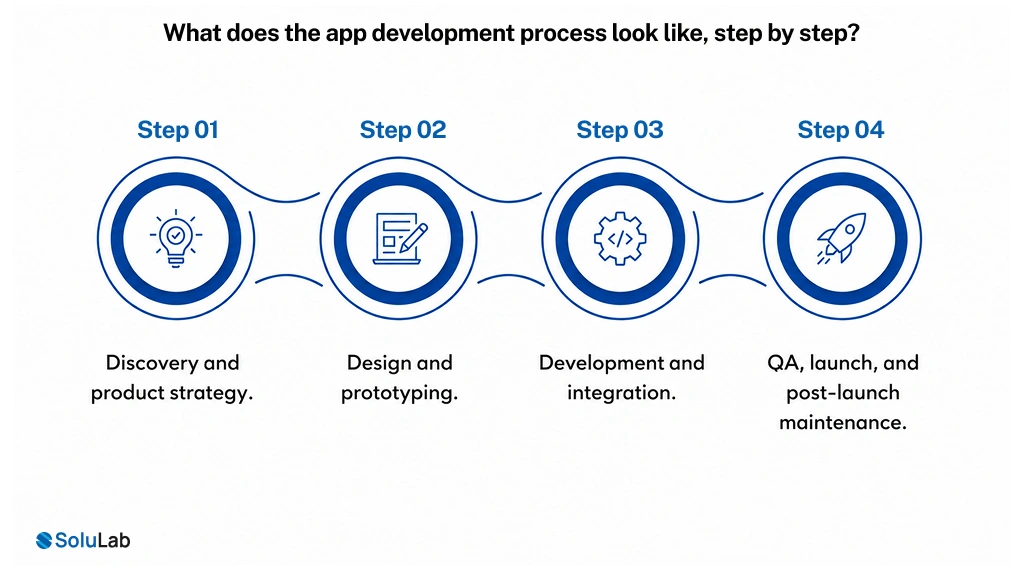
A sound app development process runs through four phases, and skipping the first one is the single most common reason projects run over budget or miss the mark on what users actually needed.
- Discovery and product strategy. Define the business goal, target users, core workflows, and success metrics before any design work starts. This phase should produce a scoped requirements document and a rough architecture direction, not just a feature list.
- Design and prototyping. Wireframes, then interactive prototypes, tested with real users or stakeholders before development begins. Catching a usability problem here costs a redesign; catching it post-launch costs a rebuild.
- Development and integration. Frontend and backend engineering, third-party integrations, and iterative delivery in short sprints with regular demos, so problems surface early rather than at final handoff.
- QA, launch, and post-launch maintenance. Functional, performance, and security testing before release, a staged rollout, then an ongoing maintenance cadence for OS updates, bug fixes, and new features.
At SoluLab, discovery is treated as a paid, standalone engagement rather than a free sales exercise, because the architecture decisions made in week one determine most of what the project costs and how long it takes.
Native, cross-platform, or PWA, which app type should you build?
This decision shapes cost, timeline, and how the app feels to use, and there’s no universally right answer, only trade-offs matched to your situation.
Native development (Swift for iOS, Kotlin for Android) gives the best performance, full access to device hardware and the latest platform features, and the most polished platform-specific feel. It’s the right call for apps with heavy graphics, AR/camera features, or complex offline functionality, at the cost of maintaining two separate codebases.
Cross-platform frameworks like Flutter and React Native let you ship one codebase to both iOS and Android, cutting development time and cost meaningfully for most business apps. Flutter tends to win on UI consistency and performance for graphics-heavy interfaces; React Native often wins when a team already has strong JavaScript/React expertise to reuse. For the large majority of business apps, cross-platform is the pragmatic default, with native reserved for genuinely hardware-intensive use cases.
Progressive web apps (PWAs) run in a browser but behave like an installed app, with offline support and push notifications, without requiring app store approval. They’re a strong fit for content-driven products or teams that need to ship fast and iterate without app store review cycles, though they can’t fully replace native for deep hardware access or App Store/Play Store discoverability.
How is AI changing app development, and can you build an AI-native app?
AI in apps has moved past chatbot widgets bolted onto an existing product. Building an AI-native app means the intelligence is part of the core architecture, not a feature added at the end, and it typically involves three patterns:
- Retrieval-augmented generation (RAG), where the app grounds an LLM’s responses in your own data, a document library, product catalog, or knowledge base, instead of relying on the model’s general training alone.
- Agentic workflows, where the app doesn’t just answer questions but takes multi-step actions on a user’s behalf, calling tools, APIs, or other services to complete a task end to end.
- On-device machine learning, running lightweight models directly on the phone for features like real-time image recognition or personalization that need to work offline or with minimal latency.
Each of these changes the underlying architecture: you’re now designing around a vector database, an orchestration layer for agent actions, and prompt and context management, not just a standard client-server app. Blockchain and Web3 features add a comparable architectural shift: wallet integration, on-chain transactions, and token-gated access change how you design state, security, and user onboarding. Teams exploring this space often start from blockchain app ideas or a practical guide on how to launch a Web3 app. This combined AI and blockchain depth is a genuinely uncommon pairing among app development companies, most shops are strong in one or neither.
How much does it cost to work with an app development company?
There’s no honest single number for “what an app costs,” because a narrow internal tool and a multi-platform consumer product with AI features are different orders of magnitude of work. What actually drives cost is more useful than a range you’d have to ignore anyway:
- Scope and feature complexity. Number of user roles, workflows, and screens. A simple booking app costs a fraction of a marketplace with payments, messaging, and admin tooling.
- Platform choice. One cross-platform codebase versus two separate native builds changes engineering time meaningfully, as covered above.
- Integrations. Every third-party system, payment processors, CRMs, AI APIs, adds design, testing, and maintenance surface area beyond the core app.
- Compliance requirements. HIPAA, PCI DSS, or SOC 2 scope adds architecture review, audit logging, and often a formal security audit before launch.
- Team location and model. Rates vary meaningfully by region and by whether you’re paying fixed-price, time and materials, or a dedicated team retainer.
Engagement models, briefly: fixed-price suits a well-defined MVP scope and gives budget certainty; time and materials (T&M) suits a product that will evolve as you learn from users; a dedicated team suits an ongoing product with a long roadmap, where continuity matters more than a project end date.
Should you hire an app development agency or build in-house?
Neither choice is automatically right, and the honest answer depends on what you’re optimizing for.
In-house makes sense when the app is your core, long-term product, you need engineers embedded daily in company context, and you can commit to the hiring, management, and retention overhead of a full team. It’s slower to stand up but gives you the most direct long-term control.
An agency or dedicated team makes sense when you need to move faster than a hiring cycle allows, when the project needs specialized skills (AI, blockchain, AR/VR) you don’t want to build in-house for one project, or when the app is a bounded initiative rather than an indefinite core product. A dedicated external team also lets you scale up or down with the roadmap, without carrying idle headcount between major releases.
Many teams land on a hybrid: a small in-house product owner working with an external engineering team for build and specialized skills, which keeps institutional knowledge in-house while borrowing depth you don’t need to hire full-time.
Why work with SoluLab for app development?
SoluLab runs every engagement strategy-first: discovery and architecture decisions happen before a fixed quote, not after. That ordering exists because the two costliest mistakes in app development, building the wrong thing well and building the right thing on the wrong architecture, both happen in week one, not month six.
SoluLab’s core practice is AI/GenAI and blockchain engineering, which means AI-native features and Web3 app capability aren’t a bolted-on add-on; they’re the team’s daily work, alongside standard mobile, web, and desktop builds for teams that don’t need either. That combination matters most for regulated or complex builds: fintech apps with compliance requirements, healthcare apps needing HIPAA-aware architecture, and blockchain products needing wallet and smart-contract integration, all of which need architecture decisions a generalist shop rarely encounters often enough to get right the first time.

FAQs
Neha is a curious content writer with a knack for breaking down complex technologies into meaningful, reader-friendly insights. With experience in blockchain, digital assets, and enterprise tech, she focuses on creating content that informs, connects, and supports strategic decision-making.