Can’t keep up with the constant demand for fresh, high-quality content? You’re not alone. For creators, marketers, and businesses, content creation can feel like a treadmill that never stops, draining time, energy, and resources.
But let’s be clear: AI isn’t here to take your job. It’s here to help you do it better. From drafting blog posts and social captions to generating video scripts and designing visuals, AI is reshaping how content gets made. And it’s not just speed. It’s sharper creativity, better consistency, and content creation that’s finally accessible to more people.
The global AI-powered content creation market sat at roughly $2.9 billion in 2024 and is on track to reach $3.53 billion in 2025, a compound annual growth rate (CAGR) of 21.9%.
This blog breaks down how AI for content creation actually works, walks through real-world use cases, highlights the key benefits, and points you toward the best tools to get started.
Why Should Businesses Use AI for Content Creation?
AI for content creation means using artificial intelligence to create and improve content: coming up with ideas, writing, editing, producing audio and video, measuring audience engagement, and more. The goal underneath all of it is simple: automate content generation to make it more effective and higher-impact.
- Increased ROI
AI’s descriptive and predictive analytics capabilities let businesses make sharper decisions and build well-informed strategies, improving ROI along the way. AI shows you what’s actually working in your content, which makes strategic planning easier, keeps budget allocation on target, and gets more out of marketing initiatives overall. AI content writing strengthens marketing by making sure resources go where they’ll actually pay off.
- Increased Awareness
Use AI-powered trend analysis and market research tools to get a clearer read on your competitors. That keeps you competitive on pricing strategies, promotional offers, and engagement approaches, without falling behind the rest of the industry.
- Idea Generation
AI systems can genuinely help with brainstorming by generating content ideas automatically. They scan market trends, audience preferences, and what competitors are doing to surface original, relevant recommendations. That keeps your content strategy fresh and creative, with a steady stream of new ideas that actually land with your audience.
- Improve Speed
AI-powered schedulers, content editors, and idea generators finish jobs faster, plain and simple. Their raw speed and larger working memory let them outpace human marketers on the repetitive parts, which makes content generation, editing, and scheduling noticeably more efficient. Using an AI humanizer on top of that can keep the generated content sounding natural and relatable, so it actually connects with a human audience.
Use Cases of AI-powered Content Creation
AI for content creation works best as a partnership between algorithms and people. AI can produce writing on its own, sure, but it does its best work when a human is steering it toward something that actually lands.
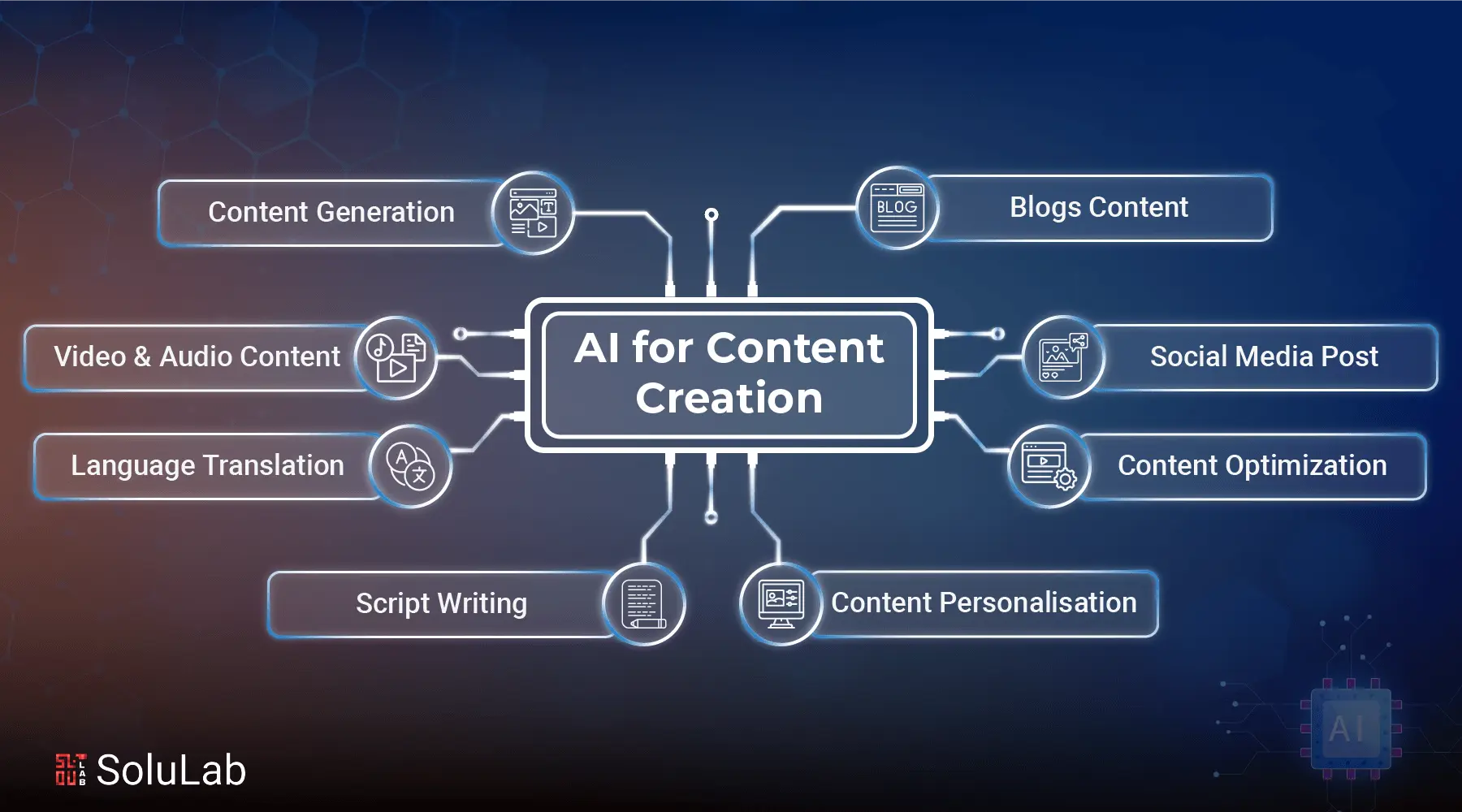
1. Generate Content
Social media management eats up time, and AI takes a real bite out of that. AI systems can write hashtags and captions, and even schedule posts for LinkedIn, Instagram, and Twitter.
Tools like Lately and Buffer study your audience’s behavior to tell you the best times to post and what kind of content actually drives engagement. They can also help you improve AI-generated writing for captions and posts, so your content stays relevant and engaging.
2. Scriptwriting
An AI writer makes scriptwriting and screenplay creation faster by analyzing huge volumes of existing screenplays and data, picking up on speech patterns, character arcs, and narrative structure.
It can predict how an audience will respond, generate dialogue, and suggest plot points. AI speeds up the first draft, and human writers come in afterward to add the uniqueness, emotion, and subtlety that make a screenplay actually grip an audience.
3. Language Translation
AI-powered translation tools make quick work of translating content between languages, keeping communication smooth across borders.
AI tools run on advanced machine learning to study the structure and meaning of text in one language, then produce equivalent text in another while keeping the original intent and context intact.
4. Humanizing AI-Written Copy with AI Writer
Plenty of AI tools can generate content fast. The harder problem is making that content actually sound human. That’s where AI Writer comes in: it rewrites and refines AI-generated text for tone, clarity, and authenticity. Blog intros, product descriptions, outreach messages, social captions, whatever the format, AI Writer keeps the brand’s voice intact while you still get the speed of AI.
5. Video and Audio Content
AI isn’t just text. Blog posts can turn into videos with text to video tools like Freepik’s AI video generator, Pictory, Veed, and Lumen5, making video production far more accessible. Audio content can get edited and transcribed with tools like Descript too.
Even voiceovers and music tracks can come from AI now, which speeds up producing podcasts, YouTube videos, and ads.
6. Graphic Design
Not everyone has design chops, but tools like Adobe Firefly and Canva make producing professional-looking images simple. These platforms suggest layout, color, and font choices based on your content, and AI can even generate graphics from scratch, saving both time and money.
Ready-made photo collage templates save even more time, keeping your visuals polished and consistent across platforms. Looking for something more polished still? graphic design services can take your designs a step further.
Read More: How Can AI Help Businesses Cut Costs?
Benefits of Using AI for Content Creation
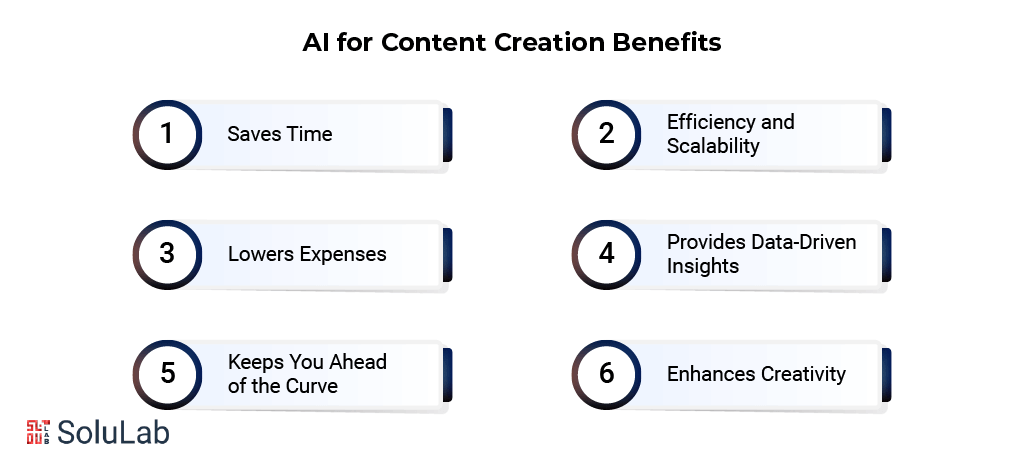
Here’s what AI actually brings to content creation:
1. Saves Time: Content takes time. Writing, editing, publishing, research, it all adds up. Automating a chunk of that with AI means you create more in less time. An AI tool can turn out a blog draft in minutes instead of hours, which frees you up for strategy and creativity instead.
2. Efficiency and Scalability: AI handles the tedious stuff, scheduling, formatting, keyword research, so you can focus on the work that actually matters. Tying platforms and tools together also streamlines the whole workflow: create content, edit it, schedule it, all from one place.
3. Lowers Expenses: Hiring a full team of writers, editors, and designers gets expensive fast. AI tools give you an affordable way to produce solid content without blowing the budget. It’s worth being clear though: AI can extend your team, it can’t replace human skill entirely.
4. Provides Data-Driven Insights: AI doesn’t just produce content, it analyzes it too. By tracking engagement, click-through rates, and conversions, AI can tell you exactly what’s working and what isn’t. That means you can sharpen your approach and build content that actually resonates.
5. Keeps You Ahead of the Curve: Staying ahead matters in a digital world that never stops shifting. AI tools help you produce original content, test new ideas, and keep pace with trends, giving you a real edge.
6. Enhances Creativity: Contrary to what a lot of people assume, AI feeds creativity rather than smothering it. By taking the tedious parts off your plate, AI frees you up to focus on the fun stuff, developing ideas, telling stories. It can also throw out ideas and inspiration you might never have landed on alone.
Future of AI in Content Creation
Creating content is one thing. Retaining and applying that knowledge is another. AI isn’t just summarizing anymore, it’s actually helping people learn.
Modern AI learning tools lean on techniques like spaced repetition (revisiting key ideas over time) and Socratic questioning (prompting deeper thinking through guided questions).
AI isn’t replacing human creativity. It’s enhancing it, taking over the repetitive tasks so creators get more time for what actually counts: ideas, storytelling, originality.
The future isn’t humans versus AI. It’s about who learns to use AI to work smarter, faster, and more meaningfully. No matter how advanced AI gets, it still needs that human spark: the ability to connect, inspire, and create things that genuinely matter.
Popular AI Content Creation Tools
Looking for a good free AI tool for content creation? Here are a few popular ones worth knowing:
- ChatGPT: ChatGPT is a capable artificial intelligence writer that can produce social posts, product descriptions, articles, and more, generating material for social media, blogs, and email alike.
- Claude: Claude is an AI-powered chatbot built by Anthropic, known for its conversational ability and ethical design, and it’s commonly used for writing, coding, and answering complex questions.
- Pictory: Easy to use, with customizable templates and the ability to turn text or lengthy articles into video, serving a broad range of users.
Conclusion
AI has become a genuine partner in content creation, changing how content gets produced, chosen, and distributed. Blending machine efficiency with human creativity is a real shift, one that helps teams actually meet their deadlines.
This goes beyond a passing trend. Using AI in content creation lets companies connect with their audiences in ways that used to feel out of reach. Lean on machine learning well, and brands build stronger bonds while growing engagement, awareness, and overall growth.
SoluLab helped AI-Build, a construction tech company, apply generative AI and machine learning to advanced product development in the CAD space. The goal was automating design processes, boosting productivity, and sharpening accuracy. The real challenge was building a system that could generate optimized designs while cutting manual work and staying scalable.
SoluLab’s AI development company expertise made AI integration possible, lifting both efficiency and performance. SoluLab has a team of experts ready to help with your business questions: contact us today!
FAQs
Shipra Garg is a tech-focused content strategist and copywriter specializing in Web3, blockchain, and artificial intelligence. She has worked with startups and enterprise teams to craft high-conversion content that bridges deep tech with business impact. Her work translates complex innovations into clear, credible, and engaging narratives that drive growth and build trust in emerging tech markets.