AI agents are changing how enterprises run, quietly. There’s no big-bang moment. Just a lot of small, repeatable decisions getting handled faster, and honestly, often better than a person rushing through them would.
Work that used to bounce between three teams before anything happened? A system now picks it up, reads the context, does the thing, and remembers how it went for next time.
That’s why the talk around AI agent development services has shifted. Nobody’s still asking what AI can write for them. They want to know what it can actually own.
Finance teams, ops teams, you name it. Companies are past the tinkering phase and looking at agent use cases that hold up in production. The questions got sharper. Where does an agent cut friction? What repetitive decision can it just take over? And where can it run on its own without breaking anyone’s trust?
So here’s the breakdown: the AI agent use cases that matter right now, and how enterprises are really shipping them in 2026.
What Makes AI Agents Different from Traditional AI Systems?
People throw everything into the artificial intelligence bucket. That gets messy fast, especially when you’re trying to size up which agent applications are worth the effort.
An AI agent isn’t a model waiting for you to prompt it. It runs with a purpose.
Usually it comes down to four pieces:
- A decision layer that reads context
- Access to tools or systems
- The ability to take action
- Feedback loops so it gets better over time
That’s the line between AI agents in business and the automation we grew up with.
Think about it this way. A chatbot answers your question. An agent goes and fixes whatever caused the question. It pulls the data, updates the system, kicks off the workflow, and tells you it’s done.
And that one shift is what sets enterprise AI use cases apart from plain old automation.

How AI Agent Use Cases Have Evolved?
The first wave of AI was mostly about seeing and assisting.
- Dashboards helped you read the data
- Chatbots fielded the easy questions
- Automation trimmed the manual grind
But a human still made every real call.
Now? AI use cases are moving into execution.
The expectation has grown. People want agents that can:
- Run multi-step workflows
- Make context-aware decisions
- Coordinate across systems
- Operate with barely any supervision
You see it clearest inside big enterprises, where speed and scale are the whole game.
The old question was, “Can AI help with this task?” Now teams ask something bolder: “Can an agent own this process end-to-end?”
And that second question is what’s shaping the next round of AI agent use case examples.
A Practical Framework to Identify AI Agent Use Cases
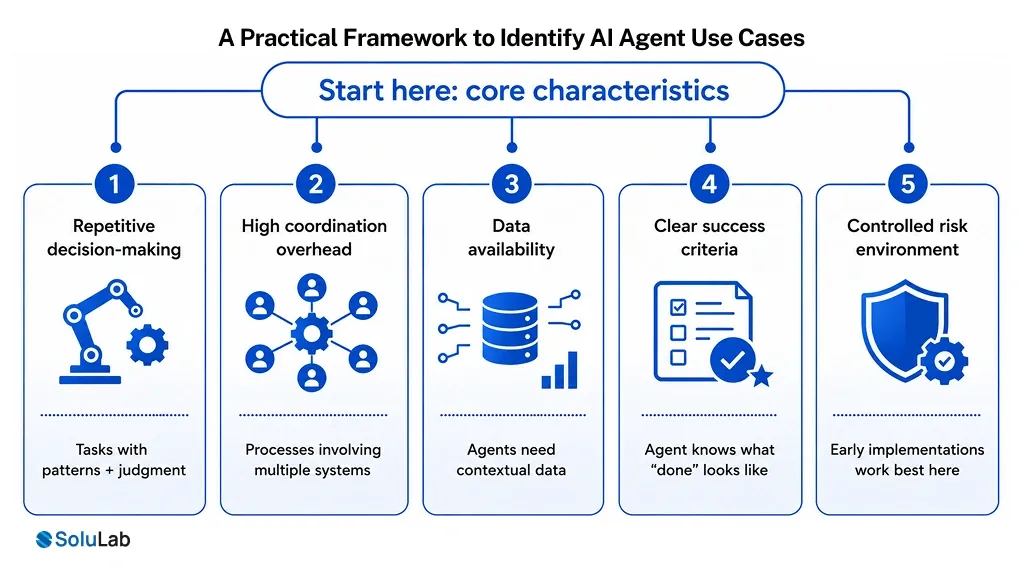
Not every process wants an agent. Force one where it doesn’t belong and you just bought yourself more complexity, not more value.
The use cases that actually pay off tend to share a handful of traits.
1. Repetitive Decision-Making
Tasks that follow a pattern but still need a judgment call
Example: fraud detection, support resolution
2. High Coordination Overhead
Anything that drags multiple systems or teams into it
Example: onboarding workflows, supply chain adjustments
3. Data Availability
Agents need real data, structured and unstructured both
No data, no context. It’s that simple
4. Clear Success Criteria
The agent has to know what “done” actually means
Example: ticket resolved, claim processed
5. Controlled Risk Environment
Start where a mistake won’t hurt much. Early runs go smoother that way
Run your ideas through this and the noise falls away. What’s left is the set of use cases that genuinely earn their keep.
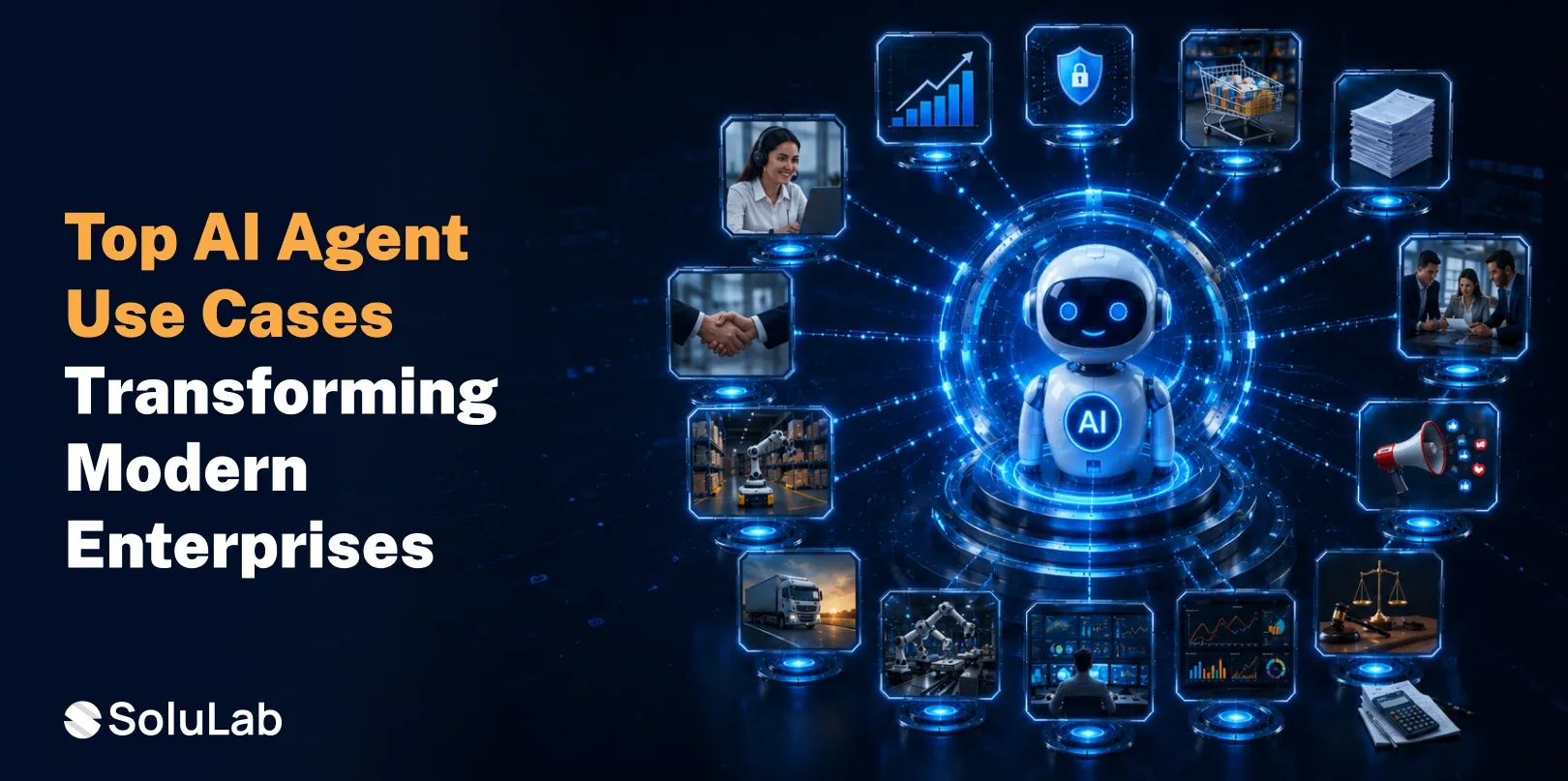
Top 11 AI Agent Use Cases and Their Business Impacts
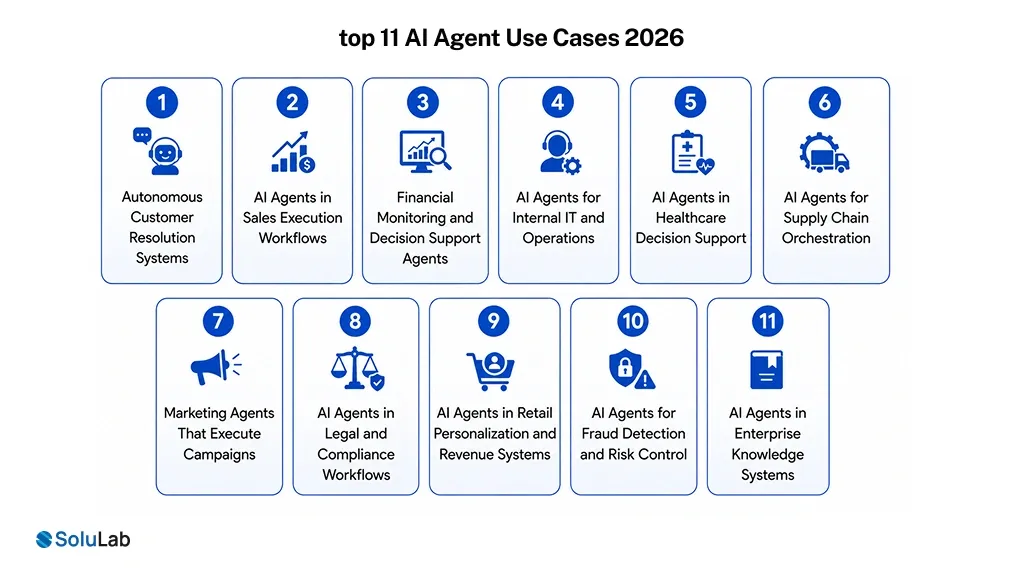
1. Autonomous Customer Resolution Systems
Support was one of the first places AI showed up. It’s also one of the most misread.
Plenty of setups still work like layered AI chatbots, tossing the conversation back and forth between a bot and a person. The real change shows up when the agent is finally allowed to finish what it picked up.
A modern agent is built to:
- Understand the issue underneath the question
- Reach into backend systems
- Actually do things: refunds, account updates, service changes
- Confirm it’s fixed, no human required
Say a customer flags a failed payment. The agent doesn’t recite troubleshooting steps and wish them luck. It reads the transaction logs, spots what broke, retries the charge or starts a refund, then tells the customer how it went.
This is one of the more grounded applications for AI agents in business, because it takes weight off the support queue and cuts response time at the same time.
The hard part isn’t the chat. It’s the system access and knowing where the agent’s authority stops.
2. AI Agents in Sales Execution Workflows
Sales teams have used AI for years, mostly for lead scoring and analytics. That’s the shallow end, though. Agents can do a lot more.
In today’s agent applications, the agent owns real execution.
It can:
- Spot leads that match your signals
- Research the company and the contact behind it
- Write outreach that actually feels personalized
- Book meetings and chase follow-ups
- Keep the CRM current on its own
What makes the difference is continuity. No more stitching five tools together. The agent carries context across the whole workflow.
Sales stops being a pile of disconnected tasks and becomes one coordinated process, run by something that never loses the thread.
Of all the AI agent business use cases out there, this one’s catching on fast. It touches revenue directly, and you don’t have to automate everything on day one to get value from it.
3. Financial Monitoring and Decision Support Agents
Finance has always drowned in data while staying oddly light on real automation.
That’s changing.
AI agent use cases in finance lean into real-time awareness and guided action instead of yesterday’s static report.
Today they’re put to work to:
- Watch transactions around the clock
- Catch anomalies or suspicious patterns
- Surface risks before they blow up
- Suggest fixes, or trip a safeguard themselves
Here’s the shift. Rather than mailing out a fraud report after the money’s gone, the agent flags a transaction as it happens, weighs the risk against past patterns, and freezes execution if it has to.
That’s the point where AI agent solutions stop being analytics and start being control.
The blocker here isn’t capability. It’s trust. Financial systems demand clean audit trails, real explainability, and hard limits on what the agent gets to do without asking.
4. AI Agents for Internal IT and Operations
Inside most companies, a shocking chunk of the day goes not to strategy, but to internal tickets.
Access requests. System errors. Onboarding. Approvals. Repetitive, structured, and slow as molasses.
Which makes them near-perfect for agents.
AI agents in IT operations can:
- Grant or pull access by role and policy
- Clear up the common system issues
- Route the messy tickets to the right place
- Keep an eye on infrastructure and answer alerts
And the payoff isn’t only automation. It’s speed. Nobody sits in a queue. They get an answer right away.
This is a great place to begin, for a few reasons:
- The environment stays controlled
- The processes are already well-defined
- You can measure the impact almost immediately
It also sets up the wider rollout. Once teams get used to agents that actually do things, not just suggest them, the trust carries over.
5. AI Agents in Healthcare Decision Support
Healthcare never lacked data. The trouble was turning that mountain of it into a decision someone could use in the moment.
That’s exactly where real-world agent use cases are starting to land.
Instead of sitting there passively, AI agents for healthcare now live right next to the decision points. They help with:
- Reading patient records and diagnostics
- Suggesting possible diagnoses from the patterns
- Tracking patient history across systems
- Pointing care teams toward the next step
What sets this apart from the old tools is continuity again. The agent doesn’t drop one recommendation and walk off. It follows the patient, refines its picture, and adjusts as things change.
In practice, that takes some of the mental load off clinicians and keeps decisions more consistent.
Of every application on this list, this is the touchiest. Accuracy, explainability, regulatory compliance, none of it is a nice-to-have. Get those wrong and nobody trusts the system, full stop.
6. AI Agents for Supply Chain Orchestration
Supply chains almost never run in a straight line. Demand swings, shipments slip, suppliers wobble, and something external always throws a wrench in.
Old systems tracked all that. Agents are starting to actually manage it.
Modern AI agents in supply chain are about coordination now, not just visibility.
Agents can:
- Forecast demand from historical and outside signals
- Shift inventory levels on the fly
- Reroute shipments as conditions change
- Keep scoring supplier performance
Here’s the real change. Decisions no longer wait for a human to open a dashboard and squint at it. The agent notices the drift and acts inside the limits you set.
That’s what makes the supply chain such a strong fit, especially at scale, where a small delay snowballs into a big one before lunch.
7. Marketing Agents That Execute Campaigns
Marketing has always been creativity plus iteration. AI already touched content and targeting. Agents push it a step past that.
In current AI agent as marketing the agent runs execution, not just support.
They can:
- Read audience segments and behavior
- Pitch campaign ideas that fit the goal
- Launch across channels
- Watch performance as it happens
- Move budget, messaging, and targeting on the fly
What flips here is speed. No more waiting on the Monday review. Optimization just keeps running.
This doesn’t cut out the humans. It moves them up a level. People own strategy, agents grind the execution loops.
Which is why marketing is turning into one of the sharper categories in agent AI use cases.
8. AI Agents in Legal and Compliance Workflows
People treat legal and compliance like speed bumps. They aren’t. They’re systems built to keep risk down.
AI agents in legal services are learning to work inside those guardrails instead of dodging them.
In modern enterprise agent use cases, legal agents get put to work to:
- Scan contracts for key clauses and risks
- Track regulatory changes across jurisdictions
- Flag compliance gaps hiding in the workflow
- Help draft and check documents
Unlike the other domains, full autonomy isn’t the goal. Controlled assistance is.
The agent pulls up what matters, points at the risky bits, and keeps things consistent across every document and process.
It’s one of the quieter AI agent solutions. Also one of the most valuable, in any industry where a compliance slip carries a real price tag.
9. AI Agents in Retail Personalization and Revenue Systems
Retail has always been rich in data and ruthless about timing. A recommendation is only worth something if it lands at the right moment, not just when it’s accurate.
That’s the frontier where retail agent use cases are evolving.
Forget the static recommendation engine. AI agents in retail now run as continuous decision systems. They:
- Follow customer behavior across sessions
- Read intent in real time
- Shift product recommendations on the fly
- Tune pricing against demand signals
Picture someone circling the same category three times without buying. The agent can sweeten the offer, float an alternative, or fire off an incentive, all on its own.
That’s not just personalization. That’s revenue optimization while the cart’s still warm.
Out of all the strong use cases, this one stands out because you can watch the impact land in conversion rates and average order value.
10. AI Agents for Fraud Detection and Risk Control
Fraud detection has been an AI job for years. What’s new is how fast, and how independently, the response fires.
Modern AI agent applications in fraud systems don’t stop at flagging the anomaly. They step in.
Agents can:
- Watch transactions nonstop
- Catch odd patterns the instant they appear
- Pause or block anything suspicious
- Kick off verification workflows
It comes down to timing. Rather than catching fraud after the fact, the agent works inside the transaction window itself.
That’s what makes AI-driven fraud detection one of the most mature and important enterprise use cases, particularly in banking, fintech, and insurance.
But these systems have to run on a tight leash. A false positive costs something real, so the decision thresholds and escalation paths need to be spelled out cleanly.
11. AI Agents in Enterprise Knowledge Systems
One of the fastest-growing use cases barely gets talked about: internal knowledge orchestration.
Companies are sitting on piles of scattered information:
- Documentation
- Emails
- Internal tools
- Knowledge bases
Agents are being pointed at all of it, to unify it and then act on it.
They can:
- Pull the right information from across systems
- Answer employee questions in context
- Kick off workflows from a request
- Link data across departments
This is where something like agentic retrieval frameworks earns its place, letting agents do more than fetch an answer. They can act on it once they’ve got it.
It’s fast becoming one of the strongest use cases going, because it lifts productivity across the whole org, not one lonely department.
Emerging Direction – Multi-Agent Systems and Autonomous Operations
Up to now, most AI deployments center on a single agent handling one workflow.
The next move is toward systems where several agents work together. In the more advanced setups, companies are trying out:
- Agents with clear roles and responsibilities
- Coordination layers that manage how they interact
- Setups where one agent’s output feeds the next one’s input
For example:
- A sales agent finds a lead
- A marketing agent preps the outreach
- A finance agent weighs the risk
- An operations agent schedules the run
That starts to look like a team, not a tool. These use cases are still finding their feet, but they point where enterprises are clearly headed.
Sure, the complexity climbs. So does the upside. Built right, a multi-agent system can take on workflows that used to be too tangled to automate at all.

Conclusion
Agents aren’t going to reinvent your business overnight. What they do is quietly strip out the friction that keeps slowing it down.
And across every function, the use cases that work best aren’t the flashiest.
They’re the ones where the decision repeats, the data’s within reach, and everyone agrees on what a good outcome looks like.
What agents really bring isn’t more automation. It’s ownership.
Work that once needed constant coordination just keeps moving without someone hovering over it.
As enterprise AI development services dig into real-world use cases, the edge won’t come from buying more tools. It’ll come from designing systems that act, not ones that only assist.
The shift is already underway. The only real question left is where it makes sense to start.
FAQs
Shipra Garg is a tech-focused content strategist and copywriter specializing in Web3, blockchain, and artificial intelligence. She has worked with startups and enterprise teams to craft high-conversion content that bridges deep tech with business impact. Her work translates complex innovations into clear, credible, and engaging narratives that drive growth and build trust in emerging tech markets.