Key Takeaways
- The problem: Every day, your business produces a flood of text: emails, support tickets, chat logs, survey answers, customer feedback. Reading through all of it by hand is slow and costly, and the useful signals tend to get buried. By the time someone spots a pattern, the moment to act has usually passed.
- The solution: Natural Language Processing reads that language for you. It automates routine communication, pulls insights out of messy text, sharpens the customer experience, and takes repetitive work off people’s plates so they can focus on the parts that actually need judgment.
- How SoluLab helps: SoluLab is an AI-native company, which means we use AI inside our own build process, not just in what we ship. That translates into faster delivery, lower cost, and NLP systems that hold up in production. From chatbots to enterprise automation, we help teams put practical AI to work without the usual drawn-out timelines.
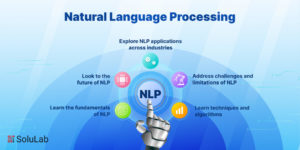
Natural Language Processing (NLP) has quietly changed how we all talk to machines. Instead of clicking through menus, you type or say what you want in plain language, and the software figures out the rest.
You already use it constantly. Voice assistants, chatbots, spam filters, translation apps: all of them run on NLP. And because your business generates so much text, speech, and interaction data, AI development solutions can turn that raw pile into something you can actually read and act on.
It answers customer questions, handles the repetitive stuff, keeps communication moving, and gives you cleaner inputs for the decisions that matter. And in 2026, none of this is stuck in a research lab anymore.
It is a working tool that companies of every size reach for when they want to run leaner, personalize what customers see, and grow without adding headcount for every new task.
What Is Natural Language Processing?
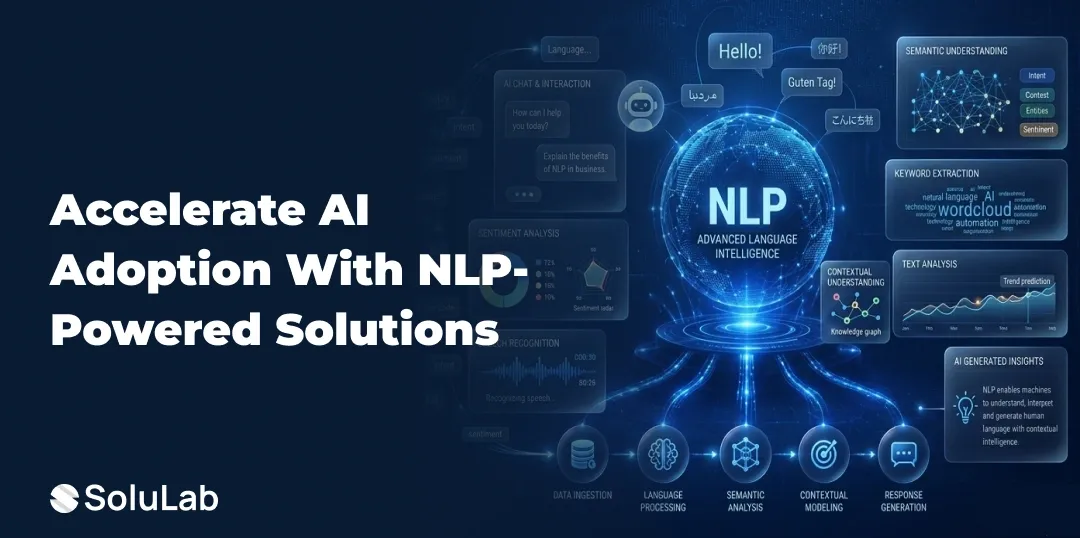
Natural Language Processing (NLP) is the branch of artificial intelligence that teaches machines to read, understand, and reply in human language. In practice, it lets a computer make sense of text, speech, and back-and-forth conversation instead of treating words as random characters. It is what sits behind chatbots, voice assistants, translation tools, and sentiment analysis. Companies lean on it to automate communication, surface insights, and make better calls.
It handles things like:
- written text
- spoken language
- conversations
- documents
- customer messages
How and Why Businesses Use Natural Language Processing?
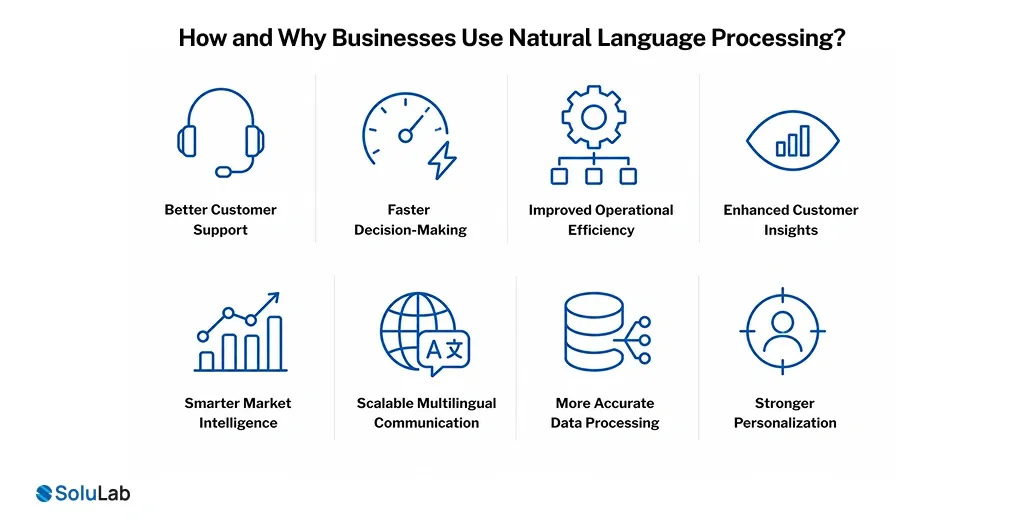
The short version: NLP takes the everyday language flowing through your business and turns it into something you can act on. That plays out across support, sales, analytics, and the internal work nobody sees but everybody depends on.
- Better customer support: NLP runs the AI chatbots, the suggested replies, and the ticket routing that get customers to the right answer faster. Support teams can handle far more volume without drowning in it.
- Faster decision-making: Feedback, emails, surveys, support chats: NLP reads all of it as it comes in, so trends and pain points show up while you can still do something about them.
- Improved operational efficiency: Document review, data extraction, sorting content by category: these language-heavy chores eat hours. Hand them to NLP and your team gets that time back.
- Enhanced customer insights: NLP in customer service reads sentiment, intent, and behavior patterns, so you can see what customers actually feel and build products around it.
- Smarter market intelligence: Point NLP at reviews, social posts, competitor chatter, and industry talk, and you get a read on the market you can adjust to quickly.
- Scalable multilingual communication: Translation, localization, multilingual support: NLP lets you serve customers around the world without the support burden multiplying.
- More accurate data processing: Businesses swim in unstructured text. NLP organizes it, classifies it, and pulls out the parts worth keeping.
- Stronger personalization: Tailored recommendations, contextual messages, experiences that feel made for the person reading them. That is what keeps people engaged and coming back.

How Does Natural Language Processing Work?
At its core, NLP turns messy human language into structured data a machine can read, sort, and answer. It pulls together linguistics, machine learning, and AI models to work through text and speech at speed. Here is what happens under the hood.
- Text and speech input processing: First, the system gathers the language coming in, whether that is chats, emails, documents, voice calls, or search queries, and converts it into a format it can actually work with.
- Data cleaning and preprocessing: Next it strips out the noise: stray punctuation, duplicates, filler words, formatting junk. Cleaner input means fewer mistakes down the line.
- Tokenization and language parsing: The system chops sentences into smaller pieces, words, phrases, tokens, so it can read grammar, structure, and meaning in context.
- Entity and intent recognition: It spots names, places, dates, emotions, and what the person is actually trying to do. This is where the text stops being a string and starts being a request.
- Machine learning model analysis: The models weigh patterns, context, and past data to classify content, predict what comes next, and shape a useful response.
- Contextual response generation: Then it delivers, whether that means an answer, a summary, a translation, an alert, or an action, in real time.
- Continuous learning and improvement: And it keeps getting better. Every new interaction, correction, and updated dataset sharpens the results over time.
Top 10 Natural Language Processing Applications
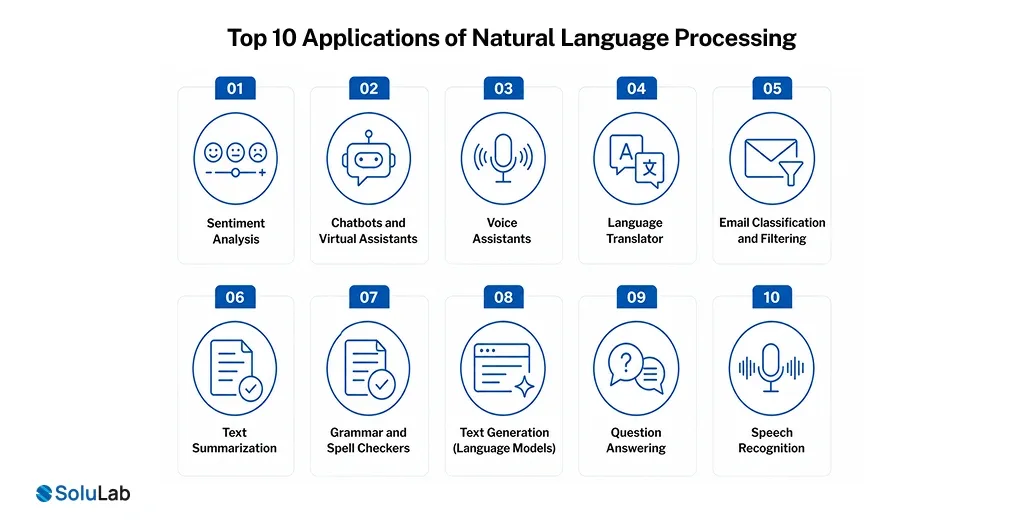
NLP is reshaping how businesses read language, automate conversations, and build better digital experiences. From support desks to content creation, AI integration now runs under a huge range of everyday tools and enterprise systems. Here are ten of the clearest examples.
1. Sentiment Analysis
Sentiment analysis reads the emotion behind what customers say across reviews, social media, surveys, and support chats. It tells you whether people are happy or frustrated, so you can fix products, protect your reputation, and step in before a small complaint turns into a pattern.
Example: Amazon
Amazon runs sentiment analysis across product reviews to catch recurring complaints and see where the experience breaks down. That feedback loop feeds straight into faster product and service fixes.
2. Chatbots and Virtual Assistants
NLP-powered chatbots and assistants read what a user actually wants, answer the question, handle the task, and stay online around the clock. The payoff is faster replies, lower support costs, and customers who get help the moment they ask for it.
Example: Intercom
Intercom uses NLP chatbots to automate support, qualify leads, and walk users through problems. Less manual work for the team, quicker answers for everyone else.
3. Voice Assistants
Voice assistants pair NLP with speech recognition so they can catch a spoken command and answer like a person would. You get things done hands-free, which makes the whole interaction quicker and more accessible.
Example: Amazon Alexa
Amazon Alexa lets people control smart devices, play music, and pull up information by voice alone. It is a big reason talking to your devices now feels normal.
4. Language Translator
NLP-based translation tools convert text or speech from one language to another, fast and with decent accuracy. They open up global communication, help with accessibility, and let businesses reach audiences they could not talk to before.
Example: Google Translate
Google Translate handles text, whole websites, and live conversations across dozens of languages. It quietly removes the language barrier for millions of people and companies.
5. Email Classification and Filtering
NLP sorts your inbox for you: it catches spam, flags the messages that matter, and clears out the clutter. That means less time triaging email and more protection from phishing and junk.
Example: Gmail
Gmail uses NLP to block spam, group emails by type, and float the important ones to the top. For millions of users, that is what keeps the inbox manageable.
6. Text Summarization
Text summarization squeezes long documents, reports, or articles down to the essentials without losing the point. You get the gist in a fraction of the time.
Example: Microsoft Copilot
Microsoft Copilot summarizes meetings, email threads, and documents so professionals can catch up in minutes instead of an hour.
7. Grammar and Spell Checkers
NLP-powered writing tools catch typos, punctuation slips, and clunky phrasing as you type. The result is writing that reads cleaner and more professional, without a second pair of eyes.
Example: Grammarly
Grammarly helps people tighten grammar, tone, and clarity across emails, documents, and messages. It turns rough drafts into something you would be comfortable sending.
8. Text Generation (Language Models)
Language models use NLP to write human-sounding text: emails, blog posts, reports, customer replies. For businesses, that means scaling content and clearing repetitive writing off the to-do list.
Example: OpenAI ChatGPT
OpenAI ChatGPT drafts content, boils down long information, and answers questions on the fly. It has changed how quickly teams move on content and everyday productivity work.
9. Question Answering
Question-answering systems read a query, understand it, and pull the answer straight from documents, websites, or databases. People find what they need faster, and decisions get made with better information behind them.
Example: Google Search AI Overviews
Google uses NLP in AI Overviews to answer search queries with a summarized take right at the top. Quick, relevant, no clicking around.
10. Speech Recognition
Speech recognition turns spoken words into text, which is what makes voice commands, transcription, and hands-free control possible. It boosts accessibility and cuts a lot of friction out of using digital tools.
Example: Otter.ai
Otter.ai transcribes meetings, lectures, and interviews as they happen. Teams walk away with an accurate record instead of half-remembered notes.
NLP Trends Shaping 2026 and Beyond
NLP keeps moving, and the direction is clear: less basic automation, more systems that read context, intent, and the specifics of a given industry. Here is what businesses are watching.
- Multimodal AI: Newer NLP systems work across text, voice, images, and video at once, which makes for richer experiences, better accuracy, and interactions that feel closer to human.
- AI agents: Agents are getting more independent. They take on support, scheduling, research, and whole workflows with barely any hand-holding, which frees people from a lot of manual work.
- Contextual search: Search is learning to read intent. By factoring in context, past interactions, and meaning rather than keywords, it returns results that are faster, more relevant, and more personal.
- Domain-specific NLP: More teams are training models for a single field, healthcare, finance, legal, where accuracy, compliance, and sound decisions in complex situations matter most.
How SoluLab Helps Businesses Build NLP Applications
Getting an AI agent system into production is not a one-model job. It takes real depth across models, architecture, and integrations. SoluLab helps businesses design AI systems that scale, stay secure, and perform under real-world load, built around the actual use case rather than a generic template.
Here is what we deliver:
- Custom AI agent system development
- Multi-agent orchestration
- LLM fine-tuning + RAG pipelines
- Enterprise integrations (CRM, ERP, APIs)
- AI deployment and scaling
- Continuous monitoring and optimization
Take CyberHulk as an example. SoluLab built it as an AI-powered marketing SaaS platform that pulled campaign management, lead generation, analytics, and workflow automation into one place.
Instead of juggling a dozen marketing tools, teams ran everything through CyberHulk, which cut down manual work, raised lead quality, and made data-driven growth calls easier to make across channels.

Conclusion
NLP is not some future technology anymore. It is already automating communication, sharpening customer experiences, working through huge volumes of data, and helping teams decide faster.
Sentiment analysis, chatbots, speech recognition, translation: piece by piece, NLP has become part of how modern operations actually run. As AI keeps improving, the companies that adopt it early tend to pull ahead, on efficiency, on personalization, on the quality of their day-to-day workflows.
Thinking about building your own NLP-powered solution? SoluLab, an AI development company in USA, can help you design it, build it, and scale it into something that holds up.
FAQs
Neha is a curious content writer with a knack for breaking down complex technologies into meaningful, reader-friendly insights. With experience in blockchain, digital assets, and enterprise tech, she focuses on creating content that informs, connects, and supports strategic decision-making.