Talk to an Expert
Get in Touch

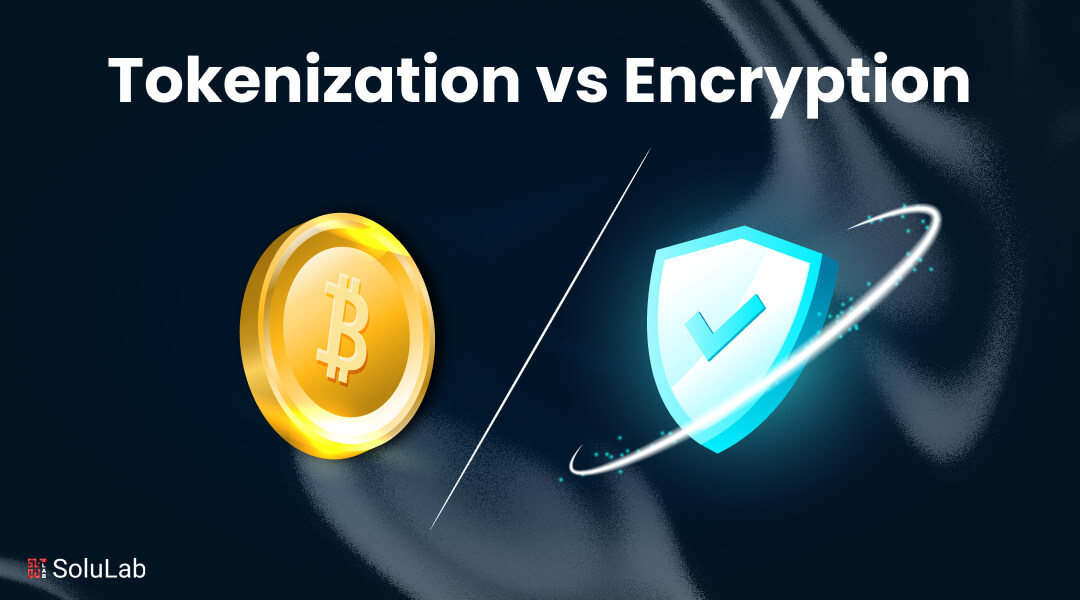
Tokenization Vs Encryption? Know the difference!


Tokenization Vs Encryption

In today’s digital age, data security is important. With the increasing prevalence of cyber threats and stringent regulatory requirements, organizations must employ robust strategies to protect sensitive information. Among the arsenal of data protection methods, encryption and tokenization stand out as two key techniques. However, despite their shared goal of safeguarding data, they operate in distinct ways and serve different purposes.

Understanding the data tokenization vs encryption is crucial for effectively implementing data security measures. In this blog, we delve into the concept of tokenization and encryption, elucidating their functionalities, advantages, and best practices. By grasping the fundamental disparities between these methods, businesses can make informed decisions to fortify their data defenses and navigate compliance requirements confidently.

What is Encryption?

Encryption is a method of securing data by converting it into an encoded form that can only be deciphered by authorized parties. In essence, encryption involves scrambling plain, readable data (known as plaintext) into an unreadable format (known as ciphertext) using an algorithm and a cryptographic key. This procedure makes sure that even if someone with illegal exposure to the encrypted data manages to decrypt it, they will be unable to do so without the necessary decryption key.

The encryption process typically involves applying a mathematical algorithm to the plaintext along with a cryptographic key. The algorithm manipulates the plaintext based on the key’s instructions, transforming it into ciphertext. The resulting ciphertext appears as a seemingly random sequence of characters, making it unintelligible to anyone who does not possess the decryption key.

Encryption plays a vital role in data security, offering confidentiality and privacy for sensitive information during transmission and storage. It is utilized across various sectors, including finance, healthcare, government, and telecommunications, to protect data from unauthorized access, interception, and tampering.

Types of Encryption

There are two primary types of encryption:

1. Symmetric Encryption: Symmetric encryption encrypts data and decrypts it using the same key. The parties involved in the communication must safely exchange this key. The Advanced Encryption Standard (AES), Data Encryption Standard (DES), and Triple DES (3DES) are examples of symmetric encryption methods.

2. Asymmetric Encryption: As an alternative to public-key encryption, asymmetric encryption employs two keys: a private key for decryption and a public key for encryption. The private key remains hidden, while the public key is shared without restriction. RSA (Rivest-Shamir-Adleman) and ECC (Elliptic Curve Cryptography) are two examples of asymmetric encryption techniques.

How Does Encryption Work?

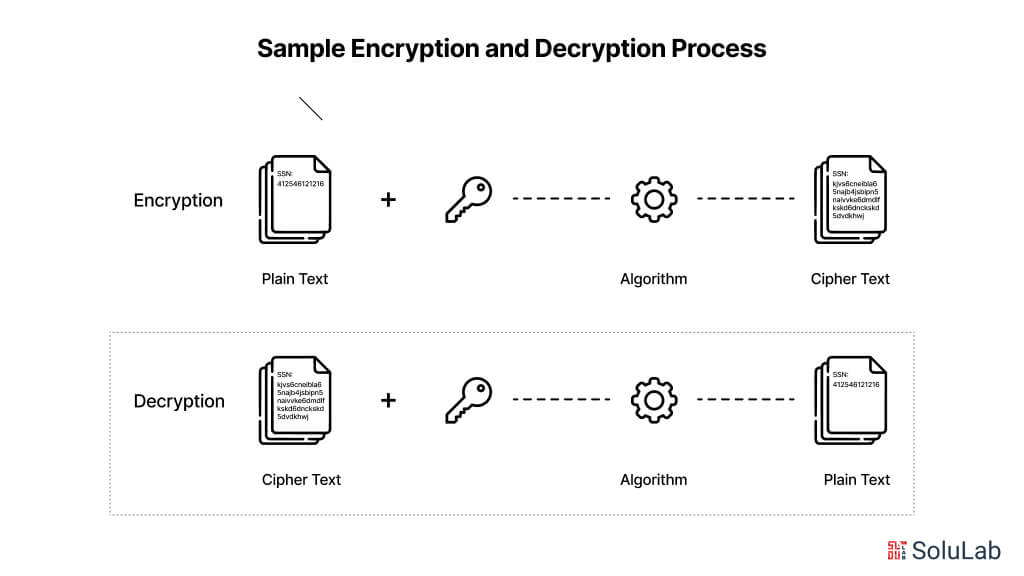
Encryption works by transforming plain, readable data (plaintext) into an unreadable format (ciphertext) using an algorithm and a cryptographic key. This procedure guarantees that private data stays safe and secret, even in the event that it is received by unapproved parties. Let’s delve into the specifics of how encryption operates:
Tokenization Vs Encryption

Encryption Process

  • Algorithm Selection: Encryption begins by selecting a suitable encryption algorithm, which dictates how the plaintext will be transformed into ciphertext. Common encryption algorithms include AES (Advanced Encryption Standard), RSA (Rivest-Shamir-Adleman), and ECC (Elliptic Curve Cryptography).
  • Key Generation: A cryptographic key is generated or selected to be used in conjunction with the encryption algorithm. The key serves as the input to the algorithm, influencing the transformation process. In symmetric encryption, the same key is used for both encryption and decryption, while in asymmetric encryption, a pair of keys (public and private) is employed.
  • Encryption: The encryption algorithm takes the plaintext and the encryption key as inputs and performs a series of mathematical operations on the plaintext, scrambling it into ciphertext. The resulting ciphertext appears as a random sequence of characters, obscuring the original data.
  • Output: Once encrypted, the ciphertext is generated and can be transmitted or stored securely. Without the corresponding decryption key, the ciphertext is indecipherable and unintelligible to unauthorized parties.

Decryption Process

  • Key Retrieval: To decrypt the ciphertext and recover the original plaintext, the recipient must possess the appropriate decryption key. In symmetric encryption, this key is the same as the one used for encryption, while in asymmetric encryption, the private key is used for decryption.
  • Decryption: The recipient applies the decryption key and the decryption algorithm to the ciphertext, reversing the encryption process. The algorithm reverses the transformations applied during encryption, converting the ciphertext back into plaintext.
  • Output: The decrypted plaintext is obtained, revealing the original, readable data. This plaintext can then be processed, displayed, or utilized as intended by the recipient.

Encryption operates on the principle of confidentiality, ensuring that only authorized parties with access to the decryption key can retrieve and understand the original data. By utilizing robust encryption techniques and secure key management practices, organizations can protect sensitive information from unauthorized access, interception, and tampering, thereby safeguarding data privacy and integrity.

Use Cases of Encryption in Data Security
Use Cases of Encryption

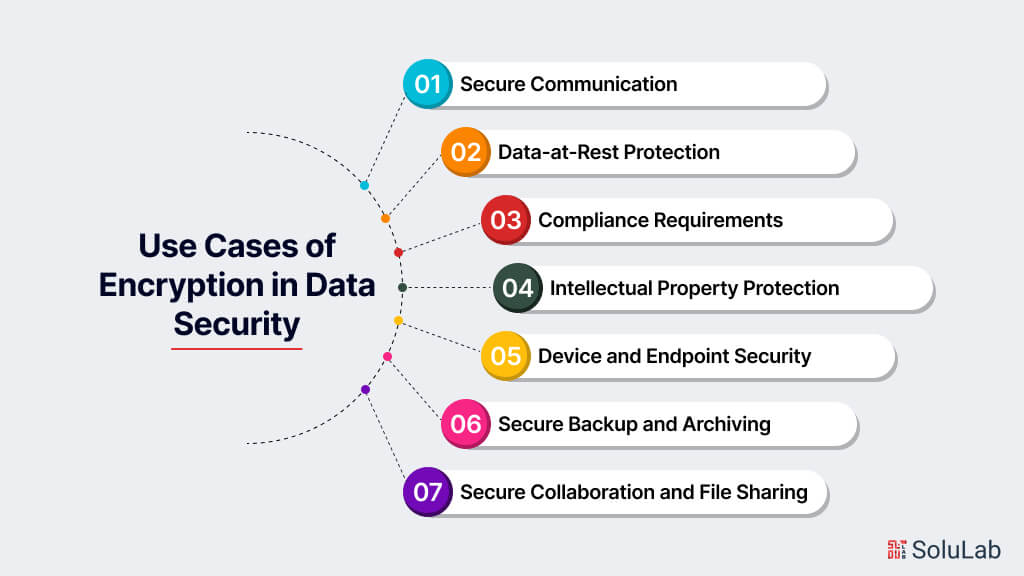
Encryption plays a crucial role in data security across various industries and applications. Here are some common use cases of encryption:

1. Secure Communication

Encryption ensures the confidentiality of sensitive information transmitted over networks, such as emails, instant messages, and online transactions. Secure protocols like SSL/TLS utilize encryption to establish secure connections between clients and servers, preventing eavesdropping and data interception. Virtual Private Networks (VPNs) use encryption to create secure tunnels over public networks, enabling secure remote access and communication.

2. Data-at-Rest Protection

Encryption safeguards data stored on devices, databases, and cloud storage against unauthorized access, theft, or breaches. Full-disk encryption encrypts entire storage devices, such as hard drives or solid-state drives (SSDs), ensuring that all data on the device remains protected. File-level encryption selectively encrypts individual files or directories, allowing granular control over data protection.

3. Compliance Requirements

Encryption is mandated by various compliance standards and regulations, such as the Health Insurance Portability and Accountability Act (HIPAA), the Payment Card Industry Data Security Standard (PCI DSS), and the General Data Protection Regulation (GDPR). Compliance with these regulations often requires the implementation of encryption measures to protect sensitive information, including personal health information (PHI), financial data, and personally identifiable information (PII).

Read Also: ERC-3643 vs ERC-1400 vs ERC-20

4. Intellectual Property Protection

Encryption safeguards intellectual property and trade secrets stored in digital formats from unauthorized access, disclosure, or theft. Industries such as technology, pharmaceuticals, and media rely on encryption to protect proprietary information, research data, and valuable assets.

5. Device and Endpoint Security

Encryption secures data stored on mobile devices, laptops, and other endpoints, preventing unauthorized access in case of loss or theft. Mobile device management (MDM) solutions often include encryption features to protect corporate data on employee-owned devices.

6. Secure Backup and Archiving

Encryption ensures the confidentiality and integrity of data backups and archives stored locally or in the cloud. Following the best practices of data backup, modern backup solutions often incorporate encryption to protect sensitive data during transmission and storage, reducing the risk of data breaches or unauthorized access.

7. Secure Collaboration and File Sharing

Encryption enables secure collaboration and file sharing among individuals or organizations, ensuring that shared data remains protected from unauthorized access. Encrypted file-sharing services and collaboration platforms encrypt data both in transit and at rest, maintaining confidentiality and privacy.

Read Also: Why Dubai, London & New York Lead in Real Estate Tokenization?

What is Tokenization?

Tokenization is a data security technique that substitutes sensitive data with non-sensitive placeholder values, called tokens. Unlike encryption, which transforms data into an unreadable format, tokenization replaces the original data with a token, which is typically a randomly generated string of characters. The token has no intrinsic meaning or value and cannot be mathematically reversed to reveal the original data. Tokenization is widely used in payment processing, healthcare, and other industries to protect sensitive information while retaining usability.

Types of Tokenization

There are four types of tokenization as follows:

  • Credit Card Tokenization: In credit card tokenization, sensitive credit card numbers are replaced with tokenized values, allowing merchants and payment processors to store and process transactions securely without exposing cardholder data. Tokens are generated and managed by a tokenization service or platform, which securely maps tokens to their corresponding credit card numbers in a token vault. Tokenized credit card data can be used for recurring payments, fraud detection, and other transactional purposes without requiring access to the original credit card numbers.
  • Data Tokenization: Data tokenization extends beyond credit card numbers to protect other types of sensitive data, such as social security numbers, bank account numbers, and personally identifiable information (PII). Like credit card tokenization, data tokenization replaces sensitive data with tokens, ensuring that the original data remains protected from unauthorized access or exposure. data tokenization vs encryption solutions may offer customization options to tokenize specific data elements based on organization-specific requirements and compliance standards.
  • Email Tokenization: Email tokenization replaces email addresses with unique tokens, enabling organizations to communicate with customers and users without exposing their email addresses. Email tokens are generated and managed securely to ensure that each token corresponds to a unique email address. Email tokenization helps protect user privacy and mitigate the risk of email-related spam, phishing, and data breaches.
  • Tokenization for Authentication: Tokenization is also used for authentication purposes, where tokens serve as temporary credentials or access tokens. Access tokens are used to authenticate users and grant access to secured resources or services, such as APIs, web applications, and cloud services. These tokens are typically time-bound and limited in scope, reducing the risk of unauthorized access or misuse.

Read Also: How to Create a Gold Tokenization Platform

How Does Tokenization Work?
How Does Tokenization Work

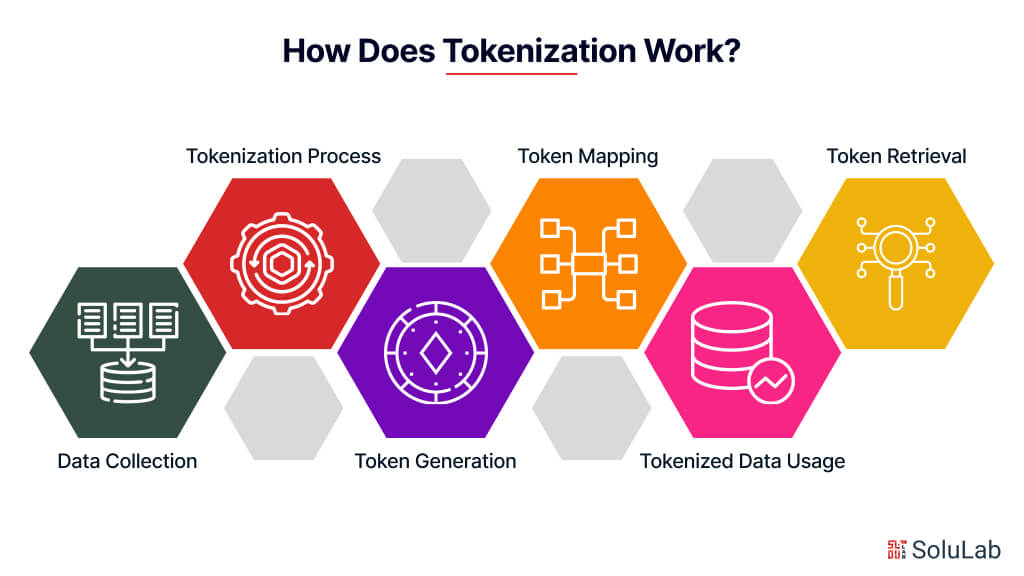
Tokenization is a data security strategy where sensitive data is replaced with replacement values that aren’t sensitive (called tokens). Here’s how tokenization works:

1. Data Collection

Initially, sensitive data, such as credit card numbers, social security numbers, or other personally identifiable information (PII), is collected from users or systems.

2. Tokenization Process

The sensitive data undergoes a tokenization process where it is replaced with randomly generated tokens. Tokenization can be performed using tokenization software or services, which manage the mapping between original data and tokens securely.

Related: How to Create an NFT Token in 2025?

3. Token Generation

Tokens are typically alphanumeric strings generated using cryptographic methods. These tokens have no intrinsic meaning or value and are randomly generated for each instance of sensitive data.

4. Token Mapping

The tokenized data and its corresponding original data are securely stored in a token vault or database. This mapping allows authorized users to retrieve the original data associated with a token when necessary.

5. Tokenized Data Usage

Tokenized data is used in place of the original sensitive data for various purposes, such as payment processing, identity verification, or data storage. Tokens can be transmitted and stored without revealing the underlying sensitive information, minimizing the risk of data exposure or theft.

6. Token Retrieval

Authorized users can retrieve the original data associated with a token from the token vault when needed for legitimate purposes, such as transaction processing or customer verification. Access to the token vault is tightly controlled to ensure that only authorized personnel can access sensitive data.

Use Cases of Tokenization in Data Security

Tokenization finds extensive use in securing sensitive data by substituting it with non-sensitive tokens. Its applications span across industries such as finance, healthcare, and e-commerce, ensuring data privacy and compliance with regulatory standards.

1. Payment Processing

Tokenization is widely used in the payment industry to secure credit card transactions. Credit card numbers are tokenized to prevent exposure of cardholder data during payment authorization, reducing the risk of fraud and data breaches.

2. Healthcare Data Protection

In the healthcare sector, tokenization is employed to protect electronic health records (EHRs) and other sensitive patient information. Patient identifiers, such as social security numbers and medical record numbers, are tokenized to comply with healthcare regulations (e.g., HIPAA) and safeguard patient privacy.

3. Data Storage and Cloud Services

Tokenization helps secure data stored in databases, cloud storage, and other repositories. Sensitive data, such as personally identifiable information (PII) and financial records, can be tokenized to mitigate the risk of unauthorized access or data breaches.

4. Identity and Access Management

Tokenization is used in identity and access management (IAM) systems to authenticate users and manage access to secured resources. Access tokens are generated to grant temporary access to applications, APIs, and online services, reducing the reliance on traditional passwords and enhancing security.

Related: How Digital Assets Are Transforming Industries?

5. Retail and E-commerce:

Tokenization is employed in retail and e-commerce environments to secure customer payment information and streamline checkout processes. Tokenized payment data allows merchants to process transactions securely without storing sensitive credit card information, improving customer trust and compliance with payment card industry standards (e.g., PCI DSS).

Key Differences Between Tokenization and Encryption

Before diving into the detailed comparisons, it’s essential to understand the key distinctions between tokenization and encryption. While both techniques aim to safeguard sensitive data, they differ in reversibility, performance, scalability, and regulatory compliance implications. Let’s explore these differences in detail:

A. Purpose and Functionality

Tokenization vs Encryption: Tokenization and encryption serve distinct purposes in data security. Tokenization substitutes sensitive data with non-sensitive tokens, ensuring data security while maintaining usability. Encryption, on the other hand, transforms data into an unreadable format, providing confidentiality but retaining the original data’s structure. While tokenization focuses on data substitution, encryption focuses on data transformation.

B. Reversibility

Data Tokenization vs Encryption: One fundamental difference lies in reversibility. Tokenization is non-reversible, meaning tokens cannot be mathematically reversed to obtain the original data. Even with knowledge of the tokenization algorithm and token values, it is practically impossible to reverse the process and retrieve the original data. Conversely, encryption is reversible, allowing encrypted data to be decrypted back into its original form using the decryption key. This reversible nature of encryption facilitates secure transmission and storage of data while ensuring that authorized parties can access and interpret the information.

C. Performance and Scalability:

Encryption vs Tokenization vs Masking: Performance and scalability considerations also distinguish tokenization from encryption. Encryption processes can be computationally intensive, especially when dealing with large volumes of data, which may impact system performance. In contrast, tokenization typically offers faster performance since it involves simple substitution of data with tokens, requiring fewer computational resources. Additionally, tokenization is inherently more scalable than encryption, making it suitable for environments with high data volumes. Tokenization systems can easily handle the generation, storage, and retrieval of large numbers of tokens without significant performance degradation, whereas encryption systems may face scalability challenges under similar conditions.

D. Regulatory Compliance Implications

Tokenization vs Encryption vs Hashing: Regulatory compliance requirements play a crucial role in determining the choice between tokenization and encryption. While encryption is often explicitly required by regulations such as GDPR (General Data Protection Regulation) or HIPAA (Health Insurance Portability and Accountability Act) for protecting sensitive data, tokenization and hashing may offer alternative methods for achieving compliance. Understanding the regulatory landscape and the specific requirements for each technique is essential for organizations to ensure compliance with data protection standards. Depending on the regulatory environment and industry-specific regulations, organizations may choose to implement tokenization, encryption, or a combination of both to meet compliance obligations and protect sensitive information effectively.

Check Our Case Study: NFTY

Pros and Cons of Encryption

Pros:

  • Confidentiality: Encryption ensures that sensitive data remains confidential and unreadable to unauthorized parties, providing a high level of security.
  • Data Integrity: Encrypted data is protected from tampering or unauthorized modifications, maintaining its integrity throughout transmission and storage.
  • Regulatory Compliance: Encryption helps organizations comply with data protection regulations such as GDPR, HIPAA, and PCI DSS by safeguarding sensitive information from unauthorized access.
  • Flexibility: Encryption can be applied to various types of data and communication channels, offering a versatile solution for securing information across different platforms and environments.

Cons:

  • Performance Overhead: Encryption can introduce computational overhead and latency, particularly in high-volume environments, impacting system performance and responsiveness.
  • Key Management Complexity: Effective encryption requires robust key management practices to securely generate, distribute, and store encryption keys, which can be complex and resource-intensive.
  • Data Recovery Challenges: If encryption keys are lost or compromised, data recovery becomes challenging or impossible, potentially leading to permanent data loss.
  • Potential Vulnerabilities: Despite its benefits, encryption may be vulnerable to cryptographic attacks or implementation flaws, requiring ongoing monitoring and updates to maintain security.
CTA1

Pros and Cons of Tokenization

Pros:

  • Data Security: Tokenization protects sensitive data by replacing it with non-sensitive tokens, reducing the risk of data breaches and unauthorized access.
  • Non-Reversibility: Tokens cannot be reversed to obtain the original data, enhancing data security and privacy.
  • Compliance Simplification: Tokenization simplifies regulatory compliance efforts by minimizing the scope of sensitive data subject to compliance requirements, reducing the risk of non-compliance penalties.
  • Scalability: Tokenization systems can easily handle large volumes of data without significant performance degradation, making them suitable for scalable applications and environments.

Cons:

  • Usability Challenges: Tokenization may introduce usability challenges, especially if the original data needs to be retrieved or processed in its original form, requiring additional token-to-data mapping mechanisms.
  • Dependency on Tokenization Systems: Organizations become reliant on tokenization systems and providers, making it essential to ensure the availability, reliability, and security of these systems.
  • Potential for Tokenization Errors: Incorrect tokenization mappings or errors in token generation can lead to data integrity issues and misinterpretation of tokenized data.
  • Implementation Complexity: Implementing tokenization systems and integrating them with existing infrastructure may require significant effort and resources, particularly in complex environments with diverse data sources and applications.

Conclusion

In conclusion, understanding the nuanced differences between tokenization and encryption is essential for organizations seeking to fortify their data security measures. While both techniques offer robust solutions for protecting sensitive information, they operate distinctly in terms of purpose, reversibility, performance, and regulatory implications. Tokenization provides a pragmatic approach by substituting sensitive data with non-sensitive tokens, ensuring data security without compromising usability. On the other hand, encryption offers a reversible method of transforming data into an unreadable format, providing confidentiality while retaining the original data’s structure. By recognizing the strengths and limitations of each approach, organizations can make informed decisions tailored to their specific security requirements, compliance obligations, and operational needs.

At SoluLab, we empower businesses to enhance their data security posture through tailored tokenization solutions. As a leading tokenization development company, we specialize in designing and implementing robust tokenization systems that safeguard sensitive information across various industries and use cases. Our team of experts uses advanced technologies and industry best practices to deliver scalable, reliable, and compliant tokenization solutions that meet the unique security needs of our clients. Whether you’re looking to protect payment data, healthcare records, or other sensitive information, SoluLab is your trusted partner in achieving data security excellence. Contact us today to learn how our tokenization services can elevate your data protection strategy and drive business success.

FAQs

1. What is the main difference between tokenization and encryption?

The primary difference lies in their approach to data security. Tokenization replaces sensitive data with non-sensitive tokens, preserving usability but ensuring data security. Encryption transforms data into an unreadable format, providing confidentiality while retaining the original data’s structure.

2. Which method, tokenization or encryption, is more secure?

Both tokenization and encryption offer robust security measures. Tokenization provides non-reversible protection by substituting data with tokens, making it highly secure. Encryption, while reversible, offers strong confidentiality through complex algorithms and keys. The choice between the two depends on the specific security requirements and use cases of the organization.

3. Are tokenization and encryption mutually exclusive?

No, tokenization and encryption can be used together to enhance data security. For instance, sensitive data can be encrypted first to ensure confidentiality and then tokenized for additional protection. This hybrid approach combines the strengths of both techniques to create a multi-layered security strategy.

4. How does tokenization impact compliance with data protection regulations?

Tokenization simplifies compliance efforts by reducing the scope of sensitive data subject to regulatory requirements. By replacing sensitive information with tokens, organizations can minimize the risk of non-compliance penalties while still maintaining data security and privacy.

5. What are the key considerations for choosing between tokenization and encryption?

When deciding between tokenization and encryption, organizations should consider factors such as data sensitivity, reversibility requirements, performance implications, and regulatory compliance obligations. Understanding the specific security needs and operational requirements will help organizations make informed decisions tailored to their unique circumstances.
 

A Complete Guide On Initial DeX Offerings (IDOs)

Initial DeX Offerings (IDOs)

The first initial dex offering (IDO) is one of the novel fundraising strategies that have emerged as a result of the overall development of the cryptocurrency sector. The initial coin offering (ICO) was the first method of obtaining capital in the cryptocurrency industry, but it caused a lot of controversy in 2017. It also made a lot of people rich very quickly, especially the early investors. A large number of initial coin offering projects made grand claims about potential profits. A lot of ICO schemes were either full-blown scams or just ploys to steal money.

To combat this, proponents of decentralized finance (Defi) are proposing new ways of obtaining capital. The dex model is one example of such a model. Crypto investors now have access to a new crowdfunding model through DEXs, which is more egalitarian. However, a quick overview of Defi and DEXs is provided here before we get into what is initial dex offering, what you need it for, what the benefits of and how can you launch one.  

Concept of Initial Dex Offering

Tokens representing any kind of asset housed on a distributed exchange (DEX) are known as initial dex offers or IDOs, a project launches a token via a decentralized liquidity exchange. From a music record to a Bitcoin, IDOs can be made for anything including aether-driven battleships. IDOs provide companies with a means to involve communities near them in an economy that enhances their goods and services as well as lets them make wise asset-related business decisions. Projects releasing initial DEX offerings get funding from individual investors, in the same manner that traditional firms get venture capital before launching. Shareholders in initial dex offerings do not acquire any ownership in the project unlike those in an initial public offer. 

An initial dex offering or IDO is the debut of a cryptocurrency on a distributed exchange (DEX). The newest paradigm for crypto initiatives seeking investor funding is IDOs. Still, they have some constraints, for example, DEXs lack scalability. ICOs and IEOs are not rare in their ability to generate more than $1 billion, this is unprecedented for DEXs. Defi platforms have a lengthy learning process, hence ignorance of how crypto works could prevent the typical crypto trader from entering the market. Effectively countering this difficulty would require sponsoring Defi’s education. 

Why Initial Dex Offering?

In 2017, Initial Coin Offerings and token sales gained popularity, and by the end of the year, they had raised an estimated $4.9 billion, at the same time, other companies were aiming to solve problems by utilizing blockchain technology. It is difficult to deny the fact that ICOs have several drawbacks, including the fact that they are centralized and susceptible to risk. However, a significant number of ICOs have been successful. Additional major drawbacks of ICOs include the potential for discrimination by third parties’ liability for larceny and human mistakes and an overall lack of privacy. 

The newly developed fundraising model seeks to alleviate the problems that are associated with initial coin offerings (ICOs) while simultaneously introducing new opportunities to the cryptocurrency industry. IDOs are decentralized, through crowdfunding with independent development organizations (IDOs), business owners can launch a blockchain idea that is immune to the influence of influence of hostile third parties and eliminates any problems that may arise from human mistakes or hackers. In addition to this, the currencies are owned by token purchasers and holders are immediately protected on their wallets with their private keys. 

Is IDO a Better Approach to Crypto Fundraising?

There have been several crypto fundraising methods before IDO, such as Initial Coin Offerings (ICO), Security Token Offerings (STOs), and Initial Exchange Offerings (IEOs) but IDOs represent the next logical step. For new enterprises and startups looking to create a token and gain access to capital quickly, IDOs are a great option because of their mechanics, which provide superior and instant liquidity at any price level. Bypassing pre-mines an issuance scheme that benefits project founders at the expense of community members is what makes IDOs a more equitable alternative to the previously described financing techniques for new cryptocurrency projects. 

In July 2013, the master coin did its first initial coin offering (ICO). In 2014 Ethereum was able to raise $ 2.3 million or 3700 BTC in the first 12 hours of its token sale. On April 17, 2019, the Idax, BitForex, Bit-Z, and Bit-M exchanges launched the first IEO. Alternatively, Raven Protocol revealed in June 2019 that it will launch its first-ever IDO and list it on Binance DEX. 

IDO Launched Projects and Use Cases

Despite first and even claims on their blog that they were unaware of what an IDO was since no one had done it before, Raven Protocol can be considered a successful venture despite being the first. 

IDO Raven Protocol

It is a distributed deep-learning training technique that uses deep neural networks that spread quite far wide. Currently managed by large firms, the Raven Protocol intends to provide quick and relatively inexpensive solutions using the blockchain to transform AI and machine learning industries. They contribute their computers with the help of the native RAVEN token, which gives them prizes; the utility token used for training AIs.

Universal Market Access Protocol Initial Distributions Offering

Another successful IDO project launch is the Universal Market Access (UMA) protocol even though its IDO had issues. This allows DeFi developers to mint synthetic Ethereum assets— tokens whose value fluctuates and is backed by collateral. From $0.26 each, it began its token sale in April at the distributed exchange marketplace – Uniswap. It cost UMA $535,000 in Ethereum to create a new liquidity pool to achieve that pricing.

Notably, however, the UMA token price quickly started rising because people waited to buy the token. After all, token pricing in Uniswap works with the help of the bonding curve instead of orders, unlike other platforms that Shiller compared the system to. Traders hence aimed at paying for more gas to transact faster which, at last, caused the UMA token price to increase to more than $2, more than a minute after launch. It eventually landed at slightly over $1 and several buyers reported they bought at a higher price than pre-sale investors. This, however, brings focus to Uniswap rather than the UMA problem.

Currently, one token of UMA is worth more than $25 with an overall market value standing at over $1.5 billion, this is after this early setback.

Swap IDO for Sushi

Another such example is SushiSwap, an Ethereum-based decentralized crypto exchange aspiring to dethrone Uniswap and become the core frequently utilized decentralized exchange developed on Ethereum. SushiSwap consumers, it seems, transferred close to a billion and one hundred forty million worth of locked-up Uniswap tokens to SushiSwap in September last year.

Interestingly, instead of performing an ICO, as is commonplace, SushiSwap staked LP tokens on Uniswap while benefiting the providers of liquidity. They were rewarded SUSHI tokens for this. For customers looking for Uniswap LP tokens to SushiSwap’s original framework, 1000 SUSHI were minted for each Ethereum block, roughly every 12 seconds in SushiSwap’s first two weeks.

How To Launch an IDO?

In this part, efforts are made to explain how users can launch their IDOs within a chronological and sequential approach. For users to create a good cryptocurrency needed to launch an IDO, they need to have some insight into the creation of a cryptocurrency.

Step 1: Formulate a Business Strategy

The potential for launching a token offering that will be available on a DEX should be well-coordinated and logical, hence the need to create a proper strategy that should govern its implementation. It has to include the problem that the project aims to solve, the funds to be used, the blockchain on which the project is going to be carried out, a broad marketing plan, and how to lead the project after the IDO session.  

Step 2: Develop Marketing Materials

In the case of an IDO launch, the marketing material is formally a website and a white paper, at minimum often. An attractive branded website can go a long way to improving investor confidence.

The whole-souled participation of the emotional factors is achievable in an excellent website for those investors, who are being logically drawn to the project. The website may help the project look much more professional. Many projects may feel the pressure to create a brand image especially if they cannot afford to have a website.  White papers differ from all other forms of marketing as they increase the value of an investment by giving detailed information and factual material. This action goes to make the investor proceed further down along the known pipeline. 

Step 3: Visit a DEX Launchpad

If the project fulfills the conditions of the platform, which are most of the time consensus and whitelisting, an IDO will be launched.

Step 4: Make The Bitcoin

Customers ask, “Is it possible for consumers to start their cryptocurrency?” The response is this: Potentially, anybody who has some knowledge of the basics of technical space and good marketing intuition could learn how to launch a crypto coin.  You may start a cryptocurrency, and that has become extremely easy. Software we have online like CoinTool will enable the user to allow the program to do all the hard work. 

After the IDO and TGE, the DEX lists the tokens required for trading. Sushiwrap and Pancakw Swap are on that list. 

Step 5: Launching the Token

A basic guide to launching a crypto token is below. The project team creates a token pool, and investors pre-purchased tokens in a token pool. Investors will receive tokens following the TGE, right after the idea. By holding an auction, the work can determine a price based on supply and demand.

Some projects may reward investors for liquidity. This can help the project gain and maintain the monument, Yama. However, offering liquidity lets users earn more tokens.

Challenges and Risks Associated With Conducting IDO

Even though initial DEX offerings have benefits, projects and buyers need to be aware of the problems and risks that come with them. Here are some risks and challenges that you should be aware of :

Possibility of Scams 

As IDOs are autonomous, bad people may want to use them. Scams like rugs where fake projects take money and then disappear are a big problem. The lack of strict rules has made it easier for dishonored businesses to take advantage of clients who don’t know what’s going on. Doing thorough due research is important to lower the risk.

Uncertainty in the Rules

The rules for cryptocurrencies that include ideas are still not stable. Different places have different rules, and sudden changes to those rules can affect whether the ideas are allowed and how they work. Stay out of trouble with the law, projects and funders need to know about changes in regulations.

Conduct Required for Investors

Before investing in an idea, investors must do a lot of research. This means looking closely at the project’s white paper to economics, team, and participation from the community ideas are decentralised, which means that there is no other central authority that checks out projects. Instead, it is up to the individual investors to do their study.

Technical risks

Smart contracts can be very dangerous if they are not secure. If there are bugs or security holes in the smart contracts, money could be lost or the token sale could be hacked. To make sure there is smart contracts are safe and work projects must try and audit them thoroughly.

What Makes IDO Different Than ICO?

Readers should understand what an idea is, and how is it better than an ICO now this section compares ICOs with IDOs. 

  • Unlike initial public offerings and IEO ideas, ICOs do not require token issues to pay intermediaries. For IDORICO funding, projects are solely responsible for marketing. You are supposed to hire more experienced developers to design the token-selling smart contracts may need to audit and verify everything on the books. This prevents any regulatory or legal surprises for project owners. 
  • Coin offerings are a very centralized rug, pulling where the crew lies with investors’ funds is another risk and the investor would lack protection. Many ICO coins are produced on the company’s website. Following the sales. This method is expensive. The issue requires that the token should be on one or major centralized exchange lists.
  • Whereas IDOs avoid premises, unlike ICOs, this can improve investor trust, especially for fundamental analysis-based project elections. Investors should not worry about the long-term tokens admission rate. IDOs also provide token access more fairly to investors specifically, IDO tokens trade instantly. ICO sometimes has lock-up periods whereas IDO does not
  • IDOs offer instant liquidity, and trade, unlike ICOs. I provide the benefit of listing the token right on time on the DEX where the IDO occurred. The investors and the insiders frequently get better terms than retail investors in ICO. IDOS cannot show favorability since smart contracts cannot do so.

Benefits Offered by Initial Dex Offering

  • Decentralized Funding

Unlike IEOs and ICOs decentralized fundraising, IDOS replaces the necessity for projects to pay costly exchange fees or wait for clearance from a centralised Authority. This distributed method makes it more easily available for projects since it allows speed and permissionless funding.

  • Vetting Programmes by Communities

IDOS the strength of outspoken community members for screening instead of depending on the approved list of project exchanges. This guarantees a more inclusive environment by opening chances for projects that are smaller and encouraging big-scale cooperation.

  • Immediate Trading and Liquidity 

Unlike the initial waiting times, mandated by ISNICS, instant liquidity and trade IDS offer, instant instantaneous access to trade and liquidity upon token Lounge. This quick availability draws early consumers and increases the value of the projects.

  • Simplified User Experience

By providing safe wallets and integrated trading systems, all in one interface I streamline the user experience. Support of several wallets, and kinds, further improves participants, accessibility, and simplicity of usage.

Future Trends of IDO

Though just with ICOs, IEOs, and STOs adjustments are still needed, even if IDS is the newest approach for crypto businesses to release tokens to the public. UMA’s IDO bears evidence of this. With IDS, however, a distributed exchange leaves a lack of control over mechanisms. Regarding fundraising, one should have control to eliminate token prize adjustments or apply KYC rules that can be seen in ICOs, IEOs, and STOs. 

Scalability is another development that has to be given attention, decentralised finance (Defi) initiatives have raised money with IDOs For now. This is not to imply other crypto projects cannot employ this type of crowdfunding. Of course, some enthusiasm from current Defi, customers will be needed for these initiatives to flourish and token investment.

Another consideration is the centralized exchange, such as Coinbase and finance that still control the market, even if demand for IDOs is growing. Investors are not wondering when the next IDO is scheduled. They currently want to know when Coinbase plans to list a particular coin. Of course, this will not certainly alter as knowledge of distributed exchanges and Defi generally increases.

Though more awareness is required, ideas may have a bright future, but not only that currently a rather Nishay industry, Defi customers account. Just a small portion of the whole crypto market, however, the numbers are rapidly increasing. Based on the Coinmarketcap ICO calendar, the last few months of project fundraising are mainly IDOs as of August 2021

The Final Word

IDOs have grown to be a prominent fundraising channel in the Bitcoin space, providing projects with a decentralized, effective, and easily accessible way to raise money. Initial deck offerings are an appealing option when it comes to investing and projecting due to their advantages, which include instant, liquidity, lower cost, and improved security, even though they come with some dangers and difficulties, initial deck offerings are often anticipated to be vital in determining the direction of Blockchain technology and enterprise finance as the crypto ecosystem develops further. 

FAQs

1. What are the differences and similarities between an ICO and an IDO?

The major difference is that marketplaces usually market their tokens using the websites of the organizer, or project developer whereas the similarity is their platform and both are meant for raising capital.

2. What is the best example of IDO?

An IDO is an initial decentralized exchange of, a cryptocurrency project list. It’s taken on a distributed exchange DEX, such as Uni, swap osmosis, or Jupiter, this token sale.

3. What is the initial Dex Offerings strategy?

IDO is a fundraising tool where a distributed Blockchain initiative that provides native coins to the public on a disparate basis. Unlike first coin offers or initial exchange offers, IDOs are carried out via distributed platforms, therefore providing a more community-centric fundraising method.

4. What is an ICO in Crypto?

The common approach to generating money for goods and services frequently connects to cryptocurrencies in initial coin offers. Though tokens are created in an ICO might also have value for software tools or products. 

5. Can Solulab assist with Initial Dex Offering secure transactions?

By using Blockchain technology, smart contracts, and guaranteed strong security mechanisms suited to the project’s needs. SoluLab can help with the initial dex offering transaction.


How To Build Your NFT Marketplace And The Cost To Build One.

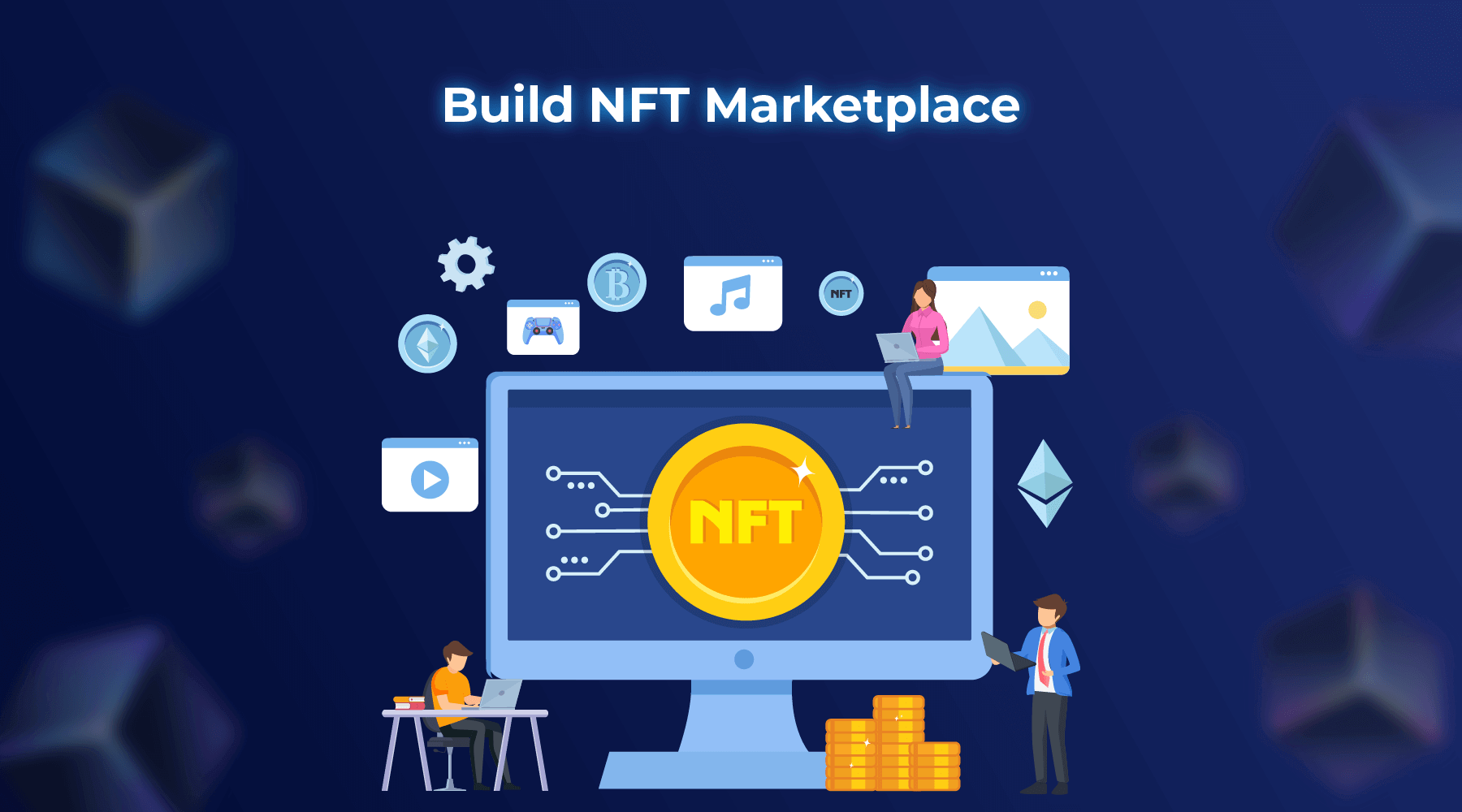
Build Nft marketplace

Modern technology makes it possible to purchase and sell practically everything, including digital characters, collectibles, cars, artwork even certain special experiences. Non-fungible tokens, or NFTs make it all possible. They are asking outrageous prices for the goods such as millions of dollars. $2.9 million was the price at which the first tweet ever sold, A group of NFTs called The Merge sold for $91.8 million. NFTs are typically gaining traction, which forces cryptocurrecny out of the market and enables the blockchain to reach new heights. 

Concept of NFT Marketplace?

An NFT marketplace is an online marketplace where a wide array of high-valued crypto-collectibles are sold via auctions. In this marketplace, the creators sell their non-fungible virtual products and the buyers or investors procure them by the use of cryptocurrencies such as Bitcoin or Ether. The NFT marketplaces charge an amount for every transaction where an NFT is purchased on the platform.

Once an NFT is purchased, the investor of the buyer gets a token. The token here is a unique identifier that consists of proof of ownership as well as information about the author, provenance, and authenticity. In an NFT marketplace, buyers can purchase various types of artwork, gaming assets, fashion accessories, memes, and a wide range of others online by making bids in the auction conducted.

Let us have a look at some of the top NFT marketplaces in terms of the highest trading volume.

  • OpenSea ($1.45 million)
  • Axie Infinity ($1.26 million)
  • NBA Top Shot ($1.06 million)
  • AtomicMarket ($850,840)
  • Decentraland ($789,670)

Important Things to Know Before Building an NFT Marketplace.

With so much hype created about the NFT marketplaces, there has been a considerable volume of blockchain enthusiast entrepreneurs planning to build an NFT marketplace. In this regard, there are a few essential things to know before creating the NFT marketplace.

NFT Standards

Standards are NFTs’ driving force which guarantees that the asset would be acting in a specific manner and showcases the ways of interaction with the basic functionalities of an asset. Presently, there are two common standards used for the creation of non-fungible tokens.

  • ERC721 This standard makes use of mapping unique identifiers to the addresses representing the owner of the identifier. ERC721 offers a permission way of transferring the assets by the “TransferFrom” method.
  • ERC1155 This standard uses IDs that do not just represent one asset but an entire class of assets. ERC1155 proves to be much more efficient as compared to the ERC721 standard.

NFT Metadata

There is a concept known as ‘owner’ in the NFT marketplace. It offers a way to search for the owner of an NFT. For instance, while searching for the owner of 212022 in any NFT’s smart contract, you can see token 212022’s owner is ‘ABC’. This information can be then verified on NFT marketplaces like OpenSea. But now the question arises how do platforms like OpenSea understand what 212022 is and what are its unique attributes? It is precisely the situation where metadata comes into play. Metadata provides descriptive information for a specific token number or an ID like descriptions, pictures, or any additional features.

Legal Documentation for Creating an NFT Marketplace

In addition to the nomenclatures, knowing the legal documentation for creating an NFT marketplace is extremely important.

  • Formation of company
  • Terms of service
  • Community standards
  • Privacy policy
  • Details of IP consideration

Working and Features of an NFT Marketplace

The working of an NFT marketplace involves a few simple steps that are described below.

  • First, the users sign up for an NFT platform.
  • The next step is to set up a crypto wallet on the platform for storing the non-fungible tokens and cryptocurrency.
  • Then the users create an NFT and appropriately configure the parameters of the auction.
  • Now, the collection is listed for sale.
  • In the next step, the chosen platform moderates the items.
  • Then the non-fungible tokens appear on the list for sale in the auction.
  • In the auction, the buyers place their bids.
  • At the close of the auction, the sellers receive notification regarding the top bids from the buyers.
  • Finally, the platform handles the transfer of items as well as funds and closes the deal.

In return for work done for transferring funds and non-fungible tokens by the platform, the NFT marketplaces charge some fees on the selling amount. Here are some of the major features of the NFT marketplace that is going to be created.

1. Storefront – It is the section of the NFT marketplace that provides users with detailed information about the items such as their details, owner, bids, price history, and a number of others.

2. Live Auction Feature – Several non-fungible tokens can be sold to prospective buyers via the live auction feature. The feature contains various types of information such as the names of the tokens & seller, methods of payment to be used, picture, price, number of bids made by other buyers, and the time left for making the bids.

3. Search Functionality Option – The NFT marketplace must possess a category tagging and management functionality, thereby making it easy for the users to search for items that they are looking forward to buying on the platform.

4. Trending Collections – Certain non-fungible tokens get a high selling price if they are appropriately showcased in the ‘Trending Collections” section. Therefore, it is extremely important for the NFT marketplace that is being built to have a special ‘trending collections’ section that contains very useful insights such as average price, features or characteristics of the crypto collectible, name of the seller, total supply, and trading volume.

5. Create Listing Feature – It is a feature of the NFT marketplace that is specifically for sellers. The platform should be created in a way that allows the users with the feasibility to create listings, thereby enabling them to add the details of their NFT.

6. Auction and Buy – Any of the efficient NFT marketplaces must have auction and buying options where the users can easily add bid amount, expiration date, and a watch list that shows all details of the status of the bids.

7. Wallet – The marketplace should necessarily have a wallet that enables users to send, receive, and store non-fungible tokens as well as cryptocurrencies. Your users will have to make use of wallets for sending, receiving, and storing NFTs and cryptocurrencies. The NFT marketplace should either be created with its wallet or have the provision to integrate existing wallets to provide a seamless experience to the users.

8. Acceptance of Various Payment Methods – A good NFT marketplace should have different methods for payment like debit cards, credit cards, wire transfers, and net banking from buyers in addition to popular crypto wallets.

9. Instant Notification Feature – The marketplace should have an instant notification feature that sends all the latest information via emails and pushes notifications regarding real-time data about the launching of collectibles, new non-fungible tokens, upcoming auctions, and many more.

10. Provision for Round the Clock Customer Support – The NFT marketplace should come with a provision for customer support which can play a significant role in boosting the customer retention rate.

Steps to Build a Highly Scalable NFT Marketplace

Now, let us discuss the steps to build an NFT marketplace.

1. Defining the Niche – The first step towards building an NFT marketplace is defining the niche. The proper definition of niche is the key to success. Also, it is extremely important to be aware of the present market. There are two types of markets.

A vertical market is where the suppliers sell the items that rightly satisfy the needs of a specific target audience.

A horizontal market where the focus is on a wide array of products or services at the same time. This type of market is quite dynamic requiring a lot of investments as well as effort.

2. Choice of Role – There are three types of roles in the NFT marketplace platforms.

Buyers – They are looking for digital artworks or other assets and are willing to buy them, hence termed as buyers.

Creators – As can be understood from the name, they are the artists who create and design digital assets that further get tokenized as non-fungible tokens.

Administrators – They are the admin of the NFT marketplace platform. They are the ones responsible for managing and running the platform. They play a crucial role in the hassle-free exchange of funds between buyers and sellers as well as the ownership of the transfer of crypto tokens.

3. Documentation of the Project – The next step is to create detailed documentation of the entire project which is of immense importance. It is a cumbersome task involving a lot of time and effort. However proper documentation helps save a lot of money in building an NFT marketplace.

Prototyping – In this highly competitive market, delivering an efficient and effective product is not sufficient since the users have a lot of choices. Thus, it is of utmost importance to aim at delivering experiences that just deliver a functional product or service. It is precisely the situation where UI and UX come to the rescue. 

The overall look and feel matter a lot in this regard. Thus, prototyping the UIs and mocks becomes an important step in the development of the NFT marketplace before the actual development starts.

Development – It is the stage where the entire developmental work takes place with the owner deciding the type of framework for the project. The development of the NFT marketplace is done keeping in mind optimum performance, functionality, reliability, efficiency, and operation.

Testing and Execution – It is the penultimate stage where the developed software is put to test and execution to check for all errors. The testing stage is aimed at finding the bugs and fixing them to make sure that the end product is of the highest quality.

Deployment ­– It is the final stage of building the NFT marketplace where the software after testing is ultimately implemented for use. After deployment, the software serves its intended purpose of use.

Cost of Developing the NFT Marketplace

Now, you have a clear understanding of NFT marketplaces. With the technology and complications involved in the development of an NFT marketplace, it is evident that a considerable volume of expenses would be incurred. The total cost of developing an NFT marketplace depends on several factors that are listed below.

FactorsAverage Costs
UX/UI Development$2395 – $5040
Authorization and Security$3285 – $8640
User Profiles$2385 – $5040
Home Page$3645 – $10,080
Search and Filters$4005 – $11,520
Product Page$2385 – $5040
Reviews & Ratings$2565 – $5760
Shopping Cart$2565 – $5760
Payments$2385 – $5040
Notifications$2085 – $3840
Ethereum Incorporation$4005 – $11,520
NFT management$4005 – $11,520
Inventory Management$2385 – $5040
Buyer Panel$3045 – $7680
Author Panel$5085 – $15.840
Admin Panel$3775 – $10,200
Total$50,000 – $116,040

Top Use 3 Use Cases Of NFTs 

In recent months, the worldwide NFT industry has established itself as a prominent and rapidly expanding subsegment of the digital assets market. The market used to be led mostly by sporting highlights and trading cards. Although NFTs took on new forms in the second part of the year, this resulted in the creation of several new market categories, including virtual real estate, gaming avatars, and fashion. Businesses, corporations, artists, and celebrities are using NFTs to communicate with their consumers and followers in a new and novel manner.

NFTs in Metaverse

The metaverse – a new type of virtual living – is becoming more popular with gamers. In tandem with the advancement of virtual and augmented reality technology, virtual worlds with unlimited experiences are progressively developing and becoming the preferred leisure channel for an increasing number of people. Furthermore, NFTs are playing an important part in the development of immersive and interactive metaverses such as Sensorium Galaxy.

Instead of scripted tales and predefined results, metaverses depend on user-generated material to serve as the connecting thread across virtual worlds, in contrast to traditional gaming. Members have complete control over the parameters of their virtual experience, from the appearance of their avatars to the dancing choreographies they want to attempt, who they want to connect with, what music concerts they want to attend, and everything in between.

Users may choose to cohabit with AI avatars or create virtual creatures that are capable of having intelligent discussions, performing their dances, and DJing unique sets in an AI-powered metaverse such as Sensorium Galaxy. Collaboration opens up a world of possibilities for content production that defies all expectations.

NFTs in Gaming

As a result of the expansion and maturation of NFTs, investors began to see the long-term potential of NFT and metaverse-based projects and initiatives. As a consequence, numerous non-traditional gaming firms with aspirations to construct virtual worlds have received tens of millions of dollars.

Gamers are increasingly choosing to enhance their knowledge, whether through subscription services such as the Xbox Game Pass and PSNow or by participating in games that operate on a freemium model, in which entry to the game is free but additional features, such as avatar skins, must be purchased separately. Fortnite and Call of Duty are two instances of free-to-play games that have achieved widespread popularity.

Among the most popular NFT-driven games today is Axie Infinity, which is a mix of CryptoKitties and Pokémon Go, replete with monster battles and other features. Small Love Potion ($SLP) tokens, which are based on the ERC-20 standard, serve as a kind of currency for raising Axies and may be traded outside of the game on global cryptocurrency platforms such as Binance. Axie Infinity presently has over 40,000 paying subscribers, $15 million in NFT volume per month, a $2 billion market capitalization, and partnerships with companies like Ubisoft, Binance, and Samsung.

The idea is to displace current game developers such as Minecraft and Roblox by giving creators genuine ownership in the form of non-fungible tokens (NFTs) and paying them for their engagement in the ecosystem as a result of their participation in the ecosystem.

NFTs in Real Estate

Real estate is both pricey and difficult to navigate. Even if you have the financial means to purchase a home these days, there is generally a significant amount of red tape to manage before you are given the keys to your new home.

When used in conjunction with blockchain, NFTs may serve as a secure and transparent means of transferring ownership. It is simpler to resolve legal paperwork and handle real estate transactions when a property is tokenized since it eliminates the need for middlemen.

Land is a limited resource, and mankind has been battling over it for millennia to secure it. A slew of virtual real estate companies have flocked to Decentraland to demonstrate their belief that it is a wise financial decision. Virtual land plots have been auctioned for as much as one million dollars in this virtual reality game in which participants may construct, purchase, and sell virtual structures.

Video games are rapidly being relied upon to offer their own NFT-driven metaverses. It was in The Sandbox, where the Winklevoss twins and other crypto giants made significant investments in virtual land. Nine plots of land in the Axie Infinity video game were auctioned for a total of $1.5 million in February. 

Physical real estate is a part of the NFT real estate market. There are around 65 billion NFTs available via a well-funded company called SuperWorld, which has digitalized the actual world and mapped it into 100×100 meter plots. In this augmented reality environment, owners may build anything they want on their plots and see it as a 3D model. The majority of common blocks (including, most likely, your childhood house) sell for 0.1 ETH. A block of New York Avenue is presently listed for 1000 ETH.

Conclusion

After reading our guide, you most likely are aware of what needs to be done if you wish to develop an app for the NFT marketplace. Naturally developing a mobile application or the website for the marketplace is not an easy task. Solulab, an NFT development company however is prepared to make this procedure simpler. Startups in the content marketplace and cryptocurrency sectors have previously benefited from our assistance. 

We understand your idea and create an interface, build it, and release it. You won’t have to think of it twice and will dominate the NFT marketplace. Solulab will allow you to create a project according to your needs and preferences. 

FAQs

1. What is the price of creating an NFT Marketplace?

The typical price range for developing an NFT marketplace is $45,000 to $50,000. Additionally, technologies and tools, the complexity of the project, and other factors all affect how much it costs to establish an NFT marketplace.

2. Does NFT Marketplace provide profits?

Transaction expenses, bidding revenue, and royalty or secondary sales are some of the ways that NFT transactions might produce a sizable income. Your NFT marketplace may grow into a successful business that draws investors, artists, and collectors with correct execution,

3. Is creating an NFT free?

Yes, it is free to generate an NFT. For instance, you can create NFTs for free using NFT-inator. However, there is usually a minor price known as “gas” associated with minting. Lazy minting is the practice of deferring gas fees from the final buyer in certain marketplaces. 

4. How can an NFT marketplace be created?

A user needs to have having minimum of two subscribers and pass verification to issue an NFT on binance. Creating a collection is the first step, followed by confirmation. Several categories are supported by the Binance NFT marketplace. 

5. Can you use your phone to create an NFT?

Yes, you can use your phone apps to create an NFT from Google Play Store and App Store. These apps are 8-bit Painters to make NFTs that resemble 8-bit vintage video games, an NFT creator app offering a vast array of graphics, and GoArt. 

Blockchain Explained Simply! If you were still living under rock.

Blockchain might be a confusing or complicated term to hear but its core concept is not quite difficult. It is rather a simple concept but people have a viewpoint that it is challenging to understand blockchain. To eliminate this confusion about blockchain, a simple explanation would be ideal. It is precisely the reason why our focus here would be on “Blockchain explained simply”.

What is Blockchain?

Blockchain is widely associated with cryptocurrencies but it is actually a lot more than just that. It has also been observed that blockchain and cryptocurrency are interchangeably used by many but they are not the same. Blockchain refers to the technology on which most cryptocurrencies are built. To state in the simplest terms, blockchain is a type of database. For a better understanding of blockchain, it would be great to understand what a database is.

A database is a collection of information that is electronically stored on computer systems. In databases, the data or information is usually stored in a structured tabulated format for ease and convenience of searching as well as filtering when looking for specific information. A blockchain gathers information in groups referred to as blocks that hold the sets of data or information. These blocks have specific storage capacities and when they are filled, they are chained onto the previously filled ones resulting in the formation of a chain of data known as a blockchain.

History of Blockchain

The first introduction of the idea of blockchain technology was in the year 1991 by two researchers W. Scott Stornetta and Stuart Haber. Stornetta and Haber in their whitepaper named “How to Time-Stamp a Digital Document,” explained the use of a continuous chain of timestamps for the purpose of recording information in a secure way. But until the creation of Bitcoin in the year 1998 put the technology into play. Bitcoin was developed to be a decentralized mode of money, instead of the money controlled by the government referred to as fiat money. The founder of Bitcoin, Satoshi Nakamoto built decentralized ledgers known as blockchain for the creation of a decentralized system that would function and could be trusted by people.

Understanding the Basics of Blockchain

Understanding the basics of blockchain is one of the major components when we are referring to ‘blockchain explained simply’. Blockchain is a decentralized public network. It allows different users including individuals as well as companies to securely store and transfer both information and currency instantaneously. In a blockchain, the data or information is stored in blocks and linked together in a permanent chain. With the addition of a new block to the chain, it becomes quite difficult to modify the previous blocks, thereby playing a significant role in making the entire chain more and more secure over time.

Special Characteristics of Blockchain That Make it Valuable and Unique

There are a few aspects that make blockchain valuable and unique.

High Accuracy

Accuracy is superior in the blockchain. Each of the actions in the blockchain is recorded, thereby making sure that none is left out. Once any action is recorded it is stored as a block of information with the timestamp and is kept secure. Anyone in the decentralized system can avail of the record.

Decentralized

The blockchain system is decentralized and therefore not stored on a single master computer or controlled by anyone bank or company. It is actually distributed over a number of computers in the network.

High Security and Permanent

Blockchain comes with high security and it is permanent. With the completion of each block on the chain, a permanent record of every transaction is created and available to each of the users of the blockchain. The combination of features provides a high level of security, thereby making the blockchain very difficult to alter.

With these valuable and unique aspects, blockchain finds a wide array of applications in different businesses.

Components of Blockchain

The three basic components of every blockchain are listed below

  1. Record – It refers to the information that can be of any type
  2. Block – It is a bundle of various records
  3. Chain – It is the chained links of all blocks

Working of a Blockchain

To eliminate the confusion among people, this ‘blockchain explained simply’ guide would prove to be of great help. With a basic understanding of blockchain, let us now understand how a blockchain actually works.

Regardless of the industry where blockchain is being used, the working of a blockchain follows these simple steps mentioned below.

Recording of a Transaction in a Record

In the first step, the record of the transaction lists the digital signatures from each of the parties along with all other relevant details. Here the recordings of transactions are kept in a record.

Checking the Validity of the Transaction

The next step involves inspecting the validity of the transaction made in the first step. The computer systems in the blockchain network inspect the transaction and make sure that it is real. The process is decentralized and hence occurs in the various nodes of the entire network.

Verification and Acceptance

After a transaction is declared valid, it is verified and then finally accepted as a real one. Each of the blocks contains a node referred to as a hash which is unique to every block. Now, the block carries its own hash before it. This is to make sure that the users always know about the location of the block in the blockchain.

Completion and Chaining

With the completion of the block, it is added to the chain. A block can contain several transactions. The hash carried by each block makes sure that each one is in the appropriate chronological order.

Pros and Cons of Blockchain

Understanding the advantages and disadvantages of blockchain is another major part of our ‘blockchain explained simply’ guide.

Pros of Blockchain

  • Higher Accuracy –

    Blockchain is highly accurate in nature since there is no involvement of humans in verification. All the transactions made on the blockchain network are approved by a huge network of computers, thereby eliminating the involvement of humans in the verification process leading to an accurate record of all information.

  • Reduction of Costs

    In blockchain transactions, there is a reduction in costs because of the elimination of third-party verification. Generally, the customers pay a bank to verify a transaction, a notary for signing a document, or any minister for performing a marriage, and a number of other similar paid transactions. But in the case of a blockchain, the need for third-party verification is eliminated and hence the associated costs are also eliminated.

  • Decentralization –

    One of the best things about blockchain is that it does not store any information in a central location but the blockchain is copied and distributed across a huge network of computers. By the spread of this information across a network, it becomes extremely difficult to tamper. Thus, it is decentralization that helps protect the information in the best possible manner since it cannot tamper with ease.

  • Transactions are Efficient –

    Blockchain transactions are highly efficient in nature. When transactions are made via any central authority, it takes up a few days to settle but with blockchain transactions can be completed within a few minutes. Blockchain operates round the clock, 365 days a year without any holidays or off days, and is therefore highly efficient. It is particularly very useful for inter-border trades that generally take a longer time of time zone challenges and the fact that each of the parties should confirm payment processing.

  • Transactions are Private

    Transactions on the blockchain are private and confidential. Though a number of blockchain networks operate as public databases, the users in the blockchain network can only view the transaction history carried out in the network and not access the details of the transactions. None can access the identifying information of the users who made the transactions.

  • Transactions are Secure

    The security of data and information is undoubtedly one of the biggest benefits of blockchain. Every recorded transaction is verified for its authenticity by the blockchain network. All the computers in the network confirm the correctness of each of the transactions which are then added to the block in the blockchain. Every block has its unique hash code and if any information is edited, the hash code changes. This, in turn, makes it extremely difficult to change any information on the blockchain network without any notice.

  • Complete Transparency –

    Blockchain is entirely transparent since most of them are completely open-source software meaning everyone can view the codes. It is quite beneficial for auditors to review for security. Moreover, it also indicates that there is no single authority that controls the codes or their editing because anyone can recommend upgrades or changes to the system. If a majority of users on the blockchain network agree that the code’s new version with the upgrade is fine, then the update takes place, thereby ensuring complete transparency.

Cons of Blockchain

  • High Cost of Technology –

    Blockchain has several upsides but there are downsides too, the first being the high cost of technology. It is true that blockchain can help users save money on the transaction fees but the cost of the technology behind the same cannot be ignored at any cost, thereby making it quite costly to adopt.

  • Inefficiency in Speed –

    Bitcoin is one of the most appropriate examples of inefficiencies of blockchain. The ‘proof of work’ system of Bitcoin takes about 10 minutes for the addition of a new block to the network. With this rate, the estimated speed that can be managed by the network is about 7 transactions per second, thereby clearly indicating the inefficiency in speed.

  • Scope of Illegal Activities –

    Privacy and confidentiality in the blockchain network helps protect users from hacks. But at the same time, it also accounts for illegal activities on the network. Silk Road is the most common example of blockchain being used for illegal activities which was an illicit online drug marketplace.

  • No Regulation –

    Blockchain network has no regulatory authorities which makes the network unmonitored. This is a big downside of blockchain which cannot be ignored in spite of so many advantages offered by the network.

Applications and Uses of Blockchain

When you are reading through ‘blockchain explained simply’, you must be keen to know about the applications and uses of blockchain. Owing to the striking features and fantastic advantages, blockchain finds a wide array of applications listed below.

  • Banking and Finance
  • Currency
  • Healthcare Industry
  • Property Records
  • Smart Contracts
  • Supply Chains
  • Voting

With the advancement of technology on a regular basis, newer and newer applications of blockchain are coming up, and hence one of the most popular in recent times.

Future of Blockchain

The ultimate part of the ‘blockchain explained simply’ post discusses the future of blockchain. Since the inception of blockchain in the year 1991, it has seen a fair share of public scrutiny over the last three decades with businesses around the world speculating about the capabilities of technology and where it is headed in the time to come.

With an array of applications in technology already implemented and explored, blockchain is the trend with Bitcoin as well as cryptocurrency being the hype. Another industry that blockchain has positively impacted is the gaming industry. Let us understand a bit more about how the gaming industry has improved using blockchain.

  •         Using blockchain makes the gaming industry much more secure
  •         Readily enhances the ownership of all in-game assets
  •         Increases the value projection of the intangible assets
  •         Helps gain control over the games with ease
  •         Blockchain technology helps develop games and applications for an immersive user experience
  •         It enhances the payments mediums

It is the word in every investor’s mouth where blockchain has made businesses and operations of governments more efficient, accurate, cheap, secure, and without any middlemen.

Now, all we can do is wait and see what blockchain has in store for us in the time to come.

A unique and innovative blockchain project that needs expert handling, SoluLab is one of the top 3 blockchain developers in the world. Reach out to us today for your project’s free consultation.

Quick Read : How Blockchain Anonymity Is Maintained?

Blockchain Consensus Mechanisms Your Project Needs!

Most blockchains share many characteristics and operate in similar ways. However, blockchain differs in one way, i.e. how to reach consensus? Which transactions are genuine, and which are added to the blockchain? Blockchains accomplish this through the use of various consensus mechanisms.

Knowing Consensus Mechanisms.

Consensus mechanisms (consensus protocols or consensus algorithms) enable distributed systems (computer networks) to collaborate while remaining secure.
These methods have been in use for a long time. This could be to build agreements between database nodes, application servers, and other business infrastructure. In recent years new consensus methods were created to provide network status for crypto-economic systems like Ethereum.

A consensus mechanism in a crypto-economic system also aids in other things like the prevention of attacks on the economy. In theory, an attacker who controls 51% of the network can jeopardize consensus. Consensus mechanisms intend to render this “51 percent attack” impractical. Different mechanisms are being developed to address this security issue in different ways.

Major Blockchain Consensus Mechanisms Types!

There are 3 primary types of consensus mechanism algorithms that operate on various principles.

Proof of Work

The work-proof algorithm or POW is a common method for consensus. Most popular networks for cryptocurrency utilize them, including bitcoin, and Litecoin. A participant node must be sure of the work they have done and submitted. It should qualify for the ability to add new transactions to the blockchain. However, large energy usage and a longer processing time were necessary for the whole Bitcoin mining mechanism.

Proof of Stake

The proof of the stake is another popular algorithm or POS. This method has developed as an alternative for cheap and low energy as compared to the Proof of work algorithm. It involves giving a participant node responsibility for keeping a public ledger depending on the number of tokens it holds for virtual currency. However, this is inconvenient to encourage the conserving of the crypto coin instead of expenditures. 

Proof Of Capacity

Other consensus methods, such as POC or Proof of Capacity, enable memory space to be shared across participating nodes on the network of blockchain. The more a node’s memory or disk capacity, the more rights it has to maintain the public record up to current.

The Goals of the Blockchain Consensus Mechanism?

1. Accord Unified

A major goal of these mechanisms is to achieve a unified agreement.

In contrast to centralized systems, where trust in authority is required, users in a decentralized system can function without developing trust in one another. There are certain protocols in the Distributed blockchain network. These ensure that the data which is a part of this process is reliable and has accuracy. Also, the public ledger’s status is the latest and updated.

2. Match Economic Incentives

Talking about developing a system that can self-regulate, it is critical to align the contemplation of network participants.

In this case, what rewards good behavior while punishing bad actors is a blockchain consensus protocol. This ensures that economic incentives are also regulated.

3. Equitable

Consensus mechanisms that are fair and equitable allow anyone to participate in the network and use the same fundamentals. In this way, it justifies the blockchain system’s open-source and decentralized nature.

4. Avoid Double Spending

Consensus mechanisms rely on specific algorithms to ensure that only verified and valid transactions are included in the public transparent ledger. This eliminates the traditional problem of double-spending or spending a digital currency twice.

5. Tolerant of Errors

Another feature of the Consensus method is that it ensures the blockchain is fault-tolerant, consistent, and dependable. That is, even in the face of failures and threats, the governed system would continue to function indefinitely.

There are currently a plethora of Blockchain consensus algorithms in the ecosystem, and many more are on their way to the market. As a result, it is critical for every Blockchain development company and aspiring entrepreneur to understand the factors that define a good consensus protocol, as well as the consequences of choosing a bad one.

Characteristics of a Good Blockchain Consensus Mechanism

1. Security

In a good consensus mechanism, all nodes are capable of producing results that are valid according to protocol rules.

2. Encompassing

A good consensus mechanism ensures that every node in the network participates in the voting process.

3. Collaborative

A Good consensus model is a consensus mechanism in which all nodes actively participate and contribute to the updating of the Blockchain database.

4. Egalitarian

Another feature of a good mechanism is that it gives equal weight and worth to each vote received from the node.


With that out of the way, let’s look at what happens when these factors are ignored and a poor consensus model is introduced into the development process.

What is the Importance of Blockchain Consensus?

Blockchain consensus is a process that allows blockchains to function; without which blockchains would fail. Understanding blockchain development entails understanding the blockchain consensus mechanisms that allow these platforms to function.


Every method comes with advantages and is thus integrated into a user-friendly platform. Proof of Work might be appropriate for the bitcoin blockchain, but it may not be appropriate for a company’s private blockchain. There is no form of consensus that is suitable for every blockchain at the same time. Hence these methods will be used until one is developed.

Conclusion

The introduction of the Bitcoin system has resulted in yet another boom in the Internet era. Many Blockchain systems have emerged in a relatively short period. Characteristics like decentration, consensus mechanisms, intelligent contracts, and other characteristics make them applicable to a wide range of fields such as finance, education, medicine, technology, and so on. 

Blockchain technology is built around the consensus mechanism. And a good consensus mechanism is critical to the stable operation of the Blockchain system. Consensus mechanism methodologies come in a variety of flavors. In all cases, the consensus approach’s goal is to secure the system, primarily through financial means: it should be prohibitively expensive, making it impossible to attack the system and more profitable to keep it secure. The required consensus mechanism process should be chosen based on the project requirements.

A unique and innovative blockchain project needs expert handling, SoluLab is one of the top 3 blockchain developers in the world. Reach out to us today for your project’s free consultation.

A Definitive Guide to Asset Tokenization

Asset Tokenization Guide

The ascent of Bitcoin, Ether, and several stablecoins shows that investors see distinct advantages based on digital assets. Many in crypto and conventional finance are working to apply such advantages to standard assets through asset tokenization, an emerging digital asset sub-field. Asset tokenization involves putting traditional asset ownership records on blockchains. Asset tokenization might improve transaction efficiency, democratize investment options, and increase liquidity in illiquid asset types like art and real estate. 

This guide to asset tokenization will explain the concepts of asset tokenization, their benefits, and the industries making use of asset tokenization. 

What is Asset Tokenization?

Asset tokenization is turning the rights of an asset into a blockchain-tradable digital token. Tokens indicate part ownership of the underlying asset. Tokenization is possible for almost any asset, from real estate to stock in a company. Creating digital tokens makes these assets more divisible, allowing fractional ownership and additional investors, which can make asset markets more liquid. 

Asset tokenization allows control, and immediate trading of existing assets without middlemen and increases market security and transparency. One crucial component of asset tokenization is decentralized finance. For example, let’s say you need $50,000 and you own a property worth $50,000, and you are unwilling to use your property as security for a loan, nor do you want to sell it to raise that money. Possession of this property might be converted into 500,00 tokens through asset tokenization, each of which would represent 0.002% of the property. Tokens are issued on an open distributed ledger, such as Hedera Hashgraph, which permits unrestricted buying and selling on various exchanges.

Types of Tokenization

Now that you know what is asset tokenization, let’s move ahead into how it can be tokenized into two types: vault and vaultless tokenization.

1. Vault Tokenization

In vault tokenization, we keep a secure database called a tokenization vault database. Here, we store both sensitive and non-sensitive data. This sensitive/non-sensitive data table may be used to detokenize the newly tokenized data.

2. Vaultless Tokenization

Vaultless tokenization is more efficient and secure than vault tokenization. This is because it does not need the usage of a database and instead relies on secure cryptographic devices.

To transform sensitive data into non-sensitive data or to create tokens, secure cryptographic devices use standards-based algorithms. These tokens may be used to create original data for detokenization. There is no requirement for a tokenization vault database.

How is Asset Tokenization used?

Certain hospitals use tokenization for patient records. It is also used in software applications for the security of login passwords. Additionally, tokenization has found uses in governance, such as voter registration. Tokenization of real-world asset in blockchain for government solutions may aid in the protection of a wealth of sensitive data. However, it is also essential to consider the motivations for developing blockchain tokenization.

The bank then puts the customer’s information into a cryptographic procedure to generate tokens. The client is then given a token on their phone representing their credit card. Any criminal attempting to hack into the user’s phone would only be able to discover the token, not any credit card information. Another significant feature of asset tokenization is that it is not limited to financial data.

It all began with cryptocurrencies. Now, a new kind of token or digital asset known as CBDC, or central bank digital currencies, is expected to be introduced. Although CBDC and cryptocurrencies are digital or tokenized assets, they are not the same.

Benefits of Tokenizing Assets

This is a definitive guide to asset tokenization that shows tokenization of assets offers various possibilities, from increased cost efficiency to leaner trade finance alternatives.

  • Efficiency in Operations

1. Transaction costs are substantially lowered by simplifying IT systems, sharing infrastructure across all participants, and avoiding the participation of a central third party.

2.Furthermore, basic send/receive transaction settlement and clearing may be automated. This would allow rapid transactions in seconds where before hours or days were needed. Both methods improve the efficiency of single transaction processing and allow for market optimization. Handling tokenized assets makes the market more efficient and improves the way assets and services may be traded.

  • Fractionality of Assets

1. DLT/Blockchain provides increased liquidity by enabling fractionalization of assets and the ability to possess and execute actions over just a part of an asset. By lowering investment obstacles, a broader variety of individuals can buy/invest in assets. In historically illiquid markets (e.g., real estate, fine art), this technology may assist sellers in more readily finding a counterpart to complete a deal.

2. It also promotes inclusive finance by making the investment market more accessible to a broader variety of investors. Because no intermediate role is needed anymore, investors now have access to investing possibilities. These were previously unavailable owing to geographical and infrastructural constraints or high minimum investment requirements. Access to financial markets and a range of different types of assets is now possible independent of an investor’s location. Moreover, a considerably lower minimum capital is required.

3. Fractioning assets also provides the concept of shared ownership, in which many individuals may purchase and utilize an item jointly. This is important in a culture where use is increasingly supplementing ownership. For example, individuals may purchase a vacation home and select who would use it for which week.

  • Transparency

1. DLT/Blockchain introduces transparency by default, as all transactions that occur on a Blockchain infrastructure are accessible to all of its participants. All tokens representing assets on Blockchain acquire this characteristic.

2. For physical assets, this openness improves traceability and builds confidence in the provenance and origin by enabling any user to examine the whole history of actions done on the item. Ownership of a particular item, as well as the related chain of ownership, may therefore be readily recognized. Transparency, on the other hand, is not consistently acceptable. It is even hostile to the simple aim of certain use cases. In the asset management sector or when rivals utilize the same infrastructure. In these situations, certain privacy-enhancing technologies may be employed to prevent sensitive information from being leaked to other network users.

  • Single source of truth for Extended Ecosystems

1. In the past and present, businesses receive a large quantity of data for each asset. But, mapping and inter-linking data points such as intellectual properties, rights, licenses, and ownership to specific goods seems to be an ongoing challenge. As a result, mainly scattered data points are available. This fragmentation makes it economically unmanageable and results in unnecessary efforts.

2. DLT/Blockchain introduces a single IT layer of trust that allows business partners or competitors to share their data. Thus, multiple actors in an ecosystem can interact with the same digital representation of an asset. Thus, driving efficiency throughout the value chain or industry and introducing new ways of collaboration.

3. Several efforts, for example, have arisen in the trade finance sector in recent years to allow firms to exchange information about assets being moved across the globe, automating and streamlining the process for large volume trading using smart contracts.

Token Types in Blockchain Tokenization?

Now that you understand the basics of tokenization of intellectual property, let us go further into the various kinds of tokens. If you are considering creating a tokenized asset, you should consider the many kinds of tokens that are frequently utilized in the blockchain environment. The first type of tokens are those that are categorized based on their nature. In the blockchain world, there are many kinds of tokens for various assets.

1. Tangible Tokens: Tangible tokens are a collection of assets with a particular monetary worth that is also widely available in physical form.

2. Fungible Tokens: Fungible tokens are digital assets that are designed in such a manner that all tokens have the same value. This implies that one Bitcoin is worth one Bitcoin, and users may only trade it for one Bitcoin.

3. Non-fungible Tokens: Non-fungible tokens are another major issue in asset tokenization. Non-fungible assets are distinguished by distinct characteristics and are not transferable.

4. Utility tokens: They are a popular example of tokens on blockchain for speculative assets. Utility tokens are essentially digital tokens that may be used to finance the development of cryptocurrencies. Furthermore, it may aid in the purchase of a particular product or service offered by the agent issuing the cryptocurrency.

5. Security tokens: They are preferable for asset tokenization. This is because they are one of the top cryptocurrency trends in the current market. The benefits of security tokens are obvious in their ability to serve as digital representations of conventional security devices.

6. Currency Tokens: Currency tokens are another noteworthy kind of token that is now in widespread usage. Money tokens are essentially digital representations of currency, offering another direct advantage of asset tokenization.

Industries that use Asset Tokenization!

Blockchain technology is most often linked with cryptocurrencies. It also offers a plethora of other use cases to the user through distributed ledger technology. This technology also enables users to do transactions without interruption. Thus, although it is not a widely used technology at the moment, most sectors are making use of its benefits. Let us look at some of the most common:

  • Transportation

The use of Blockchain technology has allowed the platforms to save money and become more efficient. Using all of the accessible choices, this technology aids in a better understanding of geography. It also contributes to the development of a more streamlined system. Here, a more functioning public ledger may access the information and efficiency of related vehicles. In the next few years, there may be a high need for Hire React native developers to help with the cause.

  • Architecture or Construction

The construction or architectural sector is the most regulated. They use a wide range of experts or tradesmen to handle their complex tasks. As a result, it is difficult to verify the identities. Preserving the quality of work since relying heavily on the segments may be time-consuming. By streamlining corporate procedures, the Blockchain-based ecosystem quickly addresses problems. It guarantees that all information is obtained from reliable sources and presented correctly.

  • Cloud Computing

Nothing about Blockchain technology is complete without discussing cloud computing. Scientific communities, including developers, academic institutions, and small and large-scale businesses, need ever-increasing computing data and the capacity to analyze enormous data. Blockchain-based cloud computing services do not operate like conventional cloud computing platforms. This is because they do not depend on centralized data. Instead, they seek to harness the dynamics of processing power that is distributed over millions of computers worldwide.

  • Accounting

Cryptocurrencies have already been embraced by a significant number of financial institutions. Accountants are using blockchain technology in the same way. Accountants work on a large number of papers, all of which include significant personal private information. Incorporating Blockchain technology ensures the security of sensitive data by processing it via accountancy companies. Using artificial intelligence, this technology also automates accounting processes. In the grand scheme of things, it also minimizes the chance of human mistakes or fraudulent behavior.

  • Trucking

Using Blockchain technology, assets that can be readily monitored or documented include not just digital transactions but also tangible things to pass on. Shipping vehicles and cargos are examples of this. Blockchain technology has the potential to improve the transaction process, cargo tracking, fleet management, and many other areas in this sector. Most platforms are also transitioning to Blockchain. This is because it can safeguard assets while also improving fleet efficiency. For example, it may check for food contamination by monitoring which cargo included the following components, and it can aid in optimizing the routes that truck drivers may use.

  • Pharmaceuticals

Even if it is completely focused on innovation or a problem-solving approach, many red tapes are surrounding complex clinical tests and much more. By using the Blockchain distributed ledger, a more efficient method for regulating production while preserving data security may be developed. Several pharmaceutical companies have already switched to Blockchain to ensure improved medication manufacturing and eliminate errors. These examples are improved by the use of a mobile app development firm.

  • Banking Industry

Banks function as the real repository for money and the transfer of assets. There are many reasons why Blockchain technology may be helpful. It is a digital, tamper-proof, secure, and well-organized distributed ledger. Thus, it can quickly improve the accuracy throughout the shared financial ecosystems. The approach aims to decrease the total cost of international transactions as well. Finally, it avoids breaches and protects the institutions’ confidentiality.

  • Platform for Messaging

Every On-demand solution is unaffected by the communication interface offered by the apps or website. Blockchain-based technology can easily expand safe browsing and other security features. The top financial institutions’ business platforms recognize the importance of asset organizations and are ready to seize the opportunity that their worth may offer. It is also anticipated that when traditional asset classes are converted to corporate securities, more active markets would emerge. Some sectors are currently in the early stages of asset tokenization. But, it can significantly alter investor dynamics or company owners. As is to be anticipated given the evolution of the same in the messaging interface.

  • Corporate Management

The effectiveness of Blockchain Technology may be observed in both governance businesses and government applications. Corporate governance exists as the equilibrium between companies and other entities like shareholders, auditors, financiers, marriages, and so forth.

The present corporate paradigm is harmed by arbitrary voting processes or other forms of insider trading. However, when distributed ledger Blockchain technology is used in the realm of corporate governance, a reciprocal feeling of transparency is established. Blockchain has also allowed it to read quicker and cheaper transaction execution speeds, as well as virtually manage stocks. Blockchain-based platforms have the potential to have a significant effect on the corporate sector, which operates similarly because third-party associations are more vulnerable to corruption.

  • Agricultural Industry

The global agricultural sector has peaked in recent years. Agriculture shipping routes are becoming more stable and cost-effective globally. All of this has led to agricultural trade being more centered and steady. Blockchain has enabled agricultural innovation by giving incentives to connected workers. This can be in the form of micropayments whenever goods are sold or bought. These crypto servings are encouraging, and the agricultural industry has grown enticing.

  • Waste Disposal

Recycling or trash management is a trendy subject right now, and the reason for its appeal is because it ensures garbage disposal. However, it is difficult to execute since the process entails a long and arduous trip with insufficient rewards for everyone. By adopting tokenization solutions, business platforms may simply improve previously implemented recycling systems. A slew of React native app development firms are springing up to adopt or encourage the technique. Plastic fintech, for example, provides digital tokens in return for old plastic goods. It is also collaborating with the IBM platform to expand the recycling solution worldwide.

  • Internet Usage

It is almost impossible to preserve or create a single genuine identity or personal information that any user may access using interoperable logins. This refers to the business servers that are used to host the apps. Blockchain technology guarantees that an individual’s identity is securely transmitted over the internet.

  • Advertising

In recent years, the internet has shown to be a viable option for emergency advertising solutions. The average mobile data consumption in this group is similarly extended for loading web pages. In the absence of dependable procedures, marketers and customers alike may incur significant losses. Blockchain technology works differently by only granting access to those who need it, with no unwanted advertising. Its method has the potential to eliminate personal identification from existing activities.

  • Aviation

The aviation industry has made many advances, yet it cannot be claimed that it has already achieved the impossible. It takes a lot of work to coordinate the movement of millions of people every hour across the world. As a result, different attempts may be made to enhance such procedures while still providing the best client experience and security. By constructing a transparent ledger, blockchain provides improved maintenance methods as well as trackability. Blockchain also provides the chain solutions needed in manufacturing for regulatory authorities to improve tracking accuracy. Asset tokenization in aviation has upended the aircraft leasing industry. It has provided huge micro-investment opportunities and lowered possible obstacles.

  • Cannabis

Since the legalization of cannabis/marijuana, the worldwide market has grown more accepting of it. Blockchain has allowed the sector to become more popular while also speeding up manufacturing and supply. Provenance is one of the most frequent problems that professionals encounter in this business. Individuals were able to monitor their goods and verify their producers thanks to advances in technology. Platforms may benefit from cryptocurrencies by obtaining a legal means for transferring values that do not rely on conventional financial procedures or systems. Blockchain also offers important incentives to vendors and government entities that may use it.

Asset Tokenization Development Services

Conclusion

The entire potential of asset tokenization has yet to be realized. Perhaps unjustly, blockchain has been chastised for being nothing more than a glorified database. Tokenization, on the other hand, takes the technology well beyond record-keeping, offering a plethora of use cases that will eventually prove useful to both businesses and people.

A unique and innovative blockchain project needs expert handling, SoluLab, an asset tokenization development company is one of the top blockchain developers in the world. Reach out to us today for your project’s free consultation.

FAQS

1. What are the examples of tokenization?

Physical goods like real estate or artwork, financial assets like stocks or bonds, intangible items like intellectual properties, or even identity and data can all be represented by tokens. 

2. What does asset management tokenization mean?

By digitizing assets and permitting fractional ownership, asset tokenization offers a solution that improves accessibility and liquidity. Assets can be divided into tens of billions of tokens through tokenization, which makes it easier to trade on open markets without middlemen.

3. What is the price of tokenizing assets?

In general terms, the range is between $5,000 to $50,000, therefore the overall cost of asset tokenization starts at $50,000 and the highest limits may vary significantly based on the requirements and particular project. 

4. What threats does tokenization pose?

Owners may no longer have direct control over their investments or properties if assets are tokenized. When an item is divided into several tokens, ownership is dispersed among numerous people, which makes decision-making challenging.

5. What aim does tokenization aim to achieve?

The task of removing any actual sensitive financial or private information from your company systems, replacing each data set with an unusable token, and storing the original data in a safe cloud environment is tokenization main aim. 

Non fungible token (NFT) is the technology, every industry is hoping on!

A  Non fungible token or NFT is one of the hottest topics of discussion about blockchain technology in recent times. They have already earned a lot of popularity within a quick span of time similar to the DeFi and Bitcoin Halving in the summers of 2020.NFTs happen to be the emerging trend in the cryptocurrency industry as a means for creating and propagating very exciting opportunities for different collectors as well as brands. Let us delve a bit deeper into the topic to understand what NFTs are.

What is a Non Fungible Token ?

What is non fungible tokens

A non fungible token is a cryptographic token representing something unique and possesses individual characteristics which set them apart. Stating in basic terms, non-fungible tokens represent uniqueness and cannot be equated or replicated with any similar asset. Owning an NFT is something like owning a special type of collectible antique or work of art. These tokens are like digital assets that generate very good value due to their uniqueness.

Fungibility refers to the ability of any asset to be interchanged or exchanged with another similar type of asset. It implies the presence of certain equality between the two assets in terms of value. On the other hand, non-fungibility might look quite similar and belong to the same category, but they are different from each other in terms of the information they hold, thereby making each one unique.

A Brief History of Non Fungible Tokens.

Some experiments were conducted with the emergence of colored coins in the Bitcoin network before Cryptokitties which is a period unironically referred to as ‘0 BC’. One of the first new illustrations was referred to as ‘Rare Pepe’ built on the Bitcoin counterparty system. After some time, a very rare set of ‘Rare Pepe’ was auctioned in New York that was sold at a good price. The first Ethereum-based non fungible token experiment was CryptoPunks. It consisted of 10000 unique punk collectibles where each of them had unique features and characteristics. 

CryptoPunks was first built by Larva Labs which was featured as an on-chain marketplace. It could be accessed and used by different crypto wallets like MetaMask. This, in turn, reduced the entry barrier for interacting with NFTs for crypto users. It was Cryptokitties that marked the incidence of an era that pushed non-fungible tokens into the mainstream to finally launch in the latter half of the year 2017. 

The debut of Cryptokitties was at the ETH Waterloo hackathon with a primitive on-chain game. There were many in that gaming community who labeled Cryptokitties as ‘not a real game,’ but the team playing found their way around the design constraints of blockchain quite well. Between the years 2018 and 2019, there was a massive exponential growth of NFTs which is referred to as the ‘NFT Cambrian Explosion.’ NFTs are lower in volume than other crypto markets, their trade volumes are increasing at a good pace.

How Does a Non Fungible Token Work?

Traditional artworks like paintings possess a lot of value since they are one of a specific kind. But with digital files, they can be very easily limitlessly duplicated. With the help of a non-fungible token, the artwork can be “tokenized” for the creation of a digital certificate of ownership which when can be easily bought and sold. 

Similar to cryptocurrency, a clear record of ownership is stored on a shared ledger referred to as the blockchain. These records cannot be forged easily since the ledger where they are stored is maintained by a huge network of computers all around the world. A non-fungible token can also contain smart contracts which might provide the artist a cut of any future sale of the token.

Most of the non-fungible tokens are a part of the Ethereum or ETH blockchain at a high level. ETH is a cryptocurrency, similar to Bitcoin or Dogecoin. But their blockchain also supports non-fungible tokens. These tokens store extra information which in turn makes them work differently from an Ethereum coin. Here it is important to notice that other blockchain might implement their own different versions of non-fungible tokens.

What are Non Fungible Token Standards?

Understanding the standards for NFTs is of immense importance since it has a significant role to play when it comes to enhancing their power. The standards offer assurance to the developers that the involved assets would be behaving in a certain manner. Moreover, the standards help describe the working of the interactions when the NFTs try to interact with the basic functionality of the assets. Here are the two common standards for non fungible token. 

ERC721 – It is the most popular standard for NFTs and was brought to existence by Cryptokitties. ERC721 is a blockchain game developed on Ethereum which happens to be a unique game allowing the players to buy, collect, breed, and sell virtual cats. ERC721 two simple methods that portray the essence of non-fungible tokens.

  1. It provides a mapping of distinctive identifiers to addresses.
  2. It provides authorization to transfer these assets.

ERC1155 – ERC1155 was developed by the Enjin Team and this Ethereum standard brings about the idea of semi-fungibility into the world of non-fungible tokens. With this standard for NFTs, IDs instead of representing individual assets, represent a class of assets. It is immensely beneficial because it brings in efficiency and lowers the efforts required for modifying smart contracts for a high volume of items.

Applications of Non Fungible Tokens.

A Non-fungible token has a wide array of applications because of its existence and trading on the blockchain network. To make it easier for the users to understand, here are a few major ways of using non-fungible tokens.

  • Constructing and curating collections
  • Using NFTs in games as well as other decentralized uses
  • It can be used to purchase or buy NFTs in a marketplace
  • Gifting NFTs to other people
  • Trading NFTs with others

Showcasing the public non-fungible token inventory by different means like social media platforms or other decentralized uses

What is the Worth of Non-Fungible Tokens?

It might sound quite wild but the truth is that people are paying millions of dollars for the non-fungible tokens. On the 19th of February 2021, an animated Gif of Nyan Cat which is nothing but a 2011 meme of a flying pop-tart cat was sold for more than 500,000 dollars. Sometime later, musician Grimes sold some of her digital art for more than about six million dollars.

It is not just about the art being tokenized and sold. Jack Dorsey, the founder of Twitter has promoted a non-fungible token of the first-ever tweet which had phenomenal bids of about 2.5 million dollars. A completely new record for digital art was created after Christie’s sale of a non-fungible token by digital artist Beeple for about 69 million dollars. 

Few Factors to Consider While Buying Non Fungible Tokens

After you have an idea about non-fungible tokens and their worth, would you consider buying them? If you are planning to buy one, then here are a few important factors to consider before you finally make your decision. 

  • The Market is Very New – We do not have a clear idea yet about the non-fungible token market, whether it will grow in the time to come or not. For instance, the sale of Beeple’s digital art valued more than 69 million dollars might completely lose its value in the future or rise further. Nobody knows since the market is relatively new. Though everything regarding crypto is hot and trending still we can definitely say anything about non-fungible tokens.  
  • Theft and Fraud – One of the biggest USPs of non-fungible tokens is their allowance to digital artists to claim ownership of their work. Before it was tough to earn anything from the files that people could download and share for free without the artist’s permission. But it does not mean non-fungible tokens are protected from fraud. There are several cases coming up where artists are complaining about their work being tokenized without their knowledge. 

Moreover, it is not yet clear how the artists would reclaim the ownership once it incorrectly enters into the blockchain in another person’s name. So, the chances of fraud and theft loom over. If you still wish to buy, check out for a trusted and reputed NFT exchange. At the same time, the buyers need to make sure that the non-fungible token has a high degree of artist verification along with good security credentials. 

  • Copyright – It is to be kept in mind while buying a non-fungible token that the copyright would not be owned by the buyer. In most cases, the artist has the copyright and can even claim royalties on sale. So, the buyers won’t be able to do everything as per their liking. So, it becomes crucial to understand all the terms involved before buying. 
  • Storage – Ultimately, you need to consider storing the non-fungible token you buy. We have learned that there is a possibility of NTF being stolen. But have you ever thought about the original file? You would not be able to store the individual assets in the blockchain ledger since the ledger stores the tokens and not the item. 

The non-fungible token usually contains a link or URL to the purchased item. Thus, digital art would be stored somewhere else. Now, if the stored file type stops working or the data gets corrupted, the buyer can be in deep trouble. So, the buyer needs to find a place to store the NFT which is again a vital factor to consider before buying.

Should You Buy a Non-Fungible Token?

Buying a non-fungible token does not mean owning the actual asset. Here is an example to understand. Nyan Cat meme’s creator sold a non-fungible token for 590,000 dollars but the person who bought it does not own the meme. The meme still belongs to the creator who had the creative as well as intellectual rights. 

The token’s owner has a record and a hash code showing the unique token’s ownership related to the particular asset. Anybody can download the meme and use it but none would be owning the token which means none would be able to sell the token. It is only the owner of the token who can sell it.  

All the factors to consider mentioned above can have solutions. But the industry is at the bud stage, thereby making it quite unclear about the solutions and whether they would be able to protect the interests of the early adopters of NFTs. Therefore, buying a non-fungible token right now can involve a lot of risks. 

The NFTs are themselves volatile and they belong to an already volatile cryptocurrency market. In addition to this, traditional art, as well as collectibles, are quite challenging to value and difficult to invest in if the buyer does not have a complete understanding of the market. 

It would not be a good idea to invest in non-fungible tokens just because you feel you are missing out on an investment opportunity. It would still make sense you are aware of the following. 

  • Have a very good understanding of the traditional art market
  • You are already in this field where you have a collection of art, sports trading cards, or anything else
  • You are not looking forward to making short cut money and see a long-term value in the investment

Finally, you should avoid investing in non-fungible tokens with your emergency fund since results can be disastrous. There is a high chance the non-fungible token market will see growth in the future where the NFTs will enhance in value but you should only go for it where there is a scope to bet cash on the chance of the investment failing.

Future of Non-Fungible Tokens.

Non fungible token hype.

Non-fungible tokens are at the budding stage and the technology behind them is under continuous changes as well as improvements due to the technical innovations. NFTs have their limitations and challenges that need proper tackling for much smoother incorporation, as well as usage. One of the crucial challenges is their inaccessibility to mainstream users, and it is only being used by tech adopters using blockchain platforms at present.

Another challenge is regarding the buying and selling of NFTs. Efficient platforms are required to be built to support larger transactions. But the future of NFTs looks quite promising which is evident from the total market of NFTs crossing 100 million dollars by July 2020. 

There are speculations that about 40 percent of new crypto users will make use of non-fungible tokens as an entry point. Surpassing the value of 4 billion dollars by the decentralized finance industry, it is quite obvious that the space for non-fungible tokens is all set to achieve exponential growth in the time to come. Let us wait to see how a non-fungible token grows.

SoluLab is one of the top 3 blockchain developers in the world. We create NFT marketplaces that get millions of traffic daily. Reach out to us today for your project’s free consultation.

What is NFT Minting? A Complete Step by Step Guide!

What is NFT Minting

The use of Non-fungible tokens (NFTs) is becoming an essential form of digital asset. Blockchains are expanding over cryptocurrencies, stablecoins, tokens for governance, and utility tokens to break into today’s cultural mindset. These one of our kind digital collectibles are experiencing growing adoption across a variety of industries, including sports, music, media, entertainment, and more. The surge in their popularity is a signal that blockchains are going beyond these categories.

The straightforward and step-by-step tutorial will teach you how to mint your very first non-fungible token, regardless of whether you are a creator, looking for creative methods to commercialize your work by utilizing modern technology, or just a collector who is entering web3 for the very first time.

What is an NFT?

First of all, it is necessary to have a complete understanding of what NFT exactly means, before moving forward with creating one. Non-fungible tokens also known as NFTs or unique tokens, follow that none of the two NFTs can ever be the same, even if they appear to be the same. This is because every NFT possesses a discrete identification. The analogy that comes to mind is that of barcode. Even though a similar image is associated with the two separate NFTs, you will be able to differentiate between them based on the barcode that they have.

This is another reason why NF is so strong for creators. As time passed, it was possible to make an infinite number of copies of digital artwork, and there was no other method to differentiate between the two files. NFTs are a technology that can shift paradigms, but that is just the tip of the iceberg when it comes to what makes them so transformational.

What is NFT Minting?

NFT Minting refers to the process by which one’s digital art becomes a part of a Blockchain, which is a public ledger. Hence, it is unchangeable and tamper-proof. It functions in representing the digital artwork as an NFT. Being displayed as such; it can be traded in the market by buying and selling online. 

Later, it can be digitally tracked as it can be sold again and even collected shortly. Therefore, it can be considered to be the most effective alternative for democratizing ownership, sales, and purchases of unique digital assets. The basic idea about NFTs can give a reliable impression of the ways to approach their creation and representation.

Process of NFT Minting

The readers now have an understanding of what NFT and NFT minting means. Now, let us delve a bit deeper into the topic to understand the process involved in minting NFTs. Here are the seven easy steps to follow.

1- Begin with the Creation of Assets

The first step towards NFT minting is to create an asset that it would be representing. The digital era has created a wide range of opportunities and choices. Hence, one can create the assets as per their choices. The various digital themes range from dimensional illustrations, abstract, and political to audio, whimsical, and hyper-realistic.

2- Purchasing of Crypto Currency

For our blog, we are taking ETH (Ethereum), it is to be kept in mind that ETH is not the only chain on which NFT minting can be done. ETH is certainly the most popular, reliable, and the highest used blockchain for minting. Once the asset is created on one blockchain, it is nearly impossible to change or transfer it to another blockchain, so think carefully before associating it with any blockchain. So, let us have a look at the different blockchain that supports the NFT token standard in addition to ETH or Ethereum.

NFT Minting can be done on any of the blockchains mentioned above. In this post, we will consider the minting procedure for NFTs on ETH or Ethereum because of their immense popularity over the others.

The second step involves purchasing ether or ETH. Ether is the cryptocurrency of blockchain. The subsequent purchase and sale of the digital assets would not affect the identity of the initial creator and owner. Furthermore, it also features accurate records of every owner and also offers public access so that everyone can see it on the blockchain. If you have to create a record for your NFT art, then you need to pay for the transactions. One can purchase Ether from a local cryptocurrency exchange.

3- Creation of a Non-Custodial Wallet for Ethereum

Now, when you have NFT on the Ethereum blockchain, you need to look for opportunities to sell the work. It is precisely the reason for the need for a non-custodial wallet for Ethereum. From this wallet, all the transactions take place on the online platform. This wallet is a non-custodial one that will have total control over your funds. So, the creation of this non-custodial wallet is an extremely important step in NFT minting.

4- Setting Up the Non-Custodial Wallet

After the creation of the non-custodial wallet, setting up the wallet is of immense importance which can be done in the following steps.

  • Access a trusted website and install the extension in Chrome.
  • Next, choose the option to create the wallet.
  • Follow the step-by-step instructions in the set of prompts and create a password. It is to be kept in mind that this password is not the seed phrase.
  • The next step is where the developers must copy the seed phrase and store the same in a secure as well as retrievable position. The seed phrase is immensely important in the creation of NFT since losing the same can result in loss of access to the funds.
  • The ultimate step is clicking on the ‘next’ button to finish the setup process.

5- Ether Transfer to the Non-Custodial Wallet

Once the non-custodial wallet is set up and running, the next step is NFT minting is underway. It is required to have the wallet address to transfer Ether to the non-custodial wallet. The wallet address is practically the account number that one can use for sending and receiving crypto from one wallet to the other. Two simple steps are required to be followed for using the wallet.

  • Sending the value of ETH purchased to the wallet address on the crypto exchange wallet;
  • Checking the updated wallet balance when the ETH arrives.

6- Selection of NFT Marketplace

The next step of the NFT minting process is the selection of the NFT marketplace. The trick here is to search for the cheapest way to mint NFT which can be done by finding the right NFT minting platform. It is precisely where an NFT marketplace comes to the rescue. The choice of the NFT marketplace is based on different factors. OpenSea and Rarible happen to be the two of the most popular NFT marketplaces in recent times. Once the marketplace is set up, the NFT after minting goes into the wallet and allows selling on the desired platform. Thus, a user can mint NFT on one platform and easily sell it on another platform.

7- Creation of NFT

The ultimate step of the NFT minting process is quite easy and the availability of different platforms has made it easier which can be done with a few clicks. Here are the steps to follow.

  • Access the chosen NFT marketplace’s website.
  • Click on the ‘create’ button where the user will be prompted to sign in to the non-custodial wallet. 
  • Now, it is vital to read the message part of the signature request for the appropriate confirmation of selecting the right option by the user. 
  • Next, click on ‘create’ on the ‘collections’ page where it is required to add a collection name, description, and logo. Users are allowed the flexibility of including multiple NFTs in their collection.
  • Finally, users can add new items to their collection of NFTs on the chosen NFT marketplace. It can be done by clicking ‘add new items’ following the subsequent instructions. Finally click ‘create’ after uploading a high-quality representation of the artwork, giving it a name, and adding external links, descriptions, and properties.

Conclusion

By providing distinct ownership of digital assets, NFTs are enabling both creators and collectors to make a great change in the digital economy. We have broken down the entire procedure of how you can mint an NFT with this guide. These procedures enable creators to easily upload their creations to the Blockchain network, guarantee, authenticity, disability, and revenue potential. In addition to being a technological breakthrough, NFT, minting, and democratic ownership, creators, musicians, and artists maintain control over their work while yet reaching a worldwide audience.

The meeting gives collectors access to the vibrant web3 ecosystem and gives them the chance to acquire and exchange unique digital collectibles. SoluLab can help you navigate the challenges while meeting MFT and marketplace billing to make this process easier. It can also assist you with realizing your vision with its knowledge of Blockchain technology and customized solutions, guaranteeing a smooth, safe, effective NFT experience.

FAQs

1. Does it cost money to mint NFT?

Some NFT marketplaces charge a commission after the NFT is completed, but they let the customers offer their digital currencies for free. Open C charges 2.5% of the complete sale as the NFT minting fee, which must be paid by the creator who chooses Rarible.

2. Where can I get free NFT minting?

Choose a platform that allows gasless minting or blockchain, which doesn’t charge for NFT minting, such as OpenSea, Rarible, or Mintable to mint NFTs for free. Although it is done for free, there can be additional costs associated with transferring or selling your NFT.

3. Does NFT help make money?

NFTs are the most widely used digital currencies in the cryptocurrency industry. Although its market keeps fluctuating over the years, it helps you ultimately generate enormous profits each year, and this trend is expected to continue in 2025.

4. How can someone who has no money? Enter NFTs?

One could step into NFP by minting their own, by this, you can also learn more about NFTs without paying any money for anything. All that you require is a platform like Mintable or Rarible and an original idea.

5. What drawbacks does NFT have?

The value of NFT can fluctuate due to their variable prices; it might become difficult to participate in an NIT market due to the market’s illiquidity. The NFT may tokenize a contaminated, duplicate, or non-existent asset. The NF team may tokenize a contaminated, duplicate, or non-existent asset.

Best DeFi Coins in 2021 – 5 ‘Blue Crypt’ Tokens to Watch!

What are crypto tokens?

The phrase crypto token means a specific virtual currency token or the method through which cryptocurrencies are valued. These tokens are fungible and transferable assets or services that exist on their blockchains. Crypto tokens are frequently used to generate funds for crowd sales, but they may also be used as a replacement for other items. These currencies are often produced, distributed, sold, and circulated via the conventional initial coin offering or ICO procedure. This procedure entails a crowdfunding activity to finance project development.

The list of ‘blue crypt’ tokens is continuously expanding, with new additions being contributed to the DeFi scoreboard.

All these can be traded through a centralized or decentralized p2p exchange. Some of the most talked-about DeFi currencies to watch in 2021 include:

Chainlink (LINK)

ChainLink is well-known for solving the Oracle Problem – an oracle that supplies value to other projects in exchange for a fee.

Chainlink happens to be the industry leader in Defi. This is because the flow of fresh data is critical for a number of DeFi applications. ChainLink claims that its technology will eliminate conventional legal agreements and instead store information on blockchain in perpetuity.

ChainLink’s value rises as it becomes more popular among Node Operators. Not only that but Node Operators are rewarded for collecting $LINK tokens by having easier access to bigger contracts, which increases the value of $LINK. Those who behave maliciously, on the other hand, are penalized by having their $LINK tokens removed.

The $LINK token enables self-regulation of the ChainLink network. Some have proposed that payments do not have to be in $LINK, but that any other cryptocurrency would suffice. Nonetheless, ChainLink’s recent price performance suggests that the San Francisco team was correct to take the native token path.

Uniswap (UNI)

Uniswap is a platform that allows for the automatic exchange of decentralized tokens. Uniswap gained momentum in 2020 as an automated market maker or AMM. Here, they were addressing the liquidity issue experienced by other Decentralized exchanges (DEXs).

Although Ethereum is still the most well-known DeFi protocol, Uniswap controls almost half of the DeFi industry. The platform allows users to trade ERC20-based tokens and earn fees as a market maker by providing liquidity to facilitate token switching. In other words, Uniswap enables customers to conduct transactions without the need for an intermediary, lowering the overall cost of the operation.

Some advantages, including cheap fees, user-friendly operations, complete ownership over your private keys, external wallet integration, and high liquidity, led to Uniswap’s record-breaking success.

Aave (AAVE)

Aave is a website where one can deposit their tokens. In return, they can earn some interest on those tokens. The APR on a stablecoin is about 10%+.

Ethereum transaction costs, which may range from $20 to $150 or more for a deposit and withdrawal round trip, need a larger investment, perhaps $10,000 or more, but the return is genuine.

Compound (COMP)

Compound is a savings and borrowing software similar to Aave, except it pays a portion of the return in its own highly rated compound token. 

Compound and Aave’s rates are just the inverse of what they charge. You receive 6.4 percent of the 8.37 percent interest rate that individuals are charged to borrow. Borrowing is a smart idea if you have enough collateral to pay the debt in full. Follow this reasoning to understand why this revolution is destroying the traditional method of conducting business.

DAI (DAI)

It is a stablecoin developed by Maker DAO, another blue crypt. DAI is a stablecoin worth a dollar plus a bit more. Stablecoins are critical to this revolution because they provide a steady value in a token that serves as a bridge to “fiat currency” and its worldwide $150 trillion in liquidity, and DAI has a beautiful characteristic. It provides a 3% dividend every year. It is cash that provides a yield. If you keep it at Coinbase or another exchange, they will collect that yield for you, and you will be able to see your dividends grow right in front of your eyes.

Three percent a year in yield is not earth-shattering for those buried in the crypto world of mooning tokens and bitcoin $40,000, but when you consider it, it is paradigm-shifting for the whole financial system.

In a world of zero-interest rates, a 3 percent return is enormous; yet, DAI is a currency that pays a dividend by definition. That is a whole new concept, and it is supported by a business model, so it is not as if fresh tokens are just produced and distributed, because if that were the case, the price would fall rapidly from its peg, which it does not. It is just a new method of generating currency, which is if you are interested in economics, a kind of credit. DAI is a new kind of money that only computers can generate and the only crypto can successfully distribute.

Conclusion

So there are five blue crypt tokens to get you started on your study, but this is just the top of the colossal iceberg that has calved from the frozen undiscovered continent of crypto. There are dozens of projects available, and new ones are being added daily. The excellent ones have a chance to be worth billions, whereas the bad ones will inevitably fail.

This new invention will dwarf bitcoin even if and when it reaches the fabled $1,000,000 per coin.

SoluLab is one of the top 3 blockchain developers in the world and we can help you launch ICO successfully. Reach out to us today for your project’s free consultation.

Decentralized p2p Exchange Features and Top 5 Decentralized Exchanges.

It is essentially a kind of cryptocurrency exchange that is entirely controlled and handled by software. It allows market players to conduct direct trades with one another. It does not need any trusted third party to execute all transactions. Rather, smart contract-powered escrow mechanisms guarantee that traders’ transactions are trustworthy, transparent, and efficient. Decentralized p2p exchange takes this concept to optimum efficiency.

Regular cryptocurrency exchanges serve as go-betweens for buyers and sellers. They earn money by charging fees on transactions. Decentralized peer-to-peer trade interactions, on the other hand, are entirely controlled by pre-programmed software and do not need any middlemen.

Decentralized peer-to-peer crypto trading is the pinnacle of the decentralization concept. Users may, in fact, trade crypto assets straight on the platform without the need for a middleman to facilitate transactions. It does not require any kind of government regulation or supervision. Smart contracts, on the other hand, handle all duties by completely automating them. The absence of human intervention significantly reduces overhead expenses.

Features of decentralized p2p exchange

  • Powerful Matching Engine 

    The exchange is bolstered by a high-speed engine suitable for pairing sellers and buyers with the least amount of delay.
  • Instant KYC and AML Verification

    An intuitive identity verification solution speeds up the KYC procedure while adhering to the correct protocol.
  • Multi-Layer Security

    SSL installation and two-factor authentication, such as email and Google login, provide an important layer of protection to our P2P trading platform.
  • Escrow System

    A safe and trustworthy smart contract-based escrow system facilitates trade among platform members.
  • Dispute Management

    A solid dispute resolution system provides the administrator with smooth dispute resolution.
  • Automatic Swap

    A peer-to-peer swap promotes transactions between authorized users, removing the need for an intermediary.
  • Multi-Language Support 

      Multi-Language Support Multi-language support gives your P2P exchange worldwide visibility.

Top 5 Decentralized p2p Exchanges

Uniswap

The Uniswap (UNI) protocol exemplifies the potential of dApps. It is a driving factor behind the DeFi ecosystem’s fast expansion. Uniswap is an Ethereum blockchain-based decentralized trading system. The platform allows for peer-to-peer (P2P) bitcoin transactions to take place without the need of order books or a centralized middleman.

The Uniswap platform does this via the use of a liquidity pool concept. As the main source of market liquidity, it employs automated smart contracts to allow potential traders to access competing user-funded token reserves. Anyone may use Uniswap to swap tokens, donate tokens to a pool and earn fees, or list a token. Because Uniswap is based on Ethereum, it can trade virtually any ERC-20 token. Furthermore, unlike other centralized crypto exchanges, there are no listing fees for a token to be accessible for trading on Uniswap.

SushiSwap

SushiSwap is a decentralized exchange (DEX) that has its own automated market maker (AMM) smart contracts. SushiSwap, developed by Chef Nomi, operates on the Ethereum blockchain. SushiSwap arose as a fork of Uniswap, another AMM DEX that grew to become one of the most popular DeFi projects in terms of volume in 2020. Its code was open-source, and SushiSwap engineers discovered that there were many enhancements that could be made.

SushiSwap drew customers and liquidity from UniSwap to jump-start the business. They provided increased incentives to liquidity providers (LPs), a contentious process described as a “vampire assault.” However, it was a successful strategy, with over 90% of the liquidity of certain Uniswap pools being moved to SushiSwap.

Atomex

Atomex Exchange is a hybrid decentralized financial exchange built on the Atomic swap underlying mechanism. The trader may conduct cross-chain transactions on this exchange without the involvement of a third party. The currencies may be exchanged directly between Blockchains. There is no need to pin any more coins.

Crypto traders are expected to benefit from cross-chain decentralization. It may be a fantastic alternative to centralized exchanges since it combines some of its features with those of decentralized exchanges.

The order book in Atomex is generated at a separate location by the liquidity providers. However, the order’s implementation is entirely decentralized. The funds are sent straight from the wallets to the smart contracts or the Hash Time locked contracts for the Atomic swap to be executed.

PancakeSwap

PancakeSwap is a decentralized cryptocurrency exchange that allows users to trade BEP-20 tokens.

Unlike conventional exchanges, the PancakeSwap platform does not utilize order books. It instead employs an AMM (automated market maker) approach. It directly matches buy and sell orders with others in a liquidity pool. User deposits help to keep liquidity pools afloat. Users may earn trading fees and liquidity provider or LP tokens by providing liquidity to such a pool. LP tokes may be redeemed for the original capital investment plus any fees received, minus any temporary loss. Additionally, LP tokens may be staked, farmed, and sold.

It is not commonplace to clone or replicate open source code from a popular decentralized application (dApp). Many new initiatives, particularly in DeFi, are based on older protocols, with minor changes to the original code. Simply modify a popular open-source code, add a new token, and name it after your favorite food, and voila – you’ve got yourself a freshly baked DeFi clone!

Whether you believe cloning is a good thing or a negative thing, it occurs a lot in the crypto world. SushiSwap, for example, is a clone of Uniswap. As a result, it should come as no surprise that PancakeSwap seems to operate in a manner similar to SushiSwap, with a comparable structure and user experience.

PancakeSwap, on the other hand, is turning the yield farming paradigm on its head by providing a slew of new features that give an all-in-one yield optimization platform based on the Pancake token (CAKE). Furthermore, PancakeSwap benefits from the security of Binance Smart Chain (BSC), which may be enough to persuade some DeFi doubters.

DexGuru

Dexguru is a trading tool for DeFi traders that combines on-chain information with execution capabilities. DexGuru combines permissionless, real-time data on every on-chain market, sophisticated analytics, and research tools, and trade execution capabilities – all in a single, completely integrated user interface. The DexGuru Interface gives users access to decentralized protocols on the Ethereum, BSC, and Polygon blockchains, allowing them to execute specific operations using digital assets or Virtual Currencies.

Conclusion

All of the initiatives discussed in this article are making significant contributions to the technology of decentralized crypto exchanges.

As our research has shown, the majority of DEXs are only focused on the Ethereum environment and only enable exchanges between ERC tokens. There are currently just a handful of DEX protocols that are not unique to the Ethereum ecosystem. Many of them depend on smart contracts, which may create security flaws, compel users to surrender control of their money, increase trading fees, and prohibit direct peer-to-peer exchanges.

Almost every DEX accessible in space now has aspects of centralization. To broadcast buy and sell orders and match users, some depend on a limited number of centralized, project-controlled order matching nodes. Others require registration, KYC documentation, and/or the payment of one-time registration fees.

SoluLab is one of the top 3 blockchain developers in the world. Reach out to us today for your project’s free consultation.

WhatsApp Telegram