DocTrace is a blockchain document management platform SoluLab engineered for an Austin-based software company. It issues tamper-proof digital records on a permissioned Hyperledger Fabric network, so a recipient can prove a certificate, permit, or licence is authentic without contacting the issuer. The product later won a CIO Review award and became an authorized Texas DIR vendor.
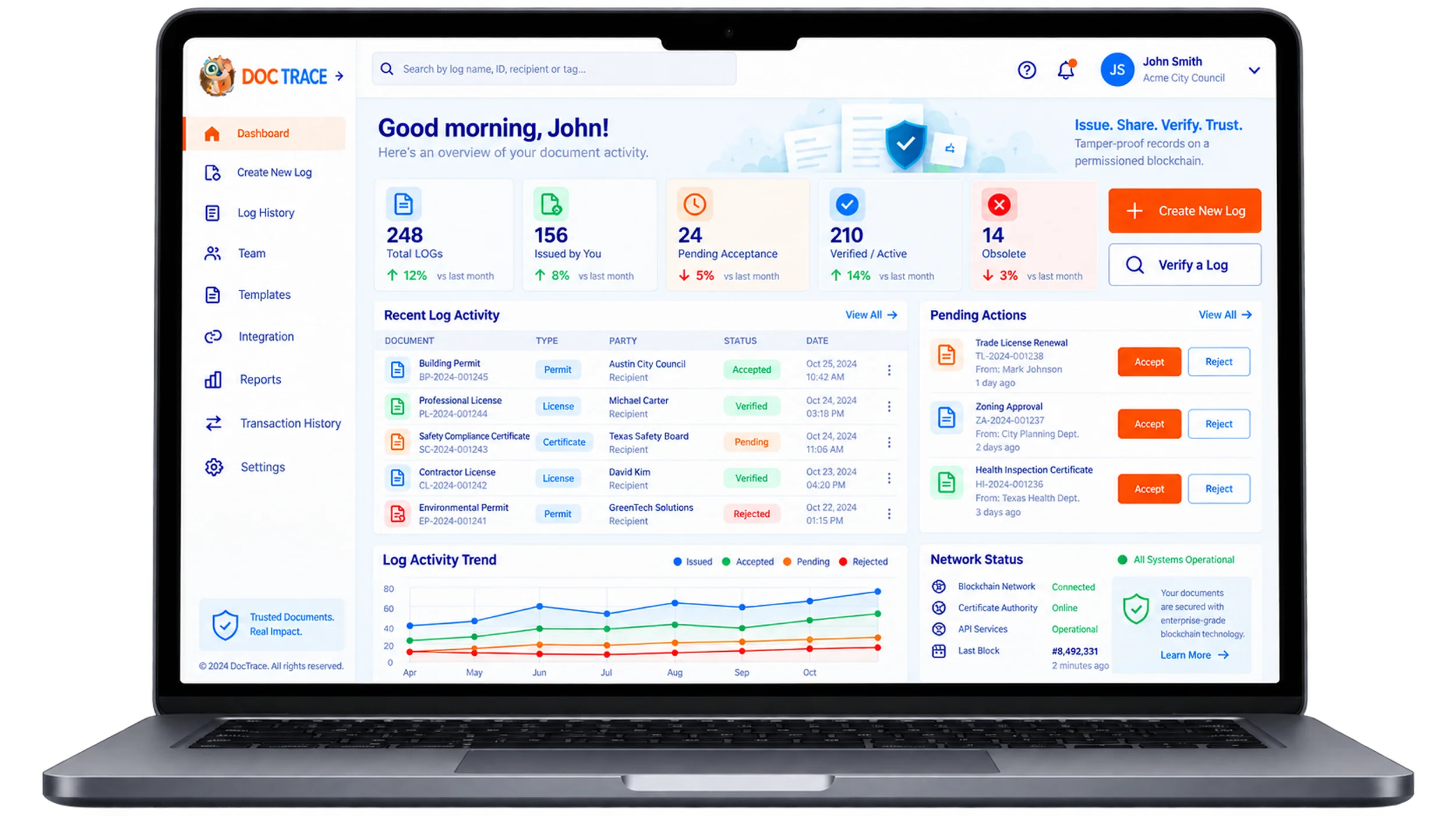
DocTrace is a records-technology company based in Austin, Texas, building for a category most software ignores: one-way records. Diplomas and transcripts, professional licences, permits, inspection reports, membership cards, warranties, event tickets, awards. Records that flow from an issuer to a holder and then have to be trusted by a third party who was never part of the transaction.
Their founding observation was that this whole category is defended by nothing. A paper certificate with a seal and a PDF with a signature image are equally forgeable. The only real check is calling the issuer, which is slow enough that in practice almost nobody does it. The result is a fraud surface that costs institutions money and costs honest holders credibility.
They came to us with a product thesis rather than an internal process to fix. The idea was to stop protecting the file and remove it. If the record exists as structured data inside a permissioned blockchain, and any attachment is only a visual rendering of that data, there is no canonical file to intercept, alter, or forward. They call this FILE-LESS, and it is the basis of their patents.
We partnered with their team to turn that thesis into a commercial platform. That meant more than a ledger. It meant provider identity vetting, per-record key management, subscription billing and metering, an admin console, dispute handling, and a public API, all built to a standard that would survive procurement review by government and education buyers.
Document fraud is a mature, industrialised problem, and the institutions carrying the cost are the ones least equipped to detect it. Universities, licensing bodies and government agencies issue records at volume, then absorb the downstream cost of verification requests, disputes and reputational damage when a forgery surfaces. Existing document management systems store and organise files well. None of them make a file provable.
50,000 fake PhD degrees are issued every year in the USA
500,000 individuals are estimated to hold fabricated degrees
44% of HR managers have found discrepancies in education records
85% of recommendation letters in the USA are estimated to be fake
$50,000 is spent annually by the average organisation combating resume fraud
12% of ticket holders are scammed with fake or illegal passes
Verification still depends on contacting the issuer, adding days to hiring, lending and admissions decisions
Document management systems organise and store files but cannot prove a single one of them is authentic
SoluLab worked with DocTrace's stakeholders to define the capabilities a commercial record-issuing platform needed. The objective was to combine a permissioned ledger, cryptographic identity, revocable sharing and subscription commerce into one architecture that institutional and government buyers would accept.

Buyers were universities, agencies and enterprises handling identifiable people, so a public chain was disqualified from the start. Each participating organisation needed to operate its own certificate authority and its own signing and identity-attestation approach while sharing a single network.
Rather than storing a document and proving it unchanged, the record itself had to exist as structured data inside the blocks. This is the patented core of the product, and it shaped every downstream design decision.
A graduate should see their own transcript and nothing else. Access boundaries had to work per record using separate key pairs, rather than one shared credential per organisation, which is more engineering effort but the only version that survives an audit.
Records get corrected and reissued. On an immutable ledger, "the current version" is not native. Corrections had to attach to their predecessor, mark it obsolete, and leave the full amendment history intact and traceable.
A credential holder needed to show a record to an employer or lender with no account, and take that access back later. Control had to sit with the receiver, not the issuer, covering both named recipients and a public link.
Someone who needs to check one record once should not have to register. A guest path was required that still delivered full authenticity verification and traceability.
Optional PDF, image and QR renderings could not go on-chain without bloating ledger writes. Attachments needed content-addressed storage returning an identifier derived from the file's own bytes, written into the on-chain record.

Anyone who can issue a trusted record can abuse that trust. Provider onboarding needed domain verification, a signed agreement, administrator review and key allocation, feeding directly into tiered subscription billing and per-record metering.
DocTrace needed to sell to institutions running their own student information, licensing and enterprise systems, so issuance and verification had to be available programmatically, not only through the DocTrace interface.
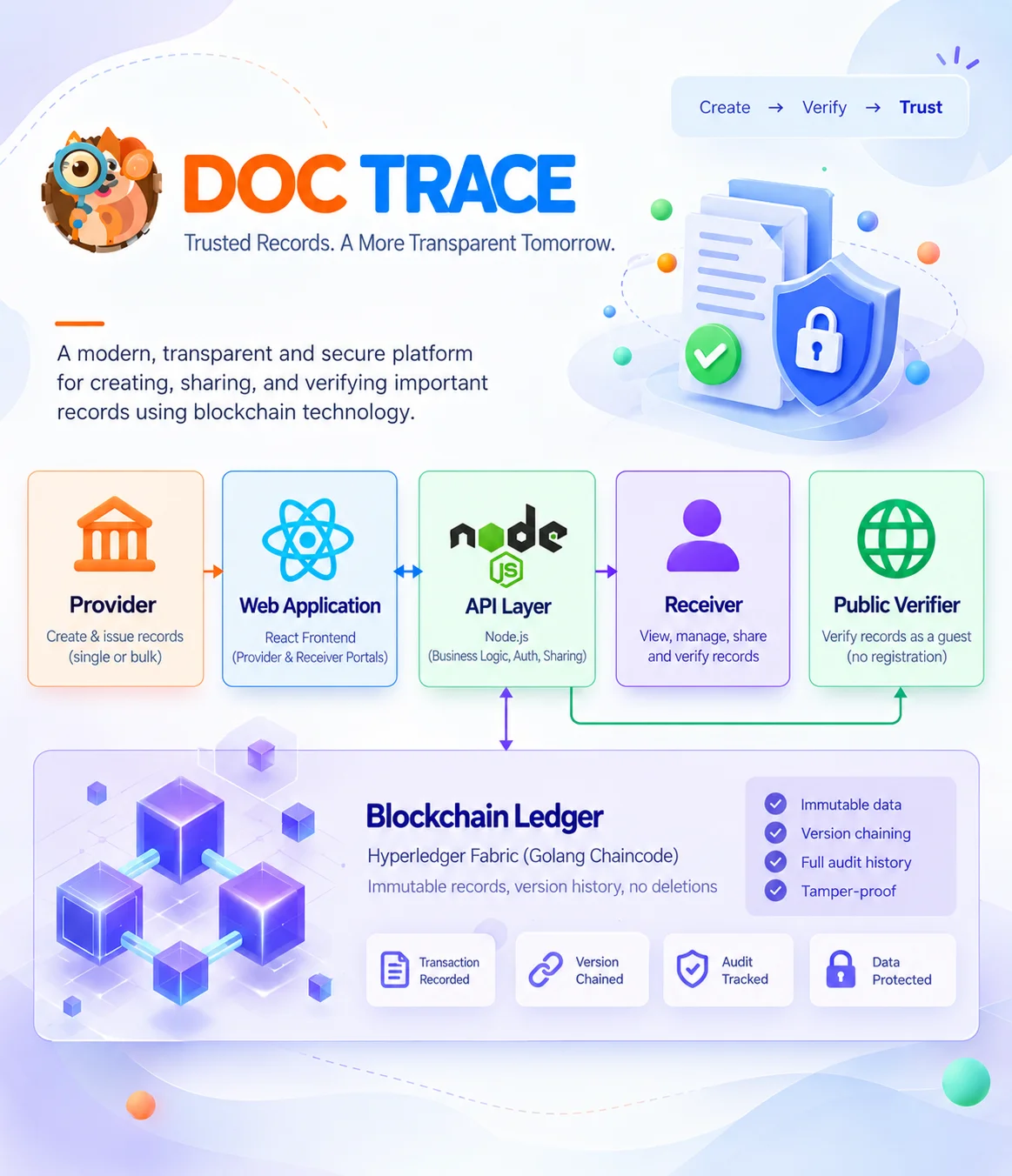
To bring the client's thesis to market, SoluLab's blockchain engineers combined a permissioned Fabric network, cryptographic identity infrastructure, content-addressed attachment storage and subscription commerce into a single platform. Our team delivered a product capable of issuing, versioning, sharing, and verifying institutional records, with the governance controls that government and education procurement demand.
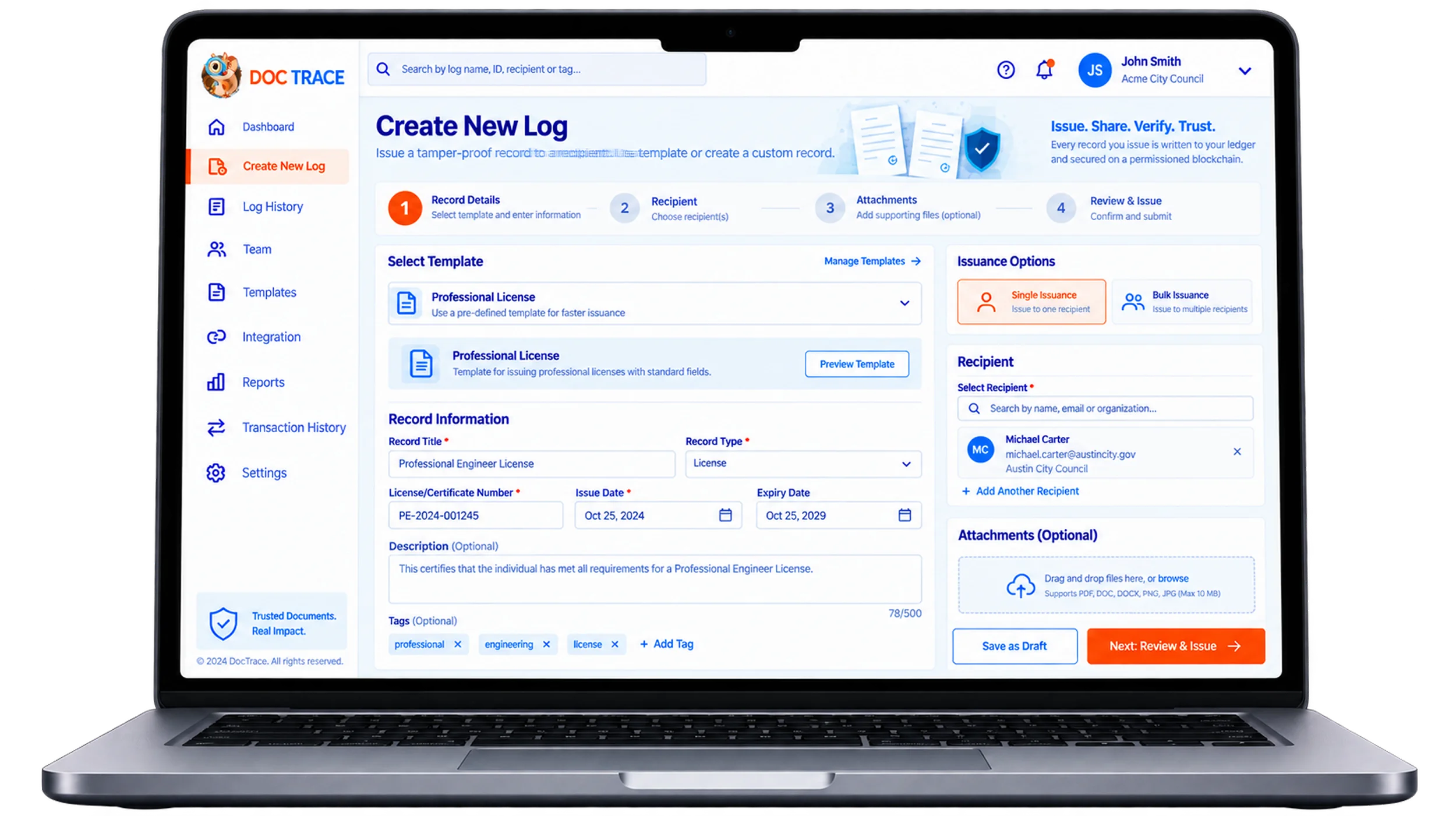
Built on React with a Node.js API layer, the provider console handles record creation from reusable templates, single and bulk issuance, recipient selection, optional attachment upload and full transaction history, writing each record to the provider's own ledger as an immutable entry.
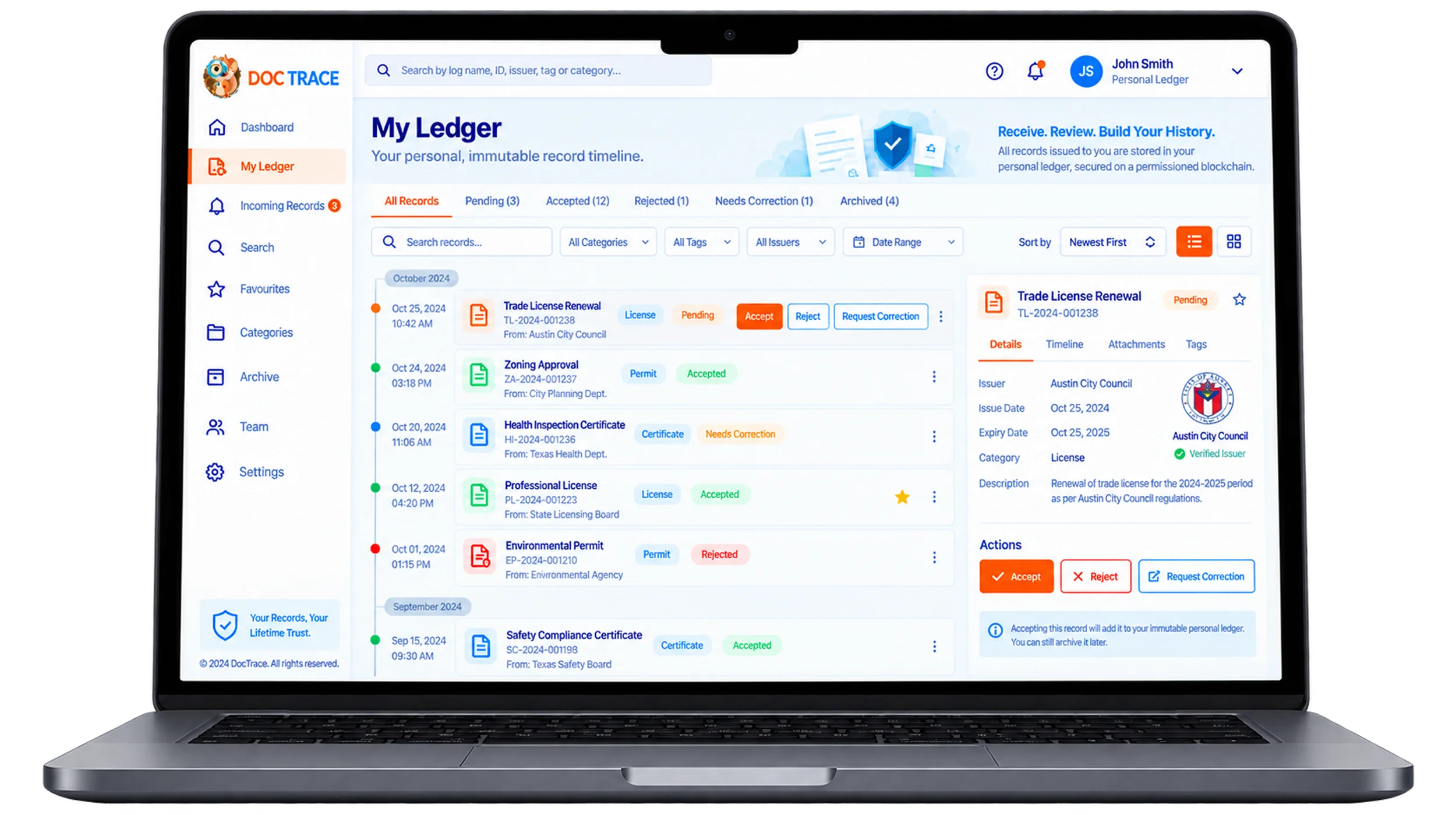
Every user receives an empty, unique personal ledger on signup. The receiver interface presents records as a chronological timeline with accept, reject and request-correction actions, plus search, tagging, categorisation, favourites and archiving.
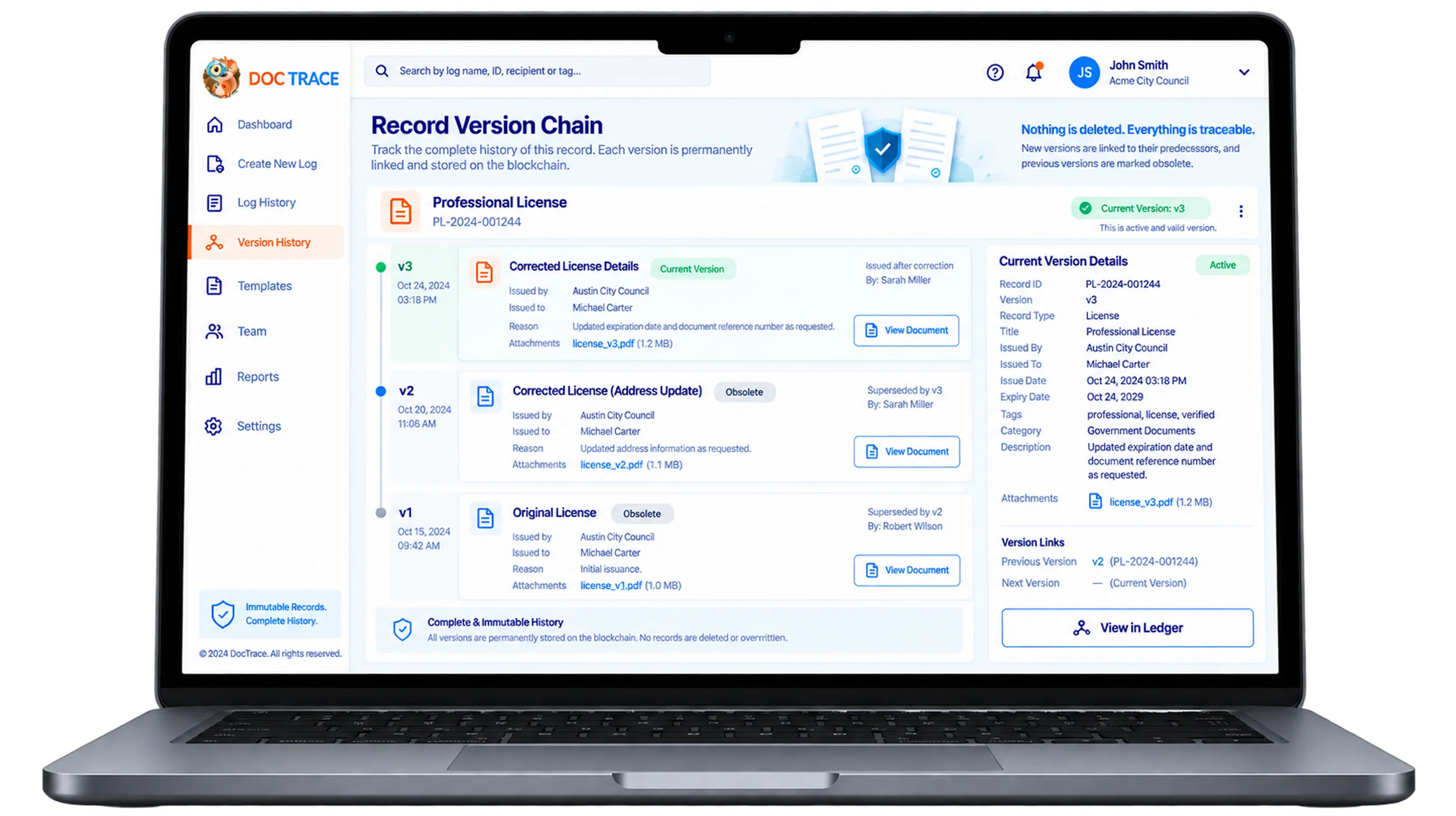
Implemented in Golang chaincode, the correction workflow issues a new version that attaches automatically to its predecessor and marks the previous record obsolete. Nothing is deleted or overwritten, so the ledger retains the complete amendment history while the application always resolves one current version.
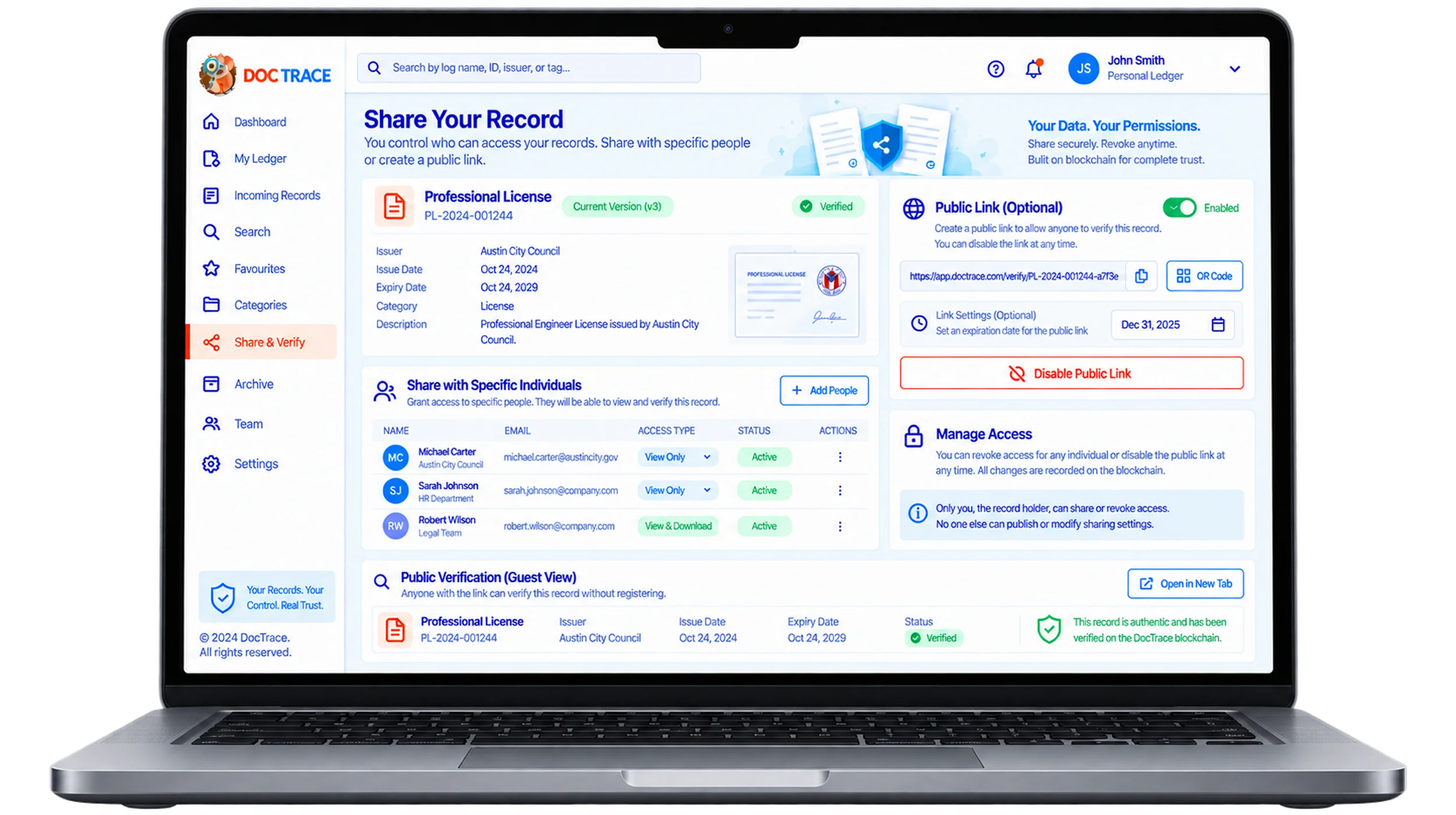
The record holder, and only the holder, can share to named individuals or publish a revocable public link. Recipients verifying a single record can do so as a guest without registering, and the holder can withdraw named access or disable the public link at any time.
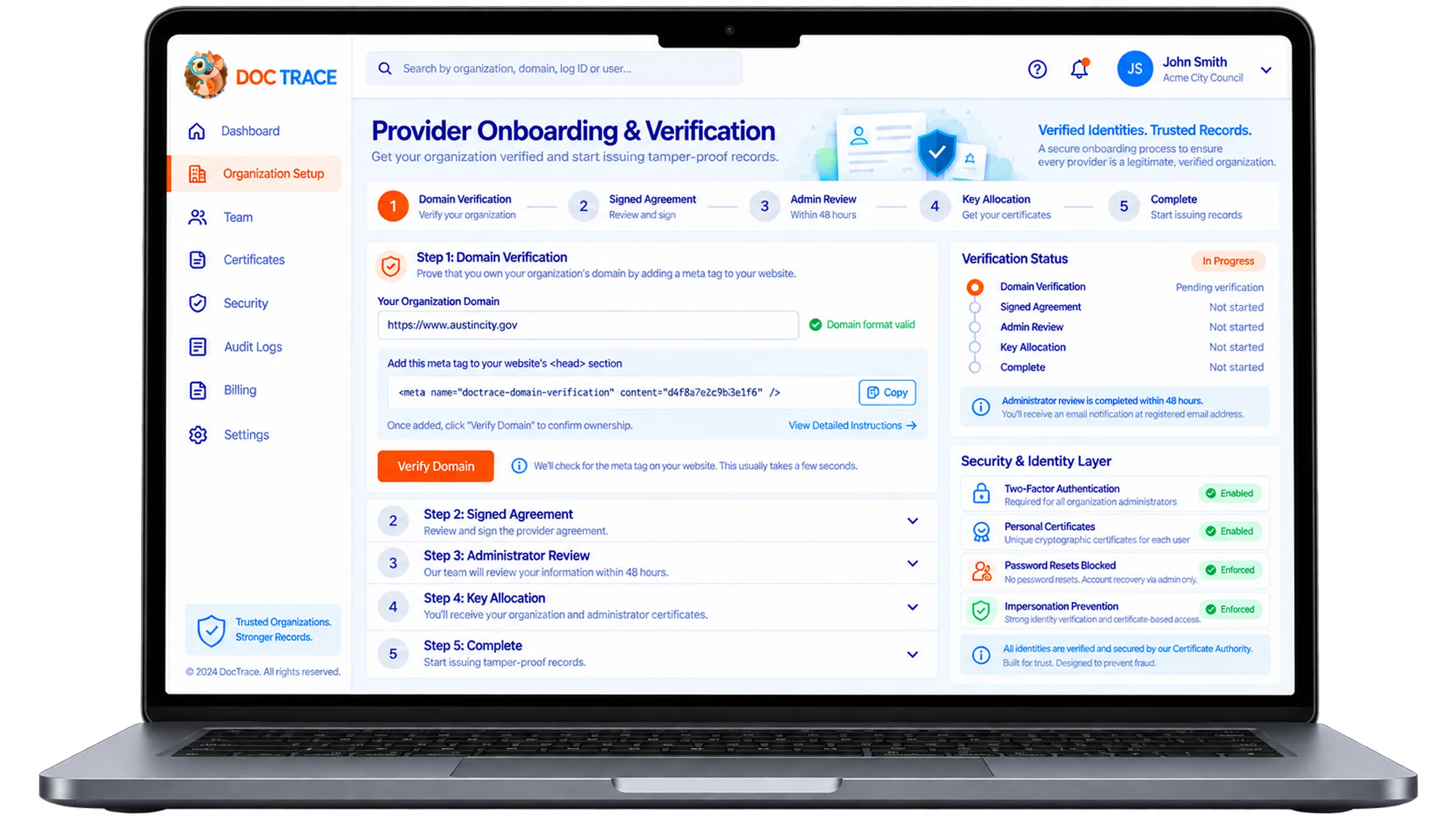
Provider onboarding runs domain verification via a backend meta tag, a signed agreement, administrator review within 48 hours, and key allocation from the certificate authority. The platform layers two-factor authentication and personal certificates on top, and blocks password resets and impersonation by design.
Storing the record as on-chain data rather than hashing a document eliminated the interception and re-distribution surface entirely, rather than making it detectable after the fact.
Immutability and correctness are not the same thing. Chaining revisions and explicitly marking predecessors obsolete was the only way to give an immutable ledger a single current version.
Letting each university, agency or enterprise run its own CA removed the objection that mattered most in procurement: nobody had to hand identity control to a shared operator.
Placing revocable share rights with the record holder matched how credentials actually get used in hiring and lending, and avoided building an issuer-side permission system nobody wanted to administer.
Treating PDFs and QR renderings as visual conveniences rather than the source of truth kept ledger writes small and preserved the FILE-LESS guarantee even when a buyer insisted on a printable artifact.

Every institution that issues certificates, licences or permits eventually absorbs the same cost: verification requests, disputes, and forgeries discovered too late. SoluLab helps organisations move that burden onto a ledger, with permissioned blockchain platforms built to survive procurement review.
Blockchain-Backed Record Integrity
User Ecosystems, One Secure Workflow
Platform Layers Delivered
Core Modules Integrated
AES encryption
Provider verification
 Hyperledger Fabric
 Golang Chaincode
 Certificate Authority (Fabric CA)
 CouchDB State Database
 IPFS
IPFS
 Content Addressing
 MongoDB
 Node.js
 REST APIs
 Public Issuance API
 Salesforce Sales Cloud
 React
React
 Kotlin
 Swift
Swift
 Per-Record Key Pairs
 Asymmetric Cryptography
 Two-Factor Authentication
 Personal Certificates
 Role-Based Access Control
"SoluLab helped us turn our vision for secure, file-less document management into a practical platform. Their understanding of blockchain technology and focus on building a reliable, user-friendly solution made the development process much easier. We now have a stronger foundation for issuing and verifying documents while reducing the risks associated with traditional files."