Home › Case Studies › AI Invoice Reconciliation
AI · ACCOUNTS PAYABLE · ENTERPRISE FINANCE

AI Invoice Reconciliation Platform: How SoluLab Automated Three-Way Matching for an Enterprise Finance Team

2/3/4-Way
Invoice Matching
IDP
Intelligent Document Processing
Rules
Deterministic Financial Decisions
API
ERP & Procurement Integration
SoD
Segregation of Duties
Full
Audit Trail
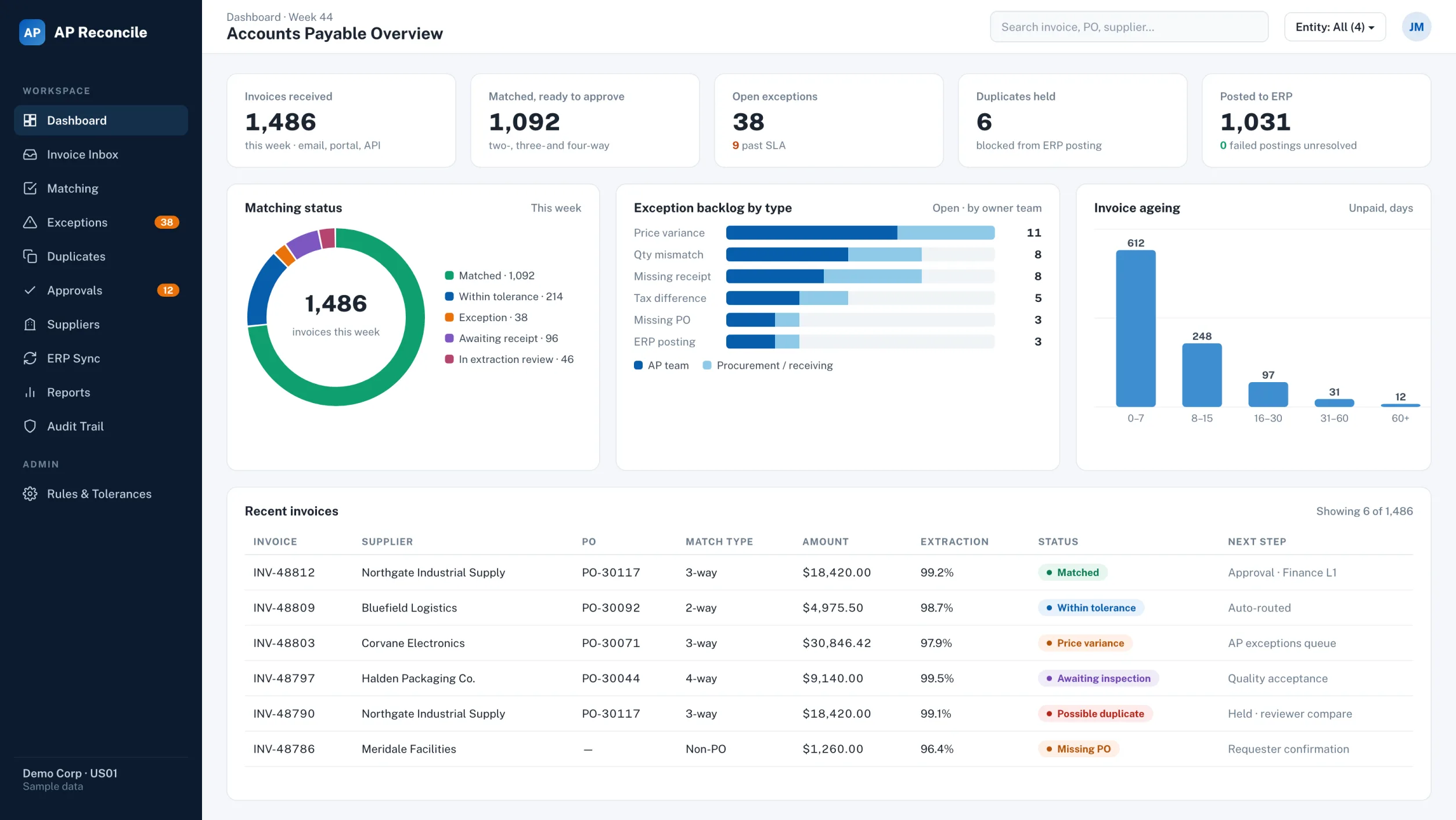
AI invoice reconciliation dashboard showing invoices received, matching status, open exceptions, duplicates held, exception backlog by type and invoice ageing

AI Invoice Reconciliation at a Glance

AI invoice reconciliation automates the matching of supplier invoices against purchase orders and goods receipts, flags mismatches and duplicates, and routes exceptions to people for review. SoluLab built this platform for an enterprise finance team to cut manual checking while keeping every calculation, approval and decision auditable.

Client
Confidential enterprise, finance and financial operations
The problem
Manual invoice data entry, slow PO matching, hidden exceptions and duplicate-payment risk
What we built
An AI-powered accounts payable platform with intelligent document processing, two-, three- and four-way matching, duplicate detection and exception management
AI approach
AI reads documents and explains discrepancies. A deterministic rules engine makes the financial decisions
Integrations
ERP, accounting, procurement and supplier systems through APIs and connectors
Control model
Role-based access, configurable approvals, segregation of duties and a full audit trail
Platform
Enterprise web application, APIs and integration services

Business Overview

The client processes a steady stream of supplier invoices. Every one has to be checked against a purchase order, a goods receipt and a set of financial policies before anyone can approve it.

As volumes grew, so did the effort. Finance staff were retyping invoice details, comparing quantities and prices by hand, and chasing answers through email.

There was also no single place to see where an invoice stood. Which ones were stuck? Who was holding them up? Nobody could say without asking around.

The brief

The brief to SoluLab was simple to state and hard to do: automate the repetitive checking, but keep every control a finance team actually needs.

The Challenges: Why Manual Invoice Reconciliation Stopped Scaling

Invoices arrived in every shape.

Layouts, formats and terminology changed from supplier to supplier, so people had to dig out invoice numbers, line items, tax amounts and totals by hand.

Purchase order matching was slow.

Checking an invoice against a PO and a goods receipt means comparing quantities, prices, delivery records and remaining order balances. Over and over. Partial deliveries made it worse.

Exceptions were hard to see.

Price differences, quantity mismatches, missing receipts and tax discrepancies were investigated across inboxes and separate systems, with no clear owner.

Duplicate invoices were a real risk.

Repeat submissions, inconsistent numbering and near-identical documents meant the same invoice could be paid twice if nobody caught it.

Approvals stalled.

Missing paperwork, unclear ownership and unresolved exceptions left invoices sitting for days.

Two more problems sat underneath all of this:

Information lived in separate ERP, procurement, accounting and document systems.

Leadership had no live view of reconciliation performance or exception trends, and auditors needed every document, calculation and decision preserved and protected.

Our Solution: How the AI Invoice Reconciliation Platform Works

Here's the thing about accounts payable automation: OCR alone isn't enough, and a chatbot bolted on top is worse. Financial reconciliation needs repeatable maths and enforceable rules. So we split the work.

AI

AI interprets documents and explains problems.

Rules engine

A deterministic rules engine decides whether a variance is acceptable.

People

People stay in charge of anything risky.

  1. Extract
  2. Match
  3. De-duplicate
  4. Investigate
  5. Approve
  6. Post to ERP
  7. Audit
01

Intelligent Invoice Data Extraction

The platform accepts invoices from email, uploads, APIs, supplier portals and enterprise integrations.

  • It classifies each document and extracts supplier details, invoice identifiers, line items, quantities, prices, tax values, totals and payment terms.
  • Every field carries a confidence score and a link back to its place in the source document.
  • Low-confidence fields go to a person for review, and unreadable or ambiguous documents are flagged instead of guessed at.
02

Two-Way, Three-Way and Four-Way Invoice Matching

  • Two-way matching compares an invoice with its purchase order.
  • Three-way matching adds the goods receipt or approved service entry.
  • Where it's needed, four-way matching brings in inspection or quality acceptance records too.
  • The engine checks supplier references, quantities, unit prices, tax, order balances, partial deliveries and configurable tolerances, then gives each invoice a clear status with a plain explanation of any gap.
03

Duplicate Invoice Detection

Document similarity is combined with supplier ID, invoice number, date, amount, currency and PO reference.

  • That catches exact duplicates, repeat submissions across channels and near-duplicates.
  • Reviewers get side-by-side comparisons and history, and controls stop a flagged duplicate from being posted downstream.
04

AI-Assisted Exception Investigation

When something doesn't match, the platform summarizes the discrepancy, pulls the relevant source records, explains the variance and suggests a next step.

  • It covers price variances, quantity mismatches, missing receipts, tax differences, missing POs and ERP posting failures.
  • Exceptions are routed to the right team and tracked until they're closed.

The AI recommends, and it never overrides the approval rules.

05

Configurable Approval Workflow Automation

Invoices are routed by amount, business unit, supplier, legal entity, cost center, exception severity and delegated authority.

  • The workflow supports sequential and parallel approvals, escalations, reassignment, evidence capture and a full approval history.
  • Segregation of duties is enforced, and invoices are revalidated after any material change.
06

ERP Integration and Posting Readiness

The platform connects to financial systems through supported APIs and connectors, and syncs suppliers, purchase orders, receipts, accounting dimensions, approved invoices and posting references.

  • Retries, idempotency controls and posting-response checks mean a failed transaction never vanishes quietly or creates a duplicate entry.

The client kept its existing systems. Nothing had to be replaced.

07

Audit Trail and Accounts Payable Dashboards

Every step is recorded: source documents, extracted fields, reconciliation outcomes, exceptions, approvals and integration results.

  • Authorized users see invoice status, matched records, applied rules, hold reasons and posting outcomes in one place, along with invoice ageing, exception backlogs and supplier trends.

Product Experience

Accounts payable dashboard with matching status, exception backlog by owner team, invoice ageing and recent invoices
Accounts Payable Dashboard
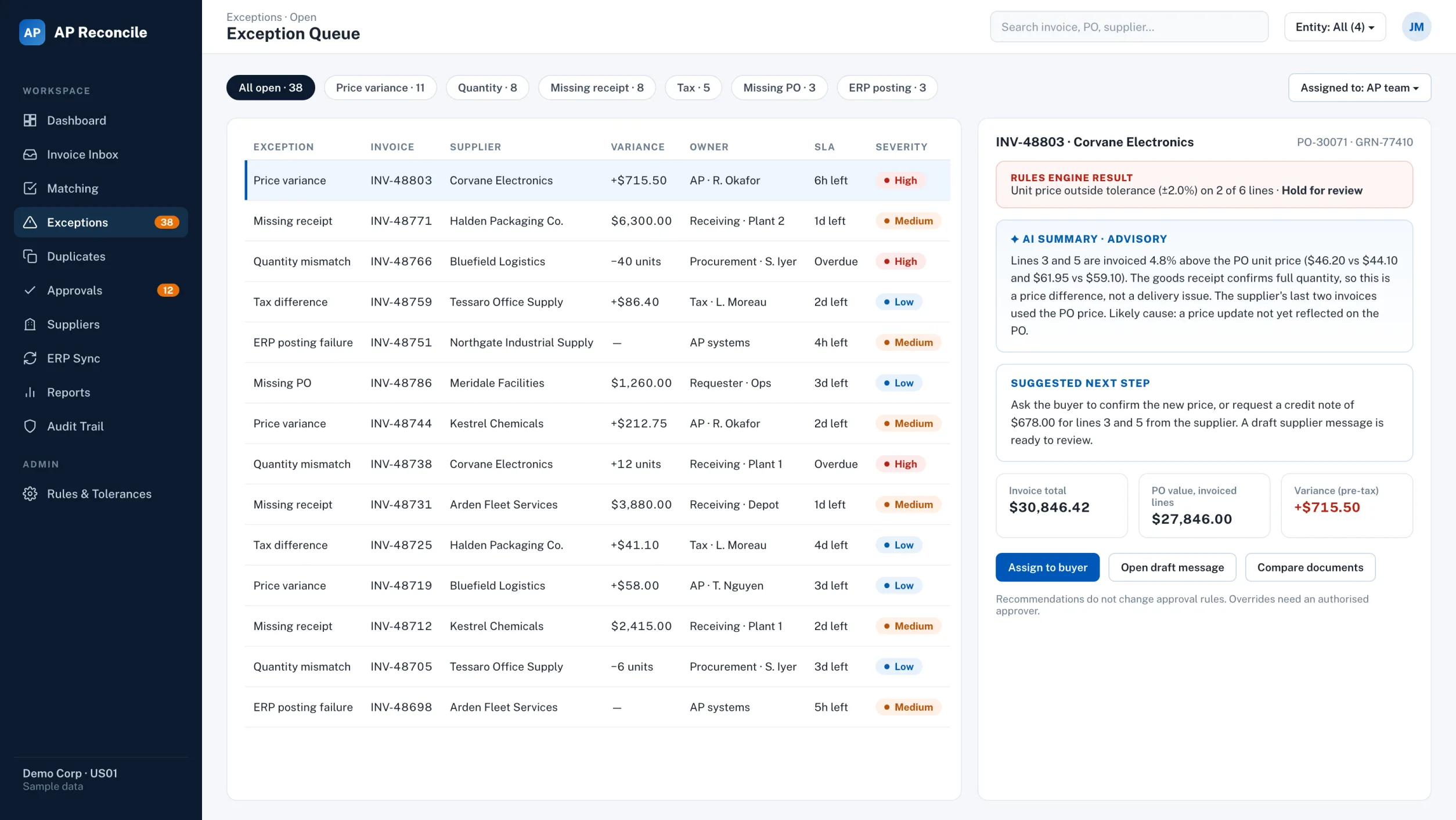
Exception queue with a price variance held by the rules engine, an advisory AI summary and a suggested next step
Exception Queue
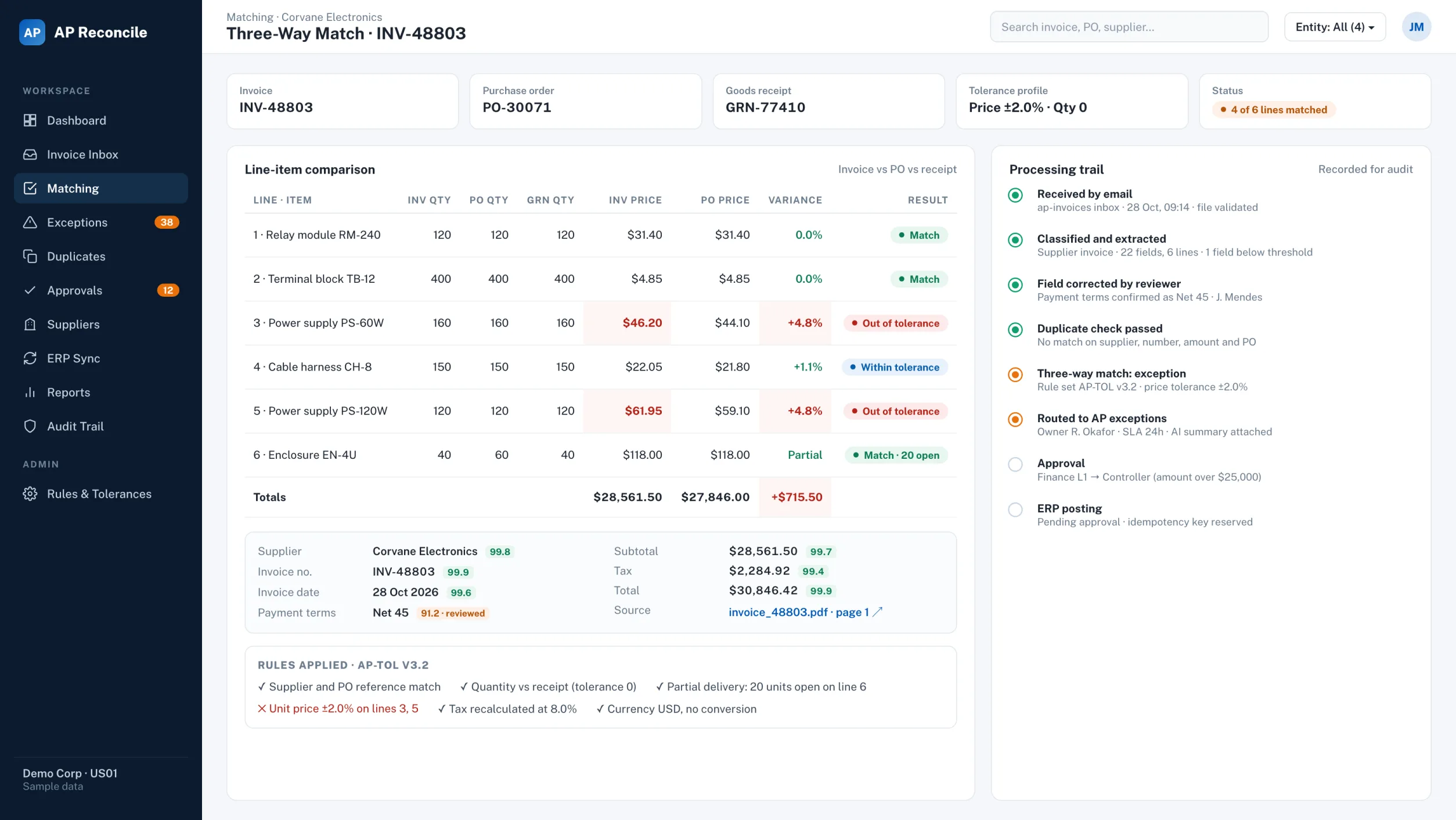
Three-way match view comparing invoice, purchase order and goods receipt line by line, with extraction confidence scores and the processing trail
Three-Way Match

Solution Architecture

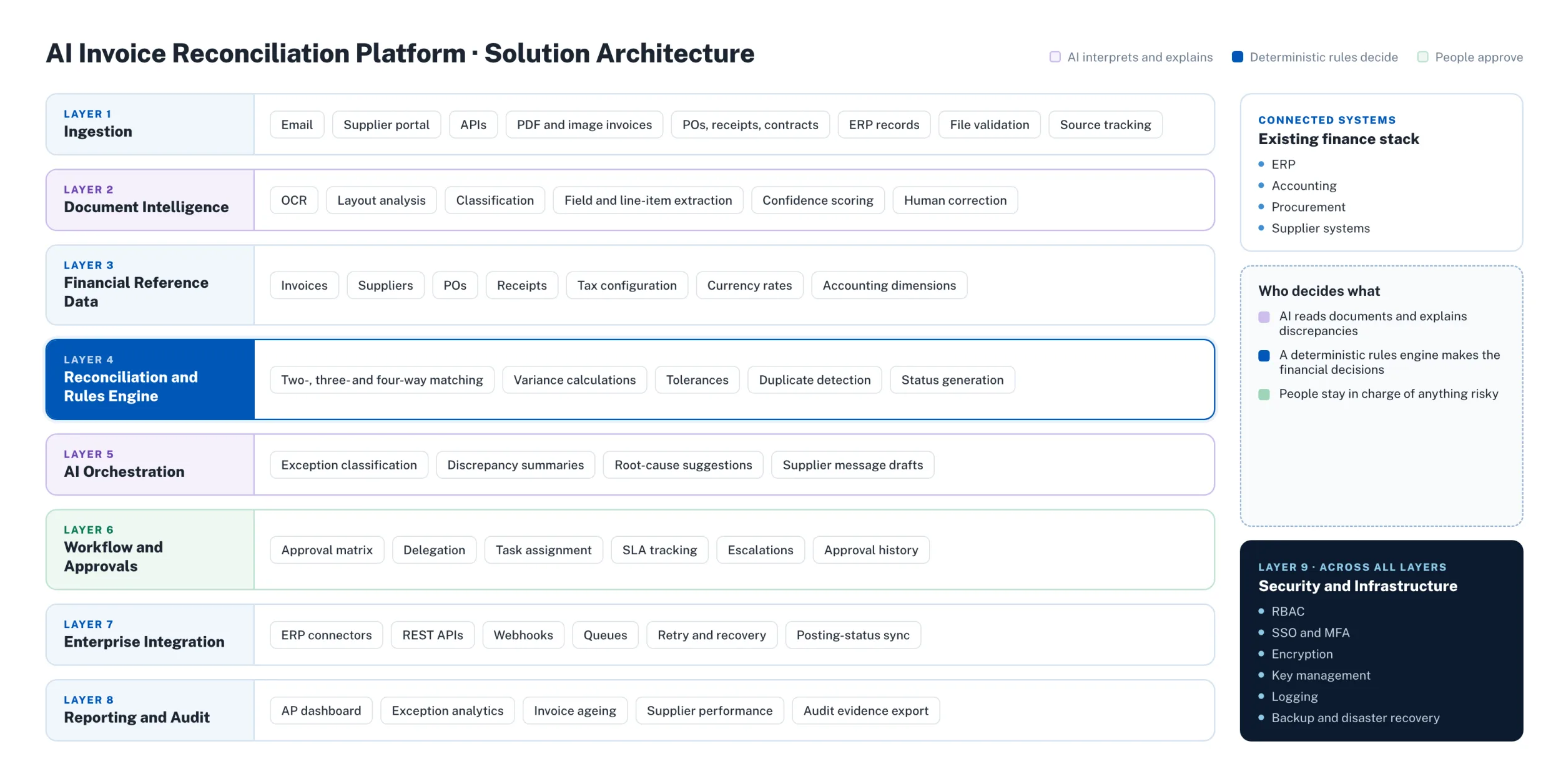
We built the platform as modular layers, so document processing, decision logic, workflow and integrations can each change without breaking the others.

AI invoice reconciliation solution architecture: ingestion, document intelligence, financial reference data, reconciliation and rules engine, AI orchestration, workflow and approvals, enterprise integration, reporting and audit, with security and infrastructure across all layers
Scroll the diagram sideways on small screens, or click it to view full size.
What each layer does ⌄
Layer
What it does
Ingestion
Email, supplier portal, APIs, PDF and image invoices, POs, receipts, contracts and ERP records, with file validation and source tracking
Document Intelligence
OCR, layout analysis, classification, field and line-item extraction, confidence scoring, human correction
Financial Reference Data
Invoices, suppliers, POs, receipts, tax configuration, currency rates, accounting dimensions
Reconciliation and Rules Engine
Two-, three- and four-way matching, variance calculations, tolerances, duplicate detection, status generation
AI Orchestration
Exception classification, discrepancy summaries, root-cause suggestions, supplier message drafts
Workflow and Approvals
Approval matrix, delegation, task assignment, SLA tracking, escalations, approval history
Enterprise Integration
ERP connectors, REST APIs, webhooks, queues, retry and recovery, posting-status sync
Reporting and Audit
AP dashboard, exception analytics, invoice ageing, supplier performance, audit evidence export
Security and Infrastructure
RBAC, SSO and MFA, encryption, key management, logging, backup and disaster recovery

Why We Separated AI From Financial Rules

“We get asked a lot why the platform doesn't just let an AI model handle everything. Honestly, because finance teams can't audit a hunch.
AI

AI is brilliant at the messy parts: reading odd layouts, interpreting item descriptions, writing up why two numbers disagree.

Rules

It's not what you want deciding whether a price variance is inside tolerance. That job belongs to rules that give the same answer every time.

People

Bounded AI agents gather evidence and suggest actions within their permissions, while material exceptions, sensitive supplier changes and policy overrides stay under authorized human control.

API-first

An API-first design finishes the picture. It lets the platform exchange data with the ERP and procurement systems that already hold the truth, so the client didn't have to rip anything out.

Technologies Used

Frontend
ReactTypeScript
Backend and APIs
Node.js or Python services
Document Intelligence
Azure AI Document Intelligence or an equivalent validated service
AI and LLM
Enterprise-approved LLM and orchestration framework
Database
PostgreSQL
Queue and Caching
Redismanaged message queue
Storage
Encrypted object storage
Integration
REST APIswebhooksERP-specific connectors
Identity
Enterprise SSOOAuth 2.0 / OIDCRBAC
DevOps
CI/CDautomated testinginfrastructure monitoring

ERP integrated on this project: a major enterprise ERP. The same API-first design can also connect to systems such as SAP, Oracle, Microsoft Dynamics 365 and NetSuite, subject to connector compatibility for the specific products and versions in use.

Security, Governance and Financial Integrity

Documents and transaction data are encrypted in transit and at rest, with controlled key management.

Users only see the entities, business units and suppliers they're authorized for.

Approved invoice data and reconciliation rules can't be changed without permission, and changes to supplier master or bank details get extra verification.

For AI-assisted decisions that matter, the platform records model versions, source evidence and recommendations.

Document provenance, corrections, approvals and posting references are preserved, and failed integration transactions are tracked rather than lost.

Performance Targets, Validation and Results

We engineered the platform against the design targets below. These are validation criteria agreed with the client, not production measurements.

Design target
98%
Invoice field extraction accuracy
At least 98% on the agreed validation dataset
Design target
70–85%
Straight-through processing
70–85% of eligible invoices after stabilization
Design target
99.5%
Reconciliation accuracy
At least 99.5% on the agreed test set
Design target
50%
Invoice processing cycle time
50% reduction from baseline
Design target
50–70%
Manual handling effort
50–70% reduction for eligible invoice categories
Design target
99%
Duplicate detection
At least 99% recall on the agreed duplicate test set
Design target
100%
Audit traceability
100% of material processing decisions recorded
Design target
99.9%
Platform availability
99.9% monthly uptime target

What changed for the finance team?

Less retyping and cross-checking, because extraction and matching are automated.

Faster invoice cycles, since fewer items wait on avoidable delays.

Better control, with duplicates and out-of-tolerance variances caught before posting.

Quicker exception resolution, because the evidence is already gathered and explained.

And audit season got easier, since the trail is already there.

It scales, too. Dashboards show invoice ageing, exception backlogs and supplier trends, and the modular design handles growth in invoice volume, suppliers, business units and integrations.

Frequently Asked Questions

1.What is AI invoice reconciliation?⌄
AI invoice reconciliation is the automated process of extracting data from supplier invoices and matching it against purchase orders and goods receipts. The system flags price, quantity and tax mismatches plus duplicates, then routes only the exceptions to finance staff for review.
2.What is three-way matching in accounts payable?⌄
Three-way matching compares a supplier invoice with the purchase order and the goods receipt or approved service entry. It checks quantities, unit prices, order balances and configured tolerances before an invoice can move to approval and payment.
3.How does the platform detect duplicate invoices?⌄
The platform combines document similarity with supplier ID, invoice number, date, amount, currency and PO reference, and compares them against historical transactions. Exact duplicates are blocked from downstream posting, and ambiguous near-duplicates go to a human reviewer.
4.Does AI approve invoices automatically?⌄
No, not by default. In this platform AI summarizes evidence and recommends actions, while approvals and exception handling follow the configured authority matrix and segregation-of-duties controls.
5.Why not let a language model do the matching itself?⌄
Financial reconciliation needs the same answer every time, so SoluLab used a deterministic rules engine for calculations and tolerance checks. AI handles document interpretation and discrepancy explanations, where its flexibility helps and its occasional errors can be reviewed.
6.Can the invoice reconciliation platform integrate with existing ERP systems?⌄
Yes. SoluLab's platform integrates with ERP and procurement systems through APIs, connectors and webhooks, so companies keep their existing systems. Compatibility and effort are validated against the specific ERP products and versions during discovery.
7.How does the platform handle reconciliation exceptions?⌄
The platform classifies each exception, explains the discrepancy, assigns it to the responsible team and tracks it until resolution. Reviewers can compare source documents, record decisions and rerun reconciliation after an approved correction.
8.Can the platform support multiple legal entities and currencies?⌄
Yes. The architecture supports configurable legal entities, business units, currencies, tax rules and reconciliation policies. Final scope depends on the requirements agreed with each client.

Related Services and Case Studies

Altair: RPA for Banking and Insurance

SoluLab built Altair, a robotic process automation platform using Blue Prism and Python that validates activities and detects fraud in banking and insurance.

View Case Study →

Kavach: AI Regulatory Change Management for Banking Compliance

SoluLab developed an AI and knowledge-graph platform that transforms every RBI circular into traced requirements, verified code changes and inspection-ready board evidence.

View Case Study →

Build Intelligent Finance Operations with SoluLab

If your AP team is still matching invoices by hand, you don't have to automate everything at once. Pick one workflow, share some sample records, and we'll show you where AI and rule-based automation can take the load off your team, with the controls intact.

Let's discuss your unique project. Talk to SoluLab: sales@solulab.com | www.solulab.com

AIAccounts Payable AutomationThree-Way MatchingDocument IntelligenceERP Integration