Talk to an Expert
Get in Touch

Bitcoin Wallet Creation Basics: Features, Libraries, and APIs

Technology development does not stand still, and virtual currencies are already firmly rooted in our lives. In addition, technologies allow you to create your own Bitcoin wallet that will best suit your business’s requirements and needs. In this article, we will look at how a Bitcoin wallet is useful as a payment method and what tools are best for Bitcoin wallet development. Without further ado, let’s get started.

Benefits of Bitcoin Wallets

First, let’s quickly figure out what a cryptocurrency wallet is. This is software that stores public and private keys and interacts with various blockchains. This allows the wallet user to send and receive cryptocurrency with ease. What else is a Bitcoin wallet used for? The wallet owner can make transactions view transactions history and the current balance of the wallet.
bitcoins
Now let’s take a closer look at how to use a Bitcoin wallet.

  • Payment in stores. Thanks to the CryptoPay startup, you can pay with Bitcoins in any store and even in those where don’t even hear about Bitcoin. CryptoPay is the same Bitcoin wallet, but it has a debit card that can be used to pay in stores via terminals.
  • Wages payment. BitWage offers employers to pay wages using Bitcoins. For example, freelancers will find this payment method very convenient compared to regular bank transfers.
  • International transfers. Bitcoin is a great option for small businesses that cannot sell goods to other countries due to high commissions. With Bitcoin, cross-border payments are several times cheaper.
  • Fraud prevention. Bitcoin provides unrivaled anonymity and payment security. For example, a payment received cannot be disputed.

bitcoin
If you study some of the popular Bitcoin wallets, then you can see some of the similar features that every Bitcoin wallet should have. These features are vital to include when you want to build MVP of a Bitcoin wallet app. The list of these bitcoin wallet features might look like this:

  • Registration and login screen
  • User profile to check balance and make transactions
  • Exchange rate
  • QR code scanner to send and request cryptocurrency
  • Trade service to see Bitcoin sellers and work as a seller
  • Push-notifications
  • Security measures (PIN and password)


Since the majority of cryptocurrency owners operate with Bitcoin, we will consider the most popular libraries that will be useful for developing Bitcoin applications for iOS and Android. Libraries are the ultimate tools that will help you create both a Bitcoin wallet and any other cryptocurrency-related application.
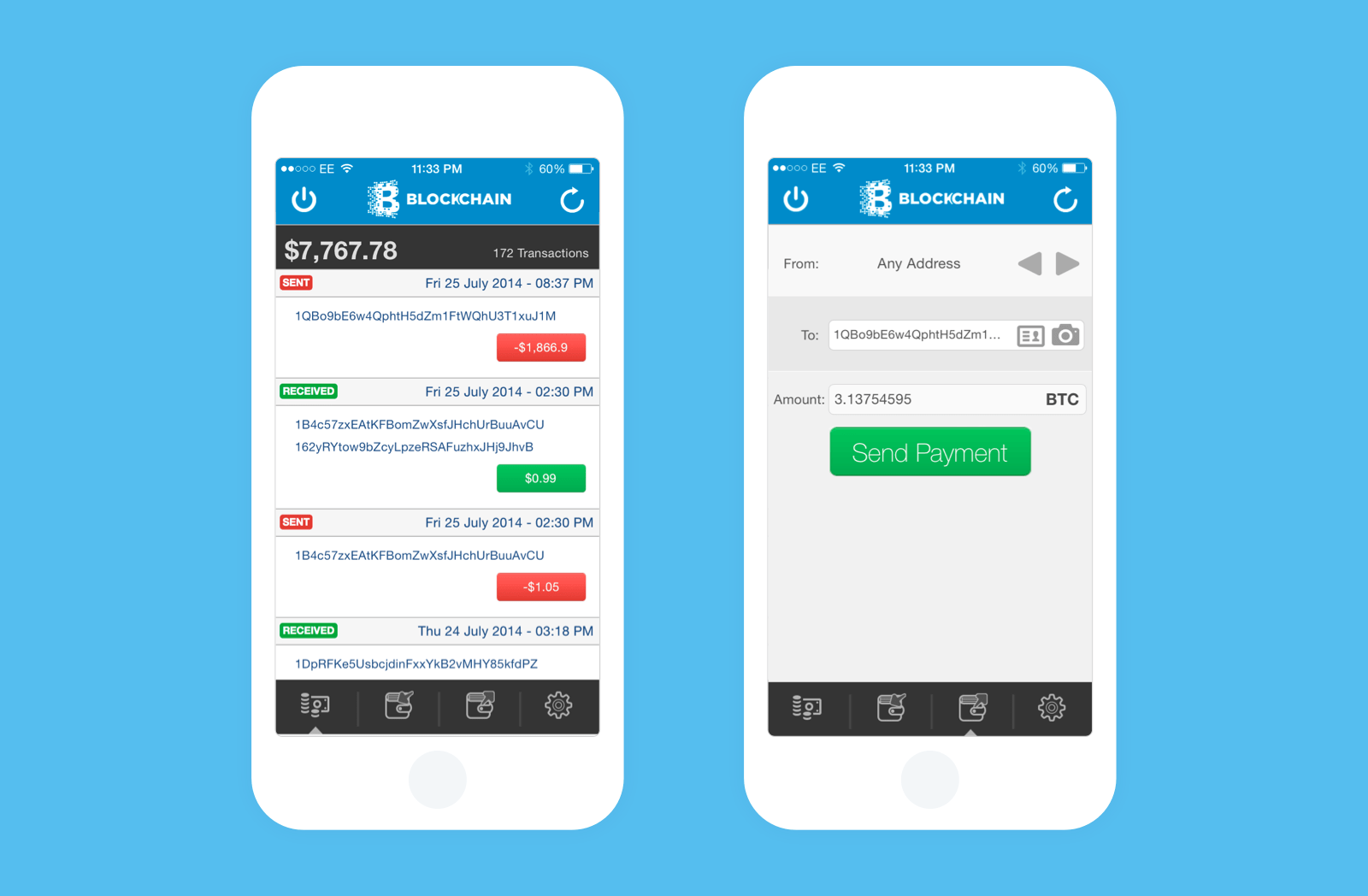
For our analysis, we’ll use the most popular Bitcoin wallet called Blockchain. This free wallet contains many free APIs for developers, and it supports many platforms such as Android, iOS, Windows, Linux, macOS.
There are two different API keys involved in the wallet:

  • V2 API KEY allows the website to easily receive payments in Bitcoins.
  • Blockchain Wallet API KEY provides full access to all functions such as wallet development, payments, transactions, address management, and much more.

You can get any of these keys by making an API request by leaving your contact information, company name, and the URL of your website or application.
Besides APIs that we mentioned above, the BitcoinJ SDK is also used in the development of Bitcoin wallets. This cross-platform library was created in Java to work with the Bitcoin system that supports the Android and Windows platforms.
This library has a fairly wide functionality that allows you to create Bitcoin wallets, work with existing wallets, balance monitoring, and transactions. In addition, this library has tools for converting exchange rates, the ability to receive information about a transaction, and fine-tune the transaction confirmation process.
The final library we’ll be looking at today is the Coinbase SDK. It is a cross-platform Java library that supports iOS and Android platforms. A distinctive feature of this library is that two methods are used for authentication:

  • API KEY. This key can be created and activated directly on the official website of the library. The key opens access to work with your personal accounts or retail orders.
  • OAuth token. This method opens access to working with personal accounts, managing wallets, and working with mobile applications.

Your business may not have grown enough to integrate Bitcoin personal payment. In this case, an excellent solution would be to use Ready-made services to integrate Bitcoin payments into your application. Let’s look at a few popular options that allow you to make transactions in Bitcoins.
For example, Stripe allows you to receive Bitcoin payments in dollars if customers implement the API in their application.
The Shopify service also allows you to create a personal store and include it in several payment methods, including Bitcoin.
There are several less popular but no less functional solutions for embedding Bitcoin payments into your application:

  • BitPay and Bitbay. Thanks to these payment systems, you can fine-tune the payment process through mobile applications.
  • BitPOS. This system was developed for physical stores that want to implement Bitcoin payments.
  • Coinbase. This payment system has command buttons for payments as well as convenient integration with shopping baskets.
  • Coinify. A very convenient platform for implementing Web payments in Bitcoins, as well as issuing payments.
  • Coinkite. It is a powerful service with features such as Full bank reservation, invoices issuance, POS terminals, and Bitcoin payments.

Wrapping Up

We have told you about several ways to create a Bitcoin application that will help you integrate Bitcoin payments into your business. Thanks to this, you can save on costs and transactions. Bitcoin is the currency of the future, and its development should definitely not be overlooked.

Unveiling the iPhone 12 Pro That Helps You Detect People Around You

Image Source – Apple

Inclusivity  

We have long lived in a world with ableism. 

Ableism, as you might guess by the name, is when being “able-bodied” is considered the “natural”, the only “normal” state of existence. People are assumed to be without disabilities until they show otherwise. The consequences of such a mentality that assumes ability are vast, and have been affecting differently abled people since ages. One of them is how, for a long period of time, everything – from public spaces to textbooks – was made by default for people who didn’t have special needs. Not only was such an implementation of projects inaccessible by differently abled people, but also led them to believe that experiencing what others experience is off the table for them. 

Slowly and gradually, efforts were made to understand what differently abled people need – some of them by people with disabilities themselves. For instance, Louis Braille, who accidentally blinded himself at age three, grew up to create braille, a language for the blind, in 1829. Organised protests and widespread understanding also led to the creation of more inclusivity in public spaces. Many governments passed legislations that mandate ramps, wheelchairs, special handles, etc. in hospitals, schools, restrooms, etc. Similarly, technological methods were also adopted by makers of phones, laptops, televisions, etc. to make technology more accessible. 

In this blog, I will talk about some of the measures Apple has taken to make their iPhones more accessible to people across ability levels, including their latest and much talked about 12 Pro LiDAR. 

Apple’s History With Accessibility 

In a world where mostly everybody relies on smartphones, a much needed move was made by Apple in the year 2009, when they took the first step towards making the iPhone more accessible. The Voiceover Programme they created that year – that I will talk more about in the following paragraphs – made them the first smartphone company to launch such a feature, and was received with open arms by the differently abled community. They went on to launch numerous other features for the community. Here’s a list of options they have for different categories of needs: 

Hearing needs

-Apple created hearing aids based on bluetooth technology. Through these aids, people with hearing disabilities can stream whatever they’d like with good sound quality. They can also manage audio levels through their phone, adjusting sound volume for each ear differently depending on the hearing range. This option is available for regular earphones/AirPods as well.

-Subtitles or captions have also been made very easily available and can be turned on any time. 

-There are vibration alerts and alarms. 

-Further, when the setting is turned on, the iPhone can recognise common alarms like the fire alarm, the tsunami/flood warning alarm, a doorbell, etc. and give emergency alerts or notifications on the screen.

Motor Needs

-There’s an option of assistive touch for people who find the home button less manageable.

-In most iPhones, one can shake to undo. 

-The screen sensitivity and home button sensitivity is changeable. 

-A latest feature allows users to tap the back of their iPhone and choose from over 24 different actions. This list can be edited and users can create their own shortcuts.

Visual Needs 

In 2009 the iPhone 3GS was launched making an iPhone usable by blind people for the very first time in history. The addition was a voiceover programme, as mentioned above. 

-Voiceover developed into a built-in feature, pre installed in every iPhone. It provides screen-reading, or an option to read aloud everything that’s written on the screen. Its functions progressed to eventually allow sending out texts, typing and even opening apps by tapping on it twice. 

-There are prompts that respond to gestures for changing settings like the speaking rate of voiceover. 

-iPhones were made compatible with braille devices. 

-For low vision users, text enlargement was introduced. Now, the iPhone’s screen can be magnified upto 1500%

-The dark mode was introduced for users with light sensitivity problems.

Here’s an extract from a statement by Sandy Murillo – a journalist and blogger with visual impairment:  

‘Today, the iPhone not only helps me stay in touch with the world, it also gives me more independence. Apps like LookTell Money Reader and TapTapSee allow me to identify things without needing someone’s assistance. With the Bard Mobile and NFB NewsLine apps I can download books, newspapers and magazines in a matter of seconds to listen on my iPhone. The kNFBReader app quickly scans printed documents and reads them out loud to me. Thanks to Voiceover and the built-in accessibility of the camera, I can even take pictures! Finding last minute transportation has become easier thanks to apps like Lyft and Uber, and I can easily find my way to unfamiliar locations with the phone’s GPS.’ 

Here’s Sandy’s complete blog –  She writes content straight from the heart, has the lived experience of being specially abled and deserves to be heard!  

The new iPhone 12 Pro takes these visual aids to the next level with the introduction of LiDAR technology and people detection.

An Overview of the iPhone 12 Pro and its LiDAR Feature

The unexpected new feature the new iPhone Pro and 12 Pro Max have is the ability for blind users and users with low vision to – for all practical purposes – see other people coming. The feature went live on Thursday with the launch of iOS 14.2. 

Apple has christened this new feature ‘People Detection’. It happens with the use of a LiDAR sensor on the back of the iPhone. It’s the same type of depth sensor that is used in augmented reality apps and games, and as the eyes of self-driving cars. Apple has applied it to iPhones to simplify navigating the world around them for people with vision problems. 

Examples of this include helping people know when to move up in the checkout line at grocery stores, alerting them when people are walking close by on sidewalks in public spaces and letting them know when a seat is available on public transport. This feature will come especially handy in the current times. With the coronavirus pandemic requiring people to maintain social distance, they can safely keep a distance of upto 15 feet/5 meters with people, just like everybody else.

About the LiDAR Sensor  

LiDAR stands for Light Detection and Ranging. 

The LiDAR scanner is built into the camera array of the new iPhone. It is a minuscule dot at the back and uses Apple’s ARKit Occlusion feature to detect if someone is in the camera’s field of view. How far away they are is also something the sensor can estimate. 

The science behind this is – the sensor sends out a short burst of infrared (IR) or ultraviolet (UV) light that momentarily illuminates its target. It is then bounced back to the sensor in a certain amount of time. This time is used to calculate the distance – the speed of light is a known constant in air. 

In more advanced setups, radiations of different wavelengths are used. The resultant difference in return times are then used to make digital 3-D representations of targets. This has terrestrial and airborne applications and is usually the technology used in jets and even satellites. 

Settings and Prompting People Detection 

This real time sensing can happen in four possible methods and, as per convenience, users can employ them in any combination. 

  1. Users can know how close somebody is to them through an audible readout. There are numbers – 1, 2, 3 and so on – in terms of feet. In meters, the lowest unit is half a meter. These numbers are called out indicating the literal distance.
  2. Users can set up a threshold distance – for example, 2 meters/6 feet (the default setting) – beyond which a certain sound is emitted and within which, a distinctly different one is.
  3. A haptic alert can be set up. This works by varying the intensity and speed  of physical pulses with respect to the distance between the user and the person detected. The farther a person is, the softer and lower the generated pulse is. As the person comes closer to the user, vibrations get louder and more frequent. The buzz can be heard, or, in the case of users with hearing impairments, be felt through touch. 
  4. A visual readout of the screen is possible that indicated in text how far the closest person to the user is. For people with low vision, a dotted line even indicates position and direction.

This setting is contained in Apple’s magnifier app. The app can be launched either through the latest back tap option or by triple clicking the side button. Siri can also be used to launch it. 

The Future 

Even though the technology has only yet come to iPhone 12 Pro and 12 Pro Max, it is all set to launch for iPads and Apple Watches as well. Attempts are being made to extend this ‘People’ Detection to Object Detection as well. 

We hope Apple continues on its journey to make technology more inclusive for people across ability levels and that others also take inspiration from them!

Things You Need To About AutoML – And It’s Not What You Think

Can the machines we create outsmart us? Well, that is debatable, but today’s machines certainly can and do think for themselves, perform tasks without human intervention and even teach themselves. This branch of artificial intelligence is called machine learning. Heard this term often but don’t really know what it is all about? Well, read on to understand this increasingly popular new-age technology

We interact with it on a daily basis without realising we’re doing it. For example, every time we read an email and get a number of automatic response options. The machine we’re using analyses the content of the email in order to determine what the suggested response should be, in the same way as it warns us with a ‘you talk of an attachment in your email, but nothing is attached; send it anyway?’ dialogue box when we write an email to our bosses but forget attaching the content that had to be sent. Everytime an unlock is attempted on machines like our smartphones or laptops, our data is protected and the user is not prioritised – until passwords, facial recognition or voice recognition comes back positive. This is a preference the machine reverses immediately as soon as you login. All of these are subtle examples of machines acting of their own accord. 

The various methods employed for machines to self-learn look like this:

Trial and Error: This is a process in which a machine takes a number of routes, no matter how many attempts it takes, in order to come up with the fastest, most efficient way. This relies on self learning through analyses of time taken and rewards based on completion of tasks. The machine learns to optimise time and output and strike a balance between the two. 

Supervised Learning: This happens through the use of labelled data. The description of, say, the same picture across millions of computers all over the world that the said machine has access to leads the machine to come up with the most suitable description. It happens in a similar way with respect to different industries, when industrial products are concerned. 

Different descriptions help industries in optimising product quality and approachability.   

Unsupervised Learning: Instead of looking for unique data and forming a larger picture, this method focuses on looking for similarities in data and divides people into groups. Division of people into groups also divides public needs into groups, and then sectors can analyse which of those needs is being met and which of them they can work on providing. These categorisations enormously help industries in looking out for opportunities that they otherwise might have missed.

AutoML- A Revolution

The biggest transformation in how organizations, pan-purposes and sizes, approach machine learning and data management is shifting from traditional to autoML. 

The Need 

This new approach is a need of the hour since traditional ML solutions are –

  • Heavily time-consuming 
  • Resource-intensive, and
  • Require experts in several technical disciplines like domain knowledge, advanced mathematical functions and computer science. With a greater demand than supply of data scientists, hiring and retaining one for your company is a challenge. Further, the vulnerability to human bias and error is ever present as long as processes aren’t automated. 

AutoML simplifies the deployment of self-learning machines into daily applications. It is achieved by running systematic processes on raw data and selecting models that extract the most relevant information from the data. This can be seen as the elimination of noise from the signal. 

With a remarkable elimination of the need for expertise, AutoML democratizes machine learning thereby opening up an avenue of possibilities for a plethora of industries and companies. Companies with limited resources at their disposal can leverage ML and AI and enjoy their benefits without heavily investing in scientists. Large companies with high resources can divert the attention and expertise of their team of scientists and engineers to other, more complex problems. The industries that autoML has impacted are healthcare, financial markets, fintech banking, public sector, marketing, retail, sports and manufacturing.

The working

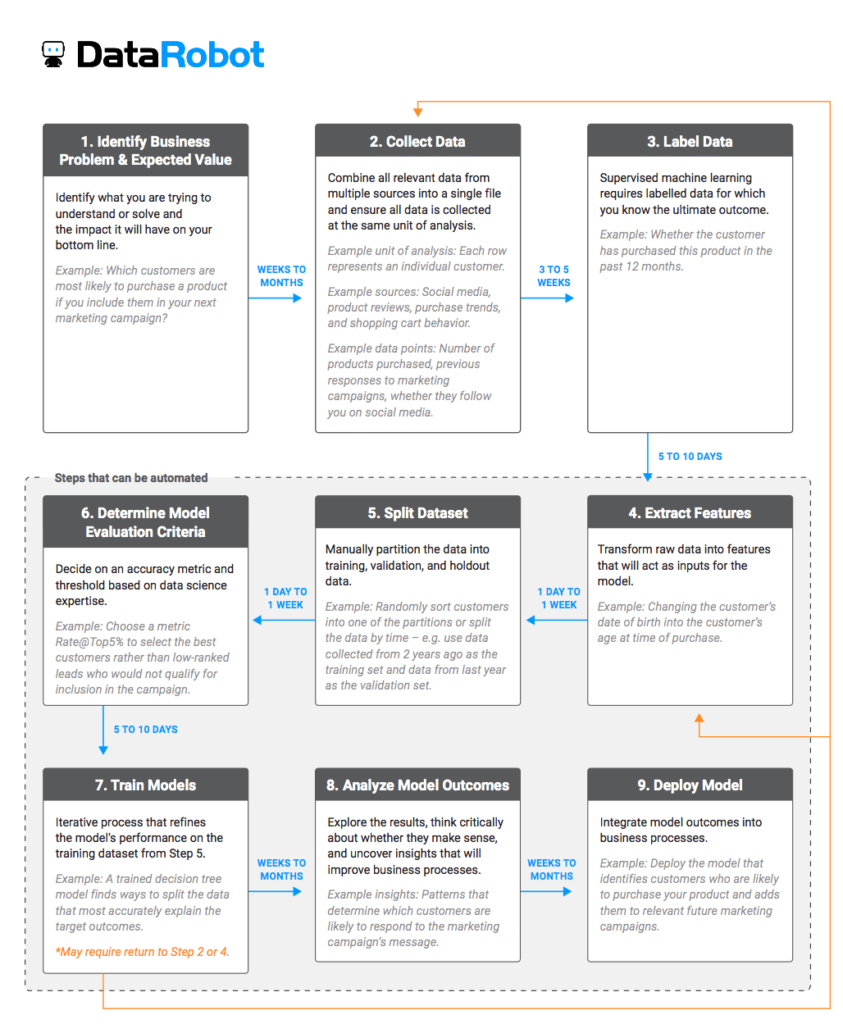
Here is a diagram depicting the detailed functioning of DataRobot:

As we can see, there are nine main steps to machine learning-

  • Identifying business problems and expected value
  • Collect data 
  • Label data 
  • Extract features 
  • Split dataset 
  • Determine model evaluation criteria 
  • Train models 
  • Analyse model outcomes 
  • Deploy model

The box indicated how all steps from 4-9 can be automated, while in the traditional method, it is only step 7. If we do the math on each arrow and its characteristics, it is clear how autoML replaces weeks and months with days at most. 

Hence, in a nutshell, autoML-

  • Preprocesses data
  • Provides feature engineering
  • Generates diverse algorithms
  • Selects suitable algorithms 
  • Trains and tunes the machine according to data requirements 
  • Does ensembling 
  • Participates in head-to-head model competitions
  • Provides human-friendly insights 
  • Simplifies deployment 
  • Monitors and manages the model

AutoML Tools 

Every technology needs tools to be functional. Ideal autoML tools are easy to use with a relatively low learning curve. The absence of complexity is essential to the democratization a responsible world should be aiming for. 

Ten main autoML tools are given below:

1. Auto Keras 

An open-source software library for autoML. It was developed by the ‘Data Lab’ at Texas A&M University and community contributors. This software library provides functions to search for the architecture and hyper-parameters of deep learning models automatically. 

2. H2OAutoML 

H2O is also an open-source platform, but it is also distributed and in-memory. It is a platform with linear scalability and includes a learning module. Driverless AI is H2O.ai’s flagship product and automates some of the most challenging and productive tasks in applied data science such as feature engineering, model tuning, model ensembling, and model deployment. 

3. SMAC 

SMAC or sequential model-based algorithm configuration is a versatile tool. It optimizes algorithm parameters and has proven to be very effective for hyper-parameter optimization, scaling to better dimensions and discrete input dimensions. These are just some examples of the many algorithms it simplifies. 

4. Auto-sklearn 

The supervised learning auto-sklearn provides is out-of-the-box. It is built around the scikit – learn machine learning library and automatically searches for the right algorithm for a new machine learning dataset, optimizing hyper-parameters.

5. Amazon Lex 

Amazon Lex provides advanced deep learning functionalities of automatic speech recognition or ASR. It helps convert speech to text and the natural language understanding or NLU enables users to build apps with highly engaging user experiences and lifelike conversational interactions. Amazon Lex is what makes Amazon Alexa available to all the developers allowing them to build natural language, and sophisticated conversational bots quickly and easily.

6.Auto-WEKA

Auto-WEKA considered and solved the problem of simultaneous selection of a learning algorithm and setting its hyper-parameters. It uses a fully automated approach, leverages recent innovations in Bayesian optimization or BOHB, and helps non-expert users in identifying ML algorithms more effectively. This happens alongside setting hyper-parameters appropriate to the particular applications.

7. Auto-PyTorch

Auto-PyTorch automates the right architecture and hyper-parameter settings. It uses multi-fidelity optimization alongside Bayesian optimization, or BOHB, to search for the best settings.

8.RoBO 

RoBO stands for Robust Bayesian Optimisation. It is a framework written in Python. The core is a modular framework. It allows an easy exchange and addition of components of Bayesian optimization such as different acquisition functions and regression models. The different regression models contained are Gaussian processes, Random Forests and Bayesian neural networks, amongst others. Expected improvement, probability of improvement, lower confidence bound and information gain are some of the acquisition functions built.

9.AutoFolio

AutoFolio’s main purpose is to optimize the performance of algorithm selection systems. It uses algorithmic configuration. It achieves the target by determining what the best selection approach and its hyper-parameters would be. 

Algorithm Selection or AS techniques have sufficiently improved the state-of-the-art in solving pressing AI concerns. They involve choosing an algorithm from a set of algorithms that would solve the given problem instance most effectively.

10. Flexfolio

Flexfolio is an open solver architecture that integrates several different techniques and approaches of portfolio-based algorithm selection. It is a modular architecture that provides a unique framework for comparing and combining existing selection systems in a single, united framework. 

Conclusion 

With people – including entrepreneurs and company owners – coming from diverse socio-economic backgrounds, it only makes sense that more inclusive technologies be developed and existing technologies be made more accessible. AutoML is just the way to do this. Small industries, companies with limited resources, entrepreneurs looking to experiment with technology – these are all groups that benefit from removing the need for experts. It is encouraging to see strides in this direction being taken. 

However, complacency is a vice and we must remember – there’s always scope for further growth and development. We have come a long way from where we were and now, it is time to take inspiration and explore the exciting possibility of another breakthrough in science. 

How Blockchain Is Redefining The Gaming World

We all have that one friend who cannot end the day without beating an opponent or two at Fifa or buying a new country’s team. Most of us have parents simply addicted to Solitaire or Candy Crush and, believe me when I tell you, people in your circles are getting quiz2win memberships as you read this, and the numbers are greater than you would expect. Then there’s PUBG, undoubtedly, and the multitudes of people having ‘chicken dinners’ during lectures or meetings as well as in all kinds of public transport. 

The examples above are my way of premising the following fact- gaming has become a part and parcel of our lives, whether we actively realise it or not. On a broad spectrum, it is, in fact, one of the integral industries of the world today. Here’s a visualisation of its staggering reach –  the overall gaming market was expected to grow to 159.3 billion USD in 2020. With the world facing a pandemic people are locked up in their homes with ample time to spare. As a consequence, a 9.3% increase in these numbers has been predicted. By the end of 2023, the figure is said to surpass 200 billion USD

With the industry being so large and dealing mainly with computer systems, it’s hardly of any surprise that it is also one of the first ones to adopt new technologies. Be it  motion sensors, augmented reality, virtual reality, artificial intelligence, machine learning – all of these have found some of the most unique and interesting uses by the gaming industry. Ones that have interested users and served as trailblazers in a world of innovation for enthusiasts. Another such technology rising through the ranks of popularity is blockchain and so is its integration with gaming. The rudimentary question this raises is – what is blockchain?

Understanding Blockchain

Blockchain is currently the most famous distributed ledger technology out there. A distributed ledger can be imagined as a record book that stores data. The word ‘distributive’ means it is distributed over systems rather than being consolidated on a single computer, and that is exactly how blockchain works. Once the authenticity of a transaction is established, it is put on a ‘block’ alongside other authenticated transactions. The block is given a ‘hash’ or a title, is time stamped and added to the ‘chain.’ Once this has happened, the information stored can never be altered; in other words, it is immutable. The time stamping ensures the order of the blocks cannot be manipulated. The rigorous encryption involved in generating the hash ensures the block’s data cannot be manipulated. Hence, it is very difficult to hack systems where blockchain is in action. Even if one system is hacked, the hacker would have to make the same exact manipulations on every single system using that blockchain – since every transaction is copied over every device- a task practically impossible to execute. This makes any attempted malicious activity quite easily trackable. 

For years, the central areas of focus for  anybody venturing into blockchain were finance, banking, logistics, food supply, pharmaceuticals, investment and the like. People are now beginning to see how blockchain and gaming converge and the new prospects their combination can give rise to. Well known companies are the flag-bearers of this change, for instance, Forte raised 100 million dollars in 2019 for blockchain gaming. In the following section, I am going to give you six possible reasons behind this investment, vis-a-vis, six of the many benefits blockchain has to offer to gaming.

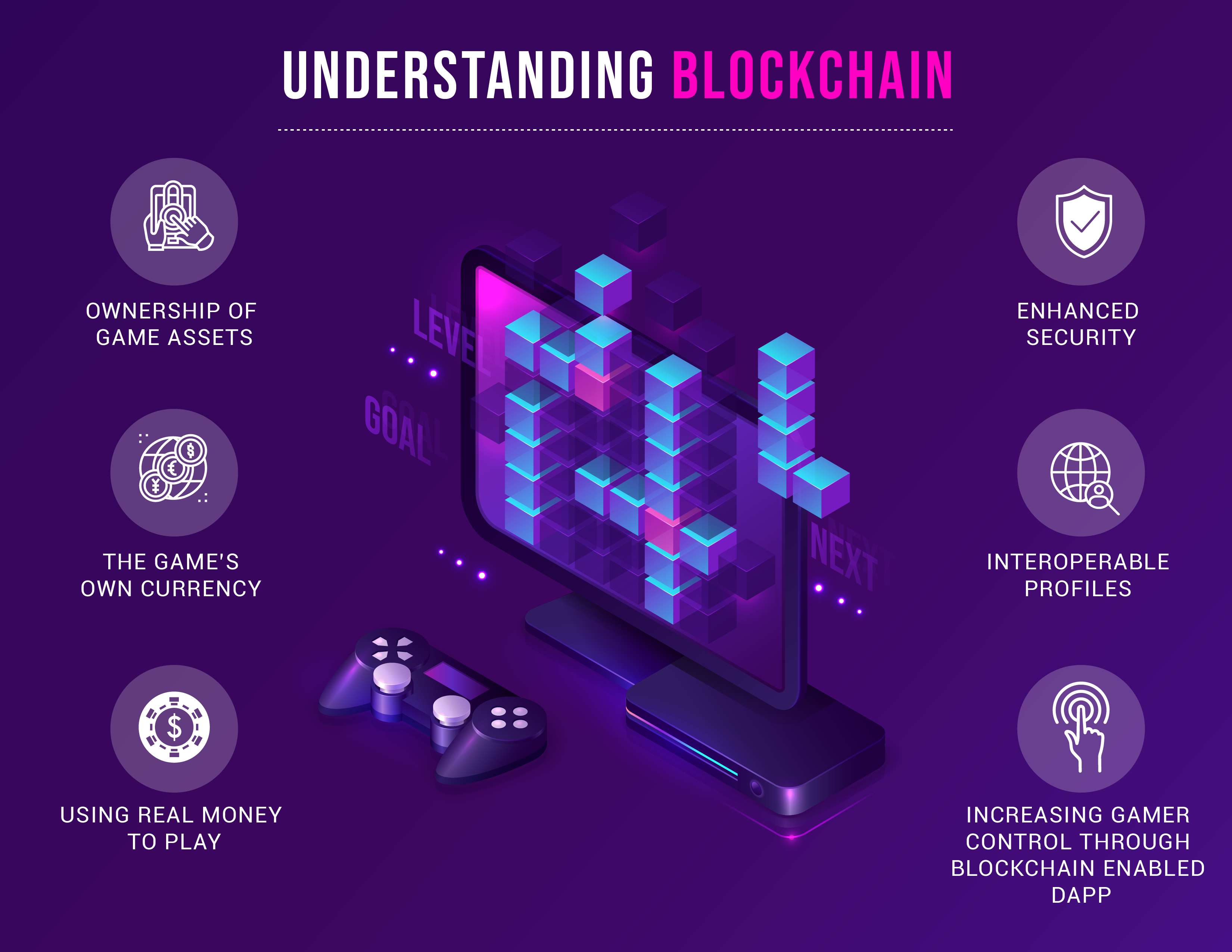
1. Ownership of Game Assets

‘Your money is there and there’s nothing you can do about it,’ said Craig Russo, director of innovation at Polyient Games, when questioned about the biggest barriers to gamers making monetary investments in games. Polyient games is a rapidly developing company that invests in early-stage gaming. They have been interacting with blockchain gaming for years.

The problem Mr. Russo rightly identifies is how sometimes, you can buy all the swords, guns and outfits you’d like but when your VR bubble breaks, you might just realise it was all for nothing. This thought has resulted in widespread apprehension towards making gaming investments in the masses. 

How blockchain gaming completely changes the game is by making people 100% owners of every virtual asset they acquire. NFTs or non-fungible tokens broaden the appeal and growth of online gaming by giving users tools that allow keeping their purchases. Surprised as you may be, these assets sometimes have much higher real-world value as one would fathom so. Even if they don’t, migrating them to other games without having to buy them again is undeniably an added convenience with high appeal.

This system makes everything you acquire actually your own and your hobby can evidently become a place you derive rewards from. Talk about  incentivising users!

2. The Game’s Own Currency 

Whenever you get the option to ‘buy more coins’ in exchange for real money, it is an example of the game having its own currency. What motivates people to buy this cryptocurrency is how acquiring them over time is a more tedious process. Making this currency blockchain powered enhances security and transparency, cuts costs and saves time – all of these making the process more user friendly and attractive. What’s more, some of these have tie-ups with other companies. An example is the game ‘Age of Rust’. It uses Ethereum powered Enjin coins that can be exchanged at Uber and Postmates. Enjin coins have a wide spectrum of use. They come with software development kits (SDKs), wallets, game penguins and other virtual item management and payment gateway apps. 

Another example would be Cryptokitties developed by Axiom Zen. From its launch on the 28th of November to a week later, the 6th of December, players had spent 6.7 millions on it. The key was simple- an interesting and fun to follow game. 

3. Using Real Money to Play

There are five words to explain this utility – cryptocurrency jackpots in online casinos. To indulge in online card games and white, government approved online gambling, you don’t have to provide card details with blockchain gaming. This enhances security and discretion manifold. If one must gamble, it is much better to do it safely and traceably. 

4. Enhanced Security

This works on two levels. 

First, blockchain helps in making games unrigged and secure. Everything on blockchain is transparent. When rules aren’t made and implemented behind opaque doors, it is much easier for people to trust the game and lay their claims. For example, ‘Beyond the Void’ is an open-source, transparent distributed gaming server for a safer, fairer player experience.

With respect to assets, blockchain makes your ownership secure. Without decentralisation, details of assets are stored on centralised servers. This makes them highly prone to hacking and malpractice. With distributed ledgers, that possibility significantly goes down. Multiple algorithms are in place to see to this. Rigorous encryption, time stamping and copies on every device or decentralisation are some of the methods employed. Additional ones are systems like the Proof of Work (POW) agreement. It is a consensus algorithm that prevents suspicious, unsupported transactions from getting recorded and defrauding the users or the government. It is also impossible to stage a Distributed Denial of Service (DDoS) attack.

5. Interoperable Profiles 

There are hardly any activities we do always from the same place. In this case, the same place is the system/network in use. As we switch between games and networks, we have to start over- approach every transaction from square one, establish new addresses, etc. This leads to user reluctance and inertia. What blockchain does is give users public addresses. These addresses can be and are used for transactions across different blockchain networks. Purchasing coins, services, upgrades on different games is literally made as simple as logging in to Amazon and Flipkart using the same Facebook ID. 

Further, from the perspective of game developers, players who play one of the many games they create can use the same public address across all the rest without even switching between blockchain networks. User friendliness is taken to the next level and all of their projects can co-exist in a holistic environment progressing simultaneously and supporting each other. 

6. Increasing Gamer Control through Blockchain Enabled DApp(s) 

A DApp is a decentralised app. DApps have revolutionised the social media industry in the past and are slowly extending their impact to the gaming industry. Community gaming increases goodwill like nothing else and incentivises users by providing a safe environment where they have maximum control. The features that help in achieving this are- 

  1. Using smart contracts in the back-end 
  2. Utilising decentralised blockchain
  3. Enabling transactions through crypto-coins 
  4. Open-source coding 
  5. Autonomous running  
  6. Basing every modification on community consensus  

The benefits above are just the tip of the iceberg. There are numerous other opportunities blockchain gaming technology has to offer and we have every reason to assume the items on this list will keep getting numerous as utilities of blockchain get discovered. For now, bringing it to mainstream games and incorporating it even in single-player consoles from vendors like Microsoft and Sony is definitely a goal. Issues with scalability and readiness of game console companies to adopt the new system will have to be resolved. It will be an uphill battle, but surely one with a rewarding end! 

Why You Need To Leverage Blockchain For Your Business Today

Leverage Blockchain in Your Business

The blockchain space is evolving into a revolutionary space by the day. In today’s dynamic business landscape, it’s become a critical part of business technology – so much so that IBM launched an entire division focused on blockchain and is continuing to invest heavily into the technology. Several other technology companies are also joining the bandwagon or actively exploring options. 

Blockchain technology has seen massive growth already; this growth is only limited by the amount of talent. With technology evolving incredibly fast, it’s important for businesses to keep up to the changes. There are multiple startups and enterprises looking to hire remote developers adept at blockchain, pitched as one of the leading cutting-edge technologies today. Better yet, the presence of the distributed ledger adds extra value to each project.

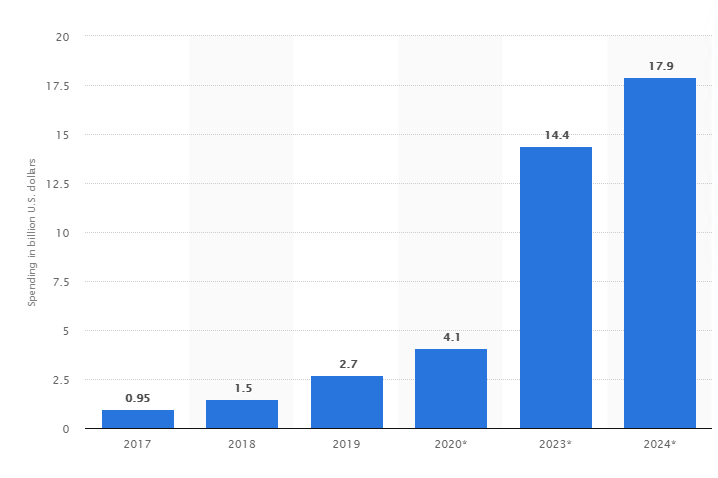
The world is going blockchain. The sheer size of the market isn’t shy of highlighting this. Its market size is projected to touch a staggering $16 billion by 2024, according to a report conducted by Global Market Insights, IBM, FedEx, British Airways, Microsoft, Nestle, Walmart – and these enterprises only sum up a few of the brands venturing into this space. 

Worldwide spending on blockchain solutions from 2017 to 2024

(in billion U.S. dollars)

Source: Statistica

Business At Play With Blockchain

One of the most important benefits of blockchain implementation is the total cost it takes to reach the market. It is significantly cheaper and much more effective to build using blockchain technology than any other platform. Fast incorporation with a number of cryptocurrencies allows it to be a site of choice for companies in all sectors. The use of this sophisticated technology has unbelievably expanded not just the realms of technology and finance, but has also driven changing business needs. In our blog, we look at why it matters.

1. Faster, accurate and more efficient processes

Negating the need for intermediaries is one of the key reasons why corporations implement blockchain technology, which not only eliminates costs but also makes the entire process quicker. It’s because by eliminating the inconvenience created by a middleman in a functioning system, you’ll certainly get things done quicker in the overall operating phase.

2. Better privacy and encryption for your business data

Blockchain technology prohibits even root users and administrators from tapping into personal or confidential information, thereby ensuring anonymity across the network. Moreover, it also keeps encryption keys that use the highest level of security. This mitigates the risk of hackers penetrating into the platform. By default, the technology is designed to reject all unwanted attempts to access data or even programmes that are within its network.

3. Cost-efficient for your business

We all love the ease of online transactions, but such fees will also limit income. In today’s market, there are various providers such as PayPal and Shopify, which carries costs ranging from 2.9 to 4.4 based on what they do, depending on the location of the purchase inside or outside the USA. Here’s where you have to pay attention to chargebacks or monthly prices. The greatest advantage of blockchain is the elimination of third parties. With blockchain, your business will be better positioned to reduce or avoid counterparty threats. 

The perks of leveraging blockchain technology for your business is hard to miss. The challenge arises when you’re looking to hire the right talent to drive a secure blockchain platform. No blockchain development is possible without utilising the skills of experts. Launching a blockchain product or service needs the highest security or expertise – without this, your business could face risks. One of the best ways to solve this is by hiring the right blockchain app development company. 

Hiring a blockchain consulting company to drive your business would help you use an open source and secure platform that can be modified to manage everything from quality assurance to financial transactions and smart contracts. Furthermore, It has transformed digital transactions through the use of tokenization of all physical assets. How do you know whether you’re hiring the right blockchain app development company? Hiring sought-after blockchain developers may be a daunting task for both established enterprises and start-ups. Here’s what you need to look out for.

1. How long have they been around? What projects have they worked on?

When you’re looking to hire blockchain app developers, it is important you look at the years of experience the developers have in building blockchain platforms. Details on their domain, founding team and senior management can help you make an informed decision. 

In addition to this, it always helps to ask for the achievements and awards they’ve won for their work in this field when hiring remote blockchain developers. Look out for any patents or licenses that they have which could highlight their product’s quality. 

One of the other major factors to check is the list of brands or the blockchain app development company’s portfolio. This will give you a picture of what products they have worked on and their performance while developing these platforms. Ask if they have built products for global enterprises or with start-ups as this will give you insights into how they can work with your product idea.

2. Learn more about their team of blockchain developers. What is the domain, skillset and tech stack?

Through this conversation, you will also learn more about the quality of their blockchain developers, where they are based out of, and how you can communicate with them.

You need to know if their remote blockchain developers understand programming languages like C, C++, Javascript, Node JS, Solidity, Java, Python and Go. A skilled blockchain developer understands the concepts of encryption, data security, decryption and data structures. Apart from the blockchain development process, it’s also important to know if the team is utilising tools that improve efficiency and deployment – be it JIRA, Slack, agile or scrum methods. 

While gathering this information, it’s also important to know if the remote blockchain developer can function or work according to your time zone.  More often than not, many blockchain developers may be based in different countries to compete with a market that’s driven by price pressure. If this triggers possibilities of quality concerns, you should discuss this with the company.

3. Understand the team’s development process and see if it fits your business needs. 

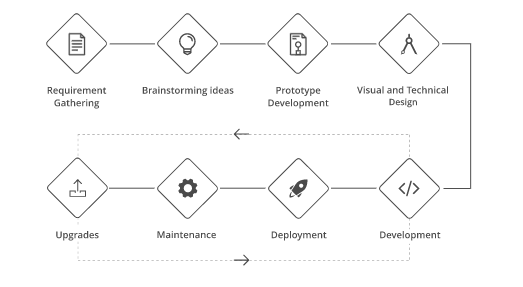
Different teams follow different development processes. When hiring a blockchain app development company, you need to ensure what development process is being followed by the team. This is important when it comes to understanding how your product is being designed, developed and implemented. 

This also helps you gauge if they have the potential to develop and build a blockchain-based platform. If the team has worked across multiple technology stacks such as cloud, microservices, iOS, Web Apps, Android or mobile app development, they have ample experience to help you navigate blockchain development. 

4. Will they support your business with maintenance or service concerns after implementing the platform? 

If you’ve managed to hire a blockchain app development company that works as an end-to-end service provider, that’s your one stop shop. They will give you access to product consultation, design, development, maintenance, support and implementation.

Rising demand for blockchain services

With the industry facing explosive growth, it also highlights the appetite for remote blockchain jobs and hiring remote developers. If you’re looking for a secure blockchain platform, partnering with the right blockchain app development company is critical. If your company needs to get ahead of the blockchain disruption curve, hiring remote developers in the post COVID-19 world may be a challenge, while being a vital necessity. Here’s where we simplify that for you. 

Why SoluLab?

Our team of over 25+ experienced blockchain developers with more than 5 years of experience works across projects in the USA, Europe and  South Asia, and has proved the capability of developing secure apps that match your business goals. Till date, we have successfully completed more than 50 projects that span blockchain consulting, enterprise blockchain development and crypto-related blockchain development. 

If you’re looking to hire a blockchain development company, SoluLab’s team can amplify your business’s technology-driven processes by creating decentralized applications, allowing only authorized personnel to control operations, track real-time data security, development of cryptocurrencies, launch ICOs and HOT wallets. We also help you with training and support migration of your systems to integrate blockchain technology and instant data sharing. Better yet, we also help you implement smart contracts where all personnel can operate in a connected environment to monitor transactions real-time. 

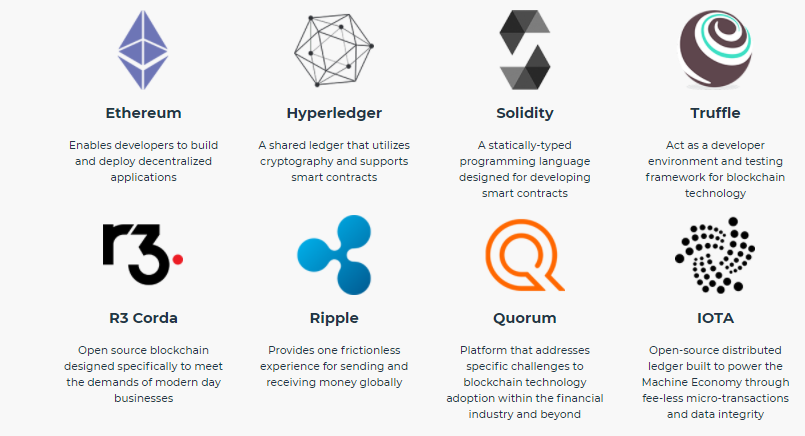
Here’s a sketch of our technology stack:

We have partnered with enterprises and hyper-growth startups to develop and design a blockchain readiness program, smart contract audits and more – with the first 15 days completely free, no strings attached. Get started today!

Most Common Myths about Blockchain Technology

In most of our blogs, we talk to you about various upcoming technologies and their interesting applications. In today’s blog, we’re looking to bust some myths. 

With blockchain trending in most circles, talks are on. The downside, though, is that the only information doing the rounds about blockchain and cryptocurrency is not factually consistent- or relevant- information that adds positive value to discourse. A lot of ‘facts’ you hear about it aren’t actually facts, rather, half-true, misinformed statements or conjectures. 

Here are some of the many myths about blockchain you might have been exposed to and believed at some point, and let’s see if we can change that for you!

1. Blockchain means cryptocurrency 

The reason this opinion became a significant myth is probably the fact that bitcoin and blockchain became famous around the same time. But are they the same thing? Absolutely not. 

While bitcoin is the virtual currency that allows transactions to take place, blockchain is the underlying distributed ledger technology that enables it to happen in the first place, and that is just one of its many different purposes. Let’s look at both separately. Bitcoin is a form of virtual currency or cryptocurrency- a currency that doesn’t exist anywhere in the form of notes or coins or gold or silver. It is an invisible, digital value that is generated through mathematical algorithms and stored in the form of computer code in cryptocurrency wallets. Transactions happen from wallet to wallet for value to circulate. And how are these transactions secured and stored? This is where blockchain comes into the picture. Blockchain helps in generating public and private keys – like email addresses and passwords – using labyrinthine encryption that cannot be done backwards and storing and time-stamping every bit of exchange that happens on it. But what is blockchain? 

Blockchain is currently the most famous distributed ledger technology out there. A distributive ledger is basically like a record book that stores data. The word ‘distributive’ means it is distributed over systems rather than being consolidated on a single computer, and that is exactly how blockchain works. Once the authenticity of a transaction is established, it is put, amongst other authenticated transactions, on a ‘block’. The block is given a ‘hash’ or a title, is time-stamped and added to the ‘chain.’ Once this is done, the information stored can never be changed; in other words, it is immutable. The time stamping ensures the order of the blocks cannot be manipulated. The rigorous encryption involved in generating the hash ensures the block’s data cannot be manipulated. Hence, it is very difficult to hack systems where blockchain is in action. Even if hacking does happen on a system, the hacker would have to make the same exact manipulations on every single system using that blockchain which would be practically impossible. This makes any attempted malicious activity quite easily trackable.  

2. Blockchain can only be used in the financial sector 

As we discussed above, finance was the first sector that was popularised along with blockchain, since blockchain basically enabled digital bitcoin transactions in the first place, and other applications it has in the finance sector are vast. 

Goldman Sachs, the world’s leading investment, banking and security group acknowledged the importance of blockchain and largely encouraged banks all over the world to do the same and integrate it with their functioning. Another feature that couldn’t have been imagined before is the concept of smart contracts or self-executing contracts upon fulfilment of predetermined conditions that has helped a large number of people in insurance, copyrighting, theft protection, etc. But none of these applications, by any means, suggests that application in the finance sector is the only application blockchain has. The Massachusetts Institute of Technology put it into good words- they say blockchain is a General Purpose Technology (GPT). A technology that 1. can be applied across a wide spectrum of industries 2. has the capacity for continual improvement and 3. acts as a catalyst for innovation with complementary technologies

Blockchain has revolutionised the medical industry in various countries, where patient records and trial details are now being stored on the blockchain, making them transparent to users and non-hackable to perpetrators. Most hospitals use it for record keeping. The Beth Israel Deaconess Medical Centre is one such example; they have been combining AI and research successfully for years. 

The fresh produce industry in various parts of the world has shaken hands with blockchain to implement sales and purchases and to maintain a stage-wise record of whatever supplies they send out. This helps in an easy location of a loophole as it happens and increases consumer trust as status updates happen on their systems in real time. 

Blockchain social media has led to the birth of decentralised social media or social media where data and power are not concentrated into the hands of one giant (like Instagram or Facebook) but distributed amongst the entire community of users. What this means is that no one authority has all of your private data that it can easily sell to Netflix or Amazon, hence privacy increases significantly. Freedom of speech and expression has also been given a new form altogether since anonymity, if chosen, is not compromised. 

Internet of Things (IoT) or the new age phenomenon where our washing machine self-orders detergent every time it is running out and our coffee makers wake us up has also been facilitated in ways by blockchain. A byproduct of people’s fridges and doors having IP addresses is that the number of hackable devices in a house becomes ten times of what it was before. Device spoofing, cyber threat and IoT botnets (a group of hacked devices) leading to mining of cryptocurrency and fluctuation in its value is a real threat. This threat can be evaded to some extent with the use of blockchain. If tiny, blockchain compatible chips are installed in these devices, they can be given immutable identities of their own, making hacking into them nearly impossible. And this identity provision is not limited to IoT devices, giving digital identity and proof-of-existence to people has also been rendered a much more secure and transparent process. 

3. Blockchain smart contracts have the same legal value as regular contracts 

While smart contracts are becoming increasingly popular and have high utility in industries such as insurance, copywriting, theft protection and IoT systems like self-ordering from the grocery store refrigerators, their legal status is a grey area. Smart contracts are still seen as lines of code that are implemented when some conditions are met, but if challenged and contested in a court of law, payments such made have the possibility of being reversed. The benefit of the doubt may be given to the other party by virtue of the bliss of ignorance. This is largely due to the novel nature of the technology and people’s subsequent apprehension.

However, smart contracts can still prove as excellent proof that the said conditions have been met and continue to be a powerful tool, perhaps enough to negate the benefit of the doubt. 

4. Blockchain is used for nefarious purposes 

This stems from a similar apprehension to new technology we discussed above. Because so many people are not familiar with the way distributed ledger technologies work, it is easier to assume that it is something shady that people who have things to hide use than to actually find out what it is; once you do, you realise it is quite the opposite of that.

Cryptocurrency on blockchain, with everything on a digital system with immutable records, is far more traceable than physical cash. Blockchain has in fact been used by governmental agencies for their forensic analysis to crack down on illegal activities such as drug exchange and money laundering. 

5. All Blockchains are the same

This results from a very reductive outlook towards blockchain. 

There are various technologies that contribute to the blockchain. There’s the ledger, peer-to-peer network, consensus and incentive mechanisms are some of the core components. If anyone of them is changed slightly, the resulting blockchain would be very different.

This anyway makes no sense considering the vast number of applications blockchain has. How can the blockchain maintaining patient records be exactly the same as the blockchain regulating the tuna market? One size doesn’t fit all, in the same way, different applications call for different blockchains. Some are private, some are semi-private and the others, wholly public. Like this, there are various other modifications and differences. 

6. Blockchain is free and highly accessible

There are no free lunches in the world- and a technology that performs such heavy mathematical functions and implements algorithms certainly comes at a cost. Somebody is paying for a large amount of computing power, and the cost is in some form, eventually falling upon the consumer. Of course, the choice then is whether or not to make the tradeoff, because the benefits are also proportionate, if not greater, than the cost.

As far as accessibility is concerned, that is something developers are still working on. The largest barrier towards this goal is the scalability of blockchain. The immutable chips need to be made as compact as possible, as data efficient as possible without compromising on security. Otherwise, imagining larger blockchain integration is difficult. 

7. Blockchain can never be hacked or altered

Blockchain is nearly impossible to hack- the emphasis here is on nearly. While it is true that a DLT has massive upsides in terms of security as compared to centralised systems, that doesn’t make it impossible for their security to ever be compromised. 

The feature that makes blockchain so secure is the high level of encryption. That fact that the private key cannot be obtained from the public key, has cannot be manipulated and the chain is basically safe and immutable depends on the fact that the mathematical operations are too complex and for all practical purposes, irreversible. However, with the development of quantum computers, this might be put under question. Quantum computers are computers that have infinite states between 1 and 0 in contrast with just the two states in regular computers. They can exist, through quantum entanglement of states, in infinite forms at the same time. What this leads to is an unprecedented increase in the efficiency of these computers and their ability to perform operations. Right now, quantum computers are not very accessible as there are massive scalability issues. They are limited to theoretical and some practical physics’ labs. But if this technology becomes more easily available, how safe blockchain is will be replaced by a question mark. However, it is reasonable to assume 1. this is not likely to happen any time soon and 2. blockchain technology will also evolve accordingly, as everything does with time and innovation. 

So, even though blockchain is not one hundred per cent hack-proof, the truth is, no system or database can ever completely be. It is sort of an unrealistic goal. So, when compared to all other systems available, blockchain still definitely has the edge and is the least hackable of all. It is also one of the few technologies that actually give a fallback mechanism- if hacked, blockchain itself will lead you to catch the unauthorised changes. 

What is cryptocurrency exchange and what will be the role of Blockchain in it?

cryptocurrency exchange

Introduction to Cryptocurrency  

Cryptocurrency may be a kind of digital currency.  It utilizes cryptography for protection and anti-counterfeiting measures—public and personal keys for assigning cryptocurrency between individuals.

As a counter-culture movement that’s often compared to cypherpunks, cryptocurrency is an authorization currency. This suggests users must reach a consensus about cryptocurrency’s price. And use it as an exchange medium as it’s not tied to a specific country. It’s fee isn’t controlled by a financial institution.

Cryptocurrency Exchange

It’s a system operating on the groundwork of trading cryptocurrencies with other assets. Sort of a traditional financial exchange. Its core operation allows the buying and selling of those digital assets. 

A cryptocurrency exchange is additionally referred to as digital currency exchange (DCE).

To apprehend cryptocurrency exchanges. These new sorts of exchanges are different from ordinary financial exchanges. Cryptocurrencies are unstable as useful and sourcing—cryptocurrencies like bitcoin related to the most vital disruptive events. Here, bitcoin value changed over a fast period of your time. Or where major exchanges went under, thanks to theft, fraud, or different problems.

Cryptocurrency exchanges need to integrate protections from many of these events. In other ways, cryptocurrency exchanges work a bit like ordinary exchanges. On many of those platforms, cryptocurrency buyers and sellers can make limit orders or market orders. The brokering process works like it would for any different, quite an asset. The cryptocurrency exchange benefits with the transaction and receives the fees. 

The difference is that the underlying asset—Bitcoin or another cryptocurrency that doesn’t have any national currency valuation properties.

Cryptocurrency wallets and wallet brokerages allow you to shop for and sell a little range of famous digital assets. You’ll then send it to a special exchange to exchange for other digital assets like altcoins. An instance of such an exchange is Kraken. It currently accepts funds within the sort of USD, JPY, CAD, and GBP. It also helps trades with Monero, Ripple, and Litecoin, also as Bitcoin and Ethereum.

What is the role of Blockchain in Cryptocurrency?

Blockchain is the technology that permits the existence of cryptocurrency (among different things). Bitcoin is the name of the best-known cryptocurrency. A cryptocurrency may be a medium of exchange, as the US dollar. But it is digital and makes use of encryption techniques to regulate the creation of monetary gadgets, also for verifying the transfer of funds.

A blockchain, a decentralized ledger of all transactions across a peer-to-peer network.  Potential applications can include fund transfers, settling trades, and lots of different issues.

A blockchain is actually a digital ledger of transactions. That’s duplicated and distributed across the whole community of computer systems on the blockchain. Each block within the chain contains a variety of transactions. Every time a replacement transaction occurs on the blockchain. A record of that transaction was added to each participant’s ledger. The decentralized database is managed by means of many participants understood as Distributed Ledger Technology (DLT).

Blockchain may be a sort of DLT. During which transactions record with an immutable cryptographic signature mentioned as a hash.

Cryptocurrency exchange fee comparison

How much does the exchange cost for converting your money?

And how does this fee compare to other comparable exchanges?

The average fee for Mastercard buys is about 4%. Bank transfer buying fees are usually 1-1.5%. Compare the rates of any exchange to different similar exchanges.

Cash fees are usually 1%, although there’s a 5-10% premium on a daily basis. This is often very true at ATMs, where there’s always a premium.

The cryptocurrency change market features a vast range. One can choose these markets as per their preference and requirements.

Keep some main factors in mind when choosing an exchange. Those factors are

Fees

US Dollar Deposits

History of Security

Customer Service

Number of Coins Available

The most trusted Bitcoin Exchanges Platforms are as follows:

Binance- Its lowest buying and selling fees. It has most coins, large volumes, and no KYC required for this. No fiat deposits. No margin. It also has regulatory risks.

Binance is one of the most important exchanges within the world by total daily volume. It’s, by the way, the most important of any exchange available to US investors. This is often quite dazzling as it launched several years later than most of its competitors in mid-2017. It began by a team out of Shanghai, led by its famous CEO Changpeng Zhao, or CZ. Currently, it moved its headquarters to Malta. There, finance and crypto regulations are much less stringent.

Binance may be a famous exchange because it’s easy to know, low fee structure. It’s one of the rock bottom costs for US investors. It offers the foremost cryptocurrencies to trade out of any major change with overflow 100. Suppose investors trade the utility of its own cryptocurrency, BNB. They’re going to receive a further fee discount.

Additionally, its massive daily volume ensures efficient markets. So, traders are usually able to buy and sell even rather obscure coins. It is also one of the only large exchanges. It does no longer need customers to provide their identity and other economic details. Most customers only need an email tackle to start trading.

Additionally, there is no margin trading. There is a mobile app. But it is not as consumer-friendly as some of its competitors.

Deposit is free.  The trading percentage is 0.1%. 

Coinbase- It is good for beginners, has a great history of security. FDIC insured.

Coinbase Pro is for Advanced Trading. But it has excessive fees; customer service is slow and no margin. Coinbase is the most successful crypto alternative in the US. It has a profitability and average volume. They were founded in 2014 by ex-Airbnb staff. Coinbase has its headquarters in San Francisco. It affords a website and mobile app to trade cryptocurrencies.

Its simplistic interface makes it an outstanding option for investors. For learning about the crypto ecosystem. It boasts Coinbase Pro, a more complex platform geared for sophisticated traders and institutions. The Coinbase Pro product provides lower fees and several more cryptocurrency buying and selling options. Coinbase has a transparent and reputable past with security. It has never had any essential security incidents and insures deposits of USD and cryptocurrencies.

Coinbase has some of the highest fees when trading in USD pairs. This is a sizable downside for investors that are looking to buy or promote in large volumes. Coinbase does not have that best track file when it comes to customer service. Many customers in the past have complained about response times. And also about getting locked out of bills without explanation. However, this has improved in the last two years. Serious traders disappointed that there is no margin trading and no savings card purchases allowed. 

Deposit at free (ACH) or $10 (wire transfer). Withdrawal is free (ACH or PayPal) and $25 (wire transfer). Trading (Coinbase) – 1.49% (US BANK ACCOUNT), 1.49% (COINBASE USD WALLET), 3.99% (CREDIT/DEBIT CARD). Trading (Coinbase Pro) – 0.05 to 0.025% (taker fee), 0.00 to 0.15% (maker fee). 

Kraken- It has margin trading. It is the oldest exchange in The US and can trade tether for USD. It has no mobile app and mistaken past maintenance.

Kraken is the oldest US-based crypto exchange with its headquarters in San Francisco. Its founder’s name is Jesse Powell. After witnessing the failures of the now-infamous Mt. Gox exchange, he started it with buying and selling first going live in 2013. Kraken is the third-largest for buying and selling the volume of all exchanges on this list.

Kraken has several unique advantages over its competitors. It is the only exchange for US investors that offers both fiat deposits and margin trading. Investors can hyperlink their bank account and trade in US Dollars. And it is very useful for frequent traders. Margin buying and selling allow investors to borrow money to place large trades. This leveraging enables savvy investors to magnify gains though it is very unstable. 

Kraken is one of the only exchanges in the world that enables investors to obtain Tether for US Dollars. 

Tether is the most abundant stable coin (i.e., a cryptocurrency secured to the dollar). Tether is popular with traders. 

As it allows them to comprehend their gains on only crypto exchanges. Kraken can be useful for traders who use several exchanges and favor an efficient way to cash out into US Dollars.

But, Kraken is the only necessary exchange for US investors that do not offer a cellular app—securing it less available and accessible. 

Over the past two years, Kraken has undergone long periods of blackouts where its site would be restrained for days at a time. 

However, there were no problems with lost funds or hacks. It was a serious problem for traders trying to trade during periods of intense market volatility.

Deposit is free or $5. Withdrawal is $5. Trading at 0.14% – 0.26 (under $100k).

Bitstamp- It is one of the most traditional exchanges in the world. FDIC insured and has excellent security antiquity. But it has high costs and limited coins.

Bitstamp is known as the oldest and most well-known crypto exchanges in the world. 

It has largely been centered on the European market.

 It was once originally based in Slovenia and later moved to Luxembourg. Moreover, it even has operations in London as well as New York.

It is still one of the greatest and best exchanges to use for European citizens due to its low fees. It provides US citizens access, even though its services are more limited, and fees are higher. For instance, it does allow savings card purchases for US citizens. Deposit and withdrawal fees are some of the highest in the market. Particularly for retail investors, who make smaller investments. Also, it solely offers a few of the most popular cryptocurrencies.

It can still be a great choice for some US investors. It has a stellar security record. This has been around longer than almost any different exchange in the world. It allows USD deposits, and all deposits are FDIC insured. Also, Bitstamp has an easy to use interface, and its trading charges are modest.

Deposit – 0.05% or $7.50. Withdrawal at 0.09% or $15. Trading percentage – 0.24% – 0.25% (under $100k). (For deposit and withdrawal, whichever is higher) 

Poloniex- Poloniex has lots of cryptocurrency, low fees, and margin trading.

Poloniex is US-based with its headquarters in Boston. It is very popular with experienced crypto traders as it affords more advanced features and a significant quantity of cryptocurrency assets to trade. Users trying to buy their first Bitcoin would now not be the optimal place to start.

Poloniex has very low fees. It is free to deposit, but they only take delivery of deposits of crypto. Investors cannot link a bank account or buy a credit scorecard. It trades over 65 different cryptocurrencies, which is the most for an exchange based out of the US. Despite the extensive amount of assets it offers. Poloniex experiences much lower volumes than its opponents on the list. For reference, it often has daily volumes that are ten times smaller than a leading trade like Binance.

Poloniex also offers investors features they can’t find in other places. They are the only exchange to provide margin trading besides Kraken. A vital difference is that it additionally allows users to take both sides in the margin trading. In different words, users can borrow assets. It also lends their own assets, income interest in the process. Because it offers risky trading offerings and obscure coins. Poloniex is best accommodated for skillful crypto investors.Poloniex is now occupied by Circle, and it is a subsidiary of Goldman Sachs.

Deposit is free. Withdrawal varies by assets. Trading percentage 0.08% – 0.20% (upto $1M)


What are intelligent apps? What is the role of data science in them?

Intelligent apps & Role of data science

Intelligent applications created with AI development services are being used more frequently to offer improved features and unique user interactions using AI and machine learning algorithms integration and data analysis as technology continues to advance quickly in this modern digital age. These applications have enormous promise since they boost efficiency across many industry sectors by automating various operations and enhancing decision-making processes. 

The AI market is expected to rise significantly from its predicted $86.9 billion in revenue in 2022 to $407 billion by 2027. This has a direct role in the exponential rise in the number of intelligent apps in marketplaces across the globe that have adopted this developed technology. 

With the increasing integration of technology in the mobile environment, everyone is anticipating good chances in the way of experiences but there is also a doubt the capabilities of standard mobile apps. 

Intelligent Apps market

What are Intelligent Apps?

AI-powered apps or smart applications are other terms for intelligent applications. These are computer programs that make use of machine learning and artificial intelligence altogether to evaluate data, learn from user interactions, and deliver wise answers to actions. Intelligent mobile apps are essentially AI-powered features that offer a customized and flexible user experience.

Intelligent apps combine the most user-centric designs and app development tools with the power of consumer data, operational data, modern technology, and predictive analysis to provide an exceptional user experience.  Consumers, clients, owners, architects, and developers may have different experiences with them in the future as GenAI demonstrates machines learn from feedback and become more self-sufficient. 

How Does Intelligent Apps Work?

Intelligent Apps Working

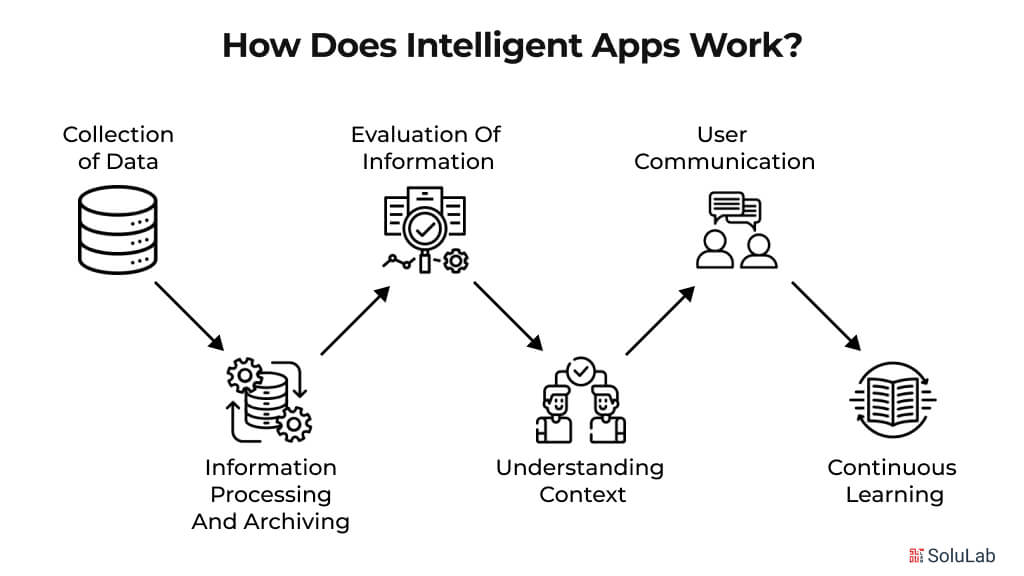
Intelligent applications follow a methodical set of steps that allow them to provide customized experiences to users. Here is the breakdown of starting to end of how intelligent apps work:

1. Collection Of Data

Like every other artificial intelligence application, the initial stage of intelligent apps is also gathering relevant data from various sources which are as follows:

  • User Interactions: Monitoring the clicks, searches, and preferences of the user as they interact with the app. 
  • External Data: Adding to the dataset by including data from social media, APIs, and Internet of Things devices. 
  • Historical Data: Examining previous user activity to spot patterns and trends. 

2. Information Processing And Archiving 

Once the data is acquired, it undergoes processing and storage, this is made possible by removing discrepancies and irrelevant details to guarantee high-quality data. Strong vast amounts of data securely and making them easily retrievable by using datasets or cloud storage. 

3. Evaluation Of Information

The software uses sophisticated analytical algorithms after processing. Alphabets for machine learning to find correlations and patterns in the data, these algorithms examine it. Algorithms for clustering, for instance, can group users who behave similarly. This makes use of past data to predict user behavior or preferences in the future. 

4. Understanding Context

Intelligent apps make use of natural language processing to enhance user interaction. This enables the app to comprehend and interpret user inputs, including text messages and voice instructions. Context awareness evaluates the current context be it time, place, or a device, and offers pertinent answers.

5. User Communication

According to the insights it generates, the app engages the user in conversation, involving users with simple-to-use interfaces that make interaction and navigation simple. Making use of voice assistants or chatbots to have natural conversations with users. 

6. Continuous Learning

The last phase entails the constant development of these applications via user feedback on their interactions is gathered to improve algorithms and models are updated based on fresh data to increase accuracy over time. 

CTA1

Do You Really Need Intelligent Apps?

Now that you are aware of what are intelligent apps and how they work a bigger question arises do you really need them? Intelligent apps are rising due to their ability to provide users with a larger part of creativity, cost-cutting, and more value. More and more technology companies are going beyond the idea of merely adding new features to their programs and infusing intelligence into them. 

If you are looking to be a part of this MLops consulting company’s tactical change that can set you apart from the crowded market and prompt broader acceptance intelligence apps are exactly what you need. If you are an independent vendor, you will be able to enter the market as a result of declining costs related to creating intelligent apps and services. A wider variety of enterprises can now more easily access intelligent solutions thanks to intelligent apps. 

Furthermore, if you require AI-powered solutions across a range of industries you should go for intelligent apps. It has been made possible with the growing expectation of business value, which is partly driven by the hype surrounding generative AI. Intelligent apps are becoming more common as businesses look to enhance experiences and streamline operations. 

Top 4 Examples of Intelligent Apps

Apart from the definition of intelligent applications and their work here are some intelligent applications examples to help you understand better:

  • ElsaAI 

An artificial intelligence app program was created to assist users in pronouncing words correctly in English. It offers individualized feedback and support for language acquisition through the use of machine learning and speed recognition technology. With the help of real-time feedback and corrections, users may practice speaking English while using the app that focuses on pronunciation instruction. ElsaAI evaluates the user’s pronunciation, pinpoints areas that need extra work, and offers fun activities and lessons that specifically address particular areas. 

Read Also: How to Integrate AI Into Your App?

  • Youper

The artificial intelligence apps that can act as a personal mental wellness helper. In addition to offering mental support, it makes use of natural language processing and AI to offer guidance and methods for handling emotional well-being. The goal of the software is to assist users in better understanding and managing their emotions, which can lower anxiety and enhance mental health in general.

  • IRIS 

IRIS is an illustration of how artificial intelligence is used in mobile apps to provide sufficient services. Paint Technology Solutions is the developer of this app, this is an iOS and Android app for intelligent reporting designed for managers, team leaders, and colleagues on any given project. They can view any team member’s support using this program. One advantage is that numerous people can view the same document simultaneously even from different synced devices. 

  • Hound  

Another great example of how adaptive AI in mobile apps is here to make your life easier is Hound. Its program uses voice commands to carry out various tasks such as learning which restaurants, hotels, and doctors are the best. The ability of this iOS app to convert audio into text and vice versa is another intriguing feature.  

Benefits of Using Intelligent Apps

Below is the list of benefits of intelligent apps

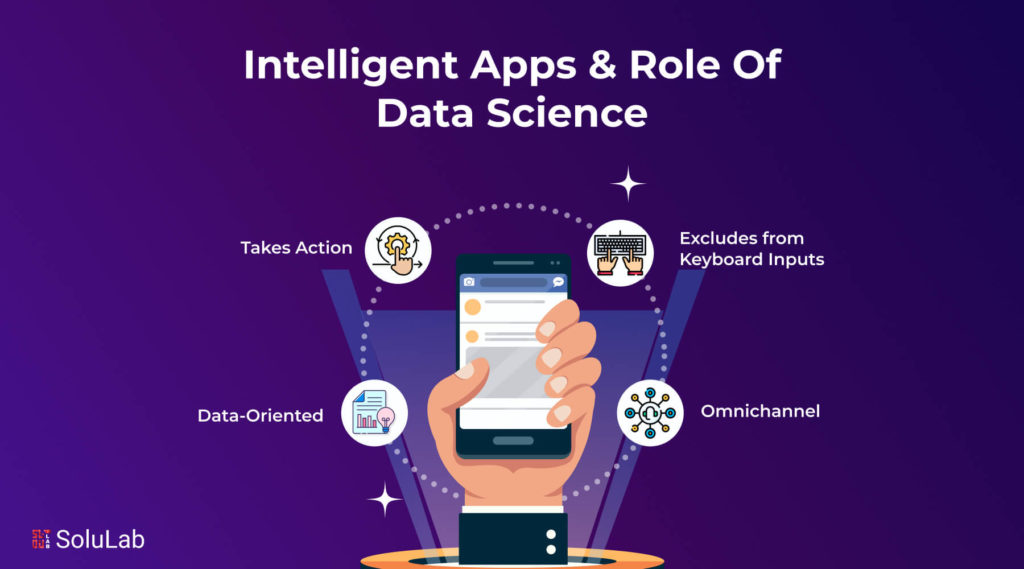
Benefit Description 
Taking Initiative  These apps don’t wait for users to take every action, rather they leverage the abilities of predictive analytics to analyze behavior and deliver customized relevant results which also reduces user disagreement. 
Data-Oriented  Provides a data-driven output and gathers data in real-time from several sources including mobile apps and websites. Provides users with precise answers for nearly all queries as a result of this. 
Leaving Out Keyboard Inputs Since these apps work to provide maximum comfort they also encourage the possibility of issuing commands without the need of any keyboard. This indicates that these applications react to voice, picture, gesture, and other kinds of commands. 
Omnichannel  These apps are aware that no matter which platform they are using, people prefer a comfortable and familiar experience. This guarantees that they have the same experience across all channels of communication.

Intelligent Apps Used In Businesses

Smart apps present businesses with numerous opportunities to improve the BI’s and CEMs of businesses. For instance, a Sales Scorecard App allows tracking of the sales rep’s performance in real-time and reveals visually what aspects need to be changed. Having a Sales incentive Transparency App may help the sales teams set more strategic goals and make better decisions about their incentive deals. 

In addition, the achievement of efforts against performance goals which is facilitated by a Campaigns App helps marketers to design better campaigns. There are many areas of store operations that a Retail Store Performance App can be beneficial to retailers including tracking sales, inventory, and staff working hours among others. Individuals managing franchises can get the latest position in every one of the franchise outlets by employing the use of the Franchise Performance App.  

When it comes to creating forms and questionnaires for both internal and external usage, an app is also useful. That is, by using an inline editing app, users can edit datasets without having any coding experience thus making data management easier. A billing review app also enables teams to review and edit customer invoices more centrally since the invoices can be edited right within the app. 

Last but not least, through the usage of a Talent Management App, even the HR departments of a company can track potential employees throughout the application, interview, and selection process. All of these illustrations demonstrate the vast opportunity that intelligent apps have in changing company processes and enhancing both the decision-making involved and the experiences of clients, as well as the employees themselves.

The Impact of Intelligent Apps On Businesses

NLP applications are still a key factor in fulfilling today’s business environment due to many compliments in customer experience and changes in organizational performance. These apps employ machine learning (ML) and artificial intelligence (AI) proprietary technologies to enhance user experience, decision-making processes, and instant analysis. Here are the major impacts of intelligent apps: 

  • There is an increased ability among companies to optimize the general availability and adapt to new problems in the organization.
  • In addition, intelligent apps also influence other kinds of added value and loyal and happy consumers with customer service automation. From this point of view, these applications can offer personalized experiences that will satisfy the specific demand of every user, based on the information introduced by the AI system.
  • Preventive measures make service delivery more efficient; organizations that employ intelligent software, for instance, have found out that the number of tickets to their customer support hotlines dropped by 40 percent. 
  • Intelligent apps also engage staff members with AI workflow automation, as well as liberate them, by automating usual processes, thereby providing them with more time for meaningful work. Besides increasing output, it fosters an environment that is creative at the workplace. 
  • Moreover, due to converged systems and enhanced security parameters, these applications enable IT to become streamlined and have reduced disruption and consequently increased availability.
  • Companies can, therefore, implement the technologies to analyze data for resource allocation and risk optimization of their operations. All things considered, one may conclude that intelligent applications transform the contemporary economy and change the way clients are dealt with as well as tasks solved by companies.

What Is The Future Of Intelligent Apps?

Anyone in a company is going to be able to develop rich, data-based experiences and make smarter business decisions with the help of intelligent apps and AI-powered tools. Apps with Intelligence will not be able to replace trained developers, rather they will facilitate the delivery of programs faster and more effortlessly, and they will encourage developers to increase their productivity. 

Over the next few years, most businesses will integrate these intelligent apps into their daily life operations. Intelligent apps will be successful in the future if they can overcome the constraints faced by them and change the perception of the role that software plays in our daily lives at work. In addition to providing efficiency gains, intelligent applications will undoubtedly continue to push the envelope of what is convincible as we anticipate the next wave of technological developments producing unquestionable value in the facets of business operations. 

Is SoluLab Working On The Development Of Intelligent Apps?

SoluLab a data science development company’s dedication to incorporating artificial intelligence within mobile applications is indicative of its creative problem-solving methodology. The creation of a chatbot in partnership with a non-profit organization serves as a case study on how intelligent applications might transform the provision of services in vital domains such as mental health. This partnership aimed to improve mental health outcomes emphasizes how important intelligent apps are today for solving problems and even helping in making well-informed decisions. We had the approach to create an online chatbot that can help people in real-time and bridge the gap between them and mental health providers. 

With the proper use of analytics and chatbot development, this intelligent app software provides personalized help, increasing the accessibility of mental health services for a wide range of users. Through the application of data-driven insights, these chatbots can modify their responses to interact with the users. These apps not only increase user engagement but also give your user access to crucial mental health-related information. 

As the technologies advance, they have the potential to greatly enhance outcomes for users by giving them all the relevant resources that they might require to successfully manage their obstacles. For engaging in such developed apps experiences contact SoluLab today. 

FAQs

1. What do you mean by intelligent applications?

They are a change from old software, which was a set of passive tools. Unlike historical apps, which require us to take action, intelligent apps act gradually to improve their autonomous replies.

2. What are the major applications of intelligent systems?

Under AI, intelligent systems refer to a wide class of systems that have algorithms installed that enable them to carry out tasks that normally humans fail to. This application ranges from data analysis to robotics and many other different industries. 

3. What are AI-powered features?

Features that provide automation and informed decision-making are known as AI-powered features such as machine learning, natural language processing, chatbots, robotics, and computer vision. 

4. What apps have artificial intelligence?

Apps that can function on their own and use the power of artificial intelligence such as ChatGPT, Amazon Alexa, Google Assistant, and Youper.

5. How is SoluLab using artificial intelligence for apps? 

By making use of machine learning algorithms and analyzing large amounts of data SoluLab utilizes artificial intelligence for developing apps which not only makes things easier for users but also gives them an informed insight on making better decisions.


The Role of Artificial Intelligence (AI) in Modern Cybersecurity

AI in Modern Cybersecurity

In today’s environment, artificial intelligence (AI) has completely changed the game.  The use of artificial intelligence (AI) in cybersecurity problems is quite beneficial. It facilitates the development of intelligent agents, which might be software or hardware. These agents are made to observe, learn, and make deft judgments in order to cope with certain security concerns in an efficient manner. They are able to detect vulnerabilities in intricate code, observe peculiar trends in user login behavior, and even detect novel forms of malicious software that conventional tools could overlook.

Intelligent agents analyze large amounts of data in order to spot trends. These insights are applied in defensive systems to examine incoming data, including previously unseen information.

AI is becoming more and more important in cybersecurity, and many businesses are using it as a vital component of their security plans.

Why Does AI Matter For Cybersecurity?

AI’s capacity to offer sophisticated threat detection, automate responses, adjust to changing threats, and manage extensive data analysis makes it crucial for cybersecurity. Al in Modern Cybersecurity tactics is becoming more and more necessary as cyber threats continue to change in order to maintain strong and efficient defenses.

  • Advanced Threat Detection

More precise and advanced threat detection is made possible by AI. Large datasets may be analyzed by machine learning algorithms, which can then quickly spot trends, abnormalities, and possible dangers. This proactive strategy makes it possible to identify new risks early on, even complex and yet undetected attacks.

  • Behavioral Analytics

AI in Cybersecurity is particularly good at behavioral analytics, which examines trends in network activity and user behavior. AI security systems may identify abnormalities or departures from the norm that can point to a security risk by setting up a baseline of typical activity. This assists in detecting zero-day attacks and insider threats that conventional security procedures could overlook.

  • Automated Reaction to Events

Processes for automating incident response are made easier by AI. AI systems have the capacity to quickly and efficiently respond to security problems because they can learn from past data and adjust to new information. Automated reactions can lessen the effects of an attack and cut down on the amount of time needed to find, stop, and fix security breaches.

  • Modular Security Protocols

Security systems may change and adapt thanks to artificial intelligence (AI) when the threat shifts. Artificial intelligence (AI) can adapt and upgrade its algorithms on a constant basis to keep ahead of new dangers as they arise. This flexibility is essential to keeping strong Al for Cybersecurity protections in place.

  • Extensive Data Interpretation

Massive volumes of data are produced by cybersecurity from a variety of sources, including network traffic, user activity, and logs. Large-scale data handling and analysis are capabilities of AI, which it may use to spot patterns and trends that could point to a security risk. Big data processing skills are necessary for efficient cybersecurity in today’s networked and data-driven workplaces.

  • Cut Down on False Positives

AI can assist in lowering the quantity of security warnings that are false positives. Conventional security systems frequently produce false alerts, which can cause alert fatigue and cause users to miss actual dangers. Artificial intelligence (AI) aids in differentiating between real dangers and false alarms by contextualizing data and understanding typical behavior patterns.

Related: Evolution of AI in Cybersecurity

  • Constant Observation and Flexible Education

AI makes it possible to continuously monitor systems and networks, giving real-time insights on any security threats. Furthermore, AI systems are able to update their knowledge of typical behavior over time, adjust to changes in the environment, and learn from current actions.

Is Cybersecurity Automation Safe?

Like every technology, cybersecurity automation has its drawbacks and concerns, but it may also be a useful and effective strategy. Although there are many advantages to automating cybersecurity, it’s important to find a balance and combine automation with human knowledge. A strong defense against the wide range of cyber threats requires the cooperation of automated technologies and knowledgeable cybersecurity experts.

1. Quickness and Effectiveness

Cybersecurity process speed and efficiency may be greatly increased by automation. When compared to human approaches, automated systems are far faster at analyzing large volumes of data, identifying dangers, and responding to incidents. This speed is essential given how quickly cyber threats are changing.

2. Cut Down on Human Error

Automation lessens the possibility of human mistakes, which frequently contribute to cybersecurity events. Automated systems reduce the possibility of errors that might result in security vulnerabilities by reliably adhering to predetermined security procedures.

3. 24×7 Observation And Reaction

Constant network and system monitoring is made possible by automated cybersecurity solutions, which offer a preventative measure against any attacks. Maintaining this ongoing watchfulness manually is difficult, particularly in expansive and complicated IT infrastructures.

4. The Ability To Scale

Systems that are automated can readily grow to manage a lot of data and a variety of security jobs. Scalability like this is crucial for enterprises with intricate infrastructures and lots of network traffic.

5. Typical and Repeated Tasks

Routine and repetitive duties are best left to automation, freeing up human cybersecurity experts to concentrate on more intricate and strategic areas of security. This raises job happiness and makes the best use of human knowledge.

But there are things to think about and possible difficulties:

6. Inaccurate Positive Results

If automation is used excessively, there may be more false positives—legitimate actions that are mistakenly reported as possible threats. Cybersecurity experts may get alert fatigued as a result, missing real dangers.

7. Intelligent Opponents

The sophistication of cyber attackers is on the rise, and some of them may deliberately craft assaults that evade automated detection systems. It still takes human judgment and analysis to spot sophisticated, focused assaults.
CTA1

8. Legal and Ethical Issues to Consider

Legal and ethical concerns arise when cybersecurity procedures are automated, especially when it comes to autonomous decision-making. In cybersecurity, figuring out how much autonomy and accountability is right is a constant struggle.

How Can Artificial Intelligence Help Cybersecurity Professionals?

Security experts benefit from artificial intelligence (AI) in cybersecurity because it can recognize complex data patterns, provide insightful guidance, and enable automatic problem-solving. It facilitates decision-making, expedites incident response, and makes it simpler to identify possible threats.

Three basic approaches are used by AI to handle complex security issues:

1. Pattern Recognition

AI excels at identifying and classifying data patterns that humans may find challenging to comprehend. Security experts may examine these patterns more closely thanks to this display.

2. Practical Suggestions

Based on the patterns found, intelligent computer programs (also known as intelligent agents) recommend doable actions. This makes it easier for security experts to know what to do.

3. Independent Mitigation

Certain intelligent algorithms are capable of resolving security issues on their own, eliminating the need for security experts to do it in person.

These astute initiatives seek to improve even the most proficient security personnel and well-equipped facilities that a firm may currently possess. They strengthen the defense as a whole by providing additional assistance. A crucial first step in protection is identifying vulnerabilities that an attacker may exploit. Artificial intelligence (AI) improves the accuracy of source code scanning, which reduces errors and aids engineers in identifying security issues prior to deploying programs.

AI aids in danger response as well. Assisting the security team with specifics and threat intelligence, intelligent AI systems provide information. The team can react to situations more swiftly and efficiently with the additional information, which improves incident response overall.

Al in Modern Cybersecurity transforms how businesses safeguard their systems and data, going beyond conventional techniques. Security experts grow more adept at identifying concerns, responding to risks before they become serious problems, and using intelligent automation to keep one step ahead of cyber dangers in a constantly evolving environment by combining Al for Cybersecurity.

What Are The Benefits Of AI For Cybersecurity?
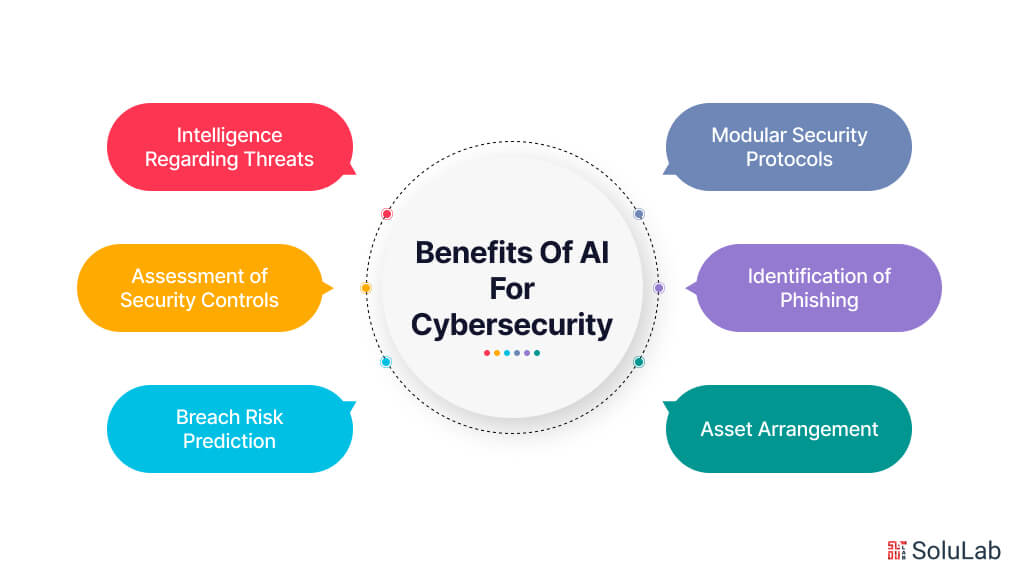
Benefits Of AI For Cybersecurity

Because AI offers real-time monitoring, automated incident response, behavioral analytics, and enhanced threat identification, cybersecurity benefits greatly from AI. However, we must examine how cybersecurity experts are equipped with more potent tools to combat the ever-changing environment of cyber threats as a result of the integration of AI security. The methods to improve human teams’ intelligence in several cybersecurity fields are listed below, including:

1. Modular Security Protocols

By constantly learning and upgrading their algorithms, AI systems are able to adjust to changes in the threat scenario. Compared to static security measures, this flexibility offers more protection against emerging and changing cyber threats.

Related: Importance of Generative AI in Cybersecurity

2. Identification of Phishing

AI security improves phishing attempt detection by examining email content, sender behavior, and other aspects. Employee vulnerability to social engineering attacks can be decreased by using machine learning algorithms to detect trends linked to phishing emails.

3. Asset Arrangement

AI can guarantee an accurate and complete log of all the devices, users, and apps that are gaining access to information systems. Sort and assess their significance to the company in order to ensure efficient administration and organization.

4. Intelligence regarding threats

Keep up with threats that are particular to your sector and the world at large so that firms may rank security measures according to likelihood and possible impact. This enhances security by enabling strategic decision-making.

5. Assessment of Security Controls

To strengthen the overall security posture, assess the influence and efficacy of the security tools and procedures currently in place. This entails evaluating the effectiveness of our present security measures and pinpointing areas in need of development.

6. Breach Risk Prediction

By taking into account variables like IT asset inventory, threat exposure, and the efficacy of security controls, AI may assist in anticipating vulnerabilities and possible security breaches. By being proactive, resources may be allocated to reduce hazards before they become significant occurrences.

By integrating Al in Modern Cybersecurity, companies may improve resilience against cyberattacks, fortify their defenses, and enable effective communication and decision-making in the risk environment.

Conclusion

Artificial intelligence (AI) is revolutionizing the field of cybersecurity, offering advanced tools and techniques to combat evolving threats. From real-time threat detection and response to enhanced security protocols, AI applications in cybersecurity are proving to be indispensable. The benefits of AI in cybersecurity are vast, including improved accuracy, speed, and efficiency in identifying and mitigating risks. As cyber threats continue to grow in complexity, the integration of AI in cybersecurity strategies will be essential for organizations seeking to protect their digital assets.

At SoluLab, we are at the forefront of this technological revolution. Our expertise in AI and cybersecurity enables us to provide cutting-edge solutions tailored to your specific needs. We leverage the latest AI technologies to enhance your security posture, ensuring your organization is well-protected against cyber threats. Partner with SoluLab an AI development company and experience the future of advanced cybersecurity with AI. Contact us today to learn how we can help you safeguard your digital environment.

FAQs

1. What is the role of AI in modern cybersecurity?

AI in modern cybersecurity plays a crucial role by automating threat detection, enhancing response times, and providing advanced analytics to identify potential security breaches before they occur. Professionals looking to build expertise in these evolving tactics are increasingly pursuing programs like an online cybersecurity masters to stay updated and competitive in the field.

2. How does AI improve cybersecurity threat response?

AI improves cybersecurity threat response by analyzing vast amounts of data in real time, identifying anomalies, and providing automated responses to mitigate threats quickly and efficiently.

3. What are the benefits of AI in cybersecurity?

The benefits of AI in cybersecurity include faster threat detection, reduced response times, improved accuracy in identifying threats, and the ability to handle large volumes of security data without human intervention.

4. What AI applications are commonly used in cybersecurity?

Common AI applications in cybersecurity include machine learning algorithms for anomaly detection, predictive analytics for threat forecasting, and natural language processing for analyzing security reports and identifying potential risks.

5. How does AI contribute to advanced cybersecurity strategies?

AI contributes to advanced cybersecurity strategies by providing deeper insights through data analysis, enabling proactive threat prevention, and enhancing the overall effectiveness of security protocols and measures.

6. What is the role of AI in cybersecurity and how does it enhance security measures?

The role of AI in Cybersecurity involves automating the detection and response to cyber threats, enhancing the accuracy of threat identification, and providing continuous monitoring to ensure robust security measures are in place.

7. Can you explain the impact of AI for cybersecurity in handling sophisticated cyber threats?

AI in Cybersecurity significantly impacts the handling of sophisticated cyber threats by leveraging machine learning to recognize patterns, predict potential attacks, and implement automated responses, thereby strengthening an organization’s defense mechanisms

How is blockchain changing the money transfer process?

The world is constantly changing and thriving to outperform itself with every innovation that comes into place. There can never be a saturation of new ideas. 

We are going to focus our attention on one such possibility that has already created a reputation in the finance sector and is grooving into other industries as well. Blockchain has changed the way people perceived transactions, technology, administration, database management, traceability, and the list could go on.

The main agenda here is the induction of Blockchain in the finance industry and what it promises in the near future. This has successfully been portrayed by the advent of Bitcoin that left people in awe, a concept introduced by Satoshi Nakamoto. Bitcoin created a lot of momentum in a considerably shorter period. Agreed, it faced a pitfall soon; we cannot deny the possibilities; it has opened the gates to, and if refined properly, can change the way we perceive our finances.

Let us dig a little deeper.

Considering the trend that has been seen in the financial industry, it is pretty evident that all the major upheavals have been an addition to the existing stack of finances controlled by banks and a central authority. Mobile banking, net banking, ATMs, and all the other innovations to facilitate the present banking system. A monotonous tradition has been developed. But with Blockchain, these barriers can be broken. Blockchain all together is an out of the box concept.

What is Blockchain?  

Blockchain is a distributed ledger where instead of centralized control, the power is shared by everyone who is a part of the blockchain. Now the records on a blockchain are practically immutable, which means that once a particular data is stored in the database, it cannot be deleted. This particular property ensures traceability. 

Being a distributed ledger, it eliminates the need for the middlemen. 

From a distance, it just seems like a minor insertion, but it can potentially make the transactions faster, safer, and cheaper. Right now, with the developments in blockchain, there are many loopholes, but they are constantly being modified to fill the gaps.

When you look at the traditional monetary system, we have physical currency or FIAT currency; cryptocurrency (developed with the help of Blockchain), on the other hand, is a digital currency. 

All the transactions that you make through FIAT currency are routed through banks and other financial institutions. They do seem secure, but there have been many cases when banks have defaulted on payments because of increasing NPA’s. To top that, banks lack transparency; therefore, the customers do not have a lot of information about how their funds are being used. The lack of lucidity often hinders customer trust and poses difficulty when it hits a crash. There have been several frauds in the financial industry owing to the current operations of banking. You do not have a lot of say about how your funds are allocated.

Of course, that is fine until your funds are safe, but it makes you question the system when these institutions face a catastrophic crash. Blockchain eliminates this discrepancy by increasing traceability and consequentially transparency.

Traditional banking systems bulk up the transaction fee up to 7%. This is mainly because of the numerous intermediaries involved that add up to the cost. 

These setbacks can be overcome with the help of Blockchain, but yes, it is not picture perfect.

What can cryptocurrency do to money transfers?

Blockchain is still a thriving concept but has a lot to offer on its plate, this can be developed, and these features can be benefited after we succeed deploying the concept to a larger audience and fixing the leaks.

  1. Speed
    Blockchain is a distributed ledger and hence, no longer needs heavy queues that usually involve bureaucratic approvals, which make the entire process too tiring, and yes, you got it right, SLOW. Blockchain operates on Smart Contracts, which is a contract written in the lines of code and auto operates according to the conditions mentioned in the contract. Every modification in the data is notified to the contributors of the blockchain. This means that the transactions and any change to the data are communicated in real-time. The conventional methods often take 2-3 days to complete an overseas money transfer, which can be achieved in minutes with Blockchain. It integrates global markets and facilitates global money transfer.
  2. Clearing and Settlement
    The money transfers accustomed to the traditional ways often adds up to 7% transaction cost overall and more for global money transfers. This is quintessential because of the middlemen involved in clearing and settling the transactions. Blockchain can reduce this cost by 127 times. Researchers drew this conclusion by closely studying 1800 transactions on the basis of their clearance time and cost, and with the help of reports published by World Banks. This is ubiquitously helpful when it comes to global transfers, which conventionally delays the clearing process and hence the settlement. With the speed that an ideal model of Blockchain provides and the costs it reduces can open up new opportunities for investments altogether.
  3. Fundraising
    If you are wondering what about the IPO facility that keeps you a helping hand when you have to raise funds from the public. You do not have to worry about that; Blockchain offers you an alternative to this, too, with something known as an ICO or Initial Coin Offering. ICO is very similar to an IPO, just instead of raising funds through FIAT, you get tokens, but also the process is much smoother and transparent. Once these have been issued, they can be traded on cryptocurrency exchanges where the market forces then decide the value of the token thereafter, just like a traditional stock market. However, the existing crypto exchanges are centralized, and the aim is to inflict decentralization to further develop and ease the exchange process
  4. Secure
    This one is obvious. Blockchain is a distributed ledger wherein every node gets notified with a mere interference with the data. Everything is approved by the users through Proof of Work, so you know there is nobody waving a wand and making things secure. You have full control over your funds. Your money transfers are transparent as you can verify their allocation in real-time. As a user, you feel more confident when, at every step, you are assured. Since the blockchain system uses hashing, it reduces the risk of manipulation by avoiding one single point of failure. It makes the system less prone to cyber-attacks, with a consensus network protecting the spirit of Blockchain as a decentralized platform.

Drawbacks

When we talk about the setbacks, these are just the ones that haven’t been dealt with yet.

This is complementary to new ideas and revelations, it’ll take time, but these will be fixed to make the current model better and possibly an ideal model

  1. A bit complicated
    When you’re lending or making a payment using your traditional currency, you do not have to know the technicalities of it because there aren’t any. But when it comes to Blockchain and cryptocurrency as it practically revolves around technology. This is just a temporary inconvenience that can be fought with little awareness and education about the concept. Just like the internet effect, initially, people thought it was too complicated to adapt, but now we can’t live without it.
  2. The fiat-Fiat mindset exists firmly.
    Since we all are set in the ways of traditional Fiat money transfers, it’ll be a long time when we get comfortable with cryptocurrency. The cryptocurrency transfer is swift, but since a majority of them prefer to convert it to, say dollars. Now since many institutions are not on board with the entire cryptocurrency, the conversion often becomes expensive and slow. This is persistent because there are;t outlets that accept cryptocurrency as a means of payment. This will develop with gradual uplift in the idea of cryptocurrency as a means of money transfers. This also causes a lot of trouble when it comes to overseas transfers; you have to pay a double-conversion fee, (for example, if you want to transfer euros from the US, you’ll be charged for dollar-bitcoin, then bitcoin-euro conversion)

This unnecessary cost is preferably avoided and is a lot harder to settle when it is routed through banks. 

Where does that leave the discussion?

These are just setbacks which have to be overcome to inhibit Blockchain in various sectors. Entrepreneurs today are starting to realize the importance of Blockchain and the benefits it offers in the global transfer industry. Another important discovery is the realization that traditional corporations are interested in applying blockchain technology to improve their services. Innovative startups and financial institutions are leveraging Blockchain for big wins; for example, the Circle Payment App manages blockchain in the backend process, and you can take a sigh of relief and deal exclusively with fiat currency. 

Big tech companies have already realized the plausible opportunities and changes that Blockchain offers and its astonishing results.

Blockchain does face some major disadvantages and needs a lot of modification to revolutionize the future. But researchers and blockchain developers are consistently working towards eliminating the loopholes in the current Blockchain model to make it more secure and handy.

WhatsApp Telegram