Talk to an Expert

How to Launch a Crypto Exchange in Switzerland?

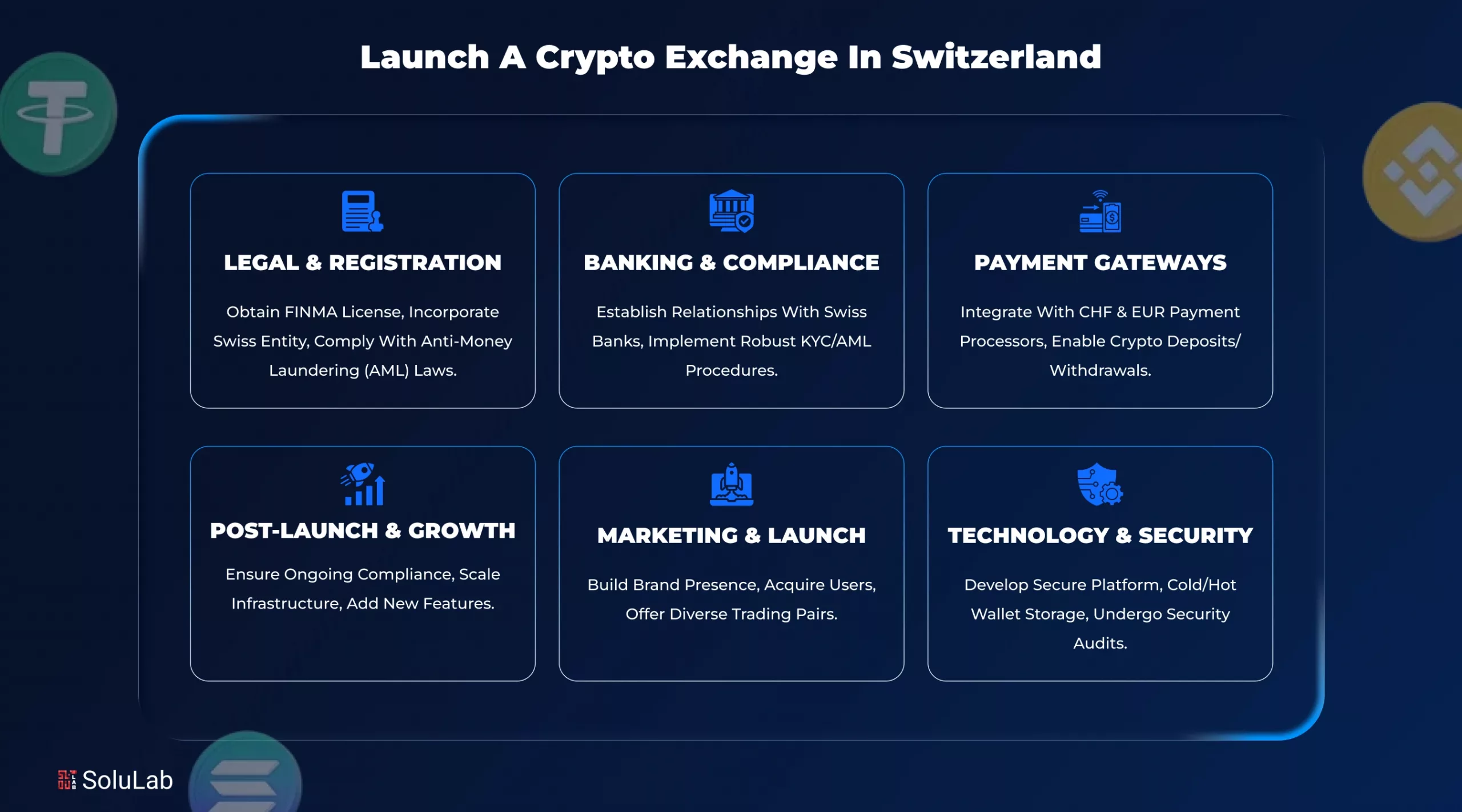
Launch a Crypto Exchange in Switzerland banner

Switzerland has quietly become one of the world’s most attractive places to start a cryptocurrency exchange in Switzerland. Stable politics, a predictable legal framework, deep financial expertise, and the famed “Crypto Valley” in Zug combine to give entrepreneurs runway for launching digital-asset businesses. Market projections show steady growth, with revenue estimates in the hundreds of millions USD and rising retail adoption. This demand, liquidity, and investor interest are all moving in the same direction.

But building the best crypto exchange in Switzerland isn’t just about code or marketing. It’s about blending technical excellence, airtight compliance, and local banking relationships. The following explains why Switzerland matters, and the step-by-step guide to launching a compliant, scalable exchange. 

Why Switzerland is the Global Crypto Hub?

Switzerland’s strength as a crypto-friendly jurisdiction is multi-fold:

  • Regulatory clarity and stability: FINMA applies existing financial and AML laws to digital assets in a technology-neutral way, which reduces legal ambiguity for entrepreneurs and investors alike.
  • Concentrated crypto ecosystem: Crypto Valley (Zug) and Zug-adjacent cantons host startups, experienced advisors, and specialized banks, creating a powerful ecosystem effect.
  • Institutional readiness: A growing slate of licensed banks and institutions offer custody, tokenization, and institutional services, which support exchanges that target high-net-worth and corporate clients.
  • Market momentum: Forecasts show the Swiss crypto market expanding in revenue and adoption, which makes timing favorable for those who launch a crypto business in Switzerland now rather than later.

Together, these elements make Switzerland an ideal base for launching consumer and institutional crypto products, from retail spot exchanges to tokenization platforms.

Legal Requirements for Starting a Crypto Exchange in Switzerland

If you want to run one of the crypto exchanges in Switzerland, you must design operations around Swiss legal obligations from day one. Let’s delve deeper into it:

1. Entity and Corporate Setup

  • Pick a legal form: Stock Corporation (AG) is preferred for exchanges due to capital and governance expectations; GmbH is possible for smaller ventures.
  • Minimum capital: AG typically requires CHF 100,000 (with a portion paid in incorporation); GmbH requires CHF 20,000.
  • Local presence: At least one Swiss-resident director and a registered office are normally required.

2. FINMA Licensing & SRO Registration

  • Activities such as custody, fiat on-ramps, or holding client funds often trigger FINMA oversight or require affiliation with an AML Self-Regulatory Organization (SRO) like VQF.
  • Possible license paths include fintech authorization (for certain deposit-taking models), banking licenses (when offering interest or broad custody), securities firm licenses (for tokenized securities), or direct FINMA approval for more complex models.
  • Expect submission of a detailed business plan, AML/KYC policies, IT security documentation, technical architecture, and proof of adequate capital.

3. AML/KYC and Recordkeeping

  • Swiss AML law applies to VASPs; full KYC, transaction monitoring, suspicious-activity reporting, and annual AML audits are standard requirements.
  • Maintain auditable records and use blockchain analytics tools to trace fund flows.

4. Token classification and investor protection

  • FINMA classifies tokens by function: payment, utility, asset, or debt, with the strictest rules applied to tokens that resemble securities. Legal classification determines disclosure, prospectus, and licensing obligations.

5. Taxation & accounting

  • Crypto assets are treated as movable property; taxation and VAT treatments vary by token type and service. Accurate accounting (mark-to-market valuations, separate ledgers for staking/rewards) and annual audited statements are expected.

Proactive legal planning not only prevents enforcement issues but is also a market differentiator; institutional counterparties will only work with exchanges that demonstrate rigorous compliance.

Benefits of Launching Your Crypto Exchange in Switzerland

Switzerland offers some of the most tangible and reliable advantages for anyone planning to launch a crypto business. Its ecosystem blends regulatory clarity, global credibility, and a sophisticated financial infrastructure that few countries can match.
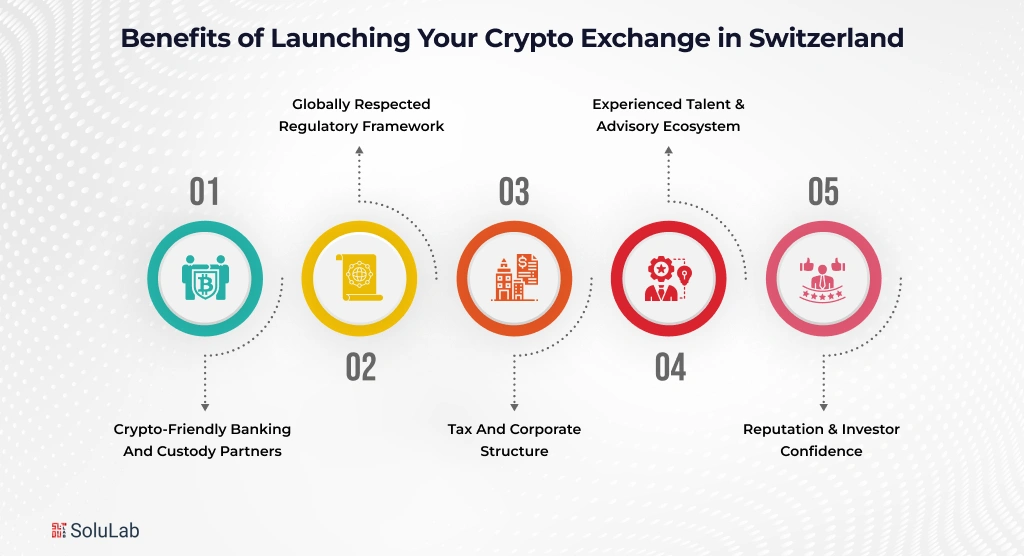
Benefits of Launching Your Crypto Exchange in Switzerland

1. Access to Crypto-Friendly Banking and Custody Partners 

Switzerland is home to more than 20 regulated financial institutions, including SEBA Bank, Sygnum, and Arab Bank (Switzerland), that actively support crypto ventures. This rare level of banking access enables smooth fiat on-ramps, secure custody, and instant settlements between banks and exchanges, reducing operational friction from day one.

2. Globally Respected Regulatory Framework 

The FINMA licensing system is recognized worldwide for its transparency and precision. Over 1,000 blockchain and fintech firms operate legally under FINMA or SRO oversight. A Swiss license instantly signals trust and helps exchanges collaborate with institutional investors, liquidity providers, and global payment partners.

3. Attractive Tax and Corporate Structure 

With corporate tax rates ranging between 11.8% in Zug and 21% in Geneva, Switzerland remains one of the most tax-efficient hubs in Europe. Over 80 double taxation treaties (DTAs) simplify cross-border operations, while IP-box regimes lower taxes on software and technology assets, letting startups reinvest more into innovation and growth.

4. Experienced Talent and Advisory Ecosystem 

The Crypto Valley region alone hosts 1,200+ blockchain companies and more than 6,000 professionals, spanning developers, auditors, and compliance experts. This ecosystem offers founders direct access to specialized advisors, law firms, and development partners well-versed in FINMA standards and crypto infrastructure.

5. Reputation and Investor Confidence 

Operating from Switzerland instantly enhances credibility. A Swiss-registered exchange conveys reliability, security, and sound governance, values synonymous with the country’s financial legacy. This reputation helps attract both retail users and institutional investors, making market entry and scaling far smoother.

Step-by-Step Process to Launch a Crypto Exchange in Switzerland

Launching a crypto exchange in Switzerland is a structured process because the country offers one of the world’s strongest regulatory, banking, and crypto-friendly environments. Here’s how the journey typically unfolds:

1. Define your business model 

Decide whether you build a centralized exchange (CEX), a decentralized exchange (DEX) with a Swiss legal wrapper, or a hybrid. Identify products, spot trading, derivatives, custody, staking, or tokenized assets.

2. Incorporate and structure capital 

Form an AG or GmbH, depending on scale. Secure the minimum paid-in capital and appoint a Swiss-resident director.

3. Legal & compliance design 

Engage Swiss counsel to classify tokens, draft a compliant AML/KYC framework, and prepare FINMA/SRO filings. Prepare business plans and financial projections required for licensing.

4. Build secure, scalable technology 

Develop or license a trading engine capable of high throughput, implement multi-layer security (cold storage, HSMs, 2FA, anti-DDoS), and integrate liquidity APIs. Ensure architecture supports real-time reconciliation and audit trails.

5. Bank and payment integrations 

Partner with crypto-friendly banks in Switzerland to enable fiat on/off ramps, settlement, and treasury services. Establish custody arrangements or integrate with licensed custodians.

6. Audit, testing & independent reviews 

Conduct smart contract and platform security audits, penetration testing, and performance benchmarks. Document results for regulators and partners.

7. Licensing / Registration 

Submit FINMA or SRO applications, respond to queries, and satisfy any capital or governance conditions. Typical review cycles vary; thorough documentation accelerates approval.

8. Launch & ongoing operations 

Roll out KYC flow, liquidity provisioning, market-making, and customer support. Maintain continuous compliance: AML monitoring, periodic audits, and regulatory reporting.

9. Post-launch scaling 

Invest in UX, mobile apps, advanced order types, and additional markets (tokenized securities, institutional desks). Keep iterating on security and compliance posture.

Many entrepreneurs engage a specialized partner for the technical and compliance lift. For example, a local development firm with FINMA experience can accelerate time-to-market while embedding regulatory controls into the product. 

What’s Next for Crypto Exchange Entrepreneurs in Switzerland?

Looking forward, Swiss exchanges that combine regulatory-first governance, institutional-grade security, and product innovation will have the strongest competitive advantage. Key future trends to monitor:

  • Tokenization and RWAs: growing demand for tokenized real estate and fund shares will create new trading venues.
  • DeFi/CeFi convergence: regulated gateways to decentralized liquidity and custody solutions will become a differentiator.
  • Institutional onboarding: exchanges with clear compliance and custody setups will capture institutional order flow.
  • Tech evolution: AI-driven risk controls, advanced analytics, and improved UX will push user expectations higher.
  • Regulatory harmonization: potential alignment with EU frameworks (e.g., MiCA-like standards) could simplify cross-border expansion.

If you plan to launch a crypto business in Switzerland today, prioritize compliance and security from day one, choose partners who understand FINMA obligations and Swiss banking nuances, and scale design. With the right foundations, Switzerland offers not just permission to operate, it offers a platform to become a trusted, long-term market participant in a maturing global crypto economy.

Crypto Exchange development CTA

Conclusion

Through this blog, you might have understood how Switzerland’s regulatory clarity, advanced banking infrastructure, and growing crypto ecosystem. These make it the ideal destination for launching a compliant exchange.

If you’re planning to start a cryptocurrency exchange in Switzerland, ensure your strategy aligns with FINMA’s framework and robust security standards.

We at SoluLab, a top cryptocurrency exchange development company, help businesses build and launch scalable, regulation-ready crypto exchange platforms. We tailor to the Swiss and international markets. Our expert team specializes in end-to-end development. From secure wallet integration and liquidity management to advanced trading engines and AML/KYC compliance.

If you’re ready to launch your crypto business in Switzerland, contact us today. 

FAQs

1. How much does it cost to start a cryptocurrency exchange in Switzerland?

The cost depends on your license type, platform complexity, and compliance needs. On average, setup costs range between CHF 150,000 to CHF 500,000, including legal, technical, and operational expenses.

2. How long does it take to obtain a crypto license in Switzerland?

Typically, FINMA licensing or SRO registration takes 3 to 6 months, depending on documentation, business model complexity, and AML readiness. Proper preparation and expert guidance can significantly shorten this process.

3. Which banks in Switzerland are crypto-friendly?

Some well-known crypto-friendly banks in Switzerland include SEBA Bank, Sygnum, Arab Bank (Switzerland), and Maerki Baumann. These banks support fiat on/off ramps, custody services, and digital-asset businesses.

4. Why choose SoluLab to build your crypto exchange?

SoluLab specializes in cryptocurrency exchange development with a regulatory-first design. Our team builds secure, high-speed, and FINMA-ready platforms, combining blockchain innovation, AML automation, and seamless user experiences for global scalability.

5. What makes Switzerland a top choice for crypto companies?

Switzerland offers clear crypto laws, low taxes, strong investor trust, and access to regulated financial institutions. Its ecosystem, led by Crypto Valley, enables safe, compliant, and scalable crypto exchange growth.

7 Best Crypto Exchanges in Canada for 2026

Best Crypto Exchanges in Canada

Crypto in Canada isn’t just booming, it’s evolving fast. With new regulations, enhanced security, and a wave of innovation, the way Canadians trade digital assets has undergone a complete transformation. But here’s the reality: not all crypto exchanges are created equal. Some offer rock-solid security and an intuitive interface. Others boast advanced features but carry higher risks. In a market where every decision matters, choosing the right exchange isn’t optional; it’s critical.

If you’re looking to buy, sell, or trade digital currencies in Canada, choosing the right cryptocurrency exchange is crucial. From regulatory compliance to trading fees, the top crypto exchanges in Canada provide secure platforms, a diverse range of coins, and an excellent user experience.

In this guide, we break down the top rated crypto exchanges for Canadian users based on features, fees, ease of use, and more. Whether you’re a beginner or an advanced trader looking for powerful features, you’ll find the best fit here.

Criteria to Choose the Best Crypto Exchanges

When it comes to picking the best crypto exchanges in Canada, we didn’t just glance at the homepage and call it a day. We evaluated each platform using a balanced mix of security, usability, and value factors that actually matter to traders.

1. Regulatory Compliance in Canada

We prioritized exchanges that are registered with Canadian authorities like the CSA (Canadian Securities Administrators) and IIROC (Investment Industry Regulatory Organization of Canada). Compliance isn’t just a checkbox—it’s your safeguard against shady practices and sudden shutdowns.

2. Security Protocols and Proof-of-Reserves

In crypto, security is non-negotiable. We looked at cold storage usage, multi-factor authentication (MFA), encryption standards, and whether the exchange offers proof-of-reserves audits to verify customer asset holdings.

3. Supported Assets & Liquidity

A platform’s coin selection and liquidity determine how fast and fairly you can trade. We gave higher scores to exchanges with a wide range of cryptocurrencies and consistently deep order books for smooth execution.

4. User Experience & Mobile App Performance

A powerful exchange should also be easy to navigate. We tested each platform’s web and mobile interfaces for speed, stability, and overall ease of use — especially important for traders on the go.

5. Fees, Spreads, and Funding Options

It’s not just about low trading fees—spreads, deposit/withdrawal costs, and funding options (like Interac e-Transfers, bank wires, or credit cards) all impact the real cost of trading.

6. Extra Features

We also factored in value-adding features like staking, margin, and futures trading, API access, and other tools for advanced users. Exchanges offering multiple ways to grow, hedge, or automate your portfolio earned bonus points.

Criteria to Choose the Best Crypto Exchanges

Top 7 Crypto Exchanges in Canada to Look for [2026]

1. Bitbuy

Bitbuy isn’t just one of the best-it’s practically the gold standard for Canadian crypto exchanges. This platform was built specifically for Canada’s market and regulatory climate, and it shows in every detail. Bitbuy isn’t a global giant trying to fit in — it’s a platform built by Canadians, for Canadians.

Why it dominates:

  • It’s fully registered with FINTRAC and a recognized restricted dealer, which means it meets some of the toughest compliance standards out there.
  • Offers CAD-friendly payment methods like Interac e-Transfer and bank wires with zero friction.
  • Military-grade security and 95% cold storage of funds.
  • User interface is clean, fast, and feels like it was made by someone who actually trades crypto.

For peace of mind and unmatched credibility, Bitbuy stands as one of the most trusted names in Canada’s crypto ecosystem.

2. Newton

Newton doesn’t just eliminate fees-it makes you question why every other exchange charges them at all. With Newton, you’re trading without commission, without cost on deposits or withdrawals, and without stress. It’s that simple.

Why Newton stands out:

  • True zero-fee structure: no gimmicks, no buried charges-just real savings.
  • Sleek interface that looks and feels like a premium fintech app.
  • Over 70+ cryptocurrencies, from the majors to some surprising gems.
  • Instant verification, smooth onboarding, and real-time CAD funding.

For traders fed up with hidden fees, Newton delivers a breath of fresh Canadian air — fair, transparent, and built for you

3. NDAX

In Canada’s crypto space, NDAX is the silent powerhouse — less flash, more muscle. It’s engineered for performance, security, and value, making it a favorite among serious traders. Fast, secure, reliable, and built to deliver without breaking the bank.

Why NDAX punches above its weight:

  • Flat 0.2% trading fee across the board. No tiers. No tricks.
  • Cold storage, institutional-grade security, and insurance backing.
  • Based in Calgary, but built with world-class technology and compliance.
  • Ideal for traders who move serious volume but want to keep costs low.

If you’re scaling up your trading and want something affordable, bulletproof, and battle-tested, NDAX delivers — quietly but powerfully.

4. Coinsquare

Coinsquare is the Swiss Army knife of Canadian crypto exchanges — packed with tools, built to last, and surprisingly refined. As one of Canada’s oldest and most established platforms, it combines years of experience with strict regulation and continuous innovation.

Why it’s a beast for advanced traders:

  • Backed by IIROC and CSA regulations, it plays by all the right rules.
  • Professional-grade trading tools including market/limit orders, advanced charting, and API access.
  • Offers crypto staking and OTC trading for high-net-worth users.
  • Now supports over 40+ digital assets with deep liquidity.

If you’ve outgrown basic trading apps and want a full trading cockpit with maximum control, Coinsquare delivers the edge you’ve been looking for.

5. Wealthsimple Crypto

Wealthsimple Crypto is the friendliest on-ramp into crypto that any beginner could ask for. It strips away the jargon, the tech headaches, and the intimidating complexity — replacing them with a clean, familiar interface that feels like second nature to anyone who’s ever used online banking.

Why new users love it:

  • No wallet setup, no keys, no confusion-just buy and sell.
  • Fully integrated with Wealthsimple Invest and Trade apps.
  • Backed by one of the most trusted names in Canadian finance.
  • Great for small, safe first steps into crypto.

Think of it as crypto training wheels — but smooth, safe, and stylish. Perfect for anyone curious about digital assets but not ready to deep-dive into the technical side.

6. Kraken

Kraken is a global titan in crypto, and its presence in Canada is nothing short of dominant for traders who want more than a basic buy-and-sell experience. This platform means business from staking to margin to futures, Kraken is engineered for those who know exactly what they’re doing and want every tool at their disposal.

Why it rules the pro crowd:

  • Supports over 200+ cryptocurrencies with deep liquidity.
  • Offers futures, margin, and staking options for active traders.
  • Known for industry-leading security and transparency (proof-of-reserves, anyone?).
  • Fee structure rewards high-volume and strategic trading.

If you want power, precision, and a global edge, Kraken is more than a platform — it’s your ultimate trading weapon.

7. Binance

Binance is a global powerhouse in the cryptocurrency space, offering one of the most extensive digital asset ecosystems available today. While it currently operates in Canada via Binance Global (without domestic regulatory licensing), its feature-rich environment and unmatched asset variety continue to attract millions of Canadian traders.

Why Binance is an altcoin playground:

  • Over 350 cryptocurrencies-if it exists, it’s probably on Binance.
  • Rock-bottom trading fees (0.1% or less).
  • Advanced tools for charting, bot trading, and strategy automation.
  • Enormous liquidity and blazing-fast trade execution.

Binance is not designed for beginners — it’s built for traders who understand the market, can manage the risks, and want unrestricted access to one of the most sophisticated crypto infrastructures in the world.

Crypto Exchange Development Services

Comparison Table: Best Crypto Exchanges Canada

Exchange CAD Support Fees # of Coins Regulated in Canada
Bitbuy Yes 0.2% trading 25+ Yes
Newton Yes No fees (spreads) 70+ Yes
NDAX Yes 0.2% trading 30+ Yes
Coinsquare Yes ~0.2% trading 40+ Yes
Wealthsimple Yes ~1.5% spread 30+ Yes
Kraken Yes 0.16%–0.26% 200+ Indirectly
Binance No official 0.1% trading 350+ No (Global)

Final Thoughts

Canada has no shortage of excellent platforms for crypto trading. Whether you’re after low fees, maximum security, or access to a wide range of coins, there’s a crypto exchange in Canada for you.

To recap, Bitbuy and Newton are best for regulatory confidence and low fees. NDAX and Coinsquare offer more advanced features. Wealthsimple is great for newcomers. Kraken and Binance cater to global users with pro tools.

If you’re building your own exchange or app, consider working with a Cryptocurrency Exchange Development Company that understands Canadian laws and infrastructure.

As always, do your own research, start small, and trade responsibly.

FAQs

1. What is the safest crypto exchange in Canada?

Bitbuy and NDAX are considered among the safest thanks to their full compliance with Canadian regulations, cold storage of user funds, and transparent operations.

2. Are Canadian crypto exchanges regulated?

Yes, exchanges operating in Canada must register with FINTRAC and comply with KYC and AML regulations. Some also work with provincial securities regulators like the OSC and IIROC.

3. Can I use Binance in Canada?

While Binance does not have official regulatory approval in Canada, many users still access it through Binance Global. Proceed with caution and be aware of the legal and security implications.

4. What is the best crypto exchange in Canada for beginners?

Wealthsimple Crypto is ideal for newcomers due to its user-friendly interface and lack of technical requirements like wallet management.

5. Is Crypto Legal in Canada?

Yes, crypto is legal in Canada. You can buy, sell, and trade digital assets freely, and the government treats cryptocurrencies like a commodity. That said, crypto exchanges must be registered with FINTRAC and comply with KYC/AML regulations.

A Step By Step Guide To Cryptocurrency Exchange Development

Cryptocurrency exchange development services is a platform that allow peers to trade assets digitally through cryptocurrencies such as Bitcoin, Ethereum, etc. Peers can also trade assets for assets digitally instead of using cash or cryptocurrency. This increases the opportunity for sellers to use the cryptocurrency exchange platform to easily liquidate assets by identifying buyers without any border limitation or restriction. Cryptocurrency exchange platform also helps to best match buyers with sellers according to type of assets, token exchange limits, etc. 

This article discusses about cryptocurrency exchange software development through a step by step guide. But before learning about cryptocurrency exchange development, you should first know about its benefits. 

How Cryptocurrency Exchange Development Is A Game Changer In The Industry Of Trading? 

Cryptocurrency exchange platform operates using a decentralized platform and thus it does not require any centralized authority in reviewing, selling assets and transacting funds through cryptocurrencies. Here, one can access the transaction data and cryptocurrencies at anyplace, anytime without any currency exchange restriction. This also makes the platform much more immutable and unhackable. 

It is easy to regulate cryptocurrency exchange as it is not limited by any law. And, it is not easy to shut down the system too. Hence, all data is available 24/7 with real-time notifications, security and privacy. 

Guide For Developing An Efficient Cryptocurrency Exchange Platform 

Before developing a cryptocurrency exchange platform, the first task is to identify the type of cryptocurrency exchange platform you want to develop. Also, next you should decide the type of architecture based on which your cryptocurrency exchange platform will operate on. 

cryptocurrency exchange platform guide

Cryptocurrency Exchange Platform Types 

Centralized type of platform 

Here the cryptocurrency exchange will take place along with the involvement of middlemen and central authorities to monitor, control and authorize transactions. 

Decentralized type of platform 

This type of cryptocurrency exchange platform enhances the P2P processes by directly connecting peers without any middlemen and central authority. 

Cryptocurrency Exchange Architecture 

  • Small type synchronous architecture 

This type of architecture can handle simple and small transactions only. They allow only limited in terms of scalability and number of volumes allowed to be traded.  

  • Medium type asynchronous architecture 

Here, the volume of transactions and the scalability is higher than synchronous architecture. Separate layers and modules are created depending upon the type of data and interface. It can also integrate multiple API to compile different peer connections. 

  • Large type distributed architecture 

Here whatever requests users submit, are split into shards which are fragments of the data and transactions that need processing. These shards are independent in terms of scaling and growth. Hence, the volume of transaction is higher than the other two structures. 

Key Considerations For Developing Cryptocurrency Exchange Platform 

  • Ensure to provide solutions to the legal issues at hand 

Cryptocurrency exchange platforms does not abide by any existing trading regulatory laws. Thus, most of the transactions take place without license which many may not prefer to. You can change this but either obtaining a license or creating your own enterprise regulatory law. However, those newly regulatory laws have to be universally confirmed. 

Focus on Anti-Money Laundering (AML) Know Your Customer (KYC) technologies to safeguard transactions, identities and avoid illegal threats. 

  • Functionality and User Interface (UI) are important considerations

As much as the importance of developing your own cryptocurrency exchange platform, it is important to ensure that the functionality and user interface does not affect the operability or user experience. 

  • Joint venture or achieve agreement consensus with a bank 

Users must be able to store, transact, transfer and withdraw their cash, funds and cryptocurrencies as they wish without any hassle. This means that, the payment processing must be rapid and must go through a payment gateway API to ensure that the channel of transaction is secured and private. Thus, make a contract agreement with a bank to depend on them for regulations and convenience.

  • Enhance the liquidation process 

For any trading market to be successful, especially a cryptocurrency exchange platform to be successful. It is important to ensure that assets and cryptocurrencies can be easily and conveniently liquidated through your platform. 

To accomplish this, implement API integration with UI to attract traders and investors. Ultimately, the liquidation position and value of the user’s asset must be increased through the trust and branding image of your cryptocurrency exchange platform. 

  • Provide 24X7 customer support 

Cryptocurrency exchange is still new and probably at the baby stages. Not all users maybe well-versed with its functionalities and usage. User’s might have numerous amounts of queries, doubts and various kinds of issues that need attention to resolve. Customer support services include launching of ICO, UTO, support for issuing tokens, etc. 

Essential Features That Enhance Cryptocurrency Exchange Operations 

Components such as crypto (HOT) wallets, administration panels, trade engines and creation of whitepapers enhance the process or orders, exchanges and speeds up the process of transactions too. Through these features, users and clients must be able to sign-in, register to access their accounts to create new orders or view previous transactions history. 

Security Aspects of Cryptocurrency Exchange Platform 

Your cryptocurrency exchange platform must not be vulnerable to attacks such as brute force attacks and must be open to phishing. Protect the data through KYC, AML and multi-factor authentication system. 

Conclusion: Create Your Own Cryptocurrency Exchange Easily Now 

Forecast future potential, provide higher system performance and increased reliability by using the right technology stack, tools and components to develop an efficient cryptocurrency exchange platform. The most important consideration of should be the adherence of your cryptocurrency exchange platform to be compatible with multiple cryptocurrencies.
