Talk to an Expert
Get in Touch

What is Argo Blockchain and How Do I Invest In Argo Blockchain?

Argo Blockchain is nothing but a publicly traded blockchain technology company that focuses on large-scale cryptocurrency mining. The company has its headquarters in the United Kingdom in London and it takes pride in being the only cryptocurrency mining company to be listed on the London Stock Exchange. Blockchain technology is all set to revolutionize the world’s future and Agro Blockchain is a hundred percent committed to sustainably taking it forward. The company has highly energy-efficient, and powerful mining operations which are strategically spread across North America.

How Agro Blockchain is Climate Friendly?

Argo Blockchain PLC addressed its own emissions of greenhouse gas for becoming carbon neutral and by the appropriate mitigation of emissions via the support of projects that are outside the group for becoming friendly to the environment. This, in turn, made the company the first publicly-traded cryptocurrency miner to become climate positive from scope one, two, and emissions of greenhouse gas from the value chain associated with its mining operations.

The company claimed this development as a significant milestone in its climate strategy which not only includes the ongoing initiatives in energy efficiency but also the future initiatives. The initiatives include reduction of e-waste, use of waste heat in partnership with the municipalities locally, and appropriately support the industry by maintaining the sustainability standards.

Understanding Cryptocurrencies

Cryptocurrencies are digital or virtual currencies that are secured by cryptography. They are a digital value system functioning as a medium of exchange. Being secured by cryptography, they are almost impossible to be counterfeited or double-spent. Cryptocurrencies are binary data designed to be used for properly facilitating transparent, secure, and fast transactions between users throughout the world.

In cryptocurrency, the individual coin ownership records are stored in a ledger that exists in the form of a computerized database. Moreover, the use of strong cryptography makes all the transaction records completely secure, appropriately controlling the creation of additional coins, and for the correct verification of the transfer of ownership of the coin. Cryptocurrencies such as Bitcoin are bringing about a revolution in the way we exchange goods as well as money throughout the economy on a global scale.

What is Crypto Mining?

Crypto mining refers to the process of gaining cryptocurrencies by solving different cryptographic equations by using computers. The process involves the validation of the blocks of data and the addition of records of the transaction to a public record or ledger referred to as a blockchain. To state in technical terms, it would be ideal to say that crypto mining is a transactional process involving the use of computers as well as cryptographic processes for the purpose of finding solutions to complex functions and recording the data on a blockchain. It is the entire network of computers that are involved in the process of crypto mining and keep shared records through those blockchains.

Crypto Mining Process and Its Working

Here are a few steps to clarify the crypto mining process and gain a better understanding of its working.

  1. Nodes, that is the individuals and the devices involved in the creation of a blockchain verify whether the transactions are legitimate or not.
  2. In the next step, separate transactions are added to a list of other transactions that help in the formation of a block.
  3. Then a hash or other types of data are added to the block that is still unconfirmed.
  4. The crypto miners then verify the hash of the block to make sure that the block so formed is legitimate.
  5. After the confirmation of the block, it gets published in the blockchain.

All the transactions for the ledger are encrypted with the help of public-key cryptography. Now, for the blocks to be accepted, they should make use of a hash that the crypto miner nodes on the blockchain for the purpose of verification of each block and ensure that each of them is genuine as well as unaltered.

Facts and Myths About Cryptocurrencies

Here are a few facts about cryptocurrencies.

  • The most fascinating fact about cryptocurrencies is that they are not controlled by any central authority or other third parties.
  • They run on a distributed blockchain network that is operated by the users themselves.
  • No individual entity has the power to alter the data in any blockchain.
  • Transferring money is easy, instant, secure, and cheap with blockchain.

Let us now check out the common myths about cryptocurrencies.

  • Cryptocurrencies do not have real monetary value but the fact is that they are digital currencies carrying monetary value. For example, Bitcoin, one of the most popular
  • cryptocurrencies, has exceeded the market size of about 150 billion dollars in recent years.
  • Cryptocurrencies cannot be used for buying things but the fact is that they serve as a medium of exchange.
  • Cryptocurrencies are illegal but the fact is that it has been accepted by several developed countries of the world including the United Kingdom, United States of America, Australia, Japan, and almost the entire Europe.

Crypto Mining on Agro Blockchain PLC

Agro Blockchain PLC has brought about clean power and superior efficiency to crypto mining. The cryptocurrency mining infrastructure at Agro Blockchain PLC has the highest ratio of petahash or PH to megawatt MW as compared to all the publicly traded companies available in the market. The unmatched energy efficiency as well as output results in much cheaper mining operations along with appropriate optimization for overall higher margins. Join Agro Blockchain to invest in the future of money.

Future of Crypto Mining

Crypto mining is undoubtedly an interesting alternative to the traditional systems that are centralized in nature operating majorly across the globe. With cryptocurrencies on the rise along with steady innovation and development of blockchain technology, crypto mining certainly has a huge scope in the future. Slowly and steadily, the utility of cryptocurrencies would undoubtedly become more widely recognized by the mainstream which in turn, ensures that the cryptocurrencies are here to stay. It certainly cannot be denied that cryptocurrencies are sure to shake the foundation of the existing concept of money and how we exchange goods, values as well as across the world.

- Contact Us -

SoluLab being the top 3 Blockchain developers can help you build the perfect blockchain applications.

What is Defi Lending and best platforms available?

DeFi, or Decentralized Finance, is an ecosystem of financial apps. These are developed on top of blockchain networks, particularly the Ethereum blockchain. Furthermore, they function without the involvement of a third-party external source or central administration.

What is DeFi lending?

The DeFi lending platforms provide trustless crypto loans and enable users to enroll their cryptocurrencies in the DeFi lending platforms for lending purposes. A borrower may take out a loan directly via this decentralized network, known as DeFi P2P lending. Additionally, the lending protocol enables the lender to earn interest.
Out of all the DApps accessible, the DeFi is regarded as the most crucial contributor for locking crypto assets with the most significant loan growth rate.

How does DeFi lending work?

Crypto assets in a wallet do not earn interest. The underlying value may rise or fall, but you will not profit from owning that specific coin.

Consider the possibility of lending your cryptocurrency to someone else and earning interest on the loan. That is how banks presently operate, but it is a service that few people have access to. Anyone may become a lender in the world of DeFi.

You may earn interest on your crypto assets by lending them to others. There are many methods to do this, but the most common is via lending pools. These are conventional bank lending offices.

Top DeFi lending platforms

Aave

Aave is a non-custodial liquidity market platform that is open source. It allows users to engage as deposits or borrowers. According to the Aave website, “depositors supply liquidity to the market to earn a passive income, while borrowers may borrow in either an overcollateralized (perpetual) or undercollateralized (one-block liquidity) fashion.”


If users are willing to use the Aave protocol, they need to follow specific steps. Initially, one needs to deposit the decided asset and amount. Once this is done, the lender will get passive revenue which depends on the market borrowing demand. Furthermore, depositing assets enables customers to borrow by utilizing the deposited assets as collateral. The income you receive by depositing cash may assist in offsetting the interest rate consumers incur by borrowing.

MakerDAO

MakerDAO is another open-source, decentralized governance platform powered by DAI, a cryptocurrency with a target price of $1, often known as a stablecoin. MakerDAO’s decentralized governance community controls DAI creation through an integrated governance mechanism inside the Maker Protocol.

The Maker Protocol is a collection of smart contracts intended to minimize the DAI stablecoin’s price volatility, enabling lenders and borrowers to borrow various digital currencies without fear of counterparty risk. The Protocol was the first decentralized finance (DeFi) application to gain widespread acceptance, and it is still one of the most popular decentralized apps (DAPPs) on the Ethereum blockchain.

Compound

Compound is a DeFi-based lending tool in the cryptocurrency world that employs a money market method, with separate pools of cash used for each supported commodity. Lenders may deposit specified sums into lending pools, earning interest continually with no set loan terms.

Compound recently implemented a governance system to replace their previous protocol administrator with community governance, enabling users to propose, debate, and adopt new improvements or recommendations.

PhoenixDAO

PhoenixDAO, a community-based decentralized platform, caters to the requirements of companies and institutions while influencing the future generation of DeFi apps. The platform aims to achieve complete decentralization via governance and control through a committed network of community members. Phoenix’s Identity-powered dapp store will fuel the DAO, guaranteeing a one-person-one-vote mechanism.

The decentralized application dapp enables users to earn up to 20% APY on staked PHNX tokens. PhoenixDAO is presently working on advanced features for a future edition, such as liquidity farming and engaging on the DAO platform using the native PHNX currency.

Curve Finance

Curve Finance is a decentralized trading network that allows the users of its platform to swap and sell Ethereum quickly. In addition, compound’s lending protocol offers liquidity in the DeFi market. Such is the case with Curve Finance.

Curve is an essential platform for DeFi lending to the current date. It pioneers its liquidity to the market via the use of a market-making algorithm. This algorithm exchanges cryptocurrency, taking advantage of bid and ask price spreads.

Curve allows users to exchange stablecoins for minimal mining costs, thereby functioning as an automated market protocol. Furthermore, anyone, wherever, may also contribute their assets primarily to various liquidity pools. Thus, smoothly earning income would be possible.

Whatever is needed to accomplish this is to have an ETH wallet. Curve also makes it simple to exchange all sorts of tokenized forms of currencies at any moment. It also offers to exchange possibilities for tokens with almost identical price ranges.

WBTC

WBTC must be included in any discussion of the top ten DeFi lending platforms in 2021. Wrapped Bitcoin or WBTC is a lending system (DeFi-based) that was developed in the year 2019. It mainly functions as an ERC20 token, whereas WBTC assets are comparable to or equal one Bitcoin.

Moreover, WBTC has been incorporated into various platforms, including ETH wallets, DApps, and Smart Contracts. Users may use WBTC to convert BTC to Wrapped Bitcoin and also do it the other way round.

WBTC, in particular, works in such a manner that users may get access to Bitcoin cryptocurrency through the Ethereum network without incurring any counterparty risk. WBTC, as the name suggests, is one of the DeFi trending protocols in 2021.

It provides simple and easy-to-flow liquidity inside the DeFi market as an open-source platform. In terms of staking, WBTC enables individual users to stake Bitcoin using an interest-earning mechanism.

Harvest Finance

Harvest Finance is up next, a decentralized finance (DeFi) platform aggregator in the DeFi sector. An automated platform intended for customers who want to combine their assets to generate a more significant amount, thus the term ‘Harvest.’


On the other hand, individual users support themselves with tokens, to begin with, to produce more on the Harvest Finance marketplace. Furthermore, Harvest Finance advises customers to the finest and most appropriate farming location. It does it by using the most current agricultural techniques to increase output.

Furthermore, problems like high transaction costs and the necessity for smart contract audits prompted the development of the yield protocol. As a consequence, Harvest Finance is audited by firms such as Haechi Audit and PeckSheild.

Harvest Finance also monitors and handles farmers’ Annual Percentage Yield (APY) and transaction expenses efficiently. Additionally, it strategically protects farmers’ money more effectively.

These were some of the best top defi lending platforms you should know about.

Conclusion

In this examination of DeFi lending and the topmost DeFi lending platforms, we’ve shown that, in terms of technology, decentralized finance protocols make a significant contribution to the DeFi sector. Because of how well the DeFi protocols work, they significantly promote DeFi adoption not just inside the DeFi ecosystem but also across the world. As a result, they are the most powerful DeFi lending platforms in crypto today. However, DeFi financing systems continue to appear more viable, offering appealing services to DeFi customers.

Quick Read: All that you need to know about the DeFi Ecosystem

- Contact Us -

SoluLab being the top 3 Blockchain developers can help you build the perfect DeFi Platforms.

What is Interoperability Blockchain – The Next Revolution In Blockchain!

Many things are so familiar that our minds often opt to overlook them. This is true of interoperability, not only of blockchains but of a wide range of other technologies. To begin, consider the following common objects: mobile phones, laptops, and email.

If just two email systems based on two separate infrastructures were not compatible, emailing would be half as efficient and influential as it is now.

For example, what if you couldn’t send an email from a Gmail account to an Outlook account? Emails would never have made it this far into the future.

The same holds for mobile and computer operating systems. What if you couldn’t make a call to an Android user from your iOS device? What if two Zoom users on Windows and macOS couldn’t video call each other? What if you couldn’t transfer money from the Android version of Google Pay to the iOS version? Users would have had a tough time if there had been no compatibility.

Deep understanding of Blockchain interoperability

This concept must be understood in terms of application and technology and terms of commercial, security, and legal concerns (see Part III). To fully realize the promise of Distributed Ledger Technologies (DLT), interoperability must be prioritized.

Breaking down data silos and walled gardens of data and apps are just a few of the numerous advantages offered by this new technology. However, these advantages will not be realized without compatibility across various blockchain protocols, Blockchain, and other new and legacy technologies, which may leave us with the same issues we started with. Interoperability of blockchains or distributed ledgers is a difficult and time-consuming task. As we get closer to the operationalization of this new technology, interoperability will emerge as a critical problem.

The core shared ledger’s many kinds, and designs may be generally categorized as permissioned or permissionless blockchain networks. Institutions and organizations have been investigating DLT technology protocols based on their own needs and the requirements of the challenge statement at hand. And, as numerous blockchain networks emerge, it is increasingly essential for these various technologies to interact not just with traditional systems but also with different distributed ledgers. This may be better readily appreciated by presenting a few examples: Central Banking and Electronic Payments: Several central banks have started to explore using Blockchain for practical interoperability.

Challenges faced in Blockchain Interoperability

Developers often disregard standards while creating a blockchain to have greater flexibility. However, this may lead to interoperability and communication problems. The most significant Blockchain interoperability problem is many blockchain networks with varying characteristics such as consensus models, smart contract capabilities, and transaction methods. Several standardization initiatives are underway to address this. To guarantee interoperability, IBM and Microsoft are using an established GS1 standard. Comparatively, The Enterprise Ethereum Alliance has created a standard from the ground up. It happens to be the Ethereum Blockchain for companies.

Blockchain interoperability endeavors can be divided into two groups:

Open protocols

Standardized protocols allow blockchains to communicate without the need for a third party or trust procedures. The Atomic swap is the most well-known open protocol.

Multi-chain frameworks

These are more sophisticated than open protocols and are referred to as the “internet of blockchains” at times. Blockchains may become part of a standardized ecosystem and exchange data and value by connecting to a framework.

Why Do Businesses Want Blockchains to Work Together?

According to industry experts such as IBM, the most important barrier to blockchain adoption is a lack of clarity regarding standards and governance. The industry has failed to create well-defined data standards that trade partners understand and accept. Even though traditional standards-making organizations have updated interoperability criteria for companies utilizing different blockchain systems, there is no standardization of identity, data, or events. Creating these standards may increase trust in the technology, propelling the industry forward and boosting adoption.

Some argue that standards should not be established until the technology has reached a certain level of maturity. Moving too quickly to standards may suffocate future innovation. Moreover, standards may unduly shape the kind of innovations that arise or prevent certain problems from even being addressed, much alone answered.

Businesses are also worried about decreased switching costs and barriers. Nobody wants to be locked into the wrong solution, especially given the technology’s infancy. However, businesses want switching costs to be as low as possible to switch solutions as needed and interoperate with systems. A hedging approach has been adopted by many businesses to provide flexibility. They’ve invested money in various initiatives since no one is knowledgeable enough to choose a clear winner.

Rather than doubling down on one solution, many businesses are still gathering data and keeping their fingers on the pulse of many blockchain applications. Companies may profit from doubling down on one option. A company may focus its efforts and resources by committing heavily to a single application.

Achieving interoperability

When it comes to moving Blockchain forward, there are likely to be more obstacles to overcome than compatibility. We believe that organizations should continue to focus on solving these problems and demonstrating actual economic benefit as technology develops to meet the needs of specific industrial use cases. This will have a greater impact on the adoption of blockchain technology shortly.

Several working groups, such as The Dutchess Project by Hyperledger, have been established to encourage connectivity across isolated blockchain networks. We provide some suggestions to assist in accomplishing this goal.

Which projects are focused on solving this issue?

Polkadot

Its network comprises parachains, which are independent blockchains that have been incorporated into the Polkadot ecosystem. The main connection between these parachains is provided by a relay chain. A parachain may be distinct in its own right and disperse transactions across the ecosystem. Chains that join the ecosystem must convert to the Polkadot mechanism for consensus, although having full control over the construction and functioning. Polkadot is distinguished by the fact that it enables not just transactions but also data exchange.

Cosmos

Tendermint Byzantine is a well-known name in blockchain interoperability, and it uses the fault tolerance protocol. The Cosmos Network is connected to Zones, which are self-contained blockchains. Thanks to the Cosmos Hub, these zones may interact with one another, and new ones can be connected. The capacity for zones to maintain their consensus process is one of Cosmos’ distinctive features.

Ark

Its mission is to provide an adaptable and scalable blockchain interoperability solution by automating new blockchains within the ecosystem. These can be created in only a few minutes. Java, Swift, Ruby, and Python are among the programming languages supported by Ark.

Wanchain

A decentralized exchange protocol that enables data transfer between blockchains and data exchange across ledgers. Their ecosystem enables the trade of digital assets between blockchains by using cross-chain smart contracts.

Interoperable blockchain applications

Let’s look at some of the applications that take advantage of blockchain interoperability:

Digix

They utilize blockchain technology to represent actual gold in the form of DGX tokens. On Ethereum, one DGX token is equivalent to one gram of gold. These tokens may be traded and transferred in an open market. The immutable ledger improves security, and the smart contract platform eliminates the danger of human error and fraud.

Regen Network

Using Blockchain to create a systematic multi-stakeholder, market-driven method allows verifiable ecological outcomes through an accounting ledger capable of rewarding ecological regeneration via smart contracts.

E-Money

The most current advancements in blockchain technology are being used to generate interest-bearing, currency-backed tokens, resulting in the next generation of money. In addition, interoperability on the Blockchain ensures long-term viability via proof-of-stake consensus, scalability for real-time global payments, and open access without gatekeepers.

Benefits of Blockchain Interoperability in Healthcare

The healthcare system’s failure to share and act on data is a high-profile issue that has hindered service delivery for years. For years, the commercial, public, and government sectors have tried in vain to solve the problem.


To transfer large quantities of data between institutions, the healthcare sector increasingly relies on centralized server infrastructure. The drawback of this method is that no one has control over data while it is in transit, which creates security issues.


Interoperability is a significant issue in the healthcare industry, with studies indicating that 86% of providers cannot share critical healthcare information readily. While most manufacturers have created interoperability solutions, the vast majority of them only work inside a single ecosystem. Developing a system that enables the smooth transfer of healthcare data throughout the whole sector is often expensive.


As a consequence, better blockchain interoperability techniques must be prioritized to remove any healthcare-related issues.

Among the challenges that healthcare faces in its quest for universal interoperability, Blockchain is slowly emerging as a technology that may help alleviate some of the pain points.

Present Scenario of Blockchain Interoperability in Healthcare

Governance is the most significant barrier to blockchain interoperability in the healthcare sector. Such concepts will only acquire traction if the industry fails to agree on governance structures.

Governance frameworks must be agreed upon by the whole sector, with a focus on interoperability standards. While there has been considerable progress in this area, it may take some time to complete. In addition, industry players will need to evaluate several blockchain-based healthcare systems to decide which one best fits their needs.

Blockchain interoperability solutions for the sector have been developed by vendors such as PakitDok, Change Healthcare, and Gem.

Trustless bridges: The Holy Grail for blockchain interoperability?

Blockchain bridges, as the name suggests, are constructed to cross blockchains and enable communication. This technique addresses the problem of interoperability between two distinct protocols. Users may make use of the advantages of both blockchains by using trustless bridges.

The “burn-and-mint” method governs these bridges in general. Tokens do not leave their respective blockchains during the transaction, according to this. The token is burnt or locked on its Blockchain, while its counterpart is minted or produced on a different blockchain. This approach guarantees a steady supply of tokens and minimizes volatility.

Blockchain bridges are classified into two types: federated and trustless. The former is a private and more centralized project that requires specific conditions before the bridge may be utilized. On the other hand, trustless bridges function in a decentralized environment: Trustless bridge validators, like Bitcoin and Ether (ETH) miners, are compensated for maintaining the bridges. Furthermore, trustless bridges operate on mathematical facts and are free of human mistakes or corruption.

Trustless bridges provide several benefits in addition to their inherent openness. They allow tokens to communicate with one another across networks. Ethereum may utilize this feature to dump transactions to a different blockchain. Furthermore, trustless bridges assist in minimizing congestion in blockchains with large transaction volumes, giving users — particularly DApp developers — a smooth transaction experience.

Trustless bridges and open finance

The use of trustless bridges is an efficient method for blockchains to develop in tandem. It also serves as a strong incentive for developers to create DeFi apps that promote the vision of an open financial system. Trustless bridges bring in a new age of interoperability, eventually unlocking new value for all market players.

The possibility for collaboration between DeFi platforms and centralized banks arises as a result of trustless bridges. A peer-to-peer banking system that capitalizes on the ease of conventional banking arrangements is a beacon of hope provided by trustless bridges.

Conclusion

The introduction of interoperable solutions may radically alter current views about Blockchain. It will be an essential step in convincing networks that the smooth flow of data is critical to the overall market’s success.

Interoperability is anticipated to become a significant game-changer for the blockchain sector as greater interoperability across blockchain protocols is expected in the future years. We may already witness successful cross-blockchain initiatives this year.
Blockchain seems to be on the verge of broad acceptance and implementation.

Quick Read: Blockchain and Healthcare: Potential and Opportunities

- Contact Us -

SoluLab being the top 3 Blockchain developers can help you build the perfect decentralized apps.

What is Security Token Offering (STO)?

Blockchain is undoubtedly one of the most promising technologies supporting several crypto assets such as Bitcoin, Ether, utility tokens, and security tokens. The crypto assets have a phenomenal potential to bring about a great transformation to the entire financial services marketplace. The users are familiar with the other crypto assets except for security tokens since it is relatively a new concept. Thus, it becomes extremely important for the users to understand what security token offering is, its types, how it is beneficial, its best platform, and many more. To make it easier for the users to understand, here we have discussed in detail the security tokens.

Concept of Security Token Offering

A security token refers to a unique token offered on either a permissioned or permissionless blockchain. The token represents a stake in an external asset or enterprise. Different entities such as government and businesses can issue security tokens that would be serving the same purpose like bonds, stocks, and other equities. With the emergence of Bitcoin in the year 2009, blockchain became mainstream. Although cryptos and other financing concepts related to blockchain were referred to as highly speculative as well as volatile, there is still a wide consensus about the value of blockchain technology along with other different forms of distributed ledger technology in finance.


Several large and reputed banking as well as technology giants like Square, JP Morgan, and Facebook have already stepped into the blockchain space. We expect to see more and more names entering into the space in the time to come. It is because of the fact that blockchain has an ever-growing role to play in the payment systems including stablecoins through tokenization of assets via security token offerings.

Types of Security Token Offering

Now, let us understand the four different types of security token offering to gain a better grasp of the concept.

1. Equity Tokens

Equity tokens are similar to traditional stocks with the difference lies in how ownership is recorded and transferred. In the traditional method, tracking of shares is recorded in a database where the ownership of shares is printed and certified on paper certificates. But equity tokens are recorded on an immutable ledger that is kept up to date by a huge network of computers globally. The ones holding equity tokens are eligible for a portion of the profit of the firm and possess the right to vote. Equity tokens are beneficial to the decision-making, regulatory frameworks, and financial outlook of the companies in three major ways.

  1. Investors are able to participate in voting without violating the securities laws.
  2. Startups can gain access to new fundraising models that are much more democratized.
  3. Regulators are able to get a new and much more transparent framework for conveniently evaluating the fundraising of a project.

2. Debt Tokens

Debt tokens represent a short-term loan on an interest rate, in the amount given as a loan by the investors to any firm. The price of a debt token is dominated by ‘risk’ and ‘dividend’. It is because of the fact that a medium risk of default cannot have the same price for a real estate mortgage and a bond for a pre-IPO organization. In a blockchain, a smart contract lives on the network that represents debt security. Within the smart contract, the terms of repayment are included, along with dictating the dividend model as well as the risk factors of the underlying debt.

3. Asset-Backed Tokens

Asset-backed tokens represent ownership of assets, like art, real estate, commodities, or carbon credits. As blockchain is secure, immutable, and transparent, it plays a significant role in enabling a trusted record of transactions. In addition to this, it reduces the chances of fraud and brings about great improvement in the settlement time, thereby becoming a good fit for the commodities trade. These tokens are digital assets with similar characteristics to any commodity like gold, silver, and oil. This, in turn, brings a lot of value to these traded tokens.

4. Utility Tokens

Utility tokens are the ones that provide the users with later access to any product or service. With the help of utility tokens, the companies are able to raise funds for the purpose of the development of blockchain projects.

Advantages of Security Token Offering

Here are some of the major advantages of a security token offering.

· Transparency

Transparency is the prime advantage of a blockchain network. It is because everything is auditable, even the identities of participants. Everyone is able to view the ledger for tracking the holdings and issuance of specific fungible as well as non-fungible tokens.

· Divisibility

Tokenization of assets opens up a considerable volume of opportunities for investment for everyone, starting from large hedge funds backed by Wall Street to the retail investors trading on Robin Hood.

· Availability

All the existing financial marketplaces run as per their schedules and they are available only during business hours for a fixed period since manual effort is required. But on the other hand, a marketplace running on a blockchain network is available 24*7 regardless of the time of day.

· Settlement is Instant

Settlements and clearances have always been a major point of concern for investors looking to transfer assets. Although the trades are performed very quickly, reassigning ownership can take several days. But on a public blockchain ledger, the process is automated, quick, and instantaneous.

· Enhanced Liquidity

Security tokens offerings are much more liquid in terms of ease and convenience of buying or selling in a market, unavailability of an underlying asset, or complexity in buying or selling.

· Cost-Effective in Nature

The issuance of security tokens is aimed at removing middlemen for the purpose of providing simplicity to the investors. Avoidance of middlemen facilitates an easy connection between the investors. This, in turn, provides larger scope to corporations to seek public investments, hence enhancing accountability as well as transparency in the long run.

· Fractional Ownership

Security tokens serve the purpose of a medium for the purpose of mobilizing funds on items that need huge investments. For example, art collectibles costing millions of dollars are limited to only affluent investors. But with the help of security tokens, the value of these collectibles can be conveniently broken down into fractions that can be issued to investors reaching a broader base. The appreciation of the value of these collectibles would accrue to the security token investors. A similar concept is presently being extended to the real estate sector as well and hence has a huge scope since the real estate value in the world has reached about 280.6 trillion dollars.

Top Security Token Offering Platforms

We are now clear with security token offering, its types, and advantages. So, let us dive a bit deeper into the topic to gain knowledge about the top five security token offering platforms.

1. Polymath

Polymath is undoubtedly one of the best security token offering or STO platforms in the blockchain community. It is similar to the Coinbase of asset tokenization. The popularity of Coinbase among cryptocurrency newbies is because it provides an intuitive arena where everyday users can conveniently buy and sell digital assets. It is the same hypothesis behind Polymath with only asset tokenization as the main area of focus. Polymath helps simplify the security token offering process and walks business owners through the process of developing and issuing blockchain-based securities.


Moreover, the platform helps the issuing entities to appropriately manage their tokenization journey. It helps in easily complying with legal as well as jurisdictional regulations. Polymath comes with a nifty feature that allows users to reserve their token “ticker” name prior to the beginning of the process of tokenization. While writing, Polymath has about 196 live tokens.

2. BlockRules

The concept of security token offering platforms might seem to be a difficult one for the ones not familiar with blockchain but it is actually quite simple. Organizations want capital and investors want a piece of the viable organization, typically in the form of equity. Tokenization of assets ties demands with supply in a new and innovative format. But the problem in this regard is how to connect demand with supply. It is precisely the situation where BlockRules comes to the rescue. It acts as an intermediary of sorts that helps launch as well as manage its clients’ tokenization.


Moreover, the organization facilitates the avenue by which investors are able to purchase the mentioned security tokens. It saves a lot of time as well as resources for organizations that are keen on tokenization of assets while providing the investors a feasible alternative beyond the traditional “analog” platforms.

3. Bankex

The specter of disruption started to cloud the mainstream banking industry with the innovation in blockchain. In this situation, security token offering platforms like Bankex play a crucial role in actualizing the potential of this technology. Bankex operates under the proposition that all assets would eventually be tokenized, whether those are real estate, stocks, agricultural lands, or others. Therefore, Bankex is establishing itself before the mass transition occurs. The appeal of Bankex lies in its simplicity and sensible approach to the blockchain.

4. Swarm

Swarm is considered to be one of the most comprehensive security token offering platforms. Swarm also helps the newbies in the field to quickly tokenize assets very similar to Polymath. It provides an intuitive space for the creation, configuration, fundraising, and issuance of tokens. In addition to this, the platform helps the users with activities after distribution such as redemption of tokens, issuance of dividend governance of assets, investor administration, communications, and reporting.


Swarm’s Earlybird architecture is what helps the platform stand out from others. Prior to spending the time and resources on STO, it is of great importance to know your audience. With Earlybird, the platform helps provide a clear signal of demand before you start, thereby saving you capital as well as headaches.

5. Capexmove

Security token offering platforms benefit the users in rightly facilitating financial functions which were previously accessible by only the exclusive parties. STO resembles initial public offerings or exchanging equity for capital. Capexmove, in this regard, helps businesses in easily and conveniently issuing debt via blockchain, essentially acting as a bond market. This is immensely beneficial to the business world since Capexmove offers appreciably increased access to lending markets. Moreover, the platform issues digital securities referred to as ERC-20 tokens that are very easily tradable in the secondary markets.

Future of Security Token Offering

The future of security token offerings looks quite bright with the increasing demand for the same. In recent times, there has been a rising demand for security token offering platforms with more and more businesses entering into the blockchain network that includes some well-known brands across the world. Real estate is one of the markets that have a huge scope for security token offering. We have to wait and see what the future has in store for STO.

- Contact Us -

SoluLab being the top 3 Blockchain developers can help you build the perfect decentralized apps.

How to start DeFi Yield Farming and Why to Invest?

DeFi or decentralized finance is undoubtedly one of the hottest areas in cryptocurrency in recent times. Now, in the world of decentralized finance yield farming has become the hottest trend. DeFi yield farming has taken the entire ecosystem by storm since the previous year. It offers the investors a reward when they lock their crypto holdings in a decentralized finance market. Let us dive a bit deeper into the topic for a better understanding of the working procedure of DeFi yield farming, its benefits, and other details.

What is DeFi Yield Farming?

Yield farming is a process that allows earning of rewards with cryptocurrency holdings. The cryptocurrency holders lock their holdings and earn rewards with them. DeFi yield farming refers to the lending of crypto assets within DeFi protocols for producing high returns in interest, incentives, or additional cryptocurrency. The term farming here implies the high interest produced through the liquidity of various protocols of DeFi. In addition to the rewards, DeFi protocols issue tokens. These tokens represent the share of every user in the liquidity pool which can be moved to other platforms for the purpose of enhancing potential gains.

Yield farming is something that proves to be quite beneficial to both lenders and borrowers. In this regard, the borrowers looking forward to margin trading and the lenders looking forward to investing their crypto assets lying idle in their wallet for passive income generation, a liquidity pool can prove to be extremely valuable. In a decentralized finance ecosystem, the yield farmers play the role of banks for lending funds to use tokens for yielding maximum returns. The ecosystem runs via blockchain-based smart contracts that help to connect the borrowers as well as the lenders and at the same time taking care of the rewards of the investors.

Important Terms to Understand Prior to Starting DeFi Yield Farming!

Here are some important terms associated with DeFi yield farming that is essential to know before starting.

Liquidity – It refers to the conversion of assets into cash. At the time when assets are either bought or sold, the crypto market becomes highly competitive across the globe.

Liquidity Pool – It refers to the pools of assets or tokens that offer much better returns to users as compared to the money markets. Smart contracts help in carrying or locking up the assets for easy facilitation of trading via high liquidity provision. These pools are of great help in various different platforms for the purpose of offering the required liquidity in different cryptocurrencies. Liquidity providers are required by liquidity pools for functioning in the right manner.

Liquidity Providers – They stake their holdings in liquidity pools for the purpose of receiving rewards that are generated by the DeFi platform. These rewards come from the fees generated by the DeFi platforms. There are some liquidity pools that pay their rewards in the form of multiple tokens. These tokens are then deposited to other liquidity pools with the aim of earning additional rewards. There are a number of DeFi platforms such as Balancer, Uniswap, etc. are considered to be the most extensive liquidity pools. They offer rewards to the liquidity providers for the addition of their assets to the pool.

Liquidity Pool Providers – Without liquidity providers yield farming is not feasible. The users who invest their assets or lock their deposits in the pool of funds are referred to as the liquidity providers. They are also referred to as the market makers since they supply the buyers and sellers with what they need to trade. The assets present in the liquidity pools are lent with a smart contract. It is precisely where the buyers & sellers agreement is coded and opened in the decentralized finance blockchain platform.

Steps to Start DeFi Yield Farming!

If you are new to DeFi yield farming, here are a few steps that you need to follow.

  1. Start with choosing an exchange and a liquidity pool.
  2. Get the crypto required for the chosen pool. The users can also trade other cryptos for it on the exchange’s site and they can also buy it on any one of the major crypto exchanges.
  3. In the next step, it is required to connect the wallet to the exchange. Each of the exchanges has a button that can link the wallet and deposit crypto with just a click.
  4. Now, go to the preferred pool and click on the button that adds liquidity.
  5. Finally, decide the amount of crypto to deposit and approve the transaction.

The most important step here is choosing the exchange and the liquidity pool. It is to be made sure that a trusted, reputed, and reliable crypto exchange is chosen. In addition to this, the choice of the right crypto is a matter of great importance. It is true that you would be earning interest on the chosen crypto but everyone would still want to choose crypto that has a good growth potential that would not crash in value in the near future.

Benefits of Investing in DeFi Yield Farming.

If you are still hesitating to invest in DeFi yield farming, it is time to stop hesitating and start investing. The yield farming credit markets offer a wide array of strategies for the crypto owners to earn highly attractive returns on their cryptocurrency holdings that are at least a hundred percent more as compared to the return offered by any traditional bank. Yield farming also offers higher gains as compared to almost any other traditional channel of investment ranging from real estate to stocks and bonds. The yield farmers can also earn higher returns with liquidity mining. They receive tokens from the company that borrows their funds, in addition to the high interest on their loan. Thus, the yield farmers’ can be classified into three major categories.

  1. Income from transaction fees
  2. Token rewards from companies
  3. Capital growth

Now, it is clear to understand why investing in DeFi yield farming would be a very good idea.

Future of DeFi Yield Farming?

DeFi yield farming has already been booming in recent times. With more and more investors, it is further on the rise without any intention of slowing down in the time to come. Hence, it becomes quite clear that the scope of DeFi yield farming is huge which in turn has the potential of generating a good amount of profit for the users.

- Contact Us -

SoluLab being the top 3 Blockchain developers can help you build the perfect decentralized apps.

How to Invest in DeFi & Best Ones to Invest.

DeFi is essentially a collection of smart contracts used to execute financial tasks such as lending and selling bitcoin. Although, if we talk about Bitcoin, it can only transmit and receive data about how much Bitcoin has, Ethereum can store code, known as smart contracts, on its blockchain.

How to invest in DeFi

The most basic approach, which gives just broad exposure to DeFi, is to purchase Ether or another currency that employs DeFi technology. Purchasing a DeFi-powered coin gives you access to virtually the entire DeFi business and even Defi Loans.

You may deposit bitcoin directly with a DeFi lending facility to receive interest on your holdings. However, suppose you are prepared to deposit money for a more extended period. In that case, you may get more excellent interest rates, and the interest rate given on your deposit can be set or variable and fluctuate with the market.

Due to the strong demand for deposits on the different DeFi platforms, a practice is known as “yield farming” has developed. Yield farmers deposit money on whatever platform offers the most significant interest rate or other incentives. They keep a close eye on the current interest rates and incentives provided by other platforms. If another platform provides a greater incentive, the yield farmers optimize their earnings by transferring their money to the other platform. As incentives shift, yield farmers continue to shift their money from platform to platform.

If you want a say in developing DeFi protocols, you may purchase a token like Uniswap’s UNI. As a governance token, UNI grants you decision-making power over the future of the Uniswap protocol in proportion to your ownership. As a result, more individuals grow interested in the future of the service as more people engage in the decision-making process by buying UNI coins, and increasingly significant holdings of UNI are needed to maintain considerable decision-making power. This dynamic has the potential to raise the token’s price substantially.

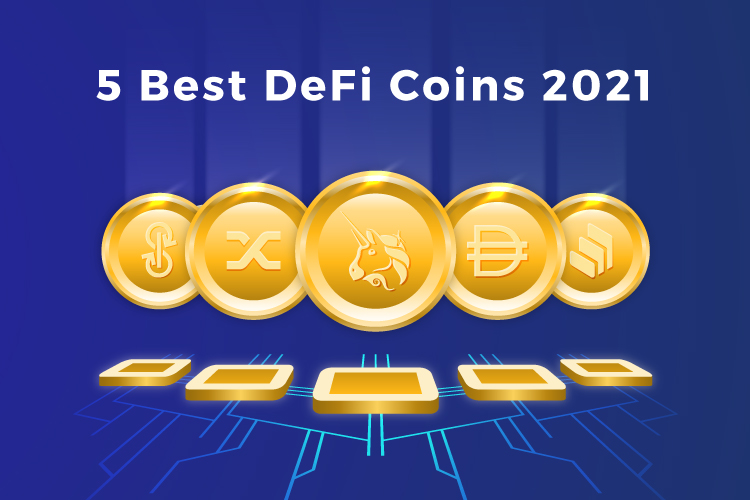
5 Best DeFi Coins 2021

5-Best-DeFi-Coins-2021

Uniswap (UNI)

Uniswap is a well-known decentralized exchange that presently rules the DeFi market. It uses an Automated Market Maker (AMM) mechanism to guarantee that the ERC20 tokens sold on its platform have enough liquidity. Furthermore, because of its crypto-asset solutions, the Uniswap protocol has a devoted following. It gives you complete control over your private keys, connects with other wallets, and enables you to trade at minimal costs.

The Uniswap protocol introduced the UNI token in September 2020 as a way to reward its users. The DeFi coin debuted on the market with a price of $2.94. Over a few months, the coin’s value has risen to $35.80. With a gain of over 1,100 percent in only eight months, the DeFi currency is undoubtedly one of the best-performing tokens in the market.

With a market value of more than $18 billion, it is also one of the finest DeFi coins in valuation. When you buy UNI, you’ll also get discounts and incentives for the Uniswap protocol. For example, depending on the amount of your UNI holdings, you will be able to vote on specific Uniswap ecosystem rules.
The Uniswap protocol has already devised a four-year strategy for allocating UNI tokens. Sixty percent of a total of one billion coins are allocated for Uniswap community members.

DAI (DAI)

For those who are unaware, the cryptocurrency and DeFi coin alternative financial sector is notoriously volatile. The DAI currency may be of interest to people who want to avoid price volatility. In a word, the DeFi cryptocurrency is based on the Ethereum blockchain and is linked to the US dollar.

DAI is, in fact, the first decentralized, collateral-backed cryptocurrency asset of its type. This DeFi currency was created using the open-source software MakerDAO Protocol, one of the finest DeFi platforms for building decentralized apps using smart contracts.

DAI has a market value of $4 billion at the moment, making it one of the most acceptable DeFi currencies in existence. Its exchange rate reflects the value of the US dollar relative to other fiat currencies. As you would expect, the primary benefit of staking DAI is that it reduces your exposure to the high volatility of the broader cryptocurrency markets.

Furthermore, utilizing DAI instead of fiat currencies may help you minimize transaction costs and delays while dealing in financial markets. Finally, DAI is one of the finest DeFi currencies of its type. Therefore we anticipate enormous things for the project in the following years.

Compound (COMP)

Compound is yet another prominent decentralized borrowing and lending platform that allows users to earn interest on their crypto assets. For this reason, the platform has created numerous Compound liquidity pools. You will be able to create cTokens after depositing your assets into one of these pools. Those unfamiliar with the cryptocurrency and DeFi coin alternative financial industry should be aware that it is famously volatile. People who wish to avoid price fluctuation may be interested in the DAI currency. In a nutshell, the DeFi cryptocurrency is built on the Ethereum blockchain and is pegged to the US dollar.

In reality, DAI is the first decentralized, collateral-backed cryptocurrency asset of its kind. This DeFi currency was developed using the open-source software MakerDAO Protocol, one of the best DeFi platforms for developing decentralized applications with smart contracts.

DAI now has a market value of $4 billion, making it one of the best DeFi currencies available. Its exchange rate indicates the US dollar’s worth of other fiat currencies. The main advantage of staking DAI is, as expected, that it lowers your exposure to the extreme volatility of the broader cryptocurrency markets.

Furthermore, using DAI rather than fiat currencies may assist you to reduce transaction costs and delays while dealing in financial markets. Finally, DAI is one of the best DeFi currencies of its kind. Therefore we expect big things from the project in the next few years.

These cTokens may be redeemed to get access to your assets. Notably, since the value of tokens rises with time, you will be able to earn interest on your investment. In addition, Compound will debut its native coin — COMP – in June 2020. Holders of this DeFi token will be able to vote on the Compound protocol.

The network has gained significant market momentum, and its DeFi currency just surpassed a market value of more than $3 billion. Compound began trading in 2021 with a price of $143.90. Since then, the value of the Defi coin has reached $638. This implies that after only four months of trading, the value of Compound has risen by more than 350%.

Synthetix (SNX)

Synthetix is one of the fastest-growing DeFi systems on the market today. It is the driving force behind a well-developed decentralized exchange that enables users to trade tokens on the platform. What is special about Synthetix, however, is that it allows users to create their synthetic assets known as “synths”. Synths are fundamental financial instruments that replicate the value of an underlying asset.

Synthetix, a decentralized exchange, lets you trade synths for cryptocurrencies, indices, and other real assets like gold. However, you need the native SNX Synthetix token in order to offer collateral against synths. As a result, your SNX tokens get trapped in a smart contract every time you trade synths.

In addition, the SNX token returns part of the fees earned to its holders, which allows it to generate passive income. Given the real utility of the platform, the demand for SNX tokens with a market value of more than $ 2 billion may continue to grow. The cryptocurrency has already established itself as one of the acceptable DeFi coins and the value of the SNX coin has risen by more than 120 percent in the last four months.

Yearn.finance (YFI)

Yearn. finance was established in early 2020 to offer significant returns for staking Ethereum, stablecoins, and other cryptocurrencies. This is made possible by the protocol’s ‘Vaults’ feature, which helps to reduce the high cost of Ethereum transactions.

Yearn. finance aims to demystify DeFi for novice investors, enabling them to maximize profits with minimum involvement. With the introduction of its YFI token, this DeFi platform has garnered further market interest. The DeFi currency has a market value of more than $1.5 billion.
However, the overall supply is restricted to 36,666 coins, which adds to the value of the Defi project. At the time of writing, the YFI coin is valued at more than $42,564, making it one of the most expensive in the market. This is a remarkable number, given that the currency was just launched in July 2020 — at the cost of $1,050.

Quick Read: What is DeFi?

- Contact Us -

SoluLab being the top 3 Blockchain developers can help you build the perfect decentralized apps.

Top 10 Blockchain dApps to Watch in 2026

Top 10 Blockchain dApps

Blockchain dApps are no longer limited to crypto enthusiasts or early adopters. By 2026, decentralized applications will have evolved into platforms used across finance, gaming, social media, healthcare, and supply chains. 

These dApps remove intermediaries, improve transparency, and give users greater control over their data and digital assets. However, with thousands of blockchain applications available, identifying reliable and high-performing dApps can be a challenging task. 

Some deliver real value, while others struggle with security, scalability, or adoption. That’s why choosing the right dApps matters. In this blog, we’ve curated a list of the top 10 blockchain dApps in 2026, based on real-world utility, user adoption, and security.

The Criteria We Used to Shortlist Top Blockchain dApps

To identify the best blockchain dApps, we evaluated each platform using clear, practical criteria that focus on real-world value, user adoption, security, scalability, and long-term sustainability.

  • User Adoption & Active Users: Daily active wallets interacting with dApps reached about 25 million in mid-2025, one of the highest activity levels since a previous market peak.
  • Security & Smart Contract Audits: Security was a top priority. We checked whether smart contracts were audited by trusted firms and reviewed past vulnerabilities or security incidents.
  • Use Case & Real-World Utility: We evaluated whether the dApp solves a real problem, delivers measurable value, and has practical use beyond speculation or hype.
  • Blockchain Network & Scalability: We considered the underlying blockchain’s speed, fees, scalability, and reliability to ensure the dApp can support long-term growth.
  • User Experience & Interface: A simple, intuitive interface matters. We assessed ease of onboarding, wallet integration, and overall usability for both beginners and advanced users.
  • Community & Developer Support: Strong communities and active developer engagement indicate sustainability. We reviewed GitHub activity, updates, and community participation across platforms.

Related: Blockchain Development in DeFi Ecosystem

Top 10 Blockchain dApps Worth Considering in 2026

The table below gives a quick comparison of the top blockchain dApps in 2026, highlighting their core use cases, supported networks, standout features, and ideal users.

dApp

Category

Primary Function

Key Blockchain(s)

Uniswap

DEX

Token swaps via AMM liquidity pools ​

Ethereum, Polygon, Optimism ​

Aave

Lending

Flash loans and collateralized borrowing

Ethereum, Polygon

Decentraland

Metaverse

Virtual land ownership and events

Ethereum

Chainlink

Oracle

Secure off-chain data feeds for smart contracts

Multi-chain

MakerDAO

Stablecoin

DAI issuance via over-collateralized vaults

Ethereum

Compound

Lending

Algorithmic money markets for lending

Ethereum, Base

Yearn.finance

Yield Aggregator

Automated yield optimization across protocols ​

Ethereum, Arbitrum

Avalanche

Layer 1

High-throughput subnets for dApps

Avalanche

Tron

Layer 1

Low-cost transactions for content dApps

Tron

CryptoKitties

NFT Game

Collectible breeding and trading game

Ethereum, Flow

This comparison makes it easier to understand how each dApp stands out, helping you choose the right platform based on functionality, adoption, and your specific blockchain needs.

CTA1

1. Uniswap

Uniswap is a leading decentralized exchange (DEX) that enables users to trade cryptocurrencies directly from their wallets, eliminating the need for intermediaries. Built on blockchain technology, it offers permissionless, trustless token swaps with high liquidity. In 2026, Uniswap continues to be a core DeFi platform for on-chain trading.

Key Features:

  • Automated Market Maker (AMM) model enabling instant, permissionless token swaps
  • Deep liquidity pools with competitive pricing for major and emerging tokens
  • Multi-chain support improves scalability and reduces transaction costs

Best For:

  • DeFi traders looking for decentralized token swaps
  • Users who prefer self-custody and wallet-based trading
  • Liquidity providers aiming to earn fees on crypto assets

2. Aave

Aave is a decentralized finance (DeFi) dApp that allows users to lend, borrow, and earn interest on crypto assets without relying on traditional banks. It operates through smart contracts, ensuring transparency and security. 

Key Features:

  • Decentralized lending and borrowing with competitive interest rates
  • Support for multiple cryptocurrencies across various blockchains
  • Flash loans that enable instant, collateral-free borrowing

Best For:

  • DeFi users looking to earn passive income
  • Traders needing quick liquidity
  • Advanced users exploring flash loan strategies

3. Decentraland

This Decentraland is a leading blockchain-based platform designed to solve a specific problem in the Web3 ecosystem. It offers secure, decentralized functionality with a strong focus on usability and scalability. By 2026, it will continue to see growing adoption across global users.

Key Features:

  • Virtual land ownership using blockchain NFTs
  • User-created experiences, games, and environments
  • In-platform economy powered by MANA token

Best For:

  • Specific industries or use cases it serves well.
  • Beginners or advanced users, depending on complexity.

4. Chainlink

Chainlink is a decentralized oracle network that connects smart contracts with real-world data. It enables blockchains to securely access off-chain information like prices, APIs, and events. This makes complex dApps reliable and functional.

Key Features:

  • Decentralized oracles that ensure accurate, tamper-resistant data feeds
  • Cross-Chain Interoperability Protocol (CCIP) for secure data and token transfers
  • Widely adopted price feeds are used across major DeFi platforms

Best For:

  • DeFi applications need reliable price data
  • Developers building data-driven smart contracts
  • Cross-chain and enterprise blockchain solutions

5. MakerDAO

MakerDAO is a leading decentralized finance (DeFi) dApp that allows users to generate stablecoins without relying on traditional banks. Built on Ethereum, it enables permissionless borrowing through smart contracts. MakerDAO plays a key role in maintaining decentralized financial stability.

Key Features:

  • Allows users to mint DAI, a decentralized stablecoin pegged to the US dollar
  • Uses smart contracts and collateralized debt positions for trustless lending
  • Governed by the community through MKR token-based voting

Best For:

  • DeFi users seeking decentralized lending options
  • Users looking for a stable, crypto-backed alternative to fiat currencies
  • Governance-focused crypto participants

6. Compound

Compound is a leading DeFi dApp that allows users to lend and borrow cryptocurrencies without intermediaries. It uses smart contracts to automate interest rates based on market demand. By 2026, Compound will remain a trusted platform for decentralized lending.

Key Features:

  • Algorithmic interest rates that adjust automatically based on supply and demand
  • Support for multiple cryptocurrencies and stablecoins
  • Non-custodial lending with full user control over the asset

Best For:

  • Users looking to earn passive income on crypto holdings
  • Borrowers who want decentralized, permissionless loans

7. Yearn. finance

Yearn.Finance is a popular DeFi dApp that helps users maximize returns on their crypto assets through automated yield farming strategies. It simplifies complex DeFi processes by managing investments on behalf of users. By automatically shifting funds across lending protocols, Yearn.finance helps users earn better yields with minimal effort and active monitoring.

Key Features:

  • Automatically optimizes yield by moving funds across multiple DeFi lending platforms
  • Vault-based strategy system that manages risk and returns efficiently
  • Community-governed protocol powered by the YFI token

Best For:

  • DeFi users looking for passive income
  • Investors who want automated yield optimization
  • Users with limited time to manage DeFi strategies

8. Avalanche

Avalanche is a high-performance blockchain platform designed for fast, secure, and scalable decentralized applications. It supports custom blockchains and DeFi ecosystems with near-instant finality. In 2026, Avalanche continues to attract developers building enterprise-grade and Web3 applications.

Key Features:

  • High transaction speed with sub-second finality
  • Low transaction fees compared to traditional Layer 1 blockchains
  • Customizable subnets for building application-specific blockchains

Best For:

  • DeFi platforms require high throughput
  • Enterprises building private or custom blockchains
  • Developers looking for scalable Layer 1 infrastructure

9. Tron

Tron is a blockchain-based dApp ecosystem focused on fast, low-cost transactions and decentralized content sharing. It aims to empower creators by removing intermediaries and giving users full control over digital assets. Tron is widely used in DeFi, gaming, and stablecoin transfers.

Key Features:

  • High-speed transactions with near-zero fees, ideal for frequent transfers
  • Strong support for stablecoins like USDT with high daily transaction volume
  • Scalable infrastructure for DeFi apps, games, and entertainment platforms

Best For:

  • Low-cost crypto transfers and payments
  • DeFi users seeking fast transactions
  • Developers building scalable dApps

10. CryptoKitties

CryptoKitties is one of the earliest and most popular NFT-based dApps built on blockchain technology. It allows users to collect, breed, and trade unique digital cats, each represented as a non-fungible token. The platform introduced NFTs to a mainstream audience and showed real digital ownership.

Key Features:

  • Unique NFT cats with distinct traits stored securely on the blockchain
  • Breeding mechanics that create new, rare CryptoKitties
  • Marketplace for buying, selling, and trading digital collectibles

Best For:

  • NFT collectors and enthusiasts
  • Beginners exploring blockchain gaming
  • Users interested in digital ownership and collectibles
CTA2

Conclusion

Blockchain dApps are moving beyond experimentation and becoming essential tools across finance, gaming, identity, and digital ownership. These applications show how decentralized technology is changing digital experiences. 

Whether you’re a developer, investor, or everyday user, understanding these platforms helps you make smarter decisions. The dApp ecosystem is evolving, and staying updated with the leading platforms will help you spot opportunities early and stay ahead in the decentralized future.

SoluLab, a dapp development company can help you design, build, and scale blockchain solutions. Contact us today to discuss further!

FAQs

1. What is a blockchain dApp and how does it work?

A blockchain dApp is an application that runs on a blockchain network instead of a centralized server. It uses smart contracts to automate logic, store data immutably, and enable P2P transactions without intermediaries. Businesses use blockchain dApps to improve transparency, security, and trust while reducing operational costs.

2. How long does blockchain dApp development take?

A basic blockchain dApp can be developed in 8–12 weeks, while advanced or enterprise-level dApps usually take 4–6 months. Timelines depend on features such as smart contract complexity, wallet integrations, cross-chain functionality, and compliance requirements.

3. How do blockchain dApps generate revenue for businesses?

Blockchain dApps generate revenue through transaction fees, subscription models, token utilities, premium features, and staking. Many businesses also monetize data insights and enterprise integrations, making blockchain dApps a sustainable long-term revenue model.

4. How much does it cost to develop a blockchain dApp?

The cost of blockchain dApp development typically ranges from $10,000 to $200,000+, depending on complexity, blockchain network, smart contract logic, security requirements, and integrations.

5. How does SoluLab help businesses build successful blockchain dApps?

SoluLab provides end-to-end blockchain dApp development services, covering strategy, design, development, security audits, and post-launch support. With 150+ blockchain projects delivered, SoluLab helps businesses launch secure, scalable, and revenue-ready decentralized apps.

10 Best Use Cases For Smart Contracts in DeFi (Decentralized Finance)

Smart contracts are a result of the evolution of blockchain technology. Let us first understand what smart contracts are and throw some light on the smart contract use cases. Smart contracts are referred to as paperless digital code providing a set of promises on some predefined conditions that have been agreed to by both parties. To state in simpler terms, it can be said that the parties can set a condition that has the ability to start an action or a series of actions at the time when the conditions are met.

Smart contracts have a wide array of applications that help automate all tasks or the entire network like the decentralized autonomous organizations making use of a set of smart contracts. The ones who are still skeptical about using smart contracts should have an idea about the benefits offered and start using the same.

  • One of the largest benefits offered by smart contracts is automation. This, in turn, makes it free from any kind of interruption and no third party can alter the agreement as well as decision.
  • Security is readily enhanced in the case of smart contracts where the entire process works in a secure manner.
  • Smart contracts are free from all sorts of interruption and hence operate smoothly.
  • The entire system is trustless and hence there is no requirement of trusting other parties for carrying out any transactions.
  • Smart contracts are able to make the transactions extremely cost-effective in nature because of the removal of intermediaries from the process.
  • The autonomous smart contracts are executed with a greater speed as compared to the traditional approach.
  • Finally, smart contracts are highly accurate and free from any kind of errors.

Use Cases of Smart Contracts

Now, we have a clear idea about the potential smart contracts and what benefits they have on offer. So, it is time now to understand the ten best smart contract use cases.

  1. Digital Identity

    One of the top smart contract use cases is providing a digital identity to assets that are individualized. It contains data, reputation, and digital assets. The digital identity when rightly used is able to bring about new opportunities to the person. In addition to this, the digital identity offered by smart contracts plays a vital role in protecting the identity of the asset from their counterparts.

  2. Loans, Mortgage, and Financial Service

    Smart contracts play a crucial role in bringing about a significant improvement in financial services. Smart contracts help the easy connection between the parties to make sure that the entire process is completed in a hassle-free manner. Moreover, the use of smart contracts also makes the process free from all sorts of errors. Another major benefit of using smart contracts in financial services is clarity and enhanced visibility to all the parties involved.

  3. Mortgage System

    The mortgage system is another use case of smart contracts. Smart contracts induce automation in the mortgage system to make it easier for both buyers as well as sellers. Now, when the system is automated, the entire process becomes less time-consuming and completely hassle-free which proves to be highly advantageous.

  4. Insurance

    Insurance has been one of the important use cases of smart contracts. Disputes are a common affair in the insurance sector and to effectively settle the disputes along with making the claim settling process smooth, smart contracts have a crucial role to play. Smart contracts facilitate the insurance policy and ensure it has the proper documentation to make the process convenient for both the insurance buyer as well as the insurance provider.

  5. Inter Border Payments

    With the help of smart contracts, inter-border payments become easy and convenient, thereby facilitating international trade. Smart contracts have the ability to revolutionize trade finance by propelling international transfer of goods and initiation of trade payments with the use of only a letter of credit. Moreover, smart contracts enhance the liquidity of financial assets, thereby improving the financial efficiency of buyers, suppliers, and institutions.

  6. Supply Chain Management

    Another use case of smart contracts is the supply chain management industry. With the help of smart contracts, supply can be readily improved. It helps easy and convenient tracking of items within the supply chain with complete transparency as well as visibility to improve overall inventory tracking. It also helps reduce verification and provides enhanced tracing which in turn results in lesser fraudulent activities.

  7. Clinical Trials

    Clinical trials improve with smart contracts since they can provide better inter-institutional visibility. It also helps automate sharing of data between institutions and enables privacy-preserving computations.

  8. Government

    Another major smart contract used case is in the Government. Smart contracts play a significant role in helping the government manage entire operations in an easy and automated manner. One of the major operations among those is recording land titles for easy property transfers. With the use of smart contracts, the entire process is quite transparent, and efficient.

  9. Recording of Financial Data

    Financial data is immensely important for every organization and the use of smart contracts is highly beneficial in this regard. Smart contracts provide the necessary way for recording data without compromising even a bit on accuracy and transparency. Therefore, financial data collection and recording are absolutely uniform across organizations resulting in decreased cost of auditing as well reporting.

  10. Management of Assets

    Smart contracts help manage assets in an efficient and effective manner. The entire process of asset management is quick because of the induced automation which is absent in the case of traditional practices. With the help of a smart contract, the process is fully transparent and hence does not give any of the users even a single chance to complain.

What Smart Contracts Have in Store for Us?

With the evolution and advancement of blockchain technology on a regular basis, the potential of smart contracts is bound to increase in the time to come. In addition to the smart contract use cases mentioned above, there are a number of other cases where smart contracts can be readily used and the number is all set to rise in the future.

- Contact Us -

SoluLab being the top 3 Blockchain developers can help you build the perfect smart contract applications.

How Blockchain Anonymity Is Maintained?

How is Blockchain anonymity maintained?

An assumption persists since long that cryptocurrencies such as Bitcoin were a refuge for criminals. This was because of their significant properties of being untraceable and being completely anonymous.

Meanwhile, as businesses and the general public grew more familiar with blockchain technology, it was becoming clear that the public transaction record of Bitcoin was, in reality, a gold mine of information for authorities. However, the issue of how anonymous cryptocurrency remains unanswered.

Difference between anonymity and privacy

To fully grasp the issue we’ll be discussing in this essay; we must first define those two – in reality, quite distinct – ideas. Anonymity “describes circumstances in which the actor’s name is unknown.” There is no mention of concealing the deed itself. In contrast, privacy is described as “the capacity of a person or group to seclude themselves, or information about themselves, and therefore express themselves selectively.”

Anonymity is about concealing the “who,” while privacy is about hiding the “what.” Anonymity in the context of blockchains refers to the capacity for parties to trade data without revealing any off-chain identifying information or previous transactions they have completed. Bitcoin, for example, is partly anonymous (each address is nothing more than a public key hash that seems random) but not private at all (we know all transactions done from/to that address

Blockchain Anonymity

Cryptocurrencies have sparked much interest from people, companies, and hackers, with Bitcoin once worth more than $5,000 per unit. Anonymity is one of the benefits of Bitcoin and other cryptocurrencies. However, there are worries that internet money transactions may not be as private as many would want.

There are many types of cryptocurrencies, the most popular being Bitcoin, Litecoin, and Ethereum. Altcoins are cryptocurrencies that were launched after the popularity of Bitcoin. Bitcoin, the father of all cryptocurrencies, mandates that the ledger, or record of transactions, be open to the public, making all transactions public knowledge. Many people are concerned about their anonymity and privacy as a result of this. In this post, we will look at some of the ways that cryptocurrency anonymity has been handled.

Bitcoin is regarded as pseudonymous

Fortunately, the blockchain doesn’t record everything. This means that the identities of the people involved in the transaction are not recorded. As a result, rather than being anonymous, bitcoin is pseudonymous. In many instances, though, one’s personal identity can be connected to one’s bitcoin address.

Bitcoin transactions with a person knowing that your identity exposes information that may be used for the identification of your past and future blockchain activities. Suppose, you send bitcoins to an online store, an exchange, or any business that collects client identification information. In that case, you allow them to connect that identity to your blockchain pseudonym, possibly exposing previous transactions you are involved in.

As a result, Bitcoin offers the ideal paper trail for law enforcement, tax authorities, and compliance experts. Because of this traceability, bitcoin theft becomes a much less appealing endeavor.

Of course, tools that launder bitcoin such as mixers,’ or tumblers’ have emerged. These services try to sever the paper trail by swapping one set of bitcoins for another, each with distinct addresses and transaction histories. But, these services come with limitations. They do not scale effectively for big quantities, and the laundering process is often traceable on the blockchain.

How can you purchase cryptocurrency anonymously?

  • Purchase it from a street vendor

This may seem suspicious, and it may even be counterintuitive to reveal your real identity at the time of purchase. However, if you do your homework, it is not as risky as it appears to be actually.

Bitcoin was exchanged in a particular manner in the early days. Bitcoin meetings would be held. Holders of the cryptocurrency would scream out prices. On the other hand, buyers used to come forward. After agreeing upon a particular price, cash would be exchanged for Bitcoin, sent immediately.

You may utilize services like Facebook, Localbitcoins.com, or Meetup.com to locate vendors in your area that you can get in touch with to exchange Bitcoin for cash. Additionally, you should utilize Tor, a VPN, and burner accounts to maintain more anonymity when you are searching and signing up for such events.

  • Purchase it at cryptocurrency or Bitcoin ATM

Purchasing Bitcoin at a cryptocurrency ATM isn’t always the greatest financial decision. To buy coins, Bitcoin ATMs mostly utilize APIs directly connected to cryptocurrency exchanges, and the person operating the ATM will surely charge a service fee for making the transaction.

They are, nevertheless, helpful for purchasing bitcoin secretly. However, one should choose their Bitcoin ATM wisely since some demand you to establish an account, thereby, exposing your name. You can go in, put some money in, and receive some bitcoin on a paper wallet for those who don’t. One may then transfer this Bitcoin to their preferred wallet using a mixer service. This will conceal its origin further and protect one’s identity.

Purchasing bitcoin by not disclosing your name is one thing. But, what one does with it may still expose your identity. Therefore, it’s important to be aware of how you’re utilizing your bitcoin at all times.

Techniques for preserving blockchain anonymity

1. Decentralized: Not under the control of governments

One of the most significant advantages of blockchain technology is its decentralized nature. Nobody has complete control over it. The blockchain of Bitcoin, for example, is maintained by hundreds of thousands of nodes. Hacking one percent, or even half, of the computer nodes, will not give you control over bitcoin.

To get power, you must launch a 51 percent assault on the whole blockchain. According to studies, a successful assault would cost $1.4 billion and months of effort. But, in exchange, you would have momentary control over the network and nothing to show for it monetarily since the coins would lose value immediately.

Blockchain communities rule themselves because they have such a high degree of security and no centralized authority. After all, self-rule was the original aim of bitcoin, and the policy was successfully handed down to all subsequent blockchain initiatives.

2.  VPNs and Tor

The best VPN and Tor services are both intended to protect the user and may be used to preserve anonymity. These technologies are utilized for both safety and privacy by researchers, journalists, businesses, governments, and others. Many bitcoin users with comparable worries utilize them as well. For example, many ransomware decryption tools are hosted on Tor as secret services.

VPNs are often used to conceal personal information while requesting bitcoin transactions. Both VPN and Tor can conceal a user’s personal information during a transaction by utilizing an alternative IP address or geolocation, which is occasionally customizable by the user. These technologies make it impossible for an attacker or analyst to observe traffic by correlating IP addresses and transactions. It may also be used to communicate with others, such as merchants while concealing your address from them.

VPNs are often used to conceal personal information while requesting bitcoin transactions. Both VPN and Tor can conceal a user’s personal information during a transaction by utilizing an alternative IP address or geolocation, which is occasionally customizable by the user. These technologies make it impossible for an attacker or analyst to observe traffic by correlating IP addresses and transactions. It may also be used to communicate with others, such as merchants while concealing your address from them.

3. CoinJoin

Typically, the back-end technology of decentralized mixers is the most frequently utilized technology. Gregory Maxwell proposed the CoinJoin protocol in 2013. The fundamental idea is that a group of payers combine their money and make a collective payment, obscuring the connection between payer and payee.

CoinJoin is made feasible because not every input in a transaction must originate from the same wallet or user. Because the signatures needed to verify a transaction are independent for each input, many users may agree to execute a single transaction to numerous unconnected payees. As a result, the information regarding which input paid which payee is not part of the blockchain and can be avoided.

CoinJoin is a critical tool for preserving anonymity since it serves as the foundation for numerous methods and implementations. SharedCoins, Darkwallet, CoinShuffle, PrivateSend, and JoinMarket are a few examples of implementations.

4. Ecosystems of Blockchain

Secure blockchain ecosystems can reduce many of the security risks associated with blockchain technology. However, using bitcoins to purchase items on Amazon does not provide much privacy. Amazon already has your name and address.

However, blockchain ecosystems that prioritize user privacy can remove all such risks. Blockchains may create secure chains that enable transparent, anonymous transactions ranging from product descriptions to purchasing and selling.

In the e-commerce industry, merchants post their products on the blockchain and enable customers to evaluate and verify the components used in their production. The transit of products from the shop to the delivery destination may be monitored safely without revealing any unnecessary addresses. Payments are made possible by digital currencies, and internet reviews help consumers discover the finest purchasing sites.

5. CryptoNote

A ring signature is a digital signature that enables one member in a group to sign on their behalf. This phase adds security by making it computationally difficult to identify which group members’ keys were used to generate the signature.

Conclusion

Bitcoin is a decentralized payment system that offers a method for obtaining numerous anonymous credentials, bitcoin addresses that may be used to conduct and receive payments. However, the previous study has shown that the system that utilizes such addresses may provide information about their owners. Furthermore, because all transactions conducted by the system are publicly accessible for study in the blockchain, it is possible to cluster various addresses belonging to the same user and classify certain usage.

Furthermore, if one of the cluster’s addresses can be linked to a real person, the payment history of the whole cluster may provide important information about that user. Although interesting research has been conducted in this area, the dynamism of the bitcoin ecosystem, which constantly modifies and improves bitcoin usage, implies that some of the hypotheses assumed for those blockchain analyses may not hold completely. Thus blockchain analysis still presents interesting open questions.

– Contact Us –

SoluLab being the top 3 Blockchain developers can help you build the perfect blockchain ecosystem.

Reach Out To Us Today

Tokenization Vs Encryption? Know the difference!


Tokenization Vs Encryption

In today’s digital age, data security is important. With the increasing prevalence of cyber threats and stringent regulatory requirements, organizations must employ robust strategies to protect sensitive information. Among the arsenal of data protection methods, encryption and tokenization stand out as two key techniques. However, despite their shared goal of safeguarding data, they operate in distinct ways and serve different purposes.

Understanding the data tokenization vs encryption is crucial for effectively implementing data security measures. In this blog, we delve into the concept of tokenization and encryption, elucidating their functionalities, advantages, and best practices. By grasping the fundamental disparities between these methods, businesses can make informed decisions to fortify their data defenses and navigate compliance requirements confidently.

What is Encryption?

Encryption is a method of securing data by converting it into an encoded form that can only be deciphered by authorized parties. In essence, encryption involves scrambling plain, readable data (known as plaintext) into an unreadable format (known as ciphertext) using an algorithm and a cryptographic key. This procedure makes sure that even if someone with illegal exposure to the encrypted data manages to decrypt it, they will be unable to do so without the necessary decryption key.

The encryption process typically involves applying a mathematical algorithm to the plaintext along with a cryptographic key. The algorithm manipulates the plaintext based on the key’s instructions, transforming it into ciphertext. The resulting ciphertext appears as a seemingly random sequence of characters, making it unintelligible to anyone who does not possess the decryption key.

Encryption plays a vital role in data security, offering confidentiality and privacy for sensitive information during transmission and storage. It is utilized across various sectors, including finance, healthcare, government, and telecommunications, to protect data from unauthorized access, interception, and tampering.

Types of Encryption

There are two primary types of encryption:

1. Symmetric Encryption: Symmetric encryption encrypts data and decrypts it using the same key. The parties involved in the communication must safely exchange this key. The Advanced Encryption Standard (AES), Data Encryption Standard (DES), and Triple DES (3DES) are examples of symmetric encryption methods.

2. Asymmetric Encryption: As an alternative to public-key encryption, asymmetric encryption employs two keys: a private key for decryption and a public key for encryption. The private key remains hidden, while the public key is shared without restriction. RSA (Rivest-Shamir-Adleman) and ECC (Elliptic Curve Cryptography) are two examples of asymmetric encryption techniques.

How Does Encryption Work?

Encryption works by transforming plain, readable data (plaintext) into an unreadable format (ciphertext) using an algorithm and a cryptographic key. This procedure guarantees that private data stays safe and secret, even in the event that it is received by unapproved parties. Let’s delve into the specifics of how encryption operates:
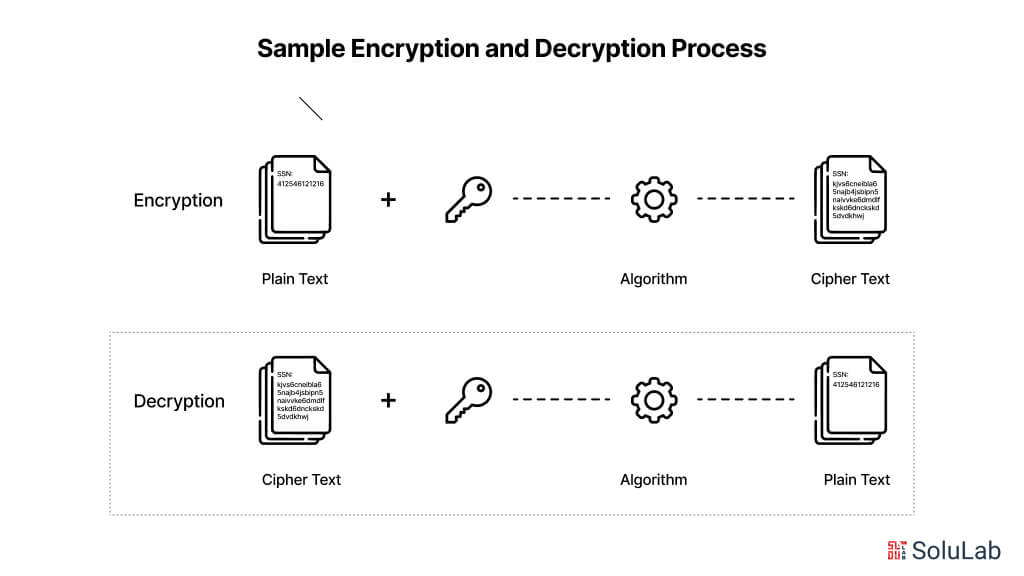
Tokenization Vs Encryption

Encryption Process

  • Algorithm Selection: Encryption begins by selecting a suitable encryption algorithm, which dictates how the plaintext will be transformed into ciphertext. Common encryption algorithms include AES (Advanced Encryption Standard), RSA (Rivest-Shamir-Adleman), and ECC (Elliptic Curve Cryptography).
  • Key Generation: A cryptographic key is generated or selected to be used in conjunction with the encryption algorithm. The key serves as the input to the algorithm, influencing the transformation process. In symmetric encryption, the same key is used for both encryption and decryption, while in asymmetric encryption, a pair of keys (public and private) is employed.
  • Encryption: The encryption algorithm takes the plaintext and the encryption key as inputs and performs a series of mathematical operations on the plaintext, scrambling it into ciphertext. The resulting ciphertext appears as a random sequence of characters, obscuring the original data.
  • Output: Once encrypted, the ciphertext is generated and can be transmitted or stored securely. Without the corresponding decryption key, the ciphertext is indecipherable and unintelligible to unauthorized parties.

Decryption Process

  • Key Retrieval: To decrypt the ciphertext and recover the original plaintext, the recipient must possess the appropriate decryption key. In symmetric encryption, this key is the same as the one used for encryption, while in asymmetric encryption, the private key is used for decryption.
  • Decryption: The recipient applies the decryption key and the decryption algorithm to the ciphertext, reversing the encryption process. The algorithm reverses the transformations applied during encryption, converting the ciphertext back into plaintext.
  • Output: The decrypted plaintext is obtained, revealing the original, readable data. This plaintext can then be processed, displayed, or utilized as intended by the recipient.

Encryption operates on the principle of confidentiality, ensuring that only authorized parties with access to the decryption key can retrieve and understand the original data. By utilizing robust encryption techniques and secure key management practices, organizations can protect sensitive information from unauthorized access, interception, and tampering, thereby safeguarding data privacy and integrity.

Use Cases of Encryption in Data Security
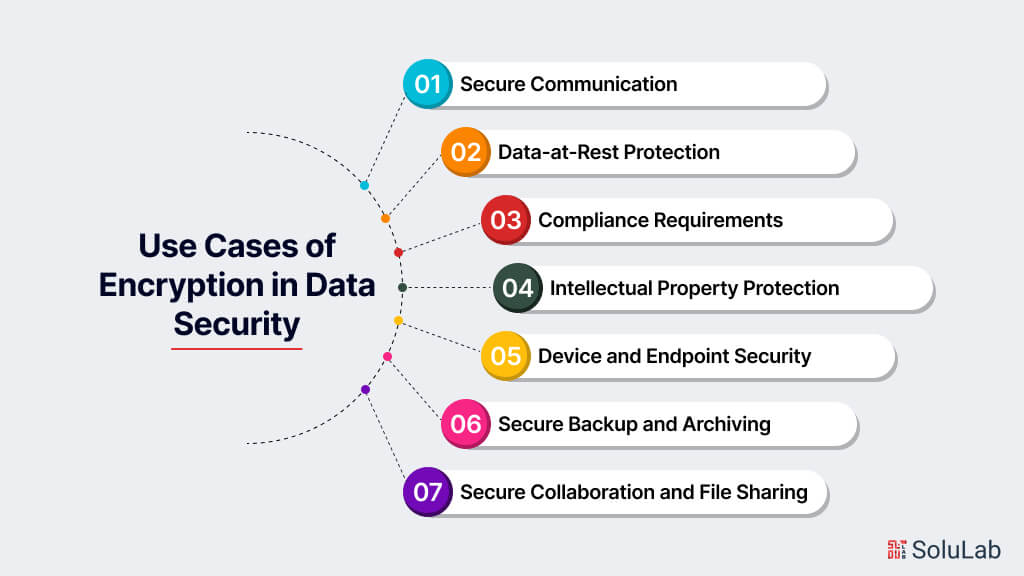
Use Cases of Encryption

Encryption plays a crucial role in data security across various industries and applications. Here are some common use cases of encryption:

1. Secure Communication

Encryption ensures the confidentiality of sensitive information transmitted over networks, such as emails, instant messages, and online transactions. Secure protocols like SSL/TLS utilize encryption to establish secure connections between clients and servers, preventing eavesdropping and data interception. Virtual Private Networks (VPNs) use encryption to create secure tunnels over public networks, enabling secure remote access and communication.

2. Data-at-Rest Protection

Encryption safeguards data stored on devices, databases, and cloud storage against unauthorized access, theft, or breaches. Full-disk encryption encrypts entire storage devices, such as hard drives or solid-state drives (SSDs), ensuring that all data on the device remains protected. File-level encryption selectively encrypts individual files or directories, allowing granular control over data protection.

3. Compliance Requirements

Encryption is mandated by various compliance standards and regulations, such as the Health Insurance Portability and Accountability Act (HIPAA), the Payment Card Industry Data Security Standard (PCI DSS), and the General Data Protection Regulation (GDPR). Compliance with these regulations often requires the implementation of encryption measures to protect sensitive information, including personal health information (PHI), financial data, and personally identifiable information (PII).

Read Also: ERC-3643 vs ERC-1400 vs ERC-20

4. Intellectual Property Protection

Encryption safeguards intellectual property and trade secrets stored in digital formats from unauthorized access, disclosure, or theft. Industries such as technology, pharmaceuticals, and media rely on encryption to protect proprietary information, research data, and valuable assets.

5. Device and Endpoint Security

Encryption secures data stored on mobile devices, laptops, and other endpoints, preventing unauthorized access in case of loss or theft. Mobile device management (MDM) solutions often include encryption features to protect corporate data on employee-owned devices.

6. Secure Backup and Archiving

Encryption ensures the confidentiality and integrity of data backups and archives stored locally or in the cloud. Following the best practices of data backup, modern backup solutions often incorporate encryption to protect sensitive data during transmission and storage, reducing the risk of data breaches or unauthorized access.

7. Secure Collaboration and File Sharing

Encryption enables secure collaboration and file sharing among individuals or organizations, ensuring that shared data remains protected from unauthorized access. Encrypted file-sharing services and collaboration platforms encrypt data both in transit and at rest, maintaining confidentiality and privacy.

Read Also: Why Dubai, London & New York Lead in Real Estate Tokenization?

What is Tokenization?

Tokenization is a data security technique that substitutes sensitive data with non-sensitive placeholder values, called tokens. Unlike encryption, which transforms data into an unreadable format, tokenization replaces the original data with a token, which is typically a randomly generated string of characters. The token has no intrinsic meaning or value and cannot be mathematically reversed to reveal the original data. Tokenization is widely used in payment processing, healthcare, and other industries to protect sensitive information while retaining usability.

Types of Tokenization

There are four types of tokenization as follows:

  • Credit Card Tokenization: In credit card tokenization, sensitive credit card numbers are replaced with tokenized values, allowing merchants and payment processors to store and process transactions securely without exposing cardholder data. Tokens are generated and managed by a tokenization service or platform, which securely maps tokens to their corresponding credit card numbers in a token vault. Tokenized credit card data can be used for recurring payments, fraud detection, and other transactional purposes without requiring access to the original credit card numbers.
  • Data Tokenization: Data tokenization extends beyond credit card numbers to protect other types of sensitive data, such as social security numbers, bank account numbers, and personally identifiable information (PII). Like credit card tokenization, data tokenization replaces sensitive data with tokens, ensuring that the original data remains protected from unauthorized access or exposure. data tokenization vs encryption solutions may offer customization options to tokenize specific data elements based on organization-specific requirements and compliance standards.
  • Email Tokenization: Email tokenization replaces email addresses with unique tokens, enabling organizations to communicate with customers and users without exposing their email addresses. Email tokens are generated and managed securely to ensure that each token corresponds to a unique email address. Email tokenization helps protect user privacy and mitigate the risk of email-related spam, phishing, and data breaches.
  • Tokenization for Authentication: Tokenization is also used for authentication purposes, where tokens serve as temporary credentials or access tokens. Access tokens are used to authenticate users and grant access to secured resources or services, such as APIs, web applications, and cloud services. These tokens are typically time-bound and limited in scope, reducing the risk of unauthorized access or misuse.

Read Also: How to Create a Gold Tokenization Platform

How Does Tokenization Work?
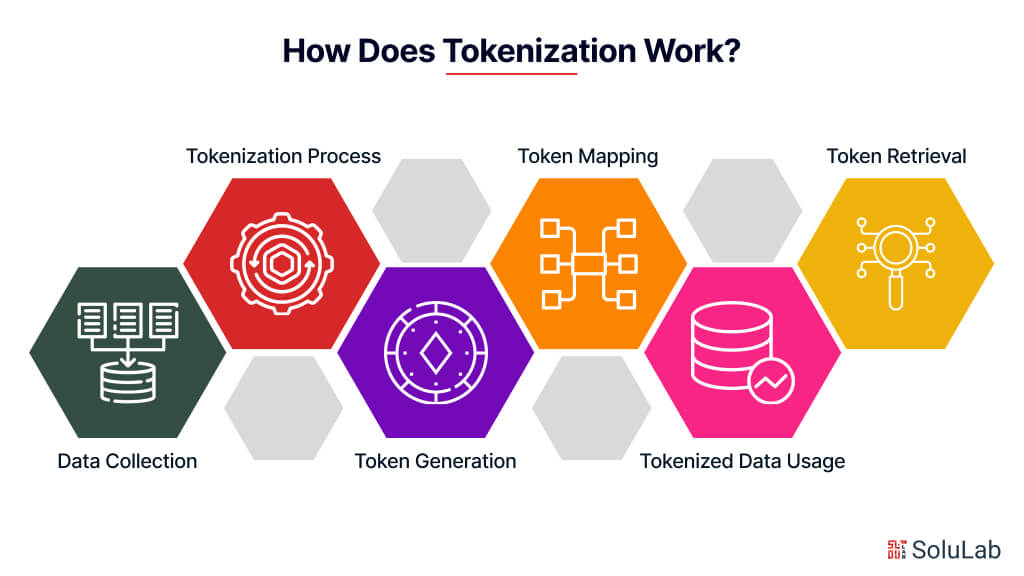
How Does Tokenization Work

Tokenization is a data security strategy where sensitive data is replaced with replacement values that aren’t sensitive (called tokens). Here’s how tokenization works:

1. Data Collection

Initially, sensitive data, such as credit card numbers, social security numbers, or other personally identifiable information (PII), is collected from users or systems.

2. Tokenization Process

The sensitive data undergoes a tokenization process where it is replaced with randomly generated tokens. Tokenization can be performed using tokenization software or services, which manage the mapping between original data and tokens securely.

Related: How to Create an NFT Token in 2025?

3. Token Generation

Tokens are typically alphanumeric strings generated using cryptographic methods. These tokens have no intrinsic meaning or value and are randomly generated for each instance of sensitive data.

4. Token Mapping

The tokenized data and its corresponding original data are securely stored in a token vault or database. This mapping allows authorized users to retrieve the original data associated with a token when necessary.

5. Tokenized Data Usage

Tokenized data is used in place of the original sensitive data for various purposes, such as payment processing, identity verification, or data storage. Tokens can be transmitted and stored without revealing the underlying sensitive information, minimizing the risk of data exposure or theft.

6. Token Retrieval

Authorized users can retrieve the original data associated with a token from the token vault when needed for legitimate purposes, such as transaction processing or customer verification. Access to the token vault is tightly controlled to ensure that only authorized personnel can access sensitive data.

Use Cases of Tokenization in Data Security

Tokenization finds extensive use in securing sensitive data by substituting it with non-sensitive tokens. Its applications span across industries such as finance, healthcare, and e-commerce, ensuring data privacy and compliance with regulatory standards.

1. Payment Processing

Tokenization is widely used in the payment industry to secure credit card transactions. Credit card numbers are tokenized to prevent exposure of cardholder data during payment authorization, reducing the risk of fraud and data breaches.

2. Healthcare Data Protection

In the healthcare sector, tokenization is employed to protect electronic health records (EHRs) and other sensitive patient information. Patient identifiers, such as social security numbers and medical record numbers, are tokenized to comply with healthcare regulations (e.g., HIPAA) and safeguard patient privacy.

3. Data Storage and Cloud Services

Tokenization helps secure data stored in databases, cloud storage, and other repositories. Sensitive data, such as personally identifiable information (PII) and financial records, can be tokenized to mitigate the risk of unauthorized access or data breaches.

4. Identity and Access Management

Tokenization is used in identity and access management (IAM) systems to authenticate users and manage access to secured resources. Access tokens are generated to grant temporary access to applications, APIs, and online services, reducing the reliance on traditional passwords and enhancing security.

Related: How Digital Assets Are Transforming Industries?

5. Retail and E-commerce:

Tokenization is employed in retail and e-commerce environments to secure customer payment information and streamline checkout processes. Tokenized payment data allows merchants to process transactions securely without storing sensitive credit card information, improving customer trust and compliance with payment card industry standards (e.g., PCI DSS).

Key Differences Between Tokenization and Encryption

Before diving into the detailed comparisons, it’s essential to understand the key distinctions between tokenization and encryption. While both techniques aim to safeguard sensitive data, they differ in reversibility, performance, scalability, and regulatory compliance implications. Let’s explore these differences in detail:

A. Purpose and Functionality

Tokenization vs Encryption: Tokenization and encryption serve distinct purposes in data security. Tokenization substitutes sensitive data with non-sensitive tokens, ensuring data security while maintaining usability. Encryption, on the other hand, transforms data into an unreadable format, providing confidentiality but retaining the original data’s structure. While tokenization focuses on data substitution, encryption focuses on data transformation.

B. Reversibility

Data Tokenization vs Encryption: One fundamental difference lies in reversibility. Tokenization is non-reversible, meaning tokens cannot be mathematically reversed to obtain the original data. Even with knowledge of the tokenization algorithm and token values, it is practically impossible to reverse the process and retrieve the original data. Conversely, encryption is reversible, allowing encrypted data to be decrypted back into its original form using the decryption key. This reversible nature of encryption facilitates secure transmission and storage of data while ensuring that authorized parties can access and interpret the information.

C. Performance and Scalability:

Encryption vs Tokenization vs Masking: Performance and scalability considerations also distinguish tokenization from encryption. Encryption processes can be computationally intensive, especially when dealing with large volumes of data, which may impact system performance. In contrast, tokenization typically offers faster performance since it involves simple substitution of data with tokens, requiring fewer computational resources. Additionally, tokenization is inherently more scalable than encryption, making it suitable for environments with high data volumes. Tokenization systems can easily handle the generation, storage, and retrieval of large numbers of tokens without significant performance degradation, whereas encryption systems may face scalability challenges under similar conditions.

D. Regulatory Compliance Implications

Tokenization vs Encryption vs Hashing: Regulatory compliance requirements play a crucial role in determining the choice between tokenization and encryption. While encryption is often explicitly required by regulations such as GDPR (General Data Protection Regulation) or HIPAA (Health Insurance Portability and Accountability Act) for protecting sensitive data, tokenization and hashing may offer alternative methods for achieving compliance. Understanding the regulatory landscape and the specific requirements for each technique is essential for organizations to ensure compliance with data protection standards. Depending on the regulatory environment and industry-specific regulations, organizations may choose to implement tokenization, encryption, or a combination of both to meet compliance obligations and protect sensitive information effectively.

Check Our Case Study: NFTY

Pros and Cons of Encryption

Pros:

  • Confidentiality: Encryption ensures that sensitive data remains confidential and unreadable to unauthorized parties, providing a high level of security.
  • Data Integrity: Encrypted data is protected from tampering or unauthorized modifications, maintaining its integrity throughout transmission and storage.
  • Regulatory Compliance: Encryption helps organizations comply with data protection regulations such as GDPR, HIPAA, and PCI DSS by safeguarding sensitive information from unauthorized access.
  • Flexibility: Encryption can be applied to various types of data and communication channels, offering a versatile solution for securing information across different platforms and environments.

Cons:

  • Performance Overhead: Encryption can introduce computational overhead and latency, particularly in high-volume environments, impacting system performance and responsiveness.
  • Key Management Complexity: Effective encryption requires robust key management practices to securely generate, distribute, and store encryption keys, which can be complex and resource-intensive.
  • Data Recovery Challenges: If encryption keys are lost or compromised, data recovery becomes challenging or impossible, potentially leading to permanent data loss.
  • Potential Vulnerabilities: Despite its benefits, encryption may be vulnerable to cryptographic attacks or implementation flaws, requiring ongoing monitoring and updates to maintain security.
CTA1

Pros and Cons of Tokenization

Pros:

  • Data Security: Tokenization protects sensitive data by replacing it with non-sensitive tokens, reducing the risk of data breaches and unauthorized access.
  • Non-Reversibility: Tokens cannot be reversed to obtain the original data, enhancing data security and privacy.
  • Compliance Simplification: Tokenization simplifies regulatory compliance efforts by minimizing the scope of sensitive data subject to compliance requirements, reducing the risk of non-compliance penalties.
  • Scalability: Tokenization systems can easily handle large volumes of data without significant performance degradation, making them suitable for scalable applications and environments.

Cons:

  • Usability Challenges: Tokenization may introduce usability challenges, especially if the original data needs to be retrieved or processed in its original form, requiring additional token-to-data mapping mechanisms.
  • Dependency on Tokenization Systems: Organizations become reliant on tokenization systems and providers, making it essential to ensure the availability, reliability, and security of these systems.
  • Potential for Tokenization Errors: Incorrect tokenization mappings or errors in token generation can lead to data integrity issues and misinterpretation of tokenized data.
  • Implementation Complexity: Implementing tokenization systems and integrating them with existing infrastructure may require significant effort and resources, particularly in complex environments with diverse data sources and applications.

Conclusion

In conclusion, understanding the nuanced differences between tokenization and encryption is essential for organizations seeking to fortify their data security measures. While both techniques offer robust solutions for protecting sensitive information, they operate distinctly in terms of purpose, reversibility, performance, and regulatory implications. Tokenization provides a pragmatic approach by substituting sensitive data with non-sensitive tokens, ensuring data security without compromising usability. On the other hand, encryption offers a reversible method of transforming data into an unreadable format, providing confidentiality while retaining the original data’s structure. By recognizing the strengths and limitations of each approach, organizations can make informed decisions tailored to their specific security requirements, compliance obligations, and operational needs.

At SoluLab, we empower businesses to enhance their data security posture through tailored tokenization solutions. As a leading tokenization development company, we specialize in designing and implementing robust tokenization systems that safeguard sensitive information across various industries and use cases. Our team of experts uses advanced technologies and industry best practices to deliver scalable, reliable, and compliant tokenization solutions that meet the unique security needs of our clients. Whether you’re looking to protect payment data, healthcare records, or other sensitive information, SoluLab is your trusted partner in achieving data security excellence. Contact us today to learn how our tokenization services can elevate your data protection strategy and drive business success.

FAQs

1. What is the main difference between tokenization and encryption?

The primary difference lies in their approach to data security. Tokenization replaces sensitive data with non-sensitive tokens, preserving usability but ensuring data security. Encryption transforms data into an unreadable format, providing confidentiality while retaining the original data’s structure.

2. Which method, tokenization or encryption, is more secure?

Both tokenization and encryption offer robust security measures. Tokenization provides non-reversible protection by substituting data with tokens, making it highly secure. Encryption, while reversible, offers strong confidentiality through complex algorithms and keys. The choice between the two depends on the specific security requirements and use cases of the organization.

3. Are tokenization and encryption mutually exclusive?

No, tokenization and encryption can be used together to enhance data security. For instance, sensitive data can be encrypted first to ensure confidentiality and then tokenized for additional protection. This hybrid approach combines the strengths of both techniques to create a multi-layered security strategy.

4. How does tokenization impact compliance with data protection regulations?

Tokenization simplifies compliance efforts by reducing the scope of sensitive data subject to regulatory requirements. By replacing sensitive information with tokens, organizations can minimize the risk of non-compliance penalties while still maintaining data security and privacy.

5. What are the key considerations for choosing between tokenization and encryption?

When deciding between tokenization and encryption, organizations should consider factors such as data sensitivity, reversibility requirements, performance implications, and regulatory compliance obligations. Understanding the specific security needs and operational requirements will help organizations make informed decisions tailored to their unique circumstances.

 

WhatsApp Telegram