


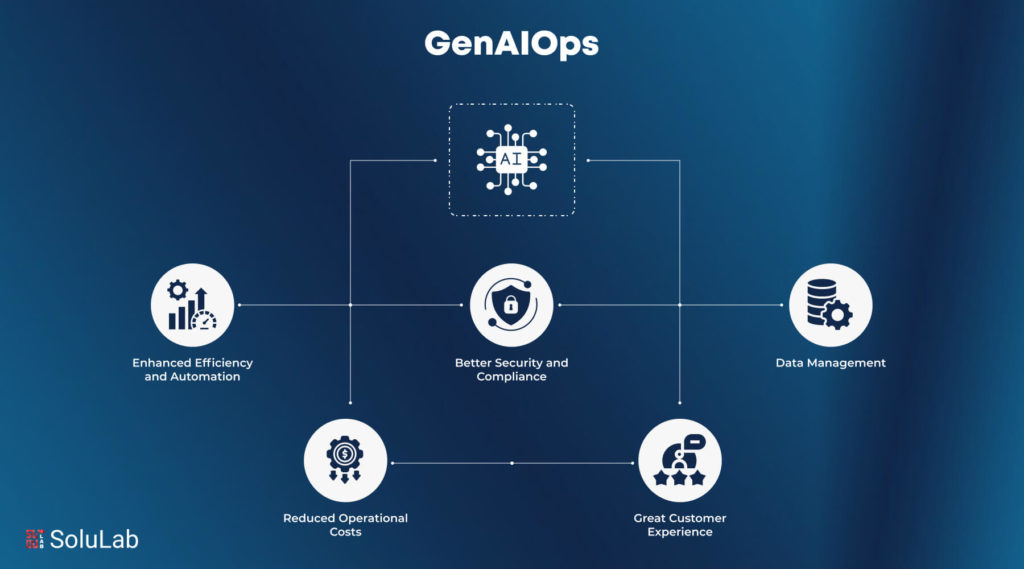
Generative AI is seen as a top emerging technology, with 74% of business leaders predicting it will significantly impact their businesses within the next 12-18 months. This reflects a strong belief in its potential to drive innovation and efficiency across various industries. As organizations increasingly rely on Generative AI to handle difficult problems using natural language commands, effective implementation of these technologies becomes essential. GenAIOps, an acronym for Generative AI Operations, arises as a solution, offering a collection of principles and procedures for developing and implementing Generative AI solutions in an organizational setting. GenAIOps provides a comprehensive method for designing, testing, and deploying Generative AI systems, including data operations (DataOps) and large language model operations (LLMOps), as well as development and operations (DevOps).
In this blog, we will look into the particular issues that organizations encounter when using Generative AI, as well as how GenAIOps tackles them. It focuses on the fundamental components of GenAIOps, its structure, best practices for organizations, obstacles, and the future of GenAIOps in AI.
By the end of this article, you will understand how GenAIOps helps organizations successfully operationalize Generative AI technologies and realize their disruptive potential.
GenAIOps, or Generative AI Operations, is a collection of strategies and procedures for developing and implementing Generative AI solutions in a corporate setting. It builds on standard MLOps frameworks to handle the specific issues brought by AI technology. The way that GenAIOps handles and works with an overarching model that covers the whole AI lifecycle is what makes it unique. This involves pretraining the foundation model, aligning it by supervised fine-tuning, tailoring it to a particular use case, pre/post-processing logic, and linking it with other foundation models, guardrails, and APIs.
When it comes to all generative AI workloads, covering language, picture, and multimodal jobs, GenAIOps include MLOps, DevOps, DataOps, and ModelOps. It entails reconsidering generative AI’s data curation, model training, customization, assessment, optimization, deployment, and risk management.
By 2025, global spending on generative AI is expected to reach $110 billion, highlighting the rapid investment and growing importance of this technology in the business landscape. Guardrails, prompt management, agent/chain management, embedding management, artificial data management, and guardrails are some of the new, emergent GenAIOps features. In addition to defining intricate multi-step application logic, managing prompts, intercepting adversarial or invalid inputs, and representing data samples as dense multi-dimensional embedding vectors, these features expand data management.
In general, GenAIOps encompasses more than simply platform capabilities and tools to support AI development. Techniques for establishing objectives and KPIs, assembling teams, tracking advancement, and consistently enhancing operational procedures are also covered.
Apart from the aforementioned features, GenAIOps facilitates the deployment and oversight of AI models and encourages collaboration within departments to maximize AI performance.

Generative AI operations, or GenAIOps, have several benefits for businesses wishing to use generative AI solutions efficiently.
The use of GenAIOps in enterprises yields revolutionary advantages for businesses, augmenting efficiency, inventiveness, and moral principles while permitting the actualization of generative AI technology’s whole potential.
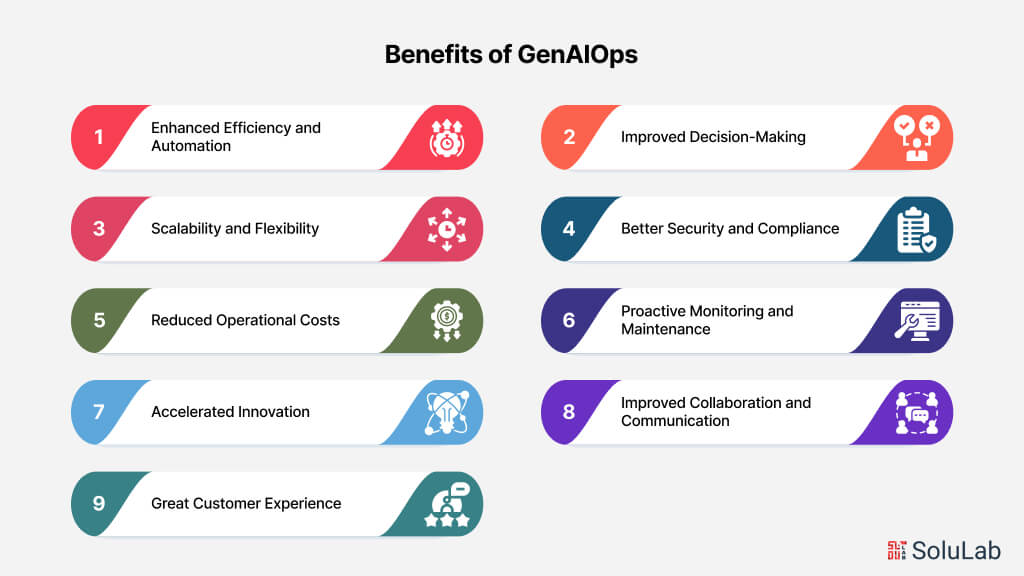
Generative AI Ops services bring significant advantages to IT operations by combining generative AI with traditional DevOps practices. These benefits streamline processes, enhance efficiency, and provide actionable insights, ultimately driving business success.
1. Enhanced Efficiency and Automation: GenAIOps automates repetitive and time-consuming tasks, such as code generation, testing, and deployment. This reduces manual effort, minimizes errors, and accelerates development cycles, allowing teams to focus on more strategic activities.
2. Improved Decision-Making: By analyzing vast amounts of data in real time, GenAIOps provides actionable insights that help in making informed decisions. This leads to better resource allocation, optimized workflows, and proactive issue resolution, enhancing overall operational effectiveness.
3. Scalability and Flexibility: GenAIOps can easily scale to meet the demands of growing businesses. It provides the flexibility to adapt to changing requirements and integrates seamlessly with existing tools and systems, ensuring continuous improvement and innovation.
4. Better Security and Compliance: GenAIOps incorporates advanced AI-driven security measures, such as anomaly detection and threat intelligence, to proactively identify and mitigate security risks. This helps in maintaining robust security postures and ensuring compliance with regulatory requirements.
5. Reduced Operational Costs: By automating tasks and improving operational efficiencies, GenAIOps significantly reduces the costs associated with manual labor and resource management. This allows organizations to allocate their budgets more effectively and invest in strategic growth initiatives.
6. Proactive Monitoring and Maintenance: GenAIOps enables continuous monitoring and predictive maintenance, reducing downtime and improving system reliability. AI algorithms can predict potential issues before they become critical, allowing for timely interventions and minimizing disruptions.
7. Accelerated Innovation: With GenAIOps handling routine tasks, development teams can focus on innovation and creative problem-solving. This fosters a culture of continuous improvement and rapid development of new features and products, driving competitive advantage.
8. Improved Collaboration and Communication: GenAIOps facilitates better collaboration between development and operations teams by providing a unified platform for managing workflows and sharing insights. This enhances communication, reduces silos, and ensures that everyone is aligned toward common goals.
Read Our Blog: Generative AI for Customer Service
9. Great Customer Experience: By improving operational efficiency, reducing downtime, and accelerating innovation, GenAIOps contributes to a better overall customer experience. Customers benefit from faster service delivery, improved reliability, and more innovative products and services.
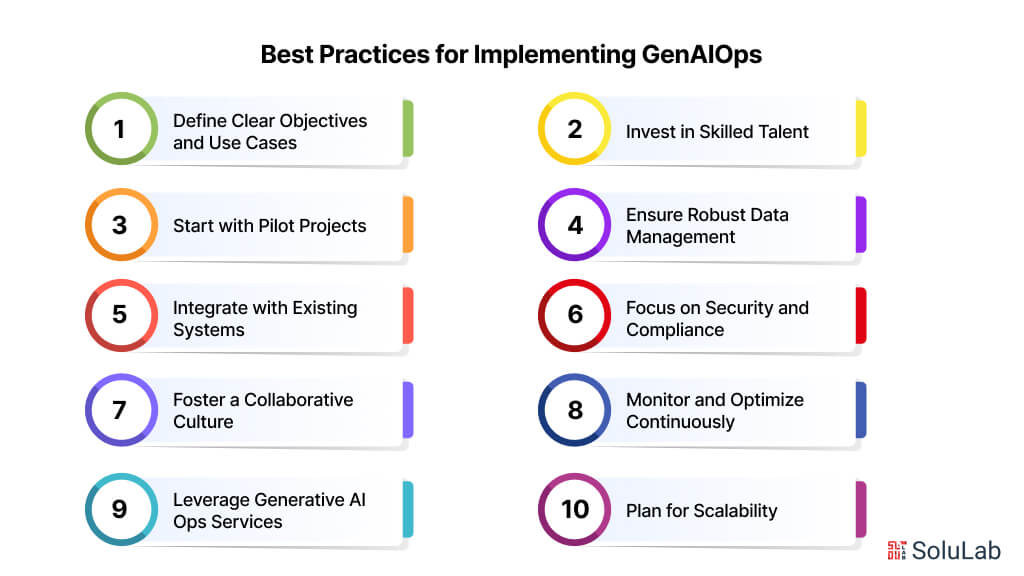
Implementing GenAIOps for enterprises requires a strategic approach that maximizes its benefits while addressing potential challenges. Here are some best practices to consider:
Before implementing GenAIOps, enterprises should identify specific objectives and use cases. This helps in aligning GenAIOps initiatives with business goals, ensuring that the deployment addresses real needs and delivers tangible value.
One of the major barriers to GenAIOps implementation is the lack of skilled talent. Investing in training and hiring professionals with expertise in AI, machine learning, and DevOps is crucial for the successful deployment and management of GenAIOps services.
Begin with pilot projects to test GenAIOps in a controlled environment. This allows enterprises to identify potential issues, refine processes, and demonstrate value before scaling up. Successful pilots can provide valuable insights and build confidence across the organization.
GenAIOps relies heavily on data. Implement strong data management practices to ensure data quality, security, and governance. This includes establishing protocols for data collection, storage, and access, as well as ensuring compliance with relevant regulations.
For seamless implementation, ensure that GenAIOps solutions integrate well with existing IT infrastructure and tools. This facilitates smooth transitions, reduces disruptions, and leverages current investments in technology.
As GenAIOps involves handling sensitive data and critical operations, prioritize security and compliance. Implement advanced security measures, such as encryption, access controls, and continuous monitoring, to protect against threats and ensure regulatory compliance.
Read Blog: An Ultimate Guide to Generative AI for Compliance
Encourage collaboration between development, operations, and AI teams. A unified approach helps in leveraging diverse expertise, fostering innovation, and ensuring that all stakeholders are aligned toward common goals.
Continuous monitoring and optimization are key to maximizing the benefits of GenAIOps. Regularly assess performance, identify bottlenecks, and make necessary adjustments to improve efficiency and effectiveness.
Consider leveraging external generative AI Ops services for specialized tasks or to augment internal capabilities. These services can provide additional expertise, tools, and resources, helping enterprises achieve their GenAIOps goals more effectively.
Ensure that your GenAIOps implementation is scalable. As the organization grows and evolves, the GenAIOps framework should be able to scale accordingly, supporting increased workloads and new use cases without compromising performance.
By following these best practices, enterprises can effectively implement GenAIOps, driving operational excellence and achieving their strategic objectives.
MLOps (Machine Learning Operations) and GenAIOps (Generative AI Operations) are two approaches within AI and machine learning technology, each focusing on different aspects of AI deployment and operations. While both aim to streamline AI workflows and enhance operational efficiency, they have distinct focuses and methodologies.
While MLOps and GenAIOps share common goals of optimizing AI operations, they cater to different aspects of AI application—predictive modeling for MLOps and content generation for GenAIOps. Understanding their unique processes, tools, and challenges helps organizations leverage each approach effectively to meet their specific AI needs.
The future of GenAIOps (Generative AI Operations) is set to transform the landscape of enterprise AI, driving significant advancements in operational efficiency, creativity, and strategic decision-making. Here are some key trends and projections for the future of GenAIOps:
By embracing these trends, enterprises can harness the full potential of GenAIOps to drive innovation, efficiency, and competitive advantage in an increasingly AI-driven world. The future of GenAIOps is bright, promising transformative impacts across all sectors.
In summary, GenAIOps is transforming enterprise operations by enhancing efficiency, enabling advanced automation, and driving innovation. By leveraging the power of generative AI, businesses can automate routine tasks, improve decision-making, and create personalized experiences for their customers. As the adoption of GenAIOps continues to grow, it promises to unlock new levels of productivity and creativity, paving the way for a future where AI-driven operations become the norm across various industries.
However, the implementation of GenAIOps also presents challenges, such as the need for skilled talent, ensuring data quality and security, and integrating AI systems with existing infrastructure. SoluLab, as a leading Generative AI development company, is well-equipped to address these challenges. Our expertise in AI and machine learning, combined with a comprehensive suite of services, ensures seamless integration, robust data management, and continuous optimization of GenAIOps solutions. Contact us today to start your GenAIOps journey!
GenAIOps, short for Generative AI Operations, represents the convergence of generative AI techniques with IT operations management. It harnesses the power of artificial intelligence to automate and optimize various facets of IT operations, including monitoring, troubleshooting, and incident response. Unlike traditional methods that rely heavily on predefined rules, GenAIOps utilizes machine learning models to learn from data and adapt dynamically to changing IT environments. This enables organizations to achieve higher levels of efficiency, scalability, and proactive management in their IT operations.
Implementing GenAIOps offers several compelling advantages for organizations. It enables automation of repetitive tasks, reducing manual effort and operational costs while improving overall efficiency. By leveraging AI-driven insights, GenAIOps facilitates proactive monitoring and predictive maintenance, helping organizations identify and resolve issues before they impact business operations. Additionally, GenAIOps supports scalability, allowing IT teams to manage growing complexities and demands effectively through intelligent automation and resource optimization.
GenAIOps distinguishes itself from traditional IT operations management through its reliance on generative AI capabilities. Unlike traditional methods that operate on fixed rules and patterns, GenAIOps employs machine learning algorithms to analyze data, detect patterns, and make informed decisions in real time. This adaptive approach enables GenAIOps to handle the dynamic and complex nature of modern IT environments more effectively, leading to improved responsiveness, agility, and proactive problem-solving capabilities.
GenAIOps finds application across various critical areas within modern IT operations. It is instrumental in predictive maintenance, where AI models predict and prevent system failures by analyzing historical data and identifying anomalies. In cybersecurity, GenAIOps enhances threat detection and response through AI-powered analytics, enabling organizations to mitigate risks proactively. Additionally, GenAIOps supports automated remediation of IT issues, performance optimization through AI-driven insights, and seamless integration into DevOps processes, enhancing overall operational efficiency and reliability.
Integrating GenAIOps into existing IT infrastructure involves a structured approach. Organizations begin by assessing their current IT operations and identifying specific areas where AI can deliver tangible benefits. This is followed by data preparation, where relevant datasets are cleaned and curated for AI model training. Next, organizations select appropriate generative AI models based on their operational needs and deploy them into their IT systems. Continuous monitoring and optimization are essential to ensure that AI models perform effectively and adapt to evolving operational requirements, ultimately enhancing organizational productivity and resilience.


