Talk to an Expert

Top 10 Countries to Launch a Real Estate Tokenization Platform in 2026

Regulations, taxation, investor trust, and even blockchain infrastructure vary from one country to another. Choose the wrong one, and you might face endless compliance, high taxes, or limited investor participation.

The real estate tokenization is expected to exceed $16.51 billion by 2033, growing at a CAGR of 19.50%. That’s why choosing the right country matters more than ever. 

In this blog, we’ll explore the top 10 countries to launch a real estate tokenization platform, highlighting their benefits, regulations, and tips so you can make an informed decision and set your platform up for long-term success.

How the Right Country Boosts Your Tokenized Real Estate Project?

Choosing the right country for tokenization platform development and launch is crucial it impacts regulations, investor confidence, and long-term project success. Let’s explore the key factors to consider before making your decision:

1. Jurisdiction: Ensure the country has clear crypto and tokenization laws. A supportive regulatory framework protects investors and minimizes compliance risks.

2. Taxation: Look for countries offering favorable tax rates on digital assets. This helps in maximizing returns and maintaining operational efficiency.

3. Market Accessibility: Choose a country with global market access and financial infrastructure. It enables transactions and broader investor participation.

4. Blockchain Ecosystem: A strong local blockchain ecosystem supports innovation. Collaboration with top blockchain companies and developers enhances project scalability.

5. Political and Economic Stability: Stable governments ensure consistent policies, reducing risks of sudden legal or economic disruptions. Stability fosters investor trust and project longevity.

6. Data Protection Laws: Opt for nations with robust data privacy regulations. Secure data handling ensures compliance and builds user confidence in tokenized assets.

Top 10 Countries for Real Estate Tokenization Platform Development in 2026

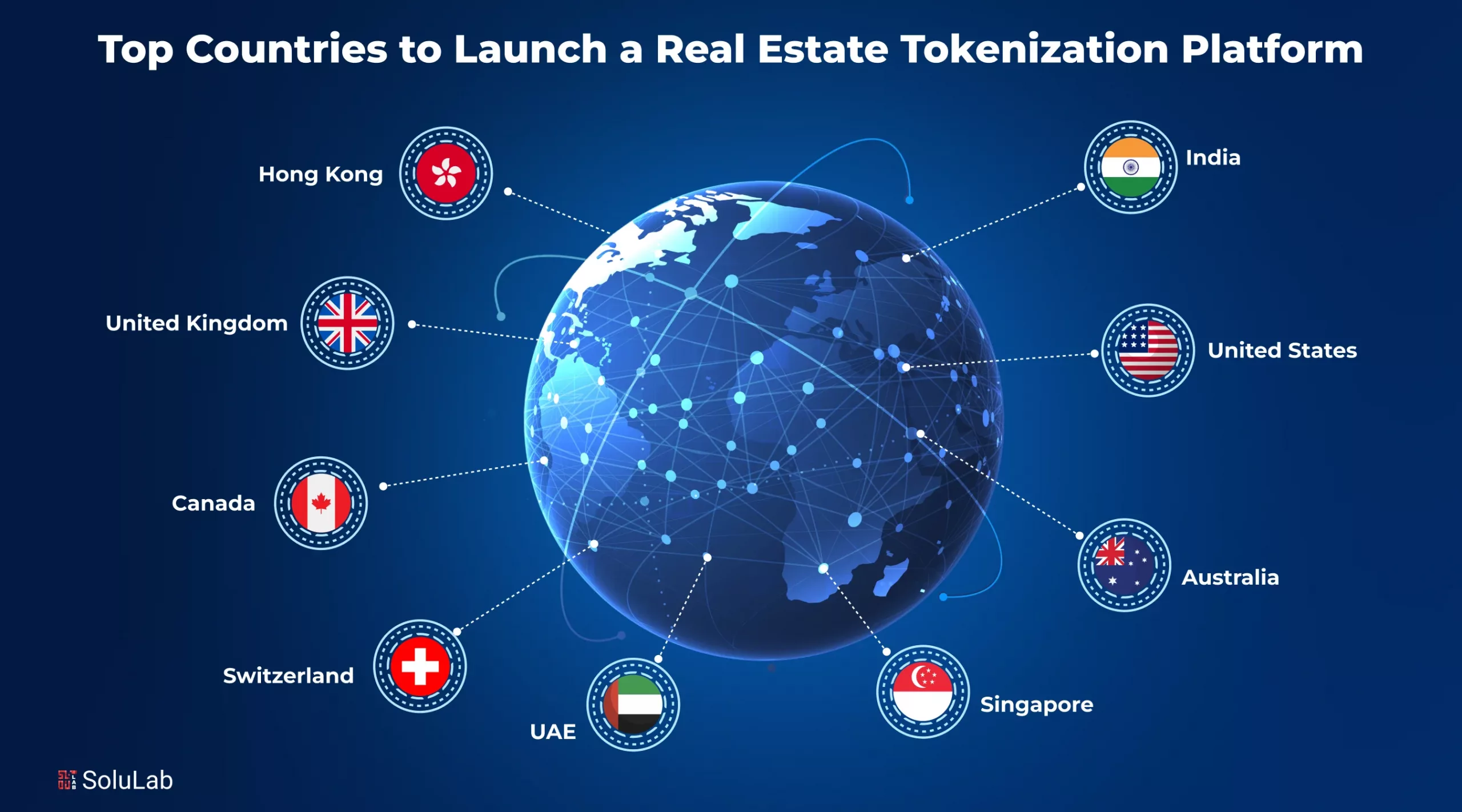
Here are the top 10 countries to consider in 2026 that provide the perfect ecosystem for launching your real estate tokenization platform:
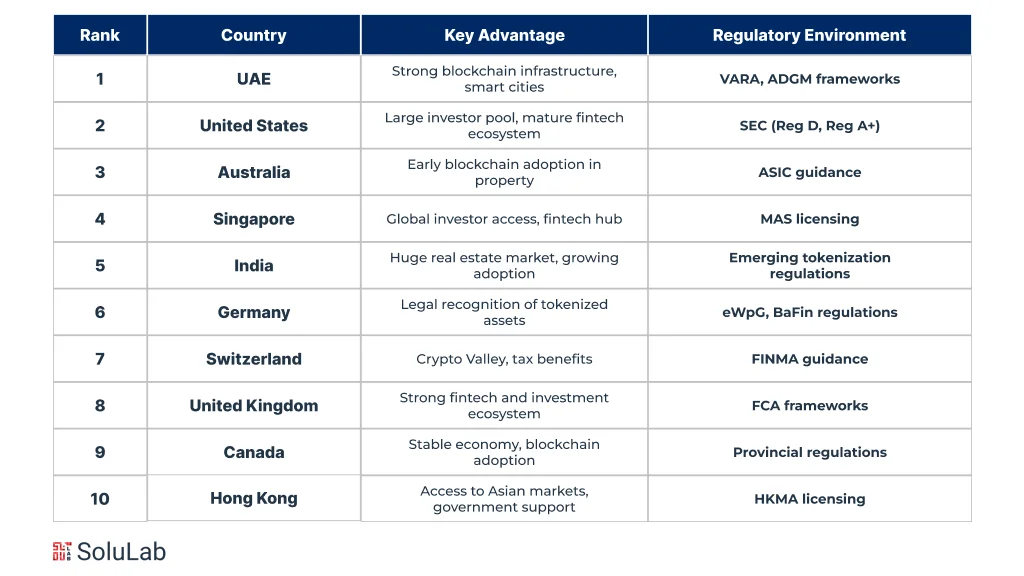
A Quick Overview of Best Countries for Real Estate Tokenization 

Top Countries to Launch a Real Estate Tokenization Platforms

Now, lets have a detailed analysis of every country that why its an ideal choice to invest in real estate tokenization projects before 2025 ends:

  • UAE

The UAE, particularly Dubai and Abu Dhabi, has become a pioneer in embracing blockchain and tokenized assets. With initiatives like the Virtual Assets Regulatory Authority (VARA) and ADGM’s DLT frameworks, the country provides a transparent regulatory environment for digital asset issuance.

  • Regulatory Advantage: VARA licensing for virtual assets ensures legal clarity for tokenization projects.
  • Investment Ecosystem: Strong investor demand for digital real estate and crypto-integrated property sales.
  • Infrastructure: Dubai’s Smart City vision supports blockchain-based property transactions.

Why UAE? It’s one of the few countries where you can legally tokenize properties and attract both local and international investors through compliant structures

  • United States

The U.S. remains the market leader for blockchain startups and real estate investments. With the SEC refining its stance on digital securities, tokenization projects can operate under regulated frameworks such as Reg D and Reg A+.

  • Regulatory Frameworks: Clear security token guidelines under SEC oversight.
  • Market Depth: Trillions in real estate value and a strong appetite for fractional ownership.
  • Tech Ecosystem: Home to top blockchain and fintech innovators.

Why the U.S.? It offers access to one of the world’s largest investor pools and a mature infrastructure for digital securities.

  • Australia

Australia is rapidly becoming a blockchain-friendly destination with government-backed digital initiatives and a strong fintech ecosystem.

  • Regulatory Support: The Australian Securities and Investments Commission (ASIC) provides structured guidance for tokenized assets.
  • Market Adoption: Early adoption of blockchain property registries in states like New South Wales.
  • Stable Economy: High investor trust and real estate transparency.

Why Australia? A strong legal system and digital-first policies make it a safe and progressive environment for real estate tokenization startups.

  • Singapore

Singapore continues to dominate Asia’s landscape with its forward-thinking regulations under the Monetary Authority of Singapore (MAS).

  • Regulatory Clarity: MAS licensing ensures compliance for security and utility tokens.
  • Investor Access: Strong institutional participation in asset-backed tokens.
  • Global Connectivity: Strategic position as a financial and blockchain hub.

Why Singapore? Businesses launching a real estate tokenization platform benefit from transparent regulation, a global investor base, and tech-savvy infrastructure.

  • India

India is gradually embracing Web3 innovation, and real estate tokenization is expected to gain strong traction by 2026.

  • Market Size: $250 billion+ real estate market ready for digital disruption.
  • Regulatory Shift: Gradual progress toward defining tokenized assets and digital property rights.
  • Startup Ecosystem: Rapidly growing blockchain and fintech startup base.

Why India? With a rising middle class and increasing investor appetite for fractional ownership of property, India is set to be a key player in tokenized real estate markets.

Get In Touch

  • Germany

Germany is one of the first EU countries to legally recognize blockchain-based securities. The Electronic Securities Act (eWpG) and BaFin regulations allow full compliance for tokenized assets.

  • Regulatory Advantage: Legal framework for tokenized real estate shares and bonds.
  • Institutional Backing: German banks are exploring blockchain-based asset custody.
  • Stable Market: High investor trust and real estate stability.

Why Germany? It combines legal certainty, strong financial institutions, and a receptive investor community for digital assets.

  • Switzerland

Switzerland remains a top choice for blockchain-based real estate projects thanks to its progressive laws and crypto-friendly banks.

  • Legal Framework: The Swiss Financial Market Supervisory Authority (FINMA) provides clear guidance for token issuance.
  • Innovation Hub: Zug’s “Crypto Valley” is home to leading blockchain companies.
  • Tax Benefits: Attractive tax policies for digital asset businesses.

Why Switzerland? Ideal for global investors seeking a regulated, low-risk jurisdiction with a strong blockchain ecosystem.

  • United Kingdom

The UK continues to evolve its digital asset regulations post-Brexit, positioning itself as a safe, innovative hub for tokenized property investments.

  • Regulatory Direction: The FCA is developing new frameworks for digital securities.
  • Financial Infrastructure: London’s investment networks and fintech community are robust.
  • Global Appeal: Attracts institutional investors seeking compliant blockchain solutions.

Why the UK? Strong legal systems, access to capital, and global credibility make it a prime location for tokenized property ventures. 

  • Canada

Canada has emerged as a forward-thinking market for blockchain asset innovation, supported by clear crypto regulations and strong investor protections.

  • Legal Oversight: Provincial regulators provide clarity on tokenized securities.
  • Blockchain Adoption: Toronto and Vancouver lead in blockchain real estate pilots.
  • Investor Confidence: Transparent taxation and reliable financial institutions.

Why Canada? A stable economic and legal environment makes it one of the most reliable destinations for launching tokenized property projects.

  • Hong Kong

Hong Kong is rapidly positioning itself as a regulated center for digital assets in Asia, following new crypto licensing policies in 2024.

  • Government Support: Proactive Web3 promotion under the Hong Kong Monetary Authority (HKMA).
  • Global Gateway: Strong connection to mainland China and global investors.
  • Regulatory Clarity: New token issuance laws allow for compliant real estate tokenization.

Why Hong Kong? It offers a balance of innovation, regulation, and access to Asian capital markets, which are perfect for tokenized real estate startups.

Factors to Consider for Choosing the Best Country for Tokenization

Before selecting a country for your Real Estate Tokenization Platform, it’s crucial to understand the legal, financial, and technological factors that can impact your project’s success.

1. Regulatory Framework: Choose a country with clear crypto and securities regulations to ensure your tokenized real estate investment platforms operate legally and transparently.

2. Tax Policies: Analyze taxation on digital assets and foreign investments to maximize profitability and minimize unexpected liabilities for your tokenized real estate platform.

3. Investor Protection Laws: Select jurisdictions that offer strong investor safeguards to build trust and attract global participants in your tokenization venture.

4. Market Maturity: Opt for countries with advanced blockchain ecosystems and financial infrastructure to support efficient token issuance and trading.

5. Banking and Payment Systems: Ensure local banks support crypto-related transactions for fund transfers and liquidity in your platform operations.

6. Technology Infrastructure: Reliable internet connectivity and data security frameworks are vital for managing token issuance, trading, and compliance efficiently.
Real Estate Tokenization Development Company

Conclusion

Whether it’s the UAE’s progressive crypto regulations, the US’s institutional adoption, or Singapore’s fintech-driven innovation, as 2025 ends, you have the opportunity to launch real estate tokenization platforms in these top countries.

SoluLab, a leading real estate tokenization development company, helps businesses and investors build secure, compliant, and scalable tokenization platforms that render the true value of digital real estate assets. From smart contract development to regulatory integration and investor dashboards, we deliver end-to-end blockchain solutions tailored to your goals. 

Get in touch today to transform your real estate assets into high-value digital tokens and lead the future of property investment!

FAQs

1. What are platforms for tokenized real estate-backed securities?

These are digital platforms that facilitate buying, selling, and managing real estate assets as blockchain-backed tokens for investors.

2. What are tokenized real estate investment platforms?

These platforms allow investors to invest in fractional property ownership through blockchain tokens, providing liquidity and global access.

3. What is XRP Dubai real estate tokenization?

XRP Dubai real estate tokenization involves leveraging XRP blockchain technology to create secure, fast, and scalable tokenized property assets in Dubai.

4. How do real estate tokenization development services help?

These services assist in creating blockchain solutions, legal compliance, smart contracts, and secure platforms for tokenized real estate investment.

5. How do you tokenize real estate?

You can tokenize real estate by creating blockchain-based digital tokens representing ownership shares, supported by legal and smart contract frameworks.

15 Blockchain Companies Shaping the Real Estate Industry

15 Blockchain Companies Shaping the Real Estate Industry

Properties for vacation rentals. parking areas even ideal residences They will all soon be bought on a blockchain. Indeed, the use of real estate crypto tokens to connect buyers, sellers, and investors as well as learn about properties is growing in popularity. But why is the real estate industry expected to benefit so significantly from blockchain? First and foremost, it fosters trust by enhancing transparency by utilizing distributed ledger technology (DLT). Trust is crucial in real estate, whether it be in a listing, an agent, or a website. Blockchain technology for real estate also streamlines contract procedures, saves time, and lowers expenses.

Blockchain in the Real Estate Industry

Blockchain is the leading technology in real estate since it has a built-in system of trust. Global real estate firms use blockchain in real estate through its ledger and smart contract features to transparently and effectively make renting, purchasing, investing, and even financing possible.

A unified database of leases and acquisitions is more important than ever because of the enormous daily rate of real estate crypto tokens. Blockchain is able to do that. Brokers and agents would be able to access the whole transaction history of a property if the traditional Multiple Listing Service database was upgraded to a blockchain-based one.

Blockchain is being embraced by the expanding property-sharing business in addition to assisting the traditional real estate industry. The 15 blockchain real estate tokenization companies listed below leverage the booming technology to expand their clientele.

CTA1

15 Blockchain Real Estate Companies Shaping the Real Estate Industry

1. SoluLab

One of the best blockchain development businesses with over 50 million active app users and a 97% customer success rate that rivals the competition. The Fortune 500 companies and high-growth startups SoluLab has collaborated with include Walt Disney, Goldman Sachs, Mercedez Benz, the University of Cambridge, Georgia Tech, and others.

SoluLab, led by management executives from Goldman Sachs & Citrix, aims to reduce costs by over 50% for the client with a faster hiring process than other market participants. Through cutting-edge technologies like the cloud, chatbots, blockchain, the internet of things, artificial intelligence, augmented and virtual reality, machine learning, and more, SoluLab’s award-winning enterprise software solutions offer full-spectrum, 360-degree services to startups, small businesses, and large corporations.

2. SafeWire

The expanding problem of wire fraud that real estate companies, agents, clients, and other industries confront as a result of hacker activity has a solution in SafeWire, which ClosingLock recently bought. The SafeWire platform uses a blockchain network to assure security for risky transactions from the time they are sent until the moment they are received & processed, decreasing the amount of money, clients, and time lost as a result of wire fraud.

3. Vairt

With the aid of Vairt, customers can create and diversify a worldwide real estate network and generate side income. When investing in fractional real estate, the robust platform provides several tools and resources to ensure the greatest results. This includes neighborhood and property insights, market overviews, real estate analysis, and long-term assistance, all of which operate on a blockchain network for the highest level of security.

4. RealT

Through a completely compliant, token-based blockchain network, the RealT fractional real estate investing platform enables investors from all over the world to invest in the American real estate market. With permissionless Ethereum & RealTokens, the platform enables investors to purchase tokenized real estate and preserve access to cash flows as well as low maintenance ownership. It provides landlords access to weekly rent payments through the xDai, Ethereum, or US-Dollar stablecoin.

5. PropertyClub

A real estate network called PropertyClub uses blockchain to improve how people advertise, look for, purchase, sell, & invest in properties. Via cryptocurrencies like Bitcoin or the company’s own PropertyClub Coin, the organization transacts real estate digitally using smart contracts.

6. ManageGo

For landlords, ManageGo uses blockchain technology. Property managers and owners may handle payments, fully conduct credit background checks, and manage maintenance tickets with the aid of ledger-backed software.

7. RealBlocks

RealBlocks leverages blockchain real estate companies to open up new real estate investment opportunities. Instead of purchasing complete portfolios or assets, investors can purchase fractional stakes on its platform. RealBlocks assists in lowering costs, accelerating procedures, and offering liquidity choices through tokenization that is implemented utilizing blockchain technology.

8. SMARTRealty

Smart real estate contracts are used by SMARTRealty to create and uphold agreements for the purchase and renting of real estate. The business’s smart contracts assist in setting rules that, if not followed, automatically dissolve a contract, whether it be for paying rent, establishing mortgages, or buying a home.

9. Propy Inc

Smart contracts are used by the real estate marketplace Propy to carry out property deals. Using a series of smart contracts, the company’s platform enables buyers, sellers, and agents to move the real estate market forward more quickly.

10. ShelterZoom

The entire real estate offer & acceptance process is managed by Docuwalk, the document management system provided by ShelterZoom, using blockchain technology. To provide an unchangeable financial record, the safe online platform logs each step taken to close a real estate deal.

11. StreetWire

Through an encrypted ledger that is under the control of the data supplier, StreetWire develops secure and trustworthy solutions for the real estate sector. Its platform makes real estate transactions speedier and more transparent.

12. CPROP

Building blockchain data applications with an emphasis on finding new opportunities, lowering risk, and discovering problems in the real estate sector are what CryptoProperties, also known as CPROP, do. The technology developed by CPROP is used in a variety of real estate fields, such as brokerage deals, investment management, property development, finance, and insurance.

13. The Crypto Realty Group

The Crypto Realty Group is a consultancy firm that collaborates with financial consulting and crypto escrow businesses to assist clients in purchasing and reselling local, national, and worldwide residential, and commercial using local real estate crypto tokens.

14. Blocksquare

While its white-label platform may be used to establish investment platforms, Blocksquare is among the real estate tokenization companies. Their protocol can be applied to digitize the value of real estate assets. The business claims that businesses of all sizes can benefit from its blockchain infrastructure.

15. RealtyBits

RealtyBits makes it easier to invest in real-world assets like real estate using blockchain technology. A user’s account can be created for free and validated in under a minute. Following their initial investment, RealtyBits offers a dashboard that enables them to keep an eye on their assets. One of the company’s investors is Coinbase.

How is Blockchain Technology Changing the Real Estate Industry?

More blockchain use in commercial real estate could have a favorable impact on the sector. Quite a few real estate companies employ blockchain because it is a relatively young technology. But when people become aware of its potential advantages, it can gain popularity. The following are possible uses of blockchain in real estate, particularly within the commercial real estate industry.

  • Faster, More Secure Transactions: Numerous characteristics of blockchain in real estate can result in speedier, more secure transactions. You don’t need to wait for financial institutions to file paperwork because every activity is recorded on a public ledger. Additionally, the use of blockchain in commercial real estate makes it impossible for records to be altered. Consumers currently depend on financial organizations to safeguard their private information, but blockchain in real estate could provide an additional layer of protection. Financial institutions are often targets for data breaches, but with blockchain, property records and ownership data would be less vulnerable to such attacks.
  • Smart Contracts: By minimizing paperwork and the stages required to purchase property, using blockchains in commercial real estate to expedite processes instantly creates chances to cut expenses. Smart contracts built on the blockchain are utilized in the process to help automate it. If/then statements that advance real estate blockchain projects at the proper point can be used in blocks of a ledger. For instance, the smart contract might stipulate that the buyer won’t get a formal price offer until the property has been thoroughly inspected and assessed by an expert.
  • Lower Costs: Another significant benefit of blockchain in real estate is the reduction of transaction costs. By minimizing paperwork and reducing the complexity of purchasing property, blockchain can lower expenses in commercial real estate deals. You can even purchase property tokens on some platforms that use blockchain in real estate, allowing investors to buy a portion of a property with cryptocurrencies, bypassing traditional brokers and their fees.
  • Asset Tokenization: Blockchain technology has the potential to revolutionize how real estate investments are crowdfunded. Currently, ownership of properties funded by crowdfunding is distributed among the investors. A real estate company, for instance, might offer 100 shares. Once fully funded, they use the investor’s funds to buy or construct an asset that will produce income.
  • Tracking Asset Ownership: The structure would be slightly changed by asset tokenization to provide investors & developers more flexibility. You could buy a token that is recorded in a public ledger rather than a portion of the real estate. You now have a fully transparent record of when and how much you spent on the token. You have evidence that you made an investment and the tokens are yours, in case your ownership is ever questioned.
  • Selling Your Real Estate Investment Tokens: Asset tokenization will also make it simpler for you to sell your investment to a third party. Investment agreements currently allow other owners to restrict you from selling your stake without their consent. Even if you are allowed to sell your share without permission, you will still need to complete a tonne of paperwork in order to transfer your ownership to another investor.

CTA2

Final Words

The real estate blockchain, tokenization, as well as cryptocurrency businesses, are all still in their infancy, as are the majority of other blockchain and tokenization integrations into the real world. Although the future seems promising, several obstacles must yet be overcome before the technology can be widely used. As was already said, tokenized real estate, which is arguably the most significant prospective utilization of real estate blockchain projects, is plagued by an extremely unliquid market, a near-total lack of asset trading between platforms, as well as a lack of institutional adoption.

Software wallets like Exodus Wallet and Trust Wallet impress with their user-friendly interfaces and elegant designs. These wallets prioritize security without sacrificing user convenience, making them popular choices for crypto enthusiasts of all levels.

Finally, it should be emphasized that the metaverse’s real estate market is booming. It’s difficult to say whether this is a short-lived trend or a wise investment, similar to real estate crypto tokens. Real-world & metaverse real estate have not yet been connected, but in the future, it’s conceivable that things will start to converge in manners we can only begin to fathom between the “meatspace” real world and the metaverse.

SoluLab, a prominent blockchain development company, specializes in empowering businesses of all sizes, from startups to enterprises, with secure and decentralized blockchain solutions. With a comprehensive range of blockchain development services, SoluLab meticulously assesses each organization’s potential for harnessing blockchain technology to bolster trust and transparency. The company’s expertise extends to the realm of real estate tokenization, offering a gateway to novel opportunities in development and investment. Whether one is a property owner aiming to raise capital through tokenization or an investor seeking portfolio diversification, SoluLab guides the way. As a leading advocate of real estate tokenization development services, SoluLab’s adept professionals are dedicated to delivering top-tier services, enabling clients to unlock the full value of their real estate assets. For a seamless transition into fractional ownership and heightened liquidity, connect with SoluLab today.

FAQs

1. What is the role of blockchain companies in the real estate industry?

Blockchain companies in the real estate industry play a pivotal role by leveraging blockchain technology to enhance transparency, security, and efficiency in property transactions. They provide solutions that streamline processes like property title verification, smart contracts, and secure data sharing among stakeholders.

2. How do blockchain companies simplify property ownership transfers?

Blockchain companies use smart contracts to automate and facilitate property ownership transfers. These self-executing contracts automatically process transactions once predefined conditions are met, reducing the need for intermediaries and expediting the transfer process.

3. What benefits do blockchain companies bring to real estate professionals?

Blockchain companies introduce efficiency gains for real estate professionals by reducing paperwork, minimizing the risk of errors, and expediting transactions. This enables professionals like agents, brokers, and lawyers to focus more on strategic tasks rather than administrative burdens.

4. What future trends can we expect from blockchain companies in real estate?

In the future, we can anticipate further integration of blockchain technology with artificial intelligence, enabling predictive analytics for property market trends. Additionally, increased regulatory support for blockchain-based property transactions and wider adoption of tokenization could reshape the way real estate is bought and sold.

5. What is SoluLab’s expertise in the blockchain industry?

SoluLab is a leading blockchain development company with extensive experience in creating cutting-edge solutions for various industries, including real estate. Their team of experts specializes in developing custom blockchain applications, smart contracts, decentralized apps (DApps), and more, providing innovative solutions that transform the real estate landscape.

6. How does SoluLab contribute to the real estate industry’s digital transformation?

SoluLab empowers the real estate sector by leveraging blockchain technology for enhanced transparency, security, and efficiency. Through their tailored solutions, they enable seamless property transactions, secure data sharing, and automated processes that streamline operations and improve customer experiences.

7. Can SoluLab assist in tokenizing real estate assets?

Absolutely! SoluLab excels in real estate tokenization development. They can create digital tokens backed by physical real estate assets, enabling fractional ownership, liquidity, and broader investment opportunities. This innovative approach enhances accessibility to real estate investments and opens doors for a wider range of investors.
