Talk to an Expert

Top 10 Countries to Launch a Real Estate Tokenization Platform in 2026

Regulations, taxation, investor trust, and even blockchain infrastructure vary from one country to another. Choose the wrong one, and you might face endless compliance, high taxes, or limited investor participation.

The real estate tokenization is expected to exceed $16.51 billion by 2033, growing at a CAGR of 19.50%. That’s why choosing the right country matters more than ever. 

In this blog, we’ll explore the top 10 countries to launch a real estate tokenization platform, highlighting their benefits, regulations, and tips so you can make an informed decision and set your platform up for long-term success.

How the Right Country Boosts Your Tokenized Real Estate Project?

Choosing the right country for tokenization platform development and launch is crucial it impacts regulations, investor confidence, and long-term project success. Let’s explore the key factors to consider before making your decision:

1. Jurisdiction: Ensure the country has clear crypto and tokenization laws. A supportive regulatory framework protects investors and minimizes compliance risks.

2. Taxation: Look for countries offering favorable tax rates on digital assets. This helps in maximizing returns and maintaining operational efficiency.

3. Market Accessibility: Choose a country with global market access and financial infrastructure. It enables transactions and broader investor participation.

4. Blockchain Ecosystem: A strong local blockchain ecosystem supports innovation. Collaboration with top blockchain companies and developers enhances project scalability.

5. Political and Economic Stability: Stable governments ensure consistent policies, reducing risks of sudden legal or economic disruptions. Stability fosters investor trust and project longevity.

6. Data Protection Laws: Opt for nations with robust data privacy regulations. Secure data handling ensures compliance and builds user confidence in tokenized assets.

Top 10 Countries for Real Estate Tokenization Platform Development in 2026

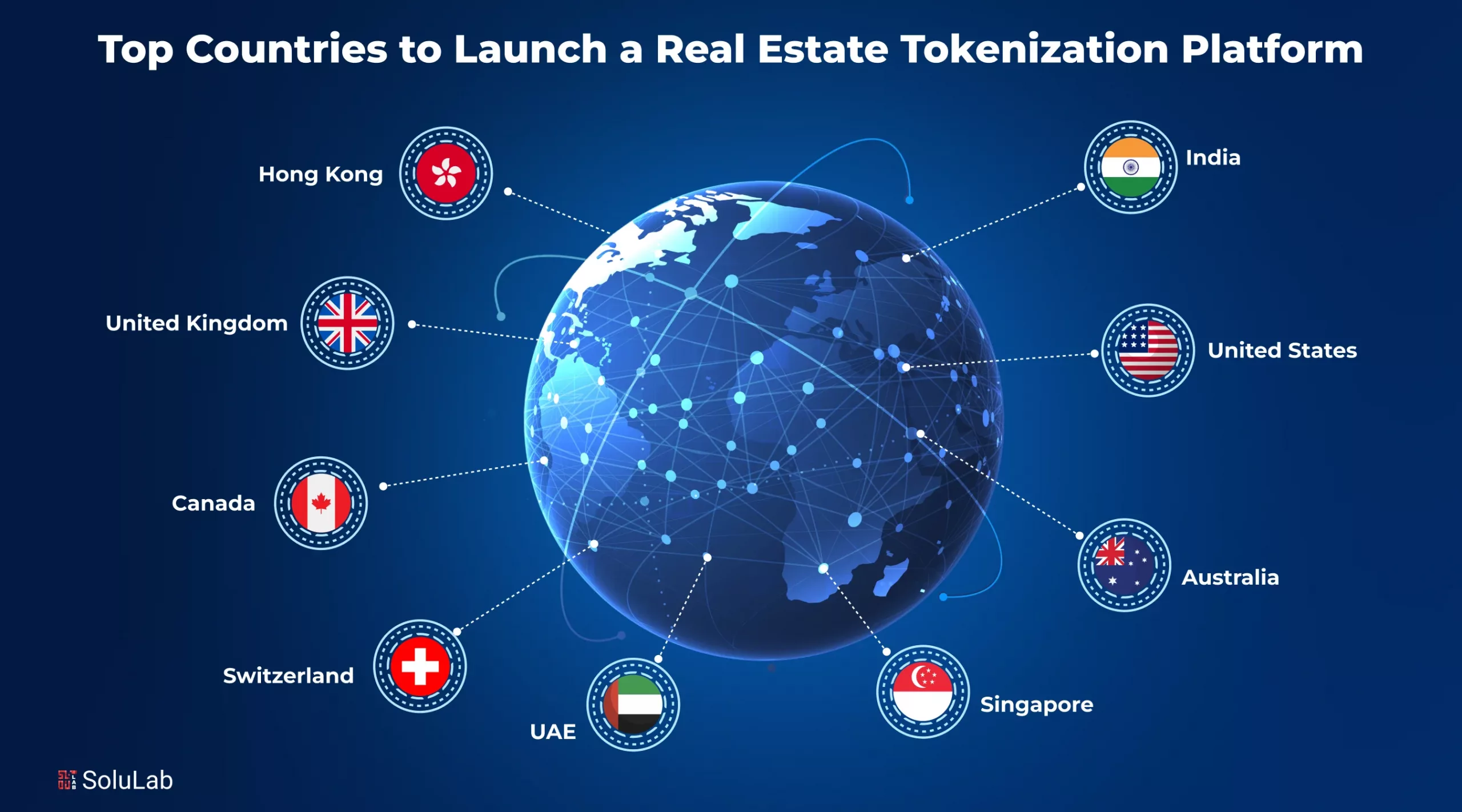
Here are the top 10 countries to consider in 2026 that provide the perfect ecosystem for launching your real estate tokenization platform:
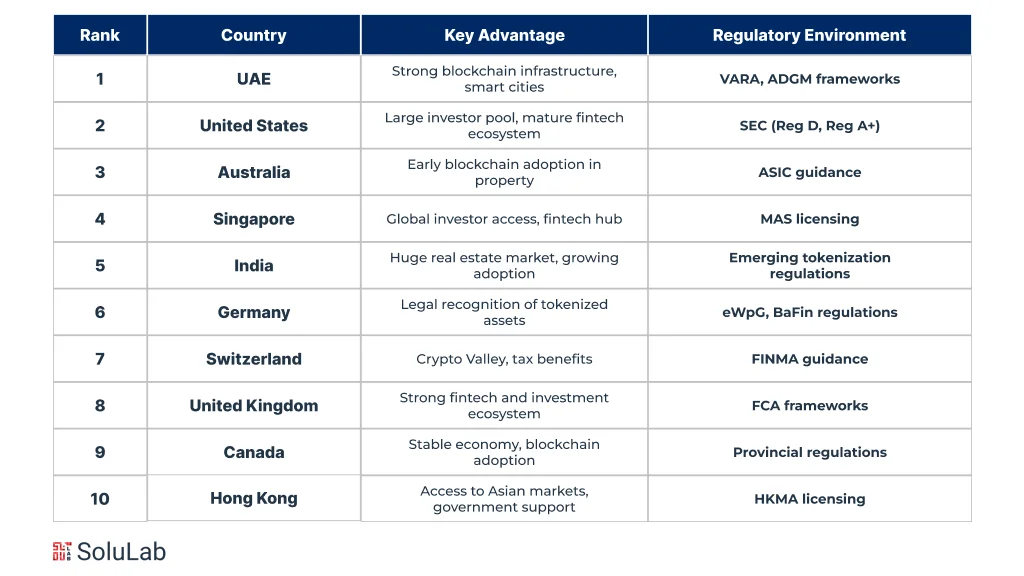
A Quick Overview of Best Countries for Real Estate Tokenization 

Top Countries to Launch a Real Estate Tokenization Platforms

Now, lets have a detailed analysis of every country that why its an ideal choice to invest in real estate tokenization projects before 2025 ends:

  • UAE

The UAE, particularly Dubai and Abu Dhabi, has become a pioneer in embracing blockchain and tokenized assets. With initiatives like the Virtual Assets Regulatory Authority (VARA) and ADGM’s DLT frameworks, the country provides a transparent regulatory environment for digital asset issuance.

  • Regulatory Advantage: VARA licensing for virtual assets ensures legal clarity for tokenization projects.
  • Investment Ecosystem: Strong investor demand for digital real estate and crypto-integrated property sales.
  • Infrastructure: Dubai’s Smart City vision supports blockchain-based property transactions.

Why UAE? It’s one of the few countries where you can legally tokenize properties and attract both local and international investors through compliant structures

  • United States

The U.S. remains the market leader for blockchain startups and real estate investments. With the SEC refining its stance on digital securities, tokenization projects can operate under regulated frameworks such as Reg D and Reg A+.

  • Regulatory Frameworks: Clear security token guidelines under SEC oversight.
  • Market Depth: Trillions in real estate value and a strong appetite for fractional ownership.
  • Tech Ecosystem: Home to top blockchain and fintech innovators.

Why the U.S.? It offers access to one of the world’s largest investor pools and a mature infrastructure for digital securities.

  • Australia

Australia is rapidly becoming a blockchain-friendly destination with government-backed digital initiatives and a strong fintech ecosystem.

  • Regulatory Support: The Australian Securities and Investments Commission (ASIC) provides structured guidance for tokenized assets.
  • Market Adoption: Early adoption of blockchain property registries in states like New South Wales.
  • Stable Economy: High investor trust and real estate transparency.

Why Australia? A strong legal system and digital-first policies make it a safe and progressive environment for real estate tokenization startups.

  • Singapore

Singapore continues to dominate Asia’s landscape with its forward-thinking regulations under the Monetary Authority of Singapore (MAS).

  • Regulatory Clarity: MAS licensing ensures compliance for security and utility tokens.
  • Investor Access: Strong institutional participation in asset-backed tokens.
  • Global Connectivity: Strategic position as a financial and blockchain hub.

Why Singapore? Businesses launching a real estate tokenization platform benefit from transparent regulation, a global investor base, and tech-savvy infrastructure.

  • India

India is gradually embracing Web3 innovation, and real estate tokenization is expected to gain strong traction by 2026.

  • Market Size: $250 billion+ real estate market ready for digital disruption.
  • Regulatory Shift: Gradual progress toward defining tokenized assets and digital property rights.
  • Startup Ecosystem: Rapidly growing blockchain and fintech startup base.

Why India? With a rising middle class and increasing investor appetite for fractional ownership of property, India is set to be a key player in tokenized real estate markets.

Get In Touch

  • Germany

Germany is one of the first EU countries to legally recognize blockchain-based securities. The Electronic Securities Act (eWpG) and BaFin regulations allow full compliance for tokenized assets.

  • Regulatory Advantage: Legal framework for tokenized real estate shares and bonds.
  • Institutional Backing: German banks are exploring blockchain-based asset custody.
  • Stable Market: High investor trust and real estate stability.

Why Germany? It combines legal certainty, strong financial institutions, and a receptive investor community for digital assets.

  • Switzerland

Switzerland remains a top choice for blockchain-based real estate projects thanks to its progressive laws and crypto-friendly banks.

  • Legal Framework: The Swiss Financial Market Supervisory Authority (FINMA) provides clear guidance for token issuance.
  • Innovation Hub: Zug’s “Crypto Valley” is home to leading blockchain companies.
  • Tax Benefits: Attractive tax policies for digital asset businesses.

Why Switzerland? Ideal for global investors seeking a regulated, low-risk jurisdiction with a strong blockchain ecosystem.

  • United Kingdom

The UK continues to evolve its digital asset regulations post-Brexit, positioning itself as a safe, innovative hub for tokenized property investments.

  • Regulatory Direction: The FCA is developing new frameworks for digital securities.
  • Financial Infrastructure: London’s investment networks and fintech community are robust.
  • Global Appeal: Attracts institutional investors seeking compliant blockchain solutions.

Why the UK? Strong legal systems, access to capital, and global credibility make it a prime location for tokenized property ventures. 

  • Canada

Canada has emerged as a forward-thinking market for blockchain asset innovation, supported by clear crypto regulations and strong investor protections.

  • Legal Oversight: Provincial regulators provide clarity on tokenized securities.
  • Blockchain Adoption: Toronto and Vancouver lead in blockchain real estate pilots.
  • Investor Confidence: Transparent taxation and reliable financial institutions.

Why Canada? A stable economic and legal environment makes it one of the most reliable destinations for launching tokenized property projects.

  • Hong Kong

Hong Kong is rapidly positioning itself as a regulated center for digital assets in Asia, following new crypto licensing policies in 2024.

  • Government Support: Proactive Web3 promotion under the Hong Kong Monetary Authority (HKMA).
  • Global Gateway: Strong connection to mainland China and global investors.
  • Regulatory Clarity: New token issuance laws allow for compliant real estate tokenization.

Why Hong Kong? It offers a balance of innovation, regulation, and access to Asian capital markets, which are perfect for tokenized real estate startups.

Factors to Consider for Choosing the Best Country for Tokenization

Before selecting a country for your Real Estate Tokenization Platform, it’s crucial to understand the legal, financial, and technological factors that can impact your project’s success.

1. Regulatory Framework: Choose a country with clear crypto and securities regulations to ensure your tokenized real estate investment platforms operate legally and transparently.

2. Tax Policies: Analyze taxation on digital assets and foreign investments to maximize profitability and minimize unexpected liabilities for your tokenized real estate platform.

3. Investor Protection Laws: Select jurisdictions that offer strong investor safeguards to build trust and attract global participants in your tokenization venture.

4. Market Maturity: Opt for countries with advanced blockchain ecosystems and financial infrastructure to support efficient token issuance and trading.

5. Banking and Payment Systems: Ensure local banks support crypto-related transactions for fund transfers and liquidity in your platform operations.

6. Technology Infrastructure: Reliable internet connectivity and data security frameworks are vital for managing token issuance, trading, and compliance efficiently.
Real Estate Tokenization Development Company

Conclusion

Whether it’s the UAE’s progressive crypto regulations, the US’s institutional adoption, or Singapore’s fintech-driven innovation, as 2025 ends, you have the opportunity to launch real estate tokenization platforms in these top countries.

SoluLab, a leading real estate tokenization development company, helps businesses and investors build secure, compliant, and scalable tokenization platforms that render the true value of digital real estate assets. From smart contract development to regulatory integration and investor dashboards, we deliver end-to-end blockchain solutions tailored to your goals. 

Get in touch today to transform your real estate assets into high-value digital tokens and lead the future of property investment!

FAQs

1. What are platforms for tokenized real estate-backed securities?

These are digital platforms that facilitate buying, selling, and managing real estate assets as blockchain-backed tokens for investors.

2. What are tokenized real estate investment platforms?

These platforms allow investors to invest in fractional property ownership through blockchain tokens, providing liquidity and global access.

3. What is XRP Dubai real estate tokenization?

XRP Dubai real estate tokenization involves leveraging XRP blockchain technology to create secure, fast, and scalable tokenized property assets in Dubai.

4. How do real estate tokenization development services help?

These services assist in creating blockchain solutions, legal compliance, smart contracts, and secure platforms for tokenized real estate investment.

5. How do you tokenize real estate?

You can tokenize real estate by creating blockchain-based digital tokens representing ownership shares, supported by legal and smart contract frameworks.

9 Blockchain Real Estate Companies to Watch in 2026

One should always keep an eye out when buying and selling real estate. Real estate transactions can become a nightmare rather than a pleasurable experience due to risks associated with buying and selling real estate, including fraud, human errors in paperwork, sluggish processing times, bureaucracy, and opaque transactions.

Blockchain in real estate startup owners are considering using blockchain technology to address real estate problems. We chose nine blockchain real estate companies building platforms in the real estate industry. We ranked them based on the following factors: availability of a live product/beta/MVP, money raised, stage of the roadmap, and scalability. This will allow us to demonstrate the most prevalent use cases of blockchain in the real estate industry.

Best Blockchain Real Estate Companies

Blockchain companies in real estate are the leading technology since it has a built-in trust system. Global real estate firms use blockchain’s ledger and smart contract features to transparently and effectively make renting, purchasing, investing, and even financing possible.

A unified database of leases and acquisitions is more important than ever because of the enormous daily rate of real estate crypto tokens. Blockchain in real estate companies can do that. Brokers and agents would be able to access the whole transaction history of a property if the traditional Multiple Listing Service database was upgraded to a blockchain-based one.

Evaluation Criteria

Several criteria should be considered when evaluating blockchain real estate companies that are using blockchain to make an informed decision. Here are some evaluation criteria to help you choose the right blockchain real estate company:

  • Experience and Track Record: Evaluate the company’s experience in the real estate industry and its track record in implementing blockchain solutions. Look for successful case studies or partnerships with reputable real estate organizations.
  • Technology and Infrastructure: Assess the company’s blockchain technology infrastructure, including its platform’s scalability, security, and efficiency. Consider the compatibility of their blockchain solutions with existing real estate systems and networks.
  • Smart Contract Capabilities: Evaluate the company’s smart contract functionality and features. Look for advanced capabilities such as automated property transfers, rental agreements, and escrow services.
  • Data Privacy and Security: Examine the company’s approach to data privacy and security. Ensure they have robust measures to protect sensitive real estate data and comply with relevant regulations.
  • Interoperability and Integration: Assess the company’s ability to integrate with other systems and platforms within the real estate ecosystem. Look for compatibility with industry standards and protocols to facilitate seamless data exchange.
  • Regulatory Compliance: Verify that the company adheres to legal and regulatory requirements in the jurisdictions they operate. Consider their understanding of real estate regulations and how they ensure compliance with their blockchain solutions.
  • User Experience and Adoption: Evaluate the user experience of their blockchain platform and the ease of adoption for both real estate professionals and end-users. Consider the availability of user-friendly interfaces, documentation, and support services.
  • Industry Reputation and Partnerships: Research the company’s reputation within the blockchain and real estate communities. Look for partnerships with established real estate organizations, industry alliances, or collaborations with other reputable companies.
  • Cost and Value Proposition: Assess the company’s pricing structure and evaluate its value in terms of cost savings, efficiency gains, or improved transparency. Consider the return on investment and the long-term benefits of implementing their blockchain solutions.
  • Customer Reviews and References: Seek feedback from existing clients or users of the company’s blockchain solutions. Look for customer reviews, testimonials, or references to gain insights into their level of satisfaction and the company’s performance.

The expanding property-sharing business embraces blockchain and assists the traditional real estate industry. The 15 blockchain real estate tokenization companies that are using blockchain listed below leverage the booming technology to expand their clientele.

Blockchain Real Estate Companies

Here are the Top 9 Blockchain Real Estate Companies to Watch in 2026.

The expanding property-sharing business embraces blockchain and assists the traditional real estate industry. The 9 blockchain real estate tokenization companies listed below leverage the booming technology to expand their clientele.

1. SoluLab

SoluLab offers a white-label real estate tokenization platform, seamlessly integrating with any real estate website. With a user-friendly Web application, buyers and agents can submit offers instantly from online listings. The platform, utilizing multiple blockchain technologies and smart contracts, ensures transparent transactions with real-time notifications and chat features.

Trusted by industry leaders like Waterton, The Corcoran Group, Freeman Webb, Global Switch, and recognized as a top Blockchain development company by Goodfirms, Clutch, and Gartner, SoluLab stands at the forefront of real estate blockchain companies. Founded by industry experts, including a former VP of Goldman Sachs, SoluLab’s excellence is underscored by its 33rd rank on Deloitte’s 2020 Technology Fast 500™ list, marking it as a leading player in real estate blockchain projects.


$25-$49


50-249


2014


Los Angeles, CA, USA


Acreage

2. Propy

Propy, a pioneer in the real estate crypto projects sphere, boasts a decentralized title registry and operates as a global real estate marketplace. Having successfully raised $15 million in its PRO Token Sale in September 2017, Propy embarked on a mission to revolutionize the global real estate industry through blockchain technology. Collaborating with the Ukrainian government and a Chinese real estate services provider, Propy facilitated foreign investors’ access to blockchain real estate, marking a significant leap in the industry.

Currently active in prominent cities like San Francisco, Dubai, Beijing, New York, Moscow, Los Angeles, Miami, and London, Propy enables users to search for properties in their local language. With detailed property information and owner contact options available, Propy facilitates seamless transactions, allowing customers to use bitcoins for real estate purchases on the blockchain.


$25-$49


101-250


2016


California, United States


N/A

3. Harbor

This blockchain real estate venture is dedicated to transforming traditionally illiquid assets like real estate and private equity into tokenized securities compliant with Securities and Exchange Commission (SEC) regulations. Harbor prioritizes compliance checks such as AML (Anti-Money Laundering) and KYC (Know Your Customer) to ensure adherence to regulatory standards when engaging with investors. Leveraging Regulated Tokens (R-Tokens), the network digitizes tangible real estate assets, with a strategic restriction that prevents non-accredited investors from purchasing R-Tokens from their accredited counterparts.

Harbor’s innovative strategy extends to its use of Ethereum’s ERC20 technical framework for R-Tokens, making them theoretically tradeable on any cryptocurrency market that accepts such tokens. The startup aims to collaborate with a client this summer to develop its inaugural securities token, demonstrating its commitment to advancing the capabilities of blockchain technology in the real estate sector.


$55-$90


1-10


2017


California, United States


N/A

4. Mogul

Alex and Joey, the Mogul founders, spent years understanding the intricate real estate investment industry. It became shockingly evident that the system was filled with antiquated procedures after searching the sector, capital stack, and product types. Several prohibitive entrance hurdles were obvious, due to which chaos birthed Mogul.

Mogul is the blockchain oracle for real estate and will continue to disrupt a sector ripe for revolution by liberalizing real estate investing. The mogul’s objective is to provide all investors direct access to real estate for $1 and property owners with cost-cutting, equity-unlocking blockchain-based solutions. Polygon, a “layer two” scalability solution for Ethereum, helps them achieve that. Polygon offers the same security and functionality as Ethereum, but transactions are faster and cheaper.


$25-$50


1-10


2022


Washington, United States


N/A

5. BitRent

BitRent is the first blockchain-based real estate platform that brings together investors worldwide and property developers to raise capital during the early phases of development. Small investments can be made and protected by being registered in the decentralized registry. Along with having its coin, the RNTB token, BitRent, also permits real estate transactions through smart contracts.


$55-$90


11-50


2001


England, United Kingdom


Blizzard, J2 Global

6. Blocksquare

Real estate firms can utilize Blocksquare’s platform to design and offer tokenized investment packages directly on their websites, enabling the sale of real estate assets to a maximum of 100 customers. Blocksquare’s blockchain-based protocol, integrated with data from land registry systems, links crucial real estate items to PropToken smart contracts. These smart contracts not only specify the rules and regulations of each asset but also securely manage ownership. Customers of Blocksquare can conveniently exchange ETH for PropTokens and utilize the decentralized exchange to buy or sell their tokens at any time.


$55-$90


11-50


2017


Ljubljana, Slovenia


N/A

7. Averspace

Averspace is the first C2C (consumer-to-consumer) one of Singapore’s leading blockchain in real estate companies. It is a platform that directly connects landlords and property owners with purchasers or tenants for transactions involving purchasing, selling, or renting real estate without brokers.

The platform also offers a user-friendly smartphone app. The creators of Averspace also work on Real Estate Doc, a cloud-based enterprise project that provides real estate firms with document management, digital signing, payments, and analytics capabilities.


$55-$99


11-50


2016


Singapore


N/A

8. ATLANT

ATLANT, an international blockchain network for real estate, offers tokenization of properties, where the owner provides property information, verifies its condition and debt-free status, and then ATLANT tokenizes the real estate asset, establishing a direct link between the number of tokens and the asset’s value. These tokens are listed on ATLANT’s trading platform, allowing investors worldwide to purchase them and acquire partial ownership of the asset until it is fully funded, with the owner receiving the payment in the chosen cryptocurrency.


$25-$50


11-50


2017


England, United Kingdom


N/A

9. BrikBit

BrikBit, a blockchain-based ecosystem, enables and oversees various activities in the real estate sector, offering benefits to all stakeholders. It utilizes unique blockchains for each real estate object based on the applicable laws and features in a given nation, covering use cases such as providing investment opportunities for construction workers, facilitating home purchases through mortgages with incremental payments, and enabling crowdfunding for property renovation expenses. Although currently in the real estate ICO stage, BrikBit aims to deliver these functionalities.


$25-$50


11-59


2018


Ticino, Switzerland


N/A

How Is Blockchain Technology Changing Real Estate?

More blockchain use in commercial real estate could have a favorable impact on the sector. Real estate companies use blockchain because it is a relatively young technology. But it can gain popularity when people become aware of its potential advantages. The following are possible blockchain uses in commercial real estate.

  • Faster, More Secure Transactions: Numerous characteristics of blockchain can result in speedier, more secure transactions. You don’t need to wait for financial institutions to file paperwork because every activity is recorded on a public ledger. Additionally, using blockchain in commercial real estate would make it impossible for records to be altered. Consumers currently depend on financial organizations to safeguard their private information. Unfortunately, the extra security measures that banks & other financial organizations take don’t guarantee safety. Financial institutions are the target of some of the largest data breaches, probably because fraudsters know they may obtain information there that would aid them in their crimes.
  • Smart Contracts: By minimizing paperwork and the stages required to purchase property, using blockchains in commercial real estate to expedite processes instantly creates chances to cut expenses. Smart contracts built on the blockchain are utilized to help automate it. If/then statements that advance real estate blockchain projects at the appropriate point can be used in blocks of a ledger. For instance, the smart contract might stipulate that the buyer won’t get a formal price offer until the property has been thoroughly inspected and assessed by an expert. Once the buyer has chosen a request, it is sent to the seller and their real estate agent for approval. Blockchain-based smart contracts ensure that all parties keep their promises before the transaction is closed when correctly implemented.
  • Lower Costs: By minimizing paperwork and the stages required to purchase property, using blockchains in commercial real estate to expedite processes instantly creates chances to cut expenses. You can buy property tokens on some websites for real estate. You can buy a house or a portion of a property using cryptocurrencies rather than going through a brokerage that levies fees. Using blockchain to buy the property directly rather than going via go-betweens, you can eliminate all the costs and percentages experts demand when selling or buying property.
  • Asset Tokenization: Blockchain technology has the potential to revolutionize how real estate investments are crowdfunded. Currently, ownership of properties funded by crowdfunding is distributed among investors. A real estate company, for instance, might offer 100 shares. Once fully funded, they use the investor’s funds to buy or construct an asset that will produce income.
  • Tracking Asset Ownership: Asset tokenization would slightly change the structure to provide investors & developers more flexibility. You could buy a token recorded in a public ledger rather than a portion of the real estate. You now have a fully transparent record of when and how much you spent on the token. You have evidence that you invested, and the tokens are yours in case your ownership is questioned.
  • Selling Your Real Estate Investment Tokens: Asset tokenization will also make it simpler for you to sell your investment to a third party. Investment agreements allow other owners to restrict you from selling your stake without their consent. Even if you can sell your share without permission, you must complete the paperwork to transfer your ownership to another investor.

Blockchain Real Estate Companies

Final Thoughts

Here is our final opinion on the decision to use digital research to study the housing market in 2023. If you’ve been considering engaging in this digital real estate transaction, you must first comprehend what blockchains are and how they operate. All the data relating to real estate transactions are intended to be stored in these databases. This industry is booming, and the number of blockchain in real estate companies using the blockchain to transact in real estate is also growing. The list will continue to grow, but we’ve included the top nine that offer specific services to issuers and real estate investors. It is important to keep in mind that blockchain real estate is safe. There is no chance that someone will delete or alter your information because it is saved permanently.

If you are interested in purchasing an investment property and, at the same time, using blockchain networks, you should consider using Solulab’s white-label real estate tokenization platform. SoluLab is a trusted blockchain development company that offers white-label real estate tokenization services. Their platform enables businesses to tokenize real estate assets, providing fractional ownership and investment opportunities. With SoluLab’s expertise in blockchain technology, they create secure and efficient solutions for the real estate industry, enhancing transparency and liquidity in the market. Their services extend beyond real estate tokenization, offering comprehensive blockchain development solutions tailored to business needs.

FAQs

1. How does real estate tokenization benefit investors?

Real estate tokenization offers several benefits to investors, including increased liquidity, fractional ownership, and access to a wider range of investment opportunities. By tokenizing real estate assets, investors can easily buy and sell tokens, eliminating the need for traditional lengthy processes associated with property transactions.

2. Is real estate tokenization secure?

Yes, real estate tokenization leverages blockchain technology, providing a high-security level. Blockchain ensures that all transactions and ownership records are stored in an immutable and decentralized ledger, making it difficult for fraudulent activities to occur. Additionally, smart contracts govern the tokenized assets, ensuring transparency and eliminating the need for intermediaries.

3. Can I invest in real estate with a small budget?

Yes, real estate tokenization allows for fractional ownership, meaning you can invest in a fraction of a property rather than purchasing an entire property. This opens up investment opportunities to individuals with smaller budgets, providing access to the real estate market that was previously limited to high-net-worth individuals.

4. How does tokenization impact property liquidity?

Tokenization enhances the liquidity of real estate assets by enabling fractional ownership and facilitating the trading of tokens on blockchain-based platforms. Investors can easily buy or sell their tokens, allowing for greater flexibility and quicker access to funds than traditional real estate investments.

5. Are there any regulatory considerations for real estate tokenization?

Yes, regulatory compliance is a crucial aspect of real estate tokenization. Each jurisdiction may have different regulations governing securities and digital assets. Working with experienced professionals who understand the legal requirements and can ensure compliance with applicable laws and regulations is important.

6. What is the role of smart contracts in real estate tokenization?

Smart contracts are self-executing contracts with the terms of the agreement directly written into code. In real estate tokenization, smart contracts automate various processes, such as token issuance, ownership transfers, and distribution of returns. They provide transparency, efficiency, and enforceability of the contractual obligations between parties involved in tokenized real estate transactions.

7. Can I tokenize any type of real estate asset?

Any type of real estate asset can be tokenized. Whether residential properties, commercial buildings, or even land, tokenization can be applied to create digital representations of these assets. However, practical considerations such as legal and regulatory requirements, market demand, and asset characteristics must be evaluated before deciding to tokenize a specific property.

Top 12 Real Estate Tokenization Companies in USA

Real estate is entering a major shift as tokenization moves from early pilots to enterprise-scale adoption. Traditional property firms, developers, and financial institutions are now working with technology providers to tokenize equity, loans, and income-producing assets. This transition is driven by clear market signals: rising investor demand, accelerating regulatory support, and the rapid growth of tokenized real estate infrastructure across the U.S.

In this blog, we highlight the top real estate tokenization companies in the USA for 2026. This helps enterprises identify the right partners to support digital transformation, compliance, and scalable asset tokenization.

Key Takeaways

  • The right real-estate tokenization company can cut operational costs by 30% and improve capital-raising efficiency significantly.
  • Strong enterprise platforms enable scalable fractional ownership, wider investor access, and faster, more compliant real estate transactions.

Why is Real Estate Tokenization Accelerating in 2025-2030?

The shift toward tokenized real estate isn’t just a blockchain technology trend. It’s a structural change in how property is financed, sold, and accessed. Market data indicate a clear acceleration curve that real estate developers, asset managers, REITs, and financial institutions should take note of.

  • According to ScienceSoft’s research, by 2030, the global market for tokenized real estate is expected to reach up to $3 trillion. This represents 15% of all real estate assets under management. 
  • Although still early, the demand signals in 2024-2025 show that real estate businesses are already preparing for this transition.

1. Market Traction Is Increasing Faster Than Expected

In June 2024, Deloitte found:

  • 12% of global real estate firms had already implemented tokenization.
  • 46% were actively piloting tokenization solutions.

This means 58% of the industry is already experimenting or adopting in a traditionally conservative market. Real estate sellers are fast realizing that tokenization:

  • Reduces settlement costs,
  • Enables fractional ownership, and
  • Expands their investor base beyond local limits.

2. Tokenization Directly Solves Real Estate’s Biggest Structural Problems

For 10 consecutive years, U.S. investors have ranked real estate as the best long-term investment asset class. Yet the sector continues to battle long-standing issues:

  • High minimum investment requirements,
  • Low liquidity,
  • Slow and expensive settlement cycles, and
  • Multiple intermediaries in every transaction.

Tokenization addresses these friction points instantly.

Blockchain-backed tokens can represent any fractional percentage of a property. This makes it possible to sell fractional ownership units without restructuring the entire asset.
This appeals to:

  • Investors seeking easier entry,
  • Asset managers who want broader distribution, and
  • Developers are looking to speed up capital raises.

3. Tokenization Enhances Liquidity

Historically, real estate market liquidity has been limited. However, tokenization changes this by enabling:

  • Digital onboarding,
  • Instant verification (KYC/AML),
  • Programmable smart contracts, and
  • Secondary trading through ATS-regulated partners.

This creates liquid pathways inside an otherwise illiquid asset class. It also begins to influence investor behavior. Looking ahead, increased liquidity may reshape:

  • REIT demand,
  • Mortgage product structures, and
  • Traditional real estate portfolio architecture.

Higher liquidity typically increases short-term market volatility, which may alter how long-term investors evaluate risk, but it widens participation dramatically.

4. A Rapidly Growing Us Market Makes Early Adoption Strategic

As of 2025, the U.S. tokenized real estate market is experiencing significant growth due to:

  • Strong investor demand,
  • Institutional experimentation, and
  • Rising interest from property sellers looking for operational efficiency.

Asset management firms are already investing in custom tokenization solutions and planning multi-year rollouts. With regulatory developments expected between 2025 and 2028, the U.S. is positioned to become the leading market for tokenized property trading.

Considerable factors for prepare the list:

Obtaining excellent outcomes in selecting the top real estate tokenization companies was no easy feat. However, we achieved this by thoroughly considering the following criteria.

  • Experience and track record in the real estate industry
  • Number of successful tokenization of real estate projects completed
  • Reputation among industry peers
  • Technology and infrastructure in place to support tokenization projects
  • Security and reliability of the platform
  • Ability to scale for larger projects
  • Approach to compliance and regulatory issues
  • Understanding of local laws and regulations
  • Ability to navigate complex legal frameworks
  • Level of support and guidance provided to clients throughout the tokenization process
  • Availability of dedicated project managers and technical support
  • An overall approach to customer service and satisfaction

List of Top 12 Real Estate Tokenization Companies in the USA

1. SoluLab

SoluLab provides an end-to-end real estate tokenization platform designed for enterprises, property developers, and financial institutions. Their platform can be integrated directly into existing real estate websites or deployed as a standalone white-label solution. The system supports multiple blockchains and features compliance-ready smart contracts.

SoluLab has worked with companies such as Waterton, The Corcoran Group, Freeman Webb, Global Switch, Lessen, Orchard, and Qualia. It has been recognized by GoodFirms, Clutch, and Gartner for excellence in blockchain development.


$25 – $49 / hr


50 – 249


2014


Los Angeles, CA, USA


Acreage

2. Harbour

Harbour is known for building one of the earliest compliance-centric tokenization frameworks. The firm focuses heavily on securities law, ensuring every deal is aligned with US regulatory requirements. Harbour supports fractional ownership through compliant digital securities, allowing investors to buy and sell equity shares of real estate assets.

Harbour has received investments from Pantera Capital, Coinbase Ventures, and Andreessen Horowitz. It has collaborated with groups like iCap Equity and Camber Creek.


$100-200


10-50


2017


San Francisco, CA


Morgan Stanley, Goldman Sachs, and Citigroup

3. Roofstock

Roofstock operates one of the most recognized single-family rental (SFR) marketplaces in the US. While not solely a tokenization platform, Roofstock has introduced blockchain-based property trading modules through Roofstock onChain.

Its core strength lies in its property inventory, underwriting, and turnkey rental management services. For B2B buyers, Roofstock brings deal volume, analytics, and real estate expertise, which complements tokenization workflows.


$50-100


50-100


2014


Atlanta, GA


Retail and accredited investors

4. RealT

RealT is a leading fractional ownership marketplace that tokenizes US rental properties. Their model allows global investors to buy small fractional shares and earn daily rental income.

RealT’s strength is liquidity. It allows peer-to-peer transfers and trading through integrated exchanges, making it attractive for investors seeking lower entry barriers and faster settlement cycles.


$50-100


5-10


2015


Austin, TX


Retail and accredited investors

5. Sandbox

Sandbox is included as a category-expanding example—focused not on physical real estate but on virtual land. The platform sells digital land parcels within a decentralized gaming ecosystem using the $SAND token.

This appeals primarily to companies exploring digital twins, virtual property, and metaverse-driven real estate models for future investor engagement.


$50-100


10-50


2019


San Francisco, CA


Global retail investors

6. Propy

Propy offers a blockchain-powered real estate transaction system and gained global attention after launching the first US-based NFT property sale in 2022. Their platform supports legal documentation, smart contracts, and transfer of ownership through tokenized structures.

They focus on simplifying cross-border transactions and enabling faster title verification with secure digital identities.


$50-100


10-50


2013


San Francisco, CA


Retail and institutional buyers

7. Republic

Republic provides regulated tokenization services and investment opportunities for commercial and residential real estate assets. Their platform handles fractional ownership, investor onboarding, and regulatory compliance.

Republic’s ecosystem includes broker-dealers, an ATS, and multiple fundraising frameworks, making it suitable for enterprises exploring compliant multi-asset tokenization.


$50-100


50-100


2016


New York, NY


Retail, accredited, and institutional investors

8. Vesta Equity

Vesta Equity specializes in home-equity tokenization. Property owners can tokenize equity and sell fractions to investors while retaining residency rights. The platform is built on Algorand and offers transparent ownership terms, investor dashboards, and appreciation-linked returns.

This model disrupts traditional HELOC and reverse mortgage structures.


$150-200


10-25


2017


San Francisco, CA


Retail and accredited investors

9. RealBlocks

RealBlocks focuses on institutional-grade real estate tokenization. Their platform supports global distribution through digital shares, automated compliance, and investor onboarding tools.

RealBlocks partners with major investment managers and provides strong back-office automation, making it attractive for funds and asset managers.


$100-150


50-100


2016


New York, NY


Institutions & accredited investors

10. Appdupe

Appdupe offers blockchain development and white-label real estate tokenization solutions aimed at startups and enterprises. Their tokenization system includes investor dashboards, token sale modules, property listing management, and multi-chain support.

They are known for fast deployment timelines and customizable interfaces.


$150


100+


2014


New York City, NY


Global retail & accredited investors

11. MartelTurnkey

MartelTurnkey provides turnkey rental properties and has expanded into fractional real estate investment using tokenized structures. Their focus is operational simplicity: investors can buy tokenized property shares with low minimums and access financial performance data easily.

This model appeals to buyers seeking passive real estate exposure with minimal involvement.


$50-100


10-25


2018


Miami, FL


Retail and accredited investors

12. Redswan

Redswan tokenizes large commercial real estate (CRE) assets, offering fractional ownership opportunities in multi-million-dollar properties. Their platform focuses on CRE liquidity and secondary market potential.

Redswan has already tokenized over $2.2 billion in commercial real estate and is targeting an additional $4 billion over the next few years.


$50-100


10-25


2019


San Francisco, CA


Accredited & global investors

top Real Estate Tokenization Companies in USA cta

Conclusion

Tokenization is reshaping real estate, and companies like Harbour, RealBlocks, Roofstock, and RealT are pushing the market forward. Still, businesses seeking security and long-term reliability need a real estate tokenization development company with proven execution. With 1500+ projects delivered, SoluLab offers an enterprise-ready white-label platform built for modern real estate workflows.

Our services include property detail verification, auto-scaling architecture and multi-lingual support. Additionally, rent and dividend automation, crypto/fiat custody, and a complete smart contract audit report to ensure trust and compliance.

For real estate firms, funds, and financial institutions looking to launch or expand tokenized asset offerings, SoluLab provides the technology, support, and stability to help you scale confidently into the future. Contact us today to make your business goals come true! 

FAQs

1. Why should I consider a real estate tokenization company? 

A real estate tokenization company helps convert physical properties into digital tokens, enabling liquidity, fractional ownership, and streamlined investment workflows.

2. How much does real estate tokenization cost? 

Costs vary based on platform complexity, compliance needs, blockchain selection, and custom features. On average, enterprise-grade real estate tokenization solutions start from $15,000.

3. How long does it take to develop a tokenized real estate platform? 

A standard real-estate tokenization platform requires 3-4 weeks. While fully customized, multi-chain, compliance-heavy solutions may take 2-4 months, depending on features and onboarding requirements.

4. What are the benefits of using a real estate tokenization platform? 

A tokenization platform offers liquidity, lower transaction costs, transparent ownership records, and fractional investment options, making real estate more accessible and efficient.

5. Why should I choose SoluLab for real estate tokenization?

SoluLab offers multi-chain architecture, property verification, automated rent/dividend management and many more. Making it a full-stack real estate tokenization partner trusted by enterprises globally.

Top Real Estate Tokenization Development Companies in 2025

Real Estate Tokenization Development Companies

Due to several technological developments made in this field, the blockchain industry is growing very quickly. These quick-fire developments caught everyone off guard. Among these developments, the Real Estate Tokenization Development is one that is gaining popularity with investors.

The real estate sector has also been affected by the expanded reach of this industry. Due to entry obstacles and the complicated concerns that arise when purchasing any property, there were formerly many restrictions on the real estate market. But since the idea of tokenization was introduced to the real estate sector, everything has changed because even tiny investors with limited resources can now invest and acquire assets.

We are here to help you through this blog if you need clarification on real estate tokenization. Let’s continue the In-depth discussions on real estate tokenization and also real estate tokenization companies for 2025 will be covered in this blog.

How does real estate tokenization work?

Real estate is fractionalized into tokens and maintained on a decentralized database through the process of real estate tokenization. The term “blockchain” refers to this decentralized database, which functions as a kind of electronic ledger for information storage. NFTs and real estate tokens are comparable. A real estate token might stand for any of the following:

  • ownership of a portion of real estate
  • ownership of the whole piece of real estate
  • an ownership stake in a company that manages real estate
  • a stake in a loan with real estate as security
  • a claim to a portion of the earnings derived from real estate

Real estate tokens differ from Real estate investment trusts (REITs) in that tokens allow a specific investment to link a specific real property, as opposed to REITs which typically support investment into pools of varied real estate assets. In a security token offering, the digital tokens are produced and distributed on a blockchain (STO). To award ownership, each ownership portion is transformed into a token and then encrypted.

The sale of Aspen Coins, one of the first profitable commercial real estate STOs raised almost US$18 million in 2018. These digital tokens represented fractional ownership of the opulent St. Regis Aspen Resort in Colorado, USA.

There are numerous such instances, like a project in the United States that aims to fund $100 million by issuing 100 million tokens at $1 each for a 24-story, 374-unit multifamily residential building in downtown San Jose that is being constructed by Alterra Worldwide.

Benefits of real estate tokenization platform

  • Lower barrier to entry

Real estate tokenization facilitates small-scale investor engagement and decreases entry barriers for retail investors by permitting investing in fractional pieces of real estate.

  • Ability to create liquidity

Blockchain technology makes it simple and safe to transfer real estate tokens, enabling investors to diversify their portfolios, lower risk, and increase liquidity in the real estate market.

  • Lower transactional costs

Blockchain technology offers the ability to simplify investment transactions and reduce transaction costs through automated procedures and a permanent, unchangeable digital record.

  • More transparent and efficient transactions 

Blockchain transactions are transparent and irreversible because of the decentralized nature of blockchains, which makes them perfect for the real estate industry with its many parties and intricate processes. Smart contracts that are automatically generated do not include any humans in the transaction process, which makes unfair trades impossible. There is no paperwork or waiting period for transaction completion in a blockchain-based system. Quick decisions and transactions are the outcomes of this. When using blockchain for real estate transactions, there are no set office hours like there are in traditional banking. Instead, the system operates transparently and continuously.

  • Opportunity for small-scale investors 

Real estate is typically regarded as an exclusive class of investment. However, tokenization has made real estate investment possible for smaller investors as well. If investors don’t have vast funds, the excessive cost of real estate assets sometimes discourages them from participating. But things have changed since real estate is now available to small-scale and individual investors thanks to the tokenization of the industry. Tokenization breaks up enormous assets into smaller fractions, making them more inexpensive and available to individuals who are interested.

  • A free-flowing market 

Overly regulated and frequently prejudiced centralized banking systems are harmful to market freedom. The real estate industry now has access to a decentralized, bias-free financial system thanks to blockchain-based tokenization. Each stakeholder has some degree of control over the outcome, and they decide as a group. A market that is streamlined and offers all players an equal chance to flourish results from the removal of unjustified barriers.

  • Decrease in counterparty risk 

It is difficult to track longer transaction chains. The pre-tokenized real estate age presented a dilemma since third parties complicated and distorted the situation. Things are improved from a regulatory standpoint by smart contracts, a crucial component of blockchain-based transactions. The chain of transactions is kept short and free of hazards brought on by weak links with minimal human involvement. Because of this, there is a greatly diminished, if not entirely gone, the danger of counterparty participation.

Read more: 15 Blockchain Companies Shaping the Real Estate Industry

Limitations of real estate tokenization platform

  • Smart contract security loopholes

The blockchain network is well secure. But in smart contracts, you can find loopholes that need to be fixed. Hackers are always trying to sneak into the code and steal money from smart contracts. If the smart contract has been diligently audited, the money isn’t secure. A simple hack or a system glitch could rob the assets of real estate investors. In the worst case, once these assets are lost, their recovery is impossible.

  • Complex licensing requirements 

The tokenization of real estate assets needs licensed platforms for the operations and management of STOs (security token offerings) to be regulated. The process of achieving a license is a bit complex. Even before the licensing stage, you need to go through multiple phases of trial and error and recurrent tests so they can be successful.

  • Regulatory issues

Many people who are working in regulatory authorities and real estate employees have no idea how blockchain technology works and eliminates the issues the sector is facing. These things lead to a poor regulatory environment and generate hurdles for all stakeholders. Regulatory uncertainty dampens the investors’ trust, resulting in poor growth.

  • Tax complexities

Many Tax regimes haven’t clear cryptocurrency tax legislation, which is an issue for stakeholders. Despite the fact that the benefits of tokenization are acknowledged on a worldwide scale, a sound taxation system has not been implemented. Everyone concerned has doubts because there isn’t a single tax system in place.

Some points to be considered!

  • Securities law implications

Generally, the tokenization of real estate will be considered security but an analysis of each specific token should be considered at the outset. If the token is a security, the issuance of such a token will be subject to the applicable prospectus requirements or reliance on an exemption, such as the “accredited investor” exemption.

In addition to the prospectus requirements, the issuer must consider the applicable registration requirements.

  • Reconciliation with the land registries

Real estate tokenization companies requires reconciling the applicable transaction with the current systems of land registration. Each jurisdiction of Canada has its land registration system, and an issuer of a real estate token will be required to reconcile the transaction with the land registration systems of the jurisdictions where the underlying real estate is located.

Top 5 real estate tokenization companies

Blockchain App Factory

Blockchain App Factory

One of the first businesses to tokenize real estate as more than just a qualified Web3 service was Blockchain App Factory. The company is among the top tokenization platforms in real estate across both the physical world and virtual worlds. The business is present throughout the world, it should be noted. Since the company’s professionals are familiar with the real estate tokenization factors, they make sure that all necessary procedures are followed before distributing client project tokens. The business is a wonderful fit for any startup hoping to succeed in the Web3 real estate sector because it has expertise in consultation, legal matters, programming, testing, and promotions.

Appwrk

Appwrk

A Web3 company called Appwrk is engaged in tokenization of real estate among other real estate token platform. The company has established a professional strategy to its real estate asset digitization projects that guarantees the project turns out as planned for clients. The business offers its skills in transaction structure, digitization, technology, distribution, marketing, as well as post-launch assistance to tokenize real estate. If desired, one might even acquire a platform like a token marketplace in addition to tokens. The company’s blockchain developers have completed a number of noteworthy projects on Web3 real estate, and as a result, they have established a solid name in the rapidly increasing Web3 community.

SolidBlock

SolidBlock real estate tokenization

SolidBlock is a unique company that mostly operates in Israel and provides real estate tokenization services. It describes itself as a company that offers tokenization as a service. The company helps entrepreneurs turn their real estate in to the blockchain-based tokens and makes it possible for them to raise money using those tokens. SolidBlock has quickly expanded in a specialised industry thanks to the ideal group of luminaries in development, analysis, legal issues, marketing, and leadership. These services are offered in an admirable manner. For asset fractionalization & security token offering campaigns, the company excels in producing real estate tokens.

Somish

Somish real estate tokenization

For startup enthusiasts looking to tokenize real estate assets, Somish has been another option. Young people with extensive experience working with Web3 apps make up the organisation. Commercial, residential, & trophy real estate tokenizations are the company’s areas of expertise. Additionally, it provides partner networking services, compliance insurance, Web3 real estate advice, and security token offering (STO) services. Additionally, Somish has received other honours, such as hackathon victories, ongoing open-source programming partnerships, as well as technological contributions to the Web3 community.

Blockchain Firm

Blockchain Firm real estate tokenization

Blockchain Firm, a seasoned player in the Web3 market, provides excellent real estate tokenization services. The business offers a wide range of services on the domain, such as the creation of platforms for real estate listings, hybrid tokenization, fractional tokenization, crowdfunding, leasing and rental assistance, and loan & mortgage facilitation. For Web3 real estate, teams at the Blockchain Firm also work on planning, smart contracts, NFT development, website development, platform development, & marketing services. The company has offices across a few nations, a substantial global presence, and extensive expertise working on certain well-known Web3 projects.

Conclusion

The top 5 real estate tokenization companies in 2025 have been explained, along with real estate tokenization itself. Currently, there has been a rapid rise in public awareness of digital real estate, which has made it easier for these enterprises to connect with communities and generate long-term reputation and financial success. Web3 startup enthusiasts can contact one of the aforementioned top tokenization platformsto actualize their ideas in order to launch a business based on the domain in the real world via metaverses. Additionally, blockchain technology may make it simpler for people to access real estate in the following ten years, and firms who launch early may benefit from establishing a reputation.
