Talk to an Expert

A Business Lens on Blockchain Stack: From Layer 0 to Layer 3

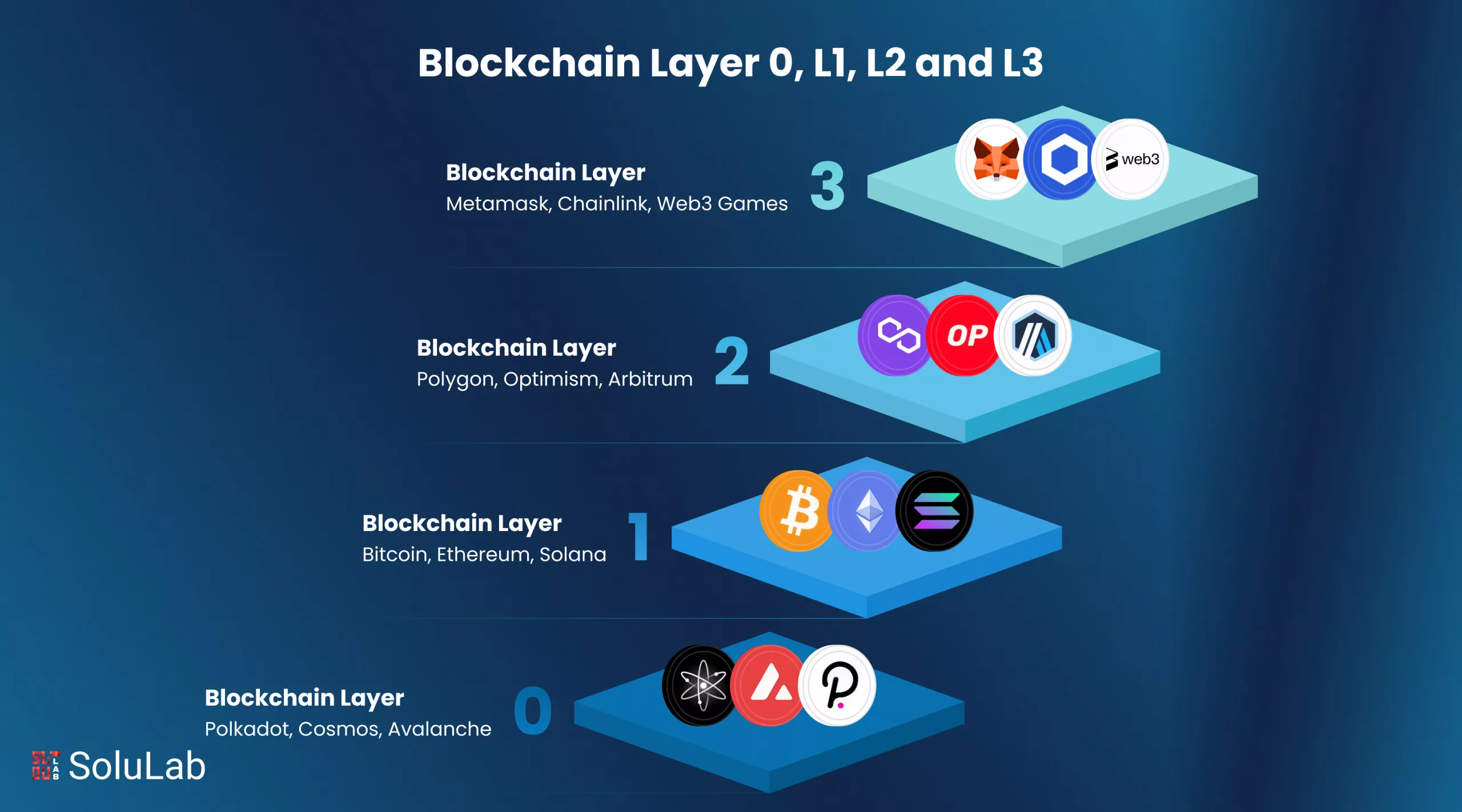
Blockchain Layer 0, L1, L2 and L3

Blockchain technology is growing fast to meet the rising need for better speed, security, and decentralization. As per the World Economic Forum, the total value of crypto assets has passed $1.7 trillion, with more than 3,000 decentralized apps (dApps) live on various blockchain platforms.

As more people and businesses adopt this tech, it’s important to understand how different layers in blockchain work together. From the base infrastructure of Layer 0 to the user-facing apps in Layer 3, each layer plays a key role in making the system faster, safer, and easier to use.

This blog will break down each of the different layers in blockchain​ in simple terms, so you can clearly see how they work and what role they play in building powerful, scalable Web3 and AI products.

What Are The Layers Of Blockchain? 

A blockchain isn’t just one system or a single line of code, it’s made up of multiple blockchain architecture layers, each playing a unique role. These layers of blockchain technology​ work together to make blockchains more secure, faster, and easier to use. 

This structure also helps solve the well-known blockchain trilemma: balancing security, scalability, and decentralization. 

Here they are:

  • Layer 0: This is the base. It includes all the behind-the-scenes parts like networking, data transfer, and how different blockchain platforms connect and talk to each other.
  • Layer 1: The core layer of the system. It runs the main blockchain protocol like Ethereum, Bitcoin, or Solana. It handles things like data validation and transaction recording.
  • Layer 2: This layer sits on top of Layer 1. It improves the speed and reduces the costs of using the blockchain. Tools like Polygon and Arbitrum are popular here.
  • Layer 3: This is what users see. It includes apps like wallets, games, or any tool that lets people interact with the blockchain. These apps are built using the foundation and upgrades of the other layers.

Why Use a Layered Blockchain Structure?

Using layers in blockchain technology makes the system more organized and flexible. It lets developers upgrade certain features without changing everything. For example:

  • Layers can improve speed with tools like rollups or sidechains.
  • Platforms can scale more easily without giving up security.
  • Services like Blockchain-as-a-Service help businesses use blockchain tech without building from scratch.

It also supports more complex systems like cross-chain multi-asset management platforms, which let users interact with different blockchains all in one place, improving blockchain interoperability.

What is Layer 0?

Layer 0 is the base layer of a blockchain network. It includes all the core systems like networking, hardware infrastructure, consensus protocols, and peer discovery mechanisms. It is the operating system of a blockchain.

Key Roles of Layer 0

  • Provides the base network for all other blockchain layers to build on
  • Manages consensus and communication between blockchains
  • Enables security and scalability at the foundational level

Interoperability & Cross-Chain Communication

Layer 0 allows different blockchains to talk to each other using technologies like Cosmos’ IBC and Polkadot’s Relay Chain. This enables multi-chain vs. cross-chain transactions and boosts blockchain interoperability.

Examples of Layer 0 Projects

  • Polkadot: Uses parachains to connect multiple blockchains
  • Cosmos: Enables communication between chains with IBC
  • Avalanche: Offers high throughput and fast finality

These are widely used blockchain platforms for building scalable and secure ecosystems.
CTA1

What is Layer 1?

Layer 1 is where the actual blockchain protocol lives. It defines how the network operates, how consensus is reached, and how transactions are verified.

Core Features

  • Implements consensus methods like PoW and PoS
  • Handles transaction validation and security
  • Hosts the native tokens of the blockchain

Popular Layer 1 Blockchains

  • Bitcoin – Uses Proof-of-Work for secure transactions
  • Ethereum – Powers smart contracts and DeFi apps
  • Solana – Known for high-speed, low-cost transactions

These are strong examples of layer 1 blockchains and are among the top blockchain development companies by adoption.

What is Layer 2?

Layer 1 can get slow and expensive. Layer 2 helps by processing transactions faster and more cheaply, then reporting back to Layer 1.

Main Techniques

  • Rollups: Bundle multiple transactions into one
  • Sidechains: Operate independently but report to Layer 1
  • State Channels: Enable instant payments between users

Key Projects

  • PolygonLayer 2 scaling for Ethereum
  • Arbitrum – Optimistic Rollup for speed and low gas
  • Optimism – Simple scaling using Rollups

This is where the Layer 1 vs Layer 2 vs Layer 3  trade-off becomes important for businesses looking to optimize cost and speed.

What is Layer 3?

Layer 3 is the user-facing part of the blockchain. It includes apps, interfaces, and APIs that connect users to the blockchain.

Key Uses

Examples

  • Metamask – A wallet extension for Ethereum
  • Chainlink Oracles – Connect real-world data to smart contracts
  • Web3 Games – On-chain games that reward players with tokens

With more demand for intelligent systems, AI agents and AI development companies are being integrated into layer 3 blockchain platforms to enhance automation and personalization.

Differences Between Layer 0, Layer 1, Layer 2, and Layer 3

The blockchain ecosystem is made up of multiple layers, each playing a unique role in how decentralized networks function, scale, and interact. Here’s a simple breakdown of Layer 0 to Layer 3 and how they differ:

Layer Main Function Key Technologies Examples Who It’s For
Layer 0 Base infrastructure for blockchains; handles networking and consensus IBC (Cosmos), Relay Chain (Polkadot), Avalanche consensus Polkadot, Cosmos, Avalanche Developers building interoperable or multi-chain ecosystems
Layer 1 Core blockchain protocol manages transactions and consensus PoW, PoS, Smart Contracts Bitcoin, Ethereum, Solana Startups & enterprises launching tokens, smart contracts, or DeFi apps
Layer 2 Offloads transaction load to scale Layer 1; enhances speed and reduces cost Rollups, Sidechains, State Channels Polygon, Optimism, Arbitrum Projects needing faster, cheaper transactions for scalability
Layer 3 Application layer that connects users with the blockchain dApps, APIs, Wallets, Oracles, AI agents Metamask, Chainlink, Web3 Games Businesses focusing on UI/UX, user growth, or integrating AI with Web3

How do Blockchain Layers Work Together?

Blockchain Layers

Blockchain layers aren’t isolated; they’re designed to work together as a stack, each serving a unique purpose while enhancing the overall functionality, scalability, and user experience of blockchain networks.

Here’s how these layers interact:

Vertical and Horizontal Interactions

Blockchain layers stack vertically. Layer 2 builds on Layer 1, which runs on Layer 0. They also connect horizontally through chain abstraction for blockchain interoperability.

Building a Modular and Scalable Web3

Each of the different layers of blockchain can evolve independently. This modular setup supports better upgrades and innovations, vital for blockchain in healthcare and blockchain in trade finance.

Key Responsibilities by Layers

  • Layers 0 & 1 ensure core security and network integrity.
  • Layer 2 offers scalability through efficient processing.
  • Layer 3 enhances user interaction and usability.

Choosing the right combination depends on your application’s goal, whether performance, decentralization, or user experience is the priority.

What Is Scalability in Blockchain?

Scalability in blockchain refers to a network’s ability to handle a growing number of transactions, users, and applications efficiently, without slowing down or becoming too expensive to use.

In simple terms, a blockchain is scalable if it can grow and serve more people without sacrificing speed, cost, or security.

The Blockchain Trilemma

Scalability, decentralization, and security by achieving all three is challenging. Layers of blockchain solve this by dividing responsibilities across layers.

How Layers Solve Scalability Challenges?

  • Layers 0 & 1 maintain decentralization and trust
  • Layers 2 & 3 improve performance and user experience

Real-World Use Cases

  • Gaming: Smooth gameplay with Layer 2 scaling
  • Logistics: Faster, cheaper tracking with decentralized ledgers
  • Finance: Secure trading with reduced latency

These highlight the importance of blockchain use cases in designing performant applications.

Performance Metrics and Tradeoffs

  • TPS (Transactions Per Second)
  • Gas fees (cost per transaction)
  • Latency (speed to finalize transactions)

Layer 2 can deliver 100x throughput over Layer 1 alone.

CTA2

Conclusion

The future of decentralized tech lies in how we leverage each of the blockchain layers. Whether you’re building a DeFi protocol or a retail app powered by AI, understanding this layered model helps you make smarter blockchain architecture layers decisions.

If you’re looking to scale or optimize your blockchain strategy, SoluLab is a trusted blockchain development company in the USA with real-world experience in implementing multi-layer systems. The team is well-versed in rendering top-notch solutions powered by a next-gen tech stack. Recently, SoluLab enabled OBORTECH to utilize Blockchain-as-a-Service (BaaS) to launch scalable blockchain applications without backend complexity, showcasing our expertise in enterprise blockchain development.

Whether you are planning to integrate blockchain or have a unique idea to build, we can cater to all your needs with the best solutions. Contact us!

FAQs

1. Which layer is best for developers to build on?

It depends on the project. Layer 1 is ideal for building secure and decentralized protocols. Layer 2 offers speed and cost-efficiency for apps that need scalability. Layer 3 is great for building user-friendly front-end experiences.

2. Can a blockchain work without Layer 0 or 3?

No, Layer 0 is the base. Layer 3 isn’t required for technical function but is essential for real-world usability.

3. Can a blockchain project operate across multiple layers?

Yes! Many modern blockchain projects use a combination of layers. For example, a DApp (Layer 3) might run on a Layer 2 solution like Arbitrum, which itself is secured by a Layer 1 blockchain like Ethereum, all connected via a Layer 0 protocol like Cosmos.

4. How do these layers benefit enterprise blockchain projects?

Enterprises can use Layer 0 for cross-chain operations, Layer 1 for secure data storage, Layer 2 for scaling high-volume use cases, and Layer 3 for creating user-friendly apps, making the tech stack modular, scalable, and enterprise-ready.

 

Layer-1 Vs. Layer-2: The Blockchain Scaling Solutions

Layer-1 Vs. Layer-2

The number of individuals using blockchain technology is rapidly increasing from a small group to millions. Research experts reveal that around 420 million individuals worldwide are cryptocurrency owners as of early 2023. While this remarkable rise is admirable, it creates an infrastructure bottleneck that hinders the functionality of blockchain networks. This is where blockchain scalability becomes relevant. Blockchain cannot become widely used if we cannot achieve great scalability.  

To address this challenge, developers have devised a range of solutions aimed at enhancing blockchain scalability. Among these solutions, Layer-1 blockchain scaling and Layer-2 blockchain scaling mechanisms have gained prominence, each offering unique approaches to improving the throughput and performance of blockchain networks.

In this blog post, we’ll explore the differences between Layer-1 and Layer-2 scaling solutions, dissecting their respective advantages, drawbacks, and real-world applications. By the end of this discussion, you’ll gain a deeper understanding of these critical components in the quest to achieve scalable, efficient, and accessible blockchain infrastructure.

Importance of Scalability in Blockchain Technology

Scalability is a crucial consideration in blockchain technology due to its direct impact on the network’s performance, user experience, and potential for mass adoption. Several key reasons underscore the importance of scalability:

  • Transaction Throughput: Scalability directly affects the number of transactions a blockchain network can process per second (TPS). Higher throughput enables faster transaction confirmation times and smoother user experiences, essential for applications requiring real-time interactions or high transaction volumes.
  • Cost Efficiency: Scalability solutions that reduce transaction fees or energy consumption make blockchain technology more accessible and cost-effective for users and businesses. Lower transaction costs encourage broader adoption and support the viability of blockchain-based applications across various industries.
  • Network Stability and Reliability: Scalability improvements enhance the stability and reliability of blockchain networks by reducing the risk of congestion, network delays, and transaction backlogs during periods of high demand. A scalable blockchain can accommodate growing user bases and fluctuating transaction volumes without compromising performance or security.
  • Ecosystem Growth and Innovation: Scalability unlocks new opportunities for innovation and ecosystem growth by enabling the development of complex decentralized applications (DApps), decentralized finance (DeFi) platforms, and other blockchain-based solutions. As scalability improves, developers can explore novel use cases and functionalities that were previously hindered by network limitations.

Types of Blockchain Layers

1. Layer-1 (On-Chain Scaling)

Layer-1 Scaling: This refers to scaling solutions implemented directly within the underlying blockchain protocol to enhance its capacity for processing transactions and supporting a larger user base. These solutions aim to optimize the protocol’s core components, such as the consensus mechanism, block size, and data structure, to improve scalability and performance. 

2. Layer-2 (Off-Chain Scaling)

Layer-2 Scaling: Layer-2 solutions operate on top of the Layer-1 blockchain and focus on improving scalability by handling transactions off-chain or via secondary protocols. These solutions aim to alleviate congestion on the main chain and enhance transaction throughput without modifying the underlying protocol. 

CTA1

What is Layer-1 Blockchain Scaling?

Layer-1 blockchain scaling solutions are pivotal in the quest to enhance the scalability of blockchain networks. These solutions focus on refining the core protocol to augment transaction processing capabilities and improve overall network efficiency. Here’s a deeper exploration of Layer-1 scaling:

Layer-1 scaling revolves around making foundational adjustments to the underlying blockchain protocol to bolster its capacity for handling transactions and accommodating a larger user base. These modifications typically target key aspects of the protocol, such as the consensus mechanism, data structure, or block validation processes. By optimizing these elements directly within the protocol, Layer-1 scaling solutions aim to lay a robust foundation for scalability and sustainable network growth.

  • Targeted Protocol Enhancements: Layer-1 scaling solutions focus on optimizing the core aspects of the blockchain protocol to streamline transaction processing and enhance network scalability.
  • Foundational Changes: Unlike Layer-2 scaling solutions, which operate above the base protocol, Layer-1 solutions involve making fundamental modifications directly within the blockchain’s architecture.

Related: Business Lens on Blockchain Stack: From Layer 0 to Layer 3

Examples of Layer-1 Scaling Solutions

Layer-1 scaling encompasses various strategies and techniques aimed at fortifying the underlying protocol. Here are some prominent examples of Layer-1 scaling solutions:

1. Sharding

Sharding is a technique that divides the blockchain network into smaller, manageable segments known as shards. Each shard operates independently, processing a subset of transactions. This parallel processing significantly boosts transaction throughput, enabling the network to handle a larger volume of transactions concurrently. Sharding has been proposed as a solution to address Ethereum’s scalability issues, with Ethereum 2.0 aiming to implement sharding to enhance its transaction processing capabilities.

Related: Top Blockchain Development Companies

2. Consensus Algorithm Optimization

Consensus algorithm optimization plays a crucial role in enhancing Layer-1 scalability. Traditional consensus mechanisms like Proof of Work (PoW) require substantial computational resources for block validation, limiting scalability. Transitioning to more efficient consensus mechanisms, such as Proof of Stake (PoS) or Delegated Proof of Stake (DPoS), can significantly improve scalability by reducing the computational overhead and energy consumption associated with block validation. Projects like Cardano (PoS) and EOS (DPoS) have adopted alternative consensus mechanisms to enhance scalability and network efficiency.

Pros and Cons of Layer-1 Scaling Solutions

Pros and Cons of Layer-1 Scaling

Layer-1 scaling solutions offer both advantages and challenges. Let’s examine the pros and cons:

Pros:

  • Enhanced Scalability: Layer-1 scaling solutions directly address scalability concerns at the protocol level, resulting in substantial improvements in transaction throughput and network performance. By optimizing core protocol components, Layer-1 solutions lay the groundwork for long-term scalability and sustainable network growth.
  • Decentralization: Many Layer-1 solutions prioritize maintaining or enhancing decentralization, ensuring the network remains secure and resistant to censorship. By implementing scalable solutions that preserve decentralization, blockchain projects can uphold the core principles of transparency, immutability, and trustlessness.

Cons:

  • Complexity and Risk: Implementing Layer-1 scaling solutions often involves making fundamental changes to the blockchain protocol, which can introduce complexities and potential vulnerabilities. Modifying core protocol components requires careful planning and extensive testing to ensure compatibility, stability, and security. Additionally, the introduction of new features or consensus mechanisms may introduce unforeseen risks or attack vectors, necessitating thorough risk assessment and mitigation strategies.
  • Potential Centralization: Some Layer-1 solutions may inadvertently lead to increased centralization if they favor certain nodes or validators over others. For example, consensus mechanisms like Proof of Stake (PoS) or Delegated Proof of Stake (DPoS) rely on token ownership or voting power to determine block validators, potentially concentrating control in the hands of a few large stakeholders. This centralization risk undermines the network’s decentralization and security, necessitating measures to promote inclusivity, fairness, and decentralization.

Read Also: Layer 3 Blockchain

What is Layer-2 Blockchain Scaling?

Layer-2 scaling solutions operate above the base Layer-1 protocol and aim to improve blockchain scalability by handling transactions off-chain or through secondary protocols. Unlike Layer-1 scaling solutions, which involve making fundamental changes to the underlying protocol, Layer-2 solutions focus on enhancing scalability without directly modifying the core blockchain architecture. Instead, Layer-2 solutions enable faster and more efficient transaction processing by conducting transactions off-chain and settling them on the main chain only when necessary. This approach reduces congestion on the main chain, increases transaction throughput, and improves overall network performance.

  • Scalability Enhancement: Layer-2 scaling solutions aim to enhance blockchain scalability by processing transactions off-chain or via secondary protocols, alleviating congestion on the main chain and improving transaction throughput.
  • Off-Chain Transactions: Layer-2 solutions enable participants to conduct transactions off-chain, allowing for faster and more cost-effective transactions while maintaining security and trustlessness through cryptographic mechanisms.
  • Main Chain Settlement: Transactions conducted off-chain are settled on the main chain only when necessary, reducing the burden on the main chain and enhancing overall network efficiency.

Different Types of Layer-2 Scaling Solutions

Types of Layer-2 Scaling

Layer-2 scaling encompasses various techniques and protocols designed to improve scalability through off-chain transaction processing and secondary protocols. Here are some common types of Layer-2 scaling solutions:

1. State Channels

State channels enable participants to conduct multiple transactions off-chain while preserving security and trustlessness through cryptographic mechanisms. Participants exchange signed messages off-chain, updating the state of their transactions, and settling the final outcome on the main chain when necessary. State channels are well-suited for use cases requiring frequent interactions and real-time transaction processing, such as micropayments and gaming. 

2. Rollups

Rollups are a Layer-2 scaling solution for blockchain networks. They work by processing transactions off-chain, aggregating them into a single compressed data structure, and then periodically settling the aggregated data on the main blockchain. Rollups come in two main types: optimistic rollups, which rely on optimistic execution and dispute resolution, and zk-rollups, which use zero-knowledge proofs to provide cryptographic assurances of transaction validity without revealing sensitive data. Rollups significantly enhance blockchain scalability, reduce transaction costs, and improve overall network efficiency while maintaining security and trustlessness.

3. Sidechains

Sidechains are independent blockchains connected to the main blockchain, allowing for faster transaction processing and experimentation with different consensus mechanisms or features without congesting the main chain. Sidechains enable participants to transfer assets between the main chain and the sidechain, providing scalability benefits while maintaining interoperability with the main chain.

4. Plasma

Plasma is a framework for creating hierarchical tree structures of sidechains (child chains) anchored to the main blockchain (parent chain). Plasma enables high-throughput transaction processing by aggregating multiple transactions into blocks on the child chain and periodically settling the state on the main chain. Plasma is suitable for applications requiring high scalability and security, such as decentralized exchanges (DEXs) and tokenized assets.

Read Also: Blockchain Interoperability’s Impact Enterprise Adoption

A Comparative Analysis Between Layer-1 Blockchains vs. Layer-2 Blockchains

Layer-1 and Layer-2 scaling solutions each offer unique approaches to addressing blockchain scalability challenges. Here’s a comparative analysis of their key characteristics:

Scalability Approach

  • Layer-1: Layer-1 scaling solutions involve making fundamental changes to the underlying blockchain protocol to directly improve scalability. These solutions aim to optimize core protocol components, such as consensus mechanisms and block size limits, to increase transaction throughput and improve network performance.
  • Layer-2: Layer-2 scaling solutions operate above the base protocol and focus on improving scalability through off-chain transaction processing and secondary protocols. By handling transactions off-chain or via secondary layers, Layer-2 solutions alleviate congestion on the main chain and enhance transaction throughput without modifying the underlying protocol.

Transaction Processing

  • Layer-1: Transactions on Layer-1 are processed directly on the main chain, which may lead to congestion and slower transaction speeds during periods of high network activity. Layer-1 scaling solutions aim to improve transaction processing efficiency at the protocol level.
  • Layer-2: Layer-2 solutions enable transactions to be processed off-chain or via secondary protocols, reducing congestion on the main chain and enabling faster transaction speeds. Off-chain processing allows for more scalable and cost-effective transactions, particularly for use cases requiring frequent interactions and real-time processing.

Security and Decentralization

  • Layer-1: Layer-1 solutions typically prioritize maintaining or enhancing security and decentralization, as changes to the core protocol can impact the network’s integrity and trustlessness. Ensuring robust security and decentralization is crucial for maintaining user trust and network reliability.
  • Layer-2: Layer-2 solutions introduce additional security considerations, such as channel disputes and data availability challenges, which must be addressed to maintain the integrity and trustworthiness of off-chain transactions. While Layer-2 solutions offer scalability benefits, ensuring security and decentralization remains paramount.

Implementation Complexity

  • Layer-1: Implementing Layer-1 scaling solutions often requires making fundamental changes to the blockchain protocol, which can be complex and require coordination among network participants. Changes to the core protocol may also introduce risks and require extensive testing and validation.
  • Layer-2: Layer-2 solutions may involve less complexity in implementation compared to Layer-1 solutions, as they operate above the base protocol and focus on improving scalability through off-chain processing. However, ensuring compatibility, security, and interoperability with the main chain and other Layer-2 solutions is still essential.

Factors to Consider When Choosing Between Layer-1 and Layer-2 Scaling

When evaluating whether to implement Layer-1 or Layer-2 scaling solutions, several factors should be considered:

1. Scalability Requirements: Assess the specific scalability needs of the blockchain network, including transaction throughput, latency, and cost considerations. Determine whether Layer-1 or Layer-2 solutions are better suited to address the scalability challenges based on the network’s requirements.

2. Security and Trustlessness: Consider the security and trustlessness implications of implementing Layer-1 versus Layer-2 scaling solutions. Evaluate the trade-offs between scalability, security, and decentralization, and prioritize solutions that maintain the integrity and reliability of the network.

3. Implementation Complexity: Assess the complexity and feasibility of implementing Layer-1 versus Layer-2 scaling solutions. Consider factors such as development effort, coordination among network participants, and risks associated with modifying the core protocol versus implementing off-chain solutions.

4. Use Case and Application Requirements: Consider the specific use cases and application requirements that the blockchain network aims to support. Evaluate whether Layer-1 or Layer-2 scaling solutions are better aligned with the performance, functionality, and user experience needs of the applications running on the network.

CTA2

Use Cases Where Layer-1 or Layer-2 Scaling Might be More Suitable

The suitability of Layer-1 or Layer-2 scaling solutions depends on the specific use cases and requirements of the blockchain network. Here are some scenarios where each approach might be more suitable:

Layer-1 Scaling Use Cases

1. High-Volume Financial Transactions:

Blockchain networks supporting high-volume financial transactions, such as cryptocurrency exchanges or payment processing platforms, require fast and efficient transaction processing directly on the main chain. Implementing Layer-1 scaling solutions like sharding or consensus algorithm optimizations can increase transaction throughput and reduce latency, enabling the network to handle a larger volume of transactions without sacrificing security or decentralization. Layer-1 scaling solutions ensure that high-volume financial transactions are processed quickly and securely on the main chain, enhancing the overall efficiency and reliability of financial applications.

2. Decentralized Finance (DeFi) Protocols

DeFi protocols, including decentralized exchanges (DEXs), lending platforms, and liquidity pools, require fast and cost-effective transaction processing to support complex financial transactions and interactions. Enhancing Layer-1 scalability through protocol optimizations or consensus algorithm upgrades can improve transaction throughput and reduce transaction fees, making DeFi protocols more accessible and efficient for users. Layer-1 scaling solutions empower DeFi protocols to support a larger user base and handle a greater volume of transactions, fostering greater adoption and liquidity within the decentralized finance ecosystem.

Layer-2 Scaling Use Cases

1. Microtransactions and Micropayments

Applications requiring frequent microtransactions or micropayments, such as online gaming platforms, content monetization systems, or pay-per-use services, need fast and inexpensive transaction processing to provide a seamless user experience. Implementing Layer-2 scaling solutions like state channels or payment channels allows users to conduct off-chain transactions quickly and cost-effectively, reducing transaction fees and latency associated with on-chain transactions. Layer-2 scaling solutions enable applications to support microtransactions and micropayments at scale, unlocking new revenue streams and business models while minimizing transaction costs and delays for users.

2. Privacy-Preserving Applications

Applications handling sensitive data or requiring transaction privacy, such as healthcare record management, supply chain tracking, or identity verification systems, need robust privacy-preserving mechanisms to protect user confidentiality and data integrity. Leveraging Layer-2 solutions like zk-rollups, which use zero-knowledge proofs to provide cryptographic privacy guarantees, enables applications to maintain transaction privacy while ensuring transaction validity and integrity. Layer-2 scaling solutions enhance the privacy and confidentiality of transactions and data, enabling applications to comply with regulatory requirements and protect user privacy without sacrificing scalability or performance.

Which Blockchain Layer Will Rule the Future?

It is justifiable to assume that layer 2 blockchains will be the most widely used in the future given the facts provided above. They facilitate interoperability and increased blockchain adoption by offering cheaper transaction speeds. Although a layer 2 blockchain still requires a layer 1 to support it, it will prosper as long as it can maintain its increased efficiency and feature set.

But the solution is not that straightforward. The blockchain world is constantly expanding and changing at a fast pace. While Solana and other more recent third-generation blockchains provide hundreds of transactions per second, Cosmos’ distinctive network design allows for efficient interoperability and scalability. Ethereum is also going through major changes that will deal with its speed and scalability

Ultimately, layer 2 blockchains are significant because they address a gap in layer 1 blockchain development. Layer 2 scaling solutions might not be necessary if layer 1s can meet user demand on their own. If enough people choose layer 1 blockchains with interoperability and scalability built in, that will be determined over time. 

Conclusion

In conclusion, the trade-offs of Layer 1 and Layer 2 blockchains must be understood in order to select the best option for your use case. Although Layer 1 blockchains offer a high degree of decentralization and security, they could have issues with scalability and transaction speed. However, Layer 2 blockchains can forgo decentralization and security in favor of speed.

Blockchain technology is continually developing, with new developments appearing on a regular basis. At the moment, layer 2 blockchains are the most widely used method for increasing scalability and cutting expenses. But it’s crucial to keep a watch on more recent third-generation blockchains since they’re expanding the scope of what can be done on Layer 1.

SoluLab, a leading blockchain development company, specializes in offering innovative solutions to both Layer-1 and Layer-2 scaling issues. We provide personalized solutions to improve the scalability and performance of blockchain networks by using our blockchain technology experience and unique approach. Our experienced blockchain engineers focus on Layer-1 protocol advancements like sharding and consensus algorithm optimizations, as well as Layer-2 scaling solutions like state channels and zk-rollups. Whether you want to improve the scalability of your blockchain network or deploy off-chain scaling solutions, SoluLab is your reliable partner. Contact us today to hire blockchain developers and maximize the potential of your blockchain project.

FAQs

1. What is the difference between Layer-1 and Layer-2 scaling solutions?

Layer-1 scaling solutions involve making fundamental changes to the underlying blockchain protocol to directly improve scalability, while Layer-2 scaling solutions operate above the base protocol and focus on improving scalability through off-chain transaction processing and secondary protocols.

2. How do Layer-1 scaling solutions improve blockchain scalability?

Layer-1 scaling solutions improve blockchain scalability by optimizing core protocol components, such as consensus mechanisms and block size limits, to increase transaction throughput and improve network performance directly at the protocol level.

3. What are some examples of Layer-2 scaling solutions?

Examples of Layer-2 scaling solutions include state channels, sidechains, Plasma, rollups, and other off-chain scaling techniques that enable faster and more cost-effective transactions by processing transactions off-chain or via secondary protocols.

4. What are the advantages of Layer-2 scaling solutions?

Layer-2 scaling solutions offer several advantages, including improved scalability, reduced transaction fees, faster transaction speeds, enhanced privacy, and the ability to support a larger volume of transactions without congesting the main chain.

5. How do I choose between Layer-1 and Layer-2 scaling solutions for my blockchain project?

When choosing between Layer-1 and Layer-2 scaling solutions, consider factors such as scalability requirements, security and decentralization, implementation complexity, and specific use cases and application requirements to determine which approach is more suitable for addressing your project’s scalability challenges.


What are Blockchain Layers?

Blockchain Layers

Blockchain architecture pertains to the components, subcomponents, or layers that comprise a comprehensive blockchain system. Each layer has a specific purpose, ranging from data storage to network communication and system-wide consensus.

Understanding these layers of blockchain is critical for engineers and start-up founders looking to use this technology properly.

In this blog, we will explain the complexities of blockchain architecture by breaking it down into layers and their related functionality. Our objective is to assist you in understanding the complexity of blockchain design, optimizing performance, and identifying any security risks.

Overview of Blockchain Architecture

Blockchain Architecture

Blockchain has transformed the way information is stored and transmitted. It is widely regarded as the greatest invention of the 21st century, and it will soon be incorporated into ordinary Internet applications. However, because of its intricacy, most people are unfamiliar with how Blockchain works. In this essay, we’ll demystify how blockchains function and the many levels within them in the simplest way possible.

Simply said, blockchain is a distributed ledger used to store transaction data. For example, Bitcoin is powered by the Bitcoin blockchain, and every transaction that involves the sending and receiving of Bitcoins is recorded on the blockchain. Because of its openness, it is a viable alternative to traditional record-keeping and verification methods. This means that any transaction on a public blockchain may be viewed by everyone.

Furthermore, a blockchain is not controlled by a single corporation, but rather by everyone who validates transactions. This eliminates a single point of failure, making blockchain hacking nearly difficult because there is no point of origin. It promotes openness, removes intermediaries, and lowers operating expenses.

Now that we’ve covered the principles of blockchain, let’s look at the layers in blockchain and how they work together. 

Blockchain is primarily made up of five layers: hardware infrastructure, data, network, consensus, and application. These blockchain architecture layers have a distinct function. These different layers of blockchain work together to provide a full solution that includes data administration on the back end and user-facing apps on the front end.

  • The Hardware Layer 

Blockchains are built around peer-to-peer information exchange. The hardware layer consists of a network of devices that contribute to the blockchain’s computational power. Most significantly, blockchains are the total of all the nodes that compose them. A node is a computer or network of computers that decrypts transactions.

  • The Data Layer

The data layer comes after the hardware layer, and it stores transaction details. The transaction stored in a block (the fundamental unit of a blockchain) contains information on the cryptocurrency delivered, the receiver’s public key, and the sender’s private key. Each data-containing block is linked to the previous and subsequent blocks formed. Only the genesis block, the network’s initial block, is connected forward rather than backward.

Related: Multi-Chain Vs. Cross-Chain: The Future of Blockchain?

  • The Network Layer

This layer handles interactions among nodes on a blockchain. While blockchain is an open system, each node must be aware of the transactions that other nodes are confirming. The network layer facilitates this communication.

  • The Consensus Layer

This layer is accountable for block validation. Let us explain the consensus layer with an example. Let’s assume John and Mark are two blockchain validators. They are given transactions, which must be decrypted and appended to the block. 

Transactions that John receives are: A and B

The transactions that Mark gets are B and C.

If both John and Mark confirm the transactions and upload them to the blockchain, transaction B will appear twice on the blockchain. This indicates that double expenditure will occur. To prevent this, John and Mark compete to solve a complex mathematical challenge, and the first person to answer it will add the block to the blockchain. This type of consensus process is known as Proof of Work. 

In the case of Proof of Stake (POS), the system selects the validator dynamically.

  • The Application Layer

Apps are created on the application layer in blockchain. These applications might be anything. Examples include wallets, social media apps, browsers, defi apps, and NFT platforms. Though the app’s UI/UX is identical to that of any other conventional application, the distinction is that these apps’ data storage is decentralized at the backend.

CTA1

What are Blockchain Layers?

Blockchain technology has revolutionized the world of finance and beyond. However, the intricacy of the technology can be frightening for newbies, particularly when attempting to comprehend the various levels that comprise the blockchain ecosystem.

Most people imagine cryptocurrencies in terms of market capitalization, which may be deceptive. A cryptocurrency’s worth is defined not just by its market capitalization, but also by the unique problem it answers, the underlying technology, and the layer of the blockchain ecosystem in which it exists.

So, what are the layers of blockchain? Blockchain layers are the several tiers of infrastructure that collaborate to allow the functioning of a blockchain-based system. Each layer builds on top of the preceding one, and each layer uses the infrastructure of the previous layer.

Related: Layer-1 Vs. Layer-2: The Blockchain Scaling Solutions

To facilitate comprehension, the blockchain ecosystem can be divided into four layers:

  • Layer 0 – Software Infrastructure

Layer 0 refers to all digital technologies that enable blockchains. Layer 0 aims to make blockchain networks viable, accessible, and interoperable. This enables developers to identify more innovative options, resulting in increased token usefulness for consumers. Layer 0 enables functioning blockchains through physical infrastructures including hardware, energy, and Internet services. Decentralization is a key distinction between traditional telecom corporations and Layer 0 initiatives. Layer 0 protocols improve blockchain communication, allowing them to synergize and use each other’s dApp ecosystems.

Cross-chain interoperability protocols (CCIP) are what Layer 0 is all about. Blockchains that are functional with one another can transfer tokens and data with ease. Examples of CCIP initiatives that give blockchains and apps off-chain data are Chain Link, Cosmos, and Polkadot.

  • Layer 1 – Blockchains/Networks

Blockchains are initiatives at Layer 1. Public blockchains are electronic ledgers that make it simple to read and contribute financial data while preventing tampering with already-existing data. Every blockchain has a unique consensus methodology to decide what information should be added, and smart contracts are used to carry out transactions without the need for outside intervention. Smart contracts are independent programs that don’t communicate with users directly, in contrast to apps. While some smart contracts, like those in Bitcoin, simply permit simple payments, others, like those in Ethereum, let programmers design sophisticated applications.

Solana, Ripple,  Binance Chain, Monero, and Litecoin are among the more Layer 1 blockchain. Developers select a blockchain according to its design; decentralization, security, and scalability are the top priorities for any network.

  • Layer 2 – Sub-Blockchains

Layer 2 blockchains are created by blockchain developers using existing blockchains as a foundation for their own. They utilize Layer 1 blockchain technology, which makes them more scalable and effective. For instance, the L2 blockchains Polygon, Arbitrum, and Optimism on Ethereum are less expensive and speedier. Nonetheless, their reduced size makes them more concentrated. L2s are likewise dependent on L1s, thus when L1s are unavailable, they cannot function. Conversely, there’s no assurance that L2 blockchains will be as safe as L1 blockchains because many of them are experimental networks.

L1 blockchains, like Ethereum 2.0 and Bitcoin Taproot, are updated on a regular basis by the community. With time, flexible blockchains grow more decentralized and safe. Such modifications are prevented by smart contracts on immutable blockchains like Ethereum. Instead, developer communities generate hard forks such as PulseChain. A fork blockchain is a variation of the original blockchain with additional features and code changes, resulting in differing scalability, security, and decentralization. The teams who build Layer 2 and fork chains are frequently unaffiliated with Layer 1 creators.

  • Layer 3 – Decentralized Applications (DApps)

The action takes place in Layer 3. The primary draw of Layer 3 is its decentralized applications (DApps), which are constructed on top of blockchains. DApps are software programs that offer a decentralized user experience and operate on a blockchain network. Simple financial apps like Bitcoin wallets and intricate ones like decentralized exchanges, lending protocols, and prediction markets are among them.

DApps are constructed on top of many blockchains, each of which has unique smart contract features and consensus mechanisms. The most widely used blockchain is Ethereum.

It is noteworthy that every layer has a distinct function and is necessary for the blockchain ecosystem to function. The top layers could not work correctly without a solid basis in the bottom layers. 

Differences Between Layers 0,1,2,3

Layer 0 This layer contains the protocols, hardware, and other fundamental components.
Layer 1 It is responsible for maintaining the blockchain’s code, consensus process, and dispute resolution. As an illustration: Blockchains for Ethereum and Bitcoin.
Layer 2 Compared to Layers 0 and 1, Layer 2 has greater scaling possibilities. It can be combined with solutions from outside sources.
Layer 3 dApps and other user-facing apps are hosted on this layer.

What is Scalability in Blockchain Technology?

Because of the increasing prevalence of cryptocurrencies in everyday life, blockchain layers are now all but essential since they improve network security and revolutionize recordkeeping, among other things.

Consider Bitcoin as an example:

The Visa network’s electronic payment network is capable of handling over 20,000 transactions per second, but Bitcoin’s primary chain can only handle seven. The disparity is astounding. For this reason, many layer 2 blockchain systems are now in use. These systems employ smart contracts to automate transactions.

CTA2

What Makes Blockchain Scalability Essential?

Since a blockchain can’t simultaneously optimize for all desirable attributes, trade-offs must be made. The increased demand has led to a rise in transaction prices to the point where some users are unable to continue using the blockchain.

The current ability of blockchains, such as Ethereum and Bitcoin, to grow is restricted. In order to overcome the blockchain trilemma, a global community of IT firms, startups, and researchers is working feverishly to build layer one and layer two solutions. Blockchain networks are designed to be scalable, secure, and fast. Additionally, they encourage novel goods and technology that can improve the scalability of current blockchain networks. Bitcoin seeks to address the problem by supplementing the existing blockchain layer with a new layer. 

As Bitcoin gains traction in the business sector, blockchain developers are working to broaden the scope of blockchain efficiency. We can reduce processing times and increase TPS (transactions per second) by developing blockchain layers and improving scalability using what is now known as “layer two” technologies.

Conclusion

In wrapping up, grasping the layers of blockchain technology is key to understanding its intricacies and possibilities. Each layer—network, consensus, incentive, and application—plays a vital role in ensuring secure and efficient transactions within decentralized systems. As blockchain evolves, a deep understanding of these layers becomes increasingly crucial for developers, businesses, and enthusiasts alike.

SoluLab stands out as a top blockchain consulting company, offering tailored solutions to businesses aiming to leverage blockchain’s potential. With expertise spanning various blockchain platforms and a commitment to innovation, SoluLab provides end-to-end support, whether it’s developing decentralized applications, integrating smart contracts, or enhancing existing systems with blockchain technology. Ready to explore the benefits of blockchain? Take the first step with SoluLab today. Contact us now!

FAQs

1. What are the main layers of blockchain technology?

Blockchain technology comprises several layers: the network layer, consensus layer, incentive layer, and application layer. Each layer serves a distinct purpose in facilitating secure and transparent transactions within decentralized networks.

2. How does the network layer of blockchain function?

The network layer of blockchain is responsible for maintaining the peer-to-peer network infrastructure. It ensures that nodes can communicate and validate transactions efficiently across the network, fostering decentralization and resilience.

3. What role does the consensus layer play in blockchain?

The consensus layer establishes a mechanism for achieving agreement among network participants on the validity of transactions. Through various consensus algorithms like Proof of Work (PoW) or Proof of Stake (PoS), consensus ensures that all nodes in the network reach a common understanding of the ledger’s state.

4. What are some real-world applications of blockchain technology?

Blockchain technology finds application across diverse industries, including finance, healthcare, supply chain management, and voting systems. For instance, it enables secure and transparent peer-to-peer transactions in finance, facilitates immutable and accessible health records in healthcare, enhances traceability and authenticity in supply chains, and ensures the integrity and transparency of electoral processes.

5. How can businesses get started with blockchain implementation?

Businesses interested in adopting blockchain can begin by identifying use cases where the technology can address specific pain points or enhance existing processes. They can then collaborate with experienced blockchain development companies like SoluLab to design, develop, and deploy tailored blockchain solutions. SoluLab offers comprehensive support, from initial consultation to implementation and maintenance, to help businesses navigate their blockchain journey seamlessly.
