Talk to an Expert

Blockchain KYC Solutions: What They Are & Top Companies in 2025

Blockchain KYC Solutions

In a world where most things are now digital, proving who you are online has become more important and more difficult than ever before. The process of Know Your Customer (KYC) helps banks, fintechs, and other businesses verify identities to stop fraud, follow the law, and build trust with their users.

But let’s be honest, traditional KYC methods can be slow, expensive, and even unsafe. That’s where Blockchain KYC comes in. It uses blockchain technology to make identity checks faster, safer, and more transparent. And the timing couldn’t be better. 

According to Statista, The digital identity verification market is projected to reach $18 billion by 2027 and The blockchain market is expected to hit $39.7 billion globally by 2025.

These numbers show that KYC blockchain isn’t just a trend; it’s the future of identity verification. Businesses around the world are already working with blockchain KYC companies in the USA to improve security, cut costs, and stay compliant with ever-changing regulations.

What Is Blockchain-Based KYC?

Blockchain KYC is a smarter, decentralized way to handle identity checks. Instead of keeping customer data in private systems owned by banks or financial platforms, KYC blockchain uses blockchain technology to store information safely. This data is encrypted, can’t be changed, and is only shared when the user agrees.

The key to this system is the use of blockchain smart contracts. These are automated programs that help businesses quickly and safely check customer identities, follow regulations, and keep a full history of all actions. Everything happens in real-time, making the KYC/AML process faster, more secure, and less expensive.

Why KYC Needs Innovation?

The traditional Know Your Customer (KYC) process is outdated and full of problems that slow down businesses and frustrate users.

Here’s what’s wrong with the old way:

  • It can take up to 30 days just to verify one customer.
  • Users often have to submit the same documents again and again on different platforms.
  • Businesses spend $60–$80 or more per user on KYC checks.
  • There’s a high risk of data leaks and identity theft, since personal information is stored in centralized systems.

That’s why companies are now turning to blockchain technology for KYC. With blockchain KYC verification, the entire process becomes faster, cheaper, and safer.

Instead of storing sensitive data in one place, blockchain KYC companies use decentralized networks. This allows users to own and reuse their identity securely across platforms without repeating the process each time.

This isn’t just a small improvement, it’s a complete shift in how we manage identity. With the power of blockchain based KYC, it becomes smarter, safer, and far more user-friendly.

How Does Blockchain Improve KYC Processes?

Using blockchain in KYC/ AML process solves many problems found in traditional identity verification systems. Here’s how:

How Does Blockchain Improve KYC Processes

1. Immutability

Once information is added to the blockchain KYC system, it cannot be changed or deleted. This creates a secure, tamper-proof record of customer data. It helps prevent fraud and makes the data highly reliable for regulators and businesses. Immutability is one of the strongest benefits of using a KYC DLT System.

2. Transparency for Regulators

All customer verifications are recorded in a way that regulators can easily track. If needed, they can quickly review compliance records. This builds trust with authorities and ensures that blockchain KYC systems meet legal standards.

3. User Ownership of Data

In a traditional system, your data is held by multiple institutions. With blockchain based KYC platform, the customer controls who can access their identity documents through private keys and permissions. This improves privacy and reduces data misuse. This is especially useful in sectors like finance and healthcare, where data sensitivity is high.

4. Automation Using Smart Contracts

With blockchain smart contracts, most of the identity checks can be automated. For example, when a user submits documents, smart contracts can instantly validate the data, reducing the need for manual checks. This reduces time, human error, and cost and it also supports scalability, especially for blockchain KYC companies working with thousands of users.

5. Higher Security with Cryptography

Each identity is stored in encrypted form on the blockchain based KYC platform.. This makes it very hard for hackers to steal or alter sensitive data. Compared to traditional KYC databases, KYC blockchain platforms offer much better protection. This is why more blockchain development companies in USA are now focusing on secure identity management solutions.

Key Features of Blockchain KYC Systems

Blockchain KYC systems are changing the way businesses verify identities. Here are the main features that make them powerful, secure, and ready for the future:

1. Reusable Digital Identity

Users don’t need to submit the same documents over and over again. Once verified, a person’s digital identity can be securely shared with other approved institutions. This reduces onboarding time and improves user experience.

2. Permissioned Access

With blockchain technology, data is not stored in one place; it’s decentralized. Users have control over who can view or access their personal information. Only trusted parties, such as a blockchain consulting company in the USA or financial institutions, can access the data through permissioned layers.

3. Fraud Detection with AI Agents

Thanks to AI and blockchain integrations, unusual behavior or suspicious activity can be flagged instantly. These intelligent tools work in real time to detect fraud, enhancing the security of KYC workflows.

4. Global Regulatory Compliance

Whether it’s a bank in Europe or an insurance company in Asia, orthe  UAE, blockchain KYC systems are built to follow local and international KYC/AML processes. They help companies stay compliant with cross-border regulations, which is especially helpful for global businesses.

Many of these advanced features are already being used by top blockchain development companies in industries like finance, insurance, and healthcare blockchain solutions.

These systems not only boost efficiency but also lower costs and help companies stay ahead of compliance risks, all while offering better protection for customer data.

Top Benefits of Blockchain KYC for Businesses

Adopting blockchain KYC systems brings clear, measurable improvements for businesses and users alike:
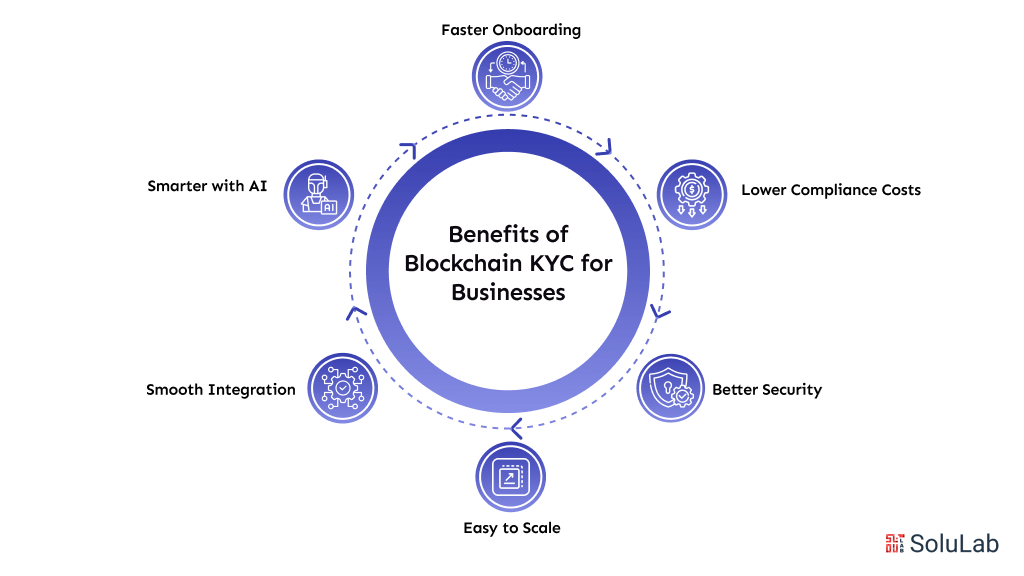
Benefits of Blockchain KYC for Businesses

1. Faster Onboarding

With a decentralized system, verifying customer identity becomes quicker. Companies can reduce user onboarding time by up to 90%, which helps improve customer experience significantly.

2. Lower Compliance Costs

Traditional KYC processes are expensive and time-consuming. Switching to a Blockchain as a Solution for KYC can cut compliance costs by 40–50%, making it ideal for financial services, crypto exchanges, and e-commerce platforms.

3. Better Security

Since data is stored on a decentralized blockchain network, the risk of hacking, leaks, or tampering is greatly reduced. It’s one of the safest ways to manage sensitive customer information today.

4. Easy to Scale

As businesses grow or expand into new regions, blockchain KYC companies USA can easily update and adjust to new regulations or requirements. It’s a future-proof solution that supports global scalability.

5. Smooth Integration Across Platforms

Blockchain smart contract and Layer 1, Layer 2 systems work together seamlessly. This means data can move securely across different platforms without repeating verification steps.

7. Smarter with AI

Adding technologies like AI in finance and AI workflow automation makes the process even more efficient. These systems can predict and automate tasks like fraud detection, reducing manual work and increasing trust.

Top 5 Companies Developing Blockchain KYC Solutions

Here are five top companies leading innovation in blockchain KYC and digital identity verification:

Top 5 Companies Developing Blockchain KYC Solutions

1. SoluLab

SoluLab is a top-rated blockchain development company in the USA known for building powerful solutions that combine KYC blockchain and AI agent technologies. Their products are designed for industries like e-commerce and finance, helping businesses stay compliant while improving customer onboarding.

2. Civic

Civic offers a secure identity verification platform through easy-to-use mobile apps. It uses blockchain-based KYC to give users full control of their data while meeting KYC requirements.

3. SelfKey

SelfKey is a decentralized KYC identity system that allows individuals and businesses to manage, control, and share personal information securely. It’s designed to work across multiple platforms and services.

4. Bloom

Bloom focuses on creating secure and privacy-first solutions for credit scoring and digital identity. It uses AI and blockchain smart contract features to keep user data safe while offering instant verifications.

5. uPort

uPort is an open-source identity platform built on Ethereum. It gives users the ability to manage and verify their identity directly through the blockchain, eliminating the need for centralized systems.

These companies are often supported by expert services like a smart contract development company to help bring these identity products to life.

Key Use Cases Across Industries

1. Banking

Banks are now using blockchain KYC to run real-time identity checks without depending on slow third-party verification. This not only improves speed but also helps with regulatory compliance. With blockchain technology, banks can safely store and share verified customer data across branches and systems.

2. Healthcare

Healthcare blockchain companies are applying blockchain KYC systems to verify patient identities more securely. Medical records can be linked to verified identities using blockchain smart contracts, reducing errors and fraud in patient data.

3. E-commerce

Online platforms are turning to AI-powered chatbots to onboard new sellers and buyers quickly. These automate identity onboarding using blockchain KYC utility. These bots automate identity verification using blockchain KYC companies solutions, helping marketplaces speed up operations while staying compliant.

4. Insurance

Insurance companies now combine AI in finance with KYC blockchain systems to simplify claims processing. Verified customer data can be accessed instantly, reducing paperwork, cutting fraud, and improving user experience. Automation also makes onboarding new policyholders faster and more secure using a KYC with AI and blockchain.

5. Crypto

In the crypto space, those who want to start a cryptocurrency exchange benefit greatly from blockchain based KYC platform. It allows instant verification of users with tamper-proof records. This builds trust, helps meet global compliance standards, and supports safe trading environments.

Token-based identity models are becoming more popular too. These are powered by asset tokenization and supported by secure blockchain based KYC platforms. They offer a new way to manage digital identities across finance, healthcare, e-commerce, and more.

The Future of Blockchain KYC solutions

The future of blockchain KYC looks bright, with powerful innovations already reshaping how identity verification works. Here’s what to expect:

1. Smarter KYC with AI agents

Advanced AI agents and Blockchain will handle customer verification in real time, reducing delays and improving accuracy. They’ll make KYC faster, more secure, and more automated.

2. Cross-Chain Identity Systems

With the rise of multi-chain vs. cross-chain technology, user identities can be verified across multiple blockchain platforms without repeating the KYC DLT systems for each one.

3. Web3 Integration

Web3 development companies are helping bring KYC blockchain systems into the decentralized internet, giving users more privacy and control over their data providing a Web3-ready blockchain KYC utility.

4. Self-Sovereign Identity (SSI) 

This means users will fully own their digital identity, without needing a middleman. It’s a key goal of many blockchain KYC companies, and it’s already becoming a reality.

5. Regulatory-Ready Blockchain KYC

As governments adapt, AI development companies and blockchain companies in USA are working together to build KYC solutions that are secure, scalable, and compliant.

With the help of all these, the future of KYC will be decentralized, efficient, and fully digital.

Blockchain Development Solutions

Final Thoughts

Blockchain KYC is no longer just a trend; it’s becoming the future of digital identity. As KYC blockchain solutions grow, businesses now have smarter, safer, and faster ways to verify users while staying compliant with global regulations.

If you’re exploring decentralized KYC solutions or want to build a trusted onboarding process with AI, SoluLab, top blockchain development company, can help. We specialize in developing smart, secure platforms with advanced AI agent integration.

Book a free consultation with us today to explore how we can build your next-gen blockchain-based KYC Platform.

FAQs

1. What is KYC on blockchain?

KYC on blockchain is a way to verify customer identities using a decentralized and secure system. Instead of relying on a central database, data is stored across multiple blockchain nodes, making it more transparent and tamper-proof. It’s faster, safer, and ideal for digital identity verification.

2. Is blockchain KYC secure?

Yes, blockchain KYC is highly secure. It uses cryptographic encryption and smart contracts to protect sensitive user data. Unlike traditional systems, data isn’t stored in one place, which reduces the risk of hacks or leaks.

3. Can AI improve blockchain KYC?

Absolutely. AI Workflow Automation and AI agents can speed up identity checks, flag risks in real-time, and reduce manual errors. Combining AI with KYC blockchain helps businesses meet compliance faster and more efficiently.

4. How does it save money?

Blockchain KYC reduces costs by cutting out middlemen and automating repetitive tasks. With fewer human touchpoints, companies spend less on labor, audits, and third-party services.

5. Which industries are adopting this?

Many sectors now use KYC blockchain, including finance, cryptocurrency exchanges, insurance, healthcare, and e-commerce. It’s especially useful in areas where secure identity verification is critical and regulations are strict.

How Blockchain Is Revolutionizing the Fintech Industry?

Blockchain In the Fintech Industry

The fintech industry is realizing how blockchain technology can revolutionize revenue generation, enhance end-user experience, streamline delivery, increase efficiency, and lower operational risk.

Like any other tech-related business, fintech is still in its early stages of development. These days, a number of brand-new finance applications appear every day, providing improved and innovative methods for handling and processing payments.

The majority of the blockchain market is made up of fintech, and for good reason. By the end of 2028, the blockchain in fintech market analysis is projected to be valued at $36.04 billion. A new financial system called Decentralized Finance (DeFi) is built on blockchain technology and lessens the power of banks over money and financial services. The way we receive, send, store, and handle money will likewise change over the next several decades as a result of digital ledgers.

This article examines how blockchain in fintech is changing the financial industry for both people and enterprises. We’ll also demonstrate how blockchain-based solutions may streamline procedures and address problems unique to a certain sector.

Understanding Blockchain in Fintech Industry

Blockchain, a decentralized ledger for P2P transactions, has been a staple in finance for over a decade. DeFi, an outcome of blockchain integration, revolutionizes financial operations, enhancing accessibility, transparency, and security. It enables direct asset exchanges sans intermediaries.

DeFi encompasses technologies enabling decentralized financial transactions on blockchain networks, enhancing accessibility, transparency, and security by merging fintech with blockchain. Moreover, it enables direct asset exchanges between entities, eliminating the necessity of intermediaries.

Related: Top 10 Fintech Software Development Companies

With a projected valuation of $10.02 billion in 2022, the worldwide technology of blockchain in the fintech market is expected to expand at a compound annual growth rate of 87.7% until 2030. Simultaneously, the DeFi market, valued at $13.61 billion in 2022, is anticipated to grow at a 46% CAGR through that same year.

Furthermore, in 2021, venture investors nearly tripled their investment in fintech businesses, investing over $133 billion.

Thus, it is evident that financial institutions favor distributed ledger technology. Let’s examine how it can fill up the holes in conventional financial services to comprehend why.

Blockchain’s Potential to Solve Fintech Industry Challenges

Blockchain: Transforming Fintech Challenges

In the fintech sector, mismanagement is frequently the cause of issues including missed deadlines, protracted fundraising rounds, and rising losses. The financial sector faces the following list of issues that blockchain technology can help with:

  • High Operational Expenses

Blockchain has the potential to lower transaction expenses in the financial sector. Even a simple credit card transaction includes many partners in a typical system: the retailer, bank, and credit card network. For its services, each organization charges a fee.

Due to the larger network of financial institutions involved, this issue is exacerbated for foreign exchanges and cross-border transfers. For a single transfer, a client can be charged for conversion, intermediary, correspondent as well as receiving bank fees for a single transfer. Blockchain removes intermediaries from financial activities via peer-to-peer transactions and decentralized protocols, leading to quicker processing and reduced transaction costs for both fintech firms and their customers.

  • Limited Accessibility to Services

In some circumstances, access to fintech services may be restricted. When a person is traveling, they might face limitations in accessing an app due to technological constraints or regulatory restrictions imposed by the company. Additionally, a business may lack physical branches or remote support staff.

Blockchain technology enables fintech enterprises to operate independently of traditional banking systems. Clients can engage in activities from any location using decentralized applications, cryptocurrencies, and smart contracts. In essence, financial services become globally accessible at all times.

  • Security Risks

Ensuring data security and safeguarding consumer privacy is a major priority in the financial sector. Security risks can arise both externally, like fraud and cyberattacks, and internally, such as inadequate access controls, employee lack of awareness about cybersecurity, and rushed implementation of cloud computing without proper security measures.

Three essential features of blockchain lower fraud and cybersecurity risks:

  • Decentralization: Since blockchain lacks a single point of failure, it is a decentralized system that is more resilient to security lapses. Each transaction undergoes verification and encryption by a network of nodes.
  • Encryption: Data is sent between members in blockchain networks using hashing and cryptographic methods Subsequently, the encrypted transactions are appended to the blocks throughout the network.
  • Immutability: To validate transactions, nodes collaborate inside a blockchain ledger. The requirement for multiple nodes to reach consensus before altering a single action enhances the data’s resilience against tampering.

Fintech businesses may strengthen their security posture and lower the risk of cyberattacks by implementing blockchain. When compared to other industries, the financial industry is still the most susceptible to cybercrime. Fintech developers are very concerned about protecting sensitive data and digital assets, as seen by the 2,527 incidents that have been reported in 2021.

  • Lack of Traceability

FinTech blockchain companies encounter traceability challenges within traditional banking systems. Basic procedures often involve numerous intermediaries, complicating tracking and verification processes. 

Moreover, the high level of centralization in conventional systems hampers transparency and elevates the risk of manipulation. Blockchain technology provides unparalleled traceability through a distributed, decentralized ledger accessible to the public. Advanced algorithms and consensus mechanisms verify and record all transactions. Consequently, auditors can easily validate fintech activities, and consumers can review each transaction on the network.

  • Slow Operations

In classic fintech systems, settlement timeframes might vary from a few hours to several days. This is because there are several middlemen and clearinghouses involved, as well as the requirement for human processing.

Blockchain has a quick design. It saves businesses time by streamlining authorization and verification processes, which in turn speeds up settlement. It also minimizes the time required to process transactions and validate payments.

Faster and less costly financial transactions are advantageous to customers. Banks are also able to process payments very instantaneously, saving money by not having to maintain as many departments or costly infrastructure.

CTA1

Applications of Blockchain in Fintech Industry

The ideal approach for looking at and understanding the impact of FinTech blockchain is to concentrate on the major economic sectors. So let’s look into blockchain applications in fintech

1. Banking and Peer-to-Peer Payments: Traditional banking systems often suffer from inefficiencies and high costs, especially in the areas of clearing and settlement. Blockchain technology introduces decentralized systems that streamline transactions through consensus algorithms, resulting in faster processing times and reduced costs. By eliminating intermediaries and bureaucracy, blockchain enhances the efficiency and transparency of peer-to-peer payments. Additionally, blockchain mitigates security concerns and reduces fraud in payment systems, making transactions more secure and trustworthy.

2. Trading and Trade Finance: Trade finance has historically relied on paper-based processes and lengthy settlement periods, leading to delays and increased risks. Blockchain technology revolutionizes trade finance by digitizing and automating transactions, reducing the need for manual paperwork, and speeding up settlement processes. Through smart contracts and distributed ledgers, blockchain enhances the accuracy and transparency of trade transactions, thereby minimizing risks and improving overall efficiency in trade finance.

Related: The Future of Blockchain in Trade Finance

3. Crypto Lending: Crypto lending introduces a novel approach to borrowing and lending, leveraging cryptocurrencies as collateral for loans. Borrowers can use their crypto assets to obtain fiat or stablecoin loans, while lenders provide the necessary funds at pre-agreed interest rates. This arrangement offers flexibility and liquidity to both borrowers and lenders, creating new opportunities for capital deployment and investment in the financial sector.

4. Regulatory Compliance: Regulatory compliance is a critical aspect of the financial industry, requiring strict adherence to legal and regulatory requirements. Blockchain technology facilitates compliance by providing a tamper-proof and transparent record of transactions, reducing the need for extensive verification processes. By ensuring the integrity and immutability of financial records, blockchain simplifies regulatory reporting and auditing, leading to increased efficiency and trust in the financial system.

5. Digital Identity: Identity theft and fraudulent accounts are significant challenges in the digital age, necessitating robust identity verification mechanisms. Blockchain offers a decentralized and secure digital identity system, allowing individuals to manage and share their identity data securely. Through cryptographic techniques and distributed consensus, blockchain enables secure authentication and verification of identities, reducing the risk of fraud and enhancing trust in digital transactions.

6. Auditing: Auditing processes in traditional financial systems can be complex and time-consuming, often requiring extensive manual verification. Blockchain simplifies auditing by providing a transparent and immutable ledger of transactions, making it easier to track and verify financial data. By automating the recording and updating of records, blockchain streamlines the auditing process, reducing costs and improving accuracy.

7. New Crowdfunding Models: Blockchain introduces innovative crowdfunding models such as Initial Coin Offerings (ICOs) and Initial Exchange Offerings (IEOs), revolutionizing the way startups and projects raise capital. These models leverage blockchain technology to offer transparency, accessibility, and efficiency in fundraising, enabling investors to participate in projects from anywhere in the world. By democratizing access to investment opportunities, blockchain crowdfunding models unlock new avenues for capital formation and economic growth.

In essence, blockchain technology is reshaping the fintech industry by enhancing efficiency, transparency, and security across various sectors, while also enabling innovative new business models and opportunities for growth.

What are the Benefits of Blockchain in the Fintech Industry?

Blockchain has made it possible for corporate networks to be open, safe, and inclusive. This has allowed for faster, more customized, and less expensive digital security to be granted. The application of blockchain technology in finance has developed over the past several years, exhibiting the following advantages:

  • Transparency

Blockchain technology uses mutualization, shared procedures, and protocols to provide a single source of growth for all network members. Faster processing increases client experience while preserving data integrity. 

  • Security

The use of blockchain in finance has made it feasible to create secure application code that is intended to be impervious to tampering by malevolent parties and third parties, making it nearly hard to alter or hack. 

  • Trust

It is simpler for different stakeholders in a corporate network to handle data cooperation, create agreements, and maintain an immutable and transparent ledger. A distributed ledger technology called blockchain is used to securely record, manage, store, and send transactions across a wide range of industries.

  • Confidentiality

Blockchain in finance enables the business network to share data selectively by providing industry-leading technologies for data privacy across the various software stack levels. This preserves privacy and secrecy while enhancing openness and confidence.

Related: Smart Contracts in DeFi

  • Programmability

It facilitates the development and operation of smart contracts, which are tamper-proof, deterministic software that automate corporate processes for improved programmability, efficiency, and confidence.

  • Superior Efficiency and Scalability

In the financial industry, blockchain is made up of private and hybrid networks that are designed to handle hundreds of transactions per second. It provides enterprises with exceptional resilience and worldwide reach by completely supporting interoperability across public and private change.

Blockchain Use Cases in Fintech Industry

Blockchain Use Cases in Fintech Industry

Blockchain technology in fintech is revolutionizing the financial industry by offering innovative solutions to longstanding challenges. Below are some key use cases demonstrating the transformative potential of blockchain in various aspects of financial services.

  • Cross-Border Payments and Remittances: The use of blockchain in fintech facilitates faster and more cost-effective cross-border payments and remittances. Blockchain technology enables direct peer-to-peer transfers without the need for intermediaries, reducing transaction fees and processing times significantly. Ripple, for instance, utilizes blockchain for real-time gross settlement systems, currency exchange, and remittance networks.
  • Smart Contracts for Financial Agreements: Smart contracts, self-executing contracts with the terms of the agreement directly written into code, are a key use of the FinTech blockchain. These contracts automatically enforce and execute the terms of agreements without the need for intermediaries, reducing the risk of fraud and streamlining processes in areas such as lending, insurance, and trade finance.
  • Asset Tokenization: Blockchain technology enables the tokenization of assets, transforming physical or illiquid assets into digital tokens that can be easily traded and transferred on blockchain networks. This use of blockchain in fintech opens up new investment opportunities and enhances liquidity in markets such as real estate, art, and securities.
  • Identity Verification and KYC Processes: Blockchain-based identity verification solutions offer a secure and efficient way to verify the identity of individuals and businesses. By storing encrypted identity data on a decentralized ledger, blockchain enhances security and reduces the risk of identity theft and fraud. This use of blockchain in fintech streamlines KYC (Know Your Customer) and AML (Anti-Money Laundering) processes for financial institutions.
  • Supply Chain Finance: Blockchain technology can be used to improve transparency and efficiency in supply chain finance by providing a decentralized and immutable record of transactions and product provenance. By tracking the movement of goods and verifying the authenticity of products, blockchain enhances trust and reduces the risk of fraud in supply chain finance.
  • Decentralized Finance (DeFi) Platforms: DeFi platforms leverage blockchain technology to offer decentralized financial services such as lending, borrowing, trading, and asset management. These platforms operate without intermediaries, allowing users to access financial services directly from their digital wallets. DeFi represents a growing use of blockchain in fintech, offering greater accessibility, transparency, and innovation in the financial sector.
  • Fraud Detection and Prevention: Blockchain can be used to improve fraud detection and prevention in the FinTech blockchain by providing a secure and immutable record of transactions. By analyzing patterns and anomalies in transaction data stored on the blockchain, machine learning algorithms can identify potential fraudulent activities and alert financial institutions in real time.

Future of Blockchain in Fintech Market

The usage of blockchain technology in finance is growing, as is the conversation regarding blockchain’s future in this industry. The market for blockchain-based financial technology is anticipated to grow at a compound annual growth rate of 75.2% to reach a worth of USD 6700.63 million by 2024.

FinTech blockchain apps are going to disrupt the sector like never before. In the future, this specific platform will not only help banks but also non-banking financial services like asset and wealth management.

Financial institutions of all sizes should look for advice on how to incorporate and use this advanced technology into their business plans so they may set their own standards for improved customer satisfaction, cost savings, and efficiency throughout the value chain.

CTA2

Conclusion

Although blockchain technology in the finance sector has the potential to completely change the way we manage money, the field is still in its infancy. Blockchain’s greater security and transparency are already helping fintech businesses, but there are still obstacles to be solved.

Scalability is among the first. The inability of current blockchain technology to manage massive data quantities is a key barrier to its acceptance in the financial industry. Development is also being hampered by regulatory concerns and interoperability problems (between blockchain networks and current financial systems). It is early to conclude that blockchain is revolutionizing the financial sector due to these and other obstacles. Although the technology has a lot of potential in the banking industry, further development is required before it is suitable for general use. We’ll probably witness more astounding application cases as technology advances and solves issues like regulation and scalability.

As a well-known blockchain development company, we at SoluLab understand how critical it is to stay current with the finance industry’s constantly shifting market. Are you eager to learn more about the fascinating new fields of blockchain, smart contracts, and DeFi? Get in touch with us for fintech software development services, technical skills, or professional guidance.

FAQs

1. How does blockchain improve security in fintech?

Blockchain enhances security in fintech by utilizing cryptographic techniques to create tamper-proof and immutable records of transactions. Each transaction is encrypted and linked to previous transactions, making it virtually impossible to alter or manipulate the data. This ensures transparency and trust in financial transactions, reducing the risk of fraud and unauthorized access.

2. Can blockchain streamline cross-border payments?

Yes, blockchain technology has the potential to revolutionize cross-border payments by eliminating intermediaries and reducing transaction times and costs. Through decentralized networks, blockchain enables direct peer-to-peer transfers of funds, bypassing traditional banking systems and their associated fees. This streamlines the process of international money transfers, making it faster, cheaper, and more efficient.

3. How does blockchain facilitate transparent and efficient lending?

Blockchain enables transparent and efficient lending through smart contracts, self-executing contracts with predefined terms written in code. These contracts automate the lending process, from loan origination to repayment, eliminating the need for intermediaries and reducing the risk of fraud. Additionally, Defi lending platforms offer greater transparency and accessibility, opening up new opportunities for borrowers and lenders.

4. How can blockchain improve regulatory compliance in fintech?

Blockchain enhances regulatory compliance in fintech by providing a transparent and immutable record of transactions. Regulators can access this decentralized ledger to verify compliance with legal and regulatory requirements, reducing the need for extensive audits and documentation. Additionally, blockchain’s cryptographic features ensure the integrity and authenticity of financial data, enhancing trust and confidence in regulatory reporting and compliance efforts.

5. What role does SoluLab play in blockchain innovation for fintech?

SoluLab is a leading blockchain development company that specializes in creating custom blockchain solutions for fintech firms. With expertise in blockchain technology and fintech domain knowledge, SoluLab helps businesses leverage blockchain to streamline operations, enhance security, and drive innovation in financial services. From smart contracts to decentralized finance (DeFi) platforms, SoluLab empowers fintech companies to harness the full potential of blockchain technology.


12 Fintech Startups Driving Innovation with Blockchain

Top Fintech Startups

Blockchain fintech companies have revolutionized the financial sector over the last 10 years by upending established banking procedures and changing the landscape. Their innovative technologies have brought them to the forefront and profoundly changed the financial services industry, along with shifting customer demands.

The term “fintech,” or financial technology, describes advanced technology that attempts to improve things by automating the usage and provision of financial services. Fintech is used to assist various businesses, customers, and entrepreneurs in managing all of their financial operations and procedures more effectively in order to enhance things all around. Blockchain is one of the main elements of fintech.

A number of firms have emerged recently to leverage blockchain technology appropriately in order to help expedite the financial revolution. Now, let’s look at a few of the most well-known fintech blockchain companies that are transforming the finance sector.

How is Fintech Blockchain Technology Transforming the Banking Sector?

The digitalization wave propels fintech success by enabling faster innovation to satisfy changing client demands. By reducing transaction fees and operating expenses, they have increased accessibility to financial services. Think about these instances:

  • Services for sending money abroad that are quicker and less expensive.
  • Digital banks, sometimes known as Neobanks, offer no-fee accounts, flexible credit and debit cards as well as business credit cards, expedited onboarding, and tools for budgeting.
  • Payment Infrastructure as a Service, or PIaaS, is a scalable and adaptable method of managing operations and payments. Providing businesses with an easy way to take payments.
  • Embedded finance is the process of integrating different platforms with banking, insurance, stock trading, wallet-as-a-service, and other services.

The requirements of the contemporary digital consumer are met by the widespread use of digital wallets and mobile banking applications, which provide a more affordable and practical method of payment. Fintech services are increasingly synonymous with personalized customer experiences and customized financial advice, strengthening client loyalty and confidence.

How Much Switching to Digital Will Cost?

Fintech blockchain is growing, but because of their complicated legacy IT systems, traditional banks are having trouble keeping up with technology. The return on investment in new digital banking services has not yet been completely realized, despite attempts to remain competitive. Banks are incorporating fintech technologies into their systems to expedite procedures and lower development costs in order to meet client demand.

Crypto fintech companies offer better experiences and products, but profitability is still a problem. In periods of limited capital, banks are crucial partners for fintech survival due to their extensive operations and varied range of products. Nevertheless, the process of establishing financial alliances takes time.

1. Fireblocks

Fireblocks is a pioneering fintech company in the crypto space, revolutionizing how financial institutions manage and transact with cryptocurrencies. With a suite of innovative solutions, Fireblocks addresses critical challenges faced by traditional finance companies venturing into the crypto realm. Offering secure wallets for crypto money transfers, Fireblocks ensures the safe and efficient movement of digital assets across borders, empowering fintech crypto companies to embrace the opportunities presented by blockchain technology without compromising on security.

Moreover, Fireblocks caters to the evolving needs of fintech crypto companies by providing robust tools for automated governance and control of crypto transactions. By leveraging blockchain’s inherent transparency and immutability, Fireblocks enables institutions to implement comprehensive compliance measures and monitor transactions in real-time, ensuring regulatory adherence and mitigating the risk of fraud or misuse. With its innovative approach to crypto finance, Fireblocks will catalyze the mainstream adoption of cryptocurrencies and drive the transformation of traditional financial systems into decentralized, blockchain-powered ecosystems.

2. ANote Music

ANote is transforming the music industry’s financial industry by tapping into blockchain technology. Serving as Europe’s primary and secondary marketplace for music royalties, ANote brings transparency, security, and accessibility to an asset class previously reserved for industry insiders. By using blockchain in fintech, ANote facilitates direct investments in songs, allowing individuals to buy rights offered by musicians, record labels, and publishers. This technology ensures trust and integrity in ownership and transfers by making transactions immutable and decentralized, removing the need for intermediaries and simplifying the investment process for everyone involved.

Furthermore, ANote introduces a fresh financial opportunity independent from traditional investments, broadening investors’ portfolios and horizons. By establishing new valuation standards for royalties throughout the EU, ANote creates a transparent marketplace where music rights’ worth is dictated by market forces and investor interest, rather than obscure industry practices. Through its blockchain-based platform, ANote democratizes access to music royalties, providing artists with new revenue streams and offering investors a chance to engage in the music industry confidently and easily.

3. AnChain.AI

Fintech blockchain companies are utilizing AI as a driving factor, with a focus on blockchain analytics enabled by AI-driven platforms. AnChain.AI, which oversees millions of dollars in weekly transaction volumes, provides essential security to some of the biggest crypto exchanges, protocols, and DApps globally, all with the main goal of strengthening the global crypto environment. Its defensive approach is centered on the Situational Awareness Platform (SAP), an advanced technology designed to proactively protect cryptocurrency holdings.

AnChain.AI’s SAP isn’t merely reactive; it’s a proactive fortress, harnessing proprietary artificial intelligence, knowledge graphs, and threat intelligence on blockchain transactions. This advanced platform not only identifies and neutralizes potential threats but also precludes their manifestation, ensuring the security and trustworthiness of financial transactions within the blockchain ecosystem. As the fintech industry increasingly pivots towards blockchain integration, AnChain.AI’s groundbreaking approach establishes new benchmarks for security and risk management, providing indispensable support to the fintech blockchain technology.

4. Aragon

Aragon is a fintech firm that is leading the way in providing blockchain solutions for fintech that are designed to transform the way businesses are established and run. Their idea is based on the knowledge that the Internet and blockchain are radically changing the way businesses function and what motivates them to exist. Leading this change is Aragon, which creates solutions, especially for the future generation of businesses ready to take advantage of these changes in the fintech blockchain business environment.

By providing blockchain solutions for fintech, Aragon aims to simplify and democratize the creation and maintenance of companies and other organizational structures. Their innovative approach uses the power of blockchain technology to offer transparent, secure, and efficient solutions for entrepreneurs and organizations. Through Aragon’s platform, individuals can establish and manage entities in a decentralized, trustless manner, bypassing traditional intermediaries and red tape. This not only fosters greater accessibility and inclusivity in the world of finance but also paves the way for new business models and organizational frameworks that fully capitalize on the potential of blockchain and the Internet.

5. Zabo

Zabo is a leading innovator in the fintech crypto companies, providing an innovative cryptocurrency banking platform that combines traditional banking with blockchain technology. Users may now get their salary in Bitcoin thanks to Zabo, which is a big step in the right direction towards the widespread usage of digital currencies in regular financial transactions. Zabo makes it easier to make the smooth transfer from fiat to cryptocurrency in the future when cryptocurrencies will play a major role in personal finance.

Zabo’s core product is an API-based cryptocurrency application that acts as a bridge to link cryptocurrency accounts to other apps with little to no coding knowledge. By enabling developers and companies to quickly integrate cryptocurrency features into their platforms, this simplified method opens up new avenues for financial innovation. Zabo also offers a full range of services, such as physical bank accounts that accept hardware wallets, allowing users to easily purchase, sell, or transfer cryptocurrency while still having the ease and security of traditional banking. Zabo stands out as a forerunner, advancing the fusion of blockchain technology and conventional banking with its user-friendly and adaptable platform as blockchain fintech companies continue to transform the financial environment.

6. Horizon Blockchain Games Inc.

Horizon is spearheading a transformative journey toward a New Dimension where internet economies are vibrant, accessible, and inclusive for all participants. At the core of their vision lies Sequence, a groundbreaking initiative aimed at ushering in a new era of user-friendly blockchain solutions for fintech. The sequence comprises two pivotal components: firstly, the development of the first-of-its-kind smart wallet tailored for crypto, NFTs, Web3, and the metaverse. This intuitive wallet not only simplifies the complexities of blockchain technology but also opens doors to new realms of digital asset management and interaction.

Secondly, Horizon introduces a developer platform integral to the Sequence ecosystem, facilitating the seamless creation of Web3 applications on Ethereum and other EVM chains. By offering developers user-friendly tools and resources, Horizon empowers them to embark on their own ventures within the blockchain space, fueling innovation and expanding the horizons of fintech blockchain companies. With Sequence, Horizon aims to democratize access to the benefits of blockchain technology, fostering a vibrant ecosystem where finance intersects with modern technology to drive positive change and empower individuals worldwide.

7. Argent

With the use of fintech blockchain technology, Argent becomes a leading force in the finance sector by providing a straightforward yet effective solution in the shape of a smart wallet made exclusively for Ethereum. Argent gives people direct access to the potential of cryptocurrencies, democratizing identity management and digital asset access. Argent gives consumers the ability to take charge of their financial destinies by offering an intuitive mobile interface that allows them to save, save, transmit, borrow, earn interest, and invest in cryptocurrency.

Argent’s fintech blockchain service is centered on a dedication to accessibility, security, and simplicity. With no need for middlemen, this non-custodial smart wallet guarantees that consumers always have complete control over their funds. In the blockchain financial space, Argent raises the bar for usability and security by fusing a sophisticated aesthetic with strong security measures. Furthermore, Argent is a worldwide financial inclusion advocate since it provides its services to anybody with an internet connection, regardless of location or nationality. Argent is a shining example of innovation in the financial sector, bringing the world of cryptocurrencies closer to the reach and convenience of everybody. This is due to the ongoing change in the fintech industry by blockchain technology.

8. Phemex

Phemex is a fintech blockchain company that is leading the way in building the most reliable cryptocurrency derivatives trading platform globally. Phemex’s ethos is centered on its dedication to a “User-oriented” approach, which puts the trust and happiness of users first. Using this perspective, Phemex painstakingly creates strong features that outperform those on current exchanges, giving traders unmatched comfort and confidence while purchasing and disposing of contracts.

Phemex uses blockchain technology to provide customers with a smooth trading experience while also guaranteeing the security and immutability of transactions. Because of the platform’s user-centric design, traders may conduct transactions in a reliable environment with confidence, knowing that their interests are protected and their assets are given top priority. Phemex is well-positioned to transform the cryptocurrency derivatives trading market and establish new benchmarks for functionality and dependability in the fintech blockchain industry thanks to its commitment to innovation and user empowerment.

9. Aurus

Aurus is at the forefront of finance using blockchain technology, revolutionizing the traditional precious metals industry through its innovative products and services. By using blockchain-based solutions, Aurus transforms the accessibility and usability of gold, silver, and platinum, making these precious metals more readily available to people worldwide. Through Aurus’s platform, individuals can seamlessly buy, store, and trade gold, silver, and platinum in a highly fractionable, portable, and accessible manner, all while enjoying the benefits of spot pricing and minimal storage and transaction fees.

As one of the leading crypto fintech companies, Aurus’s mission is to democratize access to precious metals and reshape the way they are bought, sold, and stored. By leveraging blockchain technology, Aurus eliminates barriers to entry and enables individuals to participate in the precious metals market with ease and transparency. Through its innovative approach, Aurus not only expands access to traditional assets but also unlocks new avenues for financial inclusion and empowerment, driving forward the evolution of finance in the blockchain era.

10. Bakkt

Bakkt stands as a leading startup in the fintech blockchain domain, committed to developing technology that facilitates the integration of cryptocurrencies across diverse industries. With a focus on enhancing customer loyalty and delivering exceptional experiences, Bakkt empowers companies to leverage crypto assets to create immersive and interconnected experiences for their customers. By unlocking the utility of cryptocurrencies and other digital assets, Bakkt equips its business partners with the tools to offer innovative opportunities that drive deeper engagement and satisfaction among consumers.

Through its innovative solutions, Bakkt bridges the divide between traditional finance and the blockchain ecosystem, opening up new avenues for the application of cryptocurrency in everyday transactions. By providing tailored tools and solutions, Bakkt empowers businesses to embrace blockchain technology and leverage its benefits to enhance customer loyalty and stimulate growth. As a key player among fintech blockchain companies, Bakkt is spearheading the evolution of finance by unlocking novel possibilities for businesses and consumers in the digital era.

11. Billion

Billon is a blockchain-based financial firm that is leading the way in developing a Distributed Ledger Technology (DLT) protocol and system that is designed for large-scale national currency payments and document storage. Through rigorous compliance with regulatory standards, Billon addresses major obstacles to the financial industry’s broad adoption of blockchain technology. Billon wants to unleash the disruptive power of blockchain technology in the regulated financial sector with its novel protocol, which is designed for high throughput and low maintenance costs.

Billon aims to transform traditional finance by utilizing blockchain technology in compliance with legal and regulatory requirements. Financial institutions can confidently adopt blockchain technology and reap its advantages while maintaining regulatory compliance with Billon’s scalable and compliant national currency payment and document storage platform. Being a driving force in the blockchain in fintech industry, Billon is utilizing blockchain technology to its fullest extent in regulated environments, therefore bringing about a new age of increased efficiency, transparency, and creativity.

12. Balancer

Using blockchain technology, Balancer emerges as a trailblazing startup in the financial space, upending the conventional approach to portfolio management with its cutting-edge automated portfolio manager and liquidity provider. Balancer completely reimagines the idea of an index fund, turning the traditional approach on its head. Rather than charging portfolio managers to rebalance investments, customers may now charge traders to do so by taking advantage of arbitrage possibilities. This ground-breaking method democratizes portfolio management and returns control to customers by doing away with the need for expensive middlemen.

Through its innovative model, Balancer unlocks new possibilities for dynamic fees and introduces liquidity bootstrapping pools (LBPs), which are particularly advantageous for launching new tokens and facilitating token swaps. By utilizing blockchain technology, Balancer provides a decentralized and efficient platform for managing portfolios and providing liquidity, offering users greater flexibility and control over their assets. As one of the leading blockchain fintech companies, Balancer is at the forefront of driving innovation in decentralized finance (DeFi), reshaping the landscape of traditional finance and opening up new opportunities for financial inclusion and empowerment.

Conclusion

In conclusion, the fintech revolution is being propelled forward by the innovative efforts of startups using the power of blockchain technology. These 12 startups showcased in our blog are at the forefront of driving transformative change in the financial industry, offering solutions that enhance efficiency, transparency, and accessibility. 

From decentralized lending platforms to blockchain-powered payment networks, each startup is reshaping traditional finance and paving the way for a more inclusive and decentralized financial future. As these startups continue to push the boundaries of innovation, the fintech revolution will undoubtedly accelerate, bringing about a new era of financial services that are faster, cheaper, and more secure for everyone.

FAQs

1. What is blockchain technology and how does it benefit fintech startups?

Blockchain technology is a decentralized and immutable ledger system that records transactions across a network of computers. Fintech startups leverage blockchain for its transparency, security, and efficiency. By using blockchain, startups can streamline processes, reduce costs, and enhance trust in financial transactions.

2. How do these startups use blockchain to revolutionize finance?

These startups utilize blockchain in various ways, such as facilitating cross-border payments, providing decentralized lending and borrowing platforms, creating tokenized assets, and improving transparency in financial transactions. By harnessing blockchain, they offer innovative solutions that challenge traditional financial systems and empower users with greater control over their finances.

3. Are blockchain-based fintech solutions secure?

Yes, blockchain-based fintech solutions offer enhanced security due to the decentralized nature of blockchain networks. Transactions are recorded on a distributed ledger that is immutable, making it extremely difficult for unauthorized parties to tamper with data. Additionally, cryptographic techniques ensure that transactions are secure and private.

4. How accessible are these blockchain fintech solutions to the average user?

Many of these startups prioritize user-friendliness and accessibility, offering intuitive platforms and interfaces that make it easy for individuals to participate in blockchain-based financial services. Whether it’s using a decentralized wallet for cryptocurrency transactions or accessing decentralized protocols, these solutions aim to democratize finance and empower users of all levels of expertise.

5. What regulatory challenges do blockchain fintech startups face?

Blockchain fintech startups often navigate complex regulatory landscapes as they operate in a rapidly evolving industry. Regulatory challenges can include compliance with anti-money laundering (AML) and know-your-customer (KYC) regulations, as well as navigating licensing requirements in different jurisdictions. However, many startups work closely with regulators to ensure compliance and foster trust in their platforms.
