Talk to an Expert

Blockchain KYC Solutions: What They Are & Top Companies in 2025

Blockchain KYC Solutions

In a world where most things are now digital, proving who you are online has become more important and more difficult than ever before. The process of Know Your Customer (KYC) helps banks, fintechs, and other businesses verify identities to stop fraud, follow the law, and build trust with their users.

But let’s be honest, traditional KYC methods can be slow, expensive, and even unsafe. That’s where Blockchain KYC comes in. It uses blockchain technology to make identity checks faster, safer, and more transparent. And the timing couldn’t be better. 

According to Statista, The digital identity verification market is projected to reach $18 billion by 2027 and The blockchain market is expected to hit $39.7 billion globally by 2025.

These numbers show that KYC blockchain isn’t just a trend; it’s the future of identity verification. Businesses around the world are already working with blockchain KYC companies in the USA to improve security, cut costs, and stay compliant with ever-changing regulations.

What Is Blockchain-Based KYC?

Blockchain KYC is a smarter, decentralized way to handle identity checks. Instead of keeping customer data in private systems owned by banks or financial platforms, KYC blockchain uses blockchain technology to store information safely. This data is encrypted, can’t be changed, and is only shared when the user agrees.

The key to this system is the use of blockchain smart contracts. These are automated programs that help businesses quickly and safely check customer identities, follow regulations, and keep a full history of all actions. Everything happens in real-time, making the KYC/AML process faster, more secure, and less expensive.

Why KYC Needs Innovation?

The traditional Know Your Customer (KYC) process is outdated and full of problems that slow down businesses and frustrate users.

Here’s what’s wrong with the old way:

  • It can take up to 30 days just to verify one customer.
  • Users often have to submit the same documents again and again on different platforms.
  • Businesses spend $60–$80 or more per user on KYC checks.
  • There’s a high risk of data leaks and identity theft, since personal information is stored in centralized systems.

That’s why companies are now turning to blockchain technology for KYC. With blockchain KYC verification, the entire process becomes faster, cheaper, and safer.

Instead of storing sensitive data in one place, blockchain KYC companies use decentralized networks. This allows users to own and reuse their identity securely across platforms without repeating the process each time.

This isn’t just a small improvement, it’s a complete shift in how we manage identity. With the power of blockchain based KYC, it becomes smarter, safer, and far more user-friendly.

How Does Blockchain Improve KYC Processes?

Using blockchain in KYC/ AML process solves many problems found in traditional identity verification systems. Here’s how:

How Does Blockchain Improve KYC Processes

1. Immutability

Once information is added to the blockchain KYC system, it cannot be changed or deleted. This creates a secure, tamper-proof record of customer data. It helps prevent fraud and makes the data highly reliable for regulators and businesses. Immutability is one of the strongest benefits of using a KYC DLT System.

2. Transparency for Regulators

All customer verifications are recorded in a way that regulators can easily track. If needed, they can quickly review compliance records. This builds trust with authorities and ensures that blockchain KYC systems meet legal standards.

3. User Ownership of Data

In a traditional system, your data is held by multiple institutions. With blockchain based KYC platform, the customer controls who can access their identity documents through private keys and permissions. This improves privacy and reduces data misuse. This is especially useful in sectors like finance and healthcare, where data sensitivity is high.

4. Automation Using Smart Contracts

With blockchain smart contracts, most of the identity checks can be automated. For example, when a user submits documents, smart contracts can instantly validate the data, reducing the need for manual checks. This reduces time, human error, and cost and it also supports scalability, especially for blockchain KYC companies working with thousands of users.

5. Higher Security with Cryptography

Each identity is stored in encrypted form on the blockchain based KYC platform.. This makes it very hard for hackers to steal or alter sensitive data. Compared to traditional KYC databases, KYC blockchain platforms offer much better protection. This is why more blockchain development companies in USA are now focusing on secure identity management solutions.

Key Features of Blockchain KYC Systems

Blockchain KYC systems are changing the way businesses verify identities. Here are the main features that make them powerful, secure, and ready for the future:

1. Reusable Digital Identity

Users don’t need to submit the same documents over and over again. Once verified, a person’s digital identity can be securely shared with other approved institutions. This reduces onboarding time and improves user experience.

2. Permissioned Access

With blockchain technology, data is not stored in one place; it’s decentralized. Users have control over who can view or access their personal information. Only trusted parties, such as a blockchain consulting company in the USA or financial institutions, can access the data through permissioned layers.

3. Fraud Detection with AI Agents

Thanks to AI and blockchain integrations, unusual behavior or suspicious activity can be flagged instantly. These intelligent tools work in real time to detect fraud, enhancing the security of KYC workflows.

4. Global Regulatory Compliance

Whether it’s a bank in Europe or an insurance company in Asia, orthe  UAE, blockchain KYC systems are built to follow local and international KYC/AML processes. They help companies stay compliant with cross-border regulations, which is especially helpful for global businesses.

Many of these advanced features are already being used by top blockchain development companies in industries like finance, insurance, and healthcare blockchain solutions.

These systems not only boost efficiency but also lower costs and help companies stay ahead of compliance risks, all while offering better protection for customer data.

Top Benefits of Blockchain KYC for Businesses

Adopting blockchain KYC systems brings clear, measurable improvements for businesses and users alike:
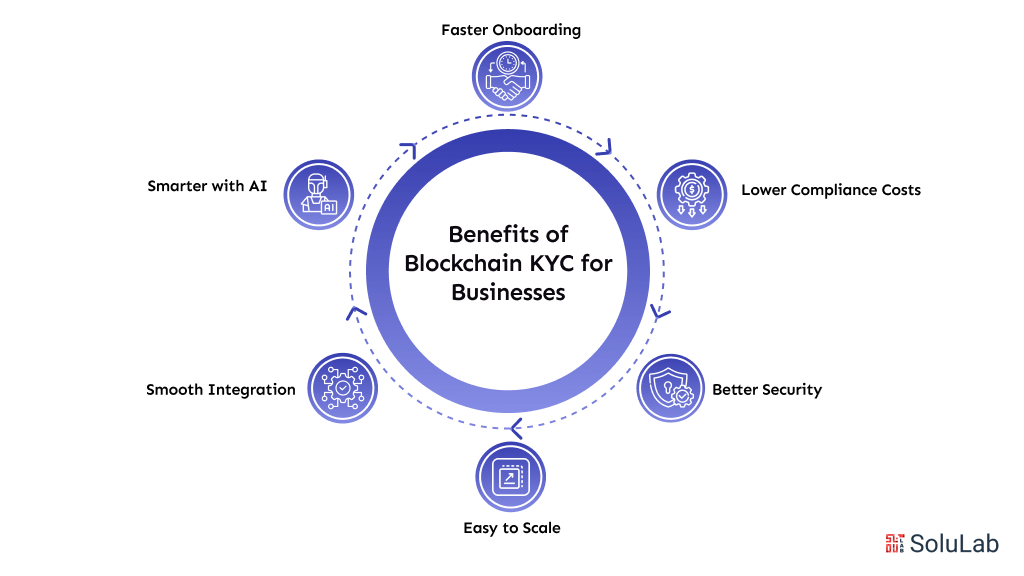
Benefits of Blockchain KYC for Businesses

1. Faster Onboarding

With a decentralized system, verifying customer identity becomes quicker. Companies can reduce user onboarding time by up to 90%, which helps improve customer experience significantly.

2. Lower Compliance Costs

Traditional KYC processes are expensive and time-consuming. Switching to a Blockchain as a Solution for KYC can cut compliance costs by 40–50%, making it ideal for financial services, crypto exchanges, and e-commerce platforms.

3. Better Security

Since data is stored on a decentralized blockchain network, the risk of hacking, leaks, or tampering is greatly reduced. It’s one of the safest ways to manage sensitive customer information today.

4. Easy to Scale

As businesses grow or expand into new regions, blockchain KYC companies USA can easily update and adjust to new regulations or requirements. It’s a future-proof solution that supports global scalability.

5. Smooth Integration Across Platforms

Blockchain smart contract and Layer 1, Layer 2 systems work together seamlessly. This means data can move securely across different platforms without repeating verification steps.

7. Smarter with AI

Adding technologies like AI in finance and AI workflow automation makes the process even more efficient. These systems can predict and automate tasks like fraud detection, reducing manual work and increasing trust.

Top 5 Companies Developing Blockchain KYC Solutions

Here are five top companies leading innovation in blockchain KYC and digital identity verification:

Top 5 Companies Developing Blockchain KYC Solutions

1. SoluLab

SoluLab is a top-rated blockchain development company in the USA known for building powerful solutions that combine KYC blockchain and AI agent technologies. Their products are designed for industries like e-commerce and finance, helping businesses stay compliant while improving customer onboarding.

2. Civic

Civic offers a secure identity verification platform through easy-to-use mobile apps. It uses blockchain-based KYC to give users full control of their data while meeting KYC requirements.

3. SelfKey

SelfKey is a decentralized KYC identity system that allows individuals and businesses to manage, control, and share personal information securely. It’s designed to work across multiple platforms and services.

4. Bloom

Bloom focuses on creating secure and privacy-first solutions for credit scoring and digital identity. It uses AI and blockchain smart contract features to keep user data safe while offering instant verifications.

5. uPort

uPort is an open-source identity platform built on Ethereum. It gives users the ability to manage and verify their identity directly through the blockchain, eliminating the need for centralized systems.

These companies are often supported by expert services like a smart contract development company to help bring these identity products to life.

Key Use Cases Across Industries

1. Banking

Banks are now using blockchain KYC to run real-time identity checks without depending on slow third-party verification. This not only improves speed but also helps with regulatory compliance. With blockchain technology, banks can safely store and share verified customer data across branches and systems.

2. Healthcare

Healthcare blockchain companies are applying blockchain KYC systems to verify patient identities more securely. Medical records can be linked to verified identities using blockchain smart contracts, reducing errors and fraud in patient data.

3. E-commerce

Online platforms are turning to AI-powered chatbots to onboard new sellers and buyers quickly. These automate identity onboarding using blockchain KYC utility. These bots automate identity verification using blockchain KYC companies solutions, helping marketplaces speed up operations while staying compliant.

4. Insurance

Insurance companies now combine AI in finance with KYC blockchain systems to simplify claims processing. Verified customer data can be accessed instantly, reducing paperwork, cutting fraud, and improving user experience. Automation also makes onboarding new policyholders faster and more secure using a KYC with AI and blockchain.

5. Crypto

In the crypto space, those who want to start a cryptocurrency exchange benefit greatly from blockchain based KYC platform. It allows instant verification of users with tamper-proof records. This builds trust, helps meet global compliance standards, and supports safe trading environments.

Token-based identity models are becoming more popular too. These are powered by asset tokenization and supported by secure blockchain based KYC platforms. They offer a new way to manage digital identities across finance, healthcare, e-commerce, and more.

The Future of Blockchain KYC solutions

The future of blockchain KYC looks bright, with powerful innovations already reshaping how identity verification works. Here’s what to expect:

1. Smarter KYC with AI agents

Advanced AI agents and Blockchain will handle customer verification in real time, reducing delays and improving accuracy. They’ll make KYC faster, more secure, and more automated.

2. Cross-Chain Identity Systems

With the rise of multi-chain vs. cross-chain technology, user identities can be verified across multiple blockchain platforms without repeating the KYC DLT systems for each one.

3. Web3 Integration

Web3 development companies are helping bring KYC blockchain systems into the decentralized internet, giving users more privacy and control over their data providing a Web3-ready blockchain KYC utility.

4. Self-Sovereign Identity (SSI) 

This means users will fully own their digital identity, without needing a middleman. It’s a key goal of many blockchain KYC companies, and it’s already becoming a reality.

5. Regulatory-Ready Blockchain KYC

As governments adapt, AI development companies and blockchain companies in USA are working together to build KYC solutions that are secure, scalable, and compliant.

With the help of all these, the future of KYC will be decentralized, efficient, and fully digital.

Blockchain Development Solutions

Final Thoughts

Blockchain KYC is no longer just a trend; it’s becoming the future of digital identity. As KYC blockchain solutions grow, businesses now have smarter, safer, and faster ways to verify users while staying compliant with global regulations.

If you’re exploring decentralized KYC solutions or want to build a trusted onboarding process with AI, SoluLab, top blockchain development company, can help. We specialize in developing smart, secure platforms with advanced AI agent integration.

Book a free consultation with us today to explore how we can build your next-gen blockchain-based KYC Platform.

FAQs

1. What is KYC on blockchain?

KYC on blockchain is a way to verify customer identities using a decentralized and secure system. Instead of relying on a central database, data is stored across multiple blockchain nodes, making it more transparent and tamper-proof. It’s faster, safer, and ideal for digital identity verification.

2. Is blockchain KYC secure?

Yes, blockchain KYC is highly secure. It uses cryptographic encryption and smart contracts to protect sensitive user data. Unlike traditional systems, data isn’t stored in one place, which reduces the risk of hacks or leaks.

3. Can AI improve blockchain KYC?

Absolutely. AI Workflow Automation and AI agents can speed up identity checks, flag risks in real-time, and reduce manual errors. Combining AI with KYC blockchain helps businesses meet compliance faster and more efficiently.

4. How does it save money?

Blockchain KYC reduces costs by cutting out middlemen and automating repetitive tasks. With fewer human touchpoints, companies spend less on labor, audits, and third-party services.

5. Which industries are adopting this?

Many sectors now use KYC blockchain, including finance, cryptocurrency exchanges, insurance, healthcare, and e-commerce. It’s especially useful in areas where secure identity verification is critical and regulations are strict.

How Do Zero-Knowledge Proofs Keep Blockchain Transactions Private?

Zero-Knowledge Proofs In Blockchain

Ever wondered how blockchain can be both transparent and private at the same time? That’s where Zero-Knowledge (ZK) proofs.

Whether it’s verifying your identity, voting online, or processing financial transactions, data privacy is a serious concern. Platforms like zkSync have seen rapid growth, with over 5 million addresses created and approximately 300,000 daily active users within eight months of launch

Here’s where zero-knowledge proofs flip the script. They let one party prove to another that something is true, without revealing what that something is. Sounds like magic? It’s not. It’s cryptographic brilliance.

In this blog, we’ll break down ZK proofs, explain how they work in blockchain, and explore how this technology is transforming sectors like finance, healthcare, and identity management, without overwhelming you with jargon.

What Is a Zero-Knowledge Proof in Blockchain?

A Zero-Knowledge Proof blockchain (ZKP) is a clever cryptographic technique that lets you prove something is true, without actually revealing the details behind it. They’re especially useful in Web3 and blockchain systems for boosting privacy and security. 

The zero-knowledge proof market is expected to generate $75 million in revenue by 2024, with projections exceeding $10 billion by 2030.

For example, you can prove you have enough crypto in your wallet to make a transaction without showing your full balance. It’s like saying, “Trust me, I’ve got it,” and the system believes you, without needing to peek into your wallet.

How Do Zero-Knowledge Proofs Work?

How Zero-Knowledge Proofs Work

The prover and the verifier engage in a process of interaction to make ZKPs work. The purpose of the prover is to show the truth of a claim, like “I have enough money for this transaction,” without disclosing any private information. The verifier verifies the evidence without discovering anything other than that the statement is true.

To start the process, the prover must provide evidence (the witness) to back up their claim, such as proof of account balance ownership or resource access permissions. The verifier then challenges the assertion, comparing it to predetermined standards using cryptographic algorithms:

  • Completeness: The verifier can verify the veracity of the prover’s assertion.
  • Soundness: The verifier cannot be persuaded to accept a wrong assertion.
  • Zero-knowledge: The verifier acquires no further information beyond the fact that the claim is true.

When the prover provides the proper proof in answer to the challenge, the verifier assesses the response. If all requirements are met, the verifier can verify the authenticity of the proof without ever having access to the private information that supports the claim. The finished proof is thereafter posted to the blockchain for final validation.

Types of Zero-Knowledge Proofs

Zero-knowledge proofs (ZKPs) are a cryptographic method used in many ZK blockchain solutions to validate data without revealing the data itself. Here’s a quick breakdown of the main types you’ll come across in:

1. Interactive Zero-Knowledge Proofs

This type involves a back-and-forth communication between the prover and verifier. It’s commonly used in real-time applications but can be less scalable, which is why most ZKP implementation services focus on more advanced alternatives.

2. Non-Interactive Zero-Knowledge Proofs (NIZK)

Unlike the interactive version, NIZKs require no communication after the initial proof is generated. They’re ideal for blockchains since they reduce overhead and are widely used in Zero-knowledge proof consulting for scalability-focused use cases.

3. zk-SNARKs (Succinct Non-Interactive Argument of Knowledge)

Zk-SNARKs are compact, fast, and perfect for lightweight ZK blockchain solutions. They’re widely adopted in privacy coins and dApps because they’re efficient to verify and don’t need ongoing interaction between parties.

4. zk-STARKs (Scalable Transparent Argument of Knowledge)

zk-STARKs offer better scalability and security without needing a trusted setup. Many modern Zero-knowledge blockchain platforms are shifting to zk-STARKs as they’re more transparent and easier to audit.

5. Bulletproofs

Used mostly for confidential transactions, Bulletproofs are efficient and don’t need trusted setups. Though not as fast as zk-SNARKs, they’re a solid option for auditability and trust minimization matters.

6. PLONK

PLONK is a universal SNARK that supports multiple circuits with a single trusted setup. It’s becoming popular for its flexibility and efficiency in handling complex blockchain computations.

CTA- 1

How ZKPs are Applied to Blockchain Privacy?

In blockchain, ZKPs are used to hide transaction details like the sender, receiver, and amount transacted. Here’s how it works:

1. Hiding Transaction Details: Instead of directly revealing the transaction details on the blockchain, the sender creates a ZKP that proves the transaction is valid. This proof demonstrates that:

  • The sender has enough funds to cover the transaction.
  • The transaction is authorized by the sender (e.g., using a digital signature).
  • The transaction adheres to the blockchain’s rules (e.g., the amount being sent is positive).

2. Verification on the Blockchain: The ZKP, rather than the transaction details themselves, is recorded on the blockchain.  Miners or validators can then verify the proof without needing to know the specifics of the transaction. If the proof is valid, the transaction is accepted and added to the block.

3. Privacy Preservation: Because the actual transaction details are never exposed, observers cannot determine who sent funds to whom, or how much was sent. The blockchain only records the fact that a valid transaction occurred.

Benefits of Zero-Knowledge Proofs in Blockchain

Benefits of ZKPs in Blockchain

More and more, people in Web3 are turning to Zero-Knowledge Proofs (ZKPs) to defend privacy and security. Here are some Benefits it offers to us:

1. Enhanced Privacy: You can verify a statement without giving away the details using ZKPs. This way, you can be sure your password or personal information is safe because it is not shared.

2. Secure Sharing of Information: ZKPs help to share data while hiding its real content securely. Therefore, businesses can collaborate easily without worrying about data breaches or privacy problems.

3. Secure Transactions: Consumers can verify their transactions with ZKPs without exposing the information involved. It makes sure that people’s financial transactions are kept private in industries like banking and DeFi.

4. Resisting tactics of Fraud and Manipulation: Since no sensitive data needs to be shown, ZKPs decrease the opportunities for data corruption, identity theft, or making the system seem less trustworthy.

5. Identity Verification: With ZKPs, people can confirm their identity while keeping private documents hidden. Users who want to stay private will appreciate it since you don’t need to give away your identity.

6. Reduced Costs: Because ZKPs do not require additional verifications or big audits, operating costs for businesses and platforms can be kept low.

7. Scalability: Because ZKPs are light, networks can handle more transactions and users smoothly, which increases the scalability of blockchain.

Applications of ZKP in Blockchain 

Zero-knowledge proofs (ZKPs) are increasingly used in different sectors since they check data while protecting confidential details. These are some existing illustrations of how zero-knowledge proof technology is now being put to work.

  • Healthcare Records: ZKPs let this information be shared privately, without revealing the whole medical history. Private data sharing is made possible, which makes it the best choice for blockchain identity solutions in healthcare.
  • Mortgage Loans: Banks do not have to review the entire bank account of a borrower because ZKPs permit them to verify just the required aspects. This makes it simpler for loans to be approved and diminishes the possibility of leaking confidential financial information.
  • Online Voting System: ZKPs ensure that voters hide their personal information and their vote preference, but can still verify their eligibility to vote and the results. Thanks to this, digital democracy becomes more transparent and trusted.
  • Network Security and Using Authentication: Due to ZKPs, it is possible to check a user’s credentials during login without disclosing the password or security tokens. It provides a major benefit for businesses when it comes to secure authentication.
  • Digital Signatures: It is possible to provide evidence that someone signed a document with a ZKP, without exposing the identity of the signer or the content, so enterprises can depend on ZKPs for blockchain security.

CTA- 2

Conclusion

Zero-knowledge proofs might sound complex, but at their core, they offer a smart and secure way to verify information without revealing the actual data. From protecting healthcare records to enabling private voting systems, ZK proofs are already making a big impact. 

As blockchain adoption grows, so will the use of this privacy-first tech. Whether you’re a developer, business leader, or just curious about blockchain, understanding ZK proofs gives you a glimpse into the future of secure digital interactions.

Partner with SoluLab, a leading blockchain development company in USA, to build privacy-first blockchain solutions using zero-knowledge proof technology tailored for your business.

FAQs

1. Why are ZKPs important for blockchain?

They add a layer of privacy by allowing verification without revealing sensitive information. This is key for secure transactions, identity protection, and regulatory compliance in blockchain.

2. What’s the difference between zk-SNARKs and zk-STARKs?

Both are types of ZKPs. zk-SNARKs are compact and efficient but require a trusted setup. Zk-STARKs are more transparent and scalable but may require more computational resources.

3. Are ZKPs secure?

Yes, ZKPs are designed to be mathematically secure. They prevent data leaks and unauthorized access while maintaining trust and transparency in blockchain systems.

4. How do ZKPs enhance privacy in crypto?

They allow users to prove they have funds or access rights without revealing wallet balances or identities, making crypto transactions more private and secure

5. Is zero-knowledge proof technology scalable?

It’s improving fast. Solutions like zk-rollups and zk-STARKs are making zero-knowledge proof technology more scalable and efficient, especially for high-volume blockchain networks.


How Will Blockchain Interoperability Impact Enterprise Adoption in 2025?

Blockchain Interoperability’s Impact on Enterprise Adoption

By 2025, enterprises will not only be investigating blockchain but also insisting on more intelligent, interconnected platforms. As enterprises progressively utilize decentralized technology, a significant difficulty will arise: How can these isolated blockchains efficiently interact with one another? This is where blockchain interoperability becomes relevant.

Blockchain interoperability solutions enable several blockchains to transfer data and assets independently of centralized middlemen. This capability of communicating effortlessly across platforms enhances productivity and facilitates creative corporate applications in supply chain, finance, and healthcare.

This blog will examine how blockchain interoperability is set to transform enterprise adoption in 2025. We will explore the real-world impacts of interoperability on decentralized ecosystems, from facilitating frictionless data interchange to enhancing cooperation.

What is Blockchain Interoperability? 

Blockchain interoperability means that different blockchain networks can talk to each other, share data, and work together without any problems. When there are many blockchains, each with its own protocols, consensus methods, and use cases, interoperability makes sure that these networks don’t stay separate but work together as a whole.

In the next few years, the blockchain interoperability market is expected to grow at a rate of 28.30% per year, rising from USD 0.83 billion in 2025 to USD 7.90 billion by 2034. There was also a blockchain interoperability market that was worth USD 0.65 billion in 2024.

Earlier, blockchain systems worked alone, with a limited network. Businesses that wanted to use multi-chain plans or add decentralized systems to current platforms had a hard time. Compatibility is important as it lets you exchange money, share smart contracts, and control your name or assets in a unified way across multiple networks.

For example, Chainlink’s Cross-Chain Interoperability Protocol (CCIP) lets different blockchains talk to each other in a safe and scalable way. These methods make it easier for businesses to work together and open up new services, such as multi-chain DeFi platforms, tracking the global supply chain, and making payments across borders.

CTA1

Why Blockchain Interoperability Matters for Enterprises?

Blockchain interoperability is not just a technological benefit for businesses; it is also a strategic need. Maximizing efficiency, lowering costs, and preserving a competitive advantage depend on integrating many systems and chains as companies use blockchain technologies across departments and worldwide operations. Cross-chain interoperability, therefore, helps to link otherwise separated systems into a coherent digital infrastructure.

Read Also: Difference Between Cross-chain And Multichain

Here’s why enterprises need interoperability:

  • Seamless Data Exchange: Interoperability lets enterprises move data across many blockchain systems, therefore ensuring consistent and coordinated information flow across platforms.
  • Multi-Chain Operations: Enterprises sometimes use many blockchains for different purposes—supply chain, finance, identification, etc., even if they are related. 
  • Enhanced Efficiency: Cross-chain interoperability simplifies operations and speeds decision-making by lowering the requirement for manual reconciliation and outside intermediaries.
  • Scalable Innovation: Interoperability gives the flexibility to embrace new chains and technologies as they develop without redesigning current infrastructure, hence facilitating long-term scalability.
  • Improved User Experience: Whether they are shared loyalty programs or cross-chain payments, interoperability helps consumers, partners, and stakeholders to have better interactions.
  • Future-Proofing Investments: Blockchain standards may change, but interoperability ensures that business solutions stay flexible and relevant, therefore safeguarding long-term technological investments.

How Blockchain Interoperability Works?

Blockchain Interoperability Working

Blockchain interoperability facilitates communication and information exchange among diverse blockchain networks, each with distinct rules, consensus methods, and data formats, without the need for centralized intermediaries. This intercommunication is essential in corporate settings where many blockchains serve distinct purposes, and cohesive data flow is imperative for efficient operations.

This approach fundamentally relies on distributed ledger technology (DLT), which offers safe data recording and maintenance over a decentralized network. However, because each blockchain functions autonomously, interoperability layers or protocols are required to connect these distinct ledgers.

This is the normal operation of interoperability within blockchain ecosystems:

  • Relays and Bridges: These are methods based on interoperable smart contracts that enable one blockchain to oversee and authenticate data from another. Relays function as intermediaries, transmitting transaction verifications between chains in a trustless manner.
  • Atomic Swaps: A technique that facilitates direct P2P transactions of assets across disparate blockchains without the necessity of a centralized exchange. This is crucial for DeFi interoperability, enabling users to exchange assets across decentralized platforms such as Ethereum and Binance Smart Chain.
  • Middleware Protocols: Interoperability solutions like Polkadot, Cosmos, and Hyperledger interoperability frameworks offer a unified layer that links several blockchains. These function as a universal translator, facilitating smooth communication and value transfer across enterprise and public blockchains.
  • Inter-Blockchain collaboration (IBC): A protocol utilized by Cosmos, IBC establishes standards for inter-blockchain messaging, facilitating secure and organized collaboration.
  • APIs and SDKs: In corporate applications, APIs are frequently utilized to facilitate interaction between legacy systems and blockchain networks. These technologies facilitate the standardization of interoperability without necessitating extensive protocol-level integration.
  • Oracles: External data feeds, such as Chainlink, provide the utilization of real-world data or outputs from one blockchain by another to initiate smart contract executions, hence augmenting the functionality of interoperable systems.

Approaches to Achieve Blockchain Interoperability

Blockchain Interoperability Approaches

Today, many methods and tools can be used to make blockchain systems work with each other. This can be done in two ways: directly by changing the infrastructures of blockchains so that transactions follow the same business logic across multiple networks; or indirectly by using external interoperability protocols that connect blockchains securely and make it possible for data, tokens, and messages to be sent between them. Here are some of the main methods that were used to make this feature work.

  • Cross-Authentication

With cross-authentication, a separate, trusted network acts as a go-between for blockchain networks to check transactions and shared data between chains. Third-party blockchain tools, such as trust methods, token links, or sidechains, are often used to handle this.

In a notary-based model, the transaction is approved by a notary on one blockchain, who then sends proof of this to the target chain. Single-signature and multi-signature notaries are the two types of notaries that are used in these kinds of programs. This makes the system more trustworthy and resilient.

  • Oracles

Oracles are very important for DeFi interoperability because they connect blockchain systems to outside data sources and even other blockchains. As trusted messengers, they send data from the real world to smart contracts or events that happen on the blockchain to other blockchain networks.

For instance, if two people use a smart contract to bet on a sports game, the smart contract itself can’t see how the game turns out. Then, oracles come in—they get the match result from a trusted outside source and send it safely to the smart contract, setting off the right outcome. In this way, oracles are the building blocks of connecting blockchains and off-chain systems.

  • API Gateways

API gateways act as software that makes it easier for blockchain protocols and external apps to talk to each other. They basically act as interpreters, taking requests from outside the blockchain network, like transaction directions or data questions, and putting them in the right shape for that network.

When the gateway gets a request, it figures out which blockchain it should send the command to and changes the style of the command so that it works with that network’s protocol. These interfaces are very important for letting global ledgers and off-chain business apps talk to each other in real time.

  • Cross-Chain Solutions

Cross-chain interoperability solutions set up a way for blockchain apps to talk to each other so that they can share data, coins, and contract calls across different blockchain platforms. These solutions create a standard interface that can be used across different networks. They do this by using token links and built-in Oracle services to make exchanges safe and reliable.

Cosmos, Polkadot, Chainlink, and Wanchain are just a few of the new message and transfer platforms that have made it easier for assets and information to move between chains. At the heart of getting efficient and useful blockchain collaboration are these options.

Related: What is Cross-Chain Compatibility? 

  • Enterprise-Grade Solutions 

Enterprise blockchains are usually private and require permissions to access, unlike public chains like Ethereum or Bitcoin. This makes it harder for them to connect to other networks. Interoperability, on the other hand, lets these companies use the blockchain technology that is already in place, so they don’t have to build new systems from scratch.

Also, enterprise-level sharing makes it easier for companies to share data safely and quickly. This is especially important in sensitive fields like healthcare and finance. When you use enterprise-grade cross-chain interoperability, you can be sure of strong privacy, data control, and compliance, and you can still work together easily with people from different environments.

The Future of Blockchain Interoperability in Enterprise Adoption

As 2025 goes on and beyond, blockchain interoperability is likely to become an essential requirement. Multi-chain methods are being used more and more by businesses to improve processes across departments, areas, and sectors. Finance, supply chains, healthcare, and the government are all realizing they need blockchain communities that are all linked and can talk to each other easily. 

Making open, safe, and accepted standards that allow people to work together across chains without losing privacy, compliance, or performance is what the future holds for blockchain interoperability. Companies that want to use blockchain in the long term will need to work with an experienced enterprise blockchain development company

These companies offer both blockchain development services and consultation on how to set up scalable, open infrastructure that fits the modern needs. Businesses that invest early in these systems will gain a competitive edge as interoperability improves. This is because they will be able to use real-time automation, cross-platform data access, and new income models powered by connected blockchain networks.

CTA2

The Bottom Line

Blockchain interoperability is no longer an idea from the future; it’s a business must. As enterprises move from test projects to full-scale blockchain integration, their ability to connect to each other over various networks will determine how well their digital transformation efforts work. This builds the foundation for better, more connected processes in many fields.

SoluLab, as a leading enterprise blockchain development company, helps businesses adapt to this change by providing custom blockchain solutions that put growth and connectivity first. Our work on the OBORTECH Smart Hub project is a great example of this because it uses Blockchain-as-a-Service (BaaS) to make things run more smoothly. This latest technology platform lets businesses create decentralized apps using third-party cloud infrastructure. 

Now is the time to act if your business is looking into blockchain or wants to expand current projects with solutions that work with each other. To find out how SoluLab can help you build cross-chain skills while discovering the real value of using blockchain in your business, get in touch with us!

FAQs

1. How is blockchain interoperability different from traditional system integration?

Traditional system integration connects centralized databases or platforms using middleware. Blockchain interoperability, on the other hand, enables decentralized networks—often with different consensus mechanisms and protocols—to securely share data and interact without intermediaries.

2. Can blockchain interoperability support compliance with industry regulations?

Yes, when designed with governance in mind, interoperable blockchain development services can enhance regulatory compliance. They allow traceable, auditable data exchange across networks, which is particularly useful in industries like finance and healthcare that demand strict compliance protocols.

3. How does blockchain interoperability influence data privacy for enterprises?

Interoperability solutions can be designed to maintain strict data privacy controls by enabling selective data sharing and encryption. Enterprises can retain sensitive information on private chains while still interacting with public or consortium networks as needed.

4. Is blockchain interoperability only relevant for large enterprises?

Not at all. While large organizations often lead adoption, small and mid-sized businesses can also benefit by integrating with larger ecosystems, automating transactions, and accessing shared data and services without rebuilding infrastructure from scratch.

5. How does blockchain interoperability affect supply chain transparency?

It enhances supply chain transparency by enabling real-time data sharing between different stakeholders, even if they use different blockchain platforms. This ensures consistent tracking, verification, and visibility across the entire supply chain network.

Top 5 Enterprise Blockchain Platforms to Consider [2026]

Enterprises are under immense pressure to stay competitive, efficient, and transparent. But with rising data, slow transactions, and outdated legacy systems, many businesses are facing troubles in scaling their operations securely.

The enterprise blockchain market is expected to reach USD 145.9 billion by 2030, growing at a CAGR of 47.4% from 2024 to 2030.

This lack of trust, especially in sectors like finance, supply chain, and healthcare, is costing companies not just money but credibility. And while everyone’s talking about blockchain, the real challenge is figuring out which platforms are enterprise-ready, scalable, and future-proof in 2026.

In this blog, we’ll explore the top 5 enterprise blockchain platforms, the criteria to select the best platform, and more. Let’s get started!

How Blockchain Is Transforming Enterprises? 

Here’s how blockchain is impacting enterprises across industries:

1. Trust Without Middlemen: Blockchain enables secure, verifiable transactions without intermediaries. That means faster processes and fewer costs. 

2. Supply Chain Transparency: Every step can be tracked from farm to fork. Enterprises can now trace product origins, reduce fraud, and ensure compliance. This is perfect for FMCG, pharma, and agriculture.

3. Smart Contracts: No more manual checks. Smart contracts automate tasks when conditions are met. Great for legal, finance, and logistics.

4. Better Payments & Settlements: Faster cross-border payments with reduced transaction fees. Especially useful for export-import businesses in India.

5. Audit & Compliance Made Easy: Audits become simpler since every change is recorded. Blockchain makes financial data tamper-proof and regulator-friendly.

Criteria for Selecting the Top Enterprise Blockchain Platforms

With the proliferation of blockchain platforms catering to enterprise needs, it’s essential to establish a set of criteria to evaluate and select the most suitable options. Each platform comes with its strengths and weaknesses, making the selection process a nuanced task. Here are the key criteria to consider when selecting the top enterprise blockchain platforms of 2026:

  • Scalability and Performance: Scalability is crucial for enterprise applications that demand high transaction throughput. Platforms must demonstrate the ability to handle a large number of transactions per second while maintaining low latency. Considerations include the platform’s consensus mechanism, sharding techniques, and approaches to optimizing network performance as the user base expands.
  • Security and Data Privacy: Enterprises handle sensitive data, and security is paramount. Blockchain platforms must employ robust encryption, hashing, and access control mechanisms to safeguard data from unauthorized access. Privacy features, such as zero-knowledge proofs and private transactions, allow enterprises to share information selectively while preserving confidentiality.
  • Interoperability and Integration: In an ecosystem with multiple blockchain networks and existing IT infrastructure, interoperability is essential. Platforms should support seamless integration with legacy systems and other blockchain networks. Standards like cross-chain communication protocols enhance interoperability and facilitate data exchange between different platforms.
  • Smart Contract Capabilities: Smart contracts automate business processes, but their complexity varies between platforms. Evaluate the programming languages supported, the ease of writing and deploying smart contracts, and the platform’s support for oracles (external data sources).
  • Community and Support: A vibrant and active community indicates a platform’s vitality and ongoing development. Robust community support ensures quick issue resolution and a wealth of resources for developers. Platform documentation, developer tools, and user-friendly interfaces contribute to a positive user experience.

Top 5 Enterprise Blockchain Platforms

Ethereum

1. Ethereum

Ethereum, founded in 2015, is one of the most widely adopted blockchain platforms, known for its smart contract functionality, decentralized applications (dApps), and a robust developer community.

While originally public, Ethereum also offers enterprise-grade solutions through frameworks like the Enterprise Ethereum Alliance (EEA). It’s ideal for businesses looking to build transparent and automated systems.

2. R3 Corda

R3 Corda, launched in 2016, is a blockchain platform designed for regulated industries like finance, healthcare, and supply chain. Unlike public blockchains, Corda focuses on privacy, scalability, and interoperability by enabling only the involved parties to access transaction data.

It supports smart contracts and offers robust identity management, making it ideal for enterprise use cases. Its unique architecture ensures compliance and efficiency for complex workflows.

3. Hyperledger Fabric

Hyperledger Fabric, launched in 2015 by the Linux Foundation, is a modular and permissioned blockchain platform designed for enterprise use. It supports pluggable consensus mechanisms, private channels for confidential transactions, and chaincode (smart contracts) written in general-purpose programming languages like Go and Java.

Its architecture is ideal for businesses needing secure, scalable, and customizable solutions across sectors like supply chain, finance, and healthcare.

4. Hedera Hashgraph

Hedera Hashgraph, founded in 2018, is a high-performance public distributed ledger designed for enterprises. Unlike traditional blockchains, it uses a unique hashgraph consensus algorithm, making it faster and more energy-efficient.

Key features include fair transaction ordering, low fees, and high throughput, making it ideal for use cases like supply chain, identity management, and payments. Its governing council includes global giants like Google and IBM, ensuring robust governance.

IBM Blockchain

5. IBM Blockchain

IBM Blockchain (launched in 2017) is a robust enterprise-ready platform built on Hyperledger Fabric, designed to help businesses securely share data and streamline workflows. Known for its modular architecture, it supports permissioned networks, ensuring high privacy and scalability.

It also integrates with existing systems, making it ideal for sectors like supply chain, finance, and healthcare. IBM offers tools, templates, and support to help enterprises build and scale blockchain solutions efficiently.

Enterprise Blockchain Development Company

Conclusion

In 2026, enterprise blockchain platforms will no longer be optional — they’re a strategic necessity. Whether it’s improving operations, security, or transparency. Platforms like Hyperledger Fabric, Ethereum Enterprise, and others are redefining how businesses function. 

Each offers unique features tailored to different enterprise needs, from smart contracts to permissioned networks. As businesses continue to grow, choosing the right blockchain platform and hiring a blockchain developer can provide a competitive edge in the market. The key is to align technology with business goals.

Token World, a crypto launchpad platform, partnered with SoluLab to enhance smart contract security, scalability, and regulatory compliance. We built robust tokenomics, investor dashboards, and multilingual support. Our blockchain integration and community strategies empowered Token World to deliver secure, user-friendly token launches and drive global investor engagement.

SoluLab, a blockchain development company, can help you pick the best platform as per your business requirements.

FAQs

1. How is enterprise blockchain different from public blockchain?

Enterprise blockchains are usually permissioned, meaning only authorized participants can access or validate transactions, ensuring privacy and control. Public blockchains like Bitcoin and Ethereum are open to everyone, and transactions are fully transparent.

2. Is it expensive to build on an enterprise blockchain platform?

Costs vary depending on the platform, complexity of the solution, development time, and compliance needs. While some platforms are open-source and free to use, enterprise-level support or custom integrations can increase expenses. However, the long-term ROI often outweighs the initial investment.

3. Can enterprise blockchains support AI and IoT integrations?

Yes, many modern enterprise blockchain platforms support integration with AI, IoT, and cloud computing. This allows for powerful use cases like predictive maintenance, smart manufacturing, automated logistics, and real-time asset tracking with secure data layers.

4. Which industries are adopting enterprise blockchain platforms the most?

Major industries using enterprise blockchain solutions include finance and banking, supply chain and logistics, healthcare, insurance, government, energy, and real estate. These sectors benefit from enhanced transparency, data integrity, and automation.

5. How long does it take to build an enterprise blockchain solution with SoluLab?

Timelines vary based on complexity, but SoluLab typically delivers MVPs within a few weeks and full-scale enterprise-grade platforms in a few months. Their agile development process ensures fast iterations and transparent progress tracking.

Defi : The Influensive Trend in Blockchain- A Complete Guide

Defi The Influensive Trend in Blockchain- A Complete Guide

Decentralized Finance, often referred to as DeFi, has emerged as one of the most influential trends in the blockchain space. This revolutionary concept leverages blockchain technology to create a decentralized financial ecosystem that operates without traditional intermediaries like banks. In this comprehensive guide, we will delve into the world of DeFi, exploring its platforms, protocols, development companies, lending platforms, trading platforms, and how it all ties into the broader blockchain landscape.

What is DeFi?

Decentralized Finance, commonly known as DeFi, is a revolutionary movement within the blockchain ecosystem protocols that seeks to recreate traditional financial systems using blockchain technology. Unlike traditional finance, which relies on centralized intermediaries like banks and financial institutions, DeFi operates on decentralized platforms and smart contracts. 

It encompasses a wide range of financial services and applications, including lending, borrowing, trading, asset management, and more, all built on blockchain networks. DeFi platforms, protocols, and development companies play a pivotal role in enabling this ecosystem, while blockchain technology provides the foundation for its transparency and security. 

Furthermore, DeFi is closely intertwined with blockchain trends, as it leverages blockchain’s potential to disrupt traditional finance and expand into other industries beyond the financial sector. This transformative trend is redefining the way we think about and interact with financial services, offering users greater control and accessibility to their financial assets and transactions.

How Does DeFi Work?

DeFi applications are built on blockchain technology, which is a distributed ledger system that records transactions in a secure and transparent manner. Blockchain technology allows DeFi applications to operate without the need for a central intermediary.  Top DeFi protocols use smart contracts to automate transactions and interactions between users. 

Benefits of DeFi

Benefits of DeFi

Decentralized Finance (DeFi) is transforming the financial landscape in numerous ways, offering a wide array of benefits to users, developers, and the global economy. 

  • Financial Inclusion

DeFi opens up financial services to anyone with internet access, enabling global financial inclusion. This is especially significant in regions with limited access to traditional banking. According to the World Bank, around 1.7 billion adults worldwide remain unbanked. DeFi can bridge this gap and empower individuals to access and manage their finances.

  • Accessibility

Unlike traditional financial markets with set trading hours, DeFi operates 24/7, allowing users to trade, lend, and borrow at their convenience. This accessibility provides flexibility and empowers users to make real-time financial decisions.

  • Reduced Intermediaries

Traditional financial systems rely on intermediaries like banks, brokers, and clearinghouses, which charge fees for their services. DeFi minimizes or eliminates these intermediaries, reducing costs for users. Smart contracts execute transactions automatically, bypassing the need for intermediaries and their associated fees.

  • Transparency

DeFi leverages blockchain technology to ensure transparent and immutable record-keeping. Every transaction is recorded on a public ledger, providing users with complete transparency. This transparency enhances trust, as users can independently verify all transactions.

  • Security

DeFi benefits from the security features of blockchain technology. Smart contracts, once deployed, are immutable, reducing the risk of tampering or fraud. The security of blockchain has contributed to a significant decrease in successful attacks on DeFi platforms.

  • Global Reach

Cross-border payments are a significant part of the global economy. DeFi enables seamless cross-border transactions, allowing users to send and receive funds globally without the delays and high fees associated with traditional cross-border banking services.

CTA1

  • Programmability

DeFi platforms are highly programmable, allowing developers to create customized financial solutions. This programmability has led to the development of a diverse range of applications, including yield farming, decentralized exchanges, automated trading bots, and more. Users can participate in these innovative financial services.

  • Yield Opportunities

DeFi platforms like Compound and Aave offer users the opportunity to earn interest on their assets. Users can participate in lending or liquidity provision, often earning yields that surpass traditional savings account rates by a significant margin. This opens up new avenues for passive income and wealth creation.

  • Innovation and Rapid Development

DeFi is characterized by its rapid pace of innovation. New projects, tokens, and protocols continually emerge, offering new financial products and services. The open-source nature of DeFi fosters competition and innovation, driving the development of cutting-edge solutions.

  • Economic Empowerment

DeFi can empower individuals to take control of their finances. Users are not reliant on centralized institutions; they have custody of their assets and can engage in financial activities autonomously. This increased agency can lead to greater financial empowerment and self-reliance.

  • Risk Management

DeFi platforms often allow users to set their own risk parameters. For example, users can choose the level of collateral required for loans, mitigating risk to some extent. Additionally, DeFi insurance projects offer coverage against smart contract vulnerabilities and hacks, further enhancing risk management.

  • Community Governance

Many DeFi projects employ decentralized governance mechanisms. Token holders have a say in protocol upgrades and decision-making. This approach promotes a more democratic and community-driven ecosystem.

  • Reduced Barriers to Entry

In traditional finance, launching financial products and services can be highly regulated and costly. DeFi reduces these barriers to entry for entrepreneurs and developers, making it easier to create and launch financial innovations.

Applications of Defi

Applications of Defi

Decentralized Finance (DeFi) has a wide range of applications that are transforming the traditional financial landscape. These applications leverage blockchain technology to provide innovative and decentralized solutions to various financial services. Here are some key applications of DeFi:

  • Lending and Borrowing

DeFi lending platforms allow users to lend their crypto assets to earn interest, while borrowers can use their crypto holdings as collateral to secure loans. These platforms often offer more attractive interest rates than traditional banks.

Examples: Compound Finance, Aave, MakerDAO

  • Decentralized Exchanges (DEXs)

DEXs enable users to trade cryptocurrencies directly without the need for a centralized intermediary. They provide liquidity and allow for trustless and transparent trading.

Examples: Uniswap, SushiSwap, Balancer

  • Stablecoins

Stablecoins are digital currencies crafted with the intention of preserving a fixed value, frequently linked to a traditional currency such as the US dollar. They serve as a stable medium of exchange and a store of value within the volatile crypto market.

Examples: USDC, USDT, DAI

  • Yield Farming and Liquidity Provision

Yield farming encompasses the act of supplying liquidity to DeFi protocols in return for incentives. Users can earn tokens and interest by locking up their assets in liquidity pools.

Examples: Yearn.finance, Curve Finance, Balancer

  • Asset Management and Index Funds

DeFi allows users to create, manage, and invest in tokenized portfolios, enabling automated trading and diversification of assets.

Examples: Set Protocol, PieDAO

  • Insurance

DeFi insurance platforms provide coverage against smart contract vulnerabilities and hacks in the DeFi ecosystem, offering protection to users.

Examples: Nexus Mutual, Cover Protocol

  • Decentralized Identity

DeFi can be used to establish decentralized identity systems, giving users more control over their personal information.

Examples: uPort, SelfKey

  • Cross-Border Payments

DeFi facilitates cost-effective and rapid cross-border transactions, reducing the fees and delays associated with traditional international transfers.

Examples: Stablecoin-based remittance services

  • Prediction Markets

DeFi prediction markets enable users to create and participate in markets for predicting real-world events, offering a decentralized way to speculate on outcomes.

Examples: Augur, Gnosis

  • Blockchain Gaming and NFTs

DeFi and blockchain technology are integrated into the gaming industry, allowing players to buy, sell, and trade in-game assets and NFTs.

Examples: Axie Infinity, Decentraland

  • Decentralized Autonomous Organizations (DAOs)

DAOs are organizations governed by smart contracts and token holders, enabling decentralized decision-making and governance.

Examples: Yearn Governance, Compound Governance

  • Real Estate and Tokenization

DeFi can be used to tokenize real estate assets, making it easier for users to invest in properties and participate in real estate markets.

Examples: RealT, Propy

Blockchain and its Role in DeFi

Blockchain and its Role in DeFi

Blockchain technology plays a pivotal role in the success and functionality of Decentralized Finance (DeFi). It underpins the entire DeFi ecosystem, providing the infrastructure and key features necessary for its operation. Here’s how blockchain contributes to DeFi:

  • Trust and Transparency

Blockchain is a decentralized and distributed ledger technology. It records transactions in a secure and transparent manner across a network of nodes. This transparency ensures that all DeFi transactions are publicly verifiable, and participants can audit the transaction history. Users can trust that the information on the blockchain is accurate and tamper-proof.

  • Smart Contracts

DeFi relies heavily on smart contracts to automate and execute financial agreements without the need for intermediaries. These contracts are immutable and executed according to predefined rules, enhancing the security and reliability of financial transactions.

  • Decentralization

Blockchain networks, such as Ethereum, are decentralized, meaning there is no central authority or intermediary controlling the system. DeFi applications leverage this decentralization, eliminating the need for trusted third parties like banks. Users retain control of their assets and transactions, reducing counterparty risk.

  • Permissionless Access

DeFi platforms built on blockchain technology are generally permissionless, meaning anyone with an internet connection and the required assets can access and use these services. This inclusivity opens financial services to a global audience without regard for geographical location, background, or identity.

  • Immutable Records

Once a transaction has been added to a blockchain, it becomes immutable, i.e. it cannot be altered or deleted. This immutability enhances the security of financial transactions, making it difficult for fraudulent or unauthorized changes to occur.

  • Interoperability

Blockchain networks and protocols are often designed to be interoperable, allowing DeFi platforms to communicate and interact seamlessly. This interoperability enables various DeFi applications to work together and create a more interconnected financial ecosystem.

  • Decentralized Identifiers

Blockchain can provide a foundation for decentralized identity solutions, allowing users to control and manage their personal data and identity. This is particularly important in DeFi, where privacy and identity verification are essential.

  • Data Feeds and Oracles

To provide real-world data to smart contracts, DeFi projects often rely on oracles. These oracles are external data sources that feed information from the real world into the blockchain. They play a critical role in enabling smart contracts to respond to real-world events and conditions.

CTA2

Conclusion

Decentralized Finance (DeFi) is reshaping the financial landscape, offering a more inclusive and transparent way of managing assets and accessing financial services. As blockchain technology continues to advance, we can expect even greater innovation and adoption in both the DeFi space and across various industries. 

Bear in mind that the DeFi arena is ever-changing, and new entrants may come into play. Hence, it’s crucial to engage in comprehensive research and due diligence when deciding on a DeFi development company. With the right team and a forward-looking vision, your DeFi project has the potential to become a game-changing force in the financial realm.

If you’re still in search of the ideal DeFi development company, get in touch with Solulab without delay. Solulab boasts extensive experience in DeFi development services, a strong technical acumen, and a commitment to fostering innovation, making them an excellent option for businesses and entrepreneurs looking to embark on DeFi endeavors or enhance their existing DeFi solutions.

FAQs

1. What is DeFi, and how does it differ from traditional finance?

DeFi, short for Decentralized Finance, is a blockchain-based financial ecosystem that offers decentralized alternatives to traditional financial services like lending, borrowing, and trading. Unlike traditional finance, DeFi operates on blockchain technology, removing the need for intermediaries, providing transparency, and enabling users to have full control over their assets.

2. How do I get started with DeFi?

To start with DeFi, you need a crypto wallet, usually compatible with the Ethereum blockchain, as many DeFi projects are built on Ethereum. You can fund your wallet with cryptocurrencies, connect to a DeFi platform, and then explore and use various DeFi applications, such as lending, borrowing, or trading.

3. Are DeFi platforms safe and secure?

DeFi platforms prioritize security, but they are not immune to risks. Users should conduct thorough research, use reputable platforms, and follow best practices such as enabling two-factor authentication and using hardware wallets. Additionally, smart contract vulnerabilities and exploits have occurred, so it’s crucial to assess the risk before participating.

4. What is yield farming in DeFi?

Yield farming is a DeFi strategy where users provide liquidity to decentralized exchanges or lending platforms in exchange for rewards or interest. It involves staking assets in liquidity pools and earning tokens or a percentage of transaction fees. Yield farming can offer attractive returns but carries risks and should be approached with caution.

5. Can I earn passive income with DeFi?

Yes, DeFi offers opportunities for passive income. Staking assets in DeFi platforms, providing liquidity to DEXs, or participating in yield farming can all generate passive income. However, these strategies come with varying degrees of risk, so it’s essential to research and understand the potential rewards and risks associated with each method.

Tokenization Trends: How Digital Assets Are Transforming Industries

Tokenization Trends: How Digital Assets Are Transforming Industries

As we navigate through the forthcoming sections, we will uncover the profound impact of asset tokenization on traditional financial markets, where assets are being digitized and made available to a wider audience. We’ll also explore how tokenization is empowering decentralized finance (DeFi) and non-fungible tokens (NFTs) as innovative instruments for investment and wealth management. Beyond finance, we’ll venture into real estate, supply chain management, art, and gaming to illustrate the far-reaching influence of tokenization.

What Exactly is Tokenization?

Tokenization is the process of converting tangible or intangible assets into digital tokens or representations, typically utilizing blockchain technology. These tokens can represent ownership, value, or access rights to the underlying asset. In essence, tokenization transforms physical or traditional assets into a format that can be easily traded, managed, and transferred in the digital realm. It provides a secure and transparent means of recording ownership, enabling fractional ownership, enhancing liquidity, and reducing the barriers to entry for a broader range of investors and participants in various industries.

Importance of Digital Assets

Digital assets, in the context of tokenization, are the driving force behind the transformation of industries. These assets, represented as tokens on blockchain networks, offer several crucial advantages. First, they enable increased accessibility and inclusivity, allowing a wider range of individuals to invest in assets that were previously out of reach. Secondly, digital assets enhance transparency and traceability, reducing the risk of fraud and ensuring that ownership records are accurate and immutable. They also facilitate fractional ownership, meaning that multiple stakeholders can own a portion of an asset, making it easier to pool resources and invest collaboratively.

Read Our Blog: What is Asset Tokenization?

Furthermore, the digitization of assets enhances liquidity, as tokens can be traded more easily and swiftly than their physical counterparts. This liquidity can unlock capital and provide more significant opportunities for investment. Finally, the importance of tokenization and digital assets lies in their potential to disrupt traditional industries, offering new avenues for innovation and revenue generation.

Tokenization in Finance

Tokenization in Finance

In the financial sector, the importance of tokenization is making a significant impact by transforming the way traditional assets are bought, sold, and managed. This section delves into the key facets of tokenization in finance, from the digitization of traditional assets to the rise of decentralized finance (DeFi) tokens and the emergence of non-fungible tokens (NFTs).

Tokenization of Traditional Assets

  • Real Estate: The tokenization of real estate assets is revolutionizing property investment. By converting physical properties into digital tokens, real estate can be divided into fractional ownership, making it more accessible to a broader range of investors. This democratization of real estate investment is opening doors for smaller investors to participate in high-value properties and presents opportunities for diversification and reduced barriers to entry.
  • Stocks and Bonds: Traditional financial instruments like stocks and bonds are being tokenized, enabling them to be traded with greater ease and efficiency on blockchain platforms. This digitization process not only enhances the liquidity of these assets but also streamlines the settlement process, reducing intermediaries and costs in traditional financial markets.

Decentralized Finance (DeFi) Tokens

Decentralized Finance, or DeFi, is a burgeoning ecosystem of financial applications built on blockchain technology. DeFi tokens are at the heart of this movement, representing a wide range of financial assets and services, from cryptocurrencies to lending, borrowing, and decentralized finance exchanges. DeFi tokens are decentralized, and autonomous, and offer increased accessibility, enabling users to bypass traditional financial institutions and engage in peer-to-peer financial activities.

CTA1

Tokenization of NFTs

Non-Fungible Tokens (NFTs) have taken the art and entertainment worlds by storm. These digital tokens represent ownership of unique, non-interchangeable digital or physical assets, such as digital art, collectibles, and even real estate. The tokenization of NFTs has introduced a novel paradigm for artists, collectors, and creators, revolutionizing the way we value and exchange art and digital collectibles.

Impact on Investment and Liquidity

The impact of tokenization in finance goes beyond digitization. It has the potential to redefine investment strategies and enhance liquidity in various ways. Tokenization enables fractional ownership, allowing a single asset to have multiple owners, making it easier for individuals to invest in high-value assets. This, in turn, can unlock new sources of capital, broaden investment portfolios, and democratize investment opportunities.

Read Also: Guide to Tokenization ERC3643

Furthermore, the digitization of assets enhances liquidity by facilitating easy and efficient trading on digital platforms. Tokens can be bought, sold, and transferred with reduced friction, leading to faster settlements and potentially greater market efficiency. This transformation in liquidity has the potential to alter the dynamics of financial markets, making them more accessible, transparent, and cost-effective for all participants.

In the ever-evolving landscape of finance, the trend of tokenization is paving the way for a more inclusive and efficient financial ecosystem, changing the way we invest and interact with traditional financial assets.

Tokenization in Real Estate

Tokenization in Real Estate

Tokenization is ushering in a new era for the real estate industry, offering innovative solutions that enhance investment opportunities, accessibility, and transparency. This section explores the impact of tokenization on real estate, including fractional ownership, increased market accessibility, and the potential for improved liquidity and transparency.

Fractional Ownership

One of the most compelling aspects of tokenization in real estate is fractional ownership. Traditional real estate investment often requires substantial capital, making it inaccessible to many. With tokenization, properties can be divided into smaller, more affordable fractions, and these fractions are represented by digital tokens. Investors can now purchase fractions of real estate tokenization assets, thereby reducing barriers to entry and enabling a broader demographic to participate in property investment. This democratization of real estate investment is reshaping the industry and opening up new opportunities for investors, especially in high-value urban properties.

Increased Accessibility to Real Estate Markets

Tokenization is transforming the way individuals access real estate markets. Instead of navigating complex and often region-specific real estate procedures, investors can now access a global array of properties via tokenized platforms. This increased accessibility allows for diversification across different properties, locations, and real estate asset types. As a result, investors can tailor their portfolios to suit their preferences and risk tolerance. Real estate markets, traditionally known for their illiquidity, are now becoming more dynamic and open to a broader range of participants.

Potential for Liquidity and Market Transparency

Tokenization has the potential to significantly impact the liquidity and transparency of real estate markets. Traditional real estate transactions are often lengthy and involve numerous intermediaries, leading to slow settlements. Tokenization streamlines these processes by providing a digital platform for real estate trading. Digital tokens representing property assets can be swiftly bought, sold, and transferred, enhancing liquidity and making the market more dynamic.

Moreover, the use of blockchain technology and smart contracts can increase transparency in property transactions. Ownership records, property histories, and transaction details can be recorded securely and immutably on the blockchain, reducing the risk of fraud and disputes. This technology can also provide a new level of trust and confidence in the market, which is essential for both individual and institutional investors.

NFT Digital Asset are also entering the real estate arena, where unique digital properties are being tokenized and sold as non-fungible tokens. Tokenization development companies play a pivotal role in enabling these innovations, providing the technology and infrastructure to digitize real estate assets and create opportunities for fractional ownership and liquidity in this traditionally rigid market. As tokenization continues to gain momentum, it is redefining how we engage with real estate and presenting a promising future for both investors and the industry as a whole.

Tokenization in Art and Collectibles

Tokenization is not limited to traditional assets; it is also reshaping the art and collectibles market, providing new avenues for ownership, provenance verification, and opportunities for artists and collectors. In this section, we will explore how Non-Fungible Tokens (NFTs) and digital art are at the forefront of this transformation, and how blockchain technology is revolutionizing the art and collectibles world.

NFTs and Digital Art

Non-Fungible Tokens (NFTs) have catapulted digital art into the spotlight. These tokens represent unique, non-interchangeable digital or physical assets, making them ideal for the art world. NFTs have enabled artists to tokenize their digital creations, turning them into scarce digital assets that can be bought and sold. Top asset tokenization platforms have sprung up to facilitate these transactions, providing artists with a platform to showcase and sell their work directly to a global audience. The use of blockchain technology ensures the rarity and provenance of each piece, adding a layer of trust to the art market.

Provenance and Ownership Verification

Blockchain technology applications are particularly relevant for the art and collectibles market. Each tokenized artwork is linked to a blockchain, which serves as an immutable ledger of ownership. This ensures that the provenance of an artwork is transparent and indisputable, reducing the risk of art fraud and counterfeit pieces. Collectors and buyers can trace the history of the artwork from its creation to the current owner. The digital signature of each piece is secured using blockchain’s cryptographic techniques, enhancing trust and confidence in the authenticity of art and collectibles.

New Opportunities for Artists and Collectors

Tokenization has introduced exciting opportunities for both artists and collectors. Artists can now reach a global audience directly through digital platforms, bypassing the traditional art market’s gatekeepers. This allows emerging artists to gain recognition and establish themselves in the art world. Additionally, artists can receive royalties from secondary sales of their work due to blockchain’s smart contract capabilities.

For collectors, the tokenization of art offers fractional ownership opportunities. This means that individuals can co-own high-value artworks or collectibles, reducing the financial barriers to entry. Tokenized art can be traded easily on various online marketplaces, promoting liquidity in the art market and providing collectors with the flexibility to diversify their art portfolios.

In the art and collectibles market, blockchain technology application is fundamentally changing the way art is created, bought, and sold. It provides new opportunities for artists to showcase their work, for collectors to diversify their holdings, and ensure the provenance and ownership verification of artworks. As the art and collectibles tokenization trend continues to evolve, it has the potential to reshape the dynamics of the art world and offer fresh perspectives on the value and ownership of creative works.

Regulatory Challenges

Regulatory Challenges

While tokenization presents exciting opportunities and transformations across various industries, it is not without its regulatory challenges. As the adoption of tokenization technology and digital assets continues to gain momentum, governments and regulatory bodies are tasked with addressing a range of complex issues. In this section, we will explore the regulatory challenges associated with tokenization.

Security and Compliance

Ensuring the security of digital assets and compliance with existing and evolving regulatory frameworks is a critical concern. As digital assets are often borderless, it can be challenging for regulators to monitor and enforce compliance. Additionally, the security of digital asset platforms and exchanges is paramount, as breaches can lead to significant financial losses. Striking the right balance between innovation and the protection of investors and consumers is an ongoing challenge that regulators face.

Legal Implications

The legal landscape for tokenization is evolving and can be ambiguous in some jurisdictions. Determining the legal status of digital tokens, whether they are considered securities, commodities, or something entirely different, can vary from one country to another. This lack of international standardization creates a complex environment for businesses and investors alike. Clear and consistent legal frameworks are essential to foster innovation while mitigating risks associated with regulatory uncertainty.

Read Our Blog Post: Importance Of Tokenization Of Assets

International Perspectives

Tokenization often transcends borders, and the lack of international harmonization in regulations poses a challenge. Conflicting regulations and varying compliance requirements across different countries can hinder the growth of tokenization. Collaborative efforts on an international scale are needed to create a cohesive and globally recognized regulatory framework.

In navigating these regulatory challenges, industry participants, including businesses, investors, and regulatory bodies, must work together to develop solutions that strike a balance between fostering innovation and protecting stakeholders. The continued development and implementation of clear, adaptable regulations will be crucial in harnessing the full potential of tokenization while mitigating risks and ensuring a secure and transparent digital asset ecosystem. As tokenization matures, regulatory frameworks will likely evolve, bringing greater clarity and stability to this transformative technology.

Future Potential of Digital Assets

Future Potential of Digital Assets

As tokenization trends continue to reshape industries, it’s essential to examine the future potential of this transformative technology. This section explores the anticipated growth of the tokenization market and the potential for tokenization to extend beyond its current applications.

Growth of the Tokenization Market

The tokenization market is poised for substantial growth in the coming years. With the increasing recognition of digital assets and blockchain technology, the adoption of tokenization is set to expand across various industries, from finance and real estate to supply chain management and art. The growth of the tokenization market is being driven by the desire for increased liquidity, enhanced transparency, and improved accessibility to assets. As more businesses and individuals recognize the benefits of tokenization, investment in this technology is expected to surge.

Blockchain asset tokenization guides are emerging as invaluable resources, providing a framework for businesses and individuals looking to tokenize their assets. These guides offer insights into the best practices and regulatory considerations when tokenizing assets, ensuring a smooth and compliant tokenization process. Furthermore, top asset tokenization platforms are continually improving their offerings, making it easier for businesses and individuals to participate in the tokenization trend.

Potential for Tokenization Beyond Current Applications

While tokenization has already disrupted numerous sectors, its potential reaches beyond its current applications. The ability to represent ownership, value, and rights through digital tokens is a versatile concept that can be adapted to various assets and industries. As technology evolves, we can expect to see tokenization in areas we might not have envisioned yet.

For instance, tokenization could find its way into intellectual property rights, allowing artists, authors, and content creators to tokenize their work, ensuring they receive fair compensation and credit for their creations. Additionally, tokenization could be applied to supply chain management for pharmaceuticals, luxury goods, and even agricultural products, enhancing traceability, quality control, and trust among consumers.

Read Also: Tokenization in Natural Language Processing

The future of tokenization is undoubtedly filled with innovative possibilities. As blockchain technology matures and becomes more mainstream, we can anticipate a broadening of tokenization applications, with new sectors and asset classes embracing the benefits of this digital revolution. Tokenization’s transformative potential is far-reaching, and its growth and diversification are poised to redefine the way we interact with assets in the digital age.

CTA2

Conclusion

In the rapidly evolving landscape of digital assets and blockchain technology, tokenization is emerging as a formidable force reshaping industries and economies. From its transformative impact in finance, real estate, supply chains, art, and gaming, to the promise of creating new avenues for investment and innovation, tokenization represents a paradigm shift in the way we perceive and interact with assets. The power of blockchain, coupled with the creativity of individuals and businesses, has paved the way for fractional ownership, increased accessibility, and enhanced transparency in a wide array of sectors. As top asset tokenization platforms and blockchain asset tokenization guides continue to mature, they are empowering users to navigate this dynamic landscape with confidence.

The future of tokenization holds great promise, both in terms of market growth and in its potential to venture into uncharted territories. As regulatory challenges are addressed and legal frameworks solidify, tokenization is expected to continue its upward trajectory. Its potential is not limited to what we currently observe; it extends into new industries and unexplored applications, promising to redefine how we interact with assets and, in the process, usher in a more inclusive, transparent, and efficient digital economy. In this era of transformation, tokenization represents a powerful and unstoppable force, one that will undoubtedly play a pivotal role in shaping the future of industries and investment.

SoluLab, as an Asset Tokenization Development Company, with its expertise in blockchain technology and deep understanding of tokenization, is well-positioned to provide invaluable assistance to businesses and individuals looking to harness the power of digital assets. Their experience in developing blockchain-based solutions and top asset tokenization platforms enables them to guide clients through the complex process of tokenization with confidence. SoluLab’s blockchain asset tokenization guides offer a roadmap to navigate the intricacies of this transformative technology, ensuring compliance with evolving regulatory frameworks while achieving efficient and secure tokenization. With a track record of delivering innovative blockchain solutions, hire dedicated developers from SoluLab as it is a trusted partner in the journey toward embracing the full potential of tokenization and blockchain technology.

FAQs

1. What is tokenization, and how does it work in the context of digital assets?

Tokenization involves converting tangible or intangible assets into digital tokens using blockchain technology. These tokens represent ownership or rights to the underlying asset. It’s a way to make assets more accessible and tradable in digital form.

2. How is tokenization changing the real estate market, and what are the benefits for investors?

Tokenization in real estate allows for fractional ownership, making it more accessible to investors. It also increases liquidity and transparency in the market, enabling investors to diversify their portfolios and invest in high-value properties.

3. What are some regulatory challenges associated with tokenization, and how can they be addressed?

Regulatory challenges include security, compliance, and legal uncertainties. To address these issues, businesses and regulators need to collaborate in developing clear and adaptable regulatory frameworks to balance innovation and investor protection.

4. How are Non-Fungible Tokens (NFTs) transforming the art and collectibles market?

NFTs have brought digital art into the spotlight, enabling artists to tokenize their work. They provide a new way to verify ownership and provenance while offering opportunities for artists to reach a global audience directly.

5. What is the future potential of tokenization, and where might we see its application beyond current use cases?

The future potential of tokenization is immense, with anticipated growth in the tokenization market. It’s expected to expand into areas like intellectual property rights, supply chain management, and beyond, thanks to the versatility of blockchain technology and the power of digital tokens.

Blockchain Technology as a Platform for Digitization

Blockchain Technology as a Platform for Digitization

Blockchain technology has emerged as a groundbreaking innovation, reshaping the way we manage digital transactions and data. In this introduction, we’ll explore the fundamentals of blockchain technology, its inner workings, and its far-reaching applications in the modern digital landscape.

At its core, a blockchain is a decentralized and distributed digital ledger. It comprises a chain of blocks, with each block containing a record of multiple transactions. This technology is characterized by its transparency, security, and immutability. Unlike centralized databases, blockchain operates on a network of computers (nodes), enabling every participant to view and validate transactions. Once data is recorded in a block and added to the chain, it becomes exceedingly challenging to alter, ensuring the integrity of the information.

In the digital age, blockchain technology has emerged as a game-changer, offering transparency, security, and efficiency in various domains. From blockchain platforms to development services and consulting, the blockchain ecosystem continues to expand, presenting abundant opportunities for businesses and developers alike. Blockchain technology has given rise to a plethora of companies specializing in various aspects of this revolutionary tech. These companies range from blockchain platform developers to blockchain development service providers. 

How Does Blockchain Work?

How Does Blockchain Work?

Blockchain technology has garnered significant attention for its potential to revolutionize various industries, from finance to supply chain management. Understanding how blockchain works is essential to grasp its transformative power. This article delves into the key components of blockchain, cryptography’s role, decentralization, and consensus mechanisms.

Key Components of Blockchain

At its core, a blockchain is a distributed and immutable ledger in blockchain that records transactions across a network of computers. Its key components include:

  • Blocks

These are containers that store data about transactions. Each block contains a group of transactions and has a unique identifier called a “hash.”

  • Chain

Blocks are linked together in chronological order, forming a chain. The previous block’s hash is included in each subsequent block, creating a secure connection.

  • Decentralization

Blockchain operates on a decentralized network of computers (nodes). Each node has a copy of the entire blockchain, ensuring redundancy and security.

Cryptography in Blockchain

Blockchain relies heavily on cryptographic techniques to secure data and ensure privacy. Key cryptographic aspects include:

Read Our Blog: Top Blockchain Technology Companies in 2024

  • Public and Private Keys

Users have a pair of cryptographic keys—a public key for identification and a private key for digital signatures. Transactions are signed with the private key and verified with the public key.

  • Hash Functions

Transactions and blocks are transformed into fixed-length alphanumeric strings using cryptographic hash functions. Even minor changes in data result in significantly different hash values, enhancing security.

Decentralization and Distributed Ledger

Decentralization is a fundamental principle of blockchain technology. Unlike traditional centralized systems, blockchain operates on a distributed ledger:

  • Network Consensus

Transactions are validated through a consensus mechanism, typically requiring a majority of nodes to agree on their validity.

  • Immutable Ledger

Once a block is added to the blockchain, it becomes virtually impossible to alter past transactions due to cryptographic integrity and the consensus mechanism.

Read Also: Top 10 Blockchain Development Companies in 2024

Consensus Mechanisms (e.g., Proof of Work, Proof of Stake)

Consensus mechanisms are pivotal to blockchain’s functionality. They ensure agreement among network participants regarding transaction validity. Two prominent mechanisms are:

  • Proof of Work (PoW)

PoW requires miners to solve complex mathematical puzzles to add new blocks to the chain. This process demands significant computational power and energy but is highly secure.

  • Proof of Stake (PoS)

PoS relies on validators who are chosen to create new blocks based on the number of coins they hold and are willing to “stake” as collateral. PoS is more energy-efficient than PoW.

What are the Fundamental Components and Characteristics of a Blockchain Network?

What are the Fundamental Components and Characteristics of a Blockchain Network

Blockchain technology is at the forefront of digital innovation, offering a secure and transparent way to record transactions and data. To comprehend blockchain fully, it’s essential to delve into the intricacies of its network. In this discussion, we will explore the various facets of a blockchain network, including nodes and participants, peer-to-peer communication, the role of miners/validators, and the distinction between public and private blockchains.

Nodes and Participants

  • At the core of a blockchain network are its nodes and participants. Nodes are individual computers or devices connected to the network. They play a crucial role in maintaining the decentralized nature of the blockchain. 
  • Participants can be individuals, organizations, or entities that engage with the blockchain by creating, validating, or storing transactions. These participants collectively form the network’s ecosystem.

Read Our Blog Post: Best Companies to Hire Blockchain Developers in 2024

Peer-to-Peer Communication

  • Blockchain operates on a peer-to-peer (P2P) network, where nodes communicate directly with each other without the need for intermediaries. This decentralized structure enhances security and eliminates single points of failure. 
  • When a participant initiates a transaction or updates the blockchain, the information is broadcast to all nodes in the network. This ensures that all nodes have a consistent and up-to-date copy of the blockchain.

The Role of Miners/Validators

  • In public blockchain networks, miners or validators play a critical role in maintaining the integrity of the blockchain. Miners validate transactions by solving complex mathematical puzzles through a process known as consensus (e.g., Proof of Work or Proof of Stake).
  • Once a transaction is verified, it is added to a new block, which is then appended to the existing blockchain. Miners are incentivized with rewards, such as cryptocurrencies, for their computational efforts.

Public vs. Private Blockchains

Blockchain networks can be categorized as either public or private, each with distinct characteristics:

  • Public Blockchains

These are open and permissionless networks accessible to anyone. They are decentralized, transparent, and often used for cryptocurrencies like Bitcoin and Ethereum. Public blockchains are maintained by a global network of miners.

Read Also: What Are The Benefits of Hiring a Blockchain Developer?

  • Private Blockchains

In contrast, private blockchains are restricted to specific participants or organizations. They are permissions, meaning that only authorized entities can validate transactions and access the blockchain. Private blockchains are commonly used for enterprise applications, supply chain management, and consortiums.

Understanding the blockchain network’s structure, participants, and communication mechanisms is crucial for grasping how blockchain technology works. It forms the foundation for various applications, including secure digital transactions, supply chain traceability, and even the creation of decentralized applications (DApps). As blockchain technology continues to evolve, it opens up new avenues for innovation, leading to exciting developments and trends in the field. 

Companies and developers are actively engaged in blockchain development, offering services and solutions to harness the full potential of this transformative technology. Blockchain consulting services can assist businesses in navigating the complexities of blockchain adoption and integration, ensuring they remain at the forefront of digital transformation.

What are the Applications of Blockchain Technology?

What are the Applications of Blockchain Technology?

Blockchain technology, often referred to as the backbone of cryptocurrencies like Bitcoin and Ethereum, is a revolutionary innovation that has found applications far beyond the realm of digital currencies. It is a distributed ledger system that provides transparency, security, and immutability to transactions. Let’s explore various applications of blockchain technology:

  • Cryptocurrencies (e.g., Bitcoin, Ethereum)

Blockchain’s most well-known application is in the creation and management of cryptocurrencies. It serves as a decentralized ledger that records all transactions. Users can conduct peer-to-peer transactions without the need for intermediaries like banks.

  • Supply Chain Management

Blockchain technology is transforming supply chain management by providing end-to-end visibility and transparency. It allows tracking of products from their origin through every touchpoint in the supply chain. This reduces fraud, ensures the authenticity of products, and enhances efficiency.

Read Our Blog: What Are The Top 10 Companies To Hire Blockchain Developers from

  • Smart Contracts

Smart contracts are self-executing contracts with the terms of the agreement directly written into code. They automatically execute when predefined conditions are met. Blockchain’s security and trustworthiness make it an ideal platform for deploying smart contracts, which find applications in legal agreements, insurance, and more.

  • Identity Verification

Blockchain can be used for secure and tamper-proof identity verification. Individuals can have control over their data and selectively share it with trusted entities, reducing the risk of identity theft and fraud.

  • Healthcare and Medical Records

Blockchain ensures the integrity and confidentiality of medical records. It enables patients to grant access to their medical data securely, streamlining the sharing of information among healthcare providers while maintaining privacy.

  • Voting Systems

Blockchain-based voting systems offer secure and transparent elections. Each vote is recorded as a transaction, making it nearly impossible to tamper with results. This application enhances trust in the democratic process.

Read Also: Investing in Blockchain Development: A Strategic Guide for Businesses

  • Intellectual Property Rights

Blockchain can be used to prove ownership and protect intellectual property rights. Artists, writers, and creators can timestamp their work on the blockchain, providing undeniable proof of creation and ownership.

As blockchain technology continues to evolve, it opens up new possibilities across various industries. Companies and organizations are exploring innovative ways to leverage blockchain for increased efficiency, security, and transparency in their operations. The trends in blockchain point to a future where blockchain’s impact will be even more significant, ushering in a new era of digital transformation.

What are the Latest Trends in Blockchain Technology?

What are the Latest Trends in Blockchain Technology?

Blockchain technology, initially introduced as the underlying technology for cryptocurrencies, has evolved significantly in recent years. Today, it extends far beyond digital currencies, with various trends shaping its trajectory.

NFTs (Non-Fungible Tokens)

  • Non-Fungible Tokens, or NFTs, have taken the digital art and collectibles world by storm. NFTs are unique digital assets that represent ownership of digital or physical items. They utilize blockchain technology to establish ownership and provenance, making them highly valuable in the world of art, music, gaming, and even virtual real estate.
  • NFTs have introduced a new paradigm for ownership and authenticity verification, challenging traditional copyright and intellectual property norms. Artists, musicians, and creators are leveraging NFTs to monetize their digital works directly, eliminating intermediaries.

DeFi (Decentralized Finance)

  • Decentralized Finance, or DeFi, is revolutionizing the traditional financial sector. Built on blockchain networks, DeFi applications provide open and permissionless access to financial services like lending, borrowing, trading, and yield farming. DeFi platforms eliminate intermediaries like banks, enabling users to have more control over their assets.
  • The DeFi trend has seen exponential growth, attracting both users and developers. However, it also comes with challenges, such as security vulnerabilities and regulatory concerns, that need to be addressed for long-term sustainability.

Central Bank Digital Currencies (CBDCs)

  • Central Bank Digital Currencies are digital versions of fiat currencies issued by central banks. These CBDCs aim to combine the advantages of blockchain technology with the stability of traditional currencies. Governments and central banks worldwide are exploring the potential of CBDCs to modernize payment systems, enhance financial inclusion, and combat illicit activities.
  • CBDCs represent a significant shift in the financial landscape and could impact the adoption and use of cryptocurrencies like Bitcoin and stablecoins.

Read Our Blog Post: Top 20 Supply Chain Startups That Are Using Blockchain Technology

Sustainability and Green Blockchain

  • Sustainability is a growing concern in the blockchain space. The energy-intensive nature of some blockchain networks, particularly Proof of Work (PoW), has raised environmental concerns. As a result, there’s a growing trend towards developing and adopting more eco-friendly consensus mechanisms, such as Proof of Stake (PoS).
  • Green blockchain initiatives aim to reduce the carbon footprint of blockchain technology while maintaining its security and decentralization benefits. These efforts align with broader global sustainability goals.

Interoperability Solutions

  • Interoperability is a critical challenge in the blockchain industry. Different blockchain networks often operate in isolation, limiting the flow of assets and data between them. Interoperability solutions seek to bridge these gaps, enabling seamless communication and value transfer between disparate blockchain networks.
  • Projects and protocols dedicated to interoperability, like Polkadot and Cosmos, are gaining traction. They facilitate cross-chain communication and the creation of interconnected blockchain ecosystems.

How is SoluLab Pioneering the Digital Revolution Through its Blockchain Development Expertise?

Blockchain technology, often referred to as the backbone of cryptocurrencies like Bitcoin, has transcended its initial purpose. It is now a transformative force driving innovation across various industries. In this era of digitalization, understanding how blockchain works, its applications, and leveraging it effectively are paramount. SoluLab, a leader in blockchain development and consulting, is at the forefront of this revolution.

At its core, a blockchain is a decentralized and immutable digital ledger that records transactions across a network of computers. It operates on a peer-to-peer basis, utilizing complex cryptography to secure data. Each “block” in the chain contains a set of transactions, and they are linked in chronological order, ensuring transparency and security.

Blockchain Development with SoluLab

  • Blockchain Platforms

SoluLab leverages leading blockchain platforms like Ethereum and Hyperledger to create scalable and secure solutions. These platforms provide the foundation for building decentralized applications (DApps) and enterprise-grade blockchain networks.

  • Role of Blockchain Development Companies

SoluLab plays a pivotal role in guiding organizations through their blockchain journey. They offer consultation, development, and implementation services to ensure seamless integration into existing systems.

  • Blockchain Development Services

SoluLab offers end-to-end blockchain development services, including smart contract development, decentralized application development, blockchain consulting, and blockchain integration into existing systems.

In conclusion, blockchain technology is reshaping industries, and SoluLab is your trusted partner in harnessing its power. With their expertise in blockchain development and consulting services, they pave the way for organizations to unlock the full potential of this transformative technology.

Conclusion

In conclusion, SoluLab stands as a beacon of innovation and expertise in the realm of blockchain technology. As we’ve explored the intricacies of what blockchain is and how it works, it becomes evident that this revolutionary technology has become the cornerstone of digital transformation. SoluLab’s commitment to excellence and its status among leading blockchain companies are testament to its prowess in developing blockchain solutions.

With an in-depth understanding of blockchain technology, SoluLab not only explains the nuances of this groundbreaking technology but also empowers businesses with cutting-edge blockchain development services. In a landscape where blockchain trends continue to evolve, SoluLab remains at the forefront, ready to adapt and harness blockchain’s potential to drive digital transformation.

For those seeking to harness the power of blockchain, SoluLab is the go-to blockchain development company. The ability to hire top blockchain developers and access comprehensive blockchain consulting services sets SoluLab apart. In an era where blockchain is more than just a buzzword, SoluLab paves the way for businesses to unlock the full spectrum of opportunities presented by blockchain technology, ushering in a new era of innovation and efficiency.

FAQs

1. What is a Blockchain?

A blockchain is a distributed and decentralized digital ledger technology that securely records transactions across multiple computers. It consists of a chain of blocks, each containing a batch of transactions, and is designed to be transparent, immutable, and resistant to tampering.

2. How Does Blockchain Work?

Blockchain works through a network of nodes (computers) that validate and record transactions into blocks. Once verified, these blocks are linked in chronological order, forming a chain. Consensus algorithms ensure agreement among nodes, and cryptographic techniques secure the data.

3. What Are Some Applications for Blockchain Technology?

Blockchain technology has diverse applications, including cryptocurrency transactions (e.g., Bitcoin), supply chain management, identity verification, voting systems, healthcare record management, and smart contracts in various industries.

4. What Are the Key Trends in Blockchain Technology?

Current trends in blockchain technology include the rise of decentralized finance (DeFi) platforms, non-fungible tokens (NFTs), central bank digital currencies (CBDCs), and sustainability efforts to reduce blockchain’s energy consumption.

5. How Can I Develop Blockchain Solutions?

To develop blockchain solutions, you can either hire top blockchain developers or engage with blockchain development companies. It involves designing and implementing smart contracts, choosing the right blockchain platform, and ensuring security and scalability.

Investing in Blockchain Development: A Strategic Guide for Businesses

Investing in Blockchain Development: A Strategic Guide for Businesses

Blockchain technology is a decentralized and immutable digital ledger system that records transactions across a network of computers in a secure and transparent manner. It consists of a chain of blocks, each containing a set of transactions. What sets blockchain apart is its cryptographic security and consensus mechanism, which ensures that once information is recorded, it cannot be altered or deleted without the consensus of the network participants. This technology was originally created as the underlying framework for cryptocurrencies like Bitcoin, but its potential applications have since expanded far beyond digital currencies.

Each block in a blockchain contains a group of transactions, and these blocks are linked together in chronological order, forming a chain. The unique feature of blockchain is its cryptographic validation mechanism, which ensures that once data is added to the chain, it cannot be altered or tampered with without consensus from the majority of network participants. This inherent security makes blockchain technology a trustworthy and tamper-resistant solution for various applications.

Read Our Blog Post: Top Blockchain Technology Companies in 2023

What is the Importance of Blockchain for Businesses?

Importance of Blockchain for Businesses

The importance of blockchain for businesses cannot be overstated, as it has the potential to transform traditional business operations, enhance security, and drive efficiency in a multitude of ways. Blockchain technology offers several key advantages:

  • Enhanced Security

Blockchain’s cryptographic nature makes it highly secure, reducing the risk of fraud and unauthorized access to data. This is especially critical in industries where data integrity is paramount, such as finance and healthcare.

  • Transparency and Trust

Blockchain’s transparent and immutable ledger fosters trust among participants. Businesses can verify the authenticity of transactions and data, reducing disputes and the need for intermediaries.

  • Efficiency and Cost Savings

Smart contracts, a feature of blockchain, automate contract execution and enforce terms without the need for intermediaries. This leads to reduced administrative costs and faster transaction processing times.

CTA1

  • Supply Chain Management

Blockchain enables end-to-end visibility in supply chains, reducing fraud, errors, and delays. Businesses can track products from origin to destination with greater accuracy.

Check Out the Blog Post: Top 10 Real World Applications of Blockchain Technology

  • Cross-Border Transactions

Blockchain facilitates cross-border transactions by eliminating the need for multiple intermediaries and reducing transaction fees. This is particularly beneficial for international trade.

  • Innovation

Blockchain is a catalyst for innovation, driving the development of new business models and revenue streams. Companies can explore blockchain applications that were previously unthinkable.

How does Blockchain work?

How does Blockchain work

Understanding how blockchain operates is crucial for businesses looking to leverage this technology effectively:

  • Transaction Submission

Users initiate transactions by creating a request to add data to the blockchain. This data can represent various actions, such as transferring assets, verifying identities, or recording ownership changes.

  • Validation

Transactions are sent to the network’s nodes, where they undergo verification. In public blockchains, this verification is typically done through a consensus mechanism like PoW.

  • Adding to the Ledger

Once a transaction is validated, it is added to a new block. This block is then linked to the previous one, forming a continuous chain.

  • Decentralized Verification

Multiple nodes on the network must reach a consensus before a transaction is considered valid. This decentralized verification ensures trust and security.

What are the Types of Blockchains?

Types of Blockchains

Blockchains come in various forms, each suitable for different business needs:

  • Public Blockchains

Public blockchains, like Bitcoin and Ethereum, are open to anyone and offer complete transparency. They are ideal for businesses looking to create blockchain-based applications with widespread accessibility.

  • Private Blockchains

Private blockchains are restricted to a specific group of participants, making them suitable for businesses that require control over access and data privacy. They are often used for internal processes and collaborations.

  • Consortium Blockchains

Consortium blockchains are a hybrid of public and private blockchains. They are governed by a group of organizations rather than a single entity. This type is beneficial for industries with multiple stakeholders, such as blockchain in supply chains.

How Can Businesses Leverage Blockchain Technology to Identify and Address Their Specific Needs?

In today’s fast-paced and ever-evolving business landscape, staying competitive requires constant innovation and the ability to leverage cutting-edge technologies. Blockchain technology has emerged as a transformative force, offering a wide array of applications for businesses across various industries. To embark on this journey, it’s crucial to start with the right blockchain business idea. In this guide, we’ll delve into the essential steps of blockchain business idea generation.

 Identifying Business Needs

  • Businesses must begin by identifying their specific needs and challenges. This introspective process involves examining existing inefficiencies, security concerns, or operational bottlenecks. 
  • For example, a company might struggle with supply chain transparency, financial fraud, or data privacy issues. Identifying these pain points is the first step in determining how blockchain can provide a solution.

Exploring Blockchain Applications

  • Once the business needs are clear, the next step is to explore the myriad blockchain applications available. Blockchain has proven its versatility, and it can be applied to various domains. 
  • Some popular blockchain use cases for businesses include supply chain management, smart contracts, identity verification, and decentralized finance (DeFi). Businesses should thoroughly research these applications to understand how they can address their specific challenges.

Assessing Market Demand

  • While blockchain technology holds immense potential, it’s essential to assess the market demand for your proposed blockchain solution. 
  • Market research is critical to determine whether there’s a demand for your idea. It involves analyzing your target audience, competitors, and potential partners. Understanding market trends, such as the increasing adoption of blockchain in various sectors, can help validate your business concept.

Formulating a Unique Blockchain Business Idea

  • To stand out in a competitive landscape, it’s crucial to formulate a unique blockchain business idea that aligns with your identified needs, blockchain applications, and market demand. This idea should address a specific pain point effectively and provide a clear value proposition.
  • For instance, if you’re in the logistics industry and have identified supply chain inefficiencies, your unique blockchain business idea could involve creating a blockchain-based platform that offers real-time visibility and traceability of goods. This solution could utilize smart contracts to automate and optimize processes, reducing costs and enhancing transparency

What are Some Key Emerging Trends and Innovations in Blockchain Technology?

Emerging Trends and Innovations in Blockchain Technology

Current State of Blockchain Adoption

Blockchain technology has made significant strides in recent years, with a growing number of businesses recognizing its potential to revolutionize various industries. The current state of blockchain adoption reflects a dynamic landscape of innovation and transformation.

  • Pilot Projects

Many businesses have moved beyond the initial experimentation phase and are now actively implementing blockchain solutions. Pilot projects are being conducted across diverse sectors, from supply chain management to healthcare.

Read Also: Top 10 Blockchain Development Companies in 2023

  • Mainstream Recognition

Blockchain is no longer a niche concept. It has gained recognition and support from major tech companies, financial institutions, and governments worldwide, showcasing its mainstream appeal.

  • Blockchain in Finance

In the financial sector, blockchain is being used for cross-border payments, remittances, and even central bank digital currencies (CBDCs). This adoption has the potential to disrupt traditional banking systems.

  • Supply Chain Optimization

Blockchain’s traceability and transparency features are driving its adoption in supply chain management. Businesses are utilizing blockchain to track and authenticate the origin of products, improving trust and reducing fraud.

Emerging Trends and Innovations

The blockchain landscape is continuously evolving, with several emerging trends and innovations shaping the future of business applications.

  • DeFi (Decentralized Finance)

DeFi projects are growing rapidly, offering decentralized lending, borrowing, and trading platforms. These innovations challenge traditional financial intermediaries and offer greater financial inclusion.

  • NFTs (Non-Fungible Tokens)

NFTs have gained immense popularity, particularly in the art, entertainment, and gaming industries. These digital assets are revolutionizing ownership and provenance verification.

  • Interoperability

Cross-chain compatibility and interoperability solutions are emerging, allowing different blockchains to communicate and share data seamlessly. This will enhance the flexibility and utility of blockchain networks.

  • Scalability Solutions

The challenge of blockchain scalability is being addressed through various solutions, such as Layer 2 solutions and sharding, enabling faster and more cost-effective transactions.

Read Our Blog: Best Companies to Hire Blockchain Developers in 2023

Regulatory Developments

Blockchain technology has prompted regulatory bodies to respond with new frameworks and guidelines.

  • Regulatory Clarity

Governments are increasingly providing regulatory clarity, which is essential for businesses to navigate the blockchain space confidently. This includes defining the status of cryptocurrencies and tokens.

  • AML/KYC Compliance

Regulations regarding Anti-Money Laundering (AML) and Know Your Customer (KYC) procedures are being strengthened to mitigate risks associated with blockchain-based financial transactions.

  • Taxation and Reporting

Tax authorities are developing guidelines for cryptocurrency taxation, ensuring that businesses and individuals are compliant with tax obligations related to blockchain assets.

Industry-specific Trends

Blockchain’s impact is felt differently across various industries, each with its unique trends and opportunities.

  • Finance

In finance, blockchain is leading to the tokenization of assets, making it easier to trade and transfer ownership of real estate, stocks, and other assets.

Read Our Blog: Blockchain Security: Best Practices Every Developer Should Know

  • Healthcare

In healthcare, blockchain is improving data security and interoperability, facilitating the secure sharing of patient records among healthcare providers.

  • Supply Chain

The supply chain industry is witnessing blockchain adoption to enhance traceability and reduce fraud, addressing consumer demands for transparency.

  • Energy

Blockchain is being used to create decentralized energy grids, allowing peer-to-peer energy trading and optimizing resource allocation.

What are the Key Components and Benefits of Blockchain Development Services?

Key Components and Benefits of Blockchain Development Services

Blockchain development services play a pivotal role in enabling businesses to harness the power of blockchain technology for their growth and innovation. These services encompass a wide range of solutions tailored to meet the specific needs of businesses seeking to leverage blockchain’s potential. Let’s delve into the essential aspects of blockchain development services, their significance, and how to make the right choice for your business.

Choosing a Reliable Development Partner

Selecting the right development partner for your blockchain project is a critical decision that can significantly impact its success. When considering blockchain development services, businesses should look for reliability, expertise, and a track record of delivering high-quality solutions. Here are key factors to consider when choosing a development partner:

  • Experience

Evaluate the development partner’s experience in blockchain technology. Have they worked on similar projects or blockchain use cases relevant to your business idea?

  • Portfolio

Examine their portfolio to gauge the quality of their previous work. Look for successful implementations of blockchain applications with businesses.

  • Expertise

Assess the team’s expertise in various blockchain platforms and technologies. Are they well-versed in blockchain trends and best practices?

  • Client References

Request client references and testimonials to gain insights into the partner’s reputation and the satisfaction of past clients.

  • Scalability

Ensure that the development partner can accommodate your project’s scalability requirements as your blockchain application grows.

Services Offered by Blockchain Development Firms

Blockchain development firms offer a comprehensive range of services to cater to diverse business needs. These services typically include:

  • Blockchain Consulting

Identifying viable blockchain use cases for your business, helping define blockchain business strategies, and assessing the feasibility of blockchain adoption.

  • Custom Blockchain Development

Creating tailor-made blockchain solutions to meet specific business requirements, whether it’s developing decentralized applications (DApps), smart contracts, or private blockchains.

  • Integration Services

Integrating blockchain technology seamlessly with existing business systems and processes to ensure smooth operations.

  • Security Audits

Conducting security audits and implementing robust security measures to protect blockchain assets and data.

  • Tokenization

Developing and launching tokens for fundraising or asset management purposes, such as initial coin offerings (ICOs) or security token offerings (STOs).

  • Smart Contract Development

Designing and coding smart contracts to automate business processes, enforce agreements, and enhance transparency.

Evaluating Development Solutions

When considering SoluLab for blockchain development services, businesses benefit from a reputable and experienced partner. SoluLab offers a wide array of blockchain services, including:

  • Blockchain Ideation

Assisting businesses in identifying blockchain use cases and crafting innovative blockchain business ideas.

  • Development on Multiple Platforms

Expertise in developing various blockchain platforms, such as Ethereum, Hyperledger, and Corda.

  • Comprehensive Blockchain Solutions

Providing end-to-end solutions, from consulting and development to deployment and maintenance.

  • Blockchain Consulting

Offering strategic guidance and insights to help businesses align their blockchain strategy with their goals.

  • Top Blockchain Developers

Access to a talented team of blockchain developers who are proficient in the latest blockchain technologies and trends.

By collaborating with SoluLab, businesses can leverage their blockchain expertise and commitment to delivering reliable, scalable, and secure blockchain solutions.

Blockchain development services are indispensable for businesses looking to harness the potential of blockchain technology. Choosing a reliable development partner and assessing the services offered are crucial steps in ensuring the success of your blockchain project. SoluLab stands as a reputable option for businesses seeking blockchain development solutions that align with their objectives and aspirations.

CTA2

Conclusion

In conclusion, SoluLab’s comprehensive Blockchain Business Strategy Guide offers invaluable insights into the dynamic world of blockchain development for businesses. As the landscape of technology evolves, it’s evident that blockchain is more than just a buzzword; it’s a transformative force with numerous blockchain use cases that can revolutionize your business. From enhancing security to streamlining operations and fostering trust among stakeholders, the potential of blockchain technology is boundless.

By investing in blockchain development services from SoluLab, you are not only staying ahead of blockchain trends but also positioning your business to thrive in an increasingly digital and decentralized world. Our expert blockchain developers can tailor blockchain solutions to match your unique needs, whether you’re exploring blockchain applications with business processes, considering new blockchain business ideas, or seeking to optimize your existing operations through blockchain technology.

With SoluLab’s blockchain consulting services, you gain a trusted partner who can guide you through the intricacies of blockchain technology, helping you make informed decisions and seize opportunities in this rapidly evolving space. Our commitment to delivering top-notch blockchain development solutions ensures that your business stays at the forefront of innovation and maintains a competitive edge. SoluLab’s blockchain consulting services provide expert guidance in the ever-evolving blockchain landscape. Trust us to lead your way to innovation and success. Contact SoluLab today for a brighter future.

FAQs

1. What is Blockchain Development, and why should businesses consider it?

Blockchain development involves creating decentralized, secure, and transparent digital ledgers. Businesses should consider it to streamline operations, enhance security, and explore innovative opportunities like blockchain applications with business.

2. What are some blockchain use cases for businesses?

Blockchain has numerous applications in businesses, including supply chain management, smart contracts, identity verification, and tokenization of assets. These use cases can improve efficiency and reduce costs.

3. What are the latest blockchain trends businesses should be aware of?

Blockchain trends evolve rapidly. Stay updated on trends like DeFi (Decentralized Finance), NFTs (Non-Fungible Tokens), and interoperability solutions to make informed investment decisions.

4. How can blockchain development benefit my business strategy?

Blockchain development can offer competitive advantages by increasing transparency, reducing fraud, and enhancing trust among stakeholders. It can also open up new revenue streams with blockchain platforms and innovative solutions.

5. What should you look for in blockchain development services?

When seeking blockchain development services, consider their expertise, track record, and ability to align blockchain technology with your business goals. Look for providers offering comprehensive blockchain solutions.

Creating the Next Decentralized Application: A Step-by-Step Blockchain Development Guide

Creating the Next Decentralized Application: A Step-by-Step Blockchain Development Guide

The technological landscape has witnessed a paradigm shift in the way applications are developed and deployed, thanks to the rise of decentralized applications (DApps) and blockchain technology. This transformative fusion has paved the way for innovative solutions that challenge the conventional models of centralized systems. 

In this blog, we embark on a comprehensive exploration of decentralized applications and the underlying blockchain technology, delving into the key steps involved in the blockchain/dapp development processes and highlighting their potential to reshape the technological landscape across various sectors.

Understanding Decentralized Applications (DApps)

At its core, a decentralized application, commonly referred to as a DApp, is a software application that operates on a decentralized network, utilizing the principles of blockchain technology. Unlike traditional applications, which rely on a central authority to manage data and processes, DApps operate on a distributed network of computers, providing enhanced transparency, security, and autonomy. DApps are characterized by their open-source nature, cryptographic security, and peer-to-peer interactions, making them a formidable alternative to centralized counterparts.

Read Blog Post: Top 10 dApp Development Companies

DApps can encompass a wide array of functionalities, ranging from finance and supply chain management to social networking and gaming. What sets them apart is their ability to function autonomously, free from the control of any single entity. Users of DApps become participants in a collective network, contributing to consensus mechanisms that validate transactions and ensure the integrity of the application. This unique architecture not only empowers users but also reduces the risk of data breaches and censorship.

Understanding Blockchain Technology

Central to the development and operation of DApps is the revolutionary concept of blockchain technology. At its core, a blockchain is a distributed, immutable ledger that records transactions across a network of computers in chronological order. This ledger is secured through advanced cryptographic techniques, ensuring that once data is recorded, it cannot be altered or tampered with, bolstering the authenticity and integrity of the information.

The blockchain’s structure comprises a series of blocks, each containing a batch of transactions. These blocks are linked together in a chain, forming an unbroken record of historical transactions. Decentralization is achieved by the network of participants, often referred to as nodes, who maintain copies of the entire blockchain. To reach a consensus on the validity of transactions, various consensus mechanisms, such as Proof of Work (PoW) and Proof of Stake (PoS), are employed, ensuring a trustworthy and transparent environment.

Blockchain technology serves as the backbone of DApps, providing the infrastructure for secure and efficient transaction processing, data storage, and execution of smart contracts. Smart contracts, self-executing agreements with predefined conditions, automate processes within DApps, eliminating the need for intermediaries and streamlining operations.

Step-by-Step Guide to Creating a Decentralized Application (DApp)

The process of creating a decentralized application involves a meticulous and multifaceted journey. Each step, from idea conceptualization to continuous improvement, plays a crucial role in shaping the success and impact of your DApp. By immersing yourself in the intricacies of each phase, collaborating with experts, and maintaining a user-centric approach, you can navigate the complexities of DApp development and contribute to the transformative potential of blockchain technology.

Step-by-Step Guide to Creating a Decentralized Application (DApp)

  •  Idea and Conceptualization

In the initial phase of developing a decentralized application (DApp), it’s crucial to lay a solid foundation through comprehensive idea conceptualization. This involves identifying a real-world challenge or inefficiency that can be effectively addressed through the unique capabilities of blockchain technology. Engage in thorough market research to pinpoint existing gaps and shortcomings in the target industry. By conducting a detailed analysis of current solutions and their limitations, you can craft a DApp concept that not only stands out but also delivers substantial value.

Outline the purpose and core functionalities of your DApp, aligning them with the identified problem. Consider creating a detailed project scope that encompasses various use cases and user personas. This scope will serve as a guiding document throughout the development process, ensuring that your DApp remains focused on its intended objectives.

  • Choosing the Right Blockchain Platform

Selecting the most suitable blockchain platform for your DApp is a pivotal decision that can significantly impact its success. Delve into a comprehensive assessment of various blockchain platforms, considering aspects such as consensus mechanisms, scalability, transaction speeds, interoperability, and developer community support.

Ethereum, for instance, is renowned for its robust smart contract capabilities, making it an ideal choice for complex decentralized applications. Conversely, Binance Smart Chain offers lower transaction fees, making it more suitable for applications that require frequent microtransactions. By thoroughly evaluating the pros and cons of each platform, you can make an informed decision that aligns with your DApp’s technical requirements and long-term vision.

CTA1

  • Designing Smart Contracts

Smart contracts are the backbone of any DApp, as they define the rules and logic governing interactions within the application. This step involves detailed planning and designing of these self-executing agreements, ensuring that they accurately reflect the intended functionalities of your DApp.

Detail the specific functions and interactions that each smart contract will facilitate. Consider outlining conditions that trigger these contracts, specifying the data they need to process and store. To expedite this process, leverage the capabilities of programming languages like Solidity (for Ethereum) that offer libraries and frameworks designed to simplify smart contract development. Thorough documentation of these contracts is essential to ensure transparency and effective collaboration among developers.

  • User Interface (UI) and User Experience (UX) Design

User experience (UX) design takes center stage as you embark on designing the user interface (UI) of your DApp. The goal here is to craft an intuitive and visually appealing interface that resonates with your target audience. This phase involves meticulous attention to detail to ensure seamless user interactions and navigation.

Lay out user flows and navigation paths that guide users through the various features of the DApp. Consider the placement of buttons, menus, and interactive elements to minimize user friction. Responsive design is paramount, ensuring that the DApp functions seamlessly across different devices and screen sizes. Collaborate with designers and UI/UX experts to create prototypes and wireframes that provide a tangible visualization of the DApp’s design and functionality.

Check Blog Post: Top Blockchain Technology Companies

  • Development and Testing

With a well-defined design in place, it’s time to roll up your sleeves and delve into the actual development of the DApp. This step encompasses both backend and frontend development, requiring proficiency in programming languages, frameworks, and development tools.

Write clean and efficient code for the backend, implementing the smart contract interactions and business logic. Simultaneously, I worked on the front end, bringing the design elements to life. Adhere to Software Development best practices, version control systems, and coding standards to ensure code quality, readability, and maintainability.

Testing plays a critical role in this phase. Set up testing environments, such as testes (sandbox environments), to simulate real-world interactions with the DApp. Perform rigorous testing, including unit tests that examine individual components, and integration tests that validate the interactions between different parts of the DApp. Security audits and vulnerability assessments are paramount to identify potential threats and weaknesses that could compromise the integrity of the DApp.

  • Deployment and Launch

The deployment of your DApp marks a significant milestone in the development process. Deploying smart contracts involves interacting with deployment tools provided by the chosen blockchain platform. This step requires meticulous attention to detail to ensure the accurate and secure uploading of your code onto the blockchain network.

Craft a comprehensive deployment plan that outlines the steps, tools, and configurations required for a successful deployment. After deployment, your DApp becomes accessible to users through their Crypto Wallets. Plan a comprehensive launch strategy that includes promotional activities, press releases, and user onboarding materials. Effectively communicate how users can access and interact with your DApp, providing them with a seamless entry point into the decentralized world you’ve created.

  • Security Measures

Security considerations are paramount in DApp development due to the sensitive nature of blockchain-based applications. Ensuring the integrity of your DApp involves a combination of proactive measures, audits, and continuous vigilance.

Conduct thorough code audits to identify vulnerabilities and potential attack vectors. Implement security best practices such as input validation, secure coding patterns, and access controls. As blockchain technology evolves, so do potential security threats. Stay updated on the latest security advisories and patches for your chosen blockchain platform, implementing updates promptly to mitigate risks.

Consider engaging third-party security auditing services to provide an independent assessment of your DApp’s security posture. This external review can offer valuable insights and help identify potential blind spots that may have been overlooked during development.

  • User Adoption and Marketing

The success of your DApp hinges on its adoption by users. Crafting a robust marketing strategy is essential to generate awareness, attract users, and foster engagement within the DApp’s ecosystem.

Utilize social media platforms, content creation, and influencer collaborations to spread the word about your DApp. Develop informative and engaging content that showcases the features and benefits of your DApp. Consider creating a dedicated website or landing page that serves as a central hub for information and user resources.

Community engagement is key in the blockchain space. Host webinars, Ask Me Anything (AMA) sessions, and online forums to interact with potential users, address their queries, and gather feedback. By actively participating in conversations and demonstrating your commitment to user satisfaction, you can build a loyal user base that becomes an integral part of your DApp’s growth journey.

Read Our Blog Post: 4 Big Problems to Solve in Crypto

  • Continuous Improvement and Updates

Even after the successful launch of your DApp, the journey is far from over. The landscape of blockchain technology is dynamic and ever-evolving, requiring constant vigilance and adaptation to remain competitive and relevant.

Monitor user engagement and gather feedback to identify areas for improvement. Regularly release updates that address bug fixes, enhance features, and incorporate user-requested changes. Stay informed about emerging trends and advancements in blockchain technology, considering how these developments can be integrated into your DApp’s roadmap.

Exploring partnerships and collaborations within the blockchain community can open up new avenues for growth and innovation. By staying proactive and receptive to user needs and technological advancements, you can position your DApp as a leading solution within its niche.

CTA2

Concluding Remarks

In conclusion, the amalgamation of decentralized applications and blockchain technology has ushered in a new era of innovation and disruption. DApps offer a novel approach to application development, leveraging blockchain’s inherent characteristics to provide trust, security, and empowerment to users. By embracing these advancements, industries stand to reshape their operations, unlocking unprecedented opportunities while addressing long-standing challenges.

SoluLab excels in decentralized application (DApp) development services, aligning seamlessly with the guide’s steps. Their strengths lie in ideation, blockchain selection, user-centric design, security, user engagement, and technological innovation. As pioneers in blockchain solutions, SoluLab exemplifies the transformative potential of DApps.

In the fast-paced world of blockchain development solutions, innovation knows no bounds. With dedication, creativity, and a commitment to the principles of decentralization, your dApp could be the next groundbreaking solution that changes the way we interact with the digital world. So, go forth, dream big, and build the future of decentralized applications! For expert guidance and support, contact SoluLab today.

FAQs

1. What is a DApp and how does it differ from a traditional app?

 A decentralized application (DApp) is a software application that operates on a decentralized network of computers, utilizing blockchain technology. Unlike traditional apps, DApps eliminate the need for intermediaries and offer greater transparency, security, and autonomy.

2. How does blockchain technology ensure the security of DApps?

Blockchain technology secures DApps through its decentralized and immutable ledger. Transactions are recorded in blocks, cryptographically linked to form a chain. This prevents unauthorized alterations, ensuring data integrity. Additionally, the consensus mechanism ensures that transactions are validated by a network of participants, reducing the risk of fraudulent activities.

3. What role do smart contracts play in DApps?

Smart contracts are self-executing agreements that automate processes within DApps. They facilitate, verify, or enforce the negotiation or performance of a contract, eliminating the need for intermediaries. Smart contracts enhance transparency, efficiency, and accuracy in various applications, from financial transactions to supply chain management.

4. How does the cost of developing a DApp compare to traditional application development?

The cost of developing a DApp can vary widely depending on factors like the complexity of the project, the blockchain platform chosen, and the desired features. While the initial investment in blockchain technology can be higher, DApps can lead to long-term cost savings by reducing intermediary fees and enhancing operational efficiency.

5. Can DApps be integrated with existing systems or applications?

Yes, DApps can be integrated with existing systems or applications through APIs (Application Programming Interfaces) or other interoperability solutions. This allows organizations to harness the benefits of blockchain technology without completely overhauling their infrastructure, making adoption more seamless and efficient.

Top 10 Blockchain Ecosystem Protocols of 2026

In the era of blockchain technology, the development of strong ecosystem protocols is increasingly important. These protocols serve as the foundation for a variety of decentralized apps (dApps), providing developers and users with a safe, transparent, and fast way to connect with blockchain networks. In this blog, we look at the Top 10 Blockchain Ecosystem Protocols that are influencing the development of decentralized finance (DeFi), non-fungible tokens (NFTs), gaming, and more.

The significance of choosing the best crypto ecosystem cannot be emphasized, as blockchain technology continues to upend established markets and open the door for creative solutions. Every protocol has its own distinct collection of characteristics and capabilities, ranging from sustainability and governance to scalability and interoperability. Regardless of your level of experience with blockchain technology or your interest in decentralized platforms, this curated blockchain ecosystem list will provide you with valuable information on the top protocols propelling the subsequent stage of blockchain development and advancement.

So, without any further ado, let’s get started!

What is the Role of Blockchain Platforms and Protocols in Fostering Innovation?

Blockchain platforms and protocols play a dual role in fostering innovation within the blockchain ecosystem.

1. Enabling Diverse Applications

By offering a standardized infrastructure, these platforms and protocols empower developers to focus on creating innovative applications and services without having to reinvent the underlying blockchain technology. This encourages experimentation and creativity in various sectors, ranging from finance and supply chain to healthcare and gaming.

2. Cross-Platform Collaboration

Interoperability between different blockchains is vital for achieving the full potential of blockchain technology. Blockchain platforms and protocols that prioritize interoperability allow data and assets to move seamlessly between distinct blockchain networks. This opens doors for collaborative efforts and the creation of complex, decentralized ecosystems that span multiple platforms.

3. Efficiency and Scalability

Innovative blockchain protocols are continuously working to address scalability and efficiency challenges that have been associated with earlier blockchain versions. By implementing novel consensus mechanisms, sharding techniques, and off-chain solutions, these protocols are paving the way for blockchain systems that can handle a higher volume of transactions without compromising speed or security.

Why Do Top Blockchain Protocols Hold Immense Significance in the Year 2026?

In 2026, top blockchain protocols hold immense significance for the industry due to their transformative impact on various sectors. These protocols not only facilitate efficient and secure transactions but also enable the development of complex decentralized applications, fostering innovation in industries such as finance, supply chain, healthcare, and more. Top blockchain protocols provide:

  • Security: Leading protocols integrate advanced cryptographic techniques to ensure data integrity and protect against unauthorized access. This level of security is crucial for applications that deal with sensitive data or valuable digital assets.
  • Scalability: Many contemporary protocols focus on scalability solutions to address the bottleneck issues that early blockchain networks faced. By optimizing consensus mechanisms and introducing techniques like sharding and layer-2 solutions, these protocols aim to accommodate a high volume of transactions without sacrificing speed or security.
  • Interoperability: Recognizing the importance of collaboration between different blockchain networks, top protocols emphasize interoperability. They enable seamless data and asset transfer between diverse platforms, contributing to the development of cross-chain applications and services.
  • Decentralization: Blockchain protocols prioritize decentralization, ensuring that no single entity has excessive control over the network. This democratic nature enhances trust, transparency, and resilience in the ecosystem.

Top 10 Blockchain Ecosystem Protocols of 2026

1. Stellar

In the era of blockchain ecosystem protocols, Stellar has emerged as a formidable player, offering groundbreaking solutions that revolutionize cross-border transactions and financial services. Recognized as one of the best crypto ecosystems of 2026, Stellar’s significance is underscored by its remarkable features and substantial contributions to the field.

Stellar stands as an open-source blockchain protocol meticulously crafted to streamline cross-border transactions and asset issuance with unparalleled speed, security, and affordability. Rooted in the ethos of inclusivity and financial accessibility, Stellar seeks to bridge the gap between conventional financial frameworks and the realm of blockchain innovation. Its unique ability to facilitate instant transactions across various currencies and networks distinguishes it from traditional approaches, which often involve protracted processes and intermediary entities.

2. Ethereum

Ethereum has long been hailed in blockchain technology, primarily celebrated for its innovative smart contract capabilities. Now, with the transition to Ethereum 2.0, the platform has honed its focus on bolstering scalability and energy efficiency, effectively tackling previous scalability challenges. This upgrade positions Ethereum as a frontrunner in the crypto ecosystem list, poised to offer enhanced performance and sustainability, thus attracting both developers and users seeking advanced blockchain solutions.

Moreover, Ethereum’s ecosystem stands out for its versatility and support for a vast array of decentralized applications (dApps). Notably, Ethereum has emerged as a leader in the burgeoning non-fungible token (NFT) space, providing a robust infrastructure for the creation, exchange, and management of digital assets. This solid foundation cements Ethereum’s position as one of the top crypto ecosystems, offering unparalleled opportunities for innovation and development across various sectors. As Ethereum continues to evolve and innovate, its ecosystem remains a cornerstone of the blockchain industry, driving forward the adoption and integration of decentralized technologies.

3. Tezos

Tezos distinguishes itself with its modular architecture and unique self-amendment protocol, setting it apart from other contenders in the list of top blockchain ecosystem protocols. This innovative approach enables Tezos to implement protocol upgrades seamlessly, eliminating the need for contentious hard forks that can disrupt the network. Moreover, Tezos’s commitment to formal verification methods ensures the utmost security and accuracy of smart contracts, providing developers with a reliable and trustworthy platform to build upon.

Another key aspect that elevates Tezos within the blockchain ecosystems is its governance model. Tezos embraces a democratic approach to network upgrades and changes, empowering stakeholders to participate in decision-making processes. This inclusive governance structure fosters community engagement and consensus-building, further solidifying Tezos’s position as one of the top blockchain ecosystem protocols. Through its modular architecture, self-amendment protocol, and democratic governance model, Tezos continues to pave the way for innovation and advancement in the blockchain space, offering a robust foundation for developers and users alike.

4. Polkadot

A key player in the blockchain ecosystem, Polkadot stands out for its unique scalability and interoperability strategies. Founded on the premise of a heterogeneous multi-chain framework, Polkadot enables seamless communication and data sharing between diverse blockchains. This interoperability empowers developers to create specialized parachains tailored to specific use cases while maintaining compatibility with the broader Polkadot network, fostering a cohesive and interconnected ecosystem of decentralized applications (dApps).

Moreover, Polkadot’s innovative consensus mechanism, known as Nominated Proof-of-Stake (NPoS), ensures a secure and efficient network operation. Through NPoS, token holders can nominate validators to secure the network, enhancing decentralization and resilience against potential attacks. With its focus on interoperability, scalability, and robust security, Polkadot continues to shape the blockchain landscape, offering a platform that facilitates the development of scalable and interoperable decentralized applications across various industries.

5. Hedera Hashgraph

Hedera Hashgraph takes security to a new level with its innovative use of asynchronous Byzantine fault tolerance (aBFT). This means that it can maintain network integrity even in the presence of malicious actors or network partitions. By creating a system where consensus is reached based on the order of events, Hedera Hashgraph achieves an unprecedented level of fairness and tamper resistance, making it highly attractive for applications requiring the utmost security and trust.

Hedera Hashgraph’s design emphasizes interoperability, allowing it to seamlessly integrate with existing systems and platforms. This makes it an attractive option for businesses and developers looking to leverage blockchain technology without disrupting their current operations. Its ability to support smart contracts and decentralized applications (DApps) further extends its utility across diverse industries, including finance, supply chain, healthcare, and more.

6. Klaytn

Klaytn is a blockchain protocol that combines the strengths of both public and private blockchains, offering a hybrid design that optimizes for both transparency and scalability. Developed by Ground X, a subsidiary of South Korea’s internet giant Kakao, Klaytn aims to streamline blockchain adoption by providing an accessible platform for businesses and developers to create and deploy applications.

Klaytn is designed for high throughput and low latency, enabling it to handle a significant number of transactions per second. This scalability is a crucial factor for applications that require fast and efficient processing of data and transactions. Klaytn’s strategic partnerships with various real-world businesses have helped bridge the gap between traditional industries and the blockchain ecosystem. These partnerships provide practical use cases and foster innovation in sectors such as finance, gaming, and more.

7. Tron

Tron has made a significant mark in the entertainment sector by offering a decentralized ecosystem for content creators and consumers. Its blockchain-based infrastructure facilitates direct connections between content producers and their audiences, bypassing intermediaries and empowering creators with a fairer revenue distribution model.

Recognizing the scalability challenges faced by many blockchain protocols, Tron has invested in innovative solutions. Its delegated proof-of-stake (DPoS) consensus mechanism and dynamic bandwidth allocation allow for higher throughput and faster transactions, making it more practical for real-time applications like gaming and streaming. Tron’s support for smart contracts has enabled the creation of decentralized applications, expanding its utility beyond financial transactions. DApps built on Tron’s platform span domains such as finance, entertainment, and social networking, enhancing user experiences and driving broader adoption of blockchain technology.

8. Dogetti

Dogetti’s innovative decentralization strategy makes it stand out in the world of crypto ecosystems. In contrast to conventional distributed ledgers, Dogetti employs a multifaceted approach that prioritizes governance and decision-making in addition to data decentralization. This all-encompassing strategy fosters inclusion and transparency by creating a fully democratic blockchain environment in which users actively participate in protocol updates and modifications.

Dogetti’s Adaptive Proof-of-Cooperation (APoC) consensus mechanism is the heart of its invention and the main factor of its success. To match the demands of the network, APoC dynamically modifies the consensus process, improving scalability during periods of high transaction volume and bolstering security during crucial processes. Applauded for its capacity to achieve a nuanced equilibrium between robustness and speed, APoC confirms Dogetti’s position as a blockchain pioneer.

9. Cardano

Cardano’s journey began with a vision to address the limitations of existing blockchain protocols, particularly in terms of scalability, interoperability, and governance. This vision has translated into tangible achievements, propelling Cardano into the ranks of the top 10 blockchain ecosystem protocols of 2026.

Unlike many blockchain projects that emphasize speed to market, Cardano took a meticulous approach by involving a global network of researchers and experts. This rigorous academic input has led to peer-reviewed research and a solid foundation for technological advancements. Cardano utilizes the Ouroboros consensus algorithm, which is a proof-of-stake (PoS) protocol designed for scalability and security. Cardano has been designed to facilitate seamless communication between different blockchains. This feature enables the creation of multi-chain applications and opens avenues for collaborative development across blockchain networks.

10. EOS

In the top blockchain ecosystem protocols, EOS stands out as a dynamic and influential platform that continues to shape the landscape in 2026. EOS, short for “Enterprise Operating System,” has established itself as a prominent player in the blockchain space, offering a range of innovative features and capabilities that contribute to its status as a top 10 blockchain ecosystem protocol.

EOS is characterized by its commitment to scalability, speed, and usability, all of which are critical factors in driving the adoption of blockchain technology across industries. Its unique approach to consensus and governance has garnered attention and admiration from developers and businesses alike. One of the standout features of EOS is its Delegated Proof of Stake (DPoS) consensus mechanism. Unlike traditional Proof of Work (PoW) mechanisms that consume substantial energy, EOS’s DPoS enhances energy efficiency while maintaining security and decentralization. Through DPoS, EOS achieves remarkable transaction speeds, making it suitable for applications that require high throughput.

Conclusion

In the ever-evolving landscape of blockchain technology, the significance of robust blockchain ecosystem protocols cannot be overstated. As 2026 unfolds, it becomes evident that these protocols form the backbone of innovation, driving the development of groundbreaking blockchain platforms.

Solulab has positioned itself at the forefront of this transformative era, solidifying its reputation as a premier blockchain development company. With an array of top blockchain ecosystem protocols under its belt, Solulab continues to redefine the parameters of possibility. Their team of adept blockchain developers handpicked to harness the potential of these protocols, is a testament to their commitment to excellence.

In a realm where staying ahead of the curve is imperative, Solulab’s proficiency in crafting bespoke blockchain solutions sets them apart. Organizations seeking to harness the power of blockchain can confidently turn to Solulab to access cutting-edge blockchain development services. The option to hire blockchain developers through Solulab ensures a journey guided by expertise and innovation. For unparalleled blockchain solutions, contact SoluLab today.

FAQs

1. What are blockchain ecosystem protocols?

Blockchain ecosystem protocols refer to a set of rules, standards, and technologies governing the functioning and development of blockchain platforms. These protocols determine how transactions are verified, data is stored, and consensus is reached within a blockchain network.

2. How do blockchain ecosystem protocols contribute to blockchain development?

Blockchain ecosystem protocols provide a foundation for developers to build and deploy decentralized applications (DApps) on various top blockchain platforms. They offer predefined structures that developers can leverage to create innovative solutions while ensuring compatibility with the underlying blockchain technology.

3. Can you name some of the top blockchain ecosystem protocols in 2026?

Certainly! Some of the top blockchain ecosystem protocols of 2026 include Ethereum 2.0, Binance Smart Chain, Solana, Cardano, Polkadot, Avalanche, Tezos, Cosmos, Algorand, and Flow.

4. How can businesses benefit from these top blockchain ecosystem protocols?

Businesses can leverage these protocols to build decentralized applications, streamline processes, enhance transparency, and create new revenue streams. They can tap into the capabilities of these protocols to develop solutions that cater to their specific industry needs.

5. Are there specialized blockchain development services for these protocols?

Yes, many blockchain development companies offer specialized services tailored to each of these protocols. They provide expertise in developing DApps, smart contracts, and other solutions that utilize the unique features of the chosen protocol.
