
Talk to an Expert

What are Some of the Benefits of an ICO?

What are Some of the Benefits of an ICO?

Initial coin offerings (ICO) are becoming an exciting fundraising tool in the constantly evolving cryptocurrency world in which investors receive virtual tokens and coins in return for money. MasterCoin was the first initial coin offering J.R. Willet started the first-ever initial coin offering (ICO) token sale in 2013. Through the initial coin offering (ICO), the token, known as MasterCoin, raised an incredible $500,000 in Bitcoin. Numerous ICOs were subsequently sparked by its success. Projects creating financial goods, including DeFi, accounted for 36% of all initial coin offerings (ICO) in 2023. 

This important strategy has transformed how businesses and projects obtain capital, with several advantages for investors and entrepreneurs alike. We will examine what an initial coin offering is and the benefits it offers to businesses in the cryptocurrency space. 

What is an Initial Coin Offering?

The cryptocurrency industry’s version of an IPO is called an ICO or an Initial Coin Offering. An ICO can be used by a business looking to generate capital to develop a new blockchain application or service using cryptocurrencies. To obtain new cryptocurrency created by the company, interested investors might participate in an initial coin offering. This token could donate some ownership in the business or project, or it might have some use concerning the goods or services the company provides. 

ICOs are frequently security offerings that require registration. In some cases, though they might not be required to register. Companies that have submitted Form D after selling their securities for the first time are permitted to make offers on up to $10 million in shares within 12 months under Rule 504 Of Regulation D. If coin issuers follow this requirement, they can lawfully sell coins to purchasers as securities.

A common method of raising money for goods and services that are typically associated with cryptocurrencies is through ICOs. While IPOs and ICOs are comparable, ICO-issued currencies may also be used for software services or other products. Inventors have made money from a few initial coin offerings. Many others have done poorly or have been exposed as fraudsters, registering is required for the majority of initial coin offers. a few intial coin offerings.

Read Also: ICO vs. STO
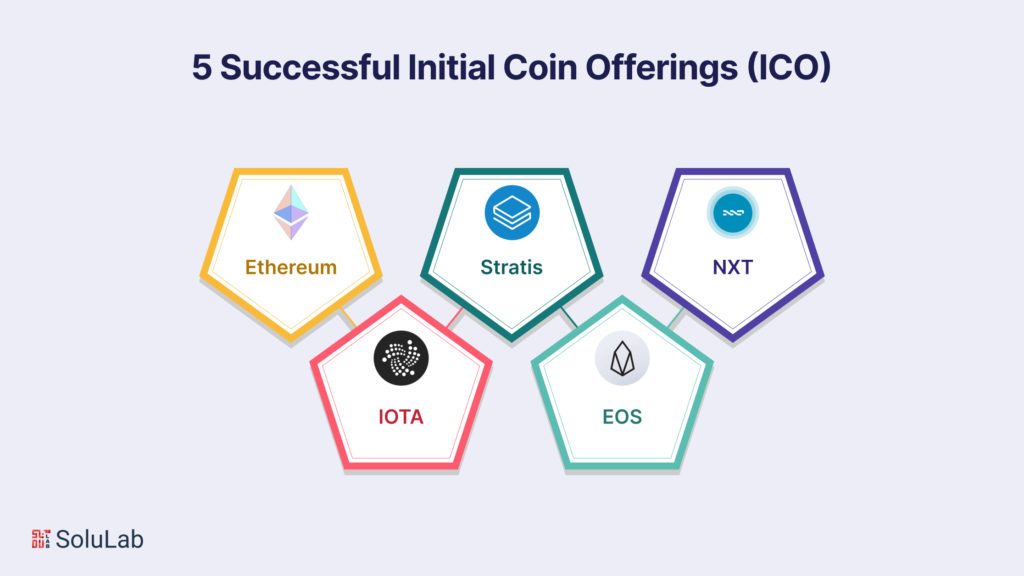
What are Five Successful Initial Coin Offerings (ICO)?

What are Five Successful Initial Coin Offerings (ICO)?

The biggest initial coin offerings have helped millions of people and organizations to raise billions of dollars. Although the IT industry has witnessed many successful ICOs, it still provides many business opportunities. Here is the list of the top five token releases to date;

  • Known to be one of the first initial coin offerings, Ethereum has made more than digital money compared to its predecessor, Bitcoin. Using smart contracts, decentralized apps can be created using Ethereum, a blockchain technology.
  • IOTA’s initial coin offering (ICO) is based on blockchain technology with the Internet of Things. Also, a cost-free, scalable environment was given via their decentralized transaction ledger.
  • Stratis is a software platform that supports many programming languages and enables companies to develop, test, and deploy programs.  Furthermore, none of this requires the setup or administration of a development environment. Nearly 1,000 BTC were raised during their ICO, valued at $675,000 and now over $8 million.
  • EOS, this popular cryptocurrency, raised more than $185 million in the first five days of its initial coin offering (ICO). Now, it is renowned for being the biggest ICO. EOS asserts in its white paper that its network is competitive (Alternative to Ethereum’s). They provide a wide range of blockchain-compatible business solutions.
  • Formerly known as Antshares, and now NXT, undergone two times of token sales. This ICO has tied up with Microsoft and the Chinese government to launch 3 cents in its initial coin offering (ICO). From October 2015 and January 2018, the cost of their coins soared to $180M. NXT is known to be one of the largest ROI coin offerings, as mentioned in its white paper.

Read Also: Which are the Best ICO Listing Websites Out There?
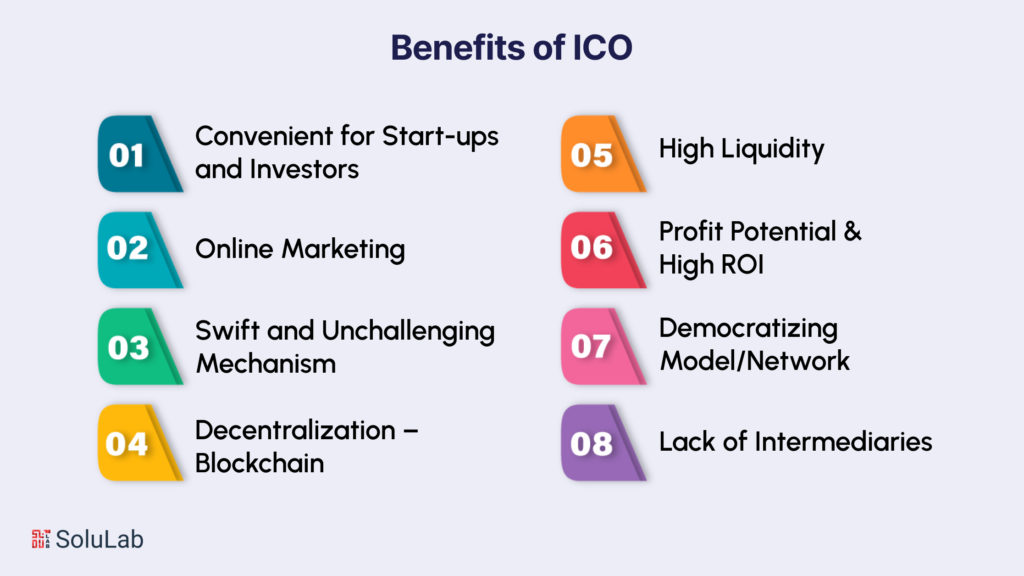
Benefits of ICO

Benefits of ICO

Below, we’ll discuss the usually analyzed advantages/ benefits of ICO, namely;

  • Convenient for Start-ups and Investors

The biggest advantage of an Initial Coin Offering (ICO) is that it gives access to a range of people, from freelancers and startups to mature investors. There aren’t any time constraints; contributors can also invest at any time, unlike traditional funding set-ups. Anyone who wishes can become an early investor. Thus, ICOs are a favorable option for Startups because, more often than not, startup companies lack the required funds to kick-start their project but can potentially raise their value over time.  

A Token launch is similar to the sale of API keys, and it’s difficult to restrict the sale of these keys to accredited investors alone. Hence it is bound to increase the buyer base relative to traditional equity financing for a start-up.

Read Our Blog: What is ICO and How Does it Work?

  • Online Marketing

It’s easier to gather information about tokens via surfacing the net. Buyers interested in these coins can learn about the ICO through the organization’s website, online forums, messaging applications, and social media websites. The internet leverages ICOs, and a large, general audience is attracted to the venture if marketed right. Also, companies seeking to raise capital through innovative blockchain-based technologies do not need high marketing and advertising costs which helps to reduce the cost of raising capital. 

  • Swift and Unchallenging Mechanism

All the transactions are done online. One can sell tokens internationally over the internet. Instead of relying on regulatory filings, as with other exchange forms like IPOs, stocks, bonds, etc., an ICO relies on blockchain technology to maintain a ledger of its multiple transactions. Data is constantly updated within seconds. All this makes an ICO less time-consuming, less energy-draining, and more efficient.

  • Decentralization – Blockchain 

From substantiating and establishing contributions to distributing tokens, ICOs only require monitoring and updating the distributed digital ledgers.

A distributed ledger lets all investors know about the ICO process daily, as the status of an ICO at each time is written on the Blockchain. This decentralization concept prevents issuers’ fraudulence over investors through ICO. ICO also changes our notion of property rights. As in the case of tokens, the final arbiter of who possesses what property is not a national court system but an international blockchain. 

CTA1

  • High Liquidity

High liquidity refers to an asset’s ability to be quickly bought or sold in the market without significantly affecting its value. ICOs are advantageous because early contributors have more liquidity in early-stage companies. Most popular tokens could exceed $100 million in 24-hour volume. Huge liquidity premium alone causes tokens to predominate (provided they are legally and technically feasible) because the time to liquidity enters inversely in the exponent of the compound annual growth rate. 

  • Profit Potential & High ROI

ICOs are said to be unregulated and risky for investment, but surely “the profits from the hits outweigh the losses of the misses.” For instance, the price of bitcoin was around $100 in June 2013 and was trading at $4,000-5,000 in early September 2017. Now investors are searching for a token that can replace Bitcoin in terms of economic appreciation. Many are citing Ethereum as “the next bitcoin.” 

ICOs are high-risk and high-reward assets. Investors seek high liquidity and the ability to recover the invested money quickly and other additional returns. A quick fix is provided to them through an ICO, making it a fairly attractive investment solution.

  • Democratizing Model/Network

Initial Coin Offerings (ICOs) are changing fundraising by democratizing access to financial capital. It’s the era of globalization of financing. ICO virtualization has made it possible for anyone, anywhere in the world, to invest in a company that is established or operating in any country. 

ICOs have caused the significance of going to Silicon Valley / Wall Street to raise funding to diminish. Everything is on the internet from the workings and marketing to opportunities. It paves the way for more expanded investment opportunities as more international clients/investors are lured into these projects. 

  • Lack of Intermediaries

Tokens mean instant custody, not requiring the role played by intermediaries. Elimination of financial intermediaries automatically minimizes the cost of funding and also the funding speed. There’s also less government control compared to traditional financing methods.

Specific Considerations

In 2019, ICO activity started to decline sharply, partly due to the legal ambiguity that ICOs operate. However, there is no foolproof way to sustain with the recent initial coin offerings even if investors do their research and track down the ICOs to invest in.

If necessary, the U.S. Securities and Exchange Commission (SEC) is permitted to intervene in an ICO, such as when the SEC has taken emergency action against Telegram and received a restraining order (temporary) after the Telegram development team allegedly engaged in illegal conduct and by the act raised $1.7 billion in an ICO during the years of 2018 and 2019. In March 2020, the Southern District of New York U.S. Court granted a preliminary injunction. An $18.5 million civil sanction and the repayment of $1.2 billion to investors were both mandated for Telegram.

Read Our Blog: ICO Vs Crowdfunding

When considering investing in an ICO, there is no assurance that the investor won’t become the victim of fraud or scam. However, you can follow these to take precautions against ICO scams.

  • Make sure the project developers can articulate their objectives properly. White papers for successful ICOs often have simple and clear goals.
  • Always seek transparency. Investors have to demand complete transparency from every company that runs an ICO.
  • Evaluate each legal term and condition of the ICO. Since there is a lack of traditional regulators, it is the investors’ responsibility to confirm the legitimacy of an ICO.
  • It is advised to keep ICO funds in an Escrow wallet. Escrow wallet protects against scams as multiple access keys are mandatory to form and open this wallet.
  • This type of wallet effectively prevents fraud and requires several access keys.

You may have to buy more coins to invest in the project since certain ICOs use other cryptocurrencies.

Why is there Immense Hype Around ICO?

The hype surrounding ICOs is tremendous. And there are many internet forums where investors meet to discuss potential opportunities. Some of the most well-known celebrities, including Steven Seagal, have urged his followers or fans to invest in a trending new initial coin offering (ICO). 

The SEC previously warned that it was illegal for celebrities to advertise ICOs on media platforms without disclosing the payment they received to do so.

Read Also: Top 10 ICO Development Companies

Centra Tech (an ICO that closed in 2017 with $30 million in funding) has previously been endorsed by DJ Khaled and the legendary boxer Floyd Mayweather Jr. The two celebrities reached a settlement with American regulators when Centra Tech was ultimately revealed to be a fraud in court. Three of the company’s founders were found guilty of ICO fraud.

Before taking part in an ICO, investors looking to invest should become familiar with cryptocurrencies and learn everything there is to know about ICOs. ICOs are not legally regulated, so it is advised for investors to proceed with utmost caution when it involves ICOs.

CTA2

How Can SoluLab Assist You With ICOs?

The amount of funding attracted by the ICO remains the most commonly used indicator for the success of companies or entrepreneurs. Organizations are considering issuing tokens as they are assumed to be securities. Because unlike holding a stock of a company (whose products a contributor never used), ironically, tokens can be more tangible than securities. On the market end, token buyers are trying to be more cautious about buying and trading ICO tokens. On the other hand, the cryptocurrency community is putting its best efforts into regulating token sales and conducting due diligence on behalf of the public.

SoluLab stands out as a premier ICO development company, particularly valuable for startups aiming to establish their presence and raise essential capital. Using their expertise, SoluLab maximizes fundraising potential through top-tier ICO development services, tailored to fuel success in the evolving ICO technology. Their adept team specializes in pioneering solutions, guaranteeing optimal outcomes for fundraising campaigns. For those looking to redefine the cryptocurrency venture experience, SoluLab offers a fully customized white-label ICO platform with multi-blockchain support. To embark on this transformative journey, connect with SoluLab and initiate the next phase of your business expansion.

In the end, we’ll advise you if you have an inclination in the crypto universe and are interested in buying ICOs, practice proper precaution before you invest in a company just to be safe.

FAQs

1. What is an ICO, and what benefits does it offer to businesses?

An Initial Coin Offering (ICO) is a fundraising method that allows businesses, especially startups, to secure capital by issuing and selling their own cryptocurrency tokens. One major benefit of ICOs is their global accessibility, enabling businesses to tap into a vast pool of potential investors without geographical constraints. This democratized funding model fosters inclusivity, as anyone can participate and support innovative projects, thereby enhancing the overall reach and visibility of the venture.

2. How does an ICO contribute to business innovation and growth?

ICOs provide a unique avenue for businesses to showcase their innovative ideas and technological solutions to a wide audience. This exposure can attract tech-savvy investors who believe in the project’s potential, leading to increased funding. Additionally, ICOs often offer early adopters the chance to acquire tokens at a lower cost, fostering a community of supporters who are genuinely invested in the project’s success. This community can become vocal advocates, amplifying the project’s credibility and driving growth.

3. What role does SoluLab play in enhancing the benefits of ICOs?

SoluLab is a leading ICO development company that specializes in creating tailored solutions for startups looking to launch their ICO campaigns. With their expertise in blockchain technology and software development, SoluLab crafts ICO platforms that are secure, user-friendly, and adaptable to multiple blockchains. By collaborating with SoluLab, businesses can ensure their ICOs are built on robust foundations, increasing investor trust and raising the likelihood of successful fundraising.

4. How do ICOs promote liquidity for investors and token holders?

One of the appealing aspects of ICOs is the liquidity they offer to investors and token holders. Once tokens are listed on cryptocurrency exchanges, they can be traded, providing investors with the flexibility to buy or sell their tokens as desired. This liquidity fosters a dynamic secondary market, where the value of tokens can appreciate based on demand and adoption, ultimately benefiting both the project and its supporters.

5. Can you elaborate on the advantages of a white label ICO platform?

A white label ICO platform, such as the one offered by SoluLab, provides businesses with a fully customized solution for launching their ICOs. This platform can be tailored to match the brand’s identity, ensuring a consistent user experience. Moreover, white label platforms often come with pre-built functionalities, reducing development time and costs. By leveraging a white label ICO platform, businesses can focus on refining their core offerings while leaving the technical intricacies to experts.

6. How do ICOs empower projects in niche industries to raise funds?

ICOs have the power to democratize fundraising, making it possible for projects in niche industries to attract capital that might be otherwise challenging to secure through traditional methods. Investors with a keen interest in a particular niche can find and support projects that align with their passions, thus fueling innovation in unique sectors. This ability to tap into a dedicated investor base enhances the viability of niche projects and contributes to diversifying the global economy.

7. What sets SoluLab apart in the ICO development landscape?

SoluLab is a trailblazer in the realm of ICO development services, offering an unparalleled combination of expertise and innovation. Their hallmark lies in providing businesses with the opportunity to launch their own white label ICO platform, complete with multi-blockchain support. This customized approach ensures that ICO campaigns are not only secure and reliable but also tailored to the brand’s vision. With a deep understanding of blockchain technology, SoluLab is committed to transforming fundraising experiences and driving success for new cryptocurrency ventures.

7 Most Successful ICOs of All Time

7 Most Successful ICOs of All Time

There are many factors that contribute to the success of ICOs. It could be the distributed ledger technologies upon which they are primarily founded or the ease with which they can be moved across international and governmental borders. Despite the increase in ICOs, “the Bitcoin explosion” left a gap that hasn’t been filled. What will be “the next bitcoin,” or who will it be? What will the cryptocurrency industry’s next big thing be? Maybe the future will make it clear.

We suggest that you carry out the proper research and study the company’s white paper if you have any interest. To help with your investigation, you may wish to check into the most successful ICOs. So let’s discuss the 7 most successful ICO initiatives that have, in no particular order, generated results with a certain degree of success.

What is an ICO?

The road to growth for conventional businesses is very predictable. Most businesses start off modest and grow as their profits rise. Companies usually turn to outside investment via transferring a portion of ownership in exchange for a quick infusion of cash. And businesses frequently “go public,” or give a share of the business (also known as stock) to investors on the open market in exchange for their money, by way of an Initial Public Offering, or IPO.

An Initial Coin Offering (ICO) is essentially comparable to a traditional initial public offering (IPO) in the world of cryptocurrencies. Companies raise money for their projects through ICOs, often referred to as crowd sales / token sale occasions, by releasing cryptocurrency to prospective buyers in the shape of crypto tokens.

What Factors Contribute to an ICO’s Success?

So, during the past several years, the ICO industry has experienced incredible growth. But what were some of the factors that contributed to this story’s success?

  • Utility: Whether the coin genuinely has good utility is one of the key success factors for an ICO. Although ICO specialists may disagree on a number of points, most concur that a coin must be more than a thing that can be purchased and traded on an exchange. The top-performing ICOs are distinguished from the countless others languishing fruitlessly in wallets or even on exchanges by their fundamental utility. An excellent way to demonstrate the usability of the ICO is to provide potential investors with a demo (or perhaps a visual model) that shows how the proposed enterprise will operate and what advantages it will provide. Furthermore, if the project is just a rehash of previous ideas, the ICO may still fail even if the coin represents a key part of the venture it is intended to support. Additionally, a reliable ICO launching platform that unites various stakeholders and offers a central dashboard can aid in ideation & customer acquisition and increase the likelihood of its success.
  • Solid Marketing, PR & Communication Strategies: Even the most innovative concept can fall short if the launch team’s PR, marketing, and communication efforts are shoddy. The likelihood of success can increase significantly if the marketing plan is comprehensive as well as the information is conveyed in an understandable manner, such as what specific problem the ICO’s project seeks to tackle. Webpages, white papers, e-newsletters, and social media accounts that are clear, succinct, and free of jargon can all be helpful in this regard. In fact, one of the main factors influencing an ICO’s influence and, consequently, its ultimate success, is its website and Alexa Rank (a measure of a website’s popularity).
  • Community Support: ICOs which are active in social media & discussion forums are likely to succeed more than those that aren’t, according to several analysts who’ve already studied past successful ICOs. Successful ICOs have, according to research by the cryptocurrency startup RAD Lending Inc., 4000-5471 Twitter/Facebook followers. Additionally, ICO teams who interact with the public on websites like Quora, Reddit, and Telegram tend to attract a larger audience of potential backers and thus have access to a larger pool of funding.
  • ICO Audits To Increase Trustworthiness: Companies that have their initial coin offerings (ICOs) audited by independent auditing advisories convey their inherent reliability to potential investors because many fraudsters and con artists occasionally utilize ICOs as a weapon to prey on overeager and ignorant investors. These audits may reveal possible problems with the ICO, such as with its corporate governance, financial model, or projections. More importantly, audits provide investors confidence, helping them see the ICO as a “non-scam” and increasing their willingness to contribute.

Some Benefits of an ICO

The benefits for all parties involved are the reason that ICOs have become more and more popular. A lot of the perks for contributors also apply to founders. These advantages motivate more participants to put their money in ICOs rather than alternative options, at the very least.

  • Liquidity: Lack of liquidity is a common barrier for people seeking new investing opportunities. Capital is often unreachable for years in many possibilities. With ICOs, investors have great liquidity as well as the secondary market, which implies that real-time price is based on the project’s current value.
  • Decentralization: Everyone may be able to participate in ICOs, especially if they take bitcoins. For the majority of ICOs, the contributors’ ability to transfer money in time to make a purchase is the only prerequisite.
  • Openness: ICOs not only let anyone invest; donors can also invest whenever they choose. Contrary to conventional models of startup finance, this makes it practically impossible to be an early investor if you don’t have a personal relationship with one of the founders.

ICOs have a lot of reasons attributed to their success. Be it the distributed ledger technologies on which they are mostly based or the fact that they can be transferred easily across national and jurisdictional boundaries. Despite the spike in ICOs, there is still a void left after “the bitcoin explosion” that remains unfulfilled. Who or maybe what is going to be “the next bitcoin”? What will be the next big thing in the crypto world? Perhaps the future will reveal it. We advise you to conduct your due diligence and read the white paper of the company you’re interested in. However, you might want to look into ICOs that closely resemble successful ICOs of the past to aid your analysis.

CTA 1

Here are the 7 Most Successful ICOs of All Time

So now as we discussed most of the ICO info, let’s discuss 7 most successful ICO initiatives that have, in no particular order, generated results with a certain degree of success:

1. NEO

NEO is an open-source Chinese blockchain project that goes by many different names. Perhaps the most common among them are Antshares, the former official title, and the nickname China’s Ethereum. NEO not only utilizes smart contract applications but also decentralized commerce & digitized assets and identification. The company gathered huge support from the Chinese government, Microsoft Corp. (MSFT), Alibaba, and other major companies. And as a result, was able to launch a successful ICO. NEO has provided exceptional ROI for many early investors and is a non-profit, community-driven blockchain project aiming to create a “Smart Economy.”

2. Stratis

This Stratis platform is a U.K.-based company that wishes to streamline business processes. Simultaneously reducing the complexity of Blockchain adoption and implementation. Stratis is one of the only platforms enabling full-stack utilization of Microsoft’s .NET Core Framework. The Stratis platform is well adaptable with multiple programming languages. It enables businesses to seamlessly create, design, and deploy custom applications without setting up or maintaining their own infrastructure. Furthermore, Stratis has made significant efforts to ensure that developers who lack previous experience can quickly pick up and become proficient with Blockchain technology.

3. Ethereum

Ethereum, a prominent cryptocurrency, has emerged as a groundbreaking platform for decentralized applications with the use of smart contracts. Unlike Bitcoin, it extends beyond being just a digital currency and has captivated the corporate world. Currently valued at an impressive $713, Ethereum has seen remarkable growth since its initial coin offering (ICO) in 2014, where it raised $18.30 million. Its potential for further innovation remains untapped, making it a significant player in the crypto space with an astonishing ROI of 4,137.54x in USD, 103.70x in BTC, and 1.00x in ETH from its ICO price of $0.31.

4. Ark

ARK is a dynamic digital currency platform that aims to provide passionate users with a solid foundation and a thriving ecosystem. Among its proprietary features is SmartBridge, an incredibly fast ecosystem enabling seamless integration of other cryptocurrencies into its blockchain. The project is supported by a distinguished team of 15 core members from 11 different countries, uniting to create a welcoming space for all blockchain enthusiasts. The ICO took place from Nov 7, 2016, to Dec 11, 2016, and successfully raised $22.00 million at an ICO price of $0.00995394. Currently in the trading stage, ARK has achieved a remarkable ROI of 36.79x in USD, 1.48x in BTC, and 0.24x in ETH.

5. Lisk

Lisk is a widely popular ICO within the programming community, and for good reason. Developed using JavaScript and involving key members from Ethereum, Lisk stands out as the pioneer in modular blockchain-based application platforms. With its innovative SDK, developers gain access to a comprehensive set of tools, empowering them to effortlessly build their own apps and deploy them on sidechains. This streamlined process of creating blockchain applications is remarkably simple due to Lisk’s modular design, which accommodates a diverse range of blockchain technology use cases.

6. Alias

Alias, formerly known as Spectrecoin, is an innovative privacy-focused cryptocurrency designed to safeguard users’ privacy. Its primary goal is to ensure real transactional anonymity, which is achieved through a distinctive integration of Tor within the ICO. By utilizing Tor, Alias ensures that users’ real IP addresses remain protected whenever they use the software, providing an extra layer of security and anonymity. This approach empowers users with the confidence to engage in transactions while keeping their identities and activities private and secure.

7. Cardano

Cardano, founded by Charles Hoskinson, one of Ethereum’s co-founders, debuted with its internal cryptocurrency ADA and a market cap of $600 million. It holds the distinction of being the largest proof-of-stake cryptocurrency, solidifying its position with a market cap of $77 billion in May 2021. One of its standout features is its innovative applications, including a collaboration with electronic dance music DJ Paul Oakenfold for the release of the album “Zombie Lobster” on the Cardano blockchain. Additionally, Cardano made significant strides in improving education in Ethiopia, with IOHK and the Ethiopia Ministry of Education partnering to launch an identity and record-keeping system on the Cardano blockchain for the country’s five million students.

Final Words

Mastercoin performed the first token sale (often known as an ICO) in July 2013. After that, they saw a decline, but they then experienced a resurgence in 2017. Initial coin offerings only have increased since that time. ICOs are excellent business financing and fundraising instrument. But as the saying goes, “It’s better to be secure than sorry.” You should therefore do so at your own risk. Watch out for con artists that attempt to use ICOs to carry out fraudulent operations.

SoluLab, renowned for its excellence in ICO development services, empowers businesses, especially startups, to achieve remarkable fundraising success and establish a strong market presence. Their top-tier ICO software development solutions ensure maximum potential for fundraising campaigns in the fast-paced ICO landscape. With an expert team dedicated to creating innovative solutions, SoluLab offers a fully-customized white label ICO platform with support for multiple blockchains, revolutionizing the fundraising experience for new cryptocurrency ventures. To leverage the full potential of their project’s fundraising capabilities, businesses can trust SoluLab’s expertise. Contact SoluLab today to launch your own white-label ICO platform and embark on a successful fundraising journey.

CTA 2

FAQs

1. What is an ICO?

ICO stands for Initial Coin Offering, which is a fundraising method used by blockchain projects to raise capital. During an ICO, companies offer new digital tokens in exchange for cryptocurrencies like Bitcoin or Ethereum. These tokens represent an investment in the project and can be traded on various cryptocurrency exchanges.

2. What makes an ICO successful?

Several factors contribute to the success of an ICO. Firstly, a strong and innovative project with a clear use case and value proposition attracts more investors. Additionally, a well-defined whitepaper detailing the project’s goals, team members, and technical aspects builds credibility. Effective marketing and community engagement also play a crucial role in attracting investors and building a strong community around the project.

3. What are the benefits of participating in successful ICOs?

Participating in successful ICOs can offer significant benefits to investors. Early investors in successful projects can enjoy substantial returns on their investment if the value of the tokens appreciates over time. Additionally, holding tokens of a successful project may provide access to various utilities within the platform or ecosystem, offering additional value to the token holders.

4. How can I participate in an ICO?

To participate in an ICO, you need to have a compatible cryptocurrency wallet and the required cryptocurrency (usually Bitcoin or Ethereum). When the ICO starts, you send your cryptocurrency to the ICO’s smart contract address, and in return, you receive the new tokens based on the exchange rate specified in the ICO’s terms.

5. Are all ICOs successful?

No, not all ICOs are successful. While some ICOs have raised significant funds and achieved their goals, many others have failed to gain traction or deliver on their promises. The success of an ICO depends on various factors, including the project’s viability, market conditions, team expertise, and execution. Investors should conduct thorough due diligence before participating in any ICO.

Disclaimer: Please note that the information contained herein is not intended to be a source of advice or credit analysis with respect to the material presented, and the information contained in this blog does not constitute investment advice.

What is ICO and How Does it Work?

ICO And It’s Working

In an initial coin offering (ICO), a company creates and sells a digital asset, known as a token, to investors utilizing blockchain technology. This method was pioneered by Willet in 2013 with MasterCoin, later renamed OMNI, resulting in the successful fundraising of $500,000 worth of Bitcoin. The funds were allocated to development, rewarding contributors, and other critical activities. A significant milestone was reached in 2015 when Ethereum introduced a standard for implementing tokens (ERC20), further simplifying the ICO process. Subsequently, the ICO market witnessed exponential growth, increasing from just 9 ICOs in 2015 to over 1,000 ICOs in 2018. ICOs serve as digital tokens issued by budding ventures in exchange for crypto-assets or traditional currencies. They represent an approach for early-stage ventures to secure funding and accelerate their growth.

What is Initial Coin Offering (ICO)?

In cryptocurrency and blockchain technology, Initial Coin Offerings (ICOs) have emerged as a way for startups and businesses to raise capital. ICO initial coin offerings have democratized the investment process, enabling anyone with internet access to invest in early-stage blockchain projects. Unlike traditional fundraising methods, which typically require navigating complex regulations and intermediaries, ICOs offer a direct, decentralized approach that has captured the attention of both investors and entrepreneurs.

An Initial Coin Offering (ICO) is a fundraising mechanism in which new projects sell their underlying cryptocurrency tokens in exchange for capital. These tokens can have various functions within the project, such as providing access to a service, granting voting rights, or being used as a currency within the project’s ecosystem. The ICO process is akin to an Initial Public Offering (IPO) in the stock market but with several key differences rooted in the decentralized nature of blockchain technology.

How Initial Coin Offerings Work? A Step-by-Step Process

Before you start with the ICO process, it’s crucial to thoroughly research and understand blockchain technology, regulatory, and token economics. This knowledge will empower you to make informed decisions and navigate the ICO journey successfully.

1. Whitepaper Creation

The first step in launching an ICO is drafting a comprehensive whitepaper. This document outlines the project’s goals, the technology behind it, the team involved, and the tokenomics—details about the token’s distribution, supply, and use cases. The whitepaper is essential for building investor confidence and providing transparency on what is an initial coin offering and how an initial coin offering works.

2. Choosing an ICO Platform

Projects often choose a blockchain platform to host their ICO. The Ethereum blockchain, with its ERC-20 token standard, is one of the most popular choices due to its robust smart contract capabilities. These smart contracts automate the ICO process, ensuring that transactions are secure and that tokens are distributed correctly once the ICO concludes.

3. Token Creation

The project team creates the digital tokens that will be sold during the ICO. These tokens are often designed as utility tokens that provide access to a product or service within the project’s ecosystem. Alternatively, they can be security tokens that represent an ownership stake in the project, similar to traditional securities.

ICO projects

4. Marketing and Promotion

To attract investors, the project team must engage in extensive marketing efforts. This includes listing the ICO on ICO initial coin offering lists, promoting it on social media, and participating in blockchain events. The goal is to build a community around the project and generate buzz that will drive the success of the ICO.

5. Token Sale and Distribution

During the ICO, tokens are sold to investors in exchange for cryptocurrency, typically Bitcoin or Ethereum. The ICO can be structured in various ways, such as a fixed-price sale, where all tokens are sold at a set price, or a Dutch auction, where the price decreases over time until all tokens are sold.

6. Post-ICO Project Development

Once the ICO concludes, the project team uses the funds raised to develop the product or service outlined in the whitepaper. Investors typically monitor the project’s progress through updates from the team and community engagement, closely watching how ICO works.

CTA1

Types of ICOs

There are various types of ICOs, each with its own characteristics and regulatory considerations. Here’s a brief overview of the most common types of ICOs:

  • Public ICOs

Public ICOs are open to anyone who wants to invest. These ICOs are highly inclusive and often attract a large number of small investors. However, they also face significant regulatory scrutiny and may require compliance with securities laws in various jurisdictions.

  • Private ICOs

Private ICOs are restricted to a select group of investors, often institutional investors or high-net-worth individuals. These ICOs tend to raise larger sums of money but are less accessible to the general public.

  • Security Token Offerings (STOs)

STOs are ICOs that issue tokens classified as securities. This means they are subject to stringent regulatory oversight, providing investors with a higher degree of legal protection. STOs are often seen as a more secure and regulated alternative to traditional ICOs.

  • Utility Token ICOs

Utility tokens are designed to be used within the project’s ecosystem. For example, a utility token might be required to access a service, pay for transaction fees, or vote on governance issues within the platform. These tokens do not confer ownership rights or dividends, differentiating them from security tokens.

Benefits of ICOs

Benefits of ICOs

Before delving into the benefits of Initial Coin Offerings (ICOs), it’s important to understand how they work and the different types of ICOs available.

  • Decentralized Fundraising

ICOs eliminate the need for traditional financial intermediaries, such as banks and venture capitalists. This decentralization allows projects to raise funds directly from the public, reducing costs and increasing accessibility.

  • Global Reach

ICOs have a global audience, enabling projects to attract investors from around the world. This global reach increases the potential for raising significant capital and building an international community around the project.

  • Liquidity

Tokens issued in an ICO can often be traded on cryptocurrency exchanges, providing liquidity to investors. This allows investors to buy or sell tokens as they see fit, potentially realizing returns on their investment even before the project is fully developed.

  • Innovation and Accessibility

ICOs provide an opportunity for projects to secure funding without the need for traditional venture capital. This has led to a surge in creativity and projects in the blockchain space, driving the industry forward.

Year ICOs Published Funds Raised
2016 29 $90 million
2017 875 $6 billion
2018 1,253 $7.5 billion
2019 109 $370 million
2020 14 $55.6 million
2021 320 $378 million
2022 217 $117 million

Who Can Launch an ICO?

While anyone can initiate an ICO, strict monitoring by authorities in developed nations like the U.S. ensures necessary registration. However, the ease of setting up an ICO as a scam, including fabricating registration documents, makes it crucial for potential investors to be vigilant. Before launching an ICO, entrepreneurs should carefully assess whether their business genuinely requires one. Initiating a security registration with the SEC is often essential in such endeavors.

Buying Into an ICO

Before investing in a new ICO, thorough research is essential. Begin by verifying the identities and accountability of the individuals behind the ICO. Next, investigate the project leaders’ track record in the cryptocurrency and blockchain industries. Beware of projects that lack individuals with verifiable and relevant experience in these fields, as this could be a red flag for a potential scam.

ICO crypto exchange

Identifying ICOs and Scams

In 2019, ICO activity experienced a significant decline, primarily due to the uncertain legal landscape surrounding ICOs. While there is no foolproof method to stay updated on all the latest initial coin offerings, interested individuals can research and participate in ICOs. Websites like TopICOlist.com offer comparisons of different ICOs. Additionally, investors can examine registered cryptocurrency exchanges to gain insights into newly listed and unlisted coins. Since many exchanges thoroughly vet the coins before listing, this approach can enhance safety.

Cryptocurrency aggregators can assist in identifying potential scams or genuine opportunities. However, it’s crucial to note that aggregators do not vet cryptocurrencies but provide purely informational services. They frequently include links to the project’s GitHub pages, websites, and social media platforms, discussing the problems the project aims to address. If there is no dedicated section describing a coin and no readily available information on websites, except for nonsensical phrases, it might be advisable to avoid such opportunities.

DO YOU KNOW?
“The U.S. Securities and Exchange Commission (SEC) can intervene in an ICO if necessary. For example, after the creator of Telegram raised $1.7 billion in an ICO in 2018 and 2019, the SEC filed an emergency action and obtained a temporary restraining order, alleging illegal activity on the part of the development team.4 In March 2020, the U.S. District Court for the Southern District of New York issued a preliminary injunction. Telegram was ordered to return $1.2 billion to investors and pay a civil penalty of $18.5 million.”

When investing in an ICO, there’s no guarantee you won’t fall victim to a scam. However, you can take several steps to reduce the risk of becoming involved in an ICO scam:

  • Scrutinize the Project’s Goals: Successful ICOs typically have clear, concise goals outlined in straightforward, understandable white papers. Ensure that project developers can clearly define their objectives.
  • Demand Transparency: Expect 100% transparency from companies launching an ICO. Verify the team’s identities, backgrounds, and qualifications. Look for evidence of their experience and expertise in the relevant industry.
  • Review the ICO’s Terms and Conditions: Given the evolving regulatory landscape, it’s your responsibility to ensure that an ICO is legitimate. Carefully review the terms and conditions, paying particular attention to the token distribution, fundraising goals, and refund policy.
  • Secure Escrow Wallet: Opt for ICOs that store funds in an escrow wallet. This type of wallet requires multiple access keys, offering protection against scams.
  • Consider Cryptocurrency Purchases: Some ICOs may require investment in another cryptocurrency. Be prepared to purchase these coins to participate in the project.

ICO Hyping

Initial Coin Offerings (ICOs) often create significant buzz, attracting investors to online forums where they discuss potential opportunities. Prominent figures like Steven Seagal have encouraged their followers to invest in popular ICOs. However, the SEC has warned celebrities that endorsing ICOs on social media without disclosing any compensation received is illegal.

Notable cases include boxing legend Floyd Mayweather Jr. and music mogul DJ Khaled, who promoted Centra Tech, an ICO that raised $32 million in late 2017. Centra Tech was later deemed a scam, leading to settlements with U.S. regulators by Mayweather, Khaled, and guilty pleas from three Centra Tech founders for ICO fraud.

Before participating in an ICO, investors should thoroughly educate themselves about cryptocurrencies and the specific ICO in question. Since fake ICOs are more often detected than prevented, prospective investors should exercise extreme caution when making investment decisions.

How ICOs Differ from IPOs?

While ICOs and IPOs share some similarities, such as raising capital from the public, they differ in several key ways:

  • Regulation: IPOs are heavily regulated by financial authorities, whereas ICOs operate in a more decentralized and less regulated environment.
  • Ownership: IPOs involve selling shares of a company, and conferring ownership rights to investors. In contrast, ICOs typically offer utility tokens that provide access to a product or service rather than ownership.
  • Accessibility: ICOs are generally more accessible to the public, allowing anyone with cryptocurrency to invest. IPOs, on the other hand, often require investors to meet specific financial criteria.

CTA2

Conclusion

Initial Coin Offerings (ICOs) represent a transformative approach to fundraising in the digital age. They offer a decentralized, accessible way for projects to secure capital and for investors to participate in the growth of the blockchain ecosystem. However, the success of an ICO depends on careful planning, compliance with regulations, and effective marketing.

At SoluLab, we specialize in ICO development and offer end-to-end solutions to help your project succeed. From drafting a compelling whitepaper to developing robust smart contracts and creating a customized ICO platform, our team of blockchain experts is here to guide you every step of the way. With a proven track record and a deep understanding of cryptocurrency, SoluLab is your trusted partner in launching a successful ICO.

Whether you’re an entrepreneur with an idea or an established company looking to explore new fundraising avenues, contact SoluLab to learn how we can help you achieve your goals with a tailor-made ICO strategy.

FAQs

1. What is an Initial Coin Offering (ICO)? 

An Initial Coin Offering (ICO) is a fundraising method where a company issues digital tokens in exchange for capital, typically in the form of cryptocurrency. It is a popular way for blockchain-based projects to raise funds.

2. How does an ICO work?

In an ICO, a company creates a whitepaper detailing the project and the associated tokens. Investors purchase these tokens during the ICO period, often using cryptocurrencies like Bitcoin or Ethereum. The funds raised are then used to develop the project.

3. What are the types of ICOs? 

There are several types of ICOs, including public ICOs, private ICOs, security token offerings (STOs), and utility token ICOs. Each type has different characteristics and serves different purposes.

4. What are the benefits of participating in an ICO? 

ICOs offer various benefits, including decentralized fundraising, global reach, and the potential for high liquidity. They also allow investors to get involved in early-stage projects that have significant growth potential.

5. How can SoluLab help with ICO development? 

SoluLab provides end-to-end ICO development services, including whitepaper drafting, smart contract development, and marketing strategy. Our team of blockchain experts ensures your ICO is compliant, secure, and strategically positioned for success.

How to Promote your ICO Effectively?

How to Promote your ICO Effectively

A fun and convenient approach to financing a digital firm is through an initial coin offering (ICO). At first appearance, it appears straightforward and transparent, which is why it was usual practice to almost completely forgo marketing help while launching ICOs in 2017–2018. the 2018 surge, but it was tarnished by fraudulent ICO schemes. Is ICO now extinct? No, ICO seems to be more vibrant and well-liked than ever thanks to effective ICO marketing techniques. Startups raised $4 billion through ICOs in 2017, while the funding totaled $17.8 billion from the start of 2017 to the middle of 2018. ICOs recovered in 2019 after hitting a low point by the end of 2018, reaching a high of nearly $14 billion. Additionally, by 2021, ICOs had already raised roughly $21 billion.

Although ICOs have decreased since the outbreak, it appears to be a positive indicator for cryptocurrencies & digital technology in general. The quality is improving, there are fewer scammers, and the greatest ideas are more prevalent as there are fewer ICOs.

Read also: Key Points to Keep in Mind while Creating an Initial Coin Offering

But in the modern era, an ICO cannot be considered effective without an ICO marketing plan. To stimulate demand, it wants to develop a market-driven ICO marketing strategy. Given the current trend, promoting an ICO is often required for ICOs to be accepted as legitimate by investors. The best technique to promote ICO, in the opinion of further than 80% of brands, is through content marketing.

ICO promotion: how to advertise ico

Advertising of ico is a major step towards its promotion  it helps to a better understanding of your promoting ico in this below section we deeply explained how you can market your ico:

Whitepaper

A whitepaper promotes your cause for popularity by proving that your ICO project is legitimate. Writing the Whitepaper containing all of the (ICO)information is essential for marketing cryptocurrencies. It serves as your project’s “Mission Statement” in the eyes of possible investors. Everything from the overview of your team’s experience and credentials to the amount of funding required for the project, token distribution strategy, and corporate social responsibility should be covered in an effective whitepaper.

Be careful to emphasize how you’ll deal with illegal activity as well. Last but not least, none of these particulars should overwhelm or jeopardize the whitepaper’s design. A good whitepaper must have a stunning design and use visual components.

Website

90% of potential investors check out the project’s website to learn more. Therefore, it follows that your website will be the focal point of your ICO digital marketing plan. Choose a design that works best for your ICO. Select a web hosting business that has a quality domain name and website builder. To create your online store, choose a store builder. Creating a quality website is one thing, but promoting it is quite another. You wouldn’t want your initial coin offering project to vanish in the sea of cryptocurrencies. Therefore, optimization for search engines is essential in putting a website in the public eye. Therefore, pick an SEO company that can improve your website’s search engine ranking.

Your website’s design components should receive more consideration than just the text.

 ICO Calendar Websites

One of the finest locations to look for investors is via ICO directories. These calendar websites make it easier to keep track of many businesses’ operations in advance. You get exposure while demonstrating to potential investors how transparent your business is. These websites are reasonably priced, simple to use, and typically ask for information such as your ICO project name, token specifics, and contact data.

So try to list your ICO on as many calendars as possible to gain maximum exposure. Some of the best ones are:

  • CoinSchedule
  • CoinGecko
  • ICOCalendar.Today

Conferences, Trade Shows, Podcasts & Interviews

Being a part of the Leading Events can have a huge impact on your project because it essentially brings together the best businesses. Podcasts, trade exhibitions, conferences, and interviews are very beneficial for building your ICO’s reputation and brand. When you’re starting and trying to spread the word about or create hype for your ICO, you should attend at least some of these events. Take advantage of the chances they present because most of these programs have low enrollment rates. Try to take advantage of podcasts and the opportunity they provide to enlighten potential customers about the specifics and features of your product. Audio material has always been effective. Regularly producing podcasts and reaching out to influencers for interviews will help you engage your audience.

Press Releases

A press release is a written, concise news item or document that announces something noteworthy that the public must be aware of and is delivered through a network of news sites as well as the media. In your press releases, you should highlight crucial details about the offers you make to investors.

Bounty Programs/Airdrop campaigns

In essence, these programs allow you to provide a variety of incentives to encourage behaviors that will boost your initial coin offerings and produce insightful data. similar to how some blockchain networks give away free tokens to entice investment. An airdrop campaign is a tried-and-true strategy that consistently succeeds since it not only increases awareness of your recently established ICO but also increases the value of your tokens.

Email Marketing

It is one of the easiest but most effective ways to promote. Making a good email marketing strategy is crucial since these communications work as compelling newsletters that can draw in new investors and keep your current ones interested. So, To reach the right audience quickly and accurately, using an email finder helps identify valid contacts and expand your reach For optimum impact, your email should address every step of the purchasing process. It must convey the ideas behind your company, present alluring deals, and offer sufficient assistance to paid users. At the same time, implementing proper DMARC policy options ensures your emails are authenticated and trusted, reducing the risk of them landing in spam folders.

Crypto Influencer Partnerships

Due to the spike in registrations and subscriptions, influencers advocating your ICO boost the project’s legitimacy and conversion rate. Partnering with reputable financial institutions and businesses will do wonders for trust-building. However, make sure the influencer you work with has a strong belief in your business; else, it could have negative consequences.

Community Management

Building a strong community and enabling it to do so should be your long-term objectives. Go above and beyond while creating networks and forming, maintaining, and developing relationships. It is crucial to understand that how you present your ICO to your target audience will determine whether it succeeds or fails. Networking on sites like LinkedIn, Reddit, Telegram, Quora Channels, and Specialized Forums is one approach to developing a community. It will be easier for you to ensure the growth and promotion of your ICO if you have a reliable community update channel.

  • Network with LinkedIn: You must be prepared to go above and above when creating networks and forming and fostering relationships, just like in a business. Look for any chance to do this, and don’t be afraid to take it. The fact that there is already a reliable platform where you can conduct the majority of your networking is advantageous. According to statistics from 2021, LinkedIn presently has more than 740 million users. Up to 55 million businesses have been listed on the site, and about 25% of that amount are senior-level influencers.In a fast-paced digital world, traditional business cards are being replaced by digital alternatives that enable seamless networking. Virtual business card allows ICO founders, investors, and crypto professionals to share their details instantly via a QR code. Unlike physical cards that can get misplaced, digital business cards ensure quick follow-ups and sustained engagement, making them an essential tool for ICO marketing and investor relations.
  • Facebook: There are numerous Facebook pages and groups that talk about cryptocurrencies, ICOs, and blockchains. This is a wonderful route for informing the public and promoting your initial coin offering.
  • Reddit: This makes the largest cryptocurrency community aware of your ICO. Subreddit creation and thread commenting are two ways to take use of this exposure.
  • Telegram: Telegram has the potential to become the next leading messaging and community-building platform. This platform is expanding every day and has gained support from the cryptocurrency community. Because of this, you must use it as a platform for ICO marketing.
  • Quora Channels: By contributing valuable information to Quora and participating in frequently updated conversations like https://www.quora.com/topic/Initial-Coin-Offerings-ICO, you stand a chance of gaining more exposure.
  • Specialized Forums: Most investors and cryptocurrency enthusiasts frequent the specialized sites to learn more about cryptocurrency and the available opportunities. Marketing on such sites provides you with a better chance to communicate your ICO to the right audience. The majority of social media platforms do not require much capital to run and therefore the best channels to use if you have a small budget.

Paid Promotions and Advertising

If you want to seriously promote anything, advertising is nearly always a given. You must hunt for venues that permit ICO adverts because they are not permitted on well-known ad networks like Google and Facebook. Some websites that specialize in Bitcoin advertising are successful in this regard. As an illustration, consider https://bitmedia.io/, which offers solutions that enable you to give a variety of ad targeting options & simple tracking at reasonable prices. If you’re pursuing a multi-pronged strategy, give each one enough time to enhance your campaigns. If not, you can always use services for online promotion.

SEO

It should be at the top of your list of priorities because it serves as the foundation for your digital marketing. These days, appearing higher in search results is automatically associated with reliability and reputation. Because of this, it’s just as effective just like any PR tactic that has previously been successful. As you presumably already know, there are several factors involved in search engine optimization. You should concentrate on the keywords you choose in your business listings if you want to promote your ICO. Don’t overlook the comments, social media shares, and mentions you receive as well. Partnering with a premium digital marketing agency can also give you an edge, helping you refine strategies, strengthen visibility, and maximize the impact of comments, social media shares, and mentions you receive. Working with an experienced marketing agency in Atlanta can further localize your efforts, ensuring your brand resonates with the right audience in a competitive regional market.

ICO marketing strategies: Key to Success

Whatever ico marketing strategy you choose to promote your ICO, you are bound to face stiff competition. You, therefore, have to be the best to beat the competition. To stand out in the competition here are some essential ico marketing strategies to help you:

Read also: How to Reap Profits from White Label Initial Coin Offering

Target the right audience

Despite the rising popularity of cryptocurrency, it doesn’t mean you should market your ICO to the masses. You will end up spending a lot of time and resources without achieving meaningful conversions. So, to be on the right track, ensure you understand your target audience and direct your efforts to that specific group. Segmenting your audience will help you in choosing the right marketing campaign for each group. This way, you will realize better conversions.

Seek the services of an ICO advisor

An ICO expert has the required experience to help you promote your ICO. You should, therefore, retain an ICO advisor to assist you to oversee the project. Such an expert understands the Dos and Don’t in the crypto industry. They will be able to tell you which marketing strategy will work and which will not. This will reduce the losses that come with putting efforts into non-productive ventures.

Make your offer to be transparent

The most important thing to make your ICO successful is to make it transparent. Transparency creates trust and confidence in the buyers which increases the funds collected during the initial offering. To create confidence among buyers, give information to all team members behind your project. You should also give all the financial information. People will also have questions to ask about your ICO. So, make sure you have a very responsive team on all the online platforms to respond to potential buyers’ questions and concerns.

Have an inspiring story

Backers like to associate with ICOs whose mission and vision they can relate to So if you have an interesting story to tell about your ICO, chances are, you will turn your potential customers into supporters. This increases the chances of success for your ICO.

Make your ICO compliant

Since ICO is a relatively new business, compliance is a key concern. Any ICO must be compliant for potential investors to consider participating in it. Ensure that your ICO complies with all SEC regulations right away if you want to succeed in this industry. This will contribute to the success of your ICO strategy. Choosing a combination of effective ICO marketing methods is the final step in promoting an ICO. A thorough investigation and plenty of time are needed to develop a successful approach. Therefore, take your time to research what is most effective, and on top of that, make sure your ICO is reliable and compliant.

Conclusion

The growing acceptance of cryptocurrencies will not help you in your ICO promotion to the appropriate target population. Therefore, picking the appropriate marketing strategy will enable you to achieve higher conversion rates. Use ico marketing plans and ICO  advisor’s services to minimize losses.

Understanding Blockchain Fundraising — Initial Coin Offering (ICO)

Understanding Blockchain Fundraising — Initial Coin Offering (ICO)

Blockchain technology has many use cases in the fundraising world. It is one of the most innovative technologies of recent times, as it provides a decentralized way for projects to raise donations, record transactions, and track how donations are spent.

Blockchain fundraising is a new trend in the fundraising world. It is a type of crowdfunding that allows people to donate money to a cause without any middlemen.

While crowdfunding through online platforms such as Kickstarter or Gofundme has exploded in popularity, blockchain’s decentralized nature allows organizations to raise funds from people directly without any middleman taking a percentage or commission.

What is Initial Coin Offering (ICO)

An Initial Coin Offering (ICO) is a type of crowdfunding that has emerged as an alternate way to raise money for start-ups. The term ICO refers to the process of releasing newly created cryptocurrencies, tokens, or other digital assets.

Startups may use an ICO to bypass rigorous and regulated capital-raising processes required by venture capitalists or banks. It can also be seen as a way for organizations to avoid the rigorous and regulated capital-raising process required by venture capitalists or banks.

Read also: Initial Coin Offering (ICO): Everything You Need To Know!

An initial Coin Offering (ICO) is similar to an IPO (Initial Public Offering), which raises funds when a new company ventures into the stock market.

Types of Token Fundraising

There are several ways people categorize the types of token fundraising. One of the easiest ways to understand crypto fundraising is to break it into Private Placements and Public Offerings.

Private Placement: Before launching a public offering, a project owner may decide to conduct a Private Placement in which tokens are offered to a select group of investors. This is called a “token presale,” which occurs when a startup or project sells tokens while the project is still in development. The token presale’s goal is to either raise funds for the project’s early development or business growth accretion leading up to the ico launch platform.

Public Offerings: There have been three main types of public offerings. It includes Initial Coin Offering (ICO), Initial Exchange Offering (IEO), and Initial Decentralised Exchange Offering (IDO).

FAQs About Initial Coin Offering (ICO)

What Happens If the Initial Coin Offering (ICO) Fails? If the ICO fails to raise enough funds, the new cryptocurrency is usually not created (or completed), and backers receive their money back.

What is the largest initial coin offering (ICO)? Ethereum’s initial coin offering (ICO) in 2014 had to be the most successful ICO of all time, at least to date. Over 42 days, the Ethereum ICO raised $18 million.

What Makes an ICO Successful? A company holding an ICO, similar to an initial public offering, should clearly state the maximum coin supply and the number of tokens allocated to founders, early investors, partners, and the company itself.

Conclusion

Finding funding to launch new ventures has long been challenging for entrepreneurs, even those with great business ideas because the traditional fundraising process requires significantly more effort, time, and money.

On the other hand, Blockchain technology provides an alternative fundraising method best suited for blockchain-related projects.

Blog Credits: Medium

Top 10 ICOs with the Best ROI

Top 10 ICOs with the Best ROI

2017 was an incredible year for initial coin offerings. According to various reports, the total amount of funds raised through ICOs in 2017 ranged from $4 billion to $5.6 billion. At the end of 2016, that figure stood at just $225 million.

That said, according to the same reports, less than half of the total number of ICOs held in 2017 were successful, while 25% of the total amount was raised by just 10 projects. These statistics prove once again that potential investors should be very careful when choosing a new company to invest in.

We present the 10 most successful ICO campaigns to date in terms of return on investment. ROI is calculated by dividing the subtraction of the investment gain minus the investment cost by the investment cost.

NXT

NXT is one of the oldest Blockchain-related projects. The official announcement was made on the BitcoinTalk forum on September 28, 2013 by an anonymous developer, who claimed to be an experienced forum member using a new account to remain anonymous.

In the announcement, NXT was described as a descendant of Bitcoin, which aimed to improve some of Bitcoin’s features, solve some of its problems, such as a bloated Blockchain, and move to a proof-of-interest algorithm.

The crowdfunding campaign also took place on the forum. In the end, the anonymous developer managed to raise about $16,800 worth of Bitcoin, distributing one billion tokens. Thus, the value of the NXT token at its ICO was only $0.0000168.

Today, NXT is a fully operational advanced blockchain platform. It provides its users with a modular toolkit that allows them to build their own Blockchain-related applications. The platform also has its own asset exchange, messaging system and marketplace.

IOTA

With a name based on the term IoT, or “Internet of Things,” IOTA is the first major cryptocurrency that doesn’t actually use a blockchain to conduct transactions. Instead, it runs on a system called Tangle. The system requires its users to verify a transaction at the exact same time it is made. This allows for fee-free transactions, among other things.

IOTA an innovative and original project, so it’s easy to see why the ICO held in late 2015 was a success, with over $400,000 raised. All of the $1 billion IOTA tokens were sold for less than $0.001 while an all-time high of $5.25 was reached on December 19, 2017.

_NEO

Neo is a project often referred to as “China’s Ethereum”. It also uses Smart Contracts, but adds decentralized trading, digitized assets and identification to the mix.

Chinese developers are creating a blockchain that would represent legal proof of ownership and be accepted by society at large, not just the crypto-currency community.

At the time of the ICO, there probably wasn’t even a single investor who doubted the value of investing in Neo. The project was backed by big names such as Microsoft and Alibaba. Naturally, the ICO held in October 2015 was a great success, with 17.5 million tokens sold for $556,500. A year later, in September 2016, Neo held a second crowdsale in which it sold 22.5 million tokens and raised over $4.5 million.

The original ICO price of the Neo token was $0.032, while an all-time high of $198.38 was reached on January 15, 2018.

_Ethereum

Everyone who is remotely interested in crypto-currencies has heard of Ethereum. It is a blockchain that allows its users to create and run decentralized applications (dapps) as well as implement and use Smart Contracts.

The mastermind behind the platform, Vitalik Buterin, is perhaps the most well-known person and a poster-boy of sorts for the entire crypto community. In addition, through its Ethereum Enterprise Alliance, the platform works in cooperation with hundreds of major customers, including the world’s largest companies, to implement Blockchain technology and Smart Contracts around the world.

Ethereum’s ICO was held in the summer of 2014. Naturally, it was a great success, the team managed to raise $15.5 million, selling 50 million tokens at a price of $0.311 per token. On January 13, 2018, Ethereum reached its all-time high of $1,448.18.

Read more: A Guide to Reaping Profits from an ICO

_Spectrecoin

Spectrecoin is one of many crypto-currencies that prioritize privacy and anonymity above all else. To do this, Spectrecoin combines a blockchain with a tokenized signature system.

In cryptography, a ring signature is a type of digital signature that can be performed by any member of a group of users who each have a key. It is impossible to know which particular member of the group signed for a transaction. Moreover, any group of users can be used as such without any additional configuration.

Unlike most other crypto-currencies, Spectrecoin uses the Tor network to increase privacy at the network level. All nodes communicate with each other exclusively via Tor, which means that Spectrecoin transactions pass through a series of intermediaries before reaching their destination, thus becoming untraceable. The network even provides a way to hide the fact that it uses Tor via a technology called OBFS4.

The team behind Spectrecoin (naturally, completely anonymous) held its ICO from November 18, 2016 to January 6, 2017. 19 million tokens were sold and the team managed to raise $15,500. Each token was sold for only $0.001, while it reached $6.28 on January 2, 2018.

_Stratis

Stratis is a project that offers end-to-end solutions for developing, testing and deploying Blockchain applications for businesses around the world. The startup has created a platform that is fully compatible with .NET and C#. Microsoft has added Stratis’ Blockchain-as-a-service (BaaS) to its Azure Cloud service, which is geared toward companies looking to build internal Blockchain solutions.

With such overwhelming support from Microsoft, Stratis’ ICO was always going to be a success. The project raised $610,000. Tokens were sold for $0.007, while an all-time high of $21.21 was reached on January 8, 2018.

ARK

Ark’s goal is to create an entire ecosystem of interconnected Blockchains, essentially bringing them together into one massive “spider’s web” of use cases. Interestingly, the project is collaborative and decentralized from start to finish: it has 17 core members from 11 different countries.

The project held its ICO from November to December 2016, successfully raising nearly $950,000. The ICO price of its token was only $0.01, while the token managed to reach $10.20.

Lisk

Lisk is the world’s first blockchain-based modular platform. This means that it has one main chain — a chain that currently hosts the LSK currency and will become a hub for all sidechains once the platform is fully operational. The sidechains are very similar to personal Blockchain, they can be easily built and adapted with Lisk tools.

The platform will allow developers to build their own apps, host them on their own custom sidechains, and even hold ICOs. More importantly, Lisk’s applications are the natural first choice for most developers, as they are built using Javascript.

The project has many well-known Ethereum players on board, so naturally, their ICO was a huge success. Held in February and March 2016, the crowdfunding campaign netted the List team $5.7 million. The token was sold for $0.076, and its all-time high was $38.8 on January 7, 2018.

DigixDAO

One of the main features of Ethereum is that it allows its users to create and manage decentralized DAOs or autonomous organizations. This is a whole new way of structuring businesses, as there are no bosses or people in charge of the whole business. Instead, all decisions are made through proposals and votes.

DigixDAO was one of the first major DAOs created on the Ethereum platform. Interestingly, the project uses two tokens: DGD and DGX.

DGD tokens were sold to investors during the ICO. It’s worth noting that when it comes to DAOs, token sales aren’t just about attracting funds. The coins purchased effectively give investors the right to vote in proposals submitted to the DAO. In this way, each token holder can participate in shaping the future of the organization.

DigixDAO aims to create a new, stable crypto-currency backed by real gold bars. That’s where DGX tokens that represent a gram of gold come in. The gold bars have all gone through a Proof of Assets protocol and their existence is proven on the Ethereum Blockchain. DGX tokens can actually be withdrawn into gold bars and redeemed by each token holder.

The participating vault is located in Singapore and can safely store up to 30 tons of gold. In the future, however, DigixDAO hopes to open additional vaults around the world.

DigixDAO made history when it completed the first fundraising round on the Ethereum blockchain. In March 2016, the project successfully raised its $5.5 million goal in just 12 hours. DGD tokens were sold for $3,235 and the token reached its all-time high of$409.6 on February 3, 2018.

Qtum

QTUM, which is actually pronounced “quantum,” is a project that integrates Ethereum’s Smart Contracts with the stable Bitcoin Core blockchain, while using a proof-of-stake algorithm for verification. The main goal of the project is to increase the number of applications using Smart Contracts, especially for commercial purposes.

Thus, QTUM benefits from the best of the new developments of the Bitcoin and Ethereum communities. In addition, QTUM aims to introduce tools, templates and various other smart contract options to make the creation and execution of smart contracts easier and more secure for businesses.

QTUM held its ICO in March 2017 and successfully raised $15.6 million in 117 hours. Tokens were sold at a price of $0.3 while an all-time high of $100 was reached on January 6, 2018.

While all of these projects managed to raise a significant amount of money to fund their ambitions, they seem to have benefited from a global hype in the cryptocurrency market. The new year 2018 corresponds more to a phase of disillusionment on the Gartner trend curve.

Blog Credits: Medium


Understanding the Ethereum ICO Token Hype

Understanding the Ethereum ICO Token Hype

Tokens and the Future of Crypto

Since the advent of bitcoin, the overall excitement around decentralized technologies has grown exponentially. The imagined possibilities of what these new systems will do for humanity have only just begun being explored in-depth. With a market capitalization of currently about ~$40 billion at the time of this writing, bitcoin remains the most valuable, and widely adopted cryptocurrency to date.

However, the rise of cryptocurrencies has birthed a few new breadwinners for our growing crypto family of public blockchains — specifically Ethereum (ETH).

Ethereum, which broke onto the scene only within the last 2 years, thanks to a very successful crowd sale, has since experienced astronomical gains…With an immense uptick in adoption from developers, institutions, and some of the largest enterprise-level organizations in the world, such as BP, Toyota, Intel, Microsoft, and more.

The core draw of generalized public blockchains like Ethereum is not purely a technical attraction, but more specifically “socio-technical”. The most disruptive aspect, thus far, for Ethereum, has been the growth of “tokenized assets” being created on the Ethereum public chain to create incentivized platforms; wherein the owners of the token use that asset to interact with and utilize the platform itself.

Read also: 7 Most Successful ICOs of All Time

The incentives for these tokens have many layers. Though the initial draw to these tokens is technical: the real benefit of tokens is the societal impact they have on the creation of new businesses, and raising funds in a borderless, global manner…without having to ask permission. Let’s jump into the specifics…

Smart Contracts 101 — An Introduction to Irrational Exuberance

If you read our previous article on our introduction to Ethereum, you should know by now that the project has the potential to solve major efficiency problems across a plethora of pre-existing industries; as well as create wholly new owned industries.

At the center of Ethereum lies the EVM or “Ethereum Virtual Machine”, a decentralized computer that can execute “smart contracts” (think mini-applications) that are submitted to run on the Ethereum public chain.

These contracts are self-enforcing, meaning that they will run exactly as pre-programmed, without the ability of manipulation or censorship, retroactively (though some will argue that this aspect isn’t true due to past events, that’s a discussion outside the scope of this post). This poses a tremendous advantage, allowing programmers to automate many processes throughout e-commerce, finance, real estate, legal contracts, and more.

Imagine an escrow system where “John” sells a product to “Mary”; a smart contract will securely store Mary’s payment, and will release it to John after the confirmation of delivery is made by an outside oracle. This eliminates the need for third parties to oversee the transaction (which creates additional counterparty risk by adding another trusted agent to the transaction).

Read also: How Do Smart Contract Applications Actually Work

Similarly, one can imagine a smart contract that automatically settles countless transactions in the banking sector, eliminating the need for costly settlement systems like the SWIFT network; systems that not only expend a large number of monetary resources but also precious human capital and intellect as well; intellect that could be best utilized in other ways than simply moving value from Point A to Point B across the globe.

Enter ERC20 Tokens

One of the main capabilities of Ethereum is that it allows a user to create their own token. A token is a representation of value, a sort of digital asset (dasset). The Ethereum developers decided to standardize this process, and so the ERC20 ‘Token Standard’ was created. This templated-contract standardization contains a series of functions that enables the issuance, distribution, and control of the assets in a formalized, standardized manner.

A token standard allows for the ease of interoperability between DApps (decentralized applications built on the Ethereum public chain) and the tokens built by the programmers.

What is an Ethereum Token sale?

Many developers have chosen Ethereum as the main platform to kickstart new projects; at the center of this, we have ICOs, which stands for “Initial Coin Offering” (there are other names as well but this is the most prevalent), similar to IPOs (initial public offerings, minus all the securities stuff, but that’s an on-going point of contingency).

ICOs are essentially a fundraising mechanism that allows a person/investor to receive a token in exchange for another well-known digital currency like Ether or Bitcoin. Typically, ICOs on the Ethereum network issue ERC20-compatible tokens to its users via smart contracts (barring the organization/individual holding the ICO from creating more tokens than originally specified in the initial contract); this allows developers to take advantage of the security the Ethereum protocol provides, minus all the additional technical overhead and complexity. Without having to worry as much about security (the initial token contract being secure is still, of course, a top priority) developers can keenly focus on the application layer; creating a more refined user experience to aid in the adoption of their platform/project.

It is also the norm that each new team that hopes to raise funding via an ICO launch platform also presents a ‘whitepaper’: a document explaining in detail the pitch of the future company and platform, going as far as to describe in detail the technology behind the proposal itself.

The various formats in which an individual or organization can hold an ICO crowd sale are ever-evolving, however; but, we’ll find a fair methodology that ensures optimal token distribution, and doesn’t create a quick cash exit, burning crowd sale participants.

What’s Got People Excited?

The initial appeal of ICOs should be fairly easy to see. Due to the borderless and decentralized nature of public blockchains like Bitcoin and Ethereum — the ease of transferring and moving wealth globally becomes almost effortless.

Now, because those transfers are effortless and permissionless, the barrier to entry for investing in a good company/venture is now freely available to everyone — even your gardener.

The tokens themselves do not offer the holder any particular rights or actual equity in these projects; however, it does enable the ability for individuals to speculate on the adoption and eventual real-world usage of those systems, creating liquidity and the ability for developers to fund their project and bring it to fruition. It also allows those users/investors to access any platforms or features that the developers create in the future with the token (think of it like an API key, that you pay for, Balaji puts that ever so succinctly).

With tokens, entrepreneurs have the ability to open up their projects to a global audience, allowing them to attract and raise funds from savvy investors all over the world salivating for the next “big thing” in tech. Technical Expertise, Developer Evangelism, and Product Marketing play a key role in helping ICO holders to establish a base of early adopters and fuel the initial bout of speculation to get the project off the ground (and enough attention to begin trading on prominent exchanges).

Token Sales Thus Far

We’ve seen many high-profile ICOs thus far. With companies like Storj, raising $ 30 million for their decentralized cloud storage platform; Brave raised a stagging ~$34mill in roughly 30 seconds; Aragon raised ~$25 million in about 20 minutes; and Gnosis, the originator of the Reverse Dutch Auction, who raised $12million in about 12 minutes.

But, we also can’t forget most recently, Bancor, who raised an astounding $140million in just a few hours (insert gasp here).

If those figures are stagging and surprising to you, you’re not the only one. But, who’s to say if these are proper valuations or not? This is the first time in history we’ve been given this ability to raise from a global audience, almost instantly. Perhaps these numbers are only a drop in the bucket for what’s to come next. Time will tell, and history will play out from here.

Picking a Good ICO

Creating an ERC20 token is easy. Paying a team to create amazing design mockups and marketing pages is even easier. The difficult aspect of ICO investing is learning to filter out the noise, and determine if the team is in it for the technology and use case — or a quick buck.

Now, you’d probably argue that’s the job of modern-day VCs, and in a way you’re right — that’s what VCs are good at. Finding the diamonds in the rough from a Founder perspective. Investing in ICOs like Brave’s Basic Attention Token Sale, an offering by an already established entity with a working product and sound team, are likely a safer bet. But, the risk/reward there might not be satisfactory (especially after you’ve gotten a taste of 5–10x returns, it can be hard to go back). Picking a great project is a combination of art, and science — due diligence remains more important than ever, especially when investing your hard-earned savings into such an unregulated and “Wild West” like industry.

Read also: How to Find the Best ICO Service Provider?

There is no clear-cut formula for token investing; it’s a matter of making informed and educated decisions, at the right time. But, fortune favors the bold, no?

Legal Risks

No primer on ICOs would be complete without a section on legal risk. As mentioned above, this space is highly unregulated and filled with opportunistic money grabbers looking to make a quick buck on your poorly informed decisions.

That said, regardless of how high-profile the token offering is, there is nothing stopping a development team from running off with the funds raised via an ICO, except for maybe burning years of social capital. Which, will stop some, but not all (greed can do powerful things, remember this).

Lock-up mechanisms (think vesting schedules and cliffs) with token contracts are becoming a more common norm; but, to think that’s enough to give you peace of mind in this (somedays seemingly) lawless jungle of cutthroats, would be naive.

Since most of these ICOs run with a disclaimer of not guaranteeing returns to investors if its associated token price plummets to zero based on negligence or malicious actions by the development team — there is likely not much legal recourse will do if the developers are good at masking their trail…this is the Wild West remember — watch out for cowboys (and cowgirls, it’s 2017).

Closing

Hopefully, this was a concise quick introduction to this growing phenomenon. For now, VCs and traditional accredited investors will do all they can to gain influence and hold ground in this fledging industry; performing the appropriate due diligence to calculate risk; maybe even picking a few winners along the way.

But, once this powerful new paradigm evolves a bit more, we may have finally created the global answer to Silicon Valley — only this time on the internet, where all can be sovereign and free.

Blog Credits: Medium

Crypto Airdrop Vs. ICO

Crypto Airdrop Vs. ICO

Airdrops and initial coin offerings (ICOs) are only two of the many entrances points bitcoin startups use daily.

Free tokens of a new or even an existing cryptocurrency are sent to participants in an “airdrop.”

Suppose they meet the criteria for the airdrop. Any new and old cryptocurrency can be used for this purpose.

The condition might be that they do certain tasks to aid the project’s development, have a specific cryptocurrency, or have just used a service.

This essay isn’t only about airdrops; there’s a lot to know about crypto and NFT airdrops if you want to earn free tokens or coins.

First Coin Offerings (ICOs) are distributed to the crypto community like airdrops to gain exposure for a new cryptocurrency venture.

They also facilitate people’s ability to invest in the nascent bitcoin market. But an airdrop is not the same as an ICO platform.

The Distinctions between Airdrops and ICOs

One fundamental difference between an ICO and an airdrop is that ICO participants are not obligated to make any financial investment, but airdrop participants are.

If someone contributes to a project and does a good deed, they can be eligible for an airdrop as compensation.

For example, the Uniswap decentralized exchange airdrop of 2020 gave all participants 400 UNI tokens as a gesture of gratitude for their prior involvement with the platform.

None of the recipients paid for the tokens; all they required was a track record of using the Uniswap DEX.

Participants in an initial coin offering (ICO) can pay for tokens with either fiat money or another cryptocurrency, such as Bitcoin or Ethereum.

Initial coin offerings (ICOs) are a way of crowdsourcing funding for the launch of a new company.

Read also: What is the ICO and How Does it Work?

At the same time, airdrops incentivize users to engage in the project and, in most instances, use their obligations as a form of free advertising.

Why is a Crypto Airdrop important?

The Uniswap airdrop is a good reminder that airdrops can be used to encourage new users to join a platform and reward loyal users for their continued support.

In honor of the introduction of Stellar XLM on the Blockchain.com wallet, the business has given two billion XLM tokens to verified Blockchain.com customers.

Each user’s wallet was credited with 100 XLM at $25.

For this purpose, airdrops are often organized to reward loyal consumers or to attract new users to a business.

In either scenario, it serves to increase membership by attracting attention and acting in a way somewhat unlike a public relations stunt.

Why is an ICO important?

First and foremost, an ICO serves to raise funds for a new business. Most ICOs are conducted by startups or established enterprises that restart their fundraising efforts.

But why does every project have to start by seeking to get capital?

When a cryptocurrency company needs to raise money quickly, it can hold an initial coin offering or ICO.

As a result, every cryptocurrency startup’s founder has the financial means to fund the venture from the outset.

Ethereum, which started as an ICO, is currently the second most valued cryptocurrency, behind only Bitcoin.

Speculators swapped their Bitcoin for Ethereum because they believed the latter would be worth more if the successful undertaking.

It did, fortunately; nevertheless, this is not always the case, and blatant scams sometimes occur.

In some cases, projects are formed only to scam unsuspecting investors out of their money in exchange for worthless tokens that the project’s designers do not intend to use.

This has made regulators wary of ICOs, leading to a significant decline in popularity.

Read also: What are Some of the Benefits of an ICO?

Most ICOs have been replaced with safer and more reliable fundraising processes like IEOs, IDOs, and DEXs (decentralized exchanges).

To Sum it Up

In the last several years, airdrops have seen significant evolution.

Once they were as simple as handing you free tokens once you completed a few simple tasks, but now that is not the case.

Competition to participate in airdrops has increased as awareness of cryptocurrencies has grown.

While most ICOs welcome anybody who wants to join in, they have certain limitations, especially because of the necessity for investment.

Blog Credits: Medium

ICO 101: A beginner’s guide to raising capital using cryptocurrencies

ICO 101: Beginner’s guide to raising capital using cryptocurrencies

An initial coin offering (ICO) is a way to raise capital for your project by selling blockchain-based digital assets.

Imagine you have a brilliant idea for a new blockchain startup. Perhaps you want to build the world’s first decentralized computer on the blockchain, which can be used to create native digital assets and develop decentralized applications. Users of the network will transact using tokens, which are digital assets created using your blockchain (and the nifty decentralized applications you can build on top).

Seems like a pretty good idea. But, like any startup, you need to raise some capital first.

For a traditional startup, your options are to either: raise a seed round from private investors, pitch a venture capital fund (or a hundred of them, most likely), or attempt crowdfunding using a crowdfunding platform. 

With your blockchain startup, however, you have another option: Why not raise capital by selling the tokens the network will eventually use? As the network grows, meaning that the tokens become more in demand, their value will rise and reward investors. This method of raising capital is an ICO platform.

Why ICOs are a popular way to raise capital

ICOs have a number of advantages:

  • Speed: It only takes 100 lines of code to create an Ethereum-based token like ERC-20, and tokens can, in theory, be created and distributed in a very short timeframe.
  • Liquidity: Tokens are sold into a global market that operates 24/7.
  • No gatekeepers: ICOs can raise capital directly from anyone with a crypto-wallet, anywhere in the world.
  • Ownership: Tokens do not confer ownership rights to tokenholders unless this is programmed into the smart contract explicitly.
  • Community: ICOs attract early adopters and align the early user base behind your success.
  • Minimal bureaucracy: Disclosure requirements and paperwork (depending on the regulatory status of your token) can be minimal.

Although the advantages are numerous, ICOs are no walk in the park. The crypto marketplace is extremely competitive and your project will face serious scrutiny from both regulators and the crypto community itself. This article will give you an overview of the work involved in pulling off a successful ICO.

Pre-sale: Everything needed before the launch

The very first question you need to answer is if an ICO is a right strategy to raise capital for your business.

The graveyard of failed ICOs is wide and deep — but the prospect of completing huge funding round in a matter of months (or even days) can still tempt overzealous entrepreneurs to ignore the risks. 

Not every project can successfully raise capital with an ICO. Firstly, it’s important to understand that an ICO isn’t just about raising capital. Before deciding on an ICO, you must know:

  1. How the use of a token (and a blockchain) genuinely improves a business, product, or service, beyond injecting a quick burst of capital in the short term;
  2. How to generate a fair return on investment for token holders over the long term.

The most successful ICOs have a compelling use case for a blockchain and, as with any successful business, a product or service that people want. 

There are thousands of tokens out there. Without a very convincing answer to these fundamental questions, investors are unlikely to take the risk of investing in businesses that are not well thought out.

Build a team

An ICO is an enormous and multi-faceted project. You’ll need an excellent team to be successful. In fact, the team behind an ICO is one of the most reliable indicators of whether it’ll succeed or not, and investors will be paying attention to it.

Understand the law and choose the right jurisdiction

Regulators and lawmakers are becoming more sophisticated in their understanding of blockchain and crypto, but as a relatively new industry powered by completely new technology, it still exists in mostly a grey area of the law — this includes ICOs.

However, you should not interpret this as meaning that your ICO won’t be subject to local laws and regulations. It actually means you definitely need legal expertise to clarify the exact legal nature of your token, how it might be regulated and what you’ll need to do to stay compliant — particularly with regard to securities law which governs the issuance of financial instruments classed as securities (such as stocks, bonds and sometimes tokens), and Anti-Money Laundering (AML) laws, which intends to prevent money laundering. 

The regulations that will apply to your ICO will vary according to the jurisdiction you’re operating in. For example, tokens sold to residents of the United States could be subject to the United States Securities and Exchange Commission (SEC) regulations and the Howey Test can be used to determine whether your token will be seen by the SEC as a security (and hence regulated by federal securities laws).

Read also: What are the Best Upcoming ICOs?

Some countries are known to have favorable legal frameworks for launching ICOs and crypto projects such as Singapore, Switzerland, Hong Kong, the British Virgin Islands, Lichtenstein, the Cayman Islands, Bermuda, Cyprus, Malta, and Gibraltar.

Choose (or build) the right technologies

It is not surprising that choosing the right technologies for your ICO will be fundamental to successful fundraising. The essential technologies that need to be in place are a blockchain, a smart contract, a token, and an assortment of back-end web and security infrastructure.

Blockchain: Some projects choose to develop their own blockchain and use it to run their ICO, but the vast majority use established platforms such as Ethereum. Building a blockchain is a complex and time-consuming undertaking and is really only used in projects where a bespoken blockchain is necessary. While these blockchains may offer unique features and greater flexibility, they also require more time and expertise.

Smart contract: A smart contract is the engine of your ICO. It handles incoming token purchases, enables token holders to transfer and sell tokens, connects to your token wallet, and more. It’s critical, therefore, that you properly audit your smart contract to ensure that it is completely secure and functional, as, for example, hackers will be looking for exploits in the smart contract to steal money from you and your investors.

Tokens: Since tokens are code, they can be programmed with different features. Tokens can be categorized as utility, participation, investment, or asset-backed. Each type can be bound by its own legal requirements and it’s therefore very important to be clear on the status of your token. 

Infrastructure: On top of the blockchain-specific technologies which are essential to your ICO, you’ll also need servers to manage your website traffic and onboard users. This is typical with automatic Know Your Customer (KYC) services or manual verification.

Security: While blockchains are highly secure, smart contracts and websites can be exploited by hackers, and ICOs can be a “honey pot” for scammers and hackers. You will be vulnerable to domain name and social phishing, personal data breaches, smart contract hacks, and distributed denial-of-service (DDoS) attacks. Having excellent security in place will protect and reassure investors about your project. Having a professionally audited smart contract, high-quality reliable hosting service (with DDoS protection), and domain monitoring for phishing, as well as buying up similar domain names yourself will all help secure your project and your investors.

Design your tokenomics

In general, you want to find a balance between the supply and the price of your token for your ICO. If the supply is too high, then the price per token will be diluted and low, but if the supply is too low then there might not be enough tokens to satisfy your investor base, or investors might be put off by the high price of the token. These factors are known as the tokenomics of your ICO.

The tokenomics of your project should support the nature of your product or service, as well as the price of your token. Two factors that are necessary to think about are the allocation and distribution of tokens and the supply of tokens.

Allocation and distribution: There are many decisions you will need to make to decide how to allocate and distribute the token. One of the first is whether it would be better to launch a private or public ICO or use both. A private ICO offers pre-mined tokens to a limited and selected group of investors, often in a pre-sale event ahead of a public ICO. Public ICOs allow almost anyone with a crypto wallet to invest in a token and are sometimes referred to as token crowdfunding.

Read also: Which are the main ICO listing websites out there?

A balance has to be struck here. If employees and early investors control too high a percentage of the tokens, the price of the token can be severely impacted if one of them sells. Many ICOs will include lock-up agreements to help stabilize the price over the short to medium term. If too much of the supply of your token is held by whales (anyone owning a significant percentage of the tokens), then it’s also a red flag for retail investors who will be wary of getting dumped on.

Supply of tokens: Your token will have a maximum supply (the maximum number of tokens that can ever be created/mined), a total supply (the number of tokens that exist at present), and a circulating supply (the number of tokens currently in circulation i.e., not locked up or burned). The value of your token will be determined in part by the supply, as well as the promise of your project.

You can design the supply of your token to be inflationary or deflationary, depending on the nature of your project. Inflationary tokens do not have a maximum supply (new tokens can always be created) but deflationary tokens such as Bitcoin (BTC) do have a capped maximum supply. 

An inflationary model can lead to the devaluation of your token over time, but it also encourages tokenholders to use their tokens. Using a deflationary model helps to increase, or at least maintain, the value of each token as demand increases, but can also lead to tokenholders hoarding their tokens instead of using them. You will have to decide which model is right for your project.

Choose your token sale model

After deciding on the tokenomics of your project, you’ll need to decide how to manage the sale of the tokens. The token sale model needs to balance simplicity with as much diversity as is necessary to entice and reward a mix of investors.

Soft, hard, and hidden Caps: The soft cap is the minimum amount your ICO must raise (either in the number of tokens sold or the amount raised) and the hard cap is the maximum amount that the ICO must raise before it ends. The caps are set before the ICO begins. Hidden Caps can be hard or soft, but investors are not able to know the capitalization until the allocation is finalized.

Uncapped or capped with fixed rates: You can create a fixed price for the tokens at an early stage of the ICO usually at a discounted price, moving them to another fixed price at a later stage. It motivates investors to buy in early.

Dutch auction and reverse Dutch auction: In a Dutch Auction, a smart contract is used to calculate the price of the token only after all bids are received, with the highest bids being prioritized. Reverse Dutch Auctions start with a high token price and cap, which then declines each day the sale runs or for every block that is mined. The sale ends once the cap is reached.

Collect and return (C&R): With C&R, the cap is fixed but with some flexibility. A smart contract collects contributions that exceed the predetermined fixed cap and then adjusts the final allocations of tokens by ratio, with any difference returned to owners.

Dynamic Ceiling: Instead of making the entire cap available to investors at once, dynamic ceiling ICOs create a series of hard caps which raise the capital in stages. This type of ICO has the advantage of preventing whales from buying up the entire allocation in one go, which could block smaller investors from buying in.

Create your product roadmap

Your ICO is a means to an end. Your investors will want to know why you’re raising this capital, what it’s going to be used for and where your company is headed. A detailed product roadmap is necessary to convince investors that your business is legitimate and likely to succeed.

The roadmap should contain:

  • A well-articulated vision of your project — hiring a copywriter can help you craft this.
  • A series of SMART (specific, measurable, actionable, realistic, time-bound) milestones and goals.

Write your white paper

A white paper is a pitch for your ICO. It will be the primary reading material for investors doing their due diligence on your project. This white paper will be vital in convincing investors that your project is legitimate and credible, and you’ll ideally want it in place before building your community and reaching out to investors, whether you’re doing a private or public ICO.

Your white paper should include everything mentioned above, from your market research and your team to your technology, tokenomics, and product roadmap. Don’t skimp on copywriters and graphic designers — the better your white paper looks, the better your project looks.

If you want a complete breakdown of how to write and structure your white paper, read the Cointelegraph guide on everything to know about white papers.

Getting ready for launch

Create your website and brand

Investors will judge a project by the quality of your website. Hire the best web developers and designers you can afford and don’t cut corners. If your project is international and you want to attract international investors, you should consider hiring professional translators to translate your website into the native languages of the jurisdictions you want to target.

Before your ICO launches, your website should also have a token sale landing page. This page should offer a snapshot of your project and its biggest selling points, as well as have your white paper clearly signposted. A well-executed landing page can be a powerful lead for your ICO.

Build your community

Community is everything in crypto. A dedicated, loyal, and enthusiastic community will be a game-changer in marketing your project and ICO. You’ll help to build your community with a serious public relations (PR) and marketing push.

In general, you’ll be best served by PR and marketing agencies specializing in ICOs and crypto. The crypto verse is unique, and most corporate and traditional practitioners won’t have a sophisticated enough understanding of the ecosystem, investors, or media.

PR: A great PR team has its finger on the pulse of the crypto media (and potentially tech and national media) and excellent proven contacts within it. PRs can get you featured in thought leadership pieces in top-tier crypto-publications, position you as an expert to be quoted in significant trending stories, write press releases that land, and, most importantly, know how to pitch your specific project to journalists. They can also get founders featured on podcasts and interviewed on YouTube channels hosted by famous crypto personalities.

Community groups: You want to ensure that you’re constantly engaged with your community before, during, and after your ICO. A community manager will organize and build your Slack, Telegram, and Discord channels, all while managing your inquisitive and enthusiastic investors. Be active on forums such as Reddit and BitcoinTalk, write your own Medium blog and frequently update your GitHub.

Social media: An engaged presence on the most popular social media channels is essential to keep investors and potential investors informed. Hire a social media manager who can give you an entertaining and engaging presence.

Pay-to-play: Many mainstream social media platforms banned ICO-related advertising in 2018 (although they have since relaxed some of these bans) but you can still run paid ads in crypto publications and other media. It’s worth experimenting with various types of advertising and pricing models (e.g., impressions vs direct response) at different stages of the token sale.

Influencer marketing: Getting a noteworthy celebrity on board can push the recognition and trust in your project to new heights. Ensure that you do a lot of due diligence and choose the right influencers — you’ll be tying your reputation to theirs.

Bounty programs: You can generate interest in your project pre-ICO by putting bounties on reporting bugs, promoting your project, maintaining forums and other fan projects, and other tasks. They are a great way to encourage crypto-savvy individuals to engage with the details of your project.

ICO calendars: You’ll want to ensure your ICO is listed on all of the most popular ICO calendars, such as Cointelegraph’s ICO calendar.

Rating agencies: Specialist rating platforms will rate and audit your ICO. They aren’t cheap but can offer an impressive stamp of quality and credibility.

List on crypto exchanges

It’s no good to have a brilliant project, a token that everyone wants to buy, and absolutely nowhere to sell it. It’s critical to have the token listed on exchanges ahead of your ICO date. Listing on high-quality, secure and legally compliant crypto exchanges will also help to promote your ICO organically.

Read also: How to Create a Cryptocurrency from Scratch and Start an ICO?

Exchanges all have their own requirements for allowing you to list, often depending on the nature of your token and business. Some of these requirements will be universal such as having an audited smart contract.

Because exchanges make money by charging fees on trades, it’s in their interest to list in-demand new tokens. If you have a sizable community and can demonstrate high demand for your token, you shouldn’t have a problem finding an exchange to list you. The application and listing process usually takes 1-2 months, so factor that into your timeline and overall ICO roadmap.

Post-sale: You’ve launched. Now what?

Remember what we said earlier: Your ICO is a means to an end. If you’ve raised the capital you needed, congratulations. Now, it’s time for you to stay engaged with your community and deliver on what you promised in your white paper.

Blog Credits: Cointelegraph

Essential Checklist Explaining Everything About ICO Development


Essential Checklist Explaining Everything About ICO Development

How well do you know about Initial Coin Offerings (ICO)? If your answer is “partial” or a “complete no,” then this blog declutters from scratch about the same. If you are looking for a guide material that can help you in knowing ICO and the need for an ICO token development company, this blog will serve that purpose.

What Is An Initial Coin Offering (ICO)?

Crowdfunding is a common method of pooling funds for a variety of projects. There are many traditional crowdfunding platforms across the globe that let entrepreneurs raise funds to launch their projects. Usually, such crowdfunding platforms charge registration fees and payment processing fees. Through the crowdfunding platform, entrepreneurs get the option to integrate with other social media platforms so that they can promote their project campaigns.

Well, crypto projects do indulge in crowdfunding to raise funds, and it is termed ICO. ICO is similar to IPO; however, the former doesn’t provide any equity/share in the product, unlike the latter. Whoever creates crypto projects and seeks funds for the same can indulge in the Initial Coin Offering platform, which is a decentralized method, i.e., no mediator or third-party involvement.

What Are The Types Of ICO?

Private ICO — As the name is explicit, in a private ICO, only a limited number of investors can take part, and that too net-worthy investors and financial institutions.

Public ICO — A public ICO is open to all investors out there. Anyone who wishes to invest in crypto projects can participate in public ICO token sales.

How Do You Get Started With Initial Coin Offering?

Firstly, let us look into the benefits of opting for an ICO and then gradually move on to the procedures associated with getting started. The crucial advantage is the non-involvement of third parties so that you can directly sell your crypto tokens to interested investors. And another major advantage is that investors across the globe can participate in token sales, so the chances of getting investments in your project are high.

Approach An ICO Token Development Company

Fundraising through ICO needs careful initial planning and analysis since it involves risks. Hence, it is necessary to partner with an ICO development agency that delivers end-to-end services from token development to launch to promotion.

Roadmap Creation

Every project needs a roadmap that tells the stakeholders the timeline of the project from scratch. When it comes to your Initial Coin Offerings, your investors need to be educated on the future of your project, which will convince them to buy your project’s tokens.

Market analysis

Before releasing your project, you must do a proper and thorough market analysis, which will help you in knowing the risks and proceed further. Again you can take help from the ICO development company as they’ll have a team of advisors who are industry experts and can help you with suggestions and clarifications.

Whitepaper Creation

A whitepaper basically comprises all the details regarding the project. It starts with the amalgamation of pain points of target audiences and gradually comes to the solution that the particular project can bring in. In addition, the whitepaper for your crypto project should include the token details, descriptions, utility values, roadmap, token price, etc. A whitepaper is one of the crucial elements that decides whether the project succeeds or fails. Hence, a whitepaper writer you hire should be well aware of your project.

Pre and Post-Launch Promotions

It is necessary to carry out pre-launch and post-launch promotions; for that, you can choose the platform where your audiences are active. Once you launch your ICO token sales, you need to promote it through popular channels. In that sequence, developing a website is highly recommended where you can list your project and feature the roadmap, which will eventually let you in pulling in audiences or investors.

Read also: 5 Best ICO Projects in 2022

Other than website creation, consider promoting on community-based platforms such as Discord, Telegram, and Slack. And of course, Twitter, Facebook, and Reddit are also perfect for educating and advertising your ICO projects.

ICO Development & Sales Model

While developing the tokens, you must decide on the token sales method. The soft cap and hard cap tokens represent the minimum and maximum amount of funds you need to raise. A fixed uncapped model represents that there isn’t any restriction on the number of participants who can take part in the sales and the amount to be raised. Whereas a capped model is vice versa.

Once your crypto tokens are developed, they can be launched and hence making them available for sale. Investors will buy your tokens in exchange for cryptocurrencies or fiat currencies. To make your tokens more familiar, you can also list them on crypto exchanges.

Conclusion

Most of all, you need to sign up for a crypto wallet so that you can store the funds you receive via token sales. So, the major part of your token sales’ success depends on the ICO launch service provider you ally with.

Blog Credits: Medium
