


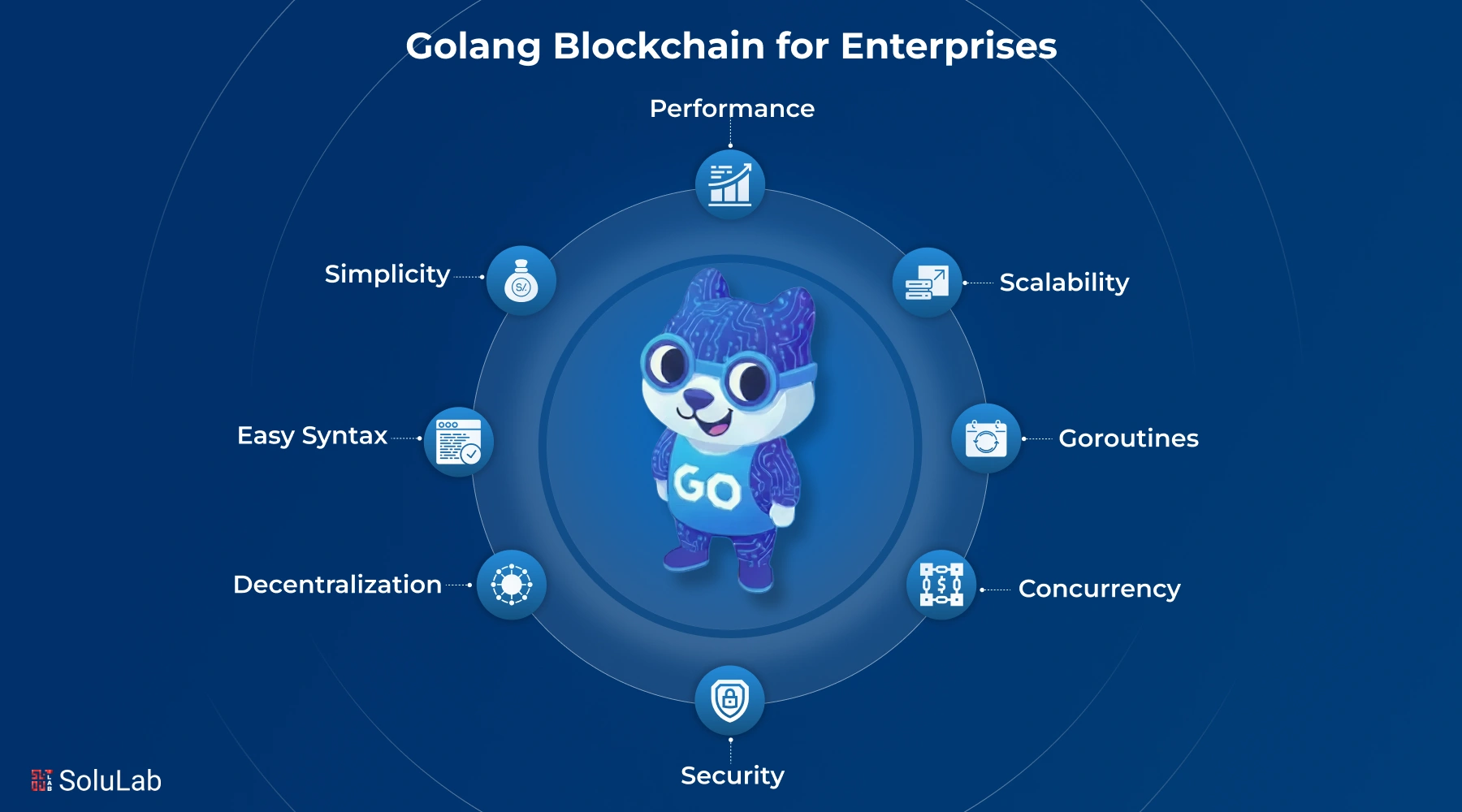
Several industries, from tech to healthcare, are adopting blockchain to secure user data. However, building a reliable blockchain is a significant task; multiple programming languages can be used. Golang is also one of the options for blockchain development.
Go is known for its simple and high-performance blockchain framework. Ethereum’s Geth client, to Hyperledger Fabric and Tendermint, adopted this method to build enhanced blockchain technology. This blog’s primary focus is to provide you with a detailed overview of blockchain development using Go.
A blockchain built with Go is a distributed system that records transactions in secure blocks linked together.
Go offers concurrency, fast execution, and easy deployment, making it suitable for enterprise blockchain solutions and lightweight blockchain prototypes. Unlike other high-level programming languages, Go compiles into a single binary. This makes deployment simple across multiple platforms. This aids startups’ blockchain app development and provides enhanced solutions.
Go’s architecture makes it ideal for large-scale blockchain programming.
These features of Golang shape the speed, security, and scalability.
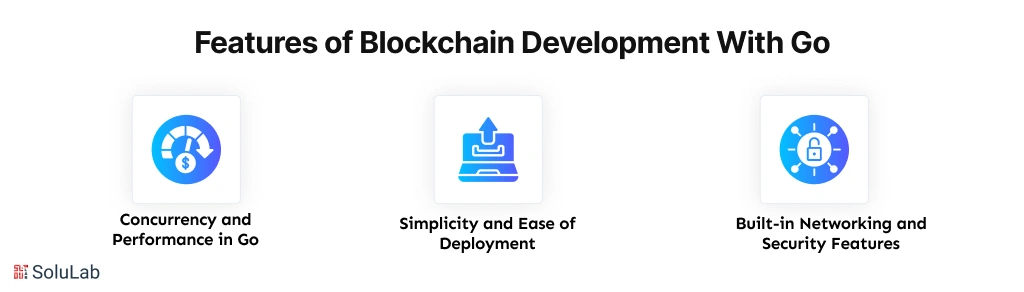
As said, Go simplifies blockchain development. Let’s check what they are and how they are enhancing blockchain technology on platforms.
Concurrency is essential for blockchains, which must process multiple transactions across distributed networks. Go’s lightweight Goroutines enable developers to manage thousands of parallel processes efficiently. This makes Go an excellent choice for high-volume transaction environments where speed and responsiveness are critical. Unlike heavier languages, Go’s performance closely rivals C, offering blockchain developers both power and flexibility.
Blockchain systems often face challenges with setup and maintenance. Go addresses this with its simple syntax and compilation process. Applications can be compiled into single, platform-independent binaries, making deployment faster and easier. This is particularly useful in blockchain app development for startups, where teams require rapid testing, iteration, and scaling without complex installation hurdles.
Networking is at the heart of blockchain frameworks, and Go’s standard library provides robust tools for secure communication. Peer-to-peer networking, encryption, and cryptographic hashing can be implemented with fewer external dependencies. These features of Golang reduce risks, simplify development, and make Go a trusted choice for enterprise-grade blockchain development.
There are several programming languages other than Golang. Here is how they are different from Go.
Python is widely used for blockchain prototypes, but it lacks Go’s raw performance. Go offers a compiled environment, giving it a speed advantage critical for production-grade systems. While Python remains useful for learning and experimentation, Go ensures scalability and efficiency in enterprise blockchain solutions.
Java has long been a popular choice in enterprise IT systems, but it often requires more resources than Go. Go’s lightweight nature makes it faster and less memory-intensive, reducing infrastructure costs. As a result, organizations moving towards enterprise-grade blockchain development increasingly adopt Go for long-term efficiency and scalability.
Rust and C++ are powerful languages that also focus on performance and safety. However, they have steeper learning curves and more complex syntax. Go achieves similar results with cleaner code, making it easier for developers to implement blockchain app development with Go without excessive overhead.
| Criteria | Go | Python | Java | Rust / C++ |
| Performance | High (compiled, fast execution) | Moderate (interpreted) | Good but heavier | Very High |
| Scalability | Excellent for large blockchain networks | Limited for production-grade systems | Strong but resource-intensive | Excellent |
| Learning Curve | Easy & clean syntax | Easy | Moderate | Hard / Complex |
| Resource Usage | Low, lightweight | Higher memory usage | Higher CPU & memory | Efficient but complex to optimize |
| Best Use Case | Enterprise blockchain, nodes, validators | Prototyping & experimentation | Legacy enterprise systems | High-performance blockchain engines |
| Key Advantage | Speed + simplicity | Flexibility | Ecosystem maturity | Maximum control & safety |
For enterprises, how is Go going to help attract users? Let’s check the business benefits as follows.
One of the strongest benefits of Go is its ability to accelerate development cycles. Startups and enterprises can build and deploy blockchain applications faster due to Go’s simplicity. This shorter time-to-market is a critical advantage in industries where innovation speed defines competitiveness.
Go is designed to handle growth effortlessly. Whether it is a small pilot project or a global enterprise blockchain solution, Go-based frameworks can scale as needed. This scalability ensures long-term value for businesses investing in blockchain app development with Go.
Go powers well-known frameworks such as Hyperledger Fabric, Tendermint, and Geth. These platforms demonstrate Go’s reliability in real-world, enterprise-grade systems. Businesses choosing Go benefit not only from its technical strengths but also from its proven adoption in blockchain use cases for enterprises worldwide.
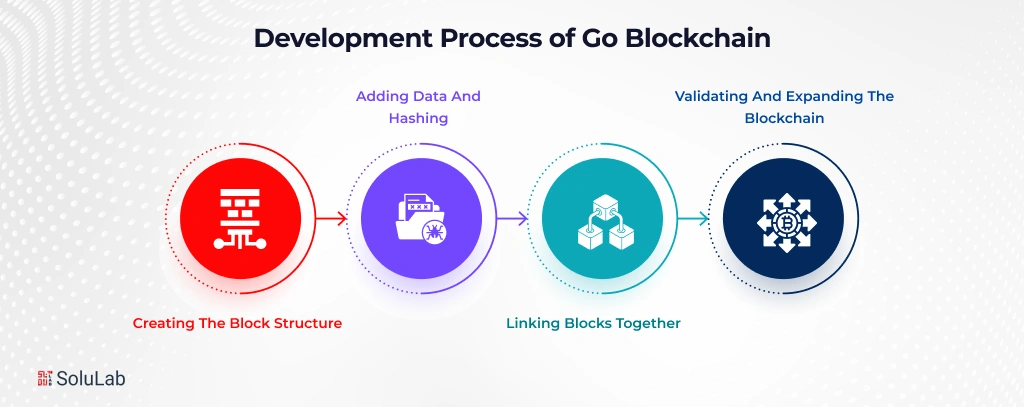
We already know GO benefits; it’s time to know the step-by-step process of blockchain development with Go. To save time and price, you can partner with blockchain development companies, which can provide support and also integrations if needed.
The first step in how to build a blockchain with Go is defining the structure of a block. Each block contains data, a timestamp, and a cryptographic hash linking it to the previous block. This ensures data security and immutability.
Once the block is created, transaction data is added. The data is secured using cryptographic hashing, which ensures that even the smallest change alters the block’s identity. This immutability builds trust across the blockchain network.
Blocks are chained by referencing the hash of the previous block. This linking creates a tamper-proof ledger, where altering one block requires changing every subsequent block. Go’s efficiency ensures this process runs smoothly, even under heavy workloads.
After building the chain, validation is essential to confirm integrity. Developers can expand the blockchain with features like peer-to-peer networking, consensus algorithms, and smart contract support, laying the groundwork for enterprise-grade blockchain development.
Note: The total process might take at least 8 weeks based on the features you want to incorporate.
You might be wondering, blockchain is adopted in several industries, but can building with Go bring any change? Let’s get to know that.
The finance sector increasingly depends on Go-powered blockchain development for finance because of its speed, reliability, and high security. Ethereum’s Geth client, written in Go, is widely used by banks and crypto platforms. Binance also built its blockchain using Go, enabling fast trades and low-cost transactions.
Blockchain in supply chain is becoming more efficient and trustworthy thanks to Go-based frameworks like the Cosmos SDK. Companies such as Suning in retail and Krafton in gaming have used these systems to track goods, verify origins, and reduce fraud.
Blockchain in healthcare is rapidly advancing as providers adopt Go-supported frameworks like Hyperledger Fabric to secure and streamline medical data. These systems allow quick access, safe sharing, and compliance with strict privacy rules, making data handling more reliable.
Startups choose Go for blockchain apps because of its simplicity and speed. Development firms and tech ventures use Go with Cosmos SDK to launch new blockchain solutions quickly, test ideas, and scale without heavy costs.
Golang is proving its credibility in blockchain development. As the technology increases, there are many possibilities for enhancement. Let’s check some expected changes.
1. Cross-Chain Interoperability: Go-based blockchain frameworks are making it easier for different blockchains to talk to each other. This helps businesses share data and assets smoothly across networks.
2. Integration with Artificial Intelligence: When Go blockchains meet AI, contracts get smarter and systems more predictive. Industries like finance and healthcare can use this for faster, data-driven decisions.
3. Growing Adoption in Enterprises: Tools like Hyperledger Fabric highlight Go’s stability. More companies are now trusting Go for secure, scalable, and efficient blockchain solutions.
4. Research on Scalability Enhancements: Developers are working on Go blockchains that can handle millions of transactions quickly. This could make Go a strong base for future large-scale blockchain systems.
Golang in blockchain development is enhancing the platform’s working that makes the company reliable and scalable. If you are also looking to build a blockchain with Go, then SoluLab is here to assist you. We at SoluLab, a top blockchain development company in the USA, deliver secure, scalable, and ROI-driven solutions that solve real business challenges.
Our expert team implemented an efficient crypto-based payment system using OBOT tokens. This is to enhance financial interactions within the OBORTECH SmartHub ecosystem. For more information, consult us today.
Financial services, supply chain, healthcare, and startups gain efficiency, transparency, and secure data management. Go’s speed and scalability allow enterprises to process transactions faster and manage complex distributed systems reliably.
A production-ready Go blockchain typically requires 6–12 weeks, depending on features, consensus mechanisms, integrations, and testing. Partnering with us for experienced developers can optimize timelines while ensuring robust enterprise-grade implementation.
Go offers concurrency, fast execution, cross-platform support, and simpler syntax. Unlike Python or Java, it handles high-volume transactions efficiently, reduces infrastructure costs, and scales easily for enterprise blockchain solutions.
SoluLab delivers enterprise-grade Go blockchain solutions, combining technical expertise and strategic insight. We design secure, scalable, and efficient systems, tailored to business needs, ensuring ROI, transparency, and seamless integration into existing workflows.
Yes, Go blockchains can integrate AI for predictive insights and IoT for real-time data tracking. This enables automated decision-making, improved operational efficiency, and more intelligent, data-driven enterprise workflows.


