Talk to an Expert

How Much Will AI Integration Cost Your Business in 2025?

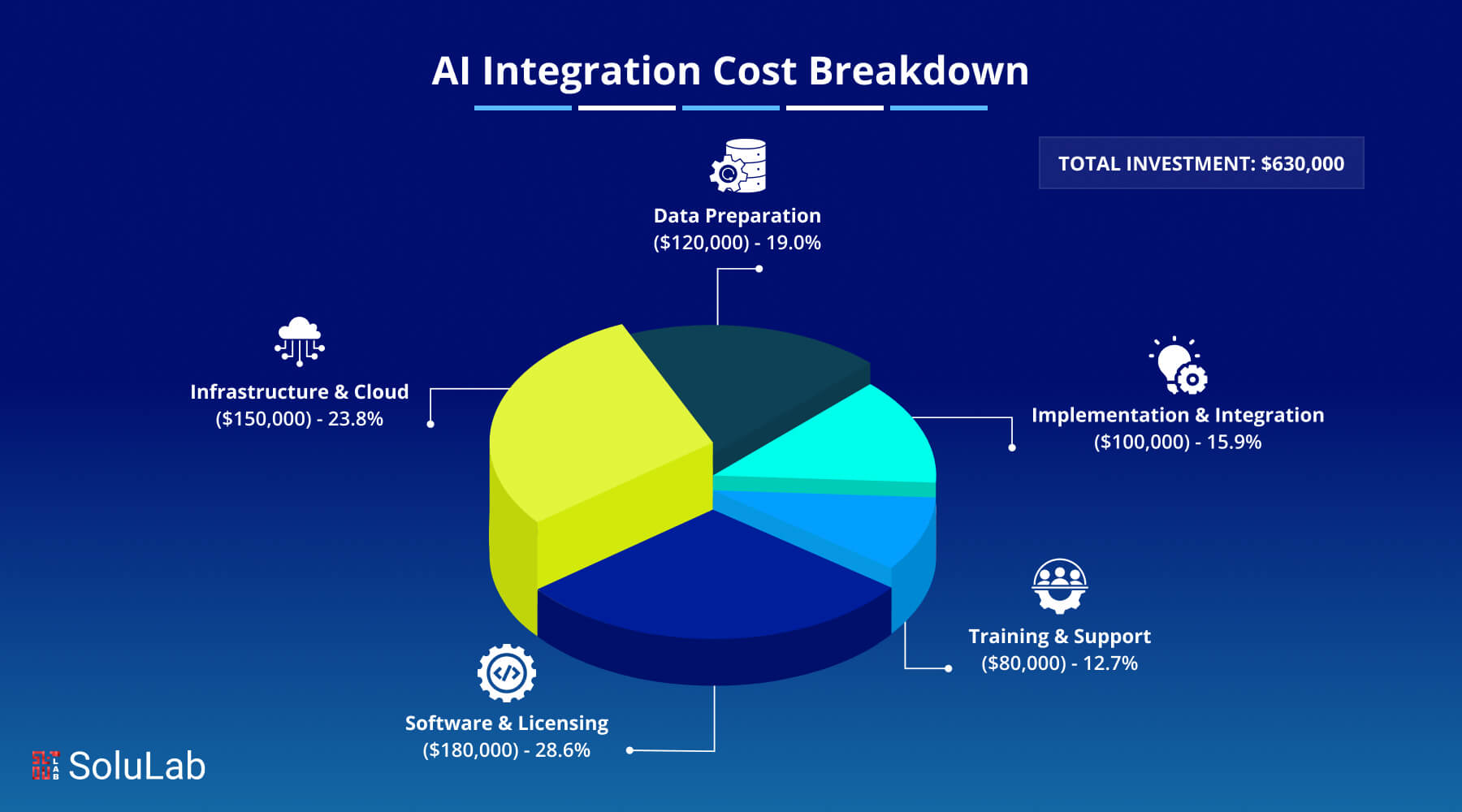
AI Integration cost breakdown

In 2025, the global artificial intelligence (AI) market is expected to cross $407 billion, up from just $86.9 billion in 2022. More than 77% of businesses are now using or actively exploring AI Integration to work smarter, reduce costs, and boost profits.

Here’s what companies are seeing with AI:

  • 30 – 50% increase in operational efficiency
  • 25 – 35% reduction in costs
  • 20 – 40% growth in revenue

As AI becomes essential to stay competitive, more organizations are looking to integrate AI into their business, but many are unsure about the real costs and what solution is best.

In this guide, we’ll break down the true Cost of Integrating AI, explain how AI Integration Services work, and help you choose the right type of AI integration for your goals.

What Is AI Integration and Why It Matter in 2025?

AI Integration is the process of adding smart technologies like machine learning, natural language processing, or computer vision into your current systems, such as your CRM, ERP, or mobile app. It helps your business make faster decisions, reduce manual work, and improve customer experiences.

In 2025, companies that use AI Integration are moving ahead by becoming more efficient and data-driven.

Examples include:

  • Using AI-powered chatbots to give instant replies to customers 24/7.
  • Automating inventory and delivery using smart AI agents
  • Adding AI in finance tools to detect fraud or predict cash flow

No matter your industry, integrating AI helps your business grow faster and operate smarter.

Key Components of AI Integration in Business

When you’re planning to integrate AI into your business, here are the most important pieces to get right:

1. Real-time data pipelines

These pipelines collect and process live data from multiple sources, helping businesses make faster, smarter decisions with AI Integration.

2. API or SDK-based model embedding

Using APIs or SDKs, companies can quickly embed pre-trained AI models into their software without starting from scratch, saving time and money.

3. User feedback loops

Feedback from users helps AI systems learn and improve over time, leading to better performance and personalized experiences.

4. Scalable architecture with cloud/edge AI

With cloud or edge computing, businesses can scale AI across devices or teams without heavy infrastructure costs.

Leading companies use AI Integration Services to turn traditional workflows into smart, efficient systems, without having to rebuild everything from scratch. It’s fast, cost-effective, and keeps your business ahead of the competition.

CTA- 1

What Are the Best AI Integration Solutions for Businesses?

Choosing the right type of AI integration depends on your industry, business goals, and budget. Below are the most effective and widely used AI solutions in 2025:

1. AI in Finance 

AI in finance helps detect fraud, assess credit risk, and automate forecasting. It improves decision-making and reduces manual work in reporting and compliance. For banks and fintech firms, it’s one of the most impactful AI integration services.

2. AI-Powered Chatbots 

AI-powered chatbots work 24/7 to manage customer queries, track orders, and improve user experience. These are key in retail, e-commerce, and customer support operations. They also lower support costs and increase satisfaction.

3. AI Agents

AI agents in healthcare can analyze patient data, assist in diagnoses, and automate record management. They reduce the load on medical staff and improve care delivery. Hospitals and clinics benefit by becoming more efficient and responsive.

4. Custom NLP for Document Automation

Legal and insurance businesses use custom NLP models to extract data, summarize reports, and manage documentation. It saves time, reduces errors, and supports compliance needs. This is ideal for firms handling high document volume.

A skilled AI consulting company can guide you through the best AI integration services, whether you need cloud-based AI, edge deployment, or hybrid solutions, all optimized for enterprise scale.

AI Integration vs. AI Development: What’s the Difference?

Many companies mix up AI Integration with full AI development, but they are very different.

Feature AI Integration AI Development
What it means Adding existing AI tools into your business systems Building AI models from the ground up
Speed Faster to launch and test Slower, it takes months to develop
Cost Lower setup and ongoing costs Higher costs for development and training
Risk Lower risk, easier to manage Higher risk, more complex to execute
Examples Using the OpenAI API, AI-powered chatbots Creating a custom AI model for your business
Best for Quick results, testing use cases Long-term, unique AI-driven products

If you’re just getting started, it’s smarter to use AI Integration Services from an experienced AI development company. This way, you can test how AI fits your business with less risk and faster results.

What’s the Cost of AI Integration by Industry in 2025?

The cost of AI integration depends on your industry, data needs, and how much automation you want. Here’s a quick look at average pricing:

Industry Cost Range (USD) What Drives the Cost
Healthcare $90K–$350K HIPAA rules, smart diagnostics, patient data
Finance $110K–$400K Fraud detection, AI in trading, compliance
Retail & E-Commerce $60K–$250K AI-powered chatbots, smart suggestions
Manufacturing $80K–$300K Predictive repairs, robotics, smart sensors
Real Estate $70K–$240K Price tools, AI agents, virtual tours

Knowing your industry’s typical AI integration expenses helps you estimate the real investment and set realistic goals. So, work with an experienced AI consulting company to avoid overspending and get faster results with customized solutions.

Read Also: How Much Does It Cost to Build an AI App in 2025?

AI Integration Costs by Country in 2025

The AI Integration Development Cost depends heavily on where your team is based. Here’s a simple breakdown to help you plan better:

Country Average Cost Range What to Know
USA $120K – $350K Best for top-tier security, quality, and enterprise support.
UK $100K – $300K Great for companies needing GDPR-ready AI Integration Services.
India $40K – $150K Most affordable option with growing AI development talent.
UAE $70K – $250K Fast government support and quick rollout for AI projects.
Canada $90K – $280K Strong in research and balanced in cost and quality.

If you’re seeking AI Integration Services in USA, expect higher costs, but also stronger compliance, data security, and enterprise support.

For startups or mid-sized firms, India offers great value with proven results.

What’s the Future of AI Integration and Cost Trends?

The future of AI Integration looks promising and more affordable.

  • AI integration costs are expected to drop by 15–20% by 2027 as tools become easier to use and more widely available.
  • AI agents will become common in industries like logistics, retail, and telecom, helping automate tasks and improve speed.
  • The demand for AI-powered chatbots is set to grow 3X, especially among small and mid-sized businesses looking to scale support without big budgets.
  • With generative AI and automation coming together, businesses can offer hyper-personalized customer experiences.

Now is the right time to invest. Costs are still manageable, and the return on investment is high. Early adopters will benefit the most from these technologies.

CTA-2

Why Choose SoluLab for AI Integration Services?

SoluLab is a trusted AI integration expert helping businesses make smart, fast, and cost-effective decisions with AI. Here’s why global companies choose us:

Results That Matter

What We Offer Industry Impact
Up to 40% faster project delivery with our AI Integration Services Transparent, fixed Cost Of AI Integration in Businesses Finance: Use AI in finance for risk analysis & fraud alerts
30–50% boost in operational efficiency Ready-to-deploy AI-integrated apps Retail: Run 24/7 support with AI-powered chatbots
25% cost savings on development Full support from strategy to launch

Healthcare: Speed up services using AI agents

Work with an experienced AI consulting company that handles everything, from planning to execution, with no hidden AI integration expenses. We deliver real results with measurable ROI.

FAQs

1. What’s included in the average AI Integration Development Cost?

It covers everything from initial planning and data preprocessing to API integrations, licensing, testing, deployment, and long-term monitoring. A reliable AI development company will also include documentation and team training, ensuring smooth handover and scalability.

2. Should we build in-house or hire an AI consulting company?

Building in-house requires deep AI, DevOps, and security expertise, which many businesses don’t have. Partnering with an AI development company gives you access to pre-vetted talent, reduces project risk, and delivers faster time-to-value.

3. Can we test AI before full-scale integration of AI?

Yes. Start with a pilot using a modular AI-integrated app. This helps validate the use case and ROI before committing to full-scale implementation.

4. How long does a typical AI Integration project take?

For most mid-sized businesses, it takes 3-6 months, depending on project complexity, data readiness, and the type of AI integration required. Timeframes may be shorter if you’re using ready-made models or tools.

5. What’s the ROI of using AI-powered chatbots for B2B?

AI-powered chatbots reduce response time by 70%, lower support costs by up to 40%, and help automate pre-sales qualification. For enterprise support, they’re one of the quickest wins in AI Integration Services.

6. How do we estimate AI integration expenses for our business?

Factor in use case complexity, existing system maturity, regulatory needs, and whether you need custom AI or off-the-shelf models. An experienced AI integration experts team will provide a tailored cost analysis.

 

AI and ML in data integration

AI and ML in data integration

Organizations struggle with inconsistent or inadequate data in the absence of well-organized data integration, which can result in bad decisions and lost opportunities. Additionally, inaccurate data can hinder teamwork and restrict the capacity to do thorough studies. The inability to integrate several data types is the real reason behind over 40% of project failures. Thus, obtaining a comprehensive understanding of the company, increasing functioning effectiveness, and promoting strategic expansion all depend on data integration. 

By offering advanced instruments that smooth procedures, intensify decision-making, and refine data value, artificial intelligence and machine learning are altering data integration. These tools facilitate better data navigation for businesses, which makes it simpler to gain insights and stimulate expansion.

What is Data Integration?

Data integration is the linchpin that binds together disparate datasets from various sources into a harmonious and unified structure. At its essence, it is the process of ensuring that data is not confined to silos but flows seamlessly, fostering a holistic view for informed decision-making. This section delves into the definition, significance, and multifaceted nature of data integration.

The significance of data integration lies in its ability to break down organizational data silos, creating a cohesive narrative from fragmented information. By providing a unified perspective, data integration enhances operational efficiency, enables accurate reporting, and forms the foundation for strategic decision-making.

The Role of AI in Data Integration

As businesses struggle to manage numerous data sources dispersed across multiple systems and cloud platforms, data integration is a crucial concern. To overcome these obstacles and fully utilize data assets in an erratic corporate environment. 

AI and ML play a critical role in transforming data integration procedures. These are the major role played by AI and ML in data integration: 

1. Rapid Data Mapping and Regulating

Data integration initiatives usually entail a greater deal of manual data mapping from multiple sources to a common format that can be surveyed. Automating, data mapping AI, and power data integration tools greatly less than their burden. Making use of machine learning algorithms can swiftly and precisely map customer data, facilitating quicker decision-making based on current data.

2. Upgraded Data Processing

Traditional legacy systems may find it difficult to handle and examine big data accurately and 50 when companies deal with an increasing amount of data. Massive data sets may be ingested, integrated, and surveyed with great efficiency using machine learning techniques and AI. Businesses can work with large data with the help of these technologies without needing a lot of code and have the capacity to build complex data models from enormous data sets.

3. Strengthen Intelligence

AI enables business users to interact with the data mode deeply by simplifying the transformation of the data mapping process. Business users may concentrate on understanding patterns, seeing trends, and using statistical modeling to extract insightful business information from carefully selected datasets while AI takes care of the technical part of the integration.

4. Data Relevance and Cleansing 

ML and AI techniques can greatly improve data quality procedures, which a crucial for data integration. Higher data accuracy is ensured by these technologies’ ability to identify and fix errors, duplication, and inconsistencies in data. Organizations can proactively clean and improve data before integration by using a machine learning algorithm, which can recognize possible problems with data quality and learn from past data trance. Data integration procedures can produce high-quality data by utilizing AI and ML, which will result in more trustworthy insights and decision-making.

5. Data Matching and Entity Resolution

When working with data from different sources, information, matching, and resolution of entities are essential phases in data integration. Even when working with inconsistent or sufficient data, AI and ML algorithms are excellent at finding comparable or identical data across several databases. These algorithms use machine learning models and pro ballistic matching approaches to precisely match and combine data, reducing duplication and improving data consolidation.

Read Also: How to Build an MLOps Pipeline?

Machine Learning in Data Integration

Navigating the principles of Machine Learning in data integration, we focus on adaptive algorithms and their transformative impact. As ML continues to evolve, we examine its pivotal role in enhancing pattern recognition and shaping the future of integration processes.

  • Exploring ML in Data Integration

Machine Learning amplifies data integration by introducing algorithms that evolve based on patterns and insights. Unlike traditional programming, ML systems adapt to new data, improving their performance over time. This section navigates the core principles of ML in data integration.

CTA1

  • ML Algorithms for Pattern Recognition

Machine Learning integration excels in pattern recognition. Algorithms such as clustering and classification become the backbone of data integration systems, uncovering relationships and correlations within diverse datasets. This capability is indispensable for creating a unified and coherent view of data.

  • Adaptive Evolution of ML in Integration

The adaptability of ML is a game-changer. ML algorithms continuously learn from new data, refining their models and predictions. This adaptive evolution ensures that the integration process remains relevant and effective, even in the face of evolving business requirements and data landscapes.

Types of Data Integration

This chapter dissects the two primary forms of data integration—batch processing and real-time integration. Delving into their distinct characteristics and applications, we uncover how these types cater to different data needs within the integration spectrum.

  • Batch Processing and Real-time Integration

Data integration manifests in two primary forms: batch processing and real-time integration. Understanding these types is crucial for organizations crafting efficient data integration strategies.

  • Use Cases of Batch Data Integration

Batch processing involves collecting and processing data in scheduled intervals. This section explores the use cases where batch data integration in machine learning shines, such as handling large volumes of historical data, facilitating routine reporting, and optimizing resource utilization.

  • Real-time Integration in Modern Applications

Real-time integration focuses on processing data as it is generated. Explore applications where real-time integration is indispensable, including scenarios where immediate insights, rapid decision-making, and dynamic data synchronization are paramount.

AI and ML Applications in Data Integration Across Industries 

Here is a thorough breakdown of the advantages that AI-based data integration offers within different industries:

  • Healthcare: AI-based data integration in healthcare transforms the field by offering an extensive perspective of patient data. It enables medical professionals to diagnose patients and customize treatment regimens by combining data from medical, imaging, and electronic health records (EHRs). AI power technologies examine this aggregated data to find trends and force any health problems before the material materializes, improving patient outcomes.
  • Banking: By combining data from various financial systems, AI-based data integration improves risk management in the financial industry by enabling organizations to more accurately examine and reduce risk. Machine learning algorithms examine combined data to identify trends and highlight possible fraud, improving security and adhering to laws such as anti-money laundering and KYC. A particular advantage is to financial institutions since they allow more specialized services and focused products.
  • Retail: Retailers retailers examine data from payment, systems, social media, and feedback from consumers using artificial intelligence data integration for understanding consumer preferences and behavior. This all-encompassing perspective makes it possible to offer products and develop more individualized marketing campaigns, which increases client loyalty and satisfaction. By estimating demand patterns, using a combine supply chain, data and sale, data, machine learning, and AI improves inventory management by lowering instances of stockouts and overstock.

Read Our Blog: AI and ML in Automotive Industry

Challenges and Considerations

Addressing ethical implications, challenges, and considerations in AI and ML integration, this chapter navigates through potential biases, emphasizing the need for transparency and responsible AI integration practices.

  • Ethical Implications in AI and ML Integration

As AI and ML become integral to data integration, ethical considerations come to the forefront. This section delves into potential ethical implications, addressing concerns such as algorithmic bias, data privacy, and responsible integration practices.

  • Balancing Automation with Human Oversight

While automation enhances efficiency, finding the right balance with human oversight is crucial. Explore strategies for ensuring that automated processes align with organizational goals and ethical standards, avoiding unintended consequences and fostering responsible integration practices.

  • Addressing Bias in AI-Driven Integration

AI algorithms are not immune to bias. This section examines the challenges associated with bias in AI-driven integration, emphasizing the need for transparency, fairness, and ongoing monitoring to address and mitigate potential biases.

The Future Landscape of AI and ML in Data Integration

Future Landscape of AI and ML in Data Integration

Anticipating future trends, this chapter explores the integration of AI and blockchain, offering insights into AI-driven integration within the Internet of Things (IoT) ecosystems. As technology advances, the chapter provides a glimpse into the future of data integration.

  • Evolving Trends and Future Possibilities

Anticipate the future trends and possibilities as AI and ML continue to evolve in the data integration landscape. From advancements in integration with emerging technologies to novel applications, this section provides insights into the evolving landscape.

  • Integration of AI and Blockchain

Explore the potential integration of AI and blockchain technologies, envisioning a future where the decentralized and secure nature of blockchain intersects with the intelligent automation capabilities of AI in data integration.

  • AI-Driven Integration in IoT Ecosystems

The Internet of Things (IoT) is a rapidly growing ecosystem. Understand how AI-driven integration plays a pivotal role in handling the vast and diverse data generated by IoT devices, ensuring seamless connectivity and actionable insights.

CTA2

Conclusion

In the grand tapestry of data evolution, the fusion of Artificial Intelligence integration (AI) and Machine Learning integration (ML) has woven a transformative narrative within the sphere of data integration. As we reflect on the intricate dance of algorithms and the seamless unison of technologies, it becomes evident that the synergy of AI and ML has not merely streamlined data integration but propelled it into a new era of intelligence and efficiency.

From unraveling the core concept of data integration to exploring the roles of AI and ML, each chapter has contributed to a holistic understanding of how these technologies converge to reshape the way organizations manage and utilize their data. As we stand at the cusp of this data revolution, the significance of AI integration in data processes cannot be overstated. It is not just about automation; it’s about unlocking insights, enhancing decision-making, and fostering a data-centric culture.

SoluLab, at the forefront of technological innovation, stands as a beacon in this transformative landscape. Leveraging the power of AI and ML, SoluLab pioneers machine learning solutions that transcend traditional boundaries. With a commitment to excellence and a focus on the future, SoluLab empowers organizations to harness the full potential of data integration.

In this ever-evolving journey of data exploration, SoluLab emerges as a trusted companion, offering not just solutions but a roadmap to navigate the complexities of AI and ML in data integration. As we conclude this exploration, let SoluLab be your guiding light in the realm of intelligent information management, where AI and ML converge to redefine the possibilities of data integration.

Frequently Asked Questions (FAQs)

1. What is the significance of AI in data integration?

AI in data integration plays a crucial role in automating tasks, improving efficiency, and enhancing accuracy. Its ability to adapt and learn from patterns makes it an invaluable asset in creating a seamless and agile data integration process.

2. How does machine learning contribute to data integration?

Machine Learning enhances data integration by introducing adaptive algorithms that evolve based on patterns and insights. ML algorithms excel in pattern recognition, contributing to improved accuracy and efficiency in data matching and merging processes.

3. What are the common challenges in data integration?

Common challenges in AI data integration include inconsistent data formats, varying sources, and the need for real-time integration. These challenges are addressed through the intelligent automation and adaptive capabilities of AI and ML.

4. How does real-time integration differ from batch processing?

Real-time integration processes data as it is generated, providing immediate insights and dynamic synchronization. In contrast, batch processing collects and processes data at scheduled intervals, making it suitable for handling large volumes of historical data and routine reporting.

5. What are the future trends in AI and ML for data integration?

The future of AI and ML in data integration holds exciting possibilities, including integration with emerging technologies like blockchain and novel applications in the Internet of Things (IoT) ecosystems. These advancements promise to reshape the landscape of data integration.

6. How can organizations address ethical considerations in AI and ML integration?

Addressing ethical considerations in AI and ML integration involves ensuring transparency, fairness, and ongoing monitoring of algorithms. Organizations should also balance automation with human oversight and adhere to responsible integration practices.

AI for Startups: Use Cases and Role in Early-Stage Success

AI for Startups: Use Cases and Role in Early-Stage Success

In the dynamic landscape of startups, Artificial Intelligence (AI) has emerged as a transformative force, reshaping the way businesses operate and innovate. AI, in its essence, refers to the simulation of human intelligence in machines, allowing them to learn, reason, and make decisions. In the startup ecosystem, the integration of AI has become synonymous with progress and efficiency.

AI for startups encompasses a broad spectrum of technologies and applications designed to augment human capabilities and streamline processes. It involves the development of algorithms that enable machines to analyze data, recognize patterns, and adapt to changing circumstances. From machine learning to natural language processing, AI empowers startups to automate tasks, gain insights, and make data-driven decisions.

For early-stage startups, the adoption of AI is not merely a technological choice but a strategic imperative. The competitive edge that AI provides can be a game-changer, allowing startups to navigate the complexities of the market with agility. By leveraging AI-driven solutions, startups can optimize operations, enhance product offerings, and gain a deeper understanding of customer needs, thereby fostering growth and sustainability.

What is AI’s Fundamental Role in Startups?

In the dynamic landscape of modern entrepreneurship, the integration of Artificial Intelligence (AI) has emerged as a pivotal factor in shaping the success trajectory of startups. From the inception stage, AI offers multifaceted advantages that redefine traditional business operations, providing a competitive edge and fostering innovation.

Benefits of AI in Startup Inception

Benefits of AI in Startup Inception

  • Enhanced Efficiency

AI-powered tools streamline various processes, automating repetitive tasks and allowing startups to allocate resources more efficiently. This not only reduces operational costs but also enables teams to focus on strategic, high-value tasks.

  •  Intelligent Decision-Making

Leveraging AI for market research equips startups with data-driven insights, enabling informed decision-making. Analyzing vast datasets, AI identifies market trends, consumer preferences, and competitor strategies, empowering startups to make strategic moves.

  • AI-Driven Chatbots

Integration of AI-driven chatbots transforms customer interactions. These virtual assistants offer real-time support, handle queries, and personalize user experiences. This not only enhances customer satisfaction but also frees up human resources for more complex tasks.

  • Scalability

Startups often face challenges related to scalability. AI provides scalable solutions that can adapt to growing demands seamlessly. This scalability is particularly crucial for startups experiencing rapid expansion.

CTA1

How Can Startups Harness the Power of AI for Growth and Innovation?

  • Customer Service Enhancement

Startups are increasingly relying on AI-driven chatbots to revolutionize customer service. These virtual assistants provide real-time responses, enhancing engagement and satisfaction. Additionally, personalization through AI-powered recommendations ensures a tailored customer experience, boosting retention rates.

  • Operational Efficiency

AI contributes significantly to operational efficiency by automating routine tasks and minimizing errors. Startups benefit from streamlined operations, allowing teams to focus on strategic initiatives. AI algorithms further optimize workflows, identifying bottlenecks and inefficiencies for improved productivity.

  • Product Development and Innovation

AI plays a pivotal role in product development and innovation for startups. Leveraging AI in product development and for market research provides valuable insights into consumer preferences and market trends. Additionally, AI-powered tools enable predictive analysis and trend forecasting, guiding startups in designing products that align with market demands.

  • Marketing and Sales

In the realm of marketing and sales, AI is a game-changer for startups. AI-driven targeted marketing strategies leverage consumer data for precise campaigns, enhancing marketing ROI and customer engagement. Sales forecasting and lead generation benefit from AI’s analytical capabilities, empowering startups to identify opportunities and challenges in the market.

Incorporating AI into startup operations is not just a trend but a strategic necessity. From enhancing customer interactions to optimizing workflows and driving innovation, startups that integrate AI into their business model position themselves for sustained growth and success in today’s digital landscape.

Read Also: AI In Marketing

How Has the Integration of AI Empowered Early-Stage Success for Startups?

In the dynamic landscape of modern business, the strategic implementation of artificial intelligence (AI) has emerged as a game-changer for startups, propelling them toward unprecedented success. This article explores the impact of AI on early-stage ventures, shedding light on case studies that vividly illustrate how startups have harnessed the power of AI to achieve remarkable growth and scalability.

  • AI for Startups: Catalyst for Growth

Startups are increasingly recognizing AI as an indispensable tool for gaining a competitive edge. The ability of AI to analyze vast datasets, identify patterns, and generate valuable insights has revolutionized decision-making processes. One standout case is that of a tech startup leveraging AI for market research, enabling it to decipher market trends, consumer preferences, and competitor strategies with unparalleled precision.

  • AI-Driven Chatbots: Transforming Customer Interaction

The integration of AI-driven chatbots has become a pivotal strategy for startups aiming to enhance customer engagement. These intelligent chatbots, armed with natural language processing capabilities, not only provide instant responses but also gather valuable customer data. A case study in point involves an e-commerce startup utilizing AI-powered chatbots to provide personalized product recommendations, resulting in a significant boost in sales and customer satisfaction.

  • Scalability Unleashed: AI Tools for Startups

AI tools have proven to be instrumental in enhancing the scalability of startups. Automation of routine tasks, predictive analytics, and process optimization are among the myriad ways AI facilitates operational efficiency. An innovative startup, specializing in logistics, implemented AI integration to optimize route planning, reduce delivery times, and lower operational costs, leading to rapid scalability and market expansion.

  • Unlocking Insights: AI Use Cases in Startups

The transformative potential of AI extends beyond operational efficiency to profound insights generation. Startups engaged in diverse sectors, from healthcare to finance, are leveraging AI for data analysis, uncovering trends, and making data-driven decisions. This article delves into a case study of a healthcare startup that harnessed AI to analyze patient data, leading to groundbreaking discoveries and personalized treatment approaches

How Can Startups Navigate the Complexities of AI Integration to Overcome Challenges?

In the rapidly evolving landscape of technology, startups are increasingly turning to Artificial Intelligence (AI) as a transformative force to gain a competitive edge. While the benefits of AI for startups are undeniable, the journey of integrating AI into business processes is often riddled with complexities. Navigating these challenges strategically is crucial for startups to harness the full potential of AI and unlock new opportunities.

  • Understanding the Landscape: AI for Startups

AI for startups is not a one-size-fits-all solution. Startups must first identify and understand their unique needs and objectives before diving into AI integration. Conducting a thorough assessment of existing processes and pinpointing areas where AI can add value is the initial step. This approach ensures a tailored and efficient integration process.

  • AI Use Cases in Startups: Tailoring Solutions to Needs

Startups must explore diverse AI use cases to find the applications most relevant to their industry and goals. Whether it’s streamlining operations, enhancing customer experiences, or optimizing decision-making, identifying the right AI use cases is pivotal. Startups can leverage AI for market research, gaining valuable insights to inform business strategies and stay ahead in dynamic markets.

Related: Use Cases Of AI Agents

  • The Rise of AI-Driven Chatbots: Personalized Customer Interactions

AI-driven chatbots stand out as a powerful tool for startups looking to enhance customer engagement. These intelligent chatbots not only provide instant responses but also learn from interactions, improving their effectiveness over time. Integrating AI-driven chatbots into customer support and communication channels can significantly boost efficiency and customer satisfaction.

  • Overcoming Integration Challenges: A Strategic Approach

AI integration in business is often met with challenges such as data compatibility, infrastructure limitations, and workforce adaptation. Startups need to approach integration strategically, addressing these challenges one step at a time. Collaborating with AI experts, investing in employee training, and gradually implementing AI tools can facilitate a smoother integration process.

Strategies and Solutions for Overcoming AI Integration Challenges

Strategies and Solutions for Overcoming AI Integration Challenges

In the dynamic realm of business, startups are increasingly turning to Artificial Intelligence (AI) to gain a competitive edge. However, integrating AI into existing business frameworks poses a unique set of challenges. From the inception of AI for startups to leveraging AI tools for market research, businesses must adopt strategic approaches to overcome integration hurdles.

  •  Comprehensive AI Integration Strategy

Developing a comprehensive strategy is fundamental to successful AI integration in startups. Start by conducting a thorough assessment of business processes and identifying areas where AI can enhance efficiency. Prioritize use cases in startups that align with core business objectives, ensuring a focused and impactful implementation.

  • Tailored AI Solutions for Startups

Off-the-shelf AI solutions might not always align with the specific needs of startups. Customized solutions tailored to the unique requirements of the business can ensure seamless integration. This approach maximizes the benefits of AI integration in business by addressing specific pain points and streamlining operations.

  •  Gradual Implementation Approach

Avoiding a rushed integration is crucial, especially for startups with limited resources. Adopt a phased implementation approach, starting with AI-driven chatbots for customer support or basic AI use cases in startups. Gradually scaling up allows for better adaptation, minimizes disruptions, and helps in identifying and resolving integration issues promptly.

  • Employee Training and Involvement

AI integration in startups necessitates a cultural shift within the organization. Provide adequate training to employees to ensure they are well-versed in working alongside AI tools for startups. Encourage a collaborative environment where employees actively participate in the integration process, fostering a smoother transition.

  • Data Security and Privacy Measures

As AI relies heavily on data, ensuring robust security and privacy measures is paramount. Establish protocols for data collection, storage, and usage, adhering to compliance standards. This is particularly crucial for AI integration in business, where customer trust and data integrity play pivotal roles.

  • Continuous Monitoring and Optimization

Post-integration, continuous monitoring is essential for identifying potential issues and optimizing AI algorithms. Regularly evaluate the performance of AI-driven chatbots and other integrated solutions. This iterative process ensures that the AI remains aligned with evolving business needs and market dynamics.

  • Collaboration With AI Experts

For startups venturing into AI for market research or other complex applications, collaborating with AI experts can be invaluable. Seek partnerships with professionals who specialize in AI integration, leveraging their expertise to navigate challenges effectively.

Read More: How Can AI Help Businesses Cut Costs?

How Can Startups Strategically Implement AI Tools to Drive Innovation and Growth?

In the ever-evolving landscape of business, startups are increasingly turning to Artificial Intelligence (AI) as a strategic ally to gain a competitive edge. This article provides an insightful overview of accessible AI tools for startups, emphasizing cost-effective solutions tailored for early-stage companies.

  • AI for Startups: A Game-Changer in Business Strategy

Startups are harnessing the power of AI to revolutionize various aspects of their operations. From streamlining processes to gaining valuable insights, AI is proving to be a versatile tool for enhancing efficiency. One of the prominent AI use cases in startups is its integration into business strategies, transforming how companies operate and engage with their customers.

  • AI-Driven Chatbots: Enhancing Customer Interaction

The integration of AI-driven chatbots has become a cornerstone for startups looking to enhance their customer interaction. These intelligent bots not only provide instant responses to queries but also learn from interactions, improving their performance over time. This cost-effective solution allows startups to provide round-the-clock support and personalized experiences without the need for an extensive human workforce.

  • AI Integration in Business: Maximizing Efficiency

AI integration in business extends beyond customer service. Startups are increasingly adopting AI tools to automate routine tasks, analyze large datasets, and derive actionable insights. This integration enhances decision-making processes, enabling startups to make informed choices based on real-time data. From inventory management to predictive analytics, AI is a transformative force in optimizing business operations.

  • Cost-Effective AI Solutions for Early-Stage Companies

Recognizing the budget constraints of early-stage companies, several AI tools cater specifically to startups. These tools offer a range of functionalities, from basic automation to advanced analytics, at affordable prices. Startups can leverage these cost-effective solutions to kickstart their AI journey without compromising on quality or functionality.

  • AI for Market Research: Unveiling Insights for Growth

Market research is a critical component for startups aiming to understand their target audience and industry dynamics. AI tools for startups in market research provide advanced analytics, sentiment analysis, and predictive modeling. These tools not only save time but also unveil valuable insights that can drive informed decision-making and fuel growth strategies.

  • The Future of AI in Startups

As technology continues to advance, the future of AI in startups will only become more significant. The key lies in strategic integration, choosing the right AI tools, and staying abreast of the latest developments in the field. From enhancing customer experiences with AI-driven chatbots to optimizing business processes through intelligent automation, startups can leverage these resources to pave the way for success in today’s competitive business landscape.

How is the Integration of Artificial Intelligence (AI) Influencing the Trajectory of Startup Ecosystems?

AI integration shapes startup ecosystems' trajectory

In a rapidly evolving technological landscape, the integration of artificial intelligence (AI) is poised to reshape the future of startups, offering innovative solutions and unlocking unprecedented opportunities. Here’s a closer look at the profound impact of AI on startups, highlighting key use cases and benefits:

  • Enhanced Operational Efficiency

Implementation of AI-driven tools and algorithms streamlines various operational processes, reducing manual workload and optimizing resource allocation.

AI integration in business operations automates repetitive tasks, allowing startups to focus on core competencies and strategic initiatives.

  • AI for Market Research

Startups can leverage AI algorithms to gather and analyze vast amounts of market data swiftly and accurately.

AI-driven market research tools provide valuable insights into consumer behavior, preferences, and market trends, enabling startups to make informed decisions and refine their strategies.

  • Customer Engagement with AI-driven chatbots

AI-powered chatbots revolutionize customer interactions, providing personalized and immediate responses.

Startups employing AI-driven chatbots enhance customer satisfaction, improve engagement, and gain a competitive edge in the market.

  • Data-Driven Decision-Making

AI tools for startups enable data analysis on a large scale, facilitating data-driven decision-making processes.

Startups can harness the power of AI to extract meaningful patterns from data, identify trends, and make informed business decisions that drive growth.

  • Optimized Marketing Strategies

AI facilitates targeted marketing campaigns by analyzing customer preferences and behaviors.

Startups can deploy AI algorithms to create personalized marketing strategies, ensuring more effective customer outreach and improved conversion rates.

  • Cost Savings and Scalability

AI integration in startups leads to cost savings through automation, reducing the need for extensive human intervention.

Scalability becomes more achievable as AI systems can adapt and handle increased workloads without a proportional increase in operating costs.

  • Predictive Analytics for Financial Planning

AI-driven predictive analytics assist startups in forecasting financial trends and identifying potential risks.

By integrating AI into financial planning, startups can develop more robust strategies and navigate uncertainties with greater confidence.

  • Customized Product Recommendations

AI algorithms analyze customer preferences and purchase history to provide personalized product recommendations.

Startups can enhance user experience and drive sales by offering tailored suggestions through their AI-driven recommendation systems.

CTA2

Conclusion

In conclusion, the pivotal role of AI for startups cannot be overstated, particularly when examining its diverse use cases and its impact on early-stage success. SoluLab, as a forward-thinking entity, recognizes the transformative potential of AI and has strategically positioned itself to harness its power for the benefit of startups.

The integration of AI in business processes, exemplified by SoluLab’s commitment, underscores its dedication to innovation and efficiency. AI-driven chatbots, a standout use case, play a central role in enhancing customer engagement, streamlining communication, and ultimately contributing to a positive customer experience. This not only establishes a competitive edge for startups but also fosters brand loyalty.

Furthermore, the application of AI in market research stands out as a game-changer. SoluLab’s as an AI development company emphasis on leveraging AI tools for startups facilitates data-driven decision-making, enabling entrepreneurs to glean valuable insights into market trends, consumer behavior, and competitive landscapes. This, in turn, empowers startups to make informed strategic choices and adapt swiftly to dynamic market conditions.

FAQs

1. What is the significance of AI for startups in today’s business landscape?

AI for startups plays a pivotal role in enhancing operational efficiency, automating processes, and gaining a competitive edge. Its ability to analyze vast datasets and provide actionable insights can significantly contribute to early-stage success.

2. How can startups leverage AI use cases to streamline their operations?

Startups can employ AI use cases in various domains, such as customer service, marketing, and product development. AI-driven chatbots, for instance, offer real-time customer support, reducing response times and improving user experience.

3. What are the key AI use cases in startups for market research?

AI empowers startups in market research by automating data analysis, predicting market trends, and extracting valuable insights. This not only saves time but also enables startups to make data-driven decisions that are crucial for their growth.

4. How can AI integration in business impact the scalability of startups?

Integrating AI in business processes can enhance scalability by automating repetitive tasks, allowing startups to focus on strategic initiatives. This integration optimizes resource allocation, fostering growth and adaptability in the dynamic startup environment.

5. Can you provide examples of AI tools tailored for startups?

Several AI tools cater specifically to startups, aiding in tasks like data analytics, customer relationship management, and workflow automation. These tools empower startups to harness the full potential of AI without overwhelming complexity.

6. How does AI for startups contribute to early-stage success in customer engagement?

AI-driven chatbots and virtual assistants are instrumental in customer engagement, offering personalized interactions and quick problem resolution. This not only improves customer satisfaction but also frees up resources for startups to invest in core business activities.
