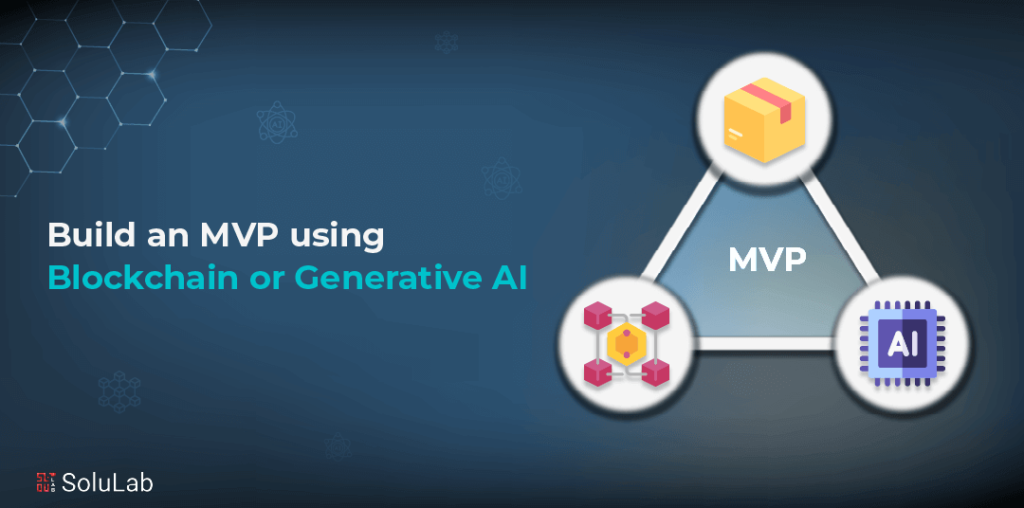
One of the most important steps in any blockchain or GenAI project is building a Minimum Viable Product (MVP). For enterprise teams, an MVP is not just a smaller product; it is a low-risk way to validate technical feasibility and regulatory fit. Additionally, developing an MVP with blockchain and GenAI alters operations across various industries. Businesses no longer need to endure lengthy development cycles without tangible proof of impact.
Many successful companies like Dropbox started with a simple video. Zappos tested demand without owning inventory. Similarly, modern blockchain and AI teams use MVPs to test tokenization models or validate AI-generated outputs with real users. This early validation helps companies reduce the 50 to 70% risk of building features customers may never use.
This blog explains,
- How to develop Blockchain and GenAI MVPs and cut upfront build costs by 30–50% before full investment.
- You’ll know MVP development timelines, use cases, and enterprise workflows.
- Also, how early MVPs can improve 20-40% efficiency and speed up time-to-market across industries.
What Is A Minimum Viable Product (MVP)?
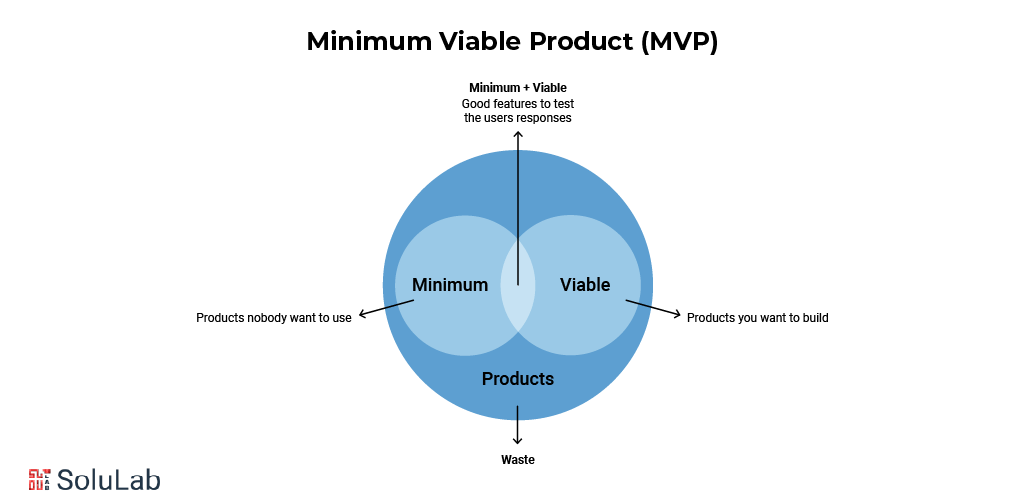
An MVP is the smallest product that demonstrates the primary value proposition and lets you gather real user feedback. It is not a half-built product; it is a deliberate experiment that answers the key business question. Many startups and enterprises turn to professional MVP development services to ensure this process is structured, efficient, and aligned with business goals. For blockchain, the question might be “Can we tokenize X assets and secure settlement?” For GenAI, it could be “Can a model generate reliable, auditable recommendations that reduce manual effort?”
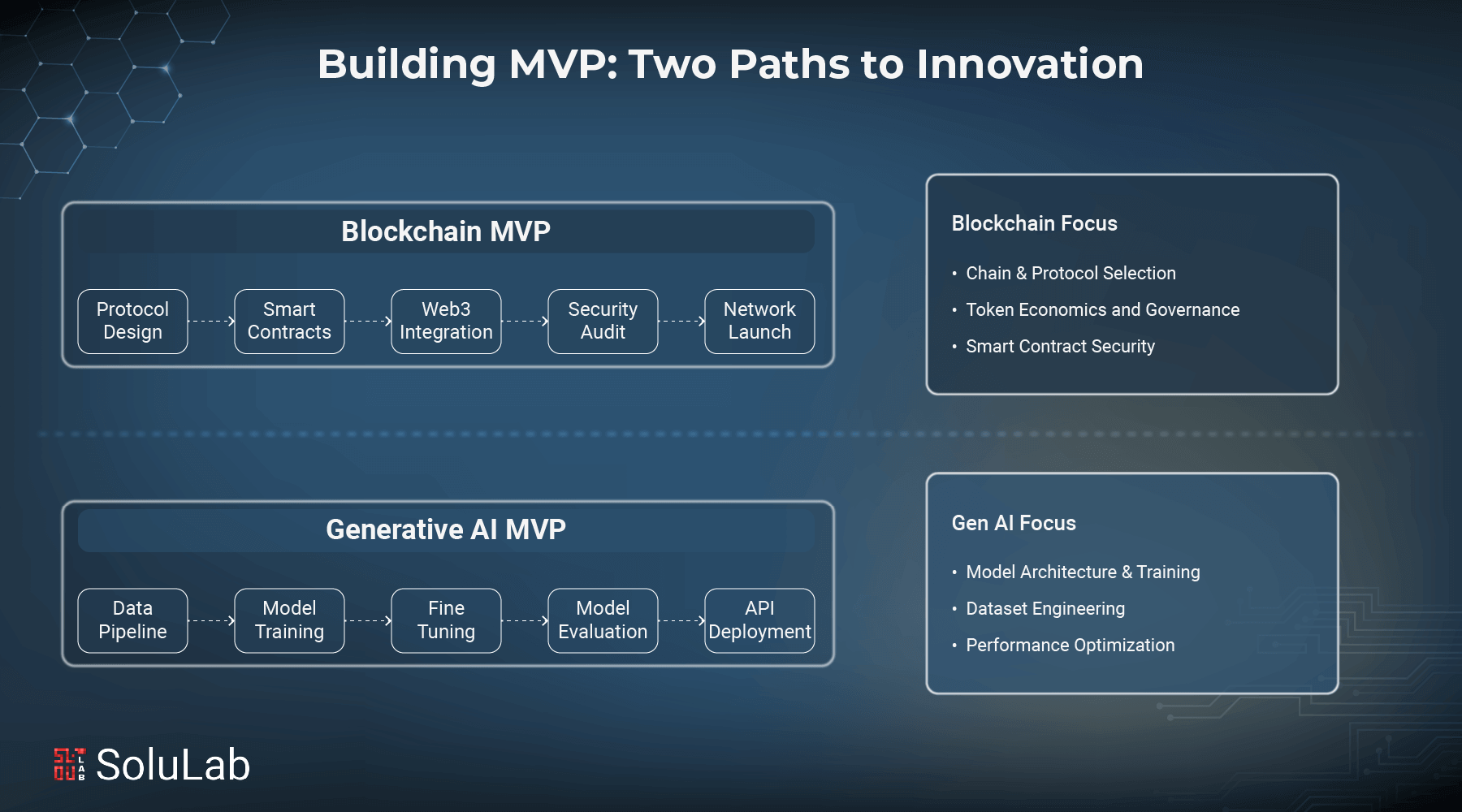
Core differences: Blockchain MVP vs GenAI MVP
- Blockchain MVP: focuses on immutable rules, token or transaction flows, crypto wallet access, and minimal compliance. It proves the decentralised flow and any financial or settlement mechanics.
- GenAI MVP: focuses on a focused model capability, data pipelines, human review controls, and governance. It proves the model’s usefulness and safety for the intended task.
| Aspect | Blockchain MVP | GenAI MVP |
| Primary Goal | Validate decentralized transaction or token flow | Validate model capability and usefulness |
| Core Focus | Immutable rules, ledger logic, smart contracts | Data pipelines, training sets, model behavior |
| Key Components | Wallet access, token mechanics, on-chain actions | Prompt workflows, human-review loops, and monitoring |
| Compliance Needs | Minimal compliance (KYC/AML only if required) | Model governance, bias checks, safety controls |
| What It Proves | Settlement flow, security, and transparency of operations | Accuracy, reliability, and safe output generation |
| Dependencies | Blockchain network selection & smart contract logic | Data quality, ML infrastructure & evaluation metrics |
| Risks Addressed | Security, double-spending, transaction validity | Hallucinations, bias, model misuse & data privacy |
| Iteration Style | Versioned smart contract updates & gas testing | Continuous training, fine-tuning & validation cycles |
Key Benefits of Developing a Blockchain MVP or GenAI MVP
Building an MVP is one of the safest and smartest ways to test new ideas. Especially when teams want to develop an MVP using advanced technologies like blockchain or generative AI. For enterprises, this early validation often shapes budget decisions, partner selection, and long-term product strategy.
1. Business Impact of a Blockchain MVP
A blockchain MVP gives leaders a functional prototype that demonstrates trust, transparency, and automation. These three qualities determine whether blockchain technology is even the right solution. With blockchain MVP development, teams can quickly validate essential elements such as:
- Smart contract behavior
- Token or asset flows
- Wallet and identity interactions
- Compliance rules and access control
- Multi-party data exchange
This early version helps companies: cut operational delays, reduce manual verification steps, and understand real integration requirements.
For example, blockchain in supply chain pilots often report 30-40% faster validation of shipment or asset records once even a basic blockchain MVP is tested in a closed environment.
A blockchain MVP also provides clear validation for leadership by answering questions such as:
- Does tokenization actually unlock liquidity or transparency?
- Is the chosen ledger cost-effective under real loads?
- Will partners or customers adopt a decentralized workflow?
These insights make it easier for decision-makers to choose whether to develop a custom MVP product into a production-grade platform. They also help teams decide if they should pivot to a different architecture before investing further.
Use cases:
- Walmart tests real-time product tracking on a blockchain MVP to verify traceability before onboarding global suppliers.
- JPMorgan’s Onyx platform uses a smart contract MVP. This is to confirm that automated settlement can reduce reconciliation time for cross-border payments.
2. Business Impact of a GenAI MVP
A GenAI MVP focuses on a single high-impact capability such as summarizing documents and generating content. Additionally, it also helps with support queries or improving analytical workflows. Companies exploring Gen AI in MVP development quickly see how targeted automation reduces repetitive effort and speeds up decision cycles.
Teams prefer AI-powered MVP development because it validates core questions early:
- Can AI generate outputs with acceptable accuracy?
- How much human review is needed to maintain quality?
- Does the model reduce workload or introduce new risks?
- Are data privacy and compliance requirements manageable?
Many enterprises experience 20 to 30% productivity gains even during the MVP stage. When AI handles structured summaries, content generation, or workflow suggestions.
Use cases:
- Morgan Stanley uses a GenAI system developed with OpenAI to extract insights from 100,000+ internal research reports.
- Klarna, the global fintech company, deployed an AI customer support assistant built on OpenAI models.
With AI MVP development, companies also validate data quality and model behavior before integrating AI into mission-critical systems. These early findings help leaders decide whether to expand the model, fine-tune it, or limit AI usage to internal workflows.
Real-World Examples Of Minimum-Viable Products
Many successful businesses have started from MVPs, which offer a useful way for them to test and improve their business concepts. The following are real-world examples of MVPs:
1. Spotify
Originally developed as a basic technical prototype, Spotify was created to test three key hypotheses: the viability of instant playback from a technical standpoint, the willingness of users to stream music, and to permit for legal streaming. Despite having limited functionality, playing only a few hard-coded tunes, and lacking polish, this early version was essential for confirming the idea. The foundation for Spotify’s future success and development was laid when the team soon discovered that instant, steady streaming was not only feasible but also much wanted by entrusting this basic MVP.
2. Zappos
Zappos was initially an MVP with no inventory, Zappos is now a well-known online shoe retailer. Nick Swinmurn, the company’s creator, merely put images of shoes from nearby retailers on his website and bought them at retail when orders came in. This strategy confirmed that selling shoes online without requiring a big upfront inventory expenditure was a viable business plan.
3. Groupon
In a month, Groupon was started as a two-for-one pizza offer emailed to a 500-person email list following an initial business turnaround. Founder Andrew Mason adds, “The first version was still not pretty.” Nevertheless, the concept proved successful and developed into Groupon’s daily deal model. With the use of this MVP strategy, Groupon was able to gauge consumer interest in group purchasing, which fueled its development in the deals industry.
How to Build a Blockchain MVP?
Building a blockchain MVP is about proving whether decentralised workflows, smart contract logic, and shared data models create real business value. Instead of jumping into a full dApp or tokenization platform, the MVP focuses on testing the smallest set of blockchain features that validate your idea.
1. Define the Core Problem and User Group
A blockchain MVP must solve one business issue, such as traceability, automated settlement, ownership transfer, or secure multi-party data sharing. Identify the one user group that feels this pain the most and design around them.
2. Identify Essential Blockchain Features
You only need a small set of features to validate the value:
- A primary smart contract with basic automation
- Wallet access or identity handling
- A simple interface to trigger on-chain actions
- Basic audit trails and security
- Optional compliance workflows if needed (KYC/AML)
This avoids overbuilding and keeps the focus on the core outcome.
3. Create the Technical Blueprint
Map out:
- How the smart contract will work
- What data needs to be on-chain vs off-chain
- Which blockchain network (L2, permissioned chain, testnet) fits the use case
- What APIs or integrations are required
For early pilots, most companies prefer L2s or permissioned ledgers to reduce cost.
4. Build Smart Contracts and Backend APIs
This is where the real blockchain logic takes shape. The expert developers implement smart contracts, test edge cases, and expose clean APIs for the UI. Even at the MVP stage, contract testing and basic audits matter to avoid costly mistakes.
5. Develop a Minimal User Experience
Create a simple interface that lets users:
- View tokens or assets
- Trigger one core action (mint, transfer, sign, verify)
- Track status
This is enough to see how people behave and where friction exists.
6. Run a Controlled Pilot and Validate Results
Launch with a small internal group or selected partners. Track:
- Transaction success rates
- Settlement time
- Cost per action
- Adoption and ease of use
If the MVP proves value, you can scale it into a full dApp or enterprise blockchain platform.
How to Build a GenAI MVP?
A GenAI MVP focuses on validating one high-impact capability, such as summarizing documents, generating insights, automating service responses, or assisting in complex decision flows. The goal is to prove whether Artificial Intelligence can meaningfully reduce time, cost, or workload for a very specific use case.
1. Define the AI Problem & Success Metrics
Start by identifying the main task GenAI should improve. It could be document analysis, data extraction, customer support, or internal knowledge search. Then set 1 to 3 KPIs like accuracy, time saved, or reduction in manual effort.
2. Select the Right Model Strategy
Choose the best approach based on your use case:
- Prompt-engineered a large model
- Fine-tuned industry-specific model
- Smaller specialized models for higher speed or lower cost
This decision shapes development cost, accuracy, and compute usage.
3. Prepare Clean Data Pipelines
AI MVP development relies heavily on data quality. Prepare:
- Clean input datasets
- Secure handling of sensitive information
- Light labeling if required
- Basic versioning and monitoring
Good data hygiene reduces hallucinations and improves reliability.
4. Build the Human-in-the-Loop Framework
Enterprises must include oversight:
- Review and approval screens
- Feedback loops for fine-tuning
- Tracking of model confidence
- Escalation flows for complex responses
This is essential for safety, compliance, and customer trust.
5. Develop a Simple UI/UX or API
Create a minimal way for users to test the model:
- A chat interface
- A document upload screen
- An internal dashboard
- An API for downstream apps
Focus on clarity and ease of use.
6. Pilot and Validate Business Value
Launch with a small group. Measure:
- Accuracy of outputs
- Improvement in turnaround time
- Reduction in manual workload
- User satisfaction
If the MVP performs well, you can expand into more generative AI use cases or build production workflows.
Cost & Time: Blockchain MVP vs GenAI MVP
Enterprises need clear cost and time expectations before they approve an MVP project. Here is a combined, easy-to-understand comparison.
Blockchain MVP
A blockchain MVP usually requires more early engineering due to contract logic, ledger setup, and security.
- Timeline: 8-16 weeks
- Investment: USD 60,000 – 300,000
- Cost Drivers: smart contract audits, compliance, integrations with external systems, and security hardening.
GenAI MVP
A GenAI MVP is faster because you often start with a pre-trained model rather than building from scratch.
- Timeline: 6–12 weeks
- Investment: USD 40,000 – 200,000
- Cost Drivers: model usage, data cleaning, fine-tuning, human-review workflows, compliance frameworks.
Conclusion
Creating an MVP for your Blockchain or Gen AI project is essential to proving your concept and drawing in investors and early adopters. It enables you to get user feedback while showcasing your product’s key features. You can increase the likelihood of your project succeeding by accounting for the important elements of Blockchain MVP development.
If you’re planning to develop a Blockchain MVP or a GenAI MVP. Then the right partner, like SoluLab, an AI development company, can help you scale with confidence. Our team developed an UpdatelA,“ GenAI-powered agentic automation platform. Designed with a central “Jarvis-style” intelligence layer and 14+ specialized AI agents. UpdateIA shows how a focused MVP can evolve into an enterprise-wide ecosystem.
Our expert developers are here to assist you in making your vision come true. Contact us today to discuss further!
FAQs
Shipra Garg is a tech-focused content strategist and copywriter specializing in Web3, blockchain, and artificial intelligence. She has worked with startups and enterprise teams to craft high-conversion content that bridges deep tech with business impact. Her work translates complex innovations into clear, credible, and engaging narratives that drive growth and build trust in emerging tech markets.