


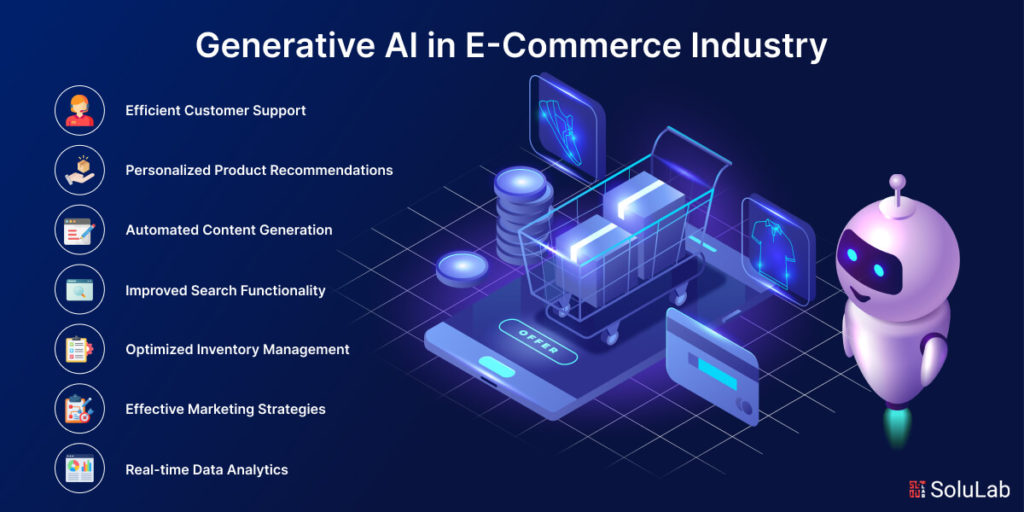
E-commerce is one of the businesses that has changed as a result of the emergence of generative AI. Generated artificial intelligence (AI) has the potential to completely transform the e-commerce sector by producing new material, including product descriptions, photos, and even whole new products. The market for generative AI alone is anticipated to grow to $110.8 billion USD by 2030. Furthermore, from less than 1% in 2021 to 10% in 2025, generative AI will contribute to the production of data.
In this blog, we will examine several applications of generative AI in e-commerce and what benefits it offers to merchants and brands.
E-commerce as a whole has continually adopted innovative online technologies, and Generative AI, an advanced machine learning (ML) technology, has piqued the attention of key industry stakeholders. It involves solution providers and entrepreneurs who are actively looking into the numerous benefits that Generative AI may offer to the e-commerce industry.
What makes this unique is that generative AI is now proving that it can provide an excellent user experience, indicating that users are ready to embrace this technology. Retailers are then more equipped to create customer journeys and use AI to benefit both consumers and staff. Retailers get a competitive edge from this strategic integration of generative AI, which boosts cost-effectiveness and profit margins.
Choosing to use generative AI for e-commerce offers companies a lot of promise for significant and profitable business results.
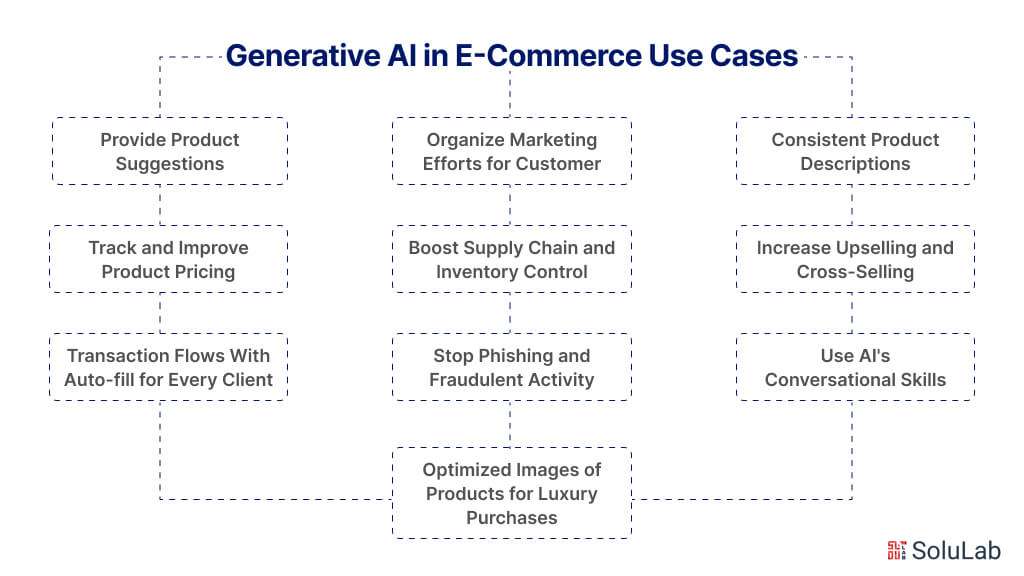
The rise in popularity of e-commerce may be attributed not only to its convenience and comfort but also to the tailored experiences that are available on several platforms, according to the unique tastes and passions of each user. Marketers examine traits that strongly connect with consumers across all industries. Aspects of consumer loyalty and growth in online retail and e-commerce include customization in product offerings, suggestions, search results, promotional mailings, and delivery choices. Equipped with this knowledge, online merchants pinpoint processes where using generative artificial intelligence (AI) technologies can result in significant returns on investment.
Businesses are using generative AI to improve operations, increase sales, and customize consumer experiences in the e-commerce space. It’s proven to be a game-changer. Here are a few instances in which generative AI is being used by e-commerce companies to their benefit.
Consumers are thrilled with the way customization makes them feel now that they’ve experienced it. Generative AI gives online retailers a number of options to suggest goods and services to customers based on their past purchases, browsing habits, wishlist items, most-searched products, and other data points. These options range from personalized product recommendations to tailored content, discounts, and deals.
These AI-powered solutions examine user information, past purchase histories, and more data sources to provide suggestions that are relevant to customers and fit with their preferences. For instance, you may offer material that your customers are more likely to look for or create customized discount plans based on the total cart values.
Read Also: AI Agents for Online Shopping
A one-size-fits-all marketing strategy used to be able to get customers to your websites or physical businesses. However, modern times have changed, as have consumer expectations. Consumers no longer want to be the target of generic marketing campaigns for goods and services that they never seek out or need.
If you are unable to provide the personalized experiences that they want, modern consumers will not hesitate to look at your rivals since they are aware of their true worth. Launch marketing initiatives that are specifically targeted. Based on behavioral and demographic information, you may divide your viewers into groups and target marketing campaigns according to their particular interests. You may guarantee certain sales and favorable returns on investment from your marketing initiatives in this way.
An online store is a digital hallway of limitless things that necessitates many exploring sessions just to locate a few choice items that appeal to a customer. This is where succinct yet informative product descriptions assist. The previous strategy was to have writers investigate descriptions, produce enticing fresh versions, and include the required SEO keywords. While this technique worked effectively, sellers sometimes uploaded contradictory product descriptions, costing them revenue and a valuable customer.
This is why, long before generative AI for eCommerce, businesses used A/B testing to determine the most compelling product descriptions. Furthermore, recent advances in generative AI technology allow them to standardize descriptions among vendors and retail sites. Writers may now give generative AI technologies explicit directions for writing product descriptions that are matched to your brand’s tone and are grammatically correct.
Product photographs are an essential component of PDP sites, with each image necessitating a large team of models, photographers, designers, editors, and creatives for the shooting. This is one area where generative AI might help online businesses create tailored product websites using textual inputs and historical picture data. Adobe Firefly, Adobe’s latest invention in creative generative AI models, enables artists to express their ideas more efficiently and without limits. All you have to do is convey the desired image to transform your creative idea into reality. You may now create realistic photographs depending on a subject, style, location, or color that you define.
The use of generative AI for e-commerce photos will allow marketers to produce visuals in real time. For example, an apparel business can create photos of people of all ages wearing their products in order to appeal to comparable customers. As users submit more personal data to generative AI models, the models’ searches will become more tailored to their specific environment.

It is common knowledge that before making a purchase, consumers research and contrast the costs of comparable goods on the Internet and in physical stores. When their favorite things are offered at a great price, they actually don’t mind the quest. Internet sellers should be aware of this price sensitivity and maintain flexibility in their pricing strategies at all times.
You may monitor price changes made by competitors, examine pricing trends and demand patterns, and further improve product prices with generative AI algorithms to keep customers from switching to your rivals.
For good cause, discussions on modernizing the supply chain as well as inventory control have been going on. Following the outbreak, dead goods have overrun warehouse racks, and supply networks are beset with problems related to geographic constraints. Most brands find it difficult to achieve the ideal balance between supply and demand when combined with delayed delivery. Generative AI for e-commerce has the potential to improve visibility and tracking in a number of supply chain tech stack scenarios.
Even if chatbots seem like something from the past, conversational AI and generative AI may raise the bar on your present customer care and support. Apart from the benefits of not needing as much manpower and having a support agent available around the clock, chatbots have advanced significantly from 15-20 decision trees to unlimited ones. Online merchants may experiment with various conversational styles to fit the consumer, customize each message to encourage additional involvement and respond to inquiries with human-like empathy and emotions to make the interaction seem human-to-human with the use of sophisticated generative models. When all of these elements work together, your customers will have better chat experiences, which will increase cart completion rates and boost revenue.
You’re probably already aware of generative AI’s powers in the areas of conversational search, product suggestions, and providing customers with tailored information based on their individual preferences, histories, and interests. Now, this material might lead to intelligent purchasing experiences and take the shape of words, photos, or other media. In the future, generative AI in online retail will be able to examine all of these existing data sets and recommend the next sensible step for a customer to take in their purchasing process. In an attempt to increase sales and return on investment, this leads to more chances for upselling and cross-selling.
Websites today have a general, set structure, which means that regardless of the user’s preferences and choices, they display the same graphics, information, and banners to all of them. Retailers can provide each consumer with a customized site experience based on their preferences thanks to generative AI for e-commerce. This implies that each consumer would view a personalized website with goods that are automatically filled in based on the client information kept in the backend. Furthermore, based on a shopper’s behavioral and demographic information, this would lead to a hyperscale degree of customization.
When spammers and hackers get access to your online business, it frequently leads to false returns or purchases, which lowers profit margins and erodes consumer confidence. By recognizing unknown users or those with suspect histories, generative AI algorithms in online retail may detect and prevent such illegal and fraudulent behaviors and prohibit them from accessing your online businesses. Over time, this results in cost and profit savings for companies.
Read Blog: Generative AI in Supply Chain
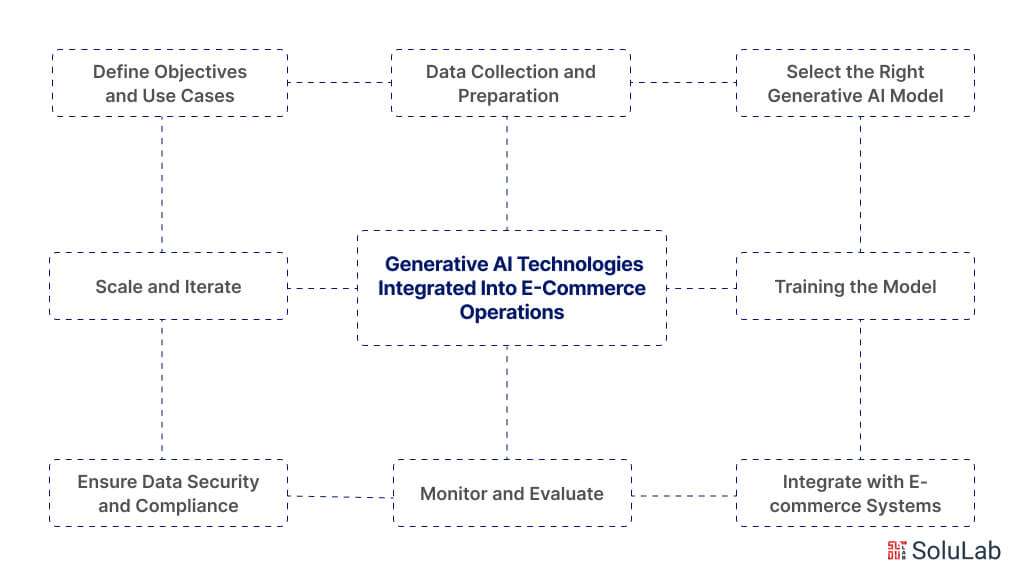
Implementing Generative AI solutions in e-commerce operations can significantly enhance various facets of the business, ranging from personalized customer experiences to optimizing supply chains. Below is a structured approach to implementing generative AI in e-commerce:
1. Define Objectives and Use Cases
2. Data Collection and Preparation
Related: Top Generative AI Use Cases
3. Select the Right Generative AI Model
4. Training the Model
5. Integrate with E-commerce Systems
6. Monitor and Evaluate
7. Ensure Data Security and Compliance
8. Scale and Iterate
By following this structured approach, businesses can effectively implement Generative AI solutions in their e-commerce operations, leading to enhanced customer experiences and improved business outcomes.
Large Language Models (LLMs) are revolutionizing e-commerce through their adeptness in powering intelligent chatbots. These chatbots, trained on vast textual data, offer natural and engaging interactions, thereby enhancing various aspects of the customer experience and driving sales. Here’s a concise overview of how LLMs benefit the e-commerce sector:
The future outlook for generative AI in e-commerce is brimming with potential, poised to revolutionize the industry’s landscape. As these AI algorithms advance, businesses can expect increasingly tailored and immersive customer journeys.

In conclusion, the transformative impact of generative AI on the e-commerce industry is undeniable, with its ability to revolutionize customer experiences, streamline operations, and drive business growth. As AI algorithms continue to evolve, businesses must embrace these innovations to stay competitive in an increasingly digital marketplace. From personalized shopping experiences and hyper-targeted marketing campaigns to optimized supply chain management and enhanced fraud detection, the possibilities are vast and promising for those willing to harness the power of generative AI.
At SoluLab, we understand the pivotal role that AI plays in shaping the future of e-commerce. As a leading generative AI development company specializing in the e-commerce sector, we offer a dedicated team of experienced AI developers ready to tackle the unique challenges and opportunities presented by this dynamic industry. Whether you’re looking to integrate AI-powered chatbots, enhance your recommendation engine, or optimize your supply chain with predictive analytics, we have the expertise and resources to help you achieve your goals. Hire AI developers from SoluLab today and unlock the full potential of generative AI in your e-commerce operations. Contact us now to learn more!
Generative AI refers to algorithms that can generate new content, such as text, images, or audio, based on patterns learned from existing data. In e-commerce, this technology can be used for various purposes, including personalized product recommendations, automated content generation, and enhancing customer service through intelligent chatbots.
Generative AI enhances the shopping experience by providing personalized recommendations tailored to each customer’s preferences and behavior. It can also streamline the search process, generate engaging content, and offer real-time assistance through AI-powered chatbots, ultimately making the shopping journey more convenient and enjoyable.
While generative AI offers numerous benefits, ensuring security is paramount for e-commerce platforms. By implementing robust security measures such as encryption, authentication, and continuous monitoring, businesses can mitigate potential risks associated with AI-generated content and protect sensitive customer information from cyber threats.
Businesses can leverage generative AI to drive sales and revenue by providing personalized product recommendations, optimizing marketing campaigns with targeted content, and improving customer engagement through interactive experiences. Additionally, generative AI can help businesses identify trends, forecast demand, and optimize inventory levels to maximize profitability.
The future prospects of generative AI in e-commerce are promising, with advancements in technologies like augmented reality, voice assistants, and supply chain management. As generative AI continues to evolve, businesses can expect more immersive shopping experiences, enhanced operational efficiency, and innovative solutions to meet the evolving needs of consumers.
SoluLab is a leading AI development company specializing in the e-commerce sector. Our team of experienced AI developers can assist businesses in leveraging generative AI for personalized product recommendations, AI-powered chatbots, content generation, and more. By hiring AI developers from SoluLab, businesses can harness the full potential of generative AI to enhance their e-commerce offerings and drive growth. Contact us today to learn more about our services and how we can help transform your e-commerce operations with generative AI.


