Talk to an Expert

The Ultimate Guide to Investing in Tokenized Real Estate

The Ultimate Guide to Investing in Tokenized Real Estate

For a very long time, investors have found real estate to be among the most alluring investment opportunities. The conventional negatives of real estate investing, however, continue to exist, and there haven’t been any notable adjustments. But given that tokenization is here to address and resolve these problems in the real estate sector, it won’t endure for much longer. tokenized real estate companies will greatly increase transparency and flexibility in real estate investing, supported by blockchain technology & smart contracts.

You might be wondering at this point how real estate tokenization functions and whether it really has a long-term future. But don’t worry; we’ll cover everything related to tokenized real estate in this blog. Therefore, let’s begin.

Tokenized Real Estate in Brief

Real estate has traditionally been defined as an illiquid asset. It has always required a significant expenditure and a drawn-out legal & financial process to buy and sell. There are various real estate tokens that can be used to denote the ownership and value of the in-question property, whether it’s residential or commercial. The rights and liabilities attached to any piece of real estate are represented by a token.

A smart contract holds the details of every real estate token. As a result, any transaction involving the tokenized real estate in issue can happen instantly and automatically if a contract provision permits it. Anyone who purchases a real estate token related to the property will now possess a portion of the actual real estate in question. That implies that they are accountable for any loss it experience as well as any gains that result from the transfer of ownership.

As soon as you understand the idea of their ownership, the opportunities expand almost instantly. Each of us may think of a sizable industrial property or a sizable commercial district that could potentially benefit from the use of real estate tokenization. Let’s now look more closely at how tokenized real estate can benefit individuals who own it and those who invest in it.
Different Types of Real Estate Tokenization

Different Types of Real Estate Tokenization

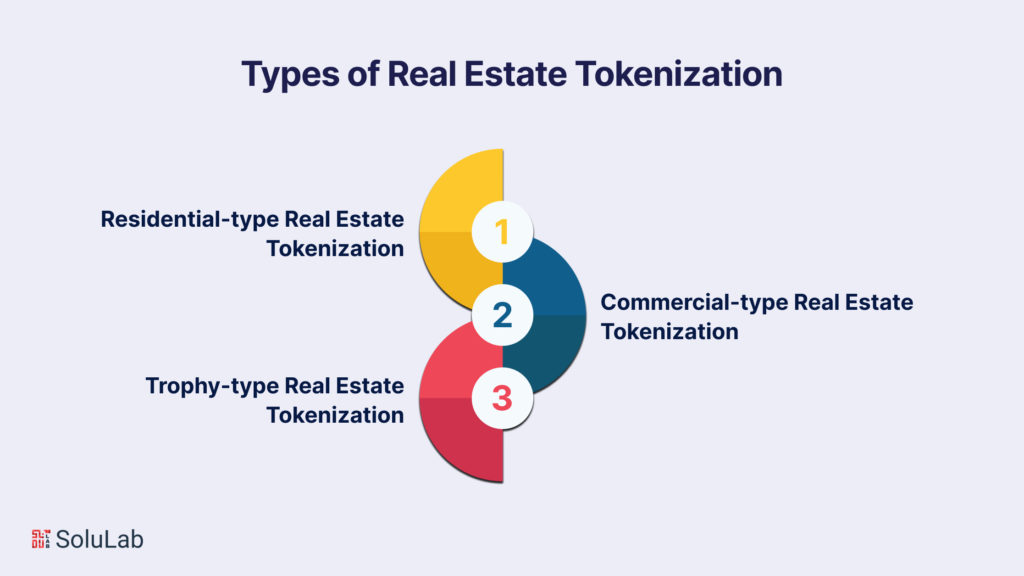
Real estate tokenization mostly has three types. So let’s examine each one in turn.

  • Residential-type Real Estate Tokenization

The practice of tokenizing a residential real estate property is known as residential real estate tokenization. The fact that investors can own a portion of residential property anywhere in the world from the comfort of their homes makes this type the most popular among the others.

  • Commercial-type Real Estate Tokenization

The tokenization of commercial real estate is very similar to that of residential real estate. Tokenizing commercial real estate properties are involved. But in this case, special care must be taken to guarantee that all legal requirements are completed and that the business property is not subject to any criminal activity.

  • Trophy-type Real Estate Tokenization

The most recognizable kind of real estate tokenization is trophy tokenization. It is the practice of tokenizing prominent, upscale venues that are extremely significant & prestigious in both terms of money as well as their intrinsic value.

CTA1

How Tokenized Real Estate Investing Works

Special purpose investment vehicles, which are often set up as limited liability corporations (LLCs), are used to invest in real estate in both conventional and tokenized deals. The ownership of the LLC is fragmented into security tokens for real estate transactions based on blockchain technology.

The creation of public security is a complex and expensive process, and since the offering is a security, it is typically registered under an exemption.

The creation of a private placement offering (PPM) that includes information on the investment’s nature, potential risks, sponsors, and other pertinent factors is one criterion for gaining the exemption. The SPV’s operating agreement and subscription agreement both outline the managers’ and investors’ responsibilities as well as the rights and obligations of both parties.

Read Our Blog Post: Top 12 Real Estate Tokenization Companies in USA

To maintain compliance with securities laws, real estate tokens are coded by the underlying smart contracts. Smart contracts have the ability to automatically enforce any buy and sale limitations required by the world’s securities authorities. Smart contracts can also be used to impose restrictions regarding who can buy tokens and holding periods for those tokens.

Real estate tokenization platforms conduct know-your-customer (KYC), anti-money laundering (AML), and investor accreditation checks in order to enforce these requirements. These examinations lead to the “whitelisting” or pre-approval” of specific buyers.
Processes Involved in Tokenized Real Estate Properties

Processes Involved in Tokenized Real Estate Properties

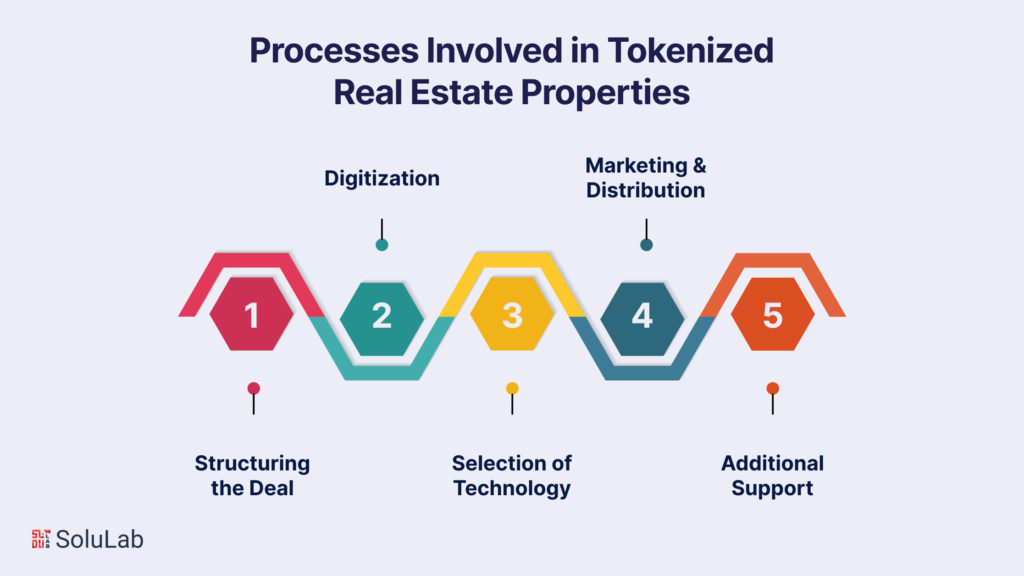
Structuring the Deal

The categories of shareholders & assets, the applicable jurisdiction, and the pertinent legislation are all significant considerations in this first step. Prior to raising capital to launch a new business, issuers frequently decide to tokenize a prior deal at this stage, largely to give liquidity to current investors.

Digitization

Information that was previously stored in paper/document form is uploaded to the blockchain at this point. This procedure makes use of smart contracts, and the kind of fund/fund structure is also chosen. The following are the most popular fund structures:

The most common fund structures are as follows:

  • Real Estate Investment Trust (REIT)
  • Real Estate Fund
  • Single asset Special Purpose Vehicle (SPV)
  • Project Finance 

Read Our Blog: What is Real Estate Tokenization and How Does it Work?

Selection of Technology

At this stage, a number of crucial technological choices can be taken, including:

  • Choose Blockchain 

Given that the transaction will be added to the blockchain ledger, it is important to choose the appropriate blockchain depending on your requirements and requirements.

  • Chose Custody Solution

It is necessary to choose a custody solution that can hold real estate tokens securely and safely.

  • Chose Marketplace 

It is necessary to choose the marketplace where investors can purchase real estate tokens. Depending on your company’s needs, you can select either a primary or a secondary market.

Read Also: Why Dubai, London & New York Lead in Real Estate Tokenization?

Marketing & Distribution

The creation & distribution of tokens are indeed the primary areas of concentration at this stage. Real estate tokens can be purchased using a number of different payment methods, such as stablecoins, cryptocurrencies, fiat money, and others. These tokens are available to investors through:

  • Primary Distribution
  • Secondary Trading

Additional Support

A real estate tokenization company now provides additional support to investors, such as developing a corporation code and helping with legal and mortgage issues.

Tokenization Advantages for Real Estate Owners

Real estate owners, sponsors, as well as investors can all gain from tokenization. The following are some of the main benefits for sponsors & owners:

  • Tokenization gives real estate ventures exposure to plenty of investors. A real estate project might not even be known to many investors until it is tokenized. A real estate tokenization platform inevitably increases marketing and awareness, enhancing sponsors’ access to financing.
  • In addition to automating investor communications, payouts, purchases & sales, tax accounting, as well as (where necessary) investor voting, smart contracts that underpin real estate tokens can also automate compliance with securities legislation. Real estate sponsors can handle numerous investors with the help of automation, which also creates a robust audit trail across all property actions.

Check Our Blog Post: Top White Label Real Estate Tokenization Platforms & Firms

  • Tokenization enables sponsors to provide investors with more liquidity, potentially improving investor returns and enabling investors to reallocate funds to the sponsor’s upcoming deal. Sponsors may immediately profit from increased liquidity among investors.
  • A real estate owner may use tokenizing an asset to resolve complex problems like how to terminate a partnership or distribute an estate among heirs. Real estate token owners are free to decide whether to buy, sell, or leave at any time. Tokenization, while not resolving every property-related conflict, can assist with many potential issues.
  • Numerous new possibilities for using and maintaining a property’s equity are made possible by tokenization. Real estate owners who tokenize their properties can raise short-term financing, receive debt secured by their tokens, sell a portion of the equity (perhaps with a buyback option), and exchange their real estate tokens for other tokens.

Disadvantages of Tokenizing Real Estate

Sponsors do need to change the way they approach real estate because of tokenization. For sponsors of tokenized real estate, the following cons might be present:

  • Many operations are automated by tokenization, which may worry sponsors who like complete anonymity and control.
  • Sponsors might be concerned about losing a dependable investment base now that investors can swap tokens more readily. However, strong sponsors can continue to work with investors, plus their track record might even help them draw in more money. Additionally, there are programs for rewarding devoted investors (like early purchase, for instance), which help sponsors build and expand their own investor base.
  • Managing more investors may intimidate some sponsors because it necessitates a variety of communication strategies. Sponsors might make use of a real estate tokenization platform’s assistance to keep investor communications going at scale.
  • Sponsors must establish and uphold rigorous guidelines regarding the information that is disclosed to investors as well as the secondary market. Primary investors need in-depth information, which might not be suitable for a wider audience. A good tokenization platform will make these restrictions easier and more automated, assisting sponsors in finding the ideal harmony between privacy and openness.

What is the Future of Real Estate Tokenization?

You might be surprised to learn that the real estate investing industry has a far larger market than a number of other businesses. In comparison to other investment vehicles like equities, mutual funds, and bonds, it is also regarded as a safe investment. But some of the market’s elite participants, who are significantly wealthier than others, control it. Real estate tokenization is therefore not only urgently needed but also has the enormous potential to completely transform the sector. Additionally, according to Prophecy Market Insights, tokenization income in the global real estate market will soar and reach $4.3 billion over the course of the following five years. The future of real estate tokenization thus appears to be quite promising based on the aforementioned points and the unmistakable numbers.

If You Need Help

Our company, SoluLab, is a market leader in blockchain development. Our team members are highly skilled and experienced in creating real estate tokenization solutions. You may securitize real estate, raise money more quickly, and reach a wider audience of investors with the assistance of our highly qualified team. Consider your options even now. Get in touch with us so that we can address all of your questions.
CTA2

Conclusion

SoluLab offers a comprehensive range of real estate tokenization development services, guiding individuals through the complex landscape of property investment and development. Whether one is a property owner seeking capital through tokenization or an investor looking to diversify, SoluLab paves the way for the future of real estate investment. Their team of dedicated professionals is committed to delivering top-tier tokenization solutions, unlocking the full potential of real estate assets. SoluLab provides a tailored white-label real estate tokenization solution, supporting multiple blockchains, to redefine the experience of trading tokenized real estate. By launching a white-label platform, clients can establish a digital presence in the crypto trading world, offering a space to list commercial or residential property tokens and configure prices as desired. To embark on this transformative journey, contact SoluLab today.

FAQs

1. What is investing in tokenized real estate?

Real estate with a fractionalized ownership structure based on blockchain technology is known as tokenized real estate. Tokenized property investing is structurally identical to purchasing real estate through a syndicated transaction. 

2. What is the price of tokenizing real estate?

Legal, governing, and technological costs are typically incurred during the process. Tokenizing a property typically costs between $30,000 and $100,000. Including legal costs, developing a blockchain, smart contract implementation, and regulatory compliance. 

3. Is tokenization in real estate the way to the future?

The future of real estate tokenization, which will be driven by blockchain technology and smart contracts, presents a tremendous opportunity for expansion, with the ability to improve stability and accessibility through rational ownership.

4. What is the process of investing in tokenized assets?

Firstly, you would be required to select the asset and the regulation that is put into the asset. Afterward, select a platform and proceed with the organization process. Once this is complete, search for investments and acquire, and invest investments. Put your attention on the plants and strategies, after which you should take care of trading and liquidity.

5. How to buy tokenized real estate?

To buy tokenized real estate select a trustworthy platform or marketplace before purchasing tokenized real estate. Make an account, finish the KYC process, and add money to your wallet using Bitcoin or Fiat. Choose a tokenized asset from the list of available properties, then by tokens that represent fractional ownership.

6. How can SoluLab help you with the tokenization of real estate assets?

In the field of real estate tokenization, SoluLab specializes in the process of transforming real estate assets with digital tokens that are stored on a blockchain. This procedure makes it possible to have fractional ownership, improves liquidity, and expands access to investment opportunities. 

Real Estate Tokenization: The Future of Real Estate Business


Real Estate Tokenization: The Future of Real Estate Business

The real estate industry is one of the largest business sectors in the global market. It is growing at the rate of 5%, with China holding the largest share in the market’s capitalization.

The market slowed down during the 2019 pandemic, but it has since begun to regain traction due to the interest and participation of global investors.

The business sector is vast, with the involvement of international affiliates. But, it lacks in the processing or transferring of ownership from one member to another. The transaction process takes a lot of time, and it is complex.

The introduction of blockchain technology has been revolutionizing many business sectors across the globe, and real estate is one of them. It has simplified the transaction process and has eliminated the need for intermediaries through real estate tokenization.

Let’s get to know about tokenization before getting into real estate tokenization.

Tokenization — Brief Introduction Of Assets To NFTs

Tokenization is the latest technique of converting real-world assets into digital forms, i.e., NFTs using blockchain technology. Tokenizing an asset increases its global visibility and makes it easier for purchasers to buy them.

Tokenization helps sellers list their assets on a digital marketplace, where interested buyers and investors can buy them directly using cryptocurrencies or other monetary forms.

It eliminates the need for a centralized party to oversee the transactions and reduces the fees associated with the transaction. It provides complete control over the assets to the buyers.

Real Estate Tokenization: NFTs and Real Estate Properties

The advent of NFTs has impacted the real estate business sector. NFTs have simplified and reliably improved how the real estate sector operates. By attracting investors and traders to the market, the combination of NFT with real estate has created new opportunities.

Transaction of property ownership is one of the biggest problems with real estate investment. Buying a real estate property through the traditional method requires a tonne of paperwork; real estate tokenization, on the other hand, is more streamlined and effective.

Due to the inclusion of NFTs in the real estate market, buyers can rapidly trace asset ownership. The benefits of using non-fungible tokens with credible, transparent, and immutable ownership proof are the key factors for the increase in the popularity of real estate tokenization.

Real estate purchasing has become digital and liquid due to blockchain technology. Real estate tokenization has allowed the selling of real-world assets into smaller pieces. A few years ago, the idea of owning portions of assets and frequently transferring them without incurring major transaction expenses seemed unfathomable. Real estate tokenization has been made possible by the adoption of blockchain technology in the real estate business sector.

Functioning of Real Estate Tokenization

Any real estate asset, including retail, residential, and exhibition properties, can be tokenized using blockchains. Real estate tokenization uses a smart contract, i.e., automated software integrated into a blockchain ecosystem to manage all the real estate tokens in the digital platform.

Anyone who purchases or possesses a real estate token has a claim in the underlying real estate property. Real estate token owners are in control of the underlying asset and any associated profits. Real estate owners can easily digitize their assets and raise money for projects on a global scale by tokenizing their real estate properties such as houses, plots, complexes, etc. It makes commerce easier and allows valuable commercial real estate, such as malls, and shopping centers, to be divided into smaller units for easier sales.

Real Estate Tokenization Categories

Real Estate Tokenization for Commercial properties

Commercial tokenization is the process of applying legal protocols to tokenize commercial real estate for enterprises. Commercial property owners, such as office buildings, retail stores, etc., can sell their assets worldwide utilizing blockchain technology.

Real Estate Tokenization of Household properties

For investors and asset buyers, household tokenization divides residential real estate holdings into fractional ownerships. Digitizing these assets in the blockchain space enables small-time sellers to profit from the global market with a large number of buyers and investors.

Benefits of Real Estate Tokenization

Blockchain transactions are best suited for the real estate sector since they are transparent, safe, and irrevocable. They have also eliminated third parties and complex procedures during transactions. Smart contracts automate the complete process, thus reducing the fees and time duration for ownership transfer.

By presenting the asset to a global audience through a digital platform, tokenization has made it possible to raise the value of assets and eliminate their lack of liquidity. When real estate is fractionalized and sold using tokens, its liquidity increases. By selling their tokens, owners of tokenized goods can instantaneously transfer divided ownership without selling the full asset.

Small-scale buyers and individual investors can now purchase real estate due to tokenization which has revolutionized the industry. Through tokenization, large assets are divided into tiny parts, making them accessible and affordable to all potential buyers.

Read also: What You Need to Know About Investing in Tokenized Real Estate

The real estate sector establishes a reliable, open, and highly secure financial system using blockchain technology. Every stakeholder is in charge, and every network participant votes on any updates. The real estate market has been streamlined by removing time-consuming limitations, and everyone now has an equal opportunity to grow and earn.

Final Thoughts

The future of the real estate business is brighter with real estate tokenization. The popularity of tokenization has increased due to the global reach of assets with blockchain technology. Property owners can now sell their assets quickly without any hassles. The world is looking towards tokenization for its heap of benefits. The digital market is revolutionizing the world with innovations, and real estate tokenization has been an enormous boon for property owners worldwide.

Blog Credits: Medium

Real Estate Tokenization — Complete Guide for 2022 & 2023


Real Estate Tokenization — Complete Guide for 2022 & 2023

The real estate sector is going through a significant transformation as a result of the adoption of blockchain technology. Blockchain-based real estate tokenization has allowed people with a flair for real estate business who previously needed more funds to do so. Inherent problems with the sector, such as a lack of transparency, trust, and speed, have also been resolved.

What kinds of real estate tokenization exist?

The following categories can be used to categorize the market for real estate asset tokenization:

  • Securitized assets on the blockchain: Securitized blockchain assets lead the market in 2022. The most recent report states that real estate tokens will make up almost 89% of all traded security tokens in 2022.
  • Fully-tokenized assets on the blockchain: They are not actively traded on secondary markets
  • Assets that have been fully tokenized: The secondary market is actively trading these products.

How do real estate asset tokenization services function?

Real estate has traditionally been one of the least liquid asset classes. It’s because real estate transactions demand a great deal of property management, legal skills, and extensive planning.

Read also: What You Need to Know About Investing in Tokenized Real Estate

By following these five stages, digital asset tokenization on blockchain assists in overcoming all these difficulties:

Stage 1- Structuring the Deal for smart contracts

Regulations based on jurisdiction and the shareholder type are important factors for a real estate tokenization asset. The terms of the tokenization are previously set forth for both current and potential investors.

Stage 2- Digitization of assets

Security tokens are issued along with smart contracts that store the traditional information of the real estate transaction on the blockchain.

Four structures are employed to securitize the asset and convert it into an investment vehicle on the blockchain:

2.1 SPV Structure

The term “SPV” stands for Single Asset Special Purpose Vehicle, which enables qualified institutional buyers or accredited investors to take part in the transaction. Tokens serve as a representation of the shares of the real estate property in this structure.

2.2 Real estate fund Structure

The token represents shares of this fund, which functions like a private equity fund. Only qualified institutional buyers are permitted to purchase properties from this equity fund, which is invested in their portfolios.

2.3 Finance Structure

Real estate is tokenized as a digital asset to facilitate fundraising in this structure. The tokens are offered for purchase by accredited institutional buyers or retail investors on the secondary market.

2.4 Real Estate Investment Trust (REIT) Structure

Although this structure is accessible to retail investors, operating it is more expensive than the others. Investors can create digitally-enhanced shares through REITs. Furthermore, REIT real estate token owners are entitled to operate income similarly to conventional investors.

The fundamental guidelines for smart contracts are established based on these structures.

Stage 3- Technology Selection

The choice of technology is essential for real estate tokenization. Following the selection of your asset tokenization services provider, you must decide on three crucial issues:

3.1 Blockchain & token selection

The right blockchain must be chosen for your real estate tokens. Transaction speed, gas costs per transaction, and the security of the blockchain are the main criteria for choosing the blockchain to add transfer limitations to your real estate token.

3.2 KYC/AML verification

Investors or token purchasers must complete the KYC/AML process on the platform where they purchase real estate tokens.

3.3 Primary or Secondary Marketplace

Buyers must have access to a marketplace where primary or secondary token sales of digital assets will be supported through the platform.

Stage 4- Token distribution

Token creation and distribution must be completed after the development and implementation of the smart contracts. Platforms for real asset tokenization may provide buyers with a range of payment options. Token distribution typically takes place in three ways:

4.1 Primary Distribution:

Investors receive these newly created tokens in exchange for their initial financial investment in the projects.

4.2 Secondary Trading:

Tokenization is crucial because it increases liquidity. Tokens are listed for secondary trading on other exchanges so that other investors can trade them with other tokens or users.

Stage 5- Post Tokenization Support

An asset tokenization services provider offers post-tokenization assistance with navigating mortgage difficulties, legal problems, and activity tracking.

Conclusion

Real estate has been growing with recent technological advancements. Before the induction of blockchains, the process was different which was hard for the ones who did that business. But, now, with the tokenization of real estate, you can trade real estate assets easily, which is why the sector has become so incredible now. It is time for you to grab the benefits that the system provides; that way, you can make incredible happenings. Begin real estate tokenization now and make way for the new future.

Blog Credits: Medium

Tokenize Your Property to Reap Fortunes Given by Web3 Tech!

Tokenize Your Property to Reap Fortunes Given by Web3 Tech!

Just two decades have passed in the 21st century, and we have already witnessed great levels of innovation and technological growth. While the internet revolutionized our lives for the first two decades, Web3, based on blockchain technology, is all set to turn the tables for at least the next two decades. The aspect of including more real-world applications for blockchains has been making sure that the previous statement will come true sooner than anticipated. Real estate tokenization has been one such use case of Web3 technology that has been raising many eyebrows recently. Let us see more about it as we progress.

Real Estate Tokenization: A Snippet

Real estate tokenization is where real estate properties are “tokenized” or registered as tokens on the blockchain. These tokens can be either fungible (similar to cryptocurrencies, such as Bitcoin) or non-fungible (similar to NFTs, such as CryptoPunks). The process helps real estate asset holders and people who aspire to invest in real estate property in multiple ways. Real estate tokenization today is still emerging, as there are a lot of regulations that require it to be modified to fit the new-generation process, alongside other restrictions, typically from skeptics who fear their “businesses” might die.

Read also: Real Estate Tokenization: Step-by-Step Guidance

Inherent Problems Present in Contemporary Real Estate

  • High Entry Barriers restrict most people from investing in real estate assets as prices accelerate higher and higher without particular reasons.
  • More Intermediaries tend to put the real estate sector into their hands and determine the industry’s flow according to their interests. Adding to the fire, their presence aggregates the costs involved in real estate investment.
  • While the Presence of Central Authorities might look safe (or we might have been tuned to such thoughts), having data gathered at a place is not safe at all times. With the presence of powerful intermediaries, central authorities tend to work hand in hand with those (in most cases) to safeguard their interests.
  • Finding Investors has been a huge issue since there are demographic restrictions for geographic assets that do not allow people from certain regions to purchase land in certain places. Such atypical limits, even in the era of globalization, make real estate assets illiquid.
  • The Possibility of Fraudulent Activities is higher in the current real estate sector irrespective of digitization, since power and money tend to reign ultimately, leaving unsuspecting commoners to suffer by accident. One can witness staggering numbers while researching court battles relating to real estate assets.

“Tokenize Your Property:” Whether This will Solve the Problems?

A solution that might help if you are a property holder will be to tokenize your property. This can save you from unwanted hassles and waste of valuable resources. Tokenizing your assets can also help you with finding buyers for the property, as the price cap will be economical enough for retail investors to get a hand in hot real estate assets. Also, with minimal paperwork, the documentation time taken will be lesser, enabling you to liquidate your assets faster. It will be a good idea to tokenize your assets if you are looking to raise quick funds.

Tokenize Your Assets Through These Token Types

  • Utility Tokens provide digital access rights to applications or services related to the property. These are beneficial in the case of ventures that raise funds through Security Token Offerings (STO).
  •  Equity Tokens offer shares of the real estate asset to investors, which can pay them dividends if in use through rent collected. Like traditional exchange stocks, the proportion of profits gained depends on the number of shares held by an investor.
  • Debt-like Tokens play the role of collateral for loans if borrowed from multiple people. The issuer has an obligation to pay back the loan with interest to the token holders; failing to do so will result in the loss of their property.
  • Participation Tokens can give participatory rights and revenue without dividends but with zero equity. That means that investors can gain benefits but cannot claim a stake in the underlying venture if there is a failure.
  • Crypto Tokens are popular real estate tokenization products as they offer fractionalized assets as fungible tokens that can be exchanged for other cryptocurrencies or fiat tender. These can be used as a means of payment by the asset holder.

Offering Concluding Insights

Hence, it will be wise to tokenize your property if you want to sell it or raise funds for a new business. Real estate tokenization ensures that raising funds through such assets is made easier than ever, and there are expert firms that can help you to tokenize your assets. The process typically involved smart contracts, which are blockchain-based programs that serve as proof of transactions (similar to real estate documents). Such firms will also have expert consultants who can assist you in clearing any doubts that can further augment real estate tokenization for you.

Tokenize your Property — Make it for Sale

Tokenize your Property — Make it for Sale

The world has now leaned towards Web3, which bases itself on empowering the end-user. While cryptocurrencies and non-fungible tokens (NFTs) opened the way for people to make money, tokenizing assets opened the avenue for investments to be made. Real estate tokenization rocked the world by surprise as it came with many advantages for the non-tech-savvy real estate sector. This blog focuses on the benefits that real estate tokenization offers to the world in the modern day.

Benefits of Real Estate Tokenization to the General World!

High Transparency

Real estate tokenization involves programming data into highly secure digital tokens. This feature would ensure complete openness between the investor and the seller, benefiting both parties. Not to mention that purchasing and selling homes will be significantly more affordable because there will be less administrative work and mediators involved in the process.

Better Liquidity

Real estate has always been a low-liquidity investment or illiquid asset. This is because of the high number of private players, the sizeable cash requirement, the extensive paperwork, and the numerous parties involved. Fortunately, real estate tokenization steps can make the process easier. It will fractionalize assets and provide investors with simple entry points, increasing the liquidity of the tokens.

Easy Property Management

Delayed monthly rent payments and lease renewal are two issues that landlords and tenants must deal with. However, the tokenization of real estate may change this. You will have the choice to enter documents into a unique database using smart tokens or contracts built on the blockchain. By doing so, you may speed up organizing loans, as well as collect rent from tenants on schedule. Overall, both sides find the token-based agreement procedure quick and effective.

Read also: A Beginner’s Guide to Real Estate Tokenization

Proof of Ownership

Intense legal disputes over land rights and ownership have frequently occurred in the real estate sector. They can end up lowering the brand’s value and costing a lot of money, which is not what anyone wants. In the case of real estate tokenization, data will be tokenized and kept on blockchain ledgers, making it impossible for anyone else to alter it. So you can begin analyzing past or present transactions once total or fractional ownership is disclosed.

Better Access to the Market

Since only those with the necessary knowledge and resources may participate in real estate investment, not everyone is able to do so. Tokenizing real estate will expand the investor base, allowing anyone with a reliable internet connection and enough money to purchase, sell, or hold real estate assets from anywhere. Since the tokens are fractionalized, selling a property as a whole is not necessary.

Final Thoughts

Hence, we can say that tokenizing real estate assets can benefit businesses and individuals alike due to the benefits discussed above. If you want to immerse yourself in such a venture, there are some real estate tokenization service providers that can assist you with their expertise. So, waste no more time and progress to start your own real estate token business to win the hearts of retail investors.

Tokenizing Real Estate with Blockchain

Tokenizing Real Estate with Blockchain

Blockchain technologies seem to have a solution to most problems, even if the problem is that I need to sell my house fast. The merger between blockchain and tokenizing real estate promises to simplify and cheapen the process of buying and selling property. This process traditionally involves a sleuth of entities who each take a cut from the deal made between the buyer and seller. The bank, broker, seller, buyer, and local government all are involved in this process, and currently, any real estate transaction requires heaps of paperwork and hours of coordination between these entities and individuals.

A seller could, if unwilling to pay these fees, list their property for sale by owner (FSBO), but then she doesn’t have access to the MLS (multiple listing service) that real estate agents use to search for the property when they have a new buyer. Notoriously, the MLS is fragmented, walled off, and complex, so navigating it as a seller is a daunting task. However, transferring these property listings to a blockchain would mean opening up access to all the available properties for anyone to review. With each listing, the seller could advertise the price of their property as well as any terms and conditions which need to be met upon purchasing.

Read also: Get ready to start tokenizing your real estate assets-Real estate tokenization on board

How is the property secured financially and contractually? Smart contracts. Smart contracts are becoming popular, but they are far from being the standard method of finalizing contractual agreements. They are the same as paper contracts, however, they are digital. The difference is in how they are implemented and who is involved. Let’s take the platform Kickstarter as an example to demonstrate the difference between paper and smart contracts. Kickstarter is a platform through which product teams can request funding from supporters for their newly-developed products, or products in the making. The platform acts as an intermediary between these supporters and product teams, meaning that both sides have to trust Kickstarter to manage their money safely. If the product teams manage to have their projects successfully funded, they expect Kickstarter to give them their money; on the other hand, supporters want their money to go to the project when it is funded, or get a refund when it hasn’t reached its goals.

Essentially, both sides have to trust Kickstarter if they want to succeed. This opens up each of them to counterparty risk. Smart contracts provide a similar system to facilitate this exchange without third-party risk. Returning to the real estate example above, if a seller wishes to advertise their property, we can program a smart contract to facilitate the transaction online. The smart contract is programmed with the seller’s price and other criteria, and only upon the meeting of those criteria can their property be sold. So why should we trust a smart contract? Because smart contracts are located on a blockchain, they are immutable and distributed. Once a smart contract is created, it can never be changed again; and being distributed means that the output of your contract is validated by everyone on the network. If a bad actor decides to tamper with the contract, everyone else on the network is a witness and can invalidate them.

So, seeing as any real estate transaction requires so much paperwork in the form of deeds, contracts, tax records, and other documents required for making the sale, smart contracts could facilitate these transactions more securely and faster. Furthermore, smart contracts could take care of any ongoing real estate transactions such as rental agreements and home warranties, simplifying the process even more.

Another exciting idea within real estate smart contracts is the ability to fractionally own properties. As the owner of an apartment building, you can program the smart contract that facilitated its sale to invite investors to purchase shares within the building. These new owners now own a share of the property which they can sell at any time, through the same smart contract.

Traditionally, real estate has been concerned with listings, to connect buyers and sellers. However, blockchain and smart contracts are introducing new ways to purchase real estate: real estate can now be tokenized, allowing the sale of properties to be handled like a stock sale on an exchange. Real estate has long been thought of as highly illiquid due to the time it takes for sales to be finalized. However, tokenizing properties opens up the market to more liquidity: properties (or fractions of properties) in the form of tokens can be readily traded on fiat exchanges, increasing their liquidity.

Buying and selling property is time-consuming, risky, complex, and expensive. Solutions on blockchain will save time and money by releasing the resources currently used for registration and settlement. With blockchain and smart contracts, there is hope that these drawbacks will be mitigated.

Tokenized Real Estate: Creating New Investing And Financing Channels Through Blockchain


Tokenized Real Estate: Creating New Investing And Financing Channels Through Blockchain

In 2018, New York City-based asset management firm Elevated Returns completed a tokenized real estate offering for $18 million on the Ethereum blockchain. The asset was the St. Regis Resort in Aspen, Colorado. The high-profile property and the employment of an unusual fundraising method caught the attention of investors, fintech enthusiasts, and blockchain communities. Not long after, a new 12-unit development valued at over $30 million was the first in Manhattan to be tokenized. Tokenization on a very broad level is similar to creating shares in a company. However, one of the key benefits of tokenizing is the ability to create partial ownership of an illiquid asset such as real estate. The art world has also taken notice. In the latter half of 2018, 31.6% of ownership shares on a renowned Andy Warhol painting (valued at $5.6 million) were tokenized and auctioned on the Ethereum blockchain. Tokenizing can open new doors for investors who are otherwise unable to invest in alternative assets due to high minimum thresholds while providing liquidity to owners and developers.

Tokenizing is the process of creating a fractional ownership interest on an asset (utility or security) with a token that is blockchain-based. Where:

A blockchain is essentially a distributed database of records or a public ledger of all transactions or digital events that have been executed and shared among participating parties. Each transaction in the public ledger is verified by the consensus of a majority of the participants in the system. Once entered, information can never be erased. The blockchain contains a certain and verifiable record of every single transaction ever made.

Read also: Real Estate Tokenization: Step-by-Step Guidance

Coupled with the blockchain’s transparency and unalterable framework across the network, a tokenized sale is embedded with a smart contract, a digital cryptographic code that will execute exactly as it was set up by the creators (Hertig, 2019). The ownership interest represented by the token dictates the value of the token. In real estate, a token can represent a variety of ownership interests including ownership of a physical asset, an interest in the debt secured by real estate, equity in a legal structure that owns the real estate, or a cash flow stream from the asset.

Tokenized Real Estate Cases

To illustrate how tokenizing can be structured in real estate, a brief overview of The St. Regis Aspen Resort may be helpful. Elevated Returns, owner of the resort, originally planned to sell up to half the property as a single asset REIT in an IPO on the New York Stock Exchange. However, the company decided instead to offer 18.9% ownership through token sales. The sale was made through the digital platform Indiegogo and a partnership with Templum Markets LLC, a FINRA and SEC-registered broker. Aspen Coins were created (tokens), which represent a share of the company Aspen Digital, the entity owning 18.9% of the St. Regis Aspen Resort. According to a spokesperson for Elevated Returns:

Essentially you have the best of both worlds with a REIT structure in place and blockchain technology with a smart contract for St. Regis Aspen. The REIT provides tax efficient structure while the blockchain provides peer-to-peer investing and cross-border transaction made simpler for investors.” 

Aspen Coins were priced at $1 per coin and all investors were required to be accredited investors with a minimum purchase of 10,000 tokens. The coins could be purchased in U.S. dollars, Bitcoin, or Ether.

Read also: How is Blockchain Linked with the Real Estate Industry?

In the case of the tokenized condo development in Manhattan, the developer worked with Fluidity, a company that specializes in tokenization, and Propellr, a management and servicing platform for digitally held assets to launch token sales. The project itself was originally funded by traditional construction debt, but as the term limit was expiring, the developer turned to tokenization to raise capital. According to the developer and his team, tokenizing would enable more investors to purchase a stake in the Manhattan property and create the cash flow needed for the development without the pressures of a bank loan. The tokenization of real estate marks a new shift in real estate investment where numerous buyers are able to purchase portions of a property while controlling interests are able to maintain managing rights.

What does tokenizing mean for real estate investors?

In addition to creating fractional ownership of an asset, tokenization can create liquidity for the investor. Traditionally, real estate investment required capital lock-in for an extended period of time. With tokenization, shares in real estate can become more liquid and create access to global capital. Tokenizing allows smaller carve-outs of an asset that are then sold, creating more liquidity for majority-share owners and developers. Whereas traditional exchanges are limited to more regional investors during local opening hours, tokens can be traded at any time across borders. However, how lawmakers will regulate these exchanges has yet to be seen. Nevertheless, tokenized real estate is spreading internationally as companies like Elevated Returns recently acquired 21% ownership of Bangkok-based Seamco Securities (BKK: ZMICO), obtaining distribution capability and regulatory licenses in Thailand and other South East Asian regions. The company announced plans to tokenize 1 billion USD of real estate in its pipeline (Elevated Returns; Securitize; Tocqueville Group, 2019). Trading volumes may be limited due to smaller market caps, a limit on the number of holders (as is the case with REITs), and a large number of tokens available if the practice becomes more widespread.

Security and Investor Management

Investor knowledge and comfort around the security and inner workings of tokenization remain formidable hurdles for the mainstream adoption of this investment medium. Blockchains are essentially traceable public ledgers for stakeholders within a blockchain network. These qualities allow transparent tracking of tokens from owner to owner. The transaction process for a real estate asset in the form of token transfers cuts through much of the traditional transaction complexity and has a publicly auditable history. Incorporating smart contracts into the transaction process can create automated protocols that are in compliance with relevant regulations. Due to failures of smart contracts in the past and the unfamiliarity of the general investing public with blockchain transactions, tokenization is still far from being a perfect or even a trusted procedure for most institutions and investors.

Challenges and Considerations

Aside from the volatility and uncertainty surrounding blockchain-based systems, real estate tokens are still far from being a democratized investment solution. Headline real estate deals such as the St. Regis sale discussed above still require participants to be accredited investors (United States Securities and Exchange Commission, 2019). For an individual, this means an earned income of $200,000 (or $300,000 together with a spouse) in each of the prior two years or a net worth of over $1 million excluding the value of the individual’s primary residence. While wider adoption of tokenized real estate appears promising, it remains to be seen whether tokenized real estate will be available to retail (non-accredited) investors.

REITs are still a more accessible option for most retail investors. With several clicks of a mouse or phone, shares in a REIT can be easily purchased. However, whereas publicly traded REITs are a portfolio of assets, tokenized real estate provides an option for a more granular investment in a specific asset or within the capital stack linked to a particular property. Furthermore, token exchange platforms could develop in the future, creating accessibility and public adoption similar to web/ app-based investment companies Robinhood and Stash challenging traditional investment, brokerage models. The development of indices for tokens could be an important next step in expanding the adoption of tokenized assets.

Read also: Real Estate Tokenization – Benefits, Challenges and Future

Tokenization might also create disclosure challenges. The accessibility to a ledger by participants and the potential frequency of token ownership changes may deter developers who do not want information shared with competitors. Some of these issues may be addressed through the development of a secure system where information is not fully decentralized and via structures within the blockchain that allow only certain information to be shared with participants (i.e. permission blocks). Tokenizing has a promising future in real estate investment. It may create more incentives for continued adoption by developers and asset managers, such as increased access to global capital and liquidity rather than traditional institutional loans. For both individual and institutional investors, the benefits of tokenized assets have collected strong supporters and may become a viable alternative investment vehicle in the coming years.

Blog Credits: Cornell Real Estate Review

Real Estate Tokenization: Step-by-Step Guidance


Real Estate Tokenization: Step-by-Step Guidance

Tokenization as a form of asset securitization is recommended to carry out in order to enhance traditional schemes applied for real estate tokenization and construction project financing. It increases the liquidity of large expensive real estate objects by way of selling them as smaller lots. As a rule, real estate assets and objects under construction, which physically cannot be split and sold in smaller parts and which already generate or will generate in the future predictable cash flow are being securitized. This cash flow constitutes a return on investment and is primarily of interest to investors.

There are two common securitization scenarios:

  • Construction project financing: The securitization vehicle issues securities (debt instruments or certificates) and uses the proceeds of such issuance to invest in a specific development project with the objective of selling this project in the relatively near future (usually within three years). The securitization vehicle will receive the proceeds of the sale of the project over the coming three years or upon completion and will pay an income to the security holders either based on fixed interest or variable interest or a combination of both.

Sample case: Clif ord Capital, a Singapore government-backed infrastructure financier, has launched Asia’s first securitization of project finance loans, sourced from five commercial banks. The portfolio, worth US$458mn, comprises 37 infrastructure loans, covering 30 projects spread across 16 Asian and Middle Eastern countries. They have been bundled into three notes and are to be listed on the Singapore Exchange. The notes were issued by Bayfront Infrastructure Capital, a company-sponsored by Clif ord Capital. The projects are at a range of stages, with 75.6% being operational with “stable and predictable cash flows” and the remaining 24.4% at the advanced construction stage.

  • Existing real-estate object financing: Existing real estate can be bought or refinanced using securitization vehicles. This is usually done in order to replace bank financing if existing credit. lines are needed for new projects. The proceeds from rental payments generate an income stream for investors. Again, the relatively stable coupon associated with this type of financing can be attractive to investors.

Read also: What You Need to Know About Investing in Tokenized Real Estate

Sample case: In 1999, the Peel Group replaced bank debt and provided itself with liquidity in a way of Traf ord Centre Real Estate Securitization. They provided investors with an attractive opportunity to buy securitized papers from one of the UK’s premier shopping centers. Traf ord Centre was a developed site located in an excellent catchment area, and before the transaction commenced 98% of its space was already let out through long-term lease contracts to a broad mix of well-known retailers. The structure was a two-tier debt financing structure that was secured by the rental cash flows of the property.

The overall structure of the transaction

There is a commonly accepted step-by-step scenario of securitization, illustrated further. This scenario is viewed from the point of view of an Arranger. This scenario can be altered at the customer’s discretion though reflects accumulated average market experience.

1. Allocation of an asset

An asset securitization transaction begins with the asset itself (in our case, real estate), which is owned by the Originator on a recourse basis. A securitized asset must not be burdened and must be alienated unhindered. If the asset is a pledge on a loan, then this loan must be transferred along with the asset.

Securitization may be carried out according to an irrevocable scenario with the transfer of control over the object. In this case, the asset is sold in trust, and shares in this trust are offered to investors as Asset-Backed Security. Alternatively, the scenario may be revocable without transferring control of the asset. In this case, the asset is sold to LLC or another company, which in turn issues debt securities, secured by the acquired asset. The bond coupon is paid from the rental income of the property, and repayment of the principal is done through the sale of the asset.

2. Initiation

The Originator of the asset engages and assigns a company in charge of putting the transaction together. It is called the Arranger/Sponsor. Typically, this role is occupied by an investment bank, although in the case of digital securities only a few companies offer deal arrangement services. The transaction Arranger creates a special company, SPV, which will act as a custodian of the asset

3. Creating an SPV

SPV is set up specifically for this purpose and is not involved in any other transactions. The sole purpose of its creation is the acquisition of a group of assets and their refinancing by issuing securities in the capital market.

Securitization transactions imply the transfer of control over an asset and the use of trust or fund structures as common legal forms for SPV. They heavily implement the economic function of independent management of an asset in the interests of a group of beneficiaries. A Trustee, in this case, is appointed by the Transaction Sponsor. Conversely, transactions looking for retaining control over an asset, require SPV corporate forms of companies like LLCs, exempted companies, etc. The deal Originator creates it with minor equity and keeps control over an asset all the time.

Read also: Importance Of Tokenization Of Assets

Tax, political, and economically neutral jurisdiction is usually chosen for SPV localization. Offshore jurisdictions like the Cayman Islands are frequent choices as there is no taxation on “exempted” companies and regulations are tailored to the needs.

4. Selling an asset

In this step, the asset Originator sells the asset/group of assets to a newly created SPV with a complete non-recourse transfer of ownership. It is important that in the case of Originator’s bankruptcy, the sale transaction was recognized as a “True sale” and the asset sold was completely isolated in legal and physical terms from the Originator. Settling this issue will create the so-called bankruptcy remote and will protect SPV investors in adverse situations. Such protection increases the credibility of securities and raises their potential rating.

5. Securities/tokens issuance

Further, SPV issues securities/tokens in an amount comparable to the value of the asset for its refinancing and settlement with the Originator. Those securities may be stocks, bonds, PNP participation notes, shares in a trust, etc. Usually, a consortium of banks is directly involved in issuing and placing such securities, but technically the SPV company is able to carry out issuance either itself or with the help of consultants. Referring to the technology-neutral European legislation and absence of regulations in Caymanian one, the issuer assumes full responsibility for the issuance of tokens, their legal binding to issued securities, technical administration, securing and operational support of transactions, as well as tailoring the offering documents to needs of digital tokenization. In a legal aspect, the regulator will qualify tokens equivalently to issued securities.

6. Credit Enhancement

Issued securities may undergo the process of credit rating assessment by rating agencies and then be offered on the capital market. Obviously, being awarded the securities credit rating makes a crucial choice factor for institutional and professional investors. Also, the rating can be improved by a set of preliminary measures called Credit enhancement such as loan agreements, guarantee letters of an Originator, keeping some cash in reserve fund within SPV, diverse insurance protection, and so on.

Implementation of Credit enhancement measures is optional and their scope and scale are determined by the Arranger in the context of reaching the best result for securities sale. In the basic scenario, they may not be carried out at all.

7. Credit rating evaluation

To increase the interest of potential investors in the issued ABS (Asset-Backed Securities), it is highly desirable to undergo evaluation by one of the rating agencies and get an investment-grade credit rating. This step is also optional and is required mostly for targeting large groups of retail investors.

8. Asset management

For trust SPVs, the asset is managed by a Trustee in the interests of the beneficiary investors. He assigns service and management companies for the maintenance and administration of the asset. He holds asset titles, manages trust accounts, and secures getting due cashflows by investors.

9. Sale of securities

Sales are targeted to investor groups by the initial placement strategy. Worth to note, the promotion options for an offer are determined not only by marketing priorities but also by legal restrictions in chosen jurisdictions. In particular, among feasible promotion options for an EU-countries market, there are private placement, public placement for professional or retail investors, and reverse solicitation. Foreword, tokens can be initially sold in two ways: by an issuer or by a financial company via an authorized marketplace.

Summary

Securitization opens for originators a new way to raise capital, which makes originators less dependent on banking financing and lets to reach new investor pools featured by smaller investment chunks and thus increase the potential interest for the object, and therefore gain its price. In the case of debt fundraising, commonly, the interest rate of bonds backed by a securitized asset is substantially lower than rates of bank loans or interest on bonds of the parent company. Furthermore, the Loan to Value (LTV) ratio reached in this case is much higher (90–95%) than when financing by bank loans (60–70%).

For investors, securitization enables investment into real estate with all their upsides, including investments in projects which were not accessible without tokenization due to high entry barriers, without incurring the need to manage and administer it. In turn, a better choice of investment vehicles entails better returns. The option of investing a smaller chunk into a project enables an Investor to diversify its unsystematic risk and thereby improve the overall portfolio parameters.

Blog Credits: Medium

Buying Properties On Blockchain: 4 Startups Offering Convenient Services

Buying Properties on Blockchain: 4 Startups Offering Convenient Services

Homestays, AirBNBs, Apartments, Villas, and Vacation Houses. Everyone has a different definition of a ‘dream home.’ Soon, buying your dream home on the blockchain will be a reality. While online platforms for investing in real estate exist, the process is arduous. Modern-day platforms enable buying and selling properties on blockchain as a more convenient alternative.

Transcending Into A Transparent Future With Blockchain

But how does blockchain real estate solve the challenges in traditional real estate? For the globalization of real estate, the importance of trust is paramount. Blockchain real estate leverages Distributed Ledger Technology (DLT) to enable complete transparency in transactions for greater trust. Blockchain-powered platforms replace agents and third parties, allowing investors to interact directly with the platform. Limited accessibility and monopoly of large-volume investors are two major challenges in traditional real estate. Buying properties on blockchain promotes increased access, paving the way for fair practices.

One could write an essay on the benefits of blockchain in real estate. Tens of emerging platforms are taking real estate blockchain to the screens of investors globally.

Best Platforms For Buying Properties On Blockchain

1. Landshare

Landshare Logo

If you have done a little research about tokenized real estate, chances are you might already know about Landshare. The blockchain-powered platform lets you invest in real estate assets for as little as $50. It is one of the most innovative projects within the crypto industry, with $LAND as its primary token. However, you can invest in properties across the world using BUSD. You get rental income from properties you have invested in directly into your wallet every month, while Landshare takes care of maintenance, tenants, and insurance.

2. RealT

RealT Logo

 RealT is one of the most popular platforms for buying properties on the blockchain. With fractional ownership of real estate assets being one of the outstanding features of the platform, RealT offers you a passive income clubbed with the security of blockchain’s DLT. On RealT, you get the opportunity to buy a fraction of tokenized properties with permissionless Ethereum. The maintenance cost is really low and can be paid with RealTokens. You also get the opportunity to earn weekly rental income in $ETH, USD stablecoin, or xDai.

3. Propy

Propy Logo

Propy is one of the first blockchain real estate platforms leveraging web3 to make the process of buying and selling properties more secure, convenient, and fast. On Propy, you can buy or sell properties using your bank account, cryptocurrencies, or NFTs. It is a tailor-made tokenized real estate platform for buyers, sellers, and agents. The California-based platform is the preferred choice for real estate investors across the United States.

4. RealBlocks

RealBlocks Logo

RealBlocks is a tech-heavy platform with blockchain at its core. The platform leverages blockchain technology to reduce fees, provide liquidity, and streamline real estate investment. RealBlocks currently has $77 billion in assets under its administration. RealBlocks’ software is used by investment managers across the world who seek to expand their footprint.
