Talk to an Expert

Unveiling Tokenization: Transforming Fine Art and Luxury Goods

Tokenization

In the ever-evolving landscape of finance and technology, the concept of tokenization has emerged as a revolutionary force, poised to reshape industries ranging from real estate to fine art and luxury goods. This paradigm shift is propelled by the integration of blockchain technology, offering a secure and transparent way to digitize assets. In this exploration, we delve into the intricate world of asset tokenization, focusing on its application in the realms of fine art and luxury goods.

Understanding Tokenization: A Gateway to Digital Assets

Understanding Tokenization: A Gateway to Digital Assets

Tokenization, at its core, is the process of converting the value of an asset into a token on a blockchain. These digital representations, known as tokens, can represent a variety of assets, ranging from real estate to intellectual property. The utilization of blockchain technology ensures that each token is secure, transparent, and immutable, thereby revolutionizing the way we perceive and interact with traditional assets.

Digital Assets and Tokenized Assets: A Symbiotic Relationship

The term ‘digital assets’ encompasses a wide array of intangible assets, from cryptocurrencies to digital art. In the context of tokenization, these digital assets find a new dimension. Tokenized assets, as the name suggests, are traditional assets that have been converted into digital tokens. The synergy between digital assets and tokenized assets creates a fluid and efficient means of managing and transferring value.

The Rise of Asset Tokenization: An Overview

  • Blockchain Technology: The Pillar of Tokenization

Central to the concept of asset tokenization is blockchain technology. The decentralized and distributed nature of blockchain ensures that transactions are secure, transparent, and tamper-proof. This foundational technology has paved the way for the tokenization of a myriad of assets, bringing about a paradigm shift in the way we perceive and interact with value.

  • Tokenization ROI: Unlocking Value in Unprecedented Ways

One of the key drivers of the adoption of asset tokenization is the potential Return on Investment (ROI). By fractionalizing ownership and allowing for easier transfer of assets, tokenization unlocks liquidity and widens the pool of potential investors. This democratization of access to traditionally illiquid assets has the potential to yield substantial returns, making tokenization an attractive prospect for both investors and asset owners.

Fine Art Tokenization: Bridging Tradition and Technology

Fine Art Tokenization: Bridging Tradition and Technology

Fine art has long been regarded as a store of value and a symbol of cultural richness. However, the art market has faced challenges, such as illiquidity and the exclusivity of ownership. Enter fine art tokenization, a technological solution poised to redefine the art market by breaking down these barriers.

  • Non-Fungible Tokens (NFTs): The Artistic Revolution

Non-Fungible Tokens (NFTs) have taken the art world by storm, providing a unique and secure way to represent ownership of digital or physical assets. In the context of fine art, NFTs serve as digital certificates of authenticity, ensuring the provenance and uniqueness of a piece. This integration of technology not only enhances the transparency of the art market but also opens up new avenues for artists to monetize their work.

  • Asset-Backed Tokenized Assets: Redefining Ownership

One of the most intriguing aspects of fine art tokenization is the concept of asset-backed tokens. These tokens are backed by the intrinsic value of a physical asset, such as a painting or sculpture. This linkage between the digital and physical worlds provides investors with a tangible connection to the art, as they hold a share in the actual asset. This innovation not only makes fine art more accessible to a broader audience but also offers a novel way for collectors to diversify their portfolios.

Fine Art NFTs: The Industry Disruptors 

While the traditional fine arts market predominantly operated offline, the online art market has experienced a substantial surge in recent years, with sales on NFT marketplace platforms reaching an impressive $2.6 billion. This figure stands apart from the $65 billion turnover of the global fine art market, indicating a growing demand for distinctive and original artworks created by renowned artists.

The advent of fine art NFTs has introduced a novel avenue for artists to earn royalties from their creations. By democratizing the fine art landscape, artists can now receive royalties with each transfer of ownership of their NFTs. The artist determines and designates the percentage at the time of minting the NFTs, providing them with a continuous stream of income.

The impact of fine art NFTs extends beyond individual earnings, bringing about a transformation in the global art market. The emergence of the NFT art market has given rise to a parallel market, offering opportunities for artists, collectors, and sellers. Moreover, artists and art enthusiasts can now participate in the democratization of fine art through specialized platforms without being burdened by the substantial transaction and service fees typically associated with traditional auction houses.

Luxury Goods in the Digital Age: Tokenization’s Touch of Elegance

The world of luxury goods, whether it be high-end fashion, watches, or jewelry, is characterized by exclusivity and craftsmanship. Tokenization brings a touch of modernity to this traditional sector, offering new avenues for ownership and investment.

  • Asset Tokenization Platforms: Paving the Way for Luxury

Specialized platforms dedicated to the tokenization of luxury goods have emerged, providing a secure and transparent environment for both sellers and buyers. These platforms leverage blockchain technology to ensure the authenticity of products, combat counterfeiting, and facilitate seamless transactions. Through asset tokenization, ownership of a luxury item becomes fluid, allowing for fractional ownership and trade in a global marketplace.

  • Investing in Tokenized Assets: A Paradigm Shift for Luxury Investors

The allure of luxury goods has extended beyond the confines of the traditional buyer, thanks to tokenization. Investors can now diversify their portfolios by gaining exposure to the luxury market without the need for exorbitant capital. This democratization of luxury ownership not only benefits investors but also contributes to the growth of the luxury industry by expanding its customer base.

  • Asset Tokenization Platforms: Enablers of Change

The success of asset tokenization relies heavily on the platforms that facilitate the creation, management, and exchange of tokens. These platforms utilize blockchain technology to ensure the security and transparency of transactions. The robustness of the underlying blockchain is crucial in maintaining the integrity of tokenized assets and providing a seamless user experience.

  • Asset Tokenization Development Companies: Architects of the Future

Numerous companies have emerged as key players in the development of asset tokenization solutions. These companies provide the technological infrastructure and expertise necessary for the successful implementation of tokenization across various industries. Their role extends beyond the technical aspects, as they actively contribute to shaping the regulatory landscape and fostering trust in the tokenization ecosystem.

  • Asset Tokenization Development Solutions: Tailoring Tokenization to Needs

The diversity of assets that can be tokenized demands flexible and customizable solutions. Asset tokenization development solutions offer a range of tools and frameworks to cater to the unique requirements of different industries. From regulatory compliance to smart contract development, these solutions pave the way for a seamless integration of tokenization into existing business models.

The Future of Tokenization: Challenges and Opportunities

The Future of Tokenization: Challenges and Opportunities

The rapid growth of tokenization has outpaced regulatory frameworks in many jurisdictions. As the industry matures, regulatory bodies are grappling with the need to strike a balance between fostering innovation and protecting investors. A clear and harmonized regulatory landscape is essential for the sustained growth of tokenization across industries.

  • Security Concerns: Safeguarding Digital Assets

While blockchain technology provides a robust security framework, the digital landscape is not immune to threats. Hacking attempts, fraud, and other malicious activities pose risks to tokenized assets. The development of advanced security measures and proactive strategies to counter potential threats is imperative for maintaining trust in the tokenization ecosystem.

  • Integration Challenges: Adapting to Change

The integration of tokenization into traditional industries comes with its own set of challenges. Legacy systems, cultural resistance, and the need for educational initiatives are hurdles that must be overcome for tokenization to realize its full potential. Industry-wide collaboration and a commitment to change are essential components of a successful transition.

Asset tokenization development services

Conclusion

In conclusion, the beauty of tokenization lies in its transformative power, unlocking new possibilities for the worlds of fine art and luxury goods. As blockchain technology continues to mature and regulatory frameworks evolve, the tokenization of assets will likely become more commonplace. This paradigm shift not only benefits investors and asset owners but also contributes to the democratization of traditionally exclusive markets. 

As we stand at the intersection of tradition and technology, the journey of asset tokenization promises to be a captivating one, reshaping industries and redefining the very nature of ownership.

In the domain of Generative AI development services, SoluLab stands out as an exceptional company that seamlessly integrates innovation, expertise, and a client-centric approach. With an impressive portfolio of successful Generative AI projects and a team of seasoned professionals, SoluLab serves as a beacon of excellence in the field. 

For those in search of a reliable partner to navigate the dynamic realm of AI innovation, SoluLab stands as a trustworthy name, shaping a future where technology opens up new realms of possibilities. Reach out to SoluLab today to embark on your Generative AI journey towards innovation and success.

FAQs

1. What is asset tokenization, and how does it work?

Asset tokenization is the process of converting the value of a physical or financial asset into digital tokens on a blockchain. These tokens, representing ownership or a share of the asset, can be traded on a decentralized and transparent platform. The process involves creating a unique token for each portion of the asset, enabling fractional ownership and facilitating efficient transfer and trading.

2. How does blockchain ensure the security of tokenized assets?

Blockchain technology ensures the security of tokenized assets through its decentralized and tamper-resistant nature. Each transaction is recorded in a transparent and immutable ledger across a network of nodes. This eliminates the risk of fraud or unauthorized alterations, providing a secure environment for the creation, transfer, and management of tokenized assets.

3. What role do Non-Fungible Tokens (NFTs) play in fine art tokenization?

NFTs play a crucial role in fine art tokenization by serving as unique and indivisible digital certificates of authenticity. They are used to represent ownership and provenance of digital or physical artworks. The uniqueness of each NFT ensures the originality and scarcity of the associated artwork, making them highly valuable in the digital art market.

4. How does asset tokenization benefit investors?

Asset tokenization benefits investors by unlocking liquidity in traditionally illiquid assets. Investors can gain exposure to a diverse range of assets with smaller capital outlays, as tokenization allows for fractional ownership. Additionally, the ease of transfer and trading on blockchain platforms enhances market efficiency, potentially leading to higher returns and portfolio diversification.

5. What challenges does the tokenization industry face, particularly in the realm of regulation?

The tokenization industry faces challenges in terms of regulatory uncertainty and divergence across jurisdictions. As the industry evolves, regulatory bodies are working to establish frameworks that balance innovation and investor protection. A clear and harmonized regulatory landscape is crucial for fostering trust and ensuring the responsible growth of the tokenization ecosystem.

6. How can individuals and businesses get involved in tokenized assets?

Individuals and businesses can get involved in tokenized assets by engaging with specialized platforms that facilitate the creation, trade, and management of tokenized assets. It’s essential to conduct thorough research, choose reputable platforms, and understand the legal and regulatory considerations. Additionally, seeking advice from professionals in the field can help navigate the process of investing or participating in the tokenization of assets.

Tokenization Trends: How Digital Assets Are Transforming Industries

Tokenization Trends: How Digital Assets Are Transforming Industries

As we navigate through the forthcoming sections, we will uncover the profound impact of asset tokenization on traditional financial markets, where assets are being digitized and made available to a wider audience. We’ll also explore how tokenization is empowering decentralized finance (DeFi) and non-fungible tokens (NFTs) as innovative instruments for investment and wealth management. Beyond finance, we’ll venture into real estate, supply chain management, art, and gaming to illustrate the far-reaching influence of tokenization.

What Exactly is Tokenization?

Tokenization is the process of converting tangible or intangible assets into digital tokens or representations, typically utilizing blockchain technology. These tokens can represent ownership, value, or access rights to the underlying asset. In essence, tokenization transforms physical or traditional assets into a format that can be easily traded, managed, and transferred in the digital realm. It provides a secure and transparent means of recording ownership, enabling fractional ownership, enhancing liquidity, and reducing the barriers to entry for a broader range of investors and participants in various industries.

Importance of Digital Assets

Digital assets, in the context of tokenization, are the driving force behind the transformation of industries. These assets, represented as tokens on blockchain networks, offer several crucial advantages. First, they enable increased accessibility and inclusivity, allowing a wider range of individuals to invest in assets that were previously out of reach. Secondly, digital assets enhance transparency and traceability, reducing the risk of fraud and ensuring that ownership records are accurate and immutable. They also facilitate fractional ownership, meaning that multiple stakeholders can own a portion of an asset, making it easier to pool resources and invest collaboratively.

Read Our Blog: What is Asset Tokenization?

Furthermore, the digitization of assets enhances liquidity, as tokens can be traded more easily and swiftly than their physical counterparts. This liquidity can unlock capital and provide more significant opportunities for investment. Finally, the importance of tokenization and digital assets lies in their potential to disrupt traditional industries, offering new avenues for innovation and revenue generation.

Tokenization in Finance

Tokenization in Finance

In the financial sector, the importance of tokenization is making a significant impact by transforming the way traditional assets are bought, sold, and managed. This section delves into the key facets of tokenization in finance, from the digitization of traditional assets to the rise of decentralized finance (DeFi) tokens and the emergence of non-fungible tokens (NFTs).

Tokenization of Traditional Assets

  • Real Estate: The tokenization of real estate assets is revolutionizing property investment. By converting physical properties into digital tokens, real estate can be divided into fractional ownership, making it more accessible to a broader range of investors. This democratization of real estate investment is opening doors for smaller investors to participate in high-value properties and presents opportunities for diversification and reduced barriers to entry.
  • Stocks and Bonds: Traditional financial instruments like stocks and bonds are being tokenized, enabling them to be traded with greater ease and efficiency on blockchain platforms. This digitization process not only enhances the liquidity of these assets but also streamlines the settlement process, reducing intermediaries and costs in traditional financial markets.

Decentralized Finance (DeFi) Tokens

Decentralized Finance, or DeFi, is a burgeoning ecosystem of financial applications built on blockchain technology. DeFi tokens are at the heart of this movement, representing a wide range of financial assets and services, from cryptocurrencies to lending, borrowing, and decentralized finance exchanges. DeFi tokens are decentralized, and autonomous, and offer increased accessibility, enabling users to bypass traditional financial institutions and engage in peer-to-peer financial activities.

CTA1

Tokenization of NFTs

Non-Fungible Tokens (NFTs) have taken the art and entertainment worlds by storm. These digital tokens represent ownership of unique, non-interchangeable digital or physical assets, such as digital art, collectibles, and even real estate. The tokenization of NFTs has introduced a novel paradigm for artists, collectors, and creators, revolutionizing the way we value and exchange art and digital collectibles.

Impact on Investment and Liquidity

The impact of tokenization in finance goes beyond digitization. It has the potential to redefine investment strategies and enhance liquidity in various ways. Tokenization enables fractional ownership, allowing a single asset to have multiple owners, making it easier for individuals to invest in high-value assets. This, in turn, can unlock new sources of capital, broaden investment portfolios, and democratize investment opportunities.

Read Also: Guide to Tokenization ERC3643

Furthermore, the digitization of assets enhances liquidity by facilitating easy and efficient trading on digital platforms. Tokens can be bought, sold, and transferred with reduced friction, leading to faster settlements and potentially greater market efficiency. This transformation in liquidity has the potential to alter the dynamics of financial markets, making them more accessible, transparent, and cost-effective for all participants.

In the ever-evolving landscape of finance, the trend of tokenization is paving the way for a more inclusive and efficient financial ecosystem, changing the way we invest and interact with traditional financial assets.

Tokenization in Real Estate

Tokenization in Real Estate

Tokenization is ushering in a new era for the real estate industry, offering innovative solutions that enhance investment opportunities, accessibility, and transparency. This section explores the impact of tokenization on real estate, including fractional ownership, increased market accessibility, and the potential for improved liquidity and transparency.

Fractional Ownership

One of the most compelling aspects of tokenization in real estate is fractional ownership. Traditional real estate investment often requires substantial capital, making it inaccessible to many. With tokenization, properties can be divided into smaller, more affordable fractions, and these fractions are represented by digital tokens. Investors can now purchase fractions of real estate tokenization assets, thereby reducing barriers to entry and enabling a broader demographic to participate in property investment. This democratization of real estate investment is reshaping the industry and opening up new opportunities for investors, especially in high-value urban properties.

Increased Accessibility to Real Estate Markets

Tokenization is transforming the way individuals access real estate markets. Instead of navigating complex and often region-specific real estate procedures, investors can now access a global array of properties via tokenized platforms. This increased accessibility allows for diversification across different properties, locations, and real estate asset types. As a result, investors can tailor their portfolios to suit their preferences and risk tolerance. Real estate markets, traditionally known for their illiquidity, are now becoming more dynamic and open to a broader range of participants.

Potential for Liquidity and Market Transparency

Tokenization has the potential to significantly impact the liquidity and transparency of real estate markets. Traditional real estate transactions are often lengthy and involve numerous intermediaries, leading to slow settlements. Tokenization streamlines these processes by providing a digital platform for real estate trading. Digital tokens representing property assets can be swiftly bought, sold, and transferred, enhancing liquidity and making the market more dynamic.

Moreover, the use of blockchain technology and smart contracts can increase transparency in property transactions. Ownership records, property histories, and transaction details can be recorded securely and immutably on the blockchain, reducing the risk of fraud and disputes. This technology can also provide a new level of trust and confidence in the market, which is essential for both individual and institutional investors.

NFT Digital Asset are also entering the real estate arena, where unique digital properties are being tokenized and sold as non-fungible tokens. Tokenization development companies play a pivotal role in enabling these innovations, providing the technology and infrastructure to digitize real estate assets and create opportunities for fractional ownership and liquidity in this traditionally rigid market. As tokenization continues to gain momentum, it is redefining how we engage with real estate and presenting a promising future for both investors and the industry as a whole.

Tokenization in Art and Collectibles

Tokenization is not limited to traditional assets; it is also reshaping the art and collectibles market, providing new avenues for ownership, provenance verification, and opportunities for artists and collectors. In this section, we will explore how Non-Fungible Tokens (NFTs) and digital art are at the forefront of this transformation, and how blockchain technology is revolutionizing the art and collectibles world.

NFTs and Digital Art

Non-Fungible Tokens (NFTs) have catapulted digital art into the spotlight. These tokens represent unique, non-interchangeable digital or physical assets, making them ideal for the art world. NFTs have enabled artists to tokenize their digital creations, turning them into scarce digital assets that can be bought and sold. Top asset tokenization platforms have sprung up to facilitate these transactions, providing artists with a platform to showcase and sell their work directly to a global audience. The use of blockchain technology ensures the rarity and provenance of each piece, adding a layer of trust to the art market.

Provenance and Ownership Verification

Blockchain technology applications are particularly relevant for the art and collectibles market. Each tokenized artwork is linked to a blockchain, which serves as an immutable ledger of ownership. This ensures that the provenance of an artwork is transparent and indisputable, reducing the risk of art fraud and counterfeit pieces. Collectors and buyers can trace the history of the artwork from its creation to the current owner. The digital signature of each piece is secured using blockchain’s cryptographic techniques, enhancing trust and confidence in the authenticity of art and collectibles.

New Opportunities for Artists and Collectors

Tokenization has introduced exciting opportunities for both artists and collectors. Artists can now reach a global audience directly through digital platforms, bypassing the traditional art market’s gatekeepers. This allows emerging artists to gain recognition and establish themselves in the art world. Additionally, artists can receive royalties from secondary sales of their work due to blockchain’s smart contract capabilities.

For collectors, the tokenization of art offers fractional ownership opportunities. This means that individuals can co-own high-value artworks or collectibles, reducing the financial barriers to entry. Tokenized art can be traded easily on various online marketplaces, promoting liquidity in the art market and providing collectors with the flexibility to diversify their art portfolios.

In the art and collectibles market, blockchain technology application is fundamentally changing the way art is created, bought, and sold. It provides new opportunities for artists to showcase their work, for collectors to diversify their holdings, and ensure the provenance and ownership verification of artworks. As the art and collectibles tokenization trend continues to evolve, it has the potential to reshape the dynamics of the art world and offer fresh perspectives on the value and ownership of creative works.

Regulatory Challenges

Regulatory Challenges

While tokenization presents exciting opportunities and transformations across various industries, it is not without its regulatory challenges. As the adoption of tokenization technology and digital assets continues to gain momentum, governments and regulatory bodies are tasked with addressing a range of complex issues. In this section, we will explore the regulatory challenges associated with tokenization.

Security and Compliance

Ensuring the security of digital assets and compliance with existing and evolving regulatory frameworks is a critical concern. As digital assets are often borderless, it can be challenging for regulators to monitor and enforce compliance. Additionally, the security of digital asset platforms and exchanges is paramount, as breaches can lead to significant financial losses. Striking the right balance between innovation and the protection of investors and consumers is an ongoing challenge that regulators face.

Legal Implications

The legal landscape for tokenization is evolving and can be ambiguous in some jurisdictions. Determining the legal status of digital tokens, whether they are considered securities, commodities, or something entirely different, can vary from one country to another. This lack of international standardization creates a complex environment for businesses and investors alike. Clear and consistent legal frameworks are essential to foster innovation while mitigating risks associated with regulatory uncertainty.

Read Our Blog Post: Importance Of Tokenization Of Assets

International Perspectives

Tokenization often transcends borders, and the lack of international harmonization in regulations poses a challenge. Conflicting regulations and varying compliance requirements across different countries can hinder the growth of tokenization. Collaborative efforts on an international scale are needed to create a cohesive and globally recognized regulatory framework.

In navigating these regulatory challenges, industry participants, including businesses, investors, and regulatory bodies, must work together to develop solutions that strike a balance between fostering innovation and protecting stakeholders. The continued development and implementation of clear, adaptable regulations will be crucial in harnessing the full potential of tokenization while mitigating risks and ensuring a secure and transparent digital asset ecosystem. As tokenization matures, regulatory frameworks will likely evolve, bringing greater clarity and stability to this transformative technology.

Future Potential of Digital Assets

Future Potential of Digital Assets

As tokenization trends continue to reshape industries, it’s essential to examine the future potential of this transformative technology. This section explores the anticipated growth of the tokenization market and the potential for tokenization to extend beyond its current applications.

Growth of the Tokenization Market

The tokenization market is poised for substantial growth in the coming years. With the increasing recognition of digital assets and blockchain technology, the adoption of tokenization is set to expand across various industries, from finance and real estate to supply chain management and art. The growth of the tokenization market is being driven by the desire for increased liquidity, enhanced transparency, and improved accessibility to assets. As more businesses and individuals recognize the benefits of tokenization, investment in this technology is expected to surge.

Blockchain asset tokenization guides are emerging as invaluable resources, providing a framework for businesses and individuals looking to tokenize their assets. These guides offer insights into the best practices and regulatory considerations when tokenizing assets, ensuring a smooth and compliant tokenization process. Furthermore, top asset tokenization platforms are continually improving their offerings, making it easier for businesses and individuals to participate in the tokenization trend.

Potential for Tokenization Beyond Current Applications

While tokenization has already disrupted numerous sectors, its potential reaches beyond its current applications. The ability to represent ownership, value, and rights through digital tokens is a versatile concept that can be adapted to various assets and industries. As technology evolves, we can expect to see tokenization in areas we might not have envisioned yet.

For instance, tokenization could find its way into intellectual property rights, allowing artists, authors, and content creators to tokenize their work, ensuring they receive fair compensation and credit for their creations. Additionally, tokenization could be applied to supply chain management for pharmaceuticals, luxury goods, and even agricultural products, enhancing traceability, quality control, and trust among consumers.

Read Also: Tokenization in Natural Language Processing

The future of tokenization is undoubtedly filled with innovative possibilities. As blockchain technology matures and becomes more mainstream, we can anticipate a broadening of tokenization applications, with new sectors and asset classes embracing the benefits of this digital revolution. Tokenization’s transformative potential is far-reaching, and its growth and diversification are poised to redefine the way we interact with assets in the digital age.

CTA2

Conclusion

In the rapidly evolving landscape of digital assets and blockchain technology, tokenization is emerging as a formidable force reshaping industries and economies. From its transformative impact in finance, real estate, supply chains, art, and gaming, to the promise of creating new avenues for investment and innovation, tokenization represents a paradigm shift in the way we perceive and interact with assets. The power of blockchain, coupled with the creativity of individuals and businesses, has paved the way for fractional ownership, increased accessibility, and enhanced transparency in a wide array of sectors. As top asset tokenization platforms and blockchain asset tokenization guides continue to mature, they are empowering users to navigate this dynamic landscape with confidence.

The future of tokenization holds great promise, both in terms of market growth and in its potential to venture into uncharted territories. As regulatory challenges are addressed and legal frameworks solidify, tokenization is expected to continue its upward trajectory. Its potential is not limited to what we currently observe; it extends into new industries and unexplored applications, promising to redefine how we interact with assets and, in the process, usher in a more inclusive, transparent, and efficient digital economy. In this era of transformation, tokenization represents a powerful and unstoppable force, one that will undoubtedly play a pivotal role in shaping the future of industries and investment.

SoluLab, as an Asset Tokenization Development Company, with its expertise in blockchain technology and deep understanding of tokenization, is well-positioned to provide invaluable assistance to businesses and individuals looking to harness the power of digital assets. Their experience in developing blockchain-based solutions and top asset tokenization platforms enables them to guide clients through the complex process of tokenization with confidence. SoluLab’s blockchain asset tokenization guides offer a roadmap to navigate the intricacies of this transformative technology, ensuring compliance with evolving regulatory frameworks while achieving efficient and secure tokenization. With a track record of delivering innovative blockchain solutions, hire dedicated developers from SoluLab as it is a trusted partner in the journey toward embracing the full potential of tokenization and blockchain technology.

FAQs

1. What is tokenization, and how does it work in the context of digital assets?

Tokenization involves converting tangible or intangible assets into digital tokens using blockchain technology. These tokens represent ownership or rights to the underlying asset. It’s a way to make assets more accessible and tradable in digital form.

2. How is tokenization changing the real estate market, and what are the benefits for investors?

Tokenization in real estate allows for fractional ownership, making it more accessible to investors. It also increases liquidity and transparency in the market, enabling investors to diversify their portfolios and invest in high-value properties.

3. What are some regulatory challenges associated with tokenization, and how can they be addressed?

Regulatory challenges include security, compliance, and legal uncertainties. To address these issues, businesses and regulators need to collaborate in developing clear and adaptable regulatory frameworks to balance innovation and investor protection.

4. How are Non-Fungible Tokens (NFTs) transforming the art and collectibles market?

NFTs have brought digital art into the spotlight, enabling artists to tokenize their work. They provide a new way to verify ownership and provenance while offering opportunities for artists to reach a global audience directly.

5. What is the future potential of tokenization, and where might we see its application beyond current use cases?

The future potential of tokenization is immense, with anticipated growth in the tokenization market. It’s expected to expand into areas like intellectual property rights, supply chain management, and beyond, thanks to the versatility of blockchain technology and the power of digital tokens.

Guide to Tokenization of Carbon Credits in 2026

Understanding The Carbon Credit Tokenization

By 2030, tokenized assets are predicted to have a $16 trillion worldwide market capitalization. Real-world asset tokenization has the potential to transform several sectors, including carbon credits, real estate, equities, and the arts. With the invention, the potential applications of blockchain technology in several industries have advanced significantly.   

Creative ways to support environmental sustainability are emerging as the globe struggles with the pressing issues of climate change. One of the most promising of these is the tokenization of carbon credits, which uses blockchain technology to make the carbon market more open, effective, and accessible. This blog explores everything you need to know about carbon credit tokenization including how it works, its advantages, fundamentals, and use cases.

What are Carbon Credits?

Before we talk about tokenizing, let’s have a better knowledge of what are carbon credits. Permits known as carbon offsets or carbon credits allow companies to release a specific quantity of greenhouse gases, or carbon dioxide. One ton of carbon dioxide (CO2) is equal to one carbon credit. As per the report provided by Ecosystem’s marketplace annual report, the voluntary carbon credit market reached a valuation of over $2 billion by 2022.

By giving businesses financial incentives to decrease their carbon footprint, the carbon credit system seeks to lower greenhouse gas (GHG) emissions. Businesses are given a fixed quantity of credits under this system, which gradually diminishes, and they are free to sell any extra credits to third parties. The cap-and-trade concept which was effectively employed to reduce sulfur pollution in the 1990s, is the foundation of this system. The framework’s worldwide applicability was further strengthened in November 2021 when negotiations decided to create an offset trading market for global credit carbons at the Glasgow COP26 climate summit. 

What is the Role of Banks in Carbon Credit Tokenization?

Banks have a big part to play in the new market for tokenizing carbon credits, and moving quickly, they can become disruptive forces when it comes to virtual asset markets. Here are the major features of banks in carbon credit tokenization:

  • Technology and Market Leadership 

Leading this modern technology businesses set an example for others to look up to and depict a dedicated environment leading towards enhanced responsibilities 

  • Increasing Consumer Demand 

Early adoption of carbon credit tokenization by banks would enable them to meet this demand and draw in a new market of customers who are economically aware. 

  • Dedication to Addressing Climate Change

By actively participating in the creation of carbon credit tokenization methods, banks may show their dedication to addressing climate change in line with international imperatives. 

  • Tokenized Securities for New Income Source

Banks can develop new tokenized securities, such as green bonds or structured products linked to the tokenized carbon credits, and gain from improved branding and reputation, particularly if concerns about climate change gain traction.

Read Blog: What Makes Germany a Natural Fit for Carbon Credit Tokenization?

Top 5 Use Cases of Carbon Credit Tokenization

The potential of tokenized credit carbons in practical applications is being demonstrated by these top 5 real-world use cases of carbon credit tokenization:

  • Verra

Leading worldwide carbon standard organization Verra has been at the forefront of the tokenization of carbon credits. Verra is streamlining its Verified Carbon Standard (VCS) credits by collaborating with blockchain platforms. To make it simpler for companies and individuals to trade carbon credits and offer their emissions, this effort seeks to improve the carbon market’s transparency, accessibility, and liquidity. 

  • Flow Carbon 

A platform for buying and retiring carbon credits is provided by Flow Carbon to both individuals and organizations. Additionally, its platform offers tools for monitoring and validating the effects of such credits, and initiatives. Through easily accessible and traceable carbon credit exchanges, Flow Carbon is dedicated to advancing climate action. 

  • Moss

Moss works to protect Brazilian rainforests, especially the Amazon. Moss has made it possible for people and organizations to contribute to the conservation of the rainforest by tokenizing carbon credits that are produced from the maintenance of this important environment. They immediately support the preservation of the most important environmental resources in the world by using Moss tokens. 

  • Klima DAO

The decentralized autonomous organization (DAO) dedicated to climate action is Klima DAO. By minting Klima tokens and buying carbon credits, Klima DAO establishes a direct connection between the cryptocurrency community and the carbon market. This strategy combines the realms of blockchain technology and environmental sustainability by encouraging people and businesses to invest in carbon credits along with promoting climate-positive initiatives. 

  • Celo

Celo’s mobile-first blockchain infrastructure is being used to investigate the possibility of tokenizing carbon credits. Celo hopes to increase accessibility and inclusivity of climate action by including carbon credit tokenization within its platforms, particularly for people and communities in countries that are developing who might not otherwise have access to carbon trading. 

Tokenized Carbon Credits: A New Asset Class for Climate Action

Tokenized carbon credits represent verified greenhouse gas reductions on the blockchain. Each token denotes one metric ton of carbon dioxide avoided or removed from the atmosphere.

These credits are created by bridging existing credits from carbon registries into crypto tokens. Rigorous verification ensures the environmental integrity of each tokenized credit.

For organizations, tokenized credits offer a blockchain-based tool to offset residual emissions and meet sustainability goals. They also allow individuals to compensate for their personal carbon footprints.

Trading these tokens unlocks liquidity, transparency and standardization in carbon markets plagued by fragmented trading and data inconsistencies.

On blockchain platforms, tokenized credits become a fluid digital asset class enabling seamless transactions. This gives corporations, governments and individuals equal access to carbon as an investable commodity.

CTA1

Tokenizing Carbon Credit: The Process 

Carbon credit tokenization converts real-world carbon credits into digital tokens using blockchain technology. This unlocks new potential for carbon markets. The tokenization process involves:

  • Verifying the carbon reductions of projects like renewable energy or reforestation. Audits rigorously quantify the emissions avoided.
  • Recording the verified impacts on a blockchain. This immutable ledger in blockchain provides permanent transparency.
  • Issuing tokens representing carbon credits via smart contracts. These automate minting and transferring the tokens.

Once tokenized, the credits become digital assets that can be freely bought, sold, and traded. Participants across the carbon markets can purchase the tokens to offset emissions or trade them on decentralized exchanges.

In this way, tokenization provides open access to carbon markets for a wider range of stakeholders. It allows more individuals and organizations to engage in sustainable practices and contribute to reducing global greenhouse gas emissions.

The automation and transparency of blockchain technology also streamlines carbon credit transactions. This democratizes participation and enhances efficiency in mitigating climate change.

Benefits of Tokenized Carbon Credits

Benefits of Tokenized Carbon Credits

Tokenization unlocks several key benefits:

  • Increased Accessibility

Carbon markets become more accessible as tokenization removes geographical restrictions. Anyone across the world can purchase, trade, and retire tokenized carbon credits through digital platforms.

  • Fractional Ownership

Each credit can be split into smaller tokenized units, allowing individuals with limited budgets to offset their footprint.

  • Enhanced Liquidity

Tokens can be seamlessly traded on decentralized exchanges, eliminating intermediaries and reducing costs.

Read Also: Top 10 Asset Tokenization Development Companies

  • Transparency

The blockchain provides an immutable record of a credit’s origins and ownership history, preventing double-counting or other fraud.

  • Automation

Smart contracts automate credit issuance, payments, transfers, and retirement, streamlining the process.

  • Price Discovery

Tokenization provides transparent pricing data, increasing market efficiency and competition.

The Future of Tokenized Carbon Markets

By harnessing blockchain technology, tokenized carbon markets have the potential to engage a broader range of stakeholders in emissions reduction. Individuals can measure and offset their personal footprints, while companies large and small can more efficiently manage their climate impact.

Standardization and mainstream adoption of tokenized credits could significantly scale voluntary carbon markets. This would catalyze progress on global emissions goals, ultimately accelerating the worldwide transition to a low-carbon economy.

Check Our Blog Post: The Ultimate Guide To Creating a Carbon Credit Marketplace

Launching an Impactful Carbon Credit Tokenization Project

Launching an Impactful Carbon Credit Tokenization Project

Tokenizing carbon credits can drive transparency and efficiency in carbon markets. But executing an effective project requires strategic planning across many fronts. Here is a step-by-step guide:

1. Source Credible Carbon Credits

First, determine where your carbon credits will originate. If you run a company with internal offsets, tokenize those. If operating a market platform, carefully select reputable partner projects. Start small and local before expanding globally.

2. Map the Credit Lifecycle

Plan how credits will be generated, verified, listed, purchased, tokenized, and retired. Select standard-setters to ensure credibility. Outline how data flows through each stage.

3. Develop a Sustainable Business Model

Consider transaction fees, subscriptions, commissions, and consulting services. Combine approaches to generate revenues sustainably. Provide ongoing value to users.

4. Design the Tokenization Framework

Choose the optimal blockchain, token standard, minting approach, and accepted currencies. Prioritize security and energy efficiency.

Read Our Blog Post: A Guide to Asset Tokenization

5. Create an Informative Platform

Develop a user-friendly site and compelling content that educates audiences on your vision. Integrate marketing to attract early adopters.

6. Implement Robust Smart Contracts

Work with experienced developers to program airtight smart contracts. Conduct meticulous auditing to identify vulnerabilities.

7. Build a Functional Marketplace

Allow seamless credit listings, purchases, payments, and transfers. Make registering and transacting intuitive for users.

8. Launch and Continuously Improve

Deploy after rigorous testing. Get user feedback. Regularly add features and upgrades to increase value. With proper planning, carbon credit tokenization can enable transparent and democratized climate action. By following best practices, your project can empower markets to drive impact.

CTA2

Conclusion

In conclusion, the concept of carbon credit tokenization presents a promising pathway toward a more sustainable and environmentally conscious future. As we grapple with the pressing issues of climate change and the urgent need to reduce greenhouse gas emissions, this innovative approach allows us to harness the power of blockchain technology to efficiently trade and track carbon credits. By tokenizing these credits, we unlock the potential for a more transparent and accessible carbon market, making it easier for businesses and individuals to contribute to global efforts in reducing carbon footprints. It is a significant step forward in the fight against climate change, offering a scalable solution that can help us achieve our collective environmental goals.

With blockchain emerging as a game-changer for carbon markets, SoluLab brings unmatched experience in tokenizing climate solutions. Having delivered sustainability applications on major protocols like Ethereum and Polygon, SoluLab provides comprehensive services from designing high-impact programs to developing robust smart contracts for transparent credit issuance. Their full-stack developers help seamlessly integrate tokenized credits into DeFi ecosystems for enhanced liquidity. For any organization pursuing tokenized carbon markets, SoluLab is the partner of choice to architect end-to-end technical solutions that unlock the vast potential of blockchain for planetary impact. Contact SoluLab today to explore how we can help your organization leverage blockchain for sustainable success.

FAQs

1. What is carbon credit tokenization, and how does it work?

Carbon credit tokenization is a process of representing and trading carbon credits using blockchain technology. It involves converting carbon credits, which are essentially certificates representing a reduction in greenhouse gas emissions, into digital tokens. These tokens are then recorded on a blockchain, creating a transparent and immutable ledger of carbon credit transactions. This technology allows for the efficient and secure trading of carbon credits, making it easier for businesses and individuals to buy, sell, and transfer these credits.

2. What are the benefits of using carbon credit tokens?

Carbon credit tokenization offers several key benefits. It enhances transparency by providing a tamper-proof record of carbon credit transactions, making it easier to verify the legitimacy of credits. It also increases accessibility, allowing a wider range of participants to engage in carbon credit trading. Additionally, it improves efficiency by reducing administrative costs associated with traditional carbon credit markets. Ultimately, this technology encourages greater participation in the fight against climate change by simplifying the process of offsetting emissions.

3. Are carbon credit tokens a viable solution for combating climate change?

Carbon credit tokenization is a promising tool in the fight against climate change. By streamlining the carbon credit market and making it more accessible, it can encourage businesses and individuals to offset their carbon emissions more effectively. While it’s not a standalone solution, it is a valuable component of broader efforts to reduce greenhouse gas emissions and transition to a more sustainable future.

4. How can I get involved in carbon credit tokenization as an individual or a business?

Individuals and businesses interested in carbon credit tokenization can start by researching blockchain platforms and organizations that facilitate carbon credit token trading. You can also reach out to accredited carbon credit project developers to purchase or invest in carbon credits. Engaging with carbon offset initiatives and seeking out platforms that support carbon credit tokenization is a great way to get started and contribute to environmental sustainability.

5. What challenges and regulatory concerns exist in the world of carbon credit tokenization?

Carbon credit tokenization faces challenges related to the credibility of carbon credit projects, potential issues with double counting of emissions reductions, and the need for comprehensive regulatory frameworks. To address these concerns, it’s essential for governments, organizations, and the blockchain community to work collaboratively in setting industry standards and ensuring that carbon credit tokenization adheres to best practices in the field. This ongoing effort is crucial to maintain the integrity of carbon credit markets and achieve meaningful environmental impact.


A Guide to Asset Tokenization

A Guide to Asset Tokenization

Investing in real estate, art, or other high-value assets often feels out of reach for everyday investors. Traditional methods involve high costs, middlemen, and limited liquidity, making asset ownership complex and restrictive.

Wanting to invest in a luxury apartment or a rare painting, but being held back by high prices and red tape. However, asset owners find it difficult to generate capital or extract value from their holdings without completely liquidating them. 

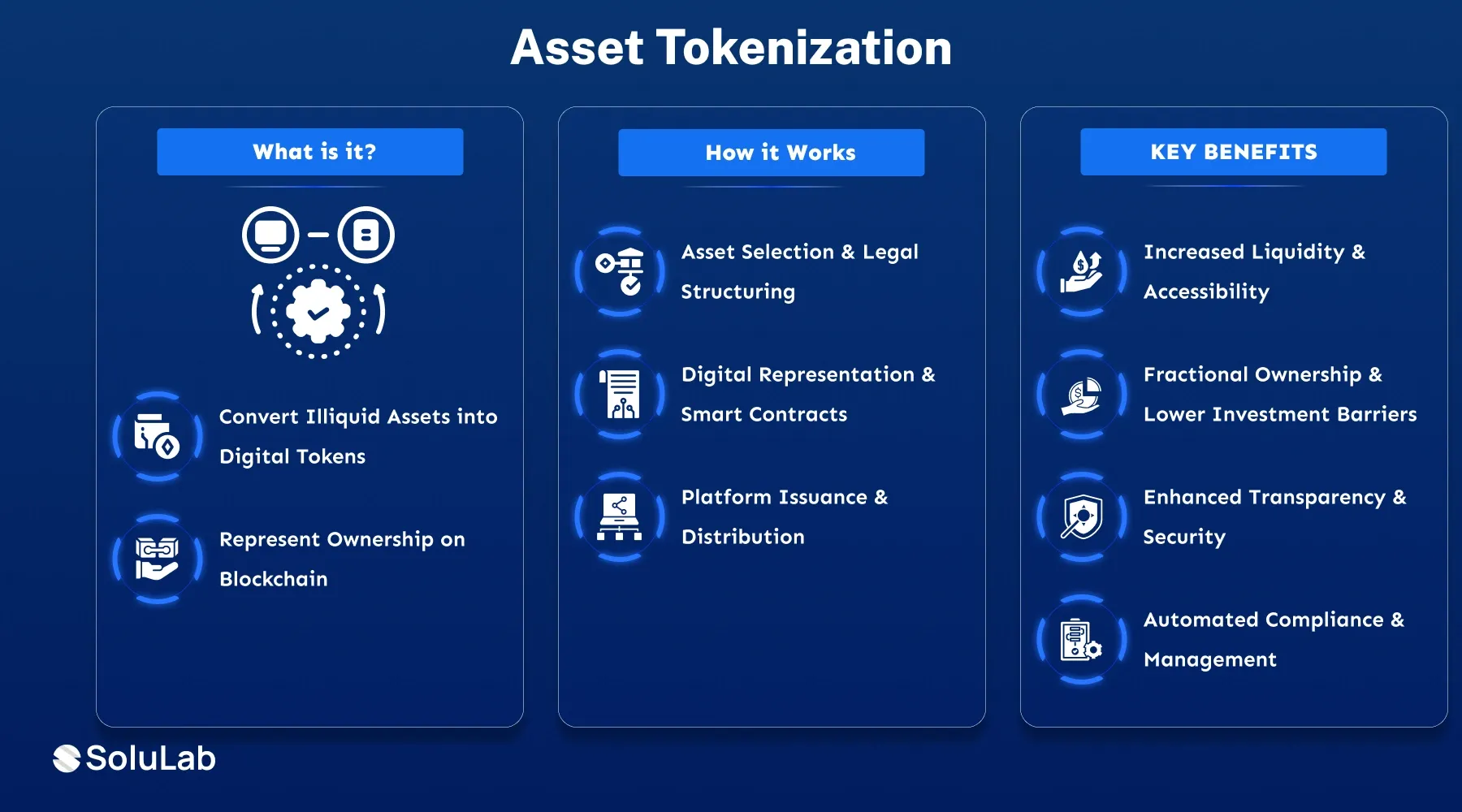
Asset tokenization is a game-changer that converts real-world assets into digital tokens on the blockchain. These tokens allow fractional ownership, increase liquidity, reduce transaction costs, and democratize access to previously illiquid markets. In this guide, we’ll break down what asset tokenization is, its benefits, use cases, and how you can get started.

Asset Tokenization (A Brief Introduction)

Tokenization is the transformative process of converting ownership and rights related to specific assets into a digital format. This method allows for the conversion of indivisible assets into tokenized representations.

To understand better, let’s take an example of an iconic painting, the Mona Lisa. To sell it traditionally, you’d need to find a buyer with the financial means to spend millions of dollars. This limits the pool of potential buyers significantly. However, through tokenization, we can fragment ownership of the painting, making it accessible to multiple individuals. Therefore, one person may own, for example, 1/25th of the painting or asset. This level of division is achievable only through tokenization, offering a modern solution compared to conventional methods. 

Read Our Blog: Top 10 Asset Tokenization Platforms in 2026

Type of Tokenized Assets

Type of Tokenized Assets 

The tokenized assets can further broadly be categorized into two types: Fungible Tokens and Non-Fungible Tokens

Fungible Tokens 

Fungible tokens refer to an asset that can be exchanged for another identical asset of the same type. When a good or service is fungible, it means it can be substituted with another identical good or service without any distinction.

Non-Fungible Tokens

Non-fungible tokens signify that each token is unique and cannot be replaced by an identical token. These tokens possess distinct characteristics, making them individual and irreplaceable. This uniqueness imparts a higher intrinsic value to NFTs compared to fungible tokens.

What Real-World Assets Can Be Tokenized?

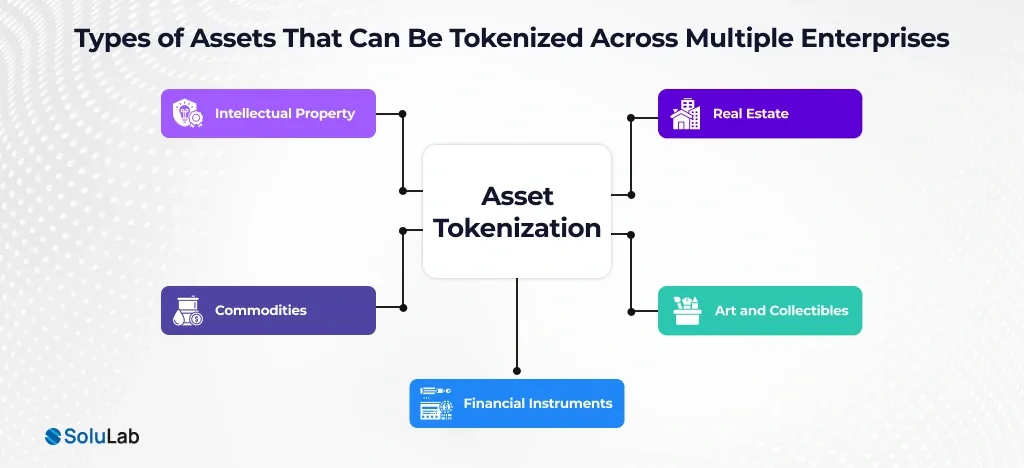
1. Commodities

Tokenization allows banks to trade commodities on the blockchain by generating digital tokens that represent ownership of the underlying commodity. These tokens can be traded on a blockchain network for faster, safer transactions.

The tokens can be exchanged for the underlying asset, usually stored commodities. Banks can improve commodities trading, lower transaction costs, and increase investor transparency.

2. Securities and Stocks

Digital tokens representing asset ownership allow banks to exchange stocks and securities on the blockchain. Tokens are usually backed by securities in custody and can be exchanged for the asset. Banks can speed securities trading, lower transaction costs, and increase investor transparency.

Fractional stock and private equity ownership allow new groups to pool resources for purchases, which is intriguing. Tokens allow banks to use present assets as collateral for future acquisitions, improving liquidity.

3. Currencies

Financial organizations create digital tokens backed by a reserve currency to represent real currency holdings. These “stablecoins” retain a stable value compared to their currency, such as the US dollar. Kaleido has built many institutional financial platforms.

The stablecoin’s one-to-one backing with the underlying currency is verified by third-party audits and verifications of the reserve currency. This makes fiat money transactions faster and more secure, and connects the regular banking system to cryptocurrencies.

4. Intellectual Property

Tokens can represent intellectual property like patents or copyrights. Trading these tokens on a blockchain platform makes intellectual property licensing and distribution more transparent and efficient.

Tokens with smart contract capability can automate royalty payments, licensing terms, and other contractual responsibilities. This helps financial institutions streamline intellectual property administration, save transaction costs, and increase owner liquidity.

5. Real Estate

Tokenizing real estate assets can boost liquidity for banks, as digital assets are easier to acquire, sell, and fractionalize. Buy smaller pieces of the property to lower entry barriers and make it more available to other investors. This allows banks to reach new consumers, including individuals who can’t afford or don’t want to acquire a whole property.

Eliminating intermediaries through real estate tokenization reduces transaction time and cost. These transactions can be audited or transparent. Digitizing physical places saves money. Management costs, including property maintenance, insurance, and legal fees, can be reduced.

6. Art & Collectibles

Tokenizing art entails digitizing it on a blockchain network. Like cryptocurrencies, this digital representation can be purchased, sold, or traded. The token can be used as loan collateral, increasing liquidity. Imagine all the new people who could possess a Picasso if they owned one millionth of it.

With art prices rising in some markets, this technology can generate a tamper-proof record of ownership and transaction history, prevent fraud, prohibit counterfeits, and confirm provenance.

CTA1

Asset Tokenization on Blockchain: Potential Benefits 

Asset Tokenization On Blockchain: Potential Benefits 

Tokenizing assets on the blockchain opens up significant growth and diversification opportunities in the market by bringing a plethora of new opportunities for businesses and individuals such as continuous operation, round-the-clock data accessibility, and immediate settlement possibilities.

  • Simplified Tokenization Process

In blockchain-based tokenization, the blockchain infrastructure replaces traditional banks, and cryptocurrency tokens replace digital dollars. While the mechanics change, the fundamental tokenization process remains similar to traditional banking, forex trading, or stock market tokenization.

  • No Intermediaries

Asset tokenization on the blockchain eliminates the intermediaries in the trading process. The distributed ledger system becomes a “source of truth” that ensures transaction integrity, securely stores digitized assets and facilitates transactions. Trust is primarily placed in the issuer and relevant regulatory bodies, simplifying and cost-reducing the process while enhancing security.

  • Divisibility of Assets

Tokenization can divide any asset into an unlimited number of virtual shares, each represented by a separate token. This feature enhances liquidity in markets where it was previously limited.

Consider real estate investments. Traditionally, buying or renting an entire building can be prohibitively expensive. However, using blockchain to divide a building into 100 tokens, each costing $2,500, reduces the investment threshold to $250. 

Similar divisibility applies to intellectual property, pharmaceutical development, space research, and even entire countries, enabling greater citizen involvement in political processes.

  • Enhanced Liquidity

Tokenizing assets broadens their accessibility, amplifying market liquidity by removing the traditional obstacles associated with illiquid investments, such as fine art or real estate. Tokenized assets can be seamlessly exchanged online, enabling investors to acquire fractional ownership in the underlying asset. In addition to increasing the liquidity of existing markets, this double effect opens up a wider range of investment opportunities to a wider range of investors.

  • Efficient and Cost-Effective Transactions

Crypto tokens eliminate the need for intermediaries and intermediaries, prevalent in traditional asset management processes. As a result, the value transfer process becomes more efficient and cost-effective by a reduction in transaction costs and processing time. Moreover, crypto tokens, residing on blockchain technology, facilitate 24/7 global trading, providing uninterrupted accessibility and flexibility.

  • Transparency and Verifiability

Crypto tokens’ residence on the blockchain ensures transparent provenance and transaction histories, cryptographically verifiable by users. Blockchain automatically records transactions, and its immutable and transparent nature guarantees the authenticity of each token’s historical data. These attributes endow crypto tokens with a level of trustworthiness rarely matched by other digital assets.

  • Immutability of Data

Data recorded on the blockchain cannot be altered, deleted, or tampered with by bribing officials or hacking systems. This inherent feature is due to blockchain architecture, which records information in blocks.

This immutability makes blockchains suitable for state registries, online banking systems, and corporate databases where data accuracy is paramount. It ensures the ability to trace the history of tokens or assets, deterring fraud, theft, errors, or corruption.

  • Enhanced Security

Blockchain Tokenization relies on cryptography and distributed registries. Cryptography safeguards open data by encrypting it with secret algorithms and keys. This enables secure storage of confidential or financial information while maintaining transparency.

These security measures enhance the safety of stored information in Token, including owner details and billing information.

  • Automation with Smart Contracts

Blockchain enables the automation of most workflow and bureaucratic procedures through smart contracts—autonomous algorithms that facilitate the exchange of assets like money, stocks, tokens, or real estate.

Smart contracts automate processes, eliminate intermediaries, accelerate transactions, reduce costs, and combat corruption. They operate based on predefined conditions, executing actions when certain criteria are met.

  • Transparency

Most blockchains are open-source software, allowing users and developers to inspect the code for vulnerabilities and functionality. This transparency ensures compliance with regulations, reduces fraud risk, and instills confidence in issuers and their assets.

Related: On-Chain vs. Off-Chain Asset Tokenization

How Does Asset Tokenization Profit the Asset Owners?

Asset tokenization brings real financial and operational benefits to asset owners. Here’s how:

  • Increased Liquidity: Owners can sell fractional shares of high-value assets, making it easier to access cash without selling the entire asset.
  • Wider Investor Reach: Digital tokens allow global investors to participate, expanding the potential buyer pool.
  • Lower Transaction Costs: Blockchain reduces the need for intermediaries, cutting fees and speeding up transactions.
  • Improved Transparency: Smart contracts ensure automated, secure, and traceable transactions, building trust with investors.
  • Enhanced Asset Utilization: Previously illiquid assets (like art or real estate) become monetizable, unlocking hidden value.

How Does Asset Tokenization Profit the Investors? 

  • Investors can easily diversify their portfolios by investing small amounts in tokenized assets, enhancing liquidity, and reducing paperwork hassles.
  • Tokenization enables quicker asset liquidity, eliminating long lock-up periods and allowing investors to access profits or make adjustments sooner.
  • Blockchain-based asset history ensures transparency, enabling investors to make informed decisions based on an asset’s true background.
  • Decentralized identity and blockchain technology provide secure, verifiable ownership and identity verification, meeting KYC/AML requirements and ensuring trust across various platforms.

Additional Features

In addition to the above benefits, tokenization offers a wide range of possibilities, including trading, storage, collateral usage, payment for goods and services, participation in loyalty programs, voting, and access to blockchain platforms.

How Does Asset Tokenization Work? 

The working of tokenization on the Blockchain network involves replacing sensitive information with an equivalent, non-sensitive placeholder known as a “token.” These tokens can be generated through several methods:

  • Using a mathematically reversible cryptographic function with a specific key.
  • Employing non-reversible functions, such as a hash function.
  • With indexing functions or generating a random number.

As a result, the token takes the place of sensitive information, while the actual sensitive data it represents is securely stored in a server referred to as a “token vault.” The token vault serves as the sole location where the original information can be mapped back to its corresponding token, ensuring the safeguarding of sensitive data. 

The Steps Involved in the Tokenization Process 

The steps involved in the Tokenization process are

1. Asset Selection- Select an asset, for example- a piece of art, intellectual property right, or house to tokenize. 

2. Asset Valuation- In this step, asset evaluation is done to determine its value, and parameters are set to understand the worth of the digital token 

3. Token Creation: After determining the value, the token is created using Blockchain technology. The token contains information related to the asset it represents such as ownership information, benefits, and rights.

4. Legal and Compliance– As per the jurisdiction, a token must fulfill the regulatory requirements and legal agreements. The process ensures that created tokens adhere to the applicable laws and regulations. 

5. Token Offering – The token created now can be made available for sale. The interested party who purchases the token will become the owner of the faction and the entire token as per the purchase agreement. 

Properties of Tokenized Real-World Assets

Properties of Tokenized Real-World Assets

  • Smart Contract 

The tokenization of real-world assets is achieved through the deployment of smart contracts. These self-executing contracts contain predefined instructions and automatically execute when specified conditions are met. This innovative approach promotes decentralization and eliminates the necessity for third-party intermediaries in transaction processes.

  • Fractionalization

Real-world assets can be subdivided into numerous digital tokens within the blockchain ecosystem. This fractionalization enhances liquidity and fosters financial inclusivity. For instance, a $1 million commercial building can be fragmented into one million digital tokens, each valued at just $1, thereby significantly reducing the investment threshold.

  • Enhanced Liquidity

Asset tokenization enhances liquidity by simplifying asset trading and transfers within a unified platform. Digital tokens can be freely and instantaneously exchanged in a peer-to-peer manner, obviating the need for intermediary financial institutions.

  • Transparency

Tokenized real-world assets are the real-world tokens present on a blockchain, which inherently offers transparency. Blockchain users can check the transaction records, trace the asset’s origins, scrutinize its complete history, and validate ownership.

  • Real-Time Tracking

As blockchains are transparent, they enable real-time tracking of tokenized assets, effectively deterring fraudulent activities. Central banks worldwide are adopting fiat currency in tokenized form, known as CBDC – “Central Bank Digital Currency”, that users can continuously monitor.

  • Unified Data Layer

Blockchain technology streamlines data management by providing a unified data layer. This facilitates more efficient data sharing and collaboration among multiple parties involved in asset management.

  • Financial Inclusivity 

Digital tokens can be issued by a wide range of entities, from small-sized businesses to big-scale industries, individuals, private companies, and non-governmental organizations, without the need for approval from traditional financial institutions. However, if these tokens are classified as securities, registration with regulatory bodies like the U.S. Securities and Exchange Commission may be required. Additionally, asset fractionalization lowers the entry barrier, promoting financial inclusivity.

  • Decentralized Distribution

Digital tokens can be easily distributed without reliance on third-party intermediaries. Token issuers have the flexibility to list their tokens on DEXs or can sell them autonomously.

  • Non-Fungibility

Non-fungible digital tokens (NFTs), which are unique and irreplaceable. Unlike fungible tokens like ETH, each NFT is distinct and non-replicable.

Industries Leveraging the Concept of Tokenization of Assets

Industries that are Embracing the Concept of Tokenization of Assets

1. Finance: Blockchain technology, specifically payment tokenization, has changed finance operations. Tokenization has altered asset management by improving exchange services and data security, eliminating the need to store credit card data. In 2020, decentralized finance (DeFi) emerged, disrupting traditional institutional frameworks by offering a variety of financial goods and services. Decentralized Finance (DeFi), with lending protocols and yield-farming tokens, can alter global banking and lending regardless of local financial conditions.

2. Real Estate: Blockchain technology has enabled asset tokenization in the real estate business, reducing middlemen and enabling cost-effective buyer-seller platforms. Tokenization promotes diverse markets and prevents fraud. Tokenization includes describing properties as blockchain tokens. This strategy allows fractional ownership by dividing ownership into smaller fractions. Thus, tokenization facilitates secondary market property share transactions. This method increases liquidity and democratizes real estate investments, making them more accessible.

  Read Also: 9 Blockchain Real Estate Companies to Watch in 2026

3. Healthcare: The healthcare industry is considering asset tokenization to solve data security and supply chain management issues. Healthcare blockchain solutions use tokenization to replace sensitive patient data with non-sensitive representations. This empowers individuals and healthcare organizations by giving them personal data ownership. Pharmaceutical tokens are unique units of medication that use tamper-proof QR codes for authentication. This strategy increases supply chain transparency and reliability, reducing counterfeit pharmaceutical items. Thus, this step is vital to patient safety.

4. Retail: Tokenization has become a popular strategy in retail, enhancing user experiences and security. Businesses may offer safer, more convenient payment options with blockchain tokenization. Payment tokenization lets users trade without sharing credit card information, reducing data breaches and fraud. Businesses can transform consumer loyalty points and prizes into tokens, making them more transferable across stores and platforms. This strategy boosts customer loyalty and simplifies store loyalty program

5. Supply Chain: Tokenization has improved supply chain transparency, traceability, and operational efficiency. Blockchain technology lets companies tokenize commodities, transportation, and inventories. This lets stakeholders track these assets along the supply chain. Transparency helps prevent counterfeiting, theft, and fraud and ensures product authenticity. Tokenization streamlines payments and documentation, reducing paperwork and administrative overhead. Thus, supply chains are more agile and responsive, speeding delivery and lowering costs for businesses.

6. Entertainment: Blockchain tokenization is changing entertainment content development, distribution, and monetization. Music, film, and art producers can tokenize their digital assets. This empowers individuals by increasing their control over intellectual property and royalties. Blockchain technology might automate licensing, copyright, and revenue-sharing arrangements, ensuring artists fair compensation. Tokenization also allows fans and investors to support their favorite musicians and invest in their projects. Democratizing the entertainment industry may empower content creators and consumers.

Real-World Use Cases of Asset Tokenization

Real-World Use Cases of Asset Tokenization internal image

Tokenization is revolutionizing various industries by leveraging blockchain technology to transform real-world assets into digital tokens, thereby enhancing liquidity and accessibility. Here are some real-life use cases where tokenization is making a significant impact.

  • Tokenization of Real Estate Assets

In the realm of real estate tokenization entails breaking down traditionally illiquid property assets into fungible blockchain tokens. 

Elevated Returns, an asset management firm based in New York, demonstrated the potential of this approach by tokenizing the St. Regis Resort in Aspen, Colorado, worth $18 million on the Ethereum blockchain in 2018.

  • Tokenization of Artwork

Tokenization extends its influence to the world of art. Consider the scenario where a company holds ownership of a limited number of prints of an artwork by a renowned artist. These prints can be tokenized, allowing the public to redeem tokens for physical copies. If the value of tokens redeemed falls short of a certain threshold, token holders can retain fractional ownership based on the assessed value. 

TheArtToken (TAT) offers tokens representing partial ownership of Contemporary and post-war art, securely stored by the Swiss government. This approach simplifies the buying and selling of art fractions.

  • Monetary Gold Tokenization by Perth Mint

The Perth Mint (Australia) launched GoldPass, a digital platform that lets users buy, sell, and transfer digital gold certificates backed by physical gold stored in their vaults. Each digital certificate is fully backed by real gold, offering a modern way to trade the metal securely and efficiently.

This highlights how a gold tokenization development company can enable financial institutions and mints to digitize gold assets, making them accessible to everyday investors without physical handling.

Read Also: Gold Tokenization and How Does It Work?

  • Tokenization of Physical Commodities

Even in the realm of physical commodities, tokenization is making strides. Take the example of gold stored in a vault owned by ABC. ABC can tokenize ownership of a portion of the gold, maintaining an ownership registry with the vault owner, XYZ. Each token sold represents ownership of a corresponding amount of gold. Token holders can redeem their gold by proving ownership via a digital signature or certificate. 

JP Morgan, a financial services giant, has revealed plans to tokenize gold bars on their Quorum blockchain network. This showcases the potential for tokenization in the world of physical assets.

  • Tokenization in Cargo

In the logistics sector, tokenization addresses the inefficiencies associated with traditional proof of ownership, such as Bill of Lading (B/L) documents. 

CargoX introduces a solution through tokenization called Smart B/L, built on Ethereum. The Smart B/L system operates akin to tokenization. Carriers create a Smart B/L using their app and send it to exporters. Upon receiving payment from importers, exporters transfer ownership of the Smart B/L token. Importers, in turn, can claim ownership of the goods by presenting the Smart B/L token to the carrier. This innovative approach streamlines cargo logistics, reducing delays and simplifying ownership verification.

These real-world examples vividly illustrate how tokenization is enhancing liquidity, accessibility, and efficiency across various sectors.

CTA2

Conclusion

Asset tokenization is changing how we view ownership, trade, and investment. By converting real-world assets into digital tokens on the blockchain, it offers greater transparency, liquidity, and accessibility to investors across the globe.

Whether it’s real estate, art, or commodities, tokenization breaks down traditional barriers and opens up new opportunities for fractional ownership. As regulations evolve and technology matures, more businesses and individuals are likely to adopt this model.

For anyone looking to future-proof their investment strategy or business model, understanding asset tokenization isn’t just smart, it’s essential.

SoluLab, a top asset tokenization development company in the USA, provides the best services as per your business needs. Contact us today to discuss further.

FAQ

1. What is the future of asset tokenization?

Asset tokenization is set to revolutionize global finance by boosting liquidity, enabling fractional ownership, and making investments more accessible, transparent, and efficient.

2. What distinguishes cryptocurrencies from tokens? 

While tokens seek to facilitate the creation of decentralized applications (dApps), and other blockchain-based platforms, coins serve as the cornerstone for safe and decentralized networks. 

3. Which is the best cryptocurrency for tokenization?

The mantra OM in the realm of real-world asset tokenization arena is a layer 1 blockchain platform the other cryptocurrencies for tokenization are such as OriginTrail (TRAC), Pendle (PENDLE), Polymesh (POLYX), and TokenFi (TOKEN). 

4. What should businesses look for when choosing an asset tokenization development company?

Businesses should prioritize expertise in blockchain, regulatory compliance, security, and industry-specific solutions to ensure scalable, secure, and legally sound tokenization platforms.

5. How can asset tokenization be aided by SoluLab?

Consultation, creation, and deployment of tokenization of assets customized according to your company’s needs and preferences all come under SoluLab’s extensive services offered.

Top 10 Asset Tokenization Platforms in 2026

Asset Tokenization Platforms

Platforms for asset tokenization development have become crucial in 2026 for democratizing access to financial possibilities. Real estate, works of art, and even intellectual property, which were previously illiquid, may now be split into digital tokens, enabling anyone to hold portions of these assets. This concept of fractional ownership gives investors the freedom to diversify their holdings and get access to markets that were previously unavailable because of high entry barriers.

As the world continues to embrace the potential of blockchain technology, leading asset tokenization platforms have emerged as powerful tools that are revolutionizing the financial landscape. These platforms leverage the security and transparency of blockchain to transform traditional assets into digital tokens, enabling fractional ownership, liquidity, and enhanced accessibility.

In the history of financial markets, transparency and security have always been top priorities. Leading Asset tokenization platforms will use blockchain technology in 2026 to address these issues. These systems offer an immutable and auditable record of asset ownership and transfers by recording and validating transactions on a distributed ledger. This openness boosts investor trust, lessens fraudulent activity, and lessens the need for middlemen.

In this article, we will explore the top 10 asset tokenization development platforms that are making waves in 2026, facilitating a new era of decentralized finance.

Read Also: What Is Asset Tokenization?

What is the Process of Converting Real-World Assets into Digital Tokens?

Asset tokenization is revolutionizing the way we perceive and invest in real-world assets. By converting tangible assets into digital tokens, asset tokenization platforms are unlocking a multitude of benefits and opportunities for investors. But how exactly does this process work? Let’s delve into the steps involved in converting real-world assets into digital tokens.

  • Asset Selection and Evaluation: The first step in the process is selecting the asset to be tokenized. This can include a wide range of assets such as real estate properties, artwork, commodities, or intellectual property rights. The asset is carefully evaluated to determine its value, marketability, and legal compliance. Due diligence is crucial to ensure that the asset meets the necessary criteria for tokenization.
  • Legal and Regulatory Compliance: It is crucial to follow all applicable laws and regulations before beginning the tokenization process. This entails making sure all paperwork is in order, confirming ownership, and abiding by securities laws. Asset tokenization development systems actively collaborate with legal professionals to handle the complicated environment and guarantee legal compliance.
  • Asset Valuation and Fractionalization: A professional assessment or valuation approach are used to ascertain the asset’s worth. The amount of tokens that will represent fractional ownership of the asset is determined as a result of the valuation procedure. A larger spectrum of investors can access an asset thanks to fractionalization, which enables investors to buy a share of its value. The ownership rights and value of the underlying asset are represented by the tokens.
  • Smart Contract Creation and Token Issuance: Smart contracts, powered by blockchain technology, play a pivotal role in asset tokenization. These contracts are programmed with the terms and conditions of the tokenized asset, including ownership rights, dividend distribution, and transferability. The smart contract ensures that the tokenized asset operates within the predefined parameters and automates certain functions, such as dividend payments. Once the smart contract is created, the digital tokens representing the asset are issued and made available for sale or trade.
  • Investor Onboarding and Token Sale: Leading Asset tokenization platforms provide a user-friendly interface for investors to participate in the token sale. Investors can register, complete the necessary know-your-customer (KYC) and anti-money laundering (AML) procedures, and fund their accounts with the designated cryptocurrency or fiat currency. The tokens are then offered for sale, either through a private placement or a public offering, depending on the platform and regulatory requirements.

Read Our Blog Post: Importance Of Tokenization Of Assets

What are the Benefits of Asset Tokenization: Unlocking a New Era of Investment Opportunities?

Asset tokenization development, enabled by blockchain technology, has disrupted the traditional investment landscape, offering many benefits to investors and asset owners. Let’s explore the advantages that asset tokenization brings to the table:

  • Increased Liquidity and Fractional Ownership: One of the key benefits of asset tokenization is the increased liquidity it offers. By converting assets into digital tokens, fractional ownership becomes possible, allowing investors to purchase and trade smaller portions of valuable assets. Previously illiquid assets, such as real estate properties or fine art, can now be divided into tokens representing fractional ownership. This democratizes access to high-value assets, opening doors for a broader range of investors and facilitating more efficient and flexible transactions.
  • Enhanced Transparency and Reduced Barriers to Entry: Asset tokenization development platforms provide a transparent and auditable record of ownership and transactions on the blockchain. This level of transparency reduces information asymmetry and instills greater trust in the investment process. Investors can easily verify the authenticity, ownership history, and market value of tokenized assets. Additionally, asset tokenization development lowers the barriers to entry for traditionally exclusive or inaccessible assets. Previously, assets like rare collectibles or prime real estate were limited to wealthy individuals or institutional investors. Through tokenization, these assets become more accessible, allowing a wider audience to participate in investment opportunities that were once out of reach.
  • Diversification Opportunities and Optimized Portfolios: Asset tokenization development pave the way for portfolio diversification and optimization. Investors can now easily allocate their funds across various asset classes, reducing concentration risk and enhancing portfolio performance. Tokenized assets represent a wide range of sectors, such as real estate, commodities, or intellectual property, allowing investors to achieve diversification without significant capital requirements. Additionally, asset tokenization enables investors to customize their portfolios according to their risk appetite and investment goals. They can allocate funds across different asset types, geographies, or sectors, thereby achieving a more balanced and optimized investment strategy.
  • Efficient and Cost-Effective Transactions: Traditional investment transactions often involve multiple intermediaries, complex paperwork, and lengthy settlement periods. Asset tokenization platforms streamline this process by automating transactions through smart contracts. Smart contracts facilitate the execution of predefined conditions, such as dividend distribution or transfer of ownership, removing the need for intermediaries and reducing associated costs. Furthermore, blockchain technology enables faster settlement times, eliminating the need for lengthy verification processes. This efficiency and cost-effectiveness benefit investors and asset owners, creating a seamless investment experience.

Read Our Blog: Top 12 Real Estate Tokenization Companies in USA

What are the Regulatory Developments and Frameworks in 2026?

As the leading asset tokenization industry continues to evolve and gain traction, regulatory authorities worldwide are actively shaping the legal frameworks to ensure investor protection, market integrity, and compliance. In 2026, several key regulatory developments and frameworks are emerging, aiming to address the unique challenges and opportunities presented by asset tokenization. Let’s explore some of the notable trends and initiatives in this domain:

  • Enhanced Investor Protection: Regulators recognize the need to safeguard investors participating in tokenized asset markets. In 2026, we see an increased emphasis on enforcing robust investor protection measures. Authorities are imposing stricter requirements for asset tokenization platforms, including comprehensive disclosure of risks, transparent pricing mechanisms, and investor suitability assessments. Additionally, Know Your Customer (KYC) and Anti-Money Laundering (AML) procedures are being reinforced to mitigate the risk of fraudulent activities and enhance the overall security of the ecosystem.
  • Clearer Regulatory Definitions: Regulatory bodies are working to provide clearer definitions and classifications for tokenized assets. This clarity is essential to determine the regulatory treatment of different token types and their compliance requirements. For instance, regulatory authorities may distinguish between security tokens, utility tokens, and payment tokens, each subject to specific regulations and guidelines. Such distinctions aim to bring regulatory certainty and foster market transparency, enabling investors to make informed decisions and asset tokenization platforms to operate within defined boundaries.
  • Standardization and Interoperability: In 2026, regulatory bodies will focus on standardizing practices and promoting interoperability within the asset tokenization ecosystem. Standardization efforts aim to create uniform guidelines for token issuances, smart contract standards, and token trading practices. These standards facilitate cross-platform compatibility, ensuring smooth interoperability and liquidity across different asset tokenization platforms. By establishing common industry practices, regulatory bodies foster trust, reduce fragmentation, and enhance market efficiency.
  • Regulatory Sandboxes and Innovation Hubs: To encourage innovation while managing potential risks, regulatory authorities are increasingly establishing regulatory sandboxes and innovation hubs. These initiatives provide a controlled environment for asset tokenization platforms and startups to test new technologies and business models under regulatory supervision. Regulatory sandboxes enable platforms to experiment with innovative approaches, while regulators closely monitor their operations and assess their compliance with existing regulations. This collaborative approach between regulators and industry participants fosters innovation, allowing regulatory frameworks to evolve alongside technological advancements.
  • International Collaboration and Harmonization: Given the global nature of asset tokenization, regulatory authorities are actively collaborating and seeking harmonization at an international level. Recognizing the need for consistent regulatory approaches, regulators are engaging in cross-border discussions to share best practices, align regulatory frameworks, and address challenges associated with cross-jurisdictional transactions. These collaborative efforts aim to establish a cohesive global regulatory landscape for asset tokenization, promoting investor confidence, and enabling seamless international investment opportunities.

Check Out Our Blog: Tokenizing Real Estate Assets On Blockchain

How Did We Compile The List of Top Asset Tokenization Platforms in 2026?

Although choosing the best asset tokenization platforms was a challenging task, we have come up with great results by considering the following factors:

  • Years of experience in the market
  • Client testimonials
  • Quality of delivered products
  • Size of the team
  • Variety of industries the company has worked with
  • Expertise in understanding business and market development
  • Technology Stack

CTA 1

Here are the Top 10 Asset Tokenization Platforms in 2026.

1. SoluLab

At SoluLab, they specialize in the transformation of physical assets into digital tokens, aiming to enhance trading accessibility and security. Their expertise lies in tokenizing various assets such as real estate, works of art, precious metals, and stock certificates on the blockchain. By analyzing the unique business requirements, they determine the optimal token type, architecture, and technology stack for the asset tokenization solution. With a focus on safety, scalability, and legal compliance, SoluLab’s team combines their extensive industry experience with technological prowess to develop asset tokenization solutions.

The team at SoluLab provides comprehensive asset tokenization development services tailored to meet the specific needs of each company. Whether the objective is to tokenize assets for crowdfunding, fractional ownership, or enhancing liquidity, they offer a range of solutions. Their expertise ensures the development of secure and scalable platforms, enabling clients to leverage the benefits of asset tokenization.


$25-$49


50-249


2014


Los Angeles, CA, USA


Disney, Microsoft, Georgia Tech

2. tZERO

tZERO has emerged as a pioneer in the realm of digital securities. Founded in 2014, tZERO is a leading blockchain-based platform that is transforming traditional capital markets by digitizing and streamlining the process of issuing, trading, and settling securities. With its innovative approach, tZERO is revolutionizing the way investors and companies interact, creating new opportunities for liquidity and efficiency.

By leveraging the power of distributed ledger technology, tZERO provides a secure and transparent platform for the issuance and trading of digital securities.


$25-$49


51-100


2015


Utah, United States


Alliance Investments, Curzio Research

3. Polymath

Polymath is an expert in tokenizing securities, streamlining the creation and administration of security tokens complying with legal requirements. With a user-friendly interface and full compliance with Know Your Customer (KYC) and Anti-Money Laundering (AML) requirements, its platform allows issuers to tokenize assets.


$55-$90


11-50


2017


Saint George, Barbados


N/A

4. ADDX

ADDX provides a user-friendly and secure digital marketplace where investors can seamlessly access and trade a diverse range of alternative assets. With its innovative approach, ADDX is breaking down barriers and opening up new avenues for individuals to diversify their portfolios and participate in traditionally exclusive investment opportunities.

One of the key advantages offered by ADDX is its global reach. The platform enables investors from around the world to participate in alternative investments that were traditionally limited to a select few.


$25-$50


51-100


2017


Central Region, Singapore


Hamilton Lane, StashAway, Singtel, Fullerton Fund Management

5. Securitize

Securitize offers a comprehensive end-to-end platform for tokenizing securities. It streamlines the compliance process, ensuring that security tokens adhere to relevant regulations. Securitize also provides tools for investor management, facilitating the distribution of dividends and other benefits to token holders.


$55-$90


50-100


2017


California, USA


Whitehall Capital, Arca Labs

6. Bitbond

Bitbond is a financial technology company that has made significant strides in revolutionising the way small and medium-sized enterprises (SMEs) access financing. Established in 2013 and headquartered in Berlin, Germany, Bitbond operates as a peer-to-peer lending platform that utilises blockchain technology to facilitate transparent and efficient lending processes.


$55-$90


11-50


2013


Berlin, Germany


N/A

7. Tokensoft

Tokensoft offers a robust platform that enables companies to tokenize a wide range of assets, including securities, real estate, funds, and more. By leveraging blockchain technology, Tokensoft facilitates the seamless creation and issuance of digital assets, providing businesses with increased liquidity, fractional ownership, and access to a global investor base. Their platform supports both public and private blockchain networks, allowing for flexibility and scalability in asset tokenization.


$55-$99


11-50


2017


California, United States


N/A

8. Securrency

Securrency is a cutting-edge financial technology company that is spearheading innovation in the field of digital asset compliance and security. With its advanced platform and solutions, Securrency enables businesses to seamlessly issue, manage, and trade digital assets while ensuring compliance with regulatory frameworks. Founded with a mission to bridge traditional finance and blockchain technology, Securrency has emerged as a trusted leader in the digital asset space.


$25-$50


101-250


2015


Washington, United States


WisdomTree, State Street, US Bank

9. Algorand

Algorand offers a high-performance blockchain platform for asset tokenization development and decentralised applications. Its pure proof-of-stake consensus algorithm ensures scalability and security. Algorand’s robust architecture and focus on speed make it suitable for asset tokenization projects that require fast transaction processing.


$25-$50


51-100


2017


Massachusetts, USA


N/A

10. Hyperledger Fabric

Hyperledger Fabric is an open-source blockchain framework developed by the Linux Foundation. It provides a modular and scalable platform for enterprises to build and deploy permissioned blockchain networks. Hyperledger Fabric’s focuses on privacy to make it an excellent choice for organizations looking to tokenize assets within a controlled environment.


$25-$50


25-100


2015


California, United States


Fintract Global, NIRA Inc, OptimHire

Final words

The impact of leading asset tokenization platforms on the finance industry is significant and poised to shape the future of how assets are valued, traded, and accessed. The top 10 asset tokenization development platforms mentioned in this article have revolutionized finance by leveraging blockchain technology to provide enhanced liquidity, fractional ownership, and increased accessibility to a diverse range of assets.

These platforms have opened up new opportunities for investors, allowing them to participate in asset ownership that was previously restricted to large institutions or wealthy individuals. By tokenizing assets, fractional ownership becomes possible, enabling broader participation and democratizing investment opportunities.

In conclusion, leading asset tokenization platforms in 2026 have significantly transformed the financial landscape by introducing decentralized and transparent solutions. These platforms empower individuals and institutions to tokenize assets, unlocking new opportunities for fractional ownership, increased liquidity, and broader market accessibility. With continuous innovation and advancements, asset tokenization platforms are poised to reshape finance and drive the adoption of decentralized finance (DeFi) in the years to come.

At SoluLab, they specialize in transforming physical assets into digital tokens, enhancing their accessibility and security for trading purposes. The efficiency demonstrated by the development team at SoluLab necessitates the hiring of an asset tokenization development company in order to attain unparalleled work experience. The SoluLab team is also dedicated to delivering excellent real estate tokenization development services, enabling clients to unlock the complete potential of their real estate assets. They offer a range of services for real estate tokenization, making it easier to enter fractional ownership and enhance liquidity. Contact us today!

FAQs

1. What is asset tokenization development?

Asset tokenization development is the process of converting real-world assets, such as real estate, art, or securities, into digital tokens that can be stored and traded on a blockchain platform.

2. How do leading asset tokenization platforms revolutionize finance?

Asset tokenization development platforms revolutionize finance by providing enhanced liquidity, fractional ownership, and increased accessibility to a diverse range of assets. They enable the creation of digital tokens that represent ownership in real-world assets, allowing for efficient trading, increased market participation, and unlocking liquidity from traditionally illiquid assets.

3. What are the top 10 asset tokenization platforms in 2026?

The top 10 leading asset tokenization platforms in 2026 are Ethereum, Polymath, Stellar, Securitize, Tezos, Neo, Ravencoin, Algorand, Hyperledger Fabric, and Ontology.

4. What makes Ethereum a leading asset tokenization platform?

Ethereum is a leading asset tokenization platform due to its robust smart contract capabilities, vibrant ecosystem, and widely adopted ERC-20 token standards. It provides a foundation for developers to create and deploy decentralized applications (dApps) for asset tokenization.

What is Asset Tokenization?

What is Asset Tokenization?

Modern technology developments are continuing to transform established sectors. Asset tokenization is one such idea that has drawn a lot of attention. By utilizing the potential of blockchain technology, asset tokenization creates digital tokens out of both tangible and intangible assets. With these tokens representing ownership rights and value, investors may participate in fractional ownership, conduct smooth asset trades, and access new investment opportunities.

Transforming physical assets into digital tokens on a blockchain network is the essence of asset tokenization. Doing so eliminates the conventional obstacles related to asset ownership and investment, creating opportunities for people and companies.

One of its key benefits is the potential for an asset tokenization development platform to democratize investing. By making several smaller investments in different assets, fractional ownership enables people to diversify their portfolios. Tokenization also eliminates geographical limitations, allowing anybody to participate in investment possibilities. Markets previously closed off because of logistical or governmental restrictions can now be accessed.

What are the Key Characteristics of Tokenized Assets?

In banking and investing, a tokenization company —turning physical assets into digital tokens—has become a ground-breaking idea. Assets that have been tokenized have several distinctive qualities that set them apart from conventional assets and appeal to investors looking for increased liquidity, transparency, and accessibility. We will discuss the main traits of tokenized assets and how they are changing the investment environment.

  • Fractional Ownership

Tokenized assets enable fractional ownership, allowing investors to own a portion of an asset rather than the whole. Through tokenization companies, high-value assets previously out of reach for many individuals can now be divided into smaller units, opening doors to a wider pool of investors. Fractional ownership not only enhances accessibility but also enables portfolio diversification by investing in multiple assets with smaller investment amounts.

  • Divisibility

Tokenized assets can be divided into numerous smaller units, known as tokens. Unlike traditional assets, which have minimum investment requirements, tokenized assets provide flexibility in terms of investment size. Divisibility facilitates liquidity and enables investors to trade smaller units of assets, promoting market efficiency and reducing barriers to entry.

  • Enhanced Liquidity

Due to high transaction costs, protracted settlement times, and a small pool of purchasers, traditional assets like real estate or fine art sometimes have restricted liquidity. By establishing a secondary market for tokenized assets, tokenization company solves this problem by making it simpler for investors to acquire and sell tokens. By increasing liquidity, asset owners can realize greater value, while investors are given the chance to exit their positions more quickly.

Read Our Blog Post: Importance Of Tokenization Of Assets

  • Transparency

Tokenized assets must possess transparency as a core quality. The underlying blockchain technology records all ownership changes and transactions, producing a transparent and immutable ledger. Thanks to this openness, all parties are guaranteed access to current information, including past ownership records, transaction specifics, and smart contract conditions. Investors might examine the ownership history and legitimacy.

  • Programmability

Tokenized assets use smart contracts and programmable, autonomous agreements. Tokenized asset terms and conditions are automated and enforced via smart contracts. They allow token holders to receive dividends, royalties, or profits automatically and by predetermined regulations. By increasing efficiency and eliminating the need for middlemen, programmability lowers costs and streamlines the fulfillment of contractual commitments.

  • Global Accessibility

Because a particular location does not limit tokenized assets, everyone in the globe may engage in investing possibilities. Traditional assets frequently encounter logistical and regulatory challenges, limiting access to a select number of investors. On the other hand, tokenized assets are simple to sell on online marketplaces, enabling investors everywhere to compete on an even playing field.

  • Security and Ownership Rights

Tokenized assets offer secure digital representations of ownership rights in terms of security and ownership rights. Tokenization’s company underlying blockchain technology guarantees tamper-proof records and fraud prevention. Holders of tokens own special cryptographic keys that provide them ownership rights and permit safe transfers. As a result, middlemen no longer need to confirm ownership, which lowers costs and improves security.

What are the Types of Tokenization?

What are the Types of Tokenization?

The process of tokenizing, which involves turning physical assets into digital tokens, has created new opportunities for ownership and investment. Different forms of tokenization are tailored to certain asset classes and goals, giving investors various ways to participate in the digital economy. Fractional ownership, securitization, and real-world assets are the three main kinds of tokenization that will be covered in this topic.

1. Fractional Ownership

By dividing assets into smaller pieces through the tokenization company of fractional ownership, investors may own only a portion of an asset rather than the complete thing. High-value assets like real estate, fine art, or antiques are appropriate for this tokenization. Fractional ownership has the following benefits:

High entry cost barriers are removed by fractional ownership, allowing smaller investors to engage in profitable assets that were previously only accessible to well-off people or institutions.

Investors may diversify their portfolios and spread risk across several asset classes by purchasing a portion of many assets. This lessens exposure to a single asset and improves the stability of the entire portfolio.

2. Securitization

Illiquid assets, such as loans, mortgages, or receivables, are transformed into marketable securities known as asset-backed tokens through securitization. These tokens are often produced through a procedure known as tokenized securitization and reflect ownership in a pool of underlying assets. Securitization’s salient attributes include

Combining many assets into a single security makes dividing the risks across a larger group of investors possible. This diversification reduces the exposure to individual defaults or variations in asset performance. Securitization increases liquidity by turning illiquid assets into tradable tokens. On secondary markets, investors may purchase and sell these tokens, unlocking value from assets that would otherwise be difficult to monetize.

3. Real-World Assets

Tokenization company incorporates a variety of real-world assets in addition to conventional financial instruments. Real-world asset tokenization platforms transform physical assets into digital tokens, such as commodities, real estate, or intellectual property. Real-world asset tokenization highlights include:

In historically unliquid markets like real estate or commodities, tokenization company creates liquidity. Investors may trade fractions of these assets by breaking them into tokens, which increases market efficiency and lowers transaction costs.

Fractional ownership is made possible through real-world asset tokenization, allowing investors to own a section of a building or a commodity. Allowing more people to contribute through fractional ownership encourages financial inclusion and diversity.

CTA 1

How to Select Assets for Tokenization: A Strategic Approach

The practice of tokenizing, which involves turning physical assets into digital tokens, has become quite popular in the financial sector. To optimize the advantages of tokenization and ensure effective deployment, choosing the appropriate assets for tokenization necessitates a deliberate approach. In this, we will examine the essential elements to consider while choosing assets for tokenization.

  • Asset Type and Characteristics

Determining the kinds of assets appropriate for tokenization is the first stage in asset selection. Physical assets like real estate or commodities, financial instruments, intellectual property rights, and revenue sources can all be considered assets. Consider the asset’s special qualities, such as its price, market demand, and possibility for fractional ownership.

  • Market Demand and Liquidity

Evaluate the asset’s liquidity and the market demand. Highly liquid assets, like publicly traded stocks, can be tokenized to simplify trading and improve market efficiency. On the other hand, illiquid assets could need extra planning and tactics to guarantee liquidity in the secondary market. 

  • Ownership Rights and Legal Considerations

Examine any restrictions imposed by legislation or regulation, such as those relating to intellectual property or securities that may affect the tokenization process. Engage legal professionals to do due diligence and guarantee adherence to pertinent rules and regulations in the country where the asset is located.

Read Our Blog: Tokenizing Real Estate Assets On Blockchain

  • Value Proposition and Benefits

Consider the advantages of a tokenization company for the asset. Increased liquidity, fractional ownership, transparency, and accessibility are just a few benefits of tokenization. Consider how these advantages combine with the features of the asset and the preferences of possible investors. Consider whether asset class tokenization may unlock value, increase market efficiency, or provide new investment possibilities.

  • Technical Realisability

Determine if tokenizing the item is possible. Consider the underlying technologies necessary for tokenization, such as the platform’s scalability, smart contract functionality, and blockchain infrastructure. Make that the asset can be effectively split into digital tokens and that the tokenized version appropriately represents the original value.

  • Market and Industry Developments

Keep up with the tokenization-related market and industry developments. Keep track of the uptake and results of comparable tokenization efforts within the target asset class. Recognize the changing regulatory environment and any new best practices or standards in the asset tokenization industry. This information will aid decision-making and ensure compliance with market trends.

What Advantages Does Asset Tokenization Company Offer?

What Advantages Does Asset Tokenization Company Offer?

Asset tokenization, the transformation of physical assets into digital tokens on a blockchain, has emerged as a game-changing technology with several benefits. Traditional assets like real estate, works of art, commodities, and financial instruments may be made more accessible, effective, and safe by utilizing the potential of tokenization. We shall examine the main benefits that the asset tokenization platform provides in this.

  • Increased Liquidity

Liquidity is increased due to the asset tokenization platform. It establishes a secondary market where investors can conveniently purchase, sell, and exchange digital tokens representing a portion of ownership in various assets. Traditional assets frequently experience low liquidity, high transaction costs, and protracted settlement times. 

By removing these obstacles, tokenization opens up the market to more investors, enables the trading of assets in smaller units, and releases value. The capacity to sell tokens on digital platforms in a constantly active global market boosts market efficiency and makes transactions quicker and more affordable.

  • Fractional Ownership

The availability of fractional ownership is one of the most important benefits of asset tokenization. Tokenization allows investors to acquire high-value assets by dividing them into smaller pieces. 

A wider spectrum of people, including retail investors, may invest in often expensive assets because of fractional ownership. Because smaller sums of money may be spread across many assets, this creates chances for portfolio diversification, risk reduction, and democratization of investing.

  • Enhanced Accessibility

Asset tokenization platform makes formerly illiquid or exclusive assets available to a larger group of investors, which lowers entry barriers and increases investment opportunities. Because tokenization eliminates regional restrictions, investors worldwide may engage in international markets and have exposure to a wide range of asset types. This improved accessibility encourages financial inclusion, allows people to invest in things they support, and cultivates a more varied and inclusive investing environment.

Check Out Our Blog: What You Need to Know About Investing in Tokenized Real Estate

  • Enhanced Transparency

The foundation of the asset tokenization platform, blockchain technology, offers a transparent and unchangeable database of transactions. The blockchain maintains a complete audit history of all ownership changes, transactions, and contract conditions. This increases transparency. 

This openness fosters investor trust by giving investors immediate access to details about the asset’s ownership history, transaction logs, and smart contract rules. Investors may confirm the legitimacy of tokenized assets and acquire faith in the ecosystem’s integrity, lowering the risk of fraud and boosting market confidence.

  • Enhanced Security

By utilizing distributed ledger technology and cryptographic technologies, tokenization improves the security of assets. Tamper-proof records are ensured by blockchain, which also guards against unauthorized changes or fraudulent activity. 

Unique cryptographic keys are given to token holders, giving them ownership rights and allowing safe transfers. As a result, intermediaries are no longer required to confirm ownership, lowering counterparty risk and possible failure points. Blockchain’s decentralized structure improves data security by making it more challenging for malevolent parties to infiltrate the system.

  • Fractional Investment Opportunities

Asset tokenization platform makes it possible to make fractional investments in assets other than standard ones. It makes it possible for regular people to invest in sources of income, intellectual property, or special investment vehicles that were previously only available to institutions or high-net-worth individuals. 

Fractional investments in these unconventional asset groups offer the diversity and opportunity for lucrative returns. The investing landscape is widened through tokenization, opening up hitherto inaccessible markets to investors.

What is Early-Stage Investment Tokenization?

Early-stage investments are essential for promoting innovation and promoting economic expansion. However, these investments frequently encounter difficulties, including low liquidity, tough entrance requirements, and restricted access for small investors. Solving these issues, tokenization, and converting assets into digital tokens can transform early-stage investing. We will discuss tokenizing early-stage investments and how they may affect investors and entrepreneurs.

  • Increased Liquidity and Market Efficiency

Early-stage investments have historically been illiquid, which makes it difficult for investors to sell their holdings before an exit event like an initial public offering (IPO) or acquisition. Through the ability to exchange digital tokens that reflect ownership holdings, tokenization adds liquidity to these assets. 

Tokenization company increases flexibility and liquidity by establishing secondary markets for these tokens, enabling investors to purchase and sell their assets. Enhancing market efficiency and boosting investor trust in the asset class improved liquidity.

  • Global Investment Opportunities

Tokenization allows investors from all around the world to invest in early-stage enterprises despite territorial limitations. With conventional funding, geographical restrictions, legal impediments, and small investor networks may make it difficult to fund businesses in other nations. 

On the other side, tokenization uses blockchain technology to establish a worldwide investment market. Entrepreneurs now have access to a wider range of prospective financing sources because of the ease with which investors may access and invest in businesses from anywhere.

  • Additional Investor Protection

Early-stage investments become transparent and accountable thanks to tokenization. Blockchain technology maintains an immutable audit trail by recording all transactions and ownership changes. As a result of being able to check ownership records and follow the movement of tokens, investors become more trusting. 

Automatic compliance with investment terms is made possible by smart contracts, self-executing arrangements built into the blockchain that guarantees the protection of investors’ rights and interests. Tokenization company lowers the possibility of fraud and increases investor trust in the investing process.

CTA 2

Conclusion

In conclusion, the asset tokenization platform is a game-changing invention with the potential to change how we perceive and use conventional assets. Asset tokenization creates ownership rights represented by digital tokens using blockchain technology, which has many advantages and prospects for investors, businesses, and the whole financial ecosystem.

Asset tokenization makes Increased liquidity possible, making buying, selling, and exchanging assets on digital marketplaces simple. This liquidity increases market efficiency, creates more investment possibilities, and attracts more investors. 

Another major benefit of tokenization is fractional ownership, which makes formerly expensive and inaccessible assets more inexpensive and available to a wider variety of people. Investors can broaden their exposure to a range of asset types that were previously out of reach by diversifying their portfolios.

FAQs

1. What is an Asset tokenization platform? 

Asset tokenization is turning physical assets into digital tokens stored on blockchain technology, including real estate, works of art, commodities, and financial instruments. These tokens, which can be purchased, sold, and exchanged on digital platforms, reflect ownership rights or value in the underlying assets.

2. How exactly does asset tokenization operate?

There are various steps in the asset tokenization platform. The asset is first assessed, and ownership rights are confirmed. The asset is then split into digital tokens, each representing a portion of the real asset. These tokens’ blockchain records are transparent and unchangeable records of ownership and financial transactions. Investors may then buy these tokens to own a portion of the asset.

3. Is asset tokenization regulated?

Different jurisdictions have different regulatory environments for asset tokenization. It is crucial to abide by all applicable financial, anti-money laundering, and securities legislation. Engaging legal professionals with expertise in tokenization and blockchain can assist in navigating the regulatory environment and ensuring compliance.

4. How does the tokenization of assets affect liquidity?

By establishing alternative markets for often illiquid assets, asset tokenization greatly improves liquidity. Digital platforms simplify buying, selling, and trading digital tokens, allowing investors to liquidate their positions quickly. A wider range of investors may now participate, and the market becomes more efficient due to the additional liquidity.

Real Estate Tokenization – Benefits, Challenges and Future

What does that mean?

Blockchain technology, which has been in use for many years, has significantly changed the face of the world. Experts predict that blockchain-based solutions will have a major impact on a variety of sectors across the economy, financial institutions, and businesses, including real estate.

Real estate is regarded as one of the safest kinds of investments, with the highest returns. If you ask anybody what the greatest kind of investment and capital protection is, they will most likely recommend purchasing an apartment or commercial property. Unfortunately, many individuals may find this impossible to do without large sums of money.

However, blockchains—and the tokenization of real estate—make this feasible.
This will alter numerous market norms governing property rights, real estate investing, and capital raising. Read the article to find out how!

What is the role of tokenization in real estate?

Because tokenization is extremely adaptable, the token may represent real estate ownership in a variety of ways. The total amount of real estate that may be tokenized can vary, much like in conventional real estate investment. However, tokenization allows for minimal third-party influence over investors. Because actual assets would back the tokens, the value of the tokens would vary depending on the asset’s performance, akin to conventional real estate investment but with the ease of transfer provided by blockchain technology.

Possibilities with Tokenization of Real Estate

There are many other benefits of real estate tokenization that make it a much more appealing proposition than any prior type of investing. Among them are the following:

1. Increases liquidity

Real estate has always been a kind of low-liquidity investment or illiquid asset. Because of the participation of many parties and the time-consuming paperwork, considerable money is required, and there are more private participants than public corporations.

However, via tokenization, investors have simple access to assets, which are fractionalized, increasing the liquidity of tokens. As a result, real estate may become much more than just purchasing houses, and it can emerge as one of the leading revenue-generating sectors.

2. Increased Market Access

Real estate investing is often seen as a game for the wealthy. Benefits of real estate tokenization, on the other hand, alters this mentality and broadens the investment pool. Anyone with enough money and an internet connection may sell, acquire, or hold real estate assets from anywhere in the globe. You don’t even have to sell the token as a complete unit since the tokens (or assets) are fractionalized.

3. Transactions with Transparency and Low Costs

Every piece of data, from contract terms and transaction information to your preferences and interest due dates, is encoded into a secure, digital token. As a result, both the investor and the seller are completely transparent. Furthermore, with fewer middlemen and less administrative labour, the whole process of purchasing and selling homes becomes less costly.

4. Unchangeable Proof of Ownership

Extreme legal fights over ownership and rights have occurred often in the real estate business. These may be not only financially exhausting, but they can also have an effect on the brand’s value. Tokenization removes the source of any doubt. The information recorded in blockchain ledgers cannot be altered. As a result, once ownership or partial ownership is stated, previous or present transactions may be readily evaluated.

5. Property Administration

Delayed monthly rent payments or renewing contracts may be difficult for both renters and landlords. This procedure may be sped up by using blockchain-based smart contracts or tokens. It allows you to register documents in a database, collect timely rent from renters, syndicate loans, and speed up the due diligence process.

Challenges faced in the Tokenization of Real Estate

In theory, the idea of tokenization has the potential to be really revolutionary in the real estate industry. However, it must pass many key tests before it can function at an industry-grade level. One of the most significant difficulties is raising knowledge about blockchain and security tokens. To be fully maximised, the idea must operate on a much bigger scale. Because the industry is on such a small scale, this will take a long time. Furthermore, there are worries regarding the technology’s scalability.

Another major issue is the absence of regulation for cryptocurrencies and tokens, at least for the time being. Most nations would agree that tokens are nothing more than codes with no value under existing laws. As a result, users would have no legal basis to link them with specific items of property. This is a problem that must be addressed as quickly as possible.

Finally, tokenization would have to result in some kind of centralization. This may seem paradoxical, given that the entire point of blockchain technology was to eliminate the need for a third party. However, although that idea may have worked well for cryptocurrencies, it is far from the situation in the actual world.

Since everything is said and done, one cannot deny that tokenization has the creative potential to transform the real estate industry.

Why Is Real Estate Tokenization an Ideal Opportunity for Blockchain to Show Its Potential?

Is there still a lot of unresolved issues with property tokenization? Sure. But does it offer enough promise to justify the effort of resolving these issues?

Consider what we stand to gain: early access to money, wider investor groups, more liquid possibilities, greater market transparency, better control over owned assets, dependable ownership monitoring, direct asset trading, real-time investment procedures, and so on. Improvements that would have an immediate beneficial effect were welcomed.

Another reason to be optimistic is that tokenization would not require a complete rebuild that would fundamentally alter how the present system operates. Instead, blockchain adoption and tokenization would simplify the real estate industry while not totally upending it.

This makes tokenization much less intimidating than cryptocurrency and other, more disruptive types of blockchain deployment. We’re talking about a fantastic chance for blockchain technology to demonstrate its value without totally altering the way things are done, which will undoubtedly help to accelerate its adoption.

That is why we are certain that property tokenization will be among the first blockchain use cases to really make an effect on the world and show what this technology is capable of on a large scale. Its advantages will make all of the transitional difficulties worthwhile, while the real estate market as we know it and all of its present problems will soon seem like a distant past.

Claus Skaaning discusses blockchain technology and its effect on tokenization

You may have heard the word “blockchain” if you have been following banking, investment, or cryptocurrencies during the past 10 years. Blockchain is the technology that powers many of these financial networks, including Bitcoin. In layman’s terms, blockchain is a database system that saves data. Just as Excel is a tool that aids in financial calculations and Power Point is a technology that aids in the creation of presentations, blockchain is a technology that allows for the creation and storage of correct records. It saves data in blocks, which are subsequently linked together. As new data is received, it is put into a new block and then chained onto the preceding block, resulting in the data being chained together in chronological sequence.

Blockchain was created as a shared, irreversible ledger that enables the recording of transactions, ownership, pricing, and asset monitoring in a corporate network. An asset may be either physical (a home, a vehicle, cash, gold, or land) or intangible (money, gold, or land) (intellectual property, patents, copyrights or branding). On a blockchain network, almost anything of value may be monitored and exchanged, lowering risk, eliminating fraud, and lowering costs for all parties involved.

Blockchain is the technology that underlies cryptocurrencies, but its applications are not restricted to them. A blockchain is a digital record of transactions that is replicated and distributed throughout the blockchain’s complete network of computer systems. Blockchain technology is intended to function without the need for a centralised authority or clearinghouse, and the records that are generated are irreversible and therefore cannot be copied or altered.

Due to its decentralisation and real-time transactions, blockchain inherently provides numerous efficiencies that existing structures cannot support.Blockchain allows for near-real-time settlement of recorded transactions involving the sale or purchase of digital assets, eliminating friction and lowering risks while also restricting the ability to charge back or cancel transactions. Because it is built on cryptographic evidence, blockchain also provides a fully transparent environment, enabling any two parties to trade directly with each other without the need for a trusted third party.

Real estate tokenization - Sohail Hassan

Because fewer than 1% of all real estate assets are traded on a national market, real estate is the largest single asset class ($228 trillion in total assets) where tokenization may offer value. One of the most significant advantages of tokenization is the potential to decrease investment ticket sizes (say, from $50,000 to $10) as a result of technical automation of the issuance and post-issuance procedures. This smaller ticket size expands the pool of investors and, as a result, the availability of money and liquidity to investors. In reality, just 7% of all commercial real estate is accessible to investors, despite the fact that over 80% of people want to invest in real estate, as shown by the rush of money pouring into crowdfunding platforms.

As a result of blockchain technology, real estate syndicators should see that good projects can raise capital more easily, quickly, and at a lower cost. Investors can enjoy increased liquidity on their investments, implying that good projects can receive a liquidity premium, and investors worldwide can gain access to previously inaccessible types of investments.

The real estate market will benefit from “standard” blockchain features, and to expedite transactions, a set of rules – known as a “smart contract” – is recorded on the blockchain and implemented automatically, automating and lowering operational, investment, and administrative expenses. In a nutshell, it is a kind of artificial intelligence that monitors compliance with technical and financial covenants, regulatory limitations, trading restrictions, and so on.

Conclusion

Tokenization and digital securities represent the next frontier of technology, providing us with a once-in-a-lifetime chance to convert real estate investment from an outdated, elite-only activity to a liquid, digital asset class available to everyone with an internet connection.

-Contact Us-

SoluLab being the top 3 Blockchain developers can help you build the perfect Blockchain Platforms.

Importance Of Tokenization Of Assets

New models are popping up day by day around blockchain technology. One of its largest propagandists is asset tokenization that can play a vital role in entirely transforming the way we look at the financial industry. At present, there are about trillions of dollars locked in assets that cannot be exploited or to which there is very little access.


Different markets like art, real estate, scarce IP, and valuable resources, are primarily owned by institutional investors, thereby allowing very little scope for investment in these markets by the retail investors. Therefore, the retail investors have the only possibility of investing in either debt or equity markets, where there’s high volatility and risk. It is precisely the situation where tokenization of assets comes to the rescue.

Concept of Tokenization OF Assets

Tokenization of assets refers to the process by which an issuer develops digital tokens on a blockchain that represents either digital or physical assets. Blockchain in this regard guarantees that the tokens representing an asset, once bought by any individual, their ownership cannot be erased or changed by any single authority, thereby ensuring that the ownership of that asset remains completely immutable.

By tokenization, any real-world asset both tangible and intangible can be easily digitized. Then they are broken down into minute parts that take the form of tokens. Speaking in a broader sense, a token represents something else, and in this case, each of the tokens represents a proportional part of the digitized asset. It also means that the owner of the token has the associated ownership rights or other types of rights.

Different Types of Tokenized Assets

Tokenized assets are of three types.
  1. Fungible Asset Tokenization –

    Each of the tokenized fungible assets is interchangeable and has the same market value as well as validity. Moreover, a fungible asset can be divided into an infinite number of decimal points as per the configuration during their issuance with each of the units having the same value and validity.
  2. Non-Fungible Asset Tokenization –

    Non-fungible asset tokens are non-interchangeable, hence cannot be replaced with the same type of tokens because each of them represents a unique value. These assets are usually not divisible. Each of the tokens differs from the other of the same type and possesses unique information as well as attributes.
  3. Tangible Asset Tokenization –

    Tangible asset tokens refer to the collection of assets that possess specific monetary value in addition to the general availability in the physical form.

Need of Tokenization of Assets to Deal with the Issues in Traditional Asset Management System

Asset management is the process of producing, procuring, storing, as well as managing all documents related to different assets before, during, and after the procedure of transferring ownership. Distributed ledger technology or blockchain technology could play a crucial role in serving as a single source of truth for reducing mismatches in information. It is an extremely dependable instrument for trading real estate, equities, stocks, bonds, and a number of similar types of assets.

Asset tokenization came into existence because of the current asset management scenario. The current asset management ecosystem consists of different stakeholders, including a number of intermediaries like brokers, investors, auditors, and custodians, thereby bringing about a substantial increase in the overall cost of the process. The traditional asset management system is very much vulnerable to fraud and errors. Additionally, the need for tokenization of assets is to appropriately deal with the following issues in the current asset management system.

  • The present asset management system is dependent on approaches that tend to create a lot of difficulties in accurately identifying the source of error when it occurs. Moreover, the complexity of the management of assets with traditional tokenization also creates hindrances to ensure accountability.
  • Fragmented data storage with the existing mechanisms for tokenization gives rise to the requirement of blockchain tokenization. Each of the parties associated with the transactions of asset management with traditional tokenization has its own data versions due to which difficulties are created incorrectly identifying error sources that tend to rise with the increasing complexity of the processes.
  • Another major issue that is present in the current asset management system is the highly complicated onboarding process. Spiteful agents could support the prolonged duration and slow speed of conventional processes of tokenization. This could give hackers the chance to exploit the vulnerabilities as a result of the complications in the overall process and make use of forged documents or identities for getting on board without any kind of difficulties.

Importance of Tokenization OF Assets

The importance of tokenization of assets is two-fold that is from the point of view of the asset owners as well the investors.

Benefits for the Asset Owners

  • The liquidity of the asset is increased to a significant extent.
  • Liquidated assets ensure that the prices are fair.
  • The cost of asset management is readily reduced which proves to be quite advantageous.

Benefits for the Investors

  • Reduced paperwork for a tokenized property makes it possible for investors to invest smaller amounts in property and hence can benefit from enhanced liquidity via tokenization.
  • Lock-up periods are shorter in the case of tokenization of assets which allows investors to sell the assets with ease in a liquid market.
  • The entire process is completely transparent since blockchain is the technology behind the tokenization of assets where investors can see the detailed history of a holding for making a more informed decision.
  • Identity is secure with the ownership and decentralized identity details kept on the blockchain.

Future of Tokenization OF Assets

Tokenization of assets is all set to transform the entire asset management scenario that exists today. It democratizes ease of access to the markets yet keeping fairness and security intact. The only obstacle at present is the legal boundaries. The creation of a legal bridge between the assets and blockchain or distributed ledger technology requires legal professionals to deal with tax-related as well as cross-jurisdictional problems. Nonetheless, new solutions are quite certain to come into the market, which will eradicate these problems in the time to come.

Quick Read: Tokenization Nlp – Methods, Types and Challenges

- Contact Us -

SoluLab being the top 3 Blockchain developers can help you build the perfect Blockchain Platforms.