Talk to an Expert

The Ultimate Guide to Investing in Tokenized Real Estate

The Ultimate Guide to Investing in Tokenized Real Estate

For a very long time, investors have found real estate to be among the most alluring investment opportunities. The conventional negatives of real estate investing, however, continue to exist, and there haven’t been any notable adjustments. But given that tokenization is here to address and resolve these problems in the real estate sector, it won’t endure for much longer. tokenized real estate companies will greatly increase transparency and flexibility in real estate investing, supported by blockchain technology & smart contracts.

You might be wondering at this point how real estate tokenization functions and whether it really has a long-term future. But don’t worry; we’ll cover everything related to tokenized real estate in this blog. Therefore, let’s begin.

Tokenized Real Estate in Brief

Real estate has traditionally been defined as an illiquid asset. It has always required a significant expenditure and a drawn-out legal & financial process to buy and sell. There are various real estate tokens that can be used to denote the ownership and value of the in-question property, whether it’s residential or commercial. The rights and liabilities attached to any piece of real estate are represented by a token.

A smart contract holds the details of every real estate token. As a result, any transaction involving the tokenized real estate in issue can happen instantly and automatically if a contract provision permits it. Anyone who purchases a real estate token related to the property will now possess a portion of the actual real estate in question. That implies that they are accountable for any loss it experience as well as any gains that result from the transfer of ownership.

As soon as you understand the idea of their ownership, the opportunities expand almost instantly. Each of us may think of a sizable industrial property or a sizable commercial district that could potentially benefit from the use of real estate tokenization. Let’s now look more closely at how tokenized real estate can benefit individuals who own it and those who invest in it.
Different Types of Real Estate Tokenization

Different Types of Real Estate Tokenization

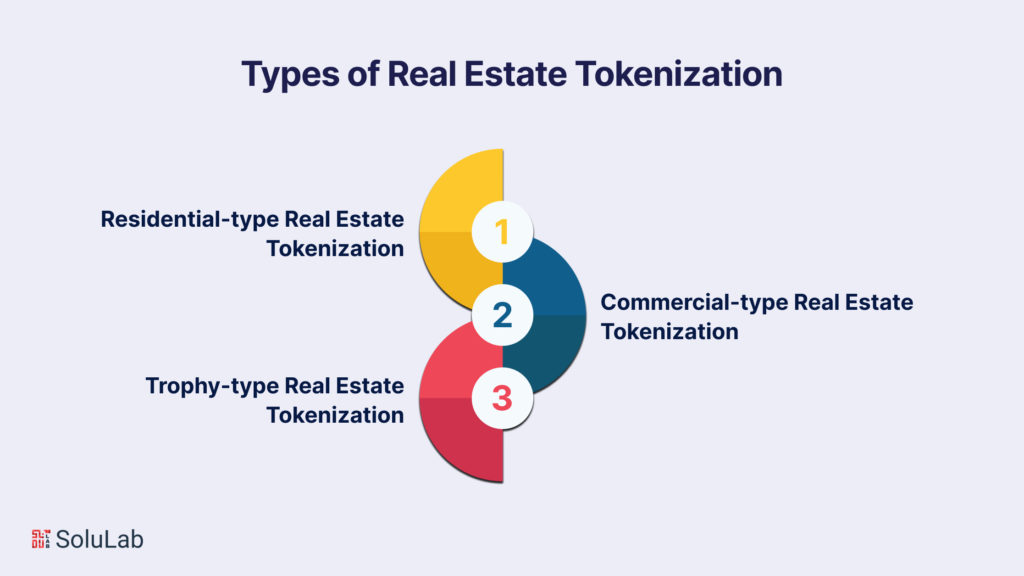
Real estate tokenization mostly has three types. So let’s examine each one in turn.

  • Residential-type Real Estate Tokenization

The practice of tokenizing a residential real estate property is known as residential real estate tokenization. The fact that investors can own a portion of residential property anywhere in the world from the comfort of their homes makes this type the most popular among the others.

  • Commercial-type Real Estate Tokenization

The tokenization of commercial real estate is very similar to that of residential real estate. Tokenizing commercial real estate properties are involved. But in this case, special care must be taken to guarantee that all legal requirements are completed and that the business property is not subject to any criminal activity.

  • Trophy-type Real Estate Tokenization

The most recognizable kind of real estate tokenization is trophy tokenization. It is the practice of tokenizing prominent, upscale venues that are extremely significant & prestigious in both terms of money as well as their intrinsic value.

CTA1

How Tokenized Real Estate Investing Works

Special purpose investment vehicles, which are often set up as limited liability corporations (LLCs), are used to invest in real estate in both conventional and tokenized deals. The ownership of the LLC is fragmented into security tokens for real estate transactions based on blockchain technology.

The creation of public security is a complex and expensive process, and since the offering is a security, it is typically registered under an exemption.

The creation of a private placement offering (PPM) that includes information on the investment’s nature, potential risks, sponsors, and other pertinent factors is one criterion for gaining the exemption. The SPV’s operating agreement and subscription agreement both outline the managers’ and investors’ responsibilities as well as the rights and obligations of both parties.

Read Our Blog Post: Top 12 Real Estate Tokenization Companies in USA

To maintain compliance with securities laws, real estate tokens are coded by the underlying smart contracts. Smart contracts have the ability to automatically enforce any buy and sale limitations required by the world’s securities authorities. Smart contracts can also be used to impose restrictions regarding who can buy tokens and holding periods for those tokens.

Real estate tokenization platforms conduct know-your-customer (KYC), anti-money laundering (AML), and investor accreditation checks in order to enforce these requirements. These examinations lead to the “whitelisting” or pre-approval” of specific buyers.
Processes Involved in Tokenized Real Estate Properties

Processes Involved in Tokenized Real Estate Properties

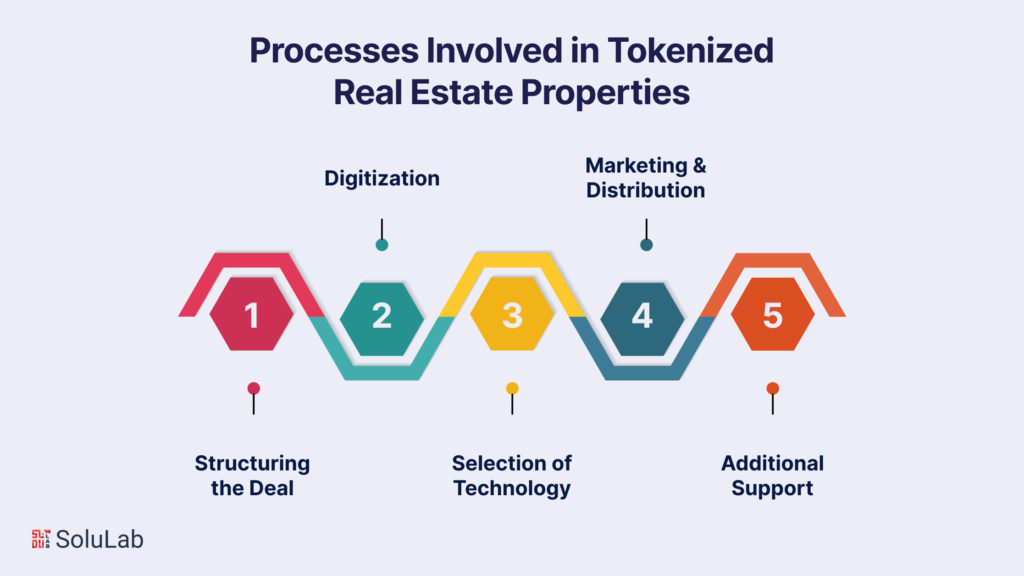
Structuring the Deal

The categories of shareholders & assets, the applicable jurisdiction, and the pertinent legislation are all significant considerations in this first step. Prior to raising capital to launch a new business, issuers frequently decide to tokenize a prior deal at this stage, largely to give liquidity to current investors.

Digitization

Information that was previously stored in paper/document form is uploaded to the blockchain at this point. This procedure makes use of smart contracts, and the kind of fund/fund structure is also chosen. The following are the most popular fund structures:

The most common fund structures are as follows:

  • Real Estate Investment Trust (REIT)
  • Real Estate Fund
  • Single asset Special Purpose Vehicle (SPV)
  • Project Finance 

Read Our Blog: What is Real Estate Tokenization and How Does it Work?

Selection of Technology

At this stage, a number of crucial technological choices can be taken, including:

  • Choose Blockchain 

Given that the transaction will be added to the blockchain ledger, it is important to choose the appropriate blockchain depending on your requirements and requirements.

  • Chose Custody Solution

It is necessary to choose a custody solution that can hold real estate tokens securely and safely.

  • Chose Marketplace 

It is necessary to choose the marketplace where investors can purchase real estate tokens. Depending on your company’s needs, you can select either a primary or a secondary market.

Read Also: Why Dubai, London & New York Lead in Real Estate Tokenization?

Marketing & Distribution

The creation & distribution of tokens are indeed the primary areas of concentration at this stage. Real estate tokens can be purchased using a number of different payment methods, such as stablecoins, cryptocurrencies, fiat money, and others. These tokens are available to investors through:

  • Primary Distribution
  • Secondary Trading

Additional Support

A real estate tokenization company now provides additional support to investors, such as developing a corporation code and helping with legal and mortgage issues.

Tokenization Advantages for Real Estate Owners

Real estate owners, sponsors, as well as investors can all gain from tokenization. The following are some of the main benefits for sponsors & owners:

  • Tokenization gives real estate ventures exposure to plenty of investors. A real estate project might not even be known to many investors until it is tokenized. A real estate tokenization platform inevitably increases marketing and awareness, enhancing sponsors’ access to financing.
  • In addition to automating investor communications, payouts, purchases & sales, tax accounting, as well as (where necessary) investor voting, smart contracts that underpin real estate tokens can also automate compliance with securities legislation. Real estate sponsors can handle numerous investors with the help of automation, which also creates a robust audit trail across all property actions.

Check Our Blog Post: Top White Label Real Estate Tokenization Platforms & Firms

  • Tokenization enables sponsors to provide investors with more liquidity, potentially improving investor returns and enabling investors to reallocate funds to the sponsor’s upcoming deal. Sponsors may immediately profit from increased liquidity among investors.
  • A real estate owner may use tokenizing an asset to resolve complex problems like how to terminate a partnership or distribute an estate among heirs. Real estate token owners are free to decide whether to buy, sell, or leave at any time. Tokenization, while not resolving every property-related conflict, can assist with many potential issues.
  • Numerous new possibilities for using and maintaining a property’s equity are made possible by tokenization. Real estate owners who tokenize their properties can raise short-term financing, receive debt secured by their tokens, sell a portion of the equity (perhaps with a buyback option), and exchange their real estate tokens for other tokens.

Disadvantages of Tokenizing Real Estate

Sponsors do need to change the way they approach real estate because of tokenization. For sponsors of tokenized real estate, the following cons might be present:

  • Many operations are automated by tokenization, which may worry sponsors who like complete anonymity and control.
  • Sponsors might be concerned about losing a dependable investment base now that investors can swap tokens more readily. However, strong sponsors can continue to work with investors, plus their track record might even help them draw in more money. Additionally, there are programs for rewarding devoted investors (like early purchase, for instance), which help sponsors build and expand their own investor base.
  • Managing more investors may intimidate some sponsors because it necessitates a variety of communication strategies. Sponsors might make use of a real estate tokenization platform’s assistance to keep investor communications going at scale.
  • Sponsors must establish and uphold rigorous guidelines regarding the information that is disclosed to investors as well as the secondary market. Primary investors need in-depth information, which might not be suitable for a wider audience. A good tokenization platform will make these restrictions easier and more automated, assisting sponsors in finding the ideal harmony between privacy and openness.

What is the Future of Real Estate Tokenization?

You might be surprised to learn that the real estate investing industry has a far larger market than a number of other businesses. In comparison to other investment vehicles like equities, mutual funds, and bonds, it is also regarded as a safe investment. But some of the market’s elite participants, who are significantly wealthier than others, control it. Real estate tokenization is therefore not only urgently needed but also has the enormous potential to completely transform the sector. Additionally, according to Prophecy Market Insights, tokenization income in the global real estate market will soar and reach $4.3 billion over the course of the following five years. The future of real estate tokenization thus appears to be quite promising based on the aforementioned points and the unmistakable numbers.

If You Need Help

Our company, SoluLab, is a market leader in blockchain development. Our team members are highly skilled and experienced in creating real estate tokenization solutions. You may securitize real estate, raise money more quickly, and reach a wider audience of investors with the assistance of our highly qualified team. Consider your options even now. Get in touch with us so that we can address all of your questions.
CTA2

Conclusion

SoluLab offers a comprehensive range of real estate tokenization development services, guiding individuals through the complex landscape of property investment and development. Whether one is a property owner seeking capital through tokenization or an investor looking to diversify, SoluLab paves the way for the future of real estate investment. Their team of dedicated professionals is committed to delivering top-tier tokenization solutions, unlocking the full potential of real estate assets. SoluLab provides a tailored white-label real estate tokenization solution, supporting multiple blockchains, to redefine the experience of trading tokenized real estate. By launching a white-label platform, clients can establish a digital presence in the crypto trading world, offering a space to list commercial or residential property tokens and configure prices as desired. To embark on this transformative journey, contact SoluLab today.

FAQs

1. What is investing in tokenized real estate?

Real estate with a fractionalized ownership structure based on blockchain technology is known as tokenized real estate. Tokenized property investing is structurally identical to purchasing real estate through a syndicated transaction. 

2. What is the price of tokenizing real estate?

Legal, governing, and technological costs are typically incurred during the process. Tokenizing a property typically costs between $30,000 and $100,000. Including legal costs, developing a blockchain, smart contract implementation, and regulatory compliance. 

3. Is tokenization in real estate the way to the future?

The future of real estate tokenization, which will be driven by blockchain technology and smart contracts, presents a tremendous opportunity for expansion, with the ability to improve stability and accessibility through rational ownership.

4. What is the process of investing in tokenized assets?

Firstly, you would be required to select the asset and the regulation that is put into the asset. Afterward, select a platform and proceed with the organization process. Once this is complete, search for investments and acquire, and invest investments. Put your attention on the plants and strategies, after which you should take care of trading and liquidity.

5. How to buy tokenized real estate?

To buy tokenized real estate select a trustworthy platform or marketplace before purchasing tokenized real estate. Make an account, finish the KYC process, and add money to your wallet using Bitcoin or Fiat. Choose a tokenized asset from the list of available properties, then by tokens that represent fractional ownership.

6. How can SoluLab help you with the tokenization of real estate assets?

In the field of real estate tokenization, SoluLab specializes in the process of transforming real estate assets with digital tokens that are stored on a blockchain. This procedure makes it possible to have fractional ownership, improves liquidity, and expands access to investment opportunities. 

15 Blockchain Companies Shaping the Real Estate Industry

15 Blockchain Companies Shaping the Real Estate Industry

Properties for vacation rentals. parking areas even ideal residences They will all soon be bought on a blockchain. Indeed, the use of real estate crypto tokens to connect buyers, sellers, and investors as well as learn about properties is growing in popularity. But why is the real estate industry expected to benefit so significantly from blockchain? First and foremost, it fosters trust by enhancing transparency by utilizing distributed ledger technology (DLT). Trust is crucial in real estate, whether it be in a listing, an agent, or a website. Blockchain technology for real estate also streamlines contract procedures, saves time, and lowers expenses.

Blockchain in the Real Estate Industry

Blockchain is the leading technology in real estate since it has a built-in system of trust. Global real estate firms use blockchain in real estate through its ledger and smart contract features to transparently and effectively make renting, purchasing, investing, and even financing possible.

A unified database of leases and acquisitions is more important than ever because of the enormous daily rate of real estate crypto tokens. Blockchain is able to do that. Brokers and agents would be able to access the whole transaction history of a property if the traditional Multiple Listing Service database was upgraded to a blockchain-based one.

Blockchain is being embraced by the expanding property-sharing business in addition to assisting the traditional real estate industry. The 15 blockchain real estate tokenization companies listed below leverage the booming technology to expand their clientele.

CTA1

15 Blockchain Real Estate Companies Shaping the Real Estate Industry

1. SoluLab

One of the best blockchain development businesses with over 50 million active app users and a 97% customer success rate that rivals the competition. The Fortune 500 companies and high-growth startups SoluLab has collaborated with include Walt Disney, Goldman Sachs, Mercedez Benz, the University of Cambridge, Georgia Tech, and others.

SoluLab, led by management executives from Goldman Sachs & Citrix, aims to reduce costs by over 50% for the client with a faster hiring process than other market participants. Through cutting-edge technologies like the cloud, chatbots, blockchain, the internet of things, artificial intelligence, augmented and virtual reality, machine learning, and more, SoluLab’s award-winning enterprise software solutions offer full-spectrum, 360-degree services to startups, small businesses, and large corporations.

2. SafeWire

The expanding problem of wire fraud that real estate companies, agents, clients, and other industries confront as a result of hacker activity has a solution in SafeWire, which ClosingLock recently bought. The SafeWire platform uses a blockchain network to assure security for risky transactions from the time they are sent until the moment they are received & processed, decreasing the amount of money, clients, and time lost as a result of wire fraud.

3. Vairt

With the aid of Vairt, customers can create and diversify a worldwide real estate network and generate side income. When investing in fractional real estate, the robust platform provides several tools and resources to ensure the greatest results. This includes neighborhood and property insights, market overviews, real estate analysis, and long-term assistance, all of which operate on a blockchain network for the highest level of security.

4. RealT

Through a completely compliant, token-based blockchain network, the RealT fractional real estate investing platform enables investors from all over the world to invest in the American real estate market. With permissionless Ethereum & RealTokens, the platform enables investors to purchase tokenized real estate and preserve access to cash flows as well as low maintenance ownership. It provides landlords access to weekly rent payments through the xDai, Ethereum, or US-Dollar stablecoin.

5. PropertyClub

A real estate network called PropertyClub uses blockchain to improve how people advertise, look for, purchase, sell, & invest in properties. Via cryptocurrencies like Bitcoin or the company’s own PropertyClub Coin, the organization transacts real estate digitally using smart contracts.

6. ManageGo

For landlords, ManageGo uses blockchain technology. Property managers and owners may handle payments, fully conduct credit background checks, and manage maintenance tickets with the aid of ledger-backed software.

7. RealBlocks

RealBlocks leverages blockchain real estate companies to open up new real estate investment opportunities. Instead of purchasing complete portfolios or assets, investors can purchase fractional stakes on its platform. RealBlocks assists in lowering costs, accelerating procedures, and offering liquidity choices through tokenization that is implemented utilizing blockchain technology.

8. SMARTRealty

Smart real estate contracts are used by SMARTRealty to create and uphold agreements for the purchase and renting of real estate. The business’s smart contracts assist in setting rules that, if not followed, automatically dissolve a contract, whether it be for paying rent, establishing mortgages, or buying a home.

9. Propy Inc

Smart contracts are used by the real estate marketplace Propy to carry out property deals. Using a series of smart contracts, the company’s platform enables buyers, sellers, and agents to move the real estate market forward more quickly.

10. ShelterZoom

The entire real estate offer & acceptance process is managed by Docuwalk, the document management system provided by ShelterZoom, using blockchain technology. To provide an unchangeable financial record, the safe online platform logs each step taken to close a real estate deal.

11. StreetWire

Through an encrypted ledger that is under the control of the data supplier, StreetWire develops secure and trustworthy solutions for the real estate sector. Its platform makes real estate transactions speedier and more transparent.

12. CPROP

Building blockchain data applications with an emphasis on finding new opportunities, lowering risk, and discovering problems in the real estate sector are what CryptoProperties, also known as CPROP, do. The technology developed by CPROP is used in a variety of real estate fields, such as brokerage deals, investment management, property development, finance, and insurance.

13. The Crypto Realty Group

The Crypto Realty Group is a consultancy firm that collaborates with financial consulting and crypto escrow businesses to assist clients in purchasing and reselling local, national, and worldwide residential, and commercial using local real estate crypto tokens.

14. Blocksquare

While its white-label platform may be used to establish investment platforms, Blocksquare is among the real estate tokenization companies. Their protocol can be applied to digitize the value of real estate assets. The business claims that businesses of all sizes can benefit from its blockchain infrastructure.

15. RealtyBits

RealtyBits makes it easier to invest in real-world assets like real estate using blockchain technology. A user’s account can be created for free and validated in under a minute. Following their initial investment, RealtyBits offers a dashboard that enables them to keep an eye on their assets. One of the company’s investors is Coinbase.

How is Blockchain Technology Changing the Real Estate Industry?

More blockchain use in commercial real estate could have a favorable impact on the sector. Quite a few real estate companies employ blockchain because it is a relatively young technology. But when people become aware of its potential advantages, it can gain popularity. The following are possible uses of blockchain in real estate, particularly within the commercial real estate industry.

  • Faster, More Secure Transactions: Numerous characteristics of blockchain in real estate can result in speedier, more secure transactions. You don’t need to wait for financial institutions to file paperwork because every activity is recorded on a public ledger. Additionally, the use of blockchain in commercial real estate makes it impossible for records to be altered. Consumers currently depend on financial organizations to safeguard their private information, but blockchain in real estate could provide an additional layer of protection. Financial institutions are often targets for data breaches, but with blockchain, property records and ownership data would be less vulnerable to such attacks.
  • Smart Contracts: By minimizing paperwork and the stages required to purchase property, using blockchains in commercial real estate to expedite processes instantly creates chances to cut expenses. Smart contracts built on the blockchain are utilized in the process to help automate it. If/then statements that advance real estate blockchain projects at the proper point can be used in blocks of a ledger. For instance, the smart contract might stipulate that the buyer won’t get a formal price offer until the property has been thoroughly inspected and assessed by an expert.
  • Lower Costs: Another significant benefit of blockchain in real estate is the reduction of transaction costs. By minimizing paperwork and reducing the complexity of purchasing property, blockchain can lower expenses in commercial real estate deals. You can even purchase property tokens on some platforms that use blockchain in real estate, allowing investors to buy a portion of a property with cryptocurrencies, bypassing traditional brokers and their fees.
  • Asset Tokenization: Blockchain technology has the potential to revolutionize how real estate investments are crowdfunded. Currently, ownership of properties funded by crowdfunding is distributed among the investors. A real estate company, for instance, might offer 100 shares. Once fully funded, they use the investor’s funds to buy or construct an asset that will produce income.
  • Tracking Asset Ownership: The structure would be slightly changed by asset tokenization to provide investors & developers more flexibility. You could buy a token that is recorded in a public ledger rather than a portion of the real estate. You now have a fully transparent record of when and how much you spent on the token. You have evidence that you made an investment and the tokens are yours, in case your ownership is ever questioned.
  • Selling Your Real Estate Investment Tokens: Asset tokenization will also make it simpler for you to sell your investment to a third party. Investment agreements currently allow other owners to restrict you from selling your stake without their consent. Even if you are allowed to sell your share without permission, you will still need to complete a tonne of paperwork in order to transfer your ownership to another investor.

CTA2

Final Words

The real estate blockchain, tokenization, as well as cryptocurrency businesses, are all still in their infancy, as are the majority of other blockchain and tokenization integrations into the real world. Although the future seems promising, several obstacles must yet be overcome before the technology can be widely used. As was already said, tokenized real estate, which is arguably the most significant prospective utilization of real estate blockchain projects, is plagued by an extremely unliquid market, a near-total lack of asset trading between platforms, as well as a lack of institutional adoption.

Software wallets like Exodus Wallet and Trust Wallet impress with their user-friendly interfaces and elegant designs. These wallets prioritize security without sacrificing user convenience, making them popular choices for crypto enthusiasts of all levels.

Finally, it should be emphasized that the metaverse’s real estate market is booming. It’s difficult to say whether this is a short-lived trend or a wise investment, similar to real estate crypto tokens. Real-world & metaverse real estate have not yet been connected, but in the future, it’s conceivable that things will start to converge in manners we can only begin to fathom between the “meatspace” real world and the metaverse.

SoluLab, a prominent blockchain development company, specializes in empowering businesses of all sizes, from startups to enterprises, with secure and decentralized blockchain solutions. With a comprehensive range of blockchain development services, SoluLab meticulously assesses each organization’s potential for harnessing blockchain technology to bolster trust and transparency. The company’s expertise extends to the realm of real estate tokenization, offering a gateway to novel opportunities in development and investment. Whether one is a property owner aiming to raise capital through tokenization or an investor seeking portfolio diversification, SoluLab guides the way. As a leading advocate of real estate tokenization development services, SoluLab’s adept professionals are dedicated to delivering top-tier services, enabling clients to unlock the full value of their real estate assets. For a seamless transition into fractional ownership and heightened liquidity, connect with SoluLab today.

FAQs

1. What is the role of blockchain companies in the real estate industry?

Blockchain companies in the real estate industry play a pivotal role by leveraging blockchain technology to enhance transparency, security, and efficiency in property transactions. They provide solutions that streamline processes like property title verification, smart contracts, and secure data sharing among stakeholders.

2. How do blockchain companies simplify property ownership transfers?

Blockchain companies use smart contracts to automate and facilitate property ownership transfers. These self-executing contracts automatically process transactions once predefined conditions are met, reducing the need for intermediaries and expediting the transfer process.

3. What benefits do blockchain companies bring to real estate professionals?

Blockchain companies introduce efficiency gains for real estate professionals by reducing paperwork, minimizing the risk of errors, and expediting transactions. This enables professionals like agents, brokers, and lawyers to focus more on strategic tasks rather than administrative burdens.

4. What future trends can we expect from blockchain companies in real estate?

In the future, we can anticipate further integration of blockchain technology with artificial intelligence, enabling predictive analytics for property market trends. Additionally, increased regulatory support for blockchain-based property transactions and wider adoption of tokenization could reshape the way real estate is bought and sold.

5. What is SoluLab’s expertise in the blockchain industry?

SoluLab is a leading blockchain development company with extensive experience in creating cutting-edge solutions for various industries, including real estate. Their team of experts specializes in developing custom blockchain applications, smart contracts, decentralized apps (DApps), and more, providing innovative solutions that transform the real estate landscape.

6. How does SoluLab contribute to the real estate industry’s digital transformation?

SoluLab empowers the real estate sector by leveraging blockchain technology for enhanced transparency, security, and efficiency. Through their tailored solutions, they enable seamless property transactions, secure data sharing, and automated processes that streamline operations and improve customer experiences.

7. Can SoluLab assist in tokenizing real estate assets?

Absolutely! SoluLab excels in real estate tokenization development. They can create digital tokens backed by physical real estate assets, enabling fractional ownership, liquidity, and broader investment opportunities. This innovative approach enhances accessibility to real estate investments and opens doors for a wider range of investors.

What is Real Estate Tokenization and How Does it Work?

Real Estate Tokenization

The real estate industry has undergone a total makeover as a result of the use of blockchain technology. It has made it easier for people to own digital real estate, giving access to those who were previously shut out owing to a lack of resources and masking problems like a lack of transparency and trust.

Real estate has historically required large capital outlays and drawn-out transaction procedures, making it a somewhat illiquid asset. However, asset tokenization has changed the situation. Furthermore, there is now unheard-of transparency thanks to the underlying blockchain technology. Having stated that, purchasers of tokenized real estate can now carry out transactions immutably.

In addition to demystifying real estate tokenization, this essay answers queries about its existence, the practical operation of real estate tokens, definition of tokenized ownership, and amount of tokenized real estate. Let’s examine how the domain has changed as a result of real estate’s fractionalization and tokenization first.

What Does Real Estate Tokenization Entail?

The act of dividing an item into digital tokens that symbolize the underlying property with all of its rights and liabilities is known as “tokenization of real estate.” Contractual details are defined through the use of smart contracts. If a predetermined contract condition is met, the algorithm stored in the digital contract triggers the events specified in the code.

For example, without requiring human intervention, a smart contract may carry out a transfer in the land registry. It adds the new block to the blockchain automatically after validating the operations.

NFTs are fractionalized using ERC-721 tokens. ERC-721 is linked to a smart contract that records the transactions in which these tokens are involved and denotes a predetermined standard on the Ethereum blockchain. The purpose of the ERC-721 standard is to improve transaction security and traceability.

Read Also: ERC-3643 vs ERC-1400 vs ERC-20

How Does Tokenization for Real Estate Operate? 

Tokenization real estate is akin to crowdfunding, in which an asset is divided into smaller portions via the use of a smart contract—a piece of automated code stored on a blockchain. A portion of the real estate belongs to whoever purchases or holds a token. They have a claim on the underlying asset, including any profits or losses incurred.

To further comprehend it, let’s say someone needs immediate cash and owns a $100,000 home. However, the owners are hesitant to part with their property for less money, and the investors who approach them lack the necessary funds. 

Tokenization comes in helpful in this situation. Each of their dispersed assets will be worth $1,000 worth of digital tokens. In this manner, it will be simple to invest in the asset over time. Since this is being done across a decentralized network, total transparency is guaranteed. 

Any type of real estate, including residential, commercial, and trophy properties, may be tokenized. Fractional slices of expensive commercial buildings, including malls and retail centers, might be used to lower the cost of investments. Tokenization of apartments in multi-story residential skyscrapers can expedite sales and acquisitions. Through tokenization, one might raise money for initiatives while selling their prize asset. 

Properties that are extremely rare and in high demand by investors are referred to as trophy assets. Trophy assets are iconic structures that have significant real estate foundations. It’s not always a structure. It may even be a riverside adorned with priceless stones or a vineyard with grapes of extraordinary quality for making wines. As a result, everything may be tokenized, including ownership of the collateralized debt, an equity stake in a legal corporation, and a digitalized part of a piece of the deed.

To give an understanding of how real estate may be tokenized, we will now detail many options in both the residential and commercial real estate sectors.

Please take note that none of the examples below have been used widely and are mostly aimed towards the future. In particular, these examples do not address difficulties pertaining to the verification of house ownership or any associated practical concerns.

1. Simple Tokenized Real Estate

One real estate property represented as an NFT is the most basic example of tokenized real estate. Because each property is unique, a non-fungible token (NFT) is a natural match for the real estate industry. It is a unique token that can be verified to be different from every other token on a blockchain.

Qualities:

1. It may be possible to own the property and the NFT at the same time.

2. Property ownership may change when the NFT is transferred.

3. Important information like previous sales, addresses, and more may be stored in the NFT.  

Listing a property on an NFT marketplace is all that is required to sell it in this hypothetical scenario. The weeks-long procedure that real estate purchases now take has drastically changed to the buyer being able to acquire it within minutes, if they have the requisite finances, by pressing a few buttons. This type of tokenization has previously happened in isolated cases.

2. Dynamic Tokenized Real Estate

With the use of dynamic NFTs (dNFTs), the preceding tokenization example may be improved even more. NFTs that dynamically update their data in response to pertinent circumstances are known as dynamic NFTs. For instance, changing the roof of the house.

Qualities:

1. It may be possible to own the property and the NFT at the same time.

2. Property ownership may change when the NFT is transferred.

3. Important data can be stored in the NFT and updated automatically.  

Improved information sharing between counterparties is made possible by dynamically updated NFTs. Web3-powered startups can use Chainlink Functions, a simple development tool that connects smart contracts to any API or external dataset, to automatically update relevant data, like renovations, improvements, and previous sales, in the NFT to help prospective buyers better understand the property and its changes. With time, dynamic NFTs gain greater use. An NFT, for instance, may contain pictures or videos of a specific property that highlight the condition of the home at a certain moment. The abundance of videos and photos that are regularly published to the NFT allows purchasers to witness the changes made to a property over time, giving them more in-depth information to consider when making a purchase—even when ownership changes hands numerous times.

3. Fractionalized Real Estate

Enabling partial ownership of a property, or fractionalization, is a compelling use case for tokenization real estate. Fungible tokens are used in this strategy. There is no way to differentiate one fungible token from another. Stocks are a real-world example of a fungible asset as they are always equal to one another.

Qualities:

1. One or more tokens may stand for a particular proportion of the property’s ownership.

2. It may be possible to own the property and all fungible tokens at the same time.

In a whole new way, fractional ownership of real estate opens up access to the real estate market. Fractionalized real estate tokens, if designed properly, might enable astute investors to assemble specialized portfolios of various real estate assets, potential homeowners to take baby steps toward living in and purchasing their ideal house, and businesses to develop customized real estate offerings. Blocksquare, for instance, is a Slovenian startup that uses an Ethereum and IPFS-based token-related solution to assist businesses in fractionalizing real estate.

4. Tokenized Real Estate Cash Flows

Property owners can have access to liquidity by using blockchain-based tokens to tokenize ownership of a certain property independently from the cash flows it generates. The option to sell the rights to future rental revenue for a lump amount can be unlocked using tokenized cash flows.

Qualities:

1. division of the rights to cash flow and property ownership.

2. An NFT can be used to represent cash flow rights.

3. cash flow is automatically sent to the NFT owner.

Property owners can distinguish between cash flow and property ownership in this scenario. The rights to the cash flow, which is often a monthly rental income, can then be sold to a different party in its entirety over a predetermined period of time. Tokenized income flows from real estate holdings can lower the cost of capital for real estate ownership and provide property owners with more options.

A decentralized approach to automating this procedure can also be employed with the Chainlink Web3 services platform. For instance, LaProp, a real estate firm located in Colombia that invented fractionalized real estate, incorporated Chainlink Automation to assist in automating token owners’ rental payments.

Read Also: Top White Label Real Estate Tokenization Platforms & Firms

5. Tokenized Real Estate Baskets

A tokenized representation of a collection of real estate assets and their cash flows may also be made.

Qualities:

1. All attributes and financial flows can be represented collectively by fungible tokens.

2. Cash can be returned to token owners automatically.

Tokenizing huge real estate baskets has several advantages, the main one being the ability to decrease trust through assurances and respond autonomously based on verified facts. Higher verifiability of the underlying collateral (the properties and their cash flows), automated payments, and enhanced transparency into asset health can all be made possible by ownership of the property and cash flows on-chain.

Benefits of Real Estate Tokenization

Benefits of Real Estate Tokenization

The real estate industry may greatly benefit from tokenization, which brings about a number of amazing developments. Let’s review them:

  • Increased Efficiency and Transparency in Transactions

Blockchain’s decentralized architecture makes transactions transparent and unchangeable, which makes them perfect for real estate with several parties involved and intricate processes. Unfair bargains are eliminated when human intervention is removed from transaction processing through automated smart contracts. There is no paperwork or waiting for transactions to be completed in a blockchain-based system. This leads to swift decisions and transactions. When blockchain is applied in real estate, transactions can occur at any time of day, unlike with traditional banking. Rather, the system operates transparently around the clock.

  • Increased Liquidity

Real estate is difficult to sell under the conventional method. Prior to the rise of digital real estate ownership, real estate was beset by a liquidity crisis that gave investors the willies. Because of issues with liquidity, many investors were just not prepared to meddle in real estate matters. Any asset’s lack of liquidity must be addressed in order to increase its value, and tokenization has offered the means to do so. A real estate piece’s liquidity increases when it is fractionalized during tokenization. The owners of tokenized parts can easily transfer ownership by selling their tokens, as opposed to selling the entire property all at once.

  • Possibility for Modest Investors

Most of the time, real estate is considered an elite investment option. On the other hand, tokenization has also made real estate investing accessible to smaller investors. Investors with smaller budgets are frequently discouraged from participating in real estate due to its high cost. However, the game has altered with the tokenization of real estate investing, opening up real estate to retail and small-scale investors. Large assets are divided into smaller portions through tokenization, making them more inexpensive and available to interested parties. 

  • An Open Market

Centralized financial systems are harmful to the free flow of the market since they are highly regulated and frequently prejudiced. The real estate industry is introduced to a decentralized, prejudice-free financial system using blockchain-based asset tokenization. Every stakeholder has some degree of control, and they decide as a group. When irrational obstacles are removed, the market becomes more efficient and gives all parties involved an equal opportunity to prosper.

  • Reduction of Counterparty Risk

Tracing longer transaction chains can be challenging. In the pre-tokenized real estate age, this was a problem since third parties were involved, which made matters opaque and less than transparent. From a regulatory perspective, smart contracts, a crucial component of blockchain-based transactions, improve things. The chain of transactions is kept short and the risks associated with weak links are eliminated when there is minimal human involvement. Consequently, there is a considerable decrease in the likelihood of counterparty participation, if not a total elimination. 

Read Blog: Daos in Real Estate Tokenization

Restrictions on Tokenized Real Estate Assets 

Restrictions on Tokenized Real Estate Assets 

Real estate tokenized assets have their own set of issues, much like any emerging technology. Let’s look at a few of the restrictions:

  • Security Gaps in Smart Contracts

The network of blockchains is rather safe. However, there are certain gaps with smart contracts that need to be closed. Hackers are persistent in their attempts to breach smart contract programming and pilfer money. The money isn’t secure until the smart contract has undergone a thorough audit. Real estate investors risk losing their investments due to a hack or system error. The fact that these assets cannot be recovered after they are gone exacerbates the situation.

Read Also: Fan Tokens

  • Complicated Licensing Requirements 

Real estate assets must be tokenized through licensed real estate tokenization platforms that allow for regulated STO (security token offering) operations and maintenance. Obtaining the license is a difficult task. To succeed, you must go through several stages of trial and error in addition to ongoing testing before you ever get to the licensing step.

  • Regulatory Matters

The majority of individuals employed by real estate companies and regulatory agencies are unaware of how blockchain technology operates and how it solves problems the industry faces. All parties face obstacles as a result of this ignorance, which creates a bad regulatory environment. Investor confidence is weakened by regulatory uncertainty, which leads to subpar growth.

  • Complexities in Taxes

Most tax regimes lack clear legislation regarding cryptocurrency taxes, which causes issues for interested parties. The benefits of tokenization are widely acknowledged, but no sensible taxation scheme has been implemented in tandem with it. Everyone concerned is left with uncertainty due to the absence of a unified tax system.

Read Also: White-Label Tokenization Vs. Custom Blockchain

The Technical Difficulties of Tokenizing Real Estate

Tokenized real estate is still a ways off from becoming widely used, and there are still a lot of obstacles to be solved before that can happen. Although there have been a few attempts to tokenize real estate so far, none of them have been successful in developing a scalable system that addresses the issues and constraints of the current real estate industry.

  • Verification and Authentication of Data

A certain level of assurance that the data supplied is accurate, dependable, and legitimate is required for digital real estate transactions, regardless of whether it includes information on property ownership, upgrades, or other mission-critical data. Real estate decision-making relies heavily on data since it contextualizes the property. What is the typical cost to rent a property? What is the amount of foot traffic on a property? When was it constructed? Which improvements have been made? How well-maintained is the infrastructure? Does the property have a past that might affect its worth? In the expanding trend of tokenizing real-world assets, Chainlink plays this function. A crucial first step in launching a future tokenized real estate market is onboarding top-tier real estate data providers, like ProspectNow and SmartZip, to deliver premium real estate data to blockchains.

  • Wallet Retriever

Consider that the NFT that is kept in your digital wallet is your house deed. The password is known to you alone. That also implies that you will lose the house if you misplace or forget the password, which will prevent you from accessing the wallet and the house deed NFT. One difficulty in balancing the digital and physical links between tokens and the underlying property is determining who, in the event of fraud or error, has the last say over who is the rightful owner of a property. If forfeiting a token equates to losing property ownership, it would be highly illogical. Instead, a centralized organization—like a government—might be able to assist in recovering and approving the issuance of a fresh NFT to take the place of your house deed. What occurs now if you misplace an actual house deed is comparable to this.

Real Estate Tokenization Services

  • Application at a Large Scale

Although tokenized real estate has a lot of promise to increase liquidity and simplify transactions for both buyers and sellers, there are still a lot of unanswered concerns about how tokenization can be implemented nationally or even internationally. It’s challenging to make significant changes to a $29T market’s backend infrastructure and procedures. Real-estate tokenization will need to be implemented at scale with open standards, a ton of trials and tests, and collaboration from Web3 groups, governments, and companies.

Conclusion

To sum up, “What is Real Estate Tokenization and How Does it Work?” offers a thorough explanation of the revolutionary idea of real estate tokenization. SoluLab, a front-runner in real estate tokenization development, provides knowledgeable services and solutions to help clients deal with the challenges of tokenizing real estate assets. Businesses may take advantage of tokenized real estate’s advantages, such as higher liquidity, the potential for fractional ownership, and improved accessibility to international investors, by utilizing our team of knowledgeable real estate tokenization developers and specialized real estate tokenization development services. With SoluLab, discover the possibilities of real estate tokenization and set off on a path of innovation and expansion in the field of digital real estate.

FAQs

1. What is real estate tokenization, and how does it work?

Real estate tokenization involves the process of converting real estate assets into digital tokens on a blockchain. These tokens represent ownership or investment in the underlying real estate property, allowing fractional ownership and increased liquidity through trading on digital asset exchanges.

2. What are the benefits of real estate tokenization?

Real estate tokenization offers several benefits, including increased liquidity, fractional ownership opportunities, reduced barriers to entry for investors, enhanced transparency and security through blockchain technology, and the ability to access a global pool of investors.

3. How does SoluLab facilitate real estate tokenization?

SoluLab, as a real estate tokenization development company, offers specialized development services tailored to the unique needs of clients looking to tokenize real estate assets. Our team of experienced developers leverages blockchain technology to create real estate tokenization platforms, smart contracts, and compliance solutions for seamless real estate tokenization.

4. What are the regulatory considerations for real estate tokenization?

Regulatory considerations for real estate tokenization vary by jurisdiction and may include securities regulations, anti-money laundering (AML) laws, and know-your-customer (KYC) requirements. It’s essential to work with legal experts and compliance professionals to ensure compliance with relevant regulations.

5. How can investors benefit from tokenized real estate assets?

Investors can benefit from tokenized real estate assets by gaining access to previously inaccessible real estate markets, diversifying their investment portfolios, enjoying fractional ownership of high-value properties, and experiencing increased liquidity through digital asset trading.

6. What are some examples of successful real estate tokenization projects?

Examples of successful real estate tokenization projects include tokenized offerings of commercial properties, residential developments, and real estate investment trusts (REITs). These projects have demonstrated the potential for real estate tokenization to unlock new opportunities for investors and property owners alike.

7. How can businesses tokenize real estate assets with SoluLab?

Businesses can tokenize real estate assets with SoluLab by leveraging our expertise in blockchain development, smart contract creation, and compliance solutions. Our team works closely with clients to understand their specific requirements and develop customized tokenization solutions that meet their objectives and regulatory obligations.


A Beginner’s Guide to Real Estate Tokenization

A Beginner's Guide to Real Estate Tokenization (1)

The adoption of blockchain technology in real estate has led to a radical transformation of the industry. It has made it easier for people to own digital real estate, allowing people who were previously excluded due to a lack of resources to participate and hiding problems such as a lack of transparency and trust.

Real estate has historically been a very illiquid asset, requiring substantial financial investments and drawn-out transaction procedures. However, tokenization has changed the situation. Additionally, the blockchain technology that underpins it has enabled previously unheard-of transparency. Having stated that buyers can now complete transactions utilizing tokenized real estate in an immutable manner.

This article debunks real estate tokenization development & answers concerns about the question of what is the tokenization of real estate, the practical operation of real estate tokens, tokenized ownership, and the amount of real estate that has been tokenized. Let’s first examine how real estate has changed as a result of its fractionalization and subsequent tokenization as we go through this guide to real estate tokenization.

Tokenization of real estate

Real estate is referred to as being tokenized when a piece of property is broken up into digital tokens that represent the underlying value of the asset with all of its rights and liabilities. Contractual details are defined via smart contracts. If a predetermined contract condition is met, the algorithm stored in the digital contract initiates the actions described in the code.

For example, a smart contract can operate without the involvement of a human to effectuate a transfer within a land register. It verifies the operations and automatically creates a new block, adding it to the blockchain.

ERC-721 tokens are applied to fractionalize NFTs. On the Ethereum (ETH) blockchain, ERC-721 denotes a predetermined standard and is linked to a smart contract that records the transactions where these tokens are involved. The traceability, as well as security of the transaction, are to be improved by the ERC-721 standard.

How does real estate tokenization work?

Real estate is fractionalized into tokens and maintained on a decentralized database through the process of real estate tokenization development. The term “blockchain” refers to this decentralized database, which functions as a kind of electronic ledger for information storage. NFTs and real estate tokens are comparable. A real estate token might stand for any of the following:

  • ownership of a portion of real estate
  • ownership of the whole piece of real estate
  • an ownership stake in a company that manages real estate
  • a stake in a loan with real estate as security
  • a claim to a portion of the earnings derived from real estate

Real estate tokens differ from Real estate investment trusts (REITs) in that tokens allow a specific investment to link a specific real property, as opposed to REITs which typically support investment into pools of varied real estate assets. In a security token offering, the digital tokens are produced and distributed on a blockchain (STO). To award ownership, each ownership portion is transformed into a token and then encrypted.

Read also: How to Buy Real Estate Using Cryptocurrency?

The sale of Aspen Coins, one of the first profitable commercial real estate STOs raised almost US$18 million in 2018. These digital tokens represented fractional ownership of the opulent St. Regis Aspen Resort in Colorado, USA.

There are numerous such instances, like a project in the United States that aims to fund $100 million by issuing 100 million tokens at $1 each for a 24-story, 374-unit multifamily residential building in downtown San Jose that is being constructed by Alterra Worldwide.

Benefits of real estate tokenization

  • Lower barrier to entry

Real estate tokenization facilitates small-scale investor engagement and decreases entry barriers for retail investors by permitting investing in fractional pieces of real estate.

  • Ability to create liquidity

Blockchain technology makes it simple and safe to transfer real estate tokens, enabling investors to diversify their portfolios, lower risk, and increase liquidity in the real estate market.

  • Lower transactional costs

Blockchain technology offers the ability to simplify investment transactions and reduce transaction costs through automated procedures and a permanent, unchangeable digital record.

  • More transparent and efficient transactions 

Blockchain transactions are transparent and irreversible because of the decentralized nature of blockchains, which makes them perfect for the real estate industry with its many parties and intricate processes. Smart contracts that are automatically generated do not include any humans in the transaction process, which makes unfair trades impossible. There is no paperwork or waiting period for transaction completion in a blockchain-based system. Quick decisions and transactions are the outcomes of this. When using blockchain for real estate transactions, there are no set office hours like there are in traditional banking. Instead, the system operates transparently and continuously.

  • Opportunity for small-scale investors 

Real estate is typically regarded as an exclusive class of investment. However, tokenization has made real estate investment possible for smaller investors as well. If investors don’t have vast funds, the excessive cost of real estate assets sometimes discourages them from participating. But things have changed since real estate is now available to small-scale and individual investors thanks to the tokenization of the industry. Tokenization breaks up enormous assets into smaller fractions, making them more inexpensive and available to individuals who are interested.

  • A free-flowing market 

Overly regulated and frequently prejudiced centralized banking systems are harmful to market freedom. The real estate industry now has access to a decentralized, bias-free financial system thanks to blockchain-based tokenization. Each stakeholder has some degree of control over the outcome, and they decide as a group. A market that is streamlined and offers all players an equal chance to flourish results from the removal of unjustified barriers.

  • Decrease in counterparty risk 

It is difficult to track longer transaction chains. The pre-tokenized real estate age presented a dilemma since third parties complicated and distorted the situation. Things are improved from a regulatory standpoint by smart contracts, a crucial component of blockchain-based transactions. The chain of transactions is kept short and free of hazards brought on by weak links with minimal human involvement. Because of this, there is a greatly diminished, if not entirely gone, danger of counterparty participation.

Limitations of Real Estate Tokenization

  • Smart contract security loopholes

The blockchain network is well secure. But in smart contracts, you can find loopholes that need to be fixed. Hackers are always trying to sneak into the code and steal money from smart contracts. If the smart contract has been diligently audited, the money isn’t secure. A simple hack or a system glitch could rob the assets of real estate investors. In the worst case, once these assets are lost, their recovery is impossible.

  • Complex licensing requirements 

The tokenization of real estate assets needs licensed platforms for the operations and management of STOs (security token offerings) to be regulated. The process of achieving a license is a bit complex. Even before the licensing stage, you need to go through multiple phases of trial and error and recurrent tests so they can be successful.

  • Regulatory issues

Many people who are working in regulatory authorities and real estate employees have no idea how blockchain technology works and eliminates the issues the sector is facing. These things lead to a poor regulatory environment and generate hurdles for all stakeholders. Regulatory uncertainty dampens the investors’ trust, resulting in poor growth.

  • Tax complexities

Many Tax regimes haven’t clear cryptocurrency tax legislation, which is an issue for stakeholders. Despite the fact that the benefits of tokenization are acknowledged on a worldwide scale, a sound taxation system has not been implemented. Everyone concerned has doubts because there isn’t a single tax system in place.

Some points to be considered!

  • Securities law implications

Generally, the tokenization of real estate will be considered security but an analysis of each specific token should be considered at the outset. If the token is a security, the issuance of such a token will be subject to the applicable prospectus requirements or reliance on an exemption, such as the “accredited investor” exemption. In addition to the prospectus requirements, the issuer must consider the applicable registration requirements.

  • Reconciliation with the land registries

Real estate tokenization requires reconciling the applicable transaction with the current systems of land registration. Each jurisdiction of Canada has its land registration system, and an issuer of a real estate token will be required to reconcile the transaction with the land registration systems of the jurisdictions where the underlying real estate is located.

Top 5 Real Estate Tokenization Companies

Blockchain App Factory

One of the first businesses to tokenize real estate as more than just a qualified Web3 service was Blockchain App Factory. The company is among the top tokenization platforms in real estate across both the physical world and virtual worlds. The business is present throughout the world, it should be noted. Since the company’s professionals are familiar with the real estate tokenization factors, they make sure that all necessary procedures are followed before distributing client project tokens. The business is a wonderful fit for any startup hoping to succeed in the Web3 real estate sector because it has expertise in consultation, legal matters, programming, testing, and promotions.

Appwrk

A Web3 company called Appwrk is engaged in the tokenization of real estate among other real estate token platforms. The company has established a professional strategy for its real estate asset digitization projects that guarantee the project turns out as planned for clients. The business offers its skills in transaction structure, digitization, technology, distribution, and marketing, as well as post-launch assistance to tokenize real estate. If desired, one might even acquire a platform like a token marketplace in addition to tokens. The company’s blockchain developers have completed a number of noteworthy projects on Web3 real estate, and as a result, they have established a solid name in the rapidly increasing Web3 community.

SolidBlock

SolidBlock is a unique company that mostly operates in Israel and provides real estate tokenization development services. It describes itself as a company that offers tokenization as a service. The company helps entrepreneurs turn their real estate into blockchain-based tokens and makes it possible for them to raise money using those tokens. SolidBlock has quickly expanded in a specialized industry thanks to the ideal group of luminaries in development, analysis, legal issues, marketing, and leadership. These services are offered in an admirable manner. For asset fractionalization & security token offering campaigns, the company excels in producing real estate tokens.

Somish

For startup enthusiasts looking to tokenize real estate assets, Somish has been another option. Young people with extensive experience working with Web3 apps make up the organization. Commercial, residential, & trophy real estate tokenizations are the company’s areas of expertise. Additionally, it provides partner networking services, compliance insurance, Web3 real estate advice, and security token offering (STO) services. Additionally, Somish has received other honors, such as hackathon victories, ongoing open-source programming partnerships, as well as technological contributions to the Web3 community.

Blockchain Firm

Blockchain Firm, a seasoned player in the Web3 market, provides excellent real estate tokenization development services. The business offers a wide range of services on the domain, such as the creation of platforms for real estate listings, hybrid tokenization, fractional tokenization, crowdfunding, leasing and rental assistance, and loan & mortgage facilitation. For Web3 real estate, teams at the Blockchain Firm also work on planning, smart contracts, NFT development, website development, platform development, & marketing services. The company has offices across a few nations, a substantial global presence, and extensive expertise working on certain well-known Web3 projects.

Tokenization’s role in the future

Tokenization offers a practical and affordable way to invest in real estate assets, but because it is a relatively new venture, regulators have not yet established a clear set of regulations. Which regulatory frameworks will be used depends on the type of asset being tokenized.

Real estate tokenization has the potential to revolutionize real estate investment by increasing liquidity in a predominately illiquid asset class, lowering entry barriers for retail investors, and lowering transaction costs. However, market participants currently face challenges related to clear market regulation, reconciliation with land title registries, and the requirement for centralized reporting of transactions.

Read also: What is the Future of Crypto Real Estate?

Real estate professionals, including those in the legal, financial, and real estate fields, should be consulted if investors or owners of real property are interested in profiting from the trend of real estate tokenization.

Conclusion

As the guide to real estate tokenization is coming to an end, A decentralized, bias-free financial system has been brought to the real estate sector thanks to the blockchain as the guide to real estate tokenization is coming to an end-based tokenization. Liquidity increases during tokenization as real estate is fractionalized. People sell tokens rather than the entire property at once, which causes a fast shift of ownership. Tokenization is bringing about some truly amazing changes to the real estate sector. A wider variety of participants and developers are drawn to the process of participating in or investing in real estate.
