Talk to an Expert

The Ultimate Guide to Investing in Tokenized Real Estate

The Ultimate Guide to Investing in Tokenized Real Estate

For a very long time, investors have found real estate to be among the most alluring investment opportunities. The conventional negatives of real estate investing, however, continue to exist, and there haven’t been any notable adjustments. But given that tokenization is here to address and resolve these problems in the real estate sector, it won’t endure for much longer. tokenized real estate companies will greatly increase transparency and flexibility in real estate investing, supported by blockchain technology & smart contracts.

You might be wondering at this point how real estate tokenization functions and whether it really has a long-term future. But don’t worry; we’ll cover everything related to tokenized real estate in this blog. Therefore, let’s begin.

Tokenized Real Estate in Brief

Real estate has traditionally been defined as an illiquid asset. It has always required a significant expenditure and a drawn-out legal & financial process to buy and sell. There are various real estate tokens that can be used to denote the ownership and value of the in-question property, whether it’s residential or commercial. The rights and liabilities attached to any piece of real estate are represented by a token.

A smart contract holds the details of every real estate token. As a result, any transaction involving the tokenized real estate in issue can happen instantly and automatically if a contract provision permits it. Anyone who purchases a real estate token related to the property will now possess a portion of the actual real estate in question. That implies that they are accountable for any loss it experience as well as any gains that result from the transfer of ownership.

As soon as you understand the idea of their ownership, the opportunities expand almost instantly. Each of us may think of a sizable industrial property or a sizable commercial district that could potentially benefit from the use of real estate tokenization. Let’s now look more closely at how tokenized real estate can benefit individuals who own it and those who invest in it.
Different Types of Real Estate Tokenization

Different Types of Real Estate Tokenization

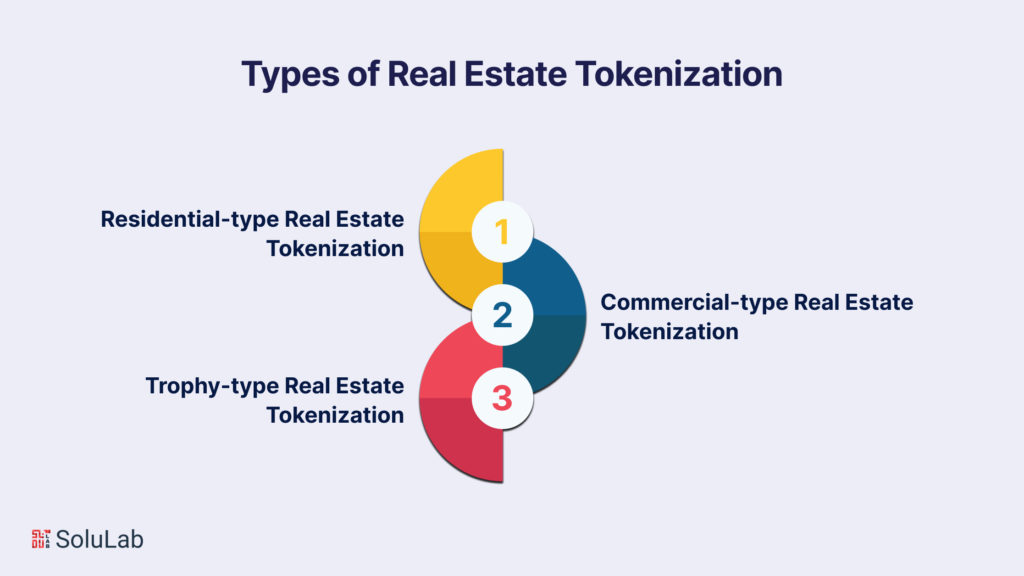
Real estate tokenization mostly has three types. So let’s examine each one in turn.

  • Residential-type Real Estate Tokenization

The practice of tokenizing a residential real estate property is known as residential real estate tokenization. The fact that investors can own a portion of residential property anywhere in the world from the comfort of their homes makes this type the most popular among the others.

  • Commercial-type Real Estate Tokenization

The tokenization of commercial real estate is very similar to that of residential real estate. Tokenizing commercial real estate properties are involved. But in this case, special care must be taken to guarantee that all legal requirements are completed and that the business property is not subject to any criminal activity.

  • Trophy-type Real Estate Tokenization

The most recognizable kind of real estate tokenization is trophy tokenization. It is the practice of tokenizing prominent, upscale venues that are extremely significant & prestigious in both terms of money as well as their intrinsic value.

CTA1

How Tokenized Real Estate Investing Works

Special purpose investment vehicles, which are often set up as limited liability corporations (LLCs), are used to invest in real estate in both conventional and tokenized deals. The ownership of the LLC is fragmented into security tokens for real estate transactions based on blockchain technology.

The creation of public security is a complex and expensive process, and since the offering is a security, it is typically registered under an exemption.

The creation of a private placement offering (PPM) that includes information on the investment’s nature, potential risks, sponsors, and other pertinent factors is one criterion for gaining the exemption. The SPV’s operating agreement and subscription agreement both outline the managers’ and investors’ responsibilities as well as the rights and obligations of both parties.

Read Our Blog Post: Top 12 Real Estate Tokenization Companies in USA

To maintain compliance with securities laws, real estate tokens are coded by the underlying smart contracts. Smart contracts have the ability to automatically enforce any buy and sale limitations required by the world’s securities authorities. Smart contracts can also be used to impose restrictions regarding who can buy tokens and holding periods for those tokens.

Real estate tokenization platforms conduct know-your-customer (KYC), anti-money laundering (AML), and investor accreditation checks in order to enforce these requirements. These examinations lead to the “whitelisting” or pre-approval” of specific buyers.
Processes Involved in Tokenized Real Estate Properties

Processes Involved in Tokenized Real Estate Properties

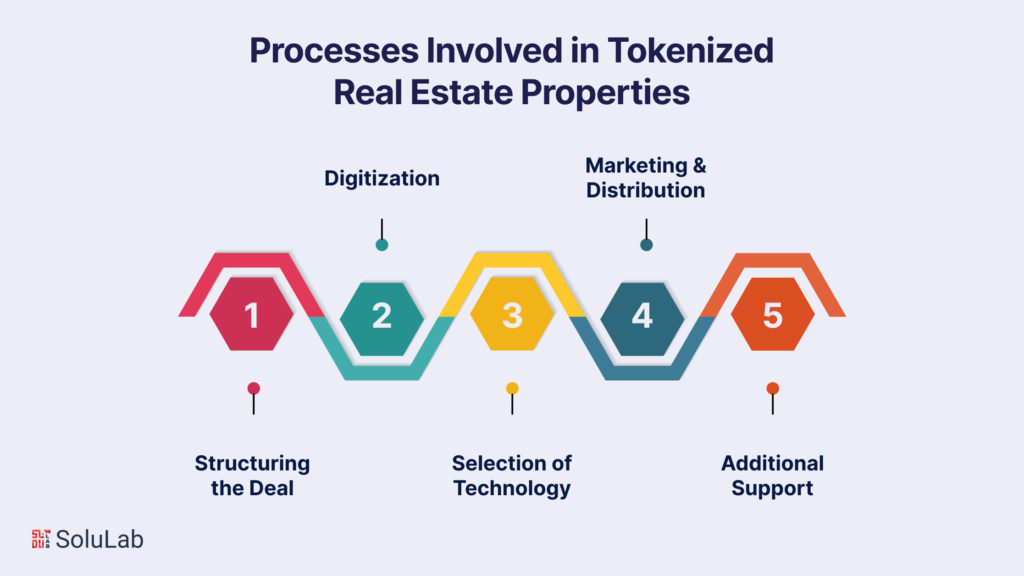
Structuring the Deal

The categories of shareholders & assets, the applicable jurisdiction, and the pertinent legislation are all significant considerations in this first step. Prior to raising capital to launch a new business, issuers frequently decide to tokenize a prior deal at this stage, largely to give liquidity to current investors.

Digitization

Information that was previously stored in paper/document form is uploaded to the blockchain at this point. This procedure makes use of smart contracts, and the kind of fund/fund structure is also chosen. The following are the most popular fund structures:

The most common fund structures are as follows:

  • Real Estate Investment Trust (REIT)
  • Real Estate Fund
  • Single asset Special Purpose Vehicle (SPV)
  • Project Finance 

Read Our Blog: What is Real Estate Tokenization and How Does it Work?

Selection of Technology

At this stage, a number of crucial technological choices can be taken, including:

  • Choose Blockchain 

Given that the transaction will be added to the blockchain ledger, it is important to choose the appropriate blockchain depending on your requirements and requirements.

  • Chose Custody Solution

It is necessary to choose a custody solution that can hold real estate tokens securely and safely.

  • Chose Marketplace 

It is necessary to choose the marketplace where investors can purchase real estate tokens. Depending on your company’s needs, you can select either a primary or a secondary market.

Read Also: Why Dubai, London & New York Lead in Real Estate Tokenization?

Marketing & Distribution

The creation & distribution of tokens are indeed the primary areas of concentration at this stage. Real estate tokens can be purchased using a number of different payment methods, such as stablecoins, cryptocurrencies, fiat money, and others. These tokens are available to investors through:

  • Primary Distribution
  • Secondary Trading

Additional Support

A real estate tokenization company now provides additional support to investors, such as developing a corporation code and helping with legal and mortgage issues.

Tokenization Advantages for Real Estate Owners

Real estate owners, sponsors, as well as investors can all gain from tokenization. The following are some of the main benefits for sponsors & owners:

  • Tokenization gives real estate ventures exposure to plenty of investors. A real estate project might not even be known to many investors until it is tokenized. A real estate tokenization platform inevitably increases marketing and awareness, enhancing sponsors’ access to financing.
  • In addition to automating investor communications, payouts, purchases & sales, tax accounting, as well as (where necessary) investor voting, smart contracts that underpin real estate tokens can also automate compliance with securities legislation. Real estate sponsors can handle numerous investors with the help of automation, which also creates a robust audit trail across all property actions.

Check Our Blog Post: Top White Label Real Estate Tokenization Platforms & Firms

  • Tokenization enables sponsors to provide investors with more liquidity, potentially improving investor returns and enabling investors to reallocate funds to the sponsor’s upcoming deal. Sponsors may immediately profit from increased liquidity among investors.
  • A real estate owner may use tokenizing an asset to resolve complex problems like how to terminate a partnership or distribute an estate among heirs. Real estate token owners are free to decide whether to buy, sell, or leave at any time. Tokenization, while not resolving every property-related conflict, can assist with many potential issues.
  • Numerous new possibilities for using and maintaining a property’s equity are made possible by tokenization. Real estate owners who tokenize their properties can raise short-term financing, receive debt secured by their tokens, sell a portion of the equity (perhaps with a buyback option), and exchange their real estate tokens for other tokens.

Disadvantages of Tokenizing Real Estate

Sponsors do need to change the way they approach real estate because of tokenization. For sponsors of tokenized real estate, the following cons might be present:

  • Many operations are automated by tokenization, which may worry sponsors who like complete anonymity and control.
  • Sponsors might be concerned about losing a dependable investment base now that investors can swap tokens more readily. However, strong sponsors can continue to work with investors, plus their track record might even help them draw in more money. Additionally, there are programs for rewarding devoted investors (like early purchase, for instance), which help sponsors build and expand their own investor base.
  • Managing more investors may intimidate some sponsors because it necessitates a variety of communication strategies. Sponsors might make use of a real estate tokenization platform’s assistance to keep investor communications going at scale.
  • Sponsors must establish and uphold rigorous guidelines regarding the information that is disclosed to investors as well as the secondary market. Primary investors need in-depth information, which might not be suitable for a wider audience. A good tokenization platform will make these restrictions easier and more automated, assisting sponsors in finding the ideal harmony between privacy and openness.

What is the Future of Real Estate Tokenization?

You might be surprised to learn that the real estate investing industry has a far larger market than a number of other businesses. In comparison to other investment vehicles like equities, mutual funds, and bonds, it is also regarded as a safe investment. But some of the market’s elite participants, who are significantly wealthier than others, control it. Real estate tokenization is therefore not only urgently needed but also has the enormous potential to completely transform the sector. Additionally, according to Prophecy Market Insights, tokenization income in the global real estate market will soar and reach $4.3 billion over the course of the following five years. The future of real estate tokenization thus appears to be quite promising based on the aforementioned points and the unmistakable numbers.

If You Need Help

Our company, SoluLab, is a market leader in blockchain development. Our team members are highly skilled and experienced in creating real estate tokenization solutions. You may securitize real estate, raise money more quickly, and reach a wider audience of investors with the assistance of our highly qualified team. Consider your options even now. Get in touch with us so that we can address all of your questions.
CTA2

Conclusion

SoluLab offers a comprehensive range of real estate tokenization development services, guiding individuals through the complex landscape of property investment and development. Whether one is a property owner seeking capital through tokenization or an investor looking to diversify, SoluLab paves the way for the future of real estate investment. Their team of dedicated professionals is committed to delivering top-tier tokenization solutions, unlocking the full potential of real estate assets. SoluLab provides a tailored white-label real estate tokenization solution, supporting multiple blockchains, to redefine the experience of trading tokenized real estate. By launching a white-label platform, clients can establish a digital presence in the crypto trading world, offering a space to list commercial or residential property tokens and configure prices as desired. To embark on this transformative journey, contact SoluLab today.

FAQs

1. What is investing in tokenized real estate?

Real estate with a fractionalized ownership structure based on blockchain technology is known as tokenized real estate. Tokenized property investing is structurally identical to purchasing real estate through a syndicated transaction. 

2. What is the price of tokenizing real estate?

Legal, governing, and technological costs are typically incurred during the process. Tokenizing a property typically costs between $30,000 and $100,000. Including legal costs, developing a blockchain, smart contract implementation, and regulatory compliance. 

3. Is tokenization in real estate the way to the future?

The future of real estate tokenization, which will be driven by blockchain technology and smart contracts, presents a tremendous opportunity for expansion, with the ability to improve stability and accessibility through rational ownership.

4. What is the process of investing in tokenized assets?

Firstly, you would be required to select the asset and the regulation that is put into the asset. Afterward, select a platform and proceed with the organization process. Once this is complete, search for investments and acquire, and invest investments. Put your attention on the plants and strategies, after which you should take care of trading and liquidity.

5. How to buy tokenized real estate?

To buy tokenized real estate select a trustworthy platform or marketplace before purchasing tokenized real estate. Make an account, finish the KYC process, and add money to your wallet using Bitcoin or Fiat. Choose a tokenized asset from the list of available properties, then by tokens that represent fractional ownership.

6. How can SoluLab help you with the tokenization of real estate assets?

In the field of real estate tokenization, SoluLab specializes in the process of transforming real estate assets with digital tokens that are stored on a blockchain. This procedure makes it possible to have fractional ownership, improves liquidity, and expands access to investment opportunities. 

Top 20 Real Estate Startups using Blockchain

Top 20 Blockchain Based Real Estate Startups

Blockchain technology’s inherent system of trust makes it absolutely perfect for real estate. It is precisely the reason why several estate companies have started to incorporate blockchain technology into their business. Real estate companies all around the world are using blockchain’s smart contracts & distributed ledger capabilities to transparently as well as efficiently facilitate buying, renting, investing, and even lending.

The demand for blockchain services in the real estate sector has dramatically risen over the past few years, which is exactly why there has been a rise in the number of blockchain-based startups in the field of real estate. So, it will be a very good idea to have a look at the top 20 blockchain-based startups in the field of real estate.  

1.  Propy Inc.

1

Propy is a Silicon Valley leader in real estate transactions and offers management for brokers and agents. We cover the entire transaction process securely and simply, from offer to close. Brokerages across the country trust Propy SaaS platform for our automated notifications, e-signature, analytics, and compliance tracking to ensure that property deals are closed quicker, easier, and cheaper.

2.  Harbor Inc

2

Harbor is a digital investment management platform for alternative assets that streamlines onboarding and subscription processing, simplifies investor communications, and unlocks enhanced liquidity options through branded private marketplaces. Harbor’s easy-to-use software enables issuers and broker-dealers to remove friction and inefficiencies from the fundraising process and ongoing investor and placement agent management. 

3.  ShelterZoom

3

ShelterZoom launched an industry-first, blockchain-based real estate online offer and acceptance platform to enable buyers and buyer agents to submit offers from any online real estate listing website instantly. Since then ShelterZoom has built an end-to-end product suite enabling secure transaction management and the first email extension to tokenize attachments, allowing senders to revoke download and share permissions to their files even after they have pressed Send.

4.  UBITQUITY 

4

UBITQUITY offers a simple user experience for securely recording, tracking, and transferring deeds with our SaaS blockchain platform. We are helping financial institutions, title, and mortgage companies benefit from reduced title search time, increased confidence, and transparency.

5.  Blocksquare

5

Blocksquare, real estate companies can create and offer tokenized real estate investment deals directly on their websites. According to Blocksquare CEO Denis Petrovcic, tokenized blockchain for real estate tears down the financial barriers between investors and properties. Blocksquare’s tokenization model allows selling a real estate asset to up to 100 buyers.

6.  ATLANT

6

ATLANT is addressing two of the most pertinent problems in real estate with its decentralized blockchain platform: Tokenized Ownership and global P2P Rentals. Everybody can buy or sell even the smallest part of the property by buying or selling the corresponding PTO tokens.

7.  CPROP

7

CPROP is a blockchain-based real estate transaction management system that allows the buyer, seller, and their respective service providers to transparently and securely close real estate deals. The platform promises to clearly display each step of the entire transaction process, accompanied by information about all required documents to complete the transaction.

8.  SMARTRealty

8

SMARTRealty applies smart contract technology to everyday real estate transactions such as rental, purchase, and sale. Two parties conclude a real estate sales, purchase, or rental agreement via the SmartRealty platform by using smart contract technology. The agreement includes all necessary terms and conditions, such as payment dates and amounts, the validity period of the agreement, penalties, termination, etc

9.  Imbrex

9

Imbrex connects vendors, buyers, and agents over a powerful open network that rewards you for your contributions. Imbrex combines three innovative technologies – The Blockchain, Data Distribution, and Digital Currencies – to create the world’s most advanced Global Real Estate Listing Service. And it’s completely free.

Instead of money, imbrex uses a digital currency, the Imbrex token, which enables frictionless transactions. Users are paid in imbrex tokens to list properties or provide market data, and tokens can be exchanged within the platform for features and services.

10.  Blocknative

10

Blocknative is a real-time Web3 infrastructure company, that enables dynamic user experiences and better decisions via pre-chain insights. Blocknative democratizes access to Memolo data across multiple chains, including Ethereum, xDai, Polygon, Binance Smart Chain, and Bitcoin, empowering users to see what is happening and what will happen next on public blockchain networks.

11.  Everyrealm Inc.

11

Everyrealm is building the gateway to the entire metaverse ecosystem. Their mission is to become the leading and most trusted metaverse & NFT innovation and investment platform by building or buying companies in order to grow.

12.  Rex  

12

Rex is a technology, investment, and real estate company whose mission is to empower the billions of people who use real estate to work, play, and call home. Rex has launched Tech Ventures Real Estate (TVRE), a venture to disrupt real estate – the world’s largest asset class. TVRE leverages Rex’s access to 10k+ apartments, an in-house startup studio, and an elite tech team that conceives of launches, and scales revenue-generating businesses at an industry-leading pace. 

13.  RealBlocks

13

RealBlocks has built an advanced alternative investment experience for fund managers and their investors worldwide through its online platform. RealBlocks is a pioneer in using Web3 Blockchain Technology to offer a fully digital, white-label solution for today’s fund managers wishing to expand their firm’s investor base by allowing them to offer more funds in more locations with lower investor minimums.

14.  RealtyBits

14

RealtyBits is a Y-Combinator-backed finance platform powered by blockchain. Their goal is to create a decentralized platform for investors to purchase commercial properties, and to open up investment in American real estate assets to global investors. By enabling real estate funds to raise capital through cryptocurrency investments, they hope to lower the costs of investing in commercial real estate.

15.  Global REIT

15

Global REIT is modeled after the Real Estate Investment Trust (REIT), a popular real estate investment tool. Global REIT plans to leverage blockchain to pay investors in their REIT token dividends, increasing the liquidity of their investments. By tokenizing a successful investment vehicle, they can provide investors new to crypto with a more stable and liquid asset.

16.  Nobul

16

Nobul is the world’s first and only technology-driven real estate marketplace where every agent, from every brokerage, can compete for the consumer’s business. They deliver consumer choice, agent accountability, and overall real estate transparency.       

17.  The Bee Token

17                              

Beenest is a part of the growing movement of home-sharing platforms like Airbnb working to decentralize home sharing and make it more egalitarian for both homeowners and renters. They leverage their token, The Bee Token, to facilitate transactions on the platform. 

18.  Wealth Migrate

18

Wealth Migrate is a digital marketplace for real estate that allows investors to crowdfund different real estate assets. Their wealth coin will help facilitate transactions on their recent blockchain integrations to the platform.

19.  Meridio

19

Meridio is a platform to create, manage, and trade fractional ownership shares in real estate assets. Investors gain access to a variety of properties with greater liquidity and lower capital requirements than traditional real estate investing. Asset owners and investors benefit from the easy-to-use web application that houses property dashboards, due diligence, and peer-to-peer trades. Their mission is to make real estate investing simple and accessible to all.

20.  SwissRealCoin 

20

SwissRealCoin is the flagship project of Crypto Real Estate. It is a token closely linked to Swiss Commercial Real Estate, and its value is tied to real-world assets. Their primary goal is to automate the management of real estate assets through digital platforms powered by their token.

Closing Thoughts

All the startups mentioned have made significant contributions to the real estate sector by making effective use of the potential of blockchain technology. However, the fullest potential of blockchain technology in the real estate sector has not yet been utilized, but it is expected that better utilization will take place in the time to come.

STO Blockchain in Real Estate


STO Blockchain in Real Estate

A security token offering of STO is a unique token issued on either a permission or a permissionless blockchain. The token represents a stake in an external enterprise or asset. A number of entities such as the government as well as businesses can issue security tokens that tend to serve the same purpose as bonds, stocks, and other equities. In recent times, STO Blockchain has been readily associated with the real estate industry. Let us now understand STO Blockchain in the real estate industry in detail and how it brings about an improvement in the market.

Concept of Real Estate Tokenization

Tokenization of real estate is the method of representing a fractional ownership interest in an asset with a security token based on blockchain. Here the asset can be a security asset or utility asset. Tokenization of real estate involves the creation of tokens on the Blockchain network and assigning them to assets in the real estate market that is already existing or are presently under construction. Tokenization plays a significant role in helping the asset or fund owners efficiently raise capital by issuing tokens via blockchain platforms.

In addition to being used for the purpose of raising capital towards development investments, these tokens can also denote an interest in the real estate market, thereby allowing a broader range of developers as well as investors to participate in the real estate market. These security tokens can be bought by other investors, where tokens represent a specific amount of shares for some assets in the real estate field. Now, the investors become the partial owners of that particular asset, which provides the investors unique access to private real estate investments, with complete transparency as well as liquidity.

Different Types of Real Estate Tokenization

Different Types of Real Estate Tokenization

Real estate tokenization on a blockchain is usually classified into four types based on the type of assets.

  • Residential Real Estate Tokenization

Residential real estate tokenization involves converting individual residential properties, such as houses, apartments, or condominiums, into digital tokens on the blockchain. This process allows property owners to fractionalize the asset, dividing it into smaller tokenized shares. Investors can then purchase these tokens, giving them fractional ownership of the property. This democratizes the real estate market, making it more accessible for smaller investors to participate in the lucrative residential property sector, which was traditionally limited to larger investors or homeowners.

  • Commercial Real Estate Tokenization

Commercial real estate tokenization is the process of digitizing commercial properties, such as office buildings, retail spaces, and industrial complexes, into blockchain-based tokens. By dividing the property’s value into tokens, investors can buy and trade fractional shares of the property, creating a more liquid and flexible investment environment. This form of tokenization opens up new opportunities for investors to diversify their portfolios and gain exposure to the potentially profitable commercial real estate sector, which was previously limited to institutional investors and wealthy individuals.

  • Trophy Real Estate Tokenization

Trophy real estate tokenization targets exclusive and high-value properties, often considered luxury assets or iconic landmarks. By tokenizing trophy real estate, developers and owners can attract a global pool of investors interested in acquiring fractional ownership. Investors, in turn, gain access to the prestige and potential returns associated with these premium properties. Tokenizing trophy real estate democratizes access to these elite assets, providing a level playing field for investors to participate in the high-end real estate market and potentially benefit from its long-term appreciation.

  • Single Real Estate Tokenization

Single real estate tokenization focuses on tokenizing individual properties, irrespective of whether they are residential or commercial. It allows property owners to digitize their real estate assets and offer tokenized shares to investors. By doing so, they can raise capital more efficiently and enhance liquidity in the real estate market. For investors, single real estate tokenization offers the opportunity to invest directly in a specific property, providing greater transparency and control over their investment decisions. This type of tokenization caters to both property owners seeking innovative fundraising options and investors looking for a more personalized real estate investment approach.

Process of Tokenizing Real Estate

The procedure for real estate STO blockchain can be done in the three steps described below.

1. The first step to follow for the purpose of tokenizing a house, property, or any commercial place is to find an appropriately regulated blockchain platform that possesses the rights to store ownership of their tokens via the proper authorities.

2. In the next step, it is to be made sure that the platform also offers the owner the function of transferring those rights to anyone and transferring the entire ownership to someone else in an authorized way.

3. Tokenization of real estate is a way of exchange similar to any other type of security, where the owner needs to exchange the token for a certain value so that each of the assets can get their proper value represented in the tokens.

4. The entire process of tokenizing real estate is not quite complicated but there might be a few obstacles in the path. Hence, it is recommended to get in touch with an expert before proceeding with the same.

CTA 1

Working Process of Real Estate Tokenization

The process of tokenization helps divide the value of assets in the real estate market into shares or tokens. These tokens denote a predefined share of the underlying asset and they are referred to as security tokens. They can be easily traded at any time and are kept on a digital wallet. The tokenized assets are very securely issued, traded, and settled via a distributed ledger. The technology of distributed ledger existed for about a decade but its true potential in leveraging property management has been brought to light very recently. Distributed ledger technology uses smart contracts for the purpose of validating the ownership of an asset.

The technology’s consensus mechanism offers top-notch cyber security measures for both the issuers as well as investors. Legal complexity is one of the major challenges of launching an STO Blockchain in real estate. In this regard, it is recommended that the issuers seek professional help from an expert in this field since all the legalities need to be met and complied with. Seeking professional help would not only be making the entire process smooth and hassle-free but also avoid costly legal mistakes.

Benefits of STO Blockchain in Real Estate

Benefits of STO Blockchain in Real Estate

STO Blockchain in real estate comes with a wide range of benefits that are discussed below.

  • Offers the Highest Level of Security

STO Blockchain in real estate not only makes the transactions secure but also makes them completely transparent. It has been observed that new technologies are questioned for security but tokenization makes sure to use the highest level of security based on the two following things.

Tokens – They help in promoting security since the investment is digitally assigned to an investor and remains with the investor till the time it is refunded or sold to another person.
Blockchain – Implementation of blockchain technology makes security even tighter.

The data so transmitted is both accessible as well as inaccessible to the ones outside the network which is possible with the help of cryptographic algorithms. The key lies in the fact that the data is decentralized. There is no copying or reversal of the code, and nodes are capable of identifying any attempts to change this code and prevent it from executing. Moreover, data is recorded in a number of places simultaneously, and the door for distributed accounting technologies opens up.

Now, the open systems will help create an entirely transparent register for real estate. The entire data associated with resources is available to everyone. Additionally, the investment is much safer since smart contracts reduce the requirement for the exchange of various documents between each of the parties involved. Most importantly, the paperwork associated with the entire process of completion of a contract is readily simplified because of tokenization. A smart contract is electronically signed which makes it irreversible, hence its content cannot be changed.

  • Immense Flexibility

Tokenization in real estate offers immense flexibility to investors. Anyone can invest a certain amount and possess partial ownership of an asset in the real estate market along with obtaining benefit from the potential profits. Moreover, these tokens can be very easily and conveniently bought as well as sold on secondary markets. The owner of the asset can also sell a part of their assets by issuing tokens. These tokens can be very easily exchanged similar to stocks, with their value oscillating depending on the changing price of the asset. Tokenization certainly offers an advantage over crowdfunding since it allows investors to have instantaneous digital ownership as well as the freedom to sell at any point in time.

  • Easy and Speedy Investment

Limiting any kind of unnecessary expenditures by staying within the legal framework is undoubtedly the most effective optimization option for any kind of activity. Blockchain technology plays a crucial role in enabling the same by the removal of barriers such as bank fees, notary fees, etc. Paying via cryptocurrency helps get over these barriers appropriately. This, in turn, results in enhancing the returns of the investors and at the same time compressing the process of raising capital where the entity manages the investment, thereby streamlining the entire process.
At the time when investments are made with tokens, it readily reduces costs. At the same time, tokens provide greater freedom as the investor can buy a share in real estate and profit from it at any time. The entire process is automated and does not require any kind of unnecessary formalities, thereby making it speedy. The right to an asset in the real estate market can be acquired through the purchase of a token that does not require any kind of changes to the records of real estate.

  • Geographical Barriers are Eliminated

STO Blockchain in real estate helps in the elimination of geographical barriers. Thus, investors regardless of their location can purchase an asset in any part of the world. The investors can benefit from participating in the same and enjoy profits from various housing estates, resorts, commercial properties, or any other irrespective of the time as well as their location.

  • The entry Barrier is Lower

Investing in real estate is always associated with huge sums of money. The high entry amount in real estate investment is precisely the reason why a considerable volume of investors stays away from it. But with the help of tokenization, there is no need to purchase an entire property. Any of the properties can be divided into several thousands of tokens. So, all that an investor requires to do is to purchase only a single token. As a result of asset tokenization, investors can very easily participate in a smaller shareholding structure which is similar to distributed investing. Therefore, tokenization eliminates millions of dollars of investment and can be done with only a few dollars of investment in purchasing a part of any asset in the real estate market. This, in turn, results in a lower entry barrier for investors with lower capital.

  • Diversification is Higher

Tokenization of assets in real estate plays a significant role in diversifying investment strategies as well as assets. With a lower entry amount, investors can buy a number of assets in the real estate market in parts instead of buying only one. It results in the diversification of their investment wallet as well as their sources of revenue. 

  • Elimination of Middlemen

STO Blockchain in real estate helps liquidate the secondary real estate market. Hence, the need to deal with formal barriers like bank charges, notarial deeds, and similar others is eliminated. Moreover, blockchain helps eliminate middlemen like agents, lawyers, etc., and reduces deposit fees. Most importantly, it works 24*7 and investors need not worry about time while planning to invest. Also, there is no limit on the number of tokens purchased or traded by an investor.

  • Costs are Lowered for Investors

Tokenizing assets involves much lower costs as compared to the other methods of financing. Moreover, the investors or developers also require a way for raising capital for various projects. Stock markets and bonds have become costly, time-consuming, and complicated. Tokenization, on the other hand, provides a faster as well as cheaper method for holding assets. If any of the real estate developers happen to choose between listing assets on the stock exchange or issuing bonds, tokenization is undoubtedly a cheaper as well as simpler option.

Use Cases of Real Estate Tokenization

Let us now analyze a few of the use cases of STO Blockchain in real estate.

  • Raising Capital for Different Real Estate Projects – STO Blockchain in real estate offers a revolutionary method to raise capital for various real estate projects. Whether it’s for property purchase, construction, expansion, or development, tokenization allows property developers and owners to fractionalize the property’s value into digital tokens. These tokens can then be sold to a broader pool of investors, including retail investors, institutional players, and international buyers. By leveraging blockchain technology, the fundraising process becomes more accessible, efficient, and transparent, attracting a larger number of potential investors and accelerating project development.
  • Selling Existing Properties – Tokenizing existing properties enables property owners to sell fractional ownership stakes to multiple investors, reducing the minimum investment threshold. This increased accessibility to real estate investment attracts a more diverse range of potential buyers, ultimately leading to a quicker sale of properties. Through tokenization, property owners can offer fractional ownership, enabling investors to diversify their portfolios by acquiring stakes in multiple properties and potentially creating a more liquid market for real estate assets. As a result, sellers can benefit from enhanced liquidity leading to increased profitability and faster real estate transactions.
  • Buying Distressed Real Estate – STO Blockchain provides an innovative solution for acquiring distressed real estate assets. Tokenizing distressed properties allows interested investors to contribute capital, collectively transforming the property’s value through renovations, upgrades, or redevelopments. As the property’s value increases, the token holders can sell their stakes at a higher price, generating profits for both the investors and the original property owners. This not only attracts capital for rehabilitation but also fosters community-driven investments leading to revitalized neighborhoods and higher returns for investors.

Read Also: 9 Blockchain Real Estate Companies to Watch in 2023

  • Creation of a Real Estate Marketplace – An STO-powered real estate asset marketplace presents a compelling use case for tokenization. This marketplace can host various real estate properties available for tokenization, allowing multiple property owners to list and sell their assets to a global audience. Through the marketplace, investors can explore and participate in crowd real estate investing by purchasing fractional ownership in multiple properties and diversifying their investment portfolio. Such a decentralized marketplace eliminates geographical barriers, making it easier for international investors to access and invest in real estate projects around the world.
  • Facilitation of Fractional Ownership of High-Value Assets – Tokenization enables fractional ownership of high-value real estate assets, such as luxury yachts, private islands, or commercial jets. Investors can purchase digital tokens representing a share of these assets, gaining access to experiences and benefits that were previously exclusive to wealthy individuals. Fractional ownership democratizes luxury asset investment, making it accessible to a broader audience and providing a new way for individuals to diversify their investment portfolio with unique and prestigious assets.
  • Allowance of Cross-Border Real Estate Investment – STO Blockchain facilitates cross-border real estate investments, overcoming geographical barriers and regulatory hurdles. International investors can easily participate in real estate projects in different countries, broadening their investment horizons and diversifying their portfolios with global assets. Tokenization streamlines the investment process, ensuring transparent ownership and simplified cross-border transactions, making it easier for investors to seize attractive real estate opportunities around the world.
  • Management of Real Estate Asset – Blockchain-based tokenization streamlines real estate asset management by automating tasks like property valuations, rent collection, and financial reporting. Smart contracts can enforce predefined rules for revenue distribution, ensuring efficient and transparent operations. Tokenized assets also allow for easy tracking of ownership, making real estate asset management more secure and less prone to fraud or disputes. This enhanced transparency can attract institutional investors seeking improved compliance and oversight in their real estate investments.

Future of STO Blockchain in Real Estate

STO Blockchain has already been acclaimed as the future of investing. The growth of global real estate investment market grew from 7.4 trillion dollars in the year 2016 to 8.5 trillion dollars in the year 2017, and then it reached 8.9 trillion dollars in the year 2018. The consistent growth of the market provides a huge scope of STO in real estate. Real estate tokenization has been the emerging trend and market experts expect it to further increase with an overall market capitalization of more than 10 trillion dollars by the end of this year.

CTA 2

Conclusion

The rise of STO blockchain in real estate has revolutionized the industry, unlocking unparalleled opportunities for investors and developers alike. SoluLab’s prowess in blockchain development and commitment to innovation has positioned them as a leading player in this dynamic field. As the real estate landscape continues to evolve, SoluLab remains dedicated to empowering clients with cutting-edge solutions that drive growth, transparency, and efficiency. Whether you are a real estate developer seeking efficient fundraising avenues or an investor looking to diversify your portfolio, SoluLab is your trusted partner in navigating the transformative world of STO blockchain in real estate. Embrace the future of real estate investment with SoluLab and unlock the full potential of blockchain technology in this dynamic industry.

FAQs

1. What is STO blockchain, and how does it impact the real estate industry?

STO blockchain refers to the process of tokenizing real-world assets, such as real estate properties, on a blockchain network. It revolutionizes the real estate industry by enabling fractional ownership, increased investment accessibility, transparency, and efficient fundraising. SoluLab, as a leading technology provider, leverages the STO blockchain to empower real estate developers and investors with innovative solutions for seamless and secure transactions.

2. How can STO blockchain benefit real estate developers?

STO blockchain offers real estate developers an alternative and efficient method of raising capital for their projects. By tokenizing real estate development projects, developers can attract a broader pool of investors, reducing reliance on traditional lenders and accelerating project timelines. SoluLab’s expertise in blockchain technology ensures a streamlined fundraising process, enhancing transparency and reducing administrative complexities.

3. Is STO blockchain secure for real estate investors?

Yes, the STO blockchain ensures a high level of security for real estate investors. Blockchain technology’s inherent properties, such as immutability and transparency, protect real estate transactions from fraudulent activities. Smart contracts govern the terms of token ownership and revenue distribution, eliminating intermediaries and enhancing security. SoluLab’s commitment to the highest security standards guarantees the integrity of real estate assets and the trust of investors.

4. How does the STO blockchain enable cross-border real estate investment?

STO blockchain facilitates cross-border real estate investment by leveraging blockchain’s borderless nature. International investors can seamlessly participate in real estate projects from different countries, diversifying their investment portfolios globally. SoluLab’s expertise in blockchain development ensures compliance with international regulations, making cross-border transactions seamless, secure, and efficient.

5. Can small investors participate in high-value real estate projects through STO blockchain?

Absolutely! STO blockchain allows fractional ownership, enabling small investors to invest in high-value real estate assets. By purchasing digital tokens representing fractional shares of properties, small investors gain access to prestigious and luxury real estate projects that were once reserved for wealthy individuals and institutions. SoluLab’s user-friendly interfaces and innovative solutions make real estate investment accessible and inclusive for all.

6. How can SoluLab assist in implementing STO blockchain solutions for real estate?

SoluLab is a leading technology provider with extensive experience in blockchain development and real estate solutions. We offer comprehensive services, including tokenization, smart contract development, security auditing, and compliance, to ensure a seamless STO blockchain implementation. Our team of experts guides real estate developers and investors throughout the process, making STO blockchain adoption a smooth and successful journey.
