Talk to an Expert

A Beginner’s Guide to DeFi Yield Farming

Guide to DeFi Yield Farming

With decentralized finance (DeFi) transforming the conventional financial scene, yield farming has become a profitable venture for investors looking to optimize their profits. We’ll dive into the context of DeFi yield farming in this beginner’s guide, explaining what it is, how it operates, and any possible hazards or rewards. This tutorial will teach you the fundamental knowledge you need to successfully navigate the fascinating world of yield farming, regardless of your level of experience with DeFi.

But first, let’s understand what is Yield Farming in brief!

What is Yield Farming?

Yield farming is a way to earn rewards by lending or staking your crypto in DeFi platforms. It helps the platform with activities like lending, borrowing, or trading.

Yield farming lets investors earn rewards by putting their coins or tokens in a decentralized exchange (DEX) to provide liquidity. Farmers use DEXs to lend, borrow, or stake coins to earn interest and profit from price changes. Smart contracts lock the tokens used for yield farming.

How Does DeFi Yield Farming Work?

Yield farming helps maximize returns in DeFi by earning rewards through lending or staking crypto. Here’s how yield farming works:

1. It starts by adding funds to liquidity pools (smart contracts with assets).

2. These pools power DeFi marketplaces for exchanging, borrowing, or lending tokens.

3. Liquidity providers earn rewards through fees generated by these platforms.

4. Simply holding ETH is not yield farming—it involves lending ETH via DeFi protocols.

5. Farmers move funds between protocols to chase higher yields.

6. Success in yield farming requires Ethereum network experience.

7. More liquidity = higher rewards, making capital size a key factor in profits.

8. Understanding Defi yield farming strategies is essential for finding the best farming opportunities.
What are the Types of Yield Farming?

Types of Yield Farming

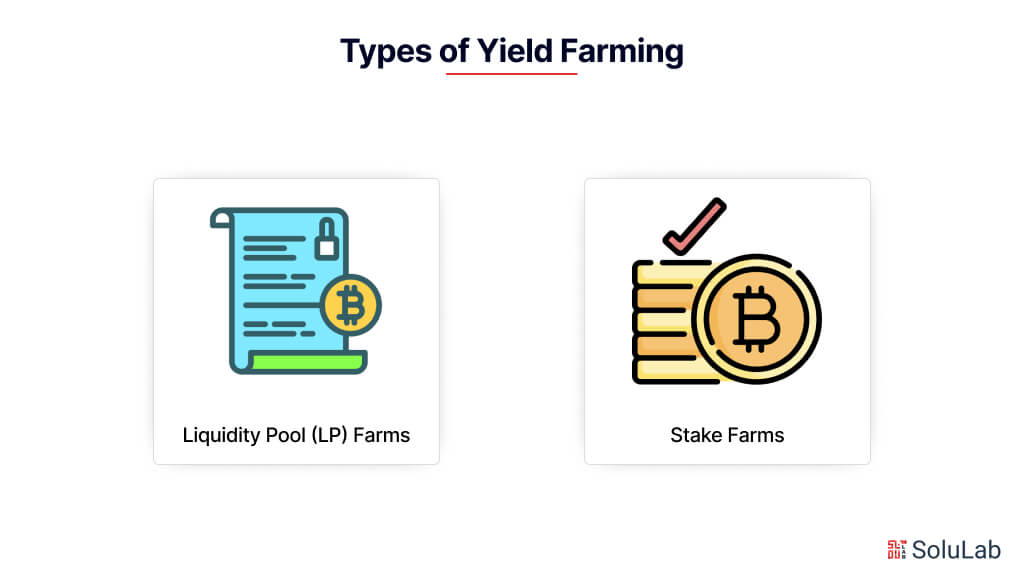
Yield farming in the crypto space presents two primary variants: liquidity pool (LP) farms and staking farms. While both involve depositing cryptocurrency into smart contracts, their mechanisms differ significantly, offering distinct opportunities for users.

1. Liquidity Pool (LP) Farms

LP farms require users to deposit crypto assets into smart contracts specifically designed to create liquidity pools. These pools function similarly to decentralized trading pairs, facilitating trading between two or more cryptocurrencies.

In LP farms, trading is limited to the cryptocurrencies provided by liquidity providers. Decentralized finance (DeFi) platforms incentivize liquidity providers with LP tokens, representing their deposits in the pool. These tokens enable providers to withdraw their deposits along with accumulated interest from trading fees at any time.

The significance of LP tokens extends further as DeFi platforms offering liquidity mining programs establish staking interfaces for them. This allows liquidity providers to lock in their funds, earning automatic and continuous rewards in the form of governance tokens. By understanding the nuances of LP farms, users can optimize their participation in crypto yield farming.

2. Stake Farms

Another yield-generation strategy that has investors interested is stake farming. The method entails a user funding a smart contract with cryptocurrency that has been configured to provide a staking pool. A decentralized trading pair and the staking pool are not comparable, though. Conversely, it is more akin to a decentralized vault for a certain class of asset.

In yield farming, the stake farming method concentrates on safeguarding the deposits rather than providing trading freedom. When compared to liquidity pool farms, stake farms may provide users with a more efficient experience. 

Unlike operating as a liquidity provider on a decentralized exchange, stake farms only need customers to deposit a single asset in order to generate passive revenue. They then concentrate on staking the tokens issued by the liquidity providers.

Difference Between Staking and Yield Farming

Staking and yield farming are two popular strategies in the world of decentralized finance (DeFi), each offering unique opportunities and mechanisms for earning rewards. Here’s a breakdown of the key differences between the two:

1. Mechanism

  • Staking: Staking involves locking up a certain amount of cryptocurrency in a wallet or smart contract to support the operations of a blockchain network. Validators or stakers are then rewarded with additional tokens as an incentive for securing the network and validating transactions.
  • Yield Farming: Yield farming, on the other hand, typically involves providing liquidity to decentralized finance protocols by depositing funds into liquidity pools or smart contracts. In return, participants receive rewards in the form of additional tokens, often generated through transaction fees or newly minted tokens.

2. Risk Profile

  • Staking: Staking generally carries lower risk compared to yield farming, as participants are primarily exposed to the volatility of the staked asset itself. However, there may be risks associated with the stability and security of the underlying blockchain network.
  • Yield Farming: Yield farming tends to involve higher risks due to potential smart contract vulnerabilities, impermanent loss, and volatility in the value of the rewarded tokens. Participants may also face risks associated with the overall health and security of the DeFi protocols they interact with.

3. Rewards

  • Staking: Stakers earn rewards in the form of additional tokens, often in the same cryptocurrency that they are staking. These rewards are typically distributed at regular intervals and are proportional to the amount of cryptocurrency staked.
  • Yield Farming: Yield farmers receive rewards in various forms, including transaction fees, newly minted tokens, or governance tokens issued by the DeFi yield farming protocols they participate. The potential for higher yields attracts participants to yield farming, but it also comes with greater complexity and risk.

4. Purpose

  • Staking: Staking is primarily used to secure and maintain the integrity of blockchain networks, promoting decentralization and network participation. It also serves as a means for token holders to earn passive income on their holdings.
  • Yield Farming: Yield farming aims to optimize returns on cryptocurrency holdings by actively engaging with DeFi protocols. Participants seek to maximize their yields by providing liquidity, taking advantage of arbitrage opportunities, or participating in liquidity mining programs.

DeFi Solutions

Additional Variants in Yield Generation

Liquidity pools and stake farming are not the only options available to you when you need to learn more about yield farming in cryptocurrency. New liquidity mining programs have been implemented by several DeFi projects, and new DeFi activity variations are linked to rewards in the form of governance tokens. These additional yield production methods can provide you with a more thorough understanding of “how DeFi yield farming works.”    

1. Insurance Mining 

In order to compensate users who must deposit assets in the decentralized insurance funds, insurance mining exclusively concentrates on yield farms. Because the winning insurance claims are deducted from the decentralized insurance funds, they carry a significant risk. Investors in this kind of yield generating might benefit from yielding farming rates on the capital they risk for project protection.

One glaring illustration of such a system is the liquidity stability pool. After that, users would contribute LUSD stablecoin to the pool, which would serve as the background for the liquidity lending protocol. The native Liquity coin, LQTY, is how users get their DeFi farms benefits. 

2. Arbitrage Mining

Arbitrage mining capitalizes on yield farms offering incentives tailored for arbitrage traders. By exploiting market discrepancies across the DeFi ecosystem, arbitrage traders seek to maximize returns from these incentives.

3. Trade Mining

Similar to arbitrage mining, trade mining involves earning token rewards through trading activities. However, the key distinction lies in the simplicity of trades conducted solely to earn rewards.

An example of trade mining innovation is Integral, a hybrid decentralized exchange utilizing an AMM/order book model. Since its inception in March 2021, Integral has distributed ITGR governance tokens to traders participating in incentivized pools, potentially revolutionizing the yield-farming crypto space.

Exploring the Potential of Yield Generation

Amidst the allure of potential gains and associated risks, many ponder the future prospects of yield generation. Reflecting on the past year, Ethereum emerged as a bustling hub for yield farming in the crypto sphere, with the majority of DeFi Yield farming platforms built on its network. This underscores the lucrative opportunities perceived within the DeFi ecosystem.

Yield generation holds immense significance, facilitating substantial liquidity and offering easier access to loans for both lenders and borrowers. Those reaping substantial profits in yield farming typically wield considerable capital. Conversely, borrowers can access loans with low DeFi farms rate, or opt for higher interest rates with greater ease.

Despite its allure, yield generation remains a contentious topic in crypto circles. While some view it as a significant advancement, others caution against its risks. Flash farms, for instance, have drawn criticism from Ethereum developers due to heightened risk levels. Nonetheless, the allure of earning significant yields on assets persists, challenging traditional financial services.

High-Return DeFi Yield Farming Techniques

DeFi investors employ high-return yield farming strategies to maximize their ROI. The techniques use DeFi protocols and financial instruments to maximize returns. Detailed descriptions of various methods follow.

1. Liquidity Mining: Depositing investments in decentralized exchanges or lending platforms for a reward is liquidity mining. After an investment, investors deposit their assets initially in liquidity pools.

Most investors receive LP tokens upon deposit. LP tokens can be staked for extra prizes or reinvested in another system. Investors join liquidity pools with high trading volumes or rewards to enhance returns. Governance tokens or awards for early or significant liquidity providers are offered by some platforms.

2. Staking: Staking is keeping assets in a blockchain network for transaction confirmation or network security. Typically, speakers receive the network’s coin. Staking contracts or pools allow users to stake their assets. Staked assets can be used to run the network’s consensus process or other functions and rewarded proportionally.

Find networks with high staking rewards or rising value. Choosing platforms with extra benefits or multi-tiered staking programs can also enhance returns.

3. Yield Aggregators: Yield aggregators automatically optimize yield farming schemes by shifting users’ funds between DeFi protocols to maximize profits. Yield Aggregators allocate funding to yield farming prospects in real-time. They also optimize reward compounding to maximize returns.

Yield aggregators give investors access to a wide selection of yield farming prospects without human changes. Most yield aggregators with advanced algorithms and high-yield pools give the best returns.

4. Leveraged Yield Farming: This method involves leveraging assets to augment capital investment in yield farming protocols, hoping for higher returns. Investors borrow to increase their yield farming pool positions. Additional capital boosts rewards but raises risk.

Investors must carefully control leverage and ensure yield exceeds borrowing costs to maximize returns. Leveraged yield farming requires high-risk tolerance and leverage management skills.

5. Joining Emerging Protocols: Many new DeFi technologies provide high returns to attract early users. These protocols may have novel reward structures or characteristics.

High reward rates or incentive programs attract initial liquidity for early participants. Early stakes and liquidity providers may benefit greatly from these techniques. Investors should investigate new protocols’ risks and returns. Early investment in promising companies can offer high rewards but also increase risk. 

Benefits of Yield Farming

Yield farming, a cornerstone of decentralized finance (DeFi), offers a multitude of benefits for participants willing to engage in this innovative financial practice. Here are some key benefits of yield farming:

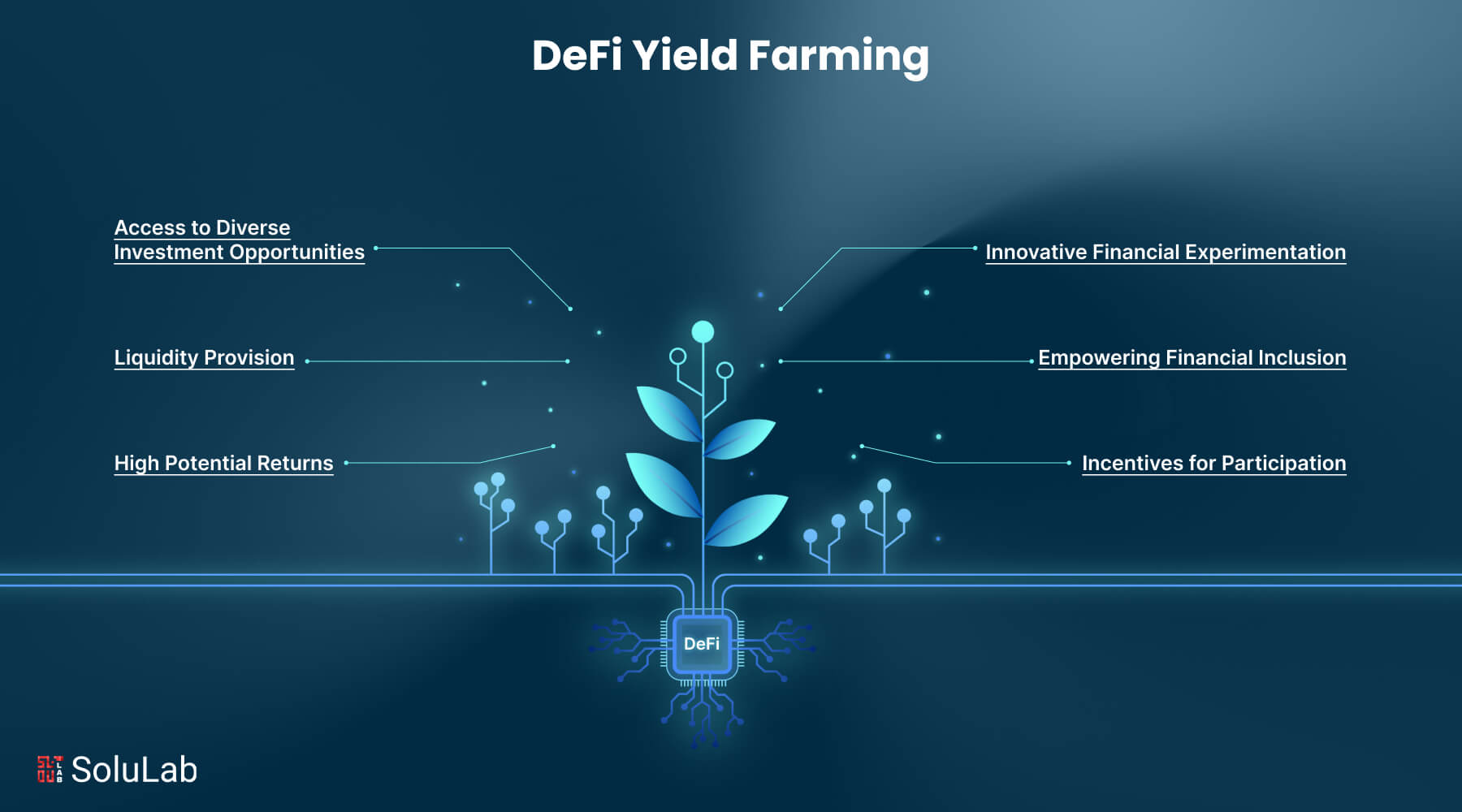
1. High Potential Returns: Yield farming presents an opportunity to earn significant returns on cryptocurrency holdings by participating in various DeFi protocols. With attractive yield rates and rewards, participants can potentially generate passive income on their assets.

2. Liquidity Provision: By providing liquidity to decentralized exchanges and liquidity pools, yield farmers contribute to the liquidity of the DeFi ecosystem. This enhances market efficiency and enables smoother trading experiences for users.

3. Access to Diverse Investment Opportunities: Yield farming allows investors to diversify their crypto portfolios by exploring different DeFi protocols and strategies. From lending and borrowing to liquidity mining and staking, participants have a wide range of options to choose from based on their risk appetite and investment goals.

4. Incentives for Participation: DeFi platforms incentivize yield farmers with rewards, often in the form of governance tokens, transaction fees, or newly minted tokens. These incentives encourage participation and help bootstrap liquidity for emerging projects and protocols.

5. Empowering Financial Inclusion: DeFi Yield farming democratizes access to financial services by providing opportunities for anyone with an internet connection and cryptocurrency holdings to participate in DeFi. This inclusive nature of DeFi yield farming promotes financial empowerment and fosters broader adoption of decentralized finance principles.

6. Innovative Financial Experimentation: Yield farming fosters experimentation and innovation within the DeFi space, driving the development of new protocols, products, and features. This continual evolution pushes the boundaries of traditional finance and opens up new avenues for decentralized financial services.
Read Blog: A Guide to Fractionalized Real Estate With DeFi

Use Cases for Yield Farming

Use Cases for Yield Farming

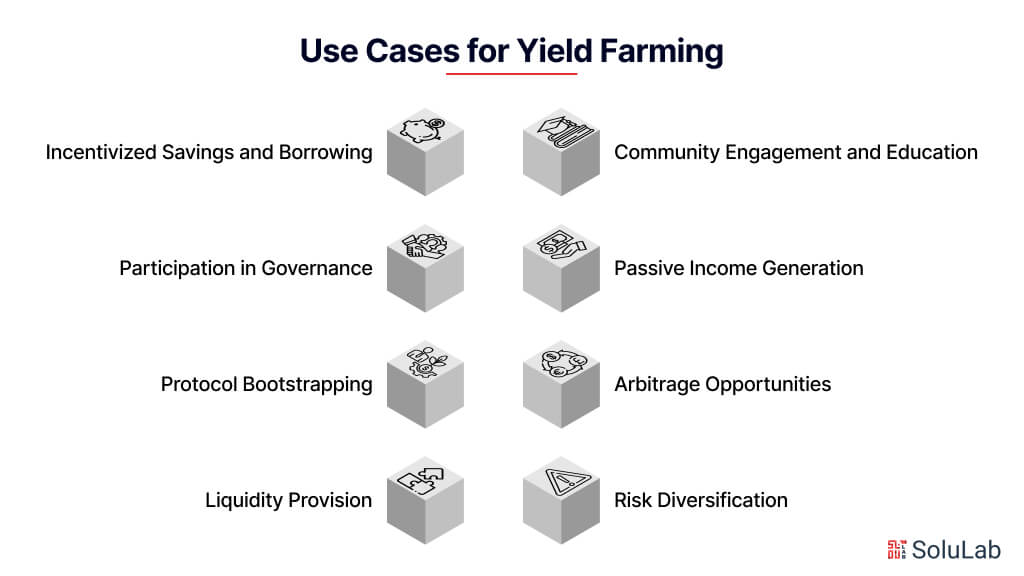
Yield farming, a prominent practice within decentralized finance (DeFi), offers a diverse array of use cases that cater to different investment strategies and objectives. Here are some notable use cases for yield farming:

  • Passive Income Generation: One of the primary use cases of yield farming is to generate passive income on cryptocurrency holdings. By providing liquidity to decentralized exchanges or liquidity pools, participants can earn rewards in the form of transaction fees, governance tokens, or newly minted tokens, thereby generating a steady stream of income.
  • Liquidity Provision: Yield farming plays a crucial role in providing liquidity to decentralized finance protocols, and facilitating efficient trading and lending activities. Participants contribute their assets to liquidity pools, enabling seamless exchange and borrowing of tokens while earning rewards for their liquidity provision.
  • Risk Diversification: Yield farming allows investors to diversify their crypto portfolios by allocating assets across different DeFi protocols and strategies. By spreading their investments across various yield farming opportunities, participants can mitigate risks associated with individual assets or protocols.
  • Arbitrage Opportunities: Yield farming provides opportunities for arbitrage traders to capitalize on price discrepancies across different decentralized exchanges and liquidity pools. By exploiting these price differentials, arbitrageurs can generate profits and contribute to market efficiency within the DeFi ecosystem.
  • Participation in Governance: Many DeFi protocols incentivize yield farmers with governance tokens, allowing them to participate in protocol governance and decision-making processes. Yield farmers can vote on proposals, shape the direction of protocol development, and influence the allocation of resources within the ecosystem.
  • Incentivized Savings and Borrowing: Some DeFi platforms offer yield farming incentives for users who deposit or borrow assets through their protocols. By participating in these incentivized savings and borrowing programs, participants can earn additional rewards while accessing liquidity or earning interest on their deposits.
  • Protocol Bootstrapping: Yield farming serves as a mechanism for bootstrapping liquidity and driving the adoption of new DeFi protocols and projects. By offering attractive incentives for liquidity providers and users, projects can attract capital, generate interest, and establish a vibrant ecosystem around their platform.
  • Community Engagement and Education: Yield farming fosters community engagement and education within the DeFi space, encouraging participants to learn about different protocols, strategies, and investment opportunities. Through participation in yield farming, users can gain hands-on experience and contribute to the growth and development of the DeFi ecosystem.

DeFi Yield Farming Development

Final Words

In conclusion, this beginner’s guide has provided a comprehensive overview of DeFi yield farming, exploring its mechanisms, benefits, risks, and diverse use cases within the decentralized finance ecosystem. From generating passive income and providing liquidity to participating in governance and exploring arbitrage opportunities, yield farming offers a plethora of avenues for investors to engage with DeFi and maximize their returns. While the potential rewards of yield farming are enticing, it’s crucial for participants to exercise caution, conduct thorough research, and practice risk management to navigate the associated risks effectively.

Looking to embark on your journey into the world of DeFi yield farming? SoluLab stands ready to guide you through the process as a leading DeFi yield farming development company. Our team of experts specializes in crafting tailored solutions for decentralized finance, including yield farming platforms, liquidity pools, and governance mechanisms. Whether you’re an investor looking to participate in yield farming or a project seeking to launch a DeFi platform, we’re here to help you unlock the full potential of decentralized finance. Contact us today to learn more and embark on your DeFi journey with confidence.

FAQs

1. What is yield farming in DeFi?

Yield farming, also known as liquidity mining, is a practice in decentralized finance (DeFi) where users provide liquidity to protocols in exchange for rewards. These rewards can include transaction fees, governance tokens, or newly minted tokens, offering participants an opportunity to earn passive income on their cryptocurrency holdings.

2. How do I start yield farming in DeFi?

To start yield farming in DeFi, you’ll need to connect your cryptocurrency wallet to a DeFi platform that offers yield farming opportunities. From there, you can deposit your assets into liquidity pools, stake them in protocols, or engage in other yield farming strategies to begin earning rewards.

3. What are the risks associated with yield farming?

While yield farming can be lucrative, it also comes with risks. These risks include impermanent loss, smart contract vulnerabilities, market volatility, liquidity risks, regulatory uncertainties, overleveraging, and unknown protocol risks. It’s essential to understand these risks and practice proper risk management when participating in yield farming.

4. What are the benefits of yield farming in DeFi?

Yield farming offers several benefits, including the potential for high returns, liquidity provision, access to diverse investment opportunities, incentives for participation, financial inclusion, and fostering innovation within the DeFi Yield farming ecosystem.

5. How can SoluLab help with DeFi development for yield farming projects?

SoluLab is a leading DeFi development company specializing in crafting tailored solutions for decentralized finance, including yield farming platforms, liquidity pools, and governance mechanisms. Our team of experts can guide you through the process of launching a DeFi project, from conceptualization to deployment, ensuring a seamless and successful journey into the world of decentralized finance. Contact us today to learn more about how we can help you realize your DeFi goals.

List of 15 Best Defi Yield Farming Platforms 2026

Best Defi Yield Farming Platforms

What if your crypto could work for you 24/7, growing while you sleep? That’s exactly what yield farming in DeFi promises, and in 2026, it’s bigger than ever. Once seen as a risky experiment, yield farming has now matured into a powerful investment strategy, helping investors earn passive income, support decentralized ecosystems, and grab financial opportunities that traditional banks can’t match.

But with hundreds of platforms competing for attention, how do you know which ones are worth your time and your tokens? Some focus on stable, low-risk returns, while others offer sky-high APYs that come with higher risks. Picking the right platform can be the difference between consistent growth and costly mistakes.

Whether you’re new to yield farming or a seasoned investor hunting for the best, in this blog, you’ll get the list of the top 15 DeFi yield farming platforms of 2026.

How to Choose the Best Yield Farming Platform?

With so many platforms available, choosing the right one for DeFi yield farming can be tricky. Here are the key factors you should evaluate before locking your assets:

  • APY/APR Rates: Check the advertised Annual Percentage Yield (APY) or Annual Percentage Rate (APR). While high yields look attractive, they often come with higher risks. A balanced, sustainable rate is usually better than chasing extreme numbers.
  • Security and Audits: Ensure the platform’s smart contracts have been audited by reputable firms. Security flaws can result in major losses, so trust platforms with proven safety measures.
  • Ease of Use (UI/UX): A platform with a user-friendly interface makes farming and managing assets much simpler, especially for beginners.
  • Multi-Chain Support: Multi-chain platforms let you farm across different blockchains (Ethereum, BNB Chain, Polygon, etc.), giving you more flexibility and better opportunities.
  • Fees and Withdrawal Flexibility: Review the transaction fees, gas costs, and withdrawal rules. Low fees and easy withdrawal options ensure you keep more of your earnings.
  • Tokenomics & Sustainability: Look into how the platform’s native tokens are distributed, burned, or rewarded. Good tokenomics ensure rewards are sustainable and not inflationary.
  • Liquidity & User Base: Platforms with high liquidity and a large user base tend to be more reliable, reducing risks like price slippage and impermanent loss.

CTA1

Top 15 DeFi Yield Farming Platforms to Consider in 2026

1. PancakeSwap

As the biggest DEX on the BNB Chain, PancakeSwap offers high-yield farming opportunities through CAKE token staking and liquidity pools. Its low fees and gamified features make it popular among retail users.

2. SushiSwap

Originally a fork of Uniswap, SushiSwap expanded into a full DeFi ecosystem with staking, farming, and lending products. Users earn rewards by staking SUSHI tokens and joining liquidity pools across multiple blockchains.

3. Yearn (YFI)

Yearn Finance simplifies yield farming through automation. By pooling user funds, Yearn deploys them into the best-performing strategies, optimizing returns without requiring constant manual management.

4. dYdX (JST)

Known for decentralized perpetual trading, dYdX rewards users through staking and liquidity incentives. It has become a top choice for advanced traders seeking both yield and exposure to derivatives.

5. Aave (AAVE)

Aave is a leading lending and borrowing protocol where users can deposit assets to earn interest or borrow against collateral. Its flash loans and multi-chain support make it one of the most versatile DeFi yield platforms.

6. Curve (CRV)

Focused on stablecoin swaps, Curve minimizes slippage and offers highly competitive APYs for stable pairs like USDT, USDC, and DAI. It’s ideal for conservative investors who prefer low volatility but steady rewards.

7. Lido (LDO)

Lido is the leading liquid staking protocol for Ethereum and other proof-of-stake assets. Users stake ETH (or other PoS tokens) to earn rewards while still maintaining liquidity via derivative tokens like stETH.

8. Venus

Built on the BNB Chain, Venus is a money market protocol where users can earn yields by lending stablecoins or major assets. It also enables the minting of synthetic stablecoins backed by collateral.

9. Balancer (BAL)

Balancer is a next-gen AMM that allows custom liquidity pools with up to eight tokens. Its flexibility in pool design and yield farming options attracts institutional and advanced DeFi users.

10. GMX

A decentralized perpetual exchange, GMX allows yield opportunities through staking and providing liquidity. Its GLP token rewards liquidity providers with fees from leveraged trading, making it a fast-growing platform in 2026.

11. Convex (CVX)

Built on top of Curve, Convex boosts rewards for liquidity providers without requiring them to lock tokens directly in Curve. It’s particularly popular among yield maximizers looking to optimize CRV rewards.

12. MakerDAO (MKR)

Creator of the stablecoin DAI, MakerDAO allows users to generate yield through vaults and stablecoin lending. It’s considered one of the most reliable platforms in DeFi due to its long track record and focus on stability.

13. Uniswap

One of the pioneers of automated market makers (AMMs), Uniswap lets users provide liquidity to pools and earn fees in return. With its V3 upgrade, liquidity providers can allocate capital more efficiently, boosting yields while keeping risks manageable.

14. Synthetix (SNX)

Synthetix enables the creation of synthetic assets, letting users gain exposure to stocks, commodities, and fiat currencies on-chain. Stakers of SNX earn rewards and fees while backing these synthetic markets.

15. Chainlink (LINK)

While primarily an oracle network, Chainlink powers yield farming platforms by securing price feeds. Holders can stake LINK tokens to earn rewards while supporting the decentralized oracle infrastructure.

Upcoming Trends in Yield Farming (2026 & Beyond)

The DeFi ecosystem is evolving rapidly, and yield farming in 2026 is no longer limited to simple liquidity pools. Here are some key trends shaping the future:

  • Cross-Chain Farming Opportunities: With multiple blockchains gaining traction, yield farming is moving beyond Ethereum. Cross-chain platforms now allow users to farm across ecosystems like BNB Chain, Polygon, Arbitrum, and Solana, unlocking better yields while reducing congestion and fees.
  • AI-Driven DeFi Strategies : Artificial Intelligence is entering DeFi farms to automate complex yield strategies. From predicting pool profitability to reallocating assets in real time, AI-driven farming tools are helping investors maximize returns with minimal manual effort.
  • Real-World Asset (RWA) Tokenization and Yield Farming: Tokenizing assets like real estate, commodities, or treasury bonds and integrating them into yield farming protocols is becoming a game-changer. Investors can farm yields on tokenized RWAs, bridging traditional finance and DeFi.

Conclusion

Yield farming has grown from a niche DeFi experiment into a mainstream strategy for generating passive income. From established platforms like Uniswap, Curve, and Aave to emerging protocols introducing cross-chain support, AI-powered strategies, and real-world asset integration, the opportunities in 2026 and beyond are bigger than ever.

SoluLab, a leading DeFi development company, specializes in building secure, scalable, and future-ready yield farming platforms. Our blockchain experts ensure security, scalability, and compliance, while integrating advanced features like multi-chain support, AI automation, and tokenomics modeling.

Connect with us today and turn your blockchain ideas into reality!

FAQs

1. What is DeFi Yield Farming?

DeFi yield farming is a process where users provide liquidity to decentralized protocols or stake their crypto assets to earn rewards, typically in the form of tokens or interest. It’s a way to generate passive income in the crypto ecosystem.

2. How do I start Yield Farming?

To start Yield Farming, you need to have assets in the form of cryptocurrencies to provide liquidity. You can choose a DeFi platform, select a liquidity pool, deposit your assets, and start earning rewards.

3. How are rewards calculated in Yield Farming?

Yield Farming rewards are typically calculated based on factors such as the amount of liquidity provided, the duration of the participation, and the trading fees generated on the platform. Rewards are distributed in the form of additional tokens or a portion of the fees collected.

4. How do I start yield farming safely?

Start by researching reputable platforms, checking smart contract audits, understanding APYs, and diversifying across multiple pools. Always avoid platforms with unusually high returns or unverified code.

5. Do I need a lot of crypto to start yield farming?

No, many platforms allow you to start with small amounts. However, larger investments may yield proportionally higher returns, so plan according to your risk tolerance.

6. Are stablecoins safer for yield farming?

Stablecoins generally offer lower volatility compared to other crypto assets, making them a popular choice for risk-averse yield farmers. Platforms like Curve specialize in stablecoin farming.

How to start DeFi Yield Farming and Why to Invest?

DeFi or decentralized finance is undoubtedly one of the hottest areas in cryptocurrency in recent times. Now, in the world of decentralized finance yield farming has become the hottest trend. DeFi yield farming has taken the entire ecosystem by storm since the previous year. It offers the investors a reward when they lock their crypto holdings in a decentralized finance market. Let us dive a bit deeper into the topic for a better understanding of the working procedure of DeFi yield farming, its benefits, and other details.

What is DeFi Yield Farming?

Yield farming is a process that allows earning of rewards with cryptocurrency holdings. The cryptocurrency holders lock their holdings and earn rewards with them. DeFi yield farming refers to the lending of crypto assets within DeFi protocols for producing high returns in interest, incentives, or additional cryptocurrency. The term farming here implies the high interest produced through the liquidity of various protocols of DeFi. In addition to the rewards, DeFi protocols issue tokens. These tokens represent the share of every user in the liquidity pool which can be moved to other platforms for the purpose of enhancing potential gains.

Yield farming is something that proves to be quite beneficial to both lenders and borrowers. In this regard, the borrowers looking forward to margin trading and the lenders looking forward to investing their crypto assets lying idle in their wallet for passive income generation, a liquidity pool can prove to be extremely valuable. In a decentralized finance ecosystem, the yield farmers play the role of banks for lending funds to use tokens for yielding maximum returns. The ecosystem runs via blockchain-based smart contracts that help to connect the borrowers as well as the lenders and at the same time taking care of the rewards of the investors.

Important Terms to Understand Prior to Starting DeFi Yield Farming!

Here are some important terms associated with DeFi yield farming that is essential to know before starting.

Liquidity – It refers to the conversion of assets into cash. At the time when assets are either bought or sold, the crypto market becomes highly competitive across the globe.

Liquidity Pool – It refers to the pools of assets or tokens that offer much better returns to users as compared to the money markets. Smart contracts help in carrying or locking up the assets for easy facilitation of trading via high liquidity provision. These pools are of great help in various different platforms for the purpose of offering the required liquidity in different cryptocurrencies. Liquidity providers are required by liquidity pools for functioning in the right manner.

Liquidity Providers – They stake their holdings in liquidity pools for the purpose of receiving rewards that are generated by the DeFi platform. These rewards come from the fees generated by the DeFi platforms. There are some liquidity pools that pay their rewards in the form of multiple tokens. These tokens are then deposited to other liquidity pools with the aim of earning additional rewards. There are a number of DeFi platforms such as Balancer, Uniswap, etc. are considered to be the most extensive liquidity pools. They offer rewards to the liquidity providers for the addition of their assets to the pool.

Liquidity Pool Providers – Without liquidity providers yield farming is not feasible. The users who invest their assets or lock their deposits in the pool of funds are referred to as the liquidity providers. They are also referred to as the market makers since they supply the buyers and sellers with what they need to trade. The assets present in the liquidity pools are lent with a smart contract. It is precisely where the buyers & sellers agreement is coded and opened in the decentralized finance blockchain platform.

Steps to Start DeFi Yield Farming!

If you are new to DeFi yield farming, here are a few steps that you need to follow.

  1. Start with choosing an exchange and a liquidity pool.
  2. Get the crypto required for the chosen pool. The users can also trade other cryptos for it on the exchange’s site and they can also buy it on any one of the major crypto exchanges.
  3. In the next step, it is required to connect the wallet to the exchange. Each of the exchanges has a button that can link the wallet and deposit crypto with just a click.
  4. Now, go to the preferred pool and click on the button that adds liquidity.
  5. Finally, decide the amount of crypto to deposit and approve the transaction.

The most important step here is choosing the exchange and the liquidity pool. It is to be made sure that a trusted, reputed, and reliable crypto exchange is chosen. In addition to this, the choice of the right crypto is a matter of great importance. It is true that you would be earning interest on the chosen crypto but everyone would still want to choose crypto that has a good growth potential that would not crash in value in the near future.

Benefits of Investing in DeFi Yield Farming.

If you are still hesitating to invest in DeFi yield farming, it is time to stop hesitating and start investing. The yield farming credit markets offer a wide array of strategies for the crypto owners to earn highly attractive returns on their cryptocurrency holdings that are at least a hundred percent more as compared to the return offered by any traditional bank. Yield farming also offers higher gains as compared to almost any other traditional channel of investment ranging from real estate to stocks and bonds. The yield farmers can also earn higher returns with liquidity mining. They receive tokens from the company that borrows their funds, in addition to the high interest on their loan. Thus, the yield farmers’ can be classified into three major categories.

  1. Income from transaction fees
  2. Token rewards from companies
  3. Capital growth

Now, it is clear to understand why investing in DeFi yield farming would be a very good idea.

Future of DeFi Yield Farming?

DeFi yield farming has already been booming in recent times. With more and more investors, it is further on the rise without any intention of slowing down in the time to come. Hence, it becomes quite clear that the scope of DeFi yield farming is huge which in turn has the potential of generating a good amount of profit for the users.

- Contact Us -

SoluLab being the top 3 Blockchain developers can help you build the perfect decentralized apps.
