Talk to an Expert

The Role of Decentralized Exchanges (DEXs) in DeFi

The Role of Decentralized Exchanges (DEXs) in DeFi

In the ever-evolving landscape of blockchain technology and cryptocurrency, the rise of decentralized finance (DeFi) has ushered in a new era of financial innovation and accessibility. At the heart of this transformative movement lies Decentralized Exchange (DEX), which has revolutionized the way individuals trade and interact with digital assets. In this blog, we will delve deep into the pivotal role that decentralized crypto exchanges play within the DeFi ecosystem, shedding light on their significance, advantages, challenges, and future prospects.

What is DeFi?

Decentralized Finance(DeFi), often abbreviated as DeFi, is a revolutionary financial ecosystem built on blockchain technology that aims to replace and enhance traditional financial services and intermediaries with decentralized alternatives. In DeFi development, financial transactions, services, and products operate on open and permissionless blockchain networks, granting users greater control, transparency, and autonomy over their assets and financial activities.

DeFi platforms utilize smart contracts to automate and execute various financial functions, such as lending, borrowing, trading, and earning interest, without the need for traditional banks or financial institutions. Key characteristics of DeFi include:
  • Decentralization: DeFi applications are typically built on blockchain networks like Ethereum, enabling trustless interactions without central authorities.
  • Transparency: All transactions and smart contract code are visible on the blockchain, promoting transparency and reducing the risk of fraud.
  • Accessibility: DeFi services are open to anyone with an internet connection and compatible digital assets, fostering financial inclusion on a global scale.
  • Interoperability: Many DeFi lending platforms are composable, meaning they can interact with each other, allowing users to access a wide range of financial services seamlessly.

The Importance of DEXs in the DeFi Ecosystem

Importance of DEXs in the DeFi Ecosystem

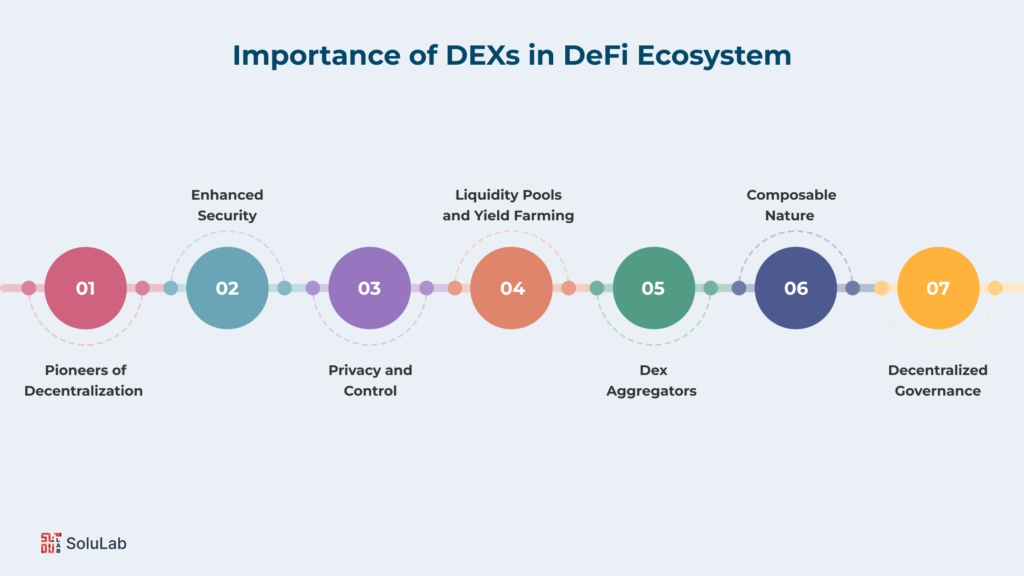
Within the expansive DeFi ecosystem, Decentralized Exchanges (DEXs) hold a central and transformative role. DEXs are blockchain-based platforms that enable users to trade cryptocurrencies directly with one another, without relying on centralized intermediaries. The significance of DEXs in DeFi ecosystem can be summarized as follows:

1. Pioneers of Decentralization: DEX platforms were among the first DeFi applications to gain widespread adoption. They set the stage for other DeFi platforms by showcasing the potential of trustless, peer-to-peer transactions.

2. Enhanced Security: DEXs prioritize security by eliminating the need for users to entrust their funds to centralized exchanges. This reduces the risk of hacks and breaches associated with centralized platforms.

3. Privacy and Control: Users of DEX platforms maintain control over their private keys and assets, ensuring greater privacy and self-sovereignty over their finances.

CTA1

4. Liquidity Pools and Yield Farming: DEXs facilitate liquidity provision through liquidity pools, allowing users to earn rewards by contributing assets. This innovation has led to the growth of yield farming and liquidity mining in the DeFi space.

5. Dex Aggregators: To further streamline DeFi trading, Dex Aggregators have emerged. These platforms consolidate liquidity from various DEXs, offering users improved access to assets and enhanced trading experiences.

6. Composable Nature: DEX platforms can be integrated with other DeFi services, creating a vibrant ecosystem where users can trade, lend, borrow, and stake assets seamlessly.

7. Decentralized Governance: Many DeFi DEX platforms incorporate decentralized governance models, allowing users to participate in decision-making processes and influence the platform’s future direction.

Understanding Decentralized Exchanges (DEXs)

In the realm of DeFi DEX platforms, Decentralized Exchanges, or DEXs, stand as the epitome of decentralized systems for crypto dex trading. In this section, we will delve into the essence of DEXs, defining these crucial components of the DeFi ecosystem. We’ll explore their key features and principles, emphasizing their role in enabling peer-to-peer trading, their non-custodial nature, their decentralized order books, and the foundation of their operations through smart contract-based transactions.
Key Features and Principles of DEXs

Key Features and Principles of DEXs

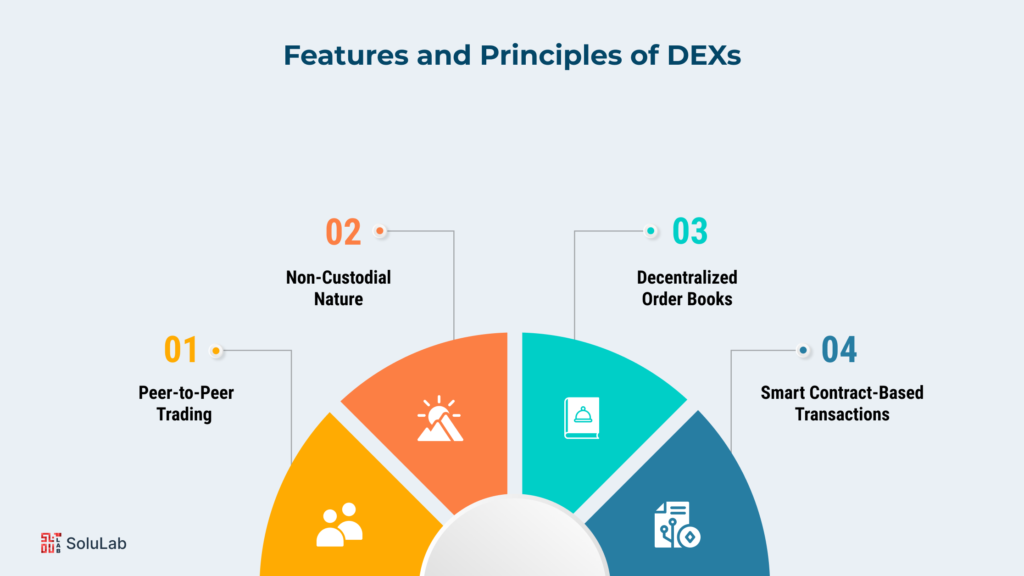
Decentralized crypto exchanges, commonly known as DEXs, embody a set of distinctive features and principles that differentiate them from traditional centralized exchanges (CEXs). Here are the key elements that define the essence of DEXs:

  • Peer-to-Peer Trading: DEXs facilitate direct crypto-to-crypto exchange between users without the need for an intermediary. This fundamental feature empowers users to interact directly with one another, creating a trustless environment for digital asset trading.
  • Non-Custodial Nature: Unlike centralized exchanges, DEXs do not require users to deposit their assets into exchange-controlled wallets. This non-custodial approach means that users retain control of their private keys and funds at all times, mitigating the risk of theft or mismanagement.

Read Blog Post: List of Top 10 Defi Savings Accounts

  • Decentralized Order Books: DEXs employ decentralized order books, which are maintained on the blockchain. These order books record buy and sell orders, ensuring transparency and eliminating the need for a centralized entity to match orders. This decentralization enhances security and reduces the risk of manipulation.
  • Smart Contract-Based Transactions: DEXs rely on smart contracts to facilitate and automate trade execution. These self-executing contracts eliminate the need for intermediaries and ensure that transactions occur only when predefined conditions are met. This feature enhances efficiency and trust in the trading process.

By embodying these key features and principles, DEXs uphold the core tenets of DEX exchange crypto, fostering trust, security, and user empowerment in the ever-evolving landscape of cryptocurrency trading.
The Advantages of DEXs in DeFi

The Advantages of DEXs in DeFi

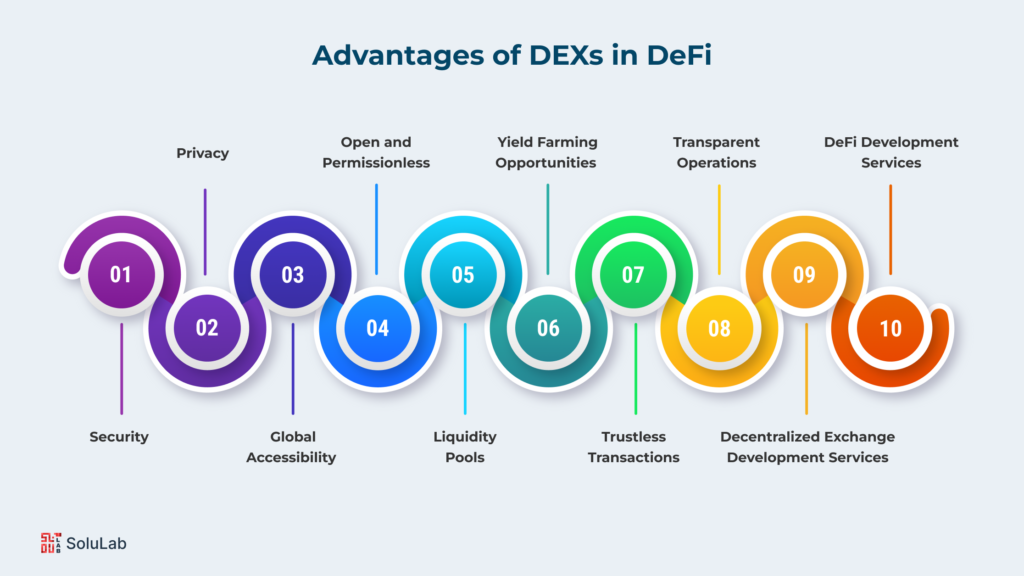
Decentralized Exchange Development holds a pivotal role within the DeFi ecosystem, offering a multitude of advantages that have contributed to their growing popularity. Here, we explore these advantages, shedding light on why DEXs are considered integral to the decentralized finance landscape.

  • Security: DEXs, developed as part of DeFi ecosystems, prioritize security by eliminating centralized points of vulnerability, making them less susceptible to hacks or breaches.
  • Privacy: Many DEXs do not require KYC, offering users enhanced privacy and reducing the need to share personal information.
  • Global Accessibility: DEXs are accessible to users worldwide, supporting the development of a truly global and inclusive financial ecosystem.
  • Open and Permissionless: These platforms are open to anyone, without the need for approval, allowing for the development of decentralized financial services without gatekeepers.
  • Liquidity Pools: DEXs enable users to provide liquidity to various DeFi projects, contributing to the liquidity and development of DeFi protocols.
  • Yield Farming Opportunities: Users can engage in yield farming, earning rewards by participating in various DeFi projects and liquidity pools.
  • Trustless Transactions: DEXs facilitate trustless trading through smart contracts, reducing the need to rely on intermediaries or centralized authorities.
  • Transparent Operations: All transactions and data are recorded on the blockchain, providing transparency and auditability.
  • Decentralized Exchange Development Services: For businesses and developers, there are specialized services that offer Decentralized Exchange Development services, making it easier to create and launch DEX platforms within the DeFi exchanges.
  • DeFi Development Services: These encompass a wide range of services for DeFi project development, including DEX integration, smart contract development, and more, further fueling the growth of DeFi.

Challenges and Concerns in the World of DEXs in DeFi

Here we will explore the various obstacles, uncertainties, and issues faced by Decentralized Exchanges (DEXs) within the DeFi ecosystem. From liquidity challenges to regulatory concerns, it delves into the complex landscape that DEX platforms navigate to provide secure and efficient trading services.

So, here are some challenges and concerns related to the role of DEXs in DeFi:

1. Liquidity Challenges: While DEXs have made significant strides in improving liquidity, they still face challenges related to fragmentation. Liquidity is often spread across multiple DEX platforms, which can lead to lower trading volumes and higher price slippage.

Read Also: Top 10 Defi NFT Games to Look for in 2025

2. Impermanent Loss: Users who provide liquidity to DEXs may experience impermanent loss, which occurs when the value of their assets in a liquidity pool diverges from their original investment due to price fluctuations.

3. Regulatory Concerns: The evolving regulatory landscape poses challenges for DEXs. Compliance with local and global regulations, especially regarding anti-money laundering (AML) and know-your-customer (KYC) requirements, can be complex and vary by jurisdiction.

4. User Experience: Some DEX platforms are criticized for their user interfaces, which can be less intuitive compared to centralized exchanges. Additionally, the unpredictability of gas fees on blockchain networks can affect the cost and speed of transactions, impacting the user experience.

5. Smart Contract Risks: DEXs rely heavily on smart contracts, which can be vulnerable to bugs, vulnerabilities, or exploits. Ensuring the security and robustness of these contracts is a constant challenge.

6. Auditing and Security Measures: Performing thorough audits of smart contracts and implementing stringent security measures to protect user funds is a critical concern for DEXs. Any security breach can result in significant financial losses and erode trust in the DeFi ecosystem.

Read Our Blog: 7 Best Defi Trading Platforms in 2025

7. Scalability: As DeFi continues to grow, DEX platforms face scalability challenges, particularly on blockchains with limited transaction throughput. Scaling solutions like layer 2 technologies are being explored to address this issue.

8. Cross-Chain Compatibility: Achieving interoperability between different blockchain networks and ensuring smooth cross-chain asset transfers can be complex and is an ongoing challenge for DEXs.

Addressing these challenges and concerns is crucial for the continued growth and maturity of the role of DEXs in DeFi. As the ecosystem evolves, DEX platforms and the broader DeFi community are actively working to find solutions and enhance the resilience and user experience of decentralized exchanges.
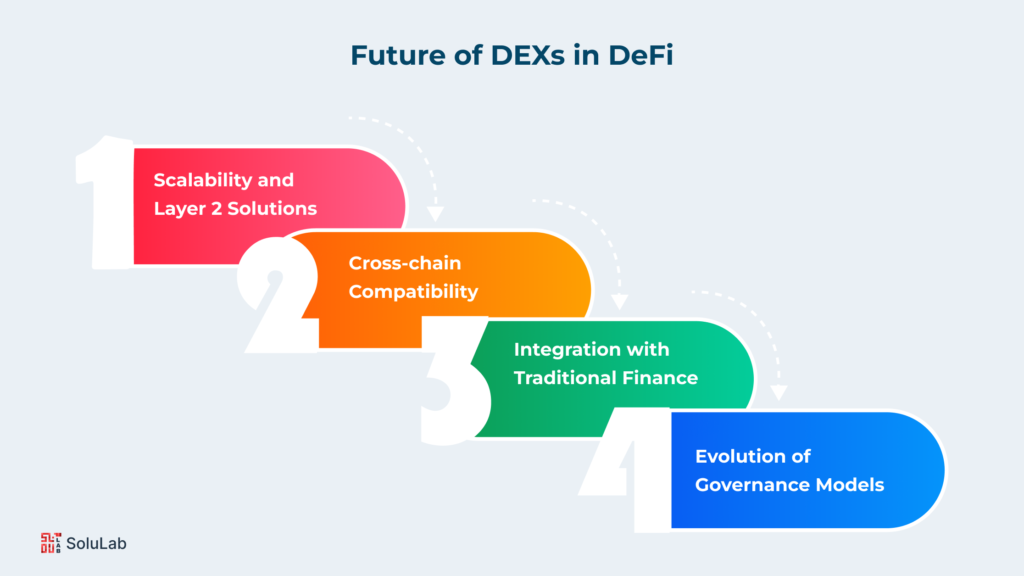
The Future of DEXs in DeFi

The Future of DEXs in DeFi

As the DeFi ecosystem continues to evolve, Decentralized Exchanges (DEXs) are poised to play an increasingly influential role. This section explores the future of DEXs, highlighting key developments and trends that will shape their trajectory within the decentralized finance landscape.

A. Scalability and Layer 2 Solutions

  • Scalability Challenges: DEXs will seek to address scalability challenges associated with blockchain networks, ensuring that they can handle a growing number of users and transactions without compromising speed or cost-effectiveness.
  • Layer 2 Solutions: The adoption of Layer 2 scaling solutions, such as sidechains and rollups, will become more prevalent. These solutions aim to alleviate congestion on the Ethereum network and enhance the scalability of DEX platforms.

Check Blog Post: The Future of Finance: Role of Blockchain Development in DeFi Ecosystem

B. Cross-chain Compatibility

  • Interoperability: DEXs will focus on achieving seamless interoperability between various blockchain networks. This will enable users to trade assets across different chains, promoting cross-chain compatibility and asset portability.
  • Multi-Chain DEXs: The emergence of multi-chain DEX platforms will provide users with a broader range of assets and trading options, reducing reliance on a single blockchain network.

C. Integration with Traditional Finance

  • Bridge to Traditional Finance: DEXs will explore opportunities for integration with traditional financial systems. This may involve partnerships with traditional exchanges, banks, and financial institutions, bridging the gap between DeFi and conventional finance.
  • Fiat Onramps: Efforts to provide fiat onramps within DEX platforms will continue, making it easier for users to convert fiat currency into digital assets directly on these platforms.

D. Evolution of Governance Models

  • Decentralized Governance: DEXs will refine their governance models, giving users more control and decision-making power over platform operations, upgrades, and tokenomics.
  • Community Engagement: DEXs will actively engage their communities, seeking input and feedback to shape the future direction of the platform. This approach enhances decentralization and user involvement.

The future of DEXs in DeFi is marked by innovation and adaptability. As scalability improves, cross-chain capabilities expand, traditional finance integration deepens, and governance models evolve, DEX platforms are poised to become even more integral to the decentralized finance ecosystem. These advancements aim to enhance user experiences, reduce barriers to entry, and contribute to the continued growth and maturation of DeFi.
CTA2

Conclusion

Decentralized Exchanges (DEXs) have not only transformed the DeFi landscape but are poised to redefine the entire financial industry. Their role as trustless, secure, and accessible platforms for peer-to-peer trading has been instrumental in advancing financial autonomy and inclusivity. The emergence of DEX Aggregators further demonstrates their adaptability and commitment to providing users with seamless trading experiences.

As we peer into the future, DEXs are set to continue their ascent. Scalability solutions and cross-chain compatibility will shatter existing limitations, allowing DEXs to accommodate the surging demand for decentralized trading. Integration with traditional finance represents a bridge between legacy systems and blockchain, promising to usher in a new era of financial innovation and collaboration. The ongoing evolution of governance models ensures that DEXs remain community-driven, putting the power to shape the platform’s direction squarely in the hands of its users. In summation, DEXs are not just a chapter in the story of DeFi; they are the architects of a new financial paradigm where individuals have unprecedented control over their assets and the global financial system becomes more equitable and accessible for all.

SoluLab, a recognized leader in Decentralized Exchange Development services and DeFi Development services, is well-equipped to be your strategic partner in navigating the complexities of the DEX and DeFi landscape. With a deep understanding of the ever-evolving blockchain ecosystem, SoluLab can provide tailored solutions that align with the insights and trends discussed in this blog. Whether you’re looking to build a cutting-edge DEX platform or embark on DeFi development endeavors, our experienced team can guide you from concept to execution, ensuring that your project not only meets but exceeds the demands of this dynamic industry. Trust SoluLab to be your trusted ally in transforming your DEX and DeFi aspirations into a reality. Let’s embark on this exciting journey together—contact SoluLab today to explore the limitless possibilities of decentralized finance.

FAQs

1. What is the main difference between DEXs and centralized exchanges (CEXs) in the context of DeFi?

DEXs operate on blockchain technology, enabling direct peer-to-peer trading without intermediaries, while CEXs are centralized platforms controlled by a single entity. DEXs prioritize decentralization and user control.

2. How do DEX Aggregators enhance the DeFi trading experience?

DEX Aggregators consolidate liquidity from multiple DEXs, providing users with improved access to assets, reduced slippage, and enhanced trading efficiency.

3. What are the scalability challenges faced by DEX platforms, and how are they being addressed?

DEXs often grapple with blockchain scalability issues. To address this, they are exploring Layer 2 solutions and sidechains, which can alleviate congestion and enhance scalability.

4. What is the role of DEXs in bridging the gap between DeFi and traditional finance?

DEXs can integrate with traditional finance systems, enabling users to convert fiat currency into digital assets and fostering collaboration between legacy financial institutions and DeFi platforms.

5. How can users ensure the security of their assets while using DEXs, given the risks associated with smart contracts and decentralized governance?

Users can enhance security by conducting thorough due diligence on DEX platforms, auditing smart contracts, and actively participating in the platform’s decentralized governance processes to contribute to its security and development.

6. How can SoluLab assist businesses looking to venture into DEX and DeFi development?

SoluLab offers comprehensive Decentralized Exchange Development services and DeFi Development services. We provide end-to-end solutions, including ideation, development, deployment, and ongoing support, tailored to your specific project needs. Our experienced team understands the intricacies of the blockchain landscape, ensuring that your DEX or DeFi project aligns with industry best practices and the latest trends. Whether you’re a startup or an established business, we can guide you through the complexities of these technologies, helping you realize your vision and succeed in the dynamic world of DEX and DeFi development.

10 Best DeFi DEX Platforms to Watch Out in 2026

Crypto trading has been changed by decentralized exchanges (DEXs), which remove the middlemen and grant customers total control over their assets. They use smart contracts to enable token swaps, which ensures more decentralization, security, and transparency than centralized exchanges.

Different decentralized crypto exchanges meet different trading needs. There is a need for a custom DEX made to fit your unique trading style, regardless of whether you value deep liquidity, governance involvement, or cheap costs. 

In this blog, we’ll explore the top 10 DeFi DEX platforms and factors you should consider before choosing a platform. Let’s begin!

Factors to Consider When Evaluating DeFi DEX Platforms

As it is known, different trading demands are met by different decentralized exchange platforms, so choosing the right one is a bit tricky. Here are some factors you should consider before choosing a suitable DeFi DEX platform:

  • Liquidity: Higher liquidity ensures smoother trades with minimal slippage, making it crucial for DeFi DEX platforms. A platform with strong liquidity pools offers better price stability and faster transactions, benefiting traders and liquidity providers alike.
  • Security: Security is paramount in decentralized finance (DeFi), as DEX platforms are vulnerable to hacks and smart contract bugs. Evaluate platforms that have undergone thorough security audits and provide transparency in their protocols to protect your assets from malicious activities.
  • User Experience (UX): A seamless, user-friendly interface improves the overall trading experience, making it easier for both beginners and advanced users to navigate the platform. A responsive design, intuitive features, and clear instructions are essential for accessibility.
  • Transaction Fees: High fees can eat into profits, especially for frequent traders. Consider platforms with competitive, low fees, or flexible fee structures. Additionally, look for platforms that offer gas fee optimization or incentives for reducing transaction costs.
  • Interoperability: Platforms that support multiple blockchains and tokens provide users with greater flexibility. DeFi DEX platforms should integrate with various blockchain networks like Ethereum, Binance Smart Chain, and others, enabling users to trade across ecosystems without friction.

DEX Development Services

Top Defi DEX (Decentralised Exchange) Platforms

Here’s a list of the top 10 best DeFi decentralized exchange platforms, highlighting their key features, benefits, and unique selling points.

Uniswap

1. Uniswap

Uniswap is a leading decentralized exchange (DEX) built on Ethereum that allows users to swap cryptocurrencies directly from their wallets using an automated liquidity protocol. Uniswap offers permissionless trading, meaning anyone can list or trade tokens without approval, making it highly inclusive. Its liquidity pool model eliminates the need for traditional order books, reducing slippage and enabling faster transactions.

Uniswap is ideal for crypto startups launching new tokens, DeFi platforms seeking integrations, and blockchain-based businesses wanting to access global liquidity without relying on centralized exchanges.

SushiSwap

2. SushiSwap

Another popular decentralized exchange (DEX) based on Ethereum, SushiSwap enables users to exchange, earn, and lend cryptocurrency assets without the need for a centralized middleman. One major benefit of SushiSwap is its community-driven governance, where token holders influence decisions and upgrades.

It also offers liquidity mining rewards, allowing users to earn incentives by providing liquidity to trading pairs. SushiSwap is helpful for DeFi startups, crypto trading platforms, and NFT marketplaces that want to integrate decentralized trading features, offer liquidity incentives, or build across multiple blockchains.

AAVE

3. AAVE

AAVE is a decentralized finance (DeFi) platform that allows users to lend and borrow cryptocurrencies without intermediaries, using smart contracts on the Ethereum blockchain. AAVE offers flexible interest rates, letting users switch between stable and variable rates based on market conditions.

Additionally, AAVE is non-custodial, so users maintain full control over their assets. AAVE is ideal for DeFi startups, crypto traders, and blockchain developers looking to build innovative financial products or earn passive income through lending and staking.

Raydium

4. Raydium

Raydium is a decentralized exchange (DEX) built on the Solana blockchain, known for its ultra-fast transactions and low fees. It uses an automated market maker (AMM) model while also integrating with Serum’s central limit order book, giving users deeper liquidity and better trading prices.

It supports yield farming, staking, and token swaps—all in a sleek, user-friendly interface. With Solana’s high-speed performance and Raydium’s innovative design, it’s a go-to platform for both beginners and seasoned DeFi traders looking for efficiency and rewards.

Synthetix

5. Synthetix

Synthetix is a decentralized exchange protocol that allows users to trade synthetic assets—tokenized derivatives that track the value of real-world assets like currencies, commodities, and stocks. One major benefit of Synthetix is its ability to offer exposure to real-world assets without needing to hold them, making it easier for users to diversify their portfolios.

Synthetix can be especially useful for DeFi startups, hedge funds, and crypto trading platforms that want to offer synthetic asset trading. It also benefits financial apps looking to expand into global asset markets without the regulatory hurdles of traditional stock or forex trading.

GMX

6. GMX

GMX is a decentralized perpetual and spot trading platform that allows users to trade cryptocurrencies with low fees, zero slippage, and up to 50x leverage. One of GMX’s standout features is its low-fee structure, which appeals to both casual and professional traders. It also offers zero price slippage, ensuring trades are executed at expected prices even in volatile markets.

GMX is ideal for crypto trading businesses, hedge funds, and DeFi portfolio managers looking for a reliable decentralized alternative to centralized exchanges. It’s also useful for startups building DeFi tools that need a trustless trading environment.

OKX

7. OKX

OKX is a popular decentralized exchange platform offering crypto trading, DeFi services, and Web3 tools, known for its speed, security, and multi-chain compatibility. OKX gives users full control over their assets through non-custodial wallets, ensuring better security and privacy.

Plus, its intuitive interface and powerful analytics tools make it beginner-friendly while still offering depth for advanced users. OKX is ideal for crypto startups, DeFi projects, NFT marketplaces, and any business looking to integrate secure and scalable blockchain solutions without relying on centralized intermediaries.

dYdX

8. dYdX

dYdX is a decentralized exchange platform specializing in perpetual contracts, offering advanced trading features like margin and leverage, without needing to give up custody of your assets. One major advantage of dYdX is its non-custodial nature, which means users retain full control over their funds.

It also offers low trading fees and fast transactions by utilizing Layer 2 scaling on Ethereum, making it ideal for high-frequency traders. dYdX is especially useful for crypto trading firms, DeFi hedge funds, and tech-savvy individual traders who want advanced trading options in a decentralized, secure environment.

Curve Finance

9. Curve Finance

Curve Finance is a decentralized exchange (DEX) focused on stablecoin trading and low-slippage swaps, offering optimized yields for liquidity providers through automated market-making (AMM).

It also allows users to earn passive income by providing liquidity to pools, thanks to its efficient AMM algorithm tailored for similar-value assets. Curve Finance is especially useful for DeFi projects, crypto hedge funds, and stablecoin-focused platforms that require efficient, high-volume stablecoin swaps with minimal price impact.

Balancer

10. Balancer

Balancer is a decentralized exchange (DEX) and automated portfolio manager that allows users to create customizable liquidity pools with multiple tokens and variable weightings. One major benefit of Balancer is its flexibility in liquidity pools—users can create pools with up to eight tokens, each with different weightings, unlike the typical 50/50 ratio.

Balancer is particularly useful for DeFi projects, crypto asset managers, and liquidity providers looking for more control over their portfolio allocations. It’s also beneficial for businesses building DEX tools, decentralized finance products, or treasury management solutions.

Conclusion

Decentralized exchanges (DEX) continue to evolve, with innovative platforms pushing the boundaries of what’s possible in the DeFi ecosystem. From Uniswap’s unmatched liquidity to Curve Finance’s stablecoin, each platform offers unique features that cater to different user needs, from liquidity providers to traders seeking high efficiency. 

For businesses and individuals looking to get involved in the DeFi space, staying updated on these platforms is crucial. As new features and technologies continue to emerge, DeFi will likely see even more opportunities for growth, innovation, and adoption. So, whether you’re a developer, investor, or enthusiast, these decentralized crypto exchange platforms are the ones to watch as the future of finance.

SoluLab recently helped DLCC build a solution, with two key platforms, Prime Product and Tokenet. It offers crypto trading, lending, and borrowing at negotiable fees. Eventually, it enhances user experience, strengthens security, and enables faster transactions. 

SoluLab, a decentralized exchange development company with its team of experts, can help you choose the right platform as per your preferences. Contact us today to discuss further.

DeFi Development Services

FAQs

1. What is a DeFi DEX platform?

A DeFi DEX (Decentralized Exchange) is a cryptocurrency trading platform that operates without a central authority. It allows users to trade digital assets directly from their wallets using smart contracts, ensuring greater privacy, security, and control over their funds.

2. What makes DeFi DEX platforms stand out in the world of finance?

DeFi DEX platforms, or Decentralized Exchange platforms, redefine traditional finance by enabling peer-to-peer trading of cryptocurrencies without intermediaries. They leverage blockchain technology and smart contracts to ensure secure and transparent transactions, fostering trust and removing the need for centralized control.

3. How do DeFi DEX platforms innovate to cater to different user needs?

DeFi DEX platforms innovate by offering features like cross-chain swaps, Layer 2 scaling for lower fees, customizable trading interfaces, yield farming, and DAO governance. These tools cater to diverse user needs—whether it’s speed, cost-efficiency, passive income, or community control.

4. Are these platforms accessible to traders of all skill levels?

Yes, most DeFi DEX platforms are designed to be accessible to traders of all skill levels. They offer user-friendly interfaces for beginners, along with advanced tools like charts and limit orders for experienced users. Many also provide tutorials, help centers, and community support to guide new users through the process.

5. How do these platforms prioritize security and user trust?

DeFi DEX platforms prioritize security and user trust by using audited smart contracts, non-custodial wallets (so users keep control of their funds), and transparent, open-source code. Many also implement multi-sig wallets, bug bounty programs, and community governance to ensure accountability and reduce risks.

Top 10 Decentralized Crypto Exchanges to Consider in 2026

Investors have long favored traditional investment avenues, but there’s a notable shift towards decentralized cryptocurrency investments today. With the global adoption of digital currencies, the rise of cryptocurrency exchanges has been meteoric. These platforms facilitate the buying and selling of digital assets. However, given the industry’s nascent stage and lack of full regulation, investors must choose reputable exchanges. It’s noteworthy that over half of decentralized exchanges currently employ smart contracts to enhance security and transparency, underlining the surge in decentralized exchange (DEX) usage.

In this blog, we’ll delve into the leading decentralized crypto exchanges reshaping how traders engage with digital assets. We’ll examine their distinctive features, advantages, and potential growth prospects in the good crypto exchange market. So, let’s get started!

What is a Decentralized Crypto Exchange?

A decentralized exchange crypto that functions without the need for a middleman or centralized authority is called a DEX, or decentralized exchange. Smart contracts on blockchain networks enable users to transact cryptocurrency with one another directly.

Because the best decentralized cryptocurrency exchange doesn’t retain customer cash, they are less vulnerable to attacks and provides more security and transparency. Top-rated crypto exchanges encourage self-custody by allowing users to keep ownership of their assets and private keys.

Conventional trading procedures have been mostly replaced by decentralized trading advantages. Liquidity pools have replaced conventional order books, and using trade volume as a guide, Automated Market Makers (AMMs) are essential in bringing together cryptocurrency buyers and sellers on the most popular DEX crypto app platform.

Read Our Blog Post: How to Build Your Own DEX Like Aster

Why Invest in Decentralized Crypto Exchanges?

Investing in the best decentralized exchange crypto can offer several advantages over traditional centralized exchanges. Here are some reasons why investors may consider this option:

1. Enhanced Privacy and Security: Decentralized good crypto exchanges prioritize user privacy and security. Since users trade directly from their wallets, there’s no need to share personal information or undergo KYC procedures. This feature ensures that sensitive data is not stored in a centralized database, reducing the risk of data breaches and identity theft.

2. Resilience to Censorship: A decentralized exchange operates globally and isn’t controlled by any central authority. This makes it highly resistant to censorship, allowing users to trade freely without restrictions tied to geography or other external factors.

3. Financial Inclusivity: Decentralized cryptocurrency exchanges are accessible to anyone with an internet connection, bridging the gap between users from different parts of the world. This inclusivity fosters financial freedom, enabling individuals in underserved regions to access a wide range of cryptocurrencies and financial services.

4. Control over Funds: In traditional exchanges, users must entrust their funds to a centralized entity, creating potential vulnerabilities. With DEXs, users retain full control over their private keys and funds, reducing the risk of theft or loss due to exchange-related issues. This shift has increased demand for the best crypto wallet tools that enable secure, self-managed storage and seamless DEX integration.

5. Opportunities for Passive Income: Many decentralized exchanges embrace decentralized finance (DeFi) protocols, offering users opportunities to earn passive income. Users can participate in liquidity pools, provide liquidity to various trading pairs, and earn rewards for their contributions.

6. Lower Fees: DEXs often boast lower fees compared to their centralized counterparts. Since there are no intermediaries involved, users can avoid hefty withdrawal, deposit, and trading fees, making decentralized exchanges more cost-effective for frequent traders.

7. Fast and Efficient Transactions: Decentralized exchanges benefit from leveraging blockchain technology to execute transactions directly between users’ wallets. This approach eliminates the need for order books and central clearing, resulting in faster and more efficient trading processes.

8. Reduced Counterparty Risk: In traditional exchanges, users face counterparty risk when trading with other individuals. In trading on DEXs, trades occur directly between wallets, significantly reducing the risk of default by the counterparty.

9. Support for Various Tokens: Decentralized trading advantages often support a wide range of tokens, including newly launched and lesser-known cryptocurrencies. This broad selection allows users to access unique investment opportunities not always available on centralized platforms.

10. Community Governance: Some DEXs embrace community governance models, where users have a say in the decision-making processes of the platform. This democratic approach ensures that the DeFi development aligns with the community’s best interests.

Top 10 Decentralized Crypto Exchanges in 2026

1. CoinBase

Coinbase has more than 110 million cryptocurrency investors, making it the top US-based exchange. BTC, ETH, SOL, and LTC are among the more than 240 cryptocurrencies that are supported by the exchange. Only well-known and highly capitalized, altcoins are often supported for trade. Base Advanced and Coinbase are two separate platforms. It provides. With features like real-time, charting, future traits, Limited orders, and other sophisticated tools, the latter is intended for experienced traders, whereas the former is easier to use.

Although the coin base is well linked by individual investors, institutional cryptocurrency, investors can also benefit from using it. The services include thorough reporting, specialized account management, and sophisticated trading tools. For major market participants, the OTC desk makes it possible to conduct huge trades without producing notable price swings.

2. Uniswap

Uniswap stands out in the top decentralized exchanges, capturing the attention of numerous cryptocurrency enthusiasts. Operating as a fully decentralized token exchange on Ethereum, Uniswap offers a straightforward and efficient platform for trading ERC20 tokens. Its innovative Automated Market Maker system democratizes market making, allowing anyone to provide liquidity and earn fees without the need for traditional order books. This unique approach has propelled Uniswap to become one of the most popular decentralized exchanges in the crypto-to-crypto exchange sphere.

An appealing feature of Uniswap is its user-friendly interface, catering to newcomers and seasoned traders alike. With a wide selection of ERC20 tokens available, users have ample opportunities to diversify their portfolios. Moreover, Uniswap is known for its low fees compared to traditional exchanges, making it an attractive option for cost-conscious traders seeking efficient trading solutions within the decentralized finance sector.

3. Curve Finance

Curve Finance, a decentralized exchange tailored for stablecoins, is renowned for its low fees and deep liquidity, catering specifically to traders dealing with stable assets. Its algorithm is engineered to minimize slippage, ensuring that substantial orders do not cause significant price fluctuations. Many investors opt for Curve Finance to stake their stablecoins, attracted by its low-risk staking rewards and consistent performance. With a variety of stablecoin pairs available, including popular options like USDT, USDC, DAI, and TUSD, traders can easily swap between different stable assets on this decentralized cryptocurrency exchange platform.

What sets Curve Finance apart is its focus on maintaining a stable price curve, achieved through an innovative bonding curve mechanism. This mechanism ensures minimal market price impact even with large trades, facilitating efficient and precise price discovery. As a result, traders benefit from a seamless stablecoin trading experience with minimal slippage, making Curve Finance an appealing choice for those navigating the decentralized finance world.

0x protocol facilitates seamless peer-to-peer exchange of ERC20 tokens on the Ethereum blockchain with minimal friction. Serving as an open standard and common building block, it promotes interoperability among decentralized applications trading advantages integrating exchange functionality. Acting as a liquidity aggregator, 0x draws liquidity from various sources, including other DEX crypto app, to offer traders optimal trading conditions such as low slippage and competitive prices.

A standout feature of 0x is its ability to aggregate liquidity from multiple trading on DEXs, ensuring traders access to a deep and diverse market. Additionally, 0x boasts a flexible and extensible smart contract architecture, empowering developers to craft tailored trading experiences and implement bespoke features to cater to their users’ specific requirements. This adaptability fosters innovation, enabling the creation of unique trading strategies and tools within the 0x ecosystem.

5. IDEX

IDEX emerges as a leading contender for the title of the best decentralized crypto exchange benefits, offering a unique hybrid model that seamlessly combines the speed of centralized exchanges with the security of decentralized ones. By separating trade matching from on-chain settlement, IDEX provides users with a trustless, real-time trading experience while ensuring blockchain-based settlement for enhanced security and audibility. Its intuitive interface has made it a popular choice among both seasoned traders and newcomers to the crypto space, offering full control over funds by enabling trading directly from wallets without the need to deposit onto the exchange.

With IDEX, users benefit from a range of trading options to suit their preferences, including limit, market, and stop-loss orders, facilitating effective strategy execution. Moreover, the decentralized cryptocurrency platform provides advanced charting tools and real-time market data, empowering traders to make well-informed decisions. Notably, IDEX prioritizes scalability by leveraging off-chain order books and settling trades on the blockchain, ensuring fast and efficient trade execution without congesting the underlying blockchain network. This commitment to scalability guarantees users a seamless trading experience even during periods of high market activity.

6. PancakeSwap

PancakeSwap reigns as the top choice among decentralized exchanges for trading Binance Smart Chain tokens, boasting widespread popularity for its low fees and user-friendly interface, particularly appealing to beginners entering the crypto-to-crypto exchange space. Operating akin to Uniswap, PancakeSwap employs an Automated Market Maker system, enabling users to provide liquidity and earn fees effortlessly.

A standout feature of PancakeSwap is its unique “yield farming” functionality, enticing investors eager to maximize their returns within the DeFi market by allowing them to stake their tokens for additional rewards. Additionally, PancakeSwap offers its native token, CAKE, facilitating governance participation and earning extra rewards through staking activities. With a growing community of users and developers, PancakeSwap continues to innovate, introducing new features and solidifying its status as one of the top 10 decentralized crypto exchanges.

7. Huobi (iToken)

Huobi’s iToken stands out as a tier-one exchange with a web 3.0 wallet app, doubling up as a decentralized exchange (DEX). This innovative platform supports multiple blockchain standards, facilitating cross-chain trading and interoperability. Users benefit from a seamless and secure trading experience, gaining access to various tokens across different blockchain networks.

A notable feature of Huobi’s iToken is its robust staking rewards program, allowing users to stake their tokens and earn attractive yields. This program has garnered popularity among investors seeking stablecoins and passive income opportunities due to its low-risk nature. Additionally, iToken offers a comprehensive range of trading tools and features, including advanced order types, real-time market data, and customizable trading interfaces. Its intuitive user interface ensures effortless navigation for both experienced traders and beginners, empowering users to make informed investment decisions in the crypto exchange United States.

8. Kucoin (Halo)

Kucoin’s decentralized app, Halo, stands out as the best decentralized crypto exchange, supporting seven blockchain standards and offering a unique ‘smart wallet tracker’ feature. This feature enables users to monitor whale investors’ token movements, providing valuable insights into market trends and aiding in more informed investment decisions. Alongside this, Halo provides a user-friendly interface and a diverse array of trading tools, including real-time market data, detailed charts, price alerts, and seamless trade execution, catering to both experienced traders and beginners.

Moreover, Kucoin’s Halo app emphasizes community engagement, offering a social trading feature where users can connect, share strategies, and discuss market insights. This collaborative environment fosters knowledge sharing and skill enhancement among traders. Whether users seek to track influential investors, access advanced trading tools, or engage in social trading, Kucoin’s Halo delivers a seamless and rewarding experience, combining the benefits of a Web 3.0 wallet with those of a decentralized cryptocurrency exchange.

9. SushiSwap

Founded in 2020, SushiSwap has quickly emerged as a prominent decentralized crypto exchange, supporting over 400 tokens and offering a range of yield services such as liquidity pools and vaults for users to earn passive income. Its unique automated market-making (AMM) protocol allows users to provide liquidity to trading pairs and earn fees in return.

SushiSwap’s offering extends to vaults and automated yield farming strategies designed to optimize users’ returns. By depositing tokens into a vault, users can leverage various yield farming opportunities across different protocols. These vaults automatically allocate funds to the most profitable strategies, ensuring optimal returns while mitigating risk. Alongside its yield services, SushiSwap is renowned for its community-driven ethos. Governed by decentralized autonomous organizations (DAOs), the platform enables token holders to actively participate in decision-making processes, ensuring that the crypto exchange in the United States evolves in line with the needs and preferences of its community members.

10. ApeSwap

ApeSwap, an emerging decentralized exchange, is swiftly gaining prominence in the DeFi space by offering cross-chain swaps, staking, farming, and other popular DeFi tools. Founded by a team of dedicated developers and community members, ApeSwap aims to provide users with a seamless and secure platform to access various DeFi services.

A standout feature of ApeSwap is its cross-chain swaps, enabling users to effortlessly swap tokens between blockchain networks like Binance Smart Chain and Ethereum. This functionality expands users’ opportunities across multiple networks without the need to convert tokens, opening new avenues for decentralized exchange benefits. With its user-friendly interface, a diverse range of services, and robust security measures, ApeSwap is poised to secure a spot among the top 10 decentralized crypto exchanges. Whether users seek token swaps, staking, farming, or governance participation, ApeSwap promises a rewarding and inclusive DeFi experience.

Conclusion

As the cryptocurrency market grows, decentralized exchanges for crypto become increasingly popular among investors and traders. These platforms offer a range of advantages, including enhanced privacy, resistance to censorship, and opportunities for passive income. SoluLab, a leading technology services provider, recognizes the importance of the best DEX crypto exchanges and offers comprehensive services to support their development and implementation.

SoluLab offers superior decentralized exchange development services, providing all the necessary features and functionalities tailored to specific business needs. Their decentralized exchange platform ensures seamless trading and secure transactions with cutting-edge software. By unlocking the potential of decentralized finance, businesses can stay ahead in the ever-evolving market. SoluLab also provides customized cryptocurrency exchange development services, offering one-stop solutions for various crypto exchange platforms, all equipped with high-security standards and multiple payment models.

In conclusion, SoluLab is at the forefront of the decentralized crypto exchange revolution, providing businesses with the necessary tools and expertise to navigate this dynamic and rapidly evolving industry. By leveraging SoluLab’s services, companies can unlock the full potential of decentralized exchanges and harness the power of cryptocurrency exchange, contact SoluLab today.

FAQs 

1. What Constitutes a Decentralized Crypto Exchanges?

A decentralized crypto exchange is a marketplace that can be accessed in the decentralized world where crypto traders can trade directly. DEX is known as the working model that made the crypto idea of a financial deal outside banks, brokers, and middlemen a reality. Currently used DEXs include Uniswa and Sushiwap both working on the Ethereum network.

2. What is the oldest and most used cryptocurrency?

The first and by far the most commonly known cryptocurrency is referred to as Bitcoin and it was launched in 2009. Now there are more than 25,000 cryptocurrencies available in the market among them 40 have a market capitalization of over $1 billion.

3. What is the major difference between a Centralized Crypto exchange and a Decentralized one?

CEX users can have an option to hold funds and keys as guardians while DE Users have an added option of having a hold on their keys and funds and not necessarily use non-custodial wallets.

4. Does Binance come under Centralized or Decentralized?

Binance comes under the largest group of decentralized exchanges available in the market all around the globe. It is operated by and registered with the Binance Holding Ltd.

5. How can SoluLab assist in blockchain development projects related to decentralized exchanges?

SoluLab offers comprehensive blockchain development services, including expertise in building decentralized exchanges (DEXs) and other blockchain-based solutions. Our team of experienced developers can help you design, develop, and deploy a custom.
