


New applications, regulatory issues, and collaboration developments are making headlines every day. According to Google, the size of the greatest AI computations is doubling every six months, “far outpacing Moore’s Law.” Since the economic potential of the Application of Generative AI development solutions is only now starting to take shape, there are virtually unlimited possibilities for what the future holds. The most recent advances in the IT sector and digital ecosystem include Google’s launch of Bard, their generative AI search and discovery tool, and Microsoft’s official integration of ChatGPT into the Bing search experience.
Since generative AI’s commercial potential is only now becoming obvious, the possibilities for its future are genuinely limitless. We advise marketers to explore productive AI technologies to understand their present capabilities better—and to be aware of their limitations, as with any fascinating breakthrough.
GPT is a tool that Application of Generative AI may use to produce text, graphics, or other types of creative output. Then, generative AI uses this material to train on new data and enhance its capacity to produce new content. Repeating this procedure will make material that gets better and more lifelike over time. GPT, for instance, may be used to create chatbot text.
The chatbot may then use this text to have natural conversations with people. Then, generative AI may leverage the chatbot’s interactions with users to train on new information and enhance its capacity to produce pertinent and interesting material.
ChatGPT is a large language model chatbot developed by OpenAI. It is based on OpenAI’s GPT-3.5 and GPT-4 foundational GPT models. According to Sam Altman CEO of Open AI, it will be the greatest force for economic empowerment, and many people are getting rich. It has been fine-tuned for conversational applications using supervised and reinforcement learning techniques. ChatGPT can generate text, translate languages, write creative content, and answer your questions informally.
This AI assistant is already capable of performing various tasks such as following instructions, fulfilling requests with care, and providing comprehensive and informative answers to all sorts of questions. Even those that are difficult or unusual. It can generate different creative text formats of text content, like poems, code, scripts, musical pieces, emails, letters, etc.
Each passing day offers new developments, inventive opportunities, and problems as usage increases and new players enter to profit from this developing frontier. Amid the enthusiasm around these ground-breaking technologies, professionals in the area and early adopters have voiced worries about the validity and reliability of autonomous creative creation and issues about their potential to replace human creativity.
We’ll continue to see new feature rollouts in the months to come as researchers and the general public pressure-test these systems with real-world applications because many of these apps and neural network models are still in open beta.
In areas like production design, design research, visual identity, naming, copy generation and testing, and real-time personalization, generative AI technology will become an indispensable creative partner for people, revealing new ways to reach and appeal to audiences.
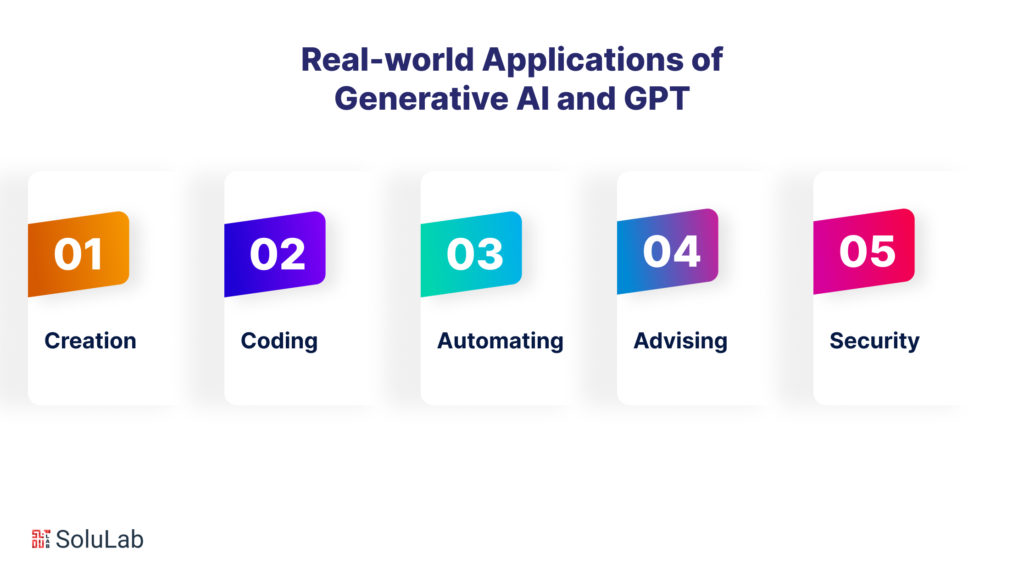
Here are some of the most popular applications of Generative AI & ChatGPT applications for content creation:
Modern ChatGPT integration services like DALLE, Midjourney, and Stable Diffusion are used by businesses to generate visual content for social media. DALLE, for instance, can analyze up to 12 billion factors when turning words into visuals and produces realistic graphics and artwork based on text descriptions. The produced images may then be posted on Twitter and Instagram.
Read Our Blog: Top 10 Generative AI Trends To Watch
Using generative AI by software developers would greatly increase productivity by allowing them to quickly switch between different programming languages, grasp various tools and techniques, automate code development, foresee and prevent issues, and manage system documentation.

GPT Applications’ sophisticated understanding of historical context, next-best actions, summarization capabilities, and predictive intelligence will spark a new era of hyper-efficiency and hyper-personalization in both the back and front offices, elevating business process automation to a completely new level.
An international bank is transforming how it handles large amounts of post-trade processing emails by utilizing generative AI and LLMs to automatically create messages with suggested actions and route them to the addressee. Consequently, less manual work is required, and client interactions go more smoothly.
Read Blog: Top Generative AI Use Cases
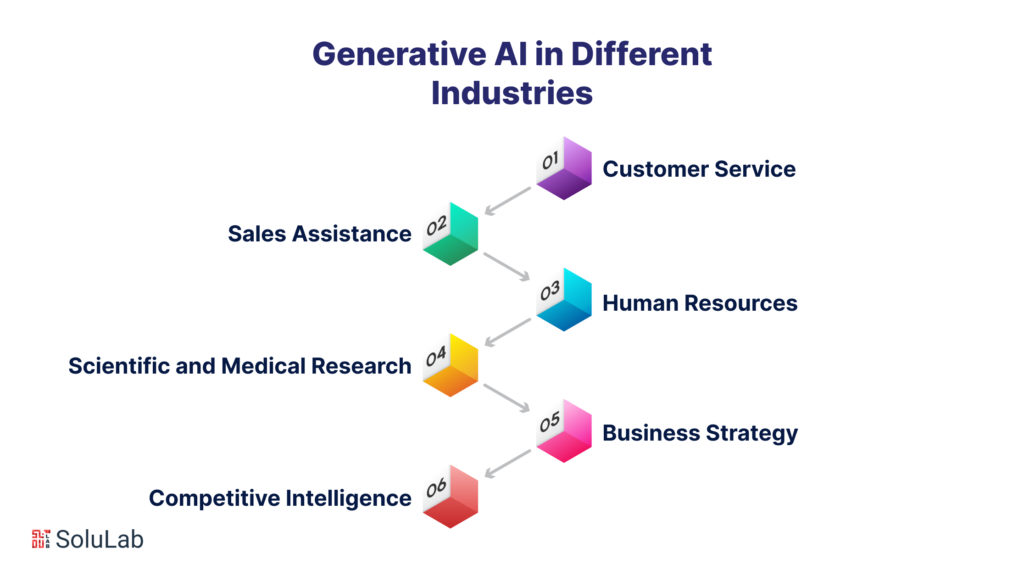
The prediction is that AI models will become every worker’s constant co-pilot, enhancing productivity by putting new forms of hyper-personalized intelligence under their control. A few examples are customer service, sales assistance, human resources, scientific and medical research, business strategy, and competitive intelligence.
Large language models help address the roughly 70% of customer service communication that is not simple and could benefit from a conversational, strong, and intelligent bot. They could help the bot understand the customer’s intent, come up with its own solutions, and increase the precision and quality of solutions.
By examining their spending patterns, earnings, and ambitions, generative AI solutions may assist people in developing tailored financial strategies. It can then produce a system outlining how to accomplish those objectives. People struggling to manage their money can get help and support from ChatGPT in real time. It can respond to inquiries on saving, investing, and budgeting, for instance.
By examining their abilities, hobbies, and personality features, people may locate their ideal occupations with the aid of career advice generated by GPT Applications. A list of professions that are a suitable fit for them can then be generated. In real-time, people looking for their dream careers may get help and guidance from ChatGPT. For instance, it can provide interview advice as well as aid with their CV and cover letter.
Generative AI applications may assist people in managing their health by keeping track of their symptoms, learning more about various diseases, and establishing connections with healthcare professionals. Additionally, it may provide customized health plans. People attempting to manage their health can receive real-time help and guidance with ChatGPT. For example, it can respond to signs, medications, and treatment queries.
By creating personalized learning plans, monitoring students’ progress, and identifying areas in which they require further support, GPT Applications may be used to support students in their academic endeavors. Additionally, it may produce quizzes and practice exams. Students wanting to excel in school may receive real-time guidance and help through ChatGPT. For instance, it can respond to inquiries on homework, assignments, and tests.
Check Out Our Blog: Role of AI in Transforming Education Industry
By examining the industry, coming up with marketing plans, and building marketing tactics, generative AI development services may be utilized to assist firms in expanding and succeeding. Additionally, it may produce customized sales presentations and marketing collateral. ChatGPT may be utilized to offer in-the-moment guidance and assistance to companies that are attempting to expand and flourish. It can, for instance, respond to inquiries concerning.
By establishing cross-domain connections and inferences inside and outside the organization, generative AI will eventually help enterprise governance and information security, safeguard against fraud, enhance regulatory compliance, and proactively recognize risk.
Large language models (LLMs) can help with strategic cyber defense by swiftly identifying webpages and describing malware. However, in the immediate future, businesses can anticipate criminals to take advantage of Generative AI technology trends capacity to create destructive code or the ideal phishing email.
Conversational AI chatbots that can address issues and provide customer support may be made using generative AI. This can free human customer support agents to concentrate on more complicated problems. Additionally, personalized marketing materials catering to each buyer’s preferences may be created using generative AI. Businesses may benefit from this by increasing consumer engagement and revenue.
Sales pitches that are individualized and catered to each customer’s demands may be made using Real Life Application of Generative AI. This might aid companies in increasing sales and income. By recognizing potential clients who are interested in a company’s goods or services, generative AI may also be used to create leads. Businesses may benefit from this by spending less time and money on marketing and sales.
Automating processes like interview scheduling and resume screening is possible with generative AI. Human HR experts can concentrate on more strategic work because of this. Employers can receive specialized training materials thanks to generative AI. Businesses may benefit from an increase in worker happiness and productivity.
Large volumes of data may be analyzed using generative AI technology to spot patterns and trends. This can aid in the development of novel scientific findings and therapeutic approaches. Simulations of complex systems may also be made using generative AI. This might assist researchers in testing novel hypotheses and creating fresh goods.
Business planning and marketing strategies may be created using generative AI. This can assist companies in reaching their objectives and making smarter judgments. Generative AI may also be used to evaluate risks and find new business possibilities. Businesses may benefit from this in order to stay competitive.
Generative AI may monitor rival activity and pinpoint its advantages and disadvantages. This can assist companies in creating plans to compete more successfully. Reports on market trends and new technology may also be produced using generative AI. This can assist companies in staying innovative.
Apart from the Benefits of generative AI for business AI can change the world, but it also has some problems. To successfully use these technologies, people, and organizations must carefully consider their limitations:
Generative AI can make harmful or misleading products by accident, like deepfakes, fake news, and other types of disinformation. Due to the possibility of misuse, strong protections are needed to ensure fair and responsible use.
A lot of the time, AI systems show biases in the material they were trained on, this could lead to biased or unfair results that keep inequality going, especially in touch areas like healthcare or jobs. To get rid of these biases, we need varied and fair datasets and to keep an eye on them all the time.
Creating and running generative AI models needs a lot of computing power, which can have big costs for both money and the environment. Companies need to compare these costs to the benefits they expect and look into AI options that use less energy.
Even though they are very smart, generative AI models sometimes can’t understand complex human situations or give out false information. For example, chatGPT might easily give answers that sound reasonable but are wrong, so someone needs to check them.
To discover a way to produce AI value, businesses must redefine labor. Starting right now, business executives must take the lead in reskilling workers and redesigning jobs and tasks. Once today’s occupations are broken down into activities that can be automated or aided and rebuilt for a new era of human & machine labor, every function in an organization has the potential to be reinvented.
By creating a new level of human and AI collaboration in which most employees will have a “copilot,” generative AI will fundamentally alter both the nature and scope of work as we currently understand it. Almost every job will be affected; some will go, most will change, and a lot of new employment will be created.
Read Our Blog: Generative AI in Healthcare
Generative AI, LLMs, and foundation models integrated into the enterprise’s digital core will optimize tasks, enhance human capacities, and create new development opportunities. The way we think about artificial intelligence has quietly changed in recent years thanks to generative AI and foundation models. The world has become aware of the opportunities this presents, thanks to ChatGPT. Although Artificial General intelligence (AGI) is still a long way off, technology is developing at an astonishing rate.
These technologies will essentially build a new vocabulary for business reinvention in the process. In the next few years, leading generative AI development companies are anticipated to get more potent and intelligent. This will result in new and creative applications in a variety of industries. ChatGPT is likely to be used more frequently in businesses.
Businesses will be able to automate processes, enhance customer service, and develop new goods and services as a result. Important ethical and security issues will be brought up by ChatGPT and generative AI. Making sure that these technologies are utilized ethically and responsibly is crucial.
Nearly everyone has been intrigued by Real Life Application of Generative AI, from corporate executives and politicians to marketers and developers, with the newest generation of AI applications like ChatGPT heralding a new phase in the development of artificial intelligence. The potential for chatbots and other AI helpers to revolutionize productivity and knowledge production has recently increased, despite being commercially accessible for years.
However, we must utilize these technologies ethically and responsibly and try to reduce any possible drawbacks. Generative AI and GPT may be utilized to build a better future for all of us with careful planning and development. They may enhance our lives in a variety of ways, from strengthening the effectiveness of our job to assisting us in learning and producing new things. We must embrace these technologies and use them to improve the world.
SoluLab, a prominent name in generative AI development services, boasts a team of adept professionals dedicated to crafting tailored ChatGPT clones that precisely align with your company’s unique needs. As a leading company in ChatGPT applications development, SoluLab continuously enhances its expertise, staying at the forefront of the latest technologies. Their goal is to empower businesses with the advanced capabilities of ChatGPT, providing an innovative AI chatbot solution. For those seeking state-of-the-art generative AI solutions, SoluLab’s team of experts is ready to guide you through the vast potential of leveraging ChatGPT for your business. Contact SoluLab today and explore the possibilities.
1. What are some real-life applications of generative AI in various industries?
Real Life Generative AI has numerous real-life applications, including content creation, personalized marketing, drug discovery, and automated design processes in industries such as entertainment, healthcare, and manufacturing.
2. How are GPT applications transforming content creation?
GPT applications are transforming content creation by generating high-quality text for articles, blogs, social media posts, and even creative writing, saving time and enhancing productivity for content creators and marketers.
3. What is a common application of generative AI in healthcare?
In healthcare, a common application of generative AI in drug discovery and development, where it helps in predicting molecular structures, optimizing chemical compounds, and accelerating the research process.
4. How can generative AI be used in personalized marketing?
Generative AI can be used in personalized marketing by analyzing customer data and generating tailored marketing messages, product recommendations, and targeted advertisements, thus improving customer engagement and conversion rates.
5. What are some GPT applications in customer service?
GPT applications in customer service include chatbots and virtual assistants that can handle customer inquiries, provide support, and perform tasks such as booking appointments or processing orders, enhancing customer experience and operational efficiency.
6. Can you provide an example of a real-life application of generative AI in the entertainment industry?
In the entertainment industry, a real life application of generative AI is in the creation of realistic animations and special effects for movies and video games, as well as in generating scripts and storylines for creative projects.
7. How does the application of generative AI impact the manufacturing sector?
In the manufacturing sector, the application of generative AI impacts by optimizing design processes, creating efficient and innovative product designs, and improving production planning and quality control through predictive analytics.


