Talk to an Expert

How the Healthcare and Biotech Industry Benefits from RWA Tokenization?

RWA Tokenization in Healthcare Industry

The global healthcare and biotech industries are growing rapidly and are expected to reach over $10 trillion by 2025. Yet, they still rely on outdated systems to manage medical records, clinical trial data, and pharmaceutical supply chains. This leads to billions lost each year due to data breaches, inefficiencies, and fraud. 

That’s where RWA Tokenization in Healthcare comes in, a breakthrough method that turns physical or digital healthcare assets into secure, tradable tokens using blockchain technology. These digital health tokens help organizations share data safely, manage assets more efficiently, and build trust across the entire healthcare ecosystem.

By using Healthcare Tokenization, hospitals, researchers, and biotech firms can unlock faster operations, improved patient outcomes, and new investment opportunities, all backed by transparent and secure digital infrastructure.

What is RWA Tokenization in Healthcare?

RWA Tokenization in Healthcare is becoming a game-changer for healthcare and biotech. It works by turning physical or digital health-related assets like medical records, lab results, and drug inventories into secure digital tokens using blockchain technology

Tokenized healthcare assets are stored on a decentralized system, making them easy to track, share, and manage. This process brings more transparency, security, and efficiency to how sensitive medical data and assets are handled.

Tokenization in Healthcare includes both physical and digital items like patient health records, medical images, genetic data, and pharmaceutical stocks. Tokenized healthcare assets mean turning them into digital tokens that can be safely stored, shared, and managed on a blockchain platform. This process helps make healthcare data more secure and easier to access.

Why Healthcare and Biotech Need New Solutions?

The healthcare industry is full of outdated systems and slow processes. From disconnected data to delays in clinical trials and poor tracking of medicine, traditional systems cause major problems. On top of that, patient privacy and data security are often at risk.

Healthcare Tokenization solutions offer a fix. It creates a secure and unchangeable digital record that can be trusted by all parties, like doctors, patients, researchers, and regulators.

How Blockchain Technology Improves Access to Assets?

With blockchain technology, RWA tokenization connects physical healthcare assets to the digital world. Hospitals, labs, and research teams can instantly access and share data when needed. Asset tokenization development helps improve patient outcomes, speeds up medical research, and reduces paperwork.

The result is a smarter, more patient-focused system that runs faster, costs less, and builds more trust.

How Asset Tokenization Applies to Medical Data?

By using healthcare data tokenization, hospitals and labs can securely manage sensitive records. For example, patient consent forms can be tokenized to track approvals clearly, and clinical trial data can be shared securely between researchers, improving teamwork and speeding up medical discoveries.

The Difference Between Utility Tokens vs Asset-Backed Tokens?

In healthcare, utility tokens give access to certain services, like telemedicine or health tracking apps. On the other hand, asset-backed tokens represent real ownership, such as shares in a biotech firm or rights to a medical patent. Knowing the difference helps patients, doctors, and investors work better with blockchain consulting companies.

Non-fungible tokens in healthcare are another type, used for unique medical items like individual test results or genetic profiles.

Feature Utility Tokens Asset-Backed Tokens
Definition Tokens that provide access to services or apps Tokens that represent ownership of real assets
Purpose in Healthcare Access to telemedicine, health monitoring tools, or platforms Ownership of shares in biotech companies, patents, or physical healthcare assets
Value Basis Value depends on usefulness within a platform Value tied to the underlying real-world asset
Transferability Usually transferable within a specific network Can represent tradable ownership, often regulated
Regulatory Impact Typically, fewer regulations, considered a utility Often subject to securities laws and stricter compliance
Role in blockchain consulting companies Used to build apps or platforms enhancing healthcare services Used to enable investment and ownership opportunities in healthcare assets
Examples Access tokens for a patient engagement app Tokenized shares in a biotech research project

Why the Healthcare Sector Needs RWA Tokenization?

The healthcare industry is one of the most asset-intensive sectors, dealing with everything from medical equipment and infrastructure to intellectual property and research data. These assets are often illiquid, underutilized, and difficult to transfer or finance. RWA tokenization offers a transformative solution by converting these physical and digital assets into blockchain-based tokens, making them easily tradable, divisible, and accessible in real-time.

  • Data Privacy and Ownership

Traditional centralized data systems are often at risk of hacks and leaks. Using Healthcare Tokenization creates a decentralized system, giving patients full control over who can see their data while following important rules like HIPAA and GDPR.

  • Transparent and Decentralized Clinical Trials

Clinical trials can be slow and unclear. With Tokenization in Healthcare, trial information, researchers create records that cannot be changed, building trust and allowing live updates. This method supports the work of blockchain development companies aiming to improve how clinical research works.

If you want to see exactly how blockchain can improve the quality and transparency of clinical trials, check out this case study

  • Empowering Patients with Control Over Their Data

With tokenization, patients own their health information and decide who can use it. Smart contracts allow patients to easily share or block access, making healthcare more focused on the individual.

  • New Research and Biotech Funding

With RWA asset tokenization, biotech companies can break large assets into smaller, affordable pieces. This opens up new ways to support research and matches the goals of leading blockchain development companies in healthcare.

How RWA Tokenization is Solving Healthcare Challenges?

The healthcare industry faces several critical challenges– funding gaps, inefficient asset utilization, complex billing systems, and a lack of transparency in supply chains. Real-World Asset (RWA) tokenization is emerging as a powerful solution to address these issues head-on.

How RWA Tokenization Solves Healthcare Challenges

1. Protecting Patient Data at Scale

As more health records go digital, protecting patient information becomes crucial. Blockchain technology offers strong security with end-to-end encryption and unchangeable records. This keeps data safe from hacks and unauthorized changes.

2. Secure and Seamless Data Sharing

Healthcare data tokenization makes it easier and safer for hospitals, labs, and insurers to share data. Using blockchain platforms, everyone involved can access up-to-date information instantly, which helps improve patient care and teamwork.

3. Tokenized Insurance Claims

Smart contracts on the blockchain automate insurance claim processes. This cuts down paperwork, speeds up payments, and reduces errors. It shows how blockchain development companies are making healthcare more efficient.

4. Remote and Cross-Border Health Systems

Tokenization helps build health systems that work together across different regions and countries. This smooth data exchange supports telemedicine and global healthcare programs, making care more accessible everywhere.

Read More: Why Is Real-World Asset Tokenization Gaining Global Popularity?

Blockchain Infrastructure in Healthcare

The healthcare sector demands high levels of data security, interoperability, and transparency. Blockchain infrastructure offers a decentralized and tamper-proof foundation. 

1. Role of Smart Contracts

Smart contracts are self-executing agreements coded on a blockchain platform. In healthcare, they automate many important tasks, such as:

  • Patient consent management: Automatically recording and verifying patient permissions to use their data, ensuring privacy and legal compliance.
  • Billing and payments: Streamlining insurance claims and billing processes by automatically triggering payments when conditions are met.
  • Medical supply tracking: Automatically updating the status of pharmaceutical shipments or equipment, reducing errors and fraud.

This automation reduces human errors, speeds up healthcare workflows, and increases overall operational efficiency. By removing manual tasks, smart contracts make healthcare systems more reliable and transparent.

2. Integration with Legacy Health IT

Healthcare organizations already use various IT systems, like electronic health records (EHRs) and hospital management software. Integrating blockchain technology into these existing systems requires:

  • Careful planning: To avoid disrupting daily operations, blockchain solutions must be compatible with current software and hardware.
  • Data interoperability: Ensuring that blockchain platforms can communicate and exchange information smoothly with legacy systems.
  • Scalable design: Building blockchain infrastructure that can grow with the healthcare provider’s needs without performance loss.

Blockchain consulting companies play a crucial role here, helping healthcare providers adopt blockchain gradually, minimizing risks, and ensuring seamless transitions.

3. Compliance by Design

Healthcare data is sensitive and heavily regulated by laws like HIPAA (Health Insurance Portability and Accountability Act) and GDPR (General Data Protection Regulation). Blockchain solutions in healthcare must be:

  • Secure: Protect patient data with encryption and decentralized storage to prevent breaches.
  • Privacy-focused: Allow patients to control who accesses their data through smart contracts and permissioned blockchains.
  • Regulation-compliant: Designed from the start (“compliance by design”) to meet all legal requirements, avoiding costly fines and legal challenges.

By embedding compliance in the blockchain system’s architecture, healthcare providers can confidently adopt innovative technologies while protecting patient rights.

Real-World Use Cases of RWA Tokenization in Healthcare

RWA tokenization is already making a tangible impact across various segments of the healthcare industry. Some of the major ones are:

Real-World Use Cases of RWA Tokenization in Healthcare

  • Solstice by Interexy

Solstice is a blockchain-based platform designed to protect clinical trial data. By using blockchain technology, Solstice ensures that the data is secure, transparent, and unchangeable. This means researchers and healthcare professionals can trust the information, speeding up drug development and improving patient safety.

  • Medicalchain

Medicalchain offers a secure way to manage electronic health records using blockchain platforms. Patients get more control over their health data, deciding who can see it and when. This reduces data breaches and improves communication between doctors and patients.

  • Healthereum

Healthereum uses token rewards to encourage patients to stay involved in their care. Patients earn tokens by completing health-related tasks like attending appointments or following treatment plans. This approach increases patient engagement and leads to better health outcomes.

How Healthcare RWA Tokenization Works?

Healthcare tokenization involves converting real-world healthcare assets, such as medical equipment, patient invoices, clinical trial data, or even hospital infrastructure, into digital tokens on a blockchain. Here’s a simplified breakdown of how it works:

  • Asset Digitization Process

In Healthcare Tokenization, medical records, lab results, or medical devices are converted into digital tokens. These tokens are then stored safely on a blockchain platform, making it easier to track, share, and manage these assets securely.

  • Identity and Access Layers

To keep patient information safe, strong identity checks and access controls are essential. This means only authorized users can view or use sensitive data, protecting privacy and complying with healthcare rules.

  • On-chain vs Off-chain Data Handling

Not all medical data is stored directly on the blockchain:

1. On-chain: Stores important proofs (e.g., verification, timestamps, permissions)

2. Off-chain: Stores large files like MRI scans or full medical histories

This hybrid storage keeps the system fast, secure, and scalable. It also cuts down on costs and keeps sensitive data more private.

Future Trends in Healthcare Tokenization

As the healthcare sector embraces digital transformation, asset tokenization is set to play a pivotal role in future innovations. We can expect to see the rise of: 

  • AI-Driven Token Utility

Combining artificial intelligence (AI) with tokenized healthcare data can improve how we analyze health information. AI can help predict diseases, personalize treatments, and support medical research faster and more accurately.

  • Tokenized Healthcare Equity

RWA Tokenization in Healthcare allows investors to buy small shares of healthcare assets, such as biotech companies or medical patents. This fractional ownership opens new funding opportunities and helps fuel healthcare innovation.

  • Decentralized Health Marketplaces

New platforms are emerging where patients can securely share and even sell their health data in decentralized marketplaces. This empowers patients to control their information and benefit financially if they choose to share it.

RWA Tokenization Company

Conclusion

Healthcare Tokenization is changing the way we handle medical data and assets. It creates more secure, efficient, and patient-focused healthcare systems. By using blockchain technology, the industry can solve problems like data silos, privacy concerns, and funding challenges. Working with expert blockchain consulting companies is key to successfully adopting these innovations.

If you’re looking to build custom Healthcare Tokenization Solutions or need guidance on healthcare blockchain solutions, SoluLab, a top asset tokenization development company in the USA, can help. The team of experts is backed by years of experience and technical expertise to render the best solutions that boost your business operations as well as ROI.

Contact us to explore how we can support your unique projects and drive growth!

FAQs

1. What are the potential use cases of tokenization in biotech?

In biotech, tokenization can be used to fund drug development, tokenize clinical trial rights, license intellectual property, or even fractionalize ownership of research outcomes.

2. Can small clinics or biotech startups use tokenization?

Absolutely. Tokenization levels the playing field by allowing smaller players to access capital markets, attract global investors, and finance innovation without traditional institutional barriers.

3. How long does it take to develop and deploy a tokenization platform?

A basic platform can take 2–3 months, while more complex, compliant solutions may require 4–6 months or longer, especially when dealing with healthcare regulations and investor features.

4. Can I tokenize a single medical asset or do I need a portfolio?

Both are possible. You can tokenize a single high-value asset (like a research patent or imaging device) or a bundle of assets for portfolio-based investments. Tokenization can scale based on your business model.

5. How do I get started with SoluLab for healthcare tokenization?

Getting started is simple! Schedule a free consultation with our blockchain experts and share your business goals and asset types to be tokenized. We’ll propose a custom roadmap, including cost estimate, timelines, and tech stack. Once approved, our team begins.


Top RWA tokenization Companies​ in 2026

Tokenization is the process of splitting actual assets into smaller pieces and using the blockchain to represent each piece as a distinct digital token. This method is already being used to trade various assets, including equities, bonds, commodities, fine art, and real estate.

Tokenization companies are opening up liquidity in formerly illiquid sectors by permitting fractional ownership, which increases the accessibility of high-value assets like real estate to a worldwide market.

Over the last two years, the Real-World Asset tokenization development industry has expanded by 80% and is still growing. It’s important to find out who the companies that supply tokenization infrastructure are, as they are expected to play a major role in this emerging sector

To help you comprehend this ecosystem, we will examine the top 10 leading tokenization companies that will be influencing the market in 2026. 

The Role of RWA Companies in Tokenization

Real-world asset (RWA) businesses form the backbone of the tokenization environment. These companies transition from the physical to the digital realm by tokenizing precious metals, masterpieces, and real estate. This transition allows businesses and investors to maximize their assets by leveraging blockchain technology to enhance productivity and security.

1. Development of Real-World Asset Tokenization: 

RWA companies are professionals at producing and implementing digital tokens that are representative of actual assets. They are in charge of creating tokenization for real-world assets

An owner of commercial real estate, for instance, might sign up with an RWA company to tokenize their assets, enabling fractional ownership and blockchain trade. 

2. Blockchain Integration

The smooth integration of tokenization systems with blockchain networks is essential for the success of tokenized assets. RWA firms provide the technical know-how to incorporate assets with superior blockchain systems, guaranteeing security, scalability, and dependability. 

These companies ensure that tokens from Ethereum, Binance Smart Chain, custom networks, and other platforms may be efficiently exchanged and managed.

3. Compliance Solutions: 

One of the biggest challenges in tokenizing is regulatory compliance, as tokenized assets typically fall under securities or commodities regulations. RWA companies provide end-to-end compliance solutions that address jurisdiction-specific requirements to manage this complexity. 

Tokenized assets will be more likely to meet the legal criteria for international transactions if Know Your Customer (KYC) and Anti-Money Laundering (AML) regulations are followed. 

Benefits of RWA Tokenization

By providing multifarious features that are unique in volatile markets, tokenization is changing asset ownership and investing. These consist of:

  • Enhanced Security: Tokenization enabled by blockchain technology increases security by encrypting each transaction and storing it in an immutable ledger. This secure documentation reduces the danger of fraud and boosts confidence.
  • Reduced Compliance Scope: By eliminating the need to maintain sensitive payment data tokenization, companies can assist companies in meeting the standards of the Payment Card Industry Data Security Standard (PCI DSS). 
  • Fraud Prevention: By exchanging tokens for sensitive data, such as card numbers, tokenization significantly decreases the risk of fraud and makes it more difficult for hackers to use stolen information.
  • Accessibility: Democratizing access to valuable assets, tokenization allows smaller investors to participate in marketplaces that were previously only accessible to wealthy individuals or organizations.
  • Efficiency: Employing smart contracts to automate transactions, tokenization reduces administrative expenses and settlement times. Platforms for tokenizing real estate are leading the industry.

Top RWA Tokenization Companies in 2026

solulab

1. SoluLab

SoluLab is a leading blockchain development company offering RWA tokenization solutions, helping businesses tokenize real-world assets such as real estate and commodities. Their company ensures secure, efficient, and scalable tokenization processes, empowering companies to integrate blockchain technology.

Its key features include tailored tokenization for various asset types, regulatory compliance, asset security, and large-scale tokenization for businesses of all sizes.


$25 – $49/ hr


50 – 249


2014


USA

MentTech

2. MentTech

At MentTech, we go beyond digitizing ownership our tokenization solutions unlock access, build trust, and create new investment opportunities in real-world assets. From real estate to security token offerings, we deliver secure, scalable, and compliant platforms.

We provide end-to-end RWA tokenization from strategy to development of equity, debt, and asset-backed tokens, with built-in compliance, investor portals, and KYC/AML integration. MentTech makes tokenization simple, secure, and ready for investment.


$30 – $50/ hr


50 – 249


2018


CA, USA

Tokeny Solutions

3. Tokeny Solutions

One of the leading companies in the RWA tokenization space is Tokeny Solutions. Tokeny is well-known for providing a stable, expandable platform that lets companies tokenize a variety of assets, including stocks, commodities, and real estate, all while guaranteeing complete adherence to international laws.

Key features include Tokeny infrastructure guarantees that tokenized assets meet worldwide regulatory standards, a key service offering. Tokeny lets enterprises create custom smart contracts, making tokenization flexible and adaptive, and works with powerful digital asset custody systems to protect tokenized assets.


NA


~40


2017


Luxembourg

Code Brew Labs

4. Code Brew Labs

Code Brew Labs is a leading real estate tokenization company that builds secure and efficient platforms using blockchain technology. They specialize in converting properties into blockchain-based digital assets, enabling fractional ownership and global trading. With over $4.5 billion in real estate digitized and compliance across 30+ jurisdictions, Code Brew Labs offers end-to-end solutions from strategy to deployment and support.

Key features include token creation aligned with specific property portfolios, platforms designed to meet global and regional regulatory standards, and automation of property transactions and ownership transfers.


$21 – $50/ hr


201 – 500


2013


India

Auroblocks

5. Auroblocks

Auroblocks is a blockchain technology studio with a focus on the tokenization of real-world assets (RWA). They provide turnkey solutions to digitize real estate, art, and private equity assets for compliance and increasing liquidity on their integrated platform. Its features are KYC/AML verification, investor accreditation, and a safe marketplace to exchange tokenized assets.

Here are some of the features of the company, including ensuring regulatory adherence with integrated KYC, AML, and investor verification processes, facilitating the transparent and regulated trading of tokenized real-world assets and managing the issuance and distribution of tokens, maintaining underlying assets, and ensuring compliance.


$25-$100/ hr


11 – 50


2018


Singapore

Blockchain App Factory

6. Blockchain App Factory

Blockchain App Factory is a leading RWA tokenization company known for building secure, customizable platforms that help businesses tokenize real-world assets like real estate, bonds, and commodities. Their end-to-end development services make them a top choice for enterprises entering the tokenized asset space.

Key features include support for multiple asset classes, regulatory compliance, and KYC integration with white label tokenization platforms.


$25/ hr


100 – 249


2017


India

Antier Solutions

7. Antier Solutions

Leading the way in RWA tokenization and blockchain development, Antier Solutions provides end-to-end services that assist companies in tokenizing assets such as commodities, private equity, and real estate. Its platform specializes in scalability, compliance requirements, and cross-chain interoperability.

Key features of the company include tokenization across different blockchains, giving investors a choice in ecosystems; tailor-made solutions for asset owners are excellent for organizations with complex assets or specific needs, and Antier ensures that tokenized assets meet all legal and regulatory requirements, reassuring investors and businesses.


$25 – $65 / hr


50 – 249


2010


India

ShamlaTech

8. ShamlaTech

Shamla Tech Solutions is a blockchain development firm specializing in Real-World Asset (RWA) tokenization. They offer customized solutions that enable businesses to automate tangible assets such as real estate, commodities, and intellectual property, improving liquidity, security, and global accessibility.

Key Features are fully customizable token development, regulatory-compliant smart contractsand secure wallet integration.


$50 – $99/ hr


150 – 250


2010


USA

BlockchainX

9. BlockchainX

BlockchainX is a top RWA tokenization firm providing end-to-end tokenization of real-world assets such as real estate, commodities, and art. With its stable infrastructure and regulatory compliance, BlockchainX enables firms to transform physical assets into easily tradable digital tokens.

Key Features of the company are support for multiple asset classes, smart contract-based automation, and regulatory-compliant token issuance.


$50/ hr


100 – 249


2017


India

Zeeve

10. Zeeve

Zeeve is a leading Web3 infrastructure provider specializing in Real-World Asset (RWA) tokenization. Their platform offers scalable, secure, and compliant solutions for enterprises aiming to digitize tangible assets like real estate, commodities, and private credit. With tools like Rollups-as-a-Service (RaaS) and support for standards such as ERC-3643, Zeeve simplifies the deployment of custom blockchains tailored for RWA projects.​

Key features include support for tokenization on 40+ blockchains, including Ethereum and Polygon; offers Rollups-as-a-Service for scalable and efficient blockchain deployments; and provides ISO 27001, SOC 2 Type II, and GDPR-compliant infrastructure.


NA


50 – 100


2021


USA

DePIN Development Company

Conclusion

The existence of RWA businesses has completely changed the handling and trading of real-world assets. Tokenization is changing many industries by improving asset management, raising transparency, and increasing liquidity due to technologies, including data tokenization companies, AI-driven solutions, and better token generation.

If you wish to investigate the potential of tokenization, these 10 leading RWA companies offer the know-how and resources to support you along this transition. These businesses are spearheading the adoption of asset tokenization, cryptocurrency trading, and real estate tokenization, positioning them for success in a market that is becoming more and more digital.

SoluLab, an asset tokenization development company, provides specialized solutions to sectors that want to tokenize their assets safely. Contact us today to discuss this further!

FAQs

1. What is RWA tokenization?

RWA tokenization refers to the process of converting real-world assets like real estate, commodities, or securities into digital tokens on a blockchain, enabling secure, transparent, and tradable assets.

2. Why is RWA tokenization important?

It improves liquidity, enhances transparency, reduces costs, and allows fractional ownership, making traditionally illiquid assets more accessible to a broader range of investors.

3. How does RWA tokenization benefit real estate investments?

Tokenization allows real estate properties to be divided into smaller, tradable units, making it easier for investors to buy and sell fractional ownership, improving liquidity.

4. Can tokenization apply to any real-world asset?

Yes, tokenization can apply to various assets, including real estate, commodities, stocks, and even intellectual property, allowing them to be traded digitally.

5. How do RWA tokenization platforms ensure security?

These platforms implement blockchain technology, ensuring secure transactions, encryption, and smart contracts that guarantee transparency and prevent fraud.

The Ultimate Guide for Asset Tokenization on Blockchain

Tokenized Asset on Blockchain

Ever wish you could invest in a high-value asset? Without needing crores in your bank account?  Asset tokenization on blockchain is making that possible.

It lets you own a piece of any asset by converting it into digital tokens. Think of it like splitting a pizza into slices, each token is a slice of that asset. It’s a game-changer for investors, businesses, and even industries like real estate, finance, and art. It offers fractional ownership, more liquidity, and transparency, all powered by blockchain.

If you’re curious about how this works, why it matters, and how you can benefit from it, this guide breaks it down step-by-step. Let’s get started!

What is Asset Tokenization in Blockchain?

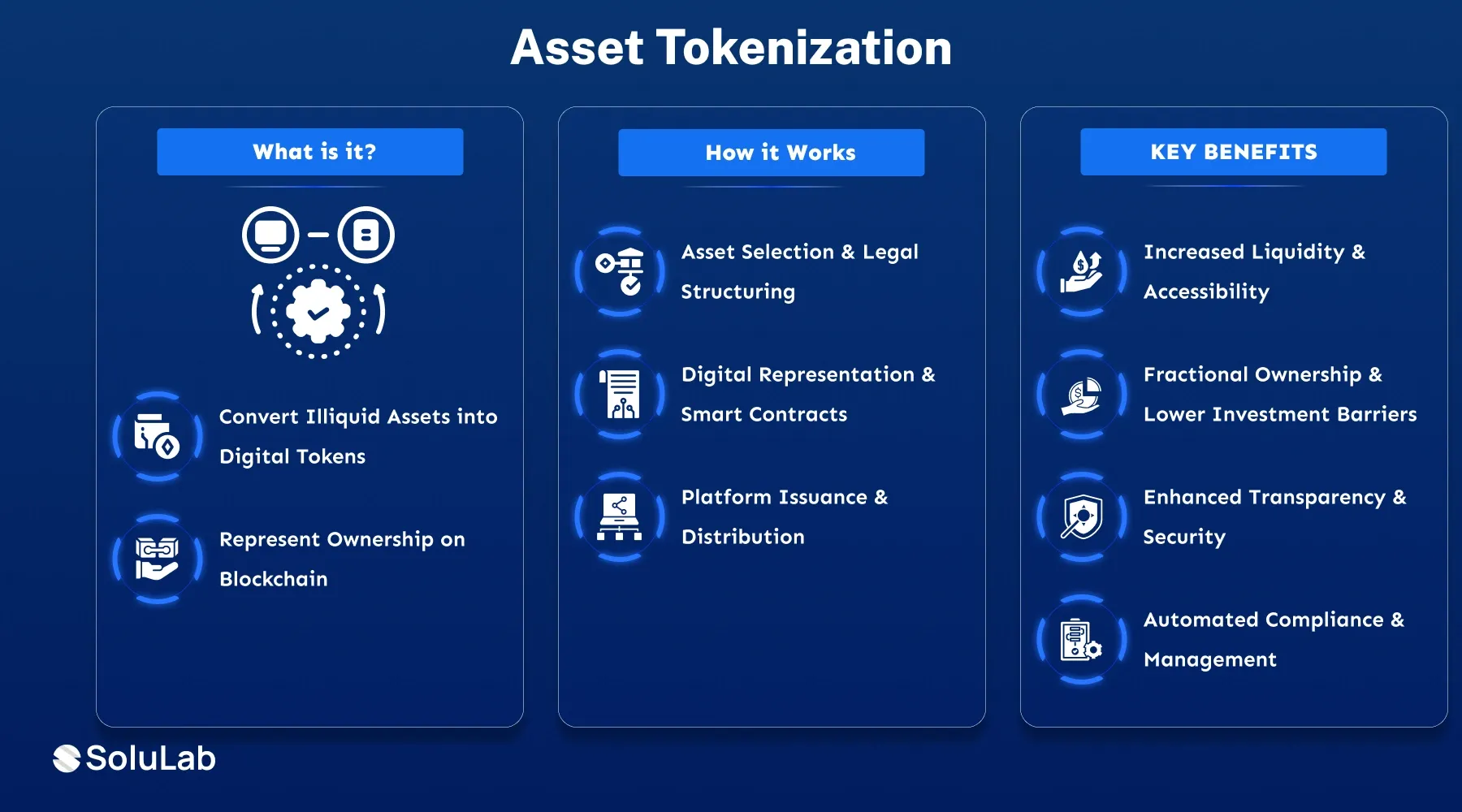
Asset tokenization is the process of converting physical or digital assets into digital tokens that exist on a blockchain. These tokens represent ownership or a share of the underlying asset, which could be anything from real estate, artwork, stocks, commodities, to even intellectual property. By utilizing blockchain technology, tokenization enables assets to be divided into smaller, tradable units, making them more accessible and liquid. 

For example, a property worth ₹1 crore could be tokenized into 1 lakh tokens, each worth ₹100, allowing multiple investors to own a fraction of it. This not only democratizes investment but also ensures transparency, faster transactions, and reduced costs through smart contracts. 

How Blockchain Digitizes Traditional  Assets?

Asset tokenization merges traditional ownership concepts with the capabilities of blockchain technology, resulting in several transformative outcomes:

  • Fractional Ownership: Assets can be divided into smaller, more affordable units, allowing a broader range of investors to participate.
  • Increased Liquidity: Tokenization enhances liquidity by making it easier to trade assets on secondary markets.
  • Reduced Transaction Costs: Blockchain transactions are efficient and cost-effective, cutting out many intermediaries.
  • Global Accessibility: Asset tokenization breaks down geographical barriers, enabling global investments and opportunities for asset owners.

Read Also: AI Tokenization For Asset Ownership

Benefits of Asset Tokenization

Tokenization of asset offers a range of benefits that are transforming how we invest, trade, and manage ownership. Here are some benefits of asset tokenization:

Benefits of Asset Tokenization

  • Enhanced Liquidity

Traditional assets, such as real estate and fine art, tend to have limited liquidity. Asset tokenization on blockchain transforms these illiquid assets into tradable digital tokens. This increased liquidity allows owners to sell their assets more easily and at any time, attracting a broader pool of potential investors.

  • Fractional Ownership

Asset tokenization divides ownership into smaller, more manageable fractions. For instance, you can own a fraction of a prestigious real estate property or a piece of valuable artwork. This democratizes investments, enabling individuals to participate in digital assets they might not otherwise afford.

  • Global Accessibility

Blockchain-based digital asset tokenization eliminates geographical barriers. Investors from around the world can access and invest in tokenized assets without the need for complex international transactions, currency conversions, or intermediaries.

  • Improved Security

The blockchain’s inherent security features ensure the authenticity and integrity of tokenized assets. Ownership records are transparent, tamper-resistant, and protected by cryptographic mechanisms. This helps to mitigate the risk of fraud and disputes.

  • Efficiency and Reduced Costs

Traditional asset transfers often involve multiple intermediaries, paperwork, and significant time delays. Real-world asset tokenization simplifies this process, reducing transaction costs and eliminating intermediaries. Smart contracts can automate various aspects of asset management and distribution.

  • Increased Transparency

Blockchain technology provides a transparent and auditable ledger of ownership and transactions. Anyone with access to the blockchain can verify the ownership of tokenized assets, enhancing trust in the system.

  • 24/7 Market Access

Tokenized assets are traded on blockchain-based platforms that operate 24/7. This continuous market access allows investors to buy or sell assets at their convenience, eliminating the need to wait for traditional market opening hours.

  • Enhanced Portfolio Diversification

Asset tokenization enables investors to diversify their portfolios easily. They can invest in a wide range of assets across different industries, like gold tokenization, art or more, spreading risk and potentially increasing returns.

  • Regulatory Compliance

Asset tokenization platforms often incorporate compliance features to ensure adherence to local and international regulations. This makes it easier for businesses and investors to operate within the legal framework.

  • Easier Inheritance and Estate Planning

Tokenized assets simplify the inheritance process. Ownership can be transferred seamlessly to heirs, reducing the complexities associated with traditional estate planning that otherwise is a major issue.

Now, let us look at some of the use cases and examples of the tokenized assets!

Read Also: Tokenizing TradFi: Real-World Assets & Smart Bonds

Emerging Use Cases of Asset Tokenization

Asset tokenization is expanding rapidly across industries, transforming how ownership, investment, and trading happen. Beyond traditional sectors like real estate and stocks, new and exciting use cases are emerging:

  • Gold and Precious Metals

Gold has long been a trusted store of value. Tokenizing gold allows investors to buy and sell small, verified portions of gold without needing physical storage or transportation. This makes gold investment more accessible and liquid while ensuring transparency through blockchain’s secure ledger.

  • Diamonds and Luxury Goods

Diamonds and other luxury goods are high-value assets often difficult to trade. Diamond Tokenization enables fractional ownership and origin verification, reducing fraud risk and opening investment opportunities in these exclusive markets.

  • Entertainment and Intellectual Property

Artists, musicians, and content creators can tokenize their work, such as music rights, film royalties, or digital art, allowing fans and investors to own fractions of these assets and receive ongoing revenue shares. Entertainment tokenization opens up new funding models and revenue streams for creative industries.

  • Carbon Credits and Sustainability Assets

As climate action grows, tokenized carbon credits and sustainability assets are gaining traction. These digital tokens allow easier tracking, trading, and verification of environmental impact, supporting green finance initiatives.

  • Tokenized Securities

Stocks, bonds, and other securities are increasingly issued as digital tokens. This streamlines issuance and trading processes, reduces settlement times, and enhances transparency. Notably, US Treasury Bills (T-Bills) are also being tokenized, offering investors a highly secure, liquid, and efficient way to buy and sell government debt instruments globally.

How Asset Tokenization Works?

How Asset Tokenization Works?

In the token economy, business interactions are reliable, quick, and irreversible. As a result, it is critical to implement the appropriate operational measures that are compliant with regulations. It is necessary to bring new participants, such as KYC utilities and blockchain analytics software vendors, forward to implement better operational measures. Here are the steps on how asset tokenization actually works:

  • Identification: Asset owners identify the asset they want to tokenize, whether it’s a property, artwork, or investment fund.
  • Legal Framework: Establish a legal and regulatory framework to ensure compliance with local laws and regulations governing tokenized assets.
  • Smart Contracts: Smart contracts, self-executing contracts with predefined rules, are created. These contracts automate asset ownership and transfer, ensuring transparency and security.

Read Our Blog Also: Top 12 Real Estate Tokenization Companies in USA

  • Token Creation: Tokens representing ownership in the asset are generated on a blockchain. Each token corresponds to a specific fraction of the asset.
  • Investor Onboarding: Investors interested in the tokenized asset go through a Know Your Customer (KYC) process to ensure regulatory compliance.
  • Purchase: Investors can purchase these tokens, becoming fractional owners of the asset. Transactions are recorded on the blockchain, ensuring transparency and immutability.
  • Ownership Management: Asset ownership, including dividend distribution, voting rights, and transfer of tokens, is managed through smart contracts.

Future of Asset Tokenization on Blockchain

As more industries recognize its potential to change how we own, trade, and manage assets. With the rise of digital asset tokenization, everything from real estate to fine art and even intellectual property can be turned into tradable tokens, with liquidity and global investor participation. 

As blockchain technology matures, blockchain tokenization will play a critical role in making financial markets more transparent, secure, and efficient. Governments and regulatory bodies are also beginning to explore frameworks to support tokenization in blockchain.  Further validating its long-term potential. 

In the coming years, we can expect to see tokenized assets become mainstream, integrated into traditional financial systems, and accessible to a wider audience. From reducing entry barriers for small investors to streamlining complex asset transactions, asset tokenization is set to redefine ownership and investment.

Asset Tokenization Development Company

Conclusion

By turning physical or digital assets into blockchain-based tokens, real world asset tokenization opens up new opportunities for fractional ownership, better liquidity, and global access. Whether you’re an investor looking to diversify or a business aiming to get value, it makes the process smoother, faster, and more transparent. As blockchain adoption grows in, understanding tokenization puts you one step ahead.

As a leading asset tokenization company, SoluLab has always been catering to the changing business needs in an efficient manner. With deep experience in blockchain development, smart contracts, and decentralized finance, our team of seasoned developers empowers businesses and investors to knock on the door of new opportunities through customized tokenization platforms.

Partner with SoluLab to unlock the full potential of blockchain-powered asset tokenization!

FAQs

1. How does asset tokenization affect ownership rights?

Token holders gain legally recognized rights to the underlying asset, which can include profits, voting, or usage rights, depending on the asset type and token structure.

2. Can anyone invest in tokenized assets?

In many cases, yes. Tokenization enables fractional ownership, allowing smaller investors to participate. However, some tokens may be restricted to accredited investors depending on legal frameworks.

3. How long does it take to launch a tokenized asset?

The timeline varies depending on asset complexity, regulatory requirements, and tokenization platform development, typically ranging from a few weeks to several months with professional support.

4. What happens if the original asset is lost or damaged?

Legal agreements and custodial arrangements usually govern the protection and maintenance of the underlying asset. Token holders rely on these protections, as the token represents ownership rights, not physical possession.

5. How do I get started with asset tokenization?

Begin by identifying the asset, ensuring regulatory compliance, partnering with a blockchain development company like SoluLab, and choosing a suitable platform for token issuance and management.


The Evolution of Token Standards: A Deep Dive into ERC-6960

ERC-6960

The world of blockchain and cryptocurrency has witnessed a remarkable evolution over the years, with various token standards playing a pivotal role in shaping the landscape. In this deep dive, we will explore the intriguing journey of token standards, with a particular focus on the groundbreaking ERC-6960 standard. From the early days of basic token standards to the sophisticated ERC-6960, we will unravel the complexities, innovations, and implications of this evolutionary process.

The Genesis: Token Standards and Their Importance

Token standards form the backbone of blockchain ecosystems, enabling the creation, transfer, and management of digital assets on a decentralized network. They provide a set of rules and protocols that ensure compatibility, interoperability, and uniformity across diverse platforms and applications. As blockchain technology matured, so did the need for more advanced and specialized token standards.

Rise of Asset Tokenization

The concept of asset tokenization emerged as a groundbreaking use case, extending the capabilities of blockchain beyond native cryptocurrencies like Bitcoin and Ethereum. Asset tokenization involves representing real-world assets (RWAs) as digital tokens on a blockchain, unlocking new possibilities for fractional ownership, liquidity, and global accessibility.

Real-World Assets (RWAs) and Their Tokenization

Real-world assets, ranging from real estate and fine art to stocks and commodities, have traditionally faced liquidity and accessibility challenges. Asset tokenization addresses these issues by converting these tangible assets into digital tokens, making them divisible, transferable, and tradable on blockchain networks. This paradigm shift has attracted significant attention from both traditional and crypto investors.

Asset Tokenization Development Solutions

The Need for Advanced Token Standards: Enter ERC-6960

In the quest for more sophisticated token standards capable of handling the intricacies of asset tokenization, the Ethereum community introduced ERC-6960. This standard goes beyond the basic functionalities of earlier standards like ERC-20 and ERC-721, offering a comprehensive framework tailored for real-world asset representation on the blockchain.

Before delving into the intricacies of ERC-6960, it is essential to grasp the limitations of prevailing token standards. The most widely used standards, ERC-20 and ERC-721, excel in representing fungible (interchangeable) and non-fungible (unique) assets, respectively. However, they falter when it comes to representing fractional ownership of an asset.

To illustrate, if you envisioned investing in a portion of a real estate property or a valuable piece of artwork, you would be required to acquire the entire asset. This substantial financial burden often proves prohibitive for the average individual. This is where ERC-6960 steps into the picture.

Token Standard Evolution: A Historical Perspective

To understand the significance of ERC-6960, it’s essential to trace the evolution of token standards. ERC-20, the first widely adopted standard, revolutionized the fundraising landscape through Initial Coin Offerings (ICOs). ERC-721 introduced the concept of non-fungible tokens (NFTs), allowing unique digital assets like art and collectibles to be tokenized. However, these standards fell short in addressing the complexities associated with real-world assets.

Deep Dive into ERC-6960

Deep Dive into ERC-6960

Understanding ERC-6960 Features

ERC-6960 introduces a set of features specifically designed for asset tokenization:

  • Divisibility: ERC-6960 tokens are divisible, allowing for the fractional ownership of real-world assets. This feature enhances liquidity and opens up investment opportunities to a broader range of participants.
  • Identity and Compliance: The standard incorporates identity and compliance protocols, ensuring that tokenized assets adhere to legal and regulatory requirements. This feature addresses concerns related to fraud, money laundering, and other illicit activities.
  • Interoperability: ERC-6960 is designed to seamlessly interact with other token standards, fostering interoperability across diverse blockchain platforms. This interoperability is crucial for the integration of asset tokenization into a broader financial ecosystem.
  • Dynamic Token Supply: Unlike fixed-supply tokens, ERC-6960 allows for the dynamic adjustment of token supply based on external factors. This flexibility accommodates changes in asset valuation and market demand.

Exploring ERC-6960

The versatility of ERC-6960 extends beyond traditional asset tokenization. It finds applications in various industries, including real estate, art, commodities, and more. Let’s explore some key use cases:

  • Real Estate Tokenization: ERC-6960 enables the fractional ownership of real estate, making high-value properties accessible to a wider investor base. This democratization of real estate investment has the potential to reshape the property market.
  • Art and Collectibles: Tokenizing art and collectibles on the blockchain ensures provenance, authenticity, and easy transferability. ERC-6960’s features make it an ideal choice for representing unique pieces of digital or physical art as tokens.
  • Commodities Trading: The dynamic token supply feature of ERC-6960 proves beneficial in commodities trading, where the token supply can adjust based on factors such as market demand, supply chain disruptions, or geopolitical events.

ERC-6960 Specifications

ERC-6960 Specifications

Delving into the technical aspects of ERC-6960, we find a well-defined set of specifications that contribute to its robustness:

Smart Contract Architecture: ERC-6960 employs a smart contract architecture that facilitates the creation, issuance, and management of tokenized assets. The use of smart contracts ensures transparency, security, and automation of asset-related processes.

Metadata Standardization: The standard includes a comprehensive metadata framework for describing tokenized assets. This metadata not only provides essential information about the asset but also aids in compliance and regulatory adherence.

Permissioned Access: ERC-6960 incorporates permissioned access controls, allowing asset issuers to regulate token ownership and transfer based on predefined criteria. This feature provides an additional layer of security and compliance.

ERC-6960 Token Development

Developing ERC-6960-compliant tokens involves adherence to the standard’s specifications and the deployment of smart contracts on the Ethereum blockchain. Developers must consider factors such as asset-specific metadata, compliance requirements, and access controls during the token creation process. The development community has played a crucial role in refining and expanding the capabilities of ERC-6960 through collaborative efforts and continuous improvement.

Token Standards Comparison: ERC-20, ERC-721, and ERC-6960

Understanding the strengths and limitations of different token standards is essential for choosing the most suitable one for a particular use case. Let’s compare ERC-20, ERC-721, and ERC-6960:

ERC-20: Ideal for fungible tokens, ERC-20 is well-suited for applications like cryptocurrencies and utility tokens. However, it lacks the sophistication required for representing unique assets or complying with complex regulatory frameworks.

ERC-721: Non-fungible tokens find their home in ERC-721, making it perfect for unique digital assets. While ERC-721 addresses the uniqueness aspect, it falls short when it comes to divisibility and dynamic token supply, limiting its application in asset tokenization.

ERC-6960: Positioned as the evolution of token standards, ERC-6960 combines the strengths of ERC-20 and ERC-721 while introducing features tailored for asset tokenization. Its divisibility, compliance, and interoperability features make it a versatile choice for a wide range of applications.

Future of Token Standards: A Glimpse Beyond ERC-6960

As technology continues to advance, the evolution of token standards is far from over. The future may witness the emergence of even more specialized standards catering to specific industries or use cases. Interoperability among different blockchain networks and standards could become a focal point, facilitating seamless asset transfer and management across diverse ecosystems.

Asset Tokenization Development: Platforms and Trends

The rise of asset tokenization has given birth to a new breed of platforms dedicated to facilitating the tokenization process. These platforms offer end-to-end solutions, from asset digitization to token issuance and trading. Some notable trends and developments in the asset tokenization space include:

Decentralized Finance (DeFi) Integration: The integration of asset-backed tokens into decentralized finance protocols expands the possibilities for borrowing, lending, and trading traditional assets in a decentralized manner.

Cross-Chain Asset Tokenization: Projects exploring cross-chain compatibility aim to bridge different blockchain networks, allowing tokenized assets to move seamlessly between platforms. This trend enhances liquidity and broadens the reach of tokenized assets.

Governance and DAOs: Asset tokenization platforms are increasingly incorporating governance mechanisms and Decentralized Autonomous Organizations (DAOs) to involve token holders in decision-making processes related to the underlying assets.

Asset Tokenization Development Services

Conclusion

The journey from basic token standards to the sophisticated ERC-6960 reflects the dynamic nature of the blockchain and cryptocurrency space. As the demand for asset tokenization grows, standards like ERC-6960 pave the way for a more inclusive and efficient financial ecosystem. The collaboration between the development community, regulatory bodies, and industry stakeholders will play a crucial role in shaping the future of token standards and their impact on the global economy. 

The Ethereum ecosystem has expanded its toolkit with the advent of ERC-6960, a revolutionary token standard poised to transform the realm of real-world assets (RWAs). This groundbreaking standard transcends mere tokenization; it serves as an unlocking mechanism, opening doors to a myriad of unprecedented opportunities for investors, developers, and the entire blockchain community.

Whether it’s the fractional ownership of real estate or the seamless transfer of unique digital assets, ERC-6960 stands as a testament to the ongoing evolution of blockchain technology, unlocking new possibilities for innovation and financial inclusion.

As the adoption of ERC-6960 gains momentum, prepare to witness a surge of groundbreaking advancements that will reshape the financial landscape. Stay tuned for this transformative journey!

FAQs

 1. What is ERC-6960?

ERC-6960 is a newly proposed token standard on the Ethereum blockchain specifically designed for tokenizing real-world assets (RWAs) such as real estate, commodities, and securities. It addresses the limitations of existing token standards by providing a comprehensive and flexible framework for representing and managing tokenized RWAs.

2. Why is ERC-6960 necessary?

Existing token standards, such as ERC-20 and ERC-721, are not well-suited for representing the complexities of RWAs, which often involve unique attributes, ownership rights, and regulatory requirements. ERC-6960 fills this gap by providing a more sophisticated framework for tokenizing RWAs, enabling fractional ownership, enhanced liquidity, and global accessibility.

3. What are the key features of ERC-6960, and how do they address the challenges associated with traditional asset representation on the blockchain?

ERC-6960 features include divisibility, identity and compliance protocols, interoperability, and dynamic token supply. These features collectively address challenges such as fractional ownership, regulatory compliance, seamless interaction with other standards, and the ability to adjust token supply dynamically based on external factors, making it suitable for real-world asset tokenization.

4. How does ERC-6960 ensure compliance with legal and regulatory requirements in the representation of real-world assets?

ERC-6960 incorporates identity and compliance protocols, ensuring that tokenized assets adhere to legal and regulatory requirements. This includes features such as permissioned access controls, metadata standardization, and smart contract architecture, providing transparency and security while facilitating regulatory compliance.

5. Can ERC-6960 tokens interact with other token standards and blockchain platforms?

Yes, ERC-6960 is designed to foster interoperability by allowing seamless interaction with other token standards. This capability enables ERC-6960 tokens to move across diverse blockchain platforms, contributing to a more interconnected and efficient financial ecosystem.

6. What are some practical use cases of ERC-6960 in the tokenization space?

ERC-6960 finds applications in various industries, including real estate, art, and commodities. Examples include fractional ownership of real estate, representing unique art pieces as tokens, and dynamic token supply adjustments for commodities trading.

7. How can developers create ERC-6960-compliant tokens, and what are the key considerations in the development process?

Creating ERC-6960-compliant tokens involves adhering to the standard’s specifications and deploying smart contracts on the Ethereum blockchain. Developers must consider factors such as asset-specific metadata, compliance requirements, and permissioned access controls during the token creation process.

8. What trends and developments are shaping the future of token standards beyond ERC-6960?

The future of token standards may witness the emergence of even more specialized standards catering to specific industries or use cases. Trends include increased interoperability among different blockchain networks, the integration of asset-backed tokens into decentralized finance (DeFi), and the incorporation of governance mechanisms and DAOs in asset tokenization platforms.

Top 10 Asset Tokenization Development Companies in 2026

As more businesses look to tokenize real-world assets, such as real estate, equities, or art, selecting the right development company has become a critical challenge. The wrong partner can mean compliance headaches, security flaws, and lost investor trust.

That’s why making an informed decision is more important than ever. With many firms offering similar services, it’s easy to feel overwhelmed. However, the truth is that not all tokenization companies are built the same. Some offer superior tech, while others excel in regulatory support or user experience.

Due to improved trading, custody, and settlement process efficiencies, the tokenization of real-world assets has the potential to generate $2.4 trillion in annual economic gains worldwide.

To help you select the best company, we’ve curated a list of the top 10 asset tokenization development companies in 2026.

What is Asset Tokenization?

Asset tokenization is the process of converting real-world assets into digital tokens on a blockchain. These tokens represent ownership or a share of the underlying asset and can be bought, sold, or traded like cryptocurrencies. 

For example, a property worth ₹1 crore can be tokenized into 1 lakh digital tokens, each worth ₹100, allowing multiple investors to own a fraction of it. This makes high-value assets more accessible, improves liquidity, and enables faster and more secure transactions. Tokenization also brings transparency through blockchain records and reduces the need for intermediaries in asset transfer processes.

How to Select the Best Asset Tokenization Development Companies?

Choosing the right asset tokenization development company is crucial to ensure your project runs smoothly, securely, and meets regulatory standards. Here are the key factors to consider while selecting the best one:

  • Experience in Blockchain and Tokenization: Look for companies with a proven track record in blockchain and tokenization projects. Their prior experience ensures better decision-making, efficient development, and fewer chances of costly technical errors.
  • Regulatory Compliance Expertise: The best companies understand global and regional legal frameworks. They help ensure your tokenized assets comply with KYC/AML laws, securities regulations, and other industry standards, reducing future legal risks.
  • Customization and Scalability: A reliable firm should offer customized solutions tailored to your business needs. They must also build platforms that are scalable, capable of growing with your user base and asset volume.
  • Security Standards: Top-tier developers adhere to rigorous security protocols, including smart contract audits, encryption, and penetration testing. This ensures your assets, data, and users remain protected from cyber threats.
  • Tech Stack and Tools: Evaluate the technologies they use—such as Ethereum, Polygon, or Hyperledger—and their familiarity with token standards like ERC-20 or ERC-1400. The right stack ensures compatibility and long-term efficiency.
  • Transparent Pricing and Timelines: A professional company provides clear cost estimates and project timelines upfront. Transparency helps avoid hidden charges and ensures realistic planning from development to deployment.
  • Post-Deployment Support: Check if the company offers ongoing support, bug fixes, and upgrades after launch. Continuous support is essential for maintaining and improving your tokenization platform over time.

CTA1

Top 10 Asset Tokenization Development Companies to Look for in 2026

1. SoluLab

SoluLab is a leading blockchain development company known for its expertise in asset tokenization solutions. With a strong portfolio of enterprise-grade projects, they offer end-to-end services—from smart contract development to token launch platforms. One of the key reasons to choose SoluLab is its ability to deliver secure, scalable, and compliant tokenization frameworks tailored to client needs.

Their services include real estate tokenization, equity tokenization, and utility tokens. Key features include cross-chain compatibility and robust KYC/AML integration, making them a reliable partner for businesses entering the digital asset space.


$25-$49


50-249


2014


Los Angeles, CA, USA


Disney, Microsoft, Georgia Tech

Konkrete

2. Konkrete

Konkrete has emerged as a distinguished player in the realm of asset tokenization development. Renowned for its expertise in facilitating the seamless conversion of tangible assets into digital tokens, Konkrete offers a comprehensive suite of services that empower businesses to harness the transformative power of blockchain technology.

With a dedicated team of experts, the company has spearheaded numerous projects spanning diverse asset classes, from real estate and precious metals to venture capital, enabling clients to unlock enhanced liquidity and investment opportunities.


$200 to $250


5-10


2022


Ontario, Canada

3. PixelPlex

PixelPlex is a leading asset tokenization development company known for its robust blockchain expertise and customized token solutions. With over a decade of experience, they help businesses tokenize real-world assets like real estate, art, and equity with full regulatory compliance.

One of their standout offerings is Tokensoft, a trusted platform that ensures secure issuance, management, and transfer of digital assets. PixelPlex provides end-to-end services from token design and smart contract development to platform integration. Pixelples offers strong KYC/AML compliance and cross-chain interoperability, making them a reliable partner for any tokenization project.


$50-$200


101-250


2007


New York, United States

4. BlockchainX

BlockchainX offers both tangible and intangible assets in highly liquid digital tokens using blockchain technology. They offer secure, regulation-compliant solutions with features like fractional ownership, cross-chain compatibility, and enhanced liquidity through secondary market trading.

Their services span across industries like real estate, art, and commodities, offering end-to-end support from ideation to deployment. With expertise in networks like Ethereum, Solana, and NEAR, they ensure seamless integration, smart contract development, and post-launch support. BlockchainX stands out for its commitment to transparency, security, and delivering custom solutions that align with global regulatory frameworks.


$25 to $50


150+


2017


Coimbatore, Tamil Nadu, India

5. Polymath

Polymath specializes in simplifying the creation and management of security tokens, helping businesses bring their token ideas to life with ease. As pioneers in security token standard development, they focus on making blockchain adoption for enterprises while ensuring compliance and security through an open ecosystem.

Their platform enhances asset liquidity and transparency by leveraging the full potential of blockchain technology. Polymath offers a range of services, including token creation, compliance tools, framework development, and integration with financial platforms. Their team also supports developers building tokenized ecosystems, making them a comprehensive partner in asset tokenization.


$200 to $250


11-50


2017


Toronto, Ontario, Canada

6. Tokensoft

Tokensoft specializes in providing secure and compliant token issuance solutions, helping businesses launch tokenized assets effectively across multiple jurisdictions. They stand out for their expert security token launch strategies and strong focus on regulatory compliance in different regions.

Tokensoft supports multiple blockchain networks, offering great flexibility for diverse project needs. Their services include token designing and issuance, developing regulatory frameworks, and investor onboarding with KYC solutions. Additionally, they offer post-launch token maintenance, making them a comprehensive partner in the asset tokenization journey.


$50-$100


11-50


2017


Austin, Texas, United States

7. Securitize

Securitize is a top asset tokenization company that bridges traditional finance with blockchain through a secure, compliant platform for digital securities. Known for their integrated regulatory framework, they offer end-to-end solutions—from token issuance to secondary trading and investor management tools.

Their strength lies in robust compliance systems and strategic partnerships with major industry players. Securitize stands out as an industry leader in securely tokenizing assets while simplifying legal and regulatory processes. Their services also include digital security issuance, trading platform development, and comprehensive compliance support.


$50 to $100


200


2017


San Francisco, California, United States

8. Tokeny

Tokeny Solutions is a top leader in asset tokenization development, known for creating secure, compliant, digital tokens that are easy to manage and transfer. With extensive experience across blockchain networks, they offer user-centric solutions that simplify complex processes while maintaining stringent compliance standards.

Their services include token development and management, identity compliance, and API integrations for various assets. Tokeny also provides strong post-launch support, ensuring smooth operation and adaptability. Their commitment to global regulatory adherence makes them a reliable choice for enterprises entering the tokenization space.


$50-$100


11-50


2017


Luxembourg, Luxembourg

9. Stobox

Stobox is a trusted name in the asset tokenization space, known for helping businesses launch and manage digital securities with ease. With a strong focus on compliance and automation, Stobox simplifies the token issuance process for real-world assets.

One of the standout reasons to choose Stobox is its user-friendly dashboard and legal framework tailored for global markets. They offer services like token issuance, investor onboarding, and secondary trading support. Key features include a customizable white-label platform and integrated KYC/AML compliance.


$50 to $100


51-100


2018


Brooklyn, New York, United States

10. tZERO

tZERO is a pioneer in merging blockchain with traditional finance, offering a secure and regulated trading platform for tokenized securities. With a strong focus on compliance, transparency, and liquidity, tZERO stands out as a market leader in blockchain-based asset tokenization.

It leverages advanced security features and ensures seamless blockchain integration into the financial ecosystem. Their services include a real-time tokenized security trading platform, an asset management solution, and a fully integrated blockchain financial ecosystem with investor engagement tools.


$47 to $68


50-100


2014


Salt Lake City, Utah, United States

CTA2

Conclusion

Tokenization continues to reshape how we invest, trade, and manage real-world assets. 

Whether you’re a startup looking to tokenize real estate or an enterprise exploring digital securities, partnering with the right development company is key to your project’s success. 

Each of these firms brings unique strengths to the table, so your final choice should align with your specific needs, goals, and jurisdiction. Asset tokenization firms will play a critical role in enabling the smooth integration of blockchain technology into current sectors, advancing a more accessible, decentralized, and inclusive economy.

SoluLab, an asset tokenization development company in the USA, can help you with real estate tokenization, equity tokenization, and more. Contact us today to discuss further. 

FAQs

1. Why is asset tokenization gaining popularity in 2026?

In 2026, asset tokenization is seeing rapid adoption due to its benefits like enhanced liquidity, fractional ownership, lower transaction costs, and global accessibility. It’s transforming how investors and institutions manage physical and financial assets.

2. How much does it cost to develop an asset tokenization platform?

The cost can range from $30,000 to over $250,000, depending on the platform’s complexity, number of tokenized assets, smart contract logic, regulatory integrations, and custom UI/UX requirements.

3. What blockchain platforms are commonly used for asset tokenization?

Popular platforms include Ethereum, Polygon, Avalanche, Binance Smart Chain (BSC), Tezos, and Hyperledger Fabric—chosen based on the client’s needs for speed, scalability, and compliance.

4. Can I tokenize both physical and digital assets?

Yes. Tokenization works for both physical assets (like real estate, gold, vehicles) and digital/intangible assets (like intellectual property, music rights, equity shares, NFTs). The key is ensuring proper asset valuation, ownership, and regulatory compliance.

5. How long does it take to launch an asset tokenization platform?

Depending on the project’s scope, it can take anywhere from 8 to 20+ weeks. This includes planning, development, smart contract deployment, legal compliance, and testing.

A Guide to Asset Tokenization

A Guide to Asset Tokenization

Investing in real estate, art, or other high-value assets often feels out of reach for everyday investors. Traditional methods involve high costs, middlemen, and limited liquidity, making asset ownership complex and restrictive.

Wanting to invest in a luxury apartment or a rare painting, but being held back by high prices and red tape. However, asset owners find it difficult to generate capital or extract value from their holdings without completely liquidating them. 

Asset tokenization is a game-changer that converts real-world assets into digital tokens on the blockchain. These tokens allow fractional ownership, increase liquidity, reduce transaction costs, and democratize access to previously illiquid markets. In this guide, we’ll break down what asset tokenization is, its benefits, use cases, and how you can get started.

Asset Tokenization (A Brief Introduction)

Tokenization is the transformative process of converting ownership and rights related to specific assets into a digital format. This method allows for the conversion of indivisible assets into tokenized representations.

To understand better, let’s take an example of an iconic painting, the Mona Lisa. To sell it traditionally, you’d need to find a buyer with the financial means to spend millions of dollars. This limits the pool of potential buyers significantly. However, through tokenization, we can fragment ownership of the painting, making it accessible to multiple individuals. Therefore, one person may own, for example, 1/25th of the painting or asset. This level of division is achievable only through tokenization, offering a modern solution compared to conventional methods. 

Read Our Blog: Top 10 Asset Tokenization Platforms in 2026

Type of Tokenized Assets

Type of Tokenized Assets 

The tokenized assets can further broadly be categorized into two types: Fungible Tokens and Non-Fungible Tokens

Fungible Tokens 

Fungible tokens refer to an asset that can be exchanged for another identical asset of the same type. When a good or service is fungible, it means it can be substituted with another identical good or service without any distinction.

Non-Fungible Tokens

Non-fungible tokens signify that each token is unique and cannot be replaced by an identical token. These tokens possess distinct characteristics, making them individual and irreplaceable. This uniqueness imparts a higher intrinsic value to NFTs compared to fungible tokens.

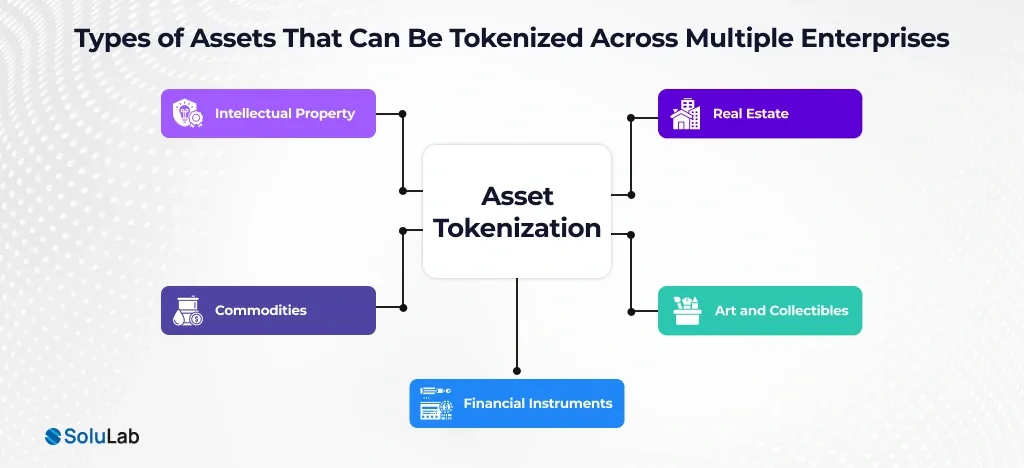
What Real-World Assets Can Be Tokenized?

1. Commodities

Tokenization allows banks to trade commodities on the blockchain by generating digital tokens that represent ownership of the underlying commodity. These tokens can be traded on a blockchain network for faster, safer transactions.

The tokens can be exchanged for the underlying asset, usually stored commodities. Banks can improve commodities trading, lower transaction costs, and increase investor transparency.

2. Securities and Stocks

Digital tokens representing asset ownership allow banks to exchange stocks and securities on the blockchain. Tokens are usually backed by securities in custody and can be exchanged for the asset. Banks can speed securities trading, lower transaction costs, and increase investor transparency.

Fractional stock and private equity ownership allow new groups to pool resources for purchases, which is intriguing. Tokens allow banks to use present assets as collateral for future acquisitions, improving liquidity.

3. Currencies

Financial organizations create digital tokens backed by a reserve currency to represent real currency holdings. These “stablecoins” retain a stable value compared to their currency, such as the US dollar. Kaleido has built many institutional financial platforms.

The stablecoin’s one-to-one backing with the underlying currency is verified by third-party audits and verifications of the reserve currency. This makes fiat money transactions faster and more secure, and connects the regular banking system to cryptocurrencies.

4. Intellectual Property

Tokens can represent intellectual property like patents or copyrights. Trading these tokens on a blockchain platform makes intellectual property licensing and distribution more transparent and efficient.

Tokens with smart contract capability can automate royalty payments, licensing terms, and other contractual responsibilities. This helps financial institutions streamline intellectual property administration, save transaction costs, and increase owner liquidity.

5. Real Estate

Tokenizing real estate assets can boost liquidity for banks, as digital assets are easier to acquire, sell, and fractionalize. Buy smaller pieces of the property to lower entry barriers and make it more available to other investors. This allows banks to reach new consumers, including individuals who can’t afford or don’t want to acquire a whole property.

Eliminating intermediaries through real estate tokenization reduces transaction time and cost. These transactions can be audited or transparent. Digitizing physical places saves money. Management costs, including property maintenance, insurance, and legal fees, can be reduced.

6. Art & Collectibles

Tokenizing art entails digitizing it on a blockchain network. Like cryptocurrencies, this digital representation can be purchased, sold, or traded. The token can be used as loan collateral, increasing liquidity. Imagine all the new people who could possess a Picasso if they owned one millionth of it.

With art prices rising in some markets, this technology can generate a tamper-proof record of ownership and transaction history, prevent fraud, prohibit counterfeits, and confirm provenance.

CTA1

Asset Tokenization on Blockchain: Potential Benefits 

Asset Tokenization On Blockchain: Potential Benefits 

Tokenizing assets on the blockchain opens up significant growth and diversification opportunities in the market by bringing a plethora of new opportunities for businesses and individuals such as continuous operation, round-the-clock data accessibility, and immediate settlement possibilities.

  • Simplified Tokenization Process

In blockchain-based tokenization, the blockchain infrastructure replaces traditional banks, and cryptocurrency tokens replace digital dollars. While the mechanics change, the fundamental tokenization process remains similar to traditional banking, forex trading, or stock market tokenization.

  • No Intermediaries

Asset tokenization on the blockchain eliminates the intermediaries in the trading process. The distributed ledger system becomes a “source of truth” that ensures transaction integrity, securely stores digitized assets and facilitates transactions. Trust is primarily placed in the issuer and relevant regulatory bodies, simplifying and cost-reducing the process while enhancing security.

  • Divisibility of Assets

Tokenization can divide any asset into an unlimited number of virtual shares, each represented by a separate token. This feature enhances liquidity in markets where it was previously limited.

Consider real estate investments. Traditionally, buying or renting an entire building can be prohibitively expensive. However, using blockchain to divide a building into 100 tokens, each costing $2,500, reduces the investment threshold to $250. 

Similar divisibility applies to intellectual property, pharmaceutical development, space research, and even entire countries, enabling greater citizen involvement in political processes.

  • Enhanced Liquidity

Tokenizing assets broadens their accessibility, amplifying market liquidity by removing the traditional obstacles associated with illiquid investments, such as fine art or real estate. Tokenized assets can be seamlessly exchanged online, enabling investors to acquire fractional ownership in the underlying asset. In addition to increasing the liquidity of existing markets, this double effect opens up a wider range of investment opportunities to a wider range of investors.

  • Efficient and Cost-Effective Transactions

Crypto tokens eliminate the need for intermediaries and intermediaries, prevalent in traditional asset management processes. As a result, the value transfer process becomes more efficient and cost-effective by a reduction in transaction costs and processing time. Moreover, crypto tokens, residing on blockchain technology, facilitate 24/7 global trading, providing uninterrupted accessibility and flexibility.

  • Transparency and Verifiability

Crypto tokens’ residence on the blockchain ensures transparent provenance and transaction histories, cryptographically verifiable by users. Blockchain automatically records transactions, and its immutable and transparent nature guarantees the authenticity of each token’s historical data. These attributes endow crypto tokens with a level of trustworthiness rarely matched by other digital assets.

  • Immutability of Data

Data recorded on the blockchain cannot be altered, deleted, or tampered with by bribing officials or hacking systems. This inherent feature is due to blockchain architecture, which records information in blocks.

This immutability makes blockchains suitable for state registries, online banking systems, and corporate databases where data accuracy is paramount. It ensures the ability to trace the history of tokens or assets, deterring fraud, theft, errors, or corruption.

  • Enhanced Security

Blockchain Tokenization relies on cryptography and distributed registries. Cryptography safeguards open data by encrypting it with secret algorithms and keys. This enables secure storage of confidential or financial information while maintaining transparency.

These security measures enhance the safety of stored information in Token, including owner details and billing information.

  • Automation with Smart Contracts

Blockchain enables the automation of most workflow and bureaucratic procedures through smart contracts—autonomous algorithms that facilitate the exchange of assets like money, stocks, tokens, or real estate.

Smart contracts automate processes, eliminate intermediaries, accelerate transactions, reduce costs, and combat corruption. They operate based on predefined conditions, executing actions when certain criteria are met.

  • Transparency

Most blockchains are open-source software, allowing users and developers to inspect the code for vulnerabilities and functionality. This transparency ensures compliance with regulations, reduces fraud risk, and instills confidence in issuers and their assets.

Related: On-Chain vs. Off-Chain Asset Tokenization

How Does Asset Tokenization Profit the Asset Owners?

Asset tokenization brings real financial and operational benefits to asset owners. Here’s how:

  • Increased Liquidity: Owners can sell fractional shares of high-value assets, making it easier to access cash without selling the entire asset.
  • Wider Investor Reach: Digital tokens allow global investors to participate, expanding the potential buyer pool.
  • Lower Transaction Costs: Blockchain reduces the need for intermediaries, cutting fees and speeding up transactions.
  • Improved Transparency: Smart contracts ensure automated, secure, and traceable transactions, building trust with investors.
  • Enhanced Asset Utilization: Previously illiquid assets (like art or real estate) become monetizable, unlocking hidden value.

How Does Asset Tokenization Profit the Investors? 

  • Investors can easily diversify their portfolios by investing small amounts in tokenized assets, enhancing liquidity, and reducing paperwork hassles.
  • Tokenization enables quicker asset liquidity, eliminating long lock-up periods and allowing investors to access profits or make adjustments sooner.
  • Blockchain-based asset history ensures transparency, enabling investors to make informed decisions based on an asset’s true background.
  • Decentralized identity and blockchain technology provide secure, verifiable ownership and identity verification, meeting KYC/AML requirements and ensuring trust across various platforms.

Additional Features

In addition to the above benefits, tokenization offers a wide range of possibilities, including trading, storage, collateral usage, payment for goods and services, participation in loyalty programs, voting, and access to blockchain platforms.

How Does Asset Tokenization Work? 

The working of tokenization on the Blockchain network involves replacing sensitive information with an equivalent, non-sensitive placeholder known as a “token.” These tokens can be generated through several methods:

  • Using a mathematically reversible cryptographic function with a specific key.
  • Employing non-reversible functions, such as a hash function.
  • With indexing functions or generating a random number.

As a result, the token takes the place of sensitive information, while the actual sensitive data it represents is securely stored in a server referred to as a “token vault.” The token vault serves as the sole location where the original information can be mapped back to its corresponding token, ensuring the safeguarding of sensitive data. 

The Steps Involved in the Tokenization Process 

The steps involved in the Tokenization process are

1. Asset Selection- Select an asset, for example- a piece of art, intellectual property right, or house to tokenize. 

2. Asset Valuation- In this step, asset evaluation is done to determine its value, and parameters are set to understand the worth of the digital token 

3. Token Creation: After determining the value, the token is created using Blockchain technology. The token contains information related to the asset it represents such as ownership information, benefits, and rights.

4. Legal and Compliance– As per the jurisdiction, a token must fulfill the regulatory requirements and legal agreements. The process ensures that created tokens adhere to the applicable laws and regulations. 

5. Token Offering – The token created now can be made available for sale. The interested party who purchases the token will become the owner of the faction and the entire token as per the purchase agreement. 

Properties of Tokenized Real-World Assets

Properties of Tokenized Real-World Assets

  • Smart Contract 

The tokenization of real-world assets is achieved through the deployment of smart contracts. These self-executing contracts contain predefined instructions and automatically execute when specified conditions are met. This innovative approach promotes decentralization and eliminates the necessity for third-party intermediaries in transaction processes.

  • Fractionalization

Real-world assets can be subdivided into numerous digital tokens within the blockchain ecosystem. This fractionalization enhances liquidity and fosters financial inclusivity. For instance, a $1 million commercial building can be fragmented into one million digital tokens, each valued at just $1, thereby significantly reducing the investment threshold.

  • Enhanced Liquidity

Asset tokenization enhances liquidity by simplifying asset trading and transfers within a unified platform. Digital tokens can be freely and instantaneously exchanged in a peer-to-peer manner, obviating the need for intermediary financial institutions.

  • Transparency

Tokenized real-world assets are the real-world tokens present on a blockchain, which inherently offers transparency. Blockchain users can check the transaction records, trace the asset’s origins, scrutinize its complete history, and validate ownership.

  • Real-Time Tracking

As blockchains are transparent, they enable real-time tracking of tokenized assets, effectively deterring fraudulent activities. Central banks worldwide are adopting fiat currency in tokenized form, known as CBDC – “Central Bank Digital Currency”, that users can continuously monitor.

  • Unified Data Layer

Blockchain technology streamlines data management by providing a unified data layer. This facilitates more efficient data sharing and collaboration among multiple parties involved in asset management.

  • Financial Inclusivity 

Digital tokens can be issued by a wide range of entities, from small-sized businesses to big-scale industries, individuals, private companies, and non-governmental organizations, without the need for approval from traditional financial institutions. However, if these tokens are classified as securities, registration with regulatory bodies like the U.S. Securities and Exchange Commission may be required. Additionally, asset fractionalization lowers the entry barrier, promoting financial inclusivity.

  • Decentralized Distribution

Digital tokens can be easily distributed without reliance on third-party intermediaries. Token issuers have the flexibility to list their tokens on DEXs or can sell them autonomously.

  • Non-Fungibility

Non-fungible digital tokens (NFTs), which are unique and irreplaceable. Unlike fungible tokens like ETH, each NFT is distinct and non-replicable.

Industries Leveraging the Concept of Tokenization of Assets

Industries that are Embracing the Concept of Tokenization of Assets

1. Finance: Blockchain technology, specifically payment tokenization, has changed finance operations. Tokenization has altered asset management by improving exchange services and data security, eliminating the need to store credit card data. In 2020, decentralized finance (DeFi) emerged, disrupting traditional institutional frameworks by offering a variety of financial goods and services. Decentralized Finance (DeFi), with lending protocols and yield-farming tokens, can alter global banking and lending regardless of local financial conditions.

2. Real Estate: Blockchain technology has enabled asset tokenization in the real estate business, reducing middlemen and enabling cost-effective buyer-seller platforms. Tokenization promotes diverse markets and prevents fraud. Tokenization includes describing properties as blockchain tokens. This strategy allows fractional ownership by dividing ownership into smaller fractions. Thus, tokenization facilitates secondary market property share transactions. This method increases liquidity and democratizes real estate investments, making them more accessible.

  Read Also: 9 Blockchain Real Estate Companies to Watch in 2026

3. Healthcare: The healthcare industry is considering asset tokenization to solve data security and supply chain management issues. Healthcare blockchain solutions use tokenization to replace sensitive patient data with non-sensitive representations. This empowers individuals and healthcare organizations by giving them personal data ownership. Pharmaceutical tokens are unique units of medication that use tamper-proof QR codes for authentication. This strategy increases supply chain transparency and reliability, reducing counterfeit pharmaceutical items. Thus, this step is vital to patient safety.

4. Retail: Tokenization has become a popular strategy in retail, enhancing user experiences and security. Businesses may offer safer, more convenient payment options with blockchain tokenization. Payment tokenization lets users trade without sharing credit card information, reducing data breaches and fraud. Businesses can transform consumer loyalty points and prizes into tokens, making them more transferable across stores and platforms. This strategy boosts customer loyalty and simplifies store loyalty program

5. Supply Chain: Tokenization has improved supply chain transparency, traceability, and operational efficiency. Blockchain technology lets companies tokenize commodities, transportation, and inventories. This lets stakeholders track these assets along the supply chain. Transparency helps prevent counterfeiting, theft, and fraud and ensures product authenticity. Tokenization streamlines payments and documentation, reducing paperwork and administrative overhead. Thus, supply chains are more agile and responsive, speeding delivery and lowering costs for businesses.

6. Entertainment: Blockchain tokenization is changing entertainment content development, distribution, and monetization. Music, film, and art producers can tokenize their digital assets. This empowers individuals by increasing their control over intellectual property and royalties. Blockchain technology might automate licensing, copyright, and revenue-sharing arrangements, ensuring artists fair compensation. Tokenization also allows fans and investors to support their favorite musicians and invest in their projects. Democratizing the entertainment industry may empower content creators and consumers.

Real-World Use Cases of Asset Tokenization

Real-World Use Cases of Asset Tokenization internal image

Tokenization is revolutionizing various industries by leveraging blockchain technology to transform real-world assets into digital tokens, thereby enhancing liquidity and accessibility. Here are some real-life use cases where tokenization is making a significant impact.

  • Tokenization of Real Estate Assets

In the realm of real estate tokenization entails breaking down traditionally illiquid property assets into fungible blockchain tokens. 

Elevated Returns, an asset management firm based in New York, demonstrated the potential of this approach by tokenizing the St. Regis Resort in Aspen, Colorado, worth $18 million on the Ethereum blockchain in 2018.

  • Tokenization of Artwork

Tokenization extends its influence to the world of art. Consider the scenario where a company holds ownership of a limited number of prints of an artwork by a renowned artist. These prints can be tokenized, allowing the public to redeem tokens for physical copies. If the value of tokens redeemed falls short of a certain threshold, token holders can retain fractional ownership based on the assessed value. 

TheArtToken (TAT) offers tokens representing partial ownership of Contemporary and post-war art, securely stored by the Swiss government. This approach simplifies the buying and selling of art fractions.

  • Monetary Gold Tokenization by Perth Mint

The Perth Mint (Australia) launched GoldPass, a digital platform that lets users buy, sell, and transfer digital gold certificates backed by physical gold stored in their vaults. Each digital certificate is fully backed by real gold, offering a modern way to trade the metal securely and efficiently.

This highlights how a gold tokenization development company can enable financial institutions and mints to digitize gold assets, making them accessible to everyday investors without physical handling.

Read Also: Gold Tokenization and How Does It Work?

  • Tokenization of Physical Commodities

Even in the realm of physical commodities, tokenization is making strides. Take the example of gold stored in a vault owned by ABC. ABC can tokenize ownership of a portion of the gold, maintaining an ownership registry with the vault owner, XYZ. Each token sold represents ownership of a corresponding amount of gold. Token holders can redeem their gold by proving ownership via a digital signature or certificate. 

JP Morgan, a financial services giant, has revealed plans to tokenize gold bars on their Quorum blockchain network. This showcases the potential for tokenization in the world of physical assets.

  • Tokenization in Cargo

In the logistics sector, tokenization addresses the inefficiencies associated with traditional proof of ownership, such as Bill of Lading (B/L) documents. 

CargoX introduces a solution through tokenization called Smart B/L, built on Ethereum. The Smart B/L system operates akin to tokenization. Carriers create a Smart B/L using their app and send it to exporters. Upon receiving payment from importers, exporters transfer ownership of the Smart B/L token. Importers, in turn, can claim ownership of the goods by presenting the Smart B/L token to the carrier. This innovative approach streamlines cargo logistics, reducing delays and simplifying ownership verification.

These real-world examples vividly illustrate how tokenization is enhancing liquidity, accessibility, and efficiency across various sectors.

CTA2

Conclusion

Asset tokenization is changing how we view ownership, trade, and investment. By converting real-world assets into digital tokens on the blockchain, it offers greater transparency, liquidity, and accessibility to investors across the globe.

Whether it’s real estate, art, or commodities, tokenization breaks down traditional barriers and opens up new opportunities for fractional ownership. As regulations evolve and technology matures, more businesses and individuals are likely to adopt this model.

For anyone looking to future-proof their investment strategy or business model, understanding asset tokenization isn’t just smart, it’s essential.

SoluLab, a top asset tokenization development company in the USA, provides the best services as per your business needs. Contact us today to discuss further.

FAQ

1. What is the future of asset tokenization?

Asset tokenization is set to revolutionize global finance by boosting liquidity, enabling fractional ownership, and making investments more accessible, transparent, and efficient.

2. What distinguishes cryptocurrencies from tokens? 

While tokens seek to facilitate the creation of decentralized applications (dApps), and other blockchain-based platforms, coins serve as the cornerstone for safe and decentralized networks. 

3. Which is the best cryptocurrency for tokenization?

The mantra OM in the realm of real-world asset tokenization arena is a layer 1 blockchain platform the other cryptocurrencies for tokenization are such as OriginTrail (TRAC), Pendle (PENDLE), Polymesh (POLYX), and TokenFi (TOKEN). 

4. What should businesses look for when choosing an asset tokenization development company?

Businesses should prioritize expertise in blockchain, regulatory compliance, security, and industry-specific solutions to ensure scalable, secure, and legally sound tokenization platforms.

5. How can asset tokenization be aided by SoluLab?

Consultation, creation, and deployment of tokenization of assets customized according to your company’s needs and preferences all come under SoluLab’s extensive services offered.

Vaultless Tokenization vs. Vault Tokenization

Vaultless Tokenization vs. Vault Tokenization


In the rapidly evolving world of data security, tokenization has emerged as an effective strategy for protecting sensitive information. However, as with any technology, there are different approaches to tokenization, each with its own strengths and weaknesses. The two primary forms – vault tokenization and vaultless tokenization – provide unique security benefits and challenges. In this comprehensive guide, we will delve into the intricacies of these two methods, examine their efficiency and safety, and help you understand which might be a better fit for your organization’s needs.

Understanding Data Tokenization: Vault Vs. Vaultless

Tokenization is a process that involves replacing sensitive data with a unique identifier or “token.” This tokenization explained can then be used in place of the original data, keeping it safe from potential threats. While both the vault and vaultless tokenization employ this basic concept, they differ significantly in their approach to storing and managing the tokens.

Vault tokenization refers to a method where the tokens are stored in a secure database called a vault. The vault acts as a centralized repository for storing and managing the tokens. When sensitive data needs to be tokenized, it is sent to the vault, which generates a unique token and stores it securely. Whenever the original data needs to be retrieved or used, the token is sent to the vault, which then retrieves the corresponding original data and returns it.

On the other hand, vaultless tokenization eliminates the need for a centralized vault. Instead, the tokenization process happens locally or on the client side. In this approach, the tokenization algorithm is performed on the user’s device or application before any data is transmitted. This means that the sensitive data never leaves the user’s environment, and only the tokenized version is transmitted or stored. The responsibility of managing the tokens lies with the user or the client-side application.

Read Also: What is Asset Tokenization?

The choice between vault and vaultless tokenization depends on various factors, including security requirements, data privacy regulations, and system architecture. Vault tokenization can provide centralized control and management of tokens, making it suitable for scenarios where there is a need for strict access control and auditing. It may also be preferred when dealing with large-scale data sets or complex systems.

On the other hand, vaultless tokenization offers greater flexibility and decentralization. It reduces the reliance on a central vault and can be more suitable for distributed or cloud-based environments. It may be preferable in situations where data sovereignty or privacy concerns require keeping sensitive data within the user’s control. Ultimately, the choice between vault and vaultless tokenization should be based on a thorough understanding of the specific requirements and considerations of the system or application in question.

The Importance of Secure and Efficient Data Protection Methods

In today’s digital landscape, data breaches pose a significant risk to companies of all sizes. Therefore, employing secure, efficient, and compliant data protection methods becomes crucial. Tokenization offers such a solution, but understanding the nuances between the vault and vaultless strategies is critical for implementing an effective data security plan.

Vault Tokenization:

Vault tokenization refers to the process of storing sensitive data in a secure vault, where it is encrypted and replaced with a token. This token acts as a reference to the original data but does not reveal any sensitive information. The vault becomes the central point for managing and controlling access to sensitive data.

Strengths of Vault Tokenization:

  • Enhanced security: By encrypting and securely storing data in a centralized vault, vault tokenization provides robust protection against unauthorized access or data breaches.
  • Simplified compliance: With sensitive data stored in a vault, organizations can easily demonstrate compliance with various industry regulations and standards.
  • Centralized control: Vault tokenization allows for efficient management and control of access to sensitive data, ensuring that only authorized individuals can retrieve or use it
  • Flexibility: Since the original data remains in the vault, organizations can perform search, analysis, and other operations on the data without compromising security.

Check Out Our Press Release: SoluLab’s White Label Real Estate Tokenization Platform is all set to start tokenizing the real estate assets instantly

Weaknesses of Vault Tokenization:

  • Potential single point of failure: If the vault is compromised, all the sensitive data stored within it could be at risk.
  • Increased infrastructure requirements: Implementing vault tokenization may require additional hardware and software infrastructure to ensure secure storage and access.

Vaultless Tokenization:

Vaultless tokenization, also known as format-preserving tokenization or deterministic tokenization, involves applying an algorithm to the sensitive data to generate a token that retains the same format and length as the original data. Unlike vault tokenization, vaultless tokenization does not rely on a centralized vault for storage.

Strengths of Vaultless Tokenization:

  • Reduced risk of a single point of failure: Since there is no centralized vaulted tokenization, the risk of a breach compromising all the sensitive data is minimized.
  • Simplified implementation: Vaultless tokenization can be implemented more easily than vaulted tokenization, as it does not require setting up and managing a centralized vault.
  • Retains data format: The format-preserving nature of vaultless tokenization makes it suitable for applications that require the original data format to be preserved, such as databases or legacy systems.

Weaknesses of Vaultless Tokenization:

  • Potentially weaker security: Without the added layer of encryption and storage in a secure vaulted tokenization, the risk of unauthorized access to sensitive data may be higher.
  • Limited search and analysis capabilities: Since the original data is not stored, performing operations like search or analysis on the tokenized data might be more challenging.

CTA1

Overview of Vault Tokenization

Exploring the Concept of Vault Tokenization

Vault tokenization involves storing the original, sensitive data in a secure database known as a “tokenization vault” after it has been replaced by a non-sensitive token. This method is often employed by data protection companies to safeguard information until it needs to be retrieved for various purposes. such as processing transactions or verifying identities. The tokenization process involves generating a unique token that is used as a placeholder for the original data. This token is then stored in the tokenization vault, while the actual sensitive data is encrypted and stored separately.

When the need arises to retrieve the original data, the token is used as a reference to access the secure vault. Only authorized individuals or systems with proper authentication can retrieve the original data by presenting the corresponding token. This ensures that sensitive information remains protected and reduces the risk of unauthorized access or data breaches.

Vaulted tokenization provides several benefits for data protection. Firstly, it eliminates the need to store sensitive data in multiple locations, reducing the chances of data exposure. Additionally, it simplifies compliance with data protection regulations as the sensitive data is securely stored and isolated from other systems. Lastly, it enables organizations to safely store and manage large amounts of sensitive data without compromising security. Overall, vaulted tokenization is an effective method for safeguarding sensitive data while still allowing authorized access when necessary. It ensures data privacy and security, giving organizations peace of mind in their data protection efforts.

The Mechanism of Vault Tokenization: From Sensitive to Non-Sensitive Data

The process begins when an organization sends its sensitive data to the vault tokenization server. This server converts the sensitive data into non-sensitive data, stores its mapping in the tokenization vault database, and returns the non-sensitive data to the organization.

Detokenization in Vault Tokenization: Reversing the Process

When the original data is needed, the organization sends the non-sensitive data to an authorized application, which then passes it to the tokenization server. The server uses the vault database to convert the data back into its original, sensitive form.

Overview of Vaultless Tokenization

The Basics of Vaultless Tokenization

Vaultless tokenization, on the other hand, does not require a tokenization vault to store data. Instead, it uses secure cryptographic devices to replace sensitive data with a unique token. This method is often deemed more efficient and safer due to the absence of a database. or vault that can be compromised. With vaultless tokenization, the sensitive data is never stored, and only the unique token is used for identification or retrieval purposes. This eliminates the risk of a data breach or unauthorized access to sensitive information.

In addition to being more secure, vaultless tokenization also offers efficiency benefits. Since there is no need to store and retrieve data from a vault, the process becomes faster and more streamlined. This can be especially advantageous in real-time transaction processing scenarios where speed is crucial. Furthermore, vaultless tokenization simplifies compliance with data protection regulations. By not storing sensitive data, organizations can minimize their scope of compliance and reduce the associated costs and complexities.

Read Also: What are Tokenized Securities and Their Importance!

Overall, vaultless tokenization provides a robust and efficient way to protect sensitive data without compromising security. It offers an alternative approach to traditional tokenization methods that rely on a centralized vault or database, making it a preferred choice for organizations seeking enhanced data protection.

Understanding the Role of Cryptographic Devices in Vaultless Tokenization

These cryptographic devices use standard-based algorithms to convert sensitive data into non-sensitive data or tokens. This tokenization explained can then be used for detokenization, allowing the retrieval of the original data without needing a tokenization vault database.

Categories of Vaultless Tokenization: Anonymization and Pseudonymization

There are two primary classes of vaultless tokenization: Anonymization and Pseudonymization. Anonymization permanently de-identifies data, making re-identification impossible. Pseudonymization, on the other hand, allows data de-identification that can be reversed, meaning the link between an individual’s identifiers and their information can be re-established. if necessary.

Anonymization is a more stringent form of data protection, as it completely removes any identifying information from the data. This ensures that even if someone were to gain access to the tokenized data, they would not be able to trace it back to the original individual. Pseudonymization, on the other hand, replaces identifying information with pseudonyms or tokens but retains the ability to re-identify the data if needed. This can be useful in situations where some level of data linkage is required for specific purposes, such as data analytics or research.

Both approaches boast their own unique benefits and applications. Anonymization provides a higher level of privacy protection but may limit certain functionalities that require data linkage. Pseudonymization offers a balance between privacy and usability, allowing for reversible de-identification when necessary while still protecting individuals’ identities.

It’s important to note that both anonymization and pseudonymization are techniques used to protect sensitive data, but they are not foolproof. Additional security measures should be implemented to safeguard the tokenization process and the handling of the tokens to prevent unauthorized re-identification or data breaches.

Comparing Efficiency: Vault vs. Vaultless Tokenization

Evaluating the Efficiency of Vault Tokenization

Vault tokenization provides a secure method for storing and retrieving sensitive data. However, it can become less efficient as the volume of data increases. With more data to token and detokenize, the size of the vault database grows, leading to increased latency. and decreased performance.

One way to address this issue is through intelligent data management techniques. This includes implementing data archiving and purging strategies to remove unnecessary or outdated data from the vault database. By regularly cleaning up the database, the overall size can be reduced, resulting in improved efficiency and performance.

Check Out Our Press Release: SoluLab Honored By GoodFirms as the Winner of Trusted Choice Award 2023

Another approach is to employ data compression techniques. Compressing the vault database can significantly reduce its size without compromising security. This can be achieved through various compression algorithms that are designed to minimize storage requirements while maintaining data integrity.

Additionally, optimizing the tokenization and detokenization processes can help enhance efficiency. This involves streamlining and fine-tuning the algorithms and procedures used for these operations to minimize computational overhead and latency. Implementing caching mechanisms and utilizing indexing techniques can also improve the retrieval speed of tokenized data. Furthermore, scaling the infrastructure supporting the vault system can enhance performance. This includes deploying additional servers or utilizing cloud-based solutions to distribute the workload across multiple instances. Load-balancing techniques can also be employed to evenly distribute requests and prevent any single point of failure.

Overall, ensuring efficient vault tokenization with increasing data volumes requires a combination of smart data management practices, compression techniques, algorithm optimization, and infrastructure scaling. By implementing these strategies, organizations can maintain high-performance levels while securely storing and retrieving sensitive data.

Assessing the Efficiency of Vaultless Tokenization

Vaultless tokenization, in contrast, does not face the same scalability issues. Since it doesn’t rely on a database, it remains equally efficient regardless of the data volume. This absence of a database also means there’s no need for data replication between centers, further enhancing efficiency. and reducing the chances of data inconsistencies. Vaultless tokenization achieves this by generating unique tokenization explained for each sensitive data element, such as credit card numbers or social security numbers, on the fly, without the need for a centralized database to store and retrieve the tokens.

Instead, the tokenization process is typically performed within the application itself, using encryption algorithms and secure key management systems. This enables each application or system to tokenize its own sensitive data independently without relying on a shared or centralized tokenization service.

As a result, vaultless tokenization offers several advantages. Firstly, it eliminates the need for complex database infrastructure and maintenance, which can be costly and resource-intensive. This makes it easier and more cost-effective to implement tokenization across multiple systems or applications.

Secondly, the absence of data replication between centers reduces network traffic and latency, improving overall system performance and responsiveness. This is particularly beneficial in distributed environments where data is stored across multiple locations or data centers.

Furthermore, vaultless tokenization offers better scalability as it can handle increasing data volumes without impacting performance. Since there is no reliance on a centralized database, the tokenization process remains efficient regardless of the amount of data being tokenized. Lastly, without the need for data replication, vaultless tokenization also reduces the chances of data inconsistencies or synchronization issues between different centers or databases. Each application or system maintains its own tokens, ensuring data integrity and consistency within its own context. Overall, vaultless tokenization provides a scalable, efficient, and cost-effective solution for protecting sensitive data without the limitations and scalability challenges associated with traditional database-dependent tokenization approaches.

Which is More Efficient? A Comparative Analysis

While both methods have their advantages, vaultless tokenization often proves to be more efficient, particularly for large volumes of data. Its usage of cryptographic devices and algorithms, rather than a database, allows for faster processing times and reduced latency.. Additionally, vaultless tokenization offers more flexibility in terms of scalability and integration with existing systems.

One advantage of vaultless tokenization is its faster processing times. Traditional tokenization methods typically involve retrieving data from a database and replacing it with a token. This process can introduce latency due to the time it takes to access and retrieve data from the database. In contrast, vaultless tokenization utilizes cryptographic devices and algorithms to generate and manage tokens, eliminating the need for database access. As a result, tokenization can be performed much more quickly, leading to improved efficiency, especially when dealing with large volumes of data.

Read Our Blog: Importance Of Tokenization Of Assets

Moreover, vaultless tokenization reduces latency by minimizing the number of steps involved in the tokenization process. With traditional tokenization, data needs to be retrieved from the database, replaced with a token and then stored back in the database. Each of these steps introduces some delays and potential points of failure. In contrast, vaultless tokenization directly generates and manages tokens using cryptographic techniques, eliminating the need for multiple database interactions. This streamlined approach significantly reduces latency, enabling faster processing and response times.

Scalability is another area where vaultless tokenization shines. Traditional tokenization methods often rely on a centralized database to store and manage tokens. As the volume of data increases, the performance of the database can degrade, leading to slower processing times. In contrast, vaultless tokenization distributes the token generation and management across cryptographic devices, allowing for better scalability. By leveraging multiple devices, vaultless tokenization can handle larger volumes of data without sacrificing performance.

Furthermore, vaultless tokenization offers greater flexibility in integration with existing systems. Traditional tokenization methods often require modifying databases and applications to accommodate the tokenization process. This can be time-consuming and disruptive to existing systems. On the other hand, vaultless tokenization can be implemented without significant changes to existing infrastructure. It leverages cryptographic devices and algorithms, which can be integrated into existing systems more seamlessly. This flexibility makes vaultless tokenization a more attractive option for organizations looking to adopt tokenization without disrupting their current operations.

In conclusion, while both methods of tokenization have their advantages, vaultless tokenization proves to be more efficient, particularly for large volumes of data. Its utilization of cryptographic devices and algorithms enables faster processing times, reduced latency, better scalability, and easier integration with existing systems. Considering these benefits, vaultless tokenization is an attractive option for organizations seeking efficient and secure data protection.

Analyzing Safety: Vault vs Vaultless Tokenization

Safety Concerns in Vault Tokenization

With vault tokenization, the primary safety concern lies in the security of the tokenization vault itself. If a breach were to occur, the original, sensitive data could be at risk. Furthermore, replicating data between centers for fault tolerance could potentially expose the data to additional risks, such as unauthorized access or interception during data transfer. It is crucial to implement robust security measures to protect the tokenization vault and ensure secure replication of data between centers.

Read Also: Top 10 Asset Tokenization Platforms in 2025

To mitigate these risks, several best practices can be followed:

  • Secure Infrastructure: The tokenization explained vault should be hosted on a highly secure infrastructure with strong access controls, encryption, firewalls, and intrusion detection systems. Carry out regular security audits and vulnerability assessments to pinpoint and resolve any potential weaknesses.
  • Access Controls: Implement strict access controls to limit access to the tokenization vault only to authorized personnel. Multi-factor authentication, role-based access controls, and privileged access management should be enforced to prevent unauthorized access.
  • Encryption: Employ strong encryption mechanisms to protect both data at rest and in transit. This includes using industry-standard encryption algorithms and key management practices to safeguard sensitive data.
  • Monitoring and Logging: Implement comprehensive monitoring and logging systems to detect any suspicious activities or breaches in real-time. Security event logs should be regularly reviewed and analyzed to identify potential threats and take appropriate actions.
  • Data Replication: When replicating data between centers for fault-tolerance, ensure that the replication process itself is secure. This can involve using secure communication channels, encrypting data during transit, and verifying the integrity of replicated data at each endpoint.
  • Disaster Recovery and Business Continuity: Develop and regularly test a robust disaster recovery plan to ensure data availability in case of a breach or system failure. This includes regular backups, offsite storage of backup data, and procedures for rapid recovery.
  • Regular Security Audits and Penetration Testing: Conduct regular security audits and penetration testing to identify vulnerabilities and weaknesses in the tokenization vault system. Address any recognized issues swiftly to ensure top-notch security.

By implementing these measures, organizations can significantly enhance the security of their tokenization vaults and reduce the risk of data breaches or unauthorized access to sensitive information.

The Safety Measures in Vaultless Tokenization

Vaultless tokenization addresses these concerns by eliminating the need for a tokenization vault. The cryptographic devices used in this method provide a high level of security, and since there’s no database, there’s less vulnerability to breaches.

Which is Safer? A Detailed Comparison

While both methods offer a level of protection, vaultless tokenization generally provides greater safety measures. Its elimination of the tokenization vault and data replication significantly reduces the risk of data breaches.

Use Cases: Vault vs. Vaultless Tokenization

Instances of Vault Tokenization in Real-World Scenarios

A notable instance of vault tokenization in practice is the Marriott data breach in 2018. Despite using tokenization methods, the hotel chain suffered one of history’s largest data breaches, underscoring the potential risks associated with vault tokenization and the need for robust security measures.

In the Marriott data breach, which was discovered in November 2018 but had been ongoing since 2014, the personal information of approximately 500 million guests was compromised. This included sensitive data such as names, addresses, passport numbers, and payment card information.

Marriott had implemented tokenization as a security measure to protect guest payment card data. Tokenization involves replacing sensitive data with randomly generated tokens, which are then used for transactional purposes. In this case, Marriott used a system where payment card information was tokenized, and the tokens were stored in a vault.

Check Out Our Press Release: SoluLab Bridging the Gap Between Technology And Innovation

However, despite the use of tokenization, the breach occurred due to unauthorized access to Marriott’s Starwood guest reservation database. The attackers were able to gain access to both encrypted and decrypted payment card information, rendering the tokenization ineffective in this particular instance.

This breach highlighted some of the potential risks associated with tokenization and the importance of implementing additional security measures. It demonstrated that tokenization alone may not be sufficient to protect against sophisticated cyberattacks or address vulnerabilities in other areas of an organization’s infrastructure.

To mitigate the risks associated with tokenization, organizations need to ensure proper encryption methods are in place, regularly monitor and update their security systems, conduct thorough risk assessments, and implement multi-layered security measures. It is crucial to consider tokenization as part of a comprehensive security strategy rather than relying solely on it for data protection.

The Marriott data breach serves as a reminder that no security measure is foolproof, and organizations must remain vigilant in maintaining robust cybersecurity practices to safeguard customer data effectively.

Practical Applications of Vaultless Tokenization

Vaultless tokenization, meanwhile, is becoming increasingly popular in industries handling large volumes of sensitive data. Its efficient and secure nature makes it ideal for organizations seeking to protect customer data while maintaining operational efficiency.and regulatory compliance.

Vaultless tokenization works by replacing sensitive data with a randomly generated token, which is then used for all subsequent transactions and operations. This tokenized data can be stored and processed without the need for a centralized vault or database that holds the original sensitive information. Instead, the tokenization process is decentralized, with each token being generated and managed independently.

This approach offers several benefits. First, it minimizes the risk of data breaches since the sensitive information is not stored in a single location. Even if an attacker were to gain access to the tokenized data, they would not be able to reverse-engineer the original information.

Second, vaultless tokenization enables organizations to comply with data protection regulations such as GDPR (General Data Protection Regulation) and PCI DSS (Payment Card Industry Data Security Standard). By tokenizing customer data, organizations can minimize the scope of their sensitive data environment, reducing the effort and cost required for compliance.

Read Also: Top 12 Real Estate Tokenization Companies in USA

Furthermore, vaultless tokenization allows for efficient data processing and storage. Since the tokenized data is much smaller in size compared to the original sensitive information, it requires less storage space and reduces the computational overhead for processing. This can lead to improved operational efficiency and cost savings for organizations dealing with large volumes of data. Overall, vaultless tokenization provides a secure and efficient solution for organizations handling sensitive data. It allows them to protect customer information while maintaining operational efficiency and complying with data protection regulations. As a result, it is becoming increasingly popular across industries where data security and privacy are paramount concerns.

Evaluating Effectiveness Through Use Cases

Through these and other use cases, it becomes clear that while both methods have their applications, vaultless tokenization often proves to be the more efficient and secure choice, particularly for organizations dealing with large data volumes. and sensitive information. Vaultless tokenization eliminates the need for a central vault or database to store and manage tokens, reducing the risk of a single point of failure or breach.

With vaultless tokenization, data can be tokenized on the fly without the need to store the original data or tokens in a centralized location. This means that even if an attacker gains access to the tokenized data, they would not be able to reverse engineer or map the tokens back to the original data.

Furthermore, vaultless tokenization allows for faster processing and retrieval of data. Since there is no need to access a central vault or database, the tokenization process can be done locally and quickly. This is especially beneficial for organizations dealing with large data volumes, as it reduces the time and resources required for tokenization. Additionally, vaultless tokenization provides enhanced scalability as there is no limit to the number of tokens that can be generated. This is in contrast to traditional vault-based tokenization, where the capacity of the vault may become a bottleneck as data volumes increase.

In terms of security, vaultless tokenization also offers advantages. With no central vault or database, the risk of a single point of failure or breach is eliminated. Even if one token is compromised, it does not impact the security of other tokens or the original data. This decentralized approach enhances the overall security of the tokenization system. Overall, vaultless tokenization is a more efficient and secure choice for organizations dealing with large data volumes and sensitive information. It eliminates the need for a central vault, provides faster processing and retrieval of data, offers enhanced scalability, and reduces the risk of a single point of failure or breach.

CTA2

Relevance in the Payment Card Industry

Role of Tokenization in Protecting Cardholders’ Data

In the payment card industry, tokenization plays a vital role in securing cardholders’ data. Every day, customers use payment cards for transactions that must occur in a secure environment. The Payment Card Industry Data Security Standard (PCI DSS) mandates standards to secure cardholders’ data, which can be achieved through tokenization.

Tokenization is the process of replacing sensitive cardholder data, such as credit card numbers, with a unique identifier called a token. This token can then be used for transactions without exposing the actual cardholder data.

By implementing tokenization, businesses can reduce the risk of data breaches and unauthorized access to customer information. Even if a hacker gains access to the tokenized data, they will not be able to use it for fraudulent activities since the tokens are meaningless outside the secure environment.

Tokenization offers several advantages in securing cardholders’ data:

  • Data Protection: Tokenization replaces sensitive data with tokens that have no inherent value, making it useless to hackers or unauthorized individuals. This reduces the risk of data theft and fraud.
  • Compliance with PCI DSS: Tokenization helps businesses meet the requirements of the PCI DSS, which mandates the protection of cardholders’ data at all stages of transaction processing. By implementing tokenization, businesses can achieve compliance and avoid penalties.
  • Simplified Payment Processes: Tokens can be used in place of actual cardholder data for payment transactions. This simplifies the payment process by eliminating the need to handle and store sensitive data, reducing the scope of PCI DSS compliance requirements.
  • Enhanced Customer Trust: Tokenization reassures customers that their sensitive payment information is securely protected. When customers feel confident that their data is safe, they are more likely to trust the business and continue using its services.
  • Flexible Integration: Tokenization can be seamlessly integrated into existing payment systems and processes. Businesses can work with payment service providers or implement their own tokenization solutions to secure cardholders’ data without disrupting their operations.

Overall, tokenization is a crucial component in protecting cardholders’ data in the payment card industry. By replacing sensitive data with tokens, businesses can enhance security, comply with industry standards, simplify payment processes, and build trust with customers.

Differentiating Between Encryption and Tokenization

It’s important to note that tokenization differs from encryption. While both methods aim to protect sensitive data, they serve different purposes and follow different procedures. Encryption changes a number mathematically, preserving the initial pattern, while tokenization removes all sensitive information and replaces it with non-decipherable tokens.

Read Also: Tokenization Vs Encryption? Know the difference!

Case Study: Marriott’s Tokenization Use and the Lessons Learned

In 2018, Marriott announced one of the most significant data breaches in history, despite using tokenization to secure its data. This breach underscores the importance of selecting the right tokenization method for your needs and implementing it correctly. It serves as a potent reminder of the potential risks involved with vault tokenization and the importance of implementing effective data security measures.to protect sensitive information.

Tokenization is a data security technique that involves replacing sensitive data with non-sensitive tokens. These tokens have no meaningful value or correlation to the original data, making them useless to attackers if stolen. Tokenization is commonly used in industries like finance and healthcare to secure credit card numbers, social security numbers, and other sensitive information. Marriott’s data breach, which exposed the personal information of approximately 500 million customers, occurred despite the company’s use of tokenization. This incident highlights the importance of selecting the right tokenization method and implementing it correctly.

Read Our Blog: What is Real Estate Tokenization and How Does it Work?

One potential cause of the breach could be the choice of vault tokenization, where the tokens are stored in a centralized vault. If this vault is compromised, all the tokens become accessible to attackers, potentially leading to a significant breach. It is crucial to carefully assess the security measures surrounding the storage of tokens when using vault tokenization.

Additionally, proper implementation of tokenization is essential. This includes robust access controls, encryption of data in transit and at rest, regular security audits, and monitoring for any unusual activities. Failure to implement these security measures effectively can leave vulnerabilities that attackers can exploit.

The Marriott breach serves as a powerful reminder of the risks involved in handling sensitive data and the need for strong data security measures. Organizations must carefully evaluate their tokenization methods, considering factors such as the security of token storage and implementation practices. By selecting the appropriate tokenization approach and implementing it correctly, businesses can significantly enhance their data protection and reduce the risk of data breaches.

Conclusion

In the ever-evolving landscape of asset tokenization, the choice between Vaultless Tokenization and Vault Tokenization represents a critical decision for investors and stakeholders. Both approaches offer unique advantages and considerations that must be carefully evaluated to align with specific goals and requirements. As we conclude this exploration of these two methodologies, it becomes evident that the asset tokenization development services provided by SoluLab play a pivotal role in shaping the future of this transformative trend.

SoluLab’s expertise in asset tokenization development services empowers businesses to navigate the complexities of this technological shift. With a deep understanding of both Vaultless Tokenization and Vault Tokenization, SoluLab offers tailored solutions that cater to diverse needs. The integration of SoluLab’s services ensures that businesses can embrace asset tokenization seamlessly, enhancing liquidity, accessibility, and efficiency in their operations.

When considering the asset tokenization development and asset tokenization development services, SoluLab’s name stands as a beacon of innovation and excellence. With a track record of delivering cutting-edge solutions, SoluLab proves to be a guiding force in the domain of asset tokenization. Their commitment to providing comprehensive services that align with the client’s unique objectives sets them apart as trusted partners in the journey toward redefining ownership, investment, and accessibility in the world of assets.

In conclusion, the comparison between Vaultless Tokenization and Vault Tokenization highlights the dynamic nature of asset tokenization. The decision between these two approaches depends on factors such as security, control, and regulatory compliance. However, throughout this deliberation, SoluLab emerges as the driving force behind successful asset tokenization development. Their proficiency in navigating the complexities of this technological advancement ensures that businesses can embark on this transformative journey with confidence, setting the stage for a future where assets are digitized, accessible, and optimized to their fullest potential.

FAQs

1. What are Vaultless Tokenization and Vault Tokenization?

Vaultless Tokenization involves directly transferring ownership of an asset to a token holder without requiring a centralized custodian. In contrast, Vault Tokenization uses a custodian to hold the asset while issuing tokens representing ownership.

2. Which approach offers more security for asset holders?

Vault Tokenization provides an extra layer of security as assets are held by a custodian, reducing the risk of direct exposure to potential threats. However, Vaultless Tokenization’s decentralized nature allows for direct ownership and control.

3. How does liquidity differ between the two approaches?

Vaultless Tokenization generally offers more immediate liquidity since token holders can trade directly. Vault Tokenization might involve additional steps to redeem tokens for the underlying asset, potentially affecting liquidity.

4. What role does regulatory compliance play in these approaches?

Both approaches require compliance with applicable regulations, but Vault Tokenization often involves custodians navigating legal requirements. Vaultless Tokenization might offer greater flexibility for international trading.

5. Which approach is more suitable for illiquid assets?

Vault Tokenization is often preferred for illiquid assets like real estate, art, or private equity. The custodian ensures efficient transactions and enhances the marketability of these traditionally hard-to-sell assets.

6. Are there potential cost differences between the two methods?

Vault Tokenization may involve additional fees related to custodial services, audits, and regulatory compliance. Vaultless Tokenization might reduce costs associated with intermediaries.

7. How does SoluLab contribute to asset tokenization development?

SoluLab offers comprehensive asset tokenization development services, supporting businesses in both Vaultless Tokenization and Vault Tokenization strategies. Their expertise ensures seamless implementation, compliance, security, and effective management of tokenized assets.

Top 10 Asset Tokenization Platforms in 2026

Asset Tokenization Platforms

Platforms for asset tokenization development have become crucial in 2026 for democratizing access to financial possibilities. Real estate, works of art, and even intellectual property, which were previously illiquid, may now be split into digital tokens, enabling anyone to hold portions of these assets. This concept of fractional ownership gives investors the freedom to diversify their holdings and get access to markets that were previously unavailable because of high entry barriers.

As the world continues to embrace the potential of blockchain technology, leading asset tokenization platforms have emerged as powerful tools that are revolutionizing the financial landscape. These platforms leverage the security and transparency of blockchain to transform traditional assets into digital tokens, enabling fractional ownership, liquidity, and enhanced accessibility.

In the history of financial markets, transparency and security have always been top priorities. Leading Asset tokenization platforms will use blockchain technology in 2026 to address these issues. These systems offer an immutable and auditable record of asset ownership and transfers by recording and validating transactions on a distributed ledger. This openness boosts investor trust, lessens fraudulent activity, and lessens the need for middlemen.

In this article, we will explore the top 10 asset tokenization development platforms that are making waves in 2026, facilitating a new era of decentralized finance.

Read Also: What Is Asset Tokenization?

What is the Process of Converting Real-World Assets into Digital Tokens?

Asset tokenization is revolutionizing the way we perceive and invest in real-world assets. By converting tangible assets into digital tokens, asset tokenization platforms are unlocking a multitude of benefits and opportunities for investors. But how exactly does this process work? Let’s delve into the steps involved in converting real-world assets into digital tokens.

  • Asset Selection and Evaluation: The first step in the process is selecting the asset to be tokenized. This can include a wide range of assets such as real estate properties, artwork, commodities, or intellectual property rights. The asset is carefully evaluated to determine its value, marketability, and legal compliance. Due diligence is crucial to ensure that the asset meets the necessary criteria for tokenization.
  • Legal and Regulatory Compliance: It is crucial to follow all applicable laws and regulations before beginning the tokenization process. This entails making sure all paperwork is in order, confirming ownership, and abiding by securities laws. Asset tokenization development systems actively collaborate with legal professionals to handle the complicated environment and guarantee legal compliance.
  • Asset Valuation and Fractionalization: A professional assessment or valuation approach are used to ascertain the asset’s worth. The amount of tokens that will represent fractional ownership of the asset is determined as a result of the valuation procedure. A larger spectrum of investors can access an asset thanks to fractionalization, which enables investors to buy a share of its value. The ownership rights and value of the underlying asset are represented by the tokens.
  • Smart Contract Creation and Token Issuance: Smart contracts, powered by blockchain technology, play a pivotal role in asset tokenization. These contracts are programmed with the terms and conditions of the tokenized asset, including ownership rights, dividend distribution, and transferability. The smart contract ensures that the tokenized asset operates within the predefined parameters and automates certain functions, such as dividend payments. Once the smart contract is created, the digital tokens representing the asset are issued and made available for sale or trade.
  • Investor Onboarding and Token Sale: Leading Asset tokenization platforms provide a user-friendly interface for investors to participate in the token sale. Investors can register, complete the necessary know-your-customer (KYC) and anti-money laundering (AML) procedures, and fund their accounts with the designated cryptocurrency or fiat currency. The tokens are then offered for sale, either through a private placement or a public offering, depending on the platform and regulatory requirements.

Read Our Blog Post: Importance Of Tokenization Of Assets

What are the Benefits of Asset Tokenization: Unlocking a New Era of Investment Opportunities?

Asset tokenization development, enabled by blockchain technology, has disrupted the traditional investment landscape, offering many benefits to investors and asset owners. Let’s explore the advantages that asset tokenization brings to the table:

  • Increased Liquidity and Fractional Ownership: One of the key benefits of asset tokenization is the increased liquidity it offers. By converting assets into digital tokens, fractional ownership becomes possible, allowing investors to purchase and trade smaller portions of valuable assets. Previously illiquid assets, such as real estate properties or fine art, can now be divided into tokens representing fractional ownership. This democratizes access to high-value assets, opening doors for a broader range of investors and facilitating more efficient and flexible transactions.
  • Enhanced Transparency and Reduced Barriers to Entry: Asset tokenization development platforms provide a transparent and auditable record of ownership and transactions on the blockchain. This level of transparency reduces information asymmetry and instills greater trust in the investment process. Investors can easily verify the authenticity, ownership history, and market value of tokenized assets. Additionally, asset tokenization development lowers the barriers to entry for traditionally exclusive or inaccessible assets. Previously, assets like rare collectibles or prime real estate were limited to wealthy individuals or institutional investors. Through tokenization, these assets become more accessible, allowing a wider audience to participate in investment opportunities that were once out of reach.
  • Diversification Opportunities and Optimized Portfolios: Asset tokenization development pave the way for portfolio diversification and optimization. Investors can now easily allocate their funds across various asset classes, reducing concentration risk and enhancing portfolio performance. Tokenized assets represent a wide range of sectors, such as real estate, commodities, or intellectual property, allowing investors to achieve diversification without significant capital requirements. Additionally, asset tokenization enables investors to customize their portfolios according to their risk appetite and investment goals. They can allocate funds across different asset types, geographies, or sectors, thereby achieving a more balanced and optimized investment strategy.
  • Efficient and Cost-Effective Transactions: Traditional investment transactions often involve multiple intermediaries, complex paperwork, and lengthy settlement periods. Asset tokenization platforms streamline this process by automating transactions through smart contracts. Smart contracts facilitate the execution of predefined conditions, such as dividend distribution or transfer of ownership, removing the need for intermediaries and reducing associated costs. Furthermore, blockchain technology enables faster settlement times, eliminating the need for lengthy verification processes. This efficiency and cost-effectiveness benefit investors and asset owners, creating a seamless investment experience.

Read Our Blog: Top 12 Real Estate Tokenization Companies in USA

What are the Regulatory Developments and Frameworks in 2026?

As the leading asset tokenization industry continues to evolve and gain traction, regulatory authorities worldwide are actively shaping the legal frameworks to ensure investor protection, market integrity, and compliance. In 2026, several key regulatory developments and frameworks are emerging, aiming to address the unique challenges and opportunities presented by asset tokenization. Let’s explore some of the notable trends and initiatives in this domain:

  • Enhanced Investor Protection: Regulators recognize the need to safeguard investors participating in tokenized asset markets. In 2026, we see an increased emphasis on enforcing robust investor protection measures. Authorities are imposing stricter requirements for asset tokenization platforms, including comprehensive disclosure of risks, transparent pricing mechanisms, and investor suitability assessments. Additionally, Know Your Customer (KYC) and Anti-Money Laundering (AML) procedures are being reinforced to mitigate the risk of fraudulent activities and enhance the overall security of the ecosystem.
  • Clearer Regulatory Definitions: Regulatory bodies are working to provide clearer definitions and classifications for tokenized assets. This clarity is essential to determine the regulatory treatment of different token types and their compliance requirements. For instance, regulatory authorities may distinguish between security tokens, utility tokens, and payment tokens, each subject to specific regulations and guidelines. Such distinctions aim to bring regulatory certainty and foster market transparency, enabling investors to make informed decisions and asset tokenization platforms to operate within defined boundaries.
  • Standardization and Interoperability: In 2026, regulatory bodies will focus on standardizing practices and promoting interoperability within the asset tokenization ecosystem. Standardization efforts aim to create uniform guidelines for token issuances, smart contract standards, and token trading practices. These standards facilitate cross-platform compatibility, ensuring smooth interoperability and liquidity across different asset tokenization platforms. By establishing common industry practices, regulatory bodies foster trust, reduce fragmentation, and enhance market efficiency.
  • Regulatory Sandboxes and Innovation Hubs: To encourage innovation while managing potential risks, regulatory authorities are increasingly establishing regulatory sandboxes and innovation hubs. These initiatives provide a controlled environment for asset tokenization platforms and startups to test new technologies and business models under regulatory supervision. Regulatory sandboxes enable platforms to experiment with innovative approaches, while regulators closely monitor their operations and assess their compliance with existing regulations. This collaborative approach between regulators and industry participants fosters innovation, allowing regulatory frameworks to evolve alongside technological advancements.
  • International Collaboration and Harmonization: Given the global nature of asset tokenization, regulatory authorities are actively collaborating and seeking harmonization at an international level. Recognizing the need for consistent regulatory approaches, regulators are engaging in cross-border discussions to share best practices, align regulatory frameworks, and address challenges associated with cross-jurisdictional transactions. These collaborative efforts aim to establish a cohesive global regulatory landscape for asset tokenization, promoting investor confidence, and enabling seamless international investment opportunities.

Check Out Our Blog: Tokenizing Real Estate Assets On Blockchain

How Did We Compile The List of Top Asset Tokenization Platforms in 2026?

Although choosing the best asset tokenization platforms was a challenging task, we have come up with great results by considering the following factors:

  • Years of experience in the market
  • Client testimonials
  • Quality of delivered products
  • Size of the team
  • Variety of industries the company has worked with
  • Expertise in understanding business and market development
  • Technology Stack

CTA 1

Here are the Top 10 Asset Tokenization Platforms in 2026.

1. SoluLab

At SoluLab, they specialize in the transformation of physical assets into digital tokens, aiming to enhance trading accessibility and security. Their expertise lies in tokenizing various assets such as real estate, works of art, precious metals, and stock certificates on the blockchain. By analyzing the unique business requirements, they determine the optimal token type, architecture, and technology stack for the asset tokenization solution. With a focus on safety, scalability, and legal compliance, SoluLab’s team combines their extensive industry experience with technological prowess to develop asset tokenization solutions.

The team at SoluLab provides comprehensive asset tokenization development services tailored to meet the specific needs of each company. Whether the objective is to tokenize assets for crowdfunding, fractional ownership, or enhancing liquidity, they offer a range of solutions. Their expertise ensures the development of secure and scalable platforms, enabling clients to leverage the benefits of asset tokenization.


$25-$49


50-249


2014


Los Angeles, CA, USA


Disney, Microsoft, Georgia Tech

2. tZERO

tZERO has emerged as a pioneer in the realm of digital securities. Founded in 2014, tZERO is a leading blockchain-based platform that is transforming traditional capital markets by digitizing and streamlining the process of issuing, trading, and settling securities. With its innovative approach, tZERO is revolutionizing the way investors and companies interact, creating new opportunities for liquidity and efficiency.

By leveraging the power of distributed ledger technology, tZERO provides a secure and transparent platform for the issuance and trading of digital securities.


$25-$49


51-100


2015


Utah, United States


Alliance Investments, Curzio Research

3. Polymath

Polymath is an expert in tokenizing securities, streamlining the creation and administration of security tokens complying with legal requirements. With a user-friendly interface and full compliance with Know Your Customer (KYC) and Anti-Money Laundering (AML) requirements, its platform allows issuers to tokenize assets.


$55-$90


11-50


2017


Saint George, Barbados


N/A

4. ADDX

ADDX provides a user-friendly and secure digital marketplace where investors can seamlessly access and trade a diverse range of alternative assets. With its innovative approach, ADDX is breaking down barriers and opening up new avenues for individuals to diversify their portfolios and participate in traditionally exclusive investment opportunities.

One of the key advantages offered by ADDX is its global reach. The platform enables investors from around the world to participate in alternative investments that were traditionally limited to a select few.


$25-$50


51-100


2017


Central Region, Singapore


Hamilton Lane, StashAway, Singtel, Fullerton Fund Management

5. Securitize

Securitize offers a comprehensive end-to-end platform for tokenizing securities. It streamlines the compliance process, ensuring that security tokens adhere to relevant regulations. Securitize also provides tools for investor management, facilitating the distribution of dividends and other benefits to token holders.


$55-$90


50-100


2017


California, USA


Whitehall Capital, Arca Labs

6. Bitbond

Bitbond is a financial technology company that has made significant strides in revolutionising the way small and medium-sized enterprises (SMEs) access financing. Established in 2013 and headquartered in Berlin, Germany, Bitbond operates as a peer-to-peer lending platform that utilises blockchain technology to facilitate transparent and efficient lending processes.


$55-$90


11-50


2013


Berlin, Germany


N/A

7. Tokensoft

Tokensoft offers a robust platform that enables companies to tokenize a wide range of assets, including securities, real estate, funds, and more. By leveraging blockchain technology, Tokensoft facilitates the seamless creation and issuance of digital assets, providing businesses with increased liquidity, fractional ownership, and access to a global investor base. Their platform supports both public and private blockchain networks, allowing for flexibility and scalability in asset tokenization.


$55-$99


11-50


2017


California, United States


N/A

8. Securrency

Securrency is a cutting-edge financial technology company that is spearheading innovation in the field of digital asset compliance and security. With its advanced platform and solutions, Securrency enables businesses to seamlessly issue, manage, and trade digital assets while ensuring compliance with regulatory frameworks. Founded with a mission to bridge traditional finance and blockchain technology, Securrency has emerged as a trusted leader in the digital asset space.


$25-$50


101-250


2015


Washington, United States


WisdomTree, State Street, US Bank

9. Algorand

Algorand offers a high-performance blockchain platform for asset tokenization development and decentralised applications. Its pure proof-of-stake consensus algorithm ensures scalability and security. Algorand’s robust architecture and focus on speed make it suitable for asset tokenization projects that require fast transaction processing.


$25-$50


51-100


2017


Massachusetts, USA


N/A

10. Hyperledger Fabric

Hyperledger Fabric is an open-source blockchain framework developed by the Linux Foundation. It provides a modular and scalable platform for enterprises to build and deploy permissioned blockchain networks. Hyperledger Fabric’s focuses on privacy to make it an excellent choice for organizations looking to tokenize assets within a controlled environment.


$25-$50


25-100


2015


California, United States


Fintract Global, NIRA Inc, OptimHire

Final words

The impact of leading asset tokenization platforms on the finance industry is significant and poised to shape the future of how assets are valued, traded, and accessed. The top 10 asset tokenization development platforms mentioned in this article have revolutionized finance by leveraging blockchain technology to provide enhanced liquidity, fractional ownership, and increased accessibility to a diverse range of assets.

These platforms have opened up new opportunities for investors, allowing them to participate in asset ownership that was previously restricted to large institutions or wealthy individuals. By tokenizing assets, fractional ownership becomes possible, enabling broader participation and democratizing investment opportunities.

In conclusion, leading asset tokenization platforms in 2026 have significantly transformed the financial landscape by introducing decentralized and transparent solutions. These platforms empower individuals and institutions to tokenize assets, unlocking new opportunities for fractional ownership, increased liquidity, and broader market accessibility. With continuous innovation and advancements, asset tokenization platforms are poised to reshape finance and drive the adoption of decentralized finance (DeFi) in the years to come.

At SoluLab, they specialize in transforming physical assets into digital tokens, enhancing their accessibility and security for trading purposes. The efficiency demonstrated by the development team at SoluLab necessitates the hiring of an asset tokenization development company in order to attain unparalleled work experience. The SoluLab team is also dedicated to delivering excellent real estate tokenization development services, enabling clients to unlock the complete potential of their real estate assets. They offer a range of services for real estate tokenization, making it easier to enter fractional ownership and enhance liquidity. Contact us today!

FAQs

1. What is asset tokenization development?

Asset tokenization development is the process of converting real-world assets, such as real estate, art, or securities, into digital tokens that can be stored and traded on a blockchain platform.

2. How do leading asset tokenization platforms revolutionize finance?

Asset tokenization development platforms revolutionize finance by providing enhanced liquidity, fractional ownership, and increased accessibility to a diverse range of assets. They enable the creation of digital tokens that represent ownership in real-world assets, allowing for efficient trading, increased market participation, and unlocking liquidity from traditionally illiquid assets.

3. What are the top 10 asset tokenization platforms in 2026?

The top 10 leading asset tokenization platforms in 2026 are Ethereum, Polymath, Stellar, Securitize, Tezos, Neo, Ravencoin, Algorand, Hyperledger Fabric, and Ontology.

4. What makes Ethereum a leading asset tokenization platform?

Ethereum is a leading asset tokenization platform due to its robust smart contract capabilities, vibrant ecosystem, and widely adopted ERC-20 token standards. It provides a foundation for developers to create and deploy decentralized applications (dApps) for asset tokenization.