


In 2025, artificial intelligence (AI) is doing more than assisting doctors, it’s changing how healthcare works. From hospitals to health tech startups, everyone is now exploring how to use AI agents in healthcare to make care faster, smarter, and more personal.
A recent study by McKinsey estimates that AI in healthcare can save $360 billion annually in the U.S. alone by improving efficiency and accuracy. Global spending on AI-powered health-tech is expected to cross $187 billion by 2030, which is a signal that this isn’t just hype; it’s the future.
If you’re a hospital, health-tech startup, or research institute exploring AI, this guide will show you why it’s worth investing in AI agent healthcare solutions and how your business can benefit.
AI agents are smart software programs that can understand information, make decisions, and take actions, all without human help. In healthcare, they act like digital assistants or analysts. They go through huge amounts of medical data like lab reports, scans, and patient histories to help doctors make faster, more accurate decisions.
These systems are at the heart of how AI agents work in healthcare. They don’t just follow rules, they learn from data and get better over time.
Different types of AI agents are used in hospitals and health tech platforms, depending on the need:
Thanks to improvements in AI applications in healthcare, these tools now do much more than basic tasks. They can think, adapt, and even talk to patients through voice or chat interfaces.
More hospitals and companies are now exploring AI in healthcare as a long-term solution. Whether it’s for robotic surgery, remote consultations, or clinical trials, these tools are becoming the brains behind modern healthcare systems.
Read Also: AI Healthcare in the UAE
Emerging diseases like COVID-19 proved that healthcare needs faster, smarter solutions. This is where AI agents for healthcare truly stand out.
These AI systems help medical teams act faster by analyzing health data, predicting risks, and suggesting treatments in real time. They’re especially useful when dealing with unknown or fast-spreading diseases.
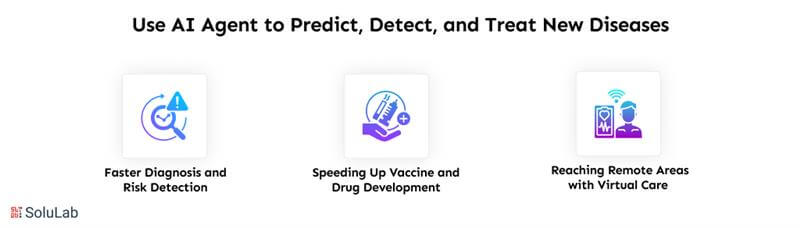
AI tools analyze patient data and medical scans to catch problems early.
AI helped researchers save time during the COVID-19 crisis.
The implementation of AI agents in virtual healthcare helps reach underserved regions.
These AI applications in healthcare are not just an innovation, they’re a necessity. For B2B healthcare providers, AI offers scalable, cost-effective ways to prepare for what’s next.
If you’re building tools for disease control or virtual care, it’s time to invest in AI agent healthcare solutions that are ready for real-world impact.
Yes and it’s already happening. Today, Healthcare AI agents are helping researchers, hospitals, and biotech firms move faster in finding treatments and potential cures. These agents process massive datasets, simulate results, and improve decision-making across medical research.
AI is helping scientists find new ways to fight cancer faster and more accurately.
Using AI to better target and prevent the spread of HIV/AIDS.
AI agents help track and treat the ongoing effects of COVID-19.
These are real-world agentic AI use cases in healthcare that are reshaping what’s possible in medical science, not years from now, but today!
Cancer is one of the biggest health challenges in the world and every second matters when it comes to diagnosis and treatment. This is where AI agents in healthcare are making a big difference. They help doctors find cancer early, suggest the right treatments, and even assist in developing new medicines.
Here’s how they’re helping:
These tools are fast, smart, and highly accurate. This kind of work is possible only because of the integration of AI agents in healthcare systems that support doctors, labs, and hospitals.
If you’re in the business of cancer diagnostics, treatment planning, or oncology research, now is the time to adopt AI. It’s not just innovation, it’s a real competitive advantage.
Read Also: How Businesses in Every Industry Are Benefiting from AI Agents?
AI agents are not limited to cancer or diagnostics, they’re being used across healthcare systems to make operations smoother, faster, and smarter. These AI applications in healthcare are helping hospitals and health-tech companies cut costs, save time, and serve patients better.
AI-powered chatbots in healthcare are being used for symptom checking, appointment scheduling, and follow-up care, especially in virtual care setups.
During health emergencies, AI agents for healthcare help predict ICU demand, staff shortage, or equipment needs in advance.
AI assistant tools automate routine tasks like documentation and report writing, freeing up time for actual care.
Companies that hire AI developers to build such tools often see higher efficiency and lower operational costs. These solutions are especially powerful when paired with Healthcare AI agents to create a connected care ecosystem.
The future of AI agents in healthcare is fast-moving and full of potential, especially for hospitals, labs, and health tech companies looking to innovate.
Here’s what’s coming next:
The most exciting shift? AI agent healthcare solutions are now being built directly into wearables, smart health monitors, and digital hospital systems. These tools can automatically track vital signs, flag early warnings, and even support clinical staff, all without adding extra workload.
If you’re a hospital, research lab, or health-tech company, now is the time to explore AI in healthcare.
Here’s why it matters:
Partnering with an experienced AI development company gives you access to custom, compliant, and scalable solutions that actually work in real clinical settings.
The future of healthcare is becoming smarter, faster, and more personalized. From cancer diagnosis to COVID-19 care to HIV prevention, AI agents in healthcare are helping doctors make better decisions and improve patient outcomes.
Whether you run a hospital, health-tech startup, research lab, or digital platform, this is the right time to invest in AI-powered healthcare solutions. The technology is ready, the demand is growing, and the impact is real.
If you’re looking to build, scale, or integrate AI into your healthcare product, SoluLab, a leading AI agent development company in the USA, is here to help. We specialize in custom AI development designed for real-world medical challenges.
Contact us to build the future of healthcare!
AI agents help healthcare providers work faster and smarter. They improve diagnosis accuracy, speed up decision-making, reduce manual work, and offer personalized treatments. These benefits lead to better outcomes for patients and lower operational costs for hospitals or clinics.
Agentic AI is being used in cancer diagnosis, patient triage, health monitoring apps, and hospital automation. For example, AI can detect cancer earlier through imaging or help hospitals allocate ICU beds based on real-time data. These agentic AI use cases in healthcare are growing quickly and offer great ROI for B2B adopters.
AI agents in healthcare collect data (like images, symptoms, or patient history), analyze it using algorithms, and then suggest or take action, like flagging a diagnosis or recommending a drug. That’s the core of how AI agents work in healthcare, whether it’s through automation, prediction, or recommendation.
AI agents for healthcare are used in disease prediction, patient communication, medication management, diagnostics, and even surgery assistance. Their job is to assist both doctors and patients, making care faster and more reliable.
AI is used in radiology, cancer treatment, predictive analytics, medical imaging, and chatbot-based consultations. These AI applications in healthcare help providers reduce costs and improve accuracy while scaling services for more patients.
The implementation of AI agents in virtual healthcare has helped reach remote areas, automate basic care, and provide 24/7 assistance through apps and chatbots. This improves accessibility, especially in under-resourced locations.


