Talk to an Expert
Get in Touch

What is a Non fungible token (NFT), can your business benefit from it?

Non-Fungible Tokens

As a result of blockchains, a plethora of innovative technologies are emerging that have the potential to completely change the IT industry. One such outcome of the advancements made possible by blockchain technology is NFTs. The need for digital assets is growing exponentially along with the paradigm change from a conventional to an increasingly digital environment. Tokens that aren’t fungible have shown to be a significant step in this approach.

It’s crucial to remember that these tokens are referred to be “non-fungible” since, once created, they cannot be altered or replicated. Every NFT is uniquely identified with the use of smart contracts, and all relevant data is kept on a distributed ledger known as the blockchain. 

Many people are interested in NFTs because of their potential. As a result, a wide range of NFT use cases across several industries, including crypto art, gaming, banking, insurance, certifications, and licensing, are being created and tested. Today, in this blog, we will go deeply into the world of NFTs and all of its important facets.

What is a Non-Fungible Token?

Now, you must be wondering what is NFT in general. Blockchain-based tokenization of assets is known as non-fungible tokenization (NFT). Tokens are distinct identifying codes generated by an encryption mechanism from metadata. These tokens are stored on a blockchain, and the assets actually are stored somewhere else. The connection between the token and the asset is what sets them apart.

NFTs are seen as an alternative investment as they aren’t fungible, or interchangeable, with other similar assets like stocks, bonds, and other conventional investments. NFTs are as same as rare collectibles They were more and more in demand in 2020 and 2021. Due to the involvement of celebrities, content providers, auction houses, and other parties in the market, the price of digital artworks increased.

History of Non-Fungible Tokens

NFTs were developed long before they gained popularity in the mainstream. Based on sources, the first NFT sold proved “Quantum,” which was created and tokenized by Kevin McKoy in 2014 on a single blockchain (Namecoin) while being coined on Ethereum and sold in 2021.

NFTs are designed in accordance with the ERC-721 (Ethereum Request for Comment #721) standard, which specifies how ownership is transmitted, mechanisms for confirming transactions, and how apps manage safe transfers, among other criteria.

The ERC-1155 standard, established six months after ERC-721, enhances on it by batching many non-fungible tokens into a single contract, lowering transaction costs.
NFT Development Services

How Do NFTs Function?

The ownership of the NFT is established using blockchain technology. Blockchain functions as a decentralized ledger, making it possible for NFTs to have public authentication. The technique verifies the originality and ownership of the work using a digital signature. Instead of owning a work of art to display on a wall, an NFT buyer receives a digital copy of the artwork together with a digital certificate of authenticity.

The item’s trademark and copyright are not owned by the NFT buyer. NFT purchasers have an original in the virtual world, notwithstanding the possibility that there are several variations available online. It is possible to build royalties into the token so that artists will eventually get paid a percentage of sales.

Because NFTs are unique, they cannot be exchanged. This is in contrast to fungible assets, which have a predetermined value and can be exchanged for other assets, including stocks, dollar notes, gold bars, Bitcoin, and other cryptocurrencies. NFTs are not interchangeable, even if it is possible to exchange one dollar note for another or one bitcoin for another with ease.

In general, NFTs are not divisible. The token, which is the fundamental unit of the NFT, is often not convertible into lower denominations, unlike dimes, which may be split into ten. However, other platforms, like Fractional, have lately introduced the concept of fractional ownership of NFTs. An NFT may be split up into smaller NFTs and sold to different customers thanks to fractional ownership.

Characteristics of Non-Fungible Tokens
Characteristics of Non-Fungible Tokens

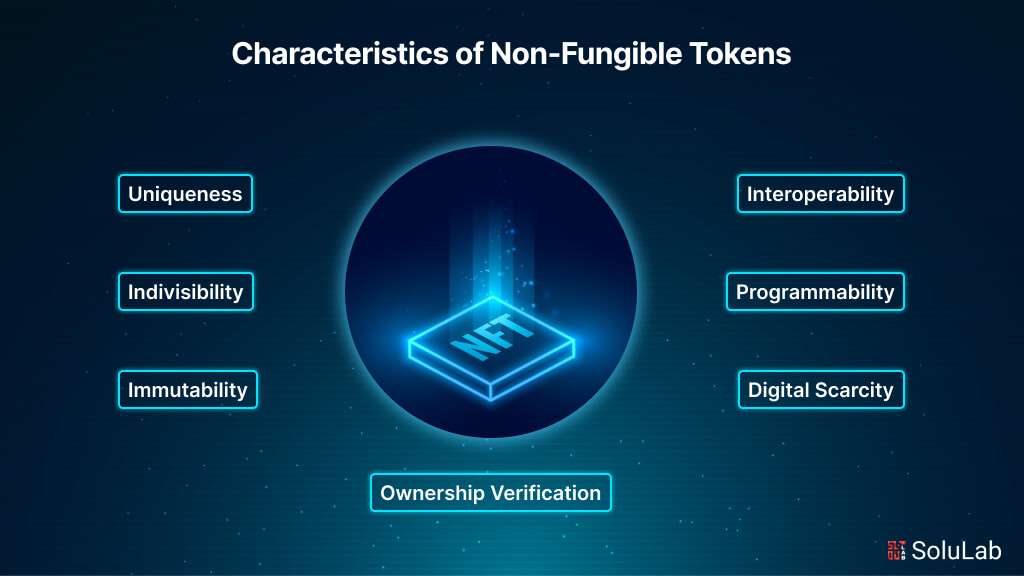
The characteristics of Non-Fungible Tokens (NFTs) include:

  • Uniqueness: Each NFT is distinct and cannot be replicated, ensuring that it represents a one-of-a-kind digital asset.
  • Indivisibility: NFTs cannot be divided into smaller units like cryptocurrencies, maintaining the integrity of the digital asset they represent.
  • Immutability: Once created and recorded on the blockchain, NFTs are immutable and cannot be altered or tampered with, providing a secure and transparent record of ownership.
  • Ownership Verification: NFTs utilize smart contracts and distributed ledger technology to verify ownership, allowing creators and buyers to establish authenticity and provenance.
  • Interoperability: NFTs can be bought, sold, and traded across different platforms and marketplaces, enabling seamless transferability of digital assets.
  • Programmability: Smart contracts embedded within NFTs can include customizable rules and conditions, enabling automated processes such as royalties for creators or restrictions on resale.
  • Digital Scarcity: NFTs introduce scarcity to the digital realm by creating limited editions or unique items, increasing their value and desirability among collectors and investors.

These characteristics collectively contribute to the utility and appeal of NFTs across various industries, from art and gaming to finance and digital identity.

Read Also: Fan Tokens

What is NFT Marketplace?

A Non-Fungible Token (NFT) marketplace is a digital platform where users can buy, sell, and trade NFTs. These marketplaces serve as hubs for creators, collectors, and investors to interact and transact with unique digital assets represented by NFTs.

In an NFT marketplace, users can browse through a diverse range of digital items, including artwork, collectibles, virtual real estate, and more. Each item is represented by its own NFT, providing proof of ownership and authenticity. These marketplaces often feature search and discovery tools to help users find specific NFTs or explore trending collections.

One of the key features of NFT marketplaces is their support for peer-to-peer transactions. Sellers can list their NFTs for sale, setting their own prices and terms, while buyers can browse listings and make purchases directly from the platform. Some marketplaces may also facilitate auctions or bidding processes for high-value NFTs.

Additionally, NFT marketplaces often provide features to enhance the user experience and support the needs of creators and buyers. This may include integrated wallets for storing and managing NFTs, social features for connecting with other users and sharing collections, and analytics tools for tracking the performance of NFT investments.

Overall, NFT marketplaces play a crucial role in the growing ecosystem of digital assets, providing a central venue for the exchange of unique and valuable digital items powered by blockchain technology.

Read Also: ERC-3643 vs ERC-1400 vs ERC-20

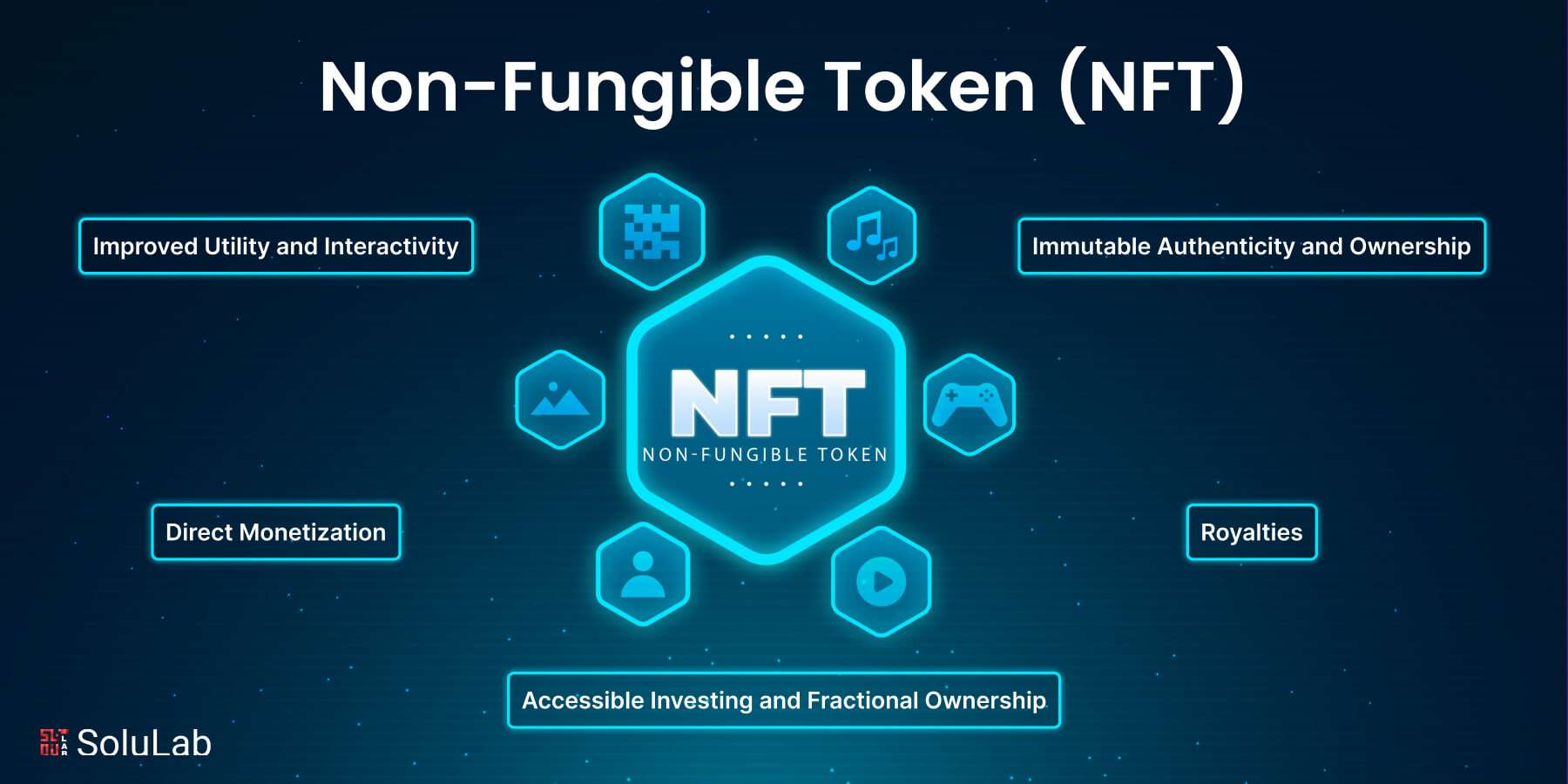
Benefits of NFTs

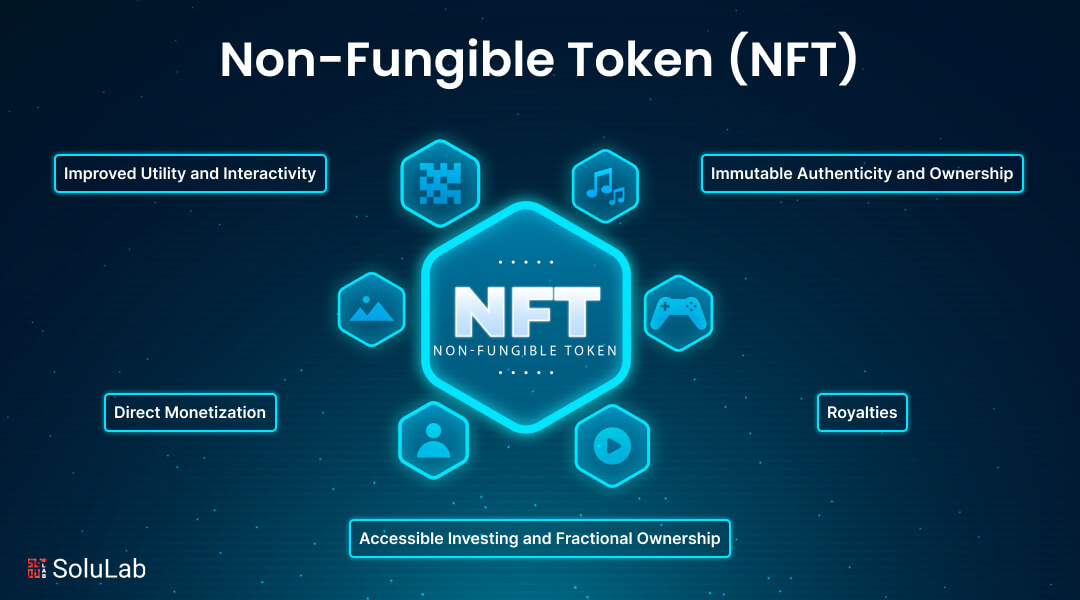
NFTs provide a number of benefits for collectors, artists, and digital artists. Among the most significant benefits of NFTs are the following:

  • Direct Monetization: With NFTs, digital artists may make money from their work without the use of galleries, auction houses, or other middlemen by selling it on online markets like Niio.
  • Immutable Authenticity and Ownership: With NFTs, owners may validate the legitimacy and unchangeable ownership of a digital item. Its provenance, ownership, and transaction history are confirmed via distinctive NFT information. This guarantees that the ownership of an NFT can be quickly and simply confirmed using blockchain technology, giving owners peace of mind and trust.
  • Royalties: Through NFTs, artists may include royalties into their creations, guaranteeing a portion of future revenues when the piece is resold on secondary markets. Even after the first sale, this feature allows artists to profit from the rising value of their works. Furthermore, royalties encourage collectors to help artists and further the development of the NFT marketplace ecosystem as a whole.
  • Accessible Investing and Fractional Ownership: NFTs facilitate fractional ownership, allowing several people to jointly own a digital asset. Individual collectors who may not otherwise be able to buy one can participate and invest in high-value objects thanks to fractional ownership. In the NFT realm, this democratization of ownership opens up new opportunities for collectors and artists alike.
  • Improved Utility and Interactivity: NFTs can include interactive components in addition to static digital data, providing collectors with a one-of-a-kind and immersive experience. Certain NFTs, for instance, provide access to special occasions, first-rate experiences, digital goods, or content associated with the artwork or collectible. This may increase the fidelity of customers.

Use Cases of the NFTs
Use Cases of the NFTs

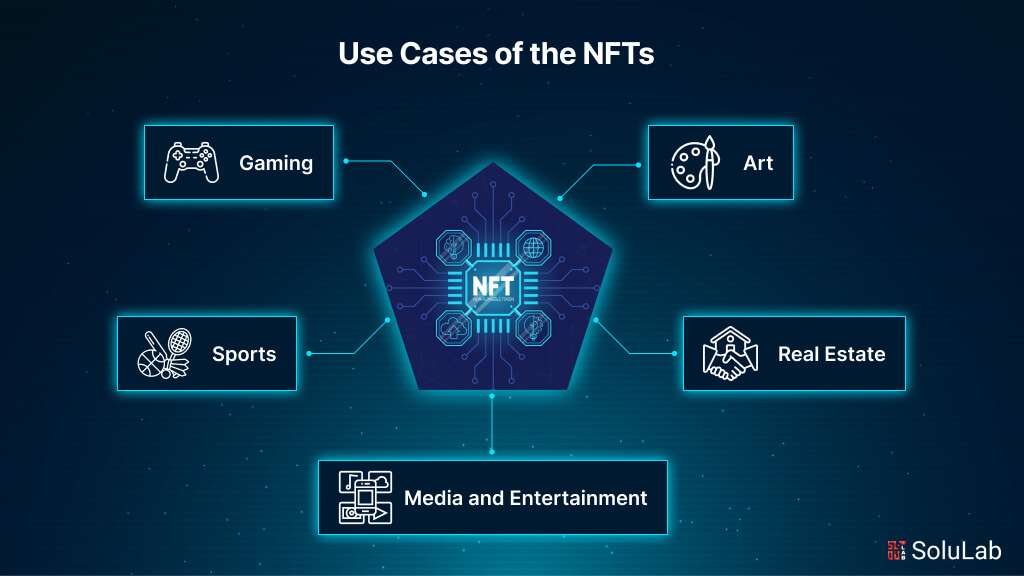
Non-fungible tokens (NFTs) have exploded in popularity and brought about a wide array of potential use cases across various industries. Here are several examples of NFT use cases:

1. Gaming

The three primary market segments that make up the global gaming industry’s enormous income streams are console, mobile, and PC. In 2018, the worldwide video game business brought in 134.9 billion US dollars in sales. For a long time, the virtual economy has been growing. The staples of the worldwide gaming sector include titles like World of Warcraft and Fortnite. The primary focus of these games is still on marketplaces, currencies, and in-game objects, which players need in order to advance in the game or level up. Players may safely transfer in-game assets and offer authentication proof while using blockchain gaming. The issue of digital ownership of rare and exclusive in-game items can be resolved using NFTs. In order to influence future game improvements, users may also take part in governance.

2. Sports

In the sports sector, blockchain offers a practical way to get rid of fake tickets and goods. By utilizing NFTs, blockchain immutability prevents counterfeiting. The blockchain-issued tokenized tickets for sporting events provide an ideal application for NFTs in the sports industry. While each game gives the audience tickets that are identical to one another, each ticket has particular data about its authorized owner on the blockchain.

3. Art

Digital artists find it difficult to protect the copyright of their creations. It is feasible to fix this problem with NFTs. A work with its whole history may be purchased by a user, who can then proudly exhibit the asset in any virtual place. The copyright data may include the artist’s name, the creation date, the asset’s worth, and the names of prior owners.

4. Media and Entertainment

The entertainment business has seen a number of scams including copyright theft, content duplication, and other related issues as a result of the internet. These are problems that the entertainment business has long faced. Every movie or other work of media may now be linked to the blockchain as an NFT thanks to the development of blockchain technology and NFTs. NFTs may aid in preventing unauthorized file sharing or copying in this manner. Since NFTs offer origin verification, they are also utilized to eradicate false information.

5. Real Estate

Real-world assets, like as real estate, are tokenized on the blockchain with the use of NFTs. Without the assistance of a third party, it would guarantee seamless transactions when purchasing or selling homes. Conflicts about the ownership of lands or other assets won’t be possible with NFTs.

Read Blog: Best Real-World Use Cases of NFT Marketplace

What Makes NFTs Important?

Non-fungible tokens are becoming quite popular, and there are a few reasons why using them is crucial. NFTs provide a number of benefits in addition to resolving persistent problems with large enterprises.

  • No Intermediary: The effectiveness of NFTs in cutting out middlemen and simplifying procedures is one of the main advantages. Direct communication between buyers and creators allows for more openness and a more robust relationship.
  • Unique Identity: Every NFT generated is guaranteed to have a unique identifier thanks to smart contracts. Furthermore, tracking all associated data with a physical item while preserving its scarcity is facilitated by tokenizing it.
  • Multiple Ownership: In terms of democratizing the digital asset market, NFTs are the most effective. Different people may now hold non-fungible tokens thanks to the fractionalization of NFTs, which benefits both purchasers and producers by giving them the ability to resell those partially held digital assets.

The Rising Acceptance of NFT Marketplaces

Non-fungible tokens provide a wide range of applications and advantages that save companies money on fraud detection, copyright problems, fake goods, and personnel handling personal and private data. NFTs have also gained a lot of popularity among digital artists, game publishers, luxury brands, and other providers of digital material as digital evidence of ownership. They are reaching out to the international market using NFTs in order to increase the monetization of their artwork. The need for NFT markets as a venue for NFT trade has grown along with NFTs’ increasing global popularity.

The NFT Marketplace’s Business Strategy

The business concept is based on commissions. NFT owners—mostly cryptocurrency enthusiasts, game producers, and digital artists—sell their NFTs in an NFT marketplace. Digital assets such as music, films, gifs, in-game goods, artwork, and other collectibles are represented by NFTs, which are tokens based on blockchain technology. These assets are verified as owned by NFTs, and NFT owners are able to trade them in an NFT marketplace for a cryptocurrency.

Regarding NFTs, there are two approaches. Let’s say you are a fan of cryptocurrencies or digital art. If so, you may create an NFT to represent your digital asset, use it to trade NFTs, and copyright your ownership. Then, by starting their own NFT markets, startups, entrepreneurs, or interested businesses may also become owners of NFT marketplaces. By setting up their own marketplace, companies may sell NFTs to users directly. Additionally, marketplace owners receive hefty commissions each time an NFT owner sells an NFT through their well-trafficked NFT marketplace.
Hire NFT Developers

Final Words

With their quick trading, non-fungible tokens have taken the globe by storm and caused NFT marketplaces to flourish. They are shown to be beneficial for both artists and art collectors. Users are making enormous profits while taking advantage of a variety of privileges. They also provide authors access to fresh revenue streams and distribution networks. A greater portion of the value derived from artists’ labor is now available to them. NFTs create a strong community by uniting like-minded individuals and defining the genuine worth of digital assets. NFTs will be a ubiquitous technology with a considerably larger following than they have at the moment.

At SoluLab, as a well-known NFT development company, we understand the power of NFTs and offer expert solutions for businesses looking to harness their potential. Our team of skilled NFT developers is equipped to guide you through every step of the development process, from conceptualization to implementation. Whether you’re looking to tokenize assets, create a marketplace, or integrate NFTs into your existing platform, we’re here to help. Contact us today to hire NFT developers and take your business to the next level with this transformative technology.

FAQs

1. What exactly is a Non-Fungible Token (NFT)?

A Non-Fungible Token (NFT) is a unique digital asset that is stored on a blockchain and represents ownership of a specific item or piece of content. Unlike cryptocurrencies such as Bitcoin or Ethereum, which are interchangeable and identical, each NFT has its own distinct value and properties, making it one-of-a-kind and non-interchangeable.

2. How can businesses benefit from using NFTs?

Businesses can benefit from NFTs in various ways, including monetizing digital assets, enhancing brand engagement, and creating new revenue streams. For example, artists can tokenize their artwork and sell it as NFTs, while gaming companies can offer rare in-game items as collectibles. Additionally, NFTs can be used to verify ownership of digital assets, create limited editions or exclusives, and foster community participation through tokenized governance.

3. Are NFTs secure and tamper-proof?

Yes, NFTs are secured by blockchain technology, which ensures that ownership records are transparent, immutable, and tamper-proof. Each NFT is uniquely identified and stored on a decentralized ledger, making it virtually impossible to counterfeit or alter ownership records. This level of security and authenticity is one of the key benefits of using NFTs for digital asset management.

4. How can businesses integrate NFTs into their existing operations?

Businesses can integrate NFTs into their existing operations by partnering with blockchain developers or NFT development companies. These experts can help businesses tokenize their assets, create NFT marketplaces, and implement smart contracts to automate transactions and enforce ownership rights. By leveraging NFT technology, businesses can unlock new opportunities for monetization, engagement, and innovation.

5. What industries are currently leveraging NFTs?

NFTs are being adopted across various industries, including art, gaming, collectibles, real estate, and entertainment. Artists are selling digital artwork as NFTs, gaming companies are offering rare in-game items, and real estate developers are tokenizing property ownership. Additionally, NFTs are being used in sports memorabilia, music royalties, virtual fashion, and more. As the technology continues to evolve, we can expect to see even more industries leveraging the unique benefits of NFTs.


 

Why is it important that blockchain have a distributed ledger?

After the 2008 global financial crisis led by some major banks like Bear Stearns, Citibank, and Lehman Brothers, which led to thousands of people losing their entire life savings. With millions losing their savings and jobs, people started losing faith in these big centralized institutions. Which led to the rise of new technologies like blockchain and cryptocurrency. So, why Is It Important That Blockchain Have A Distributed Ledger?


With the rise of Bitcoin, other cryptocurrencies, and the latest concept of NFT (Non-fungible Tokens), everyone’s focus has turned onto the blockchain. Distributed ledger technology is the underlying concept that powers these various cryptocurrencies. In this article, we will discuss the basics of Blockchain and Distributed Ledger Technology (DLT). This will give a better understanding and relation between the two concepts. The main focus is to list out the benefits and use cases of DLT with Blockchain.

What is a Distributed Ledger?

Distributed Ledger

It is often misconceived that distributed ledger technology (DLT) and blockchain technology are the same things. Although the underlying concept of decentralization may be similar, the meaning is different. Let’s try to understand a distributed ledger with an example. Imagine a database, which is shared across many nodes (individuals or institutions) which contain the records of transactions called a ledger. We can record, access, and manage these details at many locations. Thus there is no centralized data storage node in the network. These nodes present in this distributed ledger have the responsibility to verify each transaction. They maintain a record of each item, thus creating a consensus on each item. 

We can use these distributed ledgers to record and store different types of data. We can store various types of transactional information such as dynamic, static, and registry data. Distributed Ledger is timestamped and given a unique cryptographic signature which helps in tracking that specific data block. These cryptographic signatures can be used to verify the blocks and prior transactions made with this block.

Understanding Blockchain Technology.

Blockchain technology is one form of a distributed ledger technology. Blockchain is a distributed immutable ledger to record and process transactions. We can use blockchain to transfer various types of assets and maintain ownership transfer records. Blockchain ensures privacy, security, trust, and transparency for all kinds of transactions with different digital assets.

Blockchain bundles these transactions into chained blocks and broadcasts them to all the nodes in that network. To help this, blockchain uses a cryptographic signature called a hash. We can look at blockchain as a database that is being shared with records that must be validated and encrypted. We can understand this by an example of a secure google document. Where each document’s entry is dependent on its relationship with the previous ones.

Differences between Blockchain and Distributed Ledger.

Difference between blockchain and dlt

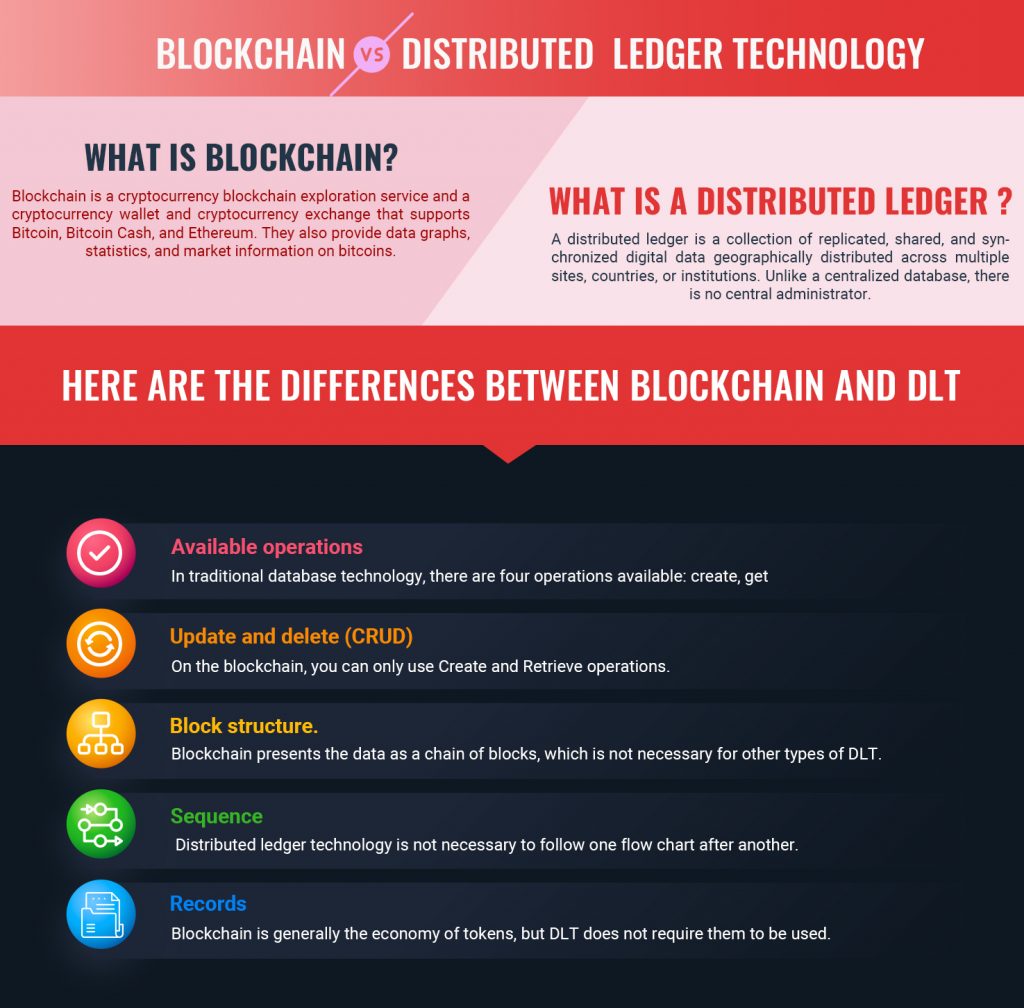
The main difference between these two is, blockchain is a type of distributed ledger. Blockchain, as the name suggests is a sequence of blocks while there is no such rule to have a chain when it comes to distributed ledgers. Removing the intermediary person from the process is what makes this concept of blockchain unique. But unlike blockchain, DLT may not have data in blocks. So, we can say that all blockchain are DLTs while all DLTs are not blockchain.

Importance of Blockchain with Distributed Ledger.

When we store data on a distributed ledger then it offers complete transparency to all the users. Transparency amongst the users builds more trust in the institution/network. When we write and add the data to the blockchain, it gets added to the network chain. When there are several transactions over a long period, then we can see a constant audit trail of blocks and their hash functions. This is very essential for financial institutions as the verification and audit process becomes very easy. , this will lead to fewer errors or frauds in a business.

DLT technology can help in speeding up the processing of transactions. It eliminates the need for a central authority or an intermediary. Big businesses can save millions by reducing the time of transaction and lowering the remittance costs. This can improve the access to financial systems for the unbanked population.

Apart from faster processing, the fees for transactions are less. This makes distributed ledgers useful for all kinds of financial transactions on an industrial scale. The immutable nature of the distributor ledger provides greater security. Thus, We can use a blockchain network to store the transactional records data.

Distributed ledger technology with blockchain can revolutionize various sectors, governments, and institutional workflow. Thousands of leading global companies and financial firms have joined decentralized blockchain networks. In the last 5 years. We can use a decentralized blockchain-based for tax collection, license registrations, voting. Blockchain technology is already making huge changes in the sector of finance, supply chain, digital artwork, digital assets.

Blockchain also guarantees protection against money laundering. This is because Distributed Ledger Technology (DLT) uses encryption. Decentralized applications will replace all manual and inefficient processes in the field of finance, loans, supply chain & commodities, etc.

Conclusion.

Thus, We may conclude that Blockchain may be regarded as a specific type of distributive ledger. Blockchain can use DLT to record, confirm and process the transactions to bring more security, transparency, and efficiency to the network. This affects the institutions and nodes on the blockchain and helps them gain more trust and efficiency. These two technologies are not the same but still, the concept of distributed ledger is important for blockchain technology. While decentralized technology has many advantages, it’s in the very initial stage. In the future, we will see the decentralization of old ledgers and available to everyone over the network.

SoluLab is one of the top 3 blockchain developers in the world. Reach out to us today for your project’s free consultation.

Blockchain Lending, a scoop inside Defi Universe.

Table of Contents

Some Basics First!

Blockchain Lending uses blockchain based underlying programs which is a technology popularized in the year 2008 by an anonymous group named Satoshi Nakamoto. It took Bitcoin to reach the cryptocurrency market to draw attention to Blockchain as a technology. It was only when people began to understand how technology is used daily, and its importance so blockchain services became popular.


Soon after Satoshi Nakamoto gave Bitcoin to the world, the cryptocurrency delivery system and platforms built on the blockchain platform followed. Ethereum, an intelligent contract manager; Bitcoin turn-out Litecoin; and real-time maintenance system, Ripple, are some of the most popular and invested cryptocurrencies on platforms today. However, the advent of cryptocurrencies and related media has primarily covered blockchain technology’s vast potential with ideas for the financial world and Fintech in particular.


Why Blockchain is essential: A business is going with information. The sooner he got it with his teaching, the better. Blockchain likes to transmit information because it provides immediate, shared, and transparent information stored in a measurable database that only network members can access. Blockchain can track orders, payments, reports, production, and much more. But because members share the same idea of reality, you can eventually see all the business details, giving you more confidence and new performance and opportunities.

Blockchain Lending & Fintech.

Blockchain Lending

Of all the successes that cryptocurrencies have gained, such as bitcoin and ether, including digital currency, millions of dollars may return more than 1000%. It is silent in the background, undermining trust and safety in business and removing agents to provide lower business costs for end-users. There are many technologies. It is as versatile as creating multiple applications that can manage scalability, security, price, and reliability.


Blockchain, also known as Distributed Ledger Technology (DLT), can breathe new life and create new systems in the surrounding industry for decades or even centuries, as fintech did for small business loans and the private credit department, which was a hit when the 2008-09 crisis was minor.


Despite the benefits of fintech and the projections of experts that the industry will grow to reach billions of dollars in financing through P2P lending platforms, the fintech industry is not ready to achieve its goals. In 2014, the sector is filing some issues like high default rates, fraud, and regulatory issues and has suffered a 12% loss in online P2P lending just because of fraud.


Here, Blockchain can help processes more secure and reliable, given distributed ledger technology. A blockchain enables two parties to record their transactions in an efficient, unchangeable, and verifiable manner. It provides a strong barrier against unauthorized access and helps prevent fraud, one of the biggest problems threatening the rapid growth and expansion of the fintech industry. 


By putting their digital assets, such as financial data and contracts, into a blockchain, fintech companies can curb fraud and identity theft problems by restoring transparency between customers, vendors, companies, and employees.


According to a World Economic Forum report, 10% of global GDP will be stored in a blockchain by the year 2025. This figure shows the possibilities of the technology and what it can do, not only for the financial sectors but for all sectors together, if used correctly and optimally. 


Merging Blockchain and alternative lending can simplify and streamline online lending and help expand its capabilities by assisting them in integrating the ultimate blockchain function.

Alternative lending through Blockchain.

The alternative credit sector and online lending, in general, will benefit significantly from blockchain technology features. The decentralized public ledger is one of the best features that can introduce significant reforms in the industry, eliminating the common fraud that has so far plagued the industry. 


This decentralized ledger can track fraudulent databases and payments in real-time. Each transaction made through the Blockchain is given a unique timestamp, making each transaction unchangeable and decreasing the chance of data being misrepresented.


With the advent of Ethereum, which enables the use of smart contracts based on the ERC-20 standard, the old documentation of legal agreements will also be taken over by a blockchain very soon. This will help lenders access transparent and unchanged repayment data, reducing the likelihood of fraud.


As the next step to integrating a blockchain into online lending, some companies are digitizing collateral such as country securities and centralizing them for public use. More and more lenders are looking for ways to minimize risk in their value chain. When it comes to the adoption of Ethereum contracts, Escrows and Settlement transactions are already very advanced.

Blockchain Lending & Real Estate.

Understanding: As mentioned earlier, the blockchain timestamp doesn’t allow you to change all contracts and transactions. This will help develop government institutions, companies and factories, and investment trust, and regulators, knowing that the data they are examining is accurate.

Decentralization

In Decentralized exchange, hacking is rare. In a traditional economy, lenders have been using their centralized cloud or home servers to store all the required data for some time. These include company data, customer data, and suppliers.


In the concept of these programs, sensitive data and information does not seem to comply with the cloud security norms or even physical servers when it comes to the database. Bad community characters have a lot of potentials to gain information about creditors stored on their centralized servers, such as personal information, social security numbers, bank details, etc. if hacked. We all have heard about various information leak scandals already, and that is because all that being vulnerable to being stored under a single stronghold and at the same time single point of failure.


Blockchain solves this problem by preserving information from a non-usable general ledger. Because business, service, contract, and data records stored across all networks are shared, it gives access to all nearby records. Only they can use the appropriate keys, access, and manage and view the information stored in the Blockchain. This strengthens the security system.

Easy to handle

The introduction of Blockchain, a cost-effective strategic plan, offers an excellent opportunity for other large and small lenders. While large lenders will want to use technology that provides a massive advantage in governance, small companies will benefit greatly from scalability and cost features when they plan to incorporate it into their system. Also, the intuitive functions allow potential users to find the required information through the platform, through the public viewing platform, without risking the entire database.

Digital identification

Blockchain does not run the risk of identity theft, which is a significant element of online loan fraud. Online lending has removed the requirement that a lender and a borrower must ever perform in real life, common in traditional banking. The first eliminated the need for long, physical checks, thus shortening the issuance and repayment of loans. 

In the fintech industry, the opportunities to develop online lending at the macro level and the micro-level are gigantic due to the Blockchain’s integration. The disruptive functions it creates are easily recognized and accepted by industry stakeholders. Fintech has combined some of the impressive features of the Blockchain to help:

  • Ultimate monitoring of the life cycle of financial transactions.
  • Create affordable financial products.
  • Invent theologically advanced financial services.

With blockchain lending, traditional banking services are obsolete, and reliance on external intermediaries is eliminated. This automated, decentralized system significantly reduces operational risks and speeds up the lending process.

By following the rules, blockchain technology can alleviate stress even in financial uncertainty, preventing cases such as the 2008 financial crisis. Overall, the Blockchain lends confidence, trustworthiness, and confidence to the complex lending process.

Home Loan Management

Blockchain Lending & Defi

Under home loans, a blockchain can condense the lengthy complicated mortgage process by removing third-party intermediaries, certificates, and inherent processing delays. This can fully improve the lending process by reducing costs, developing indestructible records, and facilitating a quick solution for all concerned parties.

Origin of home loan management

First, the individual known as a borrower applies for a new loan. This application is then sent to a creditor for processing. A standard procedure among all loans, this initial step can be improved by accurate records using blockchain technology. Lenders also receive detailed breakthrough access to loan information and data about their lead generation process.

Fulfilment in home loan

When the loan is repaid, the lender gives estimates on the amount of the loan and gives the loan itself. Blockchain can speed up this process by providing estimates and details on the receipt of time-stamped documents within 3 days.

Blockchain in compromising home loans

When closing a loan, it is necessary to present some documents on the part of the borrower, which emphasizes this complex process. With smart contracts with a blockchain, loan closure can be accurately accelerated.

Blockchain helps service providers

The service occurs when the lender collects interest, principal, and deposit from the borrower. As a complex exchange of information and money, service can be enhanced by using the Blockchain with increased tracking of payments, increased data accuracy within credit transfers, and moving assets to service providers due to blockchain validation.

Secondary Markets

In the typical borrower’s eyes, the secondary market provides space for loans to be bought and sold by various lenders and investors. Due to increased distrust due to the recession in 2008, Blockchain is an extremely transparent property and can simplify many transactional processes. 

For example, smart contracts can be implemented in major service agreements, investment contracts, and collaborative and service agreements that are not easy to manage and see in the chain. Blockchain’s automated, instant information update further ensures the security of secondary market transactions.

Conclusion

Blockchain Lending Future

Blockchain technology is revolutionary. It makes life easier, safer and changes the way personal data is stored and how businesses and services are provided. Blockchain technology ensures permanent and unchanging registration of all transactions. 

Blockchain is still evolving and emerging technology; it is difficult to predict how effective this would be outside of any proven use of cryptocurrencies. History teaches us that radical new technology takes many years to reach its full potential. So Blockchain will be revolutionary in the coming years, despite the gaps so far. Companies certainly need to look at and understand this technology because the ideas behind it are very powerful and likely to make an impact.

SoluLab is one of the top 3 blockchain developers in the world. Reach out to us today for your project’s free consultation.

This is the heading

The World is Upgrading to Blockchain. Don't get confused and take the wrong base technology for your project. Get Free Consultation Now.

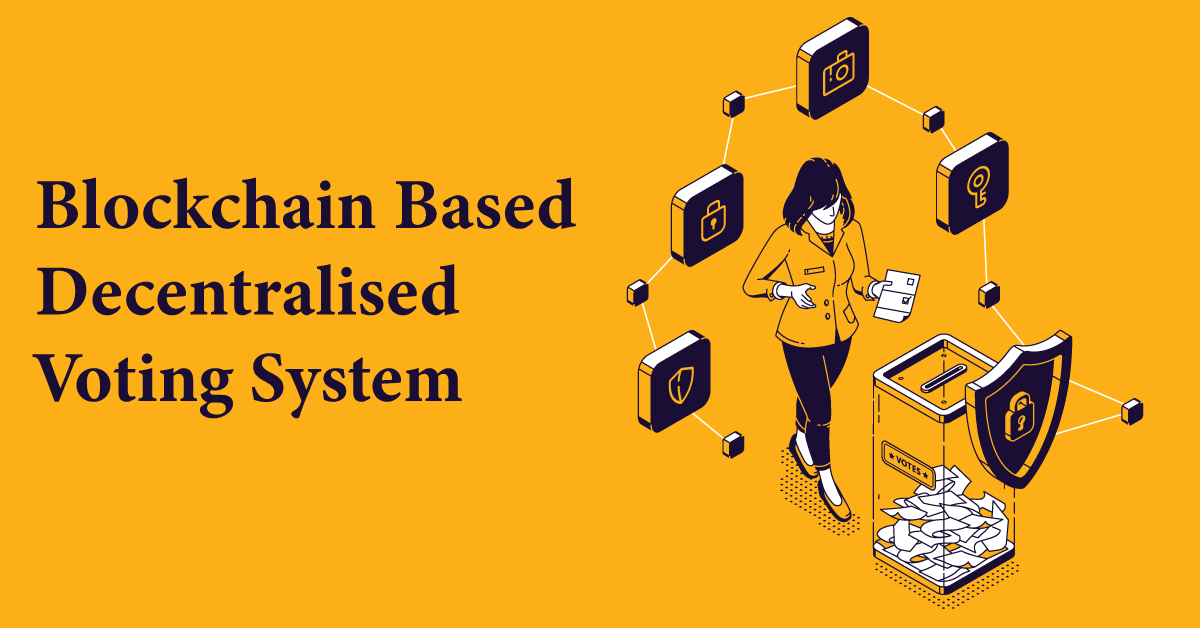
Blockchain based decentralised voting system

Blockchain based decentralised voting system

Since a blockchain is a permanent record of transactions (votes) that are distributed, every vote can irrefutably be traced back to exactly when and where it happened without revealing the voter’s identity. In addition, past votes cannot be changed, while the present can’t be hacked, because every transaction is verified by every single node in the network. And any outside or inside attacker must have control of 51% of the nodes to alter the record.

Even if the attacker was able to achieve that while incorrectly entering user votes with their real IDs under the radar, end to end voting systems could allow voters to verify whether their vote was correctly entered in the system, making the system extremely safe.

Advantages of Blockchain based decentralised voting system

Blockchain technology has the potential to facilitate a secure, accurate, and transparent election while addressing privacy concerns. A single vote cast using Blockchain is likely to bring down the cost of the vote from typical $7 to $25 to less than 50 cents in the current US election system. The immutable nature of the technology ensures election integrity and legitimacy of the outcomes.

Transparency and Accountability

Firstly, Blockchain facilitates voters to verify their votes after casting them. Additionally, immutably stored and timestamped votes ascertain transparency in the election process. Secondly, transparent systems inherently add accountability. Opportunities to rig the system significantly reduces if all the actions are immutable and transparent.

Fraud Prevention

First segregating responsibilities between the various participant nodes in the election process will ensure no collusion is possible . Having three distinct types of nodes — administrators to manage elections, validators to confirm votes, and nodes for counting votes — can reduce the possible collusion.


Secondly, the tamper-evident and incontrovertible databases ensure deliberate tampering of votes is unfeasible. Finally, since multiple, distributed nodes have to arrive at a consensus for adding votes to a block, it is possible to mitigate the opportunities of intentional fraud.

Privacy with Blockchain voting

There are two distinct privacy concerns with Blockchain voting. First is the voter privacy. If the votes and the voter data are in the same system, the ballots are likely to be traced back to the voters. Knowing the voters might result in malicious validators intending to sway the elections in a candidate’s favor to reject their votes. Hence, it is vital to maintain two distinct Blockchain systems — one for votes and one to track voter turnout.

The second concern is the privacy of votes. It is monumental to encrypt the ballots before recording them in Blockchain. Zero Knowledge Proofs help the voters declare their votes without revealing any information about the choice itself.

Security with Blockchain voting

Blockchain combines the power of cryptography with transparency, which makes it a convenient and secure option for online voting. People can now cast their votes using a computer or a mobile device, without the security or their privacy compromised.

What are the challenges with Blockchain voting?

Blockchain technology does add value to the election process. Nonetheless, using this technology for conducting elections brings in problems unique to the technology. 

The first problem to tackle is the block finality time. Depending on the system used, the time taken varies from a few seconds to a few hours. Longer confirmation times increases the possibility of double voting — Voting process that allows voters to cast their ballots multiple times as their previous votes are not yet confirmed. Hence it is wise to choose fault-tolerant algorithms instead of resource-intensive Proof-of-Work algorithms to accelerate the vote confirmation time.

Secondly, using Blockchain might endanger the fundamental principle enshrined by the US constitution — 1-person-1-vote. In other forms of voting, once the voter casts their votes, their ballots are assured to be counted unless tampered. With Blockchain, there is an additional layer of validator consensus on transactions (votes). If a majority of the validator nodes collude and reject the ballots, the voters risk losing their votes. Hence, it is judicious to have disinterested third parties overseeing the voting process.

Finally, the gravest concern is leaving out technology-challenged people from the system. With Blockchain only voting systems, there is a risk of voters who are not technology savvy or do not have access to necessary infrastructure get left out of the election process. A hybrid solution of leveraging Blockchain along with the existing systems, will be beneficial. Voters have a choice to use either traditional voting mechanisms or Blockchain powered systems for registration and voting. However, irrespective of the voting mechanism, the votes have to be recorded on Blockchain. This hybrid approach would give the best of both worlds.

Key requirements to make blockchain powered voting systems succeed

  1. Trust: All stakeholders must have confidence and trust in the decentralised voting system. This will depend on multiple aspects such as security, transparency, auditability, verifiability and other essential attributes. 
  2. Transparency: The system should support the casting of votes and tally of votes by all stakeholders, as well as allow them to verify this easily. 
  3. Verifiability: The system must enable voters to check that their votes were cast and recorded as valid votes for a candidate of their choice without any error or internal manipulation. 
  4. Auditability: The system must be able to support any process that may necessitate the rechecking and recounting votes in the event of electoral disputes. 
  5. Availability: The system must have sufficient mechanisms in place to forestall instances of down-time during the period of elections. 
  6. Performance: The system must ensure that all operations are handled speedily and efficiently. Efficiency depends on the overall system’s throughput such as the number of transactions per time (seconds/minutes), and the response time to user queries. 
  7. Non-coercion of voters: The system must minimise the risk of voters being coerced to vote in certain ways by preventing manipulation and intimidation of voters. The system must be able to conceal the identity of voters, and the choices made during voting. 
  8. Socio-economic influences: Politicians should not be able to exploit the poor socio-economic status of some voters to unduly influence them to vote in a particular way. 
  9. Socio-political factors: The decentralised voting system should not be vulnerable to socio-political manipulations that can compromise the integrity of the voting process.

Proposed Blockchain Architecture for decentralised voting system

Based on the identified requirements, here is our proposed blockchain-based architecture for decentralised voting system. 

layers

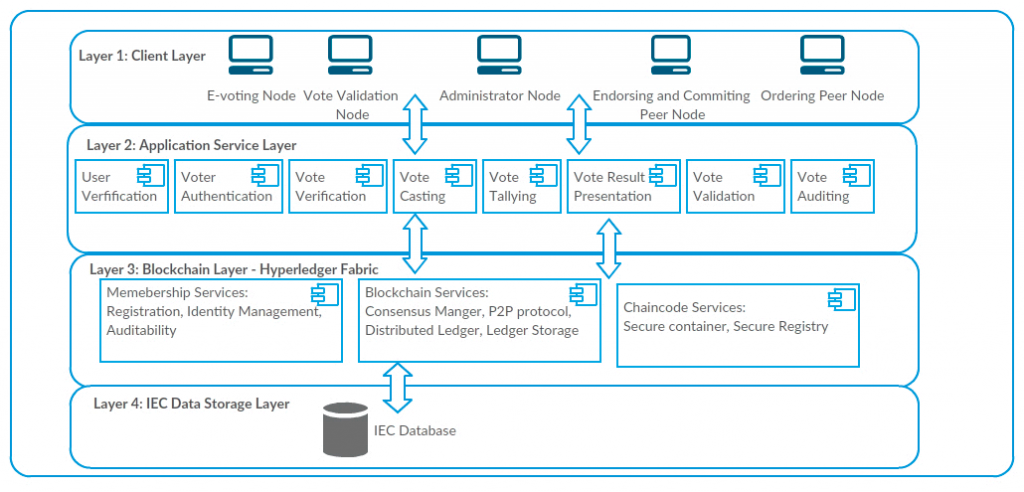
It is a layered architecture that consists of four layers which are 

  1. Client Layer
  2. Application Service Layer
  3. Blockchain Layer
  4. Data Storage Layer

Client layer: this layer contains the various electronic devices and systems with which users interact with the blockchain e-voting system. 

These devices are the peer nodes of the e-voting blockchain that interact via smart contracts, referred to as “chaincode” in the Hyperledger Fabric. The different types of peer nodes and their assigned responsibilities are: 

  1. E-Voting nodes: The primary purpose of these nodes is to enable voters authentication and casting of votes, and to ensure that all blockchain transactions are recorded.
  2. Administrator nodes: These nodes are used to configure blockchain network channels, assign roles to the nodes of the blockchain, grant permissions, and set the level of access control for specific nodes. 
  3. Public nodes: These are the nodes that enable view-only public access to transactions of the e-voting blockchain. 
  4. Vote validation: These nodes are responsible for vote validation. They are also used to ensure the authenticity of transactions that are included in a block. 
  5. Committing nodes: These are the nodes that validate and commit new blocks to the blockchain.

Application Service Layer: this consists of a set of services that are available in the decentralised voting system. The level of access control and the defined permissions level determines the type of services that a node can access in the blockchain. 

Blockchain Layer: this is composed of the Hyperledger Fabric V2.0, which is a modular blockchain architecture framework that facilitates blockchain information system solutions. It supports the creation of permissioned blockchain networks that have in-built properties such as security, and privacy protection. 

The Hyperledger Fabric has “ordering nodes” which ensures consistency of the blockchain by ensuring that only ordered blocks of an endorsed transaction are made available to the committing peer nodes before they are added to the blockchain. 

Data Storage Layer: this contains the relevant databases that store information on the profile of registered voters, political offices being contested for, and all political candidates. This database is used as the basis to authenticate and authorise voters to vote.

A Process View of the Blockchain Architecture for decentralised voting

For efficiency, it is assumed that the casting of votes will take place at designated polling units to protect voters from being coerced to vote in certain ways by politicians and their agents. 

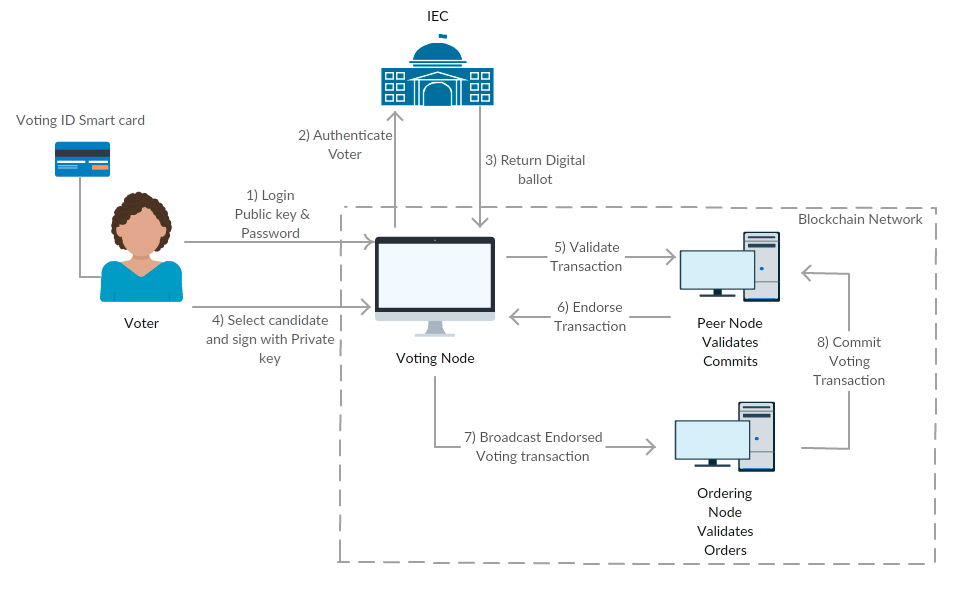
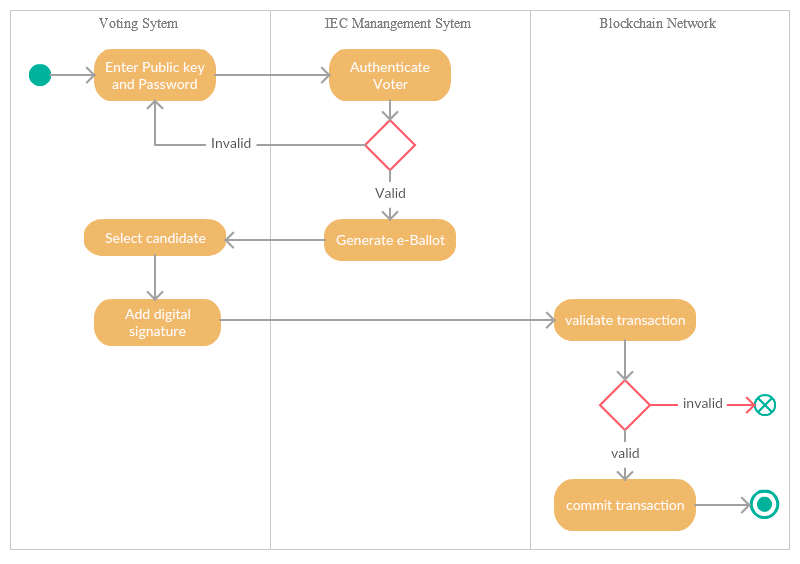
With the Blockchain, the e-voting procedure will follow the procedure below: 

  1. The voter inserts the personal smart card into the voting node and supplies a password. 
  2. Authentication and authorisation of the votes take place via the IEC database. 
  3. If successful, a digital ballot is generated by the IEC system. A digital ballot consists of a set of candidate public keys and a unique ballot ID 
  4. Voter submits a vote for the preferred candidate. 
  5. The ballot ID is assigned to the preferred candidate through their public key. The transaction is authenticated by using the digital signature of the private key. 
  6. The transaction is sent to all nodes and stored on the blockchain.

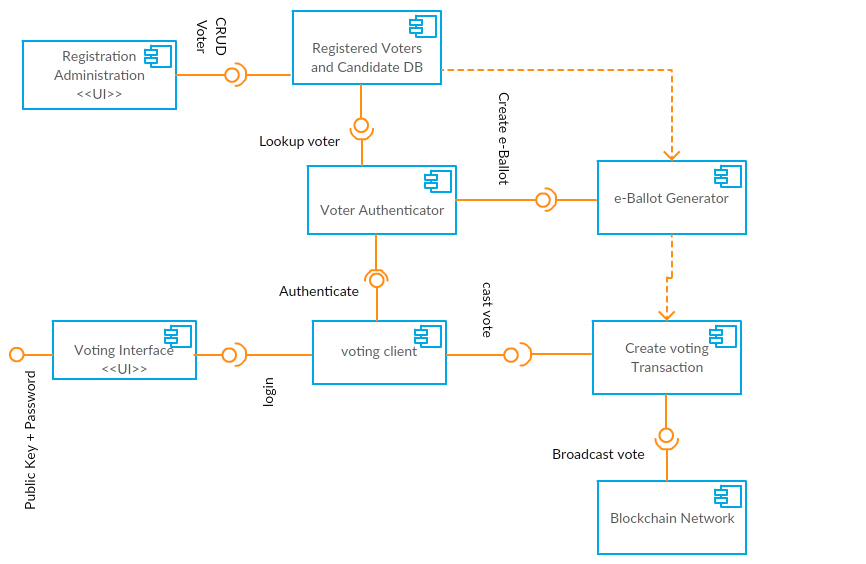
An overview of the decentralised voting process that is based on the blockchain architecture is presented in Figure.

Process View—UML activity diagram of blockchain based decentralised voting system

Development View—UML component diagram of blockchain based decentralised voting system

diagram-of-banes

In conclusion, Blockchain technology might not be the panacea for all voting problems. But the benefits of Blockchain voting would go far in reducing voter apathy and even encourage more people to vote.

How Blockchain Can Leverage Small and Medium Businesses

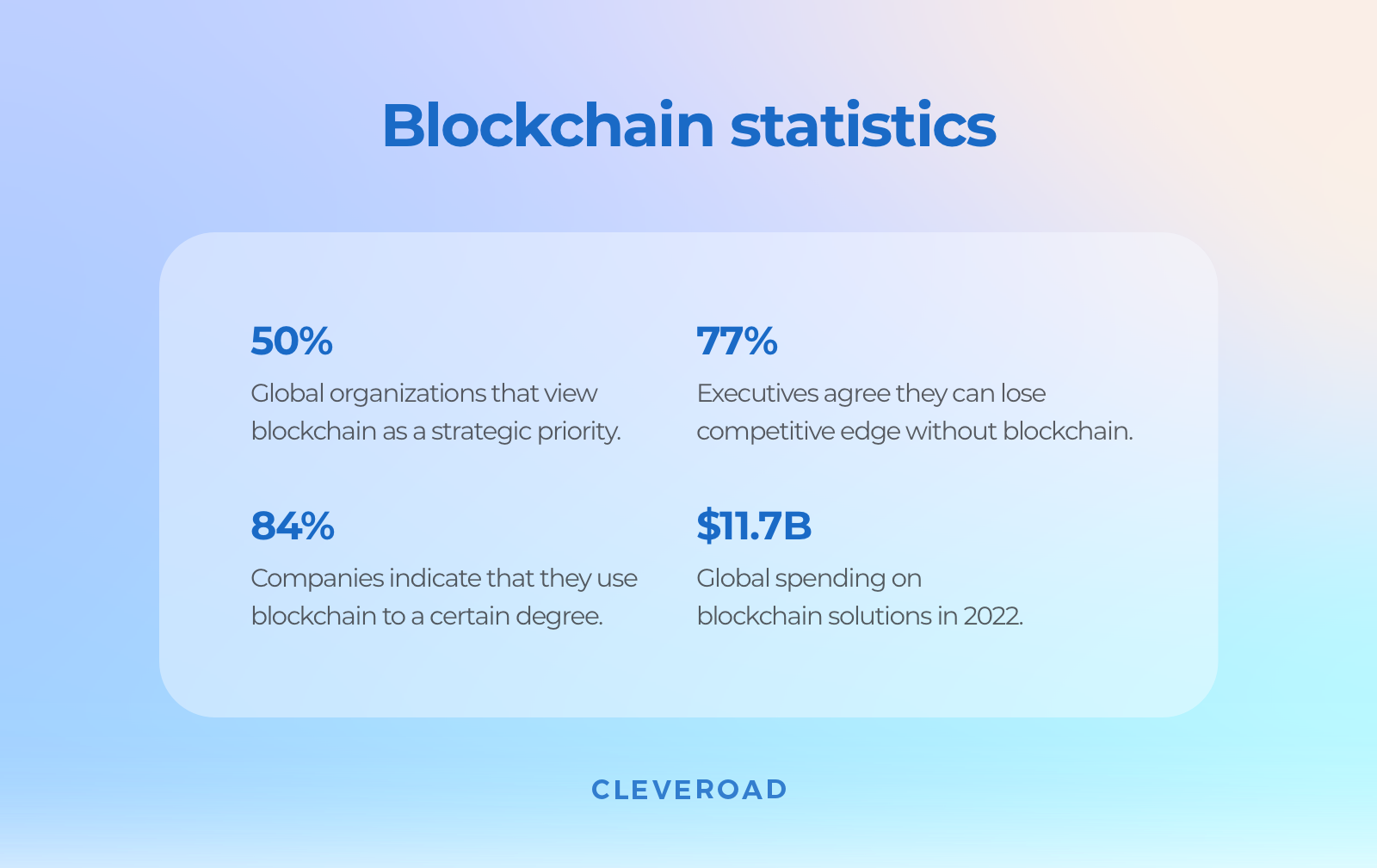
More than ten years have passed since the creation of the blockchain, and blockchain adoption is only growing every year. According to surveys, 86% of senior executives believe that blockchain will soon become the mainstream technology and will be used everywhere. 

Blockchain statistics


Blockchain is now one of the fastest-growing and most widely recognized technologies helping businesses of all sizes. In this article, we will look at what benefits blockchain can bring for small and medium-sized businesses. Without further ado, let’s get started.

Blockchain Basics

First of all, let’s talk about blockchain basics. Many of you might say that the most common use of blockchain is to send and receive payments anywhere. This is quite true, but blockchain has even broader possibilities for solving small and medium-sized businesses’ problems.

In more technical terms, blockchain is a distributed database that greatly facilitates transactions and asset tracking. Imagine a giant table that is present on several computers that are chained together. When you add some information to this table, it is updated for all participants in the chain with an exact note when the update happened. Such a blockchain system device gives rise to many myths among users. We will now debunk the most famous of them.

Famous Blockchain Myths

The myths around blockchain are wide enough and from this list are not entirely unfounded. Let’s take a quick look at them.

Myth #1. There Are One and Only Blockchain


Many people are confused by the fact that the blockchain is used in the singular, and one might think that there is only one blockchain. But in fact, there are a huge number of blockchains, and each blockchain differs due to the scope of application. Take Bitcoin for example. It uses public blockchains. In addition to Bitcoin, there are also private blockchain systems with access to a limited number of people.

Myth #2. Blockchain Is 100% Secure

We will not deny that the blockchain was created to improve the security of operations. But the blockchain is not an ultimatum method of protection since any system can be hacked if desired. However, in the case of a blockchain, the fact of hacking will be immediately recorded.

Myth #3. Blockchain Is Popular Among The Criminals

This myth features cryptocurrency and its supposed untraceableness, which can attract criminals. This myth is unfounded because the blockchain records all changes without the ability to delete data. Any transactions using cryptocurrency can be tracked after cashing out the cryptocurrency.

Myth #4. Blockchain Can’t Be Used for Business

Many people simply do not fully understand how blockchain works, and this may be the reason why many do not see the use of blockchain in business. In simple terms, the main task of the blockchain is to protect data blocks, verify the information and record all actions. These operations are beneficial for businesses that handle a huge amount of confidential data.

Ways How Businesses Can Use Blockchain

Now it’s time to talk about the most beneficial ways how businesses can adopt blockchain technology and use it to leverage their workflows. 

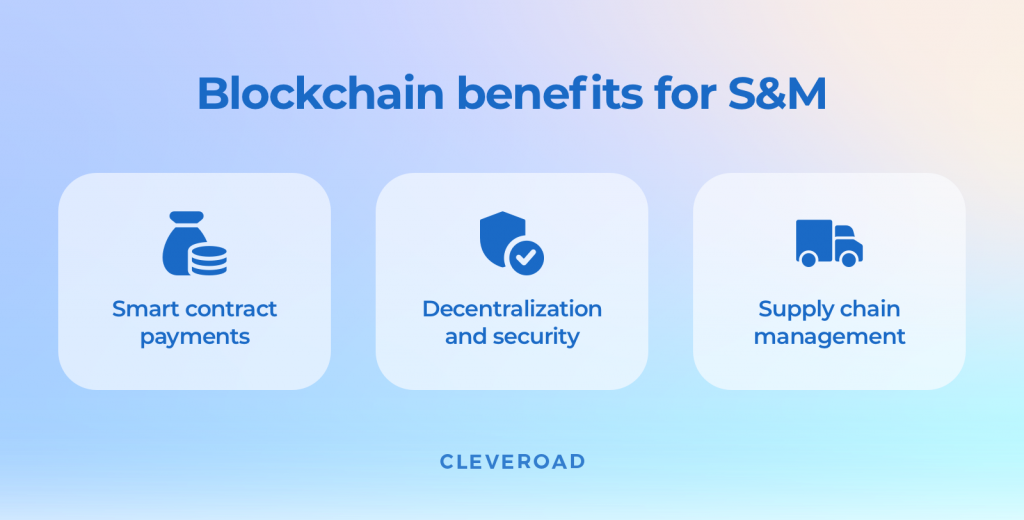
Payments With Smart Contracts

One of the most common problems for small and medium-sized businesses is the control of money flow and transactions. And as you might guess, blockchain is designed to solve this problem. This is all thanks to a special technology used in the blockchain and is called “smart contracts”. This technology automates agreements and enforces contracts between customers and suppliers.

Imagine that a smart contract is a coded agreement that is automatically executed when certain conditions are met. This technology can create convenient transaction pipelines for thousands of businesses and thereby improve their efficiency.

Internet of Things

IoT and business have long been two interconnected things. IoT devices help to collect a colossal amount of information that helps make smarter business decisions. But how can blockchain improve an already good business tool? The entire array of information needs to be stored somewhere, and the blockchain is perfect for this. Blockchain can communicate with all devices simultaneously and serve as a kind of bridge between devices. These benefits significantly save business money for handling huge amounts of informati

Decentralization and Security

Even though there are no fully secure systems, the blockchain is a fairly secure system with no analogs at the moment. This aspect is achieved thanks to the decentralization that underlies the blockchain. Data on transactions and other operations are distributed to different systems that can be located thousands of kilometers from each other. Besides, this data cannot be deleted or edited in any way, making it possible to link each transaction with the previous one.

Supply Chain Management

Blockchain is a pretty valuable asset for enterprises looking to optimize their supply chains. As everyone knows, most products are not manufactured by one company, and when the number of suppliers grows progressively, it becomes quite laborious to control and track payments. In such cases, blockchain comes to the rescue. Blockchain-fueled supply chain offers convenient tools to track all transactions from the point of origin to the point of sale in real-time. For example, this can be in the form of an audit trail or other similar software.


Blockchain helps not only track transactions but also fight fraud, but also greatly simplifies inventory management. This operation has always been quite difficult for small and medium-sized enterprises, but with the advent of blockchain, warehouse operations are becoming simpler and more efficient.

Blockchain benefits for S&M

Wrapping Things Up

As you can see, blockchain is a useful technology that can bring many benefits to both small and large businesses. This is manifested in increased efficiency and automation of internal processes, as well as the higher security level of confidential data. Now that you know a little more about blockchain, you can start thinking about introducing this technology into your workflows.

Central Bank Digital Currency (CBDC)- The Future of Money

Central Bank Digital Currency

Image Source- https://nextbigwhat.com/

For a century now, as part of their public policy objectives, Central banks have been providing trusted money to the public. Trusted cash is a public good. It offers a standard unit of account, store of value, and medium of exchange to settle the financial transaction and sell goods and services. Providing cash for public use is a vital role of Central Banks.

Central Bank’s core responsibility is providing cash to the public and for the public good. The Central Bank will continue to commit to contributing as long as there is public demand for banknotes. A Central Bank Digital Currency (CBDC) supports a unique and more resilient home payment system providing complementary central bank money to the public. It might also offer golden opportunities not possible with banknotes while supporting the revolution. To diversify and consummate their public policy objectives in a digital world, central banks actively research the pros and cons, contributing to a digital currency to the general public.

 WHAT IS CENTRAL BANK DIGITAL CURRENCY (CBDC)? 

Central Bank Digital Currency (CBDC)

Image Source- https://www.etoro.com/

Central Bank money is in digital form that is different from balances in settlement accounts or traditional reserves. The recent international exploration into Central Bank money’s future is complex as it is interrelated with two equally dynamic entities: Digital currencies and Blockchain technology. 

A blockchain-based token represents the digital form of a fiat currency of a particular nation or region. CBDC is issued and regulated by the qualified monetary authority of the country as CBDC is centralized. No country hasn’t officially launched any such money. Still, several governments are looking into the feasibility of issuing and creating CBDCs. Bitcoin is a decentralized cryptocurrency, whereas a CBDC is centralized and regulated by a country’s monetary authority.

The limelight on CBDC is undeniable, and we believe it is here to stay. The development in the financial ecosystem, including significant shifts in the payment industry, helps in the upsurge in scrutiny. Ensuring that each CBDC unit will act as a secure digital instrument equitable to banknotes and, therefore, payment mode, a store of value, and an official unit of accounts can be used. Each CBDC unit will be distinguishable to prevent resemblance, like for banknotes with a unique serial number. The central bank’s money supply will be a part of it. It will be working alongside other forms of regulated money, like bills, coins, bonds, and notes. The main aim of CBDC being is to bring in the best of both worlds- the security and convenience of digital forms like cryptocurrencies and the reserved backed banknotes of the traditional banking system. The particular central bank or other qualified monetary authority of the country will be entirely liable for its operations.

CBDC’s general purpose is to require an underlying system to provide and distribute it conveniently to the public. This system would comprise the central bank, operators, banks, and participating payment service providers. A broader ecosystem supporting the system could then include companies providing and maintaining applications, data service providers, and providers of point of sale devices to initiate and accept payments.

TYPES OF CBDC

CBDC for Wholesale Payments 

CBDC for wholesale payment would offer leading cases made available only to clearinghouses and commercial banks for utilization in the wholesale interbank market, consisting of amplifying efficiency in domestic or international interbank payments. CBDC for wholesale payment would offer leading cases made available only to clearinghouses and commercial banks for use in the wholesale interbank market, consisting of amplifying efficiency in domestic or international interbank payments. Payments to be conducted in central bank’s money across various platforms, conveying faith that token-based platforms can offer settling conditions similar to prevailing platforms. Today, some countries’ processes can be uneconomical and entail costs, time, and counterparty risks to banks.

CBDC tokens help overcome network complications and control access and assist in merging trading and payment processes. CBDC also contributes as a financial instrument for transfer and payments. If financial instruments were available in a tokenized format, CBDC would allow an end-to-end settlement in tokens. This end-to-end settlement in tokens would take the form of token-for-token exchange on token-based financial market’s economic-development to conduct prompt delivery versus payment transactions.

CBDC for Retail Payments 

CBDC for retail would offer leading cases made primarily available to the public, with the ability to increase financial inclusion potentially or serve as a strategic alternative to physical cash in economies where cash dwindles. CBDC can do the settlement between the point of sale and digital transactions online. In a digital environment, the central bank’s money would help the non-bank public in making payments. The decline in cash use has prompted some central banks to consider allocating a retail CBDC to give the public continued admission to central bank money if cash no longer readily available or vanishes absolutely.

Retail CBDC relates to serving as a strategic alternative to physical cash or potentially increasing financial inclusion in economies where cash dwindles. CBDC can act as an alternative for banknotes and a substitute to traditional bank deposits. One of the functions of CBDC is that it would rely on the existing payment infrastructure to a large extent. Therefore, the need to integrate it with core banking arises to allow payment at the time of sale without installing a new payment infrastructure.

Financial inclusion is a strong case of CBDC and largely depends on banking services like lending that central banks are unlikely to offer. The utilization of mobile services will play an essential role for the central bank in issuing CBDC directly to the public. Therefore, the need for partnership to install the infrastructure required with mobile phone operator would arise.

Central banks from various countries comprehend the ability of CBDC in the form of digital currency and their potential in the banking sector with the ability to improve Know-Your-Customer(KYC) functionalities and improve overseas payment infrastructure to suppress unlawful practices. In regions with diminishing banknotes utilization, CBDC for retail could be an essential counterweight to retail payment implementation developed by the private sector. To counterweight retail payment applications development, CBDC could do an indispensable part for the private sector.

Time To Act

The boost in CBDC from the past few months. From conceptual abstraction to an urgent question for the central banks around the world. Dependence on the bank and other financial institutions will shrink because of CBDC, which can also act as a medium that facilitates financial inclusion for the country’s non-bank population. Here, it becomes crucial for other countries to launch a proof of concept experiment to test and implement CBDC, which may or may not consist of blockchain technology

CBDC is an innovative and exciting solution to the digital transformation happening around the world. By approaching it with an imaginative mindset while keeping focused on security and functions, central banks can ensure its money will remain significant. Thus, participants in the banking sector should analyze potential implications, benefit from their development, anticipate possible failures, and figure out which role will help maximize the value of the digital currency.

SoluLab is one of the top 3 blockchain developers in the world. Reach out to us today for your project’s free consultation.

Using A Decentralized Crypto Exchange (DEX) Or Centralized?


To understand the Decentralized exchange(DEX), the best way would be to compare it with the current centralized exchanges (CEX).

Centralized exchange and Decentralized exchange.

Exchange platforms are crucial in blockchain, it helps Defi (Decentralized finance) to grow and act as a replacement for institution-controlled fiat finance. There are two types of exchanges, one decentralized which is the focus of this article, and the other is centralized exchanges. Most people still use centralized exchanges like Binance. The functionality of both is the same as both allow users to easily access the digital assets and also brings exchanging the owned for other digital assets. But the with a difference of controlling body.

What is a CEX, centralized trading platform?

A centralized exchange (CEX) could be a room managed by a company/organization, all assets you deposit are managed by that company/organization.


In multiple cases, it’s a lot safer to send a deposit than someone who keeps his or her property. Banks can have several security measures to stay their assets safe. Banks may also offer you services like loans as they are equipped with massive amounts of funds and have reliable relationships with customers.


In this case, centralized exchanges become almost like banks. You will store your assets on the exchange and trust the third party — the company/organization that manages the exchange within the storage and protection of your assets.

What is a DEX, decentralized exchange?

Decentralized Exchange (DEX). is the same marketplace as we have in current traditional finance, but without any intermediary. The role of the intermediary is to store and manage the assets, and trust intermediates, these actions are performed. In Dex, there is no intermediate, but all the actions are performed on a peer-to-peer network between the users in an automated process.

 
By eliminating the middle man, the transaction window is decreased but more importantly, the ability to hack and meddle is reduced drastically. An intermediary can be hacked, as it is a centralized place to target, but in a decentralized exchange where every user is part of the transaction on the chain, it is impossible to hack it.

Differences Between CEX and DEX!

A centralized exchange (CEX) and a decentralized exchange (DEX) has clear differentiation on these three categories:

Fund Control

Exchange users specialize in creating deposits to the exchange to facilitate exchanging/trading. These funds are controlled by an intermediator trading service. This implies that the order books, in addition, because the custody rights, are within the hands of centralized platform services.


In a decentralized cryptocurrency exchange platform, users interact directly with different traders while not a central server. There’s no centralized service that owns command books and custody rights. Therefore, funds are controlled by users and participants during this platform.


Anonymity

Several centralized exchanges every permit anonymous trading accounts on their platform. However, new government rules that have emerged in recent months have resulted in strict compliance with KYC and AML laws. it’s tough to trade anonymously on a centralized cryptocurrency exchange. In distinction, decentralized exchanges are wherever everybody will stay anonymous.

Accuracy

Centralized exchange users rely upon the platform to certify and authorize their transactions. In a way, the platform may be a third-party mediator that gives trustworthy crypto exchange services.


With a decentralized exchange, you’re counting on a system of multiple nodes that operate, no mediator.

The reason for DEX is on the path to replace CEX.

Blockchain Lending

Short process times, low fees decentralized exchanges are ready to facilitate transactions to be applied quicker, a lot of cost-effectively than centralized exchanges. The elimination of mediator authenticators considerably reduces fees and time delays before the buy/sell order is processed.

Security

Decentralized exchanges don’t keep users’ money and no organization interferes with the method, thus it’s tough for the exchange to be hacked. Meanwhile, history has recorded several attacks on a centralized exchange.

Seamless Integration

This is a serious advantage of decentralized exchanges. Several decentralized exchanges supply seamless integration with widespread hardware wallets to confirm far safer exchange/trading.


Users will send coins directly from their wallets to the smart contracts of the many decentralized exchanges. With centralized exchanges, there’s no means for users to manually fill within the private key to transfer coins from wallets to the exchange.


Full Control of Funds

This is a serious advantage of decentralized exchanges. Several decentralized exchanges supply seamless integration with widespread hardware wallets to confirm far safer exchange/trading.


Users will send coins directly from their wallets to the smart contracts of the many decentralized exchanges. With centralized exchanges, there’s no means for users to manually fill within the private key to transfer coins from wallets to the exchange.

Our thoughts

Many decentralized exchanges have emerged over the years, all iterating on previous tries to contour the user expertise and build additional powerful exchange venues. Ultimately, the concept looks heavily aligned with the attribute of self-sovereignty: like cryptocurrencies, users don’t ought to trust a 3rd party.


With the rapid growth of DeFi, DEXs & NFT’s (Non-fungible tokens) have seen huge dealings in usage. If the momentum continues, we’ll possibly witness magnified innovation within the technology across the whole business.


SoluLab is one of the top 3 blockchain developers in the world. Reach out to us today for your project’s free consultation.

What is DeFi?

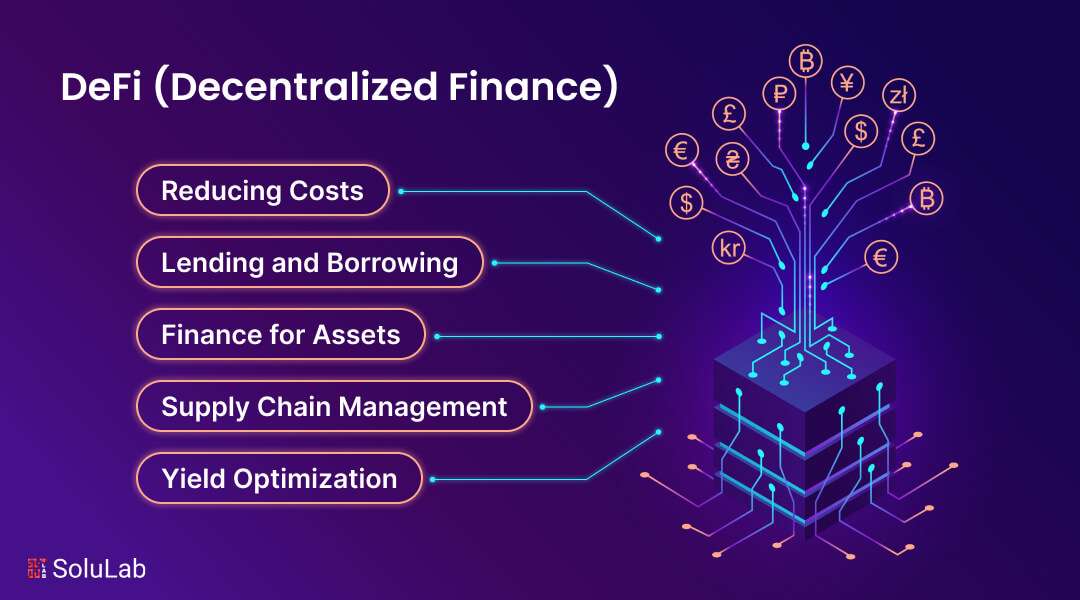
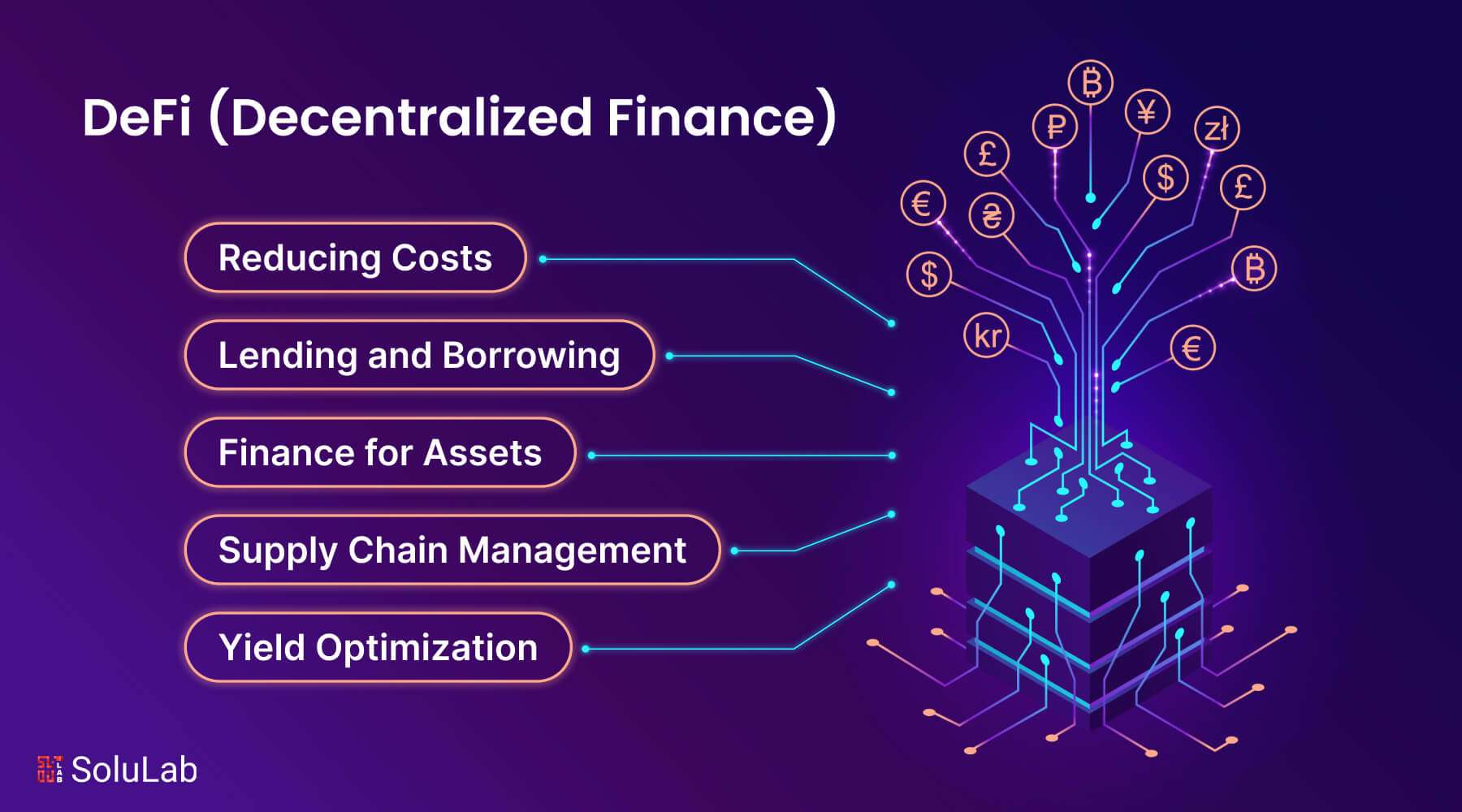
Decentralized Finance

As a means of offering financial services outside of the conventional banking system, decentralized finance is quickly gaining appeal. Decentralized Finance (DeFi) is a new world being shaped by the financial industry’s use of blockchain technology and the growth of decentralized financial services. This environment is defined by cheap transaction costs, secure transactions, worldwide accessibility to financial services, and the most recent DeFi developments dominating the industry.

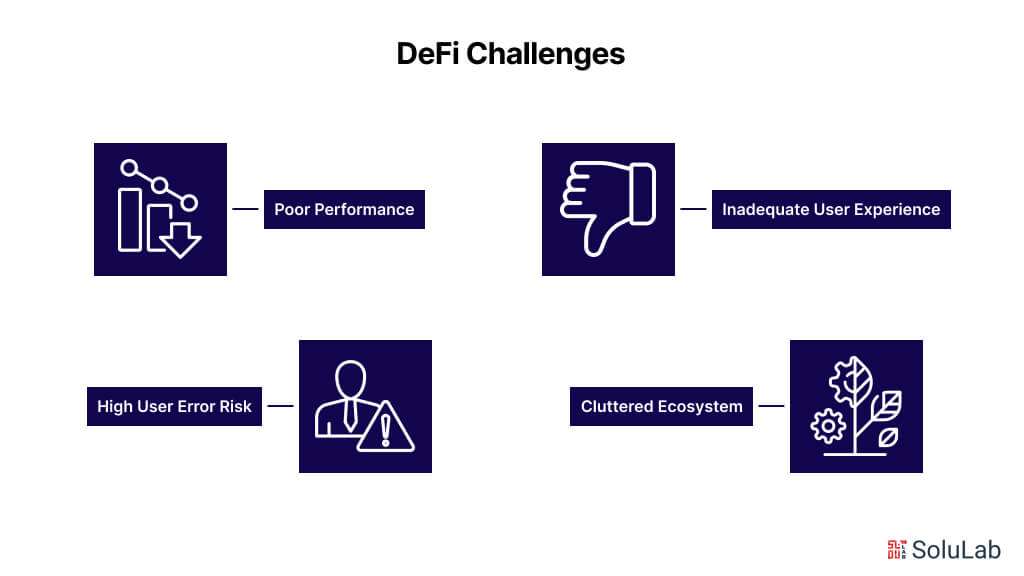
Although there are a number of possible advantages to decentralized finance (DeFi), it’s crucial to be aware of the hazards before committing to anything. We will thus lead you through the fundamentals of decentralized finance, covering what it is, how it operates, and some of the main challenges you must be aware of before beginning, through our DeFi guide on decentralized finance development for businesses. 

So, let’s get started!

What is DeFi?

You must be wondering about what is decentralized finance or DeFi, in short. A financial system based on public blockchains is known as decentralized finance or DeFi. Open finance is made up of blockchain-based smart contracts, dApps (decentralized apps), digital assets, and protocols.

Most people are aware that Ethereum and Bitcoin are cryptocurrencies, but not many are aware that they are also open-source, large networks that let users create programs that facilitate financial transactions without the participation of centralized organizations.

Users may now engage with the Ethereum blockchain in a multitude of new ways that were previously impossible thanks to the advent of decentralized finance. Users may trade digital assets without utilizing a centralized exchange, receive interest on their cryptocurrency holdings, lend or borrow Ethereum-based assets, and more by using DeFi.

Offering consumers an alternative to the sometimes opaque and unreachable existing financial institutions is the goal of bringing about decentralized finance. DeFi aims to create a more inclusive financial system that benefits all users by improving the accessibility and usability of financial services.

What is DeFi Wallet?

A DeFi (Decentralized Finance) Wallet is a type of cryptocurrency wallet specifically designed to interact with decentralized finance applications and protocols.

In traditional finance, banks and financial institutions act as intermediaries to facilitate transactions and manage assets. DeFi aims to replace these intermediaries with decentralized protocols and smart contracts running on blockchain networks like Ethereum. DeFi applications include lending, borrowing, trading, yield farming, and more.

A Crypto DeFi Wallet allows users to securely store, send, and receive various cryptocurrencies and tokens, while also providing access to decentralized applications (DApps) and protocols within the DeFi ecosystem. These wallets typically offer features such as integration with decentralized exchanges (DEXs), staking, yield farming, and participation in liquidity pools.

Some popular DeFi Wallets include MetaMask, Trust Wallet, Coinbase Wallet, and Argent, among others. These wallets often provide users with greater control over their funds and financial activities, as well as opportunities to earn interest and rewards through various DeFi protocols.

How Does DeFi Work?

Financial services can be accessed through decentralized finance, eliminating the need for centralized middlemen. On the Ethereum blockchain, it makes use of smart contracts to facilitate peer-to-peer communication. A financial system requires two primary elements in order to function properly: the infrastructure required for operation and the currency required for operation.

  • Infrastructure: Writing decentralized applications is possible on Ethereum, a DeFi platform. Smart contracts, which define a set of requirements or guidelines by which an agreement can be established, can be created using Ethereum. A smart contract cannot be changed after it has been deployed.
  • Currency: Currency: A coin that can be used to communicate with every protocol available is required to build a safe, dependable decentralized finance system. Typically, DeFi’s currency is the DAI stablecoin. A decentralized stablecoin that is correlated with the US dollar is called DAI.

Comparing Decentralized and Traditional Finance

There are certain intrinsic decentralized distinctions between Decentralized Finance (DeFi) and fintech, even if DeFi is only an enhanced form of the finance system with the same fundamental functioning, which is lying in receiving and transferring money. that establishes blockchain app development services as a significant financial trend for the years 2021–2022, and beyond. So let’s continue to learn about the distinctions.

  • Institutions and staff do not oversee the operations of DeFi. In the DeFi context, smart contracts or coded algorithms do this function. DeFi apps operate automatically after a smart contract is put onto the blockchain; in traditional finance, financial processes are managed by middlemen like banks.
  • The ability of DeFi to use code transparency is one of the key characteristics that sets it apart from conventional banking applications. This gives everyone the ability to audit, which fosters user trust as everyone can comprehend the operation of the contract. Furthermore, because the transactions are pseudonymous, privacy concerns are never raised. However, since intermediaries oversee the monetary processes in conventional finance, security lapses are possible.
  • Another kind of blockchain application employed in the DeFi environment is called dApps development, and it is intended to function worldwide right from the start. The DeFi networks and services are accessible to everyone, regardless of where they live.In contrast, financial institutions’ services are limited to their local areas in the case of the traditional financial system. For example, you are limited to opening a bank account inside the nation in which the bank is located.
  • Applications for decentralized finance can be created and used by everyone. In contrast to modern finance, consumers engage with smart contracts directly via DeFi cryptocurrency wallets; there are no accounts or gatekeepers involved. 
  • The various DeFi products are combined to create the latest decentralized financial applications. For instance, new products may be created by combining prediction markets, stablecoins, and decentralized exchanges. On the other hand, each application in the old financial system is made specifically for a particular function.

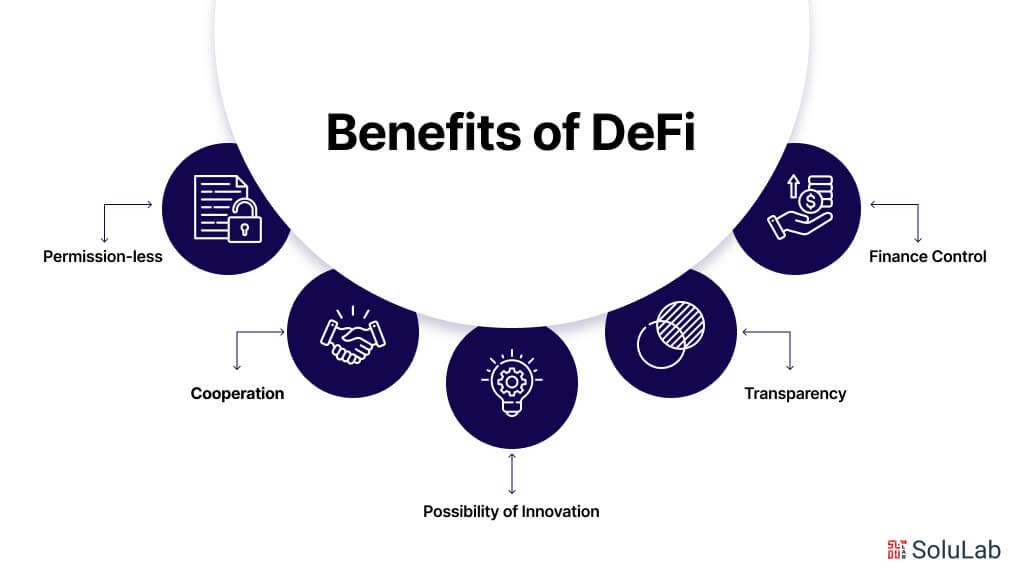
Benefits of DeFi

Benefits of DeFi

Conventional banks are costly to operate and primarily administrative in nature. The lengthy transaction procedure has resulted in the exclusion of many people from the financial system due to its strict regulations. DeFi arrived to resolve a great deal of these problems. Here are a few of the primary benefits of DeFi:

  • Permission-less

Permissionlessness is one of the primary benefits of decentralized finance (DeFi). This implies that no one needs permission from a centralized authority in order to use DeFi applications and services. DeFi’s openness and accessibility—which let anybody with an internet connection join the vibrant ecosystem—are some of its key selling points.

Furthermore, because permission-less DeFi solutions are not susceptible to single points of failure, they are frequently safer than their centralized equivalents. They are therefore perfect for conducting financial transactions and holding value. Thus, one of the main draws for anyone interested in entering the decentralized financial space is the permissionless aspect of DeFi.

Related: Permissionless Blockchain

  • Cooperation

Developers may freely build upon established protocols, alter user interfaces, and include third-party apps with decentralized accounts. This kind of versatility is why DeFi conventions are sometimes referred to as “Money Legos.” It is possible to create new decentralized money apps by combining several DeFi products.

Stablecoins, for example, may be combined with decentralized trades and prediction markets to create an entirely new and far more advanced DeFi financial market in terms of scale and centers.

  • Transparency

DeFi facilitates a higher level of transparency and accessibility. Every activity is open to the public as the majority of DeFi protocols are built on the blockchain, a public ledger. Transactions are visible to all parties; but, unlike traditional banks, no individual is personally linked to these records.

All things looked at, the accounts merely post numerical addresses and are pseudo-anonymous. The majority of DeFi products are open source, thus users with programming knowledge may also examine or expand upon the source code. Because of local area connections, open-source programs are more secure and of higher quality than proprietary software.

  • Finance Control

Financial organizations have extensive control over how customers may utilize their money when they use traditional banking. If they believe there is fraudulent behavior, they have the authority to restrict the kinds of transactions that users may complete and to prevent access to their accounts.

On the other hand, people have greater control over their personal funds using decentralized financial solutions. Users may choose which assets to interact with and manage their own assets, for instance. This makes it harder for someone to take their money and enables them to conduct transactions directly with the parties involved. Decentralized finance, as a consequence, lets consumers avoid fraud and has greater control over their personal funds.

  • Possibility of Innovation

The DeFi ecosystem offers legitimate opportunities for innovation and the development of DeFi goods and services. DeFi is an open protocol that can be very helpful in creating financial solutions for a new era. Because it supports Ethereum and enables innovators to create new decentralized financial apps, the DeFi is becoming more and more significant.

Let’s continue to learn how to utilize DeFi and its practical uses now that you have an understanding of its benefits.

How is DeFi Used?

Before you begin utilizing DeFi, there are a few things you should be aware of.

  • Retrieve Your Wallet

You will require an Ethereum-compatible digital wallet in order to use DeFi. Users may safely keep thousands of NFTs and other cryptocurrencies in the wallet.

  • Purchase Related DeFi Cryptocurrency

You must buy a decentralized finance cryptocurrency asset, like ether, that is native to the Ethereum blockchain in order to communicate with DeFi. Considering your risk tolerance and investing objectives, pick the best option for you.

  • Link Your Digital Wallet to the Decentralized Marketplace

You may begin trading on a decentralized exchange as soon as you have a digital wallet and enough cryptocurrency for decentralized financing.

Use Cases of DeFi in Real-World

Every unbanked person on the planet might have their life completely changed by the increasing use of DeFi platforms and procedures. A few significant real-world use cases for DeFi are covered in this section.

  • Reducing Costs

The costs that international workers must pay on the remittance market front, where they transmit billions of dollars to their relatives overseas, are exorbitant. There is a chance that these expenses can be reduced by over 50% thanks to the developments in decentralized finance services. In addition to raising worker productivity, this promotes economic expansion.

  • Lending and Borrowing

The other difficult area that may be resolved by focusing on DeFi’s benefits is loans. Because of their poor credit history or absence of credit scores, the unbanked are now unable to obtain loans. By bringing lenders and borrowers together, the DeFi platforms do away with the need for credit checks. 

  • Finance for Assets

An extensive network that combines DeFi protocols and financial instruments has been established by the DeFi ecosystem, ranging from portals for lending and borrowing to stablecoins and tokenized BTC. DeFi developers have opened up a world of fresh opportunities for asset-decentralized finance and risk management by using irreversible smart contracts on Ethereum.

DeFi protocols have provided new means to obtain liquidity without relying on centralized exchanges, such as flash loans that are paid in a single transaction and the ability to collateralize loans using DeFi coins or digital assets.

  • Supply Chain Management

The term “DeFi” describes the transition from conventional, centralized financial institutions to peer-to-peer lending made possible by decentralized Ethereum blockchain systems. The supply chain management sector is already starting to see the effects of this paradigm-shifting movement, which presents a plethora of opportunities for improving inefficiencies and creating new channels for decentralized financing and untrustworthy collaboration.

By eliminating errors and adding transparency, blockchain technology is only preparing to handle more advanced DeFi platform use cases.

  • Yield Optimization

Applications for DeFi can be used to aggregate, stake, and maximize yields from interest-bearing investments, automating the process. Data analytics and optimization approaches are used in the process of yield optimization. In order to obtain the greatest rates on cryptocurrency transactions, computational approaches are applied in DeFi yield optimization.

Yield farming is another name for yield optimization. A smart contracts in DeFi manages the process of reinvesting your cryptocurrency winnings to help you get optimal returns through yield optimization.  

What Challenges Does DeFi Encounter?

DeFi Challenges 

Despite the fact that decentralized finance is a relatively new field that is always changing, there are certain drawbacks to DeFi. 

  • Poor Performance: The fundamental slowness of blockchain-based applications compared to their centralized counterparts has an impact on them. The designers of DeFi programs must take these limitations into account and then optimize their work.
  • High User Error Risk: DeFi programs give the user more accountability by removing the middlemen. For many people, this might be a drawback. When products are implemented on top of immutable blockchains, designing them to reduce the possibility of user mistakes presents a difficult task.
  • Inadequate User Experience: Currently, the user must put in more effort in order to use DeFi applications. In order for DeFi apps to become an essential part of the global financial system, they must provide a compelling reason for consumers to switch from the conventional system.
  • Cluttered Ecosystem: It might be challenging to locate the application that best suits a certain use case, thus users need to be able to recognize the best possibilities. Not only is it challenging to develop apps, but it’s also challenging to consider how such applications will integrate into the broader DeFi ecosystem.

What is the Future for DeFi Systems?

The newest digital product in an industry that has existed since the dawn of time is cryptocurrency. We are about to see the complete rebuilding of every financial service we currently utilize under the fiat scheme within the DeFi and open finance ecosystem.

Collateral is a key component of the initial generation of DeFi applications, which means that in order to borrow more DeFi cryptocurrency, you must first acquire a DeFi platform coin and then put it up as collateral.

The most recent versions of DeFi applications are also already causing a great deal of innovation in the insurance industry. Many of the DeFi loans that are made today are overcollateralized (the large asset cushion maintained in the reserve gives the loans an inherent sense of safety).

DeFi cryptocurrency wallets development have also shown signs of being the hub for all activity involving digital assets. Think of it as a dashboard that displays your assets as well as the amount that is restricted by various open finance protocols, such as loans, insurance policies, and pools. 

Additionally, a move toward decentralized decision-making and governance is evident. DeFi emphasizes the word “decentralized,” however the projects now have master keys that enable DeFi platform development suppliers to disable dapps in order to prevent instances of malicious code or to facilitate upgrades. On the other hand, the DeFi community is searching for methods to allow stakeholders to cast votes on choices, opening up a far larger set of DeFi use cases. 

Something new is occurring in the open financial system front: cryptocurrencies are creating money online and providing people methods to generate money on dapps. This is in response to all the rumors and proof of concepts around new DeFi possibilities that are being created and built. Every disruptive launch challenges our understanding of how money functions.

As observers, we find it fascinating that everyone with programming skills has the potential to shape the future of decentralized banking and money.

DeFi Development Services

The Bottom Line

Fintechs may get a competitive edge and open up new avenues for financial service delivery by implementing DeFi technology.

Fintechs may now provide their clients with more effective, transparent, and easily accessible solutions thanks to their use of DeFi. Fintech companies may offer cutting-edge financial services, automate procedures, cut expenses, and do away with middlemen by utilizing blockchain technology and smart contracts.

As a leading DeFi development company, SoluLab offers comprehensive solutions tailored to meet the diverse needs of clients seeking to leverage the potential of decentralized finance. With expertise in blockchain technology, smart contracts, and decentralized applications, SoluLab empowers businesses to build, deploy, and scale innovative DeFi solutions. Whether it’s creating decentralized exchanges, liquidity pools, lending platforms, or yield farming protocols, our team of experienced developers ensures the delivery of secure, scalable, and interoperable solutions. Partner with SoluLab to revolutionize your financial services with DeFi. Contact us today to discuss your project requirements and embark on a journey towards decentralized finance excellence.

FAQs

1.  What is DeFi (Decentralized Finance)?

DeFi, or Decentralized Finance, is the abbreviation for a group of blockchain-based financial services and apps. Unlike traditional finance, which relies on intermediaries like banks, DeFi aims to create an open and permissionless financial system, allowing individuals worldwide to access financial services without the need for intermediaries. These services include lending, borrowing, trading, asset management, and more, all executed through smart contracts on decentralized platforms.

2. How does DeFi differ from traditional finance?

DeFi differs from traditional finance in several key ways. Firstly, it operates on decentralized platforms, eliminating the need for intermediaries like banks. Secondly, DeFi applications are typically accessible to anyone with an internet connection, promoting financial inclusion. Additionally, DeFi protocols often offer greater transparency, security, and composability, enabling users to seamlessly interact with multiple applications and protocols.

3. What are the risks associated with DeFi?

While DeFi presents exciting opportunities, it also comes with risks that users should be aware of. These risks include smart contract vulnerabilities, impermanent loss in liquidity provision, market volatility, regulatory uncertainty, and the potential for hacks or exploits on decentralized platforms. It’s essential for users to conduct thorough research, understand the risks involved, and exercise caution when participating in DeFi activities.

4. How can I get started with DeFi?

To get started with DeFi, you’ll need a few basic tools and resources. First, you’ll need a cryptocurrency wallet that supports DeFi tokens, such as MetaMask or Trust Wallet. Next, familiarize yourself with decentralized exchanges (DEXs) like Uniswap or SushiSwap, where you can trade tokens directly from your wallet. You can also explore DeFi lending platforms like Compound or Aave to earn interest on your crypto assets. Remember to start with small amounts and gradually increase your involvement as you become more comfortable with the DeFi ecosystem.

5. How can SoluLab help with DeFi development?

SoluLab is a trusted DeFi development company with expertise in blockchain technology, smart contracts, and decentralized applications. Whether you’re looking to build a decentralized exchange, lending platform, yield farming protocol, or any other DeFi solution, SoluLab can provide comprehensive development services tailored to your specific requirements. With a team of dedicated developers and a proven track record of delivering high-quality projects, SoluLab is your ideal partner for navigating the complexities of decentralized finance. Contact us today to discuss your DeFi project and take the first step toward financial innovation.

How to Manage Your Remote Software Development Team

Managing your remote software development team isn’t easy. Instill trust, create accountability, use training and tools, and avoid micromanaging to manage your team successfully.

Are you aware that Software Developer is within the top five remote jobs? Its expected growth rate is 24% by 2026. 

If your company is planning to expand your services, you will be losing top talents to your competition unless you know how to manage your remote software development team well.

It is not easy to manage a team of employees, especially when they are working remotely across multiple time zones. However, by following some best practices, you will be able to manage your remote software development team while increasing productivity.

Let’s get started with!

5 best practices to manage remote software development team

1. Instill trust in team members

No matter how many tools your organization uses, it is the people who will be using them. As a manager, your task is to select the best-qualified people for the vacancy and the best fit for your organization’s goals.    

Core competency is important while hiring employees, but apart from that, you should also focus on instilling trust.

A negative working atmosphere is one of the factors responsible for creating stress. And a stressful environment will restrain creativity, drive, and passion, thus impacting productivity and innovation at work. 

Trust, on the other hand, improves teamwork, collaboration, and organizational alignment. Thus, it becomes crucial to instill trust in your employees right from the start. 

To build trust, having open and honest communication is key. And you can have all the team members on the same page, regardless of which part of the world they are working from, by communicating your core company values, mission, and vision.

When you build trust, you will also find that it automatically enhances decision-making. Since trust goes both ways, when your team members trust you, and you trust them back, you are more likely to empower your team to make their own decisions. 

2. Make team members accountable

The second crucial factor to consider is accountability. A study investigating the impact of accountability on employee performance in an organization found that accountability can improve employees’ performance.

The study points out that managers can implement accountability for positive results by using satisfactory performance management principles. You can use performance assessment programs to create expectations in employees’ performance plans. For enhanced accountability, utilizing the Insightful platform can provide real-time performance tracking, actionable insights, and analytics to guide both managers and employees toward achieving their goals effectively.

To create the right environment for positive accountability, you will have to include employees while setting clear, challenging, yet attainable goals and objectives. The team members should also be given the authority to accomplish the same.

Moreover, you should offer support in all aspects of their job, monitor progress, and deliver feedback that includes credibility performance measures. Recognizing effort also plays a role in reinforcing accountability—especially in remote teams. Gestures of appreciation, such as bonuses, awards, or personalized corporate gifts, help employees feel that their contributions are seen and valued. Also, arm them with the right tools and training required to accomplish the job.

3. Take training seriously

According to statistics, inadequate training can cost you up to $13.5 million/1000 employees yearly. Not only that, by offering ineffective training, you will always be looking for new talents. 

Other stats also suggest that 40% of employees who receive poor job training resign in the first year.

When training your employees, see that you are not only focusing on their existing positive traits but also working on mitigating shortcomings and addressing weak spots you have identified before.

Since software development team managers dealing with remote teams usually have to take over projects they sometimes are not familiar with on short notice, internal communications are often neglected in such situations. 

Time is precious but so is collaborative teamwork. Managers should ensure to spend time learning more about their teams, individual members, and impending issues.

Also, make sure that the emotional distance between you and your team doesn’t pose a problem. New team members might be reluctant to come forward. As an efficient remote employee manager, you should foresee this and encourage more personal engagement by being proactive. There’s no point in having a team of skilled remote developers if they don’t share ideas with you.

Implementing cloud-based learning software such as Loop can improve your training results. It is a mobile-friendly remote training tool built to increase engagement, enhance data-enabled decision-making, and enable real-time tracking. You can also make training more engaging by using tools like Synthesia that help you turn text into video with AI, allowing complex concepts or onboarding materials to be presented in a clear and visually compelling way. 70% of employees think that training could allow them to be more focused on the job and manage time better. So, implementing training tools can highly benefit your organization.

4. Implement work tools for software developers

There are a plethora of tools out there designed to meet different needs. For distributed teams, adopt communication norms and workflows that enable effective team collaboration, improving visibility, recognition, feedback loops, and alignment on shared goals without adding more meetings. Here are some of the best tools for software developers:

  • Communication tool: A fully remote team can rely on Slack for seamless communication. It offers direct messaging and chat-rooms that can be organized by topic. Many businesses opt for this tool as it allows you to be creative. To boost productivity, some teams integrate an AI note taker to automatically capture meeting notes and key action items.
  • Programming tool: GitHub is the go-to software for software development teams. It will help you to collaborate on projects from beginning to end. You can easily review code, propose changes, and automate workflow, among others. GitHub integrates with several remote work tools including Slack, and Azure Pipelines.
  • Security tool: Security should be among your top concerns, especially since you are working remotely. Use high-quality VPNs such as NordVPN to secure your smartphone and laptop. You will have to pay to use it, but you will have a strong defense, and you will not have to worry about your data getting sold. It’s no surprise that NordVPN reviews consistently highlight its top-tier encryption, fast performance, and strong privacy features.
  • Time tracking tool: Time tracking tools help development teams monitor work hours, improve productivity, and ensure accurate project costing. Solutions such as factoHR, Keka, and Zoho People offer time tracking alongside attendance management and detailed reporting, making it easier to manage workloads and maintain accountability across remote teams.
  • Payroll/HR tool: Remote teams value clear, timely payroll. Use a generator like the FormPros paycheck stub maker to create accurate pay stubs that itemize hours, taxes, and deductions for employees and contractors, reducing disputes and simplifying income verification across jurisdictions.

5. Avoid micromanaging

If you come from a developer background, you will be tempted to micromanage your team. Instead of offering solutions and providing details on how to execute tasks, focus on communicating the issues and project goals lest you end up losing too much time. Your employees are hired to develop the software, so let them do it. 

Micromanaging can also easily lead to unsatisfied staff as they will feel undervalued and left without an opportunity to be creative or prove themselves.

So, Manage Your Remote Team Effectively! 

Managing your remote software development team can be a taxing job as a manager. However, if you follow the right practices, you can facilitate cooperation with your remote team members and work toward achieving your organization’s goals.

Bitcoin Wallet Creation Basics: Features, Libraries, and APIs

Technology development does not stand still, and virtual currencies are already firmly rooted in our lives. In addition, technologies allow you to create your own Bitcoin wallet that will best suit your business’s requirements and needs. In this article, we will look at how a Bitcoin wallet is useful as a payment method and what tools are best for Bitcoin wallet development. Without further ado, let’s get started.

Benefits of Bitcoin Wallets

First, let’s quickly figure out what a cryptocurrency wallet is. This is software that stores public and private keys and interacts with various blockchains. This allows the wallet user to send and receive cryptocurrency with ease. What else is a Bitcoin wallet used for? The wallet owner can make transactions view transactions history and the current balance of the wallet.
bitcoins
Now let’s take a closer look at how to use a Bitcoin wallet.

  • Payment in stores. Thanks to the CryptoPay startup, you can pay with Bitcoins in any store and even in those where don’t even hear about Bitcoin. CryptoPay is the same Bitcoin wallet, but it has a debit card that can be used to pay in stores via terminals.
  • Wages payment. BitWage offers employers to pay wages using Bitcoins. For example, freelancers will find this payment method very convenient compared to regular bank transfers.
  • International transfers. Bitcoin is a great option for small businesses that cannot sell goods to other countries due to high commissions. With Bitcoin, cross-border payments are several times cheaper.
  • Fraud prevention. Bitcoin provides unrivaled anonymity and payment security. For example, a payment received cannot be disputed.

bitcoin
If you study some of the popular Bitcoin wallets, then you can see some of the similar features that every Bitcoin wallet should have. These features are vital to include when you want to build MVP of a Bitcoin wallet app. The list of these bitcoin wallet features might look like this:

  • Registration and login screen
  • User profile to check balance and make transactions
  • Exchange rate
  • QR code scanner to send and request cryptocurrency
  • Trade service to see Bitcoin sellers and work as a seller
  • Push-notifications
  • Security measures (PIN and password)


Since the majority of cryptocurrency owners operate with Bitcoin, we will consider the most popular libraries that will be useful for developing Bitcoin applications for iOS and Android. Libraries are the ultimate tools that will help you create both a Bitcoin wallet and any other cryptocurrency-related application.
For our analysis, we’ll use the most popular Bitcoin wallet called Blockchain. This free wallet contains many free APIs for developers, and it supports many platforms such as Android, iOS, Windows, Linux, macOS.
There are two different API keys involved in the wallet:

  • V2 API KEY allows the website to easily receive payments in Bitcoins.
  • Blockchain Wallet API KEY provides full access to all functions such as wallet development, payments, transactions, address management, and much more.

You can get any of these keys by making an API request by leaving your contact information, company name, and the URL of your website or application.
Besides APIs that we mentioned above, the BitcoinJ SDK is also used in the development of Bitcoin wallets. This cross-platform library was created in Java to work with the Bitcoin system that supports the Android and Windows platforms.
This library has a fairly wide functionality that allows you to create Bitcoin wallets, work with existing wallets, balance monitoring, and transactions. In addition, this library has tools for converting exchange rates, the ability to receive information about a transaction, and fine-tune the transaction confirmation process.
The final library we’ll be looking at today is the Coinbase SDK. It is a cross-platform Java library that supports iOS and Android platforms. A distinctive feature of this library is that two methods are used for authentication:

  • API KEY. This key can be created and activated directly on the official website of the library. The key opens access to work with your personal accounts or retail orders.
  • OAuth token. This method opens access to working with personal accounts, managing wallets, and working with mobile applications.

Your business may not have grown enough to integrate Bitcoin personal payment. In this case, an excellent solution would be to use Ready-made services to integrate Bitcoin payments into your application. Let’s look at a few popular options that allow you to make transactions in Bitcoins.
For example, Stripe allows you to receive Bitcoin payments in dollars if customers implement the API in their application.
The Shopify service also allows you to create a personal store and include it in several payment methods, including Bitcoin.
There are several less popular but no less functional solutions for embedding Bitcoin payments into your application:

  • BitPay and Bitbay. Thanks to these payment systems, you can fine-tune the payment process through mobile applications.
  • BitPOS. This system was developed for physical stores that want to implement Bitcoin payments.
  • Coinbase. This payment system has command buttons for payments as well as convenient integration with shopping baskets.
  • Coinify. A very convenient platform for implementing Web payments in Bitcoins, as well as issuing payments.
  • Coinkite. It is a powerful service with features such as Full bank reservation, invoices issuance, POS terminals, and Bitcoin payments.

Wrapping Up

We have told you about several ways to create a Bitcoin application that will help you integrate Bitcoin payments into your business. Thanks to this, you can save on costs and transactions. Bitcoin is the currency of the future, and its development should definitely not be overlooked.

WhatsApp Telegram