Talk to an Expert

What is ICO and How Does it Work?

ICO And It’s Working

In an initial coin offering (ICO), a company creates and sells a digital asset, known as a token, to investors utilizing blockchain technology. This method was pioneered by Willet in 2013 with MasterCoin, later renamed OMNI, resulting in the successful fundraising of $500,000 worth of Bitcoin. The funds were allocated to development, rewarding contributors, and other critical activities. A significant milestone was reached in 2015 when Ethereum introduced a standard for implementing tokens (ERC20), further simplifying the ICO process. Subsequently, the ICO market witnessed exponential growth, increasing from just 9 ICOs in 2015 to over 1,000 ICOs in 2018. ICOs serve as digital tokens issued by budding ventures in exchange for crypto-assets or traditional currencies. They represent an approach for early-stage ventures to secure funding and accelerate their growth.

What is Initial Coin Offering (ICO)?

In cryptocurrency and blockchain technology, Initial Coin Offerings (ICOs) have emerged as a way for startups and businesses to raise capital. ICO initial coin offerings have democratized the investment process, enabling anyone with internet access to invest in early-stage blockchain projects. Unlike traditional fundraising methods, which typically require navigating complex regulations and intermediaries, ICOs offer a direct, decentralized approach that has captured the attention of both investors and entrepreneurs.

An Initial Coin Offering (ICO) is a fundraising mechanism in which new projects sell their underlying cryptocurrency tokens in exchange for capital. These tokens can have various functions within the project, such as providing access to a service, granting voting rights, or being used as a currency within the project’s ecosystem. The ICO process is akin to an Initial Public Offering (IPO) in the stock market but with several key differences rooted in the decentralized nature of blockchain technology.

How Initial Coin Offerings Work? A Step-by-Step Process

Before you start with the ICO process, it’s crucial to thoroughly research and understand blockchain technology, regulatory, and token economics. This knowledge will empower you to make informed decisions and navigate the ICO journey successfully.

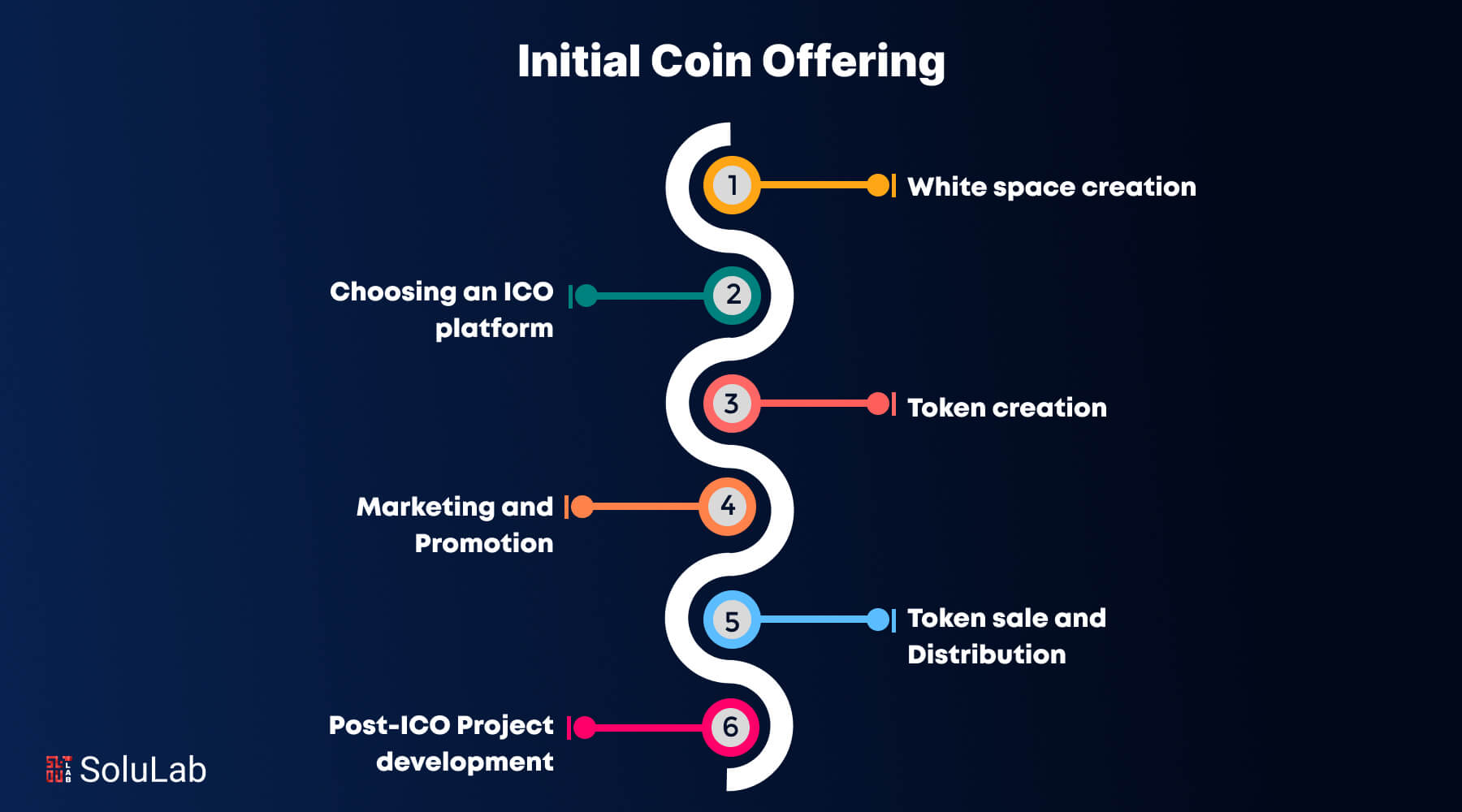
1. Whitepaper Creation

The first step in launching an ICO is drafting a comprehensive whitepaper. This document outlines the project’s goals, the technology behind it, the team involved, and the tokenomics—details about the token’s distribution, supply, and use cases. The whitepaper is essential for building investor confidence and providing transparency on what is an initial coin offering and how an initial coin offering works.

2. Choosing an ICO Platform

Projects often choose a blockchain platform to host their ICO. The Ethereum blockchain, with its ERC-20 token standard, is one of the most popular choices due to its robust smart contract capabilities. These smart contracts automate the ICO process, ensuring that transactions are secure and that tokens are distributed correctly once the ICO concludes.

3. Token Creation

The project team creates the digital tokens that will be sold during the ICO. These tokens are often designed as utility tokens that provide access to a product or service within the project’s ecosystem. Alternatively, they can be security tokens that represent an ownership stake in the project, similar to traditional securities.
ICO projects

4. Marketing and Promotion

To attract investors, the project team must engage in extensive marketing efforts. This includes listing the ICO on ICO initial coin offering lists, promoting it on social media, and participating in blockchain events. The goal is to build a community around the project and generate buzz that will drive the success of the ICO.

5. Token Sale and Distribution

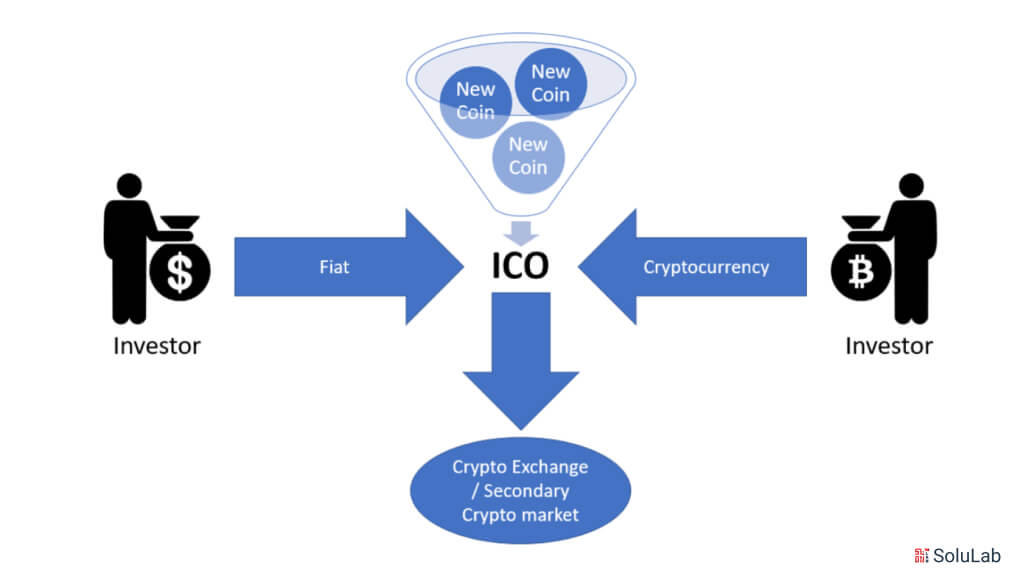
During the ICO, tokens are sold to investors in exchange for cryptocurrency, typically Bitcoin or Ethereum. The ICO can be structured in various ways, such as a fixed-price sale, where all tokens are sold at a set price, or a Dutch auction, where the price decreases over time until all tokens are sold.

6. Post-ICO Project Development

Once the ICO concludes, the project team uses the funds raised to develop the product or service outlined in the whitepaper. Investors typically monitor the project’s progress through updates from the team and community engagement, closely watching how ICO works.

CTA1

Types of ICOs

There are various types of ICOs, each with its own characteristics and regulatory considerations. Here’s a brief overview of the most common types of ICOs:

  • Public ICOs

Public ICOs are open to anyone who wants to invest. These ICOs are highly inclusive and often attract a large number of small investors. However, they also face significant regulatory scrutiny and may require compliance with securities laws in various jurisdictions.

  • Private ICOs

Private ICOs are restricted to a select group of investors, often institutional investors or high-net-worth individuals. These ICOs tend to raise larger sums of money but are less accessible to the general public.

  • Security Token Offerings (STOs)

STOs are ICOs that issue tokens classified as securities. This means they are subject to stringent regulatory oversight, providing investors with a higher degree of legal protection. STOs are often seen as a more secure and regulated alternative to traditional ICOs.

  • Utility Token ICOs

Utility tokens are designed to be used within the project’s ecosystem. For example, a utility token might be required to access a service, pay for transaction fees, or vote on governance issues within the platform. These tokens do not confer ownership rights or dividends, differentiating them from security tokens.
Benefits of ICOs

Benefits of ICOs

Before delving into the benefits of Initial Coin Offerings (ICOs), it’s important to understand how they work and the different types of ICOs available.

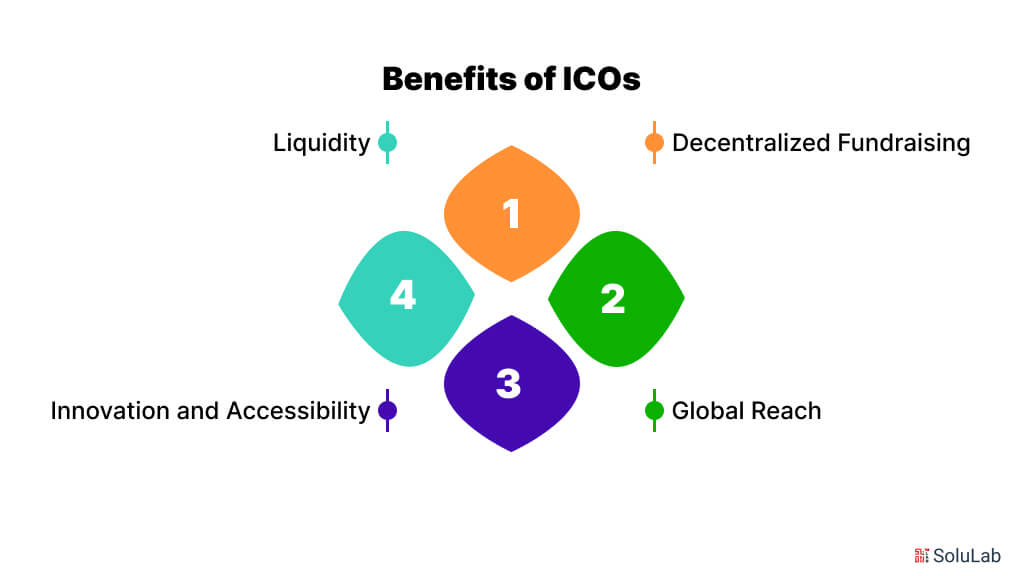
  • Decentralized Fundraising

ICOs eliminate the need for traditional financial intermediaries, such as banks and venture capitalists. This decentralization allows projects to raise funds directly from the public, reducing costs and increasing accessibility.

  • Global Reach

ICOs have a global audience, enabling projects to attract investors from around the world. This global reach increases the potential for raising significant capital and building an international community around the project.

  • Liquidity

Tokens issued in an ICO can often be traded on cryptocurrency exchanges, providing liquidity to investors. This allows investors to buy or sell tokens as they see fit, potentially realizing returns on their investment even before the project is fully developed.

  • Innovation and Accessibility

ICOs provide an opportunity for projects to secure funding without the need for traditional venture capital. This has led to a surge in creativity and projects in the blockchain space, driving the industry forward.

Year ICOs Published Funds Raised
2016 29 $90 million
2017 875 $6 billion
2018 1,253 $7.5 billion
2019 109 $370 million
2020 14 $55.6 million
2021 320 $378 million
2022 217 $117 million

Who Can Launch an ICO?

While anyone can initiate an ICO, strict monitoring by authorities in developed nations like the U.S. ensures necessary registration. However, the ease of setting up an ICO as a scam, including fabricating registration documents, makes it crucial for potential investors to be vigilant. Before launching an ICO, entrepreneurs should carefully assess whether their business genuinely requires one. Initiating a security registration with the SEC is often essential in such endeavors.

Buying Into an ICO

Before investing in a new ICO, thorough research is essential. Begin by verifying the identities and accountability of the individuals behind the ICO. Next, investigate the project leaders’ track record in the cryptocurrency and blockchain industries. Beware of projects that lack individuals with verifiable and relevant experience in these fields, as this could be a red flag for a potential scam.
ICO crypto exchange

Identifying ICOs and Scams

In 2019, ICO activity experienced a significant decline, primarily due to the uncertain legal landscape surrounding ICOs. While there is no foolproof method to stay updated on all the latest initial coin offerings, interested individuals can research and participate in ICOs. Websites like TopICOlist.com offer comparisons of different ICOs. Additionally, investors can examine registered cryptocurrency exchanges to gain insights into newly listed and unlisted coins. Since many exchanges thoroughly vet the coins before listing, this approach can enhance safety.

Cryptocurrency aggregators can assist in identifying potential scams or genuine opportunities. However, it’s crucial to note that aggregators do not vet cryptocurrencies but provide purely informational services. They frequently include links to the project’s GitHub pages, websites, and social media platforms, discussing the problems the project aims to address. If there is no dedicated section describing a coin and no readily available information on websites, except for nonsensical phrases, it might be advisable to avoid such opportunities.

DO YOU KNOW?
“The U.S. Securities and Exchange Commission (SEC) can intervene in an ICO if necessary. For example, after the creator of Telegram raised $1.7 billion in an ICO in 2018 and 2019, the SEC filed an emergency action and obtained a temporary restraining order, alleging illegal activity on the part of the development team.4 In March 2020, the U.S. District Court for the Southern District of New York issued a preliminary injunction. Telegram was ordered to return $1.2 billion to investors and pay a civil penalty of $18.5 million.”

When investing in an ICO, there’s no guarantee you won’t fall victim to a scam. However, you can take several steps to reduce the risk of becoming involved in an ICO scam:

  • Scrutinize the Project’s Goals: Successful ICOs typically have clear, concise goals outlined in straightforward, understandable white papers. Ensure that project developers can clearly define their objectives.
  • Demand Transparency: Expect 100% transparency from companies launching an ICO. Verify the team’s identities, backgrounds, and qualifications. Look for evidence of their experience and expertise in the relevant industry.
  • Review the ICO’s Terms and Conditions: Given the evolving regulatory landscape, it’s your responsibility to ensure that an ICO is legitimate. Carefully review the terms and conditions, paying particular attention to the token distribution, fundraising goals, and refund policy.
  • Secure Escrow Wallet: Opt for ICOs that store funds in an escrow wallet. This type of wallet requires multiple access keys, offering protection against scams.
  • Consider Cryptocurrency Purchases: Some ICOs may require investment in another cryptocurrency. Be prepared to purchase these coins to participate in the project.

ICO Hyping

Initial Coin Offerings (ICOs) often create significant buzz, attracting investors to online forums where they discuss potential opportunities. Prominent figures like Steven Seagal have encouraged their followers to invest in popular ICOs. However, the SEC has warned celebrities that endorsing ICOs on social media without disclosing any compensation received is illegal.

Notable cases include boxing legend Floyd Mayweather Jr. and music mogul DJ Khaled, who promoted Centra Tech, an ICO that raised $32 million in late 2017. Centra Tech was later deemed a scam, leading to settlements with U.S. regulators by Mayweather, Khaled, and guilty pleas from three Centra Tech founders for ICO fraud.

Before participating in an ICO, investors should thoroughly educate themselves about cryptocurrencies and the specific ICO in question. Since fake ICOs are more often detected than prevented, prospective investors should exercise extreme caution when making investment decisions.

How ICOs Differ from IPOs?

While ICOs and IPOs share some similarities, such as raising capital from the public, they differ in several key ways:

  • Regulation: IPOs are heavily regulated by financial authorities, whereas ICOs operate in a more decentralized and less regulated environment.
  • Ownership: IPOs involve selling shares of a company, and conferring ownership rights to investors. In contrast, ICOs typically offer utility tokens that provide access to a product or service rather than ownership.
  • Accessibility: ICOs are generally more accessible to the public, allowing anyone with cryptocurrency to invest. IPOs, on the other hand, often require investors to meet specific financial criteria.

CTA2

Conclusion

Initial Coin Offerings (ICOs) represent a transformative approach to fundraising in the digital age. They offer a decentralized, accessible way for projects to secure capital and for investors to participate in the growth of the blockchain ecosystem. However, the success of an ICO depends on careful planning, compliance with regulations, and effective marketing.

At SoluLab, we specialize in ICO development and offer end-to-end solutions to help your project succeed. From drafting a compelling whitepaper to developing robust smart contracts and creating a customized ICO platform, our team of blockchain experts is here to guide you every step of the way. With a proven track record and a deep understanding of cryptocurrency, SoluLab is your trusted partner in launching a successful ICO.

Whether you’re an entrepreneur with an idea or an established company looking to explore new fundraising avenues, contact SoluLab to learn how we can help you achieve your goals with a tailor-made ICO strategy.

FAQs

1. What is an Initial Coin Offering (ICO)? 

An Initial Coin Offering (ICO) is a fundraising method where a company issues digital tokens in exchange for capital, typically in the form of cryptocurrency. It is a popular way for blockchain-based projects to raise funds.

2. How does an ICO work?

In an ICO, a company creates a whitepaper detailing the project and the associated tokens. Investors purchase these tokens during the ICO period, often using cryptocurrencies like Bitcoin or Ethereum. The funds raised are then used to develop the project.

3. What are the types of ICOs? 

There are several types of ICOs, including public ICOs, private ICOs, security token offerings (STOs), and utility token ICOs. Each type has different characteristics and serves different purposes.

4. What are the benefits of participating in an ICO? 

ICOs offer various benefits, including decentralized fundraising, global reach, and the potential for high liquidity. They also allow investors to get involved in early-stage projects that have significant growth potential.

5. How can SoluLab help with ICO development? 

SoluLab provides end-to-end ICO development services, including whitepaper drafting, smart contract development, and marketing strategy. Our team of blockchain experts ensures your ICO is compliant, secure, and strategically positioned for success.

What are the Essential Things to Know for an ICO?

What are the Essential Things to Know for an ICO

It’s crucial to understand what to seek out if you’re considering investing in these projects and meet the requirements to do so, as initial coin offerings still take place in private investment rounds and do not need any regulatory registration. 

Initial coin offerings (ICOs) are quite popular among cryptocurrency investors. Their success is largely due to the daily creation of new cryptocurrencies. Remarkable sums of $258 and $275 were recently gathered by Hdac and Filecoin. Indeed, a lot of factors affect an ICO’s success. Let’s get over these Essential things to know about ICO in more detail if you’re interested in learning how to build up an ICO that will bring profits for your company. Before moving further it is important to know 

What is Initial Coin Offering (ICO)?

initial coin offering

But what does ICO stand for? The cryptocurrency’s version of an IPO is called an initial coin offering or ICO, an initial coin offering can be used by a business looking to generate capital to develop a new blockchain application or service using cryptocurrency. To obtain a new cryptocurrency created by the company, interested investors might participate in an initial coin offering. This token might have to be considered an investment in the corporation or project, or it might have some use with the goods or services the company provides.

An ICO working is a method of raising money for goods and services typically associated with cryptocurrencies Co-issued cryptocurrencies may also be used for software services or other products. Investors have made money from an ICO; others have done poorly or have been exposed as fraudsters. Registering is required for the majority of indices.

When do you need ICO?

ICO meaning cryptocurrency not only does this help to provide the idea of financial availability for various investments, but this creativity increases investment prospects and community participation. However, this knowledge of when an ICO is needed can help entrepreneurs make the right decisions. In the following four situations, launching an initial coin offering (ICO) may be crucial for your project: 

Access to Global Capital

Whereas many regional constraints that often prescribe conventional approaches to fundraising put a cap on the number of qualified investors an ICO lets the entrepreneurs tap into a global market. The necessity of WeFunds results in the democratization of investment which brings potential cash accessible for creative ventures because a great number of people can participate.

Lower Costs and Less Bureaucracy

ICOs disentangle the process from numerous administrative expenses and legal requirements attached more to traditional financing methods. That makes it a financially suitable approach because, with its help, companies can allocate more of their funding towards development rather than attorney’s fees and other intermediaries.

Encouraging Community Involvement

ICOs, for instance, create a great sense of community among the token owners and are often involved in making decisions concerning the project and its development. Other than enhancing project ownership, this involvement encourages early adopters to come up with useful input that may be crucial to the project.

Early-Stage Investment Opportunities

By taking part in an initial coin offering (ICO), investors can gain the first opportunity to invest in potentially lucrative operations before they become available to ordinary people. Implicit within this potential is the ability to generate large amounts of money as and when the project grows, thus attracting a broad range of investors from both private and institutional investors seeking to spice up their portfolios.

CTA1

What do we mean by an ICO rating?

Upon investing funds in an ICO, it’s of the utmost significance to study and comprehend all facets of the task to reduce risk and select feasible investment schemes. After all, numerous scam ICOs and flawed schemes are out there, so it’s essential to understand what you’re investing your funds into. One aspect of analyzing an ICO’s quality is inspecting the ICO rating. 

In addition, what looks at in an ICO rating is based on an impartial and clear evaluation of a task that assesses different elements of the task and its ICO. For example, an ICO rating takes into review; (the project’s technical features of its platform, the team behind the project, the company model, its use case, the strengths and shortcomings of its decentralized network, the issue it solves, etc.) An ICO ranking can represent the project’s possible and related risks by examining these factors equitably, transparently, and trustworthy.

How does ICO Work?

The type of payments a blockchain technology project wants to accept is the first decision made by the organizers of a project that wants to get funds through an Initial Coin Offering (ICO), ICOs can be set up in several ways, such as:

Static pricing and supply: It can have a target or a cap on the financing, and what this means is that there is a set number of tokens in existence, and the number of tokens to be sold in ICO has a particular price.

  • Static supply and dynamic pricing: An ICO may have a funding amount that actively increases and the number of tokens that remain constant; in this case, the total cost per token is equal to the total amount of money that was collected during an ICO.Some ICOs have a fixed price for their tokens and their supply is variable, this means that the number of funding received determines the supply. (ICO). ICOs can be set up in several ways, such as:
  • Static pricing and supply: An organization can have a defined financing target or cap, meaning that the total number of tokens is fixed and that each token sold in the initial coin offering (ICO) has a fixed price.
  • Static supply and dynamic pricing: An initial coin offering (ICO) may have a dynamic funding target and a static quantity of tokens; in this case, the key factor in ICO reviews is the total price per token is determined by the amount of money raised during the ICO.
  • Static pricing and dynamic supply: Certain initial coin offerings (ICOs) have a static price but a dynamic token supply, which means that the quantity of the funding received determines the supply. 

Release of the White Paper

Besides ICO, the cryptocurrency project creates a presentation report or the so-called pitchbook, also known in the business as the white paper, with which it approaches possible investors on the new token website. The project’s backers utilize its white paper to clarify crucial details about the first coin offering:

The purpose of the project

  • The condition that should have been met by the project after its completion
  • Each type of fund that is needed for the project
  • How many of the founders’ virtual tokens will they keep?
  • What currencies and what types of payment are accepted?
  • Length of ICO promotion

The white paper is launched during ICO — the fulfillment of the project’s campaign to encourage supporters and enthusiasts to buy some of the project tokens New Tokens by the rule can be purchased with fiat and digital currency, but gradually it became a trend to pay only with other cryptocurrencies like Bitcoin and Ethereum. Some of these recently created tokens are similar to shares of stock floated in the market during an IPO.

Related: ICO Vs IPO

What to look at in an ICO

The present text outlines potential ICO risks and opportunities that should be borne in mind by an ICO development company to make the right decision. The following are important qualities to search for in an ICO:

1. Quality of White Papers

The white paper is formally known as the paper of the white, and unlike the business proposal, this one is aimed at representing the goal, the technology, and the general plan of the entire project. The specific project aim, the proposed solution, and the technical characteristics of the token should be described comprehensively in a relevant white paper. Complication or ambiguity might be the signs of possible problems if these are demonstrated by the documents as too complicated or too ambiguous; as for the aims and the vitality of the plan – it should be transparent.

2. Credentials for the Team

The third factor is that the background of the members of the project team needs to be analyzed. Check their experience both in the banking industry and blockchain technologies and associated domains. Another factor associated with the likelihood of growth in a project is the probability that the project would be handled by a team of competent people with records of having pulled similar projects. Here are some ways to know if they are genuine, check their previous records and activities in the Cryptocurrency world.

3. The use of tokens

Before understanding the function of a token, it is important to understand tokenomics, which is the economy that the token operates from. This encompasses all the tokens that exist including how they are being distributed and other frameworks that encourage retention rather than trading. Tokens must be tokens of real-world value with utility to investors and within the ecosystem, as per several models

4. Adherence to Regulations

It is necessary to pay special attention to the fact that the project adheres to all the requirements of the legislation in its jurisdiction due to the current changes in the legislation of the ICO. Check if the ICO has been registered with US agencies for securities for instance the SEC or if it has gone through necessary legalCheck. Thanks to compliance, it is possible to minimize all the risks connected with any legal actions that may be potentially dangerous to the investor’s funds.

5. Engaging with the community

A significantly large number of interested and supportive people could also be used as evidence of high interest in a specific project. Try to find active threads of people who share possible investment details on Reddit, Discord, or Telegram. The idea of getting information from the community can reveal interesting ideas in the course of the project.

How to review a cryptocurrency ICO

The funding activities in the existing and emerging virtual financial economy are known as initial coin offerings or ICO. However, with opportunities come risks by the same measure, how to review a cryptocurrency ICO is necessary because fraudulent activities are rampant and to make the right choices when investing. To properly assess an ICO, follow these crucial steps:

  • Examine the White Paper: The whitepaper is the core of any kind of ICO project. Ask questions yourself if the objective of the project, nature of the technology, revenue opportunity, and the business plan are well described. Avoid generalities like just providing different solutions or values at higher, equal,l or lower levels. Also, exaggerated testimonials or vague statements should not be made.
  • Assess the Advisors and Team: There is no substitute for an efficient team for the above successful project. Check with the competency profile and have a look into the background of the members of the team. Details about them can therefore be obtained from social networks, particularly LinkedIn. Similarly, ensure that you confirm of advisors’ credentials and what they have done for the project.
  • Examine the Community and Transparency: It is common for healthy projects to have healthy communities or at least strong evidence of community activity. To measure interactions, create an account on a social platform like Reddit, telegram, or Discord. Positives include the ability to attend to inquiries, often updates, and willing to communicate.
  • Assess Security and Partnerships: It will be useful to check the. Whitepaper for practices of partnerships with reputable organizations and the usage of smart.; Xamarin Test Cloud and Contracts & Intellectual Property. Your Money could be In danger Venturing without extra security measures.

Can Anyone Offer Tokens in ICO?

Before one is allowed to launch an ICO, it is expected that he or she has a viable blockchain-based project that needs financing and that the money will be channeled to the project using tokens. These tokens always have a utility or an asset related to the project behind the launch of the tokens. Failure to develop a proper business model or value proposition leads to project failure, or, at worst, legal issues.

The compliance part is of utmost importance or say it is highly complied in nature. Some countries have certain rules on the ICO while others classify tokens as securities. To avoid such penalties certain laws such as the SEC in the United States or similar laws in other countries must be followed strictly.

Further, the technical side requires an understanding of Smart contracts and token economies along with the importance of software Security. Traditional tokens and smart contacts; if not well designed, are prone to fraudsters or investors losing their hard-earned money.

Finally, speaking about the procedure of ICO, in fact, anyone can try to attract the audience’s attention and sell tokens, but in doing this, a person has to conduct thorough preparation, apply appropriate legal actions and services, as well as meet certain technical requirements. Non-compliance with these provisions may prompt risks both to the project and investors.

Thus, even though ICO is open to anybody today, it is a well-organized and legal process that demands significant planning and technology integration into the process. The investors in the project and the project itself might suffer if these requirements are not met.

Is ICO Legal?

The legal status of initial coin offerings (ICOs) strongly depends on the layer of regulation of the juncture nation. Across the globe, governments have had varying stands regarding initial coin offerings (ICOs); a popular method of crowdfunding using blockchain.

Several countries reside in a grey area regarding ICOs. For instance, the token distributed through the ICO offerings is deemed to be a security by the Securities and Exchange Commission –SEC in the United States and hence falls under securities laws. Failure to either register or meet these requirements might cause severe legal consequences. In the meantime, countries such as Singapore and Switzerland have passed even more ICO-friendly laws that categorize tokens as security or utility. This is true but some countries like China have gone to the extent of banning ICOs entirely. 

Scams Associated With ICO

This has been made worse by the fact these security token offerings are surrounded by high risks, especially given the unstructured nature of this approach to fundraising for the expansion of a business. Most ICO scams are directed to new investors willing to make a fortune from the cryptocurrency craze.

Initial coin offerings (ICOs) that appear like legit businesses to solicit funds are fake and prevalent frauds, and other types include the “exit scams” whereby the creators of an enterprise disappear with the funds once they have been received. Satis Group data revealed that over 80% of ICOs were considered scams in 2018 alone.

The warning signs for investors are lacking clear whitepapers, no identifiable team members, overestimated profits, and forcing one to invest immediately.  For all the potential that ICOs have, the fact that this sector in particular is incredibly prone to fraud shows that there must be increased oversight and more recognition of the issue.

cta2

Can SoluLab Assist You With Your ICO Experiences?

ICOs remain a valuable method to provide access to international finance, lower expenses, and a way to encourage engrossed community participation for businesses as well as investors. However, due to the potential for fraud, legal risks, and technological problems, it is not only beneficial but required to understand the concept of the Initial Coin Offering. 

What sets SoluLab a blockchain development company apart is our ability to assist our clients around ICO obstacles for technical security, compliance, and transparency. One such success story is Acreage which introduced blockchain and artificial intelligence to the making of actual estate platforms redesigning the complete value proposition of the real estate asset class by making them sufficiently liquid, transparent, and efficient. Are you ready to turn your ideas into reality? For your initial and successful blockchain project, contact SoluLab today.!

FAQs

1. What does ICO stand for?

ICO is a public program that stands for Initial Coin Offering which is used to attract capital for a new cryptocurrency asset, business, or endeavor. Whenever a company’s stock becomes public it is known as Initial Coin Offering (ICO).

2. What are the requirements for an ICO?

Implementing methods that address business continuity management, incident handling, monitoring, auditing, and testing as well as conformity with international standards is essential. 

3. What are ICO’s primary goals?  

By protecting our information rights and empowering people to freely contribute to a flourishing society and sustainable economy, you can protect and empower individuals, especially the most vulnerable ones. 

4. How ICOs Work?

An initial coin offering (ICO) can be used by a business looking to generate capital to develop a new blockchain application or service by making use of cryptocurrencies. 

5. Can SoluLab help businesses with ICO working? 

Yes, SoluLab can help businesses with ICO workings by offering end-to-end services such as smart contracts, currency development, whitepaper authoring, marketing tactics, etc.
