Talk to an Expert

How Telegram Tap-to-Earn Bot Games Showcase the Future of AI & Blockchain Gaming?

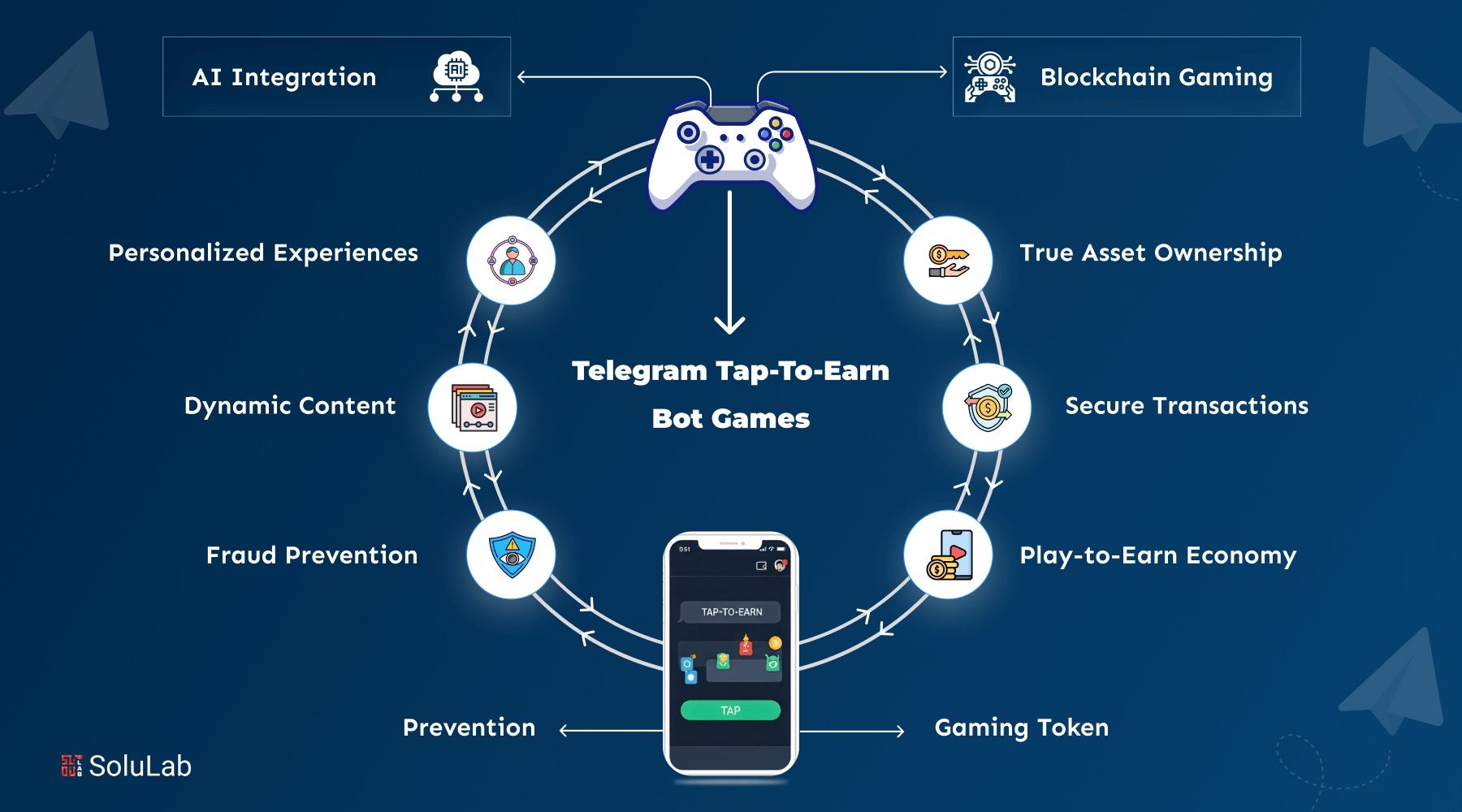
Telegram Tap-to-Earn Bot Games

Tap-to-Earn (T2E) is quickly adopting AI and blockchain technology and making a new wave of innovation. Several entrepreneurs, developers, and investors are taking a keen interest in these games. These simple models are changing how players interact and monetize. Unlike many Web3 games, these bots offer instant access inside Telegram chats. 

TapSwap reached over 55 million users globally, with 18 million daily active users by late 2024.

Through the integration of AI and blockchain, T2E and online gaming are raising the standards beyond entertainment. They showcase the future of scalable, secure, and rewarding gaming ecosystems that appeal to players while opening new opportunities for businesses and startups.

What is a Telegram Tap-to-Earn Bot Game?

A Telegram Tap-to-Earn bot game is a mini-application hosted directly within the Telegram platform. These games require no downloads, separate accounts, or complex onboarding. Players engage by tapping, completing micro-tasks, or interacting with automated challenges to earn in-game rewards.

Unlike conventional games, these bots combine gaming, earning, and social engagement in one ecosystem. The instant accessibility and freedom of choice make them attractive compared to traditional Web3 gaming

Telegram Tap-to-Earn vs. Other Game Models

Let’s check how these T2E games are different from Web3 games and what makes them viral among users. 

Feature Telegram Tap-to-Earn Bot Games Traditional Web3 Games
Access & Onboarding Launch instantly inside Telegram chats with no downloads or wallets needed. Instant play keeps users engaged. Require browser access, wallet extensions, and long onboarding, creating friction.
Wallet Integration Secure integration with Tonkeeper or MetaMask inside Telegram Mini Apps ensures seamless token earning. Wallet connections are often fragmented, making transactions slower and less intuitive.
Community Growth Games spread organically via group chats, leaderboards, and invites. Depend heavily on external marketing and paid campaigns for growth.
Development Costs Bots, APIs, and contracts reduce deployment costs and time. Full-scale Web3 infrastructure demands higher costs and longer timelines.
User Experience Combines gaming, earning, and social interaction within one platform. Experiences are fragmented across gaming, wallets, and social channels.

Blockchain Integration in Tap-to-Earn Games

Blockchain integration powers the core value of Telegram Tap-to-Earn games. It ensures security, ownership, and transparent economies.

1. Immutable Asset Ownership 

Blockchain records every purchase or transfer permanently. This transparency guarantees that player-owned assets remain secure and verifiable at all times. Players trust the ecosystem more.

2. Cross-Game Usability 

Items such as characters, weapons, or skins can be carried across games. This interoperability increases value for players and expands opportunities for developers.

3. Decentralized Transactions 

Every token movement occurs on decentralized networks. This reduces risks of fraud and makes transactions faster, fairer, and verifiable by all participants.

4. Reduced Cheating Risks 

Blockchain validation ensures fairness. Once assets and rules are coded into smart contracts, manipulation becomes almost impossible, reducing cheating and hacks.

The Role of AI in Tap-to-Earn Bot Games

Artificial intelligence transforms how players experience these games. AI makes personalization, fairness, and monetization smarter.

1. Dynamic Difficulty Adjustment 

AI tracks player actions in real time and adjusts challenges. Players remain engaged without becoming frustrated or bored. Balanced gameplay builds loyalty.

2. Personalized Rewards 

Machine learning identifies individual preferences and tailors rewards accordingly. Players receive offers aligned with their habits, which strengthens satisfaction.

3. Smart Monetization 

AI predicts which players prefer video ads, banners, or in-app purchases. Targeted recommendations increase conversions without disrupting gameplay.

4. Predictive Engagement Analytics 

AI analyzes player retention and churn risk. This data helps developers improve content, ensuring players return consistently over time.

Tokenomics, Micro-Economies and Monetization Models

Tokenomics forms the backbone of Tap-to-Earn games. A balanced economy ensures sustainability, growth, and value. Micro-economies within these games enable players to earn, trade, or stake tokens. 

AI enhances these models with tailored incentives, subscription suggestions, and revenue optimization. Monetization channels include in-game ads, cosmetic upgrades, and reward-based video ads. 

Blockchain ensures tokens retain value through scarcity mechanisms like burns. Together, these models create sustainable revenue for developers while rewarding players for engagement.

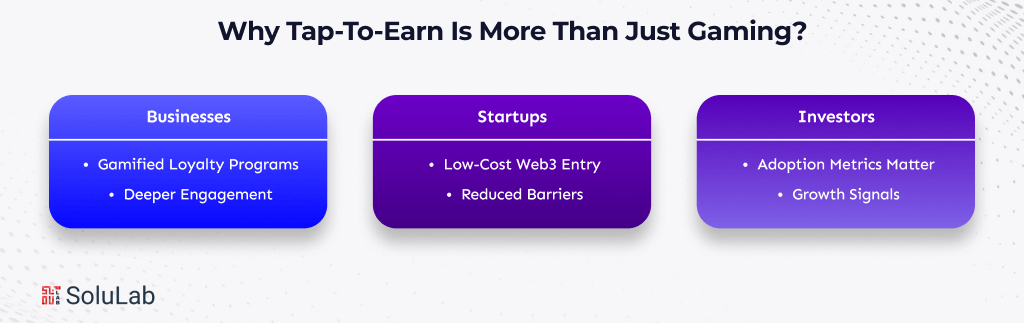
Why Tap-to-Earn Is More Than Just Gaming?

Tap-to-Earn represents more than entertainment. It is a proof-of-concept for scalable Web3 economies.

  • Businesses can adapt gamified customer loyalty programs using tokenized incentives. Customers engage deeper and return more often.
  • Startups find a low-cost entry point into Web3 through bots instead of heavy infrastructure investment. This reduces barriers to innovation.
  • Investors view user adoption metrics in Tap-to-Earn as signals of broader blockchain gaming potential. Strong engagement forecasts market growth.

This model provides a blueprint for integrating AI, blockchain, and social gaming into multiple sectors.
Why Tap-to-Earn Is More Than Just Gaming

How to Overcome AI and Blockchain Game Development Challenges?

AI and blockchain integration in games is not an easy task; there will be challenges. But every challenge has a solution. Let’s check some challenges you might face during AI and blockchain game development, and what the solutions are.

  • Scalability and Server Load Management

High traffic can overwhelm servers during rapid adoption. Cloud-based infrastructure, sharding, and load balancing distribute demand. Optimized engines and database tuning ensure smooth operations under heavy loads. Developers must scale efficiently to protect performance.

  • Botting and Cheating

Bots exploit games by tapping faster than humans. Timestamp checks, behavior analysis, and dynamic task changes counter these risks. Advanced cheat detection software and frequent audits reinforce trust and fairness within the ecosystem.

  • Designing Sustainable Tokenomics

Unbalanced supply or inflation can destroy token value. Developers must monitor token flow, introduce burns, and expand utility cases. Incentives for staking or participation prevent sell pressure and support a strong economic model.

  • Player Retention

Repetitive gameplay reduces engagement. Regular updates, meaningful rewards, and seasonal events keep players active. Building communities through leaderboards or group challenges strengthens long-term interest and loyalty within the game.

  • Designing an Engaging User Interface

Confusing UI designs drive churn. Responsive layouts, intuitive navigation, and consistent branding are critical. Testing and iteration ensure the interface adapts to player needs. Unique characters or interactive visuals enhance user satisfaction.

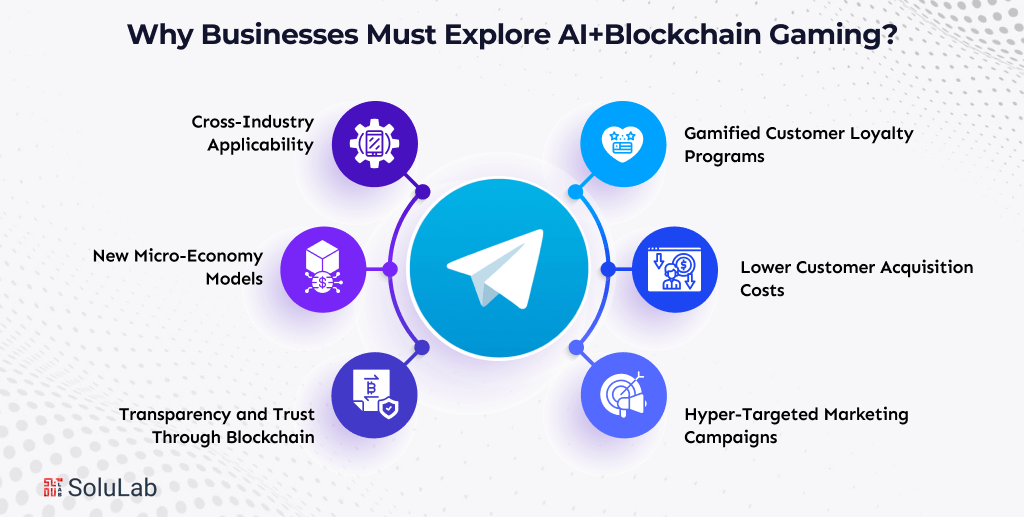
Why Businesses Should Care About AI+Blockchain Gaming?

As of now, you might have already understood the importance of AI and blockchain in the gaming industry. Here are some convincing reasons:
Why Businesses Must Explore AI+Blockchain Gaming

  • Gamified Customer Loyalty Programs

Businesses can design blockchain-based loyalty tokens that reward customer actions. A Deloitte survey found that gamified loyalty programs can increase engagement rates by up to 47%, improving retention.

  • Lower Customer Acquisition Costs

AI-driven personalization reduces marketing spend by targeting the right users. According to McKinsey, personalization can drive 40% more revenue growth while lowering acquisition costs.

  • Hyper-Targeted Marketing Campaigns

AI analyzes user behavior such as purchase history and activity patterns. This enables businesses to launch tailored campaigns that raise conversion rates by 10-15% compared to generic promotions.

  • Transparency and Trust Through Blockchain

Blockchain records are immutable, creating verifiable proof of ownership and transactions. PwC reports that 45% of consumers trust blockchain systems more than centralized databases for digital value.

  • New Micro-Economy Models

Businesses can tokenize in-game assets, loyalty points, or digital goods. These tokens can be exchanged, staked, or burned, creating sustainable value ecosystems that boost long-term engagement.

  • Cross-Industry Applicability

AI+Blockchain gaming models apply to multiple industries. Retail brands can tokenize rewards, financial firms can gamify investments, and entertainment companies can build fan economies around exclusive digital assets.

If you are thinking of developing a game that gives a wide virtual world experience with catchy rewards, consider consulting a third party. It is a good choice for AI and blockchain solutions and integration.

Future of AI & Blockchain Gaming Beyond Telegram

AI and blockchain integration in gaming is widening the innovative ideas and shaping the world’s technology. Not just games, from daily actions to global economics, AI, and beyond, blockchain solutions simplify complex actions. 
  • In the near future, gaming platforms will become cross-platform assets. These are usable in the virtual world, metaverse, and traditional gaming consoles. 
  • AI will expand personalization, analyzing behavior across networks to deliver unified experiences. 
  • Blockchain economies will underpin not just games but entire social and business ecosystems. 
  • Telegram Tap-to-Earn bots mark the first step in a broader transformation where AI, blockchain, and gaming converge to define future digital engagement.

Blockchain Development Company

Conclusion

AI and blockchain integration in games is a great innovative step. As discussed above, this brings several futuristic ideas and transformations in world economics and technology. So, if you are also thinking of building AI+blockchain games or want custom changes, then consult SoluLab. 

We, at Solulab, a top blockchain game development company, aid you in designing scalable, secure, and transparent solutions. Our expert team and enhanced technology applications help you in building a user-friendly ecosystem and craft your ideas into real-world applications. 

If you are also looking for AI and Blockchain solutions, contact us today to get started!

FAQs

1. What makes Telegram Tap-to-Earn bot games different from other Web3 games? 

Telegram Tap-to-Earn games run directly inside chats, require no downloads, and spread virally through communities, making them faster, cheaper, and more engaging than traditional Web3 models.

2. How does blockchain improve security and ownership in Tap-to-Earn games? 

Blockchain ensures every asset and transaction is transparent and permanent. This guarantees real ownership, reduces fraud, and builds stronger trust among players within the gaming ecosystem.

3. What role does AI play in enhancing Tap-to-Earn gameplay? 

AI personalizes player rewards, adjusts difficulty in real-time, and predicts engagement trends. These improvements keep players interested, reduce churn, and make gameplay rewarding without overwhelming users.

4. Why should businesses or startups consider SoluLab for AI+Blockchain game development? 

SoluLab offers tailored blockchain and AI development with proven expertise. The team builds secure, scalable, and user-friendly ecosystems, making it easier for startups and enterprises to launch innovative Web3 solutions.

5. Could Tap-to-Earn games influence industries beyond gaming? 

Yes. The tokenized incentives and AI-driven engagement models can be applied to loyalty programs, e-commerce, or even workplace training, proving that this concept can reshape multiple industries outside gaming.

The Role of Blockchain in Web 3 Development

The Role of Blockchain in Web 3 Development

The Internet has experienced major developments over the last two decades. Web 1.0 brought us static web pages, Web 2.0 introduced dynamic and interactive content, and now, Web 3.0 is poised to revolutionize the way we interact with the digital world. At the heart of this transformation is blockchain technology. 

In this blog, we will explore the crucial role of blockchain in Web 3 development and its potential to reshape the Internet as we know it.

The Evolution of the Internet Leading to Web 3.0

To understand the significance of blockchain in the context of Web 3 technology, it’s essential to trace the journey of the Internet itself. We’ve witnessed two distinct phases, known as Web 1.0 and Web 2.0, each representing a unique stage in the Internet’s development.

Web 1.0 marked the internet’s initial foray, originating in the late 1980s. This phase primarily featured static, ‘read-only’ web content and was the creation of a select few participants. At the time, Web 1.0 was groundbreaking, as it allowed people to access information from around the world. However, it came with significant limitations, particularly in terms of user interaction.

Following Web 1.0, we witnessed the rise of Web 2.0, which brought substantial advancements in user engagement and interaction. Web 2.0 empowered users to create personal accounts through various applications, enabling them to build unique digital identities on the internet. This development led to the expansion of e-commerce and social media platforms, exploring new avenues to reach a broader audience. Additionally, Web 2.0 fostered the emergence of transformative web technologies like HTML5, CSS3, and JavaScript.

Read Our Blog: Top 10 Web3 Development Companies 2024

Now, the world is on the cusp of a new era in internet development, often referred to as Web 3.0. What does this latest iteration of the internet promise, and how does blockchain fit into this new landscape?

The Emergence of Web 3.0 and the Role of Blockchain Platforms

Web 3.0 represents a paradigm shift in the way we approach the Internet. It focuses on decentralization, user control, and data security. In this new era, blockchain platforms play a central role in shaping the future of the internet.

Web 3.0 harnesses the power of blockchain technology applications to ensure that data is stored in a decentralized, tamper-resistant manner. This decentralization eliminates the need for central servers, enhancing security and reducing the risk of data breaches. Furthermore, blockchain technology is pivotal in creating self-sovereign digital identities, giving users complete control over their personal data and digital interactions.

Smart contracts, a product of blockchain platforms like Ethereum, play a crucial role in automating various processes and agreements, allowing for more efficient and trust-based transactions. Moreover, these smart contracts power decentralized applications (DApps), opening up new frontiers in areas such as decentralized finance (DeFi) and non-fungible tokens (NFTs).

CTA1

In Web 3.0, blockchain platforms promote interoperability, facilitating seamless data and asset exchange across various networks. This interconnectedness enables users to navigate the decentralized web more smoothly.

As we journey into the era of top Web platforms, blockchain technology is the linchpin, underpinning the principles of decentralization, user sovereignty, and data security. It’s revolutionizing the Internet, offering us a new digital landscape that’s more inclusive, secure, and user-centric.

Defining Web 3.0: The Next Phase of the Internet

When we delve into the concept of the latest iteration of the Internet, Web 3.0, it’s important to establish a clear definition. Web 3.0 represents the third generation of Internet services, empowered by cutting-edge technologies such as Artificial Intelligence (AI), the Internet of Things (IoT), and blockchain. This new internet phase places a strong emphasis on innovations like AI and machine learning while prioritizing enhanced security measures. To fully grasp the essence of Web 3.0, it’s essential to examine the backdrop against which it has evolved.

Web 2.0 was a pivotal turning point that transformed our understanding of online social interactions. It brought together producers and consumers of products, services, and information within a single digital arena. More significantly, Web 2.0 expanded the horizons of peer-to-peer (P2P) transactions on a global scale. However, a significant challenge with Web 2.0 became apparent through the role of platforms that had to act as trusted intermediaries between parties with mutual distrust. While Web 2.0 platforms facilitated P2P economies and efficient value settlement, they simultaneously wielded substantial control, dictating transaction rules and managing user data. These issues set the stage for the emergence of Web 3.0.

Read Also: Top Blockchain Trends in 2024

Web 3.0: Applications and Use Cases

Web 3.0: Applications and Use Cases

Web 3.0 introduces a range of innovative applications and use cases, building upon the shortcomings of its predecessor:

  • Decentralized Social Networks: Web 3 use cases allow for decentralized social platforms that put users in control of their data and interactions. This mitigates concerns over centralized data control and content censorship.
  • DeFi (Decentralized Finance): One of the standout applications of Web 3.0, DeFi platforms, leverages blockchain and smart contracts to create an open and transparent financial ecosystem. This empowers users with more control over their financial assets and transactions.
  • Digital Identity Management: Web 3.0 brings forth self-sovereign identity solutions, giving individuals complete authority over their digital identities and reducing reliance on central authorities.
  • Supply Chain Transparency: Utilizing blockchain, Web 3.0 offers immutable supply chain management systems that ensure the authenticity and traceability of products.
  • Content and Intellectual Property: Blockchain technology in Web 3.0 aids in fair compensation for content creators, particularly through NFTs, thus revolutionizing content monetization and intellectual property management.

In brief, Web 3.0 signifies the next step in the evolution of the Internet, driven by advanced technologies and a focus on user empowerment and data security. This new digital era addresses the limitations of Web 2.0 and introduces a diverse array of Web 3 use cases, promising a more decentralized, secure, and user-centric online experience.

The Role of Blockchain in Web 3.0 Advancements

The significance of Web 3.0, exemplified by innovations like voice assistants such as Siri and Alexa, showcases the transformative potential of machine learning in shaping new internet services. In addition to the integration of machine learning and the interconnection of IoT devices, the third generation of the Internet is underpinned by the utilization of decentralized protocols. This underscores the need to explore the pivotal role of blockchain technology within the Web 3.0 landscape.

In Web 3.0, networks exhibit remarkable features, including interoperability and automation facilitated by smart contracts. This results in seamless integration and the establishment of a censorship-resistant framework for the storage of peer-to-peer (P2P) data files. It becomes abundantly clear that blockchain technology is poised to become a driving force in shaping the next era of the Internet.

Check Our Blog Post: Top 5 Enterprise Blockchain Platforms of 2024

Blockchain technology plays a central role in redefining conventional approaches to data storage and management. In simpler terms, blockchain provides a distinct data collection framework or a universal state layer that operates under collective management. This state layer not only serves as the foundation for a value settlement layer on the internet but also facilitates secure, copy-protected file transfers, enabling efficient peer-to-peer transactions without the need for intermediaries.

In the realm of Web 3.0, blockchain development companies and blockchain ecosystem protocols are instrumental in harnessing the full potential of blockchain technology, revolutionizing data management, and paving the way for a more decentralized and efficient digital landscape.

How Blockchain Paved the Way for Web 3.0?

The emergence of Bitcoin marked a significant milestone in charting the course for Web 3.0. Bitcoin’s blockchain and other protocols played a crucial role in establishing networks where malicious actors would need to breach multiple global locations to access data stored in a single location. Blockchain laid the foundational principles that have come to define the Web 3.0 landscape by enabling data storage across multiple copies within a peer-to-peer (P2P) network. The protocol not only outlines clear rules for governing the network but also ensures data security through a consensus mechanism involving all network participants. Incentives in the form of native network tokens are provided to these participants for their contributions towards network security and maintenance.

Read Our Blog: Top 10 Blockchain Ecosystem Protocols of 2024

Indeed, blockchain serves as the bedrock upon which Web 3.0 is constructed, particularly in its transformation of the data structures underpinning the internet’s infrastructure. Furthermore, blockchain technology has given rise to a governance layer that operates in tandem with the existing internet. This governance layer facilitates the ability for two parties, even if they are unfamiliar with each other and harbor mutual distrust, to reach agreements and execute transactions over the internet securely.

The role of blockchain in Web 3 development is predominantly focused on effecting a transformation in the backend infrastructure. From a technical standpoint, Web 3.0 can be envisioned as an assemblage of blockchain-based protocols designed to reconfigure the foundational structure of the Internet. Blockchain, in essence, serves as a distributed global computer, poised to revolutionize our perception of the internet.

Blockchain in Web 3.0: Practical Applications

Blockchain technology entails the utilization of distributed ledgers for the storage of data, ensuring immutability, a high degree of security, and interconnectivity. Additionally, this technology incorporates smart contracts, which are self-executing programs triggered by predefined conditions.

In essence, blockchain technology presents a substantial departure from traditional methods, offering the potential to enhance and transform the Internet significantly.

  • Digital Universal Identification Through Blockchain

Presently, websites heavily rely on third-party cookies for user identification, a method that proves to be both unreliable and insecure. Furthermore, this approach is anticipated to become increasingly untenable in the future. The limitations of Web 2.0 become evident when it comes to managing the identities of individuals, objects, and organizations. As a result, most consumer identity management processes hinge on centralized and isolated service providers.

Read Also: Web 3.0 Development Trends: What’s Next for the Internet

  • How Does the Current Consumer Identity Management Process Function?

Users create IDs on platforms using email IDs from providers like Google, Yahoo, or Meta. These service providers collect and control the data generated through email permissions and tracking.

With the continuous evolution of enterprise blockchain consulting firms and blockchain technology, there is the potential for an alternative global digital identification system. Through this technology, self-sovereign and encrypted digital identities can be created. These digital IDs offer enhanced protection against online theft and breaches while eliminating the need for multiple usernames and passwords.

Benefits of Employing Blockchain in Identity Management

Benefits of Employing Blockchain in Identity Management

  • Unique User IDs: Blockchain facilitates the creation of distinct and individualized identification for each user, enhancing security and user control.
  • Data Control: Users gain greater authority over the utilization of their data, determining who can access and use it.
  • Decentralized Data: Blockchain enables data to be stored in a decentralized manner, reducing dependence on central authorities and enhancing data security.
  • Universal User Identity: Through blockchain, the possibility of establishing a universal digital identity for each user becomes feasible, streamlining interactions across various platforms.
  • Individual Monetization: Blockchain empowers users to monetize their data and digital presence, providing opportunities for individuals to benefit from their online activities.

Read Our Blog Post: The Rise of Web 3.0: Exploring its Impact on the Digital Landscape

Leveraging Blockchain Technology in Marketing

Smart Contracts, an extension of blockchain technology, offers the capacity for individuals to engage in transactions of value online without the need for intermediaries. This ensures transparency and eliminates conflicts, presenting the potential to transform how marketing operates in the context of Web 3.0.

Smart contracts reside at specific addresses on the blockchain, functioning based on predefined rules and penalties for every agreement. Notably, they do not rely on external entities or third parties, such as banks, to enforce these rules.

Blockchain technology, particularly smart contracts, has the potential to reshape the landscape of online marketing in the Web3 era. Organizations, including a Web3 game development company, can explore innovative and decentralized marketing strategies powered by these technologies.

Utilizing Blockchain in the Digital Advertising Sector

Blockchain technology is supposed to revolutionize the digital advertising industry in several impactful ways. Initially, it empowers publishers with the capability to access consumer metadata, enabling them to enhance the efficiency of their advertising campaigns. Furthermore, blockchain immutable ledger system offers a practical solution for combatting fraudulent activities by recording impressions securely.

To enhance transparency and trust, the adoption of smart contracts is encouraged as they provide a reliable and visible audience, ensuring that advertising operations run smoothly. Additionally, blockchain plays a pivotal role in anonymizing metadata, aligning with privacy regulations, and ensuring a superior brand experience for users while safeguarding their personal information.

In the era of Web 3.0, which embraces blockchain technologies, the way we store, access, and manage data on the Internet is set to undergo a transformative shift. This shift empowers individuals and elevates their web experiences by offering enhanced control over their data and interactions.

Blockchain Technology in the Healthcare Sector

The healthcare industry has witnessed substantial advantages from the progress in enterprise blockchain solutions and services. These innovations have fundamentally altered how information is exchanged within various sectors of the healthcare ecosystem.

Processes like drug development, research activities, and other essential facets of healthcare necessitate secure contracts. Blockchain technology presents a means of creating immutable documents that companies can utilize for contract purposes.

Read Also: Blockchain Security: Best Practices Every Developer Should Know

Moreover, the integration of blockchain-powered Learning Management Systems (LMS) has revolutionized the sharing of information among healthcare stakeholders. This technological advancement has made information more accessible on a global scale while ensuring that users receive pertinent and accurate data from trusted sources.

Blockchain in Web 3.0: Real-World Examples

One standout illustration of blockchain’s functionalities within the Web 3.0 landscape is the platform known as Follow. This decentralized, autonomous organization has introduced an innovative decentralized social protocol, ushering in a new era of web services. The core objective of Follow’s blockchain-based social protocol is to grant users complete control over their social identities and data. As the development of Web 3.0 unfolds, there is a concerted effort to establish novel social infrastructures that align with the foundational principles of the Internet. Blockchain’s role in this context is to eliminate the necessity for trusted intermediaries while enabling networks to collectively record and remember user interactions and past events. Clearly, blockchain stands as a formidable catalyst, unlocking the potential for a more decentralized internet.

Businesses and organizations looking to embrace blockchain technology within the Web 3.0 paradigm can consider options like to hire blockchain developers or hire dedicated developers to harness the full potential of this transformative technology.

CTA2

Conclusion

In conclusion, the role of blockchain in Web 3 development cannot be overstated. This technology is at the forefront of ushering in a new era of the internet, one that is more decentralized, secure, and user-centric. As Web 3.0 emerges, we witness the transformation of data management, digital identities, and online interactions. Blockchain’s core principles of decentralization, data immutability, and smart contracts have laid the foundation for a web where users have more control over their data and transactions, privacy is prioritized, and trust is fostered through transparency. This paradigm shift extends to various industries, from decentralized finance and supply chain management to digital content and intellectual property, all of which stand to benefit from the innovative potential of blockchain technology.

Web 3.0 represents not only a technological advancement but a paradigm shift towards a more equitable and user-driven digital future. With blockchain technology as a cornerstone, we embark on a journey where individuals have greater sovereignty over their online presence, and the internet evolves into a space that empowers rather than centralizes. As we continue to explore the vast potential of blockchain in this new web era, it is evident that it will play a pivotal role in shaping the internet of tomorrow, providing us with a more resilient, secure, and inclusive digital landscape.

SoluLab, a well-known Blockchain development company and Web3 development company is a leading provider of blockchain technology and Web3 development solutions. With our team of experienced blockchain developers and experts, we offer comprehensive services to help businesses and organizations harness the power of blockchain in building decentralized applications, and smart contracts, and integrating blockchain into existing systems. Our expertise spans a wide range of blockchain platforms and protocols, ensuring tailored solutions that align with the unique needs of clients in various industries. SoluLab’s commitment to innovation and our deep understanding of Web3 technologies make us a valuable partner for those looking to navigate the evolving landscape of blockchain and Web3 development. So, if you are looking to hire Web3 developers, look no further than SoluLab!

FAQs

1. What is Web 3.0, and how does it differ from previous iterations of the Internet? 

Web 3.0, often referred to as the “decentralized web,” is the next evolution of the internet. Unlike Web 1.0 and Web 2.0, Web 3.0 focuses on decentralization, user control, and data security. It aims to empower users, enhance data privacy, and promote interoperability among various online services.

2. How does blockchain technology enhance data security and decentralization in the context of Web 3.0? 

Blockchain provides a tamper-proof and decentralized ledger for storing data. It removes the need for centralized servers, reducing the risk of data breaches. Users gain control over their data and digital identities, and smart contracts automate and secure transactions, contributing to a more secure and decentralized internet.

3. What are some real-world applications of blockchain in Web 3.0 development? 

Blockchain in Web 3.0 is being utilized in various domains, including decentralized social networks, decentralized finance (DeFi) platforms, digital identity management, supply chain transparency, and content monetization through non-fungible tokens (NFTs).

4. How can businesses and individuals benefit from Web 3.0 and blockchain technology?

Businesses can leverage Web 3.0 and blockchain for increased security, cost-effective transactions, and innovative business models. Individuals gain more control over their online presence, better data privacy, and opportunities for monetizing their digital activities.

5. What challenges and obstacles does the integration of blockchain and Web 3.0 face, and how can they be addressed? 

Challenges include scalability, energy consumption, and regulatory issues. Solutions like layer 2 scaling, energy-efficient consensus algorithms, and regulatory frameworks can help address these challenges and pave the way for a smoother transition to Web 3.0 powered by blockchain technology.

Web3 Gaming: Future and How To Get Involved?

Web3 Gaming Future

Web3 has transformed several sectors, including gaming. With a significant departure from typical gaming platforms, Web3-based games enable players to interact with the games in novel and decentralized ways. People can earn money by playing with cryptocurrencies and NFTs. This simplifies all aspects of gaming, putting the majority of power in the hands of the player rather than one central authority inside a game. Gray markets have emerged as a result of the inefficiencies of traditional games and centralized servers, giving hackers and fraudsters more opportunities. They provide developers and administrators no advantages and take advantage of players. Administrators do not protect users on gaming platforms against cyberattacks and platform shutdowns. The digital assets are also very vulnerable to theft, fraud, and loss due to the centralized server’s ineffective defense against hackers.

Web3 gaming provides creative solutions to the issues mentioned above, including play-to-earn, crypto-secured gaming wallets, blockchain-based game asset ownership, decentralized gaming ecosystems with gaming Decentralized Autonomous Organizations (DAOs), and metaverse gaming.

In this blog, we will discuss the aspects of Web3 gaming and its unique characteristics and also how it revolutionizes the Web3 gaming industry.

What is Web3 Gaming?

Web3 gaming is a kind of decentralized gaming in which the operations of a gaming ecosystem or platform, especially the control of gaming assets and decision-making in all elements of gaming, are handed over away from any central authority. According to a recent study, as of 2024, the Web3 gaming market size is estimated to be worth over $12 billion, with projections indicating a compound annual growth rate (CAGR) of 21.8% from 2023 to 2030. This burgeoning market has seen over 100 million users actively participating in Web3 gaming platforms like Axie Infinity, Decentraland, and The Sandbox, which collectively boast over 10 million monthly active users. The in-game economy within these platforms is thriving, with transactions exceeding $3 billion in 2023 and NFT trades surpassing $5 billion. Venture capital funding for Web3 gaming startups reached over $4 billion in 2023, signaling strong investor confidence. Analysts predict that the market could surpass $50 billion by 2030, driven by advancements in blockchain technology and increased mainstream adoption.

Web3 games are created by incorporating blockchain into the gaming environment, giving players the opportunity to voice their opinions on when and how the game should progress. Web3 gaming also lays the foundation for play-to-earn, which modifies the pay-to-play paradigm by offering opportunities to earn cryptocurrencies while playing, convertible game tokens, and asset trading.  

Gaming Web3 creates fair virtual marketplaces for the gaming business, allowing gamers to access and control in-game digital goods. These materials are kept as gaming NFTs and are separate.

Gaming and Web3 also allow for broad interoperability between multiple gaming ecosystems by connecting in-game assets and players across platforms. The level of interoperability is determined by the blockchain platform used to establish a gaming environment. For example, Polkadot or Solana provide interoperability in cross-chain communication bridges.

Now that we’ve covered the basics of Web3 gaming, let’s move on to the features. 

Web3 Game Development Company

What are the Main Features of Web3 Gaming?

Web gaming is a value-exchange gaming concept in which players may own and sell in-game assets and valuables in the form of special NFTs using cryptocurrencies. Web Gaming provides self-sovereignty and decentralization in gaming, and it is open source. Here are the following Web3 in gaming features:

1. Ownership and Interoperability

Web3 gaming provides self-sovereignty, allowing users to totally control in-game assets and collectibles as digital NFTs. In conventional gaming, users possess in-game assets and collectibles, however, they forfeit all of them when they switch gaming platforms. Web3 gaming addresses this issue by enabling full ownership and interoperability across several platforms. Users may possess in-game assets on one platform and transfer them to another.

2. Old-Game Integration

Another intriguing characteristic of web3 gaming is the ability to integrate and upgrade existing game models into metaverse and blockchain systems, resulting in decentralization. The gaming experience is individualized, and each player has a favorite game. Web3 proposes to improve old and popular games by bringing them into the metaverse, where players may create avatars and barter in their favorite in-game items and treasures.

3. Player-Driven Gaming

Web3 gaming customizes the game ecology depending on player preferences. There are several ways in which Web3 gaming might benefit gamers. One is the play-to-earn component, in which they benefit from their in-game products; another is old-game integration, which caters to gamers’ desire to play games they enjoy in the metaverse. 

4. Minimal Downtime

Web3 game ecosystems are self-sufficient, requiring little maintenance and no involvement from other parties. Web3 gaming is very scalable and has very little downtime because to its block minting and huge game data storage capacity.

5. Open-source Gaming

Web3 gaming is a decentralized method where games are stored on the blockchain, rendering them impenetrable to hackers. Blockchain-based gaming is decentralized, meaning that all users on the network may access it equally and modify the game by voting consensus. It also eliminates the possibility of a single point of failure. Web3 gaming guarantees a great degree of transparency in this way. 

Challenges With Conventional Gaming

It’s no secret that playing conventional games gives us greater room to engage with our surroundings, but there are drawbacks as well. Still, millions of people utilize conventional gaming globally, making it the most potential segment of the market. Nevertheless, the shortcomings of traditional games highlighted the necessity for the Web3 gaming platform.

What challenges are those? Now let’s talk.

  • Transferring in-game Resources: Fiat money can be used to buy assets in traditional games. Although these assets have no worth outside of the relevant game’s marketplace, they may be helpful while playing the game. resulting in zero profit from several investments. 
  • True Possession of In-Game Assets: Does ownership really pass to the owner when an object is bought in a typical game? No, is the response! Since the game operators already own the copyrights to such in-game materials, they merely get a licensing to communicate with them. In the world of gaming, Web3 gives users complete sovereignty over their in-game property.
  • Centralized Data for In-Game Play: It may surprise you to learn that the data you submit when playing classic games is kept on separate servers. What is meant by that? It only indicates that the utilization of the provided data is entirely under the discretion of the game administrators. putting both data security and privacy at risk. 

How to Play a Web3 Game?

How to Play a Web3 Game

Playing a Web3 game is easy once you get the hang of it. Here’s a simple guide to help you get started:

1. Set Up a Digital Wallet: Begin by setting up a digital wallet that supports cryptocurrencies and NFTs. Popular options include MetaMask, Trust Wallet, and Coinbase Wallet. This wallet will store your digital assets and let you interact with Web3 games.

2. Get Some Cryptocurrency: Most Web3 games require cryptocurrency, often Ether (ETH) if the game is on the Ethereum blockchain. You can buy cryptocurrency on exchanges like Coinbase, Binance, or Kraken and transfer it to your digital wallet.

3. Choose a Web3 Game: There are many Web3 games to choose from, like Axie Infinity, Decentraland, and The Sandbox. Visit their websites to learn more about the games and what you need to start playing.

4. Connect Your Wallet: Once you’ve chosen a game, you’ll need to connect your digital wallet to the game’s platform. This usually involves clicking a “Connect Wallet” button on the game’s website and following the prompts to authorize the connection.

5. Create an Account or Avatar: Many Web3 games require you to create an account or an avatar. This process might include setting up a username and customizing your in-game character.

6. Acquire In-Game Assets: In Web3 games, you often need to acquire in-game assets like characters, items, or land. These can be bought using cryptocurrency or earned through gameplay. Some games also use NFTs to represent unique items or characters.

7. Start Playing: With everything set up, you can start playing. Web3 games can involve completing tasks, battling other players, or exploring virtual worlds. The gameplay varies depending on the game you choose.

8. Earn and Trade: One of the cool features of Web3 games is the ability to earn cryptocurrency and NFTs through gameplay. These can often be traded or sold in the game’s marketplace or on external platforms, potentially earning you real money.

Factors Driving the Web3 Revolution in the Gaming Industry

A specific set of technologies linked to Web3 in gaming is propelling the industry forward at an incredible pace. These key technologies include:

  • Blockchain: Implementing blockchain technology gives gamers and owners a fair chance to fully explore the gaming world. Integrating blockchain into the gaming ecosystem significantly enhances the player experience with features such as decentralization and immutability.
  • NFTs: Many Web3 games now utilize NFTs as in-game assets. NFTs, or non-fungible tokens, are cryptographic tokens that provide true ownership of the underlying assets. Their ability to be transferred between wallets makes them highly valuable, as they enable the trading of digital assets with exclusive ownership rights.
  • Artificial Intelligence: Traditional gaming has been static, requiring additional elements and interactions for improved engagement. Artificial intelligence is enhancing player engagement by enabling computers to understand information similarly to humans. This leads to improvements in speed and interaction capabilities, resulting in better gaming experiences.
  • Tokens: Tokens are widely used as incentives for players to participate in Web3 games. The value of these tokens tends to increase over time. Web3 gaming encourages the use of tokens to strengthen the gaming community. These tokens can also be sold on the market for profit.
  • AR and VR: Augmented reality (AR) and virtual reality (VR) are transforming the gaming experience. VR technology allows players to connect, socialize, and build relationships within games, while AR technology enables gameplay in a multi-dimensional space with more flexible character movements. Both technologies open new dimensions in the Web 3 gaming industry, enhancing the overall experience.

How Web3 Redefines Monetization in Gaming?

For players, traditional games typically offer enjoyment at the cost of significant financial expenditure, with in-game assets losing their value once the game ends or the player quits. Additionally, the conventional monetization models in gaming are fraught with flaws.

However, gaming in Web3, built on technologies like blockchain and NFTs, has introduced a revolutionary monetization model. Players now have the opportunity to earn passive income through staking and other methods, receiving financial rewards for the time and effort they invest in games.

For game developers and owners, Web3 games have created an endless stream of revenue opportunities. They can offer in-game purchases, run in-game marketplaces, and provide players with unprecedented freedom to trade assets. In essence, Web3 in gaming has completely overhauled the traditional monetization methods, creating a more dynamic and rewarding ecosystem for both players and developers.

What is a Gaming DAO?

Gaming DAOs (Decentralized Autonomous Organizations) are gaming platforms based on open-source code and operate independently of any centralized gaming administrators or operators. At their core, Gaming DAOs are community-driven, focusing on creating a player-centric gaming ecosystem.

Gaming DAOs empower the redistribution of game ownership across a diverse community that includes players, developers, investors, and traders. This redistribution fosters a more inclusive and collaborative gaming environment.

In Web3 gaming, Gaming DAOs are instrumental in powering the play-to-earn model, a revolutionary concept that compensates players for their game participation and success. Unlike traditional gaming models, which primarily benefit game administrators or operators, Gaming DAOs facilitate a two-way exchange of value.

The play-to-earn feature in Gaming DAOs rewards both players and developers, driving the gaming economy by recognizing and compensating for gaming skills.

Types of Gaming DAOs

Gaming DAOs can be categorized into three fundamental types:

  • Gaming Guilds: Gaming guilds consist of informal groups of gamers, well-organized multi-game clans, and e-sport teams that engage in play-to-earn activities on a communal basis. These guilds operate similarly to investment clubs, pooling funds to acquire in-game digital assets, often in the form of unique NFTs. Players within these guilds use these assets to play games, earn in-game tokens collectively, and share the revenue. Gaming guilds have significantly impacted the Web3 gaming market by accumulating in-game assets and fostering a growing community of gamers, speculators, and NFT traders.
  • Incubators and Accelerators: This type of Gaming DAO focuses on nurturing and expanding Web3 gaming platforms by providing expertise to platform founders. Incubators and accelerators offer funding for developing new gaming ventures and provide advanced tools and technical solutions to enhance Web3 games. They play a crucial role in the growth of Web3 gaming by offering grants and taking strategic initiatives to support gaming clans and developers, bringing together all gaming stakeholders and investors to financially expand Web3 gaming.
  • Developers: Developer-focused Gaming DAOs collaborate on a common platform for different Web3 game development projects. These DAOs establish terms and conditions for game development, which are monitored and enforced through smart contracts. Developer Gaming DAOs autonomously manage various aspects, including content moderation, in-game collectible policies, voting, and auctions, ensuring a transparent and decentralized development process.

These types of Gaming DAOs exemplify the diverse ways the Web3 gaming platform ecosystem is evolving, fostering innovation and community engagement in gaming.

Future of Web3 Gaming

The future of Web3 gaming promises to revolutionize the gaming industry by leveraging blockchain technology, decentralized systems, and innovative economic models. Web3 gaming is set to offer unprecedented opportunities for players, developers, and investors alike. Here are some key aspects shaping the Web3 gaming future:

1. Enhanced Player Ownership and Control: Web3 gaming will continue to empower players by providing true ownership of in-game assets through NFTs. This means that players will have full control over their digital items, which can be traded, sold, or transferred across different games and platforms, enhancing their value and utility.

2. Decentralized Economies: The future of Web3 gaming will see the rise of decentralized in-game economies where players can earn real-world value. Play-to-earn models will become more sophisticated, allowing gamers to earn cryptocurrency and other digital assets through gameplay, creating new income streams and economic opportunities.

3. Interoperability Across Platforms: Interoperability will be a cornerstone of Web3 gaming’s future. Players will be able to use their in-game assets across multiple games and platforms, creating a seamless and interconnected gaming experience. This will break down barriers between games and foster a more inclusive gaming ecosystem.

4. Community-Driven Development: Web3 gaming will further embrace community-driven development, where players and developers collaborate on game creation and improvement. Decentralized Autonomous Organizations (DAOs) will play a crucial role in governance, allowing the community to have a direct say in the direction and features of their favorite games.

5. Immersive Experiences with AR and VR: Augmented Reality (AR) and Virtual Reality (VR) technologies will be integral to the Web3 gaming future, providing immersive and interactive experiences. These technologies will enable players to engage with games in entirely new ways, making gameplay more engaging and realistic.

6. Increased Security and Transparency: Blockchain technology will enhance security and transparency in Web3 gaming. Smart contracts will ensure fair play and trustless transactions, reducing the risk of fraud and cheating. Additionally, decentralized systems will make gaming platforms more resilient to hacking and other security threats.

7. Sustainable Gaming Ecosystems: The future of Web3 gaming will prioritize sustainability, with eco-friendly blockchain solutions reducing the environmental impact of gaming. Energy-efficient consensus mechanisms and green initiatives will help create a more sustainable gaming industry.

8. Cross-Industry Collaborations: Web3 gaming will facilitate collaborations across different industries, including finance, entertainment, and social media. This convergence will lead to innovative new game features, monetization strategies, and user experiences, further blurring the lines between gaming and other sectors.

As the Web3 gaming future unfolds, it will transform the way we play, interact, and monetize gaming experiences. The integration of blockchain, decentralized technologies, and innovative economic models will create a more dynamic, equitable, and engaging gaming landscape for all stakeholders.

Connect Today

Concluding Remarks

Even though web3 gaming is still in its infancy, there is a lot of potential, and it should only become better with time. Experts predict that more participants in the gaming sector will use web3 technology. The game industry as a whole will advance significantly with Web3 as it will compensate players and owners more fairly. The main features of modern web3-based games are the strong backing provided by blockchain, the availability of NFTs as in-game assets, and the development of enormous communities known as DAOs. The future of decentralized gaming is more immersive, social, and linked than ever before, as anybody familiar with the web3 buzz can readily predict.

Web3 in gaming faces several challenges, including scalability issues, complex user interfaces, high transaction fees, and security vulnerabilities. These obstacles can hinder user adoption and the seamless integration of blockchain technology into gaming. As a leading Web3 game development company, SoluLab is uniquely positioned to address these challenges by offering scalable solutions, user-friendly interfaces, optimized transaction processes, and robust security measures. By leveraging our expertise in blockchain technology and game development, we ensure that Web3 games are accessible, efficient, and secure for both players and developers. Ready to transform your gaming experience with innovative Web3 solutions? Contact Us today to get started.

FAQs

1. How do players benefit from Web3 gaming?

Players benefit from Web3 gaming through enhanced ownership of in-game assets, which can be bought, sold, or traded across different platforms. They also have opportunities to earn cryptocurrency and other digital rewards through gameplay, creating new income streams and economic incentives.

2. How secure are Web3 gaming platforms?

Web3 gaming platforms leverage blockchain technology and smart contracts to enhance security and transparency. Blockchain ensures that in-game transactions are immutable and tamper-proof, while smart contracts automate and enforce rules, reducing the risk of fraud and ensuring fair play.

3. Can I make money playing Web3 games?

Yes, Web3 games often feature play-to-earn models where players can earn cryptocurrency and other digital rewards for their gameplay achievements. By acquiring and trading in-game assets like NFTs, players can generate real-world income, creating new opportunities for gaming enthusiasts.

4. What role do DAOs play in Web3 gaming?

DAOs, or Decentralized Autonomous Organizations, are community-driven entities that govern aspects of Web3 gaming platforms. They enable decentralized decision-making, allowing players and stakeholders to participate in governance, game development, and economic activities within the gaming ecosystem.

5. How can I get started with Web3 gaming?

To get started with Web3 gaming, you’ll need a digital wallet that supports cryptocurrencies and NFTs, such as MetaMask or Trust Wallet. Acquire some cryptocurrency like Ether (ETH), which is often used in Web3 gaming transactions. Choose a Web3 game that interests you, connect your wallet, and start exploring and playing!

6. What are the future trends in Web3 gaming?

The future of Web3 gaming includes trends like enhanced player ownership through NFTs, interoperability across gaming platforms, immersive experiences with AR and VR, and sustainable gaming ecosystems. These advancements will redefine how games are played, monetized, and experienced globally.
