


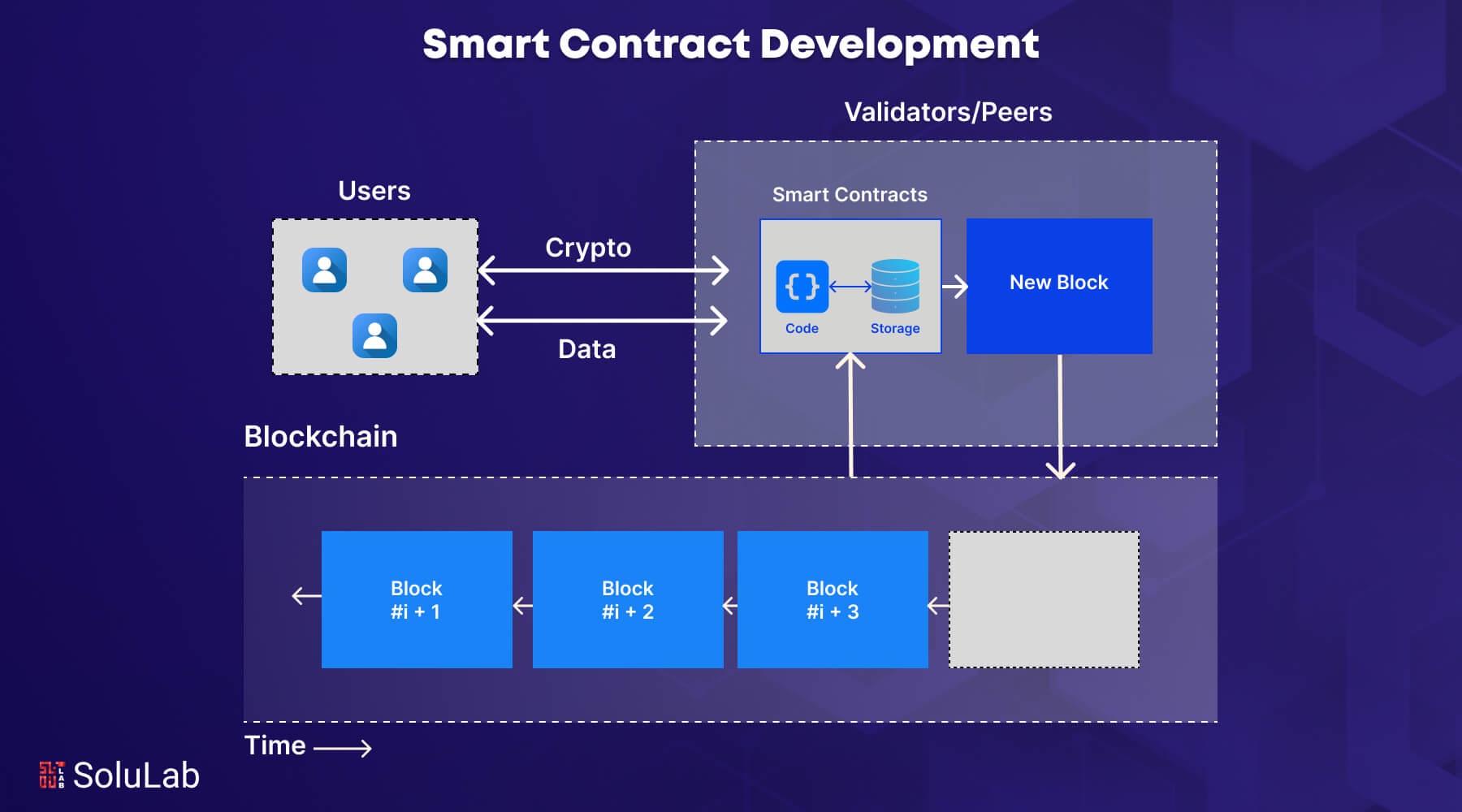
Have you ever wanted that contracts could operate without any delays, middlemen, or problems with trust?
In 2026, smart contracts are changing industries like finance, supply chain, healthcare, and real estate by automating transactions with pinpoint accuracy and full transparency. But building a smart contract requires an understanding of blockchain, coding, and security best practices. Learning how to create smart contracts will open up new possibilities for anybody involved with technology, be it a developer, company founder, or tech enthusiast.
In this step-by-step guide, we’ll walk you through everything you need to know to build secure and functional smart contracts in 2026—from choosing the right platform to deploying your first contract. Let’s begin!
Smart contracts are self-executing digital agreements written in code that automatically carry out the terms of a contract when predefined conditions are met. Built on blockchain technology, they remove the need for intermediaries like lawyers or banks, making transactions faster, cheaper, and more secure. Once deployed on a blockchain network, like Ethereum, these contracts are immutable and transparent, meaning they can’t be altered or tampered with, and everyone on the network can verify them.
For example, a smart contract could be used to automatically transfer ownership of a digital asset once payment is confirmed. Because the process is governed by code, it reduces the chances of fraud or disputes. From finance and insurance to real estate and gaming, smart contracts are changing industries by enabling trustless and efficient digital interactions.
A smart contract is a legally enforceable agreement between two parties, just like any other contract. It utilizes the benefits of blockchain technology to increase effectiveness, transparency, and privacy. These are steps that are required for smart contracts to operate.
1. Agreement: The terms and conditions of the arrangement must be agreed upon by the parties wishing to transact business or trade goods, or services. They also have to decide how a smart contract will work, including what needs to happen in order for the agreement to be completed.
2. Contract creation: There are several ways for participants in a transaction to construct a smart contract, such as working with a smart contract provider or developing it oneself. A programming language is used to code the contract’s terms. It is crucial to thoroughly confirm the contract’s security at this point.
3. Deployment: The contract has to be posted on the blockchain after it is finalized. The code is entered into the exchange’s data field, and the smart contract is posted to the blockchain in the same manner as other cryptocurrency transactions. The transaction is considered active on the blockchain after verification and cannot be undone or changed.
4. Conditions monitoring: A smart contract operates by keeping an eye on the blockchain or another trustworthy source for preset prompts or conditions. Any digitally verifiable event, such as a date reached or a payment completed, can serve as one of these triggers.
5. Execution: The smart contract is activated per the “if/when…then…” statement when the trigger criteria are satisfied. This may include registering the buyer’s control over an asset or transferring money to a vendor, among other things.
6. Recording: The blockchain instantly publishes the outcomes of contract execution. The completed agreement is stored on the blockchain after the blockchain system confirms the acts conducted and records their completion as an exchange. This document is always accessible.
Read More: What Problems Do HTLC Smart Contracts Solve in Crypto Payments?
The global smart contracts market is projected to reach $3.21 billion in 2025, growing from $2.63 billion in 2024, with a CAGR of 22%. Blockchain plays a crucial role in how smart contracts work and execute smoothly. Here’s how blockchain supports smart contract execution:
In recent years, smart contracts—self-executing computer programs that operate on a blockchain—have grown in popularity. The following are some benefits of developing smart contracts for your company:
Numerous tasks associated with carrying out a contract, including identity verification, payment execution, and contract enforcement, may be automated using smart contracts. Because it streamlines the contract execution process and does away with the need for middlemen, this may save firms both money and time.
Read Blog: Benefits of Blockchain-as-a-Service?
Once smart contracts are implemented on a blockchain, they cannot be changed and are impervious to tampering. They become far more secure as a result, and the possibility of fraud or other interference is decreased. Furthermore, smart contracts employ encryption to safeguard contract data and guarantee that only authorized parties may access it.
Blockchain consulting offers an open and unchangeable record of all transactions, is used to carry out smart contracts. Since all parties to the contract have access to the same information and records, this promotes accountability and transparency.
Smart contracts may drastically lower the expenses involved in carrying out a contract by doing away with the need for middlemen like bankers, attorneys, and other intermediaries. Furthermore, smart contracts can lower the possibility of mistakes and disagreements, which will cut expenses even more for companies.
Because smart contracts are automatically performed in accordance with predefined circumstances, they are extremely dependable. This guarantees that the contract is carried out precisely as planned and lowers the possibility of mistakes or omissions.
By automating many of the necessary stages, smart contracts may greatly accelerate the contract execution process. This can shorten the time needed to carry out an agreement, which is especially advantageous for contracts with tight deadlines.
Because smart contracts operate automatically in response to preset parameters, there is less chance of mistakes or omissions. This can lessen the possibility of disagreements or misunderstandings and increase the precision with which contracts are executed.
Smart contracts may be tailored to your company’s unique requirements. This saves you from using pre-made contract templates and enables you to customize the terms of the agreement to your own needs.
On a blockchain network, smart contracts may be carried out, giving users access to a worldwide market. By enabling you to sign contracts with people all around the world, this can increase the potential for your firm.
As an unchangeable and transparent record of every transaction, smart contracts may foster more confidence between parties. By doing this, the chance of disagreements or miscommunications can be decreased and trust between the parties can grow.
Digital contracts are being cleverly used by supply chains, insurance companies, and many more to cut expenses on administration and services. Let’s examine the many industry use cases for smart contracts:
The procedure of purchasing and selling flats is changing due to real estate smart contracts. They integrate the roles of brokers and notaries into a single, self-contained system. It is not required to negotiate a price, make changes to the title, or do any other tasks that are normally performed by attorneys and real estate investment agents.
Read Also: Why AI Smart Contracts Are the Future of Business?
Digital contracts can handle a lot of loan-serving tasks, including paying taxes, insurance companies, and collecting and disbursing payments. Each operation is independent, publicly responsible, and completely encrypted. They can be applied to banking processes both inside and outside the company. Furthermore, by simplifying the procedure, they have eliminated the possibility of human error.
The introduction of an Electronic Health Record System (EHR) transformed healthcare delivery in a regional healthcare system that was beset by ineffective paper-based patient records. The health institution prepared its medical staff to ensure a seamless adoption after choosing a reliable EHR vendor and negotiating a thorough contract that prioritized data security and interoperability.
The current insurance system is costly and does not inspire confidence among stakeholders. Using digital assets for insurance rather than creating a ton of paper agreements might be the solution to this issue.
In addition to other critical points in the supply chain and procurement automation, smart contract technology may be integrated into a product as soon as it is loaded into a truck or transported to its final destination. Payments are made in compliance with the document’s parameters to each party in the supply chain upon delivery of the goods. A corporation may also receive a notification from the system if its stock falls below a certain level, indicating the need for a product reorder.
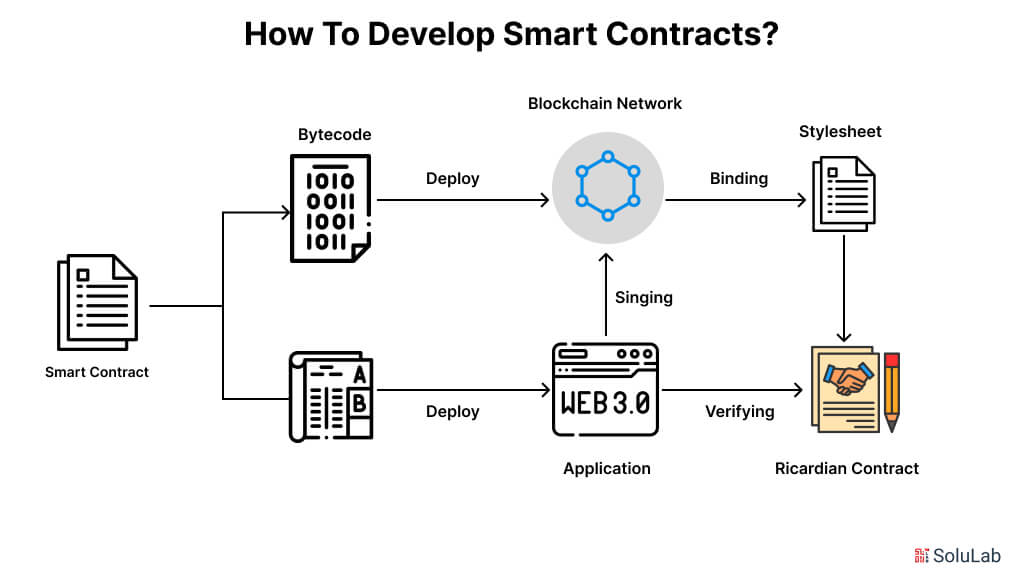
The creation of smart contracts is a difficult process that calls for a thorough grasp of blockchain technology, encryption methods, and programming languages.
Determining the business requirement for a smart contract is the first stage in the development process. This entails determining the contract’s parties, the operations that can be automated, and the advantages of automation.
Determining the contract’s terms is the next stage. This entails stating who is who, what the terms are, and what has to happen in order for the contract to go into effect. To make sure the smart contract deployment appropriately represents the conditions of the agreement, this stage is essential.
Selecting a blockchain platform to implement the smart contract on is the next stage. This entails comparing and contrasting systems according to attributes including usability, security, and scalability. The blockchain systems Ethereum, Hyperledger Fabric, and EOS are well-liked for developing smart contracts.
Choosing a programming language to create the smart contract is the next stage. Solidity, the programming language used on the Ethereum platform, is the most often utilized for creating smart contracts. Additional programming languages utilized in the creation of smart contracts are Simplicity, Chaincode, and Vyper.
The smart contract must then be coded using the programming language and contract terms chosen in the earlier stages. This entails writing the code that, in accordance with the parameters specified in the contract terms, will carry out the agreement. To make sure that the contract works as planned, the code has to be designed very precisely.
It is crucial to properly test the smart contract after it has been decided on how to design a smart contract to make sure it functions as planned. This entails assessing the contract’s performance as well as checking the code for mistakes and defects. To make sure the smart contract works as planned, testing is an essential stage in the development process.
The smart contract may be implemented on the selected blockchain platform after it has been tested. This entails running the smart contract code after uploading it to the blockchain. The parties to the contract can oversee and control the smart contract once it has been implemented.
Monitoring and maintaining the smart contract is the last phase in the creation process. This entails keeping an eye on how the contract is being carried out, handling any problems that come up, and revising the contract as necessary. To make sure the contract is safe and keeps working as intended, it is crucial to keep an eye on it and manage it.
Creating a smart contract would typically take seven to fifteen days depending on the framework and complexity, the developer’s experience. However, this is not the precise amount of time needed to create a smart contract. The following are some possible variables that might affect how long it takes to establish a smart contract:
It won’t take more than a month to create a smart contract. Once everything is finished, you may start using your smart contract right away. We are grateful for the abundance of modern innovations that have made the production of smart contracts easier.

Smart contracts are changing how digital agreements are created and enforced, offering speed, security, and automation without the need for intermediaries. In 2026, understanding the step-by-step process of smart contract development is essential for developers, businesses, and tech enthusiasts alike.
From choosing the right blockchain platform to writing, testing, and deploying secure code, every stage plays a vital role. With growing adoption across industries, smart contract skills are becoming increasingly valuable.
SoluLab, a top smart contract development company, can help you build a smart contract from ideation to deployment and maintenance. Contact us today to discuss further.
A smart contract executes a transaction automatically when predefined conditions are met, using blockchain to validate, record, and enforce the agreement without any manual intervention.
The 4 major parts are the contract address, state variables, functions, and events. These components handle the contract’s identity, store data, execute logic, and record actions.
Smart contracts comprise data storage, functions, conditions, and interfaces for interactions. Together, they automate transactions on the blockchain.
Development timelines depend on complexity, usually ranging from 2 weeks to 2 months. Factors include functionality, testing, and security audits.
Costs vary based on scope and expertise, typically ranging from $5,000 to $50,000, covering design, coding, and auditing.


