Talk to an Expert

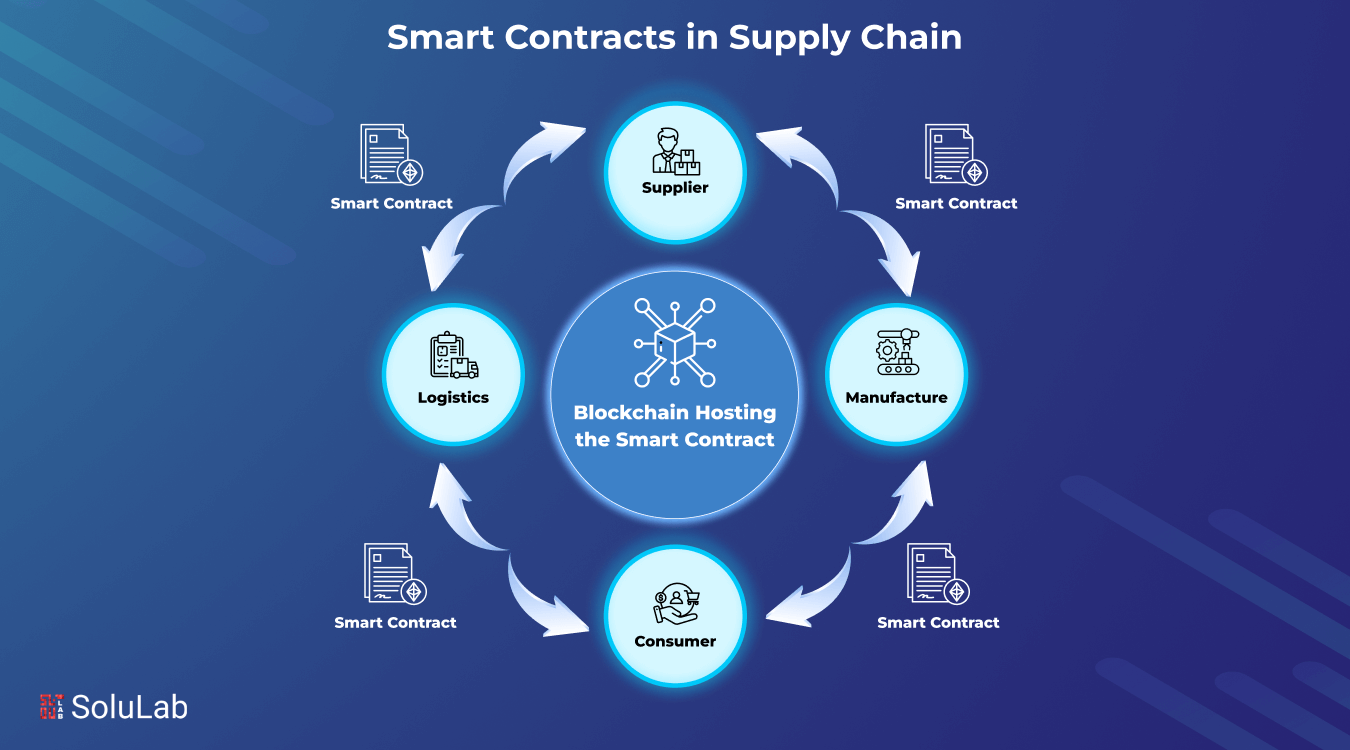
What are Smart Contracts in Supply Chain?


Smart Contracts in Supply Chain Management

These days, supply chain networks cross continents, rely on several intermediaries, and frequently experience delays, inefficiency, or mistrust. This is where blockchain-powered smart contracts, self-executing digital agreements, are beginning to transform global business operations. Smart contracts bring in a new era of speed, security, and transparency in supply chain management

By 2034, the global smart contracts market is expected to have grown at a compound annual growth rate (CAGR) of 82.21% to reach $815.86 billion

Industries including medicines, agriculture, and logistics, where timely delivery and compliance are quite vital, will experience multiple benefits. Smart contracts help to reduce human mistakes, automatically enforce contractual rules, and build confidence among people who may never cross paths directly. We will discuss how smart contracts operate within the supply chain ecosystem, explore the benefits of supply chain smart contracts, and their applications in changing world trade dynamics.

Significance of Smart Contracts in Supply Chain

Supply networks are significantly more complicated now than they were a decade ago. Before goods reach their final destination, they pass through various borders and change ownership multiple times. In this context, even small errors or delays may create significant disruptions. Smart contracts are digital agreements that run automatically when specific circumstances are satisfied. They are kept on blockchain networks, thus, the terms cannot be amended without consensus. For supply chain professionals, that brings a new level of efficiency and trust.

Here are the core reasons why they are gaining momentum:

  • Faster Processing

When specific circumstances are satisfied, such as a package being scanned upon delivery, smart contract platforms might promptly release money or update inventory information. As a result, less back-and-forth is required between distributors, buyers, and suppliers.

  • Better Visibility

Smart contracts ensure that all parties have access to the same live data. Everyone involved understands where the items are, their condition, and when they will arrive. This builds trust and allows quick action if something goes off track.

  • Trusted Execution

The system handles compliance without any bias or misunderstanding because words are coded and applied automatically. This helps to decrease disputes among parties who are working together for the first time.

  • Cost Control

With fewer intermediaries involved and less room for disputes, companies save significantly on overhead. Legal fees, administrative work, and processing delays can all be reduced by using smart contracts effectively.

  • Transparent Compliance

Audit trails are very important in businesses that are regulated. Blockchain records every transaction with a time stamp that can’t be changed. This makes it easy to show compliance and product authenticity at every step.

For businesses ready to modernize, implementing smart contracts in supply chain management offers measurable benefits in accuracy, speed, and cost efficiency. It is best to work with a team that provides professional smart contract development services to create solutions that fit the needs of your business and the way it runs.

Significance of Smart Contracts in Supply Chain

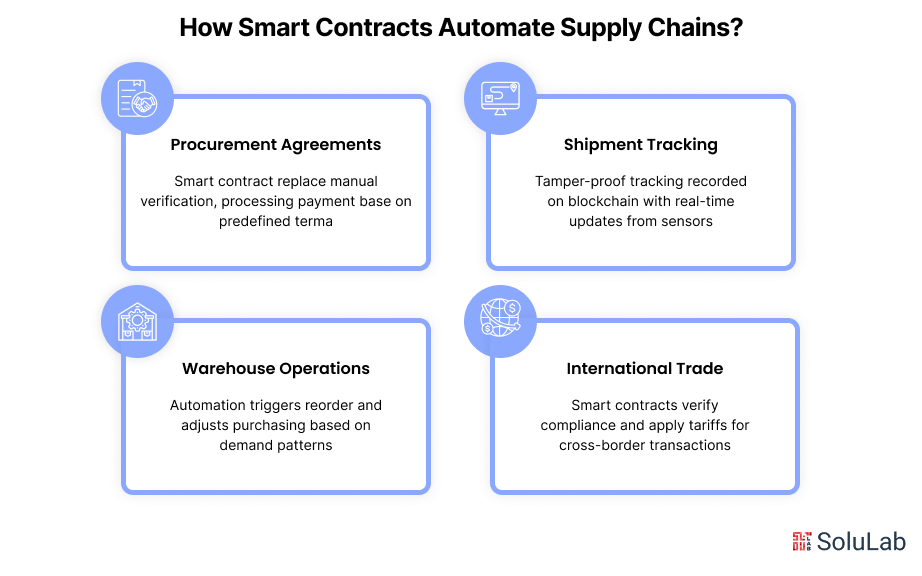
How Smart Contracts Automate Supply Chains?

The global supply chain encompasses many processes, from finding commodities and tracking warehouse inventory to scheduling delivery and deciding cross-border business practices. These steps are usually managed manually with paper records and trusted intermediaries. These tactics slow things down and increase errors, fraud, and miscommunications. Businesses can change supply chain stages with smart contracts and blockchain technology

  • Procurement Agreements

Buying from wholesalers often involves a lot of paperwork and back-and-forth approvals. People are required in traditional purchasing processes to check orders, make payments, and keep track of outcomes. Unfortunately, this exposes the process to errors, delays, and even fraud.

Smart contracts replace much of that manual work. Once predefined terms are agreed upon, the contract automatically approves and processes payment. In cases where trust between parties is still building, funds can be securely held in a shared wallet that requires both sides to confirm before anything is released. To further streamline purchasing and ensure transparency, procurement management tools can integrate smart contracts, automate approvals, and track transactions, reducing errors and accelerating the entire procurement process

  • Shipment Tracking

Moving things from one area to another presents its own set of problems. Businesses have to deal with numerous risks such as delays, theft, and fake goods. Traditional transportation systems rely on barcode reading and third-party adjustments, which can be slow and unclear.

By choosing to implement smart contracts in logistics, companies can benefit from real-time, tamper-proof tracking. Containers equipped with smart sensors record and upload location, temperature, and other key data directly to the blockchain. This data becomes instantly accessible and verifiable by all parties involved. 

In some systems, each shipment is given a unique digital identity, confirming authenticity and ownership from start to finish. If anything goes wrong, say the goods arrive damaged, the contract can immediately trigger a refund or initiate an insurance claim without human intervention.

  • Warehouse Operations

Inventory control is another area where errors are common. Many warehouses still depend on manual stock-taking, which can result in mismatched numbers and delayed restocking. This inefficiency increases holding costs and sometimes leads to lost sales.

Smart contracts bring automation to warehouse management. When stock runs low, the system can automatically reorder products without waiting for human approval. Over time, it also learns patterns in product movement and adjusts purchasing based on projected demand. In some forward-looking models, warehouse operations are governed by decentralized rules, reducing overhead and improving accuracy in how space and resources are managed.

  • International Trade

It’s even more difficult when you have to deal with taxes, customs clearing, and foreign rules. There are different rules for each area, and making sure that everything follows them can take weeks or even months.

Smart contracts help navigate these challenges with speed and accuracy. For example, they can confirm tariff rates and apply the correct taxes instantly when goods cross borders. Advanced cryptographic methods can also be used to confirm that a business meets certain compliance standards, without revealing sensitive financial or commercial information. With the help of blockchain interoperability protocols, smart contracts can work across multiple blockchain networks, making international trade seamless and reducing the friction that comes from incompatible systems.
How Smart Contracts Automate Supply Chains_

Top Applications of Smart Contracts in the Supply Chain

Smart contracts are transforming how supply chains function by introducing automation, transparency, and trust into processes that have historically relied on intermediaries and manual coordination. Below are some of the most impactful smart contracts supply chain applications:

1. Automated Procurement and Payment Settlements

Smart contracts can trigger automatic payments once predefined conditions are met. For example, when goods are delivered and verified, the contract instantly initiates the payment process without requiring human intervention. This reduces disputes, streamlines accounting, and improves cash flow.

2. Real-Time Inventory Management

By integrating smart contracts with IoT sensors, businesses can track inventory levels in real-time. As stock depletes or is replenished, the smart contract updates the system, triggers reorders, or alerts stakeholders, ensuring optimal inventory without overstocking or shortages.

3. Transparent Supplier Compliance

Manufacturers and distributors can encode compliance requirements into smart contracts. If a supplier fails to meet quality standards, delivery timelines, or ethical sourcing policies, the smart contract can halt further transactions or flag the issue automatically. This ensures adherence to contracts and brand integrity.

4. Improved Shipment Tracking and Verification

Logistics providers can use blockchain-based smart contracts to log each checkpoint a shipment passes through. Once the final delivery is confirmed and the condition of the goods is verified (such as temperature for perishables), the contract is executed, releasing the shipment data to all involved parties.

5. Streamlined Customs and Cross-Border Trade

Smart contracts can pre-verify documents required for customs clearance, accelerating international shipments. Once the necessary paperwork is digitally verified, clearance can be granted without delays, reducing wait times at borders.

6. Dispute Resolution and Auditability

In case of disagreements, all transactions recorded via smart contracts provide an immutable audit trail. This simplifies resolution and removes the need for third-party arbitration, saving both time and legal costs.

Real-Life Examples of Smart Contracts in the Supply Chain

Smart Contracts in SCM are no longer experimental—they’re reshaping global logistics through automation, real-time data exchange, and trustless coordination. By combining blockchain technology and smart contracts, companies across sectors are solving long-standing inefficiencies. Below are real-world examples of how this technology is driving measurable change.

  • Maersk & IBM – TradeLens for Global Shipping

TradeLens, a blockchain initiative by Maersk and IBM, exemplifies how smart contracts in SCM reduce friction in international shipping. By automating customs clearance, shipment tracking, and document verification, the platform enhanced visibility across over 90 organizations in the logistics chain.

  • Walmart – Blockchain for Food Traceability

Walmart adopted blockchain technology and smart contracts to ensure food safety. Using a blockchain-based system, the company tracked fresh produce from farm to shelf. The ability to trace contamination in under three seconds revolutionized their recall response process.

  • De Beers – Tracr for Ethical Diamond Sourcing

De Beers launched Tracr, a blockchain-powered platform that leverages smart contracts in SCM to certify the origin of diamonds. Each transaction—from mining to retail—is recorded immutably, ensuring that only ethically sourced stones reach the customer.

  • BHP – Mineral Sample Tracking with Blockchain

Mining giant BHP uses blockchain technology and smart contracts to manage the custody of mineral samples. With each handoff recorded securely, the company eliminated paperwork delays and gained real-time oversight across the supply lifecycle.

  • Provenance – Transparency in Ethical Fashion and Food

Provenance uses smart contracts in SCM to provide end-to-end transparency for fashion and food brands. Customers can scan a product tag and verify claims related to sustainability, fair trade, and carbon footprint, backed by data stored immutably on blockchain.

Smart Contracts Development Company

Conclusion

Supply chains have always depended on trust between suppliers, logistics partners, and buyers. But trust alone is not enough in a fast-moving and globalized world. That is where smart contracts come in. They help simplify complex processes, remove unnecessary steps, and ensure that agreements are enforced automatically without delays or confusion. It is not just about technology, but about making day-to-day operations more reliable and easier to manage.

At SoluLab, we have seen the real impact this can make as a smart contract development company. In our project called Snackhack, we built a smart contract-powered platform to track packaged food items from the production facility to retail shelves. The system verifies product quality, processes payments once delivery is confirmed, and gives everyone involved real-time visibility. It is a clear example of how purposeful technology can solve everyday supply chain challenges cleanly and efficiently.

For any supply chain looking to grow while staying in control, adopting this technology is not just useful, it is becoming essential. SoluLab can be your partner to success. Connect now!

FAQs

1. Are smart contracts legally binding in the supply chain industry?

Smart contracts can be legally enforceable if they meet the standard requirements of a traditional contract: offer, acceptance, intent, and consideration. However, the enforceability can vary depending on jurisdiction. Many companies pair smart contracts with traditional legal agreements to cover both technical and legal bases.

2. Can smart contracts work without blockchain in supply chain use cases?

No. Smart contracts rely on blockchain as their underlying infrastructure. Blockchain smart contracts provide a decentralized, immutable ledger that ensures smart contracts execute securely and transparently. Without blockchain, they lose the trustless and tamper-proof nature that makes them valuable.

3. How do smart contracts handle exceptions or unexpected events?

Smart contracts operate based on predefined logic, so handling unexpected changes like shipment delays or supplier errors requires thoughtful design. Many systems use oracles—external data sources—to feed real-time updates into the contract, allowing it to respond to changes or trigger manual overrides when necessary.

4. What industries beyond logistics are using smart contracts in their supply chains?

Industries such as pharmaceuticals, luxury goods, agriculture, and aerospace are actively exploring smart contracts. For example, pharmaceutical companies use them to track drug authenticity, while agricultural firms use them for farm-to-fork traceability and fair-trade verification.

5. What are the biggest risks in adopting smart contracts in supply chain operations?

The main risks include coding errors, reliance on external data sources, lack of regulatory clarity, and challenges with system integration. To mitigate these, companies should conduct rigorous smart contract audits, use trusted oracle services, and work with experienced development teams to ensure reliability.

 

Smart Contracts and IoT: Automating Devices and Data Exchange

Smart Contracts and IoT: Automating Devices and Data Exchange

In an era defined by digital transformation and the relentless pursuit of efficiency, the fusion of two groundbreaking technologies is reshaping the way we connect, communicate, and conduct business. The Internet of Things (IoT), a network of interconnected devices, sensors, and systems, has rapidly evolved from a futuristic concept to a fundamental pillar of modern industry. In parallel, smart contracts, the self-executing, tamper-proof agreements rooted in blockchain technology, have sparked a revolution in how we conduct transactions and automate processes.

The convergence of these two technological powerhouses—IoT and smart contracts—opens up a world of possibilities, promising to revolutionize the way we manage, secure, and leverage IoT networks. By seamlessly integrating smart contracts into IoT ecosystems, we empower devices to make autonomous decisions, streamline data exchange, and minimize the need for intermediaries.

In this blog, we embark on a journey to explore the synergy between Smart Contracts and Internet of Things. We’ll delve into the core concepts, examine the real-world applications, dissect the challenges and considerations, and peer into the promising future where the marriage of these technologies will continue to redefine industries. Whether you’re a technology enthusiast, a business leader, or simply curious about the future of interconnected devices, this blog will shed light on the exciting fusion of Smart Contracts and IoT that is driving the next wave of innovation.

So, let’s dive in and discover how this dynamic duo is reshaping the way devices communicate, transact, and evolve in our increasingly interconnected world.

Understanding IoT and its Applications

The Internet of Things (IoT) is a transformative technology paradigm that represents the interconnection of everyday objects and devices to the internet. It’s about enabling these objects to collect, transmit, and exchange data, thereby extending their functionality beyond their original design and transforming them into “smart” devices.

At the heart of IoT are sensors, embedded systems, and communication technologies that allow devices to gather and share data. These devices can be as varied as household appliances, industrial machines, vehicles, wearable gadgets, environmental sensors, and even entire smart cities.

Read Our Blog: Top 10 Smart Contract Development Companies in 2023

Applications of IoT in Different Fields

Applications of IoT in Different Fields

  • Smart Home and Home Automation: IoT enables homeowners to control and automate various aspects of their homes, including lighting, heating, security systems, and appliances. Smart speakers and connected thermostats are examples of popular IoT devices in this context.
  • Healthcare: IoT is revolutionizing healthcare through wearable devices like fitness trackers and smartwatches, which can monitor vital signs, track physical activity, and transmit health data to healthcare providers. Additionally, IoT is used for remote patient monitoring and medication adherence.
  • Agriculture: IoT plays a vital role in precision agriculture. Sensors in the field measure soil conditions, weather, and crop health, allowing farmers to make data-driven decisions about irrigation, fertilization, and pest control, ultimately improving crop yields and sustainability.
  • Transportation and Logistics: In the logistics and transportation industry, IoT is used for real-time tracking of goods, vehicle maintenance, and route optimization. It enhances supply chain efficiency and provides consumers with accurate delivery information.
  • Industrial IoT (IIoT): In manufacturing and industrial settings, IoT devices and sensors monitor equipment, predict maintenance needs, and optimize production processes. This leads to increased productivity, reduced downtime, and cost savings.

Read Also: Top IoT Development Companies 2023

  • Smart Cities: Smart city initiatives utilize IoT for various applications, including traffic management, waste management, energy efficiency, and public safety. Sensors and data analysis enable city planners to create more sustainable and livable urban environments.
  • Environmental Monitoring: IoT helps monitor and combat environmental issues. For example, it’s used in weather forecasting, air and water quality monitoring, and early detection of natural disasters.
  • Retail: In the retail industry, IoT is used for inventory management, personalized marketing, and improving the shopping experience. Smart shelves, beacons, and customer tracking systems are common IoT applications.
  • Energy Management: IoT plays a critical role in energy conservation and management. Smart meters and home energy management systems help consumers monitor and reduce their energy consumption.
  • Entertainment: IoT is integrated into entertainment systems, such as smart TVs and streaming devices, to provide a more personalized and interconnected media experience.

The applications of IoT are diverse and continue to expand into new domains as technology evolves. Its ability to gather and analyze data from various sources in real time empowers businesses and individuals to make informed decisions, automate processes, and enhance their quality of life. This transformative IoT development technology is at the forefront of the digital revolution, ushering in an era where virtually everything is connected and communicating.

Understanding Smart Contracts

Smart contracts are a fundamental component of blockchain technology that enable automated, self-executing agreements. These digital contracts have gained significant attention and have the potential to revolutionize various industries. To understand smart contracts better, let’s break down the concept and their key attributes:

  • Smart contracts are self-executing computer programs that automatically enforce and execute the terms of an agreement when predefined conditions are met.
  • They are designed to eliminate the need for intermediaries, such as banks or legal entities, by facilitating trust through code and cryptography.

Check Our Blog Post: Ultimate Checklist For Smart Contract Audit

How Do Smart Contracts Work?

How Do Smart Contracts Work?

Smart contracts are self-executing digital agreements that run on blockchain technology. They work by automating the execution and enforcement of predefined conditions and actions without the need for intermediaries. To understand how smart contracts work, let’s break down the process:

Creation

  • Smart contracts are created using programming languages specifically designed for blockchain platforms. For example, Ethereum, one of the most popular blockchain platforms for smart contracts, uses a language called Solidity.
  • The contract’s terms and conditions are coded into the smart contract. These terms can cover various agreements, such as financial transactions, supply chain operations, legal agreements, and more.

Deployment

  • Once the smart contract is coded and tested, it is deployed onto a blockchain platform. The most common platform for smart contracts is Ethereum, although others like Binance Smart Chain, Cardano, and Polkadot also support them.
  • The smart contract is stored on the blockchain, and its code becomes immutable, meaning it cannot be altered once deployed. This immutability ensures that the terms of the contract remain tamper-proof.

Execution

  • Smart contracts rely on predefined conditions, also known as “if-then” statements. These conditions are specified in the contract’s code.
  • When the conditions are met, the smart contract self-executes without the need for human intervention. For example, if the contract is a payment agreement, the contract will automatically release the payment to the specified recipient when the conditions are fulfilled.

Verification and Consensus

  • Smart contracts run on a decentralized network of computers (nodes) that validate and record transactions. These nodes reach consensus to ensure the accuracy of transactions.
  • Once a transaction triggers a smart contract, it is broadcast to the network for validation. The majority of nodes on the network must agree that the transaction is valid for it to be added to the blockchain.

Read Also: The Ultimate Smart Contract Developer Roadmap

Recording Transactions

  • All transactions related to a smart contract are recorded on the blockchain. This creates an immutable and transparent ledger of all activities associated with the contract.
  • Users can access the blockchain to verify transactions and view the contract’s history, providing a high level of transparency and security.

User Interaction

  • Users interact with smart contracts by sending transactions to the contract’s address on the blockchain. These transactions include data and instructions.
  • The smart contract processes these interactions according to its predefined code.

Payment and Gas Fees

  • In most blockchain networks, including Ethereum, executing smart contracts requires a fee known as “gas.” Gas fees are paid in cryptocurrency and cover the computational resources needed to execute the contract.
  • For example, when you send a transaction to a smart contract, you’ll need to include a certain amount of cryptocurrency to cover the gas fees.

In summary, smart contracts work by encoding the terms and actions of an agreement into self-executing, tamper-proof code. They are deployed on a blockchain network, where they automatically execute when predefined conditions are met. This automation eliminates the need for intermediaries, enhances security, and increases the efficiency and transparency of agreements and transactions.

CTA1

The Convergence of Smart Contracts and IoT

The convergence of Smart Contracts and the Internet of Things (IoT) represents a powerful synergy that has the potential to transform how devices interact and exchange data in a highly efficient and secure manner. In this discussion, we explore the exciting intersection of these two cutting-edge technologies and the possibilities it presents:

1. Automation of IoT Processes

  • The role of Smart contracts in IoT devices is to interact autonomously, executing predefined actions based on specific conditions or triggers. For example, a smart thermostat could automatically adjust the temperature when it senses occupancy or receives weather data.

2. Decentralized Decision-Making

  • IoT devices are often distributed across a network, and smart contracts operate in a decentralized blockchain environment. This decentralization ensures that decision-making and data exchange can occur without a central authority, enhancing the trust and reliability of IoT systems.

3. Improved Security

  • Smart contracts bring a layer of security to IoT. Transactions and interactions between IoT devices are recorded on a tamper-proof blockchain, reducing the risk of data tampering or hacking.

Read Our Blog: Creating the Next Decentralized Application: A Step-by-Step Blockchain Development Guide

4. Supply Chain and Asset Management

  • IoT sensors can be integrated with smart contracts to automate supply chain processes. For instance, a shipment can trigger payments automatically as it reaches predefined checkpoints, providing transparency and efficiency in logistics.

5. Conditional Access Control

  • Smart contracts in IoT can enforce access control based on certain conditions. For instance, access to a secure facility can be granted only if a person has a specific biometric reading on their IoT device.

6. Cost Reduction and Efficiency

  • Through automation and the elimination of intermediaries, the intersection of Smart Contracts and IoT can significantly reduce operational costs and increase efficiency across various industries, such as agriculture, healthcare, and manufacturing.

Benefits of Combining Smart Contracts and IoT

The pros of Smart Contracts in IoT hold tremendous potential and offer a wide array of benefits across multiple industries. This synergy brings about efficiencies, security, and innovative solutions that have the capacity to revolutionize the way we interact with devices and manage data. Here are some of the key benefits of combining Smart Contracts and IoT:

  • Efficiency and Automation: Smart Contracts automate processes in IoT. Devices can interact and execute actions autonomously based on predefined conditions, reducing the need for manual intervention. This leads to increased operational efficiency.
  • Cost Reduction: Automation and the elimination of intermediaries lead to cost savings. For example, in supply chain management, smart contracts can streamline processes, reducing administrative and logistics costs.
  • Enhanced Security: Data integrity and security are improved through the use of blockchain technology. Smart Contracts ensure that transactions and data exchanges are tamper-proof and transparent, reducing the risk of unauthorized access and data breaches.

Check Our Blog Post: How Do Smart Contract Applications Actually Work

  • Trust and Transparency: The decentralized nature of Smart Contracts and IoT interactions enhances trust among stakeholders. Transactions and actions are recorded on the blockchain, providing transparency and auditability.
  • Conditional Access Control: Smart Contracts can enforce access control based on specific conditions. For instance, IoT devices can grant access to secure facilities only if certain criteria are met, enhancing physical security.
  • Real-time Data and Decision-making: IoT devices provide real-time data, and smart contracts can process this data instantaneously. This enables rapid decision-making and the ability to respond to changing conditions in real time.

Challenges and Concerns in Combining Smart Contracts and IoT

Challenges and Concerns in Combining Smart Contracts and IoT

While the convergence of Smart Contracts and the Internet of Things (IoT) offers numerous benefits, it also presents several challenges and concerns that need to be addressed for successful implementation. Here are some of the key challenges and concerns in combining these two transformative technologies:

  • Scalability: As IoT networks expand and the number of devices increases, scalability becomes a significant concern. Ensuring that the blockchain network can handle a growing volume of transactions and smart contracts is a technical challenge.
  • Interoperability: IoT devices often use different communication protocols and standards. Ensuring compatibility and interoperability between these devices and blockchain platforms can be complex.
  • Data Privacy: Smart Contracts on a public blockchain are inherently transparent, and this transparency may conflict with data privacy regulations, especially in sensitive sectors like healthcare. Striking a balance between transparency and data privacy is a concern.
  • Security Vulnerabilities: While blockchain technology enhances security, it is not immune to vulnerabilities. Smart contracts are at risk of exploitation if not coded and audited correctly. IoT devices can also be vulnerable to cyberattacks, and combining them with smart contracts introduces additional risks.
  • Legal and Regulatory Challenges: The legal and regulatory landscape for Smart Contracts and IoT is still evolving. Compliance with existing and emerging regulations can be complex, particularly in industries like finance, healthcare, and transportation.

Read Also: Importance of Economic & Game Theory Audits in Smart Contracts

  • Oracles: Smart Contracts require real-world data to function effectively, which is provided by oracles. The accuracy and reliability of oracles are crucial, and there is a need to address the trustworthiness of data sources.
  • User Adoption: The integration of these technologies may require changes in user behavior and business processes. Achieving user adoption and ensuring that users can effectively interact with these systems is a significant concern.
  • Energy Consumption: Many blockchain networks, such as Ethereum, rely on energy-intensive consensus mechanisms like Proof of Work. This can raise concerns about the environmental impact and sustainability of such systems, particularly when applied to IoT devices with limited power resources.
  • Complexity: Combining Smart Contracts and IoT can introduce a level of complexity that may be challenging for developers, businesses, and end-users to navigate and manage.
  • Reliability: The reliability of IoT devices can vary, and not all devices are created equal. Ensuring that smart contracts can trust the data generated by these devices and the actions they take is a concern.

Future Trends and Developments in the Intersection of Smart Contracts and IoT

Future Trends and Developments in the Intersection of Smart Contracts and IoT

The intersection of Smart Contracts and the Internet of Things (IoT) is a dynamic space, poised to lead technological advancements and redefine how industries, businesses, and individuals interact with the digital and physical worlds. As these two transformative technologies continue their journey of innovation, a host of compelling future trends and developments is set to emerge, shaping the course of automation, connectivity, and data management in the years ahead.

  • Edge Computing Integration: The fusion of Smart Contract development services and IoT will see seamless integration with edge computing, enabling real-time data processing and decision-making closer to the data source. This promises to reduce latency and enhance responsiveness in IoT applications, especially in scenarios where instant decisions are crucial.
  • Blockchain Interoperability: The evolution of blockchain technology will witness a greater emphasis on interoperability, enabling diverse blockchains to communicate and collaborate. This blockchain trend will provide flexibility in selecting the most suitable blockchain platform for specific IoT applications, taking into account factors such as scalability, privacy, and consensus mechanisms.
  • Privately Controlled Blockchains: Private and consortium blockchains will become more prominent for IoT use cases, catering to industries where data privacy and control are paramount. These blockchains offer a secure and flexible environment for businesses and consortia to leverage Smart Contracts and IoT without compromising sensitive information.
  • Augmented Security Measures: The integration of advanced cryptographic techniques, secure hardware, and innovative security protocols will be at the forefront of Smart Contracts and IoT. This ongoing development will not only bolster the security of transactions and data exchanges but also address potential vulnerabilities, ensuring the trust and integrity of these systems.
  • Tokenization of IoT Assets: IoT devices and their associated data may be tokenized, creating a digital representation of physical and digital assets. This opens the door to efficient management and monetization, enabling new business models and decentralized marketplaces for IoT-specific tokens.
  • AI and Machine Learning Synergy: Artificial intelligence and machine learning will be seamlessly integrated with Smart Contracts and IoT, empowering devices to make informed, data-driven decisions. This convergence will facilitate advanced data analysis, enabling devices to adapt and optimize their functions based on patterns and real-time data.

CTA2

Conclusion

In the ever-evolving landscape of technology, the convergence of Smart Contracts and the Internet of Things (IoT) presents an extraordinary union of innovation and promise. As we conclude this exploration of Smart Contracts and IoT, we find ourselves at the threshold of a transformative era, where digital agreements and interconnected devices have the power to reshape industries, enhance efficiency, and secure transactions like never before. The benefits of automation, security, and transparency that arise from this combination promise to unlock a new realm of possibilities in areas ranging from healthcare and supply chain management to smart cities and environmental conservation.

As we look ahead, the future of Smart Contracts and IoT is rife with exciting developments, but it also poses a series of challenges that require careful consideration and solution. Scalability, interoperability, and data privacy will be focal points in the journey to harness the full potential of these technologies. Moreover, the need for regulatory clarity, education, and the enhancement of user-friendly interfaces is paramount for widespread adoption and seamless integration. The road ahead is undoubtedly marked by innovation, and as we navigate this intersection, it is imperative to balance the drive for progress with the commitment to address the complexities and concerns that arise. The convergence of Smart Contracts and IoT is a remarkable testament to our relentless pursuit of a smarter, more connected, and secure future, where devices and data exchanges operate in harmony, transcending the boundaries of our imagination.

SoluLab, as an established IoT development company, and a proficient smart contract development company, can play a pivotal role in bringing the concepts discussed in this blog on Smart Contracts and IoT to fruition. They offer comprehensive IoT development services, enabling the seamless integration of IoT devices and the implementation of secure and efficient data exchange protocols. Additionally, their smart contract development services empower businesses to leverage blockchain technology for enhanced security and automation, aligning perfectly with future trends and developments of IoT and Smart Contracts. Ready to explore the boundless possibilities of Smart Contracts and IoT? Contact SoluLab today to embark on your journey toward seamless automation, security, and innovation.

FAQs

1. How do Smart Contracts enhance security in IoT applications? 

Smart Contracts enhance security in IoT by using blockchain technology, which offers transparency, immutability, and cryptographic security. This ensures that data exchanges and device interactions are tamper-proof and free from unauthorized access, reducing security risks associated with centralized systems.

2. Can Smart Contracts be customized to specific IoT use cases? 

Yes, Smart Contracts are highly customizable to suit a wide range of IoT applications. Their code can be tailored to accommodate specific conditions, actions, and requirements unique to each use case, making them adaptable to the diverse needs of different industries.

3. What are the challenges in achieving regulatory compliance for IoT and Smart Contracts integration? 

Achieving regulatory compliance for IoT and Smart Contracts can be challenging due to evolving and sometimes ambiguous legal frameworks. Challenges include data privacy regulations, cross-border issues, and adherence to industry-specific laws. Businesses must navigate these complexities to ensure compliance.

4. How can businesses prepare for the adoption of Smart Contracts and IoT?

Businesses can prepare for the adoption of Smart Contracts and IoT by first conducting a thorough assessment of their specific needs and objectives. They should invest in employee training, understand the regulatory landscape, and identify strategic use cases. Collaborating with experienced IoT development and Smart Contract companies can streamline the adoption process.

5. What are the environmental implications of Smart Contracts and IoT in conservation efforts? 

Smart Contracts and IoT offer significant environmental benefits for conservation efforts. They enable the real-time monitoring of ecosystems, wildlife, and natural resources. Automated responses to environmental threats, such as pollution and resource depletion, can help reduce environmental impact and promote sustainability and conservation.

6. How can SoluLab assist in implementing Smart Contracts and IoT solutions for my business?

SoluLab offers comprehensive IoT development services and specializes in Smart Contract development. They can provide tailored solutions for your specific needs, ensuring a seamless integration of IoT devices and the deployment of secure, efficient Smart Contracts. Our expertise and experience make us a valuable partner in harnessing the full potential of Smart Contracts and IoT for your business.

Importance of Economic & Game Theory Audits in Smart Contracts

The Importance of Economic and Game Theory Audits in Smart Contracts

Blockchain technology has undoubtedly been a transformative force in the world of finance, commerce, and beyond. At the heart of this technological revolution lies the concept of “smart contracts.” These self-executing contracts, encoded within the blockchain, have rapidly gained prominence due to their potential to automate and streamline a wide array of processes. In this blog post, we delve into the world of smart contracts, exploring their definition, significance in the realm of blockchain technology, and the increasingly pivotal role of economic and game theory audits in ensuring their reliability and security.

A smart contract, in its simplest form, can be thought of as a computer program that automatically executes the terms of an agreement when predefined conditions are met. Unlike traditional contracts, which often rely on intermediaries and can be prone to human error or manipulation, smart contracts run on decentralized blockchain networks. They are written in code, containing a set of rules and conditions that, once triggered, initiate and enforce the contract’s terms without the need for a middleman.

Read Also: Ultimate Checklist For Smart Contract Audit

What is the Role of Economic and Game Theory Audits?

While smart contracts offer immense potential, they are not immune to vulnerabilities and flaws. This is where economic and game theory audits come into play. Economic audits focus on evaluating the economic incentives and fairness within smart contracts. They ensure that the rules and incentives embedded in the code align with the intended goals of the contract and its participants.

Game theory audits, on the other hand, analyze smart contracts from a strategic perspective. They examine the potential interactions and behaviors of participants within the contract, looking for equilibrium points and assessing the contract’s stability under various scenarios.

In an era where smart contracts are used in applications ranging from decentralized finance (DeFi) to supply chain management, economic and game theory audits serve as crucial tools for identifying and mitigating risks. They help developers and stakeholders understand the potential outcomes and challenges associated with a smart contract, ultimately enhancing its reliability and security.

In the sections that follow, we will delve deeper into the development and security aspects of smart contracts, explore the role of game theory in decentralized systems, and examine the importance of economic and game theory audits in greater detail. Through this exploration, we aim to shed light on the multifaceted world of smart contracts and the evolving strategies to ensure their integrity and functionality in the blockchain ecosystem.

CTA1

What are the Essential Steps in the Smart Contract Development Process?

Smart contracts, a pivotal component of blockchain technology, have revolutionized the way transactions are executed and automated. These self-executing contracts rely on predefined rules and conditions, eliminating the need for intermediaries and enhancing transparency. However, their implementation is not without challenges, making it crucial to emphasize the development process, security, and the importance of audits.

A. Smart Contract Development Process

Smart Contract Development Process

Smart contract development is a meticulous and structured process that involves several key steps:

  • Defining Objectives

Start by clearly defining the objectives and functions the smart contract needs to perform. This includes specifying the rules, conditions, and participants involved.

  • Choosing the Right Blockchain

Depending on your use case, select the appropriate blockchain platforms (e.g., Ethereum, Binance Smart Chain) for deploying your smart contract.

  • Writing Code

Skilled developers write the code that defines the smart contract’s logic. Solidity, a popular programming language, is commonly used for Ethereum-based contracts.

  • Testing and Debugging

Rigorous testing is essential to identify and rectify any vulnerabilities or bugs in the code. This includes simulating various scenarios to ensure the contract behaves as expected.

  • Deployment

Once thoroughly tested, the smart contract is deployed onto the chosen blockchain. Deployment typically incurs a gas fee, which varies depending on the blockchain.

  • Execution and Interaction

Users interact with the smart contract through transactions, triggering its predefined functions. These transactions are immutable and recorded on the blockchain.

B. Smart Contract Security Risks

Despite the benefits of smart contracts, they are susceptible to various security risks:

  • Code Vulnerabilities

Malicious actors can take advantage of errors or weaknesses in the programming. Common issues include reentrancy attacks, integer overflow/underflow, and unchecked external calls.

  • Oracles

Smart contracts frequently depend on other data sources known as oracles. Manipulating or compromising these oracles can lead to incorrect contract execution.

Read Our Blog: Top 10 Smart Contract Development Companies

  • Privacy Concerns

While transactions are transparent on the blockchain, the information contained within smart contracts can sometimes expose sensitive data.

  • Upgradeability

The ability to upgrade smart contracts can be a double-edged sword. While it allows for improvements, it also opens the door to potential misuse or unauthorized changes.

C. The Need for Smart Contract Audits

To mitigate these security risks, the need for smart contract audits becomes evident. Audits are a vital part of the smart contract development lifecycle, ensuring that the code is secure and functions as intended.

Smart Contract Security Audit

A smart contract security audit is a comprehensive examination of the contract’s code and functionality. This audit involves:

  • Identifying vulnerabilities and weaknesses in the code.
  • Ensure compliance with industry best practices and standards.
  • Verifying that the contract’s logic aligns with the intended functionality.
  • Analyzing potential attack vectors and recommending countermeasures.

Smart Contract Audit Services

Several specialized firms and individuals offer smart contract audit services. These auditors bring expertise in blockchain technology, smart contract development, and security best practices. Engaging audit services helps ensure that your smart contract is robust and resistant to exploitation.

D. Decentralized Applications and Their Reliance on Smart Contracts

Decentralized applications (dApps) heavily rely on smart contracts to execute their operations. These applications span various industries, from finance and supply chain to healthcare and gaming. The security and reliability of smart contracts are critical for the success and trustworthiness of dApps.

The profound impact of decentralized applications (dApps) on various industries underscores the critical role that smart contracts play in shaping the future of blockchain technology. As we’ve explored the significance of dApps and their reliance on smart contracts, it becomes evident that these self-executing contracts are the backbone of decentralized ecosystems.

SoluLab, with its expertise in blockchain technology and smart contract development services, stands at the forefront of this transformative landscape. SoluLab’s commitment to innovation, security, and best practices ensures that the smart contracts underpinning dApps are not only reliable but also resilient to the ever-evolving security challenges.

Can Game Theory Enhance Decentralized Systems through Economic Analysis in Blockchain?

Game theory, a branch of mathematics and economics, has found a compelling application in the realm of blockchain technology. It provides a systematic framework for analyzing and understanding strategic interactions among participants in decentralized systems. In this article, we explore the pivotal role of game theory in blockchain, particularly its relevance in the context of smart contracts.

A. Game Theory’s Role in Decentralized Systems

Decentralized systems, such as blockchain networks, are characterized by multiple actors making independent decisions. Game theory equips us with the tools to model and predict the outcomes of these decisions by considering the incentives and strategies of each participant. This is essential for ensuring the security, fairness, and efficiency of blockchain ecosystem protocols.

B. Game-Theoretic Models in Smart Contracts

  • Supply Chain Game

One of the prominent applications of game theory in blockchain is in supply chain management. Supply chains involve numerous stakeholders, each with distinct interests. Game theory allows us to model how these actors interact within the blockchain ecosystem to optimize their interests. For instance, suppliers, manufacturers, and distributors can use game theory to negotiate terms, ensure fair compensation, and reduce fraud through smart contracts.

  • Game-Theoretic Approaches to Smart Contracts

Smart contracts, self-executing contracts with the terms directly written into code, are integral to blockchain technology. Game theory aids in the design and evaluation of these contracts. By analyzing the potential strategies and payoffs of participants, game-theoretic models assist in creating robust smart contracts that align with the desired outcomes.

C. Theoretical Frameworks for Analyzing Smart Contracts

To comprehensively assess the security and reliability of smart contracts in blockchain systems, various theoretical frameworks and methodologies come into play. These frameworks facilitate economic and game theory audits, ensuring the integrity of decentralized applications. Some key aspects and related keywords include:

  • Smart Contract Development

Game theory can guide developers in constructing smart contracts that account for different participant strategies, ensuring that the contract behaves as expected in real-world scenarios.

  • Specialized Audit Services

There is a growing demand for specialized audit services that employ game theory to evaluate smart contracts. These services help blockchain projects maintain the highest standards of security and reliability.

What are the Economic and Game Theory Audits in Smart Contracts?

Smart contracts have revolutionized the way transactions and agreements are executed in blockchain technology. They automate processes, eliminate intermediaries, and enhance transparency. However, with the growing complexity of decentralized applications and their reliance on smart contracts, it has become essential to ensure their reliability, security, and fairness. Economic and game theory audits have emerged as powerful tools in achieving these objectives. In this article, we will delve into the significance of economic and game theory audits in the context of smart contracts, exploring how they evaluate economic incentives, ensure fairness, assess strategic interactions, and evaluate Nash equilibria.

A. Economic Audits in Smart Contracts

Economic audits in the context of smart contracts play a critical role in assessing and ensuring the financial aspects of these self-executing agreements. These audits involve a meticulous examination of the economic incentives, fairness, and equity within smart contracts.

  • Evaluating Economic Incentives

Smart contracts often involve various parties with differing economic interests. Economic audits help assess these incentives and ensure that they align with the desired outcomes of the contract. By scrutinizing the economic parameters embedded within smart contracts, auditors can identify potential misalignments or vulnerabilities.

Economic audits may involve analyzing factors such as token distribution, reward structures, and penalties. For instance, in decentralized finance (DeFi) applications, the economic audit would focus on yield farming mechanisms, liquidity provision incentives, and lending and borrowing protocols. Ensuring that these incentives are designed to encourage desired behaviors and discourage malicious actions is crucial for the contract’s long-term viability.

  • Ensuring Fairness and Equity

Fairness and equity are fundamental principles in smart contract development. Economic audits play a vital role in assessing whether the smart contract’s economic design treats all participants fairly and equitably. This involves evaluating the distribution of rewards and penalties to prevent any form of exploitation or discrimination.

Economic audits also examine potential vulnerabilities that could lead to unfair outcomes. For example, in decentralized applications that involve voting or governance, economic audits scrutinize the voting power distribution and mechanisms to prevent the concentration of power.

B. Game Theory Audits in Smart Contracts

Game theory, a field that explores strategic decision-making in competitive and cooperative scenarios, has found a significant application in the realm of smart contracts. In this context, game theory audits play a pivotal role in ensuring the security, fairness, and stability of these automated agreements.

  • Assessing Strategic Interactions

Game theory audits in smart contracts focus on modeling and analyzing strategic interactions among participants. Game theory provides a framework for understanding how rational actors make decisions in competitive or cooperative environments. In the context of smart contracts, auditors assess how participants may strategically behave to maximize their utility.

For example, in a decentralized exchange (DEX), game theory audits would consider how traders might strategically execute trades to gain an advantage. Auditors would assess factors like order book dynamics, slippage, and liquidity to ensure that the DEX is resistant to manipulation and operates fairly.

  • Evaluating Nash Equilibria

Nash equilibria represent stable points in a strategic interaction where no participant can improve their outcome by unilaterally changing their strategy. Game theory audits aim to identify and evaluate Nash equilibria in smart contracts. This helps ensure that the contract’s design leads to stable and predictable outcomes.

In applications like automated market makers (AMMs) in DeFi, game theory audits would examine how liquidity providers and traders interact. Auditors would analyze the potential for arbitrage opportunities and front-running and assess whether the AMM’s parameters are set to encourage stable equilibria.

C. The Intersection of Economic and Game Theory Audits

Economic and game theory audits often intersect, as they both contribute to the overall security and reliability of smart contracts. Economic audits ensure that economic incentives align with the contract’s objectives, while game theory audits assess how participants may strategically engage with the contract.

This intersection becomes particularly valuable in complex applications such as supply chain games. These applications involve economic considerations like fair distribution of rewards and strategic considerations like optimizing supply chain decisions. Auditors must analyze both economic and game-theoretic aspects to ensure the contract’s integrity.

Game theory stands as a pivotal element in fortifying the functionality and security of blockchain technology, particularly in the context of SoluLab’s solutions and services. By adeptly applying game-theoretic models and well-established theoretical frameworks, SoluLab empowers the development of intelligent, resilient smart contracts. This approach ensures that SoluLab’s blockchain systems remain steadfast in the presence of strategic interactions among participants, delivering unparalleled security and reliability.

What is the Future of Economic and Game Theory Audits?

As the blockchain ecosystem continues to evolve, the importance of economic and game theory audits in smart contracts becomes increasingly evident. These audits play a pivotal role in ensuring the security, fairness, and efficiency of decentralized applications. In this discussion, we explore the future of economic and game theory audits, focusing on emerging trends in smart contract development, ongoing improvements in audit services, and their potential impact on decentralized systems.

Emerging Trends in Smart Contract Development

Emerging Trends in Smart Contract Development

Smart contract development, an integral component of blockchain development, continues to evolve rapidly. As the blockchain landscape matures, emerging trends in smart contract development are reshaping how decentralized applications are built, deployed, and utilized. 

  • Interoperability

Smart contract development is no longer limited to a single blockchain platform. Emerging trends emphasize interoperability, allowing smart contracts to operate seamlessly across multiple blockchains. This requires audits to ensure that economic and game theoretic models remain consistent and secure in cross-chain environments.

  • Scalability Solutions

With the rise of decentralized applications (dApps) and DeFi platforms, there’s an increasing demand for scalable smart contracts. Developers are exploring layer 2 solutions and sharding techniques, which introduce new complexities in auditing. Future audits will need to adapt to assess the game-theoretic implications of these scaling solutions.

  • Privacy-Preserving Contracts

Privacy is a growing concern in blockchain. Smart contracts that handle sensitive data or require privacy-preserving mechanisms will require audits that account for these unique requirements while preserving security and fairness.

Ongoing Improvements in Audit Services

Ongoing Improvements in Audit Services

The world of blockchain and smart contract technology is ever-evolving, and with it, the need for robust audit services continues to grow. In this section, we’ll explore the ongoing improvements in audit services, highlighting the dynamic nature of the field and the advancements that contribute to the security and reliability of decentralized systems.

  • Automated Auditing Tools

As smart contract development accelerates, automated auditing tools are becoming more sophisticated. These tools can help identify vulnerabilities in economic and game theoretic models more efficiently, reducing the likelihood of human error and improving the overall audit process.

  • Formal Verification

Formal verification techniques are gaining traction. These methods use mathematical proofs to rigorously verify the correctness of smart contracts. The future of audits will likely include a combination of formal verification and traditional auditing approaches to ensure the highest level of security.

  • Real-Time Monitoring

Continuous monitoring of smart contracts is becoming the norm. Auditors are developing real-time monitoring solutions that can detect and respond to anomalies or potential threats promptly. This proactive approach enhances the overall security of decentralized systems.

Potential Impact on Decentralized Systems

Potential Impact on Decentralized Systems

The potential impact on decentralized systems is a topic of great significance in the ever-evolving landscape of blockchain technology and smart contracts. As these systems continue to grow and adapt, it’s essential to explore the potential consequences, benefits, and challenges that may arise. 

  • Enhanced Security

Economic and game theory audits will continue to strengthen the security of smart contracts. This, in turn, will boost confidence in decentralized applications and blockchain technology as a whole, attracting more users and investments.

  • Fairness and Trust

Audits ensure that decentralized systems operate fairly and transparently. Users can trust that the rules encoded in smart contracts will be upheld, reducing the risk of disputes and fraud.

  • Mainstream Adoption

As economic and game theory audits become more refined, they will facilitate the integration of blockchain technology into various industries beyond finance, such as supply chain management, healthcare, and government. This broader adoption will drive innovation and economic growth.

Conclusion

In conclusion, the fusion of Economic and Game Theory Audits with Smart Contracts represents an indispensable facet of the blockchain and decentralized applications ecosystem, particularly for companies like SoluLab that offer Smart Contract development services. As the realm of decentralized systems and Smart Contracts continues to expand, the significance of Smart Contract Security Audits cannot be overstated.

Blockchain technology, with its promise of trust, transparency, and immutability, has revolutionized various industries, from finance to supply chain management. Smart Contracts are the backbone of these innovations, automating processes and ensuring the execution of agreements without intermediaries. However, they are not without vulnerabilities, and the Economic and Game Theory Audits provide a crucial layer of security.

Furthermore, SoluLab’s dedication to Smart Contract audit services ensures that businesses can harness the full potential of this transformative technology while maintaining the highest level of security. With the ever-evolving landscape of blockchain and decentralized applications, staying ahead in terms of Smart Contract security is paramount. Connect with SoluLab today to safeguard your blockchain endeavors.”

FAQs

1. What is a Smart Contract Security Audit, and why is it important for decentralized applications?

A Smart Contract Security Audit is a thorough review of the code and logic within a smart contract to identify vulnerabilities and potential security risks. It is crucial for decentralized applications (DApps) as it helps ensure the integrity and trustworthiness of these applications, making them less susceptible to exploitation and fraud.

2. How does SoluLab contribute to Smart Contract Development and Audits?

SoluLab offers comprehensive Smart Contract Development services, including auditing. We help businesses create and review smart contracts to ensure they are secure, reliable, and aligned with their objectives.

3. What is the significance of Economic and Game Theory Audits in Smart Contracts?

Economic and Game Theory Audits examine the incentives and behaviors of participants within a blockchain ecosystem. These audits help ensure that the smart contract’s game-theoretic model aligns with the desired outcomes and that participants are incentivized to act in a way that benefits the ecosystem as a whole.

4. Can you explain the role of Game Theory in Smart Contract Development?

Game theory is used to model and analyze strategic interactions between participants in a decentralized system. It helps in designing smart contracts that incentivize desirable behaviors and discourage malicious actions, ultimately improving the stability and reliability of the ecosystem.

5. Why is Blockchain Technology closely linked to Economic and Game Theory Audits?

Blockchain technology relies on decentralized systems and smart contracts, making it essential to have economic and game theory audits to ensure that these systems function as intended, with the right incentives for all participants.

6. Are there any real-world examples of Game Theory Audits in Smart Contracts?

One example is the “Supply Chain Game,” where smart contracts are used to optimize supply chain processes. Game theory audits help ensure that the incentives for suppliers, manufacturers, and distributors align, resulting in efficient and cost-effective supply chains


Top 10 Smart Contract Development Companies in 2026

Smart contracts are changing blockchain technology. Without the need for a middleman, these unique contracts automatically carry out predetermined activities when particular criteria are met. As a result, procedures become safer, quicker, and more transparent.

The need for smart contract developers and smart contract development services is only going to increase as more individuals and companies utilize blockchain. However, with hundreds of companies out there claiming to be “blockchain experts,” how do you know who’s truly reliable?

To help you make an informed choice, we’ve compiled a list of the top 10 smart contract development companies in 2026. Let’s get started!

Things to Consider Before Selecting Smart Contract Development Companies

Fortune Business Insights estimates the smart contracts’ market size at USD 2.69 billion in 2025, with expectations to reach USD 12.07 billion by 2032, reflecting a CAGR of 23.9%. Before choosing a smart contract development company, it’s crucial to evaluate their expertise, security practices, and the services they offer:

1. Security Expertise: Smart contracts are immutable, so any bugs or vulnerabilities can lead to permanent losses. Choose a company with a strong track record in security audits and vulnerability assessments.

2. Industry Experience: Opt for developers who’ve worked across multiple blockchain platforms (Ethereum, Solana, Polygon, etc.). This shows adaptability and a deep understanding of different ecosystems.

3. Testing & Audit Process: Ensure the company follows thorough testing (unit, integration, fuzz testing) and external audits before deployment. This reduces risk and ensures contract reliability.

4. Transparent Documentation: A reliable company provides clear documentation on how the contract works, crucial for handover, upgrades, and community trust.

5. Post-Deployment Support: Smart contracts might be “set in stone,” but ecosystems change. Pick a company that offers upgrade paths, monitoring tools, and long-term support.

Read Also: Why AI Smart Contracts Are the Future of Business?

Top 10 Smart Contract Development Companies in 2026

Here is a list of the top 10 companies that offer trustworthy and effective smart contracts to fulfill your business needs if you’re seeking smart contract development services in 2026.

1. SoluLab

SoluLab is a leading blockchain development company known for delivering enterprise-grade solutions across industries like finance, healthcare, and supply chain. With deep expertise in smart contract development, they offer services like custom contract creation, thorough auditing, and deployment on Ethereum, Binance Smart Chain, and more.

Their smart contracts are secure, gas-optimized, and compliant with industry standards. SoluLab is best suited for startups and enterprises looking for reliable, scalable, and cost-effective smart contract solutions with ongoing support and consultation.


$25-$49


50-249


2014


Los Angeles, CA, USA

2. Maticz

Maticz Technologies is a leading blockchain development company that delivers scalable smart contract solutions. They specialize in Ethereum, Binance Smart Chain, Solana, and Polygon networks. Key features include custom smart contract creation, auditing, and upgradeable contract deployment.

Maticz follows strict security protocols and offers end-to-end support. It’s best suited for startups and enterprises looking to build DeFi platforms, token ecosystems, or NFT projects with secure, efficient, and well-documented smart contract functionality.


$20–$70


50-249


2020


Thirunagar, Madurai, India

Ment.Tech

3. Ment.Tech

Ment.Tech stands out as a top smart contract development company, delivering secure and scalable blockchain solutions. Their services cover DeFi, NFTs, RWA tokenization, Layer 1/2 integrations, and enterprise systems. Known for a consultative approach, they tailor each solution to client goals, compliance needs, and industry demands.

Trusted across finance, healthcare, logistics, and gaming, Ment.Tech blends technical precision with long-term support offering more than just development, but a true partnership in the Web3 space.


$15-$40


50-150


2018


India

4. Nadcab Labs

Nadcab Labs is a reputable blockchain development company that offers smart contract services. Their team specializes in developing personalized smart contracts that meet each customer’s particular requirements.

Nadcab Labs excels in creating scalable, effective, and safe contracts that assist companies in increasing security and automating their operations. To guarantee that smart contracts are secure and adhere to industry standards, they also provide auditing services.


$50 – $1002


50 – 2492


2013


Allahabad (Prayagraj), India

5. Blockchain App Factory

Blockchain App Factory is a leading blockchain development company known for delivering end-to-end smart contract solutions across Ethereum, Binance Smart Chain, Solana, and more. With a focus on security, automation, and scalability, they offer customized smart contract development, auditing, and deployment services.

Their solutions support DeFi, NFT marketplaces, and token launches. Ideal for startups and enterprises looking for reliable, future-ready blockchain infrastructure.


$25 – $49


250 – 999


2010


Chennai, India

6. Hyperlink Infosystem

Hyperlink InfoSystem is a leading blockchain development company based in India, known for delivering secure and scalable smart contract solutions. They offer end-to-end smart contract services including design, development, testing, and deployment on Ethereum, Binance Smart Chain, and more.

Their team ensures smart contracts are error-free and audit-ready. It’s an ideal choice for startups and enterprises seeking custom DeFi, NFT, or token-based solutions. Hyperlink combines cost-effective development with deep technical expertise, making it a smart pick for long-term blockchain success.


$25-$49


1,000 – 9,999


2011


Ahmedabad, India

7. ConsenSys

ConsenSys is a leading blockchain technology company behind some of the most powerful tools in the Ethereum ecosystem, including MetaMask and Infura. Renowned for its deep expertise in Ethereum development, ConsenSys offers secure and scalable smart contract solutions tailored for DeFi, NFTs, and enterprise applications.

Their services include contract creation, auditing, and deployment, all following industry best practices. It’s best suited for businesses and startups building on Ethereum who require enterprise-grade security and expert support.


$50-$99


501 – 1,000


2014


Brooklyn, New York, United States

8. Altoros

Altoros is a global software development company known for delivering enterprise-grade blockchain solutions. With deep expertise in smart contract development, Altoros offers secure, scalable, and thoroughly audited contracts for platforms like Ethereum, Hyperledger Fabric, and R3 Corda.

Their services include architecture design, integration, and performance optimization. Ideal for enterprises and startups seeking robust, compliant blockchain systems, Altoros is trusted by Fortune 500 companies worldwide.


$50 – $99


250 – 999


2001


Pleasanton, California, United States

9. Intellias

Intellias is a global technology partner known for delivering custom software solutions, including blockchain development. With years of experience in fintech, mobility, and enterprise software, Intellias brings deep technical expertise to smart contract development.

They offer end-to-end services from writing secure, gas-optimized smart contracts to conducting thorough audits and blockchain integration. Their smart contract solutions are ideal for enterprises and startups looking to build DeFi apps, NFT platforms, or automate digital agreements.


$50 – $99


1,000 – 9,999


2002


Lviv, Ukraine

10. Webisoft

Webisoft is a Canada-based full-service software development company known for its strong focus on blockchain and Web3 solutions. With deep expertise in smart contract development, Webisoft offers end-to-end services—from contract architecture to security audits and deployment on Ethereum, Polygon, and other chains.

Their team follows industry best practices and writes secure, gas-optimized code. Ideal for startups and enterprises looking to launch DeFi apps, NFT platforms, or DAOs with high reliability.


$50-$99


10-49


2016


Montreal, Canada

Smart Contract Development Company

Final words

Choosing the right smart contract development company can make or break your blockchain project. The top 10 companies we’ve listed in 2026 stand out for their technical expertise, security-first approach, and proven experience across industries.

Whether you’re building a DeFi platform, launching an NFT collection, or automating business processes, these teams can help you do it right, without compromising on quality or trust. As Web3 continues to grow, working with reliable smart contract developers ensures your project stays secure, scalable, and future-ready.

SoluLab, a top smart contract development company, specializes in creating secure and efficient smart contracts tailored to your needs. We also provide expert guidance to address all your questions. Reach out to us today!

FAQs

1. What is a smart contract, and why is it important?

A smart contract is a self-executing program on a blockchain that automates agreements without intermediaries. It’s crucial for enabling secure, trustless transactions in DeFi, NFTs, and other Web3 applications.

2. How much does it cost to outsource smart contract development?

Costs vary based on complexity, blockchain platform, and developer expertise. On average, it ranges from $5,000 to $50,000+. High-security contracts with audits may cost more.

3. How long does it take to develop a smart contract?

Development time varies by complexity. A basic contract may take 1–2 weeks, while a full DeFi protocol can take 2–3 months, including testing and auditing.

4. Can smart contracts be updated after deployment?

Yes—if designed with upgradability in mind, using proxy patterns. Companies like OpenZeppelin support this, but it’s not always possible on all blockchains.

5. How can I ensure that my smart contract is secure?

When creating smart contracts, security is the primary consideration. Seek out a business that does thorough security audits and tests before implementation. To make sure the contract is free, reputable businesses like Webisoft carry out in-depth code evaluations, vulnerability checks, and penetration tests.

Underlying Problems of Smart Contracts And How To Deal With Them

It has been observed that the smart contract technology has got a lot of benefits to offer to its users. Be it elimination of the middlemen for exchange of the money or some other thing that is of certain value, blockchain based smart contracts are beneficial. Though blockchain has brought a great revolution in the industries, it certainly got some factors which are causing negative impact as well.

As we crunch the numbers Ethereum 3% smart contract failure might be considered as only a minor loss but when its causing harm to currency worth billions of dollars it is certainly a cringeworthy moment. A fresh example of this is the ICON June 2018 bug which allowed any of is user to enable as well as disable the transactions and having that authority to holdup million of dollars of transactions would definitely affect most of the people but in the previous years there were more incidents reported.

Botch incident

One of the major botches was of the Distributed Autonomous Organisation (DAO) that occur in the year 2016 where through blockchain smart contract hacks, a whopping 3.6 million Ether were drained; due to which, the founders of the Ethereum were forced to take some measures and to create some policies so as to recover the lost funds.

Certainly, time is required so as to eliminate faults in a technology that has been recently introduced and same goes in the case of smart contract development services. But one cannot deny that the flaws which are related to issue such as funds, important information such as the data and other security things makes the technology simply riskier to use than its worth. There are a lot of projects which have faced one problem or the other and restoring their faith again in the technology is quite difficult.

Security issues

Security issues have always surfaced for many of the companies that offers the blockchain smart contracts but even a slightest mistake can cause heavy losses when it comes to smart contracts. Features such as verification of the smart contracts and the auditing are being introduced. Currently these options are being preferred for the security purposes and are at the frontier position at the market with cost around in thousands of dollars.

These can be effective for a mere number of cases but when it comes to global level where the need to blockchain is increasing day by day these solutions are certainly not going to be good enough and an alternative solution is definitely required to fulfil the needs and demand.


Quantstamp has taken a step forward in this field as it has introduced a security auditing protocol for the smart contracts.  The salient feature of this is that with the help of the verification software along with the bug finders the smart contract of the clients will be examined.

Companies do try to solve these smart contract development problems, but the main issue is the scalability which is a major problem due to which they are not able to address certain issues. Another solution that has come up for this problem is the engineered solution which is developed by CertiK. Talking about this engineered solution it is a platform for the verification for the several components of the blockchain system which includes smart contracts as well.


CertiK is expected to bring that revolution as it does not require the presence of bugs for the verification. Whether the item is hacker-resistant or not will be proved mathematically by it. CertiK works on the principle of the layer-based system therefore what happen according to this is a certain task is divided into several smaller fragments so that with is the task can be easily solved and that too in decentralised fashion.

CertiK has already made a mark with its previous achievements such as development of one of the worlds first hacker-resistant operating system. The reason behind this success is the strong team of CertiK . The team is a combination of academic and corporate members consisting of professors from prestigious universities like Yale and Columbia university and have some of the skilled and prominent software engineers from the topmost companies such as Facebook, Google etc.

Fate of Technology

So overall when we see blockchain certainly there are some issues when it comes to trust and being corruptible which may raise eyebrows of many but if these bugs are eliminated from the technology then it is quite beneficial to use the technology and as a matter of fact there is no denial in the fact that blockchain is the future. Blockchain can be considered as a prominent safe for storing billions of dollars if these faults are eliminated and we come up with the proper solution for them. The solutions such as the verification one needs to be strong enough to restore the faith of people who have lost it due to the previous incidents and should attract new users too.
