Talk to an Expert

What is ICO and How Does it Work?

ICO And It’s Working

In an initial coin offering (ICO), a company creates and sells a digital asset, known as a token, to investors utilizing blockchain technology. This method was pioneered by Willet in 2013 with MasterCoin, later renamed OMNI, resulting in the successful fundraising of $500,000 worth of Bitcoin. The funds were allocated to development, rewarding contributors, and other critical activities. A significant milestone was reached in 2015 when Ethereum introduced a standard for implementing tokens (ERC20), further simplifying the ICO process. Subsequently, the ICO market witnessed exponential growth, increasing from just 9 ICOs in 2015 to over 1,000 ICOs in 2018. ICOs serve as digital tokens issued by budding ventures in exchange for crypto-assets or traditional currencies. They represent an approach for early-stage ventures to secure funding and accelerate their growth.

What is Initial Coin Offering (ICO)?

In cryptocurrency and blockchain technology, Initial Coin Offerings (ICOs) have emerged as a way for startups and businesses to raise capital. ICO initial coin offerings have democratized the investment process, enabling anyone with internet access to invest in early-stage blockchain projects. Unlike traditional fundraising methods, which typically require navigating complex regulations and intermediaries, ICOs offer a direct, decentralized approach that has captured the attention of both investors and entrepreneurs.

An Initial Coin Offering (ICO) is a fundraising mechanism in which new projects sell their underlying cryptocurrency tokens in exchange for capital. These tokens can have various functions within the project, such as providing access to a service, granting voting rights, or being used as a currency within the project’s ecosystem. The ICO process is akin to an Initial Public Offering (IPO) in the stock market but with several key differences rooted in the decentralized nature of blockchain technology.

How Initial Coin Offerings Work? A Step-by-Step Process

Before you start with the ICO process, it’s crucial to thoroughly research and understand blockchain technology, regulatory, and token economics. This knowledge will empower you to make informed decisions and navigate the ICO journey successfully.

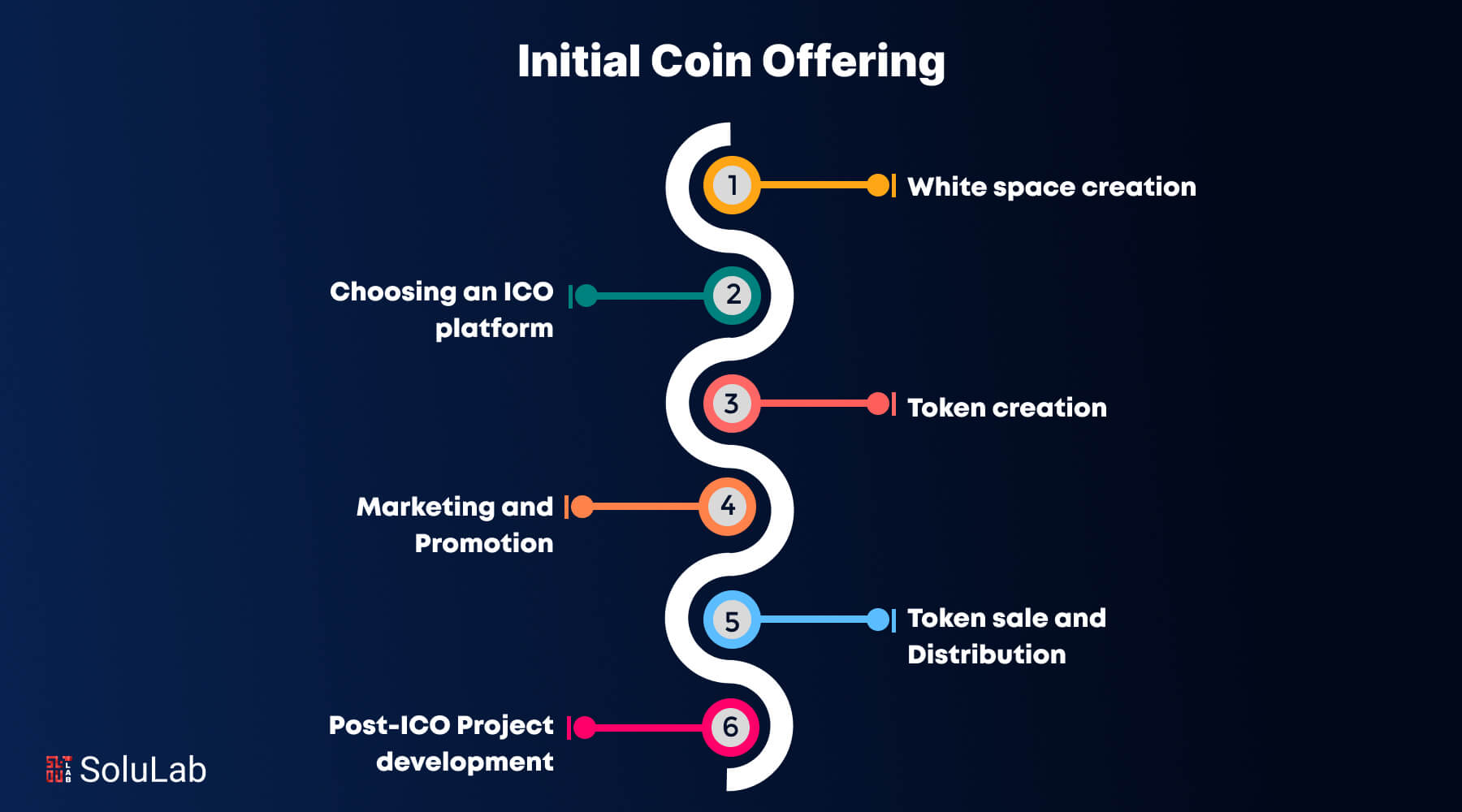
1. Whitepaper Creation

The first step in launching an ICO is drafting a comprehensive whitepaper. This document outlines the project’s goals, the technology behind it, the team involved, and the tokenomics—details about the token’s distribution, supply, and use cases. The whitepaper is essential for building investor confidence and providing transparency on what is an initial coin offering and how an initial coin offering works.

2. Choosing an ICO Platform

Projects often choose a blockchain platform to host their ICO. The Ethereum blockchain, with its ERC-20 token standard, is one of the most popular choices due to its robust smart contract capabilities. These smart contracts automate the ICO process, ensuring that transactions are secure and that tokens are distributed correctly once the ICO concludes.

3. Token Creation

The project team creates the digital tokens that will be sold during the ICO. These tokens are often designed as utility tokens that provide access to a product or service within the project’s ecosystem. Alternatively, they can be security tokens that represent an ownership stake in the project, similar to traditional securities.
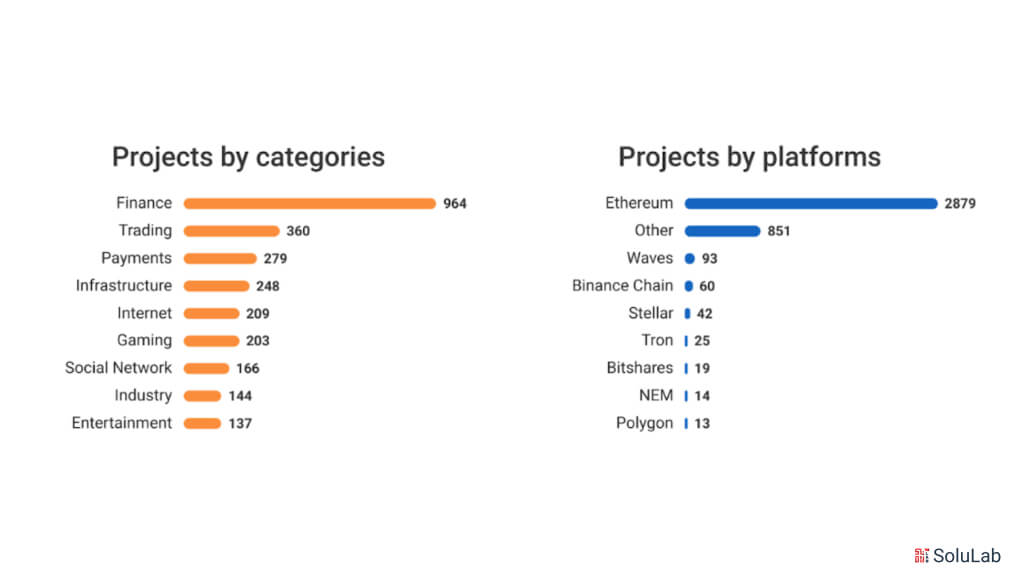
ICO projects

4. Marketing and Promotion

To attract investors, the project team must engage in extensive marketing efforts. This includes listing the ICO on ICO initial coin offering lists, promoting it on social media, and participating in blockchain events. The goal is to build a community around the project and generate buzz that will drive the success of the ICO.

5. Token Sale and Distribution

During the ICO, tokens are sold to investors in exchange for cryptocurrency, typically Bitcoin or Ethereum. The ICO can be structured in various ways, such as a fixed-price sale, where all tokens are sold at a set price, or a Dutch auction, where the price decreases over time until all tokens are sold.

6. Post-ICO Project Development

Once the ICO concludes, the project team uses the funds raised to develop the product or service outlined in the whitepaper. Investors typically monitor the project’s progress through updates from the team and community engagement, closely watching how ICO works.

CTA1

Types of ICOs

There are various types of ICOs, each with its own characteristics and regulatory considerations. Here’s a brief overview of the most common types of ICOs:

  • Public ICOs

Public ICOs are open to anyone who wants to invest. These ICOs are highly inclusive and often attract a large number of small investors. However, they also face significant regulatory scrutiny and may require compliance with securities laws in various jurisdictions.

  • Private ICOs

Private ICOs are restricted to a select group of investors, often institutional investors or high-net-worth individuals. These ICOs tend to raise larger sums of money but are less accessible to the general public.

  • Security Token Offerings (STOs)

STOs are ICOs that issue tokens classified as securities. This means they are subject to stringent regulatory oversight, providing investors with a higher degree of legal protection. STOs are often seen as a more secure and regulated alternative to traditional ICOs.

  • Utility Token ICOs

Utility tokens are designed to be used within the project’s ecosystem. For example, a utility token might be required to access a service, pay for transaction fees, or vote on governance issues within the platform. These tokens do not confer ownership rights or dividends, differentiating them from security tokens.
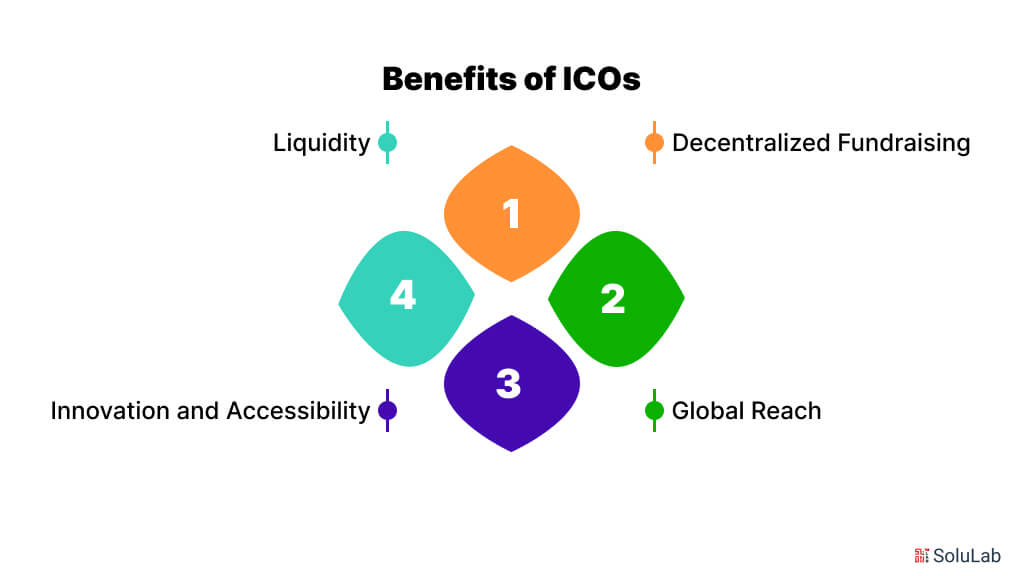
Benefits of ICOs

Benefits of ICOs

Before delving into the benefits of Initial Coin Offerings (ICOs), it’s important to understand how they work and the different types of ICOs available.

  • Decentralized Fundraising

ICOs eliminate the need for traditional financial intermediaries, such as banks and venture capitalists. This decentralization allows projects to raise funds directly from the public, reducing costs and increasing accessibility.

  • Global Reach

ICOs have a global audience, enabling projects to attract investors from around the world. This global reach increases the potential for raising significant capital and building an international community around the project.

  • Liquidity

Tokens issued in an ICO can often be traded on cryptocurrency exchanges, providing liquidity to investors. This allows investors to buy or sell tokens as they see fit, potentially realizing returns on their investment even before the project is fully developed.

  • Innovation and Accessibility

ICOs provide an opportunity for projects to secure funding without the need for traditional venture capital. This has led to a surge in creativity and projects in the blockchain space, driving the industry forward.

Year ICOs Published Funds Raised
2016 29 $90 million
2017 875 $6 billion
2018 1,253 $7.5 billion
2019 109 $370 million
2020 14 $55.6 million
2021 320 $378 million
2022 217 $117 million

Who Can Launch an ICO?

While anyone can initiate an ICO, strict monitoring by authorities in developed nations like the U.S. ensures necessary registration. However, the ease of setting up an ICO as a scam, including fabricating registration documents, makes it crucial for potential investors to be vigilant. Before launching an ICO, entrepreneurs should carefully assess whether their business genuinely requires one. Initiating a security registration with the SEC is often essential in such endeavors.

Buying Into an ICO

Before investing in a new ICO, thorough research is essential. Begin by verifying the identities and accountability of the individuals behind the ICO. Next, investigate the project leaders’ track record in the cryptocurrency and blockchain industries. Beware of projects that lack individuals with verifiable and relevant experience in these fields, as this could be a red flag for a potential scam.
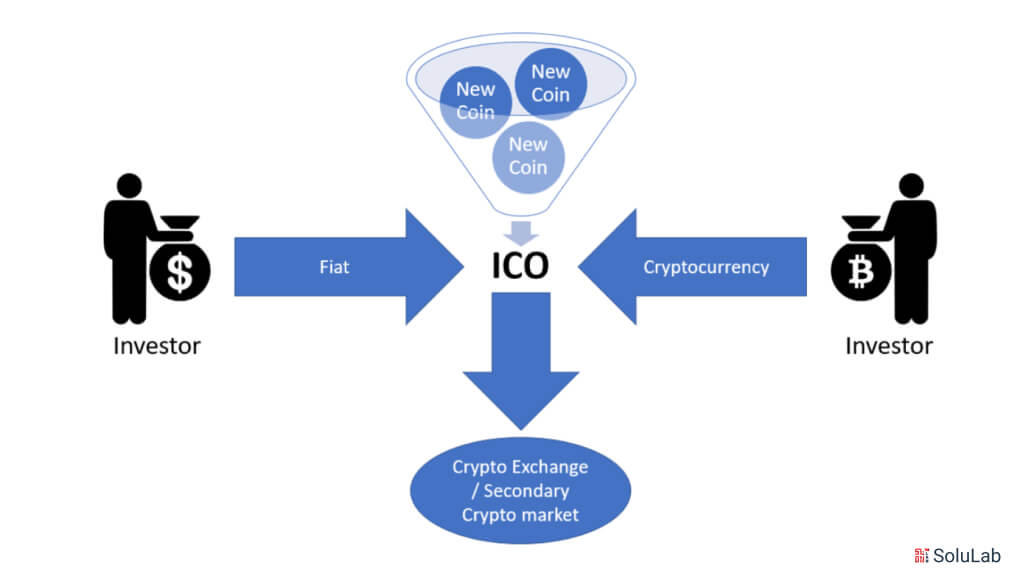
ICO crypto exchange

Identifying ICOs and Scams

In 2019, ICO activity experienced a significant decline, primarily due to the uncertain legal landscape surrounding ICOs. While there is no foolproof method to stay updated on all the latest initial coin offerings, interested individuals can research and participate in ICOs. Websites like TopICOlist.com offer comparisons of different ICOs. Additionally, investors can examine registered cryptocurrency exchanges to gain insights into newly listed and unlisted coins. Since many exchanges thoroughly vet the coins before listing, this approach can enhance safety.

Cryptocurrency aggregators can assist in identifying potential scams or genuine opportunities. However, it’s crucial to note that aggregators do not vet cryptocurrencies but provide purely informational services. They frequently include links to the project’s GitHub pages, websites, and social media platforms, discussing the problems the project aims to address. If there is no dedicated section describing a coin and no readily available information on websites, except for nonsensical phrases, it might be advisable to avoid such opportunities.

DO YOU KNOW?
“The U.S. Securities and Exchange Commission (SEC) can intervene in an ICO if necessary. For example, after the creator of Telegram raised $1.7 billion in an ICO in 2018 and 2019, the SEC filed an emergency action and obtained a temporary restraining order, alleging illegal activity on the part of the development team.4 In March 2020, the U.S. District Court for the Southern District of New York issued a preliminary injunction. Telegram was ordered to return $1.2 billion to investors and pay a civil penalty of $18.5 million.”

When investing in an ICO, there’s no guarantee you won’t fall victim to a scam. However, you can take several steps to reduce the risk of becoming involved in an ICO scam:

  • Scrutinize the Project’s Goals: Successful ICOs typically have clear, concise goals outlined in straightforward, understandable white papers. Ensure that project developers can clearly define their objectives.
  • Demand Transparency: Expect 100% transparency from companies launching an ICO. Verify the team’s identities, backgrounds, and qualifications. Look for evidence of their experience and expertise in the relevant industry.
  • Review the ICO’s Terms and Conditions: Given the evolving regulatory landscape, it’s your responsibility to ensure that an ICO is legitimate. Carefully review the terms and conditions, paying particular attention to the token distribution, fundraising goals, and refund policy.
  • Secure Escrow Wallet: Opt for ICOs that store funds in an escrow wallet. This type of wallet requires multiple access keys, offering protection against scams.
  • Consider Cryptocurrency Purchases: Some ICOs may require investment in another cryptocurrency. Be prepared to purchase these coins to participate in the project.

ICO Hyping

Initial Coin Offerings (ICOs) often create significant buzz, attracting investors to online forums where they discuss potential opportunities. Prominent figures like Steven Seagal have encouraged their followers to invest in popular ICOs. However, the SEC has warned celebrities that endorsing ICOs on social media without disclosing any compensation received is illegal.

Notable cases include boxing legend Floyd Mayweather Jr. and music mogul DJ Khaled, who promoted Centra Tech, an ICO that raised $32 million in late 2017. Centra Tech was later deemed a scam, leading to settlements with U.S. regulators by Mayweather, Khaled, and guilty pleas from three Centra Tech founders for ICO fraud.

Before participating in an ICO, investors should thoroughly educate themselves about cryptocurrencies and the specific ICO in question. Since fake ICOs are more often detected than prevented, prospective investors should exercise extreme caution when making investment decisions.

How ICOs Differ from IPOs?

While ICOs and IPOs share some similarities, such as raising capital from the public, they differ in several key ways:
  • Regulation: IPOs are heavily regulated by financial authorities, whereas ICOs operate in a more decentralized and less regulated environment.
  • Ownership: IPOs involve selling shares of a company, and conferring ownership rights to investors. In contrast, ICOs typically offer utility tokens that provide access to a product or service rather than ownership.
  • Accessibility: ICOs are generally more accessible to the public, allowing anyone with cryptocurrency to invest. IPOs, on the other hand, often require investors to meet specific financial criteria.

CTA2

Conclusion

Initial Coin Offerings (ICOs) represent a transformative approach to fundraising in the digital age. They offer a decentralized, accessible way for projects to secure capital and for investors to participate in the growth of the blockchain ecosystem. However, the success of an ICO depends on careful planning, compliance with regulations, and effective marketing.

At SoluLab, we specialize in ICO development and offer end-to-end solutions to help your project succeed. From drafting a compelling whitepaper to developing robust smart contracts and creating a customized ICO platform, our team of blockchain experts is here to guide you every step of the way. With a proven track record and a deep understanding of cryptocurrency, SoluLab is your trusted partner in launching a successful ICO.

Whether you’re an entrepreneur with an idea or an established company looking to explore new fundraising avenues, contact SoluLab to learn how we can help you achieve your goals with a tailor-made ICO strategy.

FAQs

1. What is an Initial Coin Offering (ICO)? 

An Initial Coin Offering (ICO) is a fundraising method where a company issues digital tokens in exchange for capital, typically in the form of cryptocurrency. It is a popular way for blockchain-based projects to raise funds.

2. How does an ICO work?

In an ICO, a company creates a whitepaper detailing the project and the associated tokens. Investors purchase these tokens during the ICO period, often using cryptocurrencies like Bitcoin or Ethereum. The funds raised are then used to develop the project.

3. What are the types of ICOs? 

There are several types of ICOs, including public ICOs, private ICOs, security token offerings (STOs), and utility token ICOs. Each type has different characteristics and serves different purposes.

4. What are the benefits of participating in an ICO? 

ICOs offer various benefits, including decentralized fundraising, global reach, and the potential for high liquidity. They also allow investors to get involved in early-stage projects that have significant growth potential.

5. How can SoluLab help with ICO development? 

SoluLab provides end-to-end ICO development services, including whitepaper drafting, smart contract development, and marketing strategy. Our team of blockchain experts ensures your ICO is compliant, secure, and strategically positioned for success.

How to Reap Profits from White Label Initial Coin Offering


How to Reap Profits from White Label Initial Coin Offering

A person or business owner will use crowdfunding if they want to start a new venture. With the aid of the company’s shares, anyone can raise money for their business through the phenomenon of crowdfunding. On the other hand, crypto crowdfunding is a popular alternative to traditional fundraising. In cryptocurrency crowdfunding, cryptocurrencies are used to raise money. Money may be quickly raised and large profits can be achieved with cryptocurrency crowdfunding. The crypto ecosystem is characterized by a variety of forms of cryptocurrency crowdfunding, including ICO, STO, and IEO. ICO is the most well-liked of these techniques. With the aid of utility tokens, funding comes from investors using a white label ICO.

Speaking of ICO development strategies, there are two approaches that may be used: starting from scratch or using a script. An ICO platform must be built from the ground up, which is a difficult process that takes more time, resources, & money. It is best to use the white-label ICO platform to avoid those effects. The development of the White label ICO platform, its benefits, and other topics will be covered today. Without further ado, let’s get started.

What is a White Label ICO Platform?

The ideal method to create an ICO platform is to use a white label ICO script. With an exceptional ICO script, one can rapidly establish an ICO. ICO software is a ready-made script that can be used to launch an ICO website. This product has already been produced, tested, and is ready for use right away.

Therefore, creating an ICO using a white-label script is quite effective and economical. The ICO script can be fully customized to meet your needs. Your brand, technology, functions, and logo can all be decided upon and implemented inside the white label dashboard platform. You can get an ICO script from a top-tier solution provider to launch an ICO right now. You might now be curious to learn the benefits of a white label ICO platform. Let’s start:

Benefits of a White Label marketplace

1. Improved time to market

In the workplace, clients frequently asked the team to create an online marketplace within a short time frame. They planned to launch a marketplace service in less than six weeks in an effort to ride the wave and begin generating money as soon as feasible. Despite the shortened release period, the software had to be of the greatest caliber. The team provided a white label marketplace to address these issues. With this strategy, businesses may establish a digital marketplace platform in a month or less. A business can assign customization to the solution provider after purchasing the solution. You avoid having to start from scratch when doing it this way. You end up saving at least a few months even if the full process includes steps like business analysis, design, development, testing, & deployment. Depending on the size and complexity of the project, this amount could be close to a year.

Read more: Key Points to Keep in Mind while Creating an Initial Coin Offering

2. Reduced project expenses

A business can save a lot of money by not having to develop its own white-label marketplace platform. A company needs between $75,000 and $225,000 to develop an MVP (minimum viable product) for a food delivery service like Uber Eats, whereas a complicated project may cost up to $500,000 or even more. Customized marketplace development unquestionably provides several advantages, such as the maximum level of personalization. A turnkey solution could be the greatest choice, nevertheless, if you have no special requirements and are working with a limited budget of $20,000 to $25,000. we have been receiving a lot of project requests of this kind. With the view to fulfill the goals of our previous clients, we suggested purchasing a white label marketplace while providing assistance in business analysis and customization. And the white-labeling strategy appeared to be a perfect solution to their issues.

3. Focus on core competencies

To thoroughly research every area of the market a company aspires to enter may be too difficult in today’s dynamic business environment. An organization can reduce the chances of error in processes like design, development, and quality assurance by working with a reputable vendor of a white label marketplace software (QA). An organization can better align budgets and concentrate on its core business when it employs a white-labeling strategy. You could invest more money, for instance, in market promotion, competitor research, and audience analysis.

4. Higher customer loyalty

This benefit is evident from the earlier paragraphs. A corporation may concentrate on creating lasting relationships with clients since it does not need to spend time and money on software project development. Many other activities, such as polls, surveys, social media marketing, as well as paid advertising campaigns, may be included in this. Additionally, white label marketplaces frequently offer data analytics solutions to track user behavior in real-time in order to determine the needs and preferences of consumers. A white label application will also provide a flawless user experience because a team of QA professionals has previously tested it.

Why Should you Create a White Label Marketplace?

White label marketplace development comes with a number of benefits. White-labeling a product primarily enables its resale to other companies. However, there’s more. You can draw in the audience and make money through monetization by creating a digital marketplace platform, which may include transaction commission, listing fees, as well as paid registration. You must choose an efficient revenue model, engage vendors, and keep customers from leaving in order to succeed. Additionally, you have the option of selling your own products. You can distribute the app to other industries in an effort to avoid competing with the businesses to which you will resell a white label marketplace. A turnkey solution may be appropriate for various industries because marketplaces often have comparable capabilities (registration, product search, catalog, consumer profiles, ratings and reviews online payments, listing administration, data analytics, and sales reporting). A white label marketplace will just need to be rebranded by businesses and customized to meet their unique needs. Consequently, using a white labeling strategy can provide you access to two revenue streams.

Conclusion

Due to a white-labeling strategy’s quicker time to market and lower costs, many businesses and institutions choose it in light of the increasing global popularity of online marketplaces. Businesses value having the option to concentrate on online marketplace promotion rather than allocating money to the creation of custom software. Additionally, a white label marketplace platform will enable you to test company concepts and forge closer relationships with clients without expending a lot of time or money. Contact our staff if you wish to buy a white label marketplace app. Within one working day, we’ll respond to you and offer assistance with all problems. You will receive a demo from one of our software professionals that highlights the main aspects of the program. Additionally, we will gather and assess your needs in order to determine how to design a white label marketplace to suit every facet of your company. It is free to consult on projects.

ICO Fundraising – The Advantages of Fundraising with an ICO

ICOs are becoming more and more popular day by day. There are reasons behind this fact. All parties are enjoying some or other benefit. Many of the perks for donors also apply to founders. At the very least, these advantages motivate more donors to select ICOs over conventional investment alternatives.

Even though ICOs have been around for five years, many people still don’t understand what they are, much alone investing in them to make some fast money.

A Regulatory Perspective on ICO Fundraising

Coinciding with the development of blockchain or distributed ledger technology (DLT), Initial Coin Offering or ICO has gained traction in the past three years as a means for companies to generate money using blockchain.

It is conceptually similar to crowdsourcing and a conventional initial public offering (IPO), with investors receiving tokens rather than shares in return for their investment money.

The critical distinction between an IPO and a private equity raise is that tokens do not immediately imply company ownership but often offer a different advantage to the buyer. Utility tokens are often restricted in quantity and essential to the issuer’s business model, granting the right to engage in the products or services provided by the issuer.

Other tokens may imply a right to – a voting right, a licence, a dividend, a property right, or a right to participate in the issuing company’s future success. Considering this case, the token issue is known as an STO (Security Token Offering) or a payment token in certain countries, such as Switzerland. However, in any case, this kind of token is likely to come under securities laws. However, because to the fledgling nature of regulation in the industry, none of these rights are usually protected.

The appeal of blockchain technology seems to be due to its openness and simplicity of use. For instance, many startups have opted to issue their tokens on the Ethereum blockchain. They do this utilizing the cryptocurrency Ether or their currency as a means of payment. This enables investors to buy and keep tokens from the comfort of their own homes without the need for costly brokers, agents, or advisers.

A genuine safety net for investing people is one of the most apparent issues with an unregulated or recently regulated sector. Because many blockchain businesses are worldwide and virtual in design, there is very little compensation available if investments fail or are found to be frauds.

Not much emphasis is being laid on the supervision of the quality and sustainability of many issuers entering the ICO market.

Many legislators are scrambling to catch up, and significant authorities such as the US Securities Exchange Commission (SEC) and the French Autorité des Marchés Financiers (AMF) are already thinking outside the box to incorporate the ICO phenomenon into national legislation fairly and appropriately. One significant point of contention is how to classify the tokens produced, whether they should be subject to current securities regulations or classed as commodities or primary assets. The solution for this is dependent on the nature of the token.

This challenge in determining the actual nature of tokens extends to other vital areas, such as secondary exchanges and tax treatment. It will require considerable collaboration among central authorities on a worldwide scale to be resolved successfully.

In the accompanying study, we evaluate the benefits and drawbacks of ICOs, asking why they should be utilized instead of traditional types of capital raising and which businesses or business models they are best suited for. We also receive an update on current legislative developments from nine legal professionals from various but equally progressive countries worldwide, who provide their perspectives on how ICOs may best be policed on a national and supranational basis.

Finally, we examine secondary markets and how token gains should be handled when crystallized by ICO investors.

How do ICOs aid in liquidity?

Lack of cash is a frequent barrier for individuals searching for new investment opportunities. Several possibilities have been closed for many years due to a lack of funding.
ICOs can provide tremendous liquidity to investors. Moreover, the secondary market implies that real-time pricing is dependent on the project’s current worth.

How valuable is the decentralization of ICOs?

ICOs may be accessible to everyone, especially if the ICO accepts cryptocurrency. Most ICOs demand that the donor be able to transfer money in time to purchase.

Contributors can both invest and participate at any moment in an ICO. This is in contrast to conventional methods of startup financing, in which it is almost challenging to become an early investor unless you are in close touch with one of the founders.

Investing early is advantageous since contributors pay less by avoiding premiums. In addition, contributors may become early investors by paying attention to future ICOs and buying tokens shortly after the launch.

How do ICOs aid in easy funding?

Many initiatives struggle to get financing via conventional channels, particularly if they lack interest for one reason or another. Many initiatives struggle to get financing via conventional channels, particularly if they lack interest for one reason or another.Sometimes, this is simply due to location or the type of offering, which is especially the case for non-profits. Because of the easy financing processes of ICOs, any project may possibly get money.

How are ICOs the perfect fit for investment in cryptocurrencies?

Holders of cryptocurrencies are often reluctant to utilize their riches because they prefer not to convert it to fiat and pay taxes. This implies that cryptocurrencies continue to gain value, but individuals are unable to profit from them. Thus, ICOs are the ideal outlet.

More investors are becoming aware of the advantages of ICOs and, as a result, are searching for new projects to participate in. When considering an ICO as a means of funding your concept, keep in mind the benefits for both your company and investors.

ICOs are regarded as pioneering the democratization of wealth-generating possibilities

Any US citizen may purchase tokens. A token launch is not the same as an equity sale; the latter is governed by the 1934 Act, while the former is more akin to selling API keys.

While stocks can only be sold to so-called “accredited investors” in the United States (the 3% of people with a net worth of more than €1 million), the US could not limit the selling of API keys to accredited investors alone without destroying its IT sector. Thus, if tokens (such as API keys) can be sold to 100% of the American population, it represents a 33x increase in the potential US buyer base compared to conventional equity funding for a US startup.
Tokens may be traded globally through the internet (with a 20–25X increase in purchasers).

Token launches are usually global events, with digital money transfers arriving from all over the globe. New bank accounts receiving thousands of wire transfers from all over the world in minutes for millions of dollars would very indeed be blocked. At the same time, a token sale paid in digital currency is always open for business. Given that the United States accounts for just 4–5% of the global population, worldwide availability increases the possible customer base by a ratio of 20–25X.


Tokens have a liquidity premium (a time-to-liquidity enhancement of more than 1000X).
A token has a price that is set when it is sold, and that price floats freely in a worldwide market that is open 24 hours a day, seven days a week. This is not the same as equity. While seed investor stock may take ten years to become liquid in an exit, a token can theoretically be sold in 10 minutes — but founders can and should cryptographically lock up tokens to prevent short-term speculation.

Whether you choose to sell or utilize your tokens, the time difference between 10 years and 10 minutes to obtain the choice of liquidity is up to 500,000X faster. Still, any gain in value is likely to be more significant and more sustained within a 10-year timeframe.

Because the time to liquidity is inversely proportional to the exponent of the compound annual growth rate, tokens would prevail anytime they are legally and technically viable. As a result, users may engage in new token offers with ease, allowing for quicker growth.
Tokens will decentralize the financing of technologies.

Because token launches may take place in any nation, the significance of raising funds in the United States in general, or Silicon Valley / Wall Street in particular, will decrease. Silicon Valley will most certainly continue to be the world’s top technological centre. Still, it will no longer be essential for engineers to physically go to the United States, as it did for earlier generations.

Tokens allow for the creation of a new business model: better-than-free.
Google and Facebook, for example, provide beneficial free goods. Despite this, they have been chastised for earning billions of dollars while giving free service to early users.
The token launch concept will offer a technically viable method for software firms (and open source projects in general) to distribute wealth and rally their user base behind their success. This is a better-than-free business model in which consumers profit from being early adopters.

Token purchasers will be like bloggers are to journalists.Tokens will lower the barrier between professional investors and token purchasers in the same manner that the internet did for professional journalists, tweeters, and blogs.

Consequences

Anyone may now become an amateur journalist thanks to the internet. Likewise, millions of individuals will now become inexperienced traders.

As with journalism, some of these amateurs will excel and utilize their token-buying record to break into professional leagues.

Just as it became a professional necessity for journalists to use Twitter, institutional investors of all sizes, from startup funds to hedge funds, will get involved in token purchases.
Similar to Blogger and Twitter, new tools will be created to make it simple for individuals to use, purchase, trade, and discuss tokens with others.


Tokens imply immediate custody without the need for intermediaries.Because token purchasers need to possess private keys to ensure custody, it alters our understanding of property rights. The ultimate arbitrator of who owns what property in tokens is not a national judicial system but an international blockchain.

The ICO method has various helpful features, such as the ability to split or consolidate ICO tokens. In addition, ICO coins, like regular cryptocurrency currencies, enjoy the same anonymity as stable cryptocurrency coins.Coins may be sold or purchased on cryptocurrency exchanges, which will naturally trade in them.

Benefits of contributors over stock ownership while participating in an ICO:

Transparency in money usage, an escrow may be used to check how funds are used after the ICO. In early-stage businesses, early donors will have greater liquidity. Early access to a coin with high capital growth potential. No government organization regulates or registers it.
A novel method of deploying money that protects against political and economic shocks.
An ICO that utilizes existing networks like Stratis, Ardor, and Ethereum taps on a current ecosystem’s network capital.

Contributors are often the first token users; therefore, unlike owning shares in a business whose goods the contributor has never touched, tokens may be more tangible than stocks.
Investing in ICOs may provide returns of up to 1000 per cent, with gains from successes outweighing losses from failures.

Quick Read: How To Launch A Successful ICO – Necessary Steps And Important Tips

Conclusion

The initial coin offering (ICO) is a brand-new phenomenon in the world of finance and technology. In recent years, the advent of ICOs has had a significant effect on capital-raising procedures.

-Contact Us-

SoluLab being the top 3 Blockchain developers can help you build the perfect Blockchain Platforms.
