


The metaverse market, currently valued at over $38.5 billion, is projected to grow significantly. Analysts predict an annual expansion rate of 13.1%, driven by the willingness of individuals to invest in advanced VR equipment and the increasing popularity of metaverse real estate, with investors purchasing over $500 million worth so far.
The Metaverse, a revolutionary concept, merges the best of virtual and physical reality, allowing users to interact in real time. It offers vast potential in various sectors, including virtual education, immersive shopping experiences, and transformative entertainment. Beyond its immersive experience, the Metaverse represents the evolutionary leap of the internet, transcending traditional screens and keyboards. However, privacy concerns, ethical considerations, and its impact on mental health require careful attention. The Metaverse has the power to reshape society, redefining work, education, entertainment, and communication, but its development must be guided by ethical, social, and technological considerations to ensure a positive and sustainable impact on humanity.
Metaverse gaming, empowered by Blockchain technology, has revolutionized the gaming industry by offering immersive experiences beyond mere entertainment. Players can earn in-game rewards, trade assets, and interact with each other in a virtual world. The unique blend of gaming, social interaction, and education makes Metaverse gaming a multifaceted platform. Its potential to generate revenue streams through NFTs and virtual land ownership further enhances its appeal. As technology advances, Metaverse gaming is poised to become a multi-billion dollar industry, reshaping the way we play, interact, and explore virtual worlds.
In Metaverse gaming, where immersive experiences and technological advancements converge, a multitude of components come together to shape this revolutionary gaming domain. While our list may not encompass all, it delves into the fundamental elements that define Metaverse games:
Accessible and expansive 3D environments are the foundation of Metaverse gaming, allowing players to interact, explore, and immerse themselves in the game’s universe.
Players assume the role of virtual characters, facilitating communication and collaboration with others. These interactions extend beyond the game environment, fostering socialization and teamwork among players.
Ownership of in-game items is crucial, often utilizing blockchain technology for secure and transparent transactions, including asset trading and sales.
Metaverse games feature underlying principles and objectives that guide the player experience, albeit in a more immersive setting compared to traditional games.
Virtual Reality (VR) and Augmented Reality (AR) technologies are pivotal to Metaverse gaming, blending digital and physical realities for an immersive experience.
Blockchain provides a secure framework for in-game economies, enabling real-world value transactions and digital asset ownership through cryptocurrencies and Non-Fungible Tokens (NFTs).
IoT technology integrates real-world objects into the Metaverse, enhancing the gaming experience by incorporating real-time data and physical world interactions.
3D models of real environments and mixed reality experiences enhance immersion, allowing seamless navigation between various virtual experiences.
Emerging technologies such as brain-computer interfaces are being explored to enable players to control their avatars through their thoughts, creating a more intuitive gaming experience.
These elements collectively drive the Metaverse gaming industry toward a more immersive, socially interactive, and economically vibrant ecosystem, shaping the future of gaming and entertainment.
Metaverse games are gaining popularity and offer immersive virtual worlds for players to explore. A list of top Metaverse games has been compiled based on specific criteria. Player engagement is a key factor, achieved through engaging gameplay mechanics, immersive storytelling, and meaningful player choices. Graphics and gameplay are crucial, with high-quality visuals, smooth mechanics, and a sense of progression. Community is important for enhancing the overall experience and ensuring the game’s longevity. Ultimately, a top Metaverse game provides a rich and rewarding experience that keeps players engaged and coming back for more.
“DO YOU KNOW?”
Notably, 53% of companies investing in the metaverse also invest in cryptocurrencies. With over 400 million active monthly users and the potential to contribute an additional five trillion US dollars to the world economy by 2030, the metaverse holds immense promise.
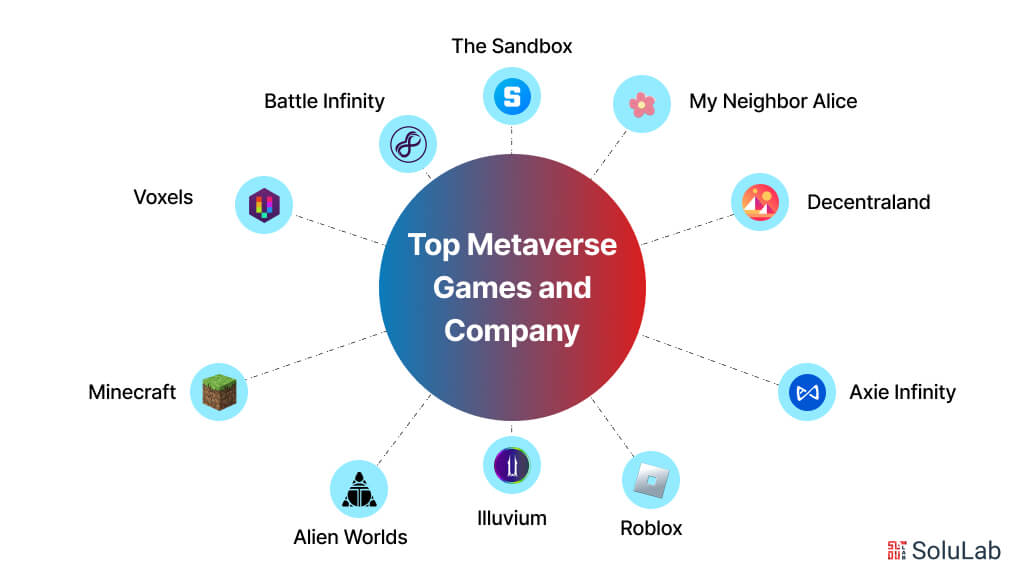
Decentraland, a virtual metaverse platform, was introduced to the public in the early 2020s. It enables players to use MANA to create avatars, purchase items, and acquire virtual land parcels, which can be rented out or used to host events and sell virtual artwork. The platform’s unique feature is LAND, non-fungible tokens representing virtual land parcels. Players can use LAND and MANA to develop immersive experiences and games that can be shared with others. Decentraland’s popularity stems from its immersive gameplay, user-generated content, and partnerships with brands and organizations. In 2021, the launch of the In-World Builder further enhanced user-generated content and experiences within the platform.
Axie Infinity is a Vietnamese company founded in 2018 that allows players to breed, raise, collect, and trade fictional creatures called Axies in a Pokemon-inspired computer game. Axies have interchangeable body parts that determine their appearance and abilities, and players can acquire land and houses for them to live in. Simulated creatures and other in-game items are represented as non-fungible tokens (NFTs) controlled by blockchain technology. Players can earn Small Love Potion (SLP) tokens by winning battles, which can be exchanged for Ethereum or other cryptocurrencies. Axie Infinity’s popularity is attributed to its innovative gameplay and the ability for players to earn real money while playing. User-generated content has played a significant role in the game’s success, and players have been able to create their mini-games within the Axie Infinity universe. Axie Infinity has had a positive impact on communities in developing countries, where players have been able to earn a living wage by playing the game.
The Sandbox is a user-generated infrastructure where individuals can create and share content using Metaverse Blockchain technologies and smart contracts. It encompasses three main elements: VoxEdit for designing avatars and objects, a marketplace for trading creations, and Game Maker for building 3D games without coding. Unique to Sandbox is its use of NFTs to represent virtual assets, enabling players to monetize their creations and trade them on the game’s marketplace. SAND is the native token used for purchasing virtual properties on the Sandbox map, which can also be sold on the Open Sea NFT marketplace. The Sandbox’s thriving community of creators and players is a major factor in its success. Players can create games, virtual real estate, and in-game items, contributing to a vibrant user-generated content ecosystem. The Creator Fund provides financial support to creators making innovative and engaging content on the platform.
Alien Worlds is a play-to-earn game where players mine Trilium, the in-game currency, on six different planets. Players can own and trade in-game assets represented by non-fungible tokens (NFTs) and create and participate in organizations called Decentralized Autonomous Organizations (DAOs). The game’s popularity stems from its engaging gameplay, unique features, and the potential to earn cryptocurrency. The game’s thriving community contributes to its success by creating user-generated content, such as planets, quests, and mini-games, enhancing the gaming experience and attracting new players.
Illuvium, a recently launched video game, has gained significant popularity by offering a unique blend of gameplay features and blockchain technology. The game allows players to explore a strange world, capture and cure mythical creatures called Illuvials, and use them in battles. Illuvial NFTs are tradable, and their value increases with their strength and rarity. Players can earn Illuvium cryptocurrency (ILV) by completing challenges and assignments, which can be traded on the IlluviDEX. Illuvium’s appeal to both gamers and NFT collectors, its community-driven approach, and user-generated content have contributed to its success. The game’s recognition by the Blockchain and gaming industries further solidifies its status as a game-changer in the Blockchain gaming landscape.
Roblox, a Metaverse gaming platform, has gained immense popularity among young gamers since its inception in 2006. With millions of active players daily, Roblox offers a vast array of user-generated games and experiences. Its accessibility, social aspect, and endless possibilities for creativity and customization have made it a favorite among children and young adults. The supportive and creative community fosters a sense of loyalty and engagement among players. The platform’s focus on user-generated content ensures constant new offerings, while its social and interactive features allow players to connect and play with friends globally. Roblox’s public offering highlights its potential for developers and investors, attracting big-name brands and generating significant revenue.
My Neighbor Alice is a popular Metaverse game built on the Ethereum Blockchain. It allows players to explore a virtual world, create and customize their islands, and interact with other players. The game’s popularity is attributed to its immersive gameplay, earning potential through cryptocurrency, and unique experiences created by user-generated content. Players can design their islands, participate in community events, and buy, sell, and trade virtual assets. The game’s focus on user-generated content has led to a thriving economy, with some players earning significant money from trading NFTs. My Neighbor Alice offers a strong social aspect, allowing players to interact with each other and collaborate on projects within the game world.
Minecraft, developed by Mojang Studios, is a popular Metaverse game known for its endless possibilities for creativity, exploration, and adventure. Its open-world gameplay, procedurally generated 3D world, and simple mechanics make it accessible to players of all ages and skill levels. Minecraft’s appeal extends beyond gameplay, with educational value and inclusivity features. Its emphasis on player creativity and imagination, along with user-generated content, mods, and multiplayer mode, contribute to its popularity and longevity. Minecraft continues to captivate players by providing a platform for building, designing, and collaborating, fostering a vibrant community that shares creations and experiences.
Voxels, previously known as Cryptovoxels, is a Metaverse platform built on the Ethereum Blockchain. It allows users to buy, sell, and build on land parcels using voxels, small cubes used to create three-dimensional structures. The game’s simplicity and accessibility, combined with its use of Blockchain technology, have made it popular in the NFT space. Voxels emphasizes community and collaboration, fostering a sense of engagement and creativity among players. The game’s appeal extends beyond the Blockchain community, attracting gamers, artists, and even educational institutions.
Battle Infinity is a Metaverse-focused gaming platform that offers an immersive gaming experience in a virtual world. It uses Blockchain technology to create a decentralized ecosystem where players have complete ownership of their in-game assets. The platform allows players to create their own games and share them with others, making it a platform for gamers, by gamers. Battle Infinity has gained immense popularity due to its unique features such as PVE and PVP battles and sports games. It has attracted over 20,000 players and generated over $200,000 in its presale. The platform’s success is attributed to its focus on user-generated content, allowing players to create and monetize their games. The use of NFTs further enhances the platform’s appeal by providing complete ownership of in-game assets. Battle Infinity has fostered a strong community, with players sharing tips and experiences, making it one of the most successful Metaverse-focused gaming platforms.
The Metaverse gaming market is rapidly growing, reaching $13.84 billion in 2023 and predicted to hit $710.21 billion by 2027. This growth is driven by advancements in VR and AR, which enhance gaming experiences. The Metaverse is also being used for education and training, with game-based learning expected to reach $52.3 billion by 2030. Sandbox games are popular and growing fastest, offering players limitless environments. North America leads, but Asia Pacific is expected to experience the highest growth. Challenges include high equipment costs and privacy concerns. Companies are focusing on alliances and partnerships to stay competitive.
“DO YOU KNOW?”
Roblox stands as the largest virtual world within the metaverse, catering to a predominantly young audience, with 51% of users under the age of 13. In the United States, 74% of adults have considered or joined the metaverse, and by 2026, it is estimated that 25% of Americans will spend at least an hour a day immersed in this virtual reality.
The Metaverse gaming industry’s rapid growth and evolution present various challenges that must be addressed for its long-term success. Here are key challenges in Metaverse gaming:
Addressing these challenges requires collaboration among developers, investors, regulatory bodies, and the gaming community. A collaborative approach is necessary to ensure the Metaverse gaming industry reaches its full potential and positively impacts the digital entertainment landscape.
The metaverse revolutionizes the NFT in gaming industry by offering immersive experiences through advanced technologies like VR and AR. It introduces economic ecosystems where players can create and trade virtual assets, fostering a vibrant in-game economy. The metaverse serves as a social platform where players can connect, interact, and build communities, facilitated by features like voice chat and multiplayer experiences. Unlike traditional games, the metaverse offers persistent worlds that continuously evolve even when players are offline. AI integration enhances gameplay experiences and creates dynamic virtual environments. Beyond entertainment, the metaverse has potential applications in education, training, collaboration, and social gatherings. It redefines how we interact with virtual environments and opens up new possibilities for the future.
In conclusion, NFT Games in the Metaverse represent an exciting intersection of digital innovation and interactive entertainment. Understanding What is NFT game and exploring the best NFT games in the metaverse can provide unparalleled experiences and opportunities. As Metaverse games evolve, the integration of NFTs in the Metaverse will shape the future of NFTs and the broader Metaverse future. Metaverse NFT games are not only redefining gameplay but also creating new economic models through NFT token economies. Companies like SoluLab are at the forefront of this transformation, offering expertise in Metaverse game development. Embrace the future of the metaverse and gaming NFT tokens with SoluLab’s innovative solutions to stay ahead in this dynamic landscape.
An NFT game integrates non-fungible tokens (NFTs) into its gameplay, allowing players to own, trade, and earn unique digital assets within the game.
NFTs in the Metaverse are digital assets that represent ownership of virtual items, such as avatars, properties, and collectibles, within a metaverse environment.
The best NFT games in the Metaverse offer immersive experiences, unique NFTs, and robust in-game economies. These games leverage blockchain technology to enhance player ownership and interactivity.
Metaverse NFT games work by integrating blockchain technology to create and manage NFTs, which players can use, trade, or sell within the metaverse. These games often feature decentralized economies and player-driven marketplaces.
The future of NFTs in the Metaverse looks promising, with increasing adoption, technological advancements, and innovative use cases driving growth and creating new opportunities for players and developers.
SoluLab is a leading developer in the NFT and Metaverse space, providing cutting-edge solutions for NFT Metaverse game development. Their expertise ensures high-quality, innovative games that leverage the full potential of NFTs and blockchain technology for the future of the metaverse.


