Talk to an Expert

Develop NFT Marketplace On Cardano

Benefits Of An NFT Marketplace On Cardano

The rise of Non-Fungible Tokens (NFTs) has taken the digital world by storm, offering a unique way to buy, sell, and own digital assets. As the demand for NFTs continues to grow, various blockchain networks have emerged to support this booming industry. One such network gaining attention is Cardano, a third-generation blockchain platform known for its scalability, security, and sustainability. 

One significant advantage of building an NFT marketplace on Cardano is the network’s scalability. Cardano utilizes a unique architecture that separates the settlement layer from the computation layer, allowing for greater scalability and improved transaction throughput. This scalability ensures that the marketplace can handle a large number of transactions, even during periods of high demand. As the NFT market continues to expand, having a scalable infrastructure becomes crucial to providing a seamless experience for creators, collectors, and traders within the marketplace.

Cardano’s focus on security and smart contract functionality also makes it an ideal choice for NFT marketplaces. Cardano employs a rigorous peer-reviewed approach to development, ensuring that its smart contracts are secure and reliable. This robustness is critical in the NFT space, where digital assets hold significant value. By building an NFT marketplace on Cardano, creators, and collectors can have peace of mind knowing that their assets are protected by a highly secure and audited blockchain network. In this blog, we will explore the advantages of creating an NFT marketplace on Cardano and how it can revolutionize the NFT ecosystem.

What are NFT Marketplaces?

NFT (Non-Fungible Token) marketplaces have emerged as the go-to platforms for buying, selling, and trading digital assets in the form of NFTs. These marketplaces provide a centralized hub where creators, collectors, and enthusiasts can connect, discover, and engage with a wide range of unique digital items. Here’s a closer look at what NFT marketplaces are and how they function:

  • Hub for Buying and Selling NFTs

NFT marketplaces serve as virtual marketplaces where individuals can buy and sell NFTs. These platforms bring together creators and collectors, offering a wide variety of digital assets such as artwork, virtual real estate, music, videos, virtual identities, collectibles, and more. 

Creators can mint and list their NFTs for sale, while buyers can browse through the marketplace, discover new and unique creations, and make purchases directly from the platform. NFT marketplaces facilitate secure transactions and provide a user-friendly interface for seamless buying and selling experiences.

  • Discover and Explore Unique Digital Assets

NFT marketplaces act as a hub for discovering and exploring a diverse range of unique digital assets. Users can browse through various categories, collections, and trending NFTs to find items that align with their interests and preferences. 

The marketplaces often include search filters, sorting options, and curated collections to help users navigate the extensive inventory of NFTs. By exploring these marketplaces, individuals can immerse themselves in a world of creativity, innovation, and digital art, discovering hidden gems and connecting with talented creators.

Read Our Blog Post: How to Build an NFT Marketplace on Ethereum Blockchain?

  • Community and Engagement

NFT marketplaces foster a vibrant community of creators, collectors, and enthusiasts. Users can engage with one another, follow their favorite artists, join discussions, and participate in auctions or sales. The marketplace acts as a social platform, enabling users to connect with like-minded individuals who share a passion for digital art and collectibles. 

This community-driven aspect adds depth and interactivity to the NFT ecosystem, allowing for collaborations, support, and shared experiences among users. NFT marketplaces often provide tools for creators and collectors to showcase their collections, share updates, and interact with their audience.

  • Secondary Market and Royalties

In addition to facilitating primary sales, many NFT marketplaces also host secondary markets where users can trade previously purchased NFTs. These secondary markets allow individuals to sell or resell their NFTs to other collectors, often at different price points based on supply and demand dynamics.

Furthermore, some marketplaces incorporate royalty mechanisms, ensuring that creators continue to earn royalties every time their NFTs are sold in the secondary market. This feature provides ongoing revenue opportunities for creators and adds value to NFT ownership.

  • Wallet Integration and Blockchain Compatibility

NFT marketplaces integrate with digital wallets that support the respective blockchain network on which the NFTs are minted. These wallets enable users to securely store, manage, and transact their NFTs. 

Marketplaces typically support popular blockchain networks like Ethereum, but with the emergence of top blockchain platforms like Cardano and Flow, marketplaces are expanding their compatibility to accommodate a broader range of NFTs and provide users with more options for participating in the NFT ecosystem.
What are the Benefits of Using Cardano NFT Marketplace?

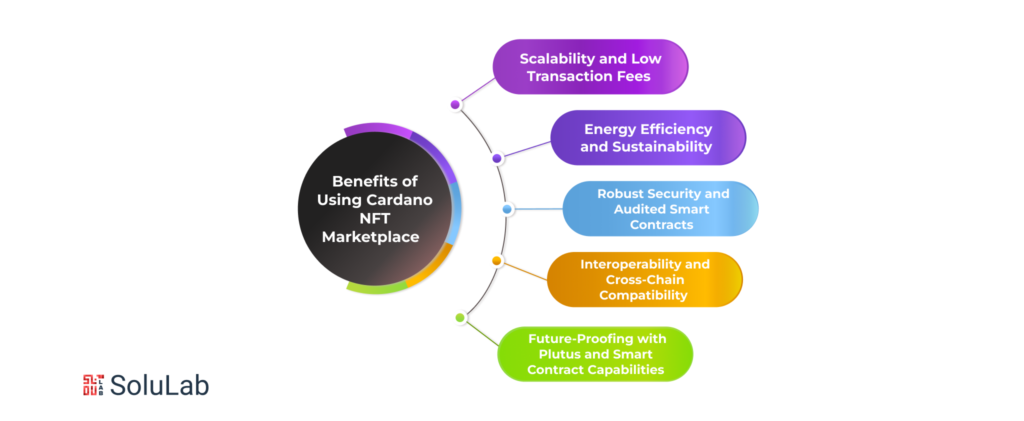
What are the Benefits of Using Cardano NFT Marketplace?

Using the best Cardano NFT marketplace offers a range of benefits that set it apart from other platforms. Cardano, a third-generation blockchain known for its scalability, security, and sustainability, provides a solid foundation for NFT marketplaces to thrive. Here are some key advantages of utilizing a Cardano NFT marketplace:

  • Scalability and Low Transaction Fees

Cardano’s architecture separates the settlement layer from the computation layer, enabling high scalability and low transaction fees. This scalability ensures that the best Cardano NFT marketplace can handle a large volume of transactions, even during periods of high demand. Users can enjoy a smooth and seamless experience when buying, selling, or trading NFTs, without experiencing delays or exorbitant fees.

  • Energy Efficiency and Sustainability

Cardano’s proof-of-stake (PoS) consensus algorithm, called Ouroboros, makes it highly energy-efficient and environmentally friendly. Unlike networks that rely on energy-intensive proof-of-work (PoW) mechanisms, Cardano’s PoS consumes significantly less electricity. This commitment to sustainability is crucial in the NFT space, where concerns about the environmental impact of blockchain networks have been raised. By using the best Cardano NFT marketplace, creators and collectors can participate in the NFT ecosystem while minimizing their carbon footprint.

  • Robust Security and Audited Smart Contracts

Cardano places a strong emphasis on security and reliability. Its development process involves rigorous peer-reviewed research and auditing. As a result, Cardano’s smart contracts are designed to be highly secure and resistant to vulnerabilities. By utilizing the best Cardano NFT marketplace, creators and collectors can have confidence in the safety of their transactions and the protection of their digital assets. This enhanced security ensures the integrity of the NFT marketplace and builds trust among users.

  • Interoperability and Cross-Chain Compatibility

Cardano has a vision for cross-chain compatibility, allowing assets and applications to seamlessly interact with other blockchain networks. This interoperability opens up opportunities for the best Cardano NFT marketplaces to connect with NFTs and assets from other blockchains, expanding the possibilities for creators and collectors. The ability to integrate and interact with multiple blockchain networks enhances the liquidity and accessibility of NFTs within the Cardano ecosystem.

Read Also: Solana NFT Marketplace: How to build your own NFT Marketplace on Solana

  • Future-Proofing with Plutus and Smart Contract Capabilities

Cardano’s upcoming upgrade, known as the Alonzo upgrade, will introduce smart contract capabilities through the Plutus platform. This upgrade will unlock a new era of advanced features and functionalities for the best Cardano NFT marketplaces. Smart contracts will allow for more complex transactions, unique royalties structures, and interactive experiences within the marketplace. By utilizing a Cardano NFT marketplace, creators and collectors can position themselves at the forefront of innovation and take advantage of these upcoming capabilities.
How to Launch Your Best Cardano NFT Marketplace?

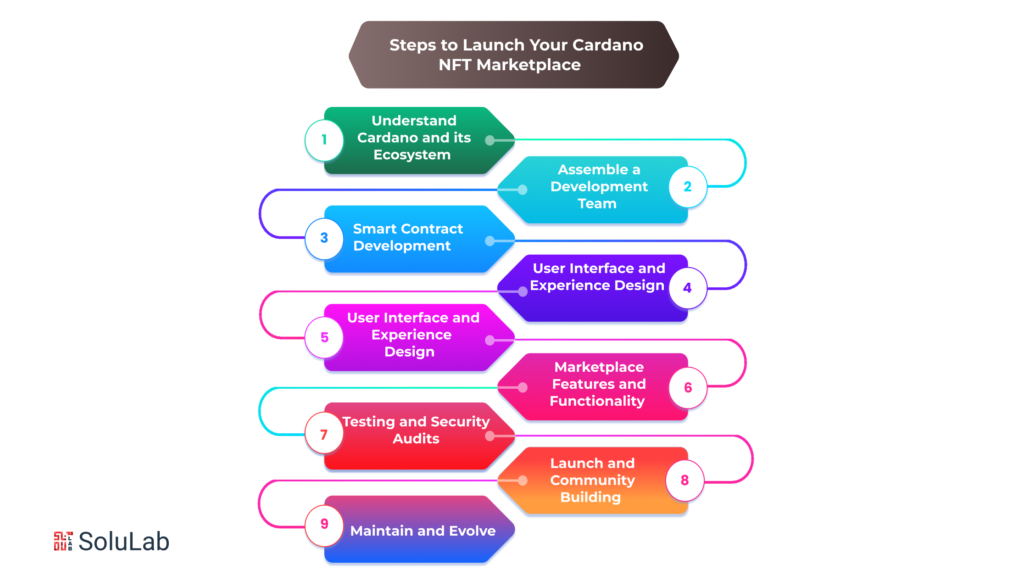
How to Launch Your Best Cardano NFT Marketplace?

Launching your best Cardano NFT marketplace can be an exciting endeavor that allows you to tap into the growing demand for unique digital assets. Here is a step-by-step guide on how to launch your Cardano NFT marketplace:

1. Define your NFT Marketplace Concept

Before diving into the technical aspects, it’s essential to define your NFT marketplace concept. Determine the target audience, the type of NFTs you want to support (art, collectibles, virtual real estate, etc.), and any unique features or value propositions you want to offer. Having a clear vision will guide the development process and help you differentiate your marketplace in a competitive landscape.

2. Understand Cardano and its Ecosystem

To launch the best Cardano NFT marketplace, you must have a solid understanding of the Cardano blockchain and its ecosystem. Familiarize yourself with the Cardano whitepaper, research the network’s capabilities, and explore existing Cardano NFT projects. This knowledge will provide insights into the possibilities and technical requirements for building your marketplace.

3. Assemble a Development Team

Building a Cardano NFT marketplace requires technical expertise. Assemble a skilled development team or consider partnering with a reputable blockchain development company experienced in Cardano. Ensure that your team has the necessary skills in smart contract development, blockchain integration, and frontend and backend development to bring your marketplace to life.

4. Smart Contract Development

Cardano’s smart contract capabilities are introduced through the Plutus platform. Work with your development team to design and develop smart contracts that will govern the minting, listing, selling, and trading of NFTs on your marketplace. Ensure that the smart contracts are secure, audited, and aligned with industry standards to protect users’ assets and transactions.

5. User Interface and Experience Design

Create an intuitive and visually appealing user interface (UI) for your marketplace. Consider the user journey, ease of navigation, and a visually engaging design that showcases NFTs effectively. Collaborate with UX/UI designers to ensure that the marketplace offers a seamless and enjoyable experience for creators, collectors, and users.

6. Marketplace Features and Functionality

Define the features and functionality of your best Cardano NFT marketplace. Consider essential elements such as NFT minting, listing, buying, selling, bidding, wallet integration, search and filtering options, social features, and community engagement tools. Additionally, think about any unique features you want to offer, such as royalties management, exclusive collections, or gamification elements.

7. Testing and Security Audits

Thoroughly test your marketplace to ensure it functions as intended and provides a secure environment for users. Conduct extensive testing to identify and fix any bugs or vulnerabilities. Consider engaging security auditors to review your smart contracts and overall marketplace security to safeguard users’ assets and transactions.

8. Launch and Community Building

Once your best Cardano NFT marketplace is fully developed, tested, and audited, it’s time to launch! Generate buzz and awareness through marketing efforts, social media campaigns, partnerships, and collaborations. Engage with the Cardano community, showcase your marketplace, and gather feedback to continuously improve and enhance the user experience.

9. Maintain and Evolve

Launching your marketplace is just the beginning. Commit to ongoing maintenance, updates, and improvements to ensure a smooth user experience, address any issues, and introduce new features.

CTA 1

What is the Cost of Developing an NFT Marketplace on Cardano?

The cost of developing an NFT marketplace on Cardano can vary depending on various factors, including the complexity of the marketplace, desired features and functionalities, design requirements, development resources, and timeline. Here’s a breakdown of the different aspects that can impact the cost of developing an NFT marketplace on Cardano:

  • Development Team and Resources

The cost of building an NFT marketplace on Cardano includes hiring a skilled development team or partnering with a reputable blockchain development company. The size and expertise of the team, along with the location and hourly rates, will influence the overall cost. Additionally, the resources required, such as project managers, designers, front-end and back-end developers, quality assurance engineers, and security auditors, will contribute to the development cost.

  • Smart Contract Development

Developing secure and audited smart contracts is a critical aspect of an NFT marketplace on Cardano. The complexity and functionality of smart contracts, such as minting, listing, buying, selling, bidding, royalties management, and integration with Cardano’s blockchain, will impact the development cost. Experienced blockchain developers will ensure that smart contracts are robust, scalable, and align with industry standards.

  • User Interface and Experience Design

Creating an intuitive and visually appealing user interface (UI) for your best Cardano NFT marketplace is crucial for a seamless user experience. The cost will depend on the complexity of the design, the number of screens, custom graphics, animations, and overall UI/UX requirements. Collaborating with experienced designers who understand NFT marketplace design principles will contribute to the overall cost.

Read Also: Metaverse NFT – Foundation Of Next Blockchain Revolution!

  • Features and Functionality

The cost of developing features and functionalities for your NFT marketplace on Cardano will depend on your specific requirements. Consider factors such as user registration, wallet integration, search, and filtering options, social features, community engagement tools, and any unique features you want to offer. The complexity and number of features, along with the development time required, will impact the overall cost.

  • Testing and Security Audits

Thorough testing and security audits are essential to ensure the functionality and security of your best Cardano NFT marketplace. The cost will depend on the scope of testing, including unit testing, integration testing, end-to-end testing, and security audits. Engaging third-party auditors for comprehensive security audits will contribute to the overall cost but is vital for maintaining the integrity and protection of the marketplace.

  • Ongoing Support and Maintenance

Launching an NFT marketplace is just the beginning, and ongoing support and maintenance are necessary to address any issues, introduce updates, and ensure the marketplace operates smoothly. The cost will depend on the level of support required, including bug fixes, feature enhancements, scalability improvements, and overall maintenance.
How to Launch Your NFT Marketplace on Cardano with SoluLab?

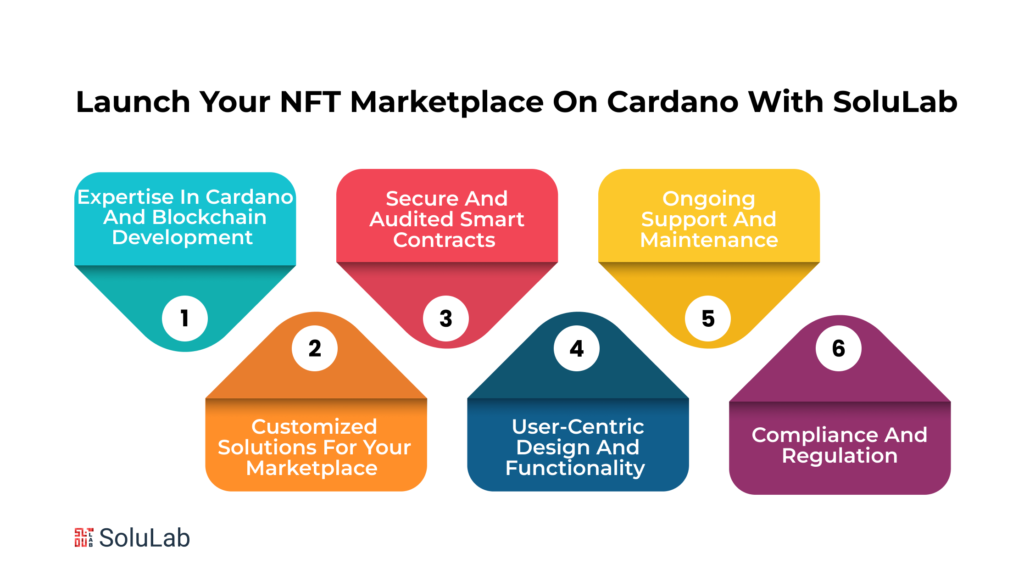
How to Launch Your NFT Marketplace on Cardano with SoluLab?

Launching your NFT marketplace on Cardano can be a complex process, but partnering with a reputable blockchain development company like SoluLab can make the journey smoother and more successful. SoluLab is an experienced and innovative company that specializes in blockchain development, including Cardano. Here’s how SoluLab can help you launch your NFT marketplace on Cardano:

1. Expertise in Cardano and Blockchain Development

SoluLab has a team of skilled blockchain developers who possess deep knowledge and expertise in Cardano and its ecosystem. They stay updated with the latest advancements in Cardano’s technology, smart contract development, and blockchain integration. With their experience, they can guide you through the entire development process, ensuring your NFT marketplace is built to the highest standards.

2. Customized Solutions for Your Marketplace

SoluLab understands that every NFT marketplace is unique, with specific requirements and features. They work closely with you to understand your vision and tailor the development process to align with your marketplace concept. Whether you need custom smart contracts, seamless user experience design, advanced search functionalities, or other unique features, SoluLab can deliver a solution that meets your needs.

Check Out Our Blog Post: Everything You Need to Know About Metaverse NFT Marketplace Development

3. Secure and Audited Smart Contracts

Security is paramount when it comes to NFT marketplaces. SoluLab follows industry best practices to develop secure and audited smart contracts for your Cardano NFT marketplace. They conduct thorough testing and security audits to identify and address any vulnerabilities. By partnering with SoluLab, you can have peace of mind knowing that your marketplace is protected against potential threats and risks.

4. User-Centric Design and Functionality

SoluLab prioritizes user experience design to create a marketplace that is intuitive, visually appealing, and easy to navigate. They collaborate with you to understand your target audience and ensure that the marketplace offers a seamless experience for creators, collectors, and users. SoluLab focuses on functionality, ensuring that essential features like minting, listing, buying, selling, and wallet integration are smooth and user-friendly.

5. Ongoing Support and Maintenance

Launching your NFT marketplace is just the beginning of the journey. SoluLab provides ongoing support and maintenance services to ensure the smooth operation of your marketplace. They are responsive to any issues or challenges that may arise and are dedicated to continuously improving and evolving your marketplace based on user feedback and market demands.

6. Compliance and Regulation

SoluLab understands the importance of compliance and regulation in the blockchain industry. They stay updated with the latest legal requirements and ensure that your Cardano NFT marketplace adheres to relevant regulations. This ensures that your marketplace operates within the legal framework, mitigating any potential risks or legal complications.
CTA 2

Conclusion

Creating an NFT marketplace on Cordano presents a unique chance to take advantage of the scalability, security, and environmental friendliness of blocking technology. Cardano’s sophisticated architecture and low transaction costs enable companies to build strong foundations that appeal to both producers and collectors. By selecting Cardano, you are influencing the NFTs ecosystem, and future creatively and sustainably rather than merely creating a marketplace.

MultiVAC, one of our greatest achievements, demonstrates how creative Blockchain solutions may completely transform the NFT market. It is a platform that facilitates the easy purchase, sale, and minting of NFTs by users worldwide. MultiVAC has established a standard in the Blockchain industry with its multi-NFT importation system, and a solid foundation based on decentralization, capability, and security.

Are you prepared to develop Cardano’s next-generation, NF T marketplace? To realize a concept, collaborate with SoluLab a NFT  marketplace development company right now. We can assist you in creating a foundation that stands out in the nifty market with our experience in blockchain development and track record.

FAQs

1. What are the benefits of using the best Cardano NFT marketplace?

Using a Cardano NFT marketplace offers several advantages that contribute to a seamless and rewarding experience for creators, collectors, and users alike.

2. What makes Cardano NFT marketplaces stand out?

Best Cardano NFT marketplaces stand out due to the unique features and benefits offered by the Cardano blockchain network. These include scalability, sustainability, security, and advanced smart contract capabilities.

3. How does scalability benefit the best Cardano NFT marketplaces?

Cardano’s scalability ensures that NFT marketplaces built on the network can handle a large number of transactions, even during periods of high demand. This scalability enables a seamless user experience, with fast transaction processing and minimal congestion.

4. What role does sustainability play in Cardano NFT marketplaces?

Cardano’s sustainability is a significant advantage for NFT marketplaces. Unlike other blockchain networks that rely on energy-intensive consensus mechanisms, Cardano utilizes a proof-of-stake (PoS) algorithm that consumes significantly less electricity. This energy efficiency reduces the environmental impact of NFT transactions while ensuring a secure and decentralized platform.

Cardano Vs Polkadot Vs Solana

Cardano Vs Polkadot Vs Solana

Are you having trouble deciding whether to use the Polkadot, Solana, or Cardano blockchain for your company? According to the block data, 80% out of 100 companies use blockchain technology. Many organizations embrace blockchain technology for its advantages, including increased security and confidentiality. Each blockchain, however, has unique advantages that might or might not be appropriate for a certain project. 

Blockchains like Solana vs. Cardano vs. Polkadat continuously expand as chains add new blockchains, enhancing the ledger’s security. Only users of an approved system can access data on the blockchain, which is distinct because it fosters trust without requiring a reliable third party. 

So, how can you pick the ideal blockchain for your company? To do so, you need to know the main distinctions between Polkadot, Solana, and Cardano, the three well-known blockchains. This detailed guide will explain each blockchain and its features. 

Background of Each Blockchain 

Before deciding you need to have a brief understanding of each of the blockchain platforms to make a better and more informed decision

What is Cardano?

Charles Hoskinson, a co-founder of Ethereum, developed Cardano in 2015. The Cardano blockchain is openly accessible, the system is decentralized and open-source, and consensus is established by proof of stake. According to the ruling in Solana vs Cardano vs Polkadot can utilize its token, ADA to facilitate peer-to-peer (P2P) transactions. As a third-generation platform, Cardano is an improved version as opposed to Polkadot vs Solana.

Additionally, the blockchain platform seeks to provide financial services to unbanked individuals worldwide. Additionally, one intriguing component of Cardano is the way it uses its ‘eras’ to celebrate historical individuals in computer science and poetry. The goal of the Basho scaling and optimization phase is to provide additional functionality to Cardano. 

What is Polkadot?

June 2021 saw the launch of the open-source Polkadt blockchain. It makes blockchains more accessible and connected by permitting distinct chains to securely communicate and carry out transactions. It makes use of the Layer-1 blockchain known as the Kusama parachain. Over 100 para chains are supported by Kusama, and experts predict that number will continue to rise. As a component in your investment strategy, you can sell and buy DOT in addition to SOL, ADA, and DOT. Users can run customized platforms on top of a global network of personal blockchains with Polkadot, a cryptocurrecny. The Polkadot token (DOT), a cryptocurrency, serves two primary purposes inside the Polkadot blockchain network. 

  • With DOT, owners have the power to shape the protocol’s course. 
  • New DOTs are created by the Polkadot cryptocurrency network, which validates transactions by staking its money.  

Blockchain numerous applications are developed by Polkadot’s para-chains and fed into the main blockchain. In comparison to ADA, SOL, and DOT, this offers para-chain interactions utilization of the same amount of security to the main chain. 

CTA1

What is Solana?

Solana (SOL) adds to the discussion of SOL vs ADA vs DOT. An open-source initiative called Solana creates a novel, quick, layer-1 Blockchain without permission. To boost the capacity beyond what is feasible and popular blockchain while maintaining affordable pricing, Anatoly Yakovenko created Solana in 2017.

A synchronized engine, a form of proof of state, and a transforming proof of history technique are both used in Solana’s hybrid consensus model. Therefore, without putting scaling solutions in place, Solana can handle up to 710,000 operations per second. If you create a Solana token, a third-generation blockchain framework to facilitate the development of decentralized apps and smart contracts. The project facilitates a range of Defi systems and non-fungible token exchanges. One of the most influential parties in SOL vs ADA vs Polkadot at the moment is Solana. 

Benefits of Adoption of Each Blockchain

Blockchain technology provides special solutions, and a project’s particular requirement will determine which platform is the best. Let’s examine the advantages of embracing Cardano, Polkadot, and Solana: 

Cardano: Ecological and Research Strictness

Cardano is disconnected by its methodical approach, which is based on a layout design and peer-reviewed research. It is one of the most environmentally sustainable blockchains due to its proof of stake, and voting process, which guarantees energy efficiency. Cardano’s emphasis on formal verification helps developers by reducing errors and vulnerabilities. It is also an excellent candidate for projects needing long-term reliability, like digital identity, management, or supply chain tracking, due to its capacity for growth through Hydra Layer 2 solutions.

Polkadot: Scalability and Interoperability 

Polkadot’s distant embassies, or interoperability make it stand out its chain promotes a real web3 environment by enabling seamless communication and information sharing between numerous blockchains. Polkadot-adopting projects can create customized blockchains (parachains) that are customized for certain use cases, such as gaming or DeFi. Polkadot is perfect for cross-chain solutions and centralized applications that need to communicate between ecosystems because of its shared security paradigm, which lowers individual network liberties while preserving scalability.

Solana: Economical and Quick

Solana token services are a great option for hyper-performance apps because of their lightning-fast transaction rates and low fees. With its proof of history mechanism, it can handle more than 65,000 transactions per second, which makes it ideal for the NFT marketplace and decentralized exchanges. Due to Solana’s affordable prices, developers, and users can access it, enabling projects to grow without being constrained by fees. 

Every Blockchain has its advantages. Polkadot concentrates on interoperability, Cardano emphasizes sustainability, and security, and Solana is superior in terms of speed and cost. The objectives and priorities of the project will determine which one is best.

Technological Comparison of Blockchains

FeaturesCardanoPolkadotSolana
Mechanisms of ConsensusProof of StakeProof of Stake nominatedProof of Stake plus Proof of History
Speed of Transactions250 transactions per second1,000 transactions per second65,000 transactions per second
ScalabilityHydra Layer 2 Solution ScalesThrough parachains scalePoH enabled parallel processing scale
Efficiency of EnergyHigh (PoS included low power consumption)High (PoS mechanism optimized)Moderate (effective but requires more power than Cardano or Polkadot)  
InteroperabilityRestricted, sidechains will be used in plans to support cross-chain.Robust, built with the Relay Chain in mind for multi-chain interaction.Limited, interoperability is less important than sing-chain performance. 
Intelligence ContractsThe Haskell-based Plutus platform prioritizes formal verification. Uses parachains to support smart contracts.C, C++, and Rust are supported by the Solana runtime for high-performance applications. 
LeadershipCommunity vote for decentralized government.Active involvement of stakeholders in on-chain governance. On-chain governance is limited and depends on core developers. 
Ecosystem of DevelopmentCentered on methodical updates and academic rigor. Developer-friendly with substrate architecture for blockchain development. An environment with high performance designed for real-time applications. 
DecentralizationHigh (decentralization that will happen gradually with the addition of nodes)High decentralization is fostered by shared security. Moderate (has comparatively fewer nodes than Polkadot and Cardano)

Uses Cases of Each Blockchain 

1. Cardano

Creating the future of multi-chain, Cardano vs Solana, Polkadot is the foundation of cross-chain solutions and web3 because of its capability and interoperability. Among the notable use cases are:

  • Digital Identification Management: Initiatives, such as Atala PRISM use Cardano to offer, decentralized and safe identification solutions to both individuals and businesses. In developing nations where identification verification is difficult, this is extremely helpful.
  • Defi and Smart Contracts: Cardano offers decentralized finance applications, including stablecoins, lending platforms, and these exchanges through the Plutus smart contract platform.
  • Certification and Education: By enabling the organization to produce veritable certificates, Cardano’s blockchain has been utilized for credential verification, guarantee, authenticity, and blocking fraud.
  • Supply Management: Cardano makes it possible to trace products, transparently, and impenetrably throughout the supply chain because its blockchain guarantees authenticity, and stakeholder trust is increased. 

2. Polkadot

Creating the future of multi-chain, Polkadot is the foundation of cross-chain solutions and web3 because of its capability and interoperability. Among the notable use cases are: 

  • Cross-Chain DeFi: Polkadot facilitates communication between blockchain and decentralized financial systems. Parachains can be used by the project to build specialized training, staking, and lending ecosystems.
  • Development of Web3: Polkadot helps decentralized apps that depend on numerous changes for functionality and data by facilitating smooth communication between them. 
  • NFTs and Gaming: Producing games powered by blockchain and an NFT marketplace, where high performance and connectivity are crucial, is made possible by Polkadot’s scalability and multi-chain capabilities. 
  • Integration of IoT: Polkadot facilitates smooth data, sharing, and automation in sectors, including agriculture, logistics, and healthcare by connecting IoT devices across several networks. 

3. Solana 

Energizing high-efficiency apps, Solana is well known for its quick transactions and lower fees, making it perfect for real-time application applications. Important use cases consist of:

  • NFT Marketplace: Solana provides minimal cost and fast transaction velocity form and trading, powering, well-known MFT platforms, such as Metroplex and Magic Eden.
  • DeFi Solutions: Decentralized exchanges, taking protocols, and lending platforms are among the decentralized finance applications that Solana supports. It is desirable for high-frequency trading due to its low latency.
  • Decentralized Applications: Solana is used by developers to create a variety of dApps, such as data, storage systems, centralized social networking, networks, and payment gateways
  • Metaverse and Gaming: Solana is extensively used in the virtual world and Blockchain-based gaming, where capability and performance are essential for smooth user experiences.

Strengths and Weaknesses of Each Blockchain

BlockchainStrengthWeakness
Cardano

Proof of Stake uses less energy.

High security is guaranteed by rigorous verification and peer-viewed protocols.

Network resilience is improved by progressively increasing the number of active nodes. 

Innovation and updates may be delayed by a research-driven strategy.

In contrast to rivals, dApp and ecosystem adoption is still increasing. 

There is still work to be done on cross-chain communication.

Polkadot

Relay chain makes it possible for several blockchains to communicate with each other easily. 

By enabling parallel processing, parachains increase transaction throughput.

Substrate makes creating unique blockchains easier. 

New developers may find the parachain and architecture model difficult to understand. 

It takes a lot of technological know-how and funding to launch parachains.

Solana

Developers and users may find it appealing because of its low fees. 

Perfect for high-performance applications like Defi, NFTs, and gaming. 

Capable of processing more than 65,000 transactions per second. 

There may be centralization problems if there are fewer validators than rivals. 

Solana has seen outages and stability problems. 

Performance on a single-chain is prioritized over cross-chain capability. 

Investment Perspective

Cardano 

It is viewed as an extended, research-driven initiative from the perspective of investment. Investors looking for stability and steady growth are drawn to its emphasis on sustainability and reviewed by experts in development. Future demand for ADA may be fuelled by Cardano’s enterprise-level adoption because of its strong security capability via Hydra. Short-term gains are at risk, nevertheless, due to its lower rate of development and less active environment than rivals. ADA is valued by investors due to its solid base and promise to address practical issues and supply chain, identity management, and DeFi.

Polkadot

Investors choose Polkadot because of its distinct capability and interoperability, which established it as a major participant in the multi-chain web three future. It is appealing for developers and projects because it encourages creativity through the creation of specific para changes. DOT is an asset that requires a lot of staking and compensates investors for their involvement. Rapid adoption might be constrained by the para-chain’s integrity and great technical entry requirements. Polkadot is a good choice for investors who are looking to the future because of its potential to dominate cross-chain solutions.

Solana

Investors looking to gain exposure to a high-performing blockchain ecosystem, find Solana appealing. It has become the preferred platform for Defi, NFTs, and gaming because of its quick transactions and inexpensive costs. The adoption of SOLN industries with significant demand is linked to its growth potential. However, risk covers investors can be turned off by worries about centralization, risk, and network disruption. SOL provides excellent shot and medium-term investment opportunities for individuals who are interested in ecosystem expansion. 

The Final Word

To sum up, Cardano, Polkadot, and Solana arose from candidates in the blockchain market since they each have special advantages suited to particular use cases, Cardano’s focus on secure and sustainable platforms through research makes it appealing for long-term projects like supply chain, tracking, and digital identity management. Due to its exceptional scalability and interoperability, Polkadot is perfect for decentralized apps, cross-chain solutions, and Internet of Things integration. Meanwhile, Solana is the go-to option for advanced applications such as NFT marketplaces, DeFi, and blockchain-based games due to its speed and inexpensive transaction fees.

Your project goals, whether they are eco-friendly expansion, smooth, cross-chain, communication of blazing, or fast performance will determine which platform is best for you. Businesses and developers may ensure effective deployment and creation in the rapidly changing market by aligning their blockchain decisions with their objectives and knowing the relative benefits of each blockchain platform.

FAQs

1. Which is superior Cardano or Solana?

Solana prioritizes speed and scalability, whereas Cardnao’s Ouroboros emphasizes security. Cardano exhibits strong decentralization by running close to 2,600 validator nodes. Conversely, Solana has more than 1,300 validator nodes, requiring certain performance trade-offs with centralization. 

2. Which cryptocurrency should I buy?

With a staggering 57% of the market capitalization of the whole cryptocurrency industry, Bitcoin (BTC) is the top choice for cryptocurrency investing. Additionally, Bitcoin’s value just rose by an additional 125% to surpass $100,000.

3. Is it worth investing more in Solana?

If you think Solana has the potential to continue growing its ecosystem, accelerating and obtaining more ETF approvals, it could be a wise investment. It is still an inflationary token, though, is far more difficult to value than Bitcoin. 

4. Which is the better choice Cardano or Polkadot?

Polkadot wants the investors to be more involved and dedicated. The infrastructure of Cardano is double-layered, and Polkadot makes it possible to connect several blockchains to a single network. High transaction speed and cheap transaction fees are two of Cardano’s advantages. 

5. Can Polkadot surpass Ethereum?

Leading para-chain-based blockchain project Polkadot (DOT) is about to make a significant advancement that would allow it to overtake rivals like Solana (SOL), Cardano (ADA), and Ethereum (ETH). 

How to Build an App on Cardano?

Cardano is a next-gen blockchain platform created by Charles Hoskinson in the year 2015. He was one of the early developers of Ethereum and the co-founder of BitShares. One of the most defining features of Cardano is its focus on completely transparent research as well as development based on evidence. It is truly the first blockchain project to be peer-reviewed. Charles Hoskinson described Cardano as the third-generation blockchain with Bitcoin and Ethereum as the first & second-generation blockchain. The platform happens to be an excellent blockchain platform for building smart contracts, websites, and apps with any kind of scalability problems.

Building an App on Cardano

Now, it is clear that Cardano serves as a very good and effective blockchain platform for building apps. So, let us dive a bit deep into the topic to understand how to build an app on Cardano.

Step 1 - Defining the Scope of the App

At the time when you have planned to build an app on Cardano, it is of immense importance to start with defining the scope or concept of the project. It is ideal to be specific about the exact product to be created, which makes the idea behind the project quite clear. Here are a few important questions to ask that help define the scope of the project and make the developmental tasks easier during the proceedings.

  • Does the app match the present trends?
  • What problem the app solves, and what benefits it offers to the users?
  • What is the app’s potential in terms of market & audience size, and future demand?
  • Who are the competitors?

Answering these questions plays a significant role in appropriately defining the scope or concept of the project.

Step 2 - Defining Business Goals, KPIs, and Monetization Models

Once the scope of the project is defined, it is essential to start defining the business goals. If the app is for commercial use, then it is important to calculate the methods of monetization and the income that it can bring in the short, medium, as well as long run. This, in turn, will play a crucial role in planning the budget of development, providing detailed information regarding the choice of optimum monetization model, and determining the KPIs. At this stage of building an app on Cardano, here are a few pointers to consider.

  • The way of revenue generation from the app.
  • The overall budget requirement for app design and development.
  • Presence of any growth springboard like the launch of a new blockchain, market or world events, the failure of competitors, etc.
  • Association of any potential risks.

Keeping these pointers in mind makes sure that the developmental tasks are carried out smoothly without any kind of interruption.

Step 3 - Choosing the Appropriate Tools and Software

It is the most important step of building an app on Cardano. It is extremely important to select the most appropriate tools and software before building the app. Choosing advanced tools and technologies makes sure that the best results can be obtained. In this regard, it would certainly be a very good idea to seek the help of a professional blockchain app development company to get the best possible results. It is recommended to choose a development company with adequate skills, vast experience, in-depth knowledge, a dedicated & comprehensive team, a comprehensive approach to app development, and a business-oriented approach.

Step 4 - Development of the App

This stage involves the building of the app. The developers perform their duties by implementing the design in the right way and the functionality in software code by the use of standard tools for development as well as some special solutions from Cardano such as Plutus, Playground, Glow, Marlowe, KEVM devnet, and IELE devnet.

Step 5 - Launching the App

It is the final stage or step where the app is launched. After designing and developing, the app is tested before its final implementation. Ultimately, the created apps need to be deployed on the Cardano blockchain and added to different listings.

Benefits of Building an App on Cardano

After reading through, you have a clear idea about the process of building an app on Cardano. Now, let us understand the benefits of building an app on Cardano.

Ouroboros Consensus Mechanism

The main benefit of building an app on Cardano is the Ouroboros consensus algorithm. It is a highly secure version of Proof-of-stake, where the transactions are not checked by every node as in the case of Proof-of-work, but they are checked by a selected group of network participants referred to as the slot leaders.

Dual-Tier Network Architecture

Another benefit of using Cardano to build apps is the separation of the blockchain into two related but fairly independent tiers.

  1. Cardano Settlement Layer or CSL is the first tier that is responsible for operation and processing transactions for the Cardano wallets.
  2. Cardano Computation Layer or CCL is the second tier that is responsible for the operation and calculation of apps.

This separation allows making significant changes to the blockchain without forking.

Interoperability

This feature allows different non-homogeneous shards and blockchains to work together. Moreover, it allows the creation of apps that are very closely linked to one another but still remain independent.

Scalability

Scalability is another major benefit of building apps on Cardano. With Ouroboros and sidechain technology, Cardano has the potential to process a trillion transactions per second. This high potential of scaling enables Cardano to be the basis for the development of any level of apps.

Transparency

Another major benefit offered by Cardano is complete transparency and its decentralized nature. All the research is public, the software’s source code is open, and the technical processes are audited on a regular basis. Moreover, the results are available publicly, thereby enhancing transparency.

Legitimacy

Legitimacy is one more important benefit of building apps on Cardano, where the project team’s wishes are balanced with those of the centralized authorities as well as the decentralized community. Developing an app on Cardano makes sure that it complies with all the necessary laws, rules, and regulations set by authorities.

Conclusion

Building apps on the Cardano blockchain is still in its budding phase. Slowly and steadily, we have seen a rise in using the Cardano platform for developing apps. It is true that the benefits offered by Cardano can be appropriately leveraged to create highly useful as well as functional apps. The scope of building apps on Cardano is huge, with a wide array of opportunities. So, we have to wait and see what the future has in store for app development on Cardano.

-Contact Us-

The World is Upgrading to Blockchain. Don't get confused and take the wrong base technology for your project. Get Free Consultation Now.
